Showing posts sorted by relevance for query TERF & Terf. Sort by date Show all posts

Monday, May 11, 2026

TERF & Terf

TERF & Terf (pronounced turf)

(1) The acronym for trans-exclusionary radical feminist (trans-exclusionary radical feminism), a fork of radical feminism which maintains a trans woman’s gender identity is not legitimate and rejects the inclusion of trans people and the gender-diverse in the feminist movement.

(2) In genetics as (1) TERF 1 (Telomeric repeat-binding factor 1), a protein which in  humans is encoded by the TERF1 gene & (2) TERF 2 (Telomeric repeat-binding factor 2), a protein present at telomeres throughout the cell cycle. 

2008: Coined by Australian feminist writer Viv Smythe (@vivsmythe (fka @tigtog, @hoydenabouttown & @GFIComedy) although Ms Smythe suggests the acronym may previously have been in use but her blog entry is the oldest instance extant, hence the credit.  By virtue of use, TERF has become a word and thus the noun terf (and its variants is correct.  The use in genetics dates from the 1990s , the definitions written as part of the project which decoded the human genome (the complete results of which weren't released until March 2022).   

TERF was said first to have been coined as a “deliberately neutral” descriptor of a certain intellectual position among certain feminists, CISgender women who self-identify as feminist but who oppose including transgender women in spaces (physical, virtual & philosophical) which their construct of feminism reserves for those assigned female at birth.  Implicit in this is the denial that trans women (or anyone anywhere on the trans gender spectrum) are women; they regard them as men and because, by definition, men cannot coexist with their feminist construct, they must be excluded.  However, though TERF was of the feminists, by a feminist, for the feminists, once in the wild it is public property and TERF didn’t long stay neutral, soon used as a slur, applied as a term of disparagement by those sympathetic to trans rights and just as quickly embraced by some TERFs in an act of reclamation (a la slut, the notorious n-word etc).  In use online since at least 2008, TERF has different connotations (depending on who is using it and for what purpose) but even when applied as something purely descriptive, feminists who have been labeled TERF have called the term a slur because it has come to be associated with violence and hatred.  It is a loaded term.

Sainte Jeanne d'Arc (Saint Joan of Arc) (1903) by Albert Lynch (1860–1950).  Joan of Arc with proto TERF bangs: latter day TERFs arouse such hatred there may have been whisperings what was required was a few burnings at the stake.

The coining of TERF inspired some neologisms.  TERF bangs (existing only in the plural and noted since 2013 although use didn't trend until 2014) is a sardonic reference to a woman's hairstyle with short, straight, blunt-edged bangs (historically called baby bangs and a variation of what's known by some hairdressers as the "Joan of Arc" fringe), especially when paired with a bob and claimed to be associated with TERFs, the link impressionistic and possibly an example of a gaboso (generalized association based on single-observation).  The link is thought to be part of the opposition to transphobia, the TERF bangs noted for their relationship to the Karen (speak to the manager) bob and all Karens are assumed to be transphobic.  TERFdom is either (1) the holding (and expression) of trans-exclusionary feminist views or (2) being in some way present in the on-line TERF ecosystem.  TERFism is the abstract noun denoting variously the action, practice, state, condition, principle, doctrine, usage, characteristic, devotion or adherence to TERFDom.  TERfturf is an expression variously of the physical, virtual or philosophical space occupied by TERFdom.  TERFy, TERFish & TERFic are adjectives (usually applied disparagingly) which suggest someone or something may be tending towards, characteristic of, or related to trans-exclusionary feminism or those who hold such views.  Strangely, TERFesque seems not to have been used and it's tempting to ponder TERFery, TERFed & TERFistic and the use to which they might be put but there's scant evidence of use.  TERF also provided the model for the backronym SWERF (sex worker exclusionary radical feminist), describing the position of those radical feminists opposed to the sex industry (including pornography), regarding all aspects of the business as exploitative and that women who participate are victims of coercion, any assertion of agency or willing participation a form of false consciousness.

TERF, TWERF and others

Whatever the life TERF subsequently took, Ms Smythe’s original piece was a critique of the undercurrent of transphobia in the UK British media, something hardly difficult to detect nor restricted to the most squalid of the tabloids.  However, as she noted, regardless of her purpose or the context of the text, TERF has became a weaponized device of the culture wars which, in the way of the battle, assumed its identities at the extremes of the trans-inclusion & trans-exclusion positions and it could hardly have followed a different course, the notion, however applied, hardly one amenable to subtle nuances (although some have tried).  That it had the effect of being an inherently schismatic force in radical feminism seemed especially to disturb Ms Smythe and later she would suggest a more accurate (or certainly less divisive) acronym would have been “…TES, with the “S” standing for separatists”, adding that many “…of the positions that are presented seem far too essentialist to be adequately described as feminist, let alone radical feminist.”  Of course, that view was in itself exclusivist and a kind of assertion of ownership of both “radical” and “feminist” but that’s entirely in the tradition of political philosophy including the strains which long pre-date modern feminism, gatekeepers rarely hesitant in lowering the intellectual portcullis, intruders rarely welcome.

Still, it wasn’t as if feminism had been immune from the fissiparousness which so often afflicted movements (secular and otherwise), the devolution into into competing doctrinal orthodoxies of course creating heretics and heroes and to think of the accepted structure of the history (first wave, second wave etc) as lineal is misleading.  Nor was the process organic and it has been claimed there are TERFs (notably some of the self-described) for whom the identification with feminism became attractive only when it seemed to offer a intellectual cloak under which push transphobia, an accusation leveled at members of the US organization GIW (Gender Identity Watch).   Described variously as a “hate group” and the “Republican party in sensible shoes”, GIW’s best known activities include lobbying and monitoring legislatures and courts to try to ensure those who are transgender are not granted either the status of women or whatever rights may accrue from that.  Their basis was simply definitional, those DMaB (designated male at birth) can never be anything beyond MiD (men in disguise) and thus have no place in women’s spaces.

T-shirts are available.  In the modern age, if there's not a T-shirt, it's probably not a cause. 

There seems little to suggest bangs are a reliable marker of TERFdom and those wishing to assert where they stand on TERFness should probably don an appropriate T-shirt.  Not only do designer colors seem rare in TERF clothing but the combos mostly are black and white which may be subliminal messaging, this being a polarized debate in which there are few gray areas.  Predictably, trans-friendly T-shirts are more colorful.

Other theorists developed their own form of exclusivism.  The idea behind the back-formation TWERF (Trans Women Exclusionary Radical Feminist) was that it was "pure womanism", the needs of trans women being not only different from “real” women but irrelevant too, again by definition because trans women are still men and even if in some way defined as not, were still not “real” women.  The distinctions drawn by the TWERFs was certainly a particular strain of radical feminism because they raised no objection to the presence of trans men, the agender and even some other non-binary people into at least some of their women-only spaces although the rationale offered to support this position did seem sometimes contradictory.  Some however seemed well to understand the meaning and they were the transsexual separatists, apparently a cause without rebels, support for the view apparently close to zero.  The transsexual separatists argue that they need to be treated, for the purposes of defined rights, as a separate category, a concept which received little attention until the Fina(Fédération internationale de notation, the International Swimming Federation) in June 2022 announced a ban on the participation of transgender women from elite female competition if they have experienced “…any part of male puberty beyond Tanner Stage 2 or before age 12, whichever is later."  As something a workaround designed somehow to combine inclusion and exclusion in the one policy, Fina undertook to create a working group to design an “open” category for trans women in “some events” as part of its new policy; when in doubt, form a committee.  The transsexual separatists may not have expected Fina to be the first mainstream organization to offer a supporting gesture but what the federation has done may stimulate discussion, even if the work-around proves unworkable.

Discursiveness is however in the nature of feminist thought, the essence of the phases of renewal which characterized progress, formalized (if sometimes misleadingly) as waves and it’s unrealistic to imagine trans-related issues will be resolved until generational change allows a new orthodoxy to coalesce.  It really wasn’t until the high-water mark of second wave of feminism in the early 1980s that some of the early radical feminists began to attempt to distance the movement from the issues pertaining to trans people, reflecting the view the implications of what was characterized as the transgender agenda would only reinforce sexual stereotyping and the gender binary.  Even then, the position taken by radical feminists was not monolithic but it was the exclusionists who attracted most interest, inevitable perhaps given they offered the media a conflictual lens through which to view the then somewhat novel matter of trans rights, until then rarely discussed.  Third wave feminism was a product of the environment in which it emerged and thus reflected the wider acceptance of transgender rights and few would argue this has not continued during the fourth wave, the attention given to TERF (and its forks and variations) an indication of the interest in the culture wars and the lure of conflict in media content (whether tabloid or twitter) rather than any indication a generalized hardening of opposition among feminists.

TERF must not be confused with the homophone “turf”

Lindsay Lohan winning on the JCB's turf: On 1 October, 2023, four-year old mare Lindsay Lohan (by Emcee out of Requebra) won the Grande Prêmio Costa Ferraz over 1,000 metres, her fourth win in ten starts; Jockey Club Brasileiro, Praça Santos Dumont, Gávea, Rio de Janeiro, Brazil.

The word turf pre-dates 900 and was from the Middle English terf & torf (turves sometimes was used as plural but wholly un-related to the phrase “topsy-turvy”), from the Old English turf & tyrf (turf, sod, slab of soil, roots cut from the earth, piece of grass-covered earth, greensward), from the Proto-West Germanic turb (turf, peat), from the Proto-Germanic turbz (turf, lawn), linked possibly to the primitive Indo-European derbh- (to wind, to compress).  It was cognate with the Dutch turf, the Old Norse torf, the Middle Low German torf (peat, turf), (from which German & German Low German gained Torf) the Danish tørv, the Swedish torv, the Norwegian torv, the Icelandic torf, the Russian трава (trava) (grass), the Old Frisian turf, and the Old High German zurba; it was akin to the Sanskrit दर्भ (darbhá) (a kind of grass) & दूर्वा (dū́rvā) (bent grass).  Turf in its original sense developed as a part of the agrarian economy, describing the top layer of soil in which seeds were planted and roots (hopefully) took hold.  Use (apparently rapidly) expanded to encompass concepts in some way related to the upper layer of the ground or what sprouted from it including sods, slabs of soil with the root systems preserved (ie a piece of grass covered earth) and expanses of grassed surfaces.  To this day, the general literal understanding of “turf” is the grassed, top layer of soil.  The use as a synecdoche for (especially thoroughbred) horse racing (as “the turf”) dates from 1755, that use emerging from the original technical use by those maintaining the grassed surface over which the horses galloped.  From this evolved the modern occupational euphemisms: (1) turf accountant (a bookmaker (bookie) with whom one places bets) and (2) turf advisor (one who for a fee provides “tips” suggesting the horse(s) on which bets should be placed).

Lindsay Lohan enjoying the turf: Lindsay Lohan in The Birdcage (right), Flemington Racecourse, Melbourne, Victoria (Spring Carnival Derby Day), 2 November, 2019. The outfit paired a Leo & Lin Venus Asymmetric Scarf Skirt with a Morgan & Taylor Leya Boater Hat.  This is a figurative use of “turf”, used as a reference to “horse racing”.

The word Astroturf dates from 1966 when it was released as a commercial product, a synthetic grass for use in sports arenas.  The use of “astroturf” as a slang term meaning “to fake the appearance of popular support for something, such as a cause or product” emerged in the last days of the 1990s although the origin of the use of the word in this context has been traced to 1985 when then Senator (Democratic, Texas) Lloyd Bentsen (1921–2006; US Secretary of the Treasury 1993-1994) used the word to distinguish between “real mail from real people” and the “mountain of cards and letters” sent to his office in a campaign organized by the insurance industry: “…a fellow from Texas can tell the difference between grass roots and AstroTurf... this is generated mail.”  Lloyd Bentsen is remembered also for the most memorable retort (which probably was rehearsed) from the 1988 presidential election in which he was the Democratic Party’s nominee for VPOTUS.  In a debate with the Republican’s Dan Quayle (b 1947; VPOTUS 1989-1993), he responded to Mr Quayle comparing himself to John Kennedy (JFK, 1917–1963; POTUS 1961-1963) by saying: “Senator, I served with Jack Kennedy.  I knew Jack Kennedy.  Jack Kennedy was a friend of mine.  Senator, you're no Jack Kennedy.”  The other coincidental link between the two candidates was that in the 1970 mid-term congressional elections, Bentsen defeated George H.W. Bush (George XLI, 1924-2018; VPOTUS 1981-1989 & POTUS 1989-1993) for a Texas senate seat and it was Dan Quayle Bush choose as a running mate in his successful 1988 presidential campaign.  Mr Qualye's other contribution to US political history was being filmed visiting a school in New Jersey school where he “corrected” a student’s spelling of “potato” by adding a final “e”.  That a man aspiring to be elected to an office “a heartbeat away from the presidency” and thus the authority to launch nuclear missiles didn’t know how to spell “potato” was disturbing enough but what made it really funny (at least in one sense) was he read the incorrect spelling from flashcards prepared in advance, confirming the public’s perception politicians obediently parrot whatever is fed to them by the party machine.

Lindsay Lohan on some turf: Lindsay Lohan standing on one of the Flemington Racecourse lawns.  This is a literal use of “turf”, used as a reference to “grass” but, had she been standing on the race track proper, the word would have been used in both senses.

As a general term for the “street or sidewalk (footpath)” in cityscapes, turf had entered slang use by at least the 1880s.  The phrase “comes with the turf” means one must “take the rough with the smooth” and accept less pleasant aspects of a chosen profession, location etc.  In figurative use the “turf war” was a demarcation dispute between parties over territory which can be literal physical space or something more abstract.  The idea of “our turf” in the sense of “streets or parts of a suburb in which a gang had an exclusive right to conduct criminal activities” must be old but the use of “turf” to describe the concept seems not to have been recorded prior to 1953.  On a gang’s turf, “civilians” might well stroll un-molested but it’d be dangerous for members of other gangs to trespass.  The term “turf war” is said to have come into use only in 1962 but the notion of “one’s turf” to which one had an exclusivity of possession or right was documented from at least the mid nineteenth century when it was almost formalized as a set of boundaries in the streets on which prostitutes plied their trade, the unmarked borders administered both by the sex workers and police officers who (usually with the extraction of some sort of fee in cash or kind) “enforced the rules”.

Sunday, November 10, 2024

Astroturf

Astroturf (pronounced as-truh-turf)

(1) A trademarked (as AstroTurf) brand of carpet-like covering made of vinyl and nylon to resemble turf, used for athletic fields, decks, patios and such (initial capital).

(2) The widely used generic term for artificial grass (no initial capital).

(3) To fake the appearance of popular support for something, such as a cause or product, the use based on the idea of faking “grassroots support” from the public the way AstroTurf is a “fake grass” (although some insist it’s really “faux grass” because usually there’s no attempt to claim the artificial product is natural).

1966: The construct was astro- + turf, the product name an allusion to the Astrodome, the baseball stadium in Houston, Texas, where first the product was laid at scale.  The astro- prefix was from the Ancient Greek ἄστρον (ástron) (celestial body), from ἀστήρ (astḗr) (star).  It was used by the astronomers of Antiquity to refer to celestial bodies which they classified as (1) fixed stars & (2) wandering stars (planets) as well as of space generally.  The word turf pre-dates 900 and was from the Middle English terf & torf (turves sometimes was used as plural but wholly un-related to the phrase “topsy-turvy”), from the Old English turf & tyrf (turf, sod, slab of soil, roots cut from the earth, piece of grass-covered earth, greensward), from the Proto-West Germanic turb (turf, peat), from the Proto-Germanic turbz (turf, lawn), linked possibly to the primitive Indo-European derbh- (to wind, to compress).  It was cognate with the Dutch turf, the Old Norse torf, the Middle Low German torf (peat, turf), (from which German & German Low German gained Torf) the Danish tørv, the Swedish torv, the Norwegian torv, the Icelandic torf, the Russian трава (trava) (grass), the Old Frisian turf, and the Old High German zurba; it was akin to the Sanskrit दर्भ (darbhá) (a kind of grass) & दूर्वा (dū́rvā) (bent grass).  Turf in its original sense developed as a part of the agrarian economy, describing the top layer of soil in which seeds were planted and roots (hopefully) took hold.  Use (apparently rapidly) expanded to encompass concepts in some way related to the upper layer of the ground or what sprouted from it including sods, slabs of soil with the root systems preserved (ie a piece of grass covered earth) and expanses of grassed surfaces.  To this day, the general literal understanding of “turf” is the grassed, top layer of soil.

Lindsay Lohan and the turf: On 1 October, 2023, Lindsay Lohan (by Emcee out of Requebra) won the Grande Prêmio Costa Ferraz over 1,000 metres (left), her fourth victory in ten starts; Jockey Club Brasileiro, Praça Santos Dumont, Gávea, Rio de Janeiro, Brazil and Lindsay Lohan in The Birdcage (right), Flemington Racecourse, Melbourne, Victoria (Spring Carnival Derby Day), 2 November, 2019.

The use of turf as a synecdoche for (especially thoroughbred) horse racing (as “the turf”) dates from 1755, that use emerging from the original technical use by those maintaining the grassed surface over which the horses galloped.  From this evolved the modern occupational euphemisms (1) turf accountant (a bookmaker (bookie) with whom one places bets) and (2) turf advisor (one who for a fee provides “tips” suggesting which horse(s) on which bets should be placed).  The phrase “comes with the turf” means one must “take the rough with the smooth” and accept less pleasant aspects of a chosen profession, location etc.  In figurative use the “turf war” was a demarcation dispute between parties over territory which can be literal physical space or something more abstract.  The idea of “our turf” in the sense of “streets or parts of a suburb in which a gang had an exclusive right to conduct criminal activities” must be old but the use of “turf” to describe the concept seems not to have been recorded prior to 1953.  On a gang’s turf, “civilians” might well stroll un-molested but it’d be dangerous for members of other gangs to trespass.  The term “turf war” is said to have come into use only in 1962 but the notion of “one’s turf” to which one had an exclusivity of possession or right was documented from at least the mid nineteenth century when it was almost formalized as a set of boundaries in the streets on which prostitutes plied their trade, the unmarked borders administered both by the sex workers and police officers who (usually with the extraction of some sort of fee in cash or kind) “enforced the rules”.  Astroturf & astroturfing are nouns & verbs, astroturfer is a noun and astroturfed is a verb & adjective; the noun plural is astroturfs.  AstroTurf is a registered trademark.

AstroTurf being laid in preparation for the first baseball game to be played in Veterans Stadium, Philadelphia, 1971.  The AstroTurf was in 2001 replaced with NexTurf and the stadium was demolished in 2006.

The use of “Astrodome” as the name for the baseball stadium in Houston, Texas, was an allusion to city's association with the US space program, a link not wholly unrelated to Texan Lyndon Johnson (LBJ, 1908–1973; VPOTUS 1961-1963 & POTUS 1963-1969), while vice-president, being appointed by John Kennedy (JFK, 1917–1963; POTUS 1961-1963) to assume nominal responsibility for the program; Houston became home to NASA's (National Aeronautics and Space Administration) MSC (Manned Spacecraft Center, now the Johnson Space Center).  Old LBJ was well-acquainted with baseball stadiums.  On the opening day (13 April) of the 1964 MLB (Major League Baseball) season at Washington DC’s District of Columbia Stadium (now the Robert F. Kennedy Memorial Stadium (named after Robert F. Kennedy (RFK, 1925–1968; US attorney general 1961-1964)) he set the record for the most hot dogs eaten by a sitting president on Opening Day, all four scoffed down in the approved manner (without resort to knife & fork).  The record still stands.  Built in the early 1960s, the Astrodome was the world’s first multi-purpose, domed sports and even before the new name was unveiled, Houston was already widely known as “Space City”.  When in 1956 the structure was completed, many had assumed it would be called the “Space City Stadium” but most seemed to agree Astrodome was a better choice and the city’s baseball team was the same year renamed the Houston Astros.  Dating from the early sixteenth century, dome was from the Middle French domme & dome (a town-house; a dome, a cupola) (which persists in modern French as dôme), from the Provençal doma, from the Italian duomo (cathedral), from the Medieval Latin domus (ecclesiae; literally “house (of the church)”), a calque of the Ancient Greek οἶκος τῆς ἐκκλησίας (oîkos tês ekklēsías).

Cats are not fooled by AstroTurf but are pragmatic.

AstroTurf is a trademarked brand name for a type of artificial surface which emulates the appearance of grass and to various degrees, also the “feel and behavior”.  When referring to the commercial product, the two upper-case characters should be used but (on the model of Hoover & hoover, Google & google, Xerox & xerox etc) the word has come frequently to be used as a generic term for any artificial turf and in these instances no initial capital should appear; style guides anyway recommend that to avoid confusion, a term such as “artificial turf” is preferred.  When used of the practice of faking the appearance of popular support for something, definitely no initial capital should appear.  Because Astroturf is “fake grass”, when used in slang, the inference is always negative, especially in relation to politics and unethical marketing.  AstroTurf has changed much in the 60-odd years of its existence with the green color about the only constant, advances in chemistry and computing meaning the surface now is more durable, cheaper to produce and more “grass-like” in its behaviour although in an age of increasing global temperatures use in the urban environment is becoming controversial because whereas grass is absorptive and tends to have a cooling effect, synthetics radiate heat and, over large surfaces, the difference in the air above can be many degrees.  Some local authorities have banned artificial turf in domestic settings although not all have jurisdiction over private property.  When first patented in 1965, it was sold as “ChemGrass” which, in retrospect, sounds a bad choice but in the mid-1960s, as a word-forming element, “chem-” didn’t carry quite the negative connotations which later became so associated.  It was rebranded as AstroTurf in 1966 to tie in with opening of the Houston Astrodome stadium.

The word Astroturf dates from 1966 when it was released as a commercial product, a synthetic grass for use in sports arenas.  The use of “astroturf” as a slang term meaning “to fake the appearance of popular support for something, such as a cause or product” emerged in the last days of the 1990s although the origin of the use of the word in this context has been traced to 1985 when then Senator (Democratic, Texas) Lloyd Bentsen (1921–2006; US Secretary of the Treasury 1993-1994) used the word to distinguish between “real mail from real people” and the “mountain of cards and letters” sent to his office in a campaign organized by the insurance industry: “…a fellow from Texas can tell the difference between grass roots and AstroTurf... this is generated mail.”  Lloyd Bentsen is remembered also for the most memorable retort (which probably was rehearsed) from the 1988 presidential election in which he was the Democratic Party’s nominee for VPOTUS.  In a debate with the Republican’s Dan Quayle (b 1947; VPOTUS 1989-1993), he responded to Mr Quayle comparing himself to President Kennedy by saying: “Senator, I served with Jack Kennedy.  I knew Jack Kennedy.  Jack Kennedy was a friend of mine.  Senator, you're no Jack Kennedy.”  The other coincidental link between the two candidates was that in the 1970 mid-term congressional elections. Bentsen defeated George H.W. Bush (George XLI, 1924-2018; VPOTUS 1981-1989 & POTUS 1989-1993) for a Texas senate seat and it was Dan Quayle Bush choose as a running mate in his successful 1988 presidential campaign.  Mr Qualye's other contribution to US political history was being filmed visiting a school in New Jersey school where he “corrected” a student’s spelling of “potato” by adding a final “e”.  That a man aspiring to be elected to an office “a heartbeat away from the presidency” and thus the authority to launch nuclear missiles didn’t know how to spell “potato” was disturbing enough but what made it really funny (at least in one sense) was he read the incorrect spelling from flashcards prepared in advance, confirming the public’s perception politicians obediently parrot whatever is fed to them by the party machine.

One of the internet’s more inexplicable juxtapositions; even the poster admitted there was nothing to link Lindsay Lohan with Coca-Cola drink AstroTurf cozies but her name remains attractive as click-bait.

The senator’s reference to the “mountain of cards and letters” as early as 1985 is an indication the technique predates the internet and historians have identified examples from Antiquity which suggest the practice is likely as old as politics itself but what the internet did was offer the possibility of scaling campaigns to a global scale at a lower (sometimes marginal or close to zero) unit cost.  When done, it is called astroturfing those coordinating such things are astroturfers.  Astroturfers are, like scammers in this calling, engaged in a constant arms race against those who detect and expose the tactic and the dramatic rise in the use of AI bots (artificial intelligence (ro)bots) has made the detection process simultaneously both easier (because at this stage it’s still a relatively simple matter for one algorithm to detect another) and more challenging because of the extraordinary rise in volume.  It’s not clear how many social media accounts are fake (run by people or bots generally receiving a payment for each post not deleted by the gatekeepers) and certainly it’s not something the platforms seem anxious to discuss although they will sometimes disclose how many have been deleted if some form of astroturfing has been so especially blatant or egregious as to induce adverse publicity.  More subtle are the “shadow organizations” set up by the usual suspects (fossil fuel companies, extractive miners, big polluters, political parties etc) which can even have bricks & mortar offices and paid staff.  The purpose of these outfits is to engage in controversial debates and attempt to both “nudge” things in the direction sought by those providing the funding and create the impression certain views enjoy wider support than may be the reality.

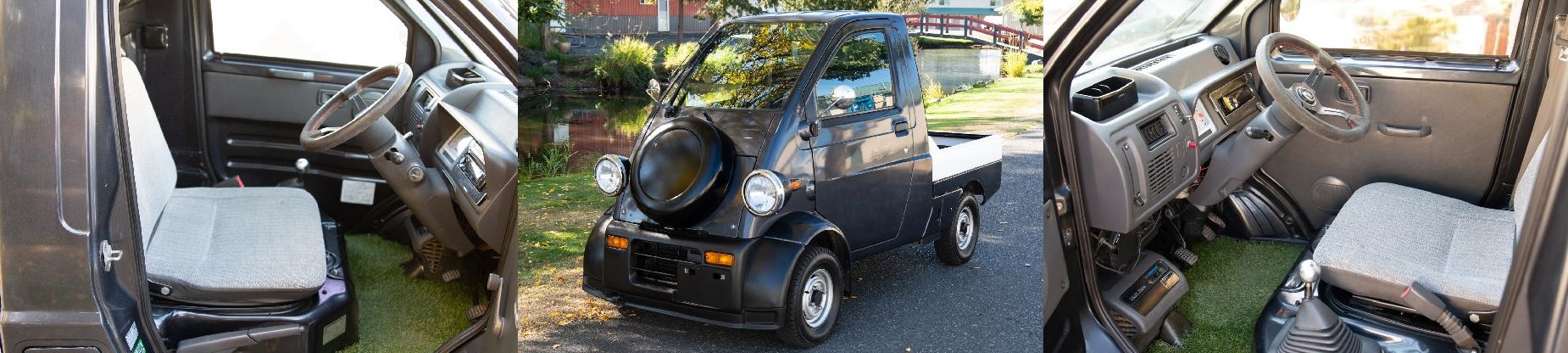
1996 Daihatsu Midget with custom AstroTurf carpets.

The Daihatsu Midget began life as a single-seater, three wheel mini-truck (1957-1972) powered by a 250cm3 (15 cubic inch) single cylinder, two-stroke engine although some were built also with a 305 cm3 (19 cubic inch) unit which may in the vernacular be thought of as the “big block” or “muscle car” version.  Produced under licence in several nations in the Far East, it’s still produced in Thailand where its compact dimensions, surprising load capacity and economy of operation make it uniquely suited to confined urban environments.  Daihatsu revived the Midget name for a four-wheel version which was produced between 1996-2001, manufactured under the “Kei Car” (a clipping of kei-jidōsha (軽自動車 (light automobile)) rules which limit mass, external dimensions and restrict displacement to 660 cm3 (40 cubic inches).  In a sign of the times, these diminutive Midgets (surely an irresistible tautology in the Kei Car business) were available with options like 4WD (four-wheel drive) and A/C (air conditioning).  Small they may have been but, within their limitations, they were remarkably capable machines and like most things Japanese, very thoughtful designs with much attention to detail.

Monday, March 2, 2026

Impressionism

Impressionism (pronounced im-presh-uh-niz-uhm)

(1) In fine art (an appropriated by others), a style of painting developed in the late nineteenth century, characterized by short brush strokes of bright colors in immediate juxtaposition to represent the effect of light on objects and a focus on everyday subject matters (by convention usually with an initial capital).

(2) A manner of painting in which the forms, colors, or tones of an object are lightly and rapidly indicated and there’s sometimes an attempt deliberately to include discordant subjects.

(3) In sculpture, a compositional style in which volumes are partially modeled and surfaces roughened to reflect light unevenly.

(4) In poetry, a style which used imagery and symbolism to convey the poet's impressions

(5) In literature, a theory and practice which emphasizes immediate aspects of objects or actions without attention to details.

(6) In musical composition, a movement of the late nineteen and early twentieth centuries (in parallel with the developments in painting) which eschewed traditional harmonies, substituting lush pieces with subtle rhythms, the unusual tonal colors used as evocative devices.

1880–1885: The construct was impression + -ism.  Impression was from the Old French impression, from the Latin impressio, from imprimo (push, thrust, assault, onslaught; squashing; stamping; impression), the construct being in- (the prefix which usually to some extent nullified but here in its rare form as an intensifier) +‎ premō (to press), from the Proto-Italic premō which may be linked with the primitive Indo-European pr-es- (to press), from per- (to push, beat, press).  The –ism suffix was from the Ancient Greek ισμός (ismós) & -isma noun suffixes, often directly, sometimes through the Latin –ismus & isma (from where English picked up ize) and sometimes through the French –isme or the German –ismus, all ultimately from the Ancient Greek (where it tended more specifically to express a finished act or thing done).  It appeared in loanwords from Greek, where it was used to form abstract nouns of action, state, condition or doctrine from verbs and on this model, was used as a productive suffix in the formation of nouns denoting action or practice, state or condition, principles, doctrines, a usage or characteristic, devotion or adherence (criticism; barbarism; Darwinism; despotism; plagiarism; realism; witticism etc).  Impressionism and impressionist are nouns; the noun plural is impressionisms.

Lindsay Lohan rendered in the style of nineteenth century Impressionism by Gemini.ai.  The digital version was based on a photograph of her in a Jill Sander (b 1943) gown in light chartreuse from the Spring 2023 collection (with a Tyler Ellis (b 1984) Clutch, Joseph Saidian & Sons Vintage Marquise & Baguette Cut Diamond, Anabela Chan Orchid Diamond Cascade Earrings and Piferi Fade Sandals by Alfredo Pīferi (b 1987)) while attending the Disney Legends Awards ceremony, Anaheim, California, August, 2024.  On the day, although the environment was not optimized for photography, the light and breeze cooperated, the gown’s fabric swishing in a way the Impressionists would have painted, even had the air been still.

The meanings of impressionism are wholly unrelated to impressionistic which is used to describe an opinion reached by means of subjective reactions as opposed to one which was the product of research or deductive reasoning (ie based on impression rather than reason or fact).  The most extreme example of the impressionistic is a gaboso (the acronym of "Generalized Association Based On Single-Observation") such as assuming if one known Terf has a particular haircut, anyone sporting that style must be "a terf".  As a noun an impressionist is (1) one who in art, music or literature produced work in the tradition of impressionism or (2) an entertainer who performs impressions of others (a mimic).  Although by some used in philosophy since 1839, impressionism really isn’t a recognized field in the discipline, instead used metaphorically (and often critically) to describe certain tendencies which share similarities with the artistic movement.  Those who describe themselves as impressionist philosophers reject the idea that objective knowledge or absolute truths exist and instead stress the importance of individual perception and personal experience, arguing that individual (and debatably collective) understanding of the world is determined only by the wholly subjective: senses and emotions.  They’re thus much concerned with perception, consciousness, and the nature of reality.  In all that there’s obviously some overlap with earlier traditions and mainstream philosophers tend to be dismissive, some suggesting impressionism is less a philosophical school than a mode of which has been explored for millennia.

Le pont du chemin de fer à Argenteuil (The Railroad Bridge in Argenteuil (1873-1874)), oil on canvas by Claude Monet (1840-1926), Musée d’Orsay, Paris).

Impressionism was an art movement that emerged in France in the late nineteenth century and was a romantic form, the core of which was the capturing of a fleeting moment (ie an impression) in time and place, characterized by the play of light and color, rendered with what gave the impression of loose (even careless) brushwork, the paint often applied in brief, broken strokes.  Breaking from the intricacy and preciseness which had distinguished high art since the Renaissance, the artists sought a feeling of spontaneity rather than the staged effect engendered by meticulously rendered details.  The whole idea was to “capture the moment” of those transitory scenes one might view humdres of times a day, the subject matter often the vistas of everyday, the apparent casualness of the composition an important psychological aspect because recollections of such visions often are hazy because the mind tends to remember only the part which has "caught the eye".  Accordingly, artists handled the peripheral surroundings with a “sense of the blurred”, summoning the notion of things vaguely being “filled in” from an incomplete memory; what they wanted to represent was the immediate sensory impressions of a particular moment rather than a polished and wholly realistic composition.  Given all this, it’s not surprising the Impressionists so frequently painted en plein air (ie outdoors) because there, natural light and breezes made for an ever-changing environment, ideal for a technique dedicated to capturing the ephemeral.

The Church at Auvers (1890), oil on canvas by Vincent van Gogh (1853-1890), Musée d'Orsay, Paris.

In the way of such things, from Impressionism, very late in the nineteenth century came post-impressionism.  Deliberately positioned as a reaction against what had come to be regarded as the strictures and limitations of Impressionism, it was noted especially for an expressive and symbolic use of color which neglected and sometimes even abandoned the link with naturalistic representation, the intensity of shade itself a vehicle of an artist’s personal interpretations.  It also distorted form and perspective, the exaggerations wildly beyond anything in the mannerist tradition and the influence upon the cubists who would follow is undeniable.  Something of a preview of post-modernism, the concerns were more with laying bare the underlying structure rather than showing anything directly representational.  However, despite the perceptions of some, technical innovation was rare and even the techniques most associated with the movement had been seen before although famously, the post-impressionists delighted in non-naturalistic color schemes.  While this was something which caught the eye, it wasn’t exactly new and claims it somehow created a heightened emotional impact have always seem hard to sustain although they certainly displeased Adolf Hitler (1889-1945; Führer (leader) and German head of government 1933-1945 & head of state 1934-1945) who decried most forms of "modern art".  Whether he ever said the quote attributed to him: “...anyone who sees and paints a sky green and fields blue ought to be sterilized” has never been verified but it certainly encapsulates his world view.  Still, the work post-impressionists influenced Fauvism and Cubism and there are critics who maintain post-impressionism was the first discernible epoch in modern art and a kind of proto-surrealism.

The Seine at Courbevoie (1885), oil on canvas by Georges Seurat (1859-1891).

Although post-impressionism can to some extent be seen as something new, the companion neo-impressionism really was a fork.  The alternative name of the movement was Divisionism which hints at the scientific basis which underlay many of the works, most notably Pointillism (the use of tiny dots which blended optically when viewed from a distance) which explored the principles of the physics of color and light by rendering paintings almost as a mathematical exercise and one far removed from the spontaneous brushwork of Impressionism.  Color under this regime came to be understood in itself as a theory, the concept of “simultaneous contrast” expressed in the placement of contrasting or complementary colors explored to exploit the way the brain processed the relationship by either “toning down” or making more luminous the visual experience.  The work was thus in the impressionist tradition of using light and color but it was different in that instead of representing an impression of how nature was seen, it deployed a scientific understanding of how the mind perceived and interpreted light and color to produce something which enhanced the effect.  In that sense it can be understood as a structuralist movement.

Separation (1896), oil on canvas by Edvard Munch (1963-1944), Munch Museum, Oslo.

Neo-impressionism should not be confused with Expressionism, a contemporary movement from Germany which some have characterized (not wholly unfairly) as “painting Friedrich Nietzsche’s (1844–1900) nightmares”.  The expressionists sought to convey the subjective emotions, inner experiences and psychological states of the artist; the viewer was there simply to view and understand the feelings of the artist who seem frequently drawn to the darker aspects of human existence.  They used distorted and exaggerated forms, heavy brushwork, and non-naturalistic colors designed expressly to be discordant.  The classic example of Expressionism is Edvard Munch’s The Scream (1893).

Lindsay Lohan (2012), oil on canvas by Lucas Bufi.

Florida-based Lucas Bufi describes himself as “modern Impressionist artist, guided by light and shadows”.  Definitely, this was an application of "light and shadow" to canvas in a way very different to the technique perfected by the chiaroscurists.  For those with a responsibility for categorizing works of art, it can be difficult to determine where impressionism ends and expressionism begins and what credit should being given to the influences of mannerism.  For that reason, some use the term “pop art” as a kind of dumping ground, displeasing those who are quite protective about the genre's boundaries.  Mr Bufi's take on Lindsay Lohan was based on one of the images from a 2011 photo-shoot for the January/February 2012 issue of Playboy magazine which featured her as the cover model.  By 2011, Playboy's sales were in sharp decline because of the availability of on-line content but the photo-shoot induced a short-lived “Lindsay Lohan led recovery”, the magazine's founder Hugh Hefner (1926-2017) tweeting on X (then known as Twitter): “The January-February Double Issue is breaking sales records.”  Unfortunately for Mr Hefner, the blip was a one-off and didn't attract “conquest customers”, the sales numbers not matched with the decline continuing until publication ceased during the COVID-19 pandemic (it was in 2025 resurrected as “an annual” but its future remains uncertain). 

Friday, August 14, 2026

Melon

Melon (pronounced mel-uhn)

(1) Any of various plants of two cucurbitaceous vines (the gourd family) including the watermelon, muskmelon etc.  Variations include Genus Cucumis (various musk melons, including honeydew, cantaloupes, and horned melon); Genus Citrullus (watermelons and others); Genus Benincasa (winter melon); Genus Momordica (a bitter melon).

(2) The fruit of any of these plants.

(3) A color ranging between a medium crimson and a deep pink, noted for the orange tinge.

(4) In zoology, the visible upper portion of the head of a surfacing whale or dolphin, including the beak, eyes, and blowhole (a mass of adipose tissue used to focus and modulate vocalizations).

(5) In the slang of (mostly North American) financial markets, an especially large additional dividend (often in the form of stock) distributed to stockholders (often as “cut a melon”).

(6) By extension, any windfall of money to be divided among specified beneficiaries.

(7) In slang, the breasts of the human female (almost always in the plural).  The alternative slang is "chest melons" and a woman generously endowed can be dubbed melonious.

(8) In slang, the head; the skull.  Those deemed vague or of limited intelligence dubbed "melon heads".

(9) In slang, a derogatory term for members of a green political party, or similar environmental groups (rare and mostly Australia & New Zealand).

1350–1400: From the Middle English meloun & melon (herbaceous, succulent trailing annual plant or its sweet, edible fruit), from the Old Portuguese (via the thirteenth century Old French melon) melon, from the Late Latin melonem & mēlōn- (stem of mēlō and a shortening of mēlopepō (the “gourd apple”, a large apple-shaped melon)), from the Ancient Greek μηλοπέπων (mēlopépōn) (large apple-shaped melon), the construct being μηλο (mêlo(n)) (apple) + πέπων (pépōn) (ripe), from πέπτω (péptō) (to ripen).  Confusingly for historians seeking to reconstruct the recipes of Antiquity the Latin melopeponem was a kind of pumpkin while the Greek mēlopepon (gourd-apple) was applied to several kinds of gourds bearing sweet fruit, the origin of that in the noun use of pépōn (ripe) distinguishing the fruit on the vine ready for harvest from those yet to ripen.  As a modifier, melon is appended as appropriate (based on color, shape, diet, environmental niche, habitat etc) including melon beetle, melon cactus, Melon rugose mosaic virus, melon thistle & melon-headed.  The best known is probably the watermelon, dating from the 1610s and so named for their high content of water-like juice; in French, the more pleasing term is melon d'eau.  Melonade is a (non-alcoholic) drink made from melons while the (definitely alcoholic) melontini is a martini cocktail made with melon.  The adjective melonic is unrelated to melons and is used in chemistry to mean "of or pertaining to a type of complex heterocyclic triazine related to melem".  Melem is the heptazine (a certain chemical compound) with three amino substituents.  Melon is a noun & adjective and melonious, melony, melonous & melonlike are adjectives; the noun plural is melons.

The Cold War won, in 1992, Richard Nixon (1913-1994; VPOTUS 1953-1961 and POTUS 1969-1974) returned to Moscow, a place more than once he’d visited as an adversary.  Visiting the markets, he bought a juicy melon.

Being prolific and undemanding to grow, melons were among the earliest plants domesticated and in Greek, “melon” was used in a generic way for many foreign fruits, a fate which would also befall "apple", thus the naming of the pineapple and in some Old English texts, cucumbers are referred to as eorþæppla (literally "earth-apples"), the deductive process that produced the French pomme de terre (potato (literally “earth-apple”)), the French pomme from the Latin pomum (apple; fruit).  Apple was from the Old English æppel (apple; any kind of fruit; fruit in general), from the from Proto-Germanic ap(a)laz (source also of the Old Saxon, Old Frisian & Dutch appel, the Old Norse eple, the Old High German apful & the German Apfel), from the primitive Indo-European ab(e)l- (apple), (source also of the Gaulish avallo (fruit), the Old Irish ubull, the Lithuanian obuolys, & the Old Church Slavonic jabloko (apple)) but etymologists caution the original sense of these and their relationship(s) to what is now understood as “an apple” is uncertain.  In Middle English, as late as the seventeenth century (even the earliest compliers of recipe books aren’t always explicit so some reverse-engineering based on supposition has been undertaken), it was a generic term for all fruit other than berries but including nuts (such as Old English fingeræppla (dates (literally "finger-apples) and the late fourteenth century Middle English appel of paradis (banana (literally apple of paradise)).

The twenty-first century judgment of Paris: Lindsay Lohan (b 1986, left), Britney Spears (b 1981, centre) & Paris Hilton (b 1981, right) reprise Hera, Athena, and Aphrodite, New York City, 29 November, 2006.  The car was a Mercedes-Benz SLR McLaren Coupé (C199, 2003-2010) leased by Ms Hilton.  It was a paparazzi photo from this moment used in the infamous "Bimbo Summit" headline by Rupert Murdoch's (b 1931) New York Post. 

That generality of meaning saw “apple” named as the fruit with which the serpent tempted Eve in the Garden of Eden, leading to the downfall of man and creating the original sin with which we’ve all since been damned.  The Biblical apportionment of blame to Eve has been held by feminists to account for at least some of the oppression suffered by women for the last two millennia.  However, the “fruit of the forbidden tree” was unspecified in the original texts of the Book of Genesis and, despite the wishful thinking of a few, in Biblical scholarship there’s no support for the notion the fruit was even hinted at being an appel of paradis, however appropriate, given the context, a nice plump banana might seem.  Nor is the forbidden fruit explicitly mentioned in the Holy Quran but according to traditional Islamic commentaries, it was not an apple but wheat.  The Prophet may not have been concerned but in Greek mythology there was the μῆλον τῆς Ἔριδος (Golden Apple of Discord) in the story of the Judgment of Paris which the goddess Ἔρις (Eris) (Strife), tossed in the midst of the feast of the gods at the wedding of Peleus and Thetis as a prize of beauty, thus sparking a vanity-fueled dispute among Hera, Athena and Aphrodite; it was that squabble that triggered the Trojan War.  Eris was the goddess of chaos and discord who (perhaps unsurprisingly), having not received a wedding invitation, was miffed and inscribed kallisti (To the prettiest one) on her “wedding gift” handing it to Πάρις (Paris, AKA Ἀλέξανδρος (Aléxandros) (Alexander), the son of King Priam and Queen Hecuba of Troy) who was told to choose the goddess he found most beautiful.  Judging what turned out to be one of Antiquity's more significant beauty contests, Paris chose Aphrodite, offending Hera and Athena, the most famous consequence of their feud being the Trojan War.  Tragedy did thereafter stalk the marriage of Peleus and Thetis; of their seven sons, the only one to survive beyond infancy was Achilles.

Cookmaid with Still Life of Vegetables and Fruit (circa 1620-1625), oil on canvas by Sir Nathaniel Bacon (1585–1627).

Beginning probably in Holland in the early seventeenth century and apparently first painted by Pieter Aertsen (circa 1533-circa 1573) "cookmaid and market scenes" was a genre in painting combining representations of produce and kitchens with themes often borrowed from the New Testament.  Two other examples of Sir Nathaniel's works in this vein are known still to exist: (1) Cookmaid with Still Life of Game and (2) Cookmaid with Still Life of Birds, both featuring healthy young ladies and there is obviously some artistic license in Cookmaid with Still Life of Vegetables and Fruit given that although every piece of produce depicted was at the time grown somewhere in England, not all simultaneously would have been in season.  Sir Nathaniel's lengthy title was too much for many, clipped often to the punchier "Maid with Melons".  This slang use of "melons" (ie female breasts) is listed by many dictionaries as “vulgar” or “mildly vulgar” but does travel with the vague respectability of a classical origin: In Antiquity the plural of the Greek melon (μῆλα) (mela) was used for “a girl's breasts” and in that tradition, in her youth, Lady Helen Taylor (née Windsor; b 1964 and a great-granddaughter of George V (1865–1936; King of the United Kingdom & Emperor of India 1910-1936)) was nicknamed “melons”.  In the line of succession to the British throne, Lady Helen comes in at number 49. 

Juicy Melons, Euston Station, London.

The world record price for a pair of juicy melons was set in May 2026 when a two “premium crown melons”, grown on Japan's northern main island of Hokkaido, realized ¥5.8 million yen (US$36,500) at the season’s first auction in Sapporo, Hokkaido, Japan; the result beat the previous mark of ¥5 million, achieved in 2019.  Although doubtlessly succulent, the prized examples were purchased not only for their taste but also as a promotional device, the successful bidder a Kushiro-based fruit and vegetable wholesaler who sold them to a supermarket where they would be “placed on display”.  Large, juicy melons should of course be put "on display"; everybody knows that, 

A cantaloupe as one would appear in most of the world (left) and a rockmelon down under (right).

Globalization has to some extent standardized in the English language spellings and meanings once disparate, sometimes reversing the trend towards diversity noted as one of the linguistic effects of the British Empire, especially in India under the Raj where the British pillaged the local languages with only slightly less enthusiasm than they showed for gold, diamonds and such.  However, the names of food seem often resistant to change, presumably most often where forms are well-established and supplied by local production.  Thus what is in some places eggplant is elsewhere the aubergine.  It’s also a melon matter because in Australia, what most of the world knows as the cantaloupe (from the French cantaloup, from the Italian place name Cantalupo, a former Papal summer estate near Rome, where the melons were first grown after being introduced to Europe from the Middle East), is called the rockmelon (occasionally rock-melon) and the antipodean quirkiness is not unique, the cantaloupe in some places called “sweet melon” or “Crenshaw melon” while in South Africa where it’s not uncommon to see fruit-stalls side-by-side, one selling cantaloupes and the other spanspeks (from the Afrikaans Spaanse spek (literally “Spanish bacon”)).  The Australian use, once deconstructed, does make sense in that a cantaloupe does (vaguely) resemble (some) rocks and has a "hard skin" but the case seems not compelling, cantaloupe a much more attractive word.  Visiting foodies will be gratified Australians follow the rest of the world when it comes to the honeydew (or honey-dew) melon, the name from the late sixteenth century honeydew (sticky sweet substance found in small drops on trees and plants), a replication of the formations in the Dutch honigdaauw and the German Honigthau.  That melon was first named in 1916 when selective breeding produced a cross between the cantaloupe and a melon native to southern African.

Anthony Albanese, shaggate & melongate

Applied kinesics: Linguists and anthropologists call the use of hand gestures as an accompaniment to speech (much associated with Italians): “gesticulations”.  Mr Albanese gesticulates (left) and Nova’s promotional banner for Nikki Osborne’s “Bushie” persona on Bush Deep (right).

Politics is unpredictable but even in the long tradition of "storm in a tea cup" scandals, few would have expected melons to play a role although, delightfully, Anthony Albanese (b 1963; prime-minister of Australia since 2022) managed a "storm in a D-cup", "melongate" the result of the second of his gaffes while in July 2026 appearing on the Bush Deep podcast.  Interviewed by comedian Nikki Osborne (b 1981), he was asked to play the “shag, marry, date” game, three Australian females from pop culture (singer Kylie Minogue (b 1968), actor Nicole Kidman (b 1967) & singer Rhonda Burchmore (b 1960)) offered as his options.  He started well by mentioning he was “newly married” (to his second wife) but Ms Osborne was tenacious and after boxing him into admitting “Kylie, clearly”, managed to press him into saying (with a slight giggle): “all of the above” (that apparently in answer to: “You’d marry Kylie? And shag her? And date her?” rather than thoughts of intimacy (concurrent or otherwise), with all three nominees but Ms Osborne, seeming pleased, did conclude: "all right, a triple" so who knows?).  The public reaction wasn’t good (although muted compared with what would have been the outrage had the remarks been made by a conservative) and quickly his office issued a one-line statement: “I apologise unequivocally for the comments”.  Educated by the Congregation of Christian Brothers (a branch of the Roman Catholic Church), the Australian arm of which was dissolved after shifting the bulk of its assets to a related but legally separate entity to protect them from civil litigation brought by victims child sexual abuse by Christian Brothers, Mr Albanese (selectively) operates on the church's long-established principle of “confess and be forgiven”.  What he should have done was make the joke one of self-deprecation, telling his host a more interesting question would be to ask the trio if any of them would contemplate shagging him and all three were anyway “too good for him”.  His second wife, by now well-acquainted with politics, would have forgiven him.

Pampered crown melons in a Shizuoka hothouse.

It turned out to be an eventful podcast because he also told the tale of meeting Sanae Takaichi san (b 1961, Prime Minister of Japan since 2025) during her Australian visit in May 2026.  Knowing a comedian would likely be not interested in trade negotiations or maritime boundaries in the South China Sea, he instead described his surprise when presented with the gift of a pair of crown melons, a fruit grown only in the western region of Japan's Shizuoka Prefecture.  The nation’s most exalted and expensive melons, farmers tending the vines in climate-controlled greenhouses each season cut away all but the most obviously fecund bud so each plant’s energy & nutrients feed a single fruit, ensuring “perfect melons”.  Understandably, crown melons are a gift presented to someone as a mark of respect or appreciation, often in the intricately constructed packaging famously used in Japan for goods from sandwiches to stilettos.  Mr Albanese described the gift as “strange” but said he found them “quite good”.  While it's not reasonable to expect him to have been aware of the cultural significance in Japan of a fruit he’d have associated with the Aus$3.99 item familiar in Australian supermarkets, his office presumably was informed so it was bad staff work he wasn’t briefed on what to say.  An additional reason for the choice of gift was to mark the “delectably honey-sweet” melons now being exported (tariff-free) to Australia.

Pamela Anderson (mostly real) on the cover of Playboy magazine, November 1994.

Things got worse.  Ms Osborne likened the melons to Canadian-US actor Pamela Anderson (b 1967) which must have amused Mr Albanese because almost instinctively he raised his hands to his chest and, making a cupping gesture, observed: “She brought two… as you do”.  There was laughter in the recording studio and it would have been a good joke in the locker room of the South Sydney Rabbitohs (the NRL (National Rugby League) club the prime minister takes every opportunity to remind the country he supports) but as the clip went around the world, he’d have understood he’d put his foot in it… again.  Well into the twenty-first century, it might be assumed politicians would by now be adept in handling the “new media” (social media, podcasts and such) but, beyond a certain age, many remain uncertain and often make the worst mistake of all: trying very hard to be “authentic” which is, of course, recognized instantly as “inauthentic”.  Politicians have before had to attempt to master “changes in platforms”.  In the nineteenth century, it was the shift from speeches being made on the floors of parliaments to public meetings; early in the twentieth it was the advent of radio (a medium better mastered by George V (1865–1936; King of the United Kingdom & Emperor of India 1910-1936) than most of his ministers), then in the post-war world it was television.  Social media & podcasts are just the latest “shock of the new” and hopefully the ALP’s operatives will arrange additional training.  Still, something good did come from the interview: Ms Osborne learning the Japanese prime minister is female.  As the first woman ever to gain the office, there had in 2025 been extensive international coverage of her accession but presumably that was something crowded out of Ms Osborne's news-feeds by the algorithms selecting matters of greater interest such as Ariana Grande's (b 1993) weight or Kylie Jenner's (b 1997) new hairstyle.

Lord Voldemort, played in this scene by Ralph Fiennes (b 1962).

Making the “melons quip” was a bit hypocritical because it hadn’t long before that Mr Albanese had issued a schoolmasteresque rebuke to a member of his shadow cabinet (Tanya Plibersek b 1969), saying she’d made “a mistake” in likening the Liberal Party’s Peter Dutton (b 1970; leader of the Liberal Party of Australia 2022-2025) to the villainous Lord Voldemort in the film adaptations of the Harry Potter children’s books.  Had the comparison been one of their political philosophy or methods (something that might still be worth pursuing) it would have been OK but in saying “I think there will be a lot of children who have watched a lot of Harry Potter films who will be very frightened of what they are seeing on TV at night” it did seem she was commenting on some physical similarity.  Asked to clarify, she said: “I am saying he looks a bit like Voldemort.  We will see whether he can do what he promised he would do when he was last running for leader, which is smile more.”  Perhaps sensing danger, she added: “I am just saying he is not the warm and friendly face of the Liberal party and, if this last election taught us anything, it taught us that the Liberal party has moved too far to the extremes of politics.”  Before long, a statement was issued from Ms Plibersek’s office saying she had “reached out” to Mr Dutton “unreservedly” to apologize, adding she acknowledged the remark should not have been made.  Mr Albanese went further, saying: “It was a mistake.  It shouldn’t have been said, we all make mistakes from time to time.  What we need to do is to move on from them and it is how we respond to them.  Tanya Plibersek responded appropriately. Tanya Plibersek did the right thing by apologising.  We should not refer to people’s appearance.”

Mr Dutton at Mr Boswell’s funeral.

Mr Dutton called the comments “unfortunate” but said they were “water off a duck’s back” and there was no need for politicians to be “nasty and mean”, concluding the affair by saying “I’m not the prettiest bloke on the block but I hope that I’m going to be pretty effective.”  Students of political phraseology enjoyed that last remark, the original used by John Howard (b 1939; Prime Minister of Australia 1996-2007) as an election campaign hook for the not at all photogenic Queensland National Party’s Senator Ron Boswell (1940–2026; senator for Queensland 1983-2014): “He may not be pretty but he’s pretty effective”.  That worked well and, in retirement, Mr Boswell wrote his memoirs, published as Ron Boswell: Not Pretty, But Pretty Effective (2023).  As leader of the opposition, Mr Dutton’s effectiveness was limited, suffering the ignominy of losing his own seat in parliament at the 2025 general election in which the Liberal party suffered its worst defeat since formation in 1944.  During the campaign, Mr Dutton limited his media appearances mostly to Mr Murdoch’s Sky News (now re-branded News24) where he could be asked “helpful” questions by other right-wing fanatics, the exchanges enjoyed by the channel’s small audience of the already converted, the only sceptical faction of which complained Mr Dutton was “not conservative enough”.  Had he dabbled in the anarchic world(s) of the Tiktokers and podcasters things might have been worse still so his handlers were right to “draw the line somewhere”.

The photogenic TERF Katherine Deves (left) and that tweet (right).

Mr Albanese’s reaction to the brief “Plibersek-Voldemort-Dutton affair” must have been something of a special case.  Although there are some things he’s done his best to forget (hoping others will do the same), otherwise his memory is typically ALP-sharp and he certainly remembered the occasions when Ms Plibersek told people she rather than him would have won the ballot for the party leadership had she chosen to contest.  Had a close factional ally pointed out Mr Dutton’s resemblance to Lord Voldemort, Mr Albanese’s reaction might have been limited to a quite chat (over a beer and a laugh) rather than a public censuring.  Sadly, the one who seemed to receive no sympathy was Lord Voldemort who was slighted by being called, by implication, “Duttonesque”; surely he had as much right to be offended by the comparison.  Amusingly, even within the Liberal Party, there are those who have seen the resemblance and commented.  Lawyer Katherine Deves (b 1978) is a (self-described) TERF (trans-exclusionary radical feminist) with a cult-following in the party and on Twitter (now X) on 1 December, 2021, while watching the televised proceedings of parliament, she tweeted: “New speaker [presiding officer of the House of Representatives] …struggles to keep order as Albo [Mr Albanese, then leader of the opposition) …calls Voldemort [Mr Dutton, then minister of defence] …‘boof head’”  The tweet has since been deleted.

Harold Macmillan (1894–1986; UK prime-minister 1957-1963, left) being shown the Sinclair ZX Spectrum home computer by Sir Clive Sinclair (1940–2021, right), London, 1984.

Old Harold Macmillan had his problems with women (being bi-sexual, he may not have been wholly blameless for his wife’s infidelity) but was fortunate to be prime minister during the last days when journalists were still deferential towards politicians (at least until they smelled blood in the water).  Clearly, at least in his dealings with the press, he’d led a sheltered life because in his memoirs he compared the still polite English journalists to the breed he encountered in Australia during his Commonwealth tour (Jan-Feb 1958), noting they were as capable as the bowlers in the nation’s cricket team of “sending down a few fast deliveries”.  By the standards of 2026 the questions he received (and played mostly with a straight bat although there was the occasional square cut) would be thought “tame” and while it can’t be certain how the old Etonian would have handled TikTokers, podcasters and YouTubers, he’d doubtlessly have been appalled and thought them all vulgarians to be avoided.

Japanese Prime Minister Sanae Takaichi san: In what was obviously a misspent youth, she was a drummer in a heavy metal band and still sometimes "picks up the sticks".  A Deep Purple (a heavy metal band formed in 1968) fan-girl, she got to meet the band during their 2026 tour of Japan. 

Mr Albanese probably wishes he could avoid appearances on the “new media” but knows a significant chunk of those with a vote long ago tuned-out of the “old media” where he for decades honed to a high-level his skills of spin and obfuscation; his office also would prefer his appearances be restricted to “more easily managed” platforms but know they must play the cards dealt.  Those in his office take pride at being thought “political pros” but curiously, by August 2026 they appeared to have forgotten the wise adage from the Watergate affair (1972-1974) that claimed the scalp of Richard Nixon (1913-1994; VPOTUS 1953-1961 and POTUS 1969-1974) that in politics what’s lethal: “is not the crime, it's the cover-up”.  Just returned from holiday, Mr Albanese “furiously denied” making a crude joke about Sanae Takaichi san’s ‘melons’ in the anyway notorious ‘shag Kylie Minogue’ interview.  At this point, rather than digging deeper, it would have been a better tactic to apologize and hope for forgiveness but Mr Albanese learned his stuff in the “non-Trotskyite” wing of the ALP’s Socialist Left faction in which “never apologize” was less a mantra than a way of life.  In what was described as a “terse statement” a spokeswoman for Mr Albanese denied the comments were a joke about prime ministerial mammary glands, stating: “This assertion is wrong.”  Unfortunately, the "damn the torpedoes, full steam ahead!" approach is a tactic and not a strategy, the efficacy of "plausible deniability" depending not on the term's second element but the first. 

So the seeking of forgiveness option (if “workshopped”) must have been discarded, the office instead opting for attack, an approach perhaps ill-advised because the spokeswoman was responding to a opinion piece (published in Mr Murdoch’s national daily The Australian) by Tokyo’s former ambassador to Canberra, Shingo Yamagami san (Japanese ambassador to Australia 2020-2023) that criticized the comments as “insulting”, speculating even that they may have damaged Sanae Takaichi san’s reputation: “However light-hearted it was intended to be, the recent joke delivered by prime minister Anthony Albanese at the expense of Japanese prime minister Sanae Takaichi is how he might be remembered by Japanese who most value the friendship with Australia.  It is a time for toiling and not for crude jokes at another’s expense.  So, prime minister, please enjoy Japan’s sweet and juicy melons without thinking about a woman’s anatomy, and instead focus on what our two countries must do together.”  As a former Director-General of the Intelligence and Analysis Service of the MoFA (Ministry of Foreign Affairs), Shingo Yamagami san was well-informed and concluded his opinion piece by reminding Mr Albanese of the special cultural significance of the revered fruit: “A crown melon is the most prized fruit in Japan and treasured as something special. Moreover, this particular fruit was painstakingly nurtured under intensive care in a special greenhouse. A single melon costs more than 30,000 yen (Aus$270).”  Translation: “Albo has gained melons but has lost face.”

Exhibit One: Shaggate.

While readers of The Australian mostly years ago made up their minds and concluded Mr Albanese “is a dud”, the reason Mr Murdoch continues to print and distribute the paper (despite large losses) is the content widely is reported on other media platforms (old and new) and while the influence is somewhat diminished, what appears can, on occasions, still “set the day’s agenda”.  However, it’s unlikely Shingo Yamagami san’s piece was written in an attempt to change many minds in Australia and was likely intended for “internal consumption” in Japan.  It’s improbable many Japanese voters would think their prime minister’s reputation much “damaged” by a foreign leader’s social ineptitude but, for a number of reasons (some geo-political but mostly economic), Sanae Takaichi san’s popularity has retreated from the stellar heights she enjoyed after assuming the presidency of the LDP (Liberal Democratic Party) and leading it to a stunning landslide in the 2026 general election (House of Representatives (lower house)) so the thought is the MoFA may have co-opted Shingo Yamagami san as a stalking horse to “muddy the waters”, seeking to exploit the “melons incident” for a bit of “blame-shifting”.  Of course, in diplomatic circles, it was hardly a secret Shingo Yamagami san was "not a big fan" of the ALP government and he may have been “freelancing”; certainly there's been from Tokyo no suggestion an apology has been sought or is expected and observers suspect  “melongate” will prove a “nine day wonder” that vanishes once Mr Murdoch's journalists conclude the story is "going nowhere" and will likely end up remembered as a “storm in a D-Cup”.

Exhibit Two: Melongate.

One who seemed gleefully to relish the opportunity to defend Mr Albanese against accusations of having violated his own instruction to her (“We should not refer to people’s appearance”) was Tanya Plibersek (an unlikely but energetic Sancho Panzo to Mr Albanese’s Don Quixote) who appeared on morning TV with Barnaby Joyce (b 1967; thrice (between local difficulties) deputy prime minister of Australia 2016-2022 and now a convert from the National Party to One Nation), the latter not previously noted for his feminist credentials.  Echoing her leader’s thoughts on the matter, Ms Plibersek said she thought the former ambassador was “…100 per cent wrong, and we have an excellent relationship with Japan.  I think the former ambassador is wrong in his interpretation.”  Now cast in the improbable role of the One Nation Party’s sole intellectual (he's a qualified accountant), Mr Joyce disagreed, saying it was “a really dangerous thing to say”, twisting the blade a little deeper by expressing some faux sympathy for his fellow panellist being bowled up to defend the indefensible: “I know you’re doing the best job you can on this, Tanya, but it’s just like the Kylie Minogue comment – completely wrong, completely trying to be clever. It wasn’t clever.  It just demeans the office of prime minister, and it certainly has created a massive problem with one of our major partners. I know in your heart, Tanya, you know it’s wrong.  Okay? And if you came out now and said, “Yeah, that was a stupid thing to say. You should have apologised for it. People say: ‘Tanya, it’s telling the truth.’”

Lay theologian Mr Joyce conjuring (with no apparent hint of irony) an impromptu encyclical on “truthfulness” was one of the more amusing episodes in the “melon incident”.  Undeterred by that surreal moment, Ms Plibersek maintained focus and insisted it was a “complete misinterpretation by the former ambassador”, unwisely adding: “People watching it for themselves can make their own minds up.”  Not one to miss a “full toss”, Mr Joyce responded: “They do, they do watch it, and they have made up their own mind.  And it is inappropriate.”  In cricketing terms, the English would have called that “being bowled a pie” (ie an “easy hit”) but anyway, Harold Macmillan politely would have applauded Mr Joyce's riposte through the slips to the third man boundary.