Showing posts sorted by relevance for query Blip. Sort by date Show all posts

Friday, February 9, 2024

Blip

Blip (pronounced blip)

(1) A spot of light on a radar screen indicating the position of a plane, submarine, or other object (also as pip); any similar use on other electronic equipment such as an oscilloscope.

(2) By adoption from the use in radar (and applied very loosely), any small spot of light on a display screen.

(3) In any tracked metric (typically revenue, sales etc), a brief and usually unexpected.

(4) In general use, an aberration, something unexpected and (usually) fleeting (often in the expression “blip on the radar).

(5) In electronic transmissions (audible signals), a pip or bleep (also both onomatopoeic of short, single-pitch sounds).

(6) By extension, any low level, repetitive sound (rare).

(7) In the slang of software developers, a minor bug or glitch (retrospectively dubbed blips if promptly fixed (or re-labeled as “a feature”)).

(8) A specific data object (individual message or document) in the now defunct Google Wave software framework.

(9) In informal use, to move or proceed in short, irregular movements.

(10) In automotive use, briefly to apply the throttle when downshifting, to permit smoother gear-changing (the origin in the days of pre-synchromesh gearboxes, especially when straight-cut gears were used) and still used in competition to optimize performance but most instances by drivers of road cars are mere affectations (used as noun & verb).

(11) In informal use, abruptly to change a state (light to dark; on to off etc), sometimes implying motion.

(12) In broadcast media (and sometimes used on-line), to replace offensive or controversial words with a tone which renders them inaudible (a synonym of “bleep”, both words used in this contexts as nouns (a bleep) and verbs (to bleep out).  In live radio & TV, a junior producer or assistant was usually the designated “blipper” or “bleeper”.

1894: An onomatopoeic creation of sound symbolism, the speculation being it may have been based on the notion of “blink” (suggesting brevity) with the -p added to bli- as symbolic of an abrupt end, the original idea to capture the experience of a “popping sound”.  The use describing the sight and sound generated by radar equipment was first documented in 1945 but may have been in use earlier, the public dissemination of information about the technology restricted until the end of World War II (1939-1945).  The verbs (blipped & blipping) came into use in 1924 & 1925 respectively while the first documented use of the noun blipper dates from 1966 although “bleeper” appeared some fifteen year earlier and the role was acknowledge as early as the 1930s.  Blip is a noun & verb, blipped & blipping are verbs and blippy, blippier & blippiest are adjectives; the noun plural is blips.

The blipster

One unrelated modern portmanteau noun was blipster, the construct a blend of b(lack) + (h)ipster, used to refer to African-Americans (and presumably certain other peoples of color (PoC)) who have adopted the visual clues of hipster culture.  Whether the numbers of blipsters represent the sort of critical mass usually associated with the recognition of sub-cultures isn’t clear but as in medicine where a novel condition does not need to be widely distributed (something suffered even by a single patient can be defined and named as a syndrome), the coining of blipster could have been inspired by seeing just one individual who conformed to being (1) African American and (2) appearing in some ways to conform to the accepted parameters of hipsterism.  Labeling theory contains reservations about this approach but for etymologists it’s fine although there is always the risk of a gaboso (generalized observation based on single observation).  Predictably, there is debate about what constitutes authentic blipsterism because there are objections by some activists to PoCs either emulating sub-cultures identified as “white” or taking self-defining interest in aspects of that culture (such as those associated with hipsterism).  What seems to be acceptable is a stylistic fusion as long as the fashions are uniquely identifiable as linkable with traditional (ie modern, urban) African-American culture and the cultural content includes only black poets, hip-hop artists etc.

The Blipvert

The construct of blipvert (also historically blip-vert) was blip + vert.  Vert in this context was a clipping of advertisement (from the Middle French advertissement (statement calling attention)), the construct being advertise +‎ -ment.  The -ment suffix was from the Middle English -ment, from the Late Latin -amentum, from -mentum which came via Old French -ment.  It was used to form nouns from verbs, the nouns having the sense of "the action or result of what is denoted by the verb".  The suffix is most often attached to the stem without change, except when the stem ends in -dge, where the -e is sometimes dropped (abridgment, acknowledgment, judgment, lodgement etc), with the forms without -e preferred in American English.  The most widely known example of the spelling variation is probably judgment vs judgement.  In modern use, judgement is said to be a "free variation" word where either spelling is considered acceptable as long as use is consistent.  Like enquiry vs inquiry, this can be a handy where a convention of use can be structured to impart great clarity: judgment used when referring to judicial rulings and judgement for all other purposes although the approach is not without disadvantage given one might write of the judgement a judge exercised before delivering their judgment.  To those not aware of the convention, it could look just like a typo.

As both word and abbreviation “vert” has a number of historic meanings.  One form was from the Middle English vert, from Old French vert, from Vulgar Latin virdis (green; young, fresh, lively, youthful) (syncopated from Classical Latin viridis)  In now archaic use it meant (1) green undergrowth or other vegetation growing in a forest, as a potential cover for deer and (2) in feudal law a right granted to fell trees or cut shrubs in a forest.  The surviving use is in heraldry where it describes a shade of green, represented in engraving by diagonal parallel lines 45 degrees counter-clockwise.  As an abbreviation, it's used of vertebrate, vertex & vertical and as a clipping of convertible, used almost exclusively by members of the Chevrolet Corvette cult in the alliterative phrase "Vette vert", a double clipping from (Cor)vette (con)vert(ible).

Vette vert: 1967 Chevrolet Corvette L88 convertible which sold at auction in 2013 at Mecum Dallas for US$3,424,000, a bit short of the L88 coupé which the next year realized US$3,850,000 at Barrett-Jackson Scottsdale; that remains the record price paid for a Corvette at auction.  The L88 used a 427 cubic inch (7.0 litre) V8 with a single four barrel carburetor, tuned to produce between 540-560 (gross) horsepower although for official purposes it was rated at 430, slightly less than the advertised output of the L71 427 which, with three two barrel carburettors was the most powerful version recommended for “street” use.  The L88 was essentially a race-ready power-plant, civilized only to the extent cars which used it could be registered for road use but, demanding high-octane fuel available only in a limited number of locations and not offered with creature comforts like air-conditioning, it really was meant only for race tracks or drag strips.  For technical reasons, L71 buyers couldn’t order air-conditioning either but were at least allowed to have a radio, something the noise generated by the L88 would anyway have rendered mostly redundant.

When humans emulated CGI: Max Headroom, 1986, background by Amiga 1000.

A blipvert is a very brief advertisement (a duration of one second or less now the accepted definition although originally they could three times as long).  The concept first attracted widespread attention in the 1980s when it was an element in the popular television show Max Headroom, a production interesting for a number of reasons as well as introducing “blipvert” to a wide audience.  In Max Headroom, blipverts were understood as high-intensity television commercials which differed from the familiar form in that instead of being 20, 30 or 60 seconds long, they lasted but three, the line being they were a cynical device to discourage viewers from switching channels (“channel surfing” not then a term in general use).  The character Max Headroom (actually an actor made up to emulate something rendered with CGI (computer generated imagery)) was said to be pure software which had attained (or retained from the downloaded “copy” of the mind taken from a man killed after running into a “Max Headroom” warning sign in a car park) some form of consciousness and had decided to remain active within the television station’s computer network.  In this, the TV show followed a popular trope from science fiction, one which now underpins many of the warnings (not all by conspiracy theorists) about the implications of AI (artificial intelligence).  Although a creation of prosthetics rather than anything digital, the technique was made convincing by using a background generated on an Amiga 1000 (1985), a modest machine by today’s standards but a revelation at the time because not only was the graphics handling much better than on many more expensive workstations but even by 1990, despite what IBM and Microsoft were telling us, running multi-tasking software was a better experience on any Amiga than trying it on a PS/2 running OS/2.

On television, the stand-alone blipvert never became a mainstream advertising form because (1) it was difficult, (2) as devices to stimulate demand in most cases they appeared not to work and (3) the networks anyway discouraged it but the idea was immensely influential as an element in longer advertisements and found another home in the emerging genre of the music video, the technique perfected by the early 1990s; it was these uses which saw the accepted duration reduced from three seconds to one.  To the MTV generation (and their descendents on YouTube and TikTok), three seconds became a long time and prolonged exposure to the technique presumably improved the ability of those viewers to interpret such messages although that may have been as the cost of reducing the attention span.  Both those propositions are substantially unproven although it does seem clear the “video content generations” do have a greater ability to decode and interpret imagery which is separate for any explanatory text.  That is of course stating the obvious; someone who reads much tends to become better at interpreting words than those who read little.  Still, the blipvert has survived, the advertising industry finding them especially effective if used as a “trigger” to reference a memory created by something earlier presented in some form and those who find them distasteful because they’re so often loud and brash just don’t get it; that’s the best way they’re effective.

Alex (Malcolm McDowell (b 1943)) being re-sensitised (blipvert by blipvert) in Stanley Kubrick's (1928-1999) file adaptation of A Clockwork Orange (1971).

The concept of the blipvert is sometimes attributed to US science fiction (SF) writer Joe Haldeman (b 1943) who described something close to the technique in his novel Mindbridge (1976) and it’s clearly (albeit in longer form) used in the deprogramming sessions in Anthony Burgess’s A Clockwork Orange (1962) but use predates both books.  In 1948, encouraged by their success in countering the Partito Comunista d'Italia (PCd'I; the Communist Party of Italy) in elections in the new Italian republic (the success achieved with a mix of bribery, propaganda, disinformation and some of the other tricks of electoral interference to which US politicians now so object when aimed at US polls), the newly formed US Central Intelligence Agency (CIA) turned their attentions to France where the perception of threat was even greater because the infiltration of the press, trade unions, universities, the military and many other organs of state was rife.  The US was well-placed to run effective propaganda campaigns because, uniquely in devastated, impoverished Europe, it could distribute the cubic money required to buy advertising space & airtime, employ cooperative journalists, trade union leaders & professors and even supply scarce commodities like newsprint and ink.  To try to avoid accusations of anything nefarious (and such suggestions were loud, frequent and often not without foundation) much of the activity was conducted as part of Marshall Plan Aid, the post-war recovery scheme with which the US revived post-war European economies with an injection of (what would in 2024 US$ terms) be something like US$182 billion.  As well as extensively publicizing the benefits of non-communist life compared with the lot of those behind the iron curtain, the CIA published books and other pieces by defectors from the Soviet Union.  One novelty of what quickly became an Anglo-American psychological operation (the British Political Warfare Executive (PWE) having honed successful techniques during wartime) was the use of 2-3 second blipverts spliced into film material supplied under the Marshall Plan.  The British were well aware the French were especially protective of what appeared in cinemas and would react unfavourably to blatant propaganda while they might treat something similar in print with little more than a superior, cynical smile.

Lindsay Lohan and her lawyer in court, Los Angeles, December 2011.

The blipvert is sometimes grouped with subliminal advertising and that’s convenient but they’re different both in practice and definitionally and the rule of thumb can be expressed as (1) if it can (briefly) be seen it’s a blipvert and (2) if it can’t be seen it’s subliminal.  No doubt media studies academics (of which there seem now to be many) could punch holes in that and cite a dozen or more exceptions but as a definition it at least hints in the right direction.  What subliminal advertising involves is the presentation of understandable information (which can be images, sound or text) at a level below the conscious awareness of the viewer, the idea being (unlike the confrontational blipvert) to bypass conscious perception.  The extent to which subliminal messaging is an effective way to influence consumer behaviour is debated (as is the notion of whether it’s manipulative and unethical) but the continued use of the technique in political campaigns does suggest that in that specialized field of consumer behaviour, there must be many convinced of the efficacy.  Certainly it appears to work although the less subtle forms are quickly deconstructed and critiqued, such as the sudden adoption in sports, almost as soon as tobacco advertising was banned, of color schemes triggering memories of cigarette packets.

A Marlboro Man lights up.  The "Marlboro 100s" in the gold & white pack were so-named because each stick was 100 mm (4 inch) long.

After some years of prevarication, in 2005 the European Union (EU) banned tobacco advertising “in the print media, on radio and over the internet” at the same prohibiting “tobacco sponsorship of cross-border cultural and sporting events”.  Making unlawful the promotion of a known carcinogen responsible over a lifetime of use for shortening lifespan (on average) by just under a decade sounds now uncontroversial but at the time it had been bitterly contested by industry.  Of interest to some was that despite the introduction of the laws being known for some two years, only couple of months earlier, Ferrari had signed a fifteen year, billion dollar sponsorship deal with Philip Morris, best known for their Marlboro cigarette and “Marlboro Man” advertising campaign which featured a variety of men photographed in outdoor settings, five of whom ultimately died of smoking-related diseases.

Variations on a theme of red & white.  Ferrari Formula One cars: F2007 (2007) in Marlboro livery (left), F10 (2010) with "bar code" (centre) and F14 (2014) in post bar-code scheme.

Ferrari’s lawyers took their fine-toothed legal combs to the problem and came up with a way to outsmart the eurocrats.  The Formula One (F1) cars Scuderia Ferrari ran began to appear in what had become the traditional red & white livery (the same combination used on Marlboro’s signature packets) but in the space where once had been displayed the Marlboro logo, there was instead a stylized “bar code”.  In response to a number of accusations (including many by those in the medical community) that the team was guilty of “backdoor advertising” of cigarettes, in 2008 a statement on the company website said it was “baffled”:

"Today and in recent weeks, articles have been published relating to the partnership contract between Scuderia Ferrari and Philip Morris International, questioning its legality.  These reports are based on two suppositions: that part of the graphics featured on the Formula 1 cars are reminiscent of the Marlboro logo and even that the red colour which is a traditional feature of our cars is a form of tobacco publicity.  Neither of these arguments have any scientific basis, as they rely on some alleged studies which have never been published in academic journals. But more importantly, they do not correspond to the truth.  "The so-called barcode is an integral part of the livery of the car and of all images coordinated by the Scuderia, as can be seen from the fact it is modified every year and, occasionally even during the season. Furthermore, if it was a case of advertising branding, Philip Morris would have to own a legal copyright on it.  "The partnership between Ferrari and Philip Morris is now only exploited in certain initiatives, such as factory visits, meetings with the drivers, merchandising products, all carried out fully within the laws of the various countries where these activities take place. There has been no logo or branding on the race cars since 2007, even in countries where local laws would still have permitted it.  The premise that simply looking at a red Ferrari can be a more effective means of publicity than a cigarette advertisement seems incredible: how should one assess the choice made by other Formula 1 teams to race a car with a predominantly red livery or to link the image of a driver to a sports car of the same colour? Maybe these companies also want to advertise smoking!  It should be pointed out that red has been the recognised colour for Italian racing cars since the very beginning of motor sport, at the start of the twentieth century: if there is an immediate association to be made, it is with our company rather than with our partner.

When red & white was just the way Scuderia Ferrari painted their race cars: The lovely, delicate lines of the 1961 Ferrari Typo 156 (“sharknose”), built for Formula One's “voiturette” (1.5 litre) era (1961-1965), Richie Ginther (1930–1989), XXIII Grosser Preis von Deutschland (German Grand Prix), Nürburgring Nordschleife, August 1961.

The suggestion was of course that this was subliminal marketing (actually unlawful in the EU since the late 1950s) the mechanics being that Ferrari knew this would attract controversy and the story was that at speed, when the bar code was blurred, it resembled the Marlboro logo; racing cars do go fast but no evidence was ever produced to demonstrate the phenomenon happened in real world conditions, either when viewed at the tracks or in televised coverage.  It was possible using software to create a blurred version of the shape and there was a vague resemblance to the logo but that wasn’t the point, as a piece of subliminal marketing it worked because viewers had been told the bar code would in certain circumstances transform into a logo and even though it never did, the job was done because Marlboro was on the mind of many and doubtlessly more often than ever during the years when the logo actually appeared.  So, job done and done well, midway in the 2010 season, Ferrari dropped the “bar code”, issuing a press release: “By this we want to put an end to this ridiculous story and concentrate on more important things than on such groundless allegations.

Friday, August 21, 2020

Bogus

Bogus (pronounced boh-guhs)

(1) Not genuine; counterfeit item; something spurious; a sham; based on false or misleading information or unjustified assumptions.

(2) In printing. a matter set (by union requirement) by a compositor and later discarded, duplicating the text of an advertisement for which a plate has been supplied or type set by another publisher.

(3) In computer programming, anything wrong, broken, unlinked, useless etc).

(4) In philately, a fictitious issue printed for exclusively for collectors, often issued as if from a non-existent territory or country (as opposed to a forgery, which is an illegitimate copy of a genuine stamp).

(5) As calibogus, a US dialectical word describing a liquor made from rum and molasses (sometimes rum and spruce beer).

1827: An invention of US English, coined originally by the underworld to describe an apparatus for coining counterfeit currency.  The origin is unknown, etymologists noting the Hausa boko (to fake) and because bogus first appeared in the US, it’s possible the source arrived on a slave ship from West Africa.  An alternative speculation is it was a clipped form of the nineteenth century criminal slang tantrabogus (a menacing object), from a late eighteenth century colloquial Vermont word for any odd-looking object (which in the following century was used also in Protestant churches to mean "the devil").  The New England form may be connected to tantarabobs (a regionalism recorded in Devonshire name for the devil) although the most obvious link (for which there’s no evidence) is to bogy or bogey (in the sense of “the bogeyman”).  In this sense, bogus might thus be related to bogle (a traditional trickster from the Scottish Borders, noted for achieving acts of household trickery which sometimes operated at the level of petty crime.  The use of bogy & bogie by the military is thought unrelated because the evidence is it didn’t pre-date the use of radar (a bogie being an unidentified aircraft or missile, especially one detected as a blip on a radar display).

The noun came first, the Oxford English Dictionary (OED) tracing the first use to describe the counterfeiting apparatus to Ohio in 1927, the products of the nefarious minting having also picked up the name by at least 1838, adjectival use (counterfeit, spurious, sham) adopted the following year.  Later, bogus came to be applied to anything of poor quality, even if not something misrepresenting a brand-name (ie bogus in intended function).  The adoption by computer programmers (apparently in the 1980s) to refer to anything wrong, broken, unlinked, useless etc was an example of English in action; they could have chosen any of bogus’s many synonyms but it was the word of choice and hackers use it too.  Bogus is an adjective and (an occasional) noun, bogotic is an adjective, bogusly is an adverb and bogusness a noun.

From the nerdy humor of programmers came the related bogon, the construct being bog(us) (fake, phony) + -on (the suffix used to form names of elementary particles or fundamental units) (the noun plural being bogons).  To programmers, the bogon was the the imaginary elementary particle of bogosity; the anti-particle to the cluon (the construct being clue (idea, notion, inkling) + -on (the plural being cluons) which was the imaginary elementary particle of cluefulness and thus the anti-particle to the bogon.  The slightly less nerdy network engineers adopted bogan to refer to an invalid Internet Protocol (IP) packet, especially one sent from an address not in use.  Clutron proved useful, a clutron an especially clever or well-informed nerd although it was also picked-up in the misogynistic word of on-line gaming where a slutron was a highly skilled female player a combination where meant she attracted hatred rather than admiration a make would usually enjoy.

The surname Bogus was borrowed from the Polish (masculine & feminine) forms Bogus & Boguś, or the Romanian Boguș (the plural of the proper noun being Boguses).  In the British Isles it was initially most common in Scotland before spreading south and is thought ultimately related to other named beginning with Bog- (Bogumił, Bogusław, Bogdan et al).  In Polish, Boguś is also a given name and listed as a back-formation (as a diminutive) from either Bogusław, Bogdan, Bogumił or Bogusław (+ -uś).

A real Ferrari 1963 250 GTO (left) and Temporoa's superbly made replica of a 1962 model (right).  US$70 million vs US$1.2 million. 

The synonyms can include fraudulent, pseudo, fake, faux, phony, false, fictitious, forged, fraudulent, sham, spurious, artificial, dummy, ersatz, imitation, pretended, pseudo, simulated, counterfeit but bogus is what’s known as a “loaded word”.  Bogus implies fake (and less commonly “of poor quality”) but just because something isn’t real doesn’t mean it need be thought bogus.  Ferrari made only 39 (it can also be calculated at 36 or 41 depending on definitions) 250 GTOs and one has sold for US$70 million but it’s possible for experts to create an almost exact replica (indeed one of higher quality than an original although given the standard of some of the welding done in the factory in those years that's really not surprising) but it will only ever be worth a fraction of the real thing (a fine example offered for US$1.2 million).  Whether such a thing should be regarded as a replica, recreation, clone or whatever is something about which there's debate but few would dismiss such a work as bogus.  It really hangs on disclosure and representation.  With only so many 250 GTOs on the planet, all with well-documented provenance, it’s not possible to claim a replica is authentic but there are cars which have been produced in the hundreds or even thousands which some try to pass off as genuine; in these cases, they have created something as bogus as knock-off handbags.  One popular use of bogus is to describe various members of royal families who parade themselves in the dress military uniforms of generals or admirals, despite often having never served on been near a combat zone.

Ferrari 250 GTB production count, 1961-1964.  

With something digital, just about anyone can create an exact duplicate, indistinguishable from the source, hence the attraction of the non-fungible token (NFT) which, thus far, can’t be forged.  NFTs have been linked to real-world objects, as a sort of proof of ownership which seems strange given that actual possession or some physical certificate is usually sufficient, certainly for those with a 250 GTO in the garage but there are implications for the property conveyancing industry, NFTs possibly a way for real-estate transactions to be handled more efficiently.  For those producing items which attract bogus items (running shoes, handbags etc), there’s interest in attaching NFTs as a method of verification.

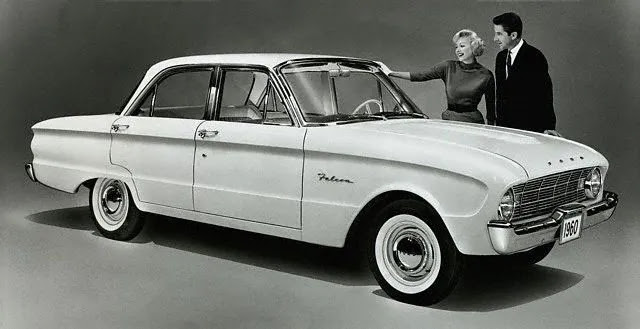
Humble beginnings: Publicity shot for the 1960 Ford Falcon.

When Ford released the Falcon in 1960, it was modest in just about every way except the expectations the company had that it successfully would counter the intrusion of the increasingly popular smaller cars which, worryingly, many buyers seemed to prefer to the increasingly large offerings from Detroit.  A success in its own right, the Falcon would provide the platform for the Mustang, the Fairlane, the Mercury Cougar and other variations which, collectively, sold in numbers which would dwarf those achieved by the original; it was one of the more profitable and enduring platforms of the twentieth century.  In the US, it was retired after a truncated appearance in 1970 but it lived on in South America and Australia, the nameplate in the latter market lasting until 2016, a run of over half a century during which the platform had been offered in seven generations in configurations as diverse as sedans, vans & pick-ups (utes), hardtop coupés, 4WDs, station wagons and long wheelbase executive cars.

Ford Falcon GTHO Phase I leading three Holden Monaro (HT) GTS 350s, Bathurst 1969.

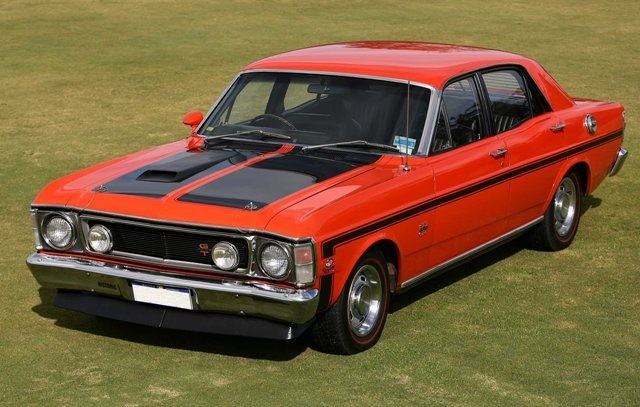
Most memorably however, between 1969-1972, it was also the basis of a number of thinly disguised racing cars, production of which was limited to not much more than was required by the rules of the time to homologate the strengthened or high-performance parts needed for use in competition.  The Falcon GT had been introduced in 1967 and had proved effective but the next year faced competition from General Motors’ (GM) Holden Monaro GTS which, with a 327 cubic inch (5.3 litre) Chevrolet V8 out-performed the Ford which had by then had benefited from an increase in displacement from 289 cubic inches (4.7 litres) to 302 (4.9) which proved not enough.  The conclusion reached by both Ford & GM was of course to increase power so for 1969 the Falcon and Monaro appears with 351 cubic inch (5.8 litre) and 350 (5.7) V8s; the power race was on.  Ford however decided to make sure of things and developed homologation-special with more power, some modification to improve durability and, with endurance racing in mind, a 36 (imperial) gallon (164 litre) fuel tank, quickly (and inexpensively) fabricated by welding together two standard tanks.  The car was called the GTHO (written variously in documents as also as G*T*H*O, GT-HO & G.T.H.O. (and as GT·HO on the glovebox lid)), HO apparently understood by the Ford engineers to mean “high output” but presented to the public as “handling options”, the company not wishing to frighten the horses with fears of racing cars being sold for use on the streets (and such a furore did ensue in 1972 which proved the GTHO’s death knell.

1970 Falcon GTHO Phase II.

If the 1967 GT had been something beyond what Ford in 1960 thought the Falcon might become, the GTHO would have been beyond their wildest imaginings.  Still usable as a road car, it also worked on the circuits although, because of a bad choice of tyre which was unsuited to the techniques of the drivers, it failed to win the annual Bathurst 500, then (as now), the race which really mattered.  Determined to win the 500, a revised GTHO was prepared and, in a novel move, was known as the Phase II (the original retrospectively re-christened the Phase I), the most obvious highlight of the revised specification a switch to Ford’s new Cleveland 351 V8 which, heavier and more powerful, replaced the Windsor 351.  Underneath however, there were changes which were just as significant with the suspension re-calibrated to suit both racing tyres and the driving style used in competition.  Said to have been developed with “a bucket of Ford’s money in one hand and a relief map of the Bathurst circuit in the other”, the Phase II drove like a real racer and probably few cars sold to the public have deliberately been engineered to produce so much oversteer.  On the track it worked and victory at Bathurst followed, something which drew attention from the early unreliability of the Cleveland 351, the implications of it’s less elaborate lubrication system not for some months appreciated.

1971 Ford Falcon GTHO Phase III (Clone).

The Phase III followed in 1971 with increased power, the propensity to oversteer toned down and it proved even more successful, the legacy due to be continued by a Phase IV with four-wheel disk brakes (something probably more helpful than more power) but the project was abandoned after a moral panic induced by a Sydney newspaper which ran a front page which alleged “160mph (257 km/h) supercars” were about to fall into the hands of teenagers to use on city streets and highways.  That certainly frightened the horses and politicians, always susceptible to anything which appears in a tabloid, vowed to act and prevailed on the manufacturers to abandon the homologation specials.  Thus ended the era of the GTHO and also the similar machines being prepared by GM and Chrysler, the handful of Phase IV GTHOs built quietly sold off, never to see a race track although one did, most improbably, enjoy a brief, doomed career as a rally car.

1972 Ford Falcon GTHO Phase IV.

Over the decades, as used cars, the surviving GTHOs (many destroyed in accidents on and off the track) have become collectable and of the 1222 made (including circa 115 of the (unofficial) Phase 1.5 with a milder (hydraulic valve lifters) Cleveland engine), it’s the Phase III (300 built) which is the most coveted at auction (the handful of Phase IVs seem to change hands mostly in private sales and the record is said to be circa Aus$2 million) and while the prices achieved track the state of the economy, the current record is believed to be Aus$1.3 million.  Based on what was essentially a taxicab which was produced in the hundreds of thousands, there’s an after-market ecosystem which produces all the parts required for one exactly (except for tags and serial numbers) to create one’s own GTHO at considerably less than what a real one now costs so it’s no surprise there are many acknowledged replicas (also described as clones, tributes etc) but the odd bogus example has also been unearthed.

Ford Falcon GTHO Phase IVs being prepared for racing, Melbourne, 1972.

Quite how many of the 287 Phase IIs survive isn’t known and the prices are high so it’s little surprise some have been tempted to misrepresent a bogus example as something real and there are legal implications to this, both criminal and civil.  There are even examples of the less desirable Falcon GTs and in 2011, in a judgment handed down in the District Court of Queensland (Sammut v De Rome [2011] QDC 294), a couple was ordered to pay the plaintiff AU$108,394.04 (US$107,200 at the then favorable exchange rate).  The defendants had sold to the plaintiff what they advertised as a 1969 Ford Falcon GT, a vehicle they had in 2006 purchased for Aus$18,000.  The plaintiff undertook due diligence, inspecting the car in person and in the company of a expert in bodywork before verifying with Ford Australia that the VIN (vehicle identification number) was legitimate car.  Once the VIN had been confirmed as belonging to a 1969 Falcon GT, a sale price of Aus$90,000 was agreed and the sale executed, the buyer having the car transported by trailer to Sydney.

Bogus & blotchy: Lindsay Lohan with fake tan.

Two years later, when the plaintiff attempted to sell the car, a detailed inspection revealed it was a bogus GT, a real GT’s VIN having been used to replace the one mounted on an ordinary 1969 Falcon, an x-ray examination of the firewall confirming the cutting and welding associated with the swap.  It was never determined who was responsible for creating the bogus GT and expert testimony given to the court confirmed that then, a non-GT Falcon of this year and condition was worth between Aus$10-15,000 while the value of an authentic GT was between Aus$65-70,000.  Accordingly, the plaintiff sued for breach of contract, requesting to be compensated to the extent of the difference between what he paid for the car and its current value, plus associated matters such as transport, interest and court costs.  The court found for the plaintiff in the sum of Aus$108,394.04 although the trial judge did note that the defendants likely didn't know the car was bogus, thereby opening for them the possibility of commencing action against the party from whom they purchased the thing, his honor mentioned that because of the civil statute of limitations, they had less than a month in which to file suit.  It's to be hoped they kept the car because in 2022, well-executed replicas of XW Falcon GTs are being advertised at more than Aus$125,000.

Monday, March 2, 2026

Impressionism

Impressionism (pronounced im-presh-uh-niz-uhm)

(1) In fine art (an appropriated by others), a style of painting developed in the late nineteenth century, characterized by short brush strokes of bright colors in immediate juxtaposition to represent the effect of light on objects and a focus on everyday subject matters (by convention usually with an initial capital).

(2) A manner of painting in which the forms, colors, or tones of an object are lightly and rapidly indicated and there’s sometimes an attempt deliberately to include discordant subjects.

(3) In sculpture, a compositional style in which volumes are partially modeled and surfaces roughened to reflect light unevenly.

(4) In poetry, a style which used imagery and symbolism to convey the poet's impressions

(5) In literature, a theory and practice which emphasizes immediate aspects of objects or actions without attention to details.

(6) In musical composition, a movement of the late nineteen and early twentieth centuries (in parallel with the developments in painting) which eschewed traditional harmonies, substituting lush pieces with subtle rhythms, the unusual tonal colors used as evocative devices.

1880–1885: The construct was impression + -ism.  Impression was from the Old French impression, from the Latin impressio, from imprimo (push, thrust, assault, onslaught; squashing; stamping; impression), the construct being in- (the prefix which usually to some extent nullified but here in its rare form as an intensifier) + premō (to press), from the Proto-Italic premō which may be linked with the primitive Indo-European pr-es- (to press), from per- (to push, beat, press).  The –ism suffix was from the Ancient Greek ισμός (ismós) & -isma noun suffixes, often directly, sometimes through the Latin –ismus & isma (from where English picked up ize) and sometimes through the French –isme or the German –ismus, all ultimately from the Ancient Greek (where it tended more specifically to express a finished act or thing done).  It appeared in loanwords from Greek, where it was used to form abstract nouns of action, state, condition or doctrine from verbs and on this model, was used as a productive suffix in the formation of nouns denoting action or practice, state or condition, principles, doctrines, a usage or characteristic, devotion or adherence (criticism; barbarism; Darwinism; despotism; plagiarism; realism; witticism etc).  Impressionism and impressionist are nouns; the noun plural is impressionisms.

Lindsay Lohan rendered in the style nineteenth century Impressionism by Gemini.ai.  The digital version was based on a photograph of her in a Jil Sander (b 1943) gown while attending the Disney Legends Awards ceremony, Anaheim, California, August, 2024.  On the day, although the environment was not optimized for photography, the light and even the breeze cooperated, the gown’s fabric swishing in a way the Impressionists would have painted, even had the air been still.

The meanings of impressionism are wholly unrelated to impressionistic which is used to describe an opinion reached by means of subjective reactions as opposed to one which was the product of research or deductive reasoning (ie based on impression rather than reason or fact).  The most extreme example of the impressionistic is a gaboso (the acronym of "Generalized Association Based On Single-Observation") such as assuming if one known Terf has a particular haircut, anyone sporting that style must be "a terf".  As a noun an impressionist is (1) one who in art, music or literature produced work in the tradition of impressionism or (2) an entertainer who performs impressions of others (a mimic).  Although by some used in philosophy since 1839, impressionism really isn’t a recognized field in the discipline, instead used metaphorically (and often critically) to describe certain tendencies which share similarities with the artistic movement.  Those who describe themselves as impressionist philosophers reject the idea that objective knowledge or absolute truths exist and instead stress the importance of individual perception and personal experience, arguing that individual (and debatably collective) understanding of the world is determined only by the wholly subjective: senses and emotions.  They’re thus much concerned with perception, consciousness, and the nature of reality.  In all that there’s obviously some overlap with earlier traditions and mainstream philosophers tend to be dismissive, some suggesting impressionism is less a philosophical school than a mode of which has been explored for millennia.

Le pont du chemin de fer à Argenteuil (The Railroad Bridge in Argenteuil (1873-1874)), oil on canvas by Claude Monet (1840-1926), Musée d’Orsay, Paris).

Impressionism was an art movement that emerged in France in the late nineteenth century and was a romantic form, the core of which was the capturing of a fleeting moment (ie an impression) in time and place, characterized by the play of light and color, rendered with what gave the impression of loose (even careless) brushwork, the paint often applied in brief, broken strokes.  Breaking from the intricacy and preciseness which had distinguished high art since the Renaissance, the artists sought a feeling of spontaneity rather than the staged effect engendered by meticulously rendered details.  The whole idea was to “capture the moment” of those transitory scenes one might view humdres of times a day, the subject matter often the vistas of everyday, the apparent casualness of the composition an important psychological aspect because recollections of such visions often are hazy because the mind tends to remember only the part which has "caught the eye".  Accordingly, artists handled the peripheral surroundings with a “sense of the blurred”, summoning the notion of things vaguely being “filled in” from an incomplete memory; what they wanted to represent was the immediate sensory impressions of a particular moment rather than a polished and wholly realistic composition.  Given all this, it’s not surprising the Impressionists so frequently painted en plein air (ie outdoors) because there, natural light and breezes made for an ever-changing environment, ideal for a technique dedicated to capturing the ephemeral.

The Church at Auvers (1890), oil on canvas by Vincent van Gogh (1853-1890), Musée d'Orsay, Paris.

In the way of such things, from Impressionism, very late in the nineteenth century came post-impressionism.  Deliberately positioned as a reaction against what had come to be regarded as the strictures and limitations of Impressionism, it was noted especially for an expressive and symbolic use of color which neglected and sometimes even abandoned the link with naturalistic representation, the intensity of shade itself a vehicle of an artist’s personal interpretations.  It also distorted form and perspective, the exaggerations wildly beyond anything in the mannerist tradition and the influence upon the cubists who would follow is undeniable.  Something of a preview of post-modernism, the concerns were more with laying bare the underlying structure rather than showing anything directly representational.  However, despite the perceptions of some, technical innovation was rare and even the techniques most associated with the movement had been seen before although famously, the post-impressionists delighted in non-naturalistic color schemes.  While this was something which caught the eye, it wasn’t exactly new and claims it somehow created a heightened emotional impact have always seem hard to sustain although they certainly displeased Adolf Hitler (1889-1945; Führer (leader) and German head of government 1933-1945 & head of state 1934-1945) who decried most forms of "modern art".  Whether he ever said the quote attributed to him: ...anyone who sees and paints a sky green and fields blue ought to be sterilized” has never been verified but it certainly encapsulates his world view.  Still, the work post-impressionists influenced Fauvism and Cubism and there are critics who maintain post-impressionism was the first discernible epoch in modern art and a kind of proto-surrealism.

The Seine at Courbevoie (1885), oil on canvas by Georges Seurat (1859-1891).

Although post-impressionism can to some extent be seen as something new, the companion neo-impressionism really was a fork.  The alternative name of the movement was Divisionism which hints at the scientific basis which underlay many of the works, most notably Pointillism (the use of tiny dots which blended optically when viewed from a distance) which explored the principles of the physics of color and light by rendering paintings almost as a mathematical exercise and one far removed from the spontaneous brushwork of Impressionism.  Color under this regime came to be understood in itself as a theory, the concept of “simultaneous contrast” expressed in the placement of contrasting or complementary colors explored to exploit the way the brain processed the relationship by either “toning down” or making more luminous the visual experience.  The work was thus in the impressionist tradition of using light and color but it was different in that instead of representing an impression of how nature was seen, it deployed a scientific understanding of how the mind perceived and interpreted light and color to produce something which enhanced the effect.  In that sense it can be understood as a structuralist movement.

Separation (1896), oil on canvas by Edvard Munch (1963-1944), Munch Museum, Oslo.

Neo-impressionism should not be confused with Expressionism, a contemporary movement from Germany which some have characterized (not wholly unfairly) as “painting Friedrich Nietzsche’s (1844–1900) nightmares”.  The expressionists sought to convey the subjective emotions, inner experiences and psychological states of the artist; the viewer was there simply to view and understand the feelings of the artist who seem frequently drawn to the darker aspects of human existence.  They used distorted and exaggerated forms, heavy brushwork, and non-naturalistic colors designed expressly to be discordant.  The classic example of Expressionism is Edvard Munch’s The Scream (1893).

Lindsay Lohan (2012), oil on canvas by Lucas Bufi.

Florida-based Lucas Bufi describes himself as “modern Impressionist artist, guided by light and shadows”.  Definitely, this was an application of "light and shadow" to canvas in a way very different to the technique perfected by the chiaroscurists.  For those with a responsibility for categorizing works of art, it can be difficult to determine where impressionism ends and expressionism begins and what credit should being given to the influences of mannerism.  For that reason, some use the term “pop art” as a kind of dumping ground, displeasing those who are quite protective about the genre's boundaries.  Mr Bufi's take on Lindsay Lohan was based on one of the images from a 2011 photo-shoot for the January/February 2012 issue of Playboy magazine which featured her as the cover model.  By 2011, Playboy's sales were in sharp decline because of the availability of on-line content but the photo-shoot induced a short-lived “Lindsay Lohan led recovery”, the magazine's founder Hugh Hefner (1926-2017) tweeting on X (then known as Twitter): “The January-February Double Issue is breaking sales records.  Unfortunately for Mr Hefner, the blip was a one-off and didn't attract “conquest customers”, the sales numbers not matched with the decline continuing until publication ceased during the COVID-19 pandemic (it was in 2025 resurrected as “an annual” but its future remains uncertain). 

Monday, November 4, 2024

Establishment

Establishment (pronounced ih-stab-lish-muhnt)

(1) The act or an instance of establishing.

(2) The state or fact of being established.

(3) Something established; a constituted order or system.

(4) The existing power structure in society; the dominant groups in society and their customs or institutions; institutional authority (ie “the Establishment” in the popular imagination which in this context should be used with an initial capital).  “The Establishment” is a nuanced synecdoche for “ruling class” with the emphasis on a dedication to the preservation of the status quo.

(5) As a modifier, belonging to or characteristic of “the Establishment” (the dominant or hegemonic “power elite” in a field of endeavor, organization etc (“the political establishment”, “the literary establishment” etc) or their “world view” (the “establishment interpretation of history”).

(6) A household; place of residence including its furnishings, grounds etc; a body of employees or servants

(7) A place of business together with its employees, merchandise, plant, equipment etc.

(8) A permanent civil, military, or other force or organization (often used to describe the defined number of personnel, in aggregate or sectionally, the “establishment” being the approved size, composition, and equipment of a unit.  In the military, the word is often modified (peacetime-establisnment, war-establishment, overseas-establishment etc).

(9) Any institution (university, hospital, library etc).

(10) The recognition by a state of a church as the state church.  In Christianity, the church so recognized, the term most associated with the Church of England (and historically the Church of Wales and Church of Ireland).

(11) A fixed or settled income (archaic).

1475–1485: A compound word, the construct being establish + -ment, from the Middle English establishment, stablishment & stablisshement, from the Old French establissement (which endures in Modern French as établissement), from the verb establir.  The noun establishment was from the late fourteenth century verb establish, from the Old French establiss-, the present participle stem of the twelfth century establir (cause to stand still, establish, stipulate, set up, erect, build), (which endures in Modern French as établir), from the Latin stabilire (make stable), from stabilis (stable).  The -ment suffix was from the Middle English -ment, from the Late Latin -amentum, from -mentum which came via Old French -ment.  It was used to form nouns from verbs, the nouns having the sense of "the action or result of what is denoted by the verb".  The suffix is most often attached to the stem without change, except when the stem ends in -dge, where the -e is sometimes dropped (abridgment, acknowledgment, judgment, lodgement etc), with the forms without -e preferred in American English.  The most widely known example of the spelling variation is probably judgment vs judgement.  In modern use, judgement is said to be a "free variation" word where either spelling is considered acceptable as long as use is consistent.  Like enquiry vs inquiry, this can be a handy where a convention of use can be structured to impart great clarity: judgment used when referring to judicial rulings and judgement for all other purposes although the approach is not without disadvantage given one might write of the judgement a judge exercised before delivering their judgment.  To those not aware of the convention, it could look just like a typo.  Establishment is a noun; the noun plural is establishments.

The noun establishmentarian describes “an adherent of the principle of an established church” dates from 1839 which of course begat the noun establishmentarianism (the doctrine of the establishmentarians).  What came first however was antidisestablishmentarianism, every schoolboy’s favorite long word although in scientific English there are constructions longer still and even the most alphabetically prolifically forms in English are short compared to those in languages such as Welsh, German and Maori.  It’s not clear who coined antidisestablishmentarianism but William Ewart Gladstone (1809–1898; prime-minister 1868–1874, 1880–1885, Feb-July 1886 & 1892–1894) used the word in his two volume work The state in its relations with the church (1841), a critique of “the ecclesiastical system established by law” and specifically the status of Church of England; it was a discussion of the implications of disestablishment (the act of withdrawing the church from its privileged relation to the state).  As words, neither establishmentarianism nor antidisestablishmentarianism now much disturb the thoughts of many in England and the only role for the latter has long been as a entry in the internet’s many lists of long, obscure or weird words.  In the narrow technical sense, the curious beast that is the Church of England became “an established church” only after the Act of Settlement (1701) and the subsequent Acts of Union (1707) which formalized the status of the institution, first in England and later Great Britain.  Functionally however, the English church can be considered “established” since the Act of Supremacy (1534) which abolished papal authority in England and declared Henry VIII (1491–1547; King of England (and Ireland after 1541) 1509-1547) Supreme Head of the Church of England, the culmination of a process the king had triggered in 1527 when Clement VII (1478–1534; pope 1523-1534) proved tiresome in the matter of divorce law.  Although other sixteenth century statutes (notably the Act of Supremacy (1558) & Act of Uniformity (1558) which usually are referred to collectively as the “Elizabethan Religious Settlement”) added to the framework, the changes were mechanistic and procedural rather than substantive and simply built upon what had since 1534 been the established “state church” while the eighteenth century acts were essentially codifications which formalized the position in constitutional law.  Legally, little since has changed and 26 Church of England bishops (all appointed by the prime-minister (on the recommendation of the Archbishop of Canterbury)) continue (as the “Lords Spiritual”, their lay colleagues being the “Lords Temporal”) to sit in the House of Lords.

In English, establishment's original fifteenth century meaning was “a finalized and settled arrangement” (ie of income or property) while the sense of “the established church” entered the language in 1731, reflecting what had been the legal position since 1534.  The sense of “a place of business” emerged in the early 1830s while the idea of “a social matrix of ruling people and institutions” was in use as early as the mid 1920s although the phrase “the Establishment” (in the socio-political sense) didn’t enter popular use until the late 1950s, influenced by the publication in 1956 of The Power Elite by US sociologist Charles Wright Mills (1916–1962 and usually styled C Wright Mills).  Mills took a structuralist approach and explored the clusters of elites and how their relationships and interactions work to enable them to exert (whether overtly or organically) an essentially dictatorial control over US society and its economy.  Mills, while acknowledging some overlap between the groups, identified six clusters of elites: (1) those who ran the large corporations, (2) those who owned the corporations, (3) popular culture celebrities including the news media, (4) the upper-strata of wealth-owning families, (5) the military establishment (centred on the Pentagon’s Joint Chiefs of Staff) and (6), the upper echelons of government (the executives, the legislatures the judges, the senior bureaucracy and the duopoly of the two established political parties.  The overlaps he noted did not in any way diminish the value of his description, instead illustrating its operation.

When the establishment fractured: Republican (for Goldwater, left) & Democratic (against Goldwater, right), 1964 presidential campaign buttons, 1964.  This was before the color coding (Republican red, Democratic blue) was standardized in 2000 by the arbitrary choice of the TV networks.

The term “Establishment Republican” (a “moderate” or “liberal” member of the US Republican Party (as opposed to the right-wing fanatics who staged a hostile take-over) emerged in the 1980s to replace “Rockefeller Republican”.  Nelson Rockefeller (1908–1979; US vice president 1974-1977) was the archetype of the “liberal republican” in the decade between crazy old Barry Goldwater (1909–1998) losing the 1964 presidential election and crooked old Richard Nixon (1913-1994; US president 1969-1974) in 1974 resigning from office in the wake of the Watergate scandal.  It was in those years the right-wing began their “march through the party establishment”, a process accelerated during the Reagan (Ronald Reagan (1911-2004; US president 1981-1989) years and the moderates came to prefer the term “Establishment Republican” because Rockefeller was tainted by his association with the north-east, something with less appeal as the party’s centre of gravity shifted to the Mid-West and south of the Mason-Dixon Line.  The few surviving Establishment Republicans are now derided by the right wing fanatics as RINOs (Republicans in name only) and in 2024 the more useful descriptors are probably “pre-Trump Republican” & “post-Trump Republican”.  That linguistic moment may pass but the party at this time shows little inclination of seeking to find the centre ground, a wisdom advocated even by Richard Nixon.  In the pre-Thatcher (Margaret Thatcher (1925–2013; UK prime-minister 1979-1990)) UK, where the existence of “the Establishment” was quite obvious, it was the journalist Henry Fairlie (1924-1990) who popularized the term, explaining the concept as a kind of individual & institutional symbiosis by which “the right chaps” came to control the country’s “levers of power, influence and social authority”, exercised through social connections established between families or at the elite schools such men attended: “By the 'Establishment' I do not mean only the centers of official power—though they are certainly part of it—but rather the whole matrix of official and social relations within which power is exercised. The exercise of power in Britain (more specifically, in England) cannot be understood unless it is recognised that it is exercised socially.

The Rover P5B, the car of the Establishment

In the UK, the Establishment had survived two world wars, the Great Depression, an abdication and even a couple of Labour governments but, by the 1960s, the acceptance of its once effortless hegemony was being challenged, not because people were becoming convinced by the writings of political theorists but as a consequence of the antics of those from the very heart of the Establishment (the Profumo scandal, the “Cambridge Five” spies etc).  In retrospect, it was the ten-odd years prior to 1973 that were the last halcyon days of the “old Establishment” for after that the UK’s anyway troubled “old” economy stagnated, triggering a series of events, notably the assault on the system from within by the improbable anti-Establishment figure of Margaret Thatcher.  The changes wrought in the last five decades shouldn’t be overstated because what happened was one Establishment was replaced by another and there was a substantial overlap in institutional and individual membership but it’s now a very different apparatus from that of the 1960s.

In A Spy Among Friends: Kim Philby and the Great Betrayal (2014), Ben Macintyre (b 1963) told the tale of the most famous of the Cambridge Five (Kim Philby (1912-1988)) and recounted a classic example of the establishment in operation.  One of the intelligence officers employed by the SIS (Secret Intelligence Service and popularly known as MI6) was summoned to an interview by the service’s newly appointed head of internal security (ie a spy who spied on spies) who was vetting all staff:

Security Officer: “Sit down, I’d like to have a frank talk with you.

Intelligence Officer: “As you wish colonel.

SO: “Does your wife know what you do?

IO: “Yes.

SO: “How did that come about?

IO: “She was my secretary for two years and I think the penny may have dropped.

SO: “Quite so.  What about your mother?

IO: “She thinks I’m in something called SIS which she believes stands for the Secret Intelligence Service.

SO: “Good God!  How did she come to know that?

IO: “A member of the War Cabinet told her at a cocktail party.

SO: “Then what about your father?

IS: “He thinks I’m a spy.

SO: “Why should he think you’re a spy?

IS: “Because the Chief [of SIS] told him in the bar at White’s.

A passage that could have appeared as a vignette in a Graham Greene (1904-1991) novel, the exchange encapsulates the way the establishment worked and illustrates why the Cambridge Five went so long undetected: it would never have occurred to anyone to suspect them.  The London club White’s, the SIS and the Cabinet were all part of the establishment and the members of each were a kind of family (in a very modern sense of the word none of them would have understood) connected by a shared background of “right” (the right schools, the right universities, the right hobbies, the right families etc).  While between members of the establishment there were fueds, hatreds and much low skulduggery, as an institution it survived for so long because it was so effective at self-replication and keeping out outsiders.  Although the word is often used, it’s misleading to speak of the Cambridge Five as having “infiltrated” the security services: they were invited to join and welcomed aboard; they were one of us.  In his memoir, (My Silent War (1968)), Philby noted what most protected the Cambridge five from suspicion was the "...genuine mental block which stubbornly resisted the belief that respected members of the establishment could do such things."

Rover 3.5 Coupé.

One charming Establishment symbol from those years which are for most not in living memory was the ultimate “Establishment car”, one which while not the biggest, fastest, or most expensive available, possessed the qualities to appeal to the “right chaps”.  The Rover P5 was in production between 1958-1973, running from around the time that old patrician Harold Macmillan (1894–1986; UK prime-minister 1957-1963) told the working class “…most of you have never had it so good” to the last days before the first oil shock ended the West’s long, post-war economic prosperity (although the British experience of that was patchy).  The P5’s presence throughout was somehow reassuring because from its debut it embodied the virtues for which Rovers had during the 1950s come to be valued: solidity, quality, comfort and an indifference to fashions and fads.  The P5 was a presence also in parts of the old British Empire and it enjoyed a following in both Australia & New Zealand, valued because it had an “Establishment air” yet was not flashy like a Pontiac or Jaguar (the mostly badge-engineered Daimlers a remarkably effective piece of product differentiation) or a statement of wealth like a Mercedes-Benz would by the mid-1960s become.

Rover 3 Litre engine schematic.

The P5 was sold originally as the 3 Litre in three releases (Mark 1, 1958-1962; Mark II, 1962-1965 & Mark III 1965-1967), using a 3.0 litre (183 cubic inch) straight-six with an implementation of the “F-head” design in which the inlet valve sat at the top of the combustion chamber with a side-mounted exhaust valve, an arrangement which offered some advantages when designing combustion chambers suited to the lower octane fuel then used in many markets and allowed the use of larger valves than would have been possible with a conventional OHV (overhead valve) arrangement).  The latter was a matter of some significance because the Rover six came from a time when the taxation regime was based on bore diameter, something which resulted in generations of British small bore, long-stroke engines and the 3 litre six was a famously smooth device, the advertising sometimes showing a circular coin sitting (on its edge) on the air-cleaner with the engine running, the coin not even vibrating.  Technologically though, for passenger vehicles, it was a cul-de-sac and more modern power-plants from the US, Europe (and even the UK) were out-performing the old F-Head.

What transformed the P5 was the adoption of the 3.5 litre (215 cid) V8 which Rover had purchased from General Motors (GM) which, in versions made by Buick, Oldsmobile & Pontiac (BOP), had been used for the new compact lines between 1961-1963.  The UK’s industry made many mistakes in the post-war years but what became the Rover V8 was an inspired purchase, remaining in production in displacements between 3.5 litres (215 cubic inch) and 5.0 (305) from 1967 until 2006, powering everything from the original Range Rovers to executive sedans and sports cars  It was related also to the Oldsmobile version (Rover used Buick’s variant) on which Repco in Australia based the 3.0 litre (193 cubic inch) SOHC (single overhead camshaft) V8 the Brabham team would use to secure the Formula One drivers & constructors championships in 1966 & 1967.

Look of the past; glimpse of the future: 1967 Rover 3.5 Saloon (left) and 1967 NSU Ro80 (right).  In fairness, what lay under the Rover's hood (bonnet) would last well into the next century while the NSU's Wankel engine would, in automotive applications, prove a cul-de-sac.  More enduring were the Ro80's lines which would for decades be influential.

It was in late 1967 the Rover 3.5 was released and the press reception was generally favourable, the improvements in performance and fuel consumption (not something often achieved when adding cylinders and displacement) attributed to a combination of greater mechanical efficiency and reduced weight, the all-aluminum V8 some 200 lb (90 kg) lighter than the hefty old six although some did note the new engine couldn’t quite match the legendary smoothness of the old.  By 1967 however the testers seemed to be aware that whatever its charms, it was a design from the drawing boards of the mid-1950s and the world had moved on although to be fair, Rover had too, it’s P6 (2000), released in 1963 was very much a modernist take (and one which would in 1968 also be transformed by the V8, becoming the 3500 (1968-1976)).  Between 1967 and the end of production in 1967, the flavor of the press commentary about the 3.5 was very much: “outmoded but satisfying”.

Released in September 1967: NSU Ro80 (left) and Rover 3.5 saloon (right), partially exposed at October's International Motor Show, Earls Court, London.

Like the 3.5, the NSU Ro80 had been released in September that year and the contrast was obviously between the past and the future, the German car influencing design for more than a generation (with the obvious exception of the ill-fated Wankel engine) while what the Rover represented was already almost extinct, few of the others in its market segment (the Vanden Plas Farinas, the Humber Super Snipe, the Vauxhall Viscount, the Daimler Majestic Major and the Austin 3 Litre) to see the 1970s.  Nor did other manufacturers make much effort to compete for buyers who clearly wanted something lighter and more modern although, after taking over Rootes Group, to replace the defunct Super Snipe and Imperial, Chrysler did embark on a quixotic venture to prove demand still existed by taking advantage of the old Commonwealth tariff preference scheme (the last relic of the chimera of imperial free trade) by importing the Australian-built Valiant (built on the US A-Body) in both straight-six & V8 form.  Even before the first oil shock hit the West in 1973 it registered barely a blip on the sales charts although, remarkably, remained available until 1976 by which time the writing was on the wall for Chrysler’s entire European operation.

A UK government 3.5 saloon waiting outside No 10 Downing Street (left) and Harold Wilson about to enter his (right).

For many however, the Rover’s reassuring presence was more appealing than modernity (although the rakish Rostyle wheels may have been a shock for some).  It certainly appealed to those at the heart of the establishment and the first prime minister to have been driven in one was the pipe-smoking Harold Wilson (1916–1995; UK prime minister 1964-1970 & 1974-1976) who, although he’d once promised to revitalize the economy with the “white heat of technological change”, was a cautious and conservative character; the car suited him and he appreciated the custom-built ashtray which held his pipe.  Edward "Ted" Heath (1916-2005; UK prime-minister 1970-1974), James "Jim" Callaghan (1912–2005; prime minister of the UK 1979-1979) and Mrs Thatcher followed him into the backseat, something made possible because the Ministry of Supply (advised production was ending in 1973), purchased a batch from the final run, stockpiling them for future VIP use, the same tactic some police forces would later adopt to secure warehouses full of Rover SD1s (another recipient of the ex-Buick V8), the front wheel drive (FWD) replacements they knew were in the pipeline not a compelling choice for the highway patrol.  Not until 1981 was Mrs Thatcher's Rover retired and replaced with a Daimler.

1955 Chrysler C-300 (top left and dubbed retrospectively the 300A), 1970 Mercedes-Benz 280 SE 3.5 Coupé (top right), Rover 3.5 Coupé (bottom left) and Rover 3.5 Saloon (bottom right).

On sale only in 1955-1956, the restrained lines of Chrysler’s elegant “Forward Look” range didn’t last long in the US as an early case of "irrational exuberance" washed over Detroit's studios but the influence endured longer in Europe, both the Mercedes-Benz W111 (1961-1971) & W112 Coupes (1962-1967) and the Rover P5 (1958-1967) & P5B (1967-1973) interpreting the shape.  The Rover was a tale of two rooflines: the “Establishment” Saloon and the rakish Coupé, the latter the sort of thing described in barristers' slang as a "co-respondent's car" (ie the type driven by the sort of chap inclined to sleep with other men's wives and thus be cited in divorce proceedings while the man with the unfaithful wife would have driven a 3.5 Saloon).

US-delivered 1965 Rover 3 Litre Coupé with California "blue plate".

Prior to 1967 when legislation rendered the low-volume model unviable, Rover did ship a small number of P5s to the US, made possible because the line was anyway produced in LHD (left-hand-drive) for European sale.  There were a number of changes such as the amber taillights being replaced with red lens but although, sensibly, the Americans spelled “coupe” without the l'accent aigu (acute accent), the “Coupé” badge was retained.  California between 1969-1987 issued licence plates with yellow characters over a blue background so, because P5s were last sold in the US in early 1968, this one may not originally have had a "blue plate" unless it shifted interstate.  However, the California DMV (Department of Motor Vehicles) has for some years offered the CLLPP California Legacy License Plate Program) which allows owners to order replica blue and yellow plates and the scheme is popular among those wanting a "correct period look".

In automobiles, by the 1960s, the English-speaking world had (more or less) agreed a coupé was a two door car with a fixed roof and (if based on a sedan), often a shorter wheelbase, designed put a premium on style over utility.  There were hold-outs among a few UK manufacturers who insisted there were fixed head coupés (FHC) and drop head coupés (DHC), the latter described by most others as convertibles or cabriolets but mostly the term had come to be well-understood.  It was thus a surprise when Rover in 1962 displayed a “four-door coupé”, essentially their 3 Litre sedan with a lower roof-line and a few “sporty” touches such as a tachometer and a full set of gauges.  One intriguing part of the tale was why, defying the conventions of the time, the low-roof variation of the four-door was called a coupé (and Rover did use the l'accent aigu (the acute accent: “é”) to ensure the “traditional pronunciation” was imposed although the Americans and others sensibly abandoned the practice).  The rakish lines, including more steeply sloped front and rear glass were much admired although the original vision had been more ambitious still, the intention being a four-door hardtop with no central pillar.  Strangely, although the Americans, Germans and later the Australian had managed this satisfactorily for mass-production, a solution eluded Rover which had to be content with a more slender B-pillar.

Lindsay Lohan with Porsche Panamera 4S four-door coupé (the factory doesn't use the designation but many do), Los Angeles, 2012.

The etymology of coupé is that it’s from couper (to cut off) but the original use in the context of horse-drawn coaches referred to the platform being shortened, not lowered.  Others too have been inventive, Cadillac for decades offering the Coupe De Ville (they used also Coupe DeVille) and usually it was built to exactly the same dimensions as the Sedan De Ville, differing on in the door count.  So Rover probably felt entitled to cut where they preferred; in their case it was the roof and in the early twentieth century, the four-door coupe became a thing, the debut in 2004 of the Mercedes-Benz CLS influencing other including BMW, Porsche, Volkswagen and Audi.  The moment for the style clearly hasn’t passed because when CLS production ended in August 2023, the lines were carried over to the new E-Class (W214, 2023-) but there are no longer references to a “four-door coupé.

JGY 280: One of Elizabeth II’s P5B Saloons outside the gates of Windsor castle (left) and Her Majesty at the wheel (right), leaving the castle, reputedly on the way to church so while one of her 3.5s won’t quite be “only driven to church on Sunday by little old lady”, being in the Royal Mews, it would have been well-maintained.

Although for almost 20 years a fixture outside No 10 Downing Street, the most famous P5B owner was Elizabeth II (1926-2022; Queen of the UK and other places, 1952-2022) who upgraded from a 3 Litre in 1968 and, although not noted for being sentimental about machinery, until 1987 ran one of the several maintained in the Royal Mews during her reign.

Rover P5B headrests (left & right) and the mounting assembly for the reading lamps in the front units (centre).

Most of the focus on the Rover 3.5 has always been about the engine or the more illustrious of the passengers but one detail of note is the unusual bulk of the headrests, optional fittings in most markets.  Quite why they were so big isn’t clear although the shape of the rear units presumably made for an easier mounting through the parcel shelf, meaning the seat's frames & covers needed no modification and it’s apparently not an urban myth some used by the British government had a bullet-proof panel inserted; there was certainly the space to accommodate even a thick metal plate.  The front headrests were used also to house the optional reading lamps, the wiring harness within well concealed.