Astroturf (pronounced as-truh-turf)
(1) A trademarked (as AstroTurf) brand of carpet-like
covering made of vinyl and nylon to resemble turf, used for athletic fields, decks,
patios and such (initial capital).
(2) The widely used generic term for artificial grass (no
initial capital).
(3) To fake the appearance of popular support for
something, such as a cause or product, the use based on the idea of faking “grassroots
support” from the public the way AstroTurf is a “fake grass” (although some
insist it’s really “faux grass” because usually there’s no attempt to claim the
artificial product is natural).
1966: The construct was astro- + turf, the product name an allusion to the Astrodome, the baseball stadium in Houston, Texas, where first the product was laid at scale. The astro- prefix was from the Ancient Greek ἄστρον (ástron) (celestial body), from ἀστήρ (astḗr) (star). It was used by the astronomers of Antiquity to refer to celestial bodies which they classified as (1) fixed stars & (2) wandering stars (planets) as well as of space generally. The word turf pre-dates 900 and was from the Middle English terf & torf (turves sometimes was used as plural but wholly un-related to the phrase “topsy-turvy”), from the Old English turf & tyrf (turf, sod, slab of soil, roots cut from the earth, piece of grass-covered earth, greensward), from the Proto-West Germanic turb (turf, peat), from the Proto-Germanic turbz (turf, lawn), linked possibly to the primitive Indo-European derbh- (to wind, to compress). It was cognate with the Dutch turf, the Old Norse torf, the Middle Low German torf (peat, turf), (from which German & German Low German gained Torf) the Danish tørv, the Swedish torv, the Norwegian torv, the Icelandic torf, the Russian трава (trava) (grass), the Old Frisian turf, and the Old High German zurba; it was akin to the Sanskrit दर्भ (darbhá) (a kind of grass) & दूर्वा (dū́rvā) (bent grass). Turf in its original sense developed as a part of the agrarian economy, describing the top layer of soil in which seeds were planted and roots (hopefully) took hold. Use (apparently rapidly) expanded to encompass concepts in some way related to the upper layer of the ground or what sprouted from it including sods, slabs of soil with the root systems preserved (ie a piece of grass covered earth) and expanses of grassed surfaces. To this day, the general literal understanding of “turf” is the grassed, top layer of soil.

Lindsay Lohan and the turf: On 1 October, 2023, Lindsay Lohan (by Emcee out of Requebra) won the Grande Prêmio Costa Ferraz over 1,000 metres (left), her fourth victory in ten starts; Jockey Club Brasileiro, Praça Santos Dumont, Gávea, Rio de Janeiro, Brazil and Lindsay Lohan in The Birdcage (right), Flemington Racecourse, Melbourne, Victoria (Spring Carnival Derby Day), 2 November, 2019.
The use of turf as a synecdoche for (especially thoroughbred) horse racing (as “the turf”) dates from 1755, that use emerging from the original technical use by those maintaining the grassed surface over which the horses galloped. From this evolved the modern occupational euphemisms (1) turf accountant (a bookmaker (bookie) with whom one places bets) and (2) turf advisor (one who for a fee provides “tips” suggesting which horse(s) on which bets should be placed). The phrase “comes with the turf” means one must “take the rough with the smooth” and accept less pleasant aspects of a chosen profession, location etc. In figurative use the “turf war” was a demarcation dispute between parties over territory which can be literal physical space or something more abstract. The idea of “our turf” in the sense of “streets or parts of a suburb in which a gang had an exclusive right to conduct criminal activities” must be old but the use of “turf” to describe the concept seems not to have been recorded prior to 1953. On a gang’s turf, “civilians” might well stroll un-molested but it’d be dangerous for members of other gangs to trespass. The term “turf war” is said to have come into use only in 1962 but the notion of “one’s turf” to which one had an exclusivity of possession or right was documented from at least the mid nineteenth century when it was almost formalized as a set of boundaries in the streets on which prostitutes plied their trade, the unmarked borders administered both by the sex workers and police officers who (usually with the extraction of some sort of fee in cash or kind) “enforced the rules”. Astroturf & astroturfing are nouns & verbs, astroturfer is a noun and astroturfed is a verb & adjective; the noun plural is astroturfs. AstroTurf is a registered trademark.

The use of “Astrodome” as the name for the baseball stadium in Houston, Texas, was an allusion to city's association with the US space program, a link not wholly unrelated to Texan Lyndon Johnson (LBJ, 1908–1973; VPOTUS 1961-1963 & POTUS 1963-1969), while vice-president, being appointed by John Kennedy (JFK, 1917–1963; POTUS 1961-1963) to assume nominal responsibility for the program; Houston became home to NASA's (National Aeronautics and Space Administration) MSC (Manned Spacecraft Center, now the Johnson Space Center). Old LBJ was well-acquainted with baseball stadiums. On the opening day (13 April) of the 1964 MLB (Major League Baseball) season at Washington DC’s District of Columbia Stadium (now the Robert F. Kennedy Memorial Stadium (named after Robert F. Kennedy (RFK, 1925–1968; US attorney general 1961-1964)) he set the record for the most hot dogs eaten by a sitting president on Opening Day, all four scoffed down in the approved manner (without resort to knife & fork). The record still stands. Built in the early 1960s, the Astrodome was the world’s first multi-purpose, domed sports and even before the new name was unveiled, Houston was already widely known as “Space City”. When in 1956 the structure was completed, many had assumed it would be called the “Space City Stadium” but most seemed to agree Astrodome was a better choice and the city’s baseball team was the same year renamed the Houston Astros. Dating from the early sixteenth century, dome was from the Middle French domme & dome (a town-house; a dome, a cupola) (which persists in modern French as dôme), from the Provençal doma, from the Italian duomo (cathedral), from the Medieval Latin domus (ecclesiae; literally “house (of the church)”), a calque of the Ancient Greek οἶκος τῆς ἐκκλησίας (oîkos tês ekklēsías).

AstroTurf is a trademarked brand name for a type of artificial surface which emulates the appearance of grass and to various degrees, also the “feel and behavior”. When referring to the commercial product, the two upper-case characters should be used but (on the model of Hoover & hoover, Google & google, Xerox & xerox etc) the word has come frequently to be used as a generic term for any artificial turf and in these instances no initial capital should appear; style guides anyway recommend that to avoid confusion, a term such as “artificial turf” is preferred. When used of the practice of faking the appearance of popular support for something, definitely no initial capital should appear. Because Astroturf is “fake grass”, when used in slang, the inference is always negative, especially in relation to politics and unethical marketing. AstroTurf has changed much in the 60-odd years of its existence with the green color about the only constant, advances in chemistry and computing meaning the surface now is more durable, cheaper to produce and more “grass-like” in its behaviour although in an age of increasing global temperatures use in the urban environment is becoming controversial because whereas grass is absorptive and tends to have a cooling effect, synthetics radiate heat and, over large surfaces, the difference in the air above can be many degrees. Some local authorities have banned artificial turf in domestic settings although not all have jurisdiction over private property. When first patented in 1965, it was sold as “ChemGrass” which, in retrospect, sounds a bad choice but in the mid-1960s, as a word-forming element, “chem-” didn’t carry quite the negative connotations which later became so associated. It was rebranded as AstroTurf in 1966 to tie in with opening of the Houston Astrodome stadium.
The word Astroturf dates from 1966 when it was released as a commercial product, a synthetic grass for use in sports arenas. The use of “astroturf” as a slang term meaning “to fake the appearance of popular support for something, such as a cause or product” emerged in the last days of the 1990s although the origin of the use of the word in this context has been traced to 1985 when then Senator (Democratic, Texas) Lloyd Bentsen (1921–2006; US Secretary of the Treasury 1993-1994) used the word to distinguish between “real mail from real people” and the “mountain of cards and letters” sent to his office in a campaign organized by the insurance industry: “…a fellow from Texas can tell the difference between grass roots and AstroTurf... this is generated mail.” Lloyd Bentsen is remembered also for the most memorable retort (which probably was rehearsed) from the 1988 presidential election in which he was the Democratic Party’s nominee for VPOTUS. In a debate with the Republican’s Dan Quayle (b 1947; VPOTUS 1989-1993), he responded to Mr Quayle comparing himself to President Kennedy by saying: “Senator, I served with Jack Kennedy. I knew Jack Kennedy. Jack Kennedy was a friend of mine. Senator, you're no Jack Kennedy.” The other coincidental link between the two candidates was that in the 1970 mid-term congressional elections. Bentsen defeated George H.W. Bush (George XLI, 1924-2018; VPOTUS 1981-1989 & POTUS 1989-1993) for a Texas senate seat and it was Dan Quayle Bush choose as a running mate in his successful 1988 presidential campaign. Mr Qualye's other contribution to US political history was being filmed visiting a school in New Jersey school where he “corrected” a student’s spelling of “potato” by adding a final “e”. That a man aspiring to be elected to an office “a heartbeat away from the presidency” and thus the authority to launch nuclear missiles didn’t know how to spell “potato” was disturbing enough but what made it really funny (at least in one sense) was he read the incorrect spelling from flashcards prepared in advance, confirming the public’s perception politicians obediently parrot whatever is fed to them by the party machine.

One of the internet’s more inexplicable juxtapositions; even the poster admitted there was nothing to link Lindsay Lohan with Coca-Cola drink AstroTurf cozies but her name remains attractive as click-bait.
The senator’s reference to the “mountain of cards and letters” as
early as 1985 is an indication the technique predates the internet and
historians have identified examples from Antiquity which suggest the practice
is likely as old as politics itself but what the internet did was offer the
possibility of scaling campaigns to a global scale at a lower (sometimes
marginal or close to zero) unit cost. When
done, it is called astroturfing those coordinating such things are astroturfers. Astroturfers are, like scammers in this
calling, engaged in a constant arms race against those who detect and expose
the tactic and the dramatic rise in the use of AI bots (artificial intelligence
(ro)bots) has made the detection process simultaneously both easier (because at
this stage it’s still a relatively simple matter for one algorithm to detect
another) and more challenging because of the extraordinary rise in volume. It’s not clear how many social media accounts
are fake (run by people or bots generally receiving a payment for each post not
deleted by the gatekeepers) and certainly it’s not something the platforms seem
anxious to discuss although they will sometimes disclose how many have been
deleted if some form of astroturfing has been so especially blatant or
egregious as to induce adverse publicity. More subtle are the “shadow
organizations” set up by the usual suspects (fossil fuel companies, extractive
miners, big polluters, political parties etc) which can even have bricks &
mortar offices and paid staff. The
purpose of these outfits is to engage in controversial debates and attempt to
both “nudge” things in the direction sought by those providing the funding and
create the impression certain views enjoy wider support than may be the
reality.
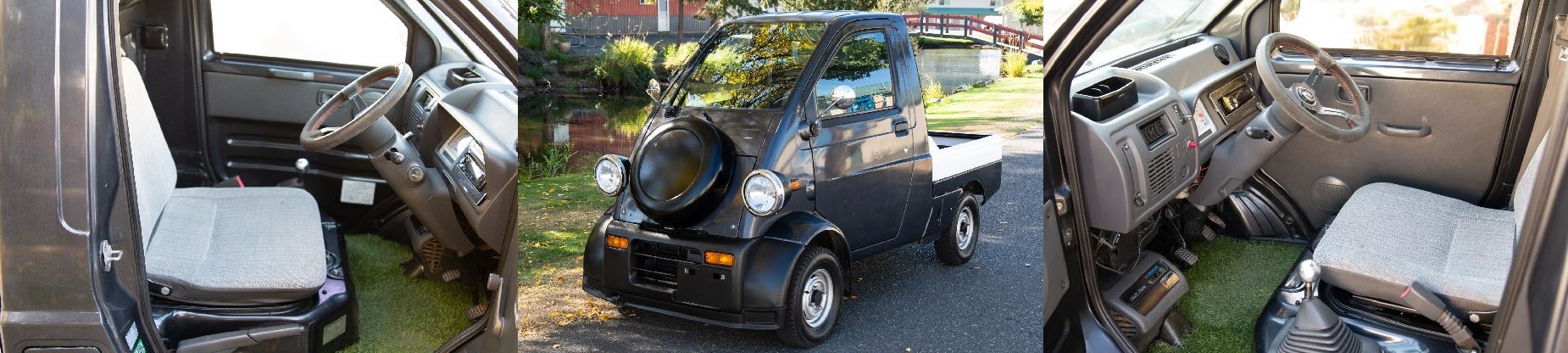
1996 Daihatsu Midget with custom AstroTurf carpets.
The Daihatsu Midget began life as a single-seater, three wheel mini-truck (1957-1972) powered by a 250cm3 (15 cubic inch) single cylinder, two-stroke engine although some were built also with a 305 cm3 (19 cubic inch) unit which may in the vernacular be thought of as the “big block” or “muscle car” version. Produced under licence in several nations in the Far East, it’s still produced in Thailand where its compact dimensions, surprising load capacity and economy of operation make it uniquely suited to confined urban environments. Daihatsu revived the Midget name for a four-wheel version which was produced between 1996-2001, manufactured under the “Kei Car” (a clipping of kei-jidōsha (軽自動車 (light automobile)) rules which limit mass, external dimensions and restrict displacement to 660 cm3 (40 cubic inches). In a sign of the times, these diminutive Midgets (surely an irresistible tautology in the Kei Car business) were available with options like 4WD (four-wheel drive) and A/C (air conditioning). Small they may have been but, within their limitations, they were remarkably capable machines and like most things Japanese, very thoughtful designs with much attention to detail.


