Showing posts sorted by date for query Knob. Sort by relevance Show all posts

Wednesday, June 10, 2026

Toggle

Toggle (pronounced tog-uhl)

(1) A pin, bolt or rod placed transversely through a chain, an eye or loop in a rope etc, as to bind it temporarily to another chain or rope similarly treated.

(2) In various types of machinery, a toggle joint, or a device having one.

(3) An ornamental, rod-shaped button for inserting into a large buttonhole, loop or frog, used especially on sports clothes.

(4) In theatre, a wooden batten across the width of a flat, for strengthening the frame (Also called the toggle rail).

(5) In engineering and construction, a metal device for fastening a toggle rail to a frame (also called a toggle iron); a horizontal piece of wood that is placed on a door, flat, or other wooden structure, but is not on one of the edges of the structure; an appliance for transmitting force at right angles to its direction.

(6) To furnish with a toggle or to bind or fasten with a toggle.

(7) In informal use, to turn, twist, or manipulate a toggle switch; dial or turn the switch of a device (often in the form “to toggle between” alternate states).

(8) A type of switch widely used in motor vehicles until outlawed by safety legislation in the 1960s.

(9) In admiralty jargon, a wooden or metal pin, short rod, crosspiece or similar, fixed transversely in the eye of a rope or chain to be secured to any other loop, ring, or bight.

In computer operating systems and applications, an expression indicating a switch of view, contest, feed, option etc.

(11) In sky-diving, a loop of webbing or a dowel affixed to the end of the steering & brake lines of a parachute providing a means of control.

(12) In whaling, as toggling harpoon, a pre-modern (believed to date from circa 5300 BC) harvesting tool used to impale a whale when thrown.

1769: The origin of toggle is murky and the best guess of most etymologists is it was in some way linked with "tug".  In the sense of a "pin passed through the eye of a rope, strap, or bolt to hold it in place" the origin is believed to be nautical (though not necessarily from the Royal Navy) thus the speculation that it’s a frequentative form of “tug” or “to tug” (in the sense of “to pull”), the evolution influenced by regional (or class-defined) pronunciations similar to tog.  The wall fastener was first sold in 1934 although the toggle bolt had been in use since 1994.  The term “toggle switch” was first used in 1938 although such devices had long been in use in the electrical industry and they were widely used in motor vehicles until outlawed by safety legislation in the 1960s.  In computing, toggle was first documented in 1979 when it referred to a keyboard combination which alternates the function between on & off (in the sense of switching between functions or states as opposed to on & off in the conventional sense).  The verb toggle dated from 1836 in the sense of “make secure with a toggle” and was a direct development from the noun.  In computing, the toggle function (“to toggle back and forth between different actions") was first described in 1982 when documenting the embryonic implementations of multi-tasking (then TSRs (terminate & stay resident programs).  Use of the mysterious togglability (the quality of being togglable) seems to be restricted to computer OSs (operating systems) to distinguish between that which can be switched between and that which is a stand-alone function which must separately be loaded & terminated.

The noun toggery (clothing; a clothing shop) is unrelated and was from tog.  It described (in slang), capes, cloaks & coats and (in New Zealand & Australia), swimwear (as a clipping of "swimming togs").  The origin of tog as various garments was as a shortened form of the earlier togemans & togeman (cloak, loose coat), from the Middle English tog, toge & togue, from the Old French togue, from the Latin toga (cloak, mantle).  Togeman(s) was criminal class cant for "cloak or coat" and in the shortened form "tog" it had spread to general use, by the early eighteenth century meaning "coat" and that also underwent mission keep, coming to be used generally of "clothing".  As a verb tog (as both "tog" & "tog up") emerged very quickly.  The special use of tog in fluid dynamics was as a unit of thermal resistance, being ten times the temperature difference (in °C) between the two surfaces of a material when the flow of heat is equal to one watt per m2.  The discipline in the 1940s appropriated the word from its commercial use as a material used in the thermal insulation of clothing.  Tog was also (as a clipping), slang for "a photographer".  Toggle is a noun & verb, toggled & toggling are verbs, toggler, toggery & togglability are nouns and togglable is an adjective; the noun plural is toggles.

The Jaguar E-Type (XKE) and the toggle switch

1964 Jaguar E-Type S1 OTS (Open Two Seater, as the factory at the time described the roadster body-style.

Jaguar’s E-Type (sometimes in North America (NA) informally called XK-E or XKE) deputed in 1961 at the now defunct Geneva Motor Show and it created quite a stir, at once recognized as one of the more seductive shapes ever rendered in metal, a view with which many today agree still.  The impact it made is undisputed but in industry folklore what is contested is whether Enzo Ferrari (1898-1988), attending the show, called it “the most beautiful car in the world”.  The origin of the tale is a recollection by Norman Dewis (1920–2019) who between 1952-1985 was a Jaguar test driver, the website Hemmings reporting him saying of that moment in Geneva: “I always remember Enzo Ferrari coming up to me.  He walked around the car. He said, ‘Norman, it’s the most beautiful car I’ve ever seen.  But there is one mistake on the car.  It hasn’t got a Ferrari badge.’’

1966 Jaguar E-Type OTS.  The cockpit of the "toggle switch E-Types" was one of the classic looks of the analogue era,  Unlike the Jaguar saloons in production at the time, from the start, the E-Type's dashboard had a padded top-rail.    

Il Commendatore seems never to have confirmed or denied expressing the sentiment and there’s no mention of it in Le mie gioie terribili (published in English as “My terrible joys: the Enzo Ferrari memoirs” (“My Terrible Joys” must be one of the finest titles for a memoir)).  So, in the absence of a denial the story stands and the E-Type clearly made an impression because after concluding the sleek shape was likely to confer great aerodynamic advantage, signor Ferrari returned to Modena and ordered the development of the 250 GTO, the three dozen-odd built now among the highest-priced collectables.  It’s not unknown for a statement of perhaps dubious provenance to gain an aura of authenticity if the subject decides it reflects well on them.  In the 1961 Australian general election, as the counting concluded, the government and opposition had won equal numbers with a single seat still to be called; on that one seat rested the fate of the election.  That one seat was held by the conservative Jim Killen (1925–2007) and ultimately he prevailed, ironically because of the “leakage” of a handful of preferences from the Communist Party candidate.  Elated, Killen told the press he’d received a congratulatory phone call from Robert Menzies (1894–1978; prime-minister of Australia 1939-1941 & 1949-1966) who’d said “Killen, you’re magnificent”.  The quip had come from Killen’s imagination and later, ruefully, he would reveal that at the first post-election meeting of Liberal Party members, Menzies “didn’t even offer me a drink.”  Still, Menzies never disowned the comment and one of his press secretaries confirmed he’d been happy for it circulate.

1961 Jaguar E-Type S1 roadster with toggle switches and aluminum trim panels.

Ergonomically, while an aesthetic delight, the layout was not wholly successful though toggle switches are thought more sexy than the later rockers (although, sardonically, in the E-Type community they are sometimes described a "suicide switches") which were adopted to comply with US safety regulations.  There are two different stamping patterns for the aluminum trim pieces and the one used on the very early cars is much prized; it has never been available as a re-production.  In 1963, as a running change (the factory bulletin indicating it was done to reduce glare), the panel's covering was changed to black vinyl.  The use of aluminum facia plates in a Jaguar was untypical and the designers later recalled it was done just to provide that "race car look" rather as some of today's manufacturers and tuning houses will use carbon fibre (real and fake).  The factory certainly was aware of the significance of the ambiance in cockpit design.  The earlier XK120 (1948-1954) had been available as a FCH (fixed head coupé), DHC (drop head coupé (ie a cabriolet)) and OTS but while the first two received the traditional burl walnut veneer, the "sportier" OTS's facia was covered in leather & leathercloth.  The latter was thought a more modern look which increasingly was used on the successor XK140 (1954-1957) & XK150 (1957-1961) with only the saloons using timber exclusively (which remained an option for the XK150).


Custom timber veneer fittings by Madera Concepts for Jaguar E-type in burl walnut (left) and Carpathian elm (right). 

Unlike the XK150, the timber fittings were never a factory option but some owners found the look irresistible and commissioned specialists to create the pieces.  Although the total area is not large, some disassembly and reassembly is required and with a few curves around which the veneer must be made to curl, it's a job which demands expertise.  The fine craftsmen at Madera Concepts in California report having done sets in both burled walnut and Carpathian elm, the results looking exactly as one imagines the factory might have produced had there ever been a Daimler version of the E-Type.  Of course, however much those commissioning the work might be delighted, the originality police are unlikely much to be impressed.  Views change and by 1985 timber had re-appeared in the cockpit of the E-Type’s nominal replacement (the XJ-S (1975-1996 and in 1991 named XJS during Jaguar's time as subsidiary of Ford) so walnut in the one-off “notchback” Daimler XJ-S prototype was not a novelty.

Erected soft-top on 1969 E-Type S2.

Jaguar devoted time and resources to testing the E-Type but one thing which slipped through the pre-production process (as well what must have been indifference to the glare from the dashboard) was a buffeting the OTS's fabric soft-top suffered at certain speeds.  It seems an obvious thing not to notice but, like the HST's (Hubble Space Telescope) mis-shaped mirror, it was just one of those things.  With the E-Type's release date locked-in, it was too late to redesign the components and it was a hint at the machine's intrinsic unsuitability for mass-production.  The factory had not expected demand to exist in anything close to what instantly emerged (they'd expected to sell at most a few thousand but not some 72,000 over 14 years; the world was however seduced and to this day the E-Type remains the definitive Jaguar).  The consensus among the cognoscenti seems to be if Jaguar had anticipated what a huge seller the E-Type would become they might have (1) devoted a few more months to the development and (2) on the production line spent maybe another £40 per car, meaning many of the E-Type's inherent problems might have been solved and adding £40 to the price would likely not much have affected demand.    

The fix.

Jaguar's Q&D (quick and dirty) solution for the buffeting was to weigh-down the affected area with a chain of lead-shot, sewed into the fabric in effectively the same way weighted hems are used in fashion.  Just over a half inch (14 mm) in diameter, the lead-shot bag was wrapped in a sisal cord with two 12 inch (300 mm) draw-cords to permit it easily to be pulled through the pocket in the top.  It was such a rush-job Jaguar never allocated a part-number and it’s only ever been part of hood cloth assembly (#BD20582 for the Series 1; 159.854 for the Series 2).  Both the S1 (1961-1968) and S2 (1968-1971) E-Types had the lead-shot bag, even though the soft-top’s frame was re-designed for the later cars (the S1 with three bows, the S2 two and the clamps securing the mechanism to the windscreen header rail were strengthened) and for the S2, the size of the shot-bag was reduced slightly to accommodate a change in placement, now beneath the centre strap between the bows.  Interestingly, despite presumably having at least slightly different aerodynamic properties, there seems to have been no difference in the buffeting suffered by the early cars with mohair fabric and the later which used Everflex (a tough, high quality synthetic used by Rolls-Royce during it's unfortunate "vinyl roof phase" in the 1970s (Rolls-Royce never used the word "vinyl", always insisting it was "an Evereflex covering").  For the S3 E-Type (1971-1974), the soft-top was again re-designed, this time in a way which rendered the lead-shot chains unnecessary.  
 
On the E-Type, the toggle switches were fitted only to the S1 & S1.25 cars built between 1961-1967 and they're admired both for the "vintage" appearance and their delightful tactility, the centrally-located array controlling functions such as lighting and the windscreen wipers.  Even by the slight standards of 1960s ergonomics the arrangement wasn’t ideal but, sitting beneath the gauges, it was an elegant and impressive layout the factory would retain for more than a decade, the E-type using the arrangement until production ended in 1974 and it endured on the low-volume Daimler DS420 limousine until 1992.  However, while the layout for a while survived, the toggle switches did not, the hard-edged protuberances deemed dangerous by the US NHSB (National Highway Safety Bureau (which in 1970 became the NHTSA (National Highway Traffic Safety Administration) under the newly created DOT (Department of Transportation), established by an act of Congress on 15 October, 1966 and beginning operation on 1 April, 1967) which, since the publication of Ralph Nader’s (b 1934) book Unsafe at any Speed (1965) had begun to write legislation which stipulated standards for automobile safety, this in parallel with the growing body of law designed to reduce toxic exhaust emissions.  The world into which the E-Type had been born was in its twilight.

1973 Jaguar E-Type S3 roadster with rocker switches.

On the later roadsters, the far-right rocker switch was un-labeled because it was functional only on the coupés, activating the rear-window demister; on the XJ sedans (which used the same switch apparatus), it swapped the flow between the dual gas (petrol) tanks.  When the S2 XJ was released in 1973, the whole dashboard was revised, greatly improving the ergonomics but lacking the visual appeal of a look dating from 1959 when the Mark II saloon (1959-1969) was released although the most extravagant implemental was on the Mark X (1961-1966) which used a full width assembly in timber veneer.  While impressive, airbags were decades away from mass use and seatbelts were uncommon so when the model was revised and released as the 420G (1966-1970), the top rail received a padded vinyl covering (with a central clock).  It didn't look as good but may have reduced the severity of a few head injuries.

In 1968, the new wave of legislation came mostly from the DOT so applied almost exclusively to vehicles sold in the US but such was the importance of that market it made little sense for Jaguar to continue to produce a separate line with toggle switches for sale in the rest of the word (RoW) so the decision was taken to standardize on the flatter rocker switches with their safer, rounded edges.  At much the same time, other changes were made to ensure the E-Type on sale in 1968 would conform also to other new rules, the most obvious being the replacement of the lovely covered headlights, replaced by units in a scalloped housing, mounted slightly higher (there was also a minimum headlight-height stipulation).  Given the extent of change, it was decided to designate the updated cars as the S2 (Series 2).  Despite the perceptions of some (fuelled by internet posts and re-posts), by 1967, Jaguar, while not a mass-production operation along the lines of a computerized Detroit assembly line, had long since ceased to be a cottage industry and as a change was made in a model’s specification, except for specified batches, it was applied to all production after a certain date.  Although the factory’s records document this, urban myths continue to circulate, stimulated by so-called “unicorns” such as the handful of 3.8 litre Mark 2 saloons built after 1967 when the line was rationalized (as the 240 & 340) and restricted to the 2.4 & 3.4 litre XK-Six; those 3.8s were official “special orders” and not ad-hoc aberrations.  However, nothing in the era has resulted in as much misinformation as the specification of what came (unofficially) to be called the S1.25 & S1.5 E-Types, the most common myth being that before S2 production began, some cars left the factory with a sometimes unpredictable mix of S1 & S2 parts, this haphazardness accounted for by the expedient of “using up stock”.  In the industry, (even in computerized Detroit) the practice was not unknown but there’s no evidence of the practice among 1967 E-Types.  What seems especially to attract speculation is the phenomenon of “overlap”, a word describing a Jaguar found to include some “later” or “earlier” features than the build date and VIN (vehicle identification number) suggest should be fitted.  It's part of the charm of the breed and was usually the result of the recorded “build date” reflecting when a car passed the final quality control checks; apparent discrepancies did happen if a car with an earlier chassis number had been returned for rectification of some fault, thus picking up what appears to be an “out-of-sequence” date.


1967 Jaguar E-Type S1 OTS (left) and 1976 Jensen Interceptor III (J Series) Convertible (right).

With the end of E-Type production, no Jaguar subsequently used the classic dashboard layout although it did endure on the Daimler DS40 limousine, built on the platform of the old Mark X.  Although over 4,000 DS420s (including two built by Vanden Plas as landaulets) were built (plus an additional 900-odd supplied as “commercial chassis” to coachbuilders who would fabricate custom aft-sections, configured mostly as hearses), the model was never sold in the US, the costs of the engineering required to make it compliant with the NHTSA’s ever-evolving rules to high to make the low-volume model viable.  Jensen however adopted the layout for the Interceptor (1966-1976) when in 1969 the Mark II was released although it too was compelled to replace the toggle switches with rockers and they went above and beyond the regulator’s dictates, installing them in a recessed, padded housing.  Even on the Interceptor Mark III (1971-1976), although there were a number of detail changes to the dashboard over the life of the model (there were “G”, “H” & ”J” series, “I” skipped to avoid confusion with the numeric “1” (one), a convention followed by many including bra manufacturers and Boeing when updating the B-52H Stratofortress), the Jaguaresque layout (an array of gauges in the centre with a line of toggles below) remained to the end.  Again, the ergonomics were not state of the art but, like the Jaguars, the Interceptor had other charms.


2006 Spyker C8 Laviolette Widebody: Dashboard layout with four-spoke “propeller” steering wheel (left) and toggle switches with nerf-bars (right).

Pleasingly, although thought extinct on the road, the toggle switches did make a comeback with several small-scale manufacturers unable to resist the look.  The way that look was kept while remaining compliant with the rules was to add rounded nerf-bars on each side of the switch, a trick borrowed from racing cars where the fittings were used to ensure a driver didn’t inadvertently “flick to wrong one”, always a risk because of the thick gloves usually worn in competition.  Spyker, a boutique operation from the Netherlands, began operation in 1999, the name coming from a Dutch coach-builder that between 1880-1926 would branch out from horse-drawn carriages to automobiles and even aircraft.  Since 2000, between various local difficulties (including bouts of bankruptcy), Spyker has produced a number of high-performance models and while the mechanical specification has always been impressive, what has also drawn attention are the exquisitely finished interiors, the intricacies (typified by the nerf-bars around the toggle switches) a delight for those who fetishize such things.  Unfortunately the four-spoke “propeller” steering wheel (a style last seen in volume on the Jaguar XK150 (1957-1961) was eventually judged just too potentially lethal to be granted an exemption from compliance and was replaced with something more accommodating from the Lamborghini parts-bin.


Engineering as art: Gear-shift mechanism, 2006 Spyker C8 Laviolette Widebody (left) and 2007 Spyker C8 Laviolette Targa with, softer, gentler steering wheel (right).

What did however survive was the wonderfully crafted shift mechanism for the rear-mounted ZF transaxle and although the exposed shafts of stainless steel might seem an affectation, it's pure functionalism; being a direct mechanical linkage, they provide precise gear-shifting, always a challenge with such a layout (the Porsche 914 (1969-1976) community coined broomstick in a jar of mayonnaise” to describe the experience of the earlier "tail-shift" models, the post 1972 "side-shift" build a great improvement from "bad" the "satisfactory").  The shape of the shifter’s knob reflects the modern practice, dating from analysed data derived in the late 1960s from the Swedish government's mandatory post mortems (autopsies) of road-accident fatalities (under Swedish law, such corpses were for 48 hours the property of the state).  What the pathologists' findings revealed was lives could be saved if engineers could devise as a shift lever handle too large to penetrate the eye socket.  One of the first knobs to reflect this design imperative appeared in 1971 on the Mercedes-Benz 350 SL (R107, 1971-1989) although, there being an element of the macabre in the research, the origin of the shape wasn't something the factory choose widely to publicize.  The small innovation was a classic example of what's called “passive safety”.  Spyker’s engineering is thorough and although pure-steel from transaxle to knob, heat-soak along the shaft is said to be minor so there was no need to resort to a timber knob as Porsche did in the late 1960s on some of its race cars; to this day the urban myth persists that Porsche used balsawood to reduce weight by a few grams.  

The pure lines of the S1 E-Type (top) were diluted, front and rear, by the need to comply with US safety legislation, the later S2's head & taillights more clunky.  The collector market slang for the later headlight treatment is "sugar scoop".

The process by which S1 evolved into S2 was in a sense transitional which is why the designations S1.25 & S1.5 became accepted in the jargon.  Not used by the factory, the terms are said to have been “invented” by JCNA (Jaguar Clubs of North America), the S1.25 run beginning on 11 January 1967 after production resumed following the Christmas holiday while the first 1.5s were built mid-year.  Although within the collector community much is made of the defining differences between the “pure” S1 and the “transitional” S1.25 & S1.5, that “purity” is nuanced because like many others, the E-Type was subject to constant product development with changes appearing from time to time and "S1" is a concept rather than a static specification.  Early in the model run, there were some obvious changes such as (1) the modification to the “flat floors” to provide more leg-room, (2) the integration of the hood (bonnet) louvers into the pressing, (3) the external hood (really a “clamshell”) release (there were two types) being replaced by an internal mechanism, (4) internal trim changes including the dashboard materials, console and seats, (5) the replacement of the Moss gearbox with an all-synchromesh unit and (6) the 4.2 litre engine replacing the original 3.8.  Beyond those well-known landmarks, between 1965 and early 1967 there was also a wealth of barely detectable (except to experts of which there are quite a few) cosmetic changes and mechanical updates including: (1) the glass windshield washer bottle being replaced by a plastic container (March 1965), (2) the addition of an alternator shield (October 1965), (3) an enclosed brake and clutch pedal box (October 1965), (4) a hazard warning (4-way) flasher included for US market cars (November 1965), (5) sun-visors added to the OTS (February 1966), (6) instrument lighting changed from blue to green (March 1966), (7) the rubber boot at the base of the gear lever being replaced by a black Ambla gaiter (October 1966), (8) detail changes to the gearbox cover and prop shift tunnel finisher (October 1966), (9) the material used for the under-dash panels switched from Rexine-skinned aluminum to fiberboard (October 1966) and (10) a Girling clutch master cylinder replaced the Dunlop unit (December 1966).  One quirky part of the evolution was that although, from their introduction in 1966, the 2+2 cars included a door for the glove-box, one wasn't fitted to the OTS & FHC until  the S1.5 run.

Jaguar E-Type: S1 with covered headlight (left), S1.25 with early "sugar scoop" (centre) and S2 with later "sugar scoop" (right). 

After the lovely headlight covers were legislated to extinction by the DOT bureaucrats, the replacement (uncovered) apparatus came to be called the “sugar scoop”, a term earlier used for the Volkswagens & Porsches sold in the NA market which had to be fitted with sealed-beam headlights because of protectionist rules designed for the benefit of US manufacturers.  The use of “sugar scoop” for the E-Type was appropriate because the visual link with the utensil was much more obvious than on the Volkswagens & Porsches.  There were three different designs of sugar scoops, one for the 1.25 & 1.5, one for the S2 and one for the S3.

Straight six by Emily Abay (b 1986).

UUA 368 is an Australian-registered 1968 (S2) Jaguar E-Type available for hire at a daily rate of Aus$990.00 (including 200 km (124 miles)); the hire company dubbed her (the car) "Penelope" (unfortunately, the company does not expand on how the names were chosen).  Not all jurisdictions allow the registration plate to be painted on the hood, a practice made famous in 1961 by photographs of 9600 HP, a pre-production E-Type used as one of the factory’s original press-cars.  It was 9600 HP which The Autocar magazine took to Belgium, successfully verifying the then astonishing claim of a top speed of 150 mph (241 km/h) although, years later, it was revealed there had been a few subtle tweaks and an E-Type off the showroom floor wouldn’t quite have hit the magic number, no matter how long and straight the road.  Painting the registration on the hood avoided disfiguring the lovely lines with a plate (no flat surfaces on the front of an E-Type) and many followed the lead, some places allowing it, some not.  A S2 E-Type, UUA 368 has the one of the more elevated of the sugar scoops but, being delivered in Australia, it retains the triple SU carburettors by then denied to customers in NA so response will be lively, especially above 100 mph (160 km/h).
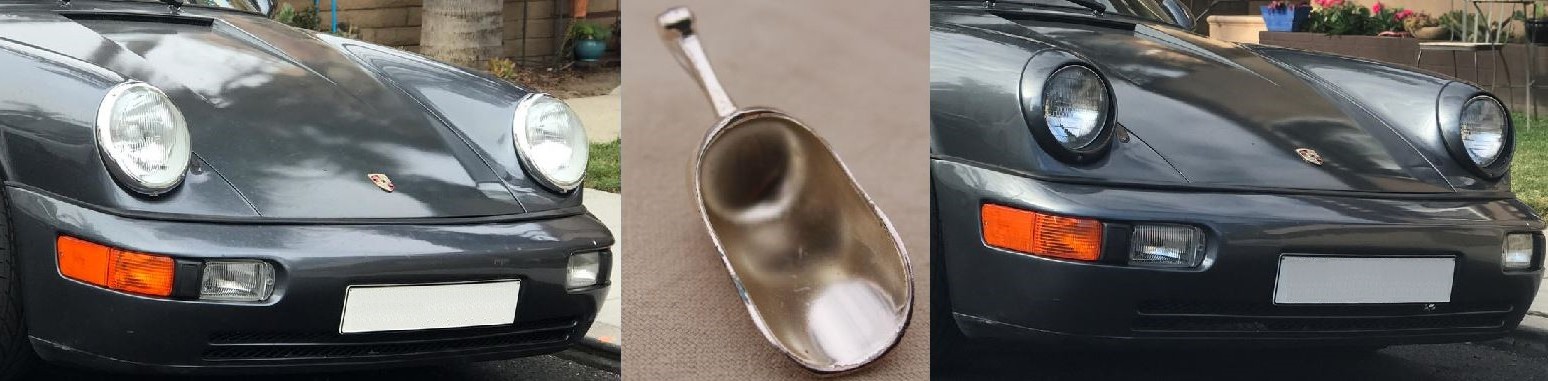
A US market 1977 Porsche 911 (1964-1989), fitted with the front bumper assembly of a later 911 (964 (1989-1994)):  The original “sugar scoops” are seen on the left and the replacement Hella H4 lights are to the right (in RoW cars both H2 & H4 units were fitted).  The (non-figurative) sugar scoop (centre) is Japanese, circa 1970s.  Sugar scoops are used to scoop sugar from a “sugar scuttle” whereas if one’s sugar is in a “sugar bowl”, a “sugar spoon” is used.  The difference between a “sugar spoon” and a “tea spoon” is the former has a deeper and usually more rounded bowl and most are supplied as part of a “tea set” or “tea service”, often with the same decorative elements.

1966 Jaguar E-Type FHC: undeniably, the headlight covers were a sexy shape.

Despite that myriad of modifications, all E-Types prior to the S2 are S1s but the running changes can be of significance to restorers if the object is exactly to emulate the state in which a vehicle rolled off the production line; in events such as a concours d'élegancé, judges can deduct points for even minor infractions.  Things became more distinct when on 11 January 1967 the first E-Type destined for the US market was built without the covered headlights and this marked the beginning of the run of what would come to be known as the 1.25 although it wouldn’t be until mid-year the open headlights became a universal fitting.  Unlike some cars where changes can be determined from the sequential VINs, the only way accurately to determine whether a 1967 E-Type built between January and July was fitted with covered or uncovered headlights work out the market for which it was built, those for NA using the uncovered fittings.  That's because an analysis of successive VINs will reveal on a given day there might have been a mix of cars going down the production line with different headlight assemblies.  Curiously, there were some 1968 E-Types built for Canada which included the triple SUs and while these included the interior changes mandated by US federal law, the door mirror on the driver’s side wasn't fitted and the tail and side lights were a different specification.  From 1969, Canada aligned its regulations with those of the US so from that point on, the NA specification was standardized but the history of S1 production does illustrate why things be so challenging for restorers wishing exactly to replicate what the factory did.

Between August-October 1967, the 1.5 run was built with twin Zenith-Stromberg carburetors (in a specification designed to reduce emissions) replacing the triple SUs (on NA cars), the substitution of ribbed camshaft covers, a higher mounting of the headlights (to meet minimum height requirements) and the adoption of rocker switches; at this point, the teardrop tail lights remained, the other most obvious external marker of the S2 being the chunky lights below the rear bumper bar.  In the usual manner, updates continued, such as twin cooling fans (a good idea) and 1000-odd run of the so-called "R2" cars, almost all of which were registered as 1971 models although many left the factory in 1970.  The R2 S2 E-Types gained a pair of "leaper" badges on the flanks, just behind the front wheel arches.  Unlike the steel leapers centrally mounted on the hoods of other models, the badges required two part numbers, one each for the left & right.  It seemed a pointless addition and just an addition of more clutter, as they were on the S1 (1968-1973) & S2 (1973-1979) XJs.

1971 S2 Jaguar E-Type (centre) from the "R2" run of 1000-odd with the leaper badges on the flanks.

So much did the clutter created by bigger bumpers, protuberant headlight assemblies, badges and side-marker lights detract from the lovely, sleek lines of the Series 1 cars, bolting a luggage rack to the trunk (boot) probably seemed no longer the disfigurement it would once have been.  The left-hand (left) and right-hand (right) badges, being directional, were different part numbers (BD35865 & BD35866 respectively) and those used on E-Types were silver on black.  There were also variants used on the XJs which were gold on black and some had the leaping feline at a slight slope, both matters of note for those wishing to restore to the exacting "factory original" standard.  

So, without a flow chart, it can be hard to follow and, because of some overlaps in the production process, the S1-to-S1.25-to-S1.5 transition wasn’t entirely lineal but none of this is mysterious because the JFSBs have documented and explained these “inconsistencies”.  Still, there are enough quirks to enrage some and delight others.  For example, there were a certain 32 specific NA market vehicles fitted with the headlight covers which were built with serial numbers later than the first of the open headlight cars.  Not all E-Types built for NA in 1967 thus had the open headlights and a not insignificant number of those 1.25 spec vehicles have been retro-fitted with the covers.  Such is the appeal of the covered headlights that although the E-Type market is monitored by the originality police (the “matching numbers” crowd with their extraordinary knowledge of things like “correct” hose clamps or screw heads), there is some untypical forgiveness for “back-dating” headlights to the sleeker look and they're not unknown even on the later, and much different, S3 cars.  Also, although US market S2 cars were from very early in the build fitted with the side-marker light assemblies, it wasn't until late in 1969 bulbs and wiring were fitted (the relevant law taking effect on 1 January 1970); prior to that they'd functioned merely as “side-reflectors”, meaning latter day purchasers need to inspect non-illuminating examples to work out if they're defective or just reflectors.  Opinion seems divided on the matter of fitting the triple SU carburetor assembly to cars delivered with the twin Zenith-Strombergs and many have been converted.  It's not difficult to make a 1.25 visually indistinguishable from a S1 and to do the same to a 1.5 is a matter just of more parts, time and money, the ethics of both ventures being transparency; once modifications are disclosed to a potential purchaser, it's up to them to decide if originality is critical.  Armed with lists of VINs, JFSBs and encyclopaedic knowledge, the JCNA's originality police will not be fooled. 

The lure of the headlight covers: 1973 E-Type S3 with headlight covers subsequently added (left) and with the standard "sugar scoops" (left).

These are US market cars with the additional "dagmars" appended to the bumperettes.  Even by 1973, thin whitewall tyres were still a popular option on US Jaguars and they remained available until the last were sold in 1975 but the wide whitewalls often supplied in the early 1960s had long fallen from favor.  Although the judges in the JCNA confederation are usually uncompromising, they make a rare exception in not deducting points from late-build E-Types (the so-called 1.25 & 1.5) which have been fitted with the headlight covers.  The covers never appeared on the S3 E-Types but their unexpected presence clearly doesn't dissuade buyers because the S3 pictured above (left) in February, 2021 sold at auction for US$230,000.  It was an exceptionally low-mileage example (8000-odd miles (13,000 km)) but even given that it represented an impressive premium for what was a "modified" vehicle.  The S3 cars also had a number of year-to-year variations but compared with the constantly evolving S1 the specification tended to the static.  One quirk was that as well as offering the new 5.3 litre (326 cubic inch) V12, it had been intended also to make available a version with the 4.2 litre XK-Six with brochures and promotional materials printed before the decision was taken only to fit the V12.  However, four six cylinder pre-production prototypes were built and one is known to survive; curiously, despite the rarity (indeed, it may genuinely be a unique, historic E-Type footnote), at auction it achieved a price little different from a 1971 V12 model in equivalent condition.

Jaguar E-Type production breakdown, 1961-1974.  

While the loss of the toggle switches, teardrop taillights and headlight covers caused many to lament that the world was shifting from elegance ungainliness, some other changes also induced pangs of regret.  The switch from triple to dual carburetors was necessitated by the emission control regulations; the claimed HP (horsepower) dropped from 265 to 246 and while not many took the original rating too seriously, there was a drop in performance, especially in the upper speed ranges.  One often less noticed change mandated by the DOT was the replacement of the “eared” knock-off hubs for the wire wheels (the E-Types only ever using a two-eared version although third-party items with three ears are available) with a more “pedestrian friendly” type which, bewilderingly, are now referred to as the “non-eared”, “curly”, “octagonal”, “smooth”, “federal” “safety” and “continental” knock offs.  Take your pick.  Buyers could also take their pick of whether their “improved” wire wheels (now incorporating a forged centre hub) were painted in matte silver or chromed although the JFSB did caution that because of the altered configuration of the spokes, the wheels were not interchangeable with the earlier type except as a complete set (ie five per car).  Available from 1 January, 1968 (the effective date for many of DOT’s new rules), this was Jaguar’s last update of the wire wheels which, in a variety of forms, the company had been using since being founded in 1922 as the Swallow Sidecar Company.  Never offered on the biggest and heaviest of the post-war cars (the Mark VII, VIII, IX and X/420G) or the new XJ range, they were last used on the “overlap” Daimler saloons (250 & Sovereign) in 1969 although they remained an option for the E-Type until the last was built in 1974.  

Wire wheels and associated components for the E-Type by Martin Robey; note the two designs of spinner saver (eared & non-eared).

Although a handful of small-scale producers (the last hold-outs from the days of cottage industries) continued to offer wire wheels, their final appearance on the option lists of the UK industry’s volume models came in 1980 when the last of MG's Midgets and MGBs were sold.  The term "knock-off" sometimes confuses because in slang it can mean a "fake or reproduction item" but in the context of wheels the original meaning described the centre-locking hubs (known also as "spinners") which were tightened or loosened by being "knocked" on the ears with the (often lead-faced) mallet (sometimes described as a hammer) included in the tool kit.  In racing, pit crews would strike the ears directly but tool-kits usually included a (typically timber) "spinner saver" to minimise damage to both hub and mallet; when non-eared hubs appeared, the shape of the spinner saver was also changed.  So the term can confuse: The famous Italian manufacturer Borrani produced many wheels with centre-lock hubs so the phrase "Borrani knock-offs" is standard industry jargon and by convention "knock off Borranis" is used of replica locking nuts (also called "spinners"), the presence of which can be a concern because they might be of lower quality, not manufactured to the safety and performance standards of the genuine product.  

Norway’s Motorhistorisk Klubb Drammen (Historic Car Club of Drammen) from Buskerud county reported on an exhibition hosted on 2 July, 2014 by the Norsk motorhistorisk museu (Norwegian Motor Historic Museum) in the village of Brund, the event honoring Lindsay Lohan’s (b 1986) 28th birthday.  The red S2 Jaguar E-Type had received a recent restoration but a detailed examination would have to be undertaken to determine the degree to which it remains in its original specification.  Given the visible clues and its presence in Norway, this may have been a RoW (which the triple SU carburetors would suggest though they are a popular swap on twin-carb models) car but there’s a lively two-way trans-Atlantic trade in E-Types (many now expertly restored in Poland) so it may originally have been sold in the US or Canada.

The “Shaguar” used in the three Austin Powers movies (1997, 1999 & 2002).

The Shaguar was a 1967 S1.5 E-Type which featured the combination of teardrop taillights, twin carburetors, sugar scoop headlights, a glove-box door, rocker switches and, being right-hand drive (RHD), it wasn't built for NA.  When the auction house published the photographs, the vibrant on-line originality police did their analysis and concluded it was built in December 1967 as a 1968 model but was in far from original condition (beyond the obvious paint and Shaguar badge).  The dashboard included the earlier manual choke and the heater and vent controls appeared to be missing and while the side & turn lights were NA specification, the taillights were those used on RoW cars.  The tachometer was the one one fitted to S2 models and it was suspected this may have been swapped when the later, non-original engine with the twin Zenith-Stromberg carburetors was installed.  Over the decades, many E-Types have for one reason and another drifted far from their original build and usually this limits their appeal to collectors but at Mecum Auctions in January 2025, the Shaguar realized US$880,000 (including 10% buyers premium), several times the typical sale price of a non-original S1.5 RoW E-Type in the same condition, its history as a cinema prop clearly an attraction.

Saturday, February 28, 2026

Knob

Knob (pronounced nob)

(1) A projecting part, usually rounded, forming the handle of a door, drawer window-frame or the like.

(2) A (usually) ball-shaped part of a handle, lever etc, designed to be grasped by the hand.

(3) In machinery, an almost always rounded control switch that can be rotated on it axis (ie to turn on/off, raise/lower volume etc), designed to be operated by the fingers and visually also emulated in software on screens.

(4) A rounded lump or protuberance on the surface or at the end of something, as a knot on a tree trunk or a fleshy lump or caruncle.

(5) A rounded ornament on the hilt of an edged weapon (the pommel).

(6) In architecture, furniture design etc, an ornamental boss, as of carved work.

(7) In geography, a rounded hill, mountain, a knoll, an elevation on a ridge or morainic ridge.

(8) In botany, a bulb of the garlic plant consisting of multiple cloves in a chunky branch,

(9) In certain military and other institutions, a new recruit.

(10) In hunting & animal husbandry (as knobber), a hart in its second year; a young male deer.

(11) In cooking, a dollop, an amount just larger than a spoonful (used usually in reference to butter and in professional catering there are “butter curlers” which produce an attractive ribbed-curl of butter to be served with the bread-rolls, each curl said to be the equivalent of a “half dollop”.

(12) In slang, the head, thus a person with red hair being a “gainer knob”.

(13) In vulgar slang the head (glans (spongiosum)) of the penis but sometimes used of the whole organ, thus the slang “knobhead” (an unintelligent or contemptible person) and a “literal” synonym of “dickhead”), sometimes used in the forms “knobber” & “knobber”.

(14) In vulgar slang (by extension), to have sexual intercourse with (someone).

(15) In vulgar slang (usually in the plural), a woman's breasts (sometimes with a modifier thought appropriate to the anatomy specifically being referenced).

(16) In vulgar slang, the clitoris.

(17) To produce a knob on (an object).

(18) To furnish with a knob, typically for a functional purpose (adding one to a door, window frame etc) but also as an ornament.

(19) To turn an object into a knob (rare).

(20) In stone cutting, to knock off (excess stone) preparatory to dressing; to knobble; to skiffle.

1350–1400: From the Middle English knobe & knobbe, thought almost certainly from a Scandinavian or German source and probably at least influenced by the Middle Low German knubbe & knobbe (knob; knot in wood; bud), the Middle Dutch knobbe & cnoppe, the Dutch knop (knob, button, bud), the Old Frisian knopp & knapp, the Old High German knopf (bud, pommel of a sword, knot, loop), the Middle High German knospe, the German Knopf (button, knob) & Knospe (bud), the Danish knap (button) & knop (knob, button, bud) and the Old Norse knyfill (short horn).  Most etymologists seem most convinced by it being a variant of the Proto-Germanic knappô (knob, lump) & knuppô (lump, clod), both among the “kn-” words related to knudaną (to knead).  Probably related were the Middle English knap & knappe (small projection, knob (in the sense of “button, tassel, tuft etc”), hill, hilltop etc)), from the Old English cnæp & cnæpp (summit, top), which may in some way be linked with the Old Norse knappr (small projection, knob (in the sense of “button, head of a stick etc”)) (and from which English gained knop), the source again the Proto-Germanic knappô.  The meaning “knoll, isolated round hill” seems first to have appeared in the 1640s and, perhaps surprisingly, no instance of “doorknob” has been found prior to 1829 although the word may have been long in oral use (drawer-knob, window-knob etc all followed).  Knob is a noun & verb, knobless is a noun, knobbed & knobbing are verbs, knoblike & knobby are adjectives; the noun plural is knobs.

Yorkeys Knob, Cairns, Queensland, Australia.

In idiomatic use, the phrase “same to you with knobs (sometimes “brass knobs”) means “the same to you but even more so” (used typically in response to an insult or slight).  A “knob-twiddler” can be an informal term for a technician or console operator whose job entails adjusting electronic devices via knobs but it can also describe anyone whose role seems either unimportant or not particularly demanding.  As machinery and later electronics became an increasingly ubiquitous part of life, so did knobs and as early as the late nineteenth century the humorous “knobologist” had been coined to describe both those designing the system and the “knob-twiddlers” using them; the discipline of design was of course dubbed “knobology” and that remains a core component of ergonomics, exploring imperatives such as placement, size, tactility and labelling, all of which influence the functionality of controls on an instrument as relevant to their application.  The knobologists deeply were implicated in convenient physical switches, knobs and buttons disappearing from cars and re-imagined virtualizations on inconvenient touch-screens.  Such has been the reaction (including the realization the change made driving more accident prone) that the tactile controls are making a welcome comeback.  The now archaic “knob-thatcher” was an affectionate term for a maker of wigs while the more modern “surfer's knob” was slang from the sport, describing a hard bump or nodule on a surfer's knee, shin or ankle, resulting from recurrent contact with their surfboard.  In engineering and metallurgy, “to knobble” was (1) to render a surface with a knobbly finish and (2) to produce wrought iron by treating semi-refined puddled iron on a hearth before shingling, a specialized device in the business being the ominous sounding “knobbling furnace”.

Gay men supporting lesbians at the first “Dyke March”, Washington DC, April 1993.  The sign held by the protester at the far left uses the compound word for which the euphemisms “knob polisher” & “knob-gobbler” were coined.

Because knob was popular slang for penis, a number of derived terms predictably emerged.  A “knob polisher” or “knob-gobbler” was “one who gives fellatio”.  “Knob rot” was a reference to certain sexually transmitted diseases contracted by men, the acute condition “galloping knob rot” describing a rapidly progressing or uncontrollable variant of the condition.  A “knob job” was the act of fellatio.  “Knob cheese” (the terms “cock cheese”, “dick cheese” and (in context) even “cheese”) was vulgar slang for smegma (a whitish sebaceous secretion that collects between the glans penis and foreskin or in the vulva).  “Knob jockey” must however be used with care because it has variously been applied to (1) gay men, (2) promiscuous straight women and (3) promiscuous straight men; context thus matters.

buttons).  In US military slang, buttonology is used of user interfaces generally.

Button porn: Centre console in 1991 Mercedes-Benz 600 SEL (V140).

Although a sight to delight button-nerds, "peak button" unfortunately coincided with the "biodegradable wiring incident" (1991-1995) in which the soy-based insulation for the cables deteriorated some decades before the supplier's projected end-of-life, the issue exacerbated by the taste of soy which would attract rodents and other creatures happy to chew on the stuff for a quick snack.  The basic shape of the gear selector knob dates from one introduced in 1971 in the 350 SL (R107, 1971-1989), the design a product of analysing data from the Swedish government's mandatory post mortems (autopsies) of road-accident fatalities (under Swedish law, such corpses were for 48 hours the property of the state).  What the pathologists' findings revealed was lives could be saved if engineers could devise as a shift lever handle too large to penetrate the eye socket.  While there's an element of the macabre in such research and it wasn't something the factory choose widely to publicize, the design was a classic example of what's called "passive safety".

Interior of Porsche 917K with cool (in both senses of the word) balsa wood shift knob.  The obviously "fake" passenger bucket seat was installed to comply with the rules in sports car racing.

To this day, the myth persists the balsa wood gear-shift knob used in the Porsche 917 was there as a “weight-saving measure”.  While it’s true the small knob was light, the difference between it and the aluminum or magnesium units the company had fitted to earlier race cars would have been so insignificant it’s doubtful it would have equalled a gulp of coffee the driver may or may not have enjoyed.  The stylish timber piece was however not a decorative flourish but a legitimate engineering solution to ameliorate one manifestation of “chronic heat soak”.  In 1969, the 917 was a radical advance which, Dreadnought-like, rendered all other cars in its class instantly obsolescent but the flat-12 engine (Porsche’s first in the configuration) radiated so much heat it was difficult to manage.  In a tradition it would not for decades abandon, Porsche continued to use air-cooling for the engine (which really means “oil cooled” about as much) and it ran hot; between that heat source and the gear level was a unbroken metal path, each component a most efficient conductor.  During endurance racing (some events conducted over 24 hours), cockpit temperatures could reach what doctors would rate as “extreme”.

Close-up of balsa wood gear-shift knob in Porsche 917K.

The metal lever was just one of the sources of this heat and the knob (which sat next to the driver’s knee) needed to be grasped by the driver, often many times a minute; were it to become so hot it caused pain, it would have been safety issue.  Although in 1969 the space-age was at its zenith, the materials which could have made a driver’s gloves close to heat-proof were not then commercially available so they gained much of their protective quality from thickness but the problem was they could be only so thick because a driver needed still to handle a highly-geared steering wheel and operate the many knobs and switches within arm’s reach.  Balsa wood, with its very low thermal conductivity was ideal because while not exactly cool to the touch after a few hours on the track, it never got so hot it felt unpleasant.  It also had adequate strength for its task; a gear-lever knob does not bear structural loads and, being Porsche, it received the same careful attention as every other component, each one precisely machined to exact dimensions before receiving two coats of clear lacquer.  Most variants of the 917 used the balsa wood part although when (as the “Turbo-panzers”) the most powerful of the breed appeared in the Can-Am (for Group 7, unlimited displacement sports cars) a metal knob was fitted, made possible because Group 7 was for open cars and significantly that reduced cabin temperatures.  By the late 1970s when the space age had made available materials (phenolic plastics, composites etc) with superior insulation qualities, the need to resort to a balsa wood knob vanished but the visual appeal remained and in the aftermarket, 917-style knobs remain widely available.

2006 Spyker C8 Laviolette Widebody: Dashboard layout with four-spoke “propeller” steering wheel (left) and toggle switches with nerf-bars (right).  While screens may for certain purposes be better than knobs & switches, the latter often are easier to use and visually, can be most pleasing.

What Porsche did in designing the linkages to the transaxle was dictated by nothing other than usual the design imperatives for racing cars: robustness, reliability, ease of operation and lightness, the use of balsawood as an “anti heat-soak” material wholly in accord and the same parameters were applied by Spyker when designing their distinctive shift mechanism.  Spyker, a boutique operation from the Netherlands, began operation in 1999, the name coming from a Dutch coach-builder that between 1880-1926 would branch out from horse-drawn carriages to automobiles and even aircraft.  Since 2000, between various local difficulties (including bouts of bankruptcy), Spyker has produced a number of high-performance models and while the mechanical specification has always been impressive, what has also drawn attention are the exquisitely finished interiors, the attention to detail (typified by the nerf-bars used to make lawful the use of toggle switches) a delight for those who study such things.  Unfortunately the four-spoke “propeller” steering wheel (a style last seen in volume on the Jaguar XK150 (1957-1961) was eventually judged just too potentially lethal to be granted an exemption from compliance and was replaced with something more accommodating from the Lamborghini parts-bin.

Engineering as art: Gear-shift mechanism, 2006 Spyker C8 Laviolette Widebody (left) and 2007 Spyker C8 Laviolette Targa with, softer, gentler steering wheel (right).

While Spyker’s wonderfully crafted shift mechanism for the rear-mounted ZF transaxle with exposed shafts of stainless steel might seem an affectation, it’s pure functionalism; being a direct mechanical linkage, they provide precise gear-shifting, always a challenge with such a layout (the Porsche 914 (1969-1976) community coined “broomstick in a jar of mayonnaise” to describe the to describe the experience of the earlier "tail-shift" models, the post 1972 "side-shift" build a great improvement from "bad" the "satisfactory").  Spyker’s engineering is thorough and although pure-steel from transaxle to knob, heat-soak along the shaft is said to be minor so there was no need to resort to timber for the knob.

1959 Ford Fairlane Galaxie 500 Sunliner with suicide knob (on steering wheel at 10 o'clock).  This was a generation before "softer, gentler steering wheels".

Suicide knob” was the most popular name for the device attached to a vehicle’s steering wheel which facilitated easier “single arm steering”.  The idea dated from the days before the almost universal fitting of power-steering and the things became popular in the US in the US in the 1950s and 1960s as even low-priced cars became heavier; for some drivers, they were invaluable when manoeuvring at low speed, especially when reversing.  They were known also as the “necker knob”, “wheel spinner” and “granny knob” but the most correct term was “Brodie Knob”, the name in honor of Steve Brodie (1861–1901), an apparently rather raffish gentleman from New York City who, as a last resort in 1886 after losing everything gambling, staged a stunt in which he jumped off the Brooklyn Bridge (site of a good many suicides), the lure a sum of money he was bet although the details of that are murky.  Mr Brodie anyway survived to collect on the wager and, on the basis of the notoriety gained, began performing other dare-devil acts for even more money.  So the jump from the Brooklyn Bridge was a good career move although the consensus now is it was a cunning stunt (ie a scam), a weighted dummy the real diver with Mr Brodie entering the water from the safety of the shoreline.  In fairness, at least some of his subsequent dangerous stunts were verified by observation and he parlayed his fame into a successful career in business, becoming a noted philanthropist and dying a rich man.

The invention of the suicide knob generally is credited to Joel Thorp of Wisconsin but similar devices had for centuries been in use on land and water.  What Mr Thorpe described in the supporting documents for what was issued as US Patent 2,101,519 STEERING WHEEL SPINNER KNOB (Dec 7, 1937) was an “improvement” of the concept:

The present invention relates generally to improvements in appliances for facilitating manipulation of the steering wheels of vehicles, and relates more specifically to improvements in the construction and operation of spinner knob attachments co-operable with the peripheral rims of steering wheels or the like in order to effect more convenient and rapid operation of such wheels under certain conditions of use.  Generally defined, an object of my present invention is to provide an improved steering wheel spinner knob which is simple in construction and highly efficient in use.

A young lady wrapping practiced fingers around the timber shift knob in 1970 Maserati Indy (Tipo 116, 1969-1975).  In the era, it was fashionable in Italian exotica for the knob and steering wheel rim to match (ie in leather or wood).

Although widely used on tractors, heavy transport vehicles and such, it was in the 1950s as cars in the US became heavier the suicide knobs gained popularity and some of that was due to reasons Mr Thorp probably never envisaged.  One receptive market was males aged 17-25 (a crew infamous for many reasons) who found the combination of suicide knob and bench seat made an idea ecosystem, enabling one hand to be used steer the vehicle while the "free" arm could wrap around the girlfriend (or alternative) who affectionately was resting her head on the driver’s shoulder.  In this arrangement, a driver’s attention more easily could be divided between her and the road.  It was also males aged 17-25 who were the core of the hot-rod community which began as a West Coast phenomenon (induced by a critical mass of the right demographic, available disposable income and a good supply of cheap, used cars which easily could be modified as desired) and they found suicide knobs the best way to “do a half donut” (a spin of one’s hot rod through 180o), the trick being to grip the knob and then suddenly turn the wheel while applying full throttle, resulting in a loud, spectacular maneuver, made the more pleasing for the driver by him having “left his mark” in strips of runner on the road.  This, the hot rodders called “spinning a brodie”, a variant on the earlier “doing a Brodie” (a dangerous or otherwise inadvisable act) which entered the language after the nation-wide publicity which followed Mr Brodie’s alleged leap from the Brooklyn Bridge.  In the era, a Brodie Knob was as essential a piece of equipment as one’s packet of unfiltered Camel cigarettes or pair of fluffy dice hanging from the rear-view mirror.

1962 Maserati 3500 GTi.  Some Maserati 3500 GTs (Tipo 101, 1957-1964) had the unusual feature of having front and rear quarter-vents fitted to the same door; they were opened and closed using knurled, stainless steel knobs.

The dark appellation “suicide knob” was bestowed because (1) the devices came to be associated with accident-prone drivers (the “males aged 17-25 cohort prominent in the statistics) who probably did use the things to engage in “risk-taking” and (2) by virtue of their location (by default affixed to the upper quadrant) on the wheel, they were a genuine danger in accidents and, in an era of non-collapsible steering columns, tales of them penetrating the eye socket, causing irreparable loss of vision and traumatic brain injury, were legion.  The crusading US lawyer Ralph Nader (b 1934) is criticized for much but the contribution his book Unsafe at Any Speed (1965) made to reducing the death toll on the roads cannot be under-estimated and the effect was world-wide because the rest the industry eventually followed the lead of the US legislation which came in the book’s wake.  In the US and elsewhere, change was of course resisted but it came and while it’s not possible to estimate how many deaths and often gruesome injuries the reforms prevented, no one denies it’s a big number.  The suicide knob was one minor casualty of the movement and in road-registered vehicles, in most jurisdictions (although some US states remain permissive), such devices are permitted only for specialized (often low-speed) vehicles and if used by drivers with some disability which precludes the use of conventional controls.

A Hurst Jaws of Life used between 1977-2012 by the fire department in Carlsbad, New Mexico, now on display at the National Museum of American History.

Another to make a life-saving contribution to reducing the road toll was George Hurst (1927-1986; founder of his eponymous company) whose great legacy to humanity was the “Jaws of Life”, a hydraulic cutter he first developed in 1961 after being shocked at how long it sometimes took to extract the driver from the crumpled wreck of a race car.  The great advantage of the “Jaws of Life” was that it worked like a very powerful pair of scissors, avoiding the showers of sparks produced by mechanical saws, always a risk to use in areas where fuel is likely to have been spilled.  The basic design came to be used in hydraulic rescue devices worldwide and quite how many lives have been saved by virtue of its use isn’t known but again, it would be a big number.

Two decades of progress: Shifter knobs for the two-speed Powerglide automatic transmission in 1953 Chevrolet Corvette (left) and a classic spherical shift knob in 1972 Chevrolet Corvette LT1 (available only with a 4-speed manual transmission).  The delicate-looking shifter in the 1953 Corvette seems modest but the location was a world-first for an automatic and was efficient because the location (between the driver’s seat and transmission tunnel) provided the shortest possible path to the linkage; as late as 1964, Chrysler used a similar apparatus for the handful of 1964 300Ks fitted with a manual transmission.  One amusing geometric quirk is the three-dimensional sphere and two dimensional circle share the same definition: A shape in which all points are equally distant from the centre. 

However, before the Jaws of Life, Hurst was already famous in the vibrant sub-culture which was at the times also known for its propensity to purchase and install suicide knobs.  Hurst produced “shifters” which were the assemblies connected to a transmission, used by the driver to “change gears” and they proved instantly popular which may seem strange given every manufacturer at the time included a shifter with every vehicle.  However, beginning in the late 1930s, the US manufacturers had begun moving from centrally located, floor-mounted levers to units on the steering column because it made for better packaging efficiency in the cabins, then optimized for bench-seats with three-astride seating.  That move achieved the goal but with the linkage between lever and gear-changing mechanism now longer and making more turns, some precision in the shifting was lost and column shifting (the once almost universal “three on the tree”) was less conducive to an enthusiastic driving style (such as that of the “suicide knob equipped” crowd).  It was in the 1950s the taste for floor-shifts like those in European sports cars began to gain critical mass and even though the 1953 Chevrolet Corvette was hardly a sports car in the tradition of MGs, Fiats and such, it’s notable Chevrolet from the start installed a floor shift for the (two-speed!) Powerglide automatic transmission; it may not have been a sports car with a “four-on-the-floor” but it had a floor-shift so there was that.  Automatic transmissions in mass-produced cars was then something of a novelty barely a decade old and the Corvette’s floor shift was apparently a world-first.

A butter curler producing curls.  Generally, the curlers come in large and small, respectively producing a curl notionally equivalent to a dollop or a knob (half-dollop).  In the kitchen however, knobs and dollops are what the chef decides they are.

Four-speed manual transmissions began to appear in Detroit-made cars in the late 1950s and within half a decade George Hurst’s shifters were close to obligatory for any racer (authorized or not) seeking “street cred” and it wasn’t a confected image, the Hurst shifters demonstratively superior without being excessively expensive.  So stellar did their reputation become even GM (General Motors) relaxed their long-standing ban on other brand-names being associated with their products and made a feature of one being standard equipment of the 1964 Pontiac GTO, the car credited with being “the first muscle car” and such was the success in 1965 the shifter’s handle was even permitted to be embossed: HURST.  Soon, other manufacturers actively were seeking co-productions.  George Hurst’s path to market domination was shockingly simple and might have come from a textbook: (1) a perfected design, (2) skilful engineering in development, (3) high quality in production and (4) an attractive price, a combination of elements with great appeal for buyers and manufacturers alike.

Hurst’s dual-gate automatic transmission “His and Hers” shifter with conventional apparatus “for the automatic minded little lady” and a performance-oriented configuration offering manual control for the “man who really wanted a 4-speed standard stick but bought this extra just for her.  Note the unfamiliar shift pattern, the now universal PRNDL not an industry standard until 1965, the year before it was demanded by regulations.  From the early days of automatic transmissions in the 1940s, reverse had been directly adjacent to Low, allowing drivers more easily to emulate what was done with manual transmissions when a “rocking” was being induced to try to free a vehicle from mud or snow.  It was a quirk of the age and, because reliability was not then what decades later came to be expected, the early transmissions included a second (rear) fluid pump to permit push/tow/hill starts.  Probably, not many much dwelt on the shape of the knob Hurst put atop the His and Hers” shifter but in geometry it would be described as an oblate spheroid with two parallel planar truncations.  Now easily modelled in software rendered with a 3D printer, perfecting a shape like this for production used to absorb much time on the drawing board and in the creation of prototypes.  A spheroid is an ellipsoid generated by rotating an ellipse about one of its principal axes which, if “stretched” along one axis becomes a prolate spheroid (ie elongated and something like a rugby ball).  If slightly flattened along the axis of rotation, it’s an oblate spheroid (like planet Earth which isn’t quite a pure sphere) but the His & Hers knob, having a slight elongation along the shifter’s axis, is closest to a prolate spheroid.  The planar-truncation (ie sliced by two parallel planes) created the (left & right) flat faces and the knob can thus be described as a “truncated ellipsoid” or “truncated prolate spheroid” but anyone wishing to out-nerd the rest would probably coin something like “biaxial ellipsoid with parallel planar truncations”.

It was early in the era of second-wave feminism (1960s-1980s) that George Hurst made his brief foray into marriage guidance counselling.  First-wave feminism (1895-1950s) is sometimes called the “de jure” or structural” period because the focus was on legal issues such as women's suffrage, property rights and political candidacy but, in the West, an early victory was overcoming any opposition to women being granted driver’s licences.  Attitudes however evolved not wholly in parallel with legal rights and even today, among some, the view persists it’s men who are focused on performance and speed while women value vehicles using other criteria.  Impressionistically, that stereotype is not wholly without foundation but, since second wave feminism reset the rules, it’s no longer possible to run advertising perpetuating the notion.  The “His and Hers” shifter worked with a key-lock which enabled the husband to ensure only he could use the “manual override” feature and the idea in recent decades has been revived although this time the target of the lockout includes one’s (presumably male) children and any concierge or attendant who might be entrusted with parking one’s car.

Advertisement for Hurst's "custom knobs" (left) and the famous Hurst "pistol grip shifter" in 1970 Plymouth 'Cuda 440+6 (ie 3 x 2bbl carburetors) (right).

The magic of Hurst’s shifters was in the mechanism but, just as for computer users the mouse and keyboard assume great importance because it’s by touching these relatively simple pieces of hardware that use can be made of the machine’s more sophisticated internals, it was the shifter’s knob which was a driver’s most intimate connection with the transmission.  Although in the art deco era there had been some lovely detailing, it wasn’t until the 1960s most conceptually moved beyond beyond “variations on a theme of sphere” and Hurst was among the manufacturers to explore shapes and substances.  There were “T-Handles” (which, usually as "T-Bars", were for decades popular around the world for automatics) and “Horseshoes” which attracted admiring glances but didn’t catch on and any number of novelty items including billiard balls (the “8 ball” predictably a favourite of the V8 crowd) and scale models of this and that including human body parts such as the skull and mammary gland.  Knobs could be of plastic, wood or various metals and came in designer colors, velvet coatings a nice touch of the 1960s.  The most fetishized of the muscle car era however was Hurst’s “Pistol Grip Shifter” which did what it said on the tin: it gave the user the feeling of holding a handgun.  In the 1960s, gun culture in the US hadn’t yet become what it is today (as now defined, the first “mass-shooting” didn’t happen until 1966) but it was still a place with a lot of firearms.  However, despite the potential implications, when in 1970 Chrysler made one standard equipment on the 1970 Plymouth ‘Cuda, one brochure made mention of the device only with the bland: “...a convenient pistol grip”.  For a corporation which called the Cuda’s hood scoop the I.Q.E.C.A.G. (Incredible Quivering Exposed Cold Air Grabber), it seemed a missed opportunity though it didn’t have much linguistic luck with I.Q.E.C.A.G., customers and everybody else deciding it was a “shaker”.

Ginger knob Lindsay Lohan in The Parent Trap, approaching 23 Egerton Terrace (tagged 7 for the film), Knightsbridge, SW3, London (the front door with a knob, left) and standing next to a door with a handle (right), from a photo-shoot by Rebecca Lader.

Architecturally, the choice between specifying door levers or door knobs is often one of mere preference or aesthetic conformity but for public or commercial buildings, some regulatory authorities now mandate the use of levers because typically they are easier to use for those with disabilities (especially if hand-mobility is limited) as they demand less dexterity.  Additionally, being circular and often highly polished, knobs can be hard to use with wet hands so that’s a consideration in kitchens, bathrooms and such; nor do young children find them as convenient as a handle.  So, all that would seem to make a compelling case for the handle but for domestic use, there’s one quirky consideration some may wish to include when making the choice.  While there are verified cases of cats and dogs learning to open doors using a handle, no pet has yet been observed mastering the turning of a door knob; while a rare problem, the chance of one’s cat or dog opening door using a lever is not zero and, because houses tend to use the same style of lever throughout, once they have learned to open one door, they’ve really learned to open all.  If it’s a concern, the good news is most doors are adaptable for either so replacing a lever with a knob does not usually require the door being replaced.