Showing posts sorted by relevance for query Saint. Sort by date Show all posts

Saturday, November 25, 2023

Saint

Saint (pronounced seynt)

(1) Any of certain persons, said to be of exceptional holiness of life, formally recognized as such by churches by act of canonization (with doctrinal and procedural differences between denominations).

(2) In secular use, figuratively, a person of extraordinary virtue or who performed acts of extraordinary virtue (often as secular saint).

(3) As patron-saint, the founder, sponsor, inspiration or patron, as of a movement or organization (used formally by churches and informally otherwise).

(4) A religious icon or relic (archaic).

Pre 1000; A borrowing from the Old French, it existed in English as seint, sainct, seinct, sanct & senct, derived from the Latin sānctus (sacred; holy), adjectival use of past participle of sancīre (to hallow; to consecrate), the construct being sanc (akin to sacer (sacred)) + tus (past participle suffix).  The French borrowing replaced the Old English sanct which had been drawn from the Latin.  Variations were adopted by most Germanic languages; it was sankt in the Old Frisian, sint in Dutch and sanct in German; the Italian is santa.  As a verb in the sense of "to enroll (someone) among the saints", use was common by the late fourteenth century and the adjectival forms saintly & saintliness emerged in the 1620s.  Universal abbreviation is St and now often without full-stop, a welcome reduction in clutter.  One quirk in English is the name St John (Christian or surname) is properly pronounced sin-jin.

Originally an adjective prefixed to the name of a canonized person, by circa 1300 it had become a noun.    Saint Bernard, to describe the breed of mastiff dogs, was used first in 1839, the name adopted because the monks of the hospice of the pass of St Bernard (between Italy and Switzerland) sent them to rescue snowbound travelers.  The term secular-saint remains in wide use, the first known example being St Elmo's Fire (named for the patron saint of Mediterranean sailors, a corruption of the name of St Erasmus (fuoco di Sant'Elmo in the Italian), an Italian bishop martyred in 303) in the 1560s.  The phenomenon of weather is known also as corposants or corpusants, from the Portuguese corpo santo (holy body), and was described as long ago as Antiquity, mentioned in Os Lusíadas (The Lusiads (1572), a Portuguese epic poem written by Luís Vaz de Camões (circa 1524-1580) and earlier alluded to by the Greek poet Xenophanes of Colophon (circa 570–circa 478 BC).

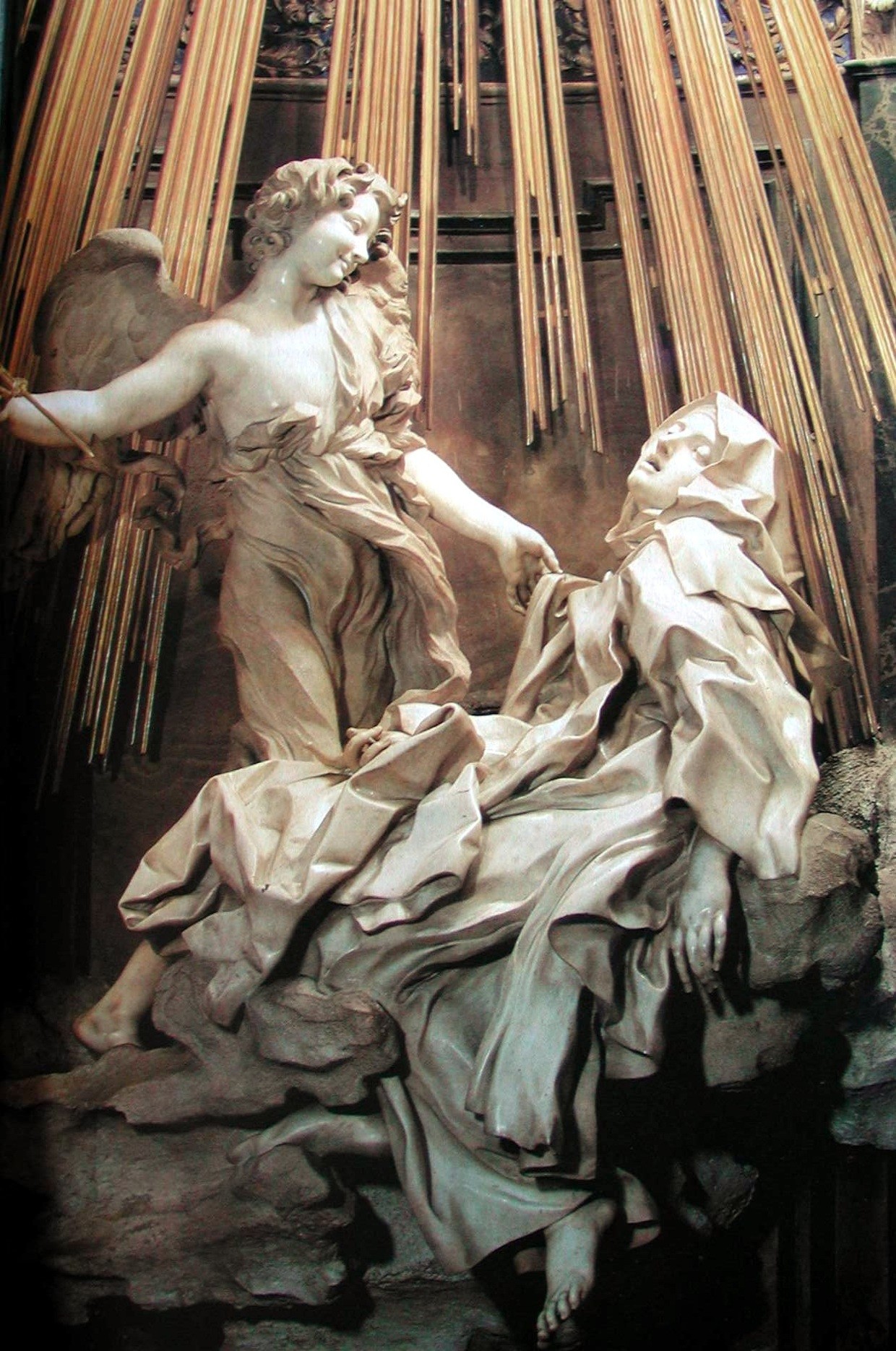
The Ecstasy of Saint Teresa

Unlike many of the buildings usually included in the standard tourist itinerary of Rome, the Cornaro Chapel (1626), at Santa Maria della Vittoria, close to the Repubblica metro station, is tiny.  In this intimate space is an elevated aedicule on which sits the little church’s famous installation, L'Estasi di Santa Teresa (The Ecstasy of Saint Teresa; sometimes called The Transverberation of Saint Teresa), a sculptural group in white marble, carved by Gianlorenzo Bernini (1598-1680) in 1652.

The interior of the church, also the work of Bernini, is sumptuously decorated, gilded stucco and multi-colored marble arranged so that barely a surface or crevice is left naked, this lushness the best setting imaginable for this masterpiece of high Roman baroque.  Bernini dismissed the suggestion he use an enclosed chapel and instead presented his composition as a theatre, cleverly lit by a window hidden by the pediment with, on the flanking walls, two opera-boxes containing sculptured representations of the family of his patron, the Venetian Cardinal Federico Cornaro (1579–1653). 

Bernini had reason to be grateful to the cardinal.  The work was completed during the pontificate of Innocent X (1574–1655; Giovanni Battista Pamphilj, pope 1644-1655) and Bernini had been the court architect of the previous pope, Urban VIII (circa 1568–1644; Maffeo Barberini, pope 1623-1644), regarded by Innocent as profligate.  With papal patronage withdrawn, Bernini was again an artist for hire and the cardinal granted the commission.  Teresa of Ávila, the Spanish founder of the Discalced Carmelite nuns, is depicted seated on clouds as if on a bed.  She is captured during the ecstasy she described in her mystical autobiography, experiencing an angel piercing her heart with a dart of divine love, causing both immense joy and pain.  Considering the long tradition of statuary in the Roman Catholic Church, that of Saint Teresa is quite a departure, her contorted posture and the ambiguous smile of the angel lending the scene a rare mix of passion and voluptuousness.  It’s reputed also to be the only Roman Catholic church with a painting depicting a battle scene above the alter and soldiers instead of angels holding up the organ, a legacy of the celebrations at the end of the Thirty Years War (1618-1648).

Saint Teresa in white marble, 1652 (left) and Lindsay Lohan resting in a Cadillac Escalade, Los Angeles, May 2007 (right).  The striking similarity between the two saintly souls inspired one of 2007's most widely-shared memes.

Wednesday, February 14, 2024

Valentine

Valentine (pronounced val-uhn-tahyn)

(1) A card, message, token or gift sent by one person to another on Valentine's Day (14 February) as a mark of affection.  Historically they were usually amatory or sentimental but there are also commercially available versions (usually as cards or e-cards) which are satirical, comical or sardonic.  They were often (and perhaps still are) send anonymously but in an age when the awareness of stalking has become heightened, caution is now recommended.

(2) A sweetheart or object of desire chosen or greeted on this day.

(3) A written or other artistic work expressing affection for something or someone (the latter often a poetic or literary device).

(4) A surname and a given name, the latter variously feminine or masculine according to local convention.

(5) As Saint Valentine (circa 226-circa 269), a saint commemorated in both Western Christianity & Eastern Orthodoxy.

(6) A locality name in a number of places.

1400–1450 (in the sense of the adoption in English): From the late Middle English, from the ecclesiastical feast of Saint Valentine (14 February).  The derived forms are rarely used.  The adjective valentinesy (something characteristic of Saint Valentine's Day) can be used of some romantic act usually more associated with 14 February and does have the advantage of being a single word which does the job which would otherwise take a phrase but the only thing that can be said in favor of the noun valentining (the practice of giving and (presumably) receiving something on Saint Valentine's Day) is that it seems not yet to have become a verb.  The noun Valentinian was used to describe a member or adherent of the second century AD school of Judaizing Gnostics, founded by Valentinus (circa 100–circa 180).  Valentinus seems to have been among the most popular of the early Christian Gnostic theologians and the legend is he founded his school in Rome after being passed over for appointment to a bishopric.  The use as a name is derived ultimately from the Latin Valentinus, from valeō (I am strong, healthy) and by accepted reckoning, Valentinus (circa 780-827; pope 780) was the hundredth pope of the Roman Catholic Church ("Pontiff 100" the preferred designation among Vatican archivists); he sat on the throne of Saint Peter "for forty days and forty nights".  Valentine evolved as a unisex given name, in use for males since the late fifteenth century and it’s been given also to females although this has been rare except in France (and the Francophone parts of the old French Empire) where it’s treated as a feminine form of Valentin.  Elsewhere, the usual feminine form is Valentina.  Valentine & Valentinian are nouns & proper nouns, valentining is a noun and valentinesy is an adjective; the noun plural is valentines.

Lindsay Lohan with Saint Valentine's Day stuffed teddy bear.

The precise origins of Valentine's Day are murky.  All agree the church festivals, feasts and holidays were named after Saint Valentine but there were a number of them in early Christianity and despite much digging, no authenticated documentary evidence has emerged to confirm which one deserves credit.  Revisionist historians have linked the later tradition to the ancient Roman festival of Lupercalia, celebrated mid-February, Lupercalia was a fertility festival dedicated to Faunus (Roman god of agriculture) and the mythical founders of Rome, the brothers Romulus & Remus. A kind of pre-modern blind-date night, during the festival, young men would draw names of young women from a jar and with whomever emerged from this lucky dip they would be coupled for the duration of the festival (hopefully longer if the things worked out).  The revisionists like the idea of a link because it hints at another example of an event on the church list owing less to theology or uniquely Christian history than being a takeover of a pagan festival (a la Christmas).  On and off, for centuries, between 496 when Gelasius I (d 496; pope 492-November 496) dedicated 14 February as the feast day on which the Christian martyr Saint Valentine was to be celebrated, it remained on the list was in 1955 struck from the General Roman Calendar by Pius XII (1876-1958; pope 1939-1958), along with an array of other minor or obscure feasts which were relegated to mere “events” within the rituals of the formal ecclesiastical calendar.  However, in 2007 Benedict XVI (1927–2022; pope 2005-2013, pope emeritus 2013-2022) issued the motu proprio (literally “on his own impulse”, a kind of executive decree) Summorum Pontificum (Of the Supreme Pontiffs) (described by some as “a shot across the bows of Vatican II” but really more a torpedo into the engine room) which was promulgated to permit the restoration of earlier forms of ritual (notably those conducted in Latin) but had the (perhaps unintended) effect of allowing feasts such as those of Saint Valentine to return as stand-alone events should that be the will of the local congregation.

The meme-makers feel Saint Valentine's pain.

By far the most popular version of the origin is that linked with Saint Valentine (circa 226-circa 269).  Valentine may have been the Bishop of Terni (in the modern day region of Umbria in Central Italy) but he was certainly a member of the Christian clergy and like many of them, he was persecuted by the authorities; even if not devoted pagans, many in authority did not much like trouble makers and alternative power structures (as members of the Falun Gong don’t need to be reminded).  There are different tales of just what were the activities which led eventually martyrdom including Valentine baptizing young men liable for military conscription (their status as Christians rendering them ineligible for service in the pagan army) but the preferred version is the one associated with young lovers.  It’s said Claudius II (214-270; Roman emperor 268-270) had banned marriage by young men, his rationale being single men made better soldiers, apparently because they were (1) less troubled by the thought of death and (2) more attracted to the prospect of the unlimited sexual license (rape (in the modern sense) & pillage) which was at the time one of the inducements to serve.  Valentine defied this imperial decree and in secret continued to conduct marriages for young lovers; when this was discovered, Claudius had the renegade priest arrested, brought to Rome and beheaded.  The act of execution seems sound historic fact although the circumstances, like much which appears in medieval texts, can’t be verified and while the tales of torture, prolonged beatings are plausible, it’s not certain the emperor’s displeasure was triggered by the priest joining the young in marriage; some histories suggest the execution was ordered merely because Valentine refused to deny Christ as his true savior.  Such deaths were far from uncommon.  God however may have been on the side of true love because shortly after, Claudius was struck down, killed by “a pestilence”, perhaps the Plague of Cyprian (250-270), one of the many epidemics that for centuries came and went, killing millions.

There seems not to have been any connection between Saint Valentine (or the celebrations in his name) and anything romantic until the notion appeared in the fourteenth century verse of Geoffrey Chaucer (circa 1344-1400) but the idea caught on to the extent that by the mid-fifteenth century, it was well-known and the secular practices attached to 14 February appear to have been tolerated by the Church and survived even the later puritans who disapproved of just about everything.  The fifteenth century customs are said to have begun in the circles associated with the French & English royal courts but it may simply be that the records of that class have survived better and the tales of February being the month when birds find their mates became part of the folk etymology.  The earliest known use of a valentine being “a letter or card sent to a sweetheart” dates from 1824 and the custom of sending special cards or letters on this date flourished in England in the mid-nineteenth century, declining gradually until the early years of the 1900s.  In the 1920s, modern capitalism (led by card manufacturers) revived the idea and for those selling cards, chocolates and flowers, 14 February has since provided good business and the rise of the internet has done little to blunt demand, virtual roses and chocolates just not the same.

The universal language of love.

Flowers, chocolate and stylized red hearts being the universal lingua franca when seeking courtship with a young lady, even in the People's Republic of China (PRC), Valentine’s Day (情人节, qíngrén jié) has become a thing.  The Chinese Communist Party (CCP) approve not at all of decadent Western influence and Christian saints (the only "true" saints being venerable figures like the General Secretary of the CCP) but it's good for business and adds to GDP so, simultaneously the day is tolerated and ignored.  The idea though has spread, several other days to one degree or another also marked including (1) White Valentine’s Day (白色情人节, báisè qíngrén jié) on 14 March when the tradition is for women who have a month earlier received something to respond with a gift of chocolate, (2) 520 Day (wǔ’èr línga) on 20 May; it's pronounced as wǔ èr líng which sounds like “I love you” (wǒ ài nǐ) in Mandarin and it's said to be entirely the invention of Chinese business, (3) the Qi Xi Festival (七夕节, qīxì jié) celebrated on 7 July on the lunar calendar (which occurs usually in August) and based on the romantic tale of two lovers who can meet but once a year, (4) the Lantern Festival (元宵节, yuánxiāo jié) held on the 15th day in the lunar calendar; it has ancient origins from the days when this was one of the few occasions young women left the home, going out to light a lantern which signified they were single and willing to meet a partner and (5) Single’s Day (双十一, shuāng shíyī) on 11 November, a recent invention said originally to have been a kind of dating society created by students at Nanjing university but which was quickly co-opted by rapacious Chinese commerce; even in the PRC it was criticized for blatant consumerism (it’s by value now one of the world’s biggest on-line shopping days although analysts are cautioning the downturn in the economy and rising youth unemployment may affect sales in 2024).  Still, even with all those options, with the recent awareness of the demographic problem created by all those “leftover women” choosing to remain single and not have babies, the CCP may decide to encourage Valentine's day.  Even those who marry often can't be induced to have more than one child so the most obvious catchment for increased procreation are the young singles: Valentine's Day target market.  The CCP is better at social engineering than many Western governments and may be tempted to make Valentine's Day compulsory, penalties imposed on eligible bachelors and spinsters "at risk" (the historic term for women deemed capable of falling pregnant) found to have neither sent nor received a box of chocolates.

Tuesday, February 2, 2021

Asseveration

Asseveration (pronounced uh-sev-uh-rey-shuhn)

(1) A vehement assertion, emphatic affirmation or asseveration; vehemence, rigor.

(2) The act of asseverating.

(3) In the technical rules of grammar, a word of emphasis (a rare form, used only by scholars using the word in the sense it was used in Latin).

1550–1560: From the Middle English asseveration (an emphatic assertion), from the Classical Latin asseverationem (nominative asseveratio) (vehement assertion, protestation), the construct being ad- (to) + severus (serious, grave, strict, austere) which was probably from the primitive Indo-European root segh- (to have, hold) on the model of "steadfastness, toughness".  The Latin assevērātiōn (stem of assevērātiō, from assevērō), (vehement assertion, protestation) was the noun of action from past participle stem of asseverare.  Asseveration is a noun, asseverate & assever are verbs; the noun plural is asseverations.

Asseverations: some stay and some go

Mr Abbott at Cardinal Pell's requiem mass, Saint Mary’s Cathedral, Sydney, Australia, 1 February 2023.

Asseverations are sometime heat of the moment things and later (something quickly) withdrawn as calmer thoughts intrude or wiser counsels prevail though not always.  Almost immediately the Holy See announced the death of Cardinal George Pell (1941—2023), noted Roman Catholic layman Tony Abbott (b 1957; Australian prime-minister 2013-2015) felt moved to praise him as “…an ecclesiastical and cultural conservative…” whose “…incarceration on charges the High Court ultimately scathingly dismissed was a modern form of crucifixion…” and his “…prison journals should become a classic: a fine man wrestling with a cruel fate and trying to make sense of the unfairness of suffering.  In his own way, by dealing so equably with a monstrous allegation, he strikes me a saint of our times.  Like everyone who knew him, I feel a deep sense of loss but am confident that his reputation will grow and grow that he will become an inspiration for the ages.”

Mourners queue to enter the cathedral.

So polarizing a figure was Pell that it’s doubtful Mr Abbott’s thoughts much influenced anyone (one way or the other) but there were those who thought he might retreat a little on the matter of good Saint George.  He didn’t and at the cardinal’s requiem mass doubled down and asseverated further, eulogizing Pell as “the greatest man I’ve ever known”, observing he was “one of our country’s greatest sons”, a “great hero” and a “saint for our times”.  To those familiar with the findings of the five-year royal commission into child sexual abuse and the criticism of the legal devices Pell set up in both Melbourne & Sydney which operated to limit the Church’s financial liability in such matters, Mr Abbott’s words must have seemed at least hyperbolic but the former prime-minister made no mention of the commission’s findings, preferring to dwell on those of the High Court of Australia (HCA) which, on appeal, unanimously (7-0) quashed the finding of a jury (upheld on a first appeal) that Pell had committed an act of sexual abuse against a minor.  Not only did Mr Abbott praise the decision to quash the conviction (on the grounds the prosecution had not beyond reasonable doubt proved the offence took place, as described, in the place, at the time alleged) but damned the charges even being laid, saying: “He should not have been charged in the absence of corroborating evidence and should never have been convicted in the absence of a plausible case, as the HCA so resoundingly made plain”, adding the cardinal had been “made a scapegoat for the church itself”.  To clarify just why Saint George it should be, he praised especially Pell’s ability to accept this “modern-day crucifixion” which was the “heroic virtue that makes him to my mind, a saint for our times”.  So the example of the late cardinal might continue to inspire others, Mr Abbott called for “Pell study courses, Pell spirituality courses, Pell lectures, Pell high schools and Pell university colleges, just as there are for the other saints” concluding that: “The ultimately triumphant life of this soldier for truth to advance through smear and doubt to victory should drive a renewal of confidence throughout the Universal Church”.  Presumably, Mr Abbott’s line of Saint George Pell T-shirts, baseball caps and swimming trunks can’t be far off.

Not all who turned up agreed with Mr Abbott.

Harvey Weinstein heading for court.

Some asseverations however quickly are deleted as the reaction makes clear what seemed at the time a good idea might need to be reconsidered.  However, in the age of Twitter and Instagram, totally to delete something is at least difficult and often impossible.  In 2017, as a twitterstorm flared around about the sexual assault allegations against film produced Harvey Weinstein (b 1952), a sympathetic Lindsay Lohan took to Instagram saying she was “feeling bad” for Weinstein and chastised his estranged wife, Georgina Chapman, for announcing she was leaving him.  “He's never harmed me or did anything to me—we've done several movies together” Ms Lohan added, concluding “I think everyone needs to stop—I think it's wrong. So stand up”.  The posts were soon deleted and in an attempt to calm the controversy they engendered, she issued a statement in which she said: “I am saddened to hear about the allegations against my former colleague Harvey Weinstein.  As someone who has lived their life in the public eye, I feel that allegations should always be made to the authorities and not played out in the media”.  In a final public atonement, she added: “I encourage all women who believe Harvey harmed them to report their experiences to the relevant authorities”.  Weinstein was later quoted as saying:  “I’m not doing OK, but I’m trying. I gotta get help, we all make mistakes.  Second chance, I hope.”

Thursday, December 23, 2021

Newmanesque

Newmanesque (pronounced new-min-esk)

The feelings of wonderment, awe, fear and enchantment induced in one when looking to the stars.

1860: From the writings of Cardinal Saint John Henry Newman (1801-1890), the construct being Newman + esque.  The -esque suffix was from the French -esque (-ish, -ic, -esque), from the Italian -esco, from the Latin -iscus, of Germanic origin, from the Lombardic -isc (-ish), from the Proto-West Germanic -isk, from the Proto-Germanic -iskaz (-ish), from the primitive Indo-European -iskos.  It was cognate with the Old High German -isc (from which German gained -isch), the Old English –isċ, the Old Norse –iskr and the Gothic -isks.   It was appended to nouns (particularly proper nouns) to form adjectives in the sense of (1) resembling or tending towards and (2) in the style or manner of.  English picked up the suffix directly as –ish; the -esque suffix technically means a stronger association than -ish or -ite but is often anyway preferred for literary effect.   

Cardinal Saint John Henry Newman (1801-1890).

John Henry Newman was a poet and theologian, first an evangelical Anglican priest (albeit one gradually assuming a higher ecclesiastical tone) who later, despite having once described the Roman church as "…polytheistic, degrading and idolatrous" became a Roman Catholic cardinal.  This appears to have happened because Newman the younger became haunted by the fourth century words of Saint Augustine of Hippo (354–430), Securus judicat orbis terrarum!, usually translated by scholars as “the verdict of the world is conclusive” and by theologians as “wherefore the entire world judges out of security, they are not good who separate themselves from the entire world, in whatever part of the entire world”.

To structuralists, it means “it is good to keep the sinners in our midst if this is the way we may convert them”.  Newman dwelt on this for some time, an indication it’s not good for impressionable souls to read Augustine, Emily Brontë (1818–1848) or Friedrich Nietzsche (1844–1900) at too young an age.  Among the laity, Newman is most remembered for what’s called the newmanesque or the newmanist: the sense of awe wonderment even atheists might feel when gazing at the heavens.  In July 2019, Pope Francis (b 1936; pope since 2013) announced at a Consistory of Cardinals (a formal meeting of the College of Cardinals which a pope can convene at any time and known within the Vatican as “a conspiracy of cardinals”) that Newman would be created a saint and his canonisation was formally announced on 13 October, thus becoming the first English saint since the seventeenth century.  It’s a long process: Newman was proclaimed "Venerable" by the Congregation for the Causes of Saints in 1991 and was beatified in 2010.  Canonisation was the final step.

The Newmanesque; some get it and some don't: Lindsay Lohan (left) and Kim Jong-un (Kim III, b 1982; Supreme Leader of DPRK (North Korea) since 2011) (right).

The Newmanesque: Look back in awe

Hubble Space Telescope Image NGC 6302 (butterfly nebula), 27 July 2009.

Image NGC 6302, commonly called the butterfly nebula, was taken by the Hubble telescope on 27 July 2009.  Something of a celestial Rorschach test card, cosmic reality belies the delicate appearance of this butterfly, those fragile-looking wings actually boiling cauldrons of gas, swirling at some 36,000o F (20,000o C) and travelling through space at 600,000 mph (960,000 km/h), fast enough to travel between earth and the moon in little more than twenty minutes.  The butterfly is in our Milky Way galaxy, some 3800 light-years distant in the constellation of Scorpius, the glowing gas the star’s outer layers, expelled over two millennia, the wingspan more than two light-years across.

At the centre lies a dying star once five times the mass of the Sun but, with its envelope of gases ejected, it’s now unleashing the stream of ultraviolet radiation that gives the cast-off material its glow.  The central star can’t be seen because of the surrounding thick belt of dust which constricts its outflow, creating the classic “bipolar” or hourglass shape shared with many planetary nebulae.  The data from Hubble do however allow scientists to construct a picture with the surface temperature estimated to be over 400,000o F (220,000o C), making it one of the Milky Way’s hotter stars.  Before losing the extended outer layers, the star had evolved into a red giant, with a diameter a thousand times that of the Sun, some of the cast-off gas creating the doughnut-shaped ring while other gas was ejected perpendicular to the ring at higher speeds, producing the butterfly’s elongated wings.  Later, as the star heated, a faster stellar wind (a stream of charged particles), ploughed through the structure, again modifying the shape.

Saturday, October 24, 2026

Scallop

Scallop (pronounced skol-uhp or skal-uhp)

(1) Any of the various marine bivalve mollusks of the superfamily Pectinoidea (genus Argopecten (Pecten)) and related genera (attached to a substratum (genus Chlamys)), distinguished by moving in water by rapidly clapping together their pair of fluted shell valves.  “Scallop” is used of other molluscs (including certain clams and oysters) and for commercial purposes, all (in the broad) are classed with the “saltwater shellfish”.

(2) The edible adductor muscle of certain species of such mollusks, widely used in cooking (in some places sold as “sea scallops” to distinguish use of “scallop” from other dishes (made usually with thinly sliced meat)).

(3) Either of the shell valves of such a mollusk, usually having radial ribs and a wavy outer edge (often used decoratively).

(4) A scallop shell re-purposed as a receptacle in which food (usually seafood) is served (and often baked).

(5) In cooking, a thin slice of meat, either so cut or something thicker “flattened” by pounding with a “meat tenderizer”, mallet or similar implement.

(6) Any of a series of curved projections (classically as multiple, symmetrical crescents) cut along the edge, used in sewing, knitting & crochet of necklines and other hems and in gardening, carpentry, art, engineering and architecture, of such shapes, used variously.

(7) In historic use (most associated with the middle & late medieval period), the badge of pilgrim (in the shape of a scallop shell).

(8) In certain places, potato (variously prepared) fried in batter.

(9) In design or construction, to finish (an edge) with scallops.

(10) In cooking, to escallop.

(11) To dredge for scallops to harvest (practiced by a scalloper).

1350-1400: From the Middle English scallop & scallop (edible bivalve mollusk), an aphetic variant of the Old French escalope (shell (of a nut); carapace), a variant of eschalope (probably from the Proto-Germanic skaljô (shell, husk, or scale), perhaps connected with the Old Norse skalpr (sheath) and the Middle Dutch schelpe (shell), from the primitive Indo-European root skel- (to cut; to split)).  English picked up the sense “thin slice of meat” from an association with French use in this context.  The process of aphesis (in linguistics & phonetics the loss of the initial unstressed vowel of a word) would have been gradual (and regionally differentiated) but, over time, the initial “e-“ vanished, “escalope” becoming “scallop”.  The use generally of shapes (clothing, architecture, garden beds) began to appear in documents in the seventeenth century although the shell (especially the larger and more colourful) clearly had for centuries been used domestically (they were nature’s pre-made serving dish) and contents (not always seafood) often were baked “in the shell”, cookbooks dated as early as 1737 detailing the methods, extending the term to describing the “decorative scalloping” used at the edges of the pastry atop pies and slices.  Before that use, “escallop” (in the sense both of “scallop shell” and “edge or border (of fabric) cut in the shape of scallops” had appeared in the late fifteenth century with the verb escalloped (having the border or edge cut out in scallops) appearing at much the same time.  The now less common alternative spelling was scallop (still seen in the UK) and the adjectival forms scallopesque, scallopish & scalloplike are non-standard.  Scallop is a noun & verb, scalloper is a noun, scalloping is a noun & verb, scalloped is a verb & adjective and scallopwise is an adverb; the noun plural is scallops.

Australian culture: The potato scallop (or “cake” or “fritter”).

In the barbarian nation of Australia, the potato scallop is a prized delicacy but while the methods of preparation and final appearance vary little from coast-to-coast, the warring tribes cannot agree on the name.  Unfortunately, use doesn’t precisely align with the state & territory boundaries but, as a general principle, it’s (1) Potato Scallop (New South Wales, Australian Capital Territory), Queensland and Western Australia, (2) Potato Cake (Victoria, Tasmania and most of the Northern Territory or (3) Potato Fritter (South Australia).  The use of “cake” and “fritter” is based on the use of those words for other dishes of a similar shape while the consensus among the “scallop faction” seems to be the name as an allusion to the “thin slice” rather than the shellfish definition and that does make sense because a potato scallop is several times the size of a typical scallop and thus dimensionally closer to the meat concoction.  Historians of food attribute the regional difference in terminology to the various terms been imported from England (where the spelling scallop was also used, the spelling influenced by certain regional pronunciations), sometime during colonial or post-colonial settlement of the continent, all the forms appearing in the British Isles at some time (although “smack” & “fairy chip” either never made the trip or didn’t survive).  In the UK, also documented is the use to describe a sautéed potato (a shallow-fried round potato slice).

Scalloped potatoes: These are different from a “potato scallop” in being thinly sliced potatoes, baked in a dish with a cheesy sauce; it's a winter favorite.

Whatever the nomenclature, the potato scallop is a classic example of “fast food” because it contains the elements (fat, salt, sugar) humans, their relatives and ancestors for millions of years stalked savannahs or jungles to hunt and harvest.  In developed nations, such substances are of course now available 24/7 “off the shelf” and a slice of potato dipped in batter and deep-fried until a golden-brown is not recommended by dieticians for frequent consumption but, for purposes of record, a “perfect scallop” is crisp on the outside with a fluffy interior the consistency of mashed potato.  The reliable Australian Food Timeline notes the long presence of this delicacy, including one recipe published in a Queensland newspaper in 1905: “Boil two pounds of potatoes, dry well, and pound in a mortar, adding three ounces of butter, half-a-gill of cream or melted butter sauce, and seasoning of pepper, salt and nutmeg. When quite smooth, butter some scallop shells, put in a teaspoonful of mixture, brush over with egg, and bake till brown; serve with watercress.”  Whether the side-dish of watercress would much mollify the dieticians is dubious but customers seem unconcerned, the item to this day a fixture on the menu-boards of fast food outlets and one that has withstood the onslaught of Burger King (Hungry Jacks in Australia), McDonalds, sushi, falafels and other international invaders.  While there may sometimes be differences in the products, these are as likely to happen within as between the regional factions.  For those who which to get a flavor of Australian culture, there’s a Potato Cake Appreciation Society run out of “cake stronghold” Victoria.

Saint James scallop shell necklaces.

The scallop shell was a symbol of Saint James the Great, worn or carried by pilgrims who had travelled to his shrine in Santiago de Compostela in Galicia, Spain, where his remains are believed to lie.  James the Great was one of the Twelve Apostles of Jesus and, in the New Testament, it’s asserted that when beheaded, (circa 44 AD), he was the second apostle to die (after the notorious Judas Iscariot) and the first to be martyred, pilgrims adopting the scallop shell because of its connection to maritime legends surrounding the saint's remains and its abundance along the Galician coast.  The concave shape also made them a practical thing to have during pilgrimages (handy utensils and cups) and scallops came often to be carved into baptistries or on baptismal fonts with shells (now not always genuine) used by priests to pour holy water on a child, initiating a new soul on a pilgrimage toward heaven.  According to legend, after James was martyred, his decapitated body was cast adrift in an unattended, rudderless boat, guided by angels to Iria Flavia in Hispania, where, on a shoreline covered with scallop shells, a large rock closed around his body.  There are variants of the tale but that’s the most popular.  Symbolically, the shell’s distinct lines (radiating outward) were said to represent the many different roads and paths across Europe converging on the single sacred destination at Santiago de Compostela.  The other practical value in the object was as a “proof of pilgrimage”, pilgrims gathering the shells from the sands at Cape Finisterre as tangible evidence they had completed the journey to the saint's shrine.

The logo of the Roman Catholic parish of Mary, Queen of Martyrs in Carver, Massachusetts was built with a central scallop, the crosses representing the three churches (Our Lady of Lourdes, Saint Kateri Tekakwitha & Saint Peter).  The parish provides an explanation of the scallop’s place in Christian iconography, noting the role as a “guide for pilgrims” (it takes an imaginative leap) on the path to their destination and the symbolic value of “authentication of completion of task”.  Historically, for pilgrims in the medieval era, the journey often was undertaken to fulfil a penance given by a priest and to verify compliance there was no other way but to make the trek and then collect a souvenir to show at mass so the priest world “tick the dutiful penitent off the list”.  However, commerce rose to the occasion and by the twelfth century traders had identified a lucrative market, selling shells from what would now be called “pop-up” stalls near cathedrals and churches.  It was from the tradition of Saint James the Great that the scallop came to be associated generally with the notion of pilgrimage, extended ultimately to the Christian’s earthly journey to heaven evoking the Letter to the Hebrews in which it was written: “These all died in faith, not having received the promises, but having seen them afar off, and were persuaded of them, and embraced them, and confessed that they were strangers and pilgrims on the earth.” (Hebrews 11:13; King James Version of the Bible (KJV, 1611)).

Shell Oil’s logos: Greta Thunberg (b 2003) disapproves of all.

Shell’s current logo dates from 1971 and was a revision by French born US designer Raymond Loewy (1893–1986) whose work spanned a remarkable number of sectors in the era of mid-century modernism, extending from corporate logos, Studebaker’s post-war automobiles, the Coca-Cola bottle & vending machines, locomotives and farm equipment; he had quite a portfolio.  For the company, a shell was always in the branding but the first image was pure “generic shellfish” and not until 1904 did something recognizably “a scallop” appear.  Unlike the use in Christianity, the logo of Shell Oil is wholly secular.  In 1833, an enterprising trader set up in London an import company to sell seashells to collectors and it stayed a family business, the product-mix shifting when a scion (Marcus Samuel, later Lord Bearsted; 1853–1927), sent in 1892 to the Caspian Sea to collect saleable specimens, realized there was potential in exporting the “lamp oil” that bubbled from the ground.  Accordingly, the company commissioned the world’s first purpose-built oil tanker (naming it the SS Murex, from the Latin where it described a type of shellfish with a highly sculptured, elongated shell with distinctive spines or fronds) to enter the market; by 1907, the company had a fleet and “the age of oil” had begun.  The origin of the Latin murex is murky.  Etymologists suspect it may be from mūs (mouse), source of mūsculus (saltwater mussel) but, along with the Ancient Greek μύαξ (múax) (sea mussel) it may be from a Mediterranean substrate language.  So, what was once the Shell Transport and Trading Company became famous as “Shell Oil” although the corporate identity has over the years changed; long known as “Royal Dutch Shell”, it’s currently listed as Shell plc (publicly limited company), the word “oil” now avoided in corporate branding by fossil fuel traders.

Scallop theorem is from the discipline of fluid dynamics; it states that to achieve propulsion at low Reynolds number (in physics, a dimensionless parameter that determines the behavior of viscous flow patterns) in simple (ie Newtonian) fluids, a swimmer must deform in a way that is not invariant under time-reversal.  Introduced in the paper Life at Low Reynolds Number (1977) by physicist Dr Edward Mills “Ed” Purcell (1912–1997) who shared 1952 Nobel Prize in Physics, scallop theorem used math to prove that at microscopic scales (where the Reynolds number is extremely low), a swimmer executing a reciprocal motion (a sequence of movements identical when played in reverse (a la a scallop opening and closing its shell)) cannot achieve any net movement.  It means in cases where the subject’s mass is negligible compared to water's viscosity, this method of propulsion fails.  Tiny organisms (cells, bacteria and such) cannot push water out of the way and thus use flagella (whip-like cellular appendage) to move through water; the motion is thus less of a “swim” (in the conventional human sense of the word” and more of a “screw” as ship designers would understand.  At these scales, viscous forces overwhelm inertial forces, a “return stroke” perfectly cancelling the progress of a “forward stroke”; whatever the energy expended, a “microswimmer” would be left “wiggling in place”.  The theorem ceases to operate at the mesoscale (the range between between microscale and macroscale) because inertia is no longer zero so the mechanical action can provide propulsion.

Dr Purcell's Scallop Theorem explained by 632NM.

Although examples have been cited where scallop theorem doesn’t operate in situations where the definition suggests it should, it is accepted in orthodox science as a foundational principle in fluid mechanics, biophysics, and micro-hydrodynamics.  The critiques discussing the “breakdown” or “violation” of scallop theorem are not wrong but nor do they debunk, rather they provide examples of scenarios in which the theorem’s strictly defined mathematical constraints are bypassed, the most common example being “collective locomotion” in which multiple reciprocal micros-swimmers interact with one another, using their combined fields to generate movement.  Of course, in non-Newtonian Fluids (mucus, polymer solutions etc), the properties of the fluid breaks time-reversal symmetry and the necessary frictional resistance exists for the action (to varying degrees) to work.  All these so-call “edge cases” do is further validate the theorem by defining the exact boundaries where the original rules operate.

Application of a different scallop theorem: Lindsay Lohan cooking scallops & crab claws on a yacht anchored off Cannes while attending the Cannes Film Festival, May, 2017.

Stone Oven Grill's Pan Seared Scallops for two

Ingredients

10 scallops (5 per person)

Salt to taste

Pepper to taste

Truffle powder (Optional)

1 tablespoon avocado oil

¼ stick butter (some prefer to use more)

Splash of white wine (some prefer to use more)

Instructions

(1) Lay scallops out on a cutting board and pat dry on both sides with paper towels.  Season all over with salt & pepper and (optional) truffle powder.

(2) Heat avocado oil in a large pan over medium high heat and once heated, add scallops to pan.  Work scallops in batches, ensuring pan is never overcrowded the pan.  Cook for 3 minutes per side; 30 seconds before the first flip, add butter to the pan to begin the melt.

(3) After flipping scallops, begin basting them with melted butter; continue basting process for the first two minutes.  While basting need not be continuous, it must periodically be done during this time.  Add white wine with 1 minute remaining and continue to baste, removing scallops once final minute is up.  Serve immediately.

Notes

Pan seared scallops, mid sear.

With a texture unique in the world, scallops offers many possibilities and the pan seared variety is a favorite, one of its many attractions being needing few ingredients, simple equipment (there are “basting spoons” available but a standard dessert spoon is serviceable) and but a few minutes preparation time.  It’s also one of those dishes amateur chefs can create at home and emulate exactly what real chefs so in real restaurants; it’s that simple.  Chefs do however have a few tips to prefect the process: (1) Pat scallops dry prior to cooking.  This is vital because it will remove any excess moisture liquid that can hinder the formation of the crust, a perfect crust being the essence of the dish.  The patting process takes only a couple of minutes: Lay them out flat and pat both sides dry with and absorbent paper towel.  (2) Pan must be hot prior to beginning the searing.  (3) Do not overcrowd pan.  While it’s tempting to fill the whole surface area, results are much better if no scallops are touching with each given a little “room to move”.

Evening gowns with scalloped necklines in a vibrant red by Georges Hobeika (b 1962) from his Spring-Summer 2017 Collection.  The scalloped cut-outs framed a sheer illusion panel, with an understated waist bow and the look worked best with a sleeveless bodice (left), the full-length sleeves and additional intricacy (right) a distraction.

Although never has the scalloped neckline defined the look of a season, never has it vanished and even if from time-to-time seen only rarely on the catwalk, it has remained a staple of high street fashion.  In the narrow technical sense, something qualifies as a “scalloped hem” by virtue of the shape being repeated along whatever line is being finished but the effect is most obvious only beyond a certain dimension.  If the arc of the curves is too small, the look can “become lost” although, paradoxically, the small scale most closely emulates the edge of a scallop’s shell.  While it shouldn’t be treated as a “rule”, as a general principle, smaller scalloping adds refinement while a larger cut is a “statement” or “playfulness” (depending on the garment) so it’s best to keep intent aligned execution.  What is possible successfully to achieve is dependant also on the fabric or material used, some scalloping demanding a degree of rigidity (such as with necklines although heavier fabrics can be difficult to persuade into the right contour) while other uses (like a skirt’s hem) can be more free-flowing.  On an outfit that really “busy”, scalloping can “get lost” in all the detail though that can work as a “highlight among highlights” if well done; it not, it’s just “making a mess”.  That’s why scalloping is recommended as a focal point, existing as the sole feature to draw the eye, explaining why designers like to add them to something sleeveless or strapless on a garment with little other detailing, even the most delicate lace inserts tending to draw the eye.

Lindsay Lohan in a black, off-the shoulder, floral cat-suit (with embedded crystals) from Balenciaga’s Summer 2024 collection, Kering Foundation’s annual Caring for Women dinner, The Pool, New York City, September 2024.

Although by any standards a “busy” fabric, this is an example of how scalloped neckline can work well if integrated with the whole.  Here, what the scallops did was “follow the pattern” and with the whole ensemble (including the very pointy knife pumps and “built-in” demi-gloves) in black, there was nothing extraneous to disturb the line.  What was clever about this piece was that although “floral” motifs intrinsically are made from curves, the overall effect was of straight lines (horizontal, vertical and diagonal) and that included the “squared-off” neckline, producing a nice effect highlighting the clavicles and bare shoulders.

1953 Aston Martin DB3S (Works).

When applied to cars, the term “scallop” is used with a different emphasis than with frocks and such in that what’s being referenced in the shell’s inside, the idea being of a shell used to “scoop out” some sand from where the sea has just receded, the lacuna creating a “scalloped” effect.  The Aston Martin DB3S was the factory’s standard competition model between 1953 and 1956 and despite being rather hastily improvised after the DB3 (1951-1953) was found to be uncompetitive (underpowered and too heavy), it enjoyed some success although it ran in an era when the Mercedes-Benz 300 SLR (W196S) and Jaguar D-Type had been perfected so championship trophies proved elusive.  The performance was however competitive and it was tough and reliable; as well as the eleven built for the factory’s team, a further 20 were sold to private teams and like the Maserati 250F, it enjoyed around the world a long career, running near the front even after obsolescent.

1953 Aston Martin DB3S front brake and scallop.  The holes were one of the many ways attempts were made to reduce temperatures (and thus “brake fade”) when using drum brakes; it was a lost cause, the answer being disc brakes.

The distinctive scallops in the “pontoon” front fenders were functional in being the most effective way to provide much-need cooling for the big Al-Fin aluminum, finned drum brakes.  Although the works cars quickly would adopt the vastly superior Girling disc brakes, right to the end of production these were an expensive option on the “customer” cars; tellingly, in the decades since, many such DB3s were upgraded to discs (some on all four wheels but most with a front disc-rear drum combination.  Although ducts to deliver cold air to brakes had long been common, the scallops were a most effective way to evacuate the hot air although, in one of those trade-offs familiar in engineering, the shape did at high-speed induce some unwanted handling characteristics, an experience many manufacturers would suffer in an age before prior testing in wind-tunnels became de rigueur and computers on which to run simulations were far in the future.  The DB3S was replaced by the DBR1 which used a form of brake cooling that didn’t so affect the aerodynamics and it proved effective, winning the 1958 World Sports Car Championship including a prized victory in the Le Mans 24 Hour endurance classic.

1958 Ferrari 250 TR.

With the standardization of disc brakes, Aston Martin didn’t carry over the DB3S’s deeply scalloped pontoon fenders but in 1958 they appeared on updated versions of the Ferrari 250 TR (Testa Rossa (literally “red head”, an allusion to the color of the cam covers), 1957-1961).  Although the looks and “end of an era” vibe have made the 250 GTO (1962-1964) the most prized (and expensive) vintage Ferrari, on the circuits, the 250 TR was much more successful, three times winning Le Mans (the final variant in 1962 the last front-engined car to win the event) and the World Sports Car Championship constructor's title.  The scallops were used on the 250 TR for the same reason Aston Martin fitted them: cooling the drum brakes.  Ferrari’s reluctance to adopt disc brakes will seem strange because by 1957 the technology was well proven; while the early disc system were sometimes noisy and pedal pressures could be high, they were effective, stopping distances shorter and fade less prevalent.  However, because Ferrari’s focus was on longer-distance events rather than sprint races, virtues like reliability and robustness were afforded a premium and it was true there were advantages, the linings in drums wearing consistently unlike the pads on discs that suddenly could lose efficiency; additionally, the hard linings of a drum brake’s shoes lasting longer than the pads of the era, meaning it often was possible to complete an event without a lining change.  None of that much convinced the drivers who wanted better brakes and the technology anyway continued to evolve, improvements by Girling meaning Aston Martin’s pit crews were by 1958 able to effect a brake-pad change in some 45 seconds, less time than it then took to re-fuel.  In 1959, Ferrari accepted reality had bitten and disc brakes became a standard fitting on all 250 TRs.  One quirk of the production history is that of the 33 250 TRs built, the 19 allocated had either the scalloped “pontoon fenders” or an enveloping front section while the 14 sold to private customers were all “scalloped”.

1958 Lincoln Continental Mark III Convertible.

Despite the coincidence in the timing, it can with certainty be said neither the Aston Martin nor the Ferrari in any way influenced Lincoln’s designers, despite distinctive “scalloped” front fenders appearing on the 1958 Lincoln Continental Mark III, a vehicle that was a remarkable change from the restrained elegance of the (highly unprofitable) Continental Mark II (1956-1957).  Although eye-catching, the Lincoln’s scallops probably don’t make as much of an impression as they might because they have to compete for attention with other “highlights” of the styling including dagmars, slanted headlights in hoods, fins, rear fender skirts, skegs and a reverse-angle rear window; it was quite a gallimaufry, assembled in a package measuring 229 inches (5,817 mm) bumper-to-bumper.

Model Adriana Fenice (b 1994) in pink stretch top with scoop neckline.

In fashion, the “scoop” neckline uses a “scalloping” effect analogous with the use by Aston Martin, Ferrari and Lincoln, the industry jargon having separate terms to avoid confusion between a “scooped” and “scalloped” neckline.  Technically, the Mark III was conventional (just scaled-up) but it’s of note because at the time it was the largest passenger vehicle ever built using unitary construction (ie no separate chassis); it still is.  While a notable achievement in pre-modern body engineering, so much internal strengthening was required (especially for the convertible) that weight could be between 5,000–5,700 lb (2,300–2,600 kg), out-weighing even a modern EV (electric vehicle) like the Tesla Model S (2012-2026) that weighed in between 4,300–5,000 lb (1,950-2,270 kg) and the Lincoln didn’t have the excuse of carrying a big battery weighing 1,000-1377 lb (454-625 kg)).  The Lincoln also had drum brakes that, like the Ferraris, sometime fought an unequal battle with the physics of inertia.  The look really was “too much” (the “moment” for such things quickly passed) and was toned-down for 1959 & 1960 although what’s often forgotten is the 1958 range out-sold the 1961 version, the latter now regarded as a classic.  However, while the 1958-1960 body was a cul-de-sac, the 1961 Lincoln Continental endured for the rest of the decade and influenced the industry in a way (and to an extent) the earlier cars never did.  What happened in 1958 proved an outlier with scallops since only hinted at.