Showing posts sorted by relevance for query Homologate. Sort by date Show all posts

Thursday, September 16, 2021

Homologate

Homologate (pronounced huh-mol-uh-geyt or hoh-mol-uh-geyt)

(1) To approve; confirm or ratify.

(2) To register (a specific model of machine (usually a car), engine or other component) in either general production or in the requisite number to make it eligible for racing competition(s).

(3) To approve or ratify a deed or contract, especially one found to be defective; to confirm a proceeding or other procedure (both mostly used in Scottish contract law).

1644: From the Latin homologāt (agreed) & homologātus, past participle of homologāre (to agree) from the Ancient Greek homologeîn (to agree to, to allow, confess) from homologos (agreeing), the construct being homo- (from the Ancient Greek μός (homós) (same) + legein (to speak).  Homologate, homologated and homologating are verbs, homologation is a noun.

Once often used to mean “agree or confirm”, homologate is now a niche word, restricted almost wholly to compliance with minimum production numbers, set by the regulatory bodies of motorsport, to permit use in sanctioned competition; the words "accredit, affirm, approbate, authorize, certify, confirm, endorse, ratify, sanction, warrant & validate etc" are otherwise used for the purpose of agreeing or confirming.  It exists however still in Scottish law as a legal device, used (now rarely) retrospectively to declare valid an otherwise defective contract.  The best known application was to validate contracts of marriage where some technical defect in the legal solemnities had rendered the union void.  In such cases case a court could hold the marriage “. . . to be homologated by the subsequent marriage of the parties”.  It was a typically Scottish, common-sense application of the law, designed originally to avoid children being declared bastards (at a time which such a label attracted adverse consequences for all involved), vaguely analogous with a “contract by acquiescence” from contract law though not all were pleased: one dour Scottish bishop complained in 1715 that homologate was a "hard word".

Case studies in homologation

1962 Ferrari GTO.

In 1962, fearing the effectiveness of Jaguar’s new E-Type (XKE), the sleek lines of which made it look faster even than it was, Ferrari created a lighter, more powerful version of their 250 GT, naming the new car 250 GTO (Gran Turismo Omologato (Grand Touring Homologated)).  The regulatory body, the Fédération Internationale de l'Automobile (FIA) required a production run of at least 100 "identical" examples within twelve months for a car to be homologated for the Group 3 Grand Touring Car class but Ferrari built only 33, 36, 39 or 41 (depending on how one treats the variations and 36 is most quoted) 250 GTOs, thus the enduring debate about whether the thing violated the rules.

Ferrari GTO production numbers 1961-1964.

There was though some "wriggle room" in those rules in that "special coachwork" was permitted for racing variants of a homologated Group 3 model, but mechanical modifications were banned and while strengthening of a chassis, was permitted, weight reduction of the structure was not.  On any objective reading of the rule book, the fact the 250 GTO used a custom, narrow-tube frame unlike any other 250 GT, certification should have been denied until the requisite 100 had within twelve months been built.  However, the FIA was aware of the "Ferrari factor" in these matters.  Race organizers had much influence on the FIA's thought processes and they really wanted Ferraris on their grids because people paid money to see the things race so the GTO was granted homologation as a legitimate "development" the 250 GT Berlinetta SWB (Short wheelbase), the papers for which had been first issued in 1960.  It was as an appendage to this document that the GTO (as "a clause driving through a loophole" as one critic put it) competed between 1961-1964.  They’re now a prized item, one in a private transaction selling in 2018 for a reputed, then world-record, US$70 million which makes it the second most expensive car ever sold, topped only by the US$142 million paid in 2022 for one of the two Mercedes-Benz 300 SLR (W196S) Uhlenhaut gull-wing coupés.

1965 Ferrari 250 LM.

The FIA’s legislative largess didn’t extend to Ferrari’s next development for GT racing, the 250 LM. The view of il Commendatore was the 250 LM was an evolution as linked to the 250 GT’s 1960 homologation papers as had been the 250 GTO and thus deserved another certificate of extension.  Stung by the criticism that Ferrari were being afforded blatant favoritism (the FIA dubbed by some: "Ferrari International Assistance"), the FIA which pointed out 250 LM (1) was mid rather than front-engined, (2) had a wholly different body and (3) used a different frame and suspension.  Neither party budged so the 250 LM could run only in the prototype class until 1966 when it gained homologation as a Group 4 Sports Car.  Although less competitive against the true prototypes, it’s speed and reliability was enough for a private entry to win the 1965 24 Hours of Le Mans, a Ferrari’s last victory in the race until 2023.  One quirk of the 250 LM was that when the FIA ruled against homologation, the point of retaining the 3.0 litre displacement became irrelevant and almost all 250 LMs used a 3.3 litre engine so under Ferrari’s naming convention, the thing properly should have been called a 275 LM.  In February 2025, at RM Sotheby's Paris Auction, the Scaglietti-bodied 1964 250 LM which won at Le Mans in 1965 (and the only Ferrari from the era to compete in six 24 hour races) was sold for US$36.2 million.  The car had for decades been on display at Indianapolis Motor Speedway Museum, like the 1954 Mercedes-Benz W196R Stromlinienwagen (streamliner) which a few days earlier had fetched US$53 million.

The famous photograph of the first 25 Porsche 917s, lined up outside the factory, Stuttgart, FRG (Bundesrepublik Deutschland (Federal Republic of Germany; the old West Germany) 1949-1990), 20 April, 1969.

In 1969, needing to build twenty-five 917s to be granted homologation, Porsche did... sort of.  When the FIA inspectors turned up to tick the boxes, they found the promised 25 existed but most were in pieces.  Despite assurances there existed more than enough parts to bolt together enough to qualify, the FIA, now less trusting, refused to sign off, despite Porsche pointing out that if they assembled them all, they'd then just have to take them apart to prepare them for the track.  The FIA conceded the point but still refused to sign-off.  Less than a month later, probably nobody at the FIA believed Porsche when the production supervisor rang back, saying 25 completed 917s were ready for inspection but dutifully the team re-visited the factory where they found the 25, lined-up in a row.  Duly the delegation granted homologation, declining the offer of twenty-five test-drives which was just as well because so hurriedly had many of the 917s been assembled (such was the rush, secretaries, accountants and such were press-ganged to help), many could only be started, put in first gear and driven a few metres.

1969 Dodge Daytona (red) & 1970 Plymouth Road Runner Superbird (blue).

By the mid 1950s, various NASCAR (National Association for Stock Car Auto Racing) competitions had become wildly popular and the factories (sometimes in secret) provided support for the racers.  This had started modestly enough with the supply of parts and technical support but so tied up with prestige did success become that soon some manufacturers established racing departments and, officially and not, ran teams or provided so much financial support some effectively were factory operations.  NASCAR had begun as a "stock" car operation in the literal sense that the first cars used were "showroom stock" with only minimal modifications.  That didn't last long, cheating was soon rife and in the interests of spectacle (ie higher speeds), certain "performance enhancements" were permitted although the rules were always intended to maintain the original spirit of using cars which were "close" to what was in the showroom.  The cheating didn't stop although the teams became more adept in its practice.  One Dodge typified the way manufactures used the homologation rule to effectively game the system.  The homologation rules (having to build and sell a minimum number of a certain model in that specification) had been intended to restrict the use of cars to “volume production” models available to the general public but in 1956 Dodge did a special run of what it called the D-500 (an allusion to the number built to be “legal”).  Finding a loophole in the interpretation of the word “option” the D-500 appeared in the showrooms with a 260-hp V8 and crossed-flag “500” emblems on the hoods (bonnet) and trunk (boot) lids, the model’s Dodge’s high-performance offering for the season.  However there was also the D-500-1 (or DASH-1) option, which made the car essentially a race-ready vehicle and one available as a two-door sedan, hardtop or convertible (the different bodies to ensure eligibility in NASCAR’s various competitions).  The D-500-1 was thought to produce around 285 hp from its special twin-four-barrel-carbureted version of the 315 cubic inch (5.2 litre) but more significant was the inclusion of heavy-duty suspension and braking components.  It was a successful endeavour and triggered both an arms race between the manufacturers and the ongoing battle with the NASCAR regulators who did not wish to see their series transformed into something conested only by specialized racing cars which bore only a superficial resemblance to the “showroom stock”.  By the 2020s, it’s obvious NASCAR surrendered to the inevitable but for decades, the battle raged.

1970 Plymouth Superbird (left) and 1969 Dodge Daytona (right) by Stephen Barlow on DeviantArt.  Despite the visual similarities, the aerodynamic enhancements  differed between the two, the Plymouth's nose-cone less pointed, the rear wing higher and with a greater rake.  It's a persistent myth the wing height was dictated by the need to ensure the trunk (boot) lid could be opened; the height a product of the point at which "clean" air, undisturbed by the car's progress, could be found while the two vertical struts improved directional stability while inducing minimal drag.     

By 1969 the NASCAR  regulators had fine-tuned their rules restricting engine power and mandating a minimum weight so manufacturers resorted to the then less policed field of aerodynamics, ushering what came to be known as the aero-cars.  Dodge made some modifications to their Charger which smoothed the air-flow, labelling it the Charger 500 in a nod to the NASCAR homologation rules which demanded 500 identical models for eligibility.  However, unlike the quite modest modifications which proved so successful for Ford’s Torino Talladega and Mercury’s Cyclone Spoiler, the 500 remained aerodynamically inferior and production ceased after 392 were built.  Subsequently, Dodge "solved" the problem of the missing 108 needed for homologation purposes by later introducing a different "Charger 500" which was just a trim level and nothing to do with competition but, honor apparently satisfied on both sides, NASCAR turned the same blind eye they used when it became clear Ford probably had bent the rules a bit with the Talladega.  Not discouraged by the aerodynamic setback, Dodge recruited engineers from Chrysler's aerospace & missile division (which was being shuttered because the Richard Nixon (1913-1994; US president 1969-1974) was taking the US towards détente with the US & USSR beginning their arms-reduction programmes) and quickly created the Daytona, adding to the 500 a protruding nosecone and high wing at the rear.  Successful on the track, this time the required 500 really were built, 503 coming of the line.  NASCAR responded by again moving the goalposts, requiring manufacturers to build at least one example of each vehicle for each of their dealers before homologation would be granted, something which typically would demand a run well into four figures.  Plymouth duly complied and for 1970 about 2000 Superbirds (NASCAR acknowledging 1920 although Chrysler insists there were 1,935) were delivered to dealers, an expensive exercise given they were said to be invoiced at below cost.  Now more unhappy than ever, NASCAR lawyered-up and drafted rules rendering the aero-cars uncompetitive and their brief era ended.
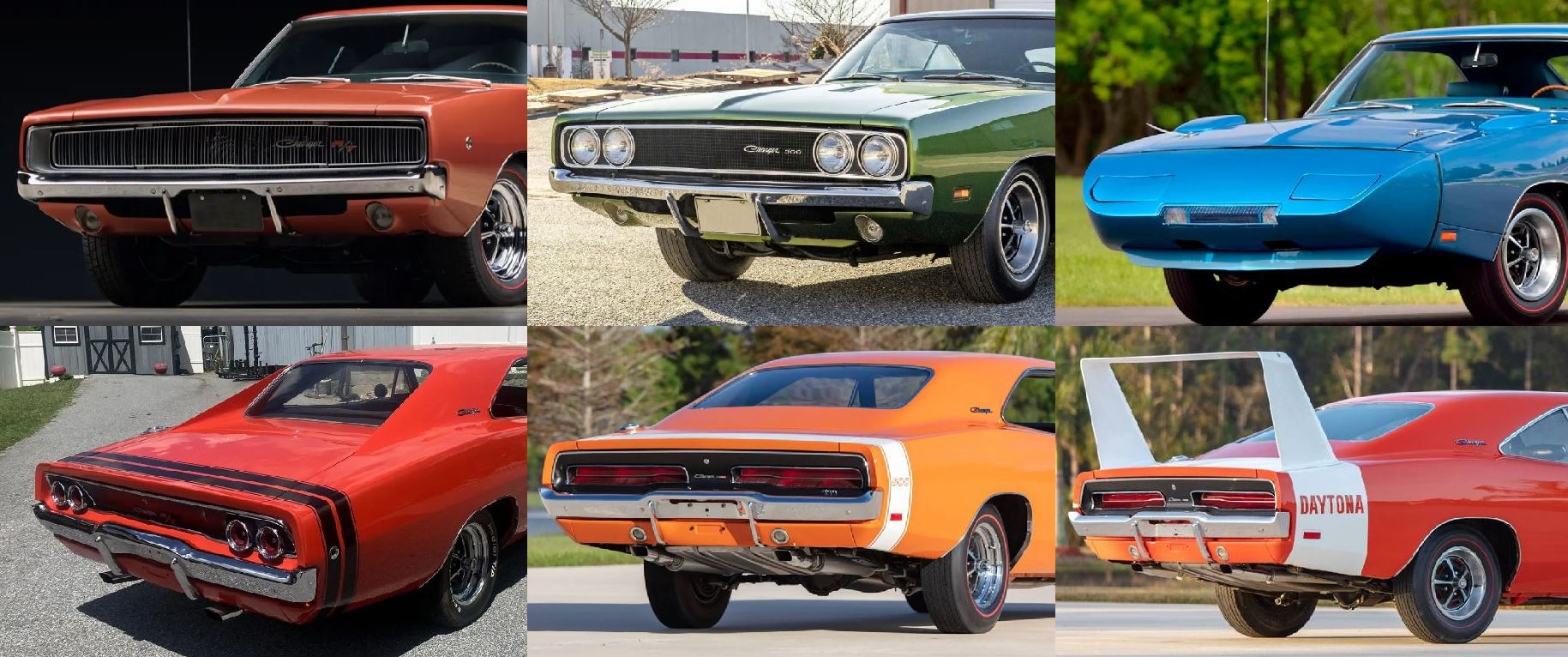
1968 Dodge Charger (left), 1968 Dodge Charger 500 (centre) and 1969 Dodge Charger Daytona (right).

Before the missile engineers got involved, the path to specific aerodynamic efficiencies had an element of trial and error.  Ascetically, the 1968 Dodge Charger (left) was visually a great improvement on its slab-sided predecessor (1966-1968) and the recessed grill with hidden headlights was much admired, as were the buttresses which at the back created what Chrysler dubbed the "tunnel roof".  However, although always intended for the NASCAR ovals, once used there at speed, the drivers found the grill functioned just like the parachute the shape resembled, increasing fuel consumption and lowering top speed while the tunnel roof created buffering, causing instability.  Above 150 mph (240 km/h), the 1968 Charger not only didn't work very well but was dangerous.  That same year, the Charger 500 (centre) appeared with the recessed grill replaced by what was close to a flat surface which to some extent ameliorated the "parachute effect" but it was still not an ideal shape with which to penetrate the air while removing the buttresses smoothed things at the back which was good but at the now higher speeds, lift became a problem, something potentially more lethal even than the movement induced by the buffering.  The missile engineers' combination of the nosecone and big rear wing on the 1969 Dodge Daytona (right) solved all problems and on 24 March 1970, at Alabama's Talladega Superspeedway, a Charger 500 (DC-93) prepared by Chrysler Engineering to Daytona specifications (originally on the press fleet, it was a recovered stolen car!) set the then closed course lap record of 200.447 mph (322.5882 km/h).

Fully restored DC-93, the Dodge Charger 500 which in Daytona trim set the 200.447 mph (322.5882 km/h) at Talladega, March 1970.  The relationship between this thing and even the Daytonas sold to the public was an indication of how far NASCAR's definition of "stock car" had travelled since competition began in 1948.   

So extreme in appearance were the cars they proved at the time sometimes hard to sell and some were converted back to the standard specification by dealers anxious to get them out of the showroom.  Views changed over time and they're now much sought by collectors, the record price known price paid for a Superbird being US$1,650,000 for one of the 135 fitted with the 426 Street Hemi.  Despite the Superbirds having been produced in some four times the quantity of Daytonas, collectors indicate they're essentially interchangeable with the determinates of price (all else being equal) being determined by (1) engine specification (the Hemi-powered models the most desirable followed by the 6-BBL Plymouths (there were no Six-Pack Daytonas built) and then the 4 barrel 440s), (2) transmission (those with a manual gearbox attracting a premium) and (3) the combination of options, mileage, condition and originality.  Mapped on to that equation is the variable of who happens to be at an auction on any given day, something unpredictable.

No homologation issues: Here and there, between 1938-2003, Volkswagen produced 21,529,464 Beetles (officially the VW Type 1).

That was demonstrated in August 2024 when a highly optioned Daytona in the most desirable configuration achieved US$3.36 million at Mecum’s auction at Monterey, California.  The price was impressive but what attracted the interest of the amateur sociologists was the same Daytona in May 2022 sold for US$1.3 million when offered by Mecum at their auction held at the Indiana State Fairgrounds.  The US$1.3 million was at the time the highest price then paid for a Hemi Daytona (of the 503 Daytonas built, only 70 were fitted with the Hemi and of those, only 22 had the four-speed manual) and the increase in value by some 250% was obviously the result of something other than the inflation rate.  The consensus was that although the internet had made just about all markets inherently global, local factors can still influence both the buyer profile and their behaviour, especially in the hothouse environment of a live auction.  Those who frequent California’s central coast between Los Angeles and San Francisco include a demographic not typically found in the mid-west and among other distinguishing characteristics there are more rich folk, able to spend US$3.36 million on a half-century old car they’ll probably never drive.  That’s how the collector market now works.  

1969 Ford Mustang Boss 429.

Although sometimes difficult, NASCAR could however be helpful, scratching the back of those who scratched theirs.  For the Torino and Mercury Cyclone race cars, Ford was allowed to homologate their Boss 429 engine in a Mustang, a model not used in top-flight stock car racing.  Actually, NASCAR had been more helpful still, acceding to Ford's request to nudge the seven litre displacement limit from 427 to 430 cubic inches, just to accommodate the Boss 429.  There was a nice symmetry to that because in 1964, Ford had been responsible for the imposition of the 427 limit, set after NASCAR became aware the company had taken a car fitted with a 483 cubic inch (7.9 litre) engine to the Bonneville salt flats and set a number of international speed records.  The car used on the salt flats was one which NASCAR had banned from its ovals after it was found blatantly in violation of homologation rules related to bodywork so there was unlikely to be much leeway offered there.

1971 Ford Falcon GTHO Phase III.

Australian manufacturers were (mostly) honest in their homologation programmes, Ford’s GTHO Falcons, Chrysler’s R/T Chargers and Holden’s L34 & A9X Toranas were produced in accordance both with the claimed volumes and technical specification.  However, although in total the numbers added-up, they weren't always so punctilious in the form the parts ended up in the hands of customers.  Ford's RPO83 (Regular Production Option #83) was a run late in 1973 of XA Falcon GTs which included many of the special parts intended for the aborted 1972 GTHO Phase IV and although, on paper, that seemed to make the things eligible for use in competition, it transpired the actual specification of various RPO83 cars wasn't consistent and didn't always match the nominal parts list.  History has been generous however and generally it's conceded that in aggregate, the parts subject to the homologation rules appear to have been produced in the requisite number.  By some accounts, this included counting the four-wheel disk brakes used on the luxury Landau hardtops but CAMS (the Confederation of Australian Motor Sport, at the time the regulatory body) was in the mood to be accommodating.

Monday, August 1, 2022

Silhouette

Silhouette (pronounced sil-oo-et)

(1) A two-dimensional representation of the outline of an object, as a cut-out or representation drawing, uniformly filled in with black, especially a black-paper, miniature cut-out of the outlines of a person's face in profile.

(2) The outline or general shape of something.

(3) Any dark image outlined against a lighter background; the outline of a solid figure as cast by its shadow.

(4) To show in or as if in a silhouette; to cause to appear in silhouette.

(5) In printing, to remove the background details from (a halftone cut) so as to produce an outline effect.

(6) In motorsport, a category which limits modifications which change a vehicle’s side-silhouette.

1759: From the French à la silhouette, named after Étienne de Silhouette (1709–1767), controller general (1759) in the French government.  The surname was a gallicized form from Biarritz in the French Basque country and the southern Basque spelling would be Zuloeta, Zulueta, Ziloeta or Zilhoeta, the construct being zulo (hole, cave) + the suffix -eta (abundance of).  The word came widely to be applied to the artwork (which had existed since 1743 and sometimes called figure d'ombre (shadow figure) in 1859.  The rare alternative spelling is silhouet and the verb dates from 1876, derived from the noun.  Silhouette is a noun & verb and silhouetted & silhouetting are verbs; the noun plural is silhouettes. 

Lindsay Lohan with pony-tail in silhouette, smoking.

Jeanne Antoinette Poisson, Marquise de Pompadour (1721–1764 and usually referred to as Madame de Pompadour), was a member of the French court of Louis XV (1710–1774; King of France 1715-1774) and the king’s official chief mistress (that how things then were done) between 1745-1751 and a court favorite until her death.  One way the estimable Madame de Pompadour used her influence was in appointments to government offices.  While some of this was little more than nepotism and the spreading around of sinecures, one substantive position in the Ancien Régime was Controller-General (the treasurer or finance minister) and to this, de Silhouette, long recognized in France as something of a “wizz kid” in economics, was appointed early in 1759 with the concubine’s support.  The powers of controller-general made whoever held the job powerful but also vulnerable, the task of limiting the expenditure of the king not one likely to be popular in the Palace of Versailles but given the state of the royal exchequer after years of war, the need for reform was urgent.  Modern economic historians seem to regard the job he did as competent and orthodox example of rationalizing public finances and he managed both to reduce expenditure and institute a system of taxation which was both simpler to administer and more effective although probably more far-reaching were the long-overdue efficiencies he introduced in internal trade.

Silhouette of the Manhattan skyline.

Despite his success however, his budget for 1760 projected a huge deficit and a rising cost in debt servicing.  Seeing no alternative, he suggested adopting some of the methods of the detested English which involved collecting some tax from the previously exempt aristocracy, landed gentry and the richest of the clergy (of which there were a remarkable number.  That was his downfall and after less than nine months as controller general, De Silhouette retired to the country although, such was the urgency of things, his later successors were compelled to follow much the same course.

Prima Donna Deauville 100th anniversary bra (p/n 0161810/11); US$159.95 from Silhouette Fine Lingerie.

Why his name endures to describe the two-dimensional black-on-white images we know as silhouettes is obscure but there are two competing theories.  One is that his methods in finance and administration were all about simplifying what had over the centuries become a system of labyrinthian complexity so, a silhouette being about the simplest form of visual art, the association stuck.  A less sympathetic view is that he was thought an austere and parsimonious fellow so his name was linked to the simple, cheap black & white portraits which had since 1843 been popular with those unable to afford more elaborate forms such as an oil painting.  There’s also the suggestion the minimalist art was named as an allusion to his brief tenure as controller-general and finally, although there’s no evidence, some maintain de Silhouette decorated his office with such portraits.  Whatever the reason, the portraits gained their name in 1859, the year of de Silhouette brief ministerial career.

Silhouette of Mercedes Benz SLC (C107; 1972-1981, left) and 1979 450 SLC 5.0 in competition under the FIA’s silhouette rules (right).

Silhouette racing was introduced essentially because it was simple to administer.  There had been a variety of classes for “modified production” cars which permitted changes to bodywork to improve aerodynamic or allow wider wheels & tyres to be used but formulating and enforcing the rules was difficult; the regulations becoming increasingly precise, subject to variations in interpretation and cheating was rife.  What the introduction of a baseline silhouette for each competing vehicle did was provide a simple, literal template: if the car fitted through, it was lawful and if manufacturers wished to change a silhouette and produce a sufficient number of identical models to homologate the car for whatever competition was involved, that was fine.  Sometimes with variations, the silhouette formula has been widely adopted from classes as varied as series production to quite radical constructions with space frames or carbon-fibre monocoques and drive-trains unrelated to road-cars, the attraction always that the external skin continues to bear more than a superficial resemblance to a production model, something important to both manufacturers wishing to maintain a tangible link to their consumer offerings and an audience prepared willingly to suspend disbelief.

1972 Lamborghini P250 Uracco (left), 1977 Lamborghini Silhouette (centre) & 1984 Lamborghini Jalpa (right).

Despite the name, the Lamborghini P300 Silhouette (1976-1979) wasn’t designed with competition in mind; it was an attempt to produce an open-top model which could be certified for sale in the lucrative US market, then a market in which the company had no offering.  The Silhouette was Lamborghini’s first targa-top and was based on the P300 Uracco (1972-1979), a mid-engined, V8-powered 2+2 which was intended to compete with the Porsche 911 and Ferrari’s Dinos.  Neither the Uracco nor the Silhouette went close to matching the volume of either of its competitors and only 54 of the latter were made but both contributed to the company’s survival in the difficult 1970s, something which at times seemed improbable.  The Silhouette’s successor was the P350 Jalpa (1981-1988), the final evolution of the Uracco.  Lamborghini was now more stable and the Jalpa was a much improved product (although the interior always attracted criticism) which sold in reasonable volumes and, more importantly, was profitable.

Lamborghini Miura Roadster in metallic blue over white leather.

Although the Silhouette was the factory’s first targa to enter series production, a decade earlier, the factory had shown one exquisite creation in that vein.  The modern convention is to distinguish between a roadster (with a roof which wholly can be removed or folded back) and a targa (with a removable panel about the seats (a cat with left & right panels being a “T-top”)) but in what now seems a linguistic quirk, Lamborghini in 1968 displayed a (sort of) targa it called a Roadster.  It would be the only convertible Miura of any type the factory would build.  Although the P400 Miura's rolling chassis had generated much interest (and some scepticism from engineers who understood the implications of installing its mid-mounted V12 engine transversely) when displayed at the 1965 Turin Auto Show, when a pre-production prototype was used for the car’s debut at the Geneva show, it created as much of a sensation as the Jaguar E-Type (XKE, 1961-1974) arrival in the same city half-a-decade earlier.  The Miura is the spiritual ancestor of the “supercars” and “hypercars” of recent decades but while undeniably beautiful, at high-speed (it could exceed 170 mph (275 km/h)) the aerodynamic properties were dubious and the transverse engine induced handling quirks even experts found challenging to master.  Still, with close to 800 made over three series (P400, 1966-1968; P400 S, 1968-1971; P400 SV 1971-1973), it was a great success and the most desirable are now multi-million dollar machines.  It was quite an achievement for a concern which between 1948-1963 had built only well-regarded tractors and although the Miura wasn’t the company’s first car, it was the one which gained the marque the credibility to ranked with Ferrari and indeed greatly it influenced the mid-engined Ferraris and Maseratis of the 1970s as well as encouraging lower-cost imitators such as De Tomaso’s Mangusta (1967-1971).

Lamborghini Miura Roadster in metallic blue over white leather.

Perhaps counterintitutively the sensuous Miura was named after a breed of bull but it was one prized in bullfighting for its aggressive qualities so one can see the connection.  While a few claim to be cooks who helped stir the broth, the Miura’s lovely lines usually are credited to Marcello Gandini (1938–2024), a designer working at Giuseppe "Nuccio" Bertone’s (1914-1997) Turin-based Carrozzeria Bertone.  The one-off Miura roadster wasn’t exactly the first mid-engined coupé in a targa configuration, Ford building in 1965 five such GT40s (1964-1969) but these were pure racing cars and the first appeared a few weeks before Porsche in 1965 released the 911 Targa so it’s not surprising Ford dubbed the things “roadsters”.  The Fords were actually rolling test-beds for components and featured a number of differences from the more numerous coupés but nor was the Miura Roadster simply a coupé pulled from the assembly line and then de-roofed.  What Bertone did was a significant re-engineering, the roofline lowered by 30 mm (1¼ inches) with the rollover hoop lowered to reduce drag, the angle off the windscreen made more acute and the rear bodywork re-shaped with larger air-intakes for the V12, a more pronounced spoiler fitted to the rear deck, the tail-pipes re-routed and revised taillights were fitted.  Unseen were structural changes which reinforced the chassis, the box-section side members strengthened to compensate for the loss of rigidity created by removing the roof.  Inside, there were detail changes to the trim and switchgear.

Bertone’s Lamborghini Miura Roadster, Brussels Salon de L’Automobile, January 1968. Young ladies adorning exhibits were once a fixture at motor shows and this bevy was more fully clothed than many.

The reaction when the roadster was displayed at Brussels was little less enthusiastic than at Geneva two years earlier and dealers and the factory at once received enquiries about price and delivery dates.  Unfortunately, what the designers knew was that stunning though it looked, what the roofectomy had done was so compromise the structural rigidity that not even the strengthening done to the platform had been enough to make the Roadster a viable production car.  To achieve that, the whole shell would have had to be re-engineered and Lamborghini’s engineers knew that though achingly lovely, the shape and the transverse mounting of the V12 which made it possible were both flawed concepts and the future lay in longitudinally-positioned power-plants within an angular wedge.  Those conclusions would be rendered in physical form when the prototype Countach appeared at Geneva in 1971 and its lines can be seen still in twenty-first century Lamborghinis.

The ILZRO’s ZN 75 in iridescent green over tan leather.  The delightful “eyelashes” above the Miura's headlights unfortunately didn't appear on the P400 SV.

So the Roadster was destined to be a one-off curiosity but the show car subsequently had an interesting life.  In 1969 it was purchased by the New York-based ILZRO (International Lead Zinc Research Organization) which wanted something eye-catching with which to promote the use of the metals in automotive use.  Renamed ZN 75, it became a demonstration platform for zinc and lead applications in automotive engineering; it was repainted in an iridescent green, and various components were recast in zinc and lead-alloys, including trim, bumpers and even engine parts.  On the periodic table, the chemical element zinc has the symbol “Zn” while the “75” was a reference to 1975, the year the ILZRO and other industry groups were lobbying the regulators to set as the date by which new automotive materials and corrosion-resistance standards would become widespread.  The ILZRO’s campaign emphasis was on galvanization and anti-corrosion technologies, with the argument that by the mid-1970s, manufacturers would need extensively and more systematically to use zinc and such to meet with expectations of durability and comply with legislative dictate.  During the 1970s, was shown around North America, Europe, and Asia becoming one of the more widely seen Miuras and decades later, was restored to its original appearance.  Whether it even should be referred to as a targa is debatable because Bertone didn’t include a removable roof panel but over the years some Miuras have been converted to targas (with a removable panel) so the pedants can designate the original roadster as being “in the targa style”.   

Friday, April 17, 2026

Bench

Bench (pronounced bench)

(1) A long seat (without arm or back-rest) for two or more people:

(2) A seat occupied by an official, especially a judge in a courtroom.

(3) Such a seat as a symbol of the office of an individual judge or the judiciary.

(4) The office or dignity of various other officials, or the officials themselves.

(5) In certain team sports, the seat (literally or figuratively) on which the reserve (substitute) players sit during a game while not playing and on which “starting side” players sit while substituted.

(6) The quality and number of the players named as substitutes.

(7) By extension, the quality and number of professionals or experts in reserve, to be called upon as needed:

(8) As a clipping of workbench, the worktable of those engaged in trades.

(9) In interior design, certain fixed flat surfaces (kitchen bench, bathroom bench etc).

(10) A platform on which animals or objects are placed for exhibition.

(11) In farming, a hollow on a hillside formed by sheep.

(12) In surveying, a bracket used to mount land surveying equipment onto a stone or a wall.

(13) In certain legislatures, as “front bench” (the office-holding members of a government or opposition who sit on the bench at the front of their side of the assembly), “back bench” (those elected members not appointed to an office who sit on benches behind) and “cross-bench” (those not members of the party in government or formal opposition who sit on other benches).  The terms are sometimes literal but depending on an assembly’s architecture or the size of a government’s majority, others can sometimes “overflow” to the physical “cross benches”.  Thus there are “front benchers”, “back benchers” & “cross benchers” (sometimes hyphenated).

(14) In geography, a shelf-like area of rock with steep slopes above and below, especially one marking a former shoreline.

(15) In extractive mining, a step or working elevation in a mine.

(16) In science (usually as “at the bench”), to distinguish between being engaged actively in research and concurrent or subsequent administrative functions.

(17) To furnish with benches (now rare).

(18) To seat on a bench or on the bench (now rare).

(19) In extractive mining, to cut away the working faces of benches.

(20) In certain team sports, to substitute or remove a player from a game or relegate them to the reserve squad.

Pre 1000: From the Middle English bench, benk & bynk, from the Old English benc (bench; long seat (especially if backless)), from then Proto-West Germanic banki, from the Proto-Germanic bankon & bankiz (bench), from the primitive Indo-European bheg.  It was cognate with the Scots benk & bink, the West Frisian bank, the Dutch bank, the Old High German Bank, the Old Norse bekkr, the Old Frisian benk, the Danish bænk, the Swedish bänk and the Icelandic bekkur, all from a Germanic source and all of which meant “bench”.  In the Old English there were the verbs bencian (to make benches) and bencsittend (one who sits on a bench).  The dialectal spellings benk & bink are both long obsolete.  Bench & benching are nouns & verbs, bencher is a noun, benched is a verb & adjective and benchy & benchlike are adjectives; the noun plural is benches.

The source of the idea of the “bench as a type of long seat” is thought to come from riparian imagery (natural earthen incline beside a body of water) and etymologists speculate the original notion was of a “man-made earthwork used as a seat”.  Bench was from the late fourteenth century used of the tables on which merchants displayed their wares and that may have been a borrowing from the reference to the seat the judge would occupy in a court of law, that use emerging early in the 1300s and coming soon to mean “judges collectively, office of a judge, the judiciary”.  Whether it was actually an allusion to customers “judging the goods displayed” is speculative.  The use in team sports of “the bench” being the “reserve or substitute team members” was drawn from the actual physical bench on the sideline on which those players would sit while not on the field.  The earliest known reference to the existence of furniture used for this purpose is from the US in 1899 but extending this generally to the “reserve of players” in baseball, football etc seems not to have begun until 1909.  In sport, the idiomatic forms include “bench player” (one habitually selected only in the reserves and not the “starting side”), “benched” (a player substituted during play and “sent to the bench”, either because of poor performance or as part of a planned rotation, “injury bench” (players substituted due to injury), “bench warmer (or “bench sitter”, or “bench jockey”) (one whose career has plateaued as a “bench player”, “warming the bench”) 

Bench has attracted many modifiers describing use including “bench grinder”, “bench saw”, “bench drill”, “sawbench”, “kitchen bench”, “deacon's bench”, “friendship bench”, “bench easel”, “mourners' bench”, “piano bench” (a “piano stool” for two), “preacher’s bench” etc.  The noun & verb “benchmark” refers to the optimal results obtained when testing something or someone on a “test bench” although the use is often conceptual, a physical “test bench” not necessarily part of the processes and even some structures in engineering referred to as a “test bench” may bear no relationship to any actual “bench” however described.

Of seats

Bench seats ranged from the functional to the extravagant.

1971 Holden HQ Belmont Station Sedan (station wagon or estate-car) (left) in turquoise vinyl and 1974 Imperial LeBaron four-door hardtop (right) in chestnut tufted leather though not actually “rich Corinthian leather” which was (mostly) exclusive to the Cordoba (1975-1983) until late 1975 when not only did the Imperial's brochures mention "genuine Corinthian leather (available at extra cost)" but for the first time since 1954 the range was referred to as the "Chrysler Imperial", a harbinger the brand was about to be retired.  Imperial's advertising copy noted of the brochure photograph above: “...while the passenger restraint system with starter interlock is not shown, it is standard on all Imperials.”; the marketing types didn't like seat-belts messing up their photos.  While all of the big three (GM, Ford & Chrysler) had tufted interiors in some lines, it was Chrysler which displayed the most commitment to the extravagance although regrettably, some testers at the time reported than while they looked accommodating, after an hour of so, they proved quite uncomfortable.  They contrasted the eye-catching seats in the Imperial with the "hard" pews provided by Mercedes-Benz which proved supportive and comfortable even after hours behind the wheel, concluding backs, shoulders and legs were a more reliable guide to orthopedic correctness  than visual appeal, Teutonic austerity proving more luxurious than Detroit's rococo.

Boring: Rear bench seat in 1963 Chrysler 300J.

The 1963 Chrysler 300J was the rarest (ie the one fewest customers purchased) of the eleven “letter-series” cars (1955-1965) and whether or not related to its performance in the market, one thing which at the time attracted comment was a rear bench seat replacing the eye-catching twin buckets and full length console which had for three seasons appeared in its predecessors (300F, 300G & 300H).  In 1963, the industry, chasing volume & profits, had begin the process of “de-contenting” their cars, either ceasing the availability of stuff expensive to make or install or moving such items to the option list; by the late 1960s even Cadillac would be afflicted.  The Chrysler “letter series” 300s had begin in 1955 with what many had assumed was a one-off high-performance model created by mixing & matching trim from the Imperial line (newly that year established as a stand-alone marquee) as well as tuning the mechanical components for speed.  Existing initially to homologate stuff for use in competition, not only did the C-300 sell in a pleasing volume but it was such a success as a image-building “halo car” the model was retained for 1956 and dubbed 300B with a further nine annually following until the end of the line in with the 300L 1965, each release appending as an identifier the next letter in the alphabet (thus 300C, 300D etc).

Much more swish: Rear bucket seats in 1961 Chrysler 300G.

However, as well as the dubious distinctions of being the least popular and being the only one the series between 1957-1965 not to be offered as a convertible, the 300J represents a quirk in the naming sequence, Chrysler skipping the letter “I”.  That was done for the same reason there are so few “I cup” bras, the rationale being “I” might be confused with the numeric “1” so most manufacturers go straight from “H cup” to “J cup” although some plug the gap with a “HH cup” and there are even those who stop at “G”, handing incremental increases in volume with “GG” & “GGG” cups; it does seem an industry crying out for an ISO.  There’s no evidence Chrysler ever pondered a “300HH”.  Like Chrysler and most bra manufacturers, the USAF (US Air Force) also opted to skip “I” when allocating a designation for the updated version of the Boeing B-52 Stratofortress (1952-1962 and still in service).  Between the first test flight of the B-52A in 1954 and the B-52H entering service in 1962, the designations B-52B, B-52C, B-52D, B-52E, B-52F & B-52G sequentially had been used but after flirting with whether to use B52J as an interim designation (reflecting the installation of enhanced electronic warfare systems) before finalizing the series as the B-52K after new engines were fitted, in 2024 the USAF announced the new line would be the B-52J and only a temporary internal code would distinguish those not yet re-powered.  Again, “I” was not used so nobody would think there was a B521.

1958 Metropolitan Hardtop in two-tone Frost White and Berkshire Green over black and white houndstooth cloth and vinyl.

Under various marques, the Metropolitan was in production between 1953-1961 and its cartoon-like appearance was a result of applying the motifs of the standard-sized US automobile to something much smaller and in that it was conceptually similar in concept to the more severely executed Triumph Mayflower (1949-1953) which took as a model the “knife-edged” lines of the Daimlers and Rolls-Royces bodied by Hooper.  Although most four-door cars with front bench seats featured full-width cushions (one which one’s butt sat) and squabs (on which one’s back rested), most two door models had “split squabs” which individually could be folded forward, affording someone access to the rear passenger compartment without disturbing anyone sitting on the other side of the front seat.

1958 Metrolpoitan.

The split squabs erect (left), the passenger's folded forward to afford entry to the rear bench (centre) and the rear bench's squab laid flat to allow access to the trunk or provide a larger storage space (right).  In modern five-seaters, the trend has been the so-called 40/60 split seat which allows two passengers still to sit on the back seat while extending the trunk space into the cabin, the origin of the idea reputedly the desire of skiers to carry their skis & poles without the need to fit external racks.  The Metropolitan also had a fold-down rear bench, a common feature in many station wagons, SUVs (sports utility vehicle) and such but for the diminutive Metropolitan it was essential because there was no trunk (boot) lid.  Though not unique, that was unusual in four-seat sedans (which the Metropolitan sort of was) although some sports cars also lacked the fitting including the early Austin-Healey Sprite (the so-called bugeye or frogeye (depending on the side of the Atlantic where one sat)) and every Chevrolet Corvette between the release of the C2 in 1962 and the C5 in 1998.

Bench seat for four: the improbable 1948 Davis Divan.  The blue car (one of a dozen survivors of the 17 built) was restored by the Petersen Automotive Museum in Los Angeles where it is on display.

In cars and such, a “bench seat” differs from a “bucket” or “individual” seat in that comfortably it can accommodate three occupants, the comparison with furniture being the difference between a “chair” and a “sofa”.  In commercial vehicles, bench seats commonly can seat four but in cars the recommended (and eventually legal) limit was typically three although the truly bizarre Davis Divan (1948) featured a bench allowing four abreast seating for adults, something which would have been an interesting experience for the quartet because a quirk of the suspension system was the long, pointed nose of the thing actually rose under braking.  The three-wheeled Divan was the brainchild of “automotive entrepreneur” (some historians are less kind) Glen Gordon “Gary” Davis (1904-1973) who put some effort into building the prototypes, not enough into preparation for actual production but much into raising funds from “investors”, a goodly chunk of which apparently was spent on real estate, entertaining and mink coats for “friends” (with all that implies).  He had a flair for slogans so many investors were attracted but the project proved chimeric, Mr Davis subsequently tried and convicted of fraud & grand theft, spending two years in prison.  The name Divan was used as an allusion to the car's wide bench seat.  It was from the French divan, from the Ottoman Turkish دیوان (divan), from the Iranian Persian دیوان (divân), from the Classical Persian دیوان (dēwān), from Middle Persian dpywʾn' or dywʾn' (dēwān) (archive, collected writings, compilation of works”), from the Sumerian dub.  The sense was of a sofa-like piece of furniture comprising a mattress lying against the wall and on either the floor or an elevated structure.  Part of the tradition of interior decorating in the Middle East, in the West divans are sometimes called “ottomans”; those with an internal storage compartment: “box ottomans”.

Four American Airlines stewardesses proving the bench seat had hiproom for four adults; its foam rubber cushion beautifully upholstered in long-wearing synthetic fabrics.”  Dr Phil Tiemeyer's Women and the Jet Age. A Global History of Aviation and Flight Attendants (2025) explores the post-war aviation industry and the not always happy part played by flight attendants.

Resembling a large shoe mounted on a tricycle undercarriage, so much was strange about the Davis Divan that in 1948 the four-abreast seating configuration probably didn’t seem so startling.  Still, the public were aware of the unusual feature because among the many publicity shots distributed was one of four American Airlines flight attendants (then called stewardesses) perched, apparently happily, on the bench seat while Mr Davis looked on approvingly.  Presumably, the four young ladies were relaxed and comfortable because the space available was rather more than airlines these days provide for economy-class passengers in airliners.  To this day, there are those who defend Mr Davis and claim the corporate failure was a consequence of his managerial ineptitude rather than constructive fraud but as well as the mink coats, there were clues some of techniques used to raise what would now be called VC (venture capital) were suspect, including the claim the movie star Greta Garbo (1905-1990) was one of the investors.  Ms Garbo was by 1948 already legendarily reclusive, never gave interviews and journalists who sent type-written questions (including a return SSAE (stamped self-addressed envelope)) were ignored.  If any alleged “investor” was unlikely to contradict Mr Davis, it was Greta Garbo.

Mannerist but not quite surrealist: Some artistic licence taken.

Advertising for the 1961 Pontiac Bonneville Sports Coupe (left) with images by Art Fitzpatrick (1919–2015) & Van Kaufman (1918-1995) and a (real) 1961 Pontiac Bonneville Sports Coupe (right) fitted with Pontiac's much admired 8-lug wheels, their exposed centres actually the brake drum to which the rim (in the true sense of the word) directly was bolted.  Four could be seated on the Bonneville's front seat but the packaging efficiency was not as good as was found on the Divan; although the car was 8.2 inches (208 mm) wider (78.2 (1,986) vs 72.0 (1,829)), at 63.4 inches (1,610 mm), the Pontiac’s front seat was narrower than the 64 inches (1,626 mm) found in the Divan.  The inefficiency inside was reflected under the hood (bonnet).  Although wide, even Detroit's large-displacement V8s of the post-war years were, by historic standards, relatively short, but to achieve the desired look (longer, lower, wider), the stylists rendered long noses and such was the capaciousness, a straight-8 or V16 could have been installed.  Remarkably, as a marker of distinction, some of these machines even had their noses extended a few inches, just "for the look", creating even more waste space.  Undeniably, something like the 1969 Pontiac Grand Prix was dramatic but it was emblematic of an era of self indulgence. 

Had one taken seriously some of the images used to advertise US cars in the 1960s, one might have assumed Mr Davis had been so influential that bench seats might by 1961 seat five but sadly, the work of Fitzpatrick & Kaufman (best remembered for what they rendered for GM’s (General Motors) PMD (Pontiac Motor Division) took some artistic licence and one piece of exaggeration was width.  The pair rendered memorable images but certainly exaggerated things where they though it would help created what were even then admired as simulacrums rather than something to be taken literally.  While PMD’s “Year of the Wide-Track” (introduced in 1959) is remembered as a slogan (the original advertising copy read “Wide Track Wheels” but was soon clipped to “Wide Track” because it was snappier), it wasn’t just advertising shtick, the decision taken to increase the track of Pontiacs by 5 inches (127 mm) because the 1958 frames were carried-over for the much wider 1959 bodies, rushed into production because the sleek new Chryslers had rendered the old look frumpy and suddenly old-fashioned.  That spliced-in five inches certainly enhanced the look but the engineering was sound, the wider stance did genuinely improve handling.  Just to make sure people got the message about the “wide” in the “Wide Track” theme, the advertising artwork deliberately exaggerated the width of the cars they depicted and while it was the era of “longer, lower, wider” (and PMD certainly did their bit in that), things never got quite that wide.  Had they been, the experience of driving would have felt something like steering an aircraft carrier's flight deck.

Davis Divan: Even if the car wasn’t “real”, the brochure was well-done, reflecting the influences of Art Deco and Mid-Century Modernism.

Although not in US terms a “big” car, at 72 inches (6 feet, 1.8 metres) in width, the Davis Divan was comparatively wide, as of course it had to be make the four-place bench seat viable.  Still, with an apparently aerodynamic body made from aluminium (taking advantage of the ample stock of the metal created when contacts for military aircraft had been cancelled after the unexpectedly abrupt end of World War II (1939-1945)) it weighed in at a svelte 2,450 pounds (1,110 kg) so the small, four cylinder engines would have delivered low fuel consumption and provided adequate, if not sparkling, performance although if the shape was as slippery as it appeared, the claimed top speed of 115 mph (185 km/h) may have been plausible; as far as is known, no one has ever attempted to verify the claim.  In a booming economy in which new cars were in high-demand, the package must have seemed attractive to investors, especially as it was expected to sell for what seemed a competitive US$995.

One of the mink coats made infamous in the court proceedings in which Mr Davis was handed a two-year sentence after being convicted of fraud & grand theft.

In retrospect, the projected price was as remote from economic reality as the 990 Reichsmarks (RM) the Nazi Party in 1938 promised would be the cost Germans would pay for a new KdF-Wagen.  The Kraft durch Freude-Wagen was the “people’s car” marketed by the Party’s Kraft durch Freude (Strength Through Joy) operation which also ran cruise liners and holiday resorts and although not one car had been delivered to a civilian customer by the end of the war, it would subsequently enjoy much global success as the Volkswagen Type 1 (VW Beetle, 1938-2003).  As late as 1943 some of the 340,000-odd Germans obediently still were making their weekly payment of 5 RM and it would be more than a decade before some received any form of refund.  While over 21 million VW Beetles were made, Davis Divan production only ever reached 16 or 17 (including three specialized military (non-combat-vehicles) variants) and remarkably, at least 12 have survived as curiosities in museums and private collections.

Of law

Bench seat for four: A gang of four Sceggs.  Sceggs should not be confused with the homophonic skegs, a feature from shipbuilding.

In courts of the common law tradition the terms “bench” & “bar” date from the medieval age and remain part of courtroom terminology.  “The bench” was originally the seat on which judges at while presiding, the early furniture apparently a simple wooden bench as one would find at many long dining tables and in the manner typical of the way English evolves, “bench” came to be used of judges collectively and of the institution of the judiciary itself.  The “bar” was the physical barrier separating the spectators and participants of a trial from the area where the lawyers and judges conducted the proceedings, thus the “bar table” being that at which the advocates sat and the right to practice law before the bench being “passing the bar”, familiar in the modern US phrase “passing the bar exam” or the English form “called to the bar”.  As “bench” became a synecdoche for the judiciary, “bar” came to be used of the lawyers although in jurisdictions where there is a separation between those who appear in court (barristers) and those who do not (solicitors) “bar” was applied only to the former and even after reforms in some abolished the distinctions between certain branches of the law, specialist practitioners continue often to be referred to as the “equity bar” & “common law bar”.  There’s thus the apparent anomaly of the use of “bencher” (recorded in the 1580s) being used to mean “senior member of an inn of court”, all of whom would have been members of “the bar”.  Presumably the idea was one of “approaching the bench” or (more mischievously) “aspiring to the bench”.  The bench-warrant (one issued by a judge, as opposed to one issued by a magistrate or justice of the peace (JP) dates from the 1690s. 

An illuminated manuscript (circa 1460) which is the earliest known depiction of the Court of King's Bench in session.

In England, the Court of King’s Bench (KB) (or Queen’s Bench (QB) depending on who was on the throne) began in the twelfth century as a court at which the monarch literally presided; it was a circuit court which would, from time-to-time, travel around the counties hearing cases.  The Court of KB was thus in some sense “virtual”, whatever wooden bench upon which he sat becoming the KB for the duration of the trial.  Kings would cease to sit as judges and the KB later was interpolated into the system of courts (there would be many internecine squabbles over the years) until (as the Court of Queen’s Bench), under the Supreme Court of Judicature Act (1873), it, along with the Court of Common Pleas, the Court of Exchequer and Court of Chancery were merged to become the High Court of Justice, each of the absorbed institutions becoming a division.  The Common Pleas and Exchequer Division were abolished in 1880 when the High Court was re-organized into the Chancery Division, Queen's Bench Division and the Probate, Divorce and Admiralty Division (the latter memorably known as “wills, wives & wrecks” in legal slang).  The origin of the KB is a hint of why a king or queen can’t appear before a court in the UK or other places in which they remain head of state: Although it is in a practical sense now a legal fiction, all courts of law are “their courts” of which they remain the highest judge.  The most famous (or infamous) relic of all this is the power of pardon which although no longer a personal power in the hands of the king, remains exactly that for a US president and is the only head of power in the US constitution not subject to "checks & balances", a POTUS able to grant pardons by ex-officio fiat.  In that sense, the POTUS is the "chief magistrate" mentioned in the Federalist Papers (1788) although the authors used the term to distinguish a republic's president from European monarchs by stressing the execution of legal duties under the rule of law rather than sovereign privilege.  Not all presidents have been much troubled by that distinction. 

Benches afforced with foreign judges, the Chinese Communist Party and Hong Kong’s national security law

Multi-national benches are not uncommon.  There have been courts operating under the auspices of the LoN (League of Nations;1920-1946) & UN (United Nations; since 1945) such as the ICC (International Criminal Court), the ICJ (International Court of Justice) and the various ad-hoc bodies set up to handle prosecutions related to crimes in specific locations (Rwanda, the former Yugoslavia etc) and the UK had the JCPC (Judicial Committee of the Privy Council) which included senior judges from the Commonwealth.  The JCPC functioned not only as a final court of appeal for Commonwealth nations (a role for a handful it still fulfils) but also as the appellate tribunal for a number of domestic bodies including some ecclesiastical bodies, admiralty matters and even matters from the usually obscure DCRCVS (Disciplinary Committee of the Royal College of Veterinary Surgeons).  There were also the IMTs (International Military Tribunal) which tried matters arising from the conduct of German & Japanese defendants from World War II (1939-1945), the bench of the latter Tokyo Tribunal notably diverse although those of the subsequent dozen trials in Nuremberg after the first (1945-1946) were staffed exclusively by US judges.  A number of former colonies also use foreign judges (and not always from the former colonial power).

However, what remains unusual is the matter of the CCP (Chinese Communist Party) deciding to have foreign judges serve on The HKCFA (Hong Kong's Court of Final Appeal), established in 1997 when the HKSAR (Hong Kong Special Administrative Region) was created upon Beijing regaining sovereignty (under the IC2S (one country, two systems)) principle, with the end of British colonial rule.  At that point, the HKCFA became the territory’s highest judicial institution, replacing the JCPC in London.  On the HKCFA’s bench sits the Chief Justice (a Hong Kong national), several “Permanent Judges” and some two-dozen odd “Non-permanent Judges” who may be recruited from Hong Kong or from among lawyers of the requisite background from any overseas common law jurisdiction.  As non-permanent judges, appointments have been drawn (from bar & bench) from Canada, Australia, New Zealand and the UK.

Lindsay Lohan, foreign judge on the bench of The Masked Singer (2019), a singing competition, the Australian franchise of a format which began in the ROK (Republic of Korea (South Korea)) as King of Mask Singer.

While it may seem strange a developed country like the PRC (People’s Republic of China (the old "Red China"), the world’s second largest economy, a permanent member of the UNSC (UN Security Council) and since 1965 the final member of the original “Club of Five” declared nuclear powers) would have foreign judges sitting on the bench of one of its superior courts, on the mainland the PRC operates under a civil law system which, like the tradition in continental European, is based primarily on written statutes and codes (with ultimate effective control remaining with the CCP), unlike common law systems, which rely heavily on case law and judicial precedent.  As a British colony, Hong Kong had used common law and under that system had become a major regional and international presence, something in part due to its judicial system being perceived as fair and uncorrupted; it was a “rule of law” state.

In the PRC there simply wasn’t a body of judges or lawyers with the necessary background in common law to staff the territory’s highest appellate court and significantly, at the time of the handover from the Raj, Hong Kong was of great importance to the PRC’s economy and the CCP understood it would be critical to maintain confidence in the rule of law, investors and overseas corporations with a presence in Hong Kong needing to be assured matters such as contracts would continue as before to be enforceable.  So it was, literally, “business as usual”, whatever may have been the fears about the political undercurrent.  The growth of the mainland economy since 1997 has been such that the HKSAR now constitutes only a small fraction of the national economy but analysts (some of whom provide advice to the CCP) understand the linkages running through the territory remain highly useful for Beijing and some long-standing conduits are still used for back-channel communications about this and that.  As far as business is concerned, the operation of the legal system has remained mostly satisfactory, even though the CCP ensured Beijing retained a reserved power to overturn the HKCFA’s decisions, the "rule of the CCP" sometimes thought preferable to the implications of "rule of law".

The colonial era building where now sits the Hong Kong Court of Final Appeal.  Formally opened in 1912, it was built with granite in the neo-classical style and between 1985-2011 was the seat of the Legislative Council (LegCo).

However, in 2020, a “National Security Law” (technically the Law of the People's Republic of China on Safeguarding National Security in the Hong Kong Special Administrative Region and thus usually written in English as the “NSL”) was imposed.  While not aimed at the regulation of business or economic matters, it was wide in scope and claims of application (the extraterritoriality extending worldwide), essentially extending to the territory many of the laws of the mainland regarding “political activities” and matters of “free speech”, the latter interpreted by the CCP in a way not unique but certainly different from Western understandings.  Citing the “political situation”, two British judges in June 2024 resigned from the HKCFA, prompted by Beijing’s recent crackdown on dissent in the city, something made possible by the NSL.  In his published letter, one judge, his rationale for departure notwithstanding, did say he continued “…to have full confidence in the court and the total independence of its members.”  As early as 2020, one Australian judge had already resigned, followed by two others from the UK, both saying the Hong Kong government had “…departed from values of political freedom and freedom of expression.”  The CCP may have anticipated some objection from the overseas judges because, since the passage of the NSL, no overseas judge has been allocated to hear the “security-related” cases.  The judicial disquiet seemed not to trouble the territory’s chief executive, former police officer Ka-chiu (John Lee; b 1957) who said the overseas appointments would continue to help “…maintain confidence in the judicial system and… strong ties with other common law jurisdictions.”  In response to the departing judge’s comment, he claimed the NSL had “no effect” on judicial independence and the only difference was that “…national security is now better safeguarded.

Early in June, the Hong Kong authorities arrested two men and one woman attending a FIFA (Fédération Internationale de Football Association (the International Federation of Association Football that, for historic reasons, recognizes more countries than the UN)) World Cup qualification match against Iran, their offence being “turning their backs to the pitch and not standing during the performance of the national anthem”, a police spokesman adding that anybody “…who publicly and intentionally insults the national anthem in any way in committing a crime.”  Before the NSL was imposed, bolshie Hongkongers were known to boo the anthem to express discontent with their rulers; that definitely will no longer be tolerated.  The match ended Iran 4: Hong Kong 2 but despite that, more than ever the HKSAR and the Islamic Republic have much in common.