Cabriolet (pronounced kab-ree-uh-ley)
(1) A
light, two-wheeled, one-horse carriage with a folding top, capable of seating
two persons. It's from cabriolet the term "cab" (in the sense of taxi) was derived).
(2) An automobile based usually on a two-door coupé but with a folding top.
(3) The
equivalent continental term for the (mostly UK) drophead coupé (DHC) or the more generic "convertible".
1766: From the French cabriolet, the construct being the Italian cabriole (horse caper) + -et (the suffix here used in the sense of “smaller
version”). The Italian cabriole was from the Latin capreolus (wild goat), from the
primitive Indo-European kápros (buck,
he-goat) and related to the Old Norse hafr
(he-goat), the Old English hæfr, the Welsh gafr
and the Old Irish gabor. The seemingly strange relationship between
the Latin capreolus (roebuck; wild
goat) and the eighteenth century horse-drawn carriage is explained by the
French cabriole (little caper), the meaning derived from its light movement, from cabrioler (to leap, caper), from the Italian capriolare (to somersault), from the Latin capreolus (roebuck; wild goat), the idea being of something light
and agile in movement. The larger, more
upscale version of the lightweight carriages the French named cabriolet, “cab” being the common form
in the vernacular, picked up in English and used to this day, "cabbies" being "cab (taxi) drivers". The –et suffix, indicating diminution or
affection, was from Old French -et,
and its feminine variant -ette, both
derived from the Late Latin -ittus
(and the other gender forms -itta, -ittum). In English use, “cab” was picked up to
describe the small carriages for hire in urban use and it was the descendants
of these which became “taxicabs” when the French taximètres (automatic meter
that records distance and fare) were adopted in the late 1890s, the word from
the German Taxameter, from Taxanom, the construct based on Taxe (tax, charge or
scale of charges), from the Medieval Latin taxa (tax, charge) + mètre. Cabriolet is a noun, the noun plural is cabriolets.

1978 Cadillac Eldorado Cabriolet Astroroof. The "Cabriolet Astroroof" (Option code CF5) added US$1565.00 over the Eldorado's base price of US$12401.00. "Astroroof" was Cadillac's marketing term for a sunroof with a large, heavily tinted glass sliding panel.
The application of cabriolet to describe
convertible cars emerged in the early years of the continental motor industry
because of the conceptual similarity to the earlier, light, horse-drawn
two-seater carriages but as the years went by, rapidly the industry retreated from the "terminological exactitude" stuck to by the coach-builders of the horse & buggy era. The "carried over" nomenclature (cabriolet, landau, brougham etc) eventually became mere "model names" and what some styled a "cabriolet", others might call something else although usually "cabriolet" did imply some part of the roof could in some way be removed. By 1977, GM (General Motors had decided that was a tiresome restriction and offered the "Cadillac Coupe DeVille Cabriolet d’Elegance" the rationale for the "cabriolet" element being the roof looked like it might be able to be lowered. The structure was however fixed but the model sold well so for more than a decades Cadillac "cabriolets" appeared with solidly attached roofs. Anyone looking up "cabriolet" in a dictionary may have been baffled but Cadillac owners knew what they wanted.

1979 Cadillac DeVille Custom Phaeton
Coupe. Those looking up "phaeton" may also have been mystified.
The 1977 venture may also have encouraged long model names because that trend persisted into the next century. So what was used to describe the variations
in convertible coachwork became something of the manufacturer's whim (except for the much later targa; Porsche had the foresight to
register that as a trademark) and if a car was called a roadster, drophead coupé, phaeton,
cabriolet or landau, it was an indication only that the roof could (usually) be
removed or folded back. In Detroit, the industry cheerfully used the historic names just as ways to impart "a certain association with something" and produced both "cabriolets" & "landaus" with fixed roofs and that trickery wasn't confined to the US, it being common practice in pre-war Europe for coupés to appear with non-functional "landau irons"; these were early "faux cabriolets". One exception to
that looseness was Daimler-Benz, the Germans tightly defining the specifications of roadsters and
landaulets and, with Teutonic thoroughness, in the mid-twentieth century codified
the five variations of Mercedes-Benz cabriolets as Cabriolet A, B, C, D & F
(if ever there was a Cabriolet E, the factory’s definition has never surfaced). With the fixed-roof two door bodies, "Coupé A" and "Coupé B" followed the same model (relating to seating & side windows).

Lindsay Lohan alighting from Porsche 911 Carrera (997) cabriolet, Los Angeles, 2012.
Being a German company, Porsche from its early years used "cabriolet" to describe its soft-top models although the Americans never really embraced the idea, habitually calling the open 356s "convertibles". Strangely, Volkswagen owners in the US took to the term, "cabriolet" usually preferred for the Karmann-built soft-top Beetles, the cabriolet in 1979 the last of the classic (Type 1, 1938-2003) Beetles sold in the US. After the targa (a word diligently trade-marked although Triumph in the UK had offered something similar (though more complex) with the "Surrey Top", available on the TR4 (1961-1967) & TR5 (1967-1968 (TR250 in the US market)) models were introduced, there was anyway a reason for Porsche to avoid "convertible" as being "imprecise"; at that point, in the Porsche ecosystem, there were "coupés" & "Targas". The 1970s were, as a general principle not "convertible-friendly" but as that troubled decade ended, it became obvious the regulatory environment was not going to become as restrictive as had been feared and at the 1981 Frankfurt Motor Show, Porsche showed an AWD (all-wheel-drive) 911 cabriolet concept that was so well-received a 911 Cabriolet the next year was added to the line, the company's first "full convertible" since the last of the 356s (1948-1965). Just to clarify things, the press were informed there were no "convertibles" in the range, just "coupés", "Targas" and "cabriolets". Such had been the enthusiasm generated by the 1981 concept-car it was obvious it would enter series-production but, upon release, the company confirmed it would not include the AWD and nor would the body-style be available with a turbocharged engine. The rationale for that was the rather patronizing" "People who drive cabriolets neither need nor want AWD and 300 HP (horsepower) engines". Amusingly, in an example of the way that in commerce "the customer is always right", where, regardless of "need", where there's "want" (ie demand), supply tends to follow and both features eventually were made available with the cabriolet body.

Saint John Paul II (1920–2005; pope 1978-2005) in Ferrari Mondial cabriolet while on a visit to the Ferrari test track, Fiorano, Italy, 4 June 1988. This is believed to be the fastest ever Popemobile.
The term "cabriolet" has over the decades been applied to convertible Ferraris but a convention seems to have emerged that exclusively it's now used for four seaters (that the factory admits are really 2+2s). The factory has had 2+2 cabriolets in the line-up for a while, most recently the California (2008-2017), Portofino (2017-2023), Roma (2020-2026) and Amalfi (since 2026) but those used a conventional front-engine layout. The Mondial (1980-1993) was mid-engined, making the accommodation of four within the cabin quite challenging and critics noted one of the compromises imposed was aesthetic, the body lacking Ferrari's usually lovely, lithe lines, something said also of its 2+2 predecessor, the fixed-roof 208 & 308 GT4 (sold as both a Dino and a Ferrari). However, the practicality of the Mondial had great appeal and it was at the time one of the the most successful Ferraris ever made. It was also something of a turning point, much thought having been put into the design, not only to ensure one basic specification could be sold in all markets but also that the cost of ownership would be lower by simplifying the servicing routines. It was much improved as the years went by and made in four distinct generations but Ferrari have not since attempted another mid-engined 2+2 (the configuration of the Roma & Amalfi sometimes described as "front mid-engine" but such things are not listed with the classic "mid-engined" machines, all of which have the power-plant mounted behind the driver).
The
classification of cabriolets by Daimler-Benz

Cabriolet A coachwork: 1937 Mercedes-Benz 540K (left), 1958 Mercedes-Benz 300 SC (centre) & 2017 Mercedes Maybach 6 (right).
A cabriolet with two doors, no rear-quarter window and room for two passengers. Occasionally, cabriolet As would be built with provision for one additional passenger, seated sideways behind
the front seats, an arrangement the factory would late use in the "Pagoda" roadsters (W113, 1963-1971) until outlawed by increasingly stringent US safety regulations. With Mercedes-Benz, the tradition of the cabriolet A in the big, open two-seat convertible would survive only until the 300 S & 300 SC (W188, 1951-1958) although in 2017, the one-off Mercedes-Maybach 6 Cabriolet was displayed, probably the most extravagantly self-indulgent "big" two-seater seen since the inter-war (1919-1939) years. That was mitigated somewhat by the electric power-train but series production was never considered.

Cabriolet B coachwork: 1970 Mercedes-Benz 280 SE 3.5 (left), 1993 Mercedes-Benz 300 CE (centre) & 2017 Mercedes-AMG S 650 (right). As the S 650 illustrates, while the use of CAD (computer aided design) and wind tunnels can make shapes more aerodynamically efficient, they doesn't guarantee they'll emerge as more elegant.
A cabriolet with two doors and room for four or five
passengers, fitted with a rear-quarter window for the rear seat. Other than when interrupted by World War II (1939-1945) and its aftermath, the cabriolet B was long a staple of the Mercedes-Benz line-up but between 1972-1992 there was a hiatus, fears that impending US legislation would outlaw convertible sales in that lucrative market meaning no two door variations were constructed on the new S-Class (W116, 1972-1980) platform and no convertible versions of the successor S-Class coupé (C126, 1981-1990) or the smaller (what would now be called "E-Class") coupé (C123, 1976-1984) were ever offered (although some third party suppliers did offer conversions, Crayford in the UK even sourcing the soft-tops for their C123 cabriolets from 1973 Ford Mustangs in US wrecking yards!). In those years, the R107 (1971-1989) roadster was the sole convertible available, its sales outside the US sufficient to maintain profitability if the ban eventuated. As things turned out, the ban never was imposed and the cabriolet B returned in the form of the E-Class A124 (1991-1997). The "smaller" Cabriolet Bs have since remained available although restricted after 2023 to the even smaller C-Class (A236) and the brief return of a "big" Cabriolet B (the A217 S-Class, 2015-2020) seems an experiment unlikely soon to be repeated.
The feared ban on convertibles in the US is an amusing tale of interest to political scientists and economists. FMVSS (federal motor vehicle safety standards) 208 (roll-over protection) was published in 1970 and one obvious implication was the banning of “real” convertibles in the US market; while the local manufacturers went to court to challenge some of the provisions in FMVSS 208, they made no attempt to prevent the demise of the convertible, sales of the configuration having fallen to the point the body-style was no longer offered in most lines and even without the intervention of government it’s likely availability would anyway further have been restricted to the odd specialist product. Indeed, Chevrolet, aware of the coming edict, had in 1968 released the coupe version of the third generation (C3) Corvette as a kind of targa (the so-called “T-top” with removable roof panels), the remaining structure essentially a “roll-bar” able to “drive through” FMVSS 208.

Compliant and not with FMVSS 208 as drafted: 1978 Chevrolet Corvette Coupe with T-Top roof (left) and 1978 Chrysler New Yorker, the last of the four-door hardtops (right).
As things turned out, there was a a lobbying effort by the AIA (Automobile Importers of America, a multi-national aggregation representing manufacturers from Europe, the UK and Japan making good profits from convertibles; indeed, some (notably MG) wholly were dependent on convertibles in the US market) to to gain exemptions because for many, even apart from the US-derived profits, it was the volumes achieved there that made viable continuation of the lines in other markets. In an example of the way government and industry in the US interact (mostly through the mechanism of “campaign financing” with lobbyists as intermediaries), in 1971 the NHTSA (National Highway Traffic Safety Administration) granted a “temporary exemption” for convertibles from the rollover parameters, the "subset clause" set originally to expire on 31 August, 1977 (ie, the end of the 1977 model season), a date chosen because by then Detroit’s existing convertible lines were schedule to have reached their EoL (end of life). The FMVSS 208 standards were otherwise maintained and that was what doomed to four-door hardtops which, lacking a central (B) pillar would have been prohibitively expensive to engineer into compliance. However, late in 1972, an unexpected ruling from a federal court held FMVSS 208 existed under the provisions of the NTMVSA (National Traffic & Motor Vehicle Safety Act (1966)) and this was found to contain no statutory basis that could extend to the banning of convertibles: As explicitly the judgment stated, the act obligated the agency “to afford such vehicles special consideration.” Detroit no more expected that than did the NHTSA but while the manufacturers were sanguine about no longer producing convertibles, the regulators were compelled to decide what to do about their regulation and, given Detroit’s attitude, they decided to "kick the can down the road" and simply extend the “temporary” exemption, nominating no end-date. As does happen in politics, the "temporary" became "indefinite".
By the time the neo-liberal order began to take control in Washington after the election of Ronald Reagan (1911-2004; POTUS 1981-1989), the political zeitgeist shifted to a desire for "less" regulation and the exemption became "permanent", convertibles in the 1980s staging a comeback in the catalogues. The indefinite extension of the "temporary exemption" of convertibles from FMVSS's roll-over standards created the curious anomaly that Chrysler could in theory have maintained a New Yorker convertible (had one existed) in production while being compelled to drop the four-door hardtop. Market realities meant no Federal Court judge ever had to sit to resolve that and no manufacturer sought an exemption for the latter. The last of the C3 (1968-1983) Corvette roadsters was produced in 1975, the style not revived in the line until a C4 (1984-1996) roadster was released in 1986. Most relieved were the UK and European producers, their little roadsters highly profitable and perennially strong sellers in North America and while the AIA didn't get everything they asked for, they got convertibles and that allowed the life of many roadsters (some with roots in the 1950s) to be extended even into the mid-1990s by which time, in a sense, customers were buying "new vintage cars".

1980 Mercedes-Benz 500 SLC.
The SLC (C107, 1971-1980) existed only because it was assumed convertible sales in the US would be banned so, with no S-Class, the "big coupé" role was fulfilled by the SLC, concocted by using a LWB (long wheelbase) version of the R107 roadster's platform with a rear seat and (non-pagoda) fixed roof. Always expensive, the SLC sold well but it had also a career never envisaged when the product-planners were drawing-up the specifications; it was used as a rally car. The big 450 SLC 5.0 (1977-1980) was one of the more improbable rally cars but it enjoyed success in long-distance events, in winning the Bandama Rally in Côte d'Ivoire an it's a footnote in the sport's history as the only V8-powered car to win a European rally; all 450 SLC 5.0s fitted with an automatic transmission which makes the thing more unusual still. 
Cabriolet C coachwork: 1937 Mercedes-Benz 540K (left), 1950 Jaguar Mark V Drophead Coupé (DHC) (centre) & 2020 Alvis TB60 DHC (continuation) (right).
A cabriolet with two doors and room for four or five
passengers with no rear quarter window. Most German manufacturers and virtually all coachbuilders kept the cabriolet C on the books throughout the inter-war period but in the post-war years, it was the British who did most to maintain the tradition, Bentley, Rolls-Royce, Daimler, Armstrong Siddeley and Alvis all offering the style and Alvis in 2018 actually re-commenced production of what they called their "continuation" series. Unlike their latter day use by US manufacturers, the often fitted external "landau irons" genuinely were functional in the raising and lowering of the soft-top. Thankfully, those "faux landau irons" no longer attract US designers but the motif endures in those building hearses with large expanses of sheet mental rather than glass, the devices to some extent disguising and "breaking up" what would otherwise be just "too much flat surface". By contrast, on a cabriolet C, the expanse of fabric can lend elegance but one obvious drawback is the restricted visibility, the bulk creating blind-spots rearward, something to bring a wry smile to drivers of 1971 "Sportsroof" Ford Mustangs.

Cabriolet D coachwork: 1961 Mercedes-Benz 300d (left), 1967 Lincoln Continental (centre) & 2006 Mercedes-Benz Concept Ocean Drive (right).
A cabriolet with four doors and room for four to six passengers. Common in the 1930s, the four door convertible was rare by the mid 1950s and even Mercedes-Benz removed the 300c (W186, 1951-1957) Cabriolet D from the range when the 300d (W189, 1957-1962) was released in 1958. However, although demand for such a machine was tiny, it wasn't non-existent and in 1959 it was announced the Cabriolet D would again be available to special order on the basis of POA (price on application), the cost depending on the specification requested; eventually, a further 65 were built. That was the last of the line however and when "semi-convertible" coachwork was introduced for the 600 (der Grosser; W100, 1963-1981), the term "landaulet" was preferred and these came in two forms: (1) the so-called "short roof" in which the folding mechanism opened only over the rear-most section and (2) the (unofficially dubbed) "presidential", the fabric extending to the central partition (divider). Other than a one-off on the SWB (short wheelbase) platform, there were 59 600 Landaulets, 12 of them the "presidential" version, two of which remain in the care of Kim Jong-Un (Kim III, b 1982; Supreme Leader of DPRK (Democratic People's Republic of Korea (North Korea)) since 2011) who inherited (along with the rest of the DPRK and its people) from his equally illustrious ancestors. Apart from the mouth-watering Concept Ocean Drive displayed in 2006, the factory has never hinted such things might return and, apart from truck-like off-road machines, nor has any other manufacturer since the last convertible Lincoln Continental left the line in 1967. Remembered also for its connection to the limousine in which President John Kennedy (JFK, 1917–1963; POTUS 1961-1963) was assassinated, that association didn't dissuade his successor (Lyndon Johnson (LBJ, 1908–1973; VPOTUS 1961-1963 and POTUS 1963-1969) from owning one but even LBJ's presidential imprimatur didn't sufficiently stimulate sales and the four-door convertible coachwork didn't appear for 1968. They were the last convertibles ever built by Lincoln.

Cabriolet F Coachwork: 1939 Mercedes-Benz 770K (W150) (left), 1961 Lincoln Continental (X-100 by Hess & Eisenhardt) (centre) & 1966 Mercedes-Benz 600 Landaulet in four-door, short roof configuration (right, which is not really a cabriolet F).
A cabriolet with four doors,
built on an extended wheelbase, usually for state or formal use with room for
six or more passengers. The rare cabriolet Fs were almost exclusively state or parade vehicles (although as used cars, they've been sometimes imaginatively re-purposed in the secondary market) and are now effectively extinct, driven from the market by security concerns and the lack of appropriate new vehicles upon which they could be based. Politicians now feel much safer in armored cars, built sometimes on a light-truck chassis and the ones used by US presidents are now essentially "armored cars disguised as traditional (ie 1980s) Cadillac limousines.
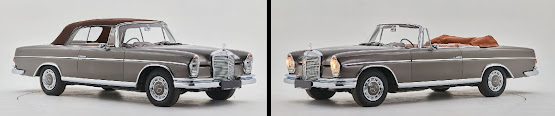
1966 Mercedes-Benz 300 SE (W112) Cabriolet. Lots of chrome on the W112 although, such was the attention to detail, some of the brightwork was polished brass.
In the collector-car market, the two-door Mercedes-Benz W111 (1961-1971) & W112 (1962-1967) remain coveted and, as is usually the case, it's the convertibles that are most sought, even though the cabriolet lacks the coupé's lovely roofline. Pedants note that although the W111s & W112s are technically a Coupé B & Cabriolet B in the factory's naming system, they're never referred to as such because no other configuration was offered in the two-door iterations. The W112 (300 SE) is of interest too because of the moldings around the wheel arches, a feature which seen on some earlier models and the 600 Grosser. Criticized by some when they appeared on the 600, the additional brightness on the W112 wasn't to everyone's taste (and it was a "delete option" when new) but it clearly had an enduring appeal because for decades, after-market suppliers found a ready market among those with later model Mercedes-Benz, BMWs, Jaguars and some others. This is not approved by the purists and whether in chrome, stainless steel or anodised plastic (!) it makes no difference: the originality police insist if it wasn't done by the factory, it shouldn't be done. It was a W112 Coupé (that had failed quality control inspection and was due to be scrapped!) that provided the test bed for the installation of the 600's 6.3 litre (386 cubic inch) V8 in a smaller platform and such was the transformative effect the project was approved for series-production although Daimler-Benz management was not convinced there would be sufficient demand for the "hot-rod" as a coupé or cabriolet and insisted it be released exclusively in four-door form.
Thus was begat the 300 SEL 6.3 (1968-1972) using the W109 platform (1965-1972) and it was for years was a favorite high-speed cruiser on the FRG's (Bundesrepublik Deutschland (Federal Republic of Germany; the old West Germany, 1949-1990) autobahns, drivers then even more than now not troubled by tiresome speed-limits. It was a great success but there have been some who longed to combine the big V8 with the lovely coachwork of the coupé & cabriolet and a surprising number of these have been built although the standard of the engineering has varied, not all interpolating the 300 SEL 6.3's air suspension. The finest of the breed were built by Wisconsin-based Karl Middelhauve (1932-2026) and while the term "guru" is these days tossed around entirely too much, truly Karl Middelhauve was "the 600 Guru".
1971 Mercedes-Benz 280SE 3.5 Coupé (converted to a cabriolet).
This is one really to upset the originality police because: (1) it started life as a coupé before a roofectomy was performed, (2) the chrome (actually anodized plastic) wheel-arch moldings were never available on this model and (3) the Fuchs (Bundt) aluminum wheels have been chromed (and may anyway be reproductions, some of which are cast and not forged, as were the originals). Such is the
price premium a cabriolet will command over a comparable coupé, over the years,
many have been tempted to cut but exactly to replicate what the factory did is
harder than at first glance it seems. It's not a matter simply of “removing the
roof”, a correctly accomplished conversion demanding: (1) structural reinforcements,
(2) a folding roof apparatus and (3) different rear-end body panels. While from the belt-line down the coupé &
cabriolet appear visually identical, the Cabriolet required extensive modifications
to the underlying platform to compensate for the removal of the structural
rigidity provided by the fixed steel roof.
Structural
Reinforcement: (1) The cabriolet used a significantly heavier, thicker floor
pan with welded-in boxed side members to prevent body flex and “scuttle (cowl)
shake” and for those prepared to do things in a way that don’t exactly emulate
the look of what the factory did all those years ago, using modern materials
and engineering techniques it is now possible to achieve ever greater rigidity
with less additional weight, the attraction being the changes remain hidden
unless the car is viewed from below (ie on a hoist) or the carpets are removed
for inspection. (2) The Cabriolet's windshield pillars (A-pillars) contain
internal steel tubes, both to afford additional rollover protection and support
the folding top mechanism, a mechanism heavy by the standards of such
things. (3) While the coupés were built
with a structural steel shelf behind the rear seats, in the cabriolets this was
replaced with a reinforced partition in which is housed the
bulk of the folding roof. (3) Without
the roof’s C-pillar, the size and shape of the rear side windows subtly is
different and these feature a unique chromed-frame designed to ensure a tight seal
against the heavy weather-stripping of the fabric top (on the coupé the glass
seals directly).
The multi-layered
soft-top: The Cabriolet’s folding roof
is not (in an engineering sense) complex but the construction was both intricate
and labor-intensive. Almost wholly hand-fitted,
the mechanism consisted of a padded outer layer, with a thick insulating bombast
of horsehair as a middle layer, finished with a tailored interior headliner.
The Rear
Body Panel Modifications: In the lower reaches of the conversion industry, this
is the most neglected aspect and the easiest way to identify “a fake” although,
unless the real thing is parked side-by-side, most would likely not tell the
difference unless their eye is keen: (1) The trunk (boot) lid length is physically
shorter on the factory-built cabriolets to accommodate the recessed storage
well into which much of the soft-top folds meaning (2) the rear-desk-sheet
metal (the panel between the back of the rear seat and the trunk opening)
is is unique to the cabriolet, featuring a chrome-trimmed latching area for the
soft top's boot.

Mercedes-Benz
770K (W150; 1938-1943), Cabriolet D (top) and Cabriolet F (bottom).
With
a variety of coachwork, all the second generation of the Großers (Grosser (Grand Mercedes)) were built on a chassis with a wheelbase of 3880 mm (152¾ inch). In some four years, only 88 were built, most
of which were allocated to senior figures in the Nazi Party, the Wehrmach (the
armed forces) and the German state although a handful were gifted to foreign
heads of state. The 770K will forever be
associated with Adolf Hitler (1889-1945; Führer (leader) and German head of
government 1933-1945 & head of state 1934-1945) because until the outbreak
of war the big Cabriolet F was his preferred parade car and one of the quirks
in the factory's nomenclature is that while the body-styles Cabriolet A, B, C
& D were defined and well-documented, there was a 770K Cabriolet F, but no
Cabriolet E. The W150 Cabriolet F was among
the rarest of the 770Ks with only five made (the distinction the additional rear
window in the passenger compartment). The
jump in the factory's designations from "D" to "F"
obviously skipped "E" and because that didn't seem the typically precise
German way of doing things, there was speculation that another type of open
coachwork had been planned (though not necessarily on the 770K chassis) but never built because of the outbreak of war in 1939. That's not impossible (some records were lost
during the war) but the archives for the period have revealed nothing to support the speculation and the sometimes repeated assertion the "Cabriolet F" label was
an allusion to "Führer" (the car's most infamous customer) is simply wrong because the designation first was used in the 1920s and was applied to the previous 770 Großer, the W07 (1931-1938). The factory seems never to have commented on the "missing Cabriolet E" although, despite having a great sense of history, it doesn't much
dwell on the company’s relationship with the state and party between 1933-1945.

Wedding
ceremony day: Hermann Göring & Emmy Sonnemann, Berliner Dom (Berlin Protestant Cathedral), 11 April, 1935.
Curiously,
the wedding car used by Hermann Göring (1893–1946; leading Nazi 1922-1945 and
Reichsmarschall 1940-1945) for his (second) marriage to Emmy Sonnemann
(1893-1973) was a Mercedes-Benz 500 K Cabriolet C and the photographs do suggest
things were a little cramped once his corpulent form had been wedged into the
back seat though his more slender bride looked content. One of the grand public spectacles the Nazi
regime (1933-1945) used as propaganda devices, the wedding received blanket
coverage in newspapers and, for the following three days, each movie shown in
German cinemas was preceded by a “newsreel” segment of “edited highlights” from
the happy day. That would have been a
good “catch-up” for Germans unlucky enough not to have been able to listen to
the live radio broadcast of the entire ceremony , carried over a then still
novel “national hook-up”. Adolf Hitler served as best man and, in an experience unfamiliar to both
him and the groom, neither were the centre of attention, eyes of the audience
and lens of the photographers alike focused on the bride.

Damenmode der 1930er-Jahre: "Gretchen mag´s mondän!" (1930s Women's Fashion: "Gretchen Likes It Sophisticated!"). Catalogue of the collection of the Münchner Stadtmuseum (Munich’s municipal museum).
General Göring wore a Luftwaffe (German Air Force) uniform in a new grayish-blue fabric chosen
for the occasion while the bride was dressed in a heavy white satin gown (cut in
the then fashionable “Gretchen fashion”) with wide puffed sleeves ending in
tight-fitting cuffs. The train was
relatively short and born not by girls (as was then customary) by boys of the HJ
(Hitlerjugend (the Hitler Youth)), possibly a deliberate adoption of a
practice then usually restricted to royalty and the aristocracy. From the cathedral, the motorcade travelled
the short distance to the Deutsche Oper Berlin (Berlin Opera House). As one of the party’s leading WAGs (wives
& girlfriends), Frau Göring made a good start in staking her claim to the
(unofficial) title First Lady des Reiches
(First Lady of the Reich), serving as Hitler's hostess at many state functions. It was however a keenly contest space and
both Anna Elisabeth “Annelies” von Ribbentrop (née Henkell 1896-1973), wife of Joachim
von Ribbentrop (1893–1946; Nazi Foreign Minister 1938-1945) and (especially) Johanna
Maria Magdalena "Magda" Goebbels (née Ritschel 1901-1945), wife of Dr
Joseph Goebbels (1897-1945; Nazi Minister of Public Enlightenment and
Propaganda 1933-1945) sought the honor and both were adept at Masonic-like
plotting & scheming. Frau Göring’s
chances of success became doomed after Eva Braun ( 1912–1945) complained to
Hitler that she was “mean to her” so the invitations “dried up” something that
didn’t much worry her husband because although regarded almost to the end as Zweiter
Mann des Reiches (Second Man of the Reich), he was never part of Hitler’s
“inner social circle”. Although the
exact nature of their relationship remains contested, being the Führer’s
concubine, Eva Braun could of course never be the Reich’s “First Lady” (her
very identity was close to a state secret and she was unknown to most of the
population) but, in the final hours of her life, she did gain the satisfaction
of being made “Frau Hitler” so there was that.
Of course, long before that low-key wedding in the Führerbunker, the
course of the war had meant becoming undisputed First Lady des Reiches was no longer the prize it once was, so what
Eva Braun gained was something of a withered garland.

Gretchen fashion: Not many women on the high street dressed quite like this but the elements did appear in everyday garments.
“Gretchen
fashion” (or “Gretchen-look”) was a term used for a fashion phenomenon much
identified with post-Weimar Germany; like many such trends, it was a blend and
the components were (1) traditional wholesomeness and (2) international glamour. The first element was a reaction against the
perception of Weimar as “decadent” (although that was always overstated and
applied only to a tiny, highly visible minority), thus the choice of the name “Gretchen”
as something archetypically German and most associated with modest, pure, rural
woman (certainly not “rootless cosmopolitans”).
Nazi-era propaganda attempted to “nudge” women towards a makeup-free life
focused on “…the three Ks - die Küche, die Kirche, die Kinder” (kitchen,
church, and children), a phrase that first became popular during the second
half of the nineteenth century but many women knew there was a variant with a
fourth “K”: Kleider (Clothing) and while the rustic look was adopted, the Gretchen-look emerged as a hybrid that owed as much to Hollywood as Hannover. Dresses shifted away from the boxy,
drop-waist 1920s flapper silhouette and used instead fabrics cut on the
diagonal (the bias cut) to elegantly skim curves and flare gently at the hem. Weimar’s characteristic angularity and androgyny
almost vanished (although the hats were too stylish to be forgotten and were
carried-over), replaced by a classic hourglass silhouette, high, natural
waistlines returning, often emphasized with slender belts or subtle ties with
hemlines at mid-calf, tea-length or floor-length depending on the time of
day. A simplicity of line was dominant
but delicate ruffles, puff sleeves and inventive (sometimes even asymmetric) necklines
decorated with tie-neck bows or fabric flowers could be used to compliment feminine
prints featuring romantic florals or polka dots. Of course, it was also the art deco era and
those motifs along with bold stripes often were seen. Some in the Nazi Party may have aspired to make
the country a totalitarian state but frocks proved a tough opponent and, defying
their Führer, women still wore red lipstick, plucked their eyebrows into arches
and varnished their nails.

Wedding day of Crown Prince Naruhito & Masako Owada san, Rolls-Royce Corniche III Convertible, 9 June, 1993. The crown prince was notably more svelte than General Göring. Because a
bride (in wedding gown) will need to step through a fairly small gap when
exiting (often while being photographed), a two-door cabriolet does seem a
strange choice as a wedding car and why one of the big 770K Cabriolet F Open
Tourers wasn’t used doesn’t seem anywhere discussed and of the many questions
directed at Göring during his week-long cross-examination at the Nuremberg
Trial (1945-1946); understandably perhaps, neither prosecution or defense counsel raised the matter so
it’s left to speculation. It may be the
bride wanted something “more romantic” and “less masculine” so there would be
the connotation of her “marrying the man rather than the state” and while that’s
wholly fanciful, it does explain the seemingly inexplicable. The use of a two-door cabriolet for a “state”
wedding proved however not unique, Japanese Crown Prince Naruhito (b 1960, Emperor
of Japan since 2019) appearing in a 1990 Rolls-Royce Corniche III Convertible
(by then the factory had ceased calling them DHCs (drophead coupé) although in
the twenty-first century DHC would get a nostalgic revival) for his wedding in
1993 to Masako Owada san (b 1963). It
was one of only two public appearances for the Corniche, later retired and
replaced by a Toyota Century Royal with one-off four door cabriolet coachwork,
something that doubtless will please brides in future weddings associated with
the Chrysanthemum Throne. Compared with
1935, there was by 1993 more material for content providers (then serving almost
exclusively television and print media) but the crown prince’s wedding was
still a major event (the day declared a national holiday) and, with the country
having entered the first of its “lost decades”, the spectacle must have been a relief
from tales of economic gloom.

How to really make a statement on one's wedding day: 1993 Rolls-Royce Corniche IV in red, on red, on red.
Although
in the English-speaking world the traditional color for wedding cars is white
(or a close variant such as cream), in Japanese culture both black and white
vehicles are used and there are even specialized Hanayome Taxis (Bridal Taxis) in which the left side of the roof
mechanically swings upward so ingress & egress can be elegant with no risk
of disturbing intricately constructed “big hair”. Usually, in vivid red, Kotobuki (congratulations; longevity; good fortune) banners appear on
the sides of the wedding cars as a warning to other traffic of the vehicle’s “special
purpose”. One Japanese “wedding
superstition” enforced with especial strictness is that a bridal car must never
shift into reverse gear because “backing-up” symbolizes “returning home” (ie a
looming divorce). One famous mid-twentieth
century tradition that has faded is the Yomeiri
(Dowry) Truck, most associated with the Nagoya region. There, the wedding motorcade was a convoy of
trucks used to transport the bride's dowry and furniture to her new home, the
vehicles wrapped in festive red-and-white Kohaku
maku (striped banners). Most
symbolically, on the bed of the last truck was the newlywed’s brand-new car,
wrapped in a large, bright red ribbon. For the crown prince and princess, their traditional
Shinto ceremony was conducted at the Kashiko-dokoro
(Shrine of the Sun Goddess Amaterasu) within the grounds of the Imperial Palace
grounds in Tokyo and while there were no dowry trucks (the palace already fully-furnished with microwave ovens, toasters and such), the Rolls-Royce was one of 46 vehicles in a motorcade stretching
slightly beyond a quarter-mile (402 metres).
Not even Göring
matched that scale although, being head of the Luftwaffe, he was able to
arrange a fly-past of dozens of fighter aircraft, timed with Teutonic precision
to appear over the cathedral just as the couple were walking down the steps to
their waiting cabriolet. The sybaritic Goering
gathered titles as enthusiastically as later he would loot Europe of artworks;
as well as heading the Luftwaffe, he was Premier of Prussia, Reich Minister of Aviation,
general in command of anti-aircraft artillery, general of fliers, Grand Master
of the Hunt, Master Forester of Germany, President of Reichstag, chief of the
Prussian secret police and Director, State Theatres & Operas (in that
capacity he granted Frau Sonnemann the title “State Actress by appointment”) so
it wasn’t difficult for him to arrange “stuff for the wedding”. Hundreds of thousands of Germans (not all of
the Berliners) lined the Wilhelmstrasse
(Wilhelm Street) and Unter den Linden
(best translated as “Boulevard of the Lime Trees”) from the chancellery to the cathedral
and seldom can a wedding have seen so men in such a variety of uniforms (at
attire then adored by Germans). Manpower
not being a resource-allocation problem for Göring, some 30,000 young men from
a variety of Nazi organizations formed a double row in order to keep the
streets clear and, with the expected military precision, they stood at
attention with right arms raised in the “Hitler salute” as the wedding motorcade
passed by. In a legal sense, the
marriage had taken place the day before in a civil ceremony at Berlin City Hall,
bride and groom signing the necessary paperwork confirming they were of “pure Aryan stock and free from hereditary
disease” (millions of those not either in the ten years to follow being
murdered by on Hitler’s orders) so the rituals in the church were essentially ceremonial
and performed for the benefit of God rather than the state. Reich Bishop Ludwig Mueller (1933-1945)
officiated, choosing the New Testament’s Book of Revelation for his text (“Be thou faithful unto death and I will give
you a crown of life.”): “Fear none of
those things which thou shalt suffer: behold, the devil shall cast some of you
into prison, that ye may be tried; and ye shall have tribulation ten days: be
thou faithful unto death, and I will give thee a crown of life.” Revelations 2:10 (King James Version of the
Bible (KJV, 1611)).

The Blue Goose. The image on the left is from the Búndesarchiv (German Federal Archives) and is stamped "1941", suggesting married life did not cause Göring to suffer weight-loss,
The
car most famously associated with Göring was also a Mercedes-Benz convertible
(though not a cabriolet): a 1937 540K (W29) Special Roadster. The earlier 500K Special Roadster came to be
called “the brightest glint of a golden age” and while the 540K SR wasn’t quite
as rakish as its slightly smaller predecessor, that may have been a good thing
because modifications had to be made the 540 to ensure Göring was “able to fit
behind the wheel” and even then, things were “tight”. His 540K SR was nicknamed das Blaue Gans (the Blue Goose) because Göring
ordered it his favourite shade of Luftwaffe
Blaue (used for the underside of reconnaissance aircraft) and he was
sufficiently fond of the hue to have one of his (many) Reichsmarschall uniforms
cut in a fabric dyed the same color.
Appointed
in 1933 by Hitler to the newly created office of Reichsbischof de Deutsche Evangelische Kirche (Bishop for the Reich
of the German Evangelical Church), Mueller, a Lutheran priest and
undistinguished theologian had no obvious qualifications for the role other
than being a devoted Nazi but for the Führer, that was enough. In office, Mueller, even by the slight
standards of the regime’s minor functionaries, proved singularity inept and far
from uniting the German protestant churches as was his designated task, he
proved a schismatic influence. By 1937, it was obvious to Hitler he’d “backed a dud” and increasingly he abandoned his
use of carrots in church matters, resorting to the stick “when required” but
otherwise becoming indifferent, seemingly resigned to the party’s state of
“semi-peaceful” co-existence with the churches.
Typically, despite his conspicuous failure, Mueller wasn’t dismissed but
simply ignored, his sycophancy and repeated attempts at ingratiation with the
regime proving pointless. Still, he
deserves credit for having been prophetic in his choice of text for Göring’s
wedding although whether “Defendant Number One” at the Nuremberg Trial much
dwelt on the words during the months he spent in his cell or as he stood to
hear the IMT’s (International Military Tribunal) president sentence him to be
hanged, isn’t known.


