Showing posts sorted by relevance for query Longevity. Sort by date Show all posts

Monday, January 31, 2022

Longevity

Longevity (pronounced lon-jev-i-tee)

(1) A long individual life; great duration of individual life.

(2) The length or duration of life.

(3) Length of service, tenure etc; seniority.

(4) Duration of an individual life beyond the norm for the species.

1605-1615: From the Late Latin longaevitatem (nominative longaevitās), from longaevus (ancient, aged; long-lived (the feminine was longaeva and the neuter longaevum)), the construct being longus (long) + aevum (age) (from PIE primitive Indo-European root aiw- (vital force, life; long life, eternity); longevous was the adjective.  The construct of longaevitās was longaevus + -itās (the suffix from the Proto-Italic -itāts & -otāts (-tās added to i-stems or o-stems, later used freely) and ultimately from the primitive Indo-European -tehats.  The adjectival form, the Latin longevous (also as longevously) is now rare in English but does occasionally appear as a poetic or literary device.  (the comparative more longevous, the superlative most longevous).  The less common antonym is shortgevity and the plural longevities; there’s not an exact synonym, the closest being probably durability, endurance & lastingness.  Longevity is a noun; the noun plural is longevities

Reader's Digest Kids Letter Writer Book & Stationary Set, one of Lindsay Lohan’s early (in 1994, then aged seven) modelling jobs.

Among monarchs, longevity is not uncommon, Louis XIV (1638–1715; le Roi Soleil (the Sun King), King of France 1643-1715) holding the world record by setting the mark at 72 years, 110 days.  All a latter day king, queen or emperor need to have a crack the record is (1) assume the throne at an early and age and avoid (1) dropping dead, (2) suffering regicide, (3) being compelled th abdicate because of some scandal or (4) being deposed and historically most have managed most or all of those but, despite that, Louis XIV’s record had stood for more than three centuries.  In fields where “what one does” rather than “how long one stays alive” determines longevity, long careers are less common but many do long endure.  In the minds of some, Lindsay Lohan (b 1986 must seem to have “been around forever” and in terms of her industry, that’s a reasonable way of putting it.  Signed at the age of three to the agency Ford Models, her early gigs were in print advertising before she appeared in dozens of television commercials and at seven, she was in episode 3358 (29 March 1995) of Sesame Street which first aired in the US in 1969.  By 2026, aged 39, Ms Lohan had been in the business for 36 years and counting.  On paper, there have been impressively long military careers but many are a bit of a fudge because of the tradition “a field marshal does not retire”.  Field Marshal August von Mackensen (1849–1945) joined the Prussian Army in 1869 so over three-quarters of a century, his career spanned service to Kingdom of Prussia, the North German Confederation, the German Empire, the Weimar Republic, the Third Reich, the so-called “Dönitz administration” and the post-war Allied occupation.

Field Marshal August von Mackensen (colorization by Richard White) in fur busby with Totenkopf.  Busby is the English name for the Hungarian prémes csákó (fur shako) or kucsma, a military head-dress and the German Totenkopf (literally “dead person's head”) and widely used in the sense of “death’s head”.

Politics being a sordid, nasty business, old Enoch Powell’s (1912–1998) dictum that “all political careers end in failure” is fulfilled often enough to be thought a rule but circumstances can occur which can make even a relatively brief seem impressively long.  Remarkably, Schwerin von Krosigk (1887-1977) served continuously in cabinet as finance minister between 1932-1945, ending his government service as chancellor (prime minister), the previous appointee to that role Dr Joseph Goebbels (1897-1945; Nazi propaganda minister 1933-1945) having committed suicide, something at the time fashionable among Nazis.  Von Krosigk thus served as a minister under the Weimar Republic, the Third Reich and the Dönitz administration, proving something of a “Vicar of Bray” in troubled times; he was quite a survivor and Winston Churchill (1875-1965; UK prime-minister 1940-1945 & 1951-1955) even contemplated maintaining the Dönitz administration as a short-term German government so briefly there was the prospect of von Krosigk serving yet another master.  Churchill also benefited from the times coming to suit him.  As early as 1929 his political career had been dismissed as “a failure” yet it was the dramatic events of 1939-1945 which revived his prospects and late in life, his success was extraordinary.  First holding office in “the glittering Liberal ministry” of Sir Henry Campbell-Bannerman (1836–1908; UK prime minister 1905-1908), 50 years later he finally retired (not entirely willingly) from the premiership.  In politics, longevity of half a century-odd (off and on) is not unique but certainly untypical.

In political terms, Vladimir Vladimirovich Putin (Vladimirovich the patronymic, Putin the family name, b 1952; president or prime minister of Russia since 1999) has displayed an extraordinary longevity.  While it's true some of his Tsarist and Soviet predecessors ruled for longer, they were operating under systems, though sometimes violently dangerous, which made the maintenance and retention of power in many ways a different sort of task.  Since 1999 he has served either as prime-minister or president of Russia, at one point swapping between the offices to circumvent a tiresome constitutional clause which placed limitations on consecutive presidential terms.  In 2021, after a well-done referendum, constitutional amendments were effected which will permit Mr Putin to seek election twice more which, providing the elections are well-run, means he could retain the presidency until 2036.  Should he defy the odds which tend to increase against any politician as the years roll by and still be in rude good health as 2036 looms, there is the suggestion he might be unwilling to relinquish office; there may be a need for more constitutional reform.
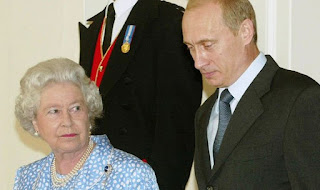
With Elizabeth II (1926-2022; Queen of the UK and other places, 1952-2022).

With Muammar Gaddafi (circa 1942–2011; leader of Libya 1969-2011).

With Yasser Arafat (1929–2004; leader of the PLO (Palestine Liberation Organization) 1969-2004).

With John Paul II (1920-2005; pope 1978-2013).

With Jiang Zemin (1926–2022; General Secretary of the Chinese Communist Party (CCP) (and thus paramount leader) 1989-2002 and President of the People's Republic of China 1993-2003).

With Boris Yeltsin (1931–2007; President of Russia 1991-1999).

With Bill Clinton (b 1946; President of US 1993-2001).

With Rudy Giuliani (b 1944; Mayor of New York City 1994-2001).

With Silvio Berlusconi (1936-2023; prime minister of Italy 1994-1995, 2001-2006 & 2008-2011).

With Kim Jong-Il (Kim II, 1941-2011; Dear Leader of DPRK (Democratic People's Republic of Korea (North Korea)) 1994-2011).

With Jacques Chirac (1932–2019; President of France 1995-2007) & Gerhard Schröder (b 1944; Chancellor of Germany 1998-2005).

With John Howard (b 1939; Prime-Minister of Australian 1996-2007).

With Benjamin Netanyahu (b 1949; prime-minister of Israel 1996-1999, 2009-2021 and since 2022).

With Tony Blair (b 1953; Prime-Minister of UK 1997-2007.

With Yoshirō Mori (b 1937; Prime-Minister of Japan 2000-2001).

With Bashar al-Assad (b 1965; President of Syria 2000-2024).

With Junichiro Koizumi (b 1942; Prime-Minister of Japan 2001-2006).

With Ariel Sharon (1928–2014) Prime Minister of Israel 2001-2006).

With George W Bush (b 1946; President of US 2001-2009).

With Hu Jintao (b 1942; general secretary of the Chinese Communist Party (CCP) 2002 to 2012 (and thus paramount leader), president of the PRC (People's Republic of China) 2003-2013).

With Benedict XVI (1927–2022; pope 2005-2013, pope emeritus 2013-2022).

With Angela Merkel (b 1954; Chancellor of Germany 2005-2021).

With Nicolas Sarközy (b 1955, President of France 2007-2012).

With Barack Obama (b 1961; President of US 2009-2017).

With crooked Hillary Clinton (b 1947; US secretary of state 2009-2013).

With Kim Jong-Un (Kim III, b 1982; Supreme Leader of DPRK (Democratic People's Republic of Korea (North Korea)) since 2011).

With Xi Jinping (b 1953; general secretary of the Chinese Communist Party (CCP) and paramount leader of the People's Republic of China (PRC) since 2012).

With Francis (1936-2025; pope 2013-2025).

With Tony Abbott (b 1957; Prime-minister of Australia 2013-2015).

With Narendra Modi (b 1950; Prime-Minister of Indian since 2014).

With Theresa May (b 1956; Prime Minister of the UK 2016-2019).


With Donald Trump (b 1946; US president 2017-2021 and since 2025).

With Emmanuel Macron (b 1977; President of France since 2017).

With Boris Johnson (b 1964; UK prime-minister 2019-2022).

With Joe Biden (b 1942; President of US 2021-2025).

Thursday, September 15, 2022

Catafalque

Catafalque (pronounced kat-uh-fawk, kat-uh-fawlk or kat-uh-falk)

(1) A (temporary or permanent) raised structure on which the body of a deceased person lies or is carried in state.

(2) A hearse (obsolete).

1635–1645: The orthodoxy is that catafalque is from the seventeenth century French catafalque, from the Italian catafalco, from the Late Latin catafalicum (scaffold), the construct being cata- (from the Ancient Greek κατά (katá) (downwards (and used in Medieval Latin with a sense of “beside, alongside”))) + fal(a) (wooden siege tower) + -icum (neuter of –icus; (the suffix used to denote "belonging to; derived from or pertaining to"), from the Etruscan.  However, etymologists are divided on the origin.  Some believe English picked up the word directly from the Italian and not via French and regard the Italian of uncertain origin, the connection with the Late Latin only speculative.  From the Medieval Latin catafalicum Old French gained chaffaut & chafaud (scaffold) which exists in the Modern French échafaud (scaffold).  Catafalque (the rare alternative spelling is catafalco) is a noun; the noun plural is catafalques.

The coffin carrying Queen Elizabeth II, rested on its catafalque for the lying in state, Westminster Hall, London, September 2022.

A catafalque is the platform upon which the body of the dead lies before their funeral.  In the West the modern practice is for the body to be placed in a coffin but historically the body was sometimes wrapped and this remains the practice for burials at sea.  Catafalques can be elaborately decorated or constructed with austere simplicity and can be mobile or stationary.  Although associated with state funerals they are a common fixture in crematoria or chapels and exist so the coffin is permitted to sit at an appropriate height for ceremonial purposes, most obviously during “open-casket” services.  Those used by undertakers (funeral directors) are usually mobile 9on wheels) so the coffin may easily be moved from one place to another, by one staff member if need be.  Thus, any appropriately elevated surface used from the purpose can be thought of (if only temporarily) as a catafalque although the name-proper is attached only to dedicated devices.  A catafalque party is a military formation, traditionally numbering four (though it may be more or fewer) assembled to stand guard over the coffin while the body is lying in state or at some other site of memorial.

A member of Queen Elizabeth II's catafalque party fainted shortly before his shift was due to end.  His injuries were said to be "not serious".

The 1865 (Abraham Lincoln) catafalque in 2006, after the most recent replacement of its fabric covering.

One catafalque noted for its longevity is that hastily (and, from the point-of-view of a professional carpenter or cabinet maker, rather crudely) fabricated was that used for the coffin of Abraham Lincoln (1809–1865) US president 1861-1865) and still in use today.  Of simple construction and using plain framing timber, it’s not at all ornate and gains its aura from the long history of use, having being used in the funerals of some four dozen US figures from politics, the judiciary, the military or society (most recently Senator Harry Reid (1939–2021; US senator (Democrat, Nevada).  Over the years, it has been enlarged and strengthened to accommodate increasingly heavy coffins and the fabric covering has several times been replaced but almost all the original structure remains so it’s not a “grandfather’s axe”.  The simplicity has sometimes been emulated with intent, Pope John Paul II’s (Karol Wojtyła, 1920–2005; Pope of the Roman Catholic Church 1978-2005) plain cypress coffin sitting atop a catafalque so basic it might have been built by Christ himself.  It’s thought JPII’s successor might choose something just as simple.

Voltaire's catafalque.

Voltaire (François-Marie Arouet, 1694–1778), the radical writer of the French Enlightenment, as controversial in death as in life, was buried quietly some way distant from Paris because his friends feared church and state would seek to deny him the proper rites of burial and it was only some thirteen years after his death, just after the French Revolution that his body was disinterred and moved to the Panthéon in Paris, a site created to honor illustrious citizens.  His catafalque was an impressive three tiered construction inscribed: Poet, philosopher, historian, he made a great step forward in the human spirit.  He prepared us to become free.

David Lloyd George's funeral bier, Good Friday (30 March) 1945, Llanystumdwy, Wales.  It was Lloyd George himself who stipulated a farm cart funeral”.

In the context of funerals, definitionally, there is no difference between a bier and a catafalque.  Bier ((1) a litter to transport the body of a dead person, (2) a platform or stand where a body or coffin is placed & (3) a count of forty threads in the warp or chain of woolen cloth) was from the Middle English beer, beere & bere, from the Old English bēr, from the West Saxon bǣr (stretcher, bier), from the Proto-West Germanic bāru, from the Proto-Germanic bērō, from the primitive Indo-European bher (to carry, bear) and was cognate with the Saterland Frisian Beere (stretcher, bier), the Dutch baar (bier) and the German Bahre (bier, stretcher).  It’s thus functionally the same as a catafalque and the only point of differentiation in modern use seems to be the convention that catafalque is used when the funeral is grand while for more modest affairs (like David Lloyd George’s (1863–1945; UK prime-minister 1916-1922) “farm cart funeral”), bier is preferred.  The pyre (from the Ancient Greek πυρά (pyrá), from πρ (pyr) (fire)), also known as a funeral pyre, is a structure, made almost always of wood, constructed for the purpose of burning a body as part of a funeral rite and thus a form of ceremonial cremation.  Dimensionally, it may be far larger than is required for purposes of combustion because big fires were often an important aspect of the spectacle.

The Cenotaph's unveiling ceremony, 11 November, 1920, Whitehall, London.

It was Lloyd George who commissioned Sir Edwin Landseer Lutyens (1869–1944) to design a catafalque past which the troops would march during the victory parade in 1919, giving the English architect only two weeks to have the structure in place.  Using a method close to what would now be called “rapid prototyping”, Sir Edwin drafted sketches and from these a full-sized catafalque was constructed in timber and plaster, so well-executed one architect thought it looked “as if it had stood sturdy for a century”.  It was so admired The Times lead a campaign demanding it be rebuilt in granite and this was done, the permanent structure in place by 11 November, 1920 for the anniversary of the armistice which ended World War I (1914-1918), the body of the Unknown Warrior carried past.

Tuesday, February 18, 2020

Herringbone

Herringbone (pronounced her-ing-bohn)

(1) A pattern, the weave resembling the skeleton of a herring fish, consisting of adjoining vertical rows of slanting lines, any two contiguous lines forming either a V or an inverted V, used in masonry, textiles, embroidery etc and .  Also called chevron, chevron weave, herringbone weave; a type of twill weave having this pattern.

(2) A fabric constructed with this weave.

(3) A garment made from such a fabric, applied especially to jackets and coats.

(4) In skiing, a method of going up a slope in which a skier sets the skis in a form resembling a V, and, placing weight on the inside edges, advances the skis by turns using the poles from behind for push and support.

(5) A type of cirrocumulus cloud.

1645–1655: The construct was herring + bone.  Herring was from the Middle English hering, from the Old English hǣring, from the Proto-West Germanic hāring (herring) of unknown origin but it may be related to the Proto-Germanic hērą (hair) due to the similarity of the fish’s fine bones to hair. It was cognate with the Scots hering & haring, the Saterland Frisian Hiering & Häiring, the West Frisian hjerring, the Dutch haring, the German and Low German Hereng & Hering, the French hareng, the Norman ĥéren and the Latin haringus; all borrowings from the Germanic.  Bone is from the Middle English bon, from the Old English bān (bone, tusk; bone of a limb), from the Proto-Germanic bainą (bone), from bainaz (straight), from the primitive Indo-European bheyhz (to hit, strike, beat).  It was cognate with the Scots bane, been, bean, bein & bain (bone), the North Frisian bien (bone), the West Frisian bien (bone), the Dutch been (bone; leg), the Low German Been & Bein (bone), the German Bein (leg), the German Gebein (bones), the Swedish ben (bone; leg), the Norwegian and Icelandic bein (bone), the Breton benañ (to cut, hew), the Latin perfinēs (break through, break into pieces, shatter) and the Avestan byente (they fight, hit). It was related also to the Old Norse beinn (straight, right, favorable, advantageous, convenient, friendly, fair, keen) (from which Middle English gained bain, bayne, bayn & beyn (direct, prompt), the Scots bein & bien (in good condition, pleasant, well-to-do, cozy, well-stocked, pleasant, keen), the Icelandic beinn (straight, direct, hospitable) and the Norwegian bein (straight, direct, easy to deal with).  The use to describe a type of cirrocumulus cloud dates from 1903.  The alternative form is herring-bone (not herring bone which would be a bone of a herring).

The herringbone shape (left) and a herring's bones (right).

The herringbone pattern picked up its rather fanciful name because of a resemblance to the fine bones of the fish.  First used in masonry, the motif has for centuries been used in wallpaper, mosaics, upholstery, fabrics, clothing and jewellery.  In engineering, the pattern is found also in the shape cut for some gears but this functionally deterministic.

Roman herringbone brickwork, Villa Rustica, Mehring, Trier-Saarburg, Rhineland, Germany.

The original herringbone design was a type of masonry construction (called opus spicatum, literally "spiked work”) used first in Ancient Rome, widely adopting during medieval times and especially associated with Gothic Revival architecture; it’s commonly seen today.  It's defined by bricks, tiles or cut stone laid in a herringbone pattern and is a happy coincidence of style and structural integrity.  Although most associated with decorative use, in many cases the layout was an engineering necessity because if tiles or bricks are laid in straight lines, the structure is inherently weak whereas if built using oblique angles, under compression, loads are more evenly distributed.  One of the reasons so much has survived from antiquity is the longevity of the famously sticky Roman concrete, the durability thought in part due to chemical reactions with an unusual Roman ingredient: volcanic ash.

1974 Holden HQ Monaro GTS (308) in Barbados Green over Doeskin vinyl with Herringbone cloth inserts (left & right) and reproduction fabric (centre) is available from Global Trim.  Holden in 1973 had replaced the previous houndstooth cloth insert option with one in a herringbone pattern (Ranier, option code 30Y), the most popular combination early in the availability being 1854-30Y (black vinyl + herringbone cloth inserts); the factory code for an all vinyl interior in black was 1854-30X.  At the time, option 30Y listed at Aus$75.00 (4 seats) and Global Trim's reproduction fabric lists at Aus$330 per metre (the bolts 1.5m wide); to re-trim an interior to factory specifications demands 2m.

Although in 1974 the 350 cubic inch (5.7 litre) Chevrolet small-block V8 remained on the option list, it was by then available only with an automatic transmission.  The HQ's new, coil-sprung rear suspension had never been equal to the task of delivering the 350's power to the ground and this the automatic disguised by acting as a fluid cushion between torque and tarmac; quietly, and with no public announcement, late in 1973 the option of pairing the 350 with a manual transmission was withdrawn.  Coincidently, by 1974, the 350 (fully-imported in US specification) could satisfactorily have again been paired with the manual because, now compliant with US emission regulations, output had dropped so much the 350 offered little over Holden's locally-manufactured 308 (5.0) V8 other than additional cost, weight and fuel consumption;  with the coming of the HJ range in October, 1974, the 350 was deleted from the option list.  In mid-1976, Australia introduced more stringent emissions regulations which meant the now less toxic 308 became thirstier and less powerful so the 350 would again have offered additional performance but, in the post oil-shock world, its reintroduction was never contemplated and Chevrolet V8 would not again be used in Holdens until 1999 when, after 30 years, local production of the V8 ended.   

Lindsay Lohan in herringbone flat-cap.

Of gears

Although the term “herringbone cut gears” is more poetic, to engineers they’re known as double helical gears.  In both their manufacturing and operation they do present challenges, the tooling needed in their production demanding unusually fine tolerances and in use a higher degree of alignment must be guaranteed during installation.  Additionally, depending on use, there is sometimes the need periodically to make adjustments for backlash (although in certain (usually lower-speed) applications they can be designed to minimize this).  However, because of the advantages the herringbone structure offers over straight cut, spur or helical gears, the drawbacks can be considered an acceptable trade-off, the principle benefits being:

(1) Smoothness of operation and inherently lower vibration:  The herringbone shape inherently balances the load on the teeth, reducing vibration and generated noise.

(2) A high specific load capacity: The symmetrical design of herringbone gears offers a high surface area and an even distribution of load, meaning larger and more robust teeth may be used, making the design idea for transmitting high torque or power.

(3) A reduction in axial thrust: Probably the reasons engineers so favour the herringbone is that axial thrust can be reduced (in certain cases to the point of effective elimination).  With helical gears, the axial force imposed inherently acts to force gears apart whereas the herringbone gears have two helical sections facing each other, the interaction cancelling the axial thrust, vastly improving mechanical stability.

(4) Self-regulating tolerance for misalignment. Herringbone handle small variations in alignment better than spur gears or single helical gears, the opposing helix angles assisting in compensating for any axial misalignment, contributing to smoother gear meshing and extending the life of components.

(5) Heat dissipation qualities: The symmetrical structure assists heat dissipation because the opposing helices create a distribution of heat through a process called mutual heat-soak, reducing the risk of localized overheating, something which improves thermal efficiency by making the heat distribution pattern more uniform.

Gears: helical (left), herringbone (or double helical) (centre) and straight-cut (right).  Although road cars long ago abandoned them, straight-cut gears are still used in motorsport where drivers put up with their inherent whine and learn the techniques needed to handle the shifting.

Sunday, September 4, 2022

Lotus

Lotus (pronounced loh-tuhs)

(1) In Greek mythology, a plant believed to be a jujube or elm, referred to as yielding a fruit that induced a state of forgetfulness and a dreamy languor in those who ate it.

(2) Any aquatic plant of the genus, Nelumbo nucifera, of the water lily family, having shield-like leaves and showy, solitary flowers usually projecting above the water.

(3) Any of several water lilies of the genus Nymphaea.

(4) A decorative motif derived from such a plant and used widely in ancient art, as on the capitals of Egyptian columns.

(5) Any shrubby plant of the genus Lotus, of the legume family, having red, pink, yellow, or white flowers.

(6) An English manufacturer of lightweight sports and racing cars, best known for its successes in Formula One between 1962-1978.

1530–1540:  From the Classical Latin, lōtus or lōtos, perfect passive participle of lavō (wash), from the Ancient Greek λωτός (lōtós) (the lotus plant), the origin of which is unknown but thought probably related to Semitic plant names such as Hebrew לוט‎ (lōt) (myrrh).  The feminine was lōta, the neuter lōtum.  The circa 1500 lote was an Englished form of lotus and it survives as Lote-tree.  The yogic sense is attested from 1848.

From the 1540s, the name was, rather casually, bestowed on many plants, some related, some not even alike and that had been the pattern of the Greek lōtós which was applied to several plants before it came exclusively to mean Egyptian white lotus (a sense attested in English from 1580s), a plant prominent part in the mythology of India, Egypt, China.  The Homeric lotus later was held to be a North African shrub, from which "a kind of wine" can be made and historians conclude that was a reference to the effects rather than the taste.  The name has also been given to several species of water-lilies and a bean that grows in water.   The noun lotion is from the circa 1400 Middle English loscion (liquid preparation for application to the skin), from the fourteenth century Old French lotion, from the Latin lotionem (nominative lotio) (a washing), a noun of action from lotus (varied contraction of lavatus (a popular form of lautus, past participle of lavere (to wash) from the primitive Indo-European root leue- (to wash)).  The circa 1600 noun lotophagi (literally “lotus-eaters”) was from the Greek lotophagoi (plural), the construct being lotos + -phagos (eating), from the primitive Indo-European root bhag- (to share out, apportion; to get a share), the more common literary form of which was lotophagous.  The lotus was believed to induce a dreamy forgetfulness, hence the mention of the lotus-eater as "one who finds pleasure in a listless life" (1812) from the Greek lotophagoi, mentioned in book IX of Homer’s Odyssey.  Odysseus had to force his lethargic sailors back on board after the lotus-eaters had shared with them the narcotic fruit.  It’s one of the earliest warnings against drug use.

Of the plural

Lindsay Lohan (left) with former special friend Samantha Ronson (righT) at a charity fundraiser for the Children’s Miracle Network, Lotus Lounge,  Washington DC, October 2008.

The use of plural forms in English is not consistent, though the wise attempt always to append just and "s" or "es" as required.  This linguistic pragmatism (or Anglo-Saxon laziness if you prefer) simplifies things and plurals like stadia and referenda, while not extinct, are probably now archaic.  That said, plurals can sometimes need to end in an i, aux or a, often more for elegance than sticking to the rules.  Rare plurals persist because they’re useful within niche communities; scientists and statisticians being punctilious in the use of datum, the rest of us calling all such stuff, singular or plural, data.  Patterns of use in English, if of sufficient longevity (though not of necessity breadth of adoption), can re-define words borrowed from other languages.  The modern English agenda (from the Latin agenda (things that ought to be done)) is now singular, the plural being agendas and the individual components, items.  In the original, agenda was plural of agendum.  However, criterion is singular and criteria plural; any other use is a more recent lapse and remains wrong.

Lindsay Lohan (left) practicing the lotus position (right).

English is best evolving its own rules, plundering shamelessly from other languages.  While correct, "Lotuses" isn’t pretty which is a good a reason as any for a word to vanish but under Latin rules the plural would be "loti" which seems little better but anyway, lotus is of Greek origin.  So, because both lotos and lotus appear in the Latin texts and the plural in Greek was "oi" (not "i"), lotoi can exist in the same texts.   That’s also why the persistent "octopi" is wrong and that’s a shame because it sounds better than the standard English plural which is "octopuses".  Octopus comes from the Ancient Greek; the correct plural form is octopodes.

By 1968, the makers of the Lotus Formula One and sports cars responded to having their machinery called (in the plural) Loti & Lotuses (whether Lotaux ever appeared isn't known) by issuing a press release advising the company would henceforth adopt "Lotus" as both plural and possessive, hinting all others should do the same.  To make sure everyone got the point, the company condemned both loti and the etymologically correct lotuses as: “horrible words”.  The press release seems to have had no effect.

The footnote: The Lotus 43

BRM H16 engine.

The change from the 1.5 litre (92 cubic inch) voiturette formula (1961-1965) to a 3.0 litre (183 cubic inch) displacement for the 1966 Formula One season meant not only would the teams need new engines but also bigger, stronger chassis.  Lotus had an advantage in solving the latter problem because it was able to modify the Lotus 38 which had won the 1965 Indianapolis 500 when fitted with a 4.2 litre (256 cubic inch Ford V8).  The 38 was a strong and adaptable design, many of the elements of which would be incorporated into the later Lotus 49 and many racing cars of the era were to some extent Lotus 38 clones.  For an engine, for a number of reasons, Lotus choose to use the BRM H16, a unit created by reconfiguring the successful 1.5 litre BRM V8 into a 180o (flat) configuration and mounting one atop another, thereby creating a 3.0 litre H16 which had the advantage of a relatively short development cycle because so many existing components were able to be used but the drawbacks were weight, size and height.

BRM H16 in Lotus 43.

Although commendably short, the H16 was tall which meant a high centre of gravity, something exacerbated by having to mount the block high in the chassis to permit sufficient clearance for the exhaust systems of the lower banks of cylinders.  It was also wide, too wide to fit into a monocoque socket and thus was taken the decision to make the engine an integral, load-bearing element of the chassis.  There was no other choice but that aspect worked well.  Had the H16 had delivered the promised horsepower the Lotus 43 might have been a success but the numbers were never realized.  The early power output was higher than the opposition but it wasn’t enough to compensate for the drawbacks inherent in the design and, these being so fundamental they couldn’t be corrected, the only hope was even more power.  The path to power was followed and modest increases were gained but it was never enough and time ran out before the plan to go from 32 to 64 valves could come to fruition, an endeavor some suggested would merely have “compounded the existing error on an even grander scale.”  Additionally, with every increase in power and weight, the already high fuel consumption increased.

Lotus 43, US Grand Prix, Watkins Glen, 1966.

In winning the 1966 US Grand Prix at Watkins Glen, the Lotus 43 delivered the H16 its sole victory, something BRM never managed when the engine was mounted in their chassis.  The 1.5 litre BRM V8 had enjoyed outstanding reliability but of the 40 times the H16 started a race, 27 ended prematurely.  The irony of the tale is that in the two seasons BRM ran the 400 horsepower H16 with its 16 cylinders, two crankshafts, eight camshafts and 32 valves, the championship in both years was won by the Repco-Brabham, its engine with 320 horsepower, eight cylinders, one crankshaft, two camshafts and 16 valves.  Adding insult to the exquisitely bespoke H16’s injury, the Repco engine was based on an old Oldsmobile block which General Motors had abandoned several year earlier (the engine blocks used by Brabham could be purchased by any customer for around US$50, a number which must have astonished outfits like Scuderia Ferrari).  After two seasons the H16 venture was retired, replaced by a conventional V12; Lotus sold the two 43s to a privateer who installed 4.7 litre (289 cubic inch) Ford (Windsor) V8s and campaigned them in Formula 5000 events.  The new Lotus 49 used the 3.0 litre Ford Cosworth (DFV) V8, a combination which enjoyed, remarkably, three successful seasons.