Showing posts sorted by relevance for query gown. Sort by date Show all posts

Wednesday, September 30, 2026

Gown

Gown (pronounced goun) 

(1) A type of woman's dress or robe, especially one full-length and worn on formal occasions and often styled as “evening gown” or “ball gown”.

(2) As nightgown, a loose fitting garment worn by sleeping (historically by both men & women but now most associated with the latter); the shortened for is “nightie”.

(3) As surgical gown, a light, protective garment worn in hospitals by medical staff, a specialized form of which is the isolation gown.

(4) As dressing gown (also call bathrobe), a garment in the form of an open robe secured by a tie and often worn over pajamas, after a bath and prior to dressing or on other occasions where there’s no immediate need to dress.

(5) A loose, flowing outer garment in various forms, worn to denote an office held, profession practiced or as an indication of rank or status, most associated with formal academic dress (sometimes in the phrase “cap & gown”).

(6) Those who work or study at a university as opposed to the other residents of the university town, expressed in the phrase “town & gown”.

(7) Historically, the dress of civil, as opposed to military officers.

(8) To supply with or dress in a gown.

1300-1350: From Middle English goune & gowne, from Anglo-Norman gune & goune (fur-trimmed coat, pelisse), from the Old French goune (robe, coat; nun's habit), from the Late Latin gunna (a garment of fur or leather), from the Ancient Greek γούνα (goúna) (coarse garment), of unknown origin but may be from a Balkan or Apennine language where it seems to have been used as early as the eighth century to describe a fur (or fur-lined), cloak-like garment worn by old or infirm monks; More speculatively, some scholars suggest a Celtic source.  The alternative explanation suggests a Scythian origin, from the Proto-Iranian gawnám (fur), the possibility of this link supported by the Younger Avestan gaona (body hair) and the Ossetian гъун (ǧun).  The alternative spelling gowne is obsolete and descendants in other languages include the Bengali গাউন (gaun), the Japanese ガウン, the Korean  가운 (gaun), the Malay gaun, the Punjabi ਗਾਊਨ (gāūna) and the Welsh gown.  Gown is a noun and verb and gowned is an adjective; the noun plural is gowns.

Surgeon in blood-splattered surgical gown (also called hospital or medical gowns), mid-procedure.

As late as the eighteenth century, gown was the common word for what is now usually described as dress and gown in this sense persisted in the US longer than in the UK and there was on both sides of the Atlantic something of a twentieth century revival and the applied uses (bridal gown, nightgown etc) became more or less universal.  The meaning “a loose, flowing outer garment in various forms, worn to denote an office held, profession practiced or as an indication of rank” emerged in the late fourteenth century and the collective singular for “residents of a university” dates from the 1650s, still heard in the rhyming phrase “town & gown”.  The night-gown (worn once by both men & women but now associated almost exclusively with the latter) became a thing in the fourteenth century.

Lindsay Lohan in white & black color-blocked bandage dress.  With a flawless figure, Ms Lohan doesn't need the "corrective" effects the bandage construction provides and this one may really be a bodycon dress with the visual effect of "bandage layers" created by stitched folds. 

Dress dates from circa 1300 and was from the Middle English dressen & dresse (to arrange, put in order), from the Anglo-Norman & Old French dresser, drecier (which persists in as dresser), from the unattested Vulgar Latin dīrēctiāre, from the Classical Latin dīrēctus, the perfect passive participle of dīrigō (to arrange in lines, direct, steer), the construct being dis- (the prefix in this context meaning “apart; asunder; in two’) + regō (to govern, manage), ultimately from the primitive Indo-European h₃reǵ- (straight, right).  The noun dress was derived from the verb and emerged in the sense of “attire” in the early 1600s.  Originally, a dress was always something which covered both the upper and lower parts of the female body but not of necessity in once piece.  The dressing gown seems first to have been described as such in 1854 although in French both robe de chambre (dressing gown) & robe de nuit (nightgown) had been in use for centuries.
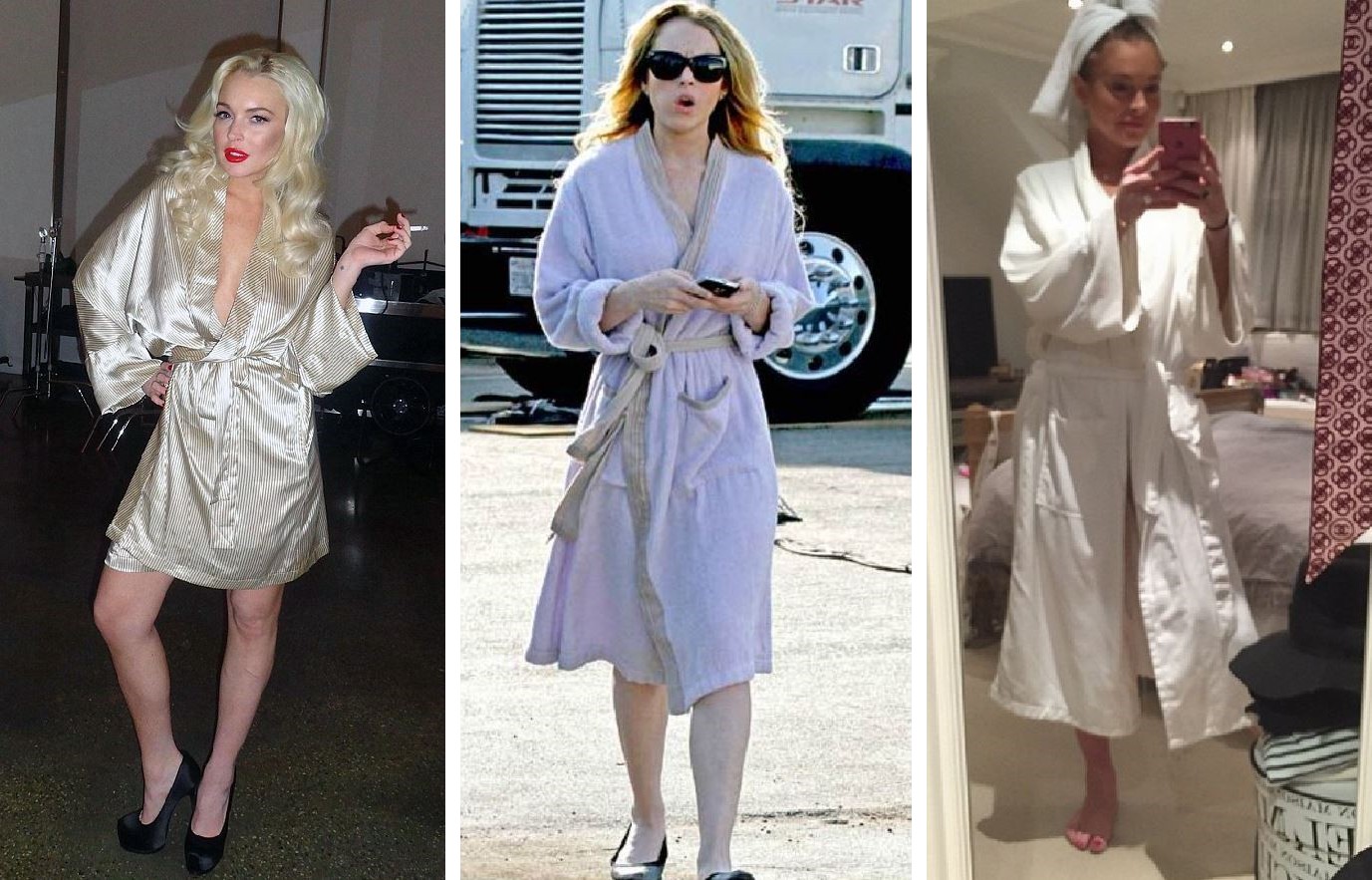
Lindsay Lohan in dressing gowns; in the US such things would usually be called bathrobes.

Robe dates from the mid-thirteenth century Middle English robe & robbe and was from the Old French robe, robbe & reube (booty, spoils of war, robe, garment), from the Frankish rouba & rauba (booty, spoils, stolen clothes (literally “things taken”)), from the Old High German roub, from the Proto-Germanic raubō, raubaz & raubą (booty, that which is stripped or carried away), from the primitive Indo-European Hrewp- (to tear away, peel off).  The noun use of robe to refer to garments had entered general use by the late thirteenth century, an adoption of a meaning from the Old French, presumably because fine clothing looted from defeated enemies were among the most prized of the spoils of war.  The Old French robe (and the alternative spellings) had as concurrent meanings both “clothing” & “plunder: as did the Germanic forms including the Old English reaf (plunder, booty, spoil; garment, armor, vestment).  By the late thirteenth century, robe had assumed the meaning “a long, loose outer garment reaching almost to the floor, worn by men or women over other dress”, those closest European equivalents being the twelfth century Old French robe (long, loose outer garment) and the Old High German rouba (vestments).  In royal, academic and ecclesiastical circles, the particular style of robes became regulated to denote rank, function or or membership of a religious order and royal courts would include offices like “page of the robes”, “mistress of the robes”, master of the robes etc” although those titles are (to modern eyes) misleading because their responsibilities extended to garments generally and not just robes as they’re now understood.  The metonymic sense of “the robe” for "the legal profession" dates from the 1640s, a reference to the dark robes worn by advocates when appearing in court.  Robe went on productively to be adopted for other purposes including (1) in the US “the skin of a bison (later applied to other slaughtered beasts) used as a cloak or wrap, (2) a short form of wardrobe (especially when built into a wall rather than being stand-alone) and (3) the largest and strongest leaves on a tobacco plant.

Singer Dr Taylor Swift in academic gown after being conferred an honorary doctorate in fine arts from New York University, May 2022.

In formal and vocational use, gown and robe and well understood and there tends not to be overlap except among those unacquainted with such things.  That’s understandable because to the casual observer the things can look much the same and the differences in nomenclature are more to do with tradition than style or cut.  Judges for example ware judicial robes and in the US these are usually black whereas elsewhere in the English-speaking world they can be of quite vivid hues, red and scarlet the most admired.  The US influence however seem pervasive and the trend is now almost universally black, certainly among newly established courts; in the same courts, barristers robes look much the same the term “judicial robe” is exclusive to the bench, the advocates garments variously called “barristers’ robes” “legal robes” or lawyers’ robes”.  Academics however wear gowns and again, the Americans tend to favor black while in the English tradition, all the colors of the rainbow have been seen.  These differ from surgical (also known as hospital or medical gowns) which, compared with just about every other gown, really aren’t gowns at all.  Surgical gowns are made usually in a blue, beige or green pastel color (better to show the blood) and are a kind of inverted dress which is fastened at the back (by an assistant so the wearer’s fingers don’t pick up germs).  In the UK parliament, there were many robes for offices of state and the one worn by the speaker made its way to colonial and dominion parliaments.  They're now rarely worn except on ceremonial occasions and the best known is probably that of the UK’s chancellors of the exchequer although the last one, dating from the late nineteenth century, is said to have “gone missing” while Gordon Brown (b 1951; UK prime-minister 2007-2010) was chancellor.

The Welsh Wizard robed:
Lloyd George as Chancellor of the Exchequer (1911) (David Lloyd George, 1863–1945; UK prime-minister 1916-1922, severed as chancellor between 1908-1915), oil on canvas by Christopher Williams (1873–1934), National Library of Wales collection.

Winston Churchill (1875-1965; UK prime-minister 1940-1945 & 1951-1955) was in 1924 both surprised and delighted when Stanley Baldwin (1867–1947; UK prime-minister 1923-1924, 1924-1929 & 1935-1937) offered him the Treasury; he’d heard rumors of appointed “chancellor” as assumed the best he could hope for was the chancellorship of the Duchy of Lancaster which, although an ancient office dating from the fourteenth century, he knew to be little more than a sinecure of slight influence, having in 1915 been for a few months relegated there after leaving the Admiralty in the wake of the failure of the Dardanelles campaign.  To atone, he went to the trenches of the Western Front and for some six month commanded a regiment of the Royal Scots Fusiliers.  Though never forgotten, much was by 1924 forgiven and Churchill was pleased to tell the prime minister he’d be glad to take the exchequer, one slight benefit to the public purse being “I still have the robes my father (Lord Randolph Churchill (1849–1895; Chancellor of the Exchequer August-December 1886)) wore as chancellor”.  In retrospect, that sartorial convenience might have been an inadequate background for handling the nation’s finances and Churchill often is listed high up the list of the UK’s “worst chancellors”, the main charge being returning sterling to the gold standard and maintaining an over-valued currency but just about all the great institutions of state (the Treasury, the Cabinet, the Bank of England etc) and most economists (a notable dissenter being John Maynard Keynes (later Lord Keynes) 1883-1946) who predicted depression as a consequence) recommended the move.  Still, it was Churchill was who signed the documents and the consensus among historians of such things is that had he known anything of economics, he’d likely have signed with even greater alacrity.

NSW (New South Wales (Australia)) Supreme Court and Court of Appeal judges in judicial robes and wigs for a ceremonial event during the COVID-19 pandemic.

It’s in women’s fashion where the distinction between a gown and a dress can become muddied and probably most illustrative is the matter of the “wedding dress” and the “wedding gown”.  Even among couturiers, there’s actually no agreed definition of where one ends and the other begins; it’s very much in the eye of the beholder although the eye of the retailer is doubtless quite an influence, the theory being the grander the design and the greater the volume of fabric, the more plausible is the label “wedding gown” and the higher the price-tag.  These informal (but serviceable) rules of thumb work also for dresses & gowns in general, the distinction more one of semantics and personal preference although, in saying that, it’s only at the margins where there can be confusion; a minimalist LBD (little black dress) would never be confused with a gown and the grandest creations recalling those worn at the famous balls held in conjunction with the Congress of Vienna (1814-1815) would never be called dresses.

Watercolor by unknown artist of one of the many balls held during the Congress of Vienna (1814-1815).  Being ankle-length, gowns were not the ideal garment for ladies dancing and it's likely some made temporary modifications, "hitching them up" a bit.

Despite that, in the narrow technical sense, to a seamstress, all gowns are dresses, but not all dresses are gowns and as late as the early eighteenth century the word "dress" was still not the exclusive province of women’s clothing ensembles.  In recent centuries, the dress has been defined by its modifiers (sun-dress, summer-dress, evening-dress, travelling dress, tent dress, riding-dress etc) and the modern convention seems to be that if an invitation specifies "semi-formal" then an evening dress is expected and that might be something thought a gown but not necessarily.  However, when an invitation states that the occasion is "formal", women are expected to wear an evening gown.  Classically, that’s understood to be something at once precise yet frivolous, with a tight fitting bodice and a skirt at least brushing the floor and this was once the accepted standard for any red-carpet event of note but the recent trend towards displays of flesh has in the entertainment industry subverted the tradition although the audience is expected still to adhere.


Illustrating the modern gown: Actor Lindsay Lohan (b 1986) in a gown with an upper-level silk tulle (a netting-like weave) by Zac Posen (b 1980), Met Gala, New York, 2007 (left) and model Kate Upton (b 1992) in a gown by Victoria Beckham (b 1974, the one-time “Posh Spice”, now Lady Beckham), Vanity Fair Oscars after-party, Los Angeles, 2016.

Fashion has since the Congress of Vienna become simplified and rather than voluminous layers of fabric, a gown’s effects are now generated by cut & color.  For his diaphanous piece, Zac Posen included a quadrilateral (a four-sided polygon) cleavage split, designed cleverly to emulate a tie (in Euclidean geometry defined as a “kite” (two pairs of adjacent, equal-length sides with the two shorter sides meeting at the bottom vertex, the longer pair intersecting at the top so a line described from top to bottom produces an axis of reflection symmetry, as does the fall of a tie)).  What Lady Beckham included would probably now be called a “uvage” although physiology can affect outcome; on a different model (with less pronounced “forward projection”) the fabric would likely fall to create a “veagage”.  While there can be overlaps in cut, construction and cues, there are points at which a LBD becomes re-defined as a “dress” (possibly with a modifier or two) or a “gown”.  Although motifs can matter (what sometimes appears on a gown often not suitable for a LBD that depends on simplicity for effect) the prime determinate really is length, the classic LBD’s hemline stopping somewhere on the thighs while a gown properly should be ankle-length although calf-left implementations have become not uncommon.  The “rule” is however selectively applied and depends also on style and intended purpose; an ankle-length “maxi-dress” will typically not be a “gown”.  Again, physiology can also influence things, someone especially statuesque could appear in a LBD while the same garment on someone shorter might be classed a “black cocktail dress”, simply because the hemline reaches below the knee.  So usually it’s not difficult to tell what is a gown but, at the margins, the distinctions can become blurred and it’s really “eye of the beholder” stuff, a subjective exercise expressed best (in another context) by Potter Stewart (1915–1985; associate justice of the SCOTUS (US Supreme Court) 1958-1981) in his famous concurring judgement in Jacobellis v Ohio (378 U.S. 184 (1964)): “I shall not today attempt further to define the kinds of material I understand to be embraced within [the term], and perhaps I could never succeed in intelligibly doing so.  But I know it when I see it…”

Thursday, May 9, 2024

Orchidaceous

Orchidaceous (pronounced awr-ki-dey-shuhs)

(1) In botany, of, relating to, or belonging to the Orchidaceae, a family of flowering plants including (but not limited to) the orchids.

(2) Figuratively, characterized by ostentatiousness; showy; extravagant; excessive in some way.

1830–1840: From the New Latin Orchidace & Orchidaceae, the construct being orchidace + -ous.  It was English botanist John Lindley (1799–1865) who in School Botanty (1845) coined the word orchid from the New Latin Orchideæ & Orchidaceae (Linnaeus), the plant's family name, from the Latin orchis (a kind of orchid), from the Ancient Greek orkhis (genitive orkheos) (orchid (literally “testicle”)) from the primitive Indo-European orghi-, the standard root for “testicle” (and related to the Avestan erezi (testicles), the Armenian orjik, the Middle Irish uirgge, the Irish uirge (testicle) and the Lithuanian erzilas (stallion).  The plant so called because of the shape of its root was said so to resemble testicles (the Greek orkhis also was the name of a kind of olive, named also for its shape).  So striking did the writers of Antiquity fine the double roots of the plant that references appear in some texts.  The Roman historian Pliny the Elder (24-79) was (as was common at the time) also something of a naturalist and he was moved to observe: “Mirabilis est orchis herba sive serapis gemina radice testiculis simili.” (The orchis plant, also known as serapis, is remarkable with its twin roots resembling testicles.)  The noun plural is orchids, the field is orchidology and the breeders, collectors and other obsessives are called orchidologists.  Orchidaceous & orchidean are adjectives and orchidacity is a noun; the noun plural is orchidacities.

Earlier in English (in the Latinesque form) was the mid-sixteenth century orchis while in fourteenth century Middle English it was ballockwort (literally “testicle plant” and related to the more recent ballocks).  The extraneous -d- in the modern spelling was added in an attempt to extract the Latin stem and it is here to stay, the history of that the construct as orch(is) (the plant) + -id(ae).  The irregular suffix –idae is the plural of a Latin transliteration of the Ancient Greek -ίδης (-ídēs), a patronymic suffix which in medieval writing was sometimes interpreted as representing instead the plural of a Latin transliteration of the Ancient Greek adjectival suffix -ειδής (-eidḗs) from εἶδος (eîdos) (appearance, resemblance).  It was adopted in 1811 at the suggestion of British entomologist William Kirby (1759-1850), to simplify and make uniform the system of French zoologist Pierre André Latreille (1762–1833) which divided insect orders into sections; in taxonomy, it’s used to form names of subclasses of plants and families of animals.  The –ous suffix was from the Middle English -ous, from the Old French –ous & -eux, from the Latin -ōsus (full, full of); a doublet of -ose in an unstressed position.  It was used to form adjectives from nouns, to denote possession or presence of a quality in any degree, commonly in abundance.  In chemistry, it has a specific technical application, used in the nomenclature to name chemical compounds in which a specified chemical element has a lower oxidation number than in the equivalent compound whose name ends in the suffix –ic (as an example, sulphuric acid (H2SO4) has more oxygen atoms per molecule than sulphurous acid (H2SO3).

The sensual orchid.

In the spirit of the figurative use (and usually of women’s fashion), although they’re non-standard, the adjective orchidaceousness and the adverb orchidaceously have been formed and in that vein, the only thing which would make orchidaceous difficult to use as a noun would be forming the plural (orchidaceoux would appall the purists).  Usually though, those commenting on what appears on the catwalks & red carpets seem content with the comparative (more orchidaceous) and the superlative (most orchidaceous).  Henry Fowler (1858–1933) in his A Dictionary of Modern English Usage (1926) noted the old spelling (orchis) was “applied chiefly to the English wild flowers and is accordingly the poetic and country word”.  The very idea of “the country word” is now dated and was a particular sort of regionalism: one used by those tied by linguistic tradition to rural England rather than certain locations, and if orchis endures as a literary or poetic device, it’s rare.  Of flowers, although orchidaceous can mean “of, relating to, or belonging to the Orchidaceae”, such is the beauty of orchids, those who write of the things seem drawn to use sexual imagery and rarely can resist “seductive” and other lovely plants are sometimes also described as orchidaceous.

The original etymology survives in medicine as orchidectomy although the construct of that was the Latin orchis (wrongly interpreting orchid- as the stem) +‎ -ectomy (the surgical removal of); the correct term is actually orchiectomy (the surgical removal of one or both testes).  The synonym is testectomy which is interesting because the use of that within the profession (usually by veterinarians) does not of necessity imply something surgical.  The -ectomy suffix was from the Ancient Greek -εκτομία (-ektomía) (a cutting out of), from ἐκτέμνω (ektémnō) (to cut out), the construct being ἐκ (ek) (out) + τέμνω (témnō) (to cut).  In surgery, it was appended to the name of whatever is being removed (eg an appendectomy being the surgical removal of the appendix) although it's borrowed (often for jocular purposes) by plumbers, carpenters and others in professions where there often a need to "cut things off", a "roofectomy" being the process by which a coach-builder converts a coupé (or other closed vehicle) into some sort of convertible.

Lindsay Lohan in a Gucci Porcelain Garden print gown (the list price a reputed Stg£4,040) at the launch of the One Family NGO (non-governmental organization), Savoy Hotel, London, June 2017 (left) and Taylor Swift in Etro navy and yellow silk floral ball gown at the Golden Globes award ceremony, The Beverly Hilton, Los Angeles, January 2020 (right).

Neither cutting-edge nor retro in the conventional sense of the word, Lindsay Lohan’s gown was mostly well-received and for students of intricacy it was worth studying although probably few would have called it orchidaceous because it conveyed such a sense of the conservative; only a burqa could have been more modest.  That’s why the blue was such a good choice; in scarlet there would have been mixed messages.  Some thought it Rococo and perhaps thematically it could have been done with just a ruffled collar, the pussy bow a detail too many, but the patterning was clever and accentuated the lines.  While it’s not certain the vivid floral patterns on Taylor Swift’s gown were actually intended to be suggestive of orchids, the effect was orchidaceous.  It was an exercise in monumentalism which swished around as wafted about, recalling the flowers of an orchid in a breeze.

Orchidacity in Solid colors: Gigi Hadid and the Met Gala, New York, May 2022 (left), Sophie Monk at the TV Week Logie Awards-Gold Coast, Australia, June 2019 (centre) and Carolina Gaitan at the Academy Awards ceremony, Los Angeles, March 2022 (right).

Although dedicated (ie obsessional) orchidologists adhere to the language from botanical taxonomy (Epidendrum, Ludisia, Masdevallia, Erythraeum, Promenaea, Spathoglottis, Psychopsis, Angraecum, Encyclia cochleata etc) when classifying their collections, most people describe them in terms of the dominant color or, when a combination is particular striking (as many of the blues & purples especially are) that mix is referenced (orange/yellow, purple/white etc) but that doesn’t mean that for some object to be thought orchidaceous it must be multi-hued.  That’s because the allure of an orchid lies not in the colors but in the sensuality of the shape; they are the sexiest of flowers, soft, feminine things which seem to draw one in to be enveloped.

Giulia Salemie (b 1993, left) & Dayane Mello (b 1989, right), Venice Film Festival, Italy, September 2016.

The trend in recent years for the “naked dress” to become the red carpet motif of the era might have been thought to limit the possibility of the creations being thought orchidaceous because the focus is so much on flesh rather than fabric, of which there’s often precious little.  However, on a fortuitously warm and not too windy September day during the Venice Film Festival, two Italian models proved the naked look could be combined with voluminous folds; it was all in the cut.  For the reasons discussed, the dresses could not be called anything but orchidaceous although the internet had already suggested VVD (visible vag(ina) dress)) which in general was wrong (although the initialism was OK) because correctly the hint was of a visible vulva and on that day in Venice, the models actually wore (that may not be the right word) color-coordinated (ie the same fabric as the dresses) adhesive micro-knickers, held in place with a skin-friendly surgical glue.  In a nice touch, their appearance came during the festival’s premiere of The Young Pope (the first time a television production had been included in the program).

Wednesday, November 15, 2023

Tie

Tie (pronounced tahy)

(1) A knot; a fastening.

(2) A knot of hair (as at the back of a wig).  A tiewig is (1) a wig having a tie or ties, or one having some of the curls tied up or (2) a wig that is tied upon the head; a court-wig tied with ribbon at the back.

(3) A long narrow piece of material worn, most often by men, under the collar of a shirt, tied in a knot close to the throat with the ends hanging down the front.  Also called necktie (a bow tie is never truncated to "tie").

(4) A lace-up shoe or boot, historically as Oxford ties, Derby ties etc (now a rare use).

(5) As “twist tie”, a piece of wire embedded in paper or a strip of plastic, wound around something (typically a bag, cable etc) and tightened to secure it.

(6) A connection between people (or groups of people) or between people and institutions, ideologies etc, especially a strong connection (familiar in the phrases “ties of friends”, “ties of allegiance”, “ties that bind” etc).

(7) In construction, any of various structural members (beams, rods, stringers etc) used to keep two objects (rafters; haunches of an arch etc), from spreading or separating.

(8) In rail track construction, any of a number of closely spaced transverse beams of concrete, metal or (historically and still mostly) wood, for holding the rails forming a track at the proper distance from each other and for transmitting train loads to the ballast and roadbed (in other places known as a “sleeper”).

(9) In sport and related competitions, the situation in which two or more participants in a competition are placed equally (known variously as a “draw” or stalemate”.  The exception is long-form cricket (test & first class) where a tie (both sides having the same total of runs when the last ball has been delivered) is distinct from a draw (neither side able to force a win).

(10) In sport and related competitions, a meeting between two players or teams in a competition (mostly UK & Commonwealth use).

(11) In music, a curved line connecting two notes of the same pitch denoting that they should be played as a single note with the combined length of both notes (distinct from a "slur").

(12) In typography & phonetic transcription, a curved line connecting two letters (⁀), used in the IPA ((International Phonetic Alphabet)) to denote a co-articulation, as for example /d͡ʒ/.

(13) In statistics, one or more equal values or sets of equal values in the data set.

(14) In surveying, a bearing and distance between a lot corner or point and a benchmark or iron off site; a measurement made to determine the position of a survey station with respect to a reference mark or other isolated point.

(15) In graph theory, a connection between two vertices.

(16) To bind, fasten, or attach with a cord, string, or the like, drawn together and knotted.

(17) To draw together the parts of with a knotted string or the like.

(18) To fasten, join, or connect in any way.

(19) To confine, restrict, or limit.

(20) To bind or oblige, as to do something.

Pre 900: From the Middle English teye, tiegh & tegh (cord, rope; chain) from the Old English tēag, tēah, tēagh and tēgh (cord; chain), from the Proto-West Germanic taugu, from the Proto-Germanic taugō, from the Old Norse taug (rope) & tygill, from the primitive Indo-European dewk- and ultimately from the from the prehistoric deuk (to pull, to lead).  It was cognate with the Danish tov.  The Middle English tien and the Old English tīgan (to tie) were both derivative of the noun and related to the Old Norse teygja (to draw, stretch out) and the Old English tēon (to pull).  Tie is a noun & verb, tying is a noun & verb, tied is a verb & adjective; the noun plural is ties.

The figurative sense dates from the 1550s and the adoption in the US to describe railway sleepers is from 1857.  The meaning "equality between competitors" was first noticed in the 1670s although the meaning “to finish equal to a competitor” seems not to have been formalized until the late 1880s.  The tie-breaker (a mechanism used to force a tied match to a win) was first mentioned in 1938 and is most familiar from tennis when it was first widely used in the early 1960s.  In most forms of sport, the “tie” is interchangeable with “draw “ except in four-innings cricket (first-class & test matches) in which, apparently uniquely, four results are possible, win, lose, draw and the (rare) tie.  The sense of a “cravat’; necktie” (usually a simple one knotted in front) dates from 1761.  The idea of the bow tie (a necktie tied in the form of a bow or a knot with two loops) was familiar by 1887 although the earlier use in the sense “a ribbon or other fabric tied in a bow-knot) was in use in 1874.

Lindsay Lohan interprets a black tie invitation with skull & crossbones tie (left) and one of the rare photographs of comrade Stalin (1878-1953; Soviet leader 1924-1953) wearing a tie (right).  The image in sepia of comrade Stalin dates from early in the first decade of the twentieth century and was taken shortly before he was sentenced to three years exile in Siberia for his "subversive activities".

Lindsay Lohan in a gown with an upper-level silk tulle (a netting-like weave) by Zac Posen (b 1980), Met Gala, New York, 2007.  The “skin tie” was a nice touch.

For his diaphanous piece, Zac Posen included a quadrilateral (a four-sided polygon) cleavage split, designed cleverly to emulate a tie (in Euclidean geometry defined as a “kite” (two pairs of adjacent, equal-length sides with the two shorter sides meeting at the bottom vertex, the longer pair intersecting at the top so a line described from top to bottom produces an axis of reflection symmetry, as does the fall of a tie)).  Clearly a variant of the veavage, fashionistas suggested “kiteage”.

In idiomatic use, to “tie the knot” means “to form a union” (usually marriage) dates from 1707.  To “Tie one on” (get drunk) was first recorded in 1944)" is recorded from 1944.  The phrase “old school tie” has been in use since 1938 and refers literally to the neckties worn by former students of a certain English public (private) schools and is used as an allusion to the way the class system is maintained.  The “tie-in” (a specific connection) was first documented in 1934 and was said to be from a verbal phrase noted since 1793.  The verb “hog-tie” was literally the most efficient way of securing a body (by binding the hands and feet by crossing and tying them) and was first documented (it’s unclear how long the technique had been in use) in 1887.  The verb tie-dye is associated with hippies and their spiritual descendants but the technique was first patented in 1902.  In telecommunications, a "tie-line" is a dedicated line between two extensions.  The origin was in the physical wire which once ran point-to-point ("tying" the two together), the classic example the cables first at scale run by the military in the trenches of World War I (1914-1918).  The term is still used to refer to dedicated private services but most are now part of distributed networks and implemented with a combination of physical switching and software.

The RSVP - What to wear

White Tie Dress Code.

White tie, also called full evening dress or a dress suit, is now the most formal evening dress code in western culture.  For men, it consists of a black tailcoat worn over a white starched shirt, Marcella waistcoat and a white bow tie worn around a detachable collar.  High-waisted black trousers and patent leather pumps complete the ensemble; decorations need not be worn unless specified, top hats and canes the only permitted accessories.  White scarves once were frequently seen but seem now frowned upon.  For women, it’s a full-length gown.  Optional is jewelry, a tiara, a small bag and evening gloves though with accessories, fashion critics urge restraint.  Although now the most elaborate western dress code, white tie is derived from the eighteenth century movement towards a less elaborate aesthetic of style and by the 1840s was de rigueur for the small fragment of the population who moved “in society circles”.  The two great events of the twentieth century (the world wars), rent social fissures which rendered white tie extinct for all but a handful of ceremonial and state occasions such as balls at some of the old universities and royal households.  The white tie belongs mostly to the lost, pre-1914 world although still required for the annual Nobel Prize ceremony.

Black Tie Dress Code.

Transcending class distinctions, black tie is a dress code for evening events and social functions.  It emerged and evolved during the late nineteenth century, was essentially codified by the 1920s and, for men, little changed since.  For men, the elements remain a white dress shirt with black bow tie, an evening waistcoat or cummerbund, a dinner jacket in black or midnight blue and polished black shoes.  This setup is known in the US as a tuxedo and in France as cravate noire.  Black tie permits variations, lighter colored jackets (first seen in the hot climates of the Raj), are now not unusual but variations need still to be on the theme.  By contrast with the essentially static men’s code, women's dress for black tie has been subject to trends, both in fashion and social mores.  Traditionally it was evening shoes and ankle or lower-calf length (depending on the hour) sleeveless evening gown, often set-off by a wrap or stole and, almost inevitability, gloves.  In the twenty-first century, women are essentially free to construct whatever seems to suit the occasion, a gown, a cocktail dress, a LBD (little black dress), even trousers and boots; black tie for women is now post-modern and thus more concept than code.

A Henry Poole & Co Dinner Jacket (Tuxedo).

According to the tailors Henry Poole & Co (1806) of 15 Savile Row, London, the evening wear now often referred to as the “tuxedo” was first created by them in 1865 when the Prince of Wales (1841-1910 and later Edward VII, King of the UK & Emperor of India 1901-1910) asked his tailor and friend Henry Poole to cut a short coat he could wear to informal dinners at Sandringham.  Mr Poole accordingly shortened a traditional tailcoat and presented the prince an “evening jacket” in celestial blue.  This, the company claims, was the origin of the British dinner jacket (DJ).  The origin of the more evocative American term “tuxedo” dates from gossip which circulated at New York’s Tuxedo Park Club, the tale being that when the prince visited in 1886, his notorious roving eye fell upon Mary Cora Brown–Potter (née Urquhart, 1857–1936), one of New York Society’s great beauties and the wife of coffee trader James Brown Potter (1853-1922).  The prince invited the couple to stay at Sandringham and Mr Potter, not well acquainted with royal protocol, requested sartorial guidance from Mr Poole who of course recommended one of his DJs in celestial blue.  Upon returning to the US, Mr Potter wore to garment often, including at fashionable events held at the Tuxedo Club.  Even Henry Poole & Co admits the story is likely apocryphal and the more likely explanation for the linguistic adoption in the US is that a number of the New York elite had clothing made by Henry Poole at the time the prince’s DJ was first tailored and the royal imprimatur would have been persuasion enough for them to order a DJ so the style was probably well-known in the Tuxedo Club by the time of the 1886 visit.  However, the company is emphatic the DJ, tuxedo, evening jacket or whatever it may in various places be called, began on Henry Poole’s cutting tables at 15 Savile Row, Mayfair, W1, City of Westminster, London.

Wednesday, March 25, 2026

Exquisite

Exquisite (pronounced ek-skwi-zit or ik-skwiz-it)

(1) Of special beauty or charm, or rare and appealing excellence and often associated with objects or great delicacy; of rare excellence of production or execution, as works of art or workmanship; beautiful, delicate, discriminating, perfect.

(2) Extraordinarily fine or admirable; consummate.

(3) Intense; acute, or keen, as pleasure or pain; keenly or delicately sensitive or responsive; exceeding; extreme; in a bad or a good sense (eg as exquisite pleasure or exquisite pain).

(4) Recherché; far-fetched; abstruse (a now rare early meaning which to some extent survives in surrealist’s exercise “exquisite corpse”).

(5) Of particular refinement or elegance, as taste, manners, etc or persons.

(6) A man excessively concerned about clothes, grooming etc; a dandy or coxcomb.

(7) Ingeniously devised or thought out (obsolete).

(8) Carefully adjusted; precise; accurate; exact (now less common except as an adverb.

(9) Of delicate perception or close and accurate discrimination; not easy to satisfy; exact; fastidious (related to the sense of “exquisite judgment, taste, or discernment”.

1400–1450: From the Late Middle English exquisite (carefully selected), from the Latin exquīsītus (excellent; meticulous, chosen with care (and literally “carefully sought out”)), perfect passive participle of exquīrō (to seek out), originally the past participle of exquīrere (to ask about, examine) the construct being ex- + -quīrere, a combining form of quaerere (to seek). The construct of exquīrō was ex- +‎ quaerō (seek).  The ex- prefix was applied to words in Middle English borrowed from the Middle French and was derived from the Latin ex- (out of, from) and was from the primitive Indo-European eǵ- & eǵs-.  It was cognate with the Ancient Greek ἐξ (ex-, out of, from) from the Transalpine Gaulish ex- (out), the Old Irish ess- (out), the Old Church Slavonic изъ (izŭ) (out), the Russian из (iz) (from, out of).  Exquisite is a noun & adjective, exquisiteness & exquisitiveness are nouns and exquisitively & exquisitely are adverbs; the noun plural is exquisites.

1972 Lancia Fulvia 1600 HF Series II.  

Everything about the Lancia Fulvia (1965-1976) appeared exquisitely delicate but the little machine was tough and was for half-a-decade a dominant force in international rallying.  A Lancia legend is that when the hood was opened on one of the first to reach the US, a mechanic, brought up on a diet of hefty V8s, upon seeing the tiny, 1.2 litre (75 cubic inch) narrow-angle V4 is said to have remarked: “Don’t ask me, take it to a jeweler.”

The etymology of the Latin quaerō (seek) is mysterious.  It may be from the Proto-Italic kwaizeō, from the primitive Indo-European kweh (to acquire) so cognates may include the Ancient Greek πέπαμαι (pépamai) (to get, acquire), the Old Prussian quoi (I/you want) & quāits (desire), the Lithuanian kviẽsti (to invite) and possibly the Albanian kam (I have).  Some have suggested the source being the primitive Indo-European kwoys & kweys (to see) but there has been little support for this.  The authoritative Lexikon der indogermanischen Verben (Lexicon of the Indo-European Verbs (LIV)), the standard etymological dictionary of the Proto-Indo-European languages, suggests it’s a derivation of hzeys (to seek, ask), via the form koaiseo.  "Exquisite corpse" is a calque of the French cadavre exquis (literally “exquisite cadaver”).  Dating from 1925, it was coined by French surrealists to describe a method of loosely structured constructivism on the model of the parlour game consequences; fragments of text (or images) are created by different people according to pre-set rules, then joined together to create a complete text.  The name comes from the first instance in 1925: Le cadavre exquis boira le vin nouveau (The exquisite corpse will drink new wine).  Exquisite corpse is noted as a precursor to both post-modernism and deconstructionist techniques.

Although not infrequently it appears in the same sentence as the word “unique”, exquisite can be more nuanced, the comparative “more exquisite, the superlative most exquisite” and there has certainly been a change in the pattern of use.  In English, it originally was applied to any thing (good or bad, art or torture, diseases or good health), brought to a highly wrought condition, tending among the more puritanical to disapprobation.  The common modern meaning (of consummate and delightful excellence) dates from the late 1570s while the noun (a dandy, a foppish man) seems first to have been used in 1819.  One interesting variant which didn’t survive was exquisitous (not natural, but procured by art), appearing in dictionaries in the early eighteenth centuries but not since.  The pronunciation of exquisite has undergone a rapid change from ek-skwi-zit to ik-skwiz-it, the stress shifting to the second syllable.  The newer pronunciation attracted the inevitable criticism but is now the most common form on both sides of the Atlantic and use seems not differentiated by class. 

The exquisite wimp: Baldur Benedikt von Schirach

Exquisite is used almost exclusively as an adjective, applied typically to objects or performances but it’s also a noun, albeit one always rare.  As a noun it was used to describe men who inhabited that grey area of being well dressed, well coiffured, well mannered and somewhat effeminate without being obviously homosexual; it was a way of hinting at something without descending to the explicit.  PG Wodehouse (1881-1975) applied it thus in Sam the Sudden (1925) and historians Ann (1938-2021) & John Tusa (b 1936) in The Nuremberg Trial (1983) found no better noun to apply to former Hitler Youth Leader Baldur von Schirach, noting (as did his many enemies in the party) his feminine tastes in furnishings and propensity to pen poor poetry.  The companion word to describe a similar chap without of necessity the same hint of effeminacy is “aesthete”.  In The Anatomy of the Nuremberg Trials: A Personal Memoir (1992), Brigadier General Telford Taylor (1908–1998; lead US counsel at the Nuremberg Trial) wrote of him that: “at thirty-nine, was the youngest and, except perhaps for Joachim von Ribbentrop (1893–1946; Nazi foreign minister 1938-1945) and Hans Fritzsche (1900–1953; Nazi propagandist), the weakest of the defendants.  If wimps had then been spoken of, Schirach would have been so styled.”

Nazi poetry circle on the terrace at the Berghof on the Obersalzberg.

Left to right: Adolf Hitler (1889-1945; Führer (leader) and German head of government 1933-1945 & head of state 1934-1945), Martin Bormann (1900–1945), Hermann Göring (1893–1946; leading Nazi 1922-1945, Hitler's designated successor & Reichsmarschall 1940-1945), and Baldur von Schirach (1907-1974; head of the Hitlerjugend (Hitler Youth) 1931-1940 & Gauleiter (district party leader) and Reichsstatthalter (Governor) of Vienna (1940-1945)), Berchtesgaden, Bavaria, Germany, 1936.  Of much, the other three were guilty as sin and would (at the last possible moment) commit suicide but von Schirach would survive to die in his bed at 67.  There seems no record to confirm if that bed was in a “a snow white bedroom with delicate lace curtains” as the rougher types in the Nazi Party had once derided him for having.

Airey Neave (1916–1979) was the British military lawyer who served the indictments on the defendants at Nuremberg and in On Trial at Nuremberg (1978) he recalled the experience, cell by cell.  His first impression of von Schirach was that his appearance was “…bi-sexual and soft with thé dansant eyes [thé dansant was a dance held while afternoon tea was served and in idiomatic use “thé dansant eyes” suggested the coquettish fluttering of the lashes a flirtatious young lady might deploy]”, adding “He looked a man who might be dangerous to small boys.  At a second glance, I imagined him beneath the palms at Cannes in co-respondent shoes.”  In this context, Neave used “co-respondent” in the sense of the man cited in divorce proceedings as the one who slept with the adulterous wife and a “co-respondent shoes (or car, suit, tie etc)” were distinguished by flashiness rather than quality.

Von Schirach went on trial before the IMT (International Military Tribunal) in the first Nuremberg trial (1945-1946), an event the author Rebecca West (1892–1983) attended in her capacity as a journalist and among her impressions she wrote of him, admitting she was at first “startled” because “…he was like a woman in a way not common among men who look like women.  It was as if a neat and mousy governess sat there, not pretty but with never a hair out of place, and always to be trusted never to intrude when there were visitors: as it might be Jane Eyre.”  Although indicted also under Count 1 (conspiracy to commit crimes against peace), for his role as head (1931-1940) of the Hitlerjugend (Hitler Youth), von Schirach was convicted only under Count 4 (crimes against humanity) for his part in deporting Viennese Jews to the death camps while Gauleiter and Reichsstatthalter of Vienna.  Cunningly, and not without ostentation, he admitted some guilt for his role in “corrupting German youth” although by that he meant the political indoctrination to which he subjected them, rather than conduct many in the Nazi party liked to hint he enjoyed with the boys under his command; however defined, it’s certain he corrupted more youth than Socrates (circa 470–399 BC).  Applying common law principles, the IMT found his actions as head of the Hitlerjugend didn’t reach the threshold of “conspiracy” and thus acquitted him on Count 1, his 20 year sentence handed down for his conduct in Vienna.  The preparation for the trial had been rushed and had subsequently discovered evidence against him been presented at the trial, doubtlessly and deservedly he’d have been hanged.  Had that sentence been imposed, whether like Göring he’d have followed Socrates and taken hemlock will never be known.

Exquisite: A style guide

Lindsay Lohan in a Gucci Porcelain Garden Print Silk Gown with an all-over Dutch toile in blue and white, high ruffled collar and bib, flared sleeves, pussy bow and a blue and red patent leather belt around a high waist, Savoy Hotel, London, June 2017.

The gown was said to have a recommended retail price (RRP) of Stg£4,040 (US$7300).  The occasion was the launch of the charitable organization One Family, dedicated to combating child trafficking.  While there was a fussiness about the detailing, the quality of the construction was obvious and successfully to use, at this scale, a pattern of this intricacy is not easy and demands a skilled eye.  On the move, it swished around nicely and although the whims of critics can be hard to predict, on the night, most seemed to like this and it was a perhaps welcome relief from the expanses of skin of the "naked dress" movement, then beginning to dominate red carpets.

Designers find inspiration where it's found: Four dinner plates from Wedgewood's Enoch "Countryside Blue" collection, circa 1967.

Within the one critique, the word exquisite can appear, used as a neutral descriptor (an expression of extent), a paean to beauty and even an ironic dismissal.  A gown for example can be “exquisitely detailed” but that doesn’t of necessity imply elegance although that would be the case of something said to be an “exquisite design”.  That said, most were drawn to the Lindsay Lohan's Gucci gown in some way, the references to Jane Austen (1775–1817) many (although historians of fashion might note Gucci’s creation as something evocative more of recent films made of Ms Austen's novels than anything representative of what was worn in her era) and the fabric’s patterning & restraint in the use of color produced a dreamily romantic look.