Showing posts sorted by relevance for query Panda. Sort by date Show all posts

Wednesday, October 28, 2026

Panda

Panda (pronounced pan-duh)

(1) A black & white, herbivorous, bearlike mammal (in popular use sometimes as “giant panda”), Ailuropoda melanoleuca (family Procyonidae), now rare with a habitat limited to relatively small forested areas of central China where ample growth exists of the stands of bamboo that constitutes the bulk of the creature’s diet.

(2) A reddish-brown (with ringed-tail), raccoon-like mammal (in the literature often referred to as the “lesser panda”), Ailurus fulgens (that inhabits mountain forests in the Himalayas and adjacent eastern Asia, subsisting mainly on bamboo & other vegetation, fruits, and insects).

(3) In Hinduism, a brahmin (a member of the highest (priestly) caste) who acts as the hereditary superintendent of a particular ghat (temple) and regarded as authoritative in matters of genealogy and ritual.

(4) In colloquial use (picked up as UK police slang) as “panda car” (often clipped to “panda”), a UK police vehicle painted in a two-tone color scheme (originally black & white but later more typically powder-blue & white) (historic use only).

(5) Used attributively, something (or someone) with all (or some combination of) the elements (1) black & white coloration, (2) perceptions of “cuteness” and (3) the perceived quality of being “soft & cuddly”.

1835: From the French (Cuvier), a name for the lesser panda, assumed to be from a Tibeto-Burman language or some other native Nepalese word.  Cuvier is a trans-lingual term which references the French naturalist and zoologist Georges Cuvier (1769–1832) and his younger brother the zoologist and paleontologist Frédéric Cuvier (1773–1838).  The term was use of any of the Latinesque or pseudo-Latin formations created as taxonomic names for organisms following the style & conventions used by the brothers.  Most etymologists suggest the most likely source was the second element of nigálya-pónya (a local name for the red panda recorded in Nepal and Sikkim), which was perhaps from the Nepali निँगाले (nĩgāle) (relating to a certain species of bamboo), the adjectival form of निँगालो (nĩgālo), a variant of निङालो (niṅālo) (Drepanostachyum intermedium (a species of bamboo)).  The second element was a regional Tibetan name for the animal, related in some way to ཕོ་ཉ (pho nya) (messenger).  The use in Hinduism describing “a learned, wise; learned man, pundit, scholar, teacher (and specifically of the Brahmin (a member of the highest (priestly) caste) who was the hereditary superintendent of a particular ghat (temple) and regarded as authoritative in matters of genealogy and ritual, especially one who had memorized a substantial proportion of the Vedas)” was from the Hindi पंडा (paṇḍā) and the Punjabi ਪਾਂਡਾ (pāṇḍā), both from the Sanskrit पण्डित (paṇḍita) (learned, wise; learned man, pundit, scholar, teacher).  The English word pundit (expert in a particular field, especially as called upon to provide comment or opinion in the media; a commentator or critic) entered the language during the British Raj in India, the use originally to describe native surveyor, trained to carry out clandestine surveillance the colonial borders.  The English form is now commonly used in many languages but the descendants included the Japanese パンダ (panda), the Korean 판다 (panda) and the Thai: แพนด้า.  Panda is a noun and pandalike (also as panda-like) is an adjective (pandaesque & panderish still listed as non-standard; the noun plural is pandas.

Charismatic creature: Panda with cub; like the dolphin with its permanent "happy smile", pandas gained much of their popularity from the genetic accident of their appearance, making them ideal as a model for plushies (stuffed toys).

Illustrative examples of PANDA as an acronym include (1) antiProton ANnihilation at Darmstadt (a particle physics experiment at GSI Darmstadt, Germany), (2) Professional Adult Nightclub DJ (Disc Jockey) Association, (3) Protocol for the Assessment of Non-Violent Direct Action and (4) Programa Nacional Contra el Desarrollo de Pandillas (Spanish: National Development Program against Gangs) while, uniquely, PANDAS stands for Pediatric Autoimmune Neuropsychiatric Disorder Associated with Streptococcal Infection.  As a word, panda has been productive.  The portmanteau noun pandemonium (the blend being panda +‎ (pande)monium was a humorous construct describing the reaction often seen in zoos when pandas appear and was on the model of fandemonium (the reaction of groupies and other fans to the presence of their idol).  The "trash panda" (also as "dumpster panda" or "garbage panda") was of US & Canadian origin and was an alternative to "dumpster bandit", "garbage bandit" or "trash bandit", describing the habit of raccoons foraging for food in trash receptacles.  The use was adopted because the black patches around the creature's eyes are similar to the markings of the giant panda.  The Australian equivalent is the "bin chicken", an allusion to the way the elegant ibis has adapted to habitat loss by entering the urban environment, living (very well) on food scraps discarded in rubbish bins.

Lindsay Lohan with “panda” eye makeup (left) and a cat managing the look, "makeup free" (right).  The companion term is "reverse panda", a usually unintended effect caused by light makeup around the eyes appearing as white circles or patches.  The look sometimes is exaggerated in photographs because of the use of studio lighting or a camera's flash.

The “panda crossing” was a pedestrian safety measure, an elaborate form of the “zebra crossing”.  It was introduced in the UK in 1962, the name derived from the two-tone color scheme used for the road marking and the warning beacons on either side of the road.  The design worked well in theory but not in practice and all sites had been decommissioned by late 1967 (although in New Zealand some were still in use in the 1990s).  The panda’s twotonalism led to the adoption of “panda dolphin” as one of the casual tags (the others being "jacobita", "skunk dolphin", "piebald dolphin" & "tonina overa" (the latter for the black & white Commerson's dolphin (Cephalorhynchus commersonii)).  In English, the first known reference to the panda was as a “carnivorous raccoon-like mammal (the lesser panda) of the Himalayas” while the giant panda was first described in 1901 although it had been “discovered” in 1869 by French missionary priest and zoologist Armand David (1826-1900); it was known as parti-colored until the name was changed after evidence of the zoological relationship to the red panda was accepted.  The giant panda was thus once included as part of the raccoon family but is now classified as a bear subfamily (Ailuropodinae), or as the sole member of a separate family (Ailuropodidae (which diverged from an ancestral bear lineage)).  The lesser panda (the population of which has greatly been reduced by collectors & hunters) is now regarded as unrelated to the giant panda and usually classified as the sole member of an Old World raccoon subfamily, Ailurinae, which diverged from an ancestral lineage that also gave rise to the New World raccoons, most familiar in North America.  As late as the early twentieth century, the synonyms for the lesser panda included "bear cat", "cat bear" & "wah", all long obsolete.

Panda diplomacy

Lindsay Lohan collecting Chinese takeaway from a Panda Express outlet, New York City, November 2008.

Although the first pandas were gifted by Generalissimo Chiang Kai-shek’s (1887-1975; leader of the Republic of China (mainland) 1928-1949 & the renegade province of Taiwan 1949-1975) Chinese government in 1941, “panda diplomacy” began as a Cold War term, the practice of sending pandas to overseas zoos becoming a tool increasingly used by Peking (Beijing after 1979) following the Sino-Soviet split in 1957.  Quite when the phrase was first used isn’t certain but it was certainly heard in government and academic circles during the 1960s although it didn’t enter popular use until 1972, when a pair of giant pandas (Ling-Ling and Hsing-Hsing) were sent to the US after Richard Nixon’s (1913-1994; VPOTUS 1953-1961 and POTUS 1969-1974) historic visit to China, an event motivated by Washington’s (1) interest in seeking Peking’s assistance in handling certain aspects of the conflict in Indochina and (2) desire to “move Moscow into check on the diplomatic chessboard”.  Ever since, pandas have been a unique part of the ruling CCP's (Communist Party of China) diplomatic toolbox although since 1984 they’ve been almost always leased rather than gifted, the annual fee usually over US$1 million per beast, the revenue generated said to be devoted to conservation of habitat and a selective breeding program designed to improve the line’s genetic diversity.  Hong Kong in 2007 was gifted a pair but that’s obviously a special case ("one country, two pandas") and while an expression of diplomatic favour, they can be also an indication of disapprobation, those housed in the UK in 2023 returned home at the end of the lease and not replaced.  In the CCP's world view, there are countries in "the panda house" and those in "the doghouse".

It’s one of a set of such terms in geopolitics including  “shuttle diplomacy” (the notion of a negotiator taking repeated "shuttle flights" between countries involved in conflict in an attempt to manage or resolve things (something with a long history but gaining the name from the travels here & there of Dr Henry Kissinger (1923-2023; US national security advisor 1969-1975 & secretary of state 1973-1977) in the 1960s & 1970s)), “ping-pong diplomacy” (the use of visiting table-tennis teams in the 1960s & 1970s as a means of reducing Sino-US tensions and maintaining low-level cultural contacts as a prelude to political & economic engagement), “commodity diplomacy” (the use of tariffs, quotas and other trade barriers as “bargaining chips” in political negotiations), “gunboat diplomacy” (the threat (real or implied) of the use of military force as means of coercion), “hostage diplomacy” (holding the nationals of a country in prison or on (sometimes spurious) charges with a view to exchanging them for someone or something) and “megaphone diplomacy” (an official or organ of government discussing in public what is usually handled through “usual diplomatic channels”; the antonym is “quiet diplomacy”).

Panda diplomacy in action.  Panda up tree can be dubbed "Beijing" and one attempting climb, "Renegade".

A case study in the mechanics of panda diplomacy was provided by PRC (People’s Republic of China) Premier Li Qiang (b 1959; premier of the PRC since 2023) during his official visit to Australia in June 2024.  Mr Li’s presence was an indication the previous state of “diplomatic deep freeze” between Beijing and Canberra had been warmed to something around “correct but cool”, the earlier state of unarmed conflict having been entered when the CCP didn't react well to public demands (delivered via “megaphone diplomacy”) by previous Australian prime minister Scott Morrison (b 1968; Australian prime-minister 2018-2022) for an international enquiry into the origin of the SARS-Covid-2 virus which triggered the COVID-19 pandemic.  Such a thing might have been a good idea but underlying Mr Morrison’s strident call was that he was (1) blaming the PRC and (2) accusing the CCP of a cover-up.  Mr Morrison is an evangelical Christian and doubtlessly it was satisfying for him to attend his church (one of those where there’s much singing, clapping, praising the Lord and discussing the real-estate market) to tell his fellow congregants how he’d stood up to the un-Christian, Godless communists but as a contribution to international relations (IR), it wasn’t a great deal of help.  His background was in advertising and coining slogans (he so excelled at both so clearly it was his calling) but he lacked the background successfully to handle the demands of IR (international relations).  The CCP’s retributions (trade sanctions and declining to take Canberra's phone calls) might have been an over-reaction but to a more sophisticated (if less godly) prime minister they would have been reasonably foreseeable.

Two years on from Mr Morrison's self-inflicted diplomatic injury and with Australia now under new management, Mr Li arrived at Adelaide Zoo for a photo-opportunity to announce the impending arrival of two new giant pandas, the incumbent pair, Wang Wang and Fu Ni, soon to return to China after their 15 year stint.  Wang Wang and Fu Ni, despite over those years having been provided “every encouragement” (including both natural mating and artificial insemination) to procreate, proved either unable or unwilling so, after thanking the zoo’s staff for looking after them so well, the premier announced: “We will provide a new pair of equally beautiful, lovely and adorable pandas to the Adelaide Zoo.”, he said through an interpreter, adding: “I'm sure they will be loved and taken good care of by the people of Adelaide, South Australia, and Australia.”  The duo, the only giant pandas in the southern hemisphere, had been scheduled to return in 2019 at the conclusion of the original ten year lease but sometime before the first news of COVID-19, this was extended to 2024.  Although their lack of fecundity was disappointing, there’s nothing to suggest the CCP regard this as a loss of face (for them or the apparently unromantic couple), Wang Wang & Fu Ni able to enjoy a comfortable retirement, munching on abundant supplies of bamboo.  Unlike some who have proved a “disappointment” to the CCP, they’ll be spared time in a “re-education centre”.

Despite tensions between Beijing and Washington, panda diplomacy remains a “headline element” in foreign policy.  During a recent visit to the US, Xi Jinping (b 1953; General Secretary of the CCP and paramount leader of the PRC since 2012) announced a breeding pair of giant pandas would be sent to Zoo Atlanta in Georgia, the “envoys of friendship” (Ping Ping & Fu Shuang) arriving within days.  Whether the alleged “subliminal messaging” (China not as a threatening predator but rather cuddly companion) still works (or ever did) isn’t clear but they’re certainly a popular attraction with crowds at zoos, making the annual lease-fee (up to US$1.2 million per panda with an additional US$600,000 payable for each cub born) sound value.  It’s also a good case study for those writing contracts, China retaining ownership of not only the leased adults but also any offspring and additionally, facilities often pay up to US$2 million for “sponsorship” and “research” funding.  While hard to be definitive, the “panda-rental” programme may be self-funding, one US think tank estimating gross-income between 1994 and 2023 of some US$300 million from its panda-rental program.  Given that, Guinness World Records listing the giant panda as the “most expensive species in captivity” (costing more even than Taylor Swift’s (b 1989) cats) is understandable.

Panda diplomacy in action.

As an example of the craft of legal drafting, the contracts are about as one-sided as it possible to achieve, the lessor able unilaterally to terminate (without notice or compensation) any agreement, effectively without having to cite any reason for the premature recall.  Although a number of potential grounds are mentioned (including “unauthorized release of relevant information”), the vista is so wide they can mean whatever the CCP on the day decides they mean and although some of proscribed words seem innocuous (“lease”; “rental”; “loan”; “contract”), clearly they are thought “sensitive” in Beijing.  That does seem strange given the essentially “transactional” nature of panda diplomacy is hardly a secret and were there any doubts, recalling two US-born panda cubs after the White House announced Barack Obama (b 1961; POTUS 2009-2017) would not cancel his meeting with the 14th Dalai Lama (Tenzin Gyatso, b 1935) illustrated how these things work.  From the point of view of assisting in the conservation of a vulnerable species, panda diplomacy does seem to be a positive force, arguments the bears are being “exploited for commercial and diplomatic purposes” a little abstract given their apparent contentment during the “overseas holidays”.  However, whether their presence in zoos here and there is a meaningful measure of bilateral relations is now questionable but what might be indicative of something is that the number of countries with leased pandas has dropped from (a pre-COVID-19) 21 in 2019 to 16 by 2026.  More fun is to compare the creatures with the PRC’s foreign policy.  Panda’s are popular as plushies because the appears so placid and cuddly but, in reality, are quite formidable with long, sharp claws and a bite with a force similar to that of an adult male lion and, as more than one political scientist has observed, even when sitting docile, a panda cannot conceal its teeth.

Pandas on four wheels

Top row: A classic UK police Wolseley 6/80 (1948-1954, left) in black, a staple of 1950s UK film & television, a brace of Adaux era Hillman Minxes (1956–1967, the time of the first "true" black & white "panda cars", centre) and Jaguar Mark 2 (1959-1969, right).

Bottom row: Ford Anglia 105E (1958-1968, in one of the pastel blues that replaced the gloss black, left) on postage stamp issued by the Royal Mail in 2013, Rover Rover 3500 (SD1, 1976-1984, centre) in one of the deliberately lurid schemes used in the 1970s & 1980s (UK police forces stockpiled Rover 3500s when it was announced production was ending; they suspected what would follow would be awful and they were right) and BMW 320d (right) in the "Battenburg markings" designed by the Police SDB (Scientific Development Branch).

Until the 1960s, the fleets of cars run by most of the UK’s police forces tended to be a glossy black.  That began to change when, apparently influenced by US practice, the front doors and often part or all of the roof were painted white, the change said to be an attempt to make them “more distinctive”.  The new scheme saw them soon dubbed “panda cars”, the slang picked up by police officers (in their economical way, often clipped to “panda”) and use persisted for years even after the dominant color switched from black to pastels, typically a duck-egg blue.  Things got brighter over the years until the police developed the high-visibility “Battenburg markings” a combination of white, blue and fluorescent yellow, a system widely adopted internationally.  Interestingly, although the black & white combination was used between the 1960s-1990s by New Zealand’s highway patrol cars (“traffic officers” then separate from the police), the “panda car” slang never caught on.

The Fiat Panda

Basic motoring: 1980 Fiat Panda.

Developed during the second half of the troubled and uncertain 1970s, the Fiat Panda debuted at the now defunct Geneva Motor Show in 1980.  Angular, though not a statement of high rectilinearism in the manner of the memorable Fiat 130 coupé (1971-1977), it was a starkly functional machine, very much in the utilitarian tradition of the Citroën 2CV (1948-1990) but visually reflecting more recent trends although, concessions to style were few, the asymmetry in the frontal facia one of the few imaginative hints and even that was an example of production-line rationalization, the grille to the left on models with an air-cooled engine and to the right for water-cooled versions, the single panel simply rotated prior to assembly.  In the design brief, Fiat had made clear it wanted a car with the cross-cultural appeal of its earlier Cinquecento (500, 1957-1975 and in some markets dubbed Bambino).  Dating from the eighteenth century, the Italian bambino was used of "a child or baby, especially a representation in art of the infant Christ wrapped in swaddling clothes" and the tiny 500 was, like the BMC (British Motor Corporation, 1952-1968) Mini (1959-2000) or denim jeans, able to transcend class, valued by all for practicality.  Designed from “the inside out” in the Fiat's 600 Multipla's (1956-1967) tradition of pure functionalism, the passenger compartment’s dimensions defined the basic structure atop the mechanical components, the body built around those parameters.

1985 Fiat Panda 4x4.  Although basic, the modularity throughout made the structure highly adaptable.  At the time, green interiors were still a thing.

The focus always was on minimizing the number of components, simplifying manufacturing and assembly processes with the final package designed to render maintenance as infrequently required and inexpensive as possible.  One "retro-innovation" which seemed at the time a money-saving device was that all glass was flat, something that had fallen from fashion for windscreens in the 1950s and for side windows a decade later because it was a simple way to increase interior space.  In theory, reverting to the pre-war practice should have meant lower unit costs and greater left-right interchangeability but no manufacturer in Italy had maintained the machinery to produce such things so consequently, the cost per square metre proved higher than would have been the case for curved glass.  Over three generations until 2024, the Panda was a great success although one that did stray from its utilitarian origins as European economies recovered from the strains of the 1970s.  There was in the 1990s even an electric version which, very expensive and with capabilities (performance & range) limited by the technology of the time, was not a success.

The name came from mythology, Empanda, a Roman goddess who was patroness of travelers and controversial among historians, some regarding her identity as but the family name of Juno, the Roman equivalent of Hera, the greatest of all the Olympian goddesses.  Whatever the lineage, she was a better choice for Fiat than Pandarus (Πάνδαρος) who came from the city of Zeleia, Apollo himself teaching him the art of archery.  Defying his father’s advice, Pandarus marched to Troy as a foot soldier, refusing to take a chariot & horses; there he saw Paris & Menelaus engaged in single combat and the goddess Athena incited Pandarus to fire an arrow at Menelaus.  In this way the truce was broken and the war resumed, the coda being Pandarus then fought Diomedes but was killed, his death thought punishment for his treachery in breaking the truce.  Although neutral on the mythology, the WWF (World Wildlife Fund) had objected to Fiat using the name of an endangered species but, pragmatically, agreed when the company made a “substantial financial contribution” that could be devoted to conservation programmes.  A cheque (check) could then validly be written on any surface so a Panda was delivered to the WWF with the relevant words and numbers on the hood (bonnet).

Press-kit images for 2024 Fiat Grande Panda issued by Stellantis, June 2024.  Despite the advertising agency's efforts, bright colors have yet to make much of a comeback. 

In June 2024, Fiat announced the fourth generation Panda and advances in technology meant the "mild hybrid" and all-electric power-trains were mainstream products, competitive on all specific measures (except price breakdown where the Chinese industry enjoys advantages perhaps beyond what an analysis of production and distribution costs would reveal).  The Grande Panda was built on the new Stellantis “Smart Car Platform” (shared with the Citroën ë-C3), offering seating capacity for five.  Unlike the original, the 2024 Panda features a few stylistic gimmicks including headlights and taillights with a “pixel theme”, the look extended to diamond-cut aluminum wheels, a homage to geometric motifs of the 1980s and the earlier Panda 4x4.  Although an accomplished piece, it lacks the style and charm of what Fiat produced between the 1950s and 1970s although, to be fair, the new Pandas apparently are commendably rust-resistant.

Homer's other odyssey: Homer vs Dignity 

Panda scene from Homer vs Dignity.

Pandas (real & fake) have a role in Homer vs Dignity, (November, 2000, episode 5, season 12 of the animated television series The Simpsons (on the Fox network 1989-2024, on Disney+ since 2024)).  The plot line involved evil nuclear power-plant owner Montgomery Burns hiring Homer Simpson as his “prank monkey”, staging public antics and publicly humiliating himself, all for Mr Burns’ amusement.  The most controversial scene was the one in which Homer, dressed in a panda suit, enjoyed (in two of "enjoyed" several senses) intimacy with a real captive panda (presumably this was referred to and signed-off by Fox's lawyers).  On The Simpsons, there’d not before been a scene like it and despite the cartoon South Park (on Paramount+'s Comedy Central since 1997) raising (or lowering, depending on the degree of one's nihilism) the cartoon bar, there’s not since been another in its ilk.

Psychological moment, Homer Simpson being dragged into panda’s den.  In the age of #metoo, Fox’s lawyers might have suggested a script-revision, “Homer being violated by a panda” just not as funny anymore.

Homer vs Dignity was at the time cited by some as a “jumping the shark” moment although it’s regarded now as a marker of a trend towards cheerfully deliberate inconsistencies (it is, after all, a cartoon show) rather than an aberration or harbinger of decline.  The idiomatic “jumping the shark” is a reference to some creative endeavor having worked the concept dry and resorting instead to gimmicks and absurdities.  The term dates from 1985 and was coined by US media personality Jon Hein (b 1957) as a belated response to an episode in the fifth season of the ABC sitcom Happy Days (1974-1984) in which a character, most incongruously, performs a water ski jump over a caged shark.  However, although Homer vs Dignity widely was panned, typically it doesn't appear in the various “top five worst episodes ever” lists, headed often by The Principal and the Pauper (September, 1997, episode 2, season 9) in which school principal Seymour Skinner is revealed to be an imposter and dismissed from his position.  However, Principle Skinner was needed as an ongoing character so the writers resolved things by having the entire population of Springfield assemble and declare never again to speak of the matter, the town's resident judge imposing the order under penalty of torture.  While the internal logic was faultless, even by cartoon standards it was an obvious fudge.

Tuesday, November 4, 2025

Chopstick

Chopstick (pronounced chop-stik)

(1) A harmonically and melodically simple waltz for piano played typically with the forefinger of each hand and sometimes having an accompanying part for a second player.  Originally, it was called The Celebrated Chop Waltz, written in 1877 by British composer Arthur de Lulli (the pen name of Euphemia Allen (1861-1949)); it’s used often as a two-finger exercise for those learning the piano and then name comes from the idea of the two fingers being arrayed in a chopstickesque way (should be used with an initial capital).

(2) In hand games, a game in which players hold up a number of fingers on each hand and try, through certain moves, to eliminate their opponent's hands.

(3) A pair of thin sticks (of ivory, wood, plastic etc), typically some 10 inches (230 mm) in length, used as eating utensils by the Chinese, Japanese, and others in East Asia as well as by those anywhere in the world eating food associated with these places.

(4) As an ethnic slur, a person of East Asian appearance.

(5) In fishing gear, a long straight stick forming part of various fishing tackle arrangements (obsolete).

(6) In parts of Australia where individuals are subject to “attack” by “swooping” magpies, the use of cable ties on bicycle helmets to produce long, thin (ie chopstickish) protrusions which act as a “bird deterrent”.

(7) In automotive slang, the “parking guides” (in some places known as “gutter scrapers”) mounted at a vehicle’s extremities to assist when parking or navigating tight spaces.  They have been replaced by sensors and cameras but were at the time an impressively effective low-tech solution.

1590s (contested): The construct was chop + stick.  The use to describe the eating utensil was first documented in 1637 and may have been a transfer of the sense from the earlier use to describe fishing tackle (in use since at least 1615) which was based on the physical resemblance (ie long & thin).  The “chop” element was long listed by dictionaries as being from the Chinese Pidgin English chop (-chop) (quick), a calque from the Chinese 筷子 (kuàizi) (chopstick”), from 快 (kuài) (quick) but this is now thought improbable because there is no record of Chinese Pidgin English until the eighteenth century.  The notion of the link with Chinese Pidgin English appeared first in the 1880s with the rationale: “The Chinese name of the article is ‘kwai-tsz (speedy-ones)” which was a decade later refined with the explanation “Possibly the inventor of the present word, hearing that the Chinese name had this meaning, and accustomed to the phrase chop-chop for ‘speedily,’ used chop as a translation.”  This became orthodoxy after being picked-up for inclusion in the OED (Oxford English Dictionary (1893)), a publication so authoritative it spread to most until English language dictionaries from the late 19th century onwards.  The chronological impossibility of the Pidgin English theory was first noted by Kingsley Bolton (b 1947) in Chinese English: A Sociolinguistic History (2003).  The English form is now thought to come simply from the use of the Chinese, modified over time and oral transmission.  The current orthodoxy is the Pidgin English chop (quick; fast) was from the Cantonese word chāu (快) (quick).  The construct of the Chinese kuàizi (筷子) was kuài (筷) (quick) + zi (子) (a diminutive suffix).  Stick was from the Middle English stikke (stick, rod, twig), from the Old English sticca (twig or slender branch from a tree or shrub (also “rod, peg, spoon”), from the Proto-West Germanic stikkō, from the Proto-Germanic stikkô (pierce, prick), from the primitive Indo-European verb stig, steyg & teyg- (to pierce, prick, be sharp).  It was cognate with the Old Norse stik, the Middle Dutch stecke & stec, the Old High German stehho, the German Stecken (stick, staff), the Saterland Frisian Stikke (stick) and the West Flemish stik (stick).  The word stick was applied to many long, slender objects closely or vaguely resembling twigs or sticks including by the early eighteenth century candles, dynamite by 1869, cigarettes by 1919 (the slang later extended to “death sticks” & “cancer sticks).  Chopstick, chopstickful, chopstickery & chopsticker are nouns, chopsticking & chopsticked are verbs and chopstickish & chopstick-like are adjectives; the noun plural is chopsticks and the word is almost always used in the plural (sometimes as “a pair of chopsticks”).  The adjective chopstickesque is non-standard.

Niche market: a pair of chopsticks in 18-carat gold, diamonds, pearls, and ebony by Erotic Jewellery, Gold Coast, Australia.  The chopsticks were listed at Aus$139,000 and have the environmental benefit being of endlessly reusable and are also dual-purpose, the pearl mounted at the end of one chopstick detachable and able to be worn as a necklace.

In English, chopstick has proved productive.  A chopsticker is one who uses chopsticks, chopstickery describes the skill or art of using chopsticks, a chopstickful describes the maximum quantity of food which can be held in one pair of chopsticks (a la “mouthful”), chopstick land was a slang term for China (used sometimes of East Asia generally) but is now listed as a microaggression, chopstick legs (always in the plural) is a fashion industry term describing long, thin legs (a usually desirable trait), chopstickology is a humorous term used by those teaching others the art of using chopsticks (on the model of “mixology” (the art of making cocktails), “Lohanology” (the study of Lindsay Lohan and all things Lohanic), “sockology” (the study of socks) etc), a chopstick rest is a small device upon which one's chopsticks may be placed while not in use (known also as a chopstick stand), chopstickless means lacking or not using, chopsticks, chopsticky is a adjective (the comparative “more chopsticky”, the superlative “most chopsticky”) meaning (1) resembling a chopstick (ie “long and thin”) (chopstick-like & chopstickish the alternative adjectives in this context), (2) suitable for the use of chopsticks or (3) characterized by the use of chopsticks (the companion noun chopsticky meaning “the state of being chopstickish”.  Chopstickism was once used of things considered Chinese or Asian in character but is now regarded as a racist slur (the non-standard chopstickistic similarly now proscribed).

They may be slender and light but because annual use is measured in the millions, there is a significant environmental impact associated with chopsticks including deforestation, waste and carbon emissions.  Beginning in the early twenty-first century, a number of countries in East Asia have taken measures designed to reduce the extent of the problem including regulatory impositions, technological innovation and public awareness campaigns.  In 2006, the Chinese government levied a 5% consumption tax on disposable wooden chopsticks and later began a “Clean Your Plate” publicity campaign to encourage sustainable dining practices.  In Japan, although disposable chopsticks (waribashi) remain common, some local governments (responsible for waste management) promote reusable options and businesses have been encouraged to offer reusable or bamboo-based alternatives although the RoK (Republic of Korea (South Korea)) went further and promoted reusable metal chopsticks, devices which could last a lifetime.

The Chork

Although the materials used in construction and the possibilities of recycling have attracted some interest, there has in hundreds of years been no fundamental change in the chopstick’s design, simply because it long ago was (in its core function) perfected and can’t be improved upon.  However, in 2016, the US fast food chain Panda Express (which specializes what it describes as “American Chinese cuisine”) displayed the chork (the construct being ch(opstick) + (f)ork).  Designed presumably for the benefit of barbaric Westerners unable to master a pair of chopsticks (one of the planet’s most simple machines) the chork had been developed by Brown Innovation Group (BIG) which first revealed its existence in 2010.  BIG has created a website for the chork which explains the three correct ways to use the utensil: (1) Employ the fork end as one might a conventional fork, (2) break the chork in two and use like traditional chopsticks or (3) use what BIG call cheater/training mode in which the chopstick component is used with the fork part still attached.  Unfortunately for potential chorkers, Panda Express used the chork only as a promotional tool for the "General Tso's Chicken" launch but they remain available from BIG in packs of 12 & 24, both manufactured in the PRC (People's Republic of China).

Richard Nixon, détente and soupgate

Comrade Nikita Khrushchev (1894–1971; Soviet leader 1953-1964, left) and (then vice president) Richard Nixon (1913-1994; US president 1969-1974, right)during the Кухонные дебаты (Kukhonnye debaty) (kitchen debate), conducted in a “model American kitchen” built for the American National Exhibition, Sokolniki Park, Moscow, 24 July 1959.  The pair (through interpreters) debated the respective virtues of communism verses capitalism, the backdrop being what was said to be a model of a “typical American kitchen”, packed with labor-saving appliances and recreational stuff “able to be afforded by the typical American family”.  Neither party persuaded the other but when finally able to choose between dialectical materialism and consumer materialism, most former Soviet comrades opted for the latter.

Richard Nixon (right) and HR Haldeman (1926–1993; White House chief of staff 1969-1973, left), the White House, 1 January 1972.

Although this photograph is sometimes captioned as being taken in the Oval Office, Nixon used that room only for formal meetings or ceremonial events and usually worked from this smaller, adjoining office.  The stacks of paper are not untypical examples of what workplaces often were like before personal computers transformed things and although the printed page has proved remarkably enduring, the days of the stacks mostly are done.  There was though one exception to that.  When in 2014 the House Select Committee on Benghazi (one of the many scandals involving crooked Hillary Clinton (b 1947; US secretary of state 2009-2013) was sitting, the State Department requested crooked Hillary provide all the emails stored on her “personal mail server” which, controversially, she’d used for official US government business and "other purposes".  A period of negotiations with her legal team ensued (given crooked Hillary’s past, it was a busy team) and what ended up being provided was a dozen file boxes filled with print-outs of over 30,000 emails (calculated to be around 64 reams of paper or a stack some 10½ feet (3.25 metres) high).  The reason crooked Hillary refused to provide the material in digital form was presumed to be (1) in digital form it would have been easier for analysts to search for data and (2) concerns that even though she’d had her staff delete from the server some 32,000 messages (claimed to be “personal”), a forensic analysis of a granular message file might have revealed all or some of what had been deleted.  Crooked Hillary’s use of her so called "home-brew" mail server has never satisfactorily been explained and the contents of the deleted emails may never be known.

Richard Nixon became famous for some things and infamous for others but one footnote in the history of his administration was that he banned soup.  In 1969, Nixon hosted a state dinner for Pierre Trudeau (1919–2000; prime minister of Canada 1968-1979 & 1980-1984) and the next day complained to HR Haldeman that formal dinners “take forever”, suggesting “Why don’t we just leave out the soup course?”, adding “Men don’t really like soup.” (other than wives & waitresses, state dinners were then substantially a male preserve).  Well-acquainted with the social ineptitude of his boss, Haldeman had his suspicions so called the president's valet and asked: “Was there anything wrong with the president’s suit after that dinner last night?”  “Why yes…”, the valet responded, “…he spilled soup down the vest.”  Not until Gerald Ford (1913–2006; US president 1974-1977) assumed the presidency was soup restored to White House menus to the relief of the chefs who couldn’t believe a dinner was really a dinner without a soup course.

Richard Nixon, détente and chopsticks

A chopstick neophyte in Beijing: Comrade Zhou Enlai (1898–1976; premier of the People's Republic of China (PRC) 1949-1976, left), Richard Nixon (centre) and comrade Zhang Chunqiao (1917–2005, right) at the welcome banquet for President Nixon's visit to the PRC, Tiananmen Square, Beijing, 26 February 1972.  After the death of comrade Chairman Mao (Mao Zedong 1893–1976; chairman of the Chinese Communist Party (CCP) 1949-1976), in a CCP power struggle, Zhang (a prominent figure in the Cultural Revolution (1966-1976)) was arrested, becoming one of the “Gang of Four” (which included the late chairman’s last wife).  After a typically efficient CCP-approved trial, he was sentenced to death but was granted a two-year reprieve and his sentence was later commuted to life in prison before being reduced to 18 years.  Released on humanitarian grounds in 1998 to enable him to receive treatment for cancer, he died in 2005.

The event in Beijing was not a “state visit” because at the time no formal diplomatic relations existed between the two nations (the US still recognized the Taiwan-based RoC (Republic of China (which Beijing regards still as a “renegade province”)) as the legitimate government of China). For that reason, the trip was described as an “official visit”, a term not part of diplomatic protocol.  There are in history a few of these fine distinctions: technically, diplomatic relations were never re-established between Berlin and Paris after the fall of the Third Republic in 1940 so ambassadors were never accredited which means Otto Abetz (1903-1958), who fulfilled the role between 1940-1944, should be referred to as “de facto” German ambassador (as the letters patent made clear, he acted with full ambassadorial authority).  In July 1949, a French court handed Abetz a twenty-year sentence for crimes against humanity; released in 1954, he died in 1958 in a traffic accident on the Cologne-Ruhr autobahn and there are conspiracy theorists who suspect the death was “an assassination”.  The de facto ambassador was the great uncle of Eric Abetz (b 1958; Liberal Party senator for Tasmania, Australia 1994-2022, member of the Tasmanian House of assembly since 2024), noted in Australian legal history for being the first solicitor in the city of Hobart to include color on his firm's letterhead.

Longing for a chork.

Still, whatever the detail of the protocol, the PRC's hospitality was lavish and it certainly looked (and tasted) like a state visit.  Both the US and the PRC had their own reasons for wishing to emerge from the “diplomatic deep-freeze” (Moscow something of a pivot) and it was this event which was instrumental in beginning the process of integrating the PRC into the international system.  The “official visit” also introduced into English the idiomatic phrase “Nixon in China” (there are variations) which describes the ability of a politician with an impeccable reputation of upholding particular political values to perform an action in seeming defiance of them without jeopardizing his support or credibility.  For his whole political career Nixon had been a virulent anti-communist and was thus able to make the tentative approach to the PRC (and later détente with the Soviet Union) in a way which would not have been possible for someone without the same history.  In the same way the Democratic Party’s Bill Clinton (b 1946; US president 1993-2001) was able during the 1990s to embark on social welfare “reform” in a way no Republican administration could have achieved.

The chopstick as a hair accessory: Lindsay Lohan (b 1986, left) in The Parent Trap (1998) and Hilary Duff (b 1987, right) at Nickelodeon's 15th Annual Kids Choice Awards, Barker Hangar, Santa Monica, California, April, 2002.  These outfits might now be described as "cultural appropriation".

Following the visit, there was also a culinary ripple in the US.  Since the nineteenth century, Chinese restaurants had been a fixture in many US cities but the dishes they served were often very different from those familiar in China and some genuinely were local creations; fortune cookies began in San Francisco courtesy of a paperback edition of “Chinese Proverbs” and all the evidence suggests egg rolls were invented in New York.  The news media’s coverage of the visit attracted great interest and stimulated interest in “authentic” Chinese food after some of the menus were published.  Noting the banquet on the first night featured shark’s fin soup, steamed chicken with coconut and almond junket (a type of pudding), one enterprising chap was within 24 hours offering in his Manhattan Chinese restaurant recreation of each dish, a menu which remained popular for some months after the president’s return.  Mr Nixon’s favorite meal during the visit was later revealed to be Peking duck and around the US, there was a spike in demand for duck.

One of the menus from the official visit (not from a banquet but one of the "working dinners").  Clearly, the president's fondness for duck had been conveyed to the chef.

The graphic is the National Emblem of the People's Republic of China and in a red circle depicts a representation of Tiananmen Gate, the entrance gate to the Forbidden City imperial palace complex, where in 1949 comrade Chairman Mao Zedong declared the foundation of the PRC (People's Republic of China) in 1949.  The five stars are those from the national flag, the largest representing the CCP, the others the four revolutionary social classes defined in Maoism (the peasantry, proletariat, petty bourgeoisie & national bourgeoisie).  Although Maoism was criticized by comrade Stalin (1878-1953; Soviet leader 1924-1953) and others for being “ideologically primitive”, it has over the decades proved a practical and enduring textbook for insurgencies and revolutionary movements, especially where those involved substantially are rural-dwellers.  Although comrade Stalin may have been sceptical about comrade Mao's contribution to Marxist theory, Maoism has endured and its many (bloody) successes would have surprised Karl Marx (1818-1883) who saw the potential for revolution only in the urban proletariat slaving in factories, grumbling that peasants were impossible to harness as a movement because they: "...were like potatoes, all the same and yet all different."    

Thursday, November 2, 2023

Pandemonium

Pandemonium (pronounced pan-duh-moh-nee-uhm)

(1) Wild uproar or unrestrained disorder; tumult or chaos.

(2) A place or scene of riotous uproar or utter chaos.

(3) Satan’s palace at the centre of Hell in Milton’s Paradise Lost.

(4) Following Milton, the abode of all the demons (often with initial capital letter).

1667: In John Milton’s (1608-1674) epic poem, Paradise Lost (1667-1674), Pandæmonium was the name of the palace in the centre of hell, "the high capital of Satan and all his peers”.  Milton coined the word as a construct of the Ancient Greek πᾶν (pân) (all; every (and equivalent to the English pan-)) + the Late Latin daemonium (evil spirit, demon), from the Ancient Greek δαιμόνιον (daimónion) (a diminutive form of δαίμων (daímōn) (“little deity”, “little spirit”, “little angel” or (as Christians interpreted it) “little daemon”, later modernized as “demon”).  Depending on one’s didactic or literary purpose, Pandæmonium may thus be translated variously as “All Demons” or, following Milton, as Pandemoneios (Παν-δαιμον-ειον) (the place of all demons).  The transferred sense of “a place of uproar” dates from 1779 while the general use meaning “wild, lawless confusion” has been in use since 1865.  The alternative spellings are pandaemonium & pandæmonium, the latter still in literary use.  Pandemonium is a noun, pandemoniacal, pandemonious, pandemonic & pandemonian are adjectives, pandemoniac is a noun & adjective; the noun plural is either pandemoniums or pandemonia.

There are special, technical uses of “pandemonium”.  In physics, a pandemonium describes a problem that leads to inaccurate results from high-resolution gamma ray detectors in cases of beta decay when the decay product has a large Q value because the decay product has too many possible energy excitation levels with too much variation in the amount of energy emitted by different levels.  Those who understand that doubtlessly visualize the phenomenon while the rest of us probably need something like a cartoon.  In cognitive science, a pandemonium is a conception of visual object recognition in the brain as a hierarchical system of detection and association by a metaphorical set of "demons" sending signals to each other.  No cartoons required.

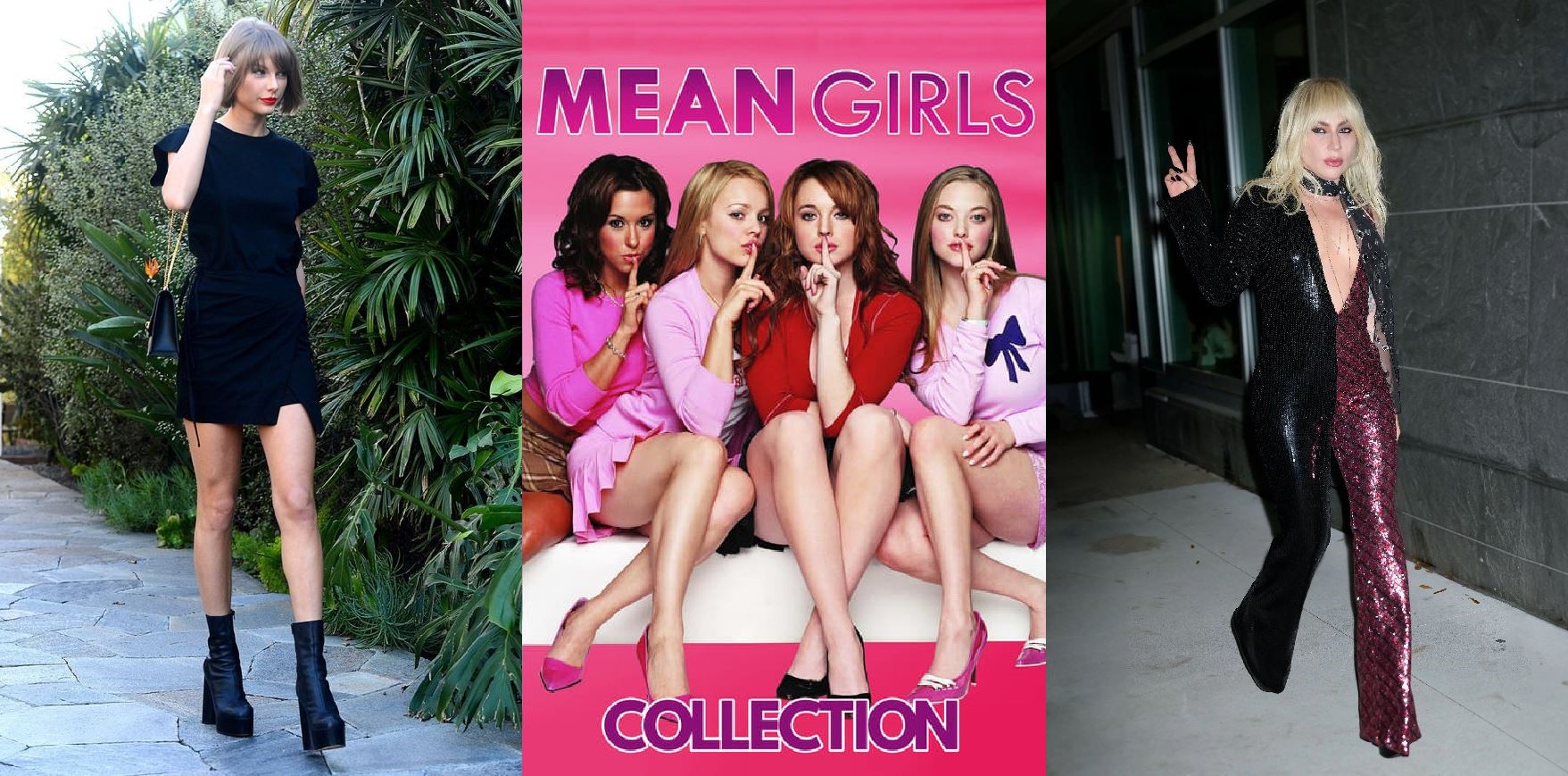
Some who have inspired fandemonium: The anyway statuesque Taylor Swift, adding to the effect in 6 inch (150 mm) heels (2016, right), the mean girls of Mean Girls (2004, centre) and the more diminutive Lady Gaga (2023, right).

By way of portmanteau nouns, pandemonium has been an element in (1) pandemonium (panda + (pande)–monium) (the furor induced by the reaction of people to the sight of pandas) and (2) fandemonium (fan + -(pan)demonium) (in pop-culture, the furor caused by or involving fans).  In the matter fandemonium, Lady Gaga (b 1986) called her fans “little monsters” while devotees of the Taylor Swift (b 1989) cult are known as “Swifties” (apparently always with an initial capital).

Paradise Lost

Written in the epic tradition of starting in medias res (in the midst of things), John Milton’s Paradise Lost was published originally as a poem of some ten-thousand lines in ten books (1667) before the second edition (1674) was re-organized into twelve volumes, possibly a nod to the Roman poet Virgil (Publius Vergilius Maro (70–19 BC)) whose epic work the Aeneid (circa 30-19 BC) was thus assembled.  The poem is an account of the biblical tale of the fall of man: the temptation of Adam & Eve by the fallen angel Satan and their expulsion from the Garden of Eden and was structured in two narrative threads, one following Satan, the other about Adam and Eve, a depiction of the tragedy of human existence which can be transformed only by a pure will for redemption.  The second edition is easier to read because it includes chapter summaries.

Milton coined the name for the capital of Hell, “the High Capital, of Satan and his Peers”, built by the fallen angels at the suggestion of Mammon and it appears at the end of Book I of Paradise Lost (1667), noted as having been designed by the architect Mulciber (In Ancient Rome, Mulciber was another name for the Roman god Vulcan), the designer of palaces in Heaven before his fall.  Book II begins with the debate among the Stygian Council (known also as the Infernal Council and the grand gathering of the demons of the Inferno; apparently something like a Tory Party conference but with better catering) in the council-chamber of Pandæmonium.  In an example of free-market efficiency, the demons built the structure in little more than an hour though by far it surpassed in grandeur all human palaces and, being made from solid gold, it never tarnished.  Interestingly, it was Tardis-like, being both small yet with a vast and spacious hall which thronged with swarms of shape-shifting demons, a quality which may account for the spatial ambiguity in the account of the dimensions.

The Shepherd’s Dream (1793), from Paradise Lost, oil on canvas by Henry Fuseli (1741-1825).

One mid-century critique was Milton's God (1965) by Sir William Empson (1906–1984), among the earliest published examples of the techniques of literary deconstructionism being applied to poetic text.   Milton noted his work was a way of “…justifying the ways of God to men” and Empson deconstructed those means, mapping them onto a framework of theological paradox.  While Milton’s God had a mixed reception, it was briefly influential as an early post-modern text although one of the problems inherent in deconstruction is it tempts others to reconstruct and there was a critic who deduced Empson had claimed “the poet felt an active hatred for the God of Christianity.”  That was a challenging notion given the book for so long sat on shelves next to the King James Bible (KJV 1611) and it seemed Epson’s subconscious was being probed.  Although in Milton’s God there was the observation Milton’s social judgment had told him that the Heaven he was imagining before the fall of the angels was already a horrible place, “against his overall intention”, it seems a quite a leap from that to a hatred of the God of the New Testament.

Empson explained what needed better to be understood (because, as he put it, modern Christianity has gone to extreme lengths “to hush it up”) was the moral character of God had become very hard to defend and that this was widely known by the time John Calvin (1509–1564) and Martin Luther (1483–1546) had trod the path of Saint Thomas Aquinas (1225–1274).  Milton was struggling to defend God, noting that in the De doctrina Christiana (On Christian Teaching (397-426)), Aquinas himself had written there were many who believed God caused evil, practically making God the Devil and Milton would assert the relevant Bible texts must not be interpreted literally.  Milton certainly presents God at his worst but the Almighty is a agreeable figure by Book III although it remains clear his path for man will long and painful with many casualties but the poet's theme remained that there would be awful consequences if “the widespread hatred of God could no longer be contained” and this Empson understood.