Showing posts sorted by date for query Claw. Sort by relevance Show all posts

Monday, April 13, 2026

Nail

Nail (pronounced neyl)

(1) A slender, typically rod-shaped rigid piece of metal, usually in many lengths and thicknesses, having (usually) one end pointed and the other (usually) enlarged or flattened, and used for hammering into or through wood, concrete or other materials; in the building trades the most common use is to fasten or join together separate pieces (of timber etc).

(2) In anatomy, a thin, horny plate, consisting of modified epidermis, growing on the upper side of the end of a finger or toe; the toughened protective protein-keratin (known as alpha-keratin, also found in hair) at the end of an animal digit, such as fingernail.

(3) In zoology, the basal thickened portion of the anterior wings of certain hemiptera; the basal thickened portion of the anterior wings of certain hemiptera; the terminal horny plate on the beak of ducks, and other allied birds; the claw of a mammal, bird, or reptile.

(4) Historically, in England, a round pedestal on which merchants once carried out their business.

(5) A measure for a length for cloth, equal to 2¼ inches (57 mm) or 1⁄20 of an ell; 1⁄16 of a yard (archaic); it’s assumed the origin lies in the use to mark that length on the end of a yardstick.

(6) To fasten with a nail or nails; to hemmer in a nail.

(7) To enclose or confine (something) by nailing (often followed by up or down).

(8) To make fast or keep firmly in one place or position (also used figuratively).

(8) Perfectly to accomplish something (usually as “nailed it”).

(9) In vulgar slang, of a male, to engage in sexual intercourse with (as “I nailed her” or (according to Urban Dictionary: “I nailed the bitch”).

(10) In law enforcement, to catch a suspect or find them in possession of contraband or engaged in some unlawful conduct (usually as “nailed them”).

(11) In Christianity, as “the nails”, the relics used in the crucifixion, nailing Christ to the cross at Golgotha.

(12) As a the nail (unit), an archaic multiplier equal to one sixteenth of a base unit

(13) In drug slang, a hypodermic needle, used for injecting drugs.

(14) To detect and expose (a lie, scandal, etc)

(15) In slang, to hit someone.

(16) In slang, intently to focus on someone or something.

(17) To stud with or as if with nails.

Pre 900: From the Middle English noun nail & nayl, from the Old English nægl and cognate with the Old Frisian neil, the Old Saxon & Old High German nagal, the Dutch nagel, the German Nagel, the Old Norse nagl (fingernail), all of which were from the unattested Germanic naglaz.  As a derivative, it was akin to the Lithuanian nãgas & nagà (hoof), the Old Prussian nage (foot), the Old Church Slavonic noga (leg, foot), (the Serbo-Croatian nòga, the Czech noha, the Polish noga and the Russian nogá, all of which were probably originally a jocular reference to the foot as “a hoof”), the Old Church Slavonic nogŭtĭ, the Tocharian A maku & Tocharian B mekwa (fingernail, claw), all from the unattested North European Indo-European ənogwh-.  It was further akin to the Old Irish ingen, the Welsh ewin and the Breton ivin, from the unattested Celtic gwhīnā, the Latin unguis (fingernail, claw), from the unattested Italo-Celtic əngwhi-;the Greek ónyx (stem onych-), the Sanskrit ághri- (foot), from the unattested ághli-; the Armenian ełungn from the unattested onogwh-;the Middle English verbs naile, nail & nayle, the Old English næglian and cognate with the Old Saxon neglian, the Old High German negilen, the Old Norse negla, from the unattested Germanic nagl-janan (the Gothic was ganagljan).  The ultimate source was the primitive Indo-European h₃nog- (nail) and the use to describe the metal fastener was from the Middle English naylen, from the Old English næġlan & nægl (fingernail (handnægl)) & negel (tapering metal pin), from the Proto-Germanic naglaz (source also of Old Norse nagl (fingernail) & nagli (metal nail).  Nail is a noun & verb, nailernailless & naillike are adjectives, renail is a verbs, nailing is a noun & vern and nailed is a verb & adjective; the noun plural is nails.

Nail is modified or used as a modifier in literally dozens of examples including finger-nail, toe-nail, nail-brush, nail-file, rusty-nail, garden-nail, nail-fungus, nail-gun & frost-nail.  In idiomatic use, a “nail in one's coffin” is a experience or event that tends to shorten life or hasten the end of something (applied retrospectively (ie post-mortem) it’s usually in the form “final nail in the coffin”.  To be “hard as nails” is either to be “in a robust physical state” or “lacking in human feelings or without sentiment”. To “nail one's colors to the mast” is to declare one’s position on something.  Something described as “better than a poke in the eye with a rusty nail” is a thing, which while not ideal, is not wholly undesirable or without charm.  In financial matters (of payments), to be “on the nail” is to “pay at once”, often in the form “pay on the nail”.  To “nail something down” is to finalize it. To have “nailed it” is “to perfectly have accomplished something” while “nailed her” indicates “having enjoyed sexual intercourse with her”.  The “right” in the phrase “hit the nail right on the head” is a more recent addition, all known instances of use prior to 1700 being “hit the nail on the head” and the elegant original is much preferred.  It’s used to mean “correctly identify something or exactly to arrive at the correct answer”.  Interestingly, the Oxford English Dictionary (OED) notes there is no documentary evidence that the phrase comes from “nail” in the sense of the ting hit by a hammer.

Double-headed nails.

Double-headed nails are used for temporary structures like fencing.  When the shaft is hammered in to the point where the surface of the lower head is flat against the surface of that into which it's being hammered, it leaves the upper head standing proud with just enough of the shaft exposed to allow a claw-hammer to be used to extract nail.  There is a story that as part of an environmental protest against the building or demolition of some structure (the tales vary), activists early one morning went to the temporary fencing around the contested site and hammered in all the double-headed nails.  This is believed to be an urban myth.

The sense of “fingernail” appears to be the original which makes sense give there were fingernails before there were spikes (of metal or any other material) used to build stuff.  The verb nail was from the Old English næglian (to fix or fasten (something) onto (something else) with nails), from the Proto-Germanic ganaglijan (the source also of the Old Saxon neglian, the Old Norse negla, the Old High German negilen, the German nageln and the Gothic ganagljan (to nail), all developed from the root of the nouns.  The colloquial meaning “secure, succeed in catching or getting hold of (someone or something)” was in use by at least the 1760; hence (hence the law enforcement slang meaning “to effect an arrest”, noted since the 1930s.  The meaning “to succeed in hitting” dates from 1886 while the phrase “to nail down” (to fix in place with nails) was first recorded in the 1660s.

Colors: Lindsay Lohan with nails unadorned and painted.

As a noun, “nail-biter” (worrisome or suspenseful event), perhaps surprisingly, seems not to have been in common use until 1999 an it’s applied to things from life-threatening situations to watching close sporting contests.  The idea of nail-biting as a sign of anxiety has been in various forms of literature since the 1570s, the noun nail-biting noted since 1805 and as a noun it was since the mid-nineteenth century applied to those individuals who “habitually or compulsively bit their fingernails” although this seems to have been purely literal rather than something figurative of a mental state.  Now, a “nail-biter” is one who is “habitually worried or apprehensive” and they’re often said to be “chewing the ends of their fingernails” and in political use, a “nail biter” is a criticism somewhat less cutting than “bed-wetter”.  The condition of compulsive nail-biting is the noun onychophagia, the construct being onycho- (a creation of the international scientific vocabulary), reflecting a New Latin combining form, from the Ancient Greek νυξ (ónux) (claw, nail, hoof, talon) + -phagia (eating, biting or swallowing), from the Ancient Greek -φαγία (-phagía).  A related form was -φαγος (-phagos) (eater), the suffix corresponding to φαγεν (phageîn) (to eat), the infinitive of φαγον (éphagon) (I eat), which serves as aorist (essentially a compensator for sense-shifts) (for the defective verb σθίω (esthíō) (I eat).  Bitter-tasting nail-polish is available for those who wish to cure themselves.  Nail-polish as a product dates from the 1880s and was originally literally a clear substance designed to give the finger or toe-nails a varnish like finish upon being buffed.  By 1884, it was being sold as “liquid nail varnish” including shads of black, pink and red although surviving depictions in art suggests men and women in various cultures have for thousands of years been coloring their nails.  Nail-files (small, flat, single-cut file for trimming the fingernails) seem first to have been sold in 1819 and nail-clippers (hand-tool used to trim the fingernails and toenails) in 1890.

Francis (1936-2025; pope 2013-2025) at the funeral of Cardinal George Pell (1941-2023), St Peter’s Basilica, the Vatican, January 2023.

The expression "nail down the lid" is a reference to the lid of a coffin (casket), the implication being one wants to make doubly certain anyone within can't possible "return from the dead".  The noun doornail (also door-nail) (large-headed nail used for studding batten doors for strength or ornament) emerged in the late fourteenth century and was often used of many large, thick nails with a large head, not necessarily those used only in doors.  The figurative expression “dead as a doornail” seems to be as old as the piece of hardware and use soon extended to “dumb as a doornail” and “deaf as a doornail).  The noun hangnail (also hang-nail) is a awful as it sounds and describes a “sore strip of partially detached flesh at the side of a nail of the finger or toe” and appears in seventeenth century texts although few etymologists appear to doubt it’s considerably older and probably a folk etymology and sense alteration of the Middle English agnail & angnail (corn on the foot), from the Old English agnail & angnail.  The origin is likely to have been literally the “painful spike” in the flesh when suffering the condition.  The first element was the Proto-Germanic ang- (compressed, hard, painful), from the primitive Indo-European root angh- (tight, painfully constricted, painful); the second the Old English nægl (spike), one of the influences on “nail”.  The noun hobnail was a “short, thick nail with a large head” which dates from the 1590s, the first element probably identical with hob (rounded peg or pin used as a mark or target in games (noted since the 1580s)) of unknown origin.  Because hobnails were hammered into the leather soles of heavy boots and shoes, “hobnail” came in the seventeenth century to be used of “a rustic person” though it was though less offensive than forms like “yokel”.

Nails and pins

Mug shot “pin” from TeePublic featuring Lindsay Lohan (b 1986, left), Donald Trump (b 1946; POTUS 2017-2021 and since 2025) and Paris Hilton (b 1981, right).  In this context, although the product really is “the badge”, the name was gained from the built-in pin supplied to secure the object to clothing.

As designs, a nail and a pin are similar, obviously differing only in scale but the function of each is different.  A nail’s primary purpose is to function as a structural fastener joining materials (most typically two or more pieces of wood) although there are specialized nails driven into substrate by impact (variously with hammers or nail guns (sometimes called “pin-nailers”, some of which are built to fire “panel pins” (very slender nails) or small “headless nails”).  A nail relies on friction and compression in the surrounding material for its holding strength.  Pins look like scaled-down nails but mostly are used for alignment, retention or pivoting, rather than structural load-bearing.  Because of their more delicate construction, pins often are inserted through specific-purpose, pre-existing holes and in many cases are intended to be temporary and are thus removable.  Visually, both nails and pins have heads (round, flat, clipped etc) and a tapered shank with a tip pointed for pointed tip for penetration (“snub-nosed” nails do exist but are rare) and both are designed slightly to deform the surrounding material when driven.  The most obvious difference is that a pin’s head is very small and some are spherical and made from plastic; they’re designed only to be pushed with finger-pressure rather than being hit with a hammer.  Although the term “pin” is used for some specialized devices used in building and engineering (dowel pin, pivot pin, gudgeon pin (also as wrist pin), roll pin, cotter pin etc), the word is most associated with the tailor’s pin (used mostly in textiles and usually clipped to “pin”).  In jewelry design and textiles there are also variants including the “lapel pin” and the fashion industry’s device of last resort, the “safety pin”.

Pinhead in publicity shot for Hellraiser III: Hell on Earth (1992).

Clive Barker's (b 1952) supernatural horror movie Hellraiser (1987) was based on his novella The Hellbound Heart (1986) and was a surprise hit, making it a franchise which has thus far spawned nine sequels, the most recent released in 2022.  The plot involved a mysterious puzzle box that, when opened, summoned the Cenobites, a group of extra-dimensional, sadomasochistic beings unable to differentiate between pain and pleasure.  It was a good premise for a horror movie but the character who really captured the audience's imagination was the unnamed figure viewers dubbed “Pinhead”.  Although Pinhead appeared in the original film for fewer than ten minutes, the character became the franchise’s focal point and has since dominated the publicity material for subsequent releases.  The popularity of Hellraiser has been maintained and it’s hoped that for the next release the producers will offer the part to Peter Dutton (b 1970; leader of the Liberal Party of Australia 2022-2025).

Peter Dutton captured by a photographer during a happy moment (left), Pinhead with the box able to summon the Cenobites (centre) and and artist's depiction of Mr Dutton in “Pinhead mode” (digitally altered image, right).

No longer burdened with tiresome parliamentary duties since losing his seat in the 2025 Australian general election, Mr Dutton has time for a third career and he should be good at playing an unsmiling character who speaks in a relentless monotone; really, all he need do is act naturally.  It’s suspected also he’ll be good at learning a script given the decades he spent parroting “talking points” and TWS (three word slogans).  While it’s an urban myth Mr Dutton wasn’t offered the part of Lord Voldemort in the Harry Potter movie franchise because he was deemed “too scary”, as Pinhead he’d be “just scary enough”.  While the LNP (Liberal National Party) state government in Queensland recently has appointed Mr Dutton to the board of the QIC (Queensland Investment Corporation, the investment manager of the state’s Aus$135 billion in assets), it’s understood his duties in the Aus$130,000 per annum role will be neither onerous or time-consuming so there’ll be ample opportunity for film-shoots.  Although when in opposition the LNP had decried the ALP (Australian Labor Party) government’s frequent appointment of ALP figures to lucrative sinecures, once in office the LNP continued the “jobs for the boys” tradition.  In the modern era, the two most striking characteristics of right-wing fanatics is (1) a fondness for sitting safely in a bunker while advocating for (and sometimes sending) other people's children to go a fight a war somewhere and (2) after a career spent extolling the virtues of “private enterprise” and criticizing “government waste”, being anxious to get back on the public payroll as soon as their political careers end.  Reassuringly for taxpayers who may have been worried Mr Dutton would not be able to continue to enjoy the lifestyle to which their taxes made him accustomed (“entitled” as he might have put it), it’s believed his director’s fees from QIC will not affect his parliamentary pension (understood to be between Aus$260,000-Aus$280,000 per annum).

The Buick Nailhead

In the 1930s, the straight-8 became a favorite for manufacturers of luxury cars, attracted by its ease of manufacture (components and assembly-line tooling able to be shared with those used to produce a straight-6), the mechanical smoothness inherent in the layout and the ease of maintenance afforded by the long, narrow configuration, ancillary components readily accessible.  However, the limitations were the relatively slow engine speeds imposed by the need to restrict the “crankshaft flex” and the height of the units, a product of the long strokes used to gain the required displacement.  By the 1950s, it was clear the future lay in big-bore, overhead valve V8s although the Mercedes-Benz engineers, unable to forget the glory days of the 1930s when the straight-eight W125s built for the Grand Prix circuits generated power and speed Formula One wouldn’t see until the 1980s, noted the relatively small 2.5 litre (153 cubic inch) displacement limit for 1954 and conjured up a final fling for the layout.  Used in both Formula One as the W196R and in sports car racing as the W196S (better remembered as the 300 SLR) the new 2.5 & 3.0 litre (183 cubic inch) straight-8s, unlike their pre-war predecessors, solved the issue of crankshaft flex (the W196's redline was 9500 compared with the W125's 5800) by locating the power take-off at the centre, adding mechanical fuel-injection and a desmodromic valve train to make the things an exotic cocktail of ancient & modern (on smooth racetracks and in the hands of skilled drivers, the swing axles at the back not the liability they might sound).  Dominant during 1954-1955 in both Formula One & the World Sports Car Championship, they were the last of the straight-8s in top-line competition.

Schematic of Buick “Nailhead” V8, 1953-1966.

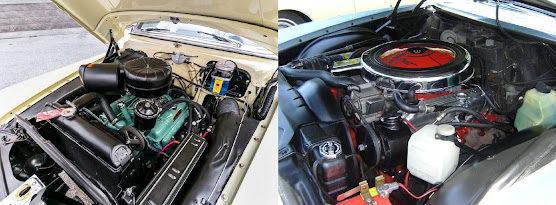
Across the Atlantic, the US manufacturers also abandoned their straight-8s.  Buick introduced their overhead valve (OHV) V8 in 1953 but, being much wider than before, the new engine had to be slimmed somewhere to fit between the existing inner-fenders (it would not be until later the platform was widened).  To achieve this, the engineers narrowed the cylinder heads, compelling both a conical (the so-called “pent-roof”) combustion chamber and an arrangement in which the sixteen valves pointed directly upwards on the intake side, something which not only demanded an unusual pushrod & rocker mechanism but also limited the size of the valves.  So, the valves had to be tall and narrow and, with some resemblance to nails, they picked up the nickname “nail valves”, morphing eventually to “nailhead” as a description of the whole engine.  The valve placement and angle certainly benefited the intake side but the geometry compromised the flow of exhaust gases which were compelled by their anyway small ports to make a turn of almost 180o on their way to the tailpipe.  As an indication of the heat-soak generated by that 180turn, the surrounding water passages were very wide. 

It wasn't the last time the head design of a Detroit V8 would be dictated by considerations of width.  When Chrysler in 1964 introduced the 273 cubic inch (4.5 litre) V8 as the first of its LA-Series (that would begat the later 318 (5.2), 340 (5.5) & 360 (5.9) as well as the V10 made famous in the Dodge Viper), the most obvious visual difference from the earlier A-Series V8s was the noticeably smaller cylinder heads.  The A engines used as skew-type valve arrangement in which the exhaust valve was parallel to the bore with the intake valve tipped toward the intake manifold (the classic polyspherical chamber).  For the LA, Chrysler rendered all the valves tipped to the intake manifold and in-line (as viewed from the front), the industry’s standard approach to a wedge combustion chamber.  The reason for the change was that the decision had been taken to offer the compact Valiant with a V8 but it was a car which had been designed to accommodate only a straight-six and the wide-shouldered polyspheric head A-Series V8s simply wouldn’t fit.  So, essentially, wedge-heads were bolted atop the old A-Series block but the “L” in LA stood for light and the engineers wanted something genuinely lighter for the compact (in contemporary US terms) Valiant.  Accordingly, in addition to the reduced size of the heads and intake manifold, a new casting process was developed for the block (the biggest, heaviest part of an engine) which made possible thinner walls.  "Light" is however a relative term and the LA series was notably larger and heavier than Ford's "Windsor" V8 (1961-2000) which was the exemplar of the "thin-wall" technique.  This was confirmed in 1967 when, after taking control of Rootes Group, Chrysler had intended to continue production of the Sunbeam Tiger, by then powered by the Ford Windsor 289 (4.7 litre) but with Chrysler’s 273 LA V8 substituted.  Unfortunately, while 4.7 Ford litres filled it to the brim, 4.4 Chrysler litres overflowed; the Windsor truly was compact.  Allowing it to remain in production until the stock of already purchased Ford engines had been exhausted, Chrysler instead changed the advertising from emphasizing the “…mighty Ford V8 power plant” to the vaguely ambiguous…an American V-8 power train”.

322 cubic inch Nailhead in 1953 Buick Skylark convertible (left) and 425 cubic inch Nailhead in 1966 Buick Riviera GS (with dual-quad MZ package, right).  Note the “Wildcat 465” label on the air cleaner, a reference to the claimed torque rating, something most unusual, most manufacturers using the space to advertise horsepower or cubic inch displacement (CID).

The nailhead wasn’t ideal for producing top-end power but the design did generate prodigious low-end torque, something much appreciated by Buick's previous generation of buyers who much had relished the low-speed responsiveness of the famously smooth straight-8.  However, like everybody else, Buick hadn’t anticipated that as the 1950s unfolded, the industry would engage in a “power race”, something to which the free-breathing Cadillac V8s and Chrysler’s Hemis were well-suited.  For that, the somewhat strangulated Buick Nailhead was not at all suited and to gain power the engineers were compelled to add high-lift, long-duration camshafts which enabled the then magic 300 HP (horsepower) number to be achieved but at the expense of smoothness; tales of Buick buyers (long accustomed to straight-8s that ran so smoothly at idle it could be hard to tell if the things were running) returning to the dealer to fix the “rumpity-rump” became legion.  Still, the Nailhead was robust, relatively light and offered what was then a generous displacement and the ever inventive hot-rod community soon worked out the path to power was to use forced induction and invert the valve use, the supercharger blowing the fuel-air mix into the combustion chambers through the exhaust ports while the exhaust gases were evacuated through the larger intake ports.  Thus, for a while, the Nailhead enjoyed a role as a niche player although the arrival in the mid 1950s of the much more tuneable Chevrolet V8s ended the vogue for all but a few devotees who continued use well into the 1960s.  Buick acknowledged reality and, unusually, instead of following the industry trend and drawing attention to displacement & power, publicized their big torque numbers, confusing some (though probably not Buick buyers who were a loyal crew who sometimes would look down on more expensive Cadillacs because they were "flashy").  The unique appearance of the old Nailhead retains some nostalgic appeal for the modern hot-rod community and they do sometimes appear, a welcome change from the more typical small-block Fords or Chevrolets.

Lockheed SR-71 Blackbird (1964-1999).

Not confused about numbers was the USAF (United States Air Force) which was much interested in power for its aircraft but also had a special need for torque on the tarmac and briefly that meant another quirky niche for the Nailhead.  The Lockheed SR-71 Blackbird (1964-1979) was a long-range, high-altitude supersonic (Mach 3+) aircraft used by the USAF for reconnaissance between 1966-1998 and by the NASA (National Aeronautics & Space Administration) for observation missions as late as 1999.  Something of a high-water mark among the extraordinary advances made in aeronautics and materials construction during the Cold War, the SR-71 used Pratt & Whitney J58 turbojet engines which featured an innovative, secondary air-injection system for the afterburner, permitting additional thrust at high speed.  The SR-71 still holds a number of altitude and speed records and Lockheed’s SR-72, a hypersonic unmanned aerial vehicle (UAV) is said to be in an “advanced stage” of design and construction although whether any test flights will be conducted before 2030 remains unclear, the challenges of sustaining in the atmosphere velocities as high as Mach 6+ onerous given the heat generated and stresses imposed by the the fluid dynamics of air at high speed.

Drawing from user manual for AG330 starter cart (left) and AG330 starter cart with dual Buick Nailhead V8s (right).

At the time, the SR-71 was the most exotic aircraft on the planet but during testing and early in its career, just for the engines to start it relied on a pair of even then technologically bankrupt Buick Nailhead V8s.  These were mounted in a towed cart and were effectively the turbojet’s starter motor, a concept developed in the 1930s as a work-around for the technology gap which emerged as the V12 aero-engines became too big to start by hand but lacked on-board electrical systems to trigger ignition.  The two Nailheads were connected by gears to a single, vertical drive shaft which ran the jet up to the critical speed at which ignition became self-sustaining.  The engineers chose the Nailheads after comparing them to other large displacement V8s, the aspect of the Buicks which most appealed being the torque generated at relatively low engine speeds, a characteristic ideal for driving an output shaft, torque best visualized as a "twisting" force.  After the Nailhead was retired in 1966, later carts used Chevrolet big-block V8s but in 1969 a pneumatic start system was added to the infrastructure of the USAF bases from which the SR-71s most frequently operated, the sixteen-cylinder carts relegated to secondary fields the planes rarely used.

Friday, December 13, 2024

Bourse

Bourse (pronounced boors)

(1) A stock exchange, the term used variously (depending on context): (1) as a synecdoche for “stock exchange”, (2) collectively of the stock exchanges of continental Europe and (3) specifically the Paris stock exchange (the Bourse de Paris, known usually in English as the “Paris Bourse”).

(2) Figuratively, any place, real, virtual or imaginary where (1) something of value is traded or (2) the value of something tradable is set or settled.

(3) In philately, a meeting of stamp collectors and or dealers where stamps and covers are sold or exchanged.

(4) In botany, the swollen basal part of an inflorescence axis at the onset of fruit development; it bears leaves whose axillary buds differentiate and may grow out as shoots.

1590s: From the mid sixteenth century French burse (meeting place of merchants), from the French bourse (meeting place of merchants (literally “purse”)), from the twelfth century Old French borse (money bag, purse), from the Medieval Latin bursa (a bag), from the Late Latin bursa (oxhide, animal skin and a variant of variant of byrsa (hide)), from the Ancient Greek βύρσα (búrsa or býrsa), (hide, wine-skin) of unknown origin.  Linked terms are used for other European stock exchanges including the Danish børs, the Swedish börs and the German Börse with the roots evident in Modern English words including bursar and reimburse.  Bursa in Late Latin meant “oxhide, animal skin” (reflecting the origins in the Greek) but, by association with use, in Medieval Latin came to mean “purse made of leather” and that meant it came also to mean “supply of money, cash, funds”, extending later to “pension”.  The modern sense of “exchange where stocks are registered and exchanged” dates from 1845, taken directly from the Bourse de Paris (Paris stock exchange).  In one legend, the use of the word “bourse” for such places was said to be derived from the House of Van der Buerse, a family in Bruges, Belgium.  There, merchants and bankers would gather to conduct financial transactions and the a variant of the name “Buerse” came to be used.  The alternative history relates how there was a sign on the front of the Buerse’s house adorned with a painting of three burses (purses).  Bourse is a noun; the noun plural is bourses.

In French, bourse is also a slang term (usually in the plural) for the scrotum and from gift-shops and street markets around the world, one can buy coin purses (various with clasps, zips and tie-strings) made from the scrotums of various slaughtered creatures.  It appears also in the (usually affectionate) French vulgarity: “Ça remonte à quand, la dernière fois que tu t’es vidé les bourses?” (When was the last time you emptied your balls?  In more polite use, there the bourse d’études (educational scholarship, stipend, student allowance), bourse d’excellence (merit scholarship; fellowship) and boursicaut (small coin purse (mostly archaic though still a favorite among antique dealers).

A bull scrotum purse in a traditional style.

One linguistic development in French might explain something about why the fluctuations in financial markets came increasingly to send ripples throughout economies: In the sixteenth century the verb boursicoter meant “to set money aside” (ie keep it in one’s purse) but by the mid-nineteenth century (under the influence of bourse coming to mean “stock exchange”, it had shifted to mean “having a flutter on the markets; dabbling in the stock market”.  In a similar vein, a boursier (feminine boursière, masculine plural boursiers, feminine plural boursières) could be (1) a scholarship beneficiary, a recipient of a bursary or grant, (2) a stockbroker or trader or (3) one who makes purses and handbags.  In idiomatic use (which survives as a literary device there was sans bourse délier (literally “without opening one's purse”) which is English aligns with “without spending a penny” or “not spending a dime”.

The Modern English purse was from the Middle English purse, from Old English pursa (little bag or pouch made of leather, especially for carrying money), partly from pusa (wallet, bag, scrip) and partly from burse.  The Old English pusa was from the Proto-West Germanic pusō, from the Proto-Germanic pusô (bag, sack, scrip), from the primitive Indo-European būs- (to swell, stuff) and was cognate with the Old High German pfoso (pouch, purse), the Low German pūse (purse, bag), the Old Norse posi (purse, bag), the Danish pose (purse, bag) and the Dutch beurs (purse, bag).  The Old English burse was from the same source as the French bourse.  “Purse” (as a synecdoche for “financial matters generally” is widely used in idiomatic English and persists in the UK persists in the office of Keeper of the Privy Purse, a member of the royal household who manages the financial affairs of the sovereign.  The office dates from the early sixteenth century (things in the palace don’t often change) and can be understood as something like a CFO (chief financial officer) or FC (financial controller (comptroller the historic use)).  Purse had been used in the sense of “the royal treasury” as early as the late thirteenth century and the figurative sense of “money, means, resources, funds” emerged by the mid-1300s, this extending to specific defined instances (such as “prize for winning a horse race etc”) by the 1640s.  The thirteenth century use in Middle English to mean “scrotum” was indicative of the shape and size of the leather pouches used to carry coins.

Lindsay Lohan illustrates the purse and the handbag: The clutch purse (left) would everywhere be understood as “a purse” but in the US such a thing commonly would be called “a clutch” because “purse” is used also of larger items.  The red one (centre) would often be called a purse in the US but elsewhere in the English-speaking world it is certainly a handbag.  By the time something assumes the dimensions of a Louis Vuitton Doctor's Bag (right), it is definitely a handbag, tote or something beyond a purse.

Purse was first used of a “woman's handbag” in the late 1870s.  Originally a purse was “a small bag for carrying money” and that use persisted even after purses became less scrotum-like but in the US it came to be used also of what would in the UK be called a “handbag” (a small bag carried usually by women and typically containing personal items (lipsticks, other makeup and often a “purse” (in the original sense)).  Not infrequently, in trans-Atlantic use, the terms “purse” and “handbag” are used interchangeably, but confusion can arise if there’s no accompanying visual clue which is why the term “clutch purse” has proved so useful.  A clutch purse is a small, often rectangular bag designed conveniently to be carried in one hand (although many are supplied with an (often detachable) chain or strap which can be slung over the shoulder or used in cross-body style.  In the industry, not only is there no set of parameters which defines where a purse ends and a handbag begins and shamelessly manufacturers will use the labels indiscriminately if they suspect it will stimulate sales.  The US usage has infected the rest of the world including places like the UK where once there was a clear distinction and now it’s something really in the eye of the beholder, perhaps recalling the judgment Potter Stewart (1915–1985; associate justice of the US Supreme Court 1958-1981) handed down (in another context) in Jacobellis v Ohio (378 U.S. 184 (1964)): “I shall not today attempt further to define… and perhaps I could never succeed in intelligibly doing so.  But I know it when I see it…

Bear & bull statues outside the Börse Frankfurt (Frankfurt Stock Exchange, formerly known as the Frankfurter Wertpapierbörse), the world's third oldest stock exchange.  Located in the German state of Hesse, Frankfurt is the country's financial centre.

About the only thing which can be guaranteed of a stock market is it will fluctuate and the most famous terms used of bourses are “bear market” & “bull market”, describing respectively the market conditions as they respond to the central dynamics of the business: fear & greed, both of which tend to manifest in waves because of what is known as the “herd mentality” of investors (gamblers as some prefer to describe themselves).  The collective noun for a group of bulls is a herd (less commonly a gang while bears assemble (a less common behavior for them) in a sloth (or sleuth).  The bull & bear metaphors have been in use since the early eighteenth century and the origin of the “bull” is uncontested and refers to the habit aggressive bulls display in pushing forward and tossing their heads upward, the idea being a herd of “bullish investors” will drive up the prices of the stocks they’re pursuing, thus creating a “bull market”.  The math of these terms is not precisely defined but, as a general principle, the view seems to be they are used of a market in which prices rise (bull) of fall (bear) 20% or more from a recent trough or peak, usually over a period or weeks or months depending on the state of an economy.  The labels can be applied to a single asset, an asset class, a group of securities, or a market as a whole and if the trends are mild or seem tentative, things can be called “bullish” or “bearish”.

One of several bull statues, DPRR (Democratic People's Republic of Rockhampton), Queensland, Australia.

The origin of the bestial analogy of the bear is contested.  The oldest story concerns the London trader who sold a shipment of Canadian bearskins sometime before they had come into his possession, his strategy being a gamble the market would fall and he’d just have to pay less for something he’s already sold at a higher price, thus gaining from “the spread” (the difference between the cost and selling prices and a variation on the mechanism used today by the “short sellers”).  These traders came to be known as “bearskin jobbers”.  The alternative history is more directly from behavioral zoology: the way bears with their powerful limbs and big, sharp claws will, if in the mood “claw stuff down”.

Lindsay Lohan with Valentine’s Day stuffed teddy bear.

The use may also have been influenced by the unfortunate history in England of bull and bear-baiting, gruesome, fight-to-the-death contests between the beasts which seem first to have been held during the thirteenth century and reaching an apex of popularity during the reign of Elizabeth I (1533–1603; Queen of England & Ireland 1558-1603).  An audience would bet on the outcome and the link with stock exchanges is that while markets may percolate for sometimes long periods, there will always be battles between “the bears” and “the bulls” and it’s during these events that great fortunes are made and lost.  The language appealed to writers and was used by the English poet & satirist Alexander Pope (1688-1744) in Book II of The Dunciad (1728), a work mocking the greed and folly of investors (gamblers) associated with the South Sea Bubble, a financial scandal of the early eighteenth century and one of many examples of herd mentality and “irrational exuberance”:

Come fill the South Sea goblet full;
The gods shall of our stock take care:
Europa pleased accepts the Bull,
And Jove with joy puts off the Bear.

Tuesday, November 5, 2024

Apricate

Apricate (pronounced ap-roh-keyt)

(1) To sunbathe, to bask in the sun.

(2) To disinfect and freshen by exposing to the sun; to sun.

(3) Figuratively, to uncover secrets (based on the idea of “exposing them to the light”.

1620s: The construct was the Latin aprīc(us) (sunny; exposed to the sun; having lots of sunshine; warmed by the sun) +‎ -ate.  Aprīcus was from aperiō (to open; to uncover), from the primitive Indo-European hepo (off, from) & hwer- (to cover, shut) + -cus (the suffix forming relational adjectives from nouns).  The Latin verb was apricari (to bask in the sun; to warm oneself by sitting in the sunlight).  The suffix -ate was a word-forming element used in forming nouns from Latin words ending in -ātus, -āta, & -ātum (such as estate, primate & senate).  Those that came to English via French often began with -at, but an -e was added in the fifteenth century or later to indicate the long vowel.  It can also mark adjectives formed from Latin perfect passive participle suffixes of first conjugation verbs -ātus, -āta, & -ātum (such as desolate, moderate & separate).  Again, often they were adopted in Middle English with an –at suffix, the -e appended after circa 1400; a doublet of –ee.  The forms were not cognate with “apricot”, although the latter was influenced by aprīcus.  The English verb apricate became rare in the twentieth century and use spiked only in the last decade but this is thought a statistical quirk because of the proliferation of instances on the internet explaining the rarity.  When actually used functionally, it’s mostly as a poetic or literary device, often to capture the simple pleasure and peacefulness of “sitting in the sun” although in politics and journalism there is the figurative sense of “to uncover secrets” (based on the idea of “exposing them to the light (of publicity)”.  Apricate, apricating & apricated are verbs and apricity & aprication are nouns; the noun plural is aprications.

The noun apricity (“the light or warmth of the Sun” and in its occasional use often use to impart the idea of “the warmth of the Sun in winter”) was from the Latin aprīcitās (the noun of quality from aprīcus) is said by more than one source to be the most commonly used variant (in the sense of “least rare”) but the numbers are distorted by the gathered data including the internet’s many lists of rare, obscure or weird words.  Because of the way Google harvests data for their ngrams, they’re not literally a tracking of the use of a word in society but can be usefully indicative of certain trends, (although one is never quite sure which trend(s)), especially over decades.  As a record of actual aggregate use, ngrams are not wholly reliable because: (1) the sub-set of texts Google uses is slanted towards the scientific & academic and (2) the technical limitations imposed by the use of OCR (optical character recognition) when handling older texts of sometime dubious legibility (a process AI should improve).  Where numbers bounce around, this may reflect either: (1) peaks and troughs in use for some reason or (2) some quirk in the data harvested.

Snowbird: An apricating Lindsay Lohan on the Greek island of Mykonos in the Aegean, May. 2024.  Lindsay Lohan is a “snowbird” (in the sense of one who in winter travels to warmer, sunnier places).

Among those who long for apricity are the so-called “snowbirds” (those who avoid the cold by travelling to warmer climate).  Surprisingly perhaps, the use to describe those who flee the chill for the warmth of Florida or the Greek Islands, isn’t documented until the 1950s and for more than half a century before that, a “snowbird” was a cocaine dealer, the use extending by the 1970s to those with the habit of the odd line.  Only a few lexicographers acknowledge the (debatable) existence of “apricitie” (the Oxford English Dictionary (OED) including it though it doesn’t appear in the concise version (COED) and all appear to cite the entry in Henry Cockeram’s English Dictionarie or An Interpreter of Hard English Words (1623): “The warmenes of the Sunne in winter”.  Even among rare words, “apricitie” is a rarity but give the rhythmic possibilities and the obvious nostalgic value, it surprising it’s not more used as a literary device.  The lexicographers are probably sceptical because of the suggestion Mr Cockeram’s entry was either (1) a spelling mistake or (2) his own invention based on the better credentialed “apricity” (both not uncommon phenomenon in the early dictionaries).

Signature Claw Clip Petite in Dark Havana by Apricité Studios.

Maybe apricitie got tared with the brush of association with other obscure words because in his Letters to Squire Pedant (1856) Lorenzo Altisonant (Samuel Klinefelter Hoshour, (1803-1883 and described as “an emigrant to the West”) wrote: “These humicubations [the act or practice of lying on the ground], the nocturnal irrorations [a sprinkling or wetting with dew], and the dankishness [the quality of being dankish (dark, damp & humid)] of the atmosphere, generated by a want of apricity, were extremely febrifacients [tending to induce fever].  So maybe it got a bad name but apricate, apricite, apricity and the other forms are (1) easy to spell, (2) easy to pronounce and (3) can be used to describe something often described so it’s surprising there’s never been much of a revival; in English there is no discernible pattern about why some words are resuscitated and flourish and some remain moribund.  Actually, because the politics of climate change have made what used to be a “safe, go-to” topic of conversation now at least potentially dangerous, it may be there’s a revival of interest in ways to discuss the subject and not just the sunshine.  A “vacuum-cleaner” language, shamelessly English has for centuries adopted words for any number of tongues, retaining some (modified and not) while discarding others.  So it’s profligate in its forms and if one tires of describing the colder months as “chilly” or “wintery”, there’s “hibernal”, “brumal” or “hiemal”.  Then there’s snow and for that there’s “subnivean” (situated or occurring under the snow) or “niveous” (of or relating to snow; resembling snow (as in whiteness); snowy).  There are organisms (they’re probably not best described as “creatures”) which inhabit a niche in which things are subnivean and they are known as “psychrophilic” (thriving at a relatively low temperature), as opposed to “thermophiles” (which like it hot) and “mesophiles” (which insist on living in a “goldilocks zone”).  All of these can be used figuratively so women shivering in offices where men set the thermostat (more than one study has confirmed this really is a thing) can call their tormenters thermophiles.

Friday, December 1, 2023

Bathtub

Bathtub (pronounced bath-tuhb or bahth-tuhb)

(1) A tub in which to bathe, variations including permanent installations (either built-in fixtures or free-standing units) in a bathroom and (now less commonly in the developed world) portable constructions (historically of metal or timber although for military and outdoor use, foldable bathtubs (of leather or canvas) have a long history).

(2) An automotive style (most common in the 1950s) in which the bodywork resembled an upturned bathtub.

1825–1835: The construct was bath + tub and the previous related word was “wash-tub”, dating from the turn of the seventeenth century.  Bath was from the Middle English bath & baþ, from the Old English bæþ (bath), from the Proto-West Germanic baþ, from the Proto-Germanic baþą (bath), from the primitive Indo-European root bhē- (to warm).  The corresponding inherited verbs were bathe & beath.  The Old English bæð (“an immersing of the body in water, mud, etc” or “a quantity of water etc., for bathing”) was from the Proto-Germanic badan (the source also of the Old Frisian beth, the Old Saxon bath, the Old Norse bað, the Middle Dutch bat and the German Bad), also from the primitive Indo-European root bhē- with the appended –thuz (the Germanic suffix indicating “act, process, condition” (as in “birth”; “death”)). The etymological sense is of heating, not immersing.  Tub was from the late fourteenth century Middle English tubbe & tobbe (open wooden vessel made of staves), from the Middle Dutch & Middle Flemish tubbe or the Middle Low German tubbe & tobbe, of uncertain origin.  Etymologists have concluded there’s no link with the Latin tubus or the English tube but it was related to the Old High German zubar (vessel with two handles, wine vessel) and the German Zuber.  In the seventeenth century tub was slang for “pulpit”, thus since the 1660s a “tub-thumper” was a particularly forceful preacher who literally “thumped his fists on the pulpit” to emphasize some point; the use was later extended beyond the church to politicians and others who spoke in a loud or dramatic way.  The English city in the county of Somerset (in Old English it was Baðun) was so called from its hot springs.  The convention now probably is to refer to any permanently installed unit as a “bath”, a bathtub something portable.  The word can appear both as bath tub and bath-tub.  Bathtub is a noun and bathtubby is an adjective (bathtubesque & bathtubbish (resembling or characteristic of a bathtub) were jocular constructions); the noun plural is bathtubs.

Lindsay Lohan with claw-footed bathtub, music video release of Confessions of a Broken Heart (Daughter to Father) (2005).

A “bathtub cockpit” is a cockpit with recessed seating, so that a pilot or driver is sitting in a bathtub-shaped space.  It was often seen in aircraft but the classic example was that used in the delicate, cigar-shape voiturettes built to contest the Formula One World Championship during the 1.5 litre era (1961-1965).  The bathtub curve is a concept from reliability engineering, describing a particular form of the hazard function taking into account three categories of failure rate.  As a theoretical model it assumes the shape of a bathtub (sectioned in the middle and viewed from the side), the three regions being (1) a decreasing failure rate due to early failures, (2) a constant failure rate due to random failures and (3) an increasing failure rate due to wear-out failures.  The slang term “bathtub gin” is a US prohibition era (1919–1933) term to refer to a gin (or other spirit) of such dubious quality it suggests it may have been distilled by an unskilled amateur in their bathtub.  It’s a similar form to “gutrot”, “moonshine” etc and was applied sometimes to any form of illicit alcohol and not just distilled spirit.  “Bathtub racing” literally describes bathtubs being raced.  One of sports more obscure niches, the variations have included (modified) bathtubs being rowed or sailed on waterways or raced on land (either powered, pushed or run on downhill courses.  In economics, the “bathtub theorem” is the charming illustration of the idea that capital accumulation = production - consumption.  The metaphor is that of the water running from the taps (production) and that exiting from the plughole (consumption).  That seems obvious but where the inflow is too great for the capacity of the plughole, the water in the tub (capital) overflows, flooding the place, an elegant explanation of the effects of over-production which can induce recessions or depressions.

Admiral Sir Reginald Aylmer Ranfurly Plunkett-Ernle-Erle-Drax KCB.  Lest it be thought multi-element names are a thing exclusive to the British Isles, they exist elsewhere, an example of which was the German Count Graf Philipp-Constantin Eduard Siegmund Clemens Tassilo Tobias von Berckheim (1924-1984).

In the intricate hierarchy of the UK’s honours system, The Most Honourable Order of the Bath is an order of chivalry dating from 1725 and the name really is derived from the use of a bathtub, the reference being to the medieval ceremony under which knighthoods were conferred, bathing being a symbol of purification.  More than most British honours, the Order of the Bath has a tangled history, at times limited to the military and with various restrictions on the numbers of members.  One thing which was once constant however was that recipients were entitled to the post-nominal letters “KB” after their name.  This changed in 1815 when the order was re-organized into three classes: Knight Grand Cross (GCB), Knight Commander (KCB) & Companion (CB) and the transition was handled effortlessly by the experts but one thing which these days annoys those who worry about such things (and there are a few) is that inexpert journalists and others not do sometimes attach a KB to a Knight Bachelor.  The Knight Bachelor actually attracts no post-nominal letters; it’s a kind of “entry-level” knighthood and recipients are not inducted as a member of one of the orders of chivalry (although there have been plenty of awards of the latter to those whose lives have been far removed from the chivalrous, not all of them from the colonies or Dominions).  The Order of the Bath also provided one of the amusing anecdotes in the unpromising field of diplomatic protocol.  In 1939, when Admiral Sir Reginald Aylmer Ranfurly Plunkett-Ernle-Erle-Drax KCB (1880-1967) was introduced at a ceremony in Moscow, protocol required his honors be read out in full, the Russian translator rendering his KCB as рыцарь умывальник (rytsar' umyval'nik) (Knight of the Wash Tub).  The Russians honor guard couldn’t help but laugh and fortunately, the admiral shared their amusement.

In December 1917, the US satirist & critic HL Mencken (1880–1956) published a fictitious history of the bathtub.  Intended as an amusing hoax, the story was so convincing that quickly it wildly was promulgated, appearing even in reference works and medical journals.  Around a century later, a similar hoax was perpetrated when a university student edited the electric toaster’s Wikipedia page, claiming it had been invented by a wholly factitious Scottish scientist.  The technique was exactly the same as Mencken’s: use the dry factual approach (ie the classic Wikipedia template) and it remained on-line for some years, presumably because the origin of the toaster is not a matter of great interest or controversy.

1949 Nash Ambassador (left), Evelyn Ay (1933–2008), Miss America 1954, in her “bathtub” Nash Rambler (the official car of the beauty pageant) (centre) and 1957 Nash Ambassador which still showed the legacy of the earlier, more extravagant bathtub styling cues.

The best remembered of the “bathtub” cars were first built in the late 1940s by manufacturers introducing their first genuinely new post-war lines (most of the cars produced in 1945-1946 were slightly updated versions of those which had last been made early in 1942).  Within the industry, engineers first called the motif “envelope styling” but the more evocative (and certainly more accurate because an up-turned bathtub came to mind more than an envelope) “bathtub” quickly became the preferred slang.  Echoes of the lines which became familiar in the next decade can be seen in some of the low-volume and experimental bodies seen in the 1920s & 1930s, many an evolution of the realization the “teardrop” shape was close to aerodynamically optimal (at least on paper, the implications of lift and down-force then not widely understood).  Among the large US manufacturers, Nash and Hudson pursued the bathtub style to its most extreme and persisted the longest.  In the early 1950s, the aerodynamic advantages were apparent and combined with the inherently good weight-distribution afforded by their low-slung “step-down” construction, the Hudson Hornet dominated NASCAR racing between 1951-1954, despite its straight-six engine having both less power and displacement than some of the competition.  Except for the odd quirky niche, the bathtub styling didn’t make it into the 1960s and nor did the Nash & Hudson nameplates, the former in 1954 absorbing the latter to created AMC (American Motor Corporation) and in 1957, both brand-names were retired.

Evolution of the Porsche “bathtub” style 1948-1965, the lines of the original a direct descendant of a pre-war racing car.  1948 Porsche 356-001 (the Gmünd Roadster) (top), 1955 Porsche 356 pre-A 1500 Speedster (centre) and 1965 Porsche 356SC Coupé (bottom).  Although the “bathtub” motif was abandoned with the end of 356 production, the 356’s contribution to the lines of the 911 (introduced in 1964 as the 901) is obvious and in the sixty-odd years since, stylistically, not much has changed.