Showing posts sorted by relevance for query Hoop. Sort by date Show all posts

Saturday, June 10, 2023

Hoop

Hoop (pronounced hoop)

(1) A circular band or ring of metal, wood, or other stiff material.

(2) Such a band for holding together the staves of a cask, tub, barrel etc.

(3) A large ring of iron, wood, plastic, etc., used as a plaything for a child to roll along the ground; the hula hoop was a later variation.

(4) A circular or ring-like object (apart, figure, component etc).

(5) In jewelry, the shank of a finger ring (the part of a finger ring through which the finger fits).

(6) In croquet, the wicket (the iron arches through which the ball is driven).

(7) In fashion, a circular band of stiff material used to expand and shape a woman's skirt (sometimes a hoop skirt or petticoat although technically, some don’t contain actual hoops).

(8) In basketball & netball, an informal term for the metal ring from which the net is suspended (the rim).  Also used to refer to the metal ring and net taken together (the basket) and (now less commonly) the game itself (always in the plural).

(9) In pottery (and the products of those which emulate the styles), a decorative band around a mug, cup bowl, plate etc.

(10) To bind or fasten with or as if with a hoop or hoops.

(11) To encircle; to surround.

(12) In circuses etc, a large ring through which performers or animals are trained to jump.

(13) In horse racing, slang for a jockey (Australia).

(14) A style of earring consisting of one or more circles of some substance (metal, plastic et al) and classically a single strand although some have several circles.  They’ve come to be associated with Gypsies (Roma; Romany; Travelers) but this may reflect depictions in popular culture).

(15) A variant spelling of whoop; a whoop, as in whooping cough; to utter a loud cry, or a sound imitative of the word, by way of call or pursuit; to shout (now rare).

(16) In cheese production (as cheese hoop), the cylinder in which the curd is pressed in making wheels of cheese.

(17) A circular band of metal, wood, or similar material used for forming part of a framework such as an awning or tent.

(18) A quart pot, so called because originally it was bound with hoops, like a barrel (used also as a measure of the portion of the contents measured by the distance between the hoops).

(19) A now obsolete (pre imperial system) measure of capacity, apparently between 1-4 pecks.  (In US customary use, a peck was equal to 8 dry quarts or 16 dry pints (8.80977 litres).  In the Imperial system, it was equal to 2 Imperial gallons or 8 Imperial quarts (9.09218 litres).)

(20) In embroidery, a circular frame used to support the thread.

(21) In sports (usually in the plural) a series of horizontal stripe on the jersey.

1125–1175: From the Middle English hope, hoope & hoop (circular band, flattened ring), from the late Old English hōp (mound, raised land; in combination, circular object), from the Proto-Germanic hōp (circular band, flattened ring) & hōpą (bend, bow, arch (which was related to the Saterland Frisian Houp (hoop), the Dutch hoep (hoop), the Old Church Slavonic кѫпъ (kǫ) (hill, island), the Lithuanian kab (hook) and the Old Norse hóp (bay, inlet)), from the primitive Indo-European kāb- (to bend).  Etymologists conclude the original meaning would have been “curve; ring” but the evolution is murky.  The verb was derived from the noun and emerged in the fifteenth century, apparently from the barrel-making business undertaken by coopers (who handled the timber) and hoopers (who fashioned the steel hoops).  Hoop is a noun & verb, hooper is a noun (the surname Hooper a proper noun), hooped is a verb & adjective hoopless, hooplike & unhooped are adjectives; the noun plural is hoops.

Lindsay Lohan wearing hooped earrings.

Although it’s clear hoops as playthings for children date back to antiquity, they weren’t again documented in Europe until the 1400s (where they were used in an early form of physiotherapy) and seem not to have been commercially available only after 1792.  The sport of basketball dates from 1891 and the term hoops (both for the physical components and the game itself) was certainly in use by 1893 although oral use may have preceded this.  The use in circuses (a large ring through which performers or animals are trained to jump) was noted in 1793 but there are journals from travelers in Spain, the Middle East and North Africa which confirm the same devices were being used to train military horses as early as the 1100s.  From this, developed the figurative form “jumping through hoops” which was used from circa 1915 to refer to the obstacles which must be overcome in order to proceed (one being forced to perform time-consuming, pointless tasks in order to gain a job, qualify for acceptance to something etc).

Structural engineering: How the hoop skirt is done.

The hoops (circular band serving to expand and shape the skirt of a woman's dress) used in fashion became popular in the 1540s but similar ideas in structural engineering has been used for thousands of years.  Until the twentieth century, the style never really went away but the size of the hoops certainly waxed and waned as tastes shifted.  The hoops were used for both skirts and petticoats and were fabricated variously from ratan, whalebone, bamboo and even steel and sometimes shapes beyond the purely circular were used, notably the bustle-back style which used the same technique of fabric over a framework.  The term hoop-petticoat appears to date from 1711 while the hoop-skirt is documented since 1856.  A hooptie (less commonly as hooptee or hoopty) is US slang for a dilapidated motor vehicle, dating from the 1920s but achieving popularity when used in hip-hop culture during the 1980s.

1958 Rolls Royce Silver Wraith touring limousine by Hooper.

The hoop snake, a native of the southern US & northern Mexico, was so named in 1784 in recognition of its ability to take its tail in its mouth and roll along like a hoop.  The phrase “cock-a-hoop” (delighted; very happy) was first noted in the sixteenth century and is of unknown origin but may be derived from either (1) the earlier “to set the cock a hoop” (prodigally to live) which implied (literally) “to put a cock on a hoop” (ie, a full measure of grain).  The surname Hooper (maker of hoops, one who hoops casks or tubs) dates from the thirteenth century and was the companion occupation of the cooper who made the barrels.  Hooper & Co (1805) was a UK coach-builder which in the twentieth century moved into the automobile business, catering for the top-end of the market including those supplied to the Royal Mews.  In the 1950s it was noted for its signature “knife-edge” style which, somewhat incongruously, applied one of the motifs of modernity to what was by then an antiquated design idea.  It was also associated with the extravagant Docker Daimlers but it was the end of an era because the move to unitary construction by the manufacturers meant the end for traditional coach-building and their production lines were closed in 1959 although business continued in various forms and in the 1980s, a few one-off Bentleys and Rolls-Royces were made.  Hoopla (also a hoop la) was a coining of US English (originally as houp-la) dating from the 1870s meaning “exclamation accompanying quick movement” and thought derived from the French phrase houp-là (“upsy-daisy” in the English sense), used in Louisiana.  It has come generally to mean “a great fuss”.

Official photograph issued by Celtic Football Club (The Hoops) showing team in traditional green-hooped livery (left) and Lindsay Lohan in a similar style (right) although her choice is presumed coincidental.

The Glasgow-based, Scottish football club Celtic is (along with Rangers) part of an effective duopoly which dominates the Scottish Premiership, the nation’s (FIFA says it’s a country) top-level competition.  The club was founded in 1887 and its first game was a “friendly” against Rangers.  In sport “friendly” is a technical term which means only that no trophy or competition points are at stake and (certainly in the crowd), there is never anything friendly about Celtic-Rangers contests.  As well as taking the majority of the cup competitions, since 1985-1986 either Celtic or Rangers have won each season’s top-flight trophy.  Reflecting their Irish-Catholic traditions, Celtic has always played in green and white and the distinctive hooped shirt was adopted in 1903, gaining them the nickname which endures to this day: The Hoops.

Lindsay Lohan recommends salt & vinegar (S&V) Hula Hoops.

Made from processed potatoes & corn (maize), Hula Hoops are fashioned in the short, hollow cylinders about one inch (25 mm) across.  They were first sold in the UK in 1973 and have been sold (under a variety of brands) in Europe, South America, Asia and throughout the English-speaking world (except North America).  Because the distribution model relied on sea transport  from centralized production facilities, the Hula Hoop business was greatly disrupted by the COVID-19 pandemic and in some cases, supplies to some markets weren't wholly restored until 2022, a problem for HH addicts because apparently, there's nothing else quite like them.  The internet noted Ms Lohan's fondness for salt & vinegar (S&V) but the consensus seem to be the most popular flavor was BBQ Beef (Brown).

Hooters is a US cultural and culinary institution and one of its signature features is the beer being served by a hula-hooping waitress.  Hooters provides an instructional video, performed by Jordan from Georgia.

The staff at Hooters of course use a traditional hula-hooping technique, not only to respect the history but because they pour beer while hooping.  However, for those able to perform in "hands-free" mode, the hoop can be made to rotate in any arc which movements of body-parts permit.

Sunday, April 2, 2023

Hooptie

Hooptie (pronounced hoop-dee or whoop-dee (contested))

In slang, an old, worn-out car.

Circa 1960s: The slang hooptie is used to describe an old, battered car.  The origin is uncertain but it’s thought to have originated in African American urban vernacular sometime in the second half of the twentieth century.  The most common explanation is that the word is a phonetic adaptation from Coupe de Ville, a model of Cadillac produced 1949-2005 (although the factory used the syntax Coupe De Ville only from 1959; prior to that they were Cadillac DeVilles with coupe bodies).  Coupé was from the French couper (to cut), from the Old French coper & colper (to cut off), probably from cop (blow) or colp (which endures as the modern coup), with sense derived from the notion of “cutting off with a blow”.  It may correspond to a Vulgar Latin verb colpāre, a syncopated form of colaphāre (blow, cuff), from the Latin colaphus (a blow delivered by a fist).  The alternative etymology suggests a link with the Vulgar Latin cuppāre (to behead), from the Latin caput (head) although this has never received much support.  The term de ville was from the French phrase de la ville which translated literally as de (of) la (the) ville (city) and in the eighteenth & nineteenth centuries a “sedanca de ville” was a type of small, horse drawn carriage popular for use in the tight streets of cities.  The carriages featured an enclosed compartment for usually two-three passengers while the driver sat outside.  That configuration was adopted in the early coachwork of some automobiles and although production declined as fully-enclosed bodies began to prevail, the style remained on the lists of many coachbuilders until the outbreak of World War II (1939-1945).  In the post-war years there was the odd sedanca de ville which coachbuilders would build on special request by the 1970s the style was thought extinct, a feeling which Bentley’s quixotic semi-revival with the production of a few dozen Continental Sedanca Coupés (SC) in 1999 did little to dispel.  The SC was actually just an appropriation of the name and really a variation of a targa, the rear passenger compartment covered but not enclosed.

Lindsay Lohan assessing her hooptie: Herbie: Fully Loaded (2005).

There have been five alternative theories for the etymology: (1) One suggests both hoopdie & hooptie were both used in the African American community in the 1920s to describe a run-down or dilapidated house (a use perhaps derived from “hovel”) and over time the term came to be was applied to old cars in some advanced state of disrepair.  There is little support for this.  (2) It may be onomatopoeic and a reference to the tortured sounds which emanate from a defective machine in need of repairs.  There is little support for this. (3) It may be related to the phrase “hope I die”, the anthropomorphic notion being the car would sooner be crushed than continue in its dilapidated state.  There is no support for this.  (4) It may be from Hupmobile, a popular brand of car early in the twentieth century, the linguist progress being from “Hupmobile” to “hup” and finally to "hoop", the theory being the use was originally specific to neglected Hupmobiles and later generalized.  There is little support for this.  (5) Hooptie may be from the West African Wolof xub (broken down), the connection being many African Americans are descended from those brought to the US during the slave trade.  It’s thought not impossible but linguistic anthropologists seem unconvinced.  The link with the Cadillac Coupe DeVille (Cadillac followed the usual US practice and never spelled Coupé with the l'accent aigu (acute accent) on the final "e") remains most convincing because for decades, the model was a byword for automotive prestige in the US and it (and similar long cars from the era) is still used in music videos by African Americans.  The song My Hooptie by Sir Mix-a-Lot (stage name of Anthony L Ray (b 1963)) was released in 1989 and included on his album Seminar.  The alternative spellings are hooptee & hoopty.  Hooptie is a noun; the noun plural is hoopties.

Peak Cadillac Coupe DeVille is probably the 1968 model which, uniquely, combined the classic 1960s styling with the stacked headlamps with the new 472 cubic inch (7.7 litre) V8 which in the 1970s would grow to 500 cubic inches (8.2 litre) before shrinking in the post oil-shock world.  When, in 368 cubic inch (6.0 litre) form it was retired in 1984, it was the last of the old “big-block” V8s available in a passenger car.

Reflecting the etymology, the original use of coupé was to describe a horse-drawn carriage cut down to a smaller size to provide for greater speed & agility but by the time Cadillac released the Coupe de Ville in 1949, coupe had come generally to mean a two door car and DeVille was appended because it was known to be suggestive of something expensive or exclusive although presumably few were well acquainted with the literal translation.  That was probably just as well because the big Cadillacs weren’t ideal for use in densely populated and congested cities, even those of the late twentieth century US where the parking meters were further apart.  Adopting Cadillac’s usual conventions of nomenclature, the companion four-door models were called Sedan DeVille (It began in 1949 as de Ville and Cadillac published material with the spellings de Ville, De Ville & DeVille before standardizing the later) and the convertibles received no separate designation, labeled also Coupe DeVille.  Surprisingly, the two and four-door were the same length which must have helped with production-line rationalization.

My Hooptie by Sir Mix-a-Lot (Lyrics © Universal Music Publishing Group)

My hooptie rollin', tailpipe draggin'
Heat don't work an' my girl keeps naggin'
Six-nine Buick, deuce keeps rollin'
One hubcap 'cause three got stolen
Bumper shook loose, chrome keeps scrapin'
Mis-matched tires, and my white walls flakin'
Hit mickey-d's, Maharaji starts to bug
He ate a quarter-pounder, threw the pickles on my rug
Runnin', movin' tabs expired
Girlies tryin' to dis 'n say my car looks tired
Hit my brakes, out slid skittles
Tinted back window with a bubble in the middle
Who's car is it? Posse won't say
We all play it off when you look our way
Rollin' four deep, tires smoke up the block
Gotta roll this bucket, 'cause my Benz is in the shop
My hooptie - my hooptie
Four door nightmare, trunk locks' stuck
Big dice on the mirror, grill like a truck
Lifters tickin', accelerator's stickin'
Somethin' on my left front wheel keeps clickin'
Picked up the girlies, now we're eight deep
Cars barely movin', but now we got heat
Made a left turn as I watched in fright
My ex-girlfriend shot out my headlight
She was standin', in the road, so I smashed her toes
Mashed my pedal, boom, down she goes
Law ain't lyin', long hairs flyin'
We flipped the skeez off, dumb girl starts cryin'
Baby called the cops, now I'm gettin' nervous
The cops see a beeper and the suckers might serve us
Hit a side street and what did we find?
Some young punk, droppin' me a flip off sign
Put the deuce in reverse, and started to curse
Another sucker on the south side about to get hurt
Homey got scared, so I got on
Yeah my group got paid, but my groups still strong
Posse moved north, headin for the CD
Ridin' real fast so the cops don't see me
Mis-matched tires got my boys uptight
Two Vogues on the left, Uniroyal on the right
Hooptie bouncin', runnin' on leaded
This is what I sport when you call me big-headed
I pot-hole crusher, red light rusher
Musher of a brother 'cause I'm plowin' over suckers
In a hooptie
It's a three-ton monster, econo-box stomper
Snatch your girly, if you don't I'll romp 'er
Dinosaur rush, lookin' like Shaft
Some get bold, but some get smashed
Cops say the car smokes, but I won't listen
It's a six-nine deuce, so the hell with emissions
Rollin' in Tacoma, I could get burned
(Sound of automatic gunfire) Betta make a you-turn
Spotted this freak with immense posterior
Tryin' to roll smooth through the Hilltop area
Brother start lettin' off, kickin' that racket
Thinkin' I'm a rock star, slingin' them packets
I ain't wit' dat, so I smooth eject
Hit I-5 with the dope cassette
Playin' that tough crew hardcore dope
The tape deck broke
Damn what's next, brothers in Goretex
Tryin' to find a spot where we could hunt for sex
Found a little club called the N-see-O
Military, competition. You know.
I ain't really fazed, 'cause I pop much game
Rolled up tough, 'cause I got much fame
"How ya doin' baby, my name is Mixalot"
"Mixalot got a Benz boy, quit smokin' that rock"
Ooooh, I got dissed. But it ain't no thing
Runnin' that game with the home made slang
Baby got ished, Bremelo gip.
Keep laughin' at the car and you might get clipped
By a hooptie
Runnin' outta gas, stuck in traffic
Far left lane, throwin' up much static
Input, output, carbeurator fulla soot
"Whatcha want me to do Mix?"
Push freak, push
Sputter, sputter rollin' over gutters
Cars dip low with hard core brothers
Tank on E, pulled into Arco
Cops on tip for Columbian cargo
We fit a stereotype, that's what he said
Big long car, four big black heads
Cops keep jockin', grabbin' like 'gators
'Bout stereotypes, I'm lookin' nuthin' like Noriega
Cop took my wallet, looked at my license
His partner said "Damn, they all look like Tyson"
Yes, I'm legit, so they gotta let me go
This bucket ain't rollin' in snow
It's my hooptie

Thursday, October 14, 2021

Bubble

Bubble (pronounced buhb-uhl)

(1) A spherical globule of gas (or vacuum) contained in a liquid or solid.

(2) Anything that lacks firmness, substance, or permanence; an illusion or delusion.

(3) An inflated speculation, especially if fraudulent.

(4) The act or sound of bubbling.

(5) A spherical or nearly spherical canopy or shelter; dome.

(6) To form, produce, or release bubbles; effervesce.

(7) To flow or spout with a gurgling noise; gurgle.

(8) To speak, move, issue forth, or exist in a lively, sparkling manner; exude cheer.

(9) To seethe or stir, as with excitement; to boil.

(10) To cheat; deceive; swindle (archaic).

(11) To cry (archaic Scots).

(12) A type of skirt.

(13) In infection control management, a system of physical isolation in which un-infected sub-sets population are protected by restricting their exposure to others.

1350-1400: From the Middle English noun bobel which may have been from the Middle Dutch bubbel & bobbel and/or the Low German bubbel (bubble) and Middle Low German verb bubbele, all thought to be of echoic origin.  The related forms include the Swedish bubbla (bubble), the Danish boble (bubble) and the Dutch bobble.  The use to describe markets, inflated in value by speculation widely beyond any relationship to their intrinsic value, dates from the South Sea Bubble which began circa 1711 and collapsed in 1720.  In response to the collapse, parliament passed The Bubble Act (1720), which required anyone seeking to float a joint-stock company to first secure a royal charter.  Interestingly, the act was supported by the South Sea Company before its failure.  Ever since cryptocurrencies emerged, many have been describing them as a bubble which will burst and while that has happened with particular coins (the exchange collapses are something different), the industry thus far has continued with only with occasional periods of inflation and deflation; this make cryptocurrencies highly volatile meaning there is much scope for profit and much risk of loss.  Bubble & bubbling are nouns & verbs, bubbler is a noun, bubbled is a verb, bubbly is a noun & adjective, bubbleless & bubblelike are adjectives and bubblingly is an adverb; the noun plural is bubbles.

Tulips.  The collective noun police in the seventeenth century missed an opportunity in not declaring that henceforth the standard use would be: "a bubble of tulips".

However, although the South Sea affair was the first use of “bubble” to describe such a market condition, it wasn’t the first instance of a bubble, the most infamous of which was the Dutch tulpenmanie (tulip mania) which bounced during the 1630s, contract prices for some bulbs of the recently introduced and wildly fashionable tulip reaching extraordinarily high levels, the values accelerating from 1634 until a sudden collapse in 1637.  Apparently just a thing explained by a classic supply and demand curve, the tulip bubble burst with the first big harvest which demonstrated the bulbs and flowers were really quite common.  In history, there would have been many pervious bubbles but it wasn’t until the economies and financial systems of early-modern Europe were operating that the technical conditions existed for them to manifest in the form and to the extent we now understand.  Interestingly, for something often regarded as the proto-speculative asset bubble and a landmark in economic history, twentieth-century revisionist historians have suggested it was more a behavioral phenomenon than anything with any great influence on the operation of financial markets or the real economy, the “economic golden age” of the Dutch Republic apparently continuing unaffected for almost a century after the bottom fell out of the tulip market.  The figurative uses have been created or emerged as required, the first reference to anything wanting firmness, substance, or permanence is from 1590s.  The soap-bubble dates from 1800, bubble-shell is from 1847, bubble-gum was introduced in 1935 and bubble-bath appears first to have be sold in 1937.  The slang noun variation “bubbly” was first noted in 1920, an invention of US English.  

The word "bubble" spiked shortly after the start of the Covid-19 pandemic.  Over time, use has expanded to encompass large-scale operations like touring sporting teams and even the geographical spaces used for the 2022 Beijing Winter Olympics but the original meaning was more modest: small groups based on close friends, an extended family or co-workers.  These small bubbles weren't supposed to be too elastic and operated in conjunction with other limits imposed in various jurisdictions; a bubble might consist of a dozen people but a local authority might limit gatherings to ten in the one physical space so two could miss out, depending on the details in the local rules.  Bubble thus began as an an unofficial term used to describe the cluster of people outside the household with whom one felt comfortable in an age of pandemic.

Bubbles were however a means of risk-reduction, not a form of quarantine.  The risks in a bubble still exist, most obviously because some may belong to more than one bubble, contact thus having a multiplier effect, the greater the number of interactions, the greater the odds of infection.  Staying home and limiting physical contact with others remained preferable, the next best thing to an actual quarantine.  The more rigorously administered bubbles used for events like the Olympics are essentially exercises in perimeter control, a defined "clean" area, entry into which is restricted to those tested and found uninfected.  At the scale of something like an Olympic games, it's a massive undertaking to secure the edges but, given sufficient resource allocation can be done although it's probably misleading to speak of such an operation as as a "bubble".  Done with the static-spaces of Olympic venues, they're really quarantine-zones.  Bubble more correctly describes touring sporting teams which move as isolated bubbles often through unregulated space.

The Bubble Skirt

A type of short skirt with a balloon style silhouette, the bubble dress (more accurately described as a bubble skirt because that’s the bit to which the description applies) is characterized by a voluminous skirt with the hem folded back on itself to create a “bubble” effect at the hemline.  Within the industry, it was initially called a tulip skirt, apparently because of a vague resemblance to the flower but the public preferred bubble.  It shouldn’t be confused with the modern tulip skirt and the tulip-bubble thing is just a linguistic coincidence, there’s no link with the Dutch tulipmania of the 1630s.  Stylistically, the bubble design is a borrowing from the nineteenth century bouffant gown which featured a silhouette made of a wide, full skirt resembling a hoop skirt, sometimes with a hoop or petticoat support underneath the skirt.   While bouffant gowns could be tea (mid-calf) or floor length, bubble skirts truncate the look hemlines tend to be well above the knee.  Perhaps with a little more geometric accurately, the design is known also as the “puffball” and, in an allusion to oriental imagery, the “harem” skirt.  Fashion designer Christian Lacroix (b 1951) became fond of the look and a variation included in his debut collection was dubbed le pouf but, in English, the idea of the “poof skirt” never caught on.

Lindsay Lohan in Catherine Malandrino silk pintuck dress with bubble skirt, LG Scarlet HDTV Launch Party, Pacific Design Center, Los Angeles, April 2008.

It must have been a memorable silhouette in the still austere post-war world, a sheath dress made voluminous with layers of organza or tulle, the result a cocoon-like dress with which Pierre Cardin (1922-2022) and Hubert de Givenchy (1927-2018) experimented in 1954 and 1958, respectively. A year later, Yves Saint Laurent (1936-2008) for Dior added the combination of a dropped waist dress and bubble skirt; post-modernism had arrived.  For dressmakers, bubble fashion presented a structural challenge and mass-production became economically feasible only because of advances in material engineering, newly available plastics able to be molded in a way that made possible the unique inner construction and iconic drape of the fabric.  For that effect to work, bubble skirts must be made with a soft, pliable fabric and the catwalk originals were constructed from silk, as are many of the high end articles available today but mass-market copies are usually rendered from cotton, polyester knits, satin or taffeta.

The bubble in the 1950s by Pierre Cardin (left), Givenchy (centre) & Dior (right).

The bubble skirt was never a staple of the industry in the sense that it would be missing from annual or seasonal ranges, sometimes for a decade or more and sales were never high, hardly surprising given it was not often a flattering look for women above a certain age (perhaps anyone aged over eight or nine).  Deconstructing the style hints at why: a hemline which loops around and comes back up, created sometimes by including a tighter bottom half with the bulk of additional material above, it formed a shape not dissimilar to a pillow midway through losing its stuffing.  For that reason, models caution the look is best when combined with a sleek, fitted top to emphasize the slimness of the waistline, cinched if necessary with a belt some sort of delineating tie.  The bubble needs to be the feature piece too, avoiding details or accessories which might otherwise distract; if one is wearing a partially un-stuffed pillow, the point needs to be made it’s being done on purpose.

The bubble is adaptable although just because something can be done doesn’t mean it should be done.  The bubble skirt has however received the Paris Hilton (b 1981) imprimatur so there’s that.

TikTok and Instagram influencer Ella Cervetto (b 2000) in Oh Polly Jessamy (an off-shoulder layered bubble hem corset mini dress) in True Red (available also in Ivory), Sydney, Australia, November 2024.

On the catwalks however, again seemingly every decade or so, the bubble returns, the industry relying on the short attention span of consumers of pop culture inducing a collective amnesia which allows many resuscitations in tailoring to seem vaguely original.  Still, if ever a good case could be made for a take on a whimsical 1950s creation to re-appear, it was the staging of the first shows of the 2020-2021 post-pandemic world and the houses responded, Louis Vuitton, Erdem, Simone Rocha and JW Anderson all with billowy offerings, even seen was an improbably exuberant flourish of volume from Burberry.  What appeared on the post-Covid catwalk seemed less disciplined than the post-war originals, the precise constraints of intricately stitched tulle forsaken to permit a little more swish and flow, a romantic rather than decadent look.  The reception was generally polite but for those who hoped for a different interpretation, history suggests the bubble will be back in a dozen-odd years.

Tuesday, September 7, 2021

Elite

Elite (pronounced ay-leet (U) or e-leet (non-U))

(1) The choice or best of anything considered collectively, as of a group or class of persons (often used with a plural verb).

(2) Historically, persons of the highest class (used with a plural verb).  Once associated mostly with high birth or social position (the aristocratic or patrician), it’s now a much applied and contested concept.

(3) A group of persons exercising the major share of authority or influence within a larger group.

(4) A typeface, approximately 10-point in printing-type size, widely used in typewriters and having 12 characters to the inch and now included in many digital font sets.

(5) Representing the most choice or select; best; of, relating to, or suitable for an elite; exclusive

1350–1400: From the Middle English (in the sense of "a person elected to office"), from the Middle French e(s)lit (chosen), feminine past participle of e(s)lisre & e(s)lire (to choose), from the Latin ēligere (to elect), the past participle electus; the source of the modern elect, election & related forms.  Variations are created as required such as anti-elite, global-elite, non-elite, power-elite & super-elite.  Words in a similar sense include exclusive, silk-stocking, aristocracy, celebrity, establishment, society, choice, cool, crack, elect, noble, pick, super, top, best, cream & gentility.  The alternative spelling is the French élite and use of the French pronunciation the "U" ay-leet rather than the "non-U" e-leet is one of the "class-identifiers" on which readers of publications like Country Life focus when meeting folk.

Use in English became more frequent after 1823 in the sense of "a choice or select body, the best part".  Earlier, in fourteenth century Middle English it had been borrowed from French with the meaning "chosen person" (and was used much in ecclesiastical documents to describe a bishop-elect) but had died out by the middle of the next century.  Elite was re-introduced to general use when it appeared by in Lord Byron's (1788-1824) epic poem Don Juan (1819-1824); it caught on and was by 1852 an adjective.  The noun elitism (advocacy of or preference for rule or social domination by an elite element in a system or society; attitude or behavior of persons who are or deem themselves among the elite) dates from 1951 and is an early example of the development of the language of critical theory which emerged, encouraged by the vast increase in the social sciences in the expanded universities of the post-war years.

IBM 12 Point Pitch 96 character "Golf Ball" Prestige Elite font for Selectric III Typewriter.

Introduced in 1961, the IBM Selectric (a portmanteau of select(ive) + (elect)ric)) was a landmark of modern industrial design and the last major advance in desktop document production before the word processor.  Built to the high standard for which IBM was once renowned, it allowed users to change font sets within seconds, simply by swapping the "element" which everybody except IBM staff (always in blue suits and white shirts) called "golf balls".  At the time the concept of a swappable character set was actually decades old and systems using flat, rotating "wheels" were the usual alternative approach but the Selectric did it best and in the 1960s there was still a enticing allure to the IBM name.  The most popular of the early fonts were Elite, Gothic & Courier (all available in several variations.  The first Elite typeface was released in 1920 and used by both typewriters and hot metal typesetting.  Prestige Elite (usually referred to as “Prestige” or “Elite”), was a monospaced typeface, created in 1953 for IBM and among the most popular of those available for the Selectric.  Optimized for the particular technology of the typewriter, Prestige Elite was characterized by the large x-height and moderate stroke thickness suitable for ribbon-based impact printing.  Unlike the similar Courier, the Elite sets did not transition to the digital age although TrueType, PostScript and other formats of variations of Elite are commercially available.

The rise in use of the adjective elitist (advocating or preferring rule or social domination by an elite element in a system or society; deeming oneself to be among the elite) is noted from the same era, the original adjectival examples including Sigmund Freud (1856-1939), Friedrich Nietzsche (1844–1900), and Thomas Carlyle (1795–1881).  The nous use quickly followed although some dictionaries insist it’s not attested until 1961.  The concept attracted much attention from sociologists exploring structures of power and the relationships between them, much discussed in Michael Young’s (1915-2002) The Rise of the Meritocracy (1958) although, while intended as a critique of a society increasingly divided between a skilled power-holding elite and a disenfranchised underclass of the less qualified, meritocracy, to the author’s disquiet, meritocracy (and meritocratic) evolved into a word with at least neutral and often positive connotations.

Shoes for elite feet: Lindsay Lohan in Isabel Marant Poppy Elite Suede Pumps in beige, New York City, August 2015.  Jeans for the elite now can affect the look of the tatterdemalion ("distressed" the industry term) which once was a mark of the clothing of the poor but they should include a label confirming their US$800 + cost, a particular art of "implied price-taggery". 

Charles Wright Mills (1916–1962 and usually styled C Wright Mills) was an American sociologist who published the much criticized but also influential The Power Elite (1956) which appears to have introduced the term to political criticism.  Mills took a structuralist approach and explored the clusters of elites and how their relationships and interactions works to enable them to exert (whether overtly or organically) an essentially dictatorial control over US society and its economy.  Mills, while acknowledging some overlap between the groups, identified six clusters of elites: (1) those who ran the large corporations, (2) those who owned the corporations, (3) popular culture celebrities including the news media, (4) the upper-strata of wealth-owning families, (5) the military establishment (centred on the Pentagon’s Joint Chiefs of Staff) and (6), the upper echelons of government (the executives, the legislatures the judges, the senior bureaucracy and the duopoly of the two established political parties.  The overlaps he noted did not in any way diminish the value of his description, instead illustrating its operation.

Although criticized as being more a left-wing polemic than conventional academic research (something from which Mills really didn’t demur), The Power Elite aged well and influenced many, the famous caution President Eisenhower (1890–1969; president of the US 1953-1961) issued in his valedictory address warning of the “military-industrial complex” was quite Millsian and a helpful contribution to the library of structuralism.  Generations of sociologists and others would develop his idea of the new and shifting construct of a ruling class and culture.  In recent years, elite has become a term used (usually between elites) as an accusation; elite populists finding their base responsive to the label being applied to those of whom they're anyway most suspicious: journalists, scientists, academics etc. 

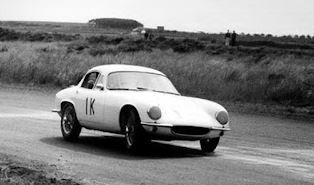
The Lotus Elite

1959 Lotus Elite S1.

The design of the Lotus Elite (Type 14, 1957-1963) was a catalogue of innovation, some of which would have an immediate effect on the industry though some would proved too difficult to implement in mass-production and, except for the most expensive, impossible profitably to pursue on a smaller scale.  Most distinctive was a technique borrowed from aviation, the stressed-skin glass-fibre unibody which obviated entirely the need for a chassis or space-frame, the body an integrated, load-bearing structure.  The only substantial steel components were a sub-frame supporting the engine and front suspension and a hoop to which was attached the windscreen, door hinges and jacking points.  In an indication of how much things have changed, the hoop was the extent of passenger protection.

Club sandwich: The Elite's triple-layer monocoque.

Even had all the components been produced in accordance with the specification, many parts of the structure were so close to the point of failure that some revisions to the design would anyway have been necessary but the early cars were far from perfect.  The contact for the fabrication of the bodies had been won by a boat-builder, then one of the few companies with much experience in molding fibreglass.  However, the Elite was a more complex design than a boat hull and fibreglass was still a novel material, even Chevrolet in the United States, with access to the financial and engineering resources of General Motors, found early in the production of the Corvette there were lessons still to be learned.  After the first 250-odd were built, Lotus became aware there were problems, the need for a fix urgent.  Cleverly, the body consisted of three stressed-fiberglass layers which, when joined in a monocoque, created the bulkheads and eight torsion boxes gave the structure its strength and stiffness although the success was something of a surprise.  The designer, working in the pre-CAD era and with no experience of the behavior of fibreglass, had doubted the material would be strong enough so had the first prototype built with some steel and aluminum plates sandwiched between the layers with mounting brackets bonded in points at the rear to support the suspension and differential mountings.  In subsequent tests, these proved unnecessary but so poorly molded were many of the layers that structural failures became common, the resin porings of inconsistent thickness creating weaknesses at critical points, suspension struts and differentials known to punch themselves loose from mountings or even tear away chunks of the supposedly supporting fibreglass.

1962 Lotus Elite S2.

Needing an operation more acquainted with the tight tolerances demanded in precision engineering, Lotus switched suppliers, the molding contract granted to the Bristol Aeroplane Company. This transformed quality control and the remaining 750-odd Elites carried an S2 designation, the early cars retrospectively (but unofficially) dubbed S1.  Even so, despite the improved, lighter and stiffer shell, it would be another generation before the structural implications of fibreglass would fully be understood and the flaws inherent in the design remained, suspension attachment points sometimes still prone to detachment, Lotus content to the extent it now happened only under extreme loading rather than habitually.

Coventry Climax FWE, 1962 Lotus Elite S2 SE.

Improbably, the power-plant was the 1.2 litre Coventry Climax FWE (Fire-Water-Elite), an all-aluminum inline four cylinder engine which began life as the FWA (feather weight automotive), derived from a water-pumping unit for the UK Government’s fleet of fire-trucks but, small, light and robust, when tuned, it proved ideally suited to motorsport.  The first derivative for competition was the FWB, the unexpected fork prompting Coventry-Climax to rename to versions still used on fire-trucks to FWP (P=Pump).  The FWE was produced especially for the Elite but its qualities attracted a number of specialist race-car builders and in historic racing, the little powerhouse remains competitive to this day.

Nürburgring 1000 km, May 1962 (DNF).

The combination of light-weight, a surprisingly powerful engine and a degree of aerodynamic efficiency which few for decades would match delivered a package with a then unrivalled combination of performance and economy.  On the road, point-to-point, it was able to maintain high average speeds under most conditions and only in then unusual places like the German autobahns with their unlimited speeds could heavier, more powerful machines assert their advantage.

Le Mans 24 Hour, June 1959.  Lotus Elite #41 leads Ferrari 250TR #14. The Ferrari (DNF) retired after overheating, the Elite finishing eighth overall, winning the 1.5 litre GT class.

On the circuits, it enjoyed an illustrious career, notable especially for success in long-distance events at the Nürburgring and Le Mans.  The frugal fuel consumption was an important factor too, as well as claiming five class trophies in the Le Mans 24 hour race, the Elite twice won the mysterious Indice de performance (an index of thermal efficiency), a curious piece of mathematics actually designed to ensure, regardless of other results, a French car would always win something.

Lotus Elite (Leo Geoghegan), Phillip Island, 1960.  That year an Elite would win the Australian GT Championship, contested on the Mount Panorama circuit at Bathurst. 

One problem however was never solved: profitability.  It was something which would plague the UK’s low-volume manufacturers throughout the 1960s, for, whatever the design and engineering prowess available, there was often a lack of financial acumen and accounting skills, many companies never fully evolving from their cottage-industry origins in a back shed, their administrative structures still close to the family business they had once been.  Whether Lotus lost quite as much per Elite as the legend suggests isn’t known but it certainly wasn’t profitable.  Those lessons were learned and the replacement, while less intriguing a design, would be easier to build, more reliable in operation and, compared to the Elite, mass-produced.  The replacement was called the Elan.

1975 Lotus Elite 503 (Type 75).

The Elite name was reprised.  Between 1974-1982, the Elite (Types 75 & 83) was one of a number of the then fashionable wedge-shaped designs which would litter the decade.  Effectively replacing the Elan +2, the new Elite was big and heavy by earlier standards, its performance in some aspects inferior to the Elan but it was a difficult era and many manufacturers with more resources did worse.  Later variations of this were called the Eclat and Excel but, like much of what was done in the 1970s, none are remembered with great fondness.

Lotus Elite Concept, 2010.

More promising was the Elite Concept, shown in 2010.  Hardly original, and actually derivative in just about every way, it nevertheless tantalized all with a specification list including Toyota’s fine 5.0 litre Lexus V8 but any hope of a production version vanished after one of the many corporate restructures undertaken in the wake of the global financial crisis (GFC, 2009-2011).