Toggle (pronounced tog-uhl)
(1) A pin, bolt or rod placed transversely through a
chain, an eye or loop in a rope etc, as to bind it temporarily to another chain
or rope similarly treated.
(2) In various types of machinery, a toggle joint, or a
device having one.
(3) An ornamental, rod-shaped button for inserting into a
large buttonhole, loop or frog, used especially on sports clothes.
(4) In theatre, a wooden batten across the width of a
flat, for strengthening the frame (Also called the toggle rail).
(5) In engineering and construction, a metal device for
fastening a toggle rail to a frame (also called a toggle iron); a horizontal
piece of wood that is placed on a door, flat, or other wooden structure, but is
not on one of the edges of the structure; an appliance for transmitting force
at right angles to its direction.
(6) To furnish with a toggle or to bind or fasten with a
toggle.
(7) In informal use, to turn, twist, or manipulate a
toggle switch; dial or turn the switch of a device (often in the form “to toggle
between” alternate states).
(8) A type of switch widely used in motor vehicles until
outlawed by safety legislation in the 1960s.
(9) In admiralty jargon, a wooden or metal pin, short
rod, crosspiece or similar, fixed transversely in the eye of a rope or chain to
be secured to any other loop, ring, or bight.
In computer operating systems and applications, an
expression indicating a switch of view, contest, feed, option etc.
(11) In sky-diving, a loop of webbing or a dowel affixed
to the end of the steering & brake lines of a parachute providing a means
of control.
(12) In whaling, as toggling harpoon, a pre-modern
(believed to date from circa 5300 BC) harvesting tool used to impale a whale
when thrown.
1769: The origin of toggle is murky and the best guess of most etymologists is it was in some way linked with "tug". In the sense of a "pin passed through the eye of a rope, strap, or bolt to hold it in place" the origin is believed to be nautical (though not necessarily from the Royal Navy) thus the speculation that it’s a frequentative form of “tug” or “to tug” (in the sense of “to pull”), the evolution influenced by regional (or class-defined) pronunciations similar to tog. The wall fastener was first sold in 1934 although the toggle bolt had been in use since 1994. The term “toggle switch” was first used in 1938 although such devices had long been in use in the electrical industry and they were widely used in motor vehicles until outlawed by safety legislation in the 1960s. In computing, toggle was first documented in 1979 when it referred to a keyboard combination which alternates the function between on & off (in the sense of switching between functions or states as opposed to on & off in the conventional sense). The verb toggle dated from 1836 in the sense of “make secure with a toggle” and was a direct development from the noun. In computing, the toggle function (“to toggle back and forth between different actions") was first described in 1982 when documenting the embryonic implementations of multi-tasking (then TSRs (terminate & stay resident programs). Use of the mysterious togglability (the quality of being togglable) seems to be restricted to computer OSs (operating systems) to distinguish between that which can be switched between and that which is a stand-alone function which must separately be loaded & terminated.
The noun toggery (clothing; a clothing shop) is unrelated and was from tog. It described (in slang), capes, cloaks & coats and (in New Zealand & Australia), swimwear (as a clipping of "swimming togs"). The origin of tog as various garments was as a shortened form of the earlier togemans & togeman (cloak, loose coat), from the Middle English tog, toge & togue, from the Old French togue, from the Latin toga (cloak, mantle). Togeman(s) was criminal class cant for "cloak or coat" and in the shortened form "tog" it had spread to general use, by the early eighteenth century meaning "coat" and that also underwent mission keep, coming to be used generally of "clothing". As a verb tog (as both "tog" & "tog up") emerged very quickly. The special use of tog in fluid dynamics was as a unit of thermal resistance, being ten times the temperature difference (in °C) between the two surfaces of a material when the flow of heat is equal to one watt per m2. The discipline in the 1940s appropriated the word from its commercial use as a material used in the thermal insulation of clothing. Tog was also (as a clipping), slang for "a photographer". Toggle is a noun & verb, toggled & toggling are verbs, toggler, toggery & togglability are nouns and togglable is an adjective; the noun plural is toggles.
The Jaguar E-Type (XKE) and the toggle switch

1964 Jaguar E-Type S1 OTS (Open Two Seater, as the factory at the time described the roadster body-style.
Jaguar’s E-Type (sometimes in North America (NA) informally called XK-E or XKE) deputed in 1961 at the now defunct Geneva Motor Show and it created quite a stir, at once recognized as one of the more seductive shapes ever rendered in metal, a view with which many today agree still. The impact it made is undisputed but in industry folklore what is contested is whether Enzo Ferrari (1898-1988), attending the show, called it “the most beautiful car in the world”. The origin of the tale is a recollection by Norman Dewis (1920–2019) who between 1952-1985 was a Jaguar test driver, the website Hemmings reporting him saying of that moment in Geneva: “I always remember Enzo Ferrari coming up to me. He walked around the car. He said, ‘Norman, it’s the most beautiful car I’ve ever seen. But there is one mistake on the car. It hasn’t got a Ferrari badge.’’

1966 Jaguar E-Type OTS. The cockpit of the "toggle switch E-Types" was one of the classic looks of the analogue era, Unlike the Jaguar saloons in production at the time, from the start, the E-Type's dashboard had a padded top-rail.
Il Commendatore seems never to have confirmed or denied expressing the sentiment and there’s no mention of it in Le mie gioie terribili (published in English as “My terrible joys: the Enzo Ferrari memoirs” (“My Terrible Joys” must be one of the finest titles for a memoir)). So, in the absence of a denial the story stands and the E-Type clearly made an impression because after concluding the sleek shape was likely to confer great aerodynamic advantage, signor Ferrari returned to Modena and ordered the development of the 250 GTO, the three dozen-odd built now among the highest-priced collectables. It’s not unknown for a statement of perhaps dubious provenance to gain an aura of authenticity if the subject decides it reflects well on them. In the 1961 Australian general election, as the counting drew to a conclusion, the government and opposition had won equal numbers with a single seat still to be called; on that one seat rested the fate of the election. That one seat was held by the conservative Jim Killen (1925–2007) and ultimately he prevailed, ironically because of the “leakage” of a handful of preferences from the CPA (Communist Party of Australia (1920-1991) and styled the ACP (Australian Communist Party between 1944-1951) candidate. Elated, Killen told the press he’d received a congratulatory phone call from Robert Menzies (1894–1978; prime-minister of Australia 1939-1941 & 1949-1966) who’d said “Killen, you’re magnificent”. The quip had come from Killen’s imagination and later, ruefully, he would reveal that at the first post-election meeting of Liberal Party members, Menzies “didn’t even offer me a drink.” Still, Menzies never disowned the comment and one of his press secretaries confirmed he’d been happy for it circulate.

Ergonomically, while an aesthetic delight, the layout was not wholly successful though toggle switches are thought more sexy than the later rockers (although, sardonically, in the E-Type community they are sometimes described a "suicide switches") which were adopted to comply with US safety regulations. There are two different stamping patterns for the aluminum trim pieces and the one used on the very early cars is much prized; it has never been available as a re-production. In 1963, as a running change (the factory bulletin indicating it was done to reduce glare), the panel's covering was changed to black vinyl. The use of aluminum facia plates in a Jaguar was untypical and the designers later recalled it was done just to provide that "race car look" rather as some of today's manufacturers and tuning houses will use carbon fibre (real and fake). The factory certainly was aware of the significance of the ambiance in cockpit design. The earlier XK120 (1948-1954) had been available as a FCH (fixed head coupé), DHC (drop head coupé (ie a cabriolet)) and OTS but while the first two received the traditional burl walnut veneer, the "sportier" OTS's facia was covered in leather & leathercloth. The latter was thought a more modern look which increasingly was used on the successor XK140 (1954-1957) & XK150 (1957-1961) with only the saloons using timber exclusively (which remained an option for the XK150).


The pure lines of the S1 E-Type (top) were diluted, front and rear, by the need to comply with US safety legislation, the later S2's head & taillights more clunky. The collector market slang for the later headlight treatment is "sugar scoop".
The process by which S1 evolved into S2 was in a sense transitional which is why the designations S1.25 & S1.5 became accepted in the jargon. Not used by the factory, the terms are said to have been “invented” by JCNA (Jaguar Clubs of North America), the S1.25 run beginning on 11 January 1967 after production resumed following the Christmas holiday while the first 1.5s were built mid-year. Although within the collector community much is made of the defining differences between the “pure” S1 and the “transitional” S1.25 & S1.5, that “purity” is nuanced because like many others, the E-Type was subject to constant product development with changes appearing from time to time and "S1" is a concept rather than a static specification. Early in the model run, there were some obvious changes such as (1) the modification to the “flat floors” to provide more leg-room, (2) the integration of the hood (bonnet) louvers into the pressing, (3) the external hood (really a “clamshell”) release (there were two types) being replaced by an internal mechanism, (4) internal trim changes including the dashboard materials, console and seats, (5) the replacement of the Moss gearbox with an all-synchromesh unit and (6) the 4.2 litre engine replacing the original 3.8. Beyond those well-known landmarks, between 1965 and early 1967 there was also a wealth of barely detectable (except to experts of which there are quite a few) cosmetic changes and mechanical updates including: (1) the glass windshield washer bottle being replaced by a plastic container (March 1965), (2) the addition of an alternator shield (October 1965), (3) an enclosed brake and clutch pedal box (October 1965), (4) a hazard warning (4-way) flasher included for US market cars (November 1965), (5) sun-visors added to the OTS (February 1966), (6) instrument lighting changed from blue to green (March 1966), (7) the rubber boot at the base of the gear lever being replaced by a black Ambla gaiter (October 1966), (8) detail changes to the gearbox cover and prop shift tunnel finisher (October 1966), (9) the material used for the under-dash panels switched from Rexine-skinned aluminum to fiberboard (October 1966) and (10) a Girling clutch master cylinder replaced the Dunlop unit (December 1966). One quirky part of the evolution was that although, from their introduction in 1966, the 2+2 cars included a door for the glove-box, one wasn't fitted to the OTS & FHC until the S1.5 run.

Jaguar E-Type: S1 with covered headlight (left), S1.25 with early "sugar scoop" (centre) and S2 with later "sugar scoop" (right).
After the lovely headlight covers were legislated to extinction by the DOT bureaucrats, the replacement (uncovered) apparatus came to be called the “sugar scoop”, a term earlier used for the Volkswagens & Porsches sold in the NA market which had to be fitted with sealed-beam headlights because of protectionist rules designed for the benefit of US manufacturers. The use of “sugar scoop” for the E-Type was appropriate because the visual link with the utensil was much more obvious than on the Volkswagens & Porsches. There were three different designs of sugar scoops, one for the 1.25 & 1.5, one for the S2 and one for the S3.

UUA 368 is an Australian-registered 1968 (S2) Jaguar E-Type available for hire at a daily rate of Aus$990.00 (including 200 km (124 miles)); the hire company dubbed her (the car) "Penelope" (unfortunately, the company does not expand on how the names were chosen). Not all jurisdictions allow the registration plate to be painted on the hood, a practice made famous in 1961 by photographs of 9600 HP, a pre-production E-Type used as one of the factory’s original press-cars. It was 9600 HP which The Autocar magazine took to Belgium, successfully verifying the then astonishing claim of a top speed of 150 mph (241 km/h) although, years later, it was revealed there had been a few subtle tweaks and an E-Type off the showroom floor wouldn’t quite have hit the magic number, no matter how long and straight the road. Painting the registration on the hood avoided disfiguring the lovely lines with a plate (no flat surfaces on the front of an E-Type) and many followed the lead, some places allowing it, some not. A S2 E-Type, UUA 368 has the more elevated of the sugar scoops but, being delivered in Australia, it retains the triple SU carburetors by then denied to customers in NA so response will be lively, especially above 125 mph (200 km/h). SU was the initialization of “Skinners Union” the company founded in 1910 by the brothers George Herbert “Bert” Skinner (1982-1931) and Thomas Carlyle “Carl” Skinner (1882-1958). Under various corporate umbrellas, it operated until 1994 but in 1996 the brand was acquired by Burlen Fuel Systems and, under that name, it now produces carburetors, pumps and various related components, supplying mostly the collector market.
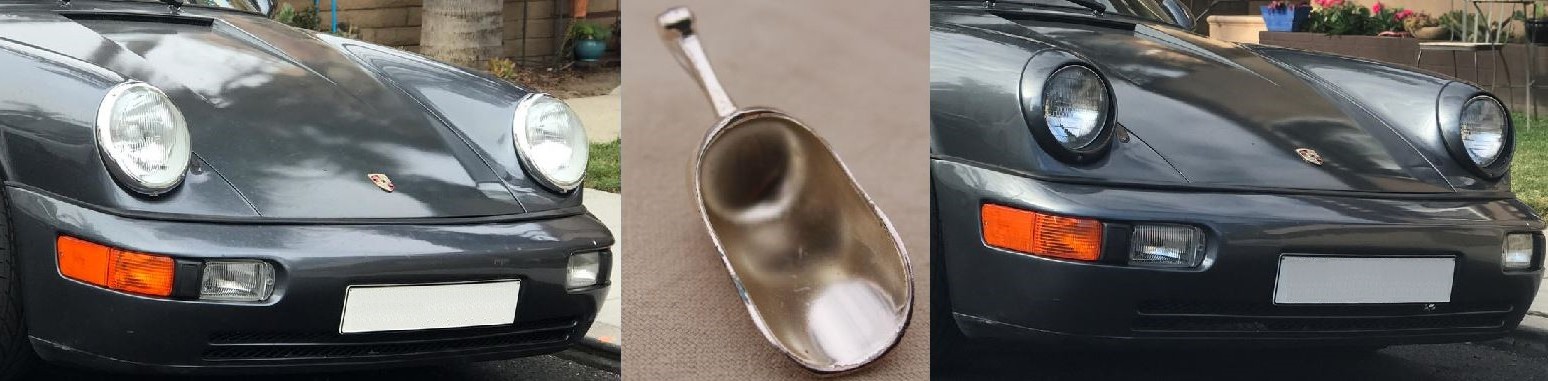
A US market 1977 Porsche 911 (1964-1989), fitted with the front bumper assembly of a later 911 (964 (1989-1994)): The original “sugar scoops” are seen on the left and the replacement Hella H4 lights are to the right (in RoW cars both H2 & H4 units were fitted). The (non-figurative) sugar scoop (centre) is Japanese, circa 1970s. Sugar scoops are used to scoop sugar from a “sugar scuttle” whereas if one’s sugar is in a “sugar bowl”, a “sugar spoon” is used. The difference between a “sugar spoon” and a “tea spoon” is the former has a deeper and usually more rounded bowl and most are supplied as part of a “tea set” or “tea service”, often with the same decorative elements.

Despite that myriad of modifications, all E-Types prior to the S2 are S1s but the running changes can be of significance to restorers if the object is exactly to emulate the state in which a vehicle rolled off the production line; in events such as a concours d'élegancé, judges can deduct points for even minor infractions. Things became more distinct when on 11 January 1967 the first E-Type destined for the US market was built without the covered headlights and this marked the beginning of the run of what would come to be known as the 1.25 although it wouldn’t be until mid-year the open headlights became a universal fitting. Unlike some cars where changes can be determined from the sequential VINs, the only way accurately to determine whether a 1967 E-Type built between January and July was fitted with covered or uncovered headlights work out the market for which it was built, those for NA using the uncovered fittings. That's because an analysis of successive VINs will reveal on a given day there might have been a mix of cars going down the production line with different headlight assemblies. Curiously, there were some 1968 E-Types built for Canada (those not sold in Ontario) that included the triple SUs and while these included the interior changes mandated by US federal law, the door mirror on the driver’s side wasn't fitted and the tail and side lights were a different specification. These quirks are among the many illustrating why things can be challenging for restorers wishing exactly to replicate what the factory did.

Between late August 1967 and July 1968the 1.5 run was built with twin Zenith-Stromberg carburetors (in a specification designed to reduce emissions) replacing the triple SUs (on most NA cars), the substitution of ribbed camshaft covers, a higher mounting of the headlights (to meet minimum height requirements) and the adoption of rocker switches; at this point, the teardrop tail lights remained, the other most obvious external marker of the S2 being the chunky lights below the rear bumper bar. In the usual manner, updates continued, such as twin cooling fans (a good idea) and 1000-odd run of the so-called "R2" cars, almost all of which were registered as 1971 models although many left the factory in 1970. The R2 S2 E-Types gained a pair of "leaper" badges on the flanks, just behind the front wheel arches. Unlike the steel leapers centrally mounted on the hoods of other models, the badges required two part numbers, one each for the left & right. It seemed a pointless addition and just an addition of more clutter, as they were on the S1 (1968-1973) & S2 (1973-1979) XJs.

One aspect of the switch from triple to twin carburetors that should be discussed is (1) the reduction in claimed HP (from 265 to 246) and (2) the consequent drop in performance. What probably seems strange is not that performance suffered but that the effect was (initially) so slight, given the math of going from 3 x 2-inch (50 mm) SUs to 2 x 1.75 (44.45) Zenith-Strombergs meant, in effect, the fuel pipe’s ID (internal diameter) was narrowed from 6 inches (152.4 mm) to 3.5 (88.9); on paper, that would suggest, on the road, things should have been pretty grim. However, while the charm of the SUs was they were (relatively) simple to maintain and keep in synchronisation (if installed in multiples), they were also a primitive design, the original patent dating from 1922. While the units used by Jaguar in the 1960s weren’t quite as simple as the pre-war units, the essentials of the design had been retained whereas the Zenith-Strombergs, despite being so similar in appearance, were more sophisticated. Designed explicitly to maximize performance while conforming with the new (and projected) US emission rules, the Zenith-Strombergs were thermostatic (ie containing a temperature-sensitive mechanism), the internal valves reacting to engine temperature by opening, allowing the correct volume of air to flow, negating the need for the “brute-force” approach of the three big SUs, the effect augmented by the new apparatus atomizing the fuel-air mix into a finer emulsion.

Additionally, concurrent with the change, E-Types built for the NA market received a higher-rated distributor meaning the spark in the combustion chamber ignited the fire with more energy, making the detonation of the finer mist (something that meant the spread within the hemispherical chamber was wider) more powerful. All this meant that power was maintained with the new configuration while emissions were reduced and fuel consumption fell (in general use) by as much as 4-5%. The power-loss (246 vs 265) the SU cognoscenti so lament actually came not from the change in carburetion but the crossover pipe (Jaguar called it a “heat-riser” or “heat-exchanger” and the design of the unidirectional conduit twice would change between 1968-1971) installed to transfer heat from the rear exhaust manifold to the intake manifold. What this did was heat the mix on the path to the combustion chamber, the increased temperature forcing the air molecules to expand (thereby taking up more space), meaning the delivered mix would be “leaner” and thus produce fewer harmful emissions; a leaner mix meaing "less engergy", this was what sacrificed a few HP. In the early build “de-toxed” E-Types (as late as most of the 1969 run), if the pipe is removed, the performance substantially is restored (except at high speeds, the big SUs really showing their stuff at full throttle above 125 mph (200 km/h)). By 1970, US rules had further been tightened so the twin carburetor E-Types were noticeably less lively and by the time the last were built in 1971, its estimated output was at most around 210-215 HP. That’s why the performance of the emission-compliant V12 in the S3 needs to be compared not to a (toxic) S1 of half-a-decade earlier but what was delivered by the retired (de-toxed) S2 of 1971. In a coincidence of circumstances, Jaguar actually provided the case studies for a C&C (compare & contrast): Most 1968 E-Types built for Canada included the triple SUs but those sold in Ontario (the most populous province and the one sharing a long border with the north-east US) had the twin Zenith-Strombergs but no cross-over pipe. From 1969, Canada aligned its regulations with those of the US so from that point on, the NA specification was close to standardized.

By 1970, Jaguar was aware press reports of the somewhat subdued nature of the detoxed E-Type offered to buyers in North America were affecting perceptions of the thing and knew the target market was unlikely much to be mollified by their annual fuel bill being a few dollars less or the warm inner glow of knowing they were doing their bit for cleaner air. To an E-Type buyer able under clear skies to enjoy the often deserted roads of Nevada and Montana (many stretches then with no speed limits), thoughts of smog in remote Los Angeles or San Francisco must have seemed an abstraction. Of course, the world of 1970 was a very different place from that which had in 1961, with a collective gasp, welcomed the E-Type. Traffic densities were higher with speed limits often more rigidly enforced while safety regulations had been imposed in an attempt to reduce the carnage on highways. Most significantly, the environmental moment had created an awareness of the damage automobile emissions were causing; in 1961, there had been no environmental movement and the young males of the post-war baby boom were then just entering their “driving years”. The US in the 1960s enjoyed a historically unique combination of circumstances: (1) cheap, seemingly limitless gas and (2) an economic buoyancy that enabled males aged 17-25 to have either the disposable income or credit rating to purchase (3) relatively low-cost cars with the power and performance a generation earlier would have been seen only on race tracks. Unfortunately, while power and speed greatly had increased, things like brakes often were little improved and, because the core characteristics of males aged 17-25 hadn’t much changed in thousands of years, the accident rate not only increased but situation dramas happened at higher speeds, thus the rise in the injury and death rate. While awaiting next year’s V12 engine, Jaguar couldn’t do anything about US laws but they could run their “Domesticated. Not declawed.” advertising campaign and, in truth, the availability in the S2 E-Type of air-conditioning probably attracted more buyers than would have been drawn by restoration of lost power. When the S3 arrived, with the adoption of the 2+2’s longer wheelbase for the roadster (the FCH was dropped), automatic transmission became available on all models and the E-Type’s transformation to the 1970s was complete, paving the way for XJ-S (1975-1996).

1971 S2 Jaguar E-Type (centre) from the "R2" run of 1000-odd with the leaper badges on the flanks.
So much did the clutter created by bigger bumpers, protuberant headlight assemblies, badges and side-marker lights detract from the lovely, sleek lines of the Series 1 cars, bolting a luggage rack to the trunk (boot) probably seemed no longer the disfigurement it would once have been. The left-hand (left) and right-hand (right) badges, being directional, were different part numbers (BD35865 & BD35866 respectively) and those used on E-Types were silver on black. There were also variants used on the XJs which were gold on black and some had the leaping feline at a slight slope, both matters of note for those wishing to restore to the exacting "factory original" standard.
So, without a flow chart, it can be hard to follow and, because of some overlaps in the production process, the S1-to-S1.25-to-S1.5 transition wasn’t entirely lineal but none of this is mysterious because the JFSBs have documented and explained these “inconsistencies”. Still, there are enough quirks to enrage some and delight others. For example, there were a certain 32 specific NA market vehicles fitted with the headlight covers which were built with serial numbers later than the first of the open headlight cars. Not all E-Types built for NA in 1967 thus had the open headlights and a not insignificant number of those 1.25 spec vehicles have been retro-fitted with the covers. Such is the appeal of the covered headlights that although the E-Type market is monitored by the originality police (the “matching numbers” crowd with their extraordinary knowledge of things like “correct” hose clamps or screw heads), there is some untypical forgiveness for “back-dating” headlights to the sleeker look and they're not unknown even on the later, and much different, S3 cars. Also, although US market S2 cars were from very early in the build fitted with the side-marker light assemblies, it wasn't until late in 1969 bulbs and wiring were fitted (the relevant law taking effect on 1 January 1970); prior to that they'd functioned merely as “side-reflectors”, meaning latter day purchasers need to inspect non-illuminating examples to work out if they're defective or just reflectors. Opinion seems divided on the matter of fitting the triple SU carburetor assembly to cars delivered with the twin Zenith-Strombergs and many have been converted. It's not difficult to make a 1.25 visually indistinguishable from a S1 and to do the same to a 1.5 is a matter just of more parts, time and money, the ethics of both ventures being transparency; once modifications are disclosed to a potential purchaser, it's up to them to decide if originality is critical. Armed with lists of VINs, JFSBs and encyclopaedic knowledge, the JCNA's originality police will not be fooled.

The lure of the headlight covers: 1973 E-Type S3 with headlight covers subsequently added (left) and with the standard "sugar scoops" (left).
These are US market cars with the additional "dagmars" appended to the bumperettes. Even by 1973, thin whitewall tyres were still a popular option on US Jaguars and they remained available until the last were sold in 1975 but the wide whitewalls often supplied in the early 1960s had long fallen from favor. Although the judges in the JCNA confederation are usually uncompromising, they make a rare exception in not deducting points from late-build E-Types (the so-called 1.25 & 1.5) which have been fitted with the headlight covers. The covers never appeared on the S3 E-Types but their unexpected presence clearly doesn't dissuade buyers because the S3 pictured above (left) in February, 2021 sold at auction for US$230,000. It was an exceptionally low-mileage example (8000-odd miles (13,000 km)) but even given that it represented an impressive premium for what was a "modified" vehicle. The S3 cars also had a number of year-to-year variations but compared with the constantly evolving S1 the specification tended to the static. One quirk was that as well as offering the new 5.3 litre (326 cubic inch) V12, it had been intended also to make available a version with the 4.2 litre XK-Six with brochures and promotional materials printed before the decision was taken only to fit the V12. However, four six cylinder pre-production prototypes were built and one is known to survive; curiously, despite the rarity (indeed, it may genuinely be a unique, historic E-Type footnote), at auction it achieved a price little different from a 1971 V12 model in equivalent condition.

Jaguar E-Type production breakdown, 1961-1974.
While the loss of the toggle switches, teardrop taillights and headlight covers caused many to lament that the world was shifting from elegance ungainliness, some other changes also induced pangs of regret. The switch from triple to dual carburetors was necessitated by the emission control regulations; the claimed HP (horsepower) dropped from 265 to 246 and while not many took the original rating too seriously, there was a drop in performance in the upper speed ranges and by 1970-1971, the loss would be greater. One often less noticed change mandated by the DOT was the replacement of the “eared” knock-off hubs for the wire wheels (the E-Types only ever using a two-eared version although third-party items with three ears are available) with a more “pedestrian friendly” type which, bewilderingly, are now referred to as the “non-eared”, “curly”, “octagonal”, “smooth”, “federal” “safety” and “continental” knock offs. Take your pick. Buyers could also take their pick of whether their “improved” wire wheels (now incorporating a forged centre hub) were painted in matte silver or chromed although the JFSB did caution that because of the altered configuration of the spokes, the wheels were not interchangeable with the earlier type except as a complete set (ie five per car). Available from 1 January, 1968 (the effective date for many of DOT’s new rules), this was Jaguar’s last update of the wire wheels which, in a variety of forms, the company had been using since being founded in 1922 as the Swallow Sidecar Company. Never offered on the biggest and heaviest of the post-war cars (the Mark VII, VIII, IX and X/420G) or the new XJ range, they were last used on the “overlap” Daimler saloons (250 & Sovereign) in 1969 although they remained an option for the E-Type until the last was built in 1974.

Although a handful of small-scale producers (the last hold-outs from the days of cottage industries) continued to offer wire wheels, their final appearance on the option lists of the UK industry’s volume models came in 1980 when the last of MG's Midgets and MGBs were sold. The term "knock-off" sometimes confuses because in slang it can mean a "fake or reproduction item" but in the context of wheels the original meaning described the centre-locking hubs (known also as "spinners") which were tightened or loosened by being "knocked" on the ears with the (often lead-faced) mallet (sometimes described as a hammer) included in the tool kit. In racing, pit crews would strike the ears directly but tool-kits usually included a (typically timber) "spinner saver" to minimise damage to both hub and mallet; when non-eared hubs appeared, the shape of the spinner saver was also changed. So the term can confuse: The famous Italian manufacturer Borrani produced many wheels with centre-lock hubs so the phrase "Borrani knock-offs" is standard industry jargon and by convention "knock off Borranis" is used of replica locking nuts (also called "spinners"), the presence of which can be a concern because they might be of lower quality, not manufactured to the safety and performance standards of the genuine product.

Norway’s Motorhistorisk Klubb Drammen (Historic Car Club of Drammen) from Buskerud county reported on an exhibition hosted on 2 July, 2014 by the Norsk motorhistorisk museu (Norwegian Motor Historic Museum) in the village of Brund, the event honoring Lindsay Lohan’s (b 1986) 28th birthday (Ken Curtis (1916–1991) was a US singer and actor). The red S2 Jaguar E-Type had received a recent restoration but a detailed examination would have to be undertaken to determine the degree to which it remains in its original specification. Given the visible clues and its presence in Norway, this may have been a RoW car (something the triple SU carburetors would suggest though they are a popular swap on twin-carb models) but there’s a lively two-way trans-Atlantic trade in E-Types (many now expertly restored in Poland) so it may originally have been sold in the US, Canada or some other LHD (left hand drive) market.

The “Shaguar” used in the three Austin Powers movies (1997, 1999 & 2002).
The Shaguar was a 1967 S1.5 E-Type which featured the combination of teardrop taillights, twin carburetors, sugar scoop headlights, a glove-box door, rocker switches and, being right-hand drive (RHD), it wasn't built for NA. When the auction house published the photographs, the vibrant on-line originality police did their analysis and concluded it was built in December 1967 as a 1968 model but was in far from original condition (beyond the obvious paint and Shaguar badge). The dashboard included the earlier manual choke and the heater and vent controls appeared to be missing and while the side & turn lights were NA specification, the taillights were those used on RoW cars. The tachometer was the one one fitted to S2 models and it was suspected this may have been swapped when the later, non-original engine with the twin Zenith-Stromberg carburetors was installed. Over the decades, many E-Types have for one reason and another drifted far from their original build and usually this limits their appeal to collectors but at Mecum Auctions in January 2025, the Shaguar realized US$880,000 (including 10% buyers premium), several times the typical sale price of a non-original S1.5 RoW E-Type in the same condition, its history as a cinema prop clearly an attraction.
