Showing posts sorted by relevance for query Franchise. Sort by date Show all posts

Tuesday, March 10, 2020

Franchise

Franchise (pronounced fran-chahyz)

(1) A privilege of a public nature conferred on an individual, group, or company by a government.

(2) In commerce, the right or license granted by a company to an individual or group to market its products or services in a specific territory.

(3) A store, restaurant, or other business operating under such a license.

(4) The territory over which such a license extends.

(5) The right to vote (usually regarded as concurrent with the full rights of citizenship.

(6) A privilege arising from the grant of a sovereign or government, or from prescription, which presupposes a grant.

(7) In professional sport, the right to own or operate a team as a member of a league.

(8) In modern commercial cinema, a film that is or has the potential to be part of a series and lends itself to merchandising.

(9) In the marine insurance division of Admiralty law, a sum or percentage stated in a policy, below which the insurer disclaims all liability.

(10) An obsolete word for enfranchise.

1250-1300: From the Middle English, from Old French, derivative of franc (free) and franchir & franchiss (to set free).  In Old French, the twelfth century word franchise meant “freedom, exemption; right, privilege” but by early eighteenth century meaning had narrowed to "particular legal privilege," then, the post-revolutionary "right to vote" by 1790.  The meaning in the sense of commercial licencing is cited variously between 1959-1966, though actual word franchising was first noted in the 1570s.  Use in the film industry is most modern, emerging in the late twentieth century (although the concept pre-dated the use of the descriptor) and in law and commerce, forms have been coined as required including: overfranchised, disfranchisement, subfranchise, subfranchised & subfranchising.  Franchise & franchising are nouns & verbs, franchiser, franchisor, franchisement, franchisability & franchisee are nouns and franchised is a verb; the most common noun plurals are franchises and franchisers.

Jim's Mowing began in Australia literally as a one-man, part-time lawn-mowing created by a student to generate income while pursuing a history Ph.D.  It has since expanded into a franchise business which has been adapted to over 50 service industries in four countries (Australia, Canada, the UK & US) with some 4,000 franchises.

In popular culture, the most common use of franchise is in film and television where it's used to describe productions of media content that in some way share a common fictional universe (the characters or the theme).  The typical franchise is two or more films or television shows connected by shared elements, such as recurring characters, settings, storylines, or themes.  Although some are now planned according to a well-understood formula, historically franchises emerged from a films or TV show which generated a sufficient level of fan interest and revenue and the revenue generation streams extend beyond the original format(s) to include merchandizing opportunities as video games, books, comics and clothing.  Dating from 2006, The Real Housewives is an US "reality television" franchise which has thus far yielded 11 geographically different series (The Real Housewives of Dubai including the novelty of being set overseas), more than 20 international adaptations and some two-dozen "spin-offs", some successful, some not.  The Real Housewives of Dubai (RHODubai to the cognoscenti) debuted in mid-2022 but, unfortunately, does not feature noted Dubai resident Lindsay Lohan.  Perhaps it's only a matter of time.

Saturday, August 23, 2025

Suffrage

Suffrage (pronounced suhf-rij)

(1) The right to vote, especially in a publicly contested, democratic elections; the franchise.

(2) The exercise of such a right; casting a vote.

(3) In ecclesiastical use, a prayer, especially a short intercessory prayer (especially those offered for the faithful dead) or a short petition (such as those after the creed in matins and evensong.

(4) Aid, intercession (now rare).

(5) Testimony; attestation; witness; approval (now rare).

(6) The collective opinion of a body of persons (archaic and probably extinct).

1350–1400: From the Middle English suffrage (intercessory prayers or pleas on behalf of another), from the thirteenth century Old French sofrage (plea, intercession), from the from Medieval Latin, from the Latin suffragium (voting tablet, a vote cast in an assembly (for a law or candidate), an act of voting or the exercise of the right to vote, the decision reached by a vote, an expression of approval, influence or promotion on behalf of a candidate), the construct being suffrag(ari) (genitive suffrāgiī or suffrāgī) (to express public support, vote or canvass for, support) + -ium (the noun suffix).  The –ium suffix (used most often to form adjectives) was applied as (1) a nominal suffix (2) a substantivisation of its neuter forms and (3) as an adjectival suffix.  It was associated with the formation of abstract nouns, sometimes denoting offices and groups, a linguistic practice which has long fallen from fashion.  In the New Latin, as the neuter singular morphological suffix, it was the standard suffix to append when forming names for chemical elements.  The derived forms included nonsuffrage, presuffrage, prosuffrage & antisuffrage (the latter a once well-populated field).  Suffrage, suffragist, suffragette, suffragettism & suffragent are nouns and suffraged is an adjective; the noun plural is suffrages.

The sense in English of “vote” or “right to vote” was derived directly from the Classical Latin and it came by the late nineteenth century to be used with modifiers, chosen depending on the campaign being advocated (manhood suffrage, universal suffrage, women's suffrage, negro suffrage etc and the forms were sometimes combined (universal manhood suffrage).  Because the case for women became the most prominent of the political movements, “suffrage” became the verbal shorthand (ie technically a clipping of woman suffrage).The meaning “a vote for or against anything” was in use by the 1530s and by the turn of the century this had assume the specific sense “a vote or voice in deciding a question or in a contest for office”.  By the 1660s, widely it was held to mean “act of voting in a representative government” and this is the origin of the modern idea of the franchise: “the political right to vote as a member of a body” codified in 1787 in the US US Constitution (in reference to the states).

Exercising her suffrage: Wearing “I voted” sticker, Lindsay Lohan leaves polling station after casting her vote in the 2008 US presidential election, West Hollywood, 4 November 2008.  In California, the Democratic ticket (Barack Obama (b 1961; US president 2009-2017) & Joe Biden (b 1942; US president 2021-2025) took gained all 55 electors in the Electoral College with 8,274,473 votes (61.01%) against the 5,011,781 (36.95%) gained by the Republican ticket (John McCain (1936–2018) & Sarah Palin (b 1964).

In zoology the suffrago (as a learned borrowing from Latin suffrāgō (the pastern, or hock)) describes the joint between the tibia and tarsus, such as the hock of a horse's hind leg or the heel of a bird.  Always rare (and now probably extinct), the companion term in clinical use was suffraginous, from the Latin suffraginosus (diseased in the hock), from suffrāgō, used in the sense of “of or relating to the hock of an animal”.  So, there’s an etymological relationship between English noun “suffrage” (in zoology, the joint between the tibia and tarsus) and “suffrage” (an individual's right to vote) and while there are many strange linkages in the language, that one seems weirder than most.  The anatomical term describes what is essentially the hock in quadrupeds (although it was used also of birds) and that was from the Classical Latin, suffrāgō (ankle-bone, hock or the part of the leg just above the heel) and traditionally, etymologists analyzed this as related to sub- (under) + a base meaning “break, fracture” or “support” although there were scholars who connected it with frag- (to break) from frangere (to break).  The functionalists weren’t impressed by that, suggesting it was a transferred anatomical term.

The Suffragist, 7 July, 2017.

Printed originally in 1913 as a single-sheet pamphlet, in November that year The Suffragist was first issued as weekly, eight-page tabloid newspaper, noted for its cover art which was a kind of proto-agitprop.  A classic single-issue political movement, the pamphlets had been produced by the CU (Congressional Union), an affiliate of the NAWSA (National American Woman Suffrage Association) but The Suffragist was an imprint of the CUWS (Congressional Union for Woman Suffrage), created (with a unique legal personage to avoid corporate liability) as a publicity and activist organ; in 1917 it became the NWP (National Woman's Party).  After its aims were in 1918 realised, The Suffragist ceased publication and the activists shifted their attention to the promotion of the ERA (Equal Rights Amendment), some which, more than a century on, has still not been ratified and has thus never been interpolated into the constitution.

Suffrage came ultimately from the suffrāgium (which had a number of senses relating to “voting”) writers from Antiquity documented their takes on the etymology.  In De lingua latina libri XXV (On the Latin Language in 25 Books), the Roman scholar Varro (Marcus Terentius Varro, 116–27 BC) held it arose metaphorically from suffrāgō (ankle-bone), the rationale being that votes originally were cast pebbles, sherds (now more commonly called “shards”) or other small tokens, possibly with astragali (knuckle or ankle-bones typically from sheep or goats) used like dice or counters.  Animal bones widely were used for many purposes, Pliny the Elder (24-79) in his encyclopaedic Naturalis historia (Natural History (37 thematic books in ten conceptual volumes)) noted people re-purposing astragali for tasks as diverse as teaching arithmetic, gambling, divination, or decision-making.  The Roman statesman Cicero (106-43 BC) seems not directly to have commented on the etymology, in his De Legibus (On the Laws) using suffrāgium in the common sense of “voting” & “vote” applied it also as a rhetorical device to suggest “support” so while not supporting the link with bones, nor does he contradict the popular notion that as an ankle-bone supports the human structure, votes support a candidate.

The Suffragist, 15 September, 1917.

The medieval grammarians also took an interest, Isidore of Seville (circa 560-636) covering all bases by noting (1) suffrāgium’s link with fragor (breaking) implied the idea of “breaking one’s voice” in approval (voting then often done in town squares “by the voice” and (2) the role of the ankle-bone in supporting the as a vote cast supports a proposition or candidate in an election.  Because only fragments of texts from thousands of years ago remain extant, it’s impossible to be emphatic about how such things happened but the consensus among modern etymologists appears to favour the purely metaphorical “support” rather than any use of bones as electoral tokens or calculation devices.  Better documented is the migration of suffrāgium to ecclesiastical use, entering Church Latin to use used to mean “prayers of intercession”; it was from here the English suffrage first entered the language.  As the Roman world Christianized, many words were re-purposed in a religious context and suffrāgium was picked up in the sense of “spiritual support”, manifested in prayers of intercession which originally were those offered for the “faithful dead”: in Confessiones (Confessions, 397-400), Saint Augustine of Hippo (354–430) wrote of suffragia sanctorum (the suffrages of the saints) by which he meant their intercessory prayers but, as was not uncommon, although the “masses for the dead” remained the standard, there was some theological mission creep and the prayers could assume a wider vista, extending also to the living.

Heartfelt advice in 1918 from a “suffragette wife” to young ladies contemplating marriage.

The Old French sofrage came directly from Church Latin, entering Middle English in the fourteenth century with suffrages being prayers of intercessions, often described as “petitions” to God or (in the case of specific topics) to the relevant saint or saints and “suffrage” seems to have entered the vernacular, Geoffrey Chaucer (circa 1344-1400) using the word merely as a synonym for “prayers” of whatever type.  Having thus arrived in the Church, the use was extended to the ecclesiastical structure, the first suffragan bishops appointed in the late 1500s, their role being a “bishop who assists another bishop” and the role seems to have been envisaged as something of a clerical plateau, intended as an appointment for one either “unsuitable” for an ordinary jurisdiction or with no desire to ascend the hierarchy.  The use came directly from the thirteenth century Old French suffragan, from the Medieval Latin suffraganeus (an assistant) which was a noun use of the adjective, (assisting, supporting) from the Latin suffragium (support).  The title endures to this day although between denominations there can be variations in the role (ie job description) including some being appointed as assistants to bishops while others directly administer geographical regions within a supervising bishop’s diocese.  That means the title alone does not describe the nature of the office and although a priest may be styled Diocesan bishop, Titular bishop, Coadjutor bishop, Auxiliary bishop or Suffragan Bishop, not all of the same type necessarily fulfil the same duties and there may be overlap.  While engaged in wartime cryptographic work for the UK government, the troubled mathematician Dr Alan Turing (1912-1954) became well-acquainted with the organizational structure of the British Army and was struck by the similarities between that institution and the Church of England as described in Anthony Trollope’s (1815-1882) The Chronicles of Barsetshire (published in a series of six novels between 1855-1867).  Ever the mathematician, Dr Turing devised a table, having concluded a lieutenant-colonel was a dean while a major-general was a bishop.  A brigadier was a suffragan bishop, the rational for that being they were the “cheapest kind of bishop”.

The Suffragist, 3 October, 1917.

It was the “re-discovery” of the Classical world (ironically often through the archives or writings of Islamic scholars) during the Renaissance and Reformation that Western scholars and translators re-visited the Latin sources, reviving the political sense of suffrāgium into English, restoring “vote” and “right to vote” alongside what had become the standard (religious) sense.  Even then, although there was in most places rarely a wide franchise, voting did happen (among a chosen few) and by the seventeenth century “suffrage” (a vote in an election) was part of common English use and in the 1700s & 1800s, as various forces began to coalesce into democratic movements, it assumed the meaning “a right to vote” which evolved gradually (via manhood suffrage, woman suffrage, negro suffrage etc) into the now familiar “universal adult suffrage”. In English, suffrage has thus enjoyed a palimpsestic past, its ancestral roots anatomical, adapted in antiquity for matters electoral, taken up in Christendom as a form of prayer before returning again with a use in democratic politics.

The most famous derived from was of course the noun suffragette which seems first to have been appeared in print in the UK in 1906, used as a term of derision (by a man).  It was an opportunist coining which can be deconstructed as a (etymologically incorrect) feminine form of the noun suffragist (an advocate of the grant or extension of political suffrage) but it owed its existence to the women who in the UK began to take militant action.  Whereas a suffragist might have been someone (male or female) who wrote learned letters on the subject to the editor of The Times, the suffragette chained herself to the railings outside Parliament House and engaged in other forms of civil disobedience with at least one fatality recorded.

The end of civilization as men knew it: Postcard marking the granting of voting rights to women by the colonial government in New Zealand (1893), printed & published in England by the Artist's Suffrage League, Chelsea, London.

Only four countries: New Zealand, Australia, Finland & Norway (and 11 US states) extended the franchise to women prior to World War I.  France (birthplace of “Liberté, égalité, fraternité”) denied women the vote until after World War II (1939-1945), Charles de Gaulle's (1890-1970; President of France 1959-1969) provisional government in Algiers granting “full suffrage” on 21 April 1944 with the first exercise of the right in the municipal elections of 29 April, 1945.  Swiss women gained the right to vote (at the federal level) in 1971, following a national referendum in which a majority approved the idea.  At the cantonal (regional) level, some cantons had earlier granted women voting rights, Vaud the first in 1959.  The last was Appenzell Innerrhoden which did so only to comply with a ruling by the Swiss Federal Supreme Court.

As the campaign stepped up, techniques were borrowed from anarchists and revolutionaries including fire-bombings of institutions of “the establishment”; if imprisoned, the suffragettes would stage hunger strikes compelling the home secretary to order either their release or force-feeding (a practice previously most associated with lunatic asylums).  Although the suffragettes generated international publicity and encouraged similar movements in other places, despite New Zealand having in 1893 having granted the vote to women on the same basis as men without the country having descended into some kind of feminized Hell, little progress was made and it was only the social and economic disruptions brought about by World War I which induced change, women over 30 able to vote in elections and be elected to parliament in 1918.  In 1928, this was extended to all women over 21, thus aligning their franchise with that which men had since 1918 enjoyed.  The 1928 settlement remains the classic definition of “universal suffrage” in the sense of “all adults” and all that has changed is the threshold age has been lowered to 18 although the UK government has suggested it will seek further to lower this to 16.  If that’s enacted, it’ll still be less permissive that what the ayatollahs (not usually thought paragons of liberalism) in Iran permitted during the 1980s when 15 year olds got the vote.

"Love, honor and obey" was a bride's traditional wedding vow but in the nuclear weapons treaty business between the US & USSR the principle was: "trust but verify".  

As the meme-makers knew, even after women voting became a thing, some husbands knew they still had to check to make sure their wives got it right:  Donald Trump (b 1946; US president 2017-2021 and since 2025) verifying the vote of Melania Trump (b 1970, US First Lady 2017-2021 and since 2025) while exercising her “secret ballot” in the 2016 US presidential election, Polling Station 59 (a school), Manhattan, New York, 8 November 2016.

The –ette suffix was from the Middle English -ette, a borrowing from the Old French -ette, from the Latin -itta, the feminine form of -ittus.  It was used to form nouns meaning a smaller form of something and the use in English to create informal feminine forms has long upset some, including Henry Fowler (1858–1933) who in his A Dictionary of Modern English Usage (1926) condemned the formation of “suffragette”: “A more regrettable formation than others such as leaderette & flannelette, in that it does not even mean a sort of suffrage as they mean a sort of leader & of flannel, & therefore tends to vitiate the popular conception of the termination's meaning. The word itself may now be expected to die, having lost its importance; may its influence on word-making die with it!”  Whether one might read into that that damnation that Henry Fowler regretted women getting the vote can be pondered but to be fair, the old linguistic curmudgeon may have been a proto-feminist who approved.  There were anyway some reactionaries who became converted to the cause.  After a satisfactory election result, Winston Churchill (1875-1965; UK prime-minister 1940-1945 & 1951-1955) was reminded by his wife Clementine Churchill (1885–1977) that he’d received more votes from women than from men, having apparently been forgiven for having once been in the vanguard of the opposition to woman suffrage.  “Quite right”, cheerfully he agreed; a practical democrat, he by then welcomed votes regardless of their origin.

Woman Suffrage Headquarters, Euclid Avenue, Cleveland Ohio, 1912.

The word “suffrage” came by the late 1860s to be attached to activists advocating extending the franchise to women, “woman suffragist” & “female suffragist” both used in US publications and the divergence in the movement was reflected in the UK by the adoption of terms “manhood suffragist” (by at least 1866) and “woman suffragist” (by 1871) although the first reference of the latter was to actions in the US, the existence of the breed in England not acknowledged for a further three years.  Historically, both “woman suffrage” & “women's suffrage” were used but the former overwhelmingly was the standard phrasing late in the 1800s and into the next century when the matter became a great political issue.  To modern eyes “woman suffrage” looks awkwardly wrong but is grammatically correct, “woman” used as a noun adjunct (ie a noun modifying a following noun).  Singular noun adjuncts are common such as “student union” even though the in institution has a membership of many students.  In English, a singular noun can function attributively (like an adjective) to describe a category or class (manpower, horse racing etc).  The possessive (women’s suffrage) emphasizes ownership: the notion of suffrage (in the linguistic sense) “belonging” to women and in modern use that that appears to be the common form and “woman suffrage” was a formal, abstract construction from more exacting times, reflected in uses like “manhood suffrage”, “child labor”, “slave trade” etc.  In structural linguistics, the shift to a preference for possessive forms (workers’ unions, children’s rights, women’s movement etc) is thought a marker of the increasingly fashionable concepts of agency and belonging.

“Kaiser Wilson” protest sign criticizing Woodrow Wilson (1856–1924; US president 1913-1921) for not keeping his 1916 election “promise” to fight for woman suffrage: “Have you forgotten your sympathy with the poor Germans because they were not self-governed?  20,000,000 American women are not self-governed.  Take the beam out of your own eye.  The quote: “Take the beam out of your own eye” comes from Biblical scripture:

Matthew 7:3-5 (King James Version, (KJV, 1611))

3 And why beholdest thou the mote that is in thy brother's eye, but considerest not the beam that is in thine own eye?

4 Or how wilt thou say to thy brother, Let me pull out the mote out of thine eye; and, behold, a beam is in thine own eye?

5 Thou hypocrite, first cast out the beam out of thine own eye; and then shalt thou see clearly to cast out the mote out of thy brother's eye.

What’s discussed in Matthew 7:3-5 is hypocrisy, the metaphor being a speck of dust in one’s brother's eye and a plank in one's own and the teaching is one should first rectify their own significant flaws (the “plank”) before criticizing the minor flaws of others (the “speck”).  What reading the passage should do is encourage humility and self-reflection, persuading individuals to acknowledge their own shortcomings before judging others.  The passage was part of the Sermon on the Mount, regarded by Christians as a central element in Christ’s moral teachings and Woodrow Wilson, the son of a preacher and himself a noted (if selective) moralist would have well acquainted with the text.

Watched by an approving comrade Vyacheslav Molotov (1890–1986; Soviet foreign minister 1939-1949 & 1953-1956), comrade Stalin (1878-1953; Soviet leader 1924-1953) casts his vote in the 1937 election for the Supreme Soviet.  To the left, Comrade Marshal Kliment Voroshilov (1881–1969) watches Comrade Nikolai Yezhov (1895–1940, head of the NKVD 1936-1938).

Those voting in 1937 may have had high hopes for the future because, read literally, the 1936 Constitution of the Soviet Union (adopted 5 December 1936) described a democratic utopia.  Unfortunately, within months, comrade Stalin embarked on his Great Purge and turned his country into a kind of combination of prison camp and abattoir, many of those involved in drafting the constitution either sent to the Gulag or shot.  In 1937 the CPSU (Communist Party of the Soviet Union) was declared to have won 99% of the vote so it was not an exceptional result but the photograph is unusual in that it’s one of the few in which the usually dour comrade Molotov is smiling.  It was comrade Vladimir Lenin (1870–1924; head of government of Russia or Soviet Union 1917-1924) who dubbed Molotov “stone ass” because of his famous capacity (rare among the Bolsheviks) to sit for hours at his desk and process the flow of paperwork the CPSU’s bureaucracy generated.  Precise in every way, Molotov would correct those who suggested Lenin’s moniker had been “iron ass” but, disapproving of “shameful bureaucratism”, he may have used several variants in the same vein and in another nod to Molotov’s centrality in the administrative machinery of government, he was known also as “comrade paper-clip”.

On paper, between 1936-1991, the Supreme Soviet was the highest institution of state authority in the Soviet Union (1922-1991) but was in reality a “rubber stamp parliament” which existed only to ratify, adding a veneer of legality to laws sent down by the executive, controlled exclusively by the CPSU although it was valued for photo-opportunities, enthralled delegates always seen attentively listening to comrade Stalin’s speeches.  On election night comrade Stalin was quoted in the Soviet press as saying: “Never in the history of the world have there been such really free and really democratic elections -- never!  History knows no other example like it...our universal elections will be carried out as the freest elections and the most democratic compared with elections in any other country in the world.  Universal elections exist and are also held in some capitalist countries, so-called democratic countries.  But in what atmosphere are elections held there?… In an atmosphere of class conflicts, in an atmosphere of class enmity.  The statement often attributed to comrade Stalin: “It's not who votes that counts, it's who counts the votes” probably was apocryphal but indicative of how he did things and his psephological model has been an inspiration to figures such as Saddam Hussein (1937–2006; president of Iraq 1979-2003) and Kim Jong-Un (Kim III, b 1982; Supreme Leader of DPRK (North Korea) since 2011).

Sunday, July 19, 2020

Réchauffé

Réchauffé (pronounced rey-shoh-fey )

(1) A warmed-up dish of food; the use of leftovers.

(2) By extension, anything old or stale brought back into service; old material reworked or rehashed.

Circa 1800: From the French réchauffé, past participle of réchauffer (to re-heat), the construct being r(e)- (again) + échauffer (to warm) (from the Vulgar Latin excalefāre, the construct being ex- (the intensive prefix + calefacere ( to warm).  In English, the spelling is usually rechauffe and the word was a direct borrowing from the French rechauffe, the feminine réchauffée, the masculine plural rechauffes & the feminine plural réchauffées.  Échauffer was related to Middle & Old French chaufer (which persists in modern French as chauffer) (to warm), ultimately from Latin cal(e)facere (to make hot), the construct being cale– (stem of calēre (to be hot) + facere (to make).  The Middle French chaufer was the source of English chafe (to wear or abrade by rubbing) although the original meaning was ”to warm, heat”, and that sense survives in culinary use, the chafing dish a receptacle which consists of a metal dish with a lamp or heating appliance beneath, used for keeping food hot at the table.

In English, few prefixes have been more productively applied than re- but, being a direct import from the French, re-chauffe never emerged.  The re- prefix is from the Middle English re-, from the circa 1200 Old French re-, from the Latin re- & red- (back; anew; again; against), from the primitive Indo-European wre & wret- (again), a metathetic alteration of wert- (to turn).  It displaced the native English ed- & eft-.  A hyphen is not normally included in words formed using this prefix, except when the absence of a hyphen would (1) make the meaning unclear, (2) when the word with which the prefix is combined begins with a capital letter, (3) when the word with which the is combined with begins with another “re”, (4) when the word with which the prefix is combined with begins with “e”, (5) when the word formed is identical in form to another word in which re- does not have any of the senses listed above.  As late as the early twentieth century, the dieresis was sometimes used instead of a hyphen (eg reemerge) but this is now rare except when demanded for historic authenticity or if there’s an attempt deliberately to affect the archaic.  Re- may (and has) been applied to almost any verb and previously irregular constructions appear regularly in informal use; the exception is all forms of “be” and the modal verbs (can, should etc).  Although it seems certain the origin of the Latin re- is the primitive Indo-European wre & wret- (which has a parallel in Umbrian re-), beyond that it’s uncertain and while it seems always to have conveyed the general sense of "back" or "backwards", there were instances where the precise was unclear and the prolific productivity in Classical Latin tended make things obscure.

Rechauffe entered English early in the nineteenth century in the figurative sense which had for some time been current in France, suggesting something (ideas, literature etc) or someone (actors, artists and (especially) politicians) old being rehashed or recycled (hence the common phrase c’est du réchauffé (meaning “it’s old hat)).  That remains the most common use in English but by the late 1800s, the original sense in French (reheated food) had been picked up across the channel, presumably because “Réchauffé Bœuf bourguignon” is a more appealing dish than “yesterday’s stew”.  Rechauffe, rechauffement, rechauffeist & rechauffementism are nouns, rechauffed is a verb & adjective and rechauffing is a verb; the noun plural is rechauffes.  Not all the derived forms are listed in dictionaries as standard, many coined only as for humorous effect.

Evil Dead 2 (1987) was an accomplished sequel but the “tree root scene” in Evil Dead (1981) was not rechauffed; something like that should be done but once.

The rechauffe concept is a staple of popular culture although different terms are used to describe the nuances, the phenomenon best documented in film & television.  A “remake” is a new production that substantially re-tells the plot in an earlier film and while many aspects (setting (time period, geography etc), the cast, tone & genre treatment, cultural context and technology (the use of CGI (computer-generated imagery) an obvious example)) may change, in essence it’s the original, in some way updated, a “re-staging” rather than a continuation.  A “sequel” continues the story of an earlier film within the same fictional continuity; it assumes the original events occurred and builds upon them.  The companion term is prequel which recounts events which happened prior to the setting of the original.  At the margins, where one definition ends and the other begins can be hard to determine, indeed, there can be some overlap in that a film can have elements of all three so quite how something like Army of Darkness (1992) should be classified can be debated because it was following two horror films (Evil Dead (1982) and Evil Dead 2 (1987)) but re-imagined as a comedy; probably it best to call it a “franchise” and leave it at that.

Lindsay Lohan (b 1986, left) and Jamie Lee Curtis (b 1958, right) in 1969 Chevrolet Camaro SS 396 Convertible in Freakier Friday (2025).  The fifth generation Camaro (2010-2015) was a tacit admission by GM (General Motors) the previous two versions were failed attempts create a new design language and the original (1966-1969) needed to be the inspiration.

Lindsay Lohan (an invaluable cultural reference point) appeared in Freaky Friday (2003) and that was at the time the fifth “instalment” of the franchise and the third as a feature film.  It was thus a remake whereas Freakier Friday (2025) was a sequel because it shifted the original protagonists forward two decades while re-using a variant of the same plot.  In popular culture, rechauffing is a vital part of the ecosystem, but it’s done in many ways.  In industrial production, the concept is also often explored.  Although something few publicly would admit, at least some of those who design cars quietly have conceded aesthetic perfection was achieved sometime in the 1960s and although the legislative environment and the unforgiving physics of wind tunnels conspire against the most uncompromising homages, where it’s possible the more pleasing lines of the past are mined, the most recent of Ford’s Mustang, Chevrolet’s Camaro and Dodge’s Challenger all tributes to the classics from the 1960s.

Lasagna (lasagne).

Before the figurative use prevailed, rechauffe referred to reheating food left over from an earlier meal, a practice doubtless common since cooking became a thing and one commendable for reducing waste and encouraging thrift.  It needs however to be undertaken with care because cooked food cannot be stored for too long without the quality deteriorating or the risk of unpleasant bacterial infection increasing.  As a general principle, never re-cook; only reheat left-overs which retain their wholesomeness.  Where possible, cut the cooked food finely (increasing the surface area will quicken the reheating and enhance the penetration of flavor, where necessary adding additional moisture (sauces or a gravy) during the reheating.  There are some foods which probably should never been reheated (most famously chicken) and some which are said to benefit from being left overnight, notably lasagna (lasagne) which many insist seems to gain some richness once rechauffed.

The politically rechauffed

Politicians in the modern age are rechauffed with less frequency than was once tolerated.  It’s hard now to imagine major political parties allowing someone who let them to defeat at an election being further indulged but in earlier times, Australia and the United States provided a few examples:

William Jennings Bryan (1860–1925) gained the Democratic Party’s nomination for President of the United States in 1896, 1900 & 1908, losing each time.  For a generation he dominated his party but is probably now better remembered as the anti-evolutionist lawyer in the 1925 “Scopes Monkey Trial“ (State of Tennessee v John Thomas Scopes).  His daughter once had to sprint to catch a bus and remarked "I'm the first member of my family successfully to run for something". 

Dr H.V. Evatt (1894-1965) was a judge of the High Court who entered politics, becoming leader of the Australian Labor Party (ALP), leading them to defeat in three successive elections, 1954, 1955 & 1958.  They were difficult days for the ALP and Evatt’s declining mental acuity, subsequently attributed to arteriosclerosis, was noted even at the time.  Later, those who knew him would differ greatly on just when the instability began though all would agree there was at some point madness which was sad because his mind undeniably had been brilliant.

Evatt’s successor as ALP leader was Arthur Calwell (1896-1973), a devoted Roman Catholic who in dress and manner seemed a figure from an earlier age.  He contested three elections (1961, 1963 & 1966) without success although he came close in the first, actually gaining more votes than his opponent though without securing the requisite number of seats (shades of crooked Hillary Clinton in 2016).  However, in 1966 he lost in a landslide, a result which would have implications, the extent of his loss meaning not even the landslide the ALP achieved in 1969 was enough to secure victory (had the ALP been able to form government in 1969 rather than 1972 history might have been very different).  His slim volume Be Just and Fear Not (1972) remains one of the better Australian political memoirs and while he never became prime-minister, he was appointed to the Privy Council and in 1963 was created a Knight Commander of St Gregory the Great with Silver Star (the honor conferred by Paul VI (1897-1978; pope 1963-1978)) so there was that.  Some time earlier, Calwell had announced there was little chance of an ALP victory short of "the visitation of the the Angel of Death to Raheen" (Raheen the residence of Archbishop Dr Daniel Mannix (1864–1963; Roman Catholic Archbishop of Melbourne 1917-1963)) but whether the Holy See knighting him shortly after the death of the meddling priest was related isn't known.  In the Vatican however, there may have been a few among the curia who also prayed for the visit; when once it was suggested Dr Mannix might be found "a job in Rome" one papal envoy went pale and muttered "the Lord forbid". 

It was Sir Robert Menzies 1894–1978 (prime-minister of Australia 1939-1941 & 1949-1966) who thrice defeated both Evatt and Calwell.  Written-off after losing office in 1941 (the famous phrase of the era that “Menzies couldn’t lead a flock of homing pigeons” summed up the feeling) his rechauffe was all the more remarkable because he followed a path which rarely succeeds, forming a new political party as his platform, one that survives to this day as the country’s most successful electoral machine.  Menzies said of Dr Evatt: “I disliked him, I distrusted him” but served as one of the pallbearers at his funeral, some wondering what “the Doc”, whose feelings were reciprocal, would have made of that.

Adlai Stevenson, 1952.

Adlai Stevenson (1900–1965) had no easy task running for US President in 1952 against Dwight Eisenhower (1885-1969; US president 1953-1961).  That he lost to the popular soldier who had been supreme commander not only of the D-Day invasion of Nazi-occupied Europe but also of NATO (1921-1952) was less a surprise than the fact the general’s margin of victory wasn’t greater.  In the prosperous 1950s, the Democratic nomination to run against Eisenhower wasn’t really a good career move but Stevenson sought the party’s endorsement and it unexpectedly turned into a fairly nasty contest after the general suffered a heart attack, encouraging some previously reticent Democrats to enter the fray.  The president however recovered well and won in a landslide.  When Stevenson died in London, many obituaries ran the famous photograph of him on the hustings in 1952 with a hole in the sole of his shoe.

Richard Nixon (left) & Lyndon Baines Johnson, the White House, 1968. Although Nixon was a Republican and JBJ a Democrat, the two had much in common. 

Eisenhower’s vice-president was Richard Nixon (1913-1994, US president 1969-1974) perhaps the most remarkable rechauffe of the modern age.  His famous defeat in the 1960 presidential election seemed bad enough but what appeared the final nail in his political coffin was losing the gubernatorial contest in California two years later and most suspect that for any other politician, that really would have been the end.  His tenacity however was legendary and assisted by the lucky circumstances of the 1960s: (1) the huge loss by Republican Barry Goldwater (1909-1998) in 1964, (2) the various traumas of the war in Vietnam, (3) social unrest and (4) the implosion of LBJ’s (Lyndon Baines Johnson, 1908-1973; US president 1963-1969) presidency, Nixon returned to win convincingly in 1968 and massively in 1972.  From there it ended badly but the Nixon of 1960 does deserve some credit.  After being told he’d lost by “an electoral eyelash” and there was evidence of much fraud (and that evidence was compelling, unlike the allegations in 2020), his advisors told him he had sound grounds on which challenge the result.  Nixon declined to pursue the matter, arguing the institution of the presidency was too important to suggest it was tainted.  Nobody steals the presidency of the United States” he told his aides.  Not all of his successors have shared his view.

The rechauffe of John Howard (b 1939; Australian prime-minister 1996-2007) proved a remarkable success and one he’d come not to expect.  Having lost the 1987 election after a truly bizarre schism in conservatives politics, he’d been written off, a judgement from which he didn't demur, telling one interviewer that a comeback “…really would be Lazarus with a triple bypass” yet the universe shifted and he regained the leadership, winning four successive elections (even a now rare upper house majority which proved a poisoned chalice).  The circumstances of his remarkable success would have surprised him because his assumption had long been it would come when "the times will suit me" by which he meant he would be the one turned to to deal with dire economic circumstances and general distress.  Instead, during his long tenure, the economy grew as never before and his government's coffers were awash with cash.  Sometimes one gets lucky.  Howard's internecine opponent of the 1980s, Andrew Peacock (1939-2021) was also recycled but without success, his tilt at the 1990 election no more productive than his loss in 1984.  One of his opponents, noting the rechauffe, explored the culinary metaphor further, observing that “a soufflé never rises twice”.  That was an allusion to his image as someone rather insubstantial but he’ll always be remembered for allowing the country to have two elections contested by a Mr Peacock and a Mr Hawke (Bob Hawke (1929–2019; Prime Minister of Australia 1983-1991)).  It was a time of such coincidences, the National Party (the old Country Party) at the time including Mr Blunt (Charles Blunt, b 1951) and Mr Sharp (John Sharp, b 1954).

The Crooked Hillary Clinton Burger (2016) as advertised (left) and as sold (right) after having been taken from the cold storage facility where it had been stored since 2008, rechauffed and served as "freshly made".

Ambushed in 2008 by Barack Obama's (b 1961; US president 2009-2017) twenty-first century style campaign to secure the Democratic Party's nomination for that years presidential election, crooked Hillary Clinton (b 1947; US secretary of state 2009-2013) ran another analogue era effort in 2016 against Donald Trump (b 1946; US president 2017-2021).  To an extent, it worked because crooked Hillary did gain an absolute majority of votes cast but failed to secure the requisite numbers in the Electoral College because the campaign team neglected adequately to target areas in states both her crew and the Democrat National Committee (DNC) regarded either (1) solidly in the possession of their machine or (2) populated by folk from the "basket of deplorables" and thus not worthy only resource allocation.  Like the candidate, the 2016 campaign was something not greatly different from the 2008 plan, taken from the cold-room, rechauffed and served with the claim it was fresh.  It wasn't quite that the staff had "learned nothing and forgotten everything" but it does seem the operation was top-heavy with political operatives and lacking in those with a mastery of the techniques of data analysis.  All the evidence suggests there was no lack of data, just an inability to extract from it enough useful information.  Fortunately, in 2017, crooked Hillary published What Happened (a work of a dozen-odd pages somehow  padded out to over 500 using the "how to write an Amazon best-seller" template), in which she explained how everything was someone else's fault.

Monday, April 13, 2026

Nail

Nail (pronounced neyl)

(1) A slender, typically rod-shaped rigid piece of metal, usually in many lengths and thicknesses, having (usually) one end pointed and the other (usually) enlarged or flattened, and used for hammering into or through wood, concrete or other materials; in the building trades the most common use is to fasten or join together separate pieces (of timber etc).

(2) In anatomy, a thin, horny plate, consisting of modified epidermis, growing on the upper side of the end of a finger or toe; the toughened protective protein-keratin (known as alpha-keratin, also found in hair) at the end of an animal digit, such as fingernail.

(3) In zoology, the basal thickened portion of the anterior wings of certain hemiptera; the basal thickened portion of the anterior wings of certain hemiptera; the terminal horny plate on the beak of ducks, and other allied birds; the claw of a mammal, bird, or reptile.

(4) Historically, in England, a round pedestal on which merchants once carried out their business.

(5) A measure for a length for cloth, equal to 2¼ inches (57 mm) or 1⁄20 of an ell; 1⁄16 of a yard (archaic); it’s assumed the origin lies in the use to mark that length on the end of a yardstick.

(6) To fasten with a nail or nails; to hemmer in a nail.

(7) To enclose or confine (something) by nailing (often followed by up or down).

(8) To make fast or keep firmly in one place or position (also used figuratively).

(8) Perfectly to accomplish something (usually as “nailed it”).

(9) In vulgar slang, of a male, to engage in sexual intercourse with (as “I nailed her” or (according to Urban Dictionary: “I nailed the bitch”).

(10) In law enforcement, to catch a suspect or find them in possession of contraband or engaged in some unlawful conduct (usually as “nailed them”).

(11) In Christianity, as “the nails”, the relics used in the crucifixion, nailing Christ to the cross at Golgotha.

(12) As a the nail (unit), an archaic multiplier equal to one sixteenth of a base unit

(13) In drug slang, a hypodermic needle, used for injecting drugs.

(14) To detect and expose (a lie, scandal, etc)

(15) In slang, to hit someone.

(16) In slang, intently to focus on someone or something.

(17) To stud with or as if with nails.

Pre 900: From the Middle English noun nail & nayl, from the Old English nægl and cognate with the Old Frisian neil, the Old Saxon & Old High German nagal, the Dutch nagel, the German Nagel, the Old Norse nagl (fingernail), all of which were from the unattested Germanic naglaz.  As a derivative, it was akin to the Lithuanian nãgas & nagà (hoof), the Old Prussian nage (foot), the Old Church Slavonic noga (leg, foot), (the Serbo-Croatian nòga, the Czech noha, the Polish noga and the Russian nogá, all of which were probably originally a jocular reference to the foot as “a hoof”), the Old Church Slavonic nogŭtĭ, the Tocharian A maku & Tocharian B mekwa (fingernail, claw), all from the unattested North European Indo-European ənogwh-.  It was further akin to the Old Irish ingen, the Welsh ewin and the Breton ivin, from the unattested Celtic gwhīnā, the Latin unguis (fingernail, claw), from the unattested Italo-Celtic əngwhi-;the Greek ónyx (stem onych-), the Sanskrit ághri- (foot), from the unattested ághli-; the Armenian ełungn from the unattested onogwh-;the Middle English verbs naile, nail & nayle, the Old English næglian and cognate with the Old Saxon neglian, the Old High German negilen, the Old Norse negla, from the unattested Germanic nagl-janan (the Gothic was ganagljan).  The ultimate source was the primitive Indo-European h₃nog- (nail) and the use to describe the metal fastener was from the Middle English naylen, from the Old English næġlan & nægl (fingernail (handnægl)) & negel (tapering metal pin), from the Proto-Germanic naglaz (source also of Old Norse nagl (fingernail) & nagli (metal nail).  Nail is a noun & verb, nailernailless & naillike are adjectives, renail is a verbs, nailing is a noun & vern and nailed is a verb & adjective; the noun plural is nails.

Nail is modified or used as a modifier in literally dozens of examples including finger-nail, toe-nail, nail-brush, nail-file, rusty-nail, garden-nail, nail-fungus, nail-gun & frost-nail.  In idiomatic use, a “nail in one's coffin” is a experience or event that tends to shorten life or hasten the end of something (applied retrospectively (ie post-mortem) it’s usually in the form “final nail in the coffin”.  To be “hard as nails” is either to be “in a robust physical state” or “lacking in human feelings or without sentiment”. To “nail one's colors to the mast” is to declare one’s position on something.  Something described as “better than a poke in the eye with a rusty nail” is a thing, which while not ideal, is not wholly undesirable or without charm.  In financial matters (of payments), to be “on the nail” is to “pay at once”, often in the form “pay on the nail”.  To “nail something down” is to finalize it. To have “nailed it” is “to perfectly have accomplished something” while “nailed her” indicates “having enjoyed sexual intercourse with her”.  The “right” in the phrase “hit the nail right on the head” is a more recent addition, all known instances of use prior to 1700 being “hit the nail on the head” and the elegant original is much preferred.  It’s used to mean “correctly identify something or exactly to arrive at the correct answer”.  Interestingly, the Oxford English Dictionary (OED) notes there is no documentary evidence that the phrase comes from “nail” in the sense of the ting hit by a hammer.

Double-headed nails.

Double-headed nails are used for temporary structures like fencing.  When the shaft is hammered in to the point where the surface of the lower head is flat against the surface of that into which it's being hammered, it leaves the upper head standing proud with just enough of the shaft exposed to allow a claw-hammer to be used to extract nail.  There is a story that as part of an environmental protest against the building or demolition of some structure (the tales vary), activists early one morning went to the temporary fencing around the contested site and hammered in all the double-headed nails.  This is believed to be an urban myth.

The sense of “fingernail” appears to be the original which makes sense give there were fingernails before there were spikes (of metal or any other material) used to build stuff.  The verb nail was from the Old English næglian (to fix or fasten (something) onto (something else) with nails), from the Proto-Germanic ganaglijan (the source also of the Old Saxon neglian, the Old Norse negla, the Old High German negilen, the German nageln and the Gothic ganagljan (to nail), all developed from the root of the nouns.  The colloquial meaning “secure, succeed in catching or getting hold of (someone or something)” was in use by at least the 1760; hence (hence the law enforcement slang meaning “to effect an arrest”, noted since the 1930s.  The meaning “to succeed in hitting” dates from 1886 while the phrase “to nail down” (to fix in place with nails) was first recorded in the 1660s.
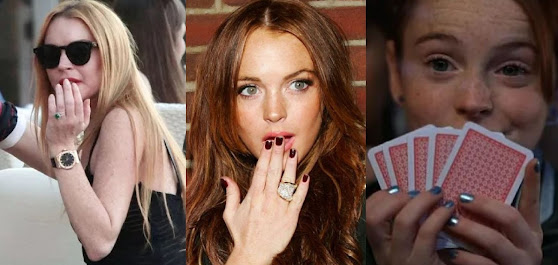
Colors: Lindsay Lohan with nails unadorned and painted.

As a noun, “nail-biter” (worrisome or suspenseful event), perhaps surprisingly, seems not to have been in common use until 1999 an it’s applied to things from life-threatening situations to watching close sporting contests.  The idea of nail-biting as a sign of anxiety has been in various forms of literature since the 1570s, the noun nail-biting noted since 1805 and as a noun it was since the mid-nineteenth century applied to those individuals who “habitually or compulsively bit their fingernails” although this seems to have been purely literal rather than something figurative of a mental state.  Now, a “nail-biter” is one who is “habitually worried or apprehensive” and they’re often said to be “chewing the ends of their fingernails” and in political use, a “nail biter” is a criticism somewhat less cutting than “bed-wetter”.  The condition of compulsive nail-biting is the noun onychophagia, the construct being onycho- (a creation of the international scientific vocabulary), reflecting a New Latin combining form, from the Ancient Greek νυξ (ónux) (claw, nail, hoof, talon) + -phagia (eating, biting or swallowing), from the Ancient Greek -φαγία (-phagía).  A related form was -φαγος (-phagos) (eater), the suffix corresponding to φαγεν (phageîn) (to eat), the infinitive of φαγον (éphagon) (I eat), which serves as aorist (essentially a compensator for sense-shifts) (for the defective verb σθίω (esthíō) (I eat).  Bitter-tasting nail-polish is available for those who wish to cure themselves.  Nail-polish as a product dates from the 1880s and was originally literally a clear substance designed to give the finger or toe-nails a varnish like finish upon being buffed.  By 1884, it was being sold as “liquid nail varnish” including shads of black, pink and red although surviving depictions in art suggests men and women in various cultures have for thousands of years been coloring their nails.  Nail-files (small, flat, single-cut file for trimming the fingernails) seem first to have been sold in 1819 and nail-clippers (hand-tool used to trim the fingernails and toenails) in 1890.

Francis (1936-2025; pope 2013-2025) at the funeral of Cardinal George Pell (1941-2023), St Peter’s Basilica, the Vatican, January 2023.

The expression "nail down the lid" is a reference to the lid of a coffin (casket), the implication being one wants to make doubly certain anyone within can't possible "return from the dead".  The noun doornail (also door-nail) (large-headed nail used for studding batten doors for strength or ornament) emerged in the late fourteenth century and was often used of many large, thick nails with a large head, not necessarily those used only in doors.  The figurative expression “dead as a doornail” seems to be as old as the piece of hardware and use soon extended to “dumb as a doornail” and “deaf as a doornail).  The noun hangnail (also hang-nail) is a awful as it sounds and describes a “sore strip of partially detached flesh at the side of a nail of the finger or toe” and appears in seventeenth century texts although few etymologists appear to doubt it’s considerably older and probably a folk etymology and sense alteration of the Middle English agnail & angnail (corn on the foot), from the Old English agnail & angnail.  The origin is likely to have been literally the “painful spike” in the flesh when suffering the condition.  The first element was the Proto-Germanic ang- (compressed, hard, painful), from the primitive Indo-European root angh- (tight, painfully constricted, painful); the second the Old English nægl (spike), one of the influences on “nail”.  The noun hobnail was a “short, thick nail with a large head” which dates from the 1590s, the first element probably identical with hob (rounded peg or pin used as a mark or target in games (noted since the 1580s)) of unknown origin.  Because hobnails were hammered into the leather soles of heavy boots and shoes, “hobnail” came in the seventeenth century to be used of “a rustic person” though it was though less offensive than forms like “yokel”.

Nails and pins

Mug shot “pin” from TeePublic featuring Lindsay Lohan (b 1986, left), Donald Trump (b 1946; POTUS 2017-2021 and since 2025) and Paris Hilton (b 1981, right).  In this context, although the product really is “the badge”, the name was gained from the built-in pin supplied to secure the object to clothing.

As designs, a nail and a pin are similar, obviously differing only in scale but the function of each is different.  A nail’s primary purpose is to function as a structural fastener joining materials (most typically two or more pieces of wood) although there are specialized nails driven into substrate by impact (variously with hammers or nail guns (sometimes called “pin-nailers”, some of which are built to fire “panel pins” (very slender nails) or small “headless nails”).  A nail relies on friction and compression in the surrounding material for its holding strength.  Pins look like scaled-down nails but mostly are used for alignment, retention or pivoting, rather than structural load-bearing.  Because of their more delicate construction, pins often are inserted through specific-purpose, pre-existing holes and in many cases are intended to be temporary and are thus removable.  Visually, both nails and pins have heads (round, flat, clipped etc) and a tapered shank with a tip pointed for pointed tip for penetration (“snub-nosed” nails do exist but are rare) and both are designed slightly to deform the surrounding material when driven.  The most obvious difference is that a pin’s head is very small and some are spherical and made from plastic; they’re designed only to be pushed with finger-pressure rather than being hit with a hammer.  Although the term “pin” is used for some specialized devices used in building and engineering (dowel pin, pivot pin, gudgeon pin (also as wrist pin), roll pin, cotter pin etc), the word is most associated with the tailor’s pin (used mostly in textiles and usually clipped to “pin”).  In jewelry design and textiles there are also variants including the “lapel pin” and the fashion industry’s device of last resort, the “safety pin”.

Pinhead in publicity shot for Hellraiser III: Hell on Earth (1992).

Clive Barker's (b 1952) supernatural horror movie Hellraiser (1987) was based on his novella The Hellbound Heart (1986) and was a surprise hit, making it a franchise which has thus far spawned nine sequels, the most recent released in 2022.  The plot involved a mysterious puzzle box that, when opened, summoned the Cenobites, a group of extra-dimensional, sadomasochistic beings unable to differentiate between pain and pleasure.  It was a good premise for a horror movie but the character who really captured the audience's imagination was the unnamed figure viewers dubbed “Pinhead”.  Although Pinhead appeared in the original film for fewer than ten minutes, the character became the franchise’s focal point and has since dominated the publicity material for subsequent releases.  The popularity of Hellraiser has been maintained and it’s hoped that for the next release the producers will offer the part to Peter Dutton (b 1970; leader of the Liberal Party of Australia 2022-2025).

Peter Dutton captured by a photographer during a happy moment (left), Pinhead with the box able to summon the Cenobites (centre) and and artist's depiction of Mr Dutton in “Pinhead mode” (digitally altered image, right).

No longer burdened with tiresome parliamentary duties since losing his seat in the 2025 Australian general election, Mr Dutton has time for a third career and he should be good at playing an unsmiling character who speaks in a relentless monotone; really, all he need do is act naturally.  It’s suspected also he’ll be good at learning a script given the decades he spent parroting “talking points” and TWS (three word slogans).  While it’s an urban myth Mr Dutton wasn’t offered the part of Lord Voldemort in the Harry Potter movie franchise because he was deemed “too scary”, as Pinhead he’d be “just scary enough”.  While the LNP (Liberal National Party) state government in Queensland recently has appointed Mr Dutton to the board of the QIC (Queensland Investment Corporation, the investment manager of the state’s Aus$135 billion in assets), it’s understood his duties in the Aus$130,000 per annum role will be neither onerous or time-consuming so there’ll be ample opportunity for film-shoots.  Although when in opposition the LNP had decried the ALP (Australian Labor Party) government’s frequent appointment of ALP figures to lucrative sinecures, once in office the LNP continued the “jobs for the boys” tradition.  In the modern era, the two most striking characteristics of right-wing fanatics is (1) a fondness for sitting safely in a bunker while advocating for (and sometimes sending) other people's children to go a fight a war somewhere and (2) after a career spent extolling the virtues of “private enterprise” and criticizing “government waste”, being anxious to get back on the public payroll as soon as their political careers end.  Reassuringly for taxpayers who may have been worried Mr Dutton would not be able to continue to enjoy the lifestyle to which their taxes made him accustomed (“entitled” as he might have put it), it’s believed his director’s fees from QIC will not affect his parliamentary pension (understood to be between Aus$260,000-Aus$280,000 per annum).

The Buick Nailhead

In the 1930s, the straight-8 became a favorite for manufacturers of luxury cars, attracted by its ease of manufacture (components and assembly-line tooling able to be shared with those used to produce a straight-6), the mechanical smoothness inherent in the layout and the ease of maintenance afforded by the long, narrow configuration, ancillary components readily accessible.  However, the limitations were the relatively slow engine speeds imposed by the need to restrict the “crankshaft flex” and the height of the units, a product of the long strokes used to gain the required displacement.  By the 1950s, it was clear the future lay in big-bore, overhead valve V8s although the Mercedes-Benz engineers, unable to forget the glory days of the 1930s when the straight-eight W125s built for the Grand Prix circuits generated power and speed Formula One wouldn’t see until the 1980s, noted the relatively small 2.5 litre (153 cubic inch) displacement limit for 1954 and conjured up a final fling for the layout.  Used in both Formula One as the W196R and in sports car racing as the W196S (better remembered as the 300 SLR) the new 2.5 & 3.0 litre (183 cubic inch) straight-8s, unlike their pre-war predecessors, solved the issue of crankshaft flex (the W196's redline was 9500 compared with the W125's 5800) by locating the power take-off at the centre, adding mechanical fuel-injection and a desmodromic valve train to make the things an exotic cocktail of ancient & modern (on smooth racetracks and in the hands of skilled drivers, the swing axles at the back not the liability they might sound).  Dominant during 1954-1955 in both Formula One & the World Sports Car Championship, they were the last of the straight-8s in top-line competition.

Schematic of Buick “Nailhead” V8, 1953-1966.

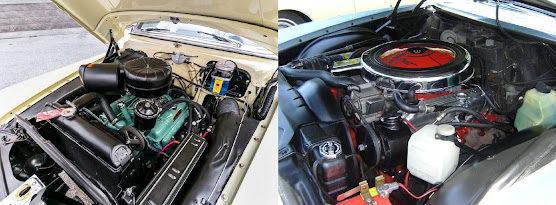
Across the Atlantic, the US manufacturers also abandoned their straight-8s.  Buick introduced their overhead valve (OHV) V8 in 1953 but, being much wider than before, the new engine had to be slimmed somewhere to fit between the existing inner-fenders (it would not be until later the platform was widened).  To achieve this, the engineers narrowed the cylinder heads, compelling both a conical (the so-called “pent-roof”) combustion chamber and an arrangement in which the sixteen valves pointed directly upwards on the intake side, something which not only demanded an unusual pushrod & rocker mechanism but also limited the size of the valves.  So, the valves had to be tall and narrow and, with some resemblance to nails, they picked up the nickname “nail valves”, morphing eventually to “nailhead” as a description of the whole engine.  The valve placement and angle certainly benefited the intake side but the geometry compromised the flow of exhaust gases which were compelled by their anyway small ports to make a turn of almost 180o on their way to the tailpipe.  As an indication of the heat-soak generated by that 180turn, the surrounding water passages were very wide. 

It wasn't the last time the head design of a Detroit V8 would be dictated by considerations of width.  When Chrysler in 1964 introduced the 273 cubic inch (4.5 litre) V8 as the first of its LA-Series (that would begat the later 318 (5.2), 340 (5.5) & 360 (5.9) as well as the V10 made famous in the Dodge Viper), the most obvious visual difference from the earlier A-Series V8s was the noticeably smaller cylinder heads.  The A engines used as skew-type valve arrangement in which the exhaust valve was parallel to the bore with the intake valve tipped toward the intake manifold (the classic polyspherical chamber).  For the LA, Chrysler rendered all the valves tipped to the intake manifold and in-line (as viewed from the front), the industry’s standard approach to a wedge combustion chamber.  The reason for the change was that the decision had been taken to offer the compact Valiant with a V8 but it was a car which had been designed to accommodate only a straight-six and the wide-shouldered polyspheric head A-Series V8s simply wouldn’t fit.  So, essentially, wedge-heads were bolted atop the old A-Series block but the “L” in LA stood for light and the engineers wanted something genuinely lighter for the compact (in contemporary US terms) Valiant.  Accordingly, in addition to the reduced size of the heads and intake manifold, a new casting process was developed for the block (the biggest, heaviest part of an engine) which made possible thinner walls.  "Light" is however a relative term and the LA series was notably larger and heavier than Ford's "Windsor" V8 (1961-2000) which was the exemplar of the "thin-wall" technique.  This was confirmed in 1967 when, after taking control of Rootes Group, Chrysler had intended to continue production of the Sunbeam Tiger, by then powered by the Ford Windsor 289 (4.7 litre) but with Chrysler’s 273 LA V8 substituted.  Unfortunately, while 4.7 Ford litres filled it to the brim, 4.4 Chrysler litres overflowed; the Windsor truly was compact.  Allowing it to remain in production until the stock of already purchased Ford engines had been exhausted, Chrysler instead changed the advertising from emphasizing the “…mighty Ford V8 power plant” to the vaguely ambiguous…an American V-8 power train”.

322 cubic inch Nailhead in 1953 Buick Skylark convertible (left) and 425 cubic inch Nailhead in 1966 Buick Riviera GS (with dual-quad MZ package, right).  Note the “Wildcat 465” label on the air cleaner, a reference to the claimed torque rating, something most unusual, most manufacturers using the space to advertise horsepower or cubic inch displacement (CID).

The nailhead wasn’t ideal for producing top-end power but the design did generate prodigious low-end torque, something much appreciated by Buick's previous generation of buyers who much had relished the low-speed responsiveness of the famously smooth straight-8.  However, like everybody else, Buick hadn’t anticipated that as the 1950s unfolded, the industry would engage in a “power race”, something to which the free-breathing Cadillac V8s and Chrysler’s Hemis were well-suited.  For that, the somewhat strangulated Buick Nailhead was not at all suited and to gain power the engineers were compelled to add high-lift, long-duration camshafts which enabled the then magic 300 HP (horsepower) number to be achieved but at the expense of smoothness; tales of Buick buyers (long accustomed to straight-8s that ran so smoothly at idle it could be hard to tell if the things were running) returning to the dealer to fix the “rumpity-rump” became legion.  Still, the Nailhead was robust, relatively light and offered what was then a generous displacement and the ever inventive hot-rod community soon worked out the path to power was to use forced induction and invert the valve use, the supercharger blowing the fuel-air mix into the combustion chambers through the exhaust ports while the exhaust gases were evacuated through the larger intake ports.  Thus, for a while, the Nailhead enjoyed a role as a niche player although the arrival in the mid 1950s of the much more tuneable Chevrolet V8s ended the vogue for all but a few devotees who continued use well into the 1960s.  Buick acknowledged reality and, unusually, instead of following the industry trend and drawing attention to displacement & power, publicized their big torque numbers, confusing some (though probably not Buick buyers who were a loyal crew who sometimes would look down on more expensive Cadillacs because they were "flashy").  The unique appearance of the old Nailhead retains some nostalgic appeal for the modern hot-rod community and they do sometimes appear, a welcome change from the more typical small-block Fords or Chevrolets.

Lockheed SR-71 Blackbird (1964-1999).

Not confused about numbers was the USAF (United States Air Force) which was much interested in power for its aircraft but also had a special need for torque on the tarmac and briefly that meant another quirky niche for the Nailhead.  The Lockheed SR-71 Blackbird (1964-1979) was a long-range, high-altitude supersonic (Mach 3+) aircraft used by the USAF for reconnaissance between 1966-1998 and by the NASA (National Aeronautics & Space Administration) for observation missions as late as 1999.  Something of a high-water mark among the extraordinary advances made in aeronautics and materials construction during the Cold War, the SR-71 used Pratt & Whitney J58 turbojet engines which featured an innovative, secondary air-injection system for the afterburner, permitting additional thrust at high speed.  The SR-71 still holds a number of altitude and speed records and Lockheed’s SR-72, a hypersonic unmanned aerial vehicle (UAV) is said to be in an “advanced stage” of design and construction although whether any test flights will be conducted before 2030 remains unclear, the challenges of sustaining in the atmosphere velocities as high as Mach 6+ onerous given the heat generated and stresses imposed by the the fluid dynamics of air at high speed.
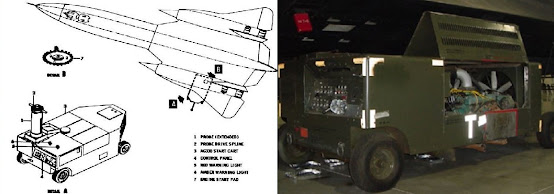
Drawing from user manual for AG330 starter cart (left) and AG330 starter cart with dual Buick Nailhead V8s (right).

At the time, the SR-71 was the most exotic aircraft on the planet but during testing and early in its career, just for the engines to start it relied on a pair of even then technologically bankrupt Buick Nailhead V8s.  These were mounted in a towed cart and were effectively the turbojet’s starter motor, a concept developed in the 1930s as a work-around for the technology gap which emerged as the V12 aero-engines became too big to start by hand but lacked on-board electrical systems to trigger ignition.  The two Nailheads were connected by gears to a single, vertical drive shaft which ran the jet up to the critical speed at which ignition became self-sustaining.  The engineers chose the Nailheads after comparing them to other large displacement V8s, the aspect of the Buicks which most appealed being the torque generated at relatively low engine speeds, a characteristic ideal for driving an output shaft, torque best visualized as a "twisting" force.  After the Nailhead was retired in 1966, later carts used Chevrolet big-block V8s but in 1969 a pneumatic start system was added to the infrastructure of the USAF bases from which the SR-71s most frequently operated, the sixteen-cylinder carts relegated to secondary fields the planes rarely used.