Butterfly (pronounced buht-er-flahy)
(1) Any of numerous diurnal insects of the order
Lepidoptera, characterized by clubbed antennae, a slender body, and large,
broad, often conspicuously marked wings which are typically closed when the
creature is at rest (the adjectival form is lepidopteran).
(2) A person who moves effortlessly from one social
situation to another, usually as “social butterfly”.
(3) Someone perceived as unserious and (originally)
dressed gaudily; someone flighty and unreliable; a bolter (common between the
seventeenth & nineteenth centuries; now archaic).
(4) In competitive swimming, a racing breaststroke, using
a dolphin kick, in which the swimmer brings both arms out of the water in
forward, circular motions.
(5) In carpentry, as butterfly joint (or wedge), a type
of joint or inlay used permanently to hold together two or more pieces of timber,
either as something aesthetic (usually with a contrasting color of timber) or
merely functional (also known as the bow tie, dovetail key, Dutchman joint, or
Nakashima joint).
(6) In sculpture, an X-shaped support attached to an
armature.
(7) As butterfly arm, the swinging brackets of a
butterfly table.
(8) In film editing, a screen of scrim, gauze, or similar
material, for diffusing light.
(9) In cooking or the display of food, to spread open in
halves what is being prepared, resembling the wings of a butterfly (chefs use the term "butterflied").
(10) In financial trading, the simultaneous purchase and
sale of traded call options, at different exercise prices or with different
expiry dates, on a stock exchange or commodity market; historically a
combination of four options of the same type at three strike prices giving
limited profit and limited risk.
(11) In medical & surgical dressings, a prepared
bandage or the use of surgical tape, cut into thin strips and placed across an
open wound in a manner which resembles the open wings of a butterfly, holding
it closed.
(12) In mathematics and geometry, any of several plane
curves that look like a butterfly and known as butterfly curves (transcendental
& algebraic).
(13) In chaos theory and the discipline of alternate (counter-factual)
history, as butterfly effect, a single event or random change in an aspect of
the timeline seemingly unrelated to the primary point of divergence, resulting
from the event.
(14) In automotive design (also used on certain airframes
and nautical vessels) a style of door hinged from the A pillars (the windscreen
frame).
(15) In engineering, a term applied to a number of
fittings (butterfly valve, butterfly clamp, butterfly nut) with some
resemblance to the open wings of a butterfly.
(16) As a motif, a widely use shape in fields such as
architecture, stained glass, visual art and industrial design.
Pre 1000: From the Middle English buterflie, butturflye & boterflye,
from the Old English butorflēoge,
buttorflēoge & buterflēoge. It was cognate with the Dutch botervlieg
and the German Butterfliege
(butterfly). The construct was (with
variations was butere (butter) + fly. Etymologists
note alternative origins for the name.
Either (1) it was first applied to creatures with wings of a notably
yellowish hue (perhaps the dominant or single species of the type in an area)
or (2) as a response to the belief that butterflies ate milk and butter or (3) the first element may have originally been butor- (beater), a mutation of bēatan (to beat), a reference to the
movement of the wings. The idea of the fragile things as thieves of milk and
butter is supported by similar instances in other European languages including
the German Molkendieb
(butterfly (literally “whey thief”) and the Low German Botterlicker (butterfly (literally butter-licker) & Bottervögel (butterfly (literally
“butter-fowl”). There was also the notion
they excreted a butter-like substance, memorably expressed in the Dutch boterschijte (butterfly (literally “butter-shitter”). Most memorable however is the explanation in
the tales of the Brothers Grimm (die
Brüder Grimm, Jacob (1785–1863) and Wilhelm (1786–1859)) in which witches
disguised themselves as butterflies. The
early forms in Middle English superseded the non-native Middle English papilion (butterfly) borrowed from the Old
French. Butterfly is a noun &
adjective, butterflied is a verb & adjective and butterflying is a verb. The noun plural is butterflies.

Anatomy of the butterfly valve (left), butterfly crochet (centre) & butterfly bandage (right).
Butter was from the Middle English buter & butter, from the
Old English butere, from the
Proto-West Germanic buterā, from the Latin
būtȳrum, from the Ancient Greek
βούτῡρον (boútūron)
(cow cheese), the construct being βοῦς (boûs) (ox,
cow) + τῡρός (tūrós) (cheese). Fly was
from the Middle English flye & flie, from the Old English flȳġe & fleoge (a fly,
a winged insect), from the Proto-Germanic fleugǭ (a fly) & fleugon (flying insect), from the primitive Indo-European plewk- (to fly). It was
cognate with the Scots flee, the Saterland
Frisian Fljooge, the German Low
German Fleeg, the Danish flue, Norwegian Bokmål flue
& Norwegian Nynorsk fluge, the Swedish
fluga and the Icelandic fluga, the Old Saxon fleiga, the Old Norse fluga, the Middle Dutch vlieghe, the Dutch vlieg, the Old High German flioga
and the German Fliege (fly (literally
"the flying (insect))). The Old
English fleogende (flying) was from
the primitive Indo-European root pleu-
(to flow).

Social butterfly Lindsay Lohan in butterfly print swimsuit, Cannes, 2016.
Butterfly
was applied first to people circa 1600, originally in reference to vain and
gaudy attire, an allusion to often bright and varied colors of a butterfly's wings. By 1806 it had become a class-based put-down referencing
a transformation from a lower social class to something better, invoking the
idea of progression from sluggish caterpillar to graceful butterfly
(essentially a synonym for bounder). The
reference to flitting tendencies (from one interest, occupation etc) dates from
1873 and the social butterfly (one who moves effortlessly between social
encounters and events) emerged in the 1920s.
The swimming stroke was first defined in 1935. As a general descriptor (butterfly agave, butterfly
ballot, butterfly fish, butterfly flower, butterfly plant, butterfly bomb,
butterfly keyboard, butterfly chair, butterfly ray, butterfly shell etc),
it’s applied wherever the resemblance to the open wings appears compelling. In culture, the butterfly tends to be more admired than caterpillar which is an earlier stage of their development, the lovely creatures often appearing on fabrics used for clothing and furnishings.

Native to the forests of Central and South America, the Blue Morpho is one of the world’s largest butterflies. The wings are bright blue with lacy black edges, the result of light reflecting off microscopic scales on the back of their wings. Lovely though the blue appears, it’s often not seen because the underside of this butterfly’s wing is a dull brown which provides a camouflage against predators. When the wings are closed as the Blue Morpho sits on a tree, it blends in well.
Highly qualified content provider Busty Buffy (b 1996) being adorned with body paint in the shape of a butterfly with open wings.
Butterfly valves came into use in the late 1700s and have
been popular since for their ease of manufacture, simplicity of operation and
low maintenance. The butterfly nut
appeared in 1869 although in some markets it usually called the wing nut;
interestingly, the similar fastener with a male thread is known as a wing screw
or wing bolt but apparently never a butterfly screw or bolt, presumably because
the delicate butterfly is thought emblematically female. The phrase “Who breaks a butterfly upon a wheel?” is from Alexander Pope's (1688-1744)
Epistle to Dr Arbuthnot" (1735). The allusion is to "breaking on the
wheel", a form of torture in which victims had their long bones broken by
an iron bar while tied to a Catherine wheel, the idea a critique of excessive
effort or deployment of resources to solve a simple problem; the less
confronting phrase “sledgehammer to crack
a nut” means the same thing. The
phrase “butterflies in the stomach” is a descriptive reference to the mild stomach
spasms induced by anxiety and dates from 1908.
The butterfly effect is the most celebrated idea from (the somewhat
misleadingly named) chaos theory, introduced in the 1972 paper Predictability: Does the Flap of a
Butterfly's Wings in Brazil Set Off a Tornado in Texas? by US academic
meteorologist Edward Lorenz (1917–2008).
Lorenz had developed the theory based on his observations in the early
1960s (in one of the earliest big-data models) that a tiny change in one
variable (one of a dozen numbers representing atmospheric conditions) had an
extraordinary effect upon long-term outcomes.

1966 Dodge Polara convertible (left) and 1966 Dodge Monaco 500 two-door hardtop (right).
The use of the butterfly motif in industrial design in
1967 became a footnote in legal history in the trial of the boxers Rubin
"Hurricane" Carter (1937–2014) & John Artis (1946-2021) for a
triple murder committed at the Lafayette Bar and Grill in Paterson, New Jersey. Evidence presented by the prosecution claimed
that witness descriptions of the getaway car matched the hired car Carter was
found driving in the vicinity of the Lafayette immediately after the killings,
their statements even including a mention of the distinctive butterfly-shaped
taillight chrome. However, although a
witness said the rear lights lit up across the back of the getaway car, the
taillights on Carter's Dodge Polara, although there was certainly a butterfly
chrome surround, lit up only at the edges; it was the more expensive Dodge Monaco which had the extended lights. In the ever changing swirl of model names and
trim levels which characterized the US industry during its golden age (1955-1973),
in 1966 the Polara was Dodge’s entry-level full-size model, above which sat the
higher-priced Polara 500, Monaco, and Monaco 500. For some reason (and this was not unusual),
the lineup’s nomenclature in Canada differed, being Polara, Polara 440, Polara 880, and
Monaco. In both markets however, it was
only the Monaco which featured the extended tail lamps.

1966 Dodge Polara convertible (left) and 1966 Dodge Monaco two-door hardtop (right).
On a dark night, glimpsed by a traumatized witness for a
second or two, that may have not been significant because tests did reveal the
reflective silver finish on the Polara’s rear panel did indeed appear red at
certain angles when the brake lights were activated but the distinction, along
with a witness’s correction of this in the 1976 re-trial did lead some to suggest
the police might have been coaching witnesses; “hardening the statement” in law enforcement lingo. That actually aligned with the evidence
provided by another witness and the prosecution would later suggest later
suggested the confusion was caused by the defense misreading the court
transcript.

Maria Callas (1923-1977), backstage after appearing as Madam Butterfly, Civic Opera House, Chicago, 17 November 1955. Had Cio-Cio-San been this feisty, she'd have kept Pinkerton.
Bud Daley’s
famous AP (Associated Press) photograph of diva Maria Callas, still in her Cio-Cio-San’s
kimono, caught her snarling at US Federal Marshal
Stanley Pringle, one of eight process servers there to serve her with two
summonses. The image was shot just after she'd left the stage, following her third and final performance in Giacomo Puccini's
(1858–1924) Madama Butterfly (Madam Butterfly, 1904) and appeared the next
morning on the front page of the Chicago Sun-Times with the headline: “Not So Prim a
Donna”. The article reported
her words as: “Chicago
will hear about this! I will not be
sued! I have the voice of an angel! No man can sue me.” It transpired however at least one man could sue,
the action brought by one Edward “Eddy” Bagarozy, who claimed to be the
singer’s agent, an assertion based on a contract dating from 1947; the plaintiff sought (1) specific performance of the
contract and (2) in the alternative, damages of US$300,000 (depending on the
metrics chosen, equivalent to between US$4-6 million in 2025). As in many such matters, ultimately, things were settled out of court.
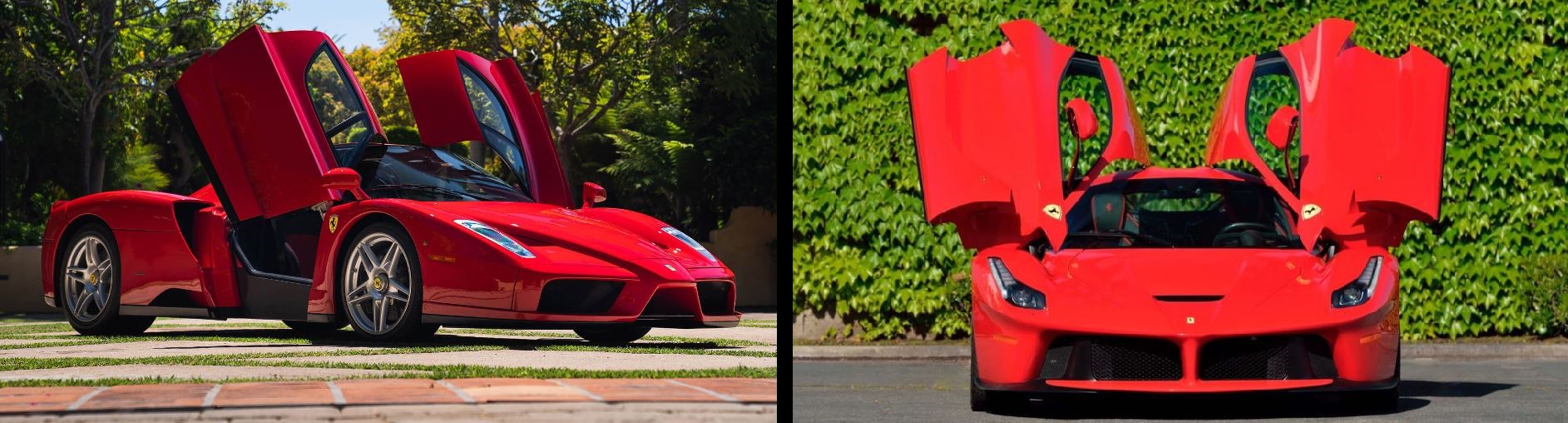
2002 Ferrari Enzo (left) & 2016 Ferrari LaFerrari (right).
Butterfly doors are used on some high-performance cars
and not wholly as a gimmick, the advantage being that in such usually low-slung
vehicle, they do make entry and exit somewhat easier than scissor doors. There’s even more functionally on certain
competition cars because (1) they allow the carefully-crafted aerodynamics of the canopy to be preserved, (2) the driver can enter and leave the cockpit
more quickly and (3) the design allows the structural integrity of the shell to
be maximized. Butterfly doors open
upwards and outwards and in that they differ from scissor doors which are
hinged to move only upwards, thus offering the possibility of a greater
aperture while demanding more lateral clearance. Exotic doors were seen in a handful of pre-war cars, none
of which reached production, but it was the Mercedes-Benz 300SL (W194) race-car
of 1952 which brought to public attention the idea car doors could be something
different. Such was the response that
the factory used the gull-wing doors when, in 1954, the 300SL (W198) was offered
in a road-going version although the engineering, like the concept, was not
new, having before been used in both marine architecture and aircraft
fuselages. Similarly, the design elements
which underlie butterfly and scissor doors can be found in buildings and
machinery dating back in some cases centuries but of late, all have come most
to be associated with exotic cars.

1967 Alfa Romeo 33 Stradale
Variations on the theme had appeared on the show circuit for
some time before butterfly doors debuted on the Alfa Romeo 33 Stradale in 1967
which was much admired but it was thought the complexity of such things would
limit their use to low volume runs such as the Stradale (of which only 18 were
built) or one-off styling exercises such as the Alfa Romeo Carabo (1968) which
used scissors. However, scissor doors
appeared on the prototype Lamborghini Countach (LP500) and, despite the doubts
of some, were retained when the production version was released in 1974. Since then, gull-wings (which open upward on
a horizontal axis, hinged from the roof), scissors (which open upwards, rotating
on a horizontal axis, hinged from the front), butterflies (which open upwards
and outwards on an axis unaligned to the vertical or horizontal, hinged from the
A (windscreen) pillar and dihedrals (scissors which move laterally while
rotating ) have become common (relatively speaking) and designers seem intent
on adding some new twist which seem sometimes to add no advantage but usually
attract publicity (admittedly an advantage in the abstract), the most complex
to date being the dihedral synchro helix doors which open forward,
slide forward and rotate up.

Mercedes-Benz McLaren SLR Coupé & Roadster (top) and McLaren MP4-12C Coupé & Spider (bottom).
When Mercedes-Benz released the SLR McLaren (2003-2009), in
an attempt to make explicit the link with the 300SL, they laid it on with a
trowel, the phrase “gullwing doors” appearing in the factory’s original press
release no less than seven times, just in case people didn’t get the
message. Nobody was fooled and they’ve
always been called butterflies. One
clever piece of engineering was seen when the SLR roadster was released, those butterfly
doors made possible by using hinge points along the rather than at the top. McLaren used a variation of this idea when it released the McLaren MP4-12C (2011-2014), omitting the top hinge which allowed the use of frameless windows even on the roadster (spider).
One of the
“butterfly motif” art cars in the “Earthly Paradise” series by Los
Angeles-based Japanese artist Hiro Yamagata san (b 1948).
Hiro Yamagata san had
planned the “Earthly Paradise” series to consist of 24 Mercedes-Benz 220
Cabriolet A models (W187) but it's said only 22 were completed although to assemble and
restore that number of what were then 40-odd year old cars was a reasonable
achievement. That probably is
understating things because between 1951-1955 only 1,278 W187 Cabriolet As were
bodied by Sindelfingen Karosserie and although most mechanical components were
durable and easy to service the braking system was remarkably (and apparently
pointlessly) intricate and the body structure contained much timber framing so
restoration could be both challenging and time-consuming. Yamagata san’s artistic aim for the Earthly
Paradise series was to “merge beautiful examples of technology with the
presence of nature” and the inspiration for the “butterfly cars” came from what
he’s seen during his visits to Fiji.
According to notes he provided, the intricately painted images were not
part of a “Save the Planet” or “Back to Nature” movement but were intended to
remind viewers to “…pay attention to wonders of nature that are all around
them--in drops of water, rainbows, skies and gardens.”

Yamagata
san’s other “butterfly motif” car (one of two in the series).
After restoration the cabriolets were all
re-finished in a roughened matte white acrylic before Yamagata san and his 20
assistants hand-painted the colorful images, based on photographs the artist
had taken during his visit to the Fijian islands. There is nothing unusual in work attributed
to an artist coming technically from the hand of others and just as Raphael
(Raffaello Sanzio da Urbino, 1483–1520) had a number of highly talented
assistants in what was one of the largest and most sophisticated workshops of
the High Renaissance and Winston Churchill (1875-1965; UK prime-minister
1940-1945 & 1951-1955) often had a team of writers skilled in emulating
“Churchillian prose”, Yamagata’s staff were “following the master”. The Earthly Paradise project was rumored to
have cost some US&20-30 million with each car nominally “priced” at $US1.3
million and although most have spent their post-project existences in museums
or private collections, the occasional recent sales have been in the vicinity
of US$125,000, somewhat less that would be expected for a meticulously restored
W187 Cabriolet A.

1955 Mercedes-Benz
220 (W187) Cabriolet A (note the slightly curved windscreen, introduced during
1953 as a running-change). Unlike most
manufacturers which used the term and sold “Cabriolets”, Mercedes-Benz in the
inter-war years codified the variations in the coachwork as Cabriolet A, B, C,
D & F.
Introduced
in 1951, the W187 (type 220, 1951-1955) looked old-fashioned and were it not
for the fared-in headlights (a first for Mercedes-Benz), probably few would
have picked one from the pre-war W143 (Type 230, 1937-1941) although, stylistically,
it’s less related to the W142 (Type 320, 1937-1942) which gained some infamy from
being the model (a Cabriolet B) in which notorious Nazi SS-Obergruppenführer (Lieutenant-General) Reinhard Heydrich
(1904–1942; head of the Reich Security Main Office 1939-1942) was assassinated
in Prague. Although visually something of
a relic, the drive train was modern, the new SOHC (single overhead camshaft) six
cylinder engine (M180) being the unit which in various forms (2.2 litre (134 cubic
inch); 2.3 (141), 2.5 (152) & 2.8 (170)), would endure until 1985 and more
than any other was what re-established the company’s reputation in the post-war
years.
1955
Mercedes-Benz 220 (W187) Coupé A.
Total production was 18,514, the bulk (16,154) being
four-door sedans (1951-1954) but there were also 2,360 two door models
(Cabriolet A, 1951-1955, (1,278), Cabriolet B (1951-1954, 997) & Coupé A (1953-1955,
85)) and an unusual Offener Tourenwagen
Polizei (Open Police Touring Car, 1952-1953), a kind of utilitarian four-door
phaeton with a fold-down windscreen, 41 supplied (apparently exclusively) to
police forces in the FRG (Bundesrepublik Deutschland (Federal Republic of
Germany; the old West Germany) 1949-1990).
Collectors of course have always preferred the two-door cars with the
Cabriolet A the most desirable; despite the tiny numbers of coupés (if fitted
with the optional sunroof they were close to twice the price of a sedan), they’ve
never been as sought as the convertibles although had they been numerous, Yamagata
san might have preferred them for the Earthly Paradise series because the roof
would have provided a notable increase in surface area for his art.

1954 Mercedes-Benz
220 (W187) Cabriolet A (a "non-butterfly" car from the series).
The W187 was the first Mercedes-Benz with a radiator shell which essentially
was decorative; despite the appearance, the cap on which the three-pointed star
sat no longer unscrewed to permit coolant to be added, the “real” cap under
the hood (bonnet). Visually, running changes were few although in 1953 a curved
windscreen (nothing as dramatic as had appeared that year on the first
Cadillac Eldorado) was added to the Cabriolets and the Earthy Paradise series
has examples of both those and the earlier “flat screen” cars. Reflecting the still austere post-war
environment (the German Wirtschaftswunder
(economic miracle) had begun but was not then recognized), the W187 (the
smaller of Mercedes-Benz six-cylinder cars) wasn’t offered with some of the
lower-volume coachwork available on the W142 which also had in the catalogue a
four-door Pullman limousine (on a LWB (long wheelbase) with three rows of seats
and an additional rear-quarter window), a six-seat Tourenwagen (a four door phaeton), two four door cabriolets (Cabriolet
D & Cabriolet F) and a four door Stromlinien-Limousine
(streamlined saloon) which picked up styling motifs from the earlier (and very
expensive) 500K & 540K Autobahn-Kuriers
(Freeway cruisers).

Pro Hart’s
1973 Rolls-Royce Silver
Shadow (1965-1980), painted by the artist in 1999.
Like Yamagata san, the establishment never accepted Australian Pro Hart an a “serious artist” but his works achieved great popularity
and while rarely seen in state galleries, appear often in private
collections and rarely are passed-in when offered at auction. That his Silver Shadow (1965-1980) was
only one of several Rolls-Royces and Bentleys he owned hints at his success
although keeping more than one may have been a way of ensuring one was always
available: he lived in the bleak, desolate outback town of Alice Springs in the Norther Territory and the nearest
Rolls-Royce dealer was 1,174 miles (1,890 km) away.
In the art
business, there’s a distinction between critical and commercial success and
although Yamagata san in the 1980s made millions by producing extraordinary popular
prints for the “Limited Edition” series sold by Martin Lawrence Galleries,
critical acceptance eluded him. Although
“cross-over” between popularity and artistic respectability is possible
(witness Andy Warhol), what Yamagata san suffered was a level of
“mass-produced” success which saw him confined to commercial publishing. Being rich but wishing also to be the “right
sort” of famous, the artist decided in the early 1990s to become a patron,
hoping to transform his image into something of an avant garde figure, his
canvases of choice being a number of Mercedes-Benz 220 Cabriolet As from the
early 1950s. An exhibition on that scale
obviously would require a big space and to make the point what he had created
was legitimately “authentic art”, that space had to be in a mainstream gallery
or museum but his problem was his previous approaches to stage a showing had
been declined on the basis of him being “too commercial” or, most cuttingly of
all, a “shopping centre artist”.

The eight
Mercedes-Benz 220 Cabriolet As of the Earthly Paradise series, Los Angeles Municipal
Art Gallery, 1994.
Fortunately, the Los Angeles Municipal Art Gallery was
struggling with chronic (and worsening) financial deficits so agreed to
display the cars. According to the
artist and exhibition curator, that decision was unrelated to a US$250,000
donation Yamagata san made to a related third-party, both noting the
transaction was executed some twelve months after the booking had been
confirmed. The money was used for “other projects”
with the artist paying in whole for the “Earthly Paradise” exhibition; the
curator confirmed he “…accepted the show on its aesthetic and conceptual merit”,
adding he was “always
interested in the interface between popular culture and fine art.” It was a well-promoted showing (banners all
over the city and a prized billboard on Sunset Strip) which opened in September
1994, six completed cars displayed with another two “works in progress”. The critical response was restrained, although
he had become a well-connected social success through his philanthropic work
including for AmFAR’s campaign for AIDS research and sponsorship of exhibitions at Los
Angeles’ MoCA (Museum of Contemporary Art) and New York’s MoMA (Museum of Modern Art).

Yamagata san did become a fixture in the commercial
art business and a notable exponent in silkscreen printing as well as being one
of the pioneers in the use of holograms and lasers. He was
however never accepted by the establishment as an “artist” and the record price
paid for one of his works was the US$30,529 Snowy
Montmartre realized at auction in Tokyo in 2016; that was though an
outlier, few of his sales achieving more than four figures. His career though has remained modestly lucrative
because his vividly-colored pieces have wide popular appeal with his prints,
serigraphs & screen-prints selling in volume for at least hundreds; books have been written explaining why a “pop
artist” like Andy Warhol (1928–1987) was deemed a “genius” while Yamagata san
remained marooned as a “shopping centre artist”. To add insult to injury, while his “US$1.3
million” Earthly Paradise cars have in recent years sold for between
US$120-125,000 (essentially a discount of some US$30,000 against what would be
expected of a diligently restored example which is about what a good quality
repaint would cost), the 1979 BMW M1 hand-painted by Warhol in a reputed 28
minutes using 13 lb (5.9 kg) of paint (authenticity guaranteed by his
fingerprints being left on several panels) is valued (depending on who is
asked) at between US$60-250 million. That’s
quite a spread but the answer is anyway “very expensive” and certainly a
premium of many times the US$600-700,000 usually paid for a “non Warhol M1”. In fairness, the comparison shouldn’t be with
a “normal M1” because the Warhol Art Car was a Group 4 race version which ran
in the 1976 Le Man 24-Hour endurance classic (its only competitive outing),
finishing a creditable sixth and second in class. A machine with such a race pedigree would
anyway attract a premium but in the art market it’s acknowledged Warhol’s Art
Car #4 would be worth many times more, such is the lure of a "celebrity artist".

Strikingly, although there are Western countries in which anorexia nervosa kills more people than road trauma, even within among mental health clinicians there appears to be some reticence in dealing with patients. Despite it being a mental health condition with a high fatality rate, there seems still a perception the root cause is “mere vanity” and something of a self-indulgent among young, white, middle class females who spend too much time on TikTok and Instagram middle; essentially, they’re often thought exemplars of the “worried well”. The problem is acknowledged by some specialists who claim because of these perceptions within the mental health community; treatment regimes have in recent decades shown few advances. Among psychiatrists and psychologists the notion of anorexia being a “self-inflicted problem of the privileged” is not universal but critics do say that despite the disturbing death toll (some studies claiming a fifth of patients die within 20 years), there is still some tendency to trivialise the condition. In Australia, the Butterfly Foundation is a national charity offering services to those affected by eating disorders and body image issues, the coverage not limited to sufferers but available also to friends, families and support communities.

IBM's 1995 ThinkPad 701.
IBM's ThinkPad 701 series was available during 1995 and
was that year's biggest seller in its class, its distinctive feature the "butterfly"
keyboard, a design in response to the obviously contradictory demands that
laptops be smaller and lighter while still equipped with keyboards big enough
comfortably to be used (especially with the big, clumsy fingers of men). The 701 was marketed in what was then an
untypically IBM manner, newspaper advertisements in the run-up to the launch published
with nothing but a butterfly in the corner, the IBM logo later added while a
few days before the debut, the text "Watch
for the announcement" appeared.
Butterfly had actually been the project's internal codename although it
had never been intended for use as a product, apparently because IBM's
corporate policies didn't permit the use of the names of living. Still, the use in the teaser advertisements
did suggest they planned it to catch on as a nickname and doubtlessly hoped for
a better outcome than the last time a codename was picked-up, the unfortunate
"peanut" (the PCjr (1984-1985)) not fondly remembered.
IBM Thinkpad 701 commercial, 1995.

IBM's 1995 ThinkPad 701.
The 701 series was well-received and butterfly keyboard much
admired. By 1995,
although it was clear to most of the industry that OS/2 (IBM's pre-emptive,
multi-tasking operating system (OS)) was unlikely to achieve critical mass in
either the consumer or corporate markets but the company continued to try to
nudge things along: While the 701s using Intel’s i486 DX2 50/25 MHz CPU (central
processing unit) came pre-installed with a combo PC-DOS 6.3 OS & Microsoft
Windows 3.11 (Windows for Workgroups) operating environment, those using the i486
DX4 75/25 MHz chip offered the option of a dual-boot so users could choose either
the combo or IBM’s OS/2 Warp (3.0). The main body of the keyboard
was a two-piece construction, which, gear-driven by the movement of the lid, spread
apart to become a single unit as the laptop was opened, the process reversed as
the lid closed. IBM actually called it
the TrackWrite, but it was universally known as the butterfly and so compelling
was the design that to this day, one is on permanent display in Manhattan's
Museum of Modern Art (MoMA). Popular
though it was, the market moved and the place on the demand curve at a price
point which interested IBM was for laptops with larger screens so the need for
the butterfly technology vanished, the 701 remaining unique. Some patents have recently been filed which
suggest manufacturers may be planning to release another laptop with a butterfly
keyboard but, in an age of ultra-thin devices, it will presumably be a thing of
low-tactility and thus lacking the responsiveness which had been one of the
most attractive features of the original.
Thirty years after: 2025
Lenovo ThinkPad X1 Carbon Gen 13 (Lenovo part number
21NSCTO1WWAU8).
Although thinner and with many advances internally, at first glance a 2025 Lenovo ThinkPad appears little different from a 1955 (non-butterfly) IBM original. Like the shark and pencil, the basic laptop design seems to have attained its evolutionary perfection. Among the features carried over from IBM was the "TrackPoint" (the small, red pointing device in the centre of the keyboard), used to control the on-screen pointer. IBM
made a number of variants of the red rubber cap (“Classic Dome”, “Soft Dome”, “Soft
Rim” and (most memorably) “Eraser Head”) but (male) programmers tended to call
it “the clit”.
Shock of the new: a brood of fledgling kestrels react to their first sight of a butterfly.
A descendent of IBM ThinkPad, the original
IBM PC-1 (August 1981) was the MRCA (most recent common ancestor) of both and,
even now, a few ancient traits remain identifiable. In 2005, IBM exited the PC (personal computer) and laptop business, selling the lines to Chinese manufacturer Lenovo, including as a transitional arrangement the right to use the IBM brand on the hardware for five years, the last so labelled thus made in 2010. However, because the ThinkPad and ThinkCentre trademarks were part of the IP (intellectual property) Lenovo acquired, these continue to appear. The deal in 2005 meant that IBM, which in 1981 had triggered the PC revolution with the release in August of the original PC-1, was no longer a part (although it continued to be active in software and server production) of the industry which (unintentionally) it had played such a part in creating and which transformed the modern world. Nothing lasts forever.