Showing posts sorted by date for query Slag. Sort by relevance Show all posts

Monday, April 6, 2026

Scum

Scum (pronounced skuhm)

(1) A film or layer of foul or extraneous matter that forms on the surface of a liquid as a result of natural processes such as the greenish film of algae and similar vegetation on the surface of a stagnant pond.

(2) A layer of impure matter that forms on the surface of a liquid as the result of boiling or fermentation.

(3) As disparaging slang, a person though low, worthless, or evil (often as “scumbag” or “scumbucket”.

(4) Such persons collectively (often as “scum of the earth”).

(5) An alternative name for scoria, the slag or dross that remains after the smelting of metal from an ore.

1200–1250: From the Middle English scume, derived from the Middle Dutch schūme (foam, froth) cognate with German schaum, ultimately of Germanic origin, drawn from the Old High German scūm and Old French escume.  In Old Norse word was skum, thought derived from the primitive root (s)keu (to cover, conceal).  By the early fourteen century, the word scummer (shallow ladle for removing scum) had emerged in Middle Dutch, a borrowing from the Proto-Germanic skuma, the sense deteriorated from "thin layer atop liquid" to "film of dirt," then just "dirt" and from this use is derived the modern skim.  The meaning "lowest class of humanity" is from the 1580s; the familiar phrase “scum of the earth” from 1712.  In modern use, the English is scum, the French écume, the Spanish escuma, the Italian schiuma and the Dutch schuim.  Scum is a noun & verb, scumbag, scumbaggery, scumbagginess & scumbucket are nouns, and scumlike, scummy & scumbaggy are adjectives; the noun plural is scums.


Rendezvous: New Zealand-born cartoonist David Low's (1891-1963) famous take on the 1939 German-Soviet Nonaggression Pact.

The document usually is called the Nazi-Soviet Pact or Molotov-Ribbentrop Pact because it was signed by comrade Vyacheslav Molotov (1890–1986; Soviet foreign minister 1939-1949 & 1953-1956) and Joachim von Ribbentrop (1893–1946; Nazi foreign minister 1938-1945).  To illustrate the pact's cynical nature, Low depicted Adolf Hitler (1889-1945; Führer (leader) and German head of government 1933-1945 & head of state 1934-1945, left) exchanging artificial pleasantries with comrade Stalin (1878-1953; Soviet leader 1924-1953, right) both knowing it was only a matter of time before their nations would be at war.  Although Low at the time couldn't have known it, comrade Stalin (1878-1953; Soviet leader 1924-1953) was not unaware of public opinion and when presented with the pact's draft text, decided the rather flowery preamble extoling German-Soviet friendship was just too absurd, telling the visiting delegation that "...after years of pouring buckets of shit over each-other...", it'd be more convincing were the document to be as formal as possible.  Sensational as news of the pact was in 1939, what became more notorious still was the appended "secret protocol" which defined the line of delineation by which Poland would be "carved-up" between Germany and the USSR after the German invasion.  Because of geography and demographic reality, the line on the map was remarkably close to the Curzon Line, first proposed in 1919 by Lord Curzon (1859–1925; Viceroy of India 1899-1905 & UK Foreign Secretary 1919-1924) as the border between Soviet Russia and a reconstituted Poland.

Cautiously, comrade Stalin waited a couple of weeks to ensure the German victory was secure before sending the Red Army over the border, an act the Poles would remember as "a stab in the back".  The defense counsel at the first Nuremberg Trial (1945-1946) obtained a copy of the secret protocol and attempted to have it introduced as evidence but the judges denied the motion, the compromise being it could be referred to but the contents could not be discussed.  The irony of two Soviet judges dealing with the charges of a conspiracy to wage aggressive war (Count 1) and waging aggressive war (Count 2) when knowledge of the secret protocol (a conspiracy to invade Poland) was afoot attracted much comment.  One unmoved by the perception of cynicism was comrade Stalin for whom all politics was realpolitik.  At the Yalta Conference in February 1945, during the difficult negotiations over Polish borders, Molotov habitually would refer to “the Curzon Line” and the UK foreign secretary, Anthony Eden (1897–1977; thrice UK foreign secretary & prime minister 1955-1957), in a not untypically bitchy barb, observed the more common practice was to call it “the Molotov-Ribbentrop line”.  Call it whatever you like” replied Stalin, “we still think it's fair and just”.  Rarely did comrade Stalin much care to conceal the nature of the regime he crafted in his own image.      
 
The Society for Cutting Up Men: The S.C.U.M. Manifesto

S.C.U.M. Manifesto (post shooting, 1968 paperback Edition).

Although celebrated in popular culture as the summer of love, not everyone shared the hippie vibe in 1967.  The S.C.U.M. Manifesto was a radical feminist position paper by Valerie Solanas (1936-1988), self-published in 1967 with a commercial print-run a year later.  Although lacking robust theoretical underpinnings and criticized widely within the movement, it remains both feminism’s purest and most uncompromising work and an enduring landmark in the history of anarchist publishing.  In the abstract, S.C.U.M. suggested little more than the parlous state of the word being the fault of men, it was the task of women to repair the damage and this could be undertaken only if men were exterminated from planet Earth.  The internal logic was perfect.

As well as the Society for Cutting Up Men, Acronym Finder’s list of the use of SCUM as an acronym includes (1) Subculture Urban Marketing, (2) Santa Clara United Methodist, (3) Sensitive Caring Urban Male (though being one of those wouldn’t save them and they’re as likely (after ordering their Venti Iced Caramel Macchiato with almond milk and an extra shot of espresso) as a (4) Self-Centered Urban Male to get Solanas’ “six-inch blade” between the ribs), (5) Southern California Unified Malacologists (malacology is the study of molluscs), (6) South Coast United Motorcyclist and (7) Socialist Cover-Up Media (how Fox News and those in the MAGA (Make America Great Again) cult think of the “fake news media).

The use of Scum as an acronym for Society for Cutting Up Men existed in printed form from 1967 (though not in the manifesto’s text) although Solanas later denied the connection, adding that S.C.U.M. never existed as an organization and was just “…a literary device”.  The latter does appear true, S.C.U.M. never having a structure or membership, operating more as Solanas’ catchy marketing label for her views; dubbing it a literary device might seem pretentious but, given her world-view, descending to the mercantile would have felt grubby.  That said, when selling the original manifesto, women were charged US$1, men US$2.  While perhaps not as elegant an opening passage as a Jean-Jacques Rousseau (1712–1778) might have penned, Solanas’ words were certainly succinct.  "Life in this society being, at best, an utter bore and no aspect of society being at all relevant to women, there remains to civic-minded, responsible, thrill-seeking females only to overthrow the government, eliminate the money system, institute complete automation and eliminate the male sex.”  Ominously, “If S.C.U.M. ever strikes” she added, “it will be in the dark with a six-inch blade.”  No ambiguity there, men would know what to expect.

On set, 1967, Andy Warhol (1928-1987) & Nico (1938-1988).

Author and work were still little-known outside anarchist circles when, on 3 June 1968, Solanas attempted to murder pop-artist Andy Warhol, firing three shots, one finding the target.  The year 1968 was in the US a time of violence and tumult but amid it all, the celebrity connection and the bizarre circumstances ensured this one crime would attract widespread coverage.  Valerie Solanas with her two guns had entered Mr Warhol’s sixth-floor office at 33 Union Square West convinced he was intent on stealing the manuscript of the play Up Your Ass she’d repeatedly tried to persuade him to produce.  Warhol and his staff had reviewed the work and decided it simply wasn’t very good (Warhol giving the the back-handed compliment of it being "well-typed") but because he’d “misplaced” the manuscript (it was later discovered in a trunk) Solanas concluded that was just a trick and he was going to steal what she thought of as her brilliant play, claiming it as her own.  Although she’d for some time hovered around the fringes of the Warhol “Factory”, she seems not to have had much success as an advocate.  Her S.C.U.M. Manifesto envisioned a world without men which was at the time heady stuff with a certain mid-1960s appeal but Warhol also declined her offer to become a member of the Scum’s “Men’s Auxiliary” (a group for men sufficiently sympathetic to Scum’s aims to begin “working diligently to eliminate themselves.”)  As offers go, it really wasn't compelling.

New York Daily News, 4 June 1968.

Not best pleased by the headline, “Actress Shoots Andy Warhol”, Solanas demanded a retraction claiming that she was "a writer, not an actress."  The paper had based the headline on her appearance in Warhol's films I, a Man (1967) and Bike Boy (1967).  Warhol later admitted he'd cast her in I, a Man (for which she received a US$25 fee) in the hope she'd stop nagging him about the play she'd written.  She never complained about anything else the press wrote about her but apparently the label "actress" was beyond the pale.

Solanas’ state of mind about the fate of her intellectual property can be explained by it being no secret Warhol was inclined to “use” (the words “borrow”, “appropriate” “steal” also often used but “sample” was not yet a thing) and rebrand it all as “his art”.  For weeks leading up to the attempt on his life, repeatedly she’d called his office with first requests and then demands about her manuscript, culminating with threats at which point Warhol stopped taking her calls; the next call she made was in person and she shot him and an art gallery owner with who he was discussing an exhibition (he (as collateral damage) received minor injuries); Warhol was declared dead but paramedics arrived to stabilize him.  Calmly, Solanas left the building and several hours later, approached a policeman in Times Square, handed over her two guns and told him: “He had too much control over my life.  Unsurprisingly, a judge ordered a psychiatric evaluation and she received a diagnosis of paranoid schizophrenia but despite this, she was found competent to stand trial and pleaded guilty to “reckless assault with intent to harm”; sentenced to three years incarceration (including time served) in the Matteawan Hospital for the Criminally Insane (1892-1977); she was released late in 1971.  Solanas never renounced the S.C.U.M. manifesto nor lost faith in its capacity to change the world but her her mental health continued to decline and reports indicate she became increasingly paranoid and unstable. She spent her last years in a single-occupancy welfare hotel in San Francisco, where, alone, she died in 1988, the official cause of death listed as "pneumonia".  
  
A (fake) montage of Lindsay Lohan as Andy Warhol (1928–1987) might have rendered.  Ms Lohan was not yet 12 months old when Warhol died (the start of her modeling career still two years off) but had he lived another two decades he'd almost certainly have painted her.

Ms Solanas' infamy lasted beyond fifteen minutes and one unintended consequence of her act was the S.C.U.M. Manifesto finally finding a commercial publisher, thus becoming what is publishing is known as succès de scandale (a work which owes its success or very existence to some notoriety or scandalous element).  In certain feminist and anarchist circles she remains a cult figure although, it takes some intellectual gymnastics to trace a lineal path from her manifesto to the work of even the more radical of the later-wave feminists such as Andrea Dworkin (1946-2005), Susan Brownmiller (b 1935) or Catharine MacKinnon (b 1946).  Solanas to this day still is usually described as a “feminist” or “radical feminist” but, given the implication of the manifesto, it would seem more accurate to label her a misandrist (one who exhibits a hatred of or a prejudice against men), a world view which attracts many because, to be fair, there are any number of reasons to hate men.  Although one suspects among women the "all men are bastards" school of thought is ancient, the noun "misandry" was a late nineteenth century formation, the construct being mis- (in the sense of “hatred”) + -andry (men), by analogy with the more commonly used misogyny (hatred of or a prejudice against women); the inspiration was the Ancient Greek μισανδρία (misandría), the construct being μισέω (miséō) (hate) + νήρ (anr) (man).


Cause and effect: The (attempted) murder weapon (Beretta M1935 automatic in .32ACP, left) and Warhol's post-operative torso (right).

Warhol required surgery to his spleen, stomach, liver, esophagus and lungs; the damage he suffered to a range of internal organs not uncommon among those shot at close range; the bullet ricocheted off a rib, accounting for the lateral trajectory.  Although the Beretta M1935 automatic (in .32ACP) she used is not regarded as a “big calibre” (the .32 listed by most as a “small bore”), a single shot from one, especially at close-range, can be lethal and an wound from even a smaller load (like the .22 she was also carrying) can be fatal.  In the context of handguns, a “big calibre” load usually is defined as one with a diameter of .40 inches (10mm) or larger and of those there are many including .44, .45 & .50 although “magnum” versions of smaller bore ammunition (.22, .357 etc) can match many larger loads in “stopping power”.  Interviewed later, Warhol reflected: “Before I was shot [June, 1968], I always thought that I was more half-there than all-there - I always suspected that I was watching TV instead of living life. People sometimes say that the way things happen in the movies is unreal, but actually it’s the way things happen to you in life that’s unreal. The movies make emotions look so strong and real, whereas when things really do happen to you, it’s like watching television - you don’t feel anything. Right when I was being shot and ever since, I knew that I was watching television. The channels switch, but it’s all television.

Gun (1982), synthetic polymer paint and silkscreen ink on canvas by Andy Warhol.

Artistically, the shooting had consequences.  Warhol became more guarded, abandoning projects like filmmaking which required so much contact with people and stopping the production of controversial art which might attract more murderous types and focusing on business, in 1969 founding what in 1969 became Interview magazine.  Although there had in his previous output been evidence of an interest in death and violence, after the shooting, often he would visited the theme of death, painting a series of skulls and one of guns, a weapon with which he now had an intensely personal connection.  He was certainly not unaware what happened that day in June 1968 was a turning point in his life, some twenty years later noting in his diary: “I said that I wasn’t creative since I was shot, because after that I stopped seeing creepy people.

Sunday, February 2, 2025

Tarmacadam

Tarmacadam (pronounced tahr-muh-kad-uhm)

(1) A paving material consisting of coarse crushed stone covered with a mixture of tar and bitumen.

(2) To cover or surface with tarmacadam.

1880–1885: The construct was tar + macadam (the spelling tar-macadam was also used).  Tar was from the Middle English ter, terr & tarr, from the Old English teoru, from the Proto-West Germanic teru, from the Proto-Germanic terwą (related to the Saterland Frisian Taar, the West Frisian tarre & tar, the Dutch teer & German Teer), from the primitive Indo-European derwo- (related to the Welsh derw (oaks), the Lithuanian dervà (pinewood, resin), the Russian де́рево (dérevo) (tree) and the Bulgarian дърво́ (dǎrvó) (tree)), from dóru (tree).  Tar described the black, oily, sticky, viscous substance, consisting mainly of hydrocarbons derived from organic materials such as wood, peat, or coal and it has been in use for millennia including as a water-proofing agent in the warships of Antiquity where it worked well but, being flammable, increased the vessels vulnerability to attack by “fire-ships”, an early “high-tech” weapon.  It’s used also as a descriptor of the solid residual by-product of tobacco smoke, seen often in anti-smoking campaigns, often demonstrating the effect on the lungs.  The old slang of a “tar” (also “jack tar”) being a sailor was unrelated to the hydrocarbon derivative and was a clipping of “tarpaulin”, allusion to the clothing seafarers wore.  In drug user slang, “black tar” was a form of heroin.  Tarmacadam is a noun & verb, and tarmacadaming & tarmacadamed are verbs; the noun plural is tarmcadams.

A Clan MacAdam family crest (there are many MacAdam crests and coats of arms).

The origin of the prefixes “Mc” & “Mac” in Scottish surnames lie in the Gaelic language historically was spoken in Scotland and both “son of”, thus indicating lineage, specifically to signify “son of” a particular person or ancestor (a la Robinson, Johnson et al).  Over centuries, the original “Mac” prefix was sometimes shortened to “Mc” but both forms are used interchangeable, carrying the same meaning.  The prefixes were an example of Celtic naming traditions (obviously most prevalent in Scotland & Ireland but also in other Gaelic-speaking regions) where surnames often were patronymic, based on the name of a father or ancestor.  Family lineage and heritage are important aspects in the naming traditions and conventions in many cultures and the “Mac” & Mc” use was the Gaelic practice.  The surname McAdam (also as MacAdam, Macadam & Mac Adaim (Irish)) belonged to a Scottish Gaelic clan which originated as a branch of Clan Gregor and although it has spread to many nations of the old British Empire (notably Ireland, the US, New Zealand, Australia and Canada), it is most prominent in the Galloway and Ayrshire regions of Scotland.

Clan MacAdam tartans: Reproduction (left), Modern (centre) and Ancient (right).  There are many Clan MacAdam tartans and the provenance of some may be dubious.  

The Gaelic “son of Adam” existed in those cases where the Biblical name had not been Gaelicized.  In this sense it was a companion of McGaw & MacGaw (from a Gaelicized form of the personal name) which in Ireland evolved as McCadden (in County Armagh) and McCaw (in County Cavan).  The Gaelic original seems to have been MacAdaim, introduced into both England and Scotland by twelfth century crusaders returning from the various (and usually unsuccessful) expeditions to “free” the Holy Land from Islamic control; Among the warrior crusaders, it was a fashion to give their children biblical names and because of the patronymic convention, they became elements in surnames from the thirteenth century onwards, MacAdam & McAdam proliferating.  So, given the etymology, it would be reasonable to assume tarmacadam might be pronounced tahr-mick-adam but even by the turn of the twentieth century it had become a stand-alone English word pronounced tahr-muh-kad-uhm.  

Tarmacadaming in progress (the worker on the right wielding a “tarmac rake”).  Like an iceberg, much of what a road is lies beneath. 

John McAdam (1756- 1836) was a Scottish civil engineer who specialized in road-building who in 1824 invented a process he called “macadamisation”.  His innovation was a system which enabled roads to be built with a smooth hard surface, using a defined mix of materials consisting particle of mixed sizes and predetermined structure; it offered the advantage of a surface which was more durable and less muddy than soil-based tracks.  Except when subjected to sustained periods of extreme weather, a characteristic of a “macadamed” surface was that vehicular transport tended to “compact and preserve” the integrity of the structure rather than wear and contribute to its deterioration.  However, as early as 1834 others began experimenting with tar (essentially as a sealant or sort of glue) as a way of strengthening a macadam road, increasing its durability, some of these enchantments involving both a top and underlying layer of tar and others adding to the surface alone.  Tar-augmented macadam was in use by the late nineteenth century but it never became widespread until the demands imposed by increasingly fast and heavy motorized vehicles.  John McAdam personally was never an advocate of the use of tar in road-building, his concern that there existed a tendency for such methods to “trap” water which would expand in sub-zero temperatures, causing the surface to break up; for this reason he preferred a structure which “breathed”, allowing the slight slope he engineered into his projects to permit natural drainage.

PavingExpert.com has a fine page explaining the terminology.

It was the Welsh civil engineer Edgar Hooley who in 1901 “invented” tarmacadam although “discovered” is a better description of what happened because the circumstances were serendipitous.  Mr Hooley was walking towards an ironworks when he observed an unusually smooth stretch of road and when he enquired what had caused the phenomenon, he was told a large barrel of tar had fallen onto the road and smashed, disgorging the contents which quickly spread, making a black, stick, mess.  Staff from the ironworks had been dispatched with a cart of slag (a waste-product from the blast furnaces with instructions to spread it across the road and Mr Hooley noted the impromptu resurfacing had solidified the road, giving it a marvelously smooth, consistent surface with no rutting and no dust.

Prototype William C Oastler steamroller, Cooke Locomotive factory, Paterson, New Jersey, 1899.

Within months, Mr Hooley had completed his design for a process he called “tarmac”.  This involved mechanically mixing tar and aggregate into a dispensing device which “laid-it-down” to be compacted with a steam-engine powered roller (the appropriately named “steamroller”).  What made the process possible was the basic tar being modified with the addition of pitch, cement & resin.  In 1902, Mr Hooley was granted a patent and the essence of his design remains in use today.  It produced good results but it was a more expensive method than the traditional approach but what radically reduced the cost was the emergence in the US of a large-scale petroleum industry which produced large quantities of bitumen as a by-product, something for which there was then little demand.  The sudden availability of vast quantities of bitumen meant coal tar could be replaced and Mr Hooley’s mechanized process then became a cheaper method of road building, the combination of the dispensing device and steamroller eliminating much of the labor-intensive activities inherent in the business of macadamisation; the most familiar modern version of the process in the “tar and chip” method which civil engineers refer to as BST (bituminous surface treatment).

Tarmacadam variations.

The classic tarmac surface is now rarely used although in a curious linguistic quirk, the word persists as a common term describing the apron outside airport passenger terminals (the “marshalling area” where aircraft are parked to allow passengers to embark & disembark (de-plane the current buzz phrase)) although these are now typically constructed with concrete.  In some markets “asphalt concrete” (the smooth, black surface sometimes called “road carpet”) but the word “tarmacadam” remains commonly used in road-building and other fields in civil engineering.  Technically, Tarmacadam should now correctly be referred to as “bituminous macadam” (“Bitmac” in professional slang) and it’s one of those processes which is appropriate for some jobs and not others, largely because while a relatively cheap method when used at large scale, for small areas it can be very expensive because the machinery is all designed to be deployed at scale.

On the tarmac: Lindsay Lohan in costume for Liz & Dick (2012), Van Nuys Airport, Los Angeles, June 2012.  Based on this image, the Van Nuys tarmac is of concrete construction.

Saturday, November 2, 2024

Brat

Brat (pronounced brat)

(1) A child, especially one is ill-mannered, unruly, annoying, spoiled or impolite etc (usually used either playfully or in contempt or irritation, often in the phrase “spoiled brat”.

(2) As “military brat”, “army brat” etc, a child with one or more parent serving in the military; most associated with those moving between military bases on a short-duration basis; the derived form is “diplomatic brat” (child living with parents serving in overseas missions).

(3) In the BDSM (bondage/discipline, dominance/submission, sadism/masochism) community, a submissive partner who is disobedient and unruly (ie a role reversal: to act in a bratty manner as the submissive, the comparative being “more bratty”, the superlative “most bratty”).

(4) In mining, a thin bed of coal mixed with pyrites or carbonate of lime.

(5) A rough makeshift cloak or ragged garment (a now rare dialectal form).

(6) An apron fashioned from a coarse cloth, used to protect the clothing (a bib) (a now obsolete Scots dialect word).

(7) A turbot or flatfish.

(8) The young of an animal (obsolete).

(9) A clipping of bratwurst, from the German Bratwurst (a type of sausage) noted since 1904, from the Middle High German brātwurst, from the Old High German, the construct being Brāt (lean meat, finely shredded calf or swine meat) + wurst (sausage).

(10) As a 2024 neologism (technically a re-purposing), the qualities associated with a confident and assertive woman (along the lines of the earlier “bolshie woman” or “tough broad” but with a more overtly feminist flavor).

1500–1520: Thought to be a transferred use (as slang for “a beggar's child”) of the early Middle English brat (cloak of coarse cloth, rag), from the Old English bratt (cloak) of Celtic origin and related to the Old Irish brat (mantle, cloak; cloth used to cover the body).  The origin of the early Modern English slag use meaning “beggar's child” is uncertain.  It may have been an allusion, either to the contemporary use meaning “young of an animal” or to the shabby clothing such a child would have worn", the alternative theory being some link with the Scots bratchet (bitch, hound).  The early sense development (of children) may have included the fork of the notion of “an unplanned or unwanted baby” (as opposed to a “bastard” (in the technical rather than behavioral sense)) had by a married couple.  The “Hollywood Brat Pack” was a term from the mid-1980s referring to a grouping of certain actors and modeled on the 1950s “Rat Pack”.  The slang form “brattery” (a nursery for children) sounds TicTokish but actually dates from 1788 while the generalized idea of “spoiled and juvenile” became common in the 1930s.  The unrelated use of bratty (plural bratties) is from Raj-era Indian English where it describes a cake of dried cow dung, used for fuel.  Brat is a noun, verb & adjective, brattishness & brattiness are nouns, bratting & bratted are verbs, brattish & bratty are adjectives and brattily is an adverb; the noun plural is brats.

New York magazine, 10 June, 1985.

First published in 1968, New York magazine is now owned by Vox media and, unlike many, its print edition still appears on surviving news-stands.  The editorial focus has over the decades shifted, the most interesting trend-line being the extent to which it could be said to be very much a “New York-centred” publication, something which comes and goes but the most distinguishing characteristic has always been a willingness (often an eagerness) to descend into pop-culture in a way the New Yorker's editors would have distained; it was in a 1985 New York cover story the term “Brat Pack” first appeared.  Coined by journalist David Blum (b 1955) and about a number of successful early twenty-something film stars, the piece proved controversial because the subjects raised concerns about what they claimed was Blum’s unethical tactics in obtaining the material.  The term was a play on “Rat Pack” which in the 1950s had been used of an earlier group of entertainers although Blum also noted another journalist's coining of “Fat Pack”, used in restaurant-related stories.

LBJ, the "Chicken Tax" and the Subaru BRAT

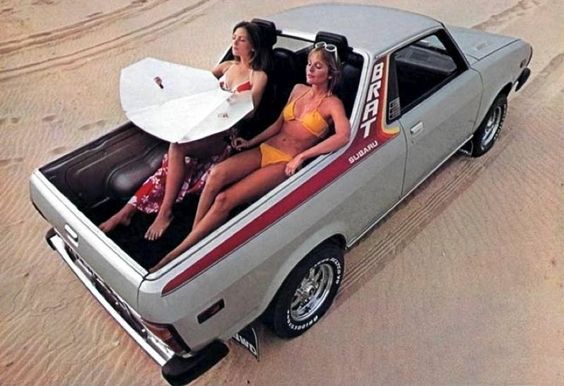
Subaru BRAT, advertising in motion (in a US publication and thus a left-hand drive model).

The Subaru BRAT was (depending on linguistic practice) (1) a coupé utility, (2) a compact pick-up or (3) a small four wheel drive (4WD) ute (utility).  The name was an acronym (Bi-drive Recreational All-terrain Transporter), the novel idea of “bi-drive” (4WD) being the notion of both axles being driven, that linguistic construction dictated by the need to form the acronym.  Bi-Drive Recreational All-Terrain Transporter” certainly was more imaginative (if opportunistic) than other uses of BRAT as an acronym which have included: ”Behaviour Research And Therapy” (an academic journal), “Bananas, Rice, Applesauce and Toast” (historically a diet recommended for those with certain stomach disorders), “Brush Rapid Attack Truck” (a fire-fighting vehicle), “Basenji Rescue and Transport” (a dog rescue organization), “Behavioral Risk Assessment Tool” (used in HIV/AIDS monitoring), Beautiful, Rich and Talented (self-explanatory), the “Bureau de Recherche en Aménagement du Territoire” (the Belgium Office of Research in Land Management (in the French)), “Beyond Line-Of-Sight Reporting and Tracking” (a US Army protocol for managing targets not in visual range) and “Battle-Management Requirements Analysis Tool” (a widely used military check-list, later interpolated into a BMS (Battle Management System).

Ronald Reagan on his Santa Barbara ranch with Subaru BRAT.  Like many owners who used their BRATs as pick-up trucks, President Reagan had the jump seats removed.

Built on the platform of the Leone (1971-1994) and known in some markets also as the MV Pickup, Brumby & Shifter, the BRAT was variously available between 1978-1994 and was never sold in the JDM (Japanese domestic market) although many have been “reverse imported” from other places (Australia favored because salt isn't used on the roads so rust is less of an issue) and the things now have a cult following in Tokyo.  The most famous BRAT owner was probably Ronald Reagan (1911-2004; US president 1981-1989) who kept a 1978 model on his Californian ranch until 1988, presenting something of a challenge for his Secret Service detail, many of whom didn’t know how to drive a stick-shift (manual transmission).  That though would have been less frightening than the experience of many taken for a drive by Lyndon Johnson (LBJ, 1908–1973; US president 1963-1969) in the Amphicar 770 (1961-1965) he kept at his Texas ranch.  LBJ suddenly would turn off the path, driving straight into the waters of the dam, having neglected to tell his passengers of the 770’s amphibious capabilities.  Although “770” has been used in the industry (in the US and Australia) as a trim-level designation (often as part of the sequence 440, 550, 660 etc) , on the amphibious Amphicar it was a reference to it being able to achieve speeds of 7 knots (8 mph; 13 km/h) on water and 70 mph (110 km/h) on land, both claims verified by testers although the nautical performance did demand reasonable calm conditions.

The Subaru BRAT is remembered also as a “Chicken Tax car”.  Tax regimes have a long history of influencing or dictating automotive design, the Japanese system of displacement-based taxation responsible for the entire market segment of “Kei cars” (a clipping of kei-jidōsha (軽自動車) (light automobile), the best known of which have been produced with 360, 600 & 660 cm3 (22, 37 & 40 cubic inch) engines in an astonishing range of configurations ranging from micro city cars to roadsters and 4WD dump trucks.  In Europe too, the post-war fiscal threshold resulted in a wealth of manufacturers (Mercedes-Benz, Jaguar, BMW, Ford, Maserati, Opel etc) offering several generations of 2.8 litre (171 cubic inch) sixes while the that imposed by the Italian government saw special runs of certain 2.0 litre (122 cubic inch) fours, sixes & even V8s.  The US government’s “Chicken Tax” (a part of the “Chicken War”) was different in that it was a 25% tariff imposed in November 1963 (to come into effect in January 1964) by the Johnson administration on potato starch, dextrin, brandy and light trucks; it was a response to the impost of a similar tariffs by France and the FRG (Federal Republic of Germany, the old West Germany) on chicken meat imported from the US.

Wheeling & dealing: Walter Reuther (left) and LBJ (right), scheming something, November 1963.

In any president’s political horse trading there are always hidden agendas and ulterior motives and in LBJ’s White House there were more than usual because that’s the way he’d always done business and had he written a guide to the process, he might have called it "The Art of the Deal".  He was in his generation the most skilled of all, historians concluding after in 1937 having been initiated into the fraternity of Freemasons, he took the only first degree (as an “Entered Apprentice”) and opted not further to progress because soon he understood there was little even the Masons could teach him about the dark arts of plotting & scheming.  Year after the imposition of the chicken tax, the contents of the surviving tape-recordings of discussions in the White House revealed LBJ was negotiating with UAW (United Auto Workers’) president Walter Reuther (1907–1970) in the run-up to the 1964 congressional & presidential elections and the tariffs aimed at curtailing Volkswagen’s increasing market share were just one of the “quid pro quo chips” on the table.  Although it was the taping system used by Richard Nixon (1913-1994; US president 1969-1974) that became infamous, devices of this kind had been installed in the White House as early as the during the administration of Franklin Delano Roosevelt (FDR, 1882–1945, US president 1933-1945) and Nixon actually had LBJ’s devices removed before his staff came to understand their usefulness and Nixon agreed to having them re-fitted, the rest being history. 

Subaru BRAT in use.

The post-war development in the US of large scale, intensive chicken farming had both vastly expanded production of the meat and radically reduced the unit cost of production which was good but because supply quickly exceeded the demand capacity of the domestic market, the surplus was exported, having the effect in Europe of transforming chicken from a high-priced delicacy to a staple consumer protein; by 1961, imported US chicken had taken some 50% of the European market.  This was at a time when international trade operated under the General Agreement on Tariffs and Trade (the GATT (1947)) and there was nothing like the codified dispute resolution mechanism which exists in the rules of the successor World Trade Organization (the WTO (1995)) and the farming lobbies in Germany, France and the Netherlands accused the US producers of “dumping” (ie selling at below the cost of production) with the French government objecting that the female hormones US farmers used to stimulate growth were a risk to public health, not only to those who ate the flesh but to all because nature of the substances was such that a residue enter the water supply.  The use of the female hormones in agriculture does remains a matter of concern, some researchers linking it to phenomena noted in the last six decades including the startling reduction in the human male's sperm count, the shrinking in size of the penises of alligators living in close proximity to urban human habitation and early-onset puberty in girls.

Subaru BRAT Advertising (US).

Eventually, the tariffs on potato starch, dextrin and brandy were lifted but the protection for the US truck producers remained, triggering a range of inventive “work-arounds” concocted between various engineering and legal offices, most of which involved turning two-seater trucks & vans into vehicles which technically could quality as four-seaters, a configuration which lasted sometimes only until the things reached a warehouse where the fittings could be removed, something which would cost the Ford Motor Company (one of the corporations the tax had been imposed to protect) over US$1 billion in penalties, their tactics in importing the Transit Connect light truck from Turkey (now the Republic of Türkiye) just too blatant.  In New Zealand, in the mid 1970s, the government found the “work-arounds” working the other way.  There, changes had been implemented to make the purchase of two seater light vans more attractive for businesses so almost instantly, up sprang a cottage industry of assembling four-door station wagons with no rear seat which, upon sale, returned to the workshop to have a seat fitted.  Modern capitalism has always been imaginative.

Subaru "Passing Lamp" on Leone 1600 GL station wagon (optional on BRATs, 1980-1982).

In Fuji Heavy Industries’ (then Subaru’s parent corporation) Ebisu boardroom, the challenge of what probably was described as the “Chicken Tax Incident” was met by adding to the BRAT two plastic, rear-facing jump seats, thereby qualifying the vehicle as a “passenger car” subject in the US only to a 2.5 and not a 25% import tax.  Such a “feature” probably seems strange in the regulatory environment of the 2020s but there was a time when there was more freedom in the air.  Subaru’s US operation decided the BRAT’s “outdoor bucket seats” made it an “open tourer” and slanted the advertising thus, the model enjoying much success although the additional seating wasn’t available for its final season in the US, the BRAT withdrawn after 1987.  Another nifty feature available on the BRAT between 1980-1982 was the “Passing Lamp” (renamed “Center Lamp” in 1982 although owners liked “Third Eye” or “Cyclops”), designed to suit those who had adopted the recommended European practice of flashing the headlights (on high beam) for a second prior to overtaking.  The BRAT was not all that powerful so passing opportunities were perhaps not frequent but the “passing lamp” was there to be used if ever something even slower was encountered.  The retractable lamp was of course a complicated solution to a simple problem given most folk so inclined just flash the headlights but it was the sort of fitting with great appeal to men who admire intricacy for its own sake.

BRAT seat mountings 1983 (left) and 1984 (centre).  The BRAT on the right has been retro-fitted with the seats (note the safety wire attached to the frame!) using U-bolts, a satisfactory method provided (1) the U-bolts are of high-tensile steel and (2) there is a backing place of adequate strength and size.

The seats were bolted to a frame (the design of which changed) which was welded to the bed.  The use of welding rather than bolts was dictated by the regulations because, had the frame been bolted (and thus defined as “removable”), the BRAT's classification would have changed from “passenger vehicle” to “truck” and been subject to the very tax the seats were installed to avoid.  Amusingly though, the side impact regulations which applied to the BRAT were in a different act and for those purposes the thing was defined as a truck which meant the doors could be fitted with lighter reinforcing bars than those mandated for the Subaru Leone sedans, station wagons and hatchbacks.  The stronger mechanism can be installed in a BRAT's doors so safety conscious owners do have that option.

Two 1987 BRATs with retro-fitted seats, the one on the right also with an after-market roll-bar, something which, all things considered, seems a sensible addition.  Of the physics, those familiar Sir Isaac Newton's (1642–1727) First Law of Motion (known also as the Law of Inertia"An object at rest will remain at rest, and an object in motion will continue in motion with the same speed and in the same direction unless acted upon by an unbalanced external force") can ponder the possibilities while wondering whether to bother buckling up the seat belt or just rely on the "grab handles" (and probably never was that term used more appropriately).  Although the seats weren't factory-fitted after 1985, the parts could still be ordered and many later models have been retro-fitted.  The adjustable headrests were a nice touch although some did note they could be classified also as "rear window protectors".

Brat: Charli XCX's Summer 2024 album

Charli XCX, BRIT Awards, O2 Arena,  London, February 2016; the "BRITs" are the British Phonographic Industry's annual popular music awards.

“Brat” has been chosen by the Collins English Dictionary as its 2024 Word of the Year (WotY), an acknowledgement of the popular acclaim which greeted the word’s re-purposing by English singer-songwriter Charli XCX (the stage-name of Charlotte Emma Aitchison (b 1992)) who used it as the title for her summer 2024 album.  The star herself revealed the stage name is pronounced chahr-lee ex-cee-ex; it has no connection with Roman numerals and XCX is anyway not a standard Roman number.  XC is “90” (C minus X (100-10)) and CX is “110” (C plus X (100 +10)) but XCX presumably could be used as a code for “100” should the need arise, on the model of something like the “May 35th” reference adopted by Chinese Internet users in an attempt to circumvent the CCP's (Chinese Communist Party) "Great Firewall of China" when speaking of the “Tiananmen Square Incident” of 4 June 1989.  In 2015, Ms XCX revealed “XCX” was an element of her MSN screen name (CharliXCX92) when young (it stood for “kiss Charli kiss”) and she used it on some of the early promotion material for her music.

Charli XCX with Brat album (vinyl pressing edition) packaging in "brat green".

According to Collins, the word “resonated with people globally”.  The dictionary had of course long had an entry for the word something in the vein of: “someone, especially a child, who behaves badly or annoys you”, but now it has added “characterized by a confident, independent, and hedonistic attitude”.  In popular culture, the use spiked in the wake of the album's released but it may be “brat” in this sense endures if the appeal is maintained, otherwise it will become unfashionable and fade from use, becoming a “stranded word”, trapped in the time of its historic origin.  So, either it enters the vernacular or by 2025 it will be regarded as “so 2024”.  The lexicographers at Collins seem optimistic about its future, saying in the WotY press release that “brat summer has established itself as an aesthetic and a way of life”.

Lindsay Lohan in Jil Sander (b 1943) "brat green" gown, Disney Legends Awards ceremony, Anaheim, Los Angeles, October 2024.  For anyone wanting to describe a yellowish-green color with a word which has the virtues of (1) being hard to pronounce, (2) harder to spell and (3) likely to baffle most of one’s interlocutors, there’s “smaragdine” (pronounced smuh-rag-din), from the Latin smaragdinus, from smaragdus (emerald), from the Ancient Greek σμάραγδινος (smáragdinos), from σμάραγδος (smáragdos).

The “kryptonite green” used for Brat’s album’s packaging seems also to have encouraged the use in fashion of various hues of “lurid green” (the particular shade used by Ms XCX already dubbed “brat green” although some which have appeared on the catwalks seem more of a chartreuse) and an online “brat generator” allowed users replicate the cover with their own choice of words.  The singer was quite helpful in fleshing out the parameters of the aesthetic, emphasizing it didn’t revolve around a goth-like “uniform” and nor was it gender-specific or socially restricted.  In an interview with the BBC (British Broadcasting Corporation), Ms XCX explained the brat thing was a spectrum condition extending from “luxury” to “trashy” and was a thing of attitude rather than accessories: “A pack of cigs, a Bic lighter, and a strappy white top with no bra.  That’s kind of all you need.”  Although gender-neutral, popular use does seem to put the re-purposed “brat” in the tradition of the earlier “bolshie woman” or “tough broad” but with a more overtly feminist flavor, best understood as “the qualities associated with a confident and assertive woman”.  In its semantic change, “brat” has joined some other historically negative words & phrases (“bitch”, “bogan”, the infamous “N-word(s)” etc) which have been “reclaimed” by those at whom the slur was once aimed, a tactic which not only creates or reinforces group identity but also re-weaponizes what was once a spent-insult so it can be used to return fire.