Showing posts sorted by relevance for query Reprise. Sort by date Show all posts

Thursday, May 28, 2020

Reprise

Reprise (pronounced ri-prahyz or ruh-preez)

(1) In law, (usually in the plural reprises), an annual deduction, duty, or payment out of a manor or estate, as an annuity or the like (also spelled reprises).

(2) In music, a repetition of a phrase, a return to an earlier theme, or a second rendition or version of a song in a programme or musical.

(3) A recurrence or resumption of an action; To return to an earlier (often first) theme or subject.

(4) To execute a repetition of; repeat.

(5) In fencing, a renewal of a failed attack, after going back into the en garde position.

(6) A taking by way of retaliation.

(7) To take (something) up or on again (obsolete, transitive form).

(8) To recompense; to pay (obsolete).

(9) In admiralty law, a ship recaptured from an enemy or from a pirate.

(10) In masonry, the return of a molding in an internal angle.

1350–1400: The late fourteenth century noun in the sense of "an annual deduction from charges upon a manor or estate" gained its meaning from the thirteenth century Old French reprise (act of taking back), the feminine of repris, past participle of reprendre (take back), from the Latin reprendere (pull back, hold back).  The meaning "resumption of an action" dates from the 1680s while the musical sense of "a repeated passage, act of repeating a passage" has been in use since 1879.  Reprise as a verb dates from the early fifteenth century as reprisen (begin (an activity) again), from the Old French repris, from the Latin reprehendere (to blame, censure, rebuke; seize, restrain ( literally "pull back, hold back).  Obsolete in this sense, the the modern meaning is "to repeat a (theatrical, musical etc.) performance" dates only from circa 1964, a presumably new formation from the verb. The familiar verbs (used with object) are reprised and reprising.

Blonde on Blonde

Bert Stern’s (1929-2013) photo shoot of Marilyn Monroe (1926–1962) was commissioned by Vogue magazine and shot over three days, some six weeks before her death.  In book form, the images captured were compiled and published as The Last Sitting (first edition, William Morrow and Company (1982) ISBN 0-688-01173-X).

Stern reprised his work in 2008 with Lindsay Lohan, the photographs published in February 2008’s spring fashion issue of New York magazine.  Stern chose the medium of forty-six years earlier, committing the images to celluloid rather than using anything digital.  The reprised sessions visually echoed the original with a languorous air though the diaphanous fabrics were draped sometimes less artfully than all those years ago.  He later expressed ambivalence about the shoot, hinting regret at having imitated his own work but the photographs remain an exemplar of Lohanary.

Tuesday, January 13, 2026

Equiluminant

Equiluminant (pronounced ee-kwuh-loom-uh-nuhnt)

(1) In optics, the quality of two or more objects or phenomenon being equally luminant.

(2) Figuratively, two or more people being judged equally illustrious, attractive, talented etc.

1860s: The construct was equi- +‎ luminant.  As an adjective, luminant means "that which illuminates; that which is luminous" while as a noun it describes "an illuminating agent".  Luminant was from the Latin verb lūminant, the third-person plural present active indicative of lūminō, the construct being lūmen, from the Proto-Italic louksmən, from the primitive Indo-European léwk-s-mn̥, from the root lewk- (bright) +‎ -ō (appended to form agent nouns).  The accepted synonym is isoluminant and equiluminescent is the alternative form.  When used figuratively, although it would make no sense in science, the comparative is “more equiluminant” and the superlative most “equiluminant”.  Equiluminant & equiluminescent are adjectives and equiluminance is a noun; the noun plural is equiluminances (which some list as non-standard).

The prefixes: equi-, homo-, peri- & iso-

The prefixes “equi-”, “homo-”, “peri-” & “iso-” are all used to in same way suggest a concept of sameness or equality, but by tradition and convention, are used in different contexts to produce different meanings or emphasis:  Equi- is used to indicate equality, evenness, or uniformity and is often seen in mathematical, scientific & technical publications to describe something is equal in measure or evenly distributed such as equilateral (a shape having all sides of equal length, equidistant (being at equal distances from two or more points) & equilibrium (a state of balance where opposing forces or influences are equal).  Homo- is used to imply “same” or “alike” and thus sameness or (sometimes by degree) similarity.  In technical use it is a standard form in biology, chemistry & the social sciences to indicate sameness in kind, structure, or composition and by far the most common modern use is in the now familiar “homosexual” which in many jurisdictions is now a proscribed (or at least discouraged) term because of negative associations (“homo” as a stand-alone word also having evolved as a slur used of, about or against homosexual men).

The uses of the prefix are illustrated by homogeneous (composed of parts or elements that are all of the same kind, homologous (having the same relation, relative position, or structure) & homonym (in linguistics words which sound the same or are spelled the same but have different meanings).  Iso- is used to denote equality, uniformity, or constancy in terms of specific characteristics like size, number, or configuration and is most used in scientific and mathematical publications.  Examples of use include isometric (having equal dimensions or measurements, isothermal (having constant temperature) & isosceles (having two sides of equal length).  Peri- is used to denote “surrounding or enclosing”, or “something near or around a specific area or object”, examples including perimeter (the continuous line forming the boundary of a closed geometric figure), periscope (an optical instrument for viewing objects that are above the level of direct sight, using mirrors or prisms to reflect the view & peripheral (relating to or situated on the edge or periphery of something.  So equi-focuses on equality in measure, distance, or value, homo- focuses on sameness in kind, structure, or composition, iso- focuses on equality or uniformity in specific characteristics or conditions while peri- :focuses on surrounding or enclosing, or being near or around something.  For most purposes equi- & iso- can be used interchangeably and which is used tends to be a function of tradition & convention.

Equiluminant colors

An example the equiluminant in blue & orange.  In color the text appears at the edges to "shimmer" or "vibrate".  When re-rendered in grayscale, because the value of the luminance is so close, the two shades become almost indistinguishable.

In optics, “equiluminant” is a technical term used to colors with the same (or very similar) luminance (brightness) but which differ in hue (color) or saturation (intensity).  The standard test for the quality is to convert a two-color image to grayscale and, if equiluminant, the colors would appear nearly indistinguishable because they share the same level of “lightness”.  It’s of some importance in fields as diverse as military camouflage, interior decorating, fashion, astronomy and cognitive psychology.  In the study of visual perception, when colors are equiluminant, the human visual system relies primarily on the differences in hue and saturation (rather than brightness) to distinguish between them and this can create challenges in perception; in many cases, the brain will struggle to segregate colors based solely on luminance; essentially, there is a lack of information.

An enigmatic abstraction (2024) by an unknown creator.  This is an example of the use of non-equiluminant shades of orange & blue, the original to the left, copy rendered in gray-scale to the right.

In art and design, the quality of equiluminance can be exploited to create visual effects, the perception of some “shimmering” or “vibrating” at the edges where colors meet actually a product of the way the different hues are perceived by the brain to be “less defined” (a process not dissimilar to the “grayscaling”) and thus “dynamic”, lending the impression of movement even in a static image, especially if seen with one’s peripheral vision.  While a handy device for visual artists, it can be something of some significance because the close conjunction of equiluminant colors can make certain visual tasks more difficult, most obviously reading text or distinguishing shapes and objects.  All that happens is the extent of the luminance contrast can create a perception of fuzziness at the edges of shapes which means some people can suffer a diminished ability to distinguish fine details and the smaller the object (text, numerals or geometric shape), the more acute the problem.  The phenomenon has been well researched, scientists using the properties in equiluminant colors to study how the brain processes color and the findings have been important in fields like instrumentation and the production of warning signs.

Richard Petty's 1974 NASCAR (National Association of Stock Car Auto Racing) Dodge Charger (left) and 3 ton Super-Duty Jack, produced under licence by the Northern Tool Company (right).

1974 was the last year in which the big-block engines were allowed to run in NASCAR and the big-block era (1962-1973) was NASCAR's golden age.  Richard Petty (b 1937) used a "reddish orange" to augment his traditional blue when he switched from Plymouth to Dodge as the supplier of his NASCAR stockers in the early 1970s.  His team was actually sponsored by STP rather than Gulf and STP wanted their corporate red to be used but in the end a "reddish orange" compromise was negotiated.  However, when he licenced the Northern Tool Company to sell a "Richard Petty" jack, the shade used appeared to be closer to the classic "Gulf orange".

Sexy Lamborghinis in a not quite equiluminant color combination following those of the Gulf Western racing teams: 1964 1C TL tractor (top) and 1968 1R tractor (bottom).

Lamborghini had been making tractors and other farm equipment since 1948 when first its track-drive models appeared in 1955, the 1C-TL produced between 1962-1966.  Unrelated to that model cycle, it was in 1966 Lamborghini unveiled the sensational Miura (1966-1973), powered by a transversely located, mid-mounted, 3,929 cm3 (240 cubic inch) V12 engine which sucked prodigious quantities of gas (petrol) through four triple throat downdraft Weber carburetors, each of which was needed to satiate the thirst.  The power was sent to the road via a five-speed transaxle which shared it's lubrication with the engine (shades of the BMC Mini (1959-2000) which turned out to be a bad idea and one not corrected until the final run as the Miura SV (1971-1973).  To achieve the stunning lines, mounting the V12 transversely was the only way to make things fit and the engineering was a masterpiece of packaging efficiency but it resulted in the car displaying some curious characteristics at high speed.  The specification of the 1C TL Tractor was more modest although quite appropriate for its purpose; it was powered by an air-cooled 1,462 cm3 (89 cubic inch) which delivered power to the rear portal axle and drive sprockets via a dual-range, three-speed manual transmission.  However, being a diesel, there was of course fuel-injection (by Bosch), an advance Lamborghini's V12s didn’t receive until 1985 when US emission-control regulations compelled the change.  This version of 1R tractor is known as the cofano squadrato (squared hood (bonnet)); produced between 1966-1969, it replaced the earlier 1R (1961-1965) which featured a rounded hood.  The earlier model seems not retrospectively to have been christened but presumably it would have been the cofano arrotondato (rounded hood), proving everything sounds better in Italian.  An Italian could read from a lawnmower repair manual and it would sound poetic.

As everybody knows, in Mean Girls (2004), there's an example or reference point for just about every known sociological, zoological, linguistic, political, scientific, botanical, geological or cosmological phenomenon yet observed.  Here, Lindsay Lohan in baby pink and powder blue illustrates an instance of equiluminance.

At scale, equiluminance doesn’t have to be obvious for it still to have desirable “side effects” and while it’s often noted two specific hues ((1) the blue Llewellyn Rylands pigments 3707 (Zenith Blue, replicated by Dulux as “Powder Blue”) & (2) the orange Rylands pigments 3957 (Tangerine, replicated by Dulux as “Marigold”)), that their use in combination appears so often on cars, motor-cycles and other stuff with wheels is due less to the claim the shades seem at the edge to “vibrate” that the striking combination appearing on some of the Gulf Oil sponsored Ford GT40s and Porsche 917s during sports car racing’s golden era (1950-1972).  Given the surface area involved, the effect is probably imperceptible when viewed at close range but the science does suggest that at speed (and these were fast machines), at the typical viewing range found on racetracks, there was what the optical analysts call “visual pop”, something which heightens the brain’s perception of motion.

Ford GT40 chassis# 1075, winner of the 1968 & 1969 Mans 24 hour endurance classic in Gulf racing livery.

Gulf's colors were not equiluminescent.  The company's original "corporate color scheme" had been a dark blue & orange combo but Gulf was an acquisitive conglomerate and in late 1967 it took over the Wilshire Oil Company of California, the signature colors of which were powder blue and orange, something which Gulf’s management thought “more exciting” and better suited to a racing car.  The change was made for the 1968 season with the Fords now running as five-litre (305 cubic inch) sports cars, governing body having banned the seven-litre engines the cars previously had used (under a variety of names, motorsport has for decades been governed by some of world sport’s dopiest regulatory bodies).  In the Gulf colors, fitted with 302 cubic inch (4.9 litre) engines, Ford GT40 Mark I (chassis #1075) won the Le Mans 24 hour endurance classic in 1968 & 1969 (repeating the brace Ford had achieved with the 7.0 litre (427 cubic inch) Mark II & Mark IV versions in 1966-1967), the first time the same car had achieved victory twice.  In 1968, #1075 won the BOAC International 500, the Spa 1000-kilometer race, and the Watkins Glen 6-hour endurance race, while in 1969 it also took the Sebring 12-hour race, a remarkable achievement for a race car thought obsolescent.  The livery has since been much replicated, including on many machines which have never been near a race track.

1971 Porsche 917K in Gulf Racing livery.  The fins were added to improve straight-line stability and were strikingly similar to those which appeared on some late 1950s US Chryslers although the aerodynamic properties of those were dubious, despite corporate claims.

Interestingly, the team painting the GT40s were aware of the issue created by equiluminant colors and knew that when photographed in certain conditions, the shades could tend thus.  As a matter of professional pride, they didn’t want it thought they’d created something with “fuzzy edges” so deliberately was added a dark blue hairline-border around the orange, reducing the optical illusion to ensure that when photographed, everything looked painted with precision.  When the Gulf team in 1970 switched to using Porsche 917s for the World Sports Car championship, they adopted the expedient of a black line of definition between the blue & orange so the whole enduring appeal of the combination lies just in the striking contrast and relies not at all on any tendency to the equiluminant.

Ford GT Heritage Edition First Generation (left) and Second Generation (right). 

Little more than 100 GT40s were built but Ford noted with interest the ongoing buoyancy of the replica market, as many as 2,000 thought to have been built in a number of countries (although that's dwarfed by number of replica Shelby American Cobras; it's believed there are 50-60,000-odd of them, a remarkable tribute to the 998 originals).  In the twenty-first century, the company decided to reprise the design but the new GT (2004-2006) was hardly a clone and although it shared the basic mechanical layout and the shape (though larger) was close, it was a modern machine.  The car wasn’t called GT40 because the rights to the name had ended up with another company and Ford declined to pay the demanded price.  Over 4000 were built and one special run was a tribute to the 1968-1969 cars in Gulf livery, 343 of the “Heritage Editions” produced.  A second generation of GTs was produced between 2016-2022 and was very modern, the demands of the wind-tunnel this time allowed to prevail over paying tribute to the classic lines of the 1960s.  Although the supercharged 5.4 litre V8 didn’t return and the new car used a turbocharged 3.5 litre (214 cubic inch) V6, it outperformed all its predecessors over the last 60-odd years (all the original GT40 chassis built between 1964-1969) including the 427 cubic inch monsters that won at Le Mans in 1966 & 1967 so it took decades, but eventually there really was a "replacement for displacement".  The V6 also was used also in pick-up trucks which doesn't sound encouraging but versions of the small & big block V8s used in the GT40s also saw similar service, the latter even first appearing in the doomed EdselProduction of the second generation was limited to 1350 units, 50 of which were “Heritage Editions” in the Gulf colors, one of several “limited editions”.

Saturday, November 22, 2025

Burlesque

Burlesque (pronounced ber-lesk)

(1) An artistic composition, especially literary or dramatic, that, for the sake of laughter, vulgarizes lofty material or treats ordinary material with mock dignity.

(2) A humorous and provocative (often bawdy) stage show featuring slapstick humor, comic skits and a scantily clad female chorus; by the late nineteenth century striptease was often the main element (the usual slang was burleycue).

(3) As neo-burlesque, a late twentieth century revival (with rather more artistic gloss) of the strip-tease shows of the 1920s.

(4) An artistic work (especially literary or dramatic), satirizing a subject by caricaturing it.

(5) Between the seventeenth and nineteenth centuries, a play parodying some contemporary dramatic fashion or event.

(6) A production of some kind involving ludicrous or mocking treatment of a solemn subject; an absurdist imitation or caricature.

(7) Of, relating to, or characteristic of a burlesque; of, relating to, or like stage-show burlesque.

(8) To represent or imitate (a person or thing) in a ludicrous way; caricature.

(9) To make ridiculous by mocking representation.

(10) To in some way use a certain type of caricature.

1650–1660: From the French burlesque, from the Italian burlesco (ludicrous and used in the sense of “parodic”), the construct being burl(a) (joke, fun, mockery) + -esco (the adjectival suffix used in English as –esque).  The Italian burla may ultimately be from the Late Latin burra (trifle, nonsense (and literally “flock of wool”) and thus used to suggest something “fluffy” (in the sense of being “lightweight” rather than serious) which was of unknown origin.  Alternatively, some etymologists suggest burla may be from the Spanish burladero (the protective barrier behind which people in the bullring are protected from the bull).  The verb burlesque (make ridiculous by mocking representation) came directly from the noun and was in use by the 1670s.  The spelling burlesk is archaic.  While the derived form unburlesqued means simply “not burlesqued”, preburlesque is a historian's term meaning “prior to the introduction of burlesque performances”.  Burlesque, burlesquer & burlesqueness are nouns, burlesqued & burlesquing are verbs and burlesquely is an adverb; the noun plural is burlesques.

The original mid-sixteenth century meaning was related to stage performances and meant “a piece composed in the burlesque style, a derisive imitation or grotesque parody, a specific development from the slightly earlier adjectival sense of “odd or grotesque”, taken directly from the French burlesque.  The more familiar adjectival meaning (tending to excite laughter by ludicrous contrast between the subject and the manner of treating it) was in use by at least the late 1690s.  As a definition that’s fine but in the hands of playwrights, satirists and such there was obviously much scope, prompting one journalist (a breed which seems first to have been described thus in the 1680s) in 1711 to clarify things in a London periodical:

The two great branches of ridicule in writing are comedy and burlesque. The first ridicules persons by drawing them in their proper characters; the other, by drawing them quite unlike themselves. Burlesque is therefore of two kinds; the first represents mean persons in accoutrements of heroes, the other describes great persons acting and speaking like the basest among the people.

The meaning shifted as what appeared on stage evolved and by the 1880s the typical understanding was something like (1) “travesties on the classics and satires on accepted ideas” and (2) comic opera which tended towards vulgarity.  From this came the still prevalent modern sense of “variety show featuring music, dancing and striptease” although some historians of the industry link this use directly from the mid-nineteenth century tradition of “scantily-clad performers who staged the sketches concluding minstrel shows”.  The implications of that evolution didn’t impress all and by the early twentieth century, in the US, the word “burlesque” had become verbal shorthand for “entertainment designed to titillate, verging on the obscene while avoiding prosecution”.  The term “neo-burlesque” (a revived form of traditional American burlesque performance, involving dance, striptease, dramatic performance etc) emerged in the 1990s, describing the stage shows which sought to re-capture the once respectable spirit of burlesque as it was performed in US clubs before “changing attitudes” saw the performances outlawed or marginalized.  Whether attitudes really much changed among the general population has been debated by historians but the US political system then (as now) operated in a way in which well-funded groups could exert a disproportionate influence on public policy and while this often was used by sectional interests to gain financial advantage, some also decided to impose on others their view of morality; it was in the era of the crackdown on burlesque shows the Motion Picture Production Code (the so-called “Hays Code” which, remarkably, endured, at least on paper, until 1968!) was created as a set of “moral guidelines” with which the Hollywood studios had to conform.  So the “culture wars” are nothing new and in the US, there has always been a tension between puritan religiosity and political freedom, the two forces reflecting the concerns and obsessions of those from the “Old World” of Europe who in the early seventeenth century founded the settlement which ultimate became what came to be known as “America”.

Although often hardly “respectable” theatre, burlesque has a long tradition in performance and almost its techniques will long pre-date recorded history.  The essence of the form was based on an exaggerated “sending up” or a derisive imitation of a literary or musical work and can be anything from a friendly joke to vicious ridicule.  Historically most associated with some form of stage entertainment, burlesque was distinguished from parody in being usually stronger (though not always broader) in tone and style and often lacked the edgy subtlety of satire.   It was the Athenian playwright of Ancient Greece, Aristophanes (circa 446–386 BC), who the late Medieval scribes declared “the father of comedy” and while that was a little misleading, he would occasionally use the device of burlesque in his plays though the satyr plays probably were the first institutionalized form of burlesque.

Empire Burlesque (1985) by Bob Dylan (b 1941).

Early in his long career, Bob Dylan must have noticed the press seemed to be more interested in discussing the stuff about which he didn’t comment that that which he’d taken the time to explain.  Whether or not that’s a factor, Dylan appears never to have explained the meaning behind the title of his 1985 album, Empire Burlesque.  Although some speculated it may have been a metaphor for the nature of “the American Empire” (however defined), there’s nothing substantive to support the speculation and a more grounded theory came from the Beat poet Allen Ginsberg (1926–1997) who recounted how Dylan had once told him: “That was the name of a burlesque club I used to go to when I first came to New York, down on Delancey Street.”  Ginsberg thought it “a good title” for an album.

Intriguingly, the satyr play was a kind of coda.  In Greek theatre, the convention was to present four plays in succession: three tragedies (though not necessarily a trilogy) with a satyr play appended as the final piece.  Typically, in a satyr play, a mythical hero (who may have appeared in one or all of the foregoing tragedies) was presented as a ridiculous personage with a chorus of satyrs (creatures half man and half goat (or half horse) with prominent, erect phalluses (it was satyr imagery which in Europe made the goat a symbol of lust and, two millennia on, cynical Berliners would refer to the notoriously philandering Dr Joseph Goebbels (1897-1975; Nazi propaganda minister 1933-1945) as “the he-goat of Berlin”)).  As far as is known, the satyr plays almost always were ribald in speech and action as well as in costume and their purpose has been debated by historians.  While classical Greek tragedy is almost wholly devoid of comedy (in the sense of set-pieces although there’s the occasional sardonic quip or grim observation that would have enticed a laconic guffaw) the satyr play concluding the tetralogy would have worked as a sort of palliative burlesque after the catharsis of three acts of fear, loathing and, not infrequently, death,  Their dramatic function clearly was a form of comic relief but coming immediately after three works of earnest high-seriousness, they must have has the effect of “calming the senses” of the audience after the intense, exalting spiritual experience of the tragedies.  That’s interesting in that it implies it was thought desirable to return the audience to “earthly life” and remind them what they had just experienced was not “reality” and their emotions had just been manipulated by a technique.  It all sounds rather post-modern and in a similar literary vein, the “clowning interludes” in Elizabethan plays can also be seen as a type of burlesque; in William Shakespeare’s (1564–1616) A Midsummer Night's Dream (1590) the interpolation of the play of Pyramus and Thisbe performed by Bottom and his companions was the bard making fun of the “Interludes” of earlier types.

An expanded vista derailing the Pronomos Vase (red-figure pottery Ancient Greece, circa 400 BC) believed to depict the whole cast and chorus of a satyr play, along with the playwright, the musician Pronomos, and the gods Dionysos and Ariadne.  The scene is thought to capture the figures after a performance which, in modern use, would be thought a “behind the scenes” grab.   The vase was discovered in 1835 in a tomb in Ruvo di Puglia, Italy; it’s now on permanent display in the Museo Nazionale in Naples.

To make things difficult for students, there are linguistic traps in the terminology and despite the similarity in the spelling, there was no connection whatever between satyric drama and satire and some seem convinced there may have been none between it and Greek comedy.  For structuralists, it can be a difficult field to study because over the centuries so many contradictory texts and commentaries emerged and that’s at least partly attributable to the influence of Aristotle (384-322 BC) who looms over the understanding of Greek theatre because his writings came to be so revered by the scholars of the late Medieval period and especially the Renaissance.  As far as in known, the Greeks were the first of the tragedians and it’s through the surviving texts of Aristotle that later understandings were filtered but all of his conclusions were based only on the tragedies and such was his historic and intellectual authority that for centuries his theories came to be misapplied and misused, either by mapping them on to all forms of tragedy or using them as exclusionary, dismissing from the canon those works which couldn’t be made to fit his descriptions.

The Pronomos Vase as displayed in Naples.

Nor was burlesque confined to drama; it was the most common structure used in the mock-heroic poem to ridicule the often overblown works of romance, chivalry and Puritanism.  Dripping often with irony and a confected grave decorum, the classic example is English poet & satirist Alexander Pope’s (1688-1744) The Rape of the Lock (1712), cited by some (however unconvincingly) as the spiritual origin of “high camp”.  Also, because the gothic novel often was written in such self-conscious “high style”, the form lent itself naturally to burlesque re-tellings, something exploited to this day in Hollywood which has often made sequels to horror films in comedic from.  The burlesque (in the sense it was a descendent of the Greek satyr play) could also be positioned as something transgressive although it must be wondered if this sometimes was a product more of the commentator’s view than the positionality intended by the author.  This aspect of burlesque is explored in the genre of literary carnival when a technique is borrowed from the Socratic dialogues (in which what appears to be logic is deconstructed and proved to be illogical).  Carnivalesque elements are inherent in burlesque (and can exist in satire, farce, parody and such) and a theory of Russian philosopher & literary critic Mikhail Bakhtin (1895–1975) was that in its disruption of authority and implication of possible alternatives, carnival in literature was subversive and the use of burlesque in the form was a concealment (in the sense of avoiding the censor’s pen) of what could be a liberating influence; Bakhtin’s particular target was the “suffocatingly sacred word” in Renaissance culture but his theory has more generally been applied.

The noun amphigory (burlesque nonsense writing or verse) dates from 1809 and was from the eighteenth century French amphigouri of unknown origin but presumed by most etymologists to have been a jocular coining although there may have been some influence from the New Latin amphi-, from the Ancient Greek ἀμφί (amphí) (on both sides) and the Greek γύρος (gýros), derived from the “turning of the meat on a spit” (as a calque of Turkish döner into Greek).  The notion was of “making the whole” (ie “circle on both sides”) but a link with the Greek -agoria (speech) (as in allegory, category) has been suggested as a simpler explanation.  The word “amphigory” found a niche in literary criticism and academic use (recommended for students wishing to impress the professor) to describe a particular flavour of burlesque or parody, especially a verse or other text in which the impression is for a while sustained of something which will make sense but ultimately fails, an oft-cited example being Nephelidia (literally “cloudlets”) by the English poet Algernon Charles Swinburne (1837–1909) in which the writer parodies his own distinctive style.

In A Dictionary of Modern English Usage (1926), Henry Fowler (1858–1933) noted the wide application of the words often listed as synonymous with burlesque (caricature, parody, travesty etc), citing the not uncommon use of burlesque to describe a “badly conducted trial” or “a perverted institution”, adding the two critical distinctions were (1) burlesque, caricature & parody have, besides their wider uses, each a special province; action or acting is burlesqued, form and features are caricatured and verbal expression is parodied and (2) travesty differs from the others both in having no special providence and, in being more used than they (though all four may be used either way) when the imitation is intended to be or pass for an exact one but fails.  Were Henry Fowler alive to see TikTok and such, he’d realize not many are reading his book.

Pink Purple HD Lip Paint (Burlesque) by MBACosmetics.  Burlesque's ingredients includes: Castor Oil, Jojoba Oil, Beeswax, Carnauba Wax, Fractionated Coconut Oil, Shea Butter, Vitamin E, Mica, Titanium Dioxide, Oxides, May contain Yellow #5 Lake, Yellow #6 Lake, Red #7 Lake, Red #40, Red #33, Red #27, Red #30, Orange #5, Hydrogenated Polisobutene and Palmitic Acid.

The difficulty in assigning synonyms to “burlesque” is that things are not only nuanced but historically variable; what would in one time and place have been thought satirical might in other circumstances be called a parody.  The earliest known use in English of the noun parody was by the playwright Benjamin Jonson (circa 1572-circa 1637) who would have understood it as something close to the modern definition: “a literary work in which the form and expression of dignified writing are closely imitated but are made ridiculous by the ludicrously inappropriate subject or methods; a travesty that follows closely the form and expression of the original”.  Parody was from the Latin parodia (parody), from the Ancient Greek parōidia (burlesque song or poem), the construct being para- (beside, parallel to (used in this context in the sense “to mock; mockingly to present”)) + ōidē (song, ode) and from the technical use in theatre came the general meaning “a poor or feeble imitation”, in use by at least the late 1820s.  So, depending on the details, a parody could be a type of burlesque but might also be described as a satire, ridicule, lampoon or farce.  It was Benjamin Jonson who in 1609 debuted his “anti-masque” an innovation which took the form of either (1) a buffoonish and grotesque episode before the main masque or (2) a similarly farcical interlude interpolated during the performance (if performed beforehand, it was dubbed an “ante-masque”. One variant of the anti-masque was a burlesque of the masque itself and in that sense there was a distinct affinity with the Greek satyr play.

So in literary use, synonyms for burlesque must be applied on a case-by-case basis, caricature, parody and travesty all used variously to refer to the written or preformed forms imitating serious works or subjects, the purpose being to achieve a humorous or satiric purpose.  In this context, burlesque achieves its effects through a mockery of both high and low through association with their opposites: burlesques of high and low life can thus be though a kind of specific application of irony.  Caricature, usually associated with visual arts or with visual effects in literary works, implies exaggeration of characteristic details, analogous with the technique of the political cartoonist.  Parody achieves humor through application of the manner or technique (typically well-known poets, authors, artists and such), often to an unaccustomed (and, ideally, wholly incongruous) subject while a travesty can be a grotesque form of burlesque, the latter also nuanced because travesties can be intentional or just bad products.  All of these forms can be the work of absurdists, that genre ranging from the subtle to the blatant and they may also be spoofs.  Spoof was a neologism coined in 1884 by the English comedian Arthur Roberts (1852–1933) as the name of a card game which involved deception, trickery and nonsense.  From this the word came to be used of any sort of hoaxing game but it became most popular when used of literary works and staged performances which is some way parodied someone or something but the point about the use of “spoof” is should describe a “gentle” rather than a “biting” satire, elements of the burlesque thus often present in spoofs.

South Park's take on Donald Trump (b 1946; US president 2017-2021 and since 2025).  Somewhere in probably every South Park episode, there are switches between parody, satire, ridicule, lampoon and farce with elements of the burlesque often in each.

A distinction certainly is drawn between political burlesque and political satire.  Political burlesque is a particular application of the satirical which relies on parody and exaggeration (often absurdist) to mock political figures, events, concepts or institutions and the purpose can range from the merely comic to the subversive, the two poles not being mutually exclusive.  In the burlesque, a politician’s traits, patterns of speech or behaviour (scandals are best) are explored and sometimes exaggerated to the point they become obviously ridiculous or absurd, the best practitioners of the art using the amplification to take things to a logical (if improbable) conclusion and while it can be done almost affectionately, the usual purpose is to draw attention to flaws such as incompetence, corruption, indifference to others, hypocrisy or ideological fanaticism.  Essentially a political cartoon writ large, it’s a popular device because in masking the message in humor, there’s usually some protection from a defamation writ, witness the relationship between the animation South Park and Donald Trump.  The tradition is old and evidence is at least hinted in graffiti unearthed in Ancient Rome but material from in recent centuries is extant and techniques of the English artists William Hogarth (1697–1764) and James Gillray (1756-1815) remain in use to this day, illustrating the way political burlesque is best understood as a sub-set of political satire, separate but (often) equal as it were, the differences in tone, method, and degree of exaggeration a matter of tactics rather than strategy.

As an umbrella term, “political satire” has a wide vista in that it can be subtle, dry, ironic & biting, deployed with wit & understatement but it can also switch to (some would say “descend to”) the burlesque in becoming loud, exaggerated and even grotesque in fusing elements of slapstick and farce.  While burlesque amplifies absurdity, venality or whatever is being critiqued, satire need only “point it out” and some very effective satires have done nothing more than quote politicians verbatim, their words “hoisting them with their own petard” if the mixed metaphor will be forgiven.  So, all political burlesque is political satire, but not all political satire is burlesque.  The companion term in politics is vaudevillian and that describes a politician for whom “all the world’s a stage” and politics thus a form of theatre.  Their performances can (sometimes unintentionally) sometimes seem to at least verge on the burlesque but usually it’s about attracting attention and a classic exponent was Boris Johnson (b 1964; UK prime-minister 2019-2022) who was said to have been influenced by Ronald Reagan (1911-2004; US president 1981-1989).  During the 1980 presidential campaign, a reporter asked Mr Reagan: “How can an actor run for President?”, receiving the prompt reply: “How can a president not be an actor?  Some have of course been more adapt than others at “flicking the switch to vaudeville” and Paul Keating (b 1944; Prime Minister of Australia 1991-1996) whose vocabulary was rich (if not always refined) used to use what he called his “dead cat strategy” which referred to introducing a shocking or controversial issue to divert unwanted attention from other, more embarrassing or damaging news.  It was most graphically expressed as “tossing a dead cat on the table”.

Lindsay Lohan in burlesque mode in I Know Who Killed Me (2007).  Neglected upon its release, IKWKM has since been re-evaluated as a modern giallo and has acquired a cult following, sometimes see on the playbill of late-night screenings.

As popular entertainment, burlesque performance enjoyed a revival which began in the 1990s and in the twenty-first century it’s now an entrenched niche as well a minor industry in publishing.  By the 1960s, what was called burlesque had become rather tatty and the common understanding of the term was something not greatly different from a strip club with a slightly better class of drunk in the audience, the women there to disrobe in the hope of encouraging the sale of expensive alcoholic.  What in the 1990s was dubbed the “neo-burlesque” was not a reprise of how things used to be done but a construct which might be thought a more “women-centric” interpretation of the discipline and while there will be factions of feminism which won’t take that notion too seriously and dismiss as “false consciousness” the idea of women publicly taking off their clothes as a form of “empowerment”, the latter day performers seem to treat it as exactly that.  Despite the criticism of some, burlesque seem now to verge on the respectable and, internationally, there are various burlesque festivals and a Burlesque Hall of Fame (the grand opening, perhaps predictably, in Las Vegas).

Burlesque and the Art of the Teese /Fetish and the Art of the Teese (2006) by Dita Von Teese (stage name of Heather Renée Sweet, b 1972).  Perhaps surprisingly, despite the phrase “the art of the teese” being at least potentially a piece of “ambush marketing” piggy-backing on the success of the acclaimed (48 weeks on The New York Times Best Seller list) book The Art of the Deal by Donald Trump and Tony Schwartz (b 1952), Mr Trump didn’t sue Ms von Teese.  Maybe he’s a burlesque fan-boy.

In the modern era, no figure is more associated with the neo-burlesque than Dita von Teese and her janus-configured book Burlesque and the Art of the Teese / Fetish and the Art of the Teese is similar to Mr Trump’s magnum opus in being a hybrid: part memoir, part instruction manual.  This significance of publishing the burlesque and fetish components as separate sections was presumably to make the point that while there’s obvious cross-fertilization between the two disciplines and for some the former may be a stepping stone to the latter, there is a clear distinction, one a piece of performance art, the other a deliberate statement of deviance; decisively one must step from one into the separate world of the other.  Ms von Teese’s book documents the “dos & don’ts” of each “calling” and. as she explains, the point about the neo-burlesque was it was less a revival than a re-defining, the thematic emphasis on style and glamour rather than sleaze, more aligned with the image (if not exactly the reality) of the Berlin cabarets of the 1920 than the seedy Soho strip joints which once so tarnished the brand.

Thursday, August 12, 2021

Prepone & Postpone

Postpone (pronounced pohst-pohn or pohs-pohn)

(1) To put off to a later time; to defer.

(2) To place after in order of importance or estimation; to subordinate in a hierarchy (rare, probably obsolete).

1490–1500: From the Latin postpōnere (to put after, esteem less, neglect, lay aside), the construct being post- (after) + pōnere (to put, to place) and postpōnō (I put after; I postpone), the construct being post (after) + pōnō (I put; I place).  The usual meaning in Latin was the one now rare (to place something lower in importance); the now almost universal sense of an "act of deferring to a future time" is from 1770, the common form since then postpone + -ment.  Earlier, Dr Johnson in 1755 listed postponence.  The -ment suffix was from the Middle English -ment, from the Late Latin -amentum, from -mentum which came via Old French -ment.  It was used to form nouns from verbs, the nouns having the sense of "the action or result of what is denoted by the verb".  The suffix is most often attached to the stem without change, except when the stem ends in -dge, where the -e is sometimes dropped (abridgment, acknowledgment, judgment, lodgment etc), with the forms without -e preferred in American English.  The most widely known example of the spelling variation is probably judgment vs judgement.  Judgement is said to be a "free variation" word where either spelling is considered acceptable as long as use is consistent.  Like enquiry vs inquiry, this can be a handy where a convention of use can be structured to impart great clarity: judgment used when referring to judicial rulings and judgement for all other purposes although the approach is not without disadvantage given one might write of the judgement a judge exercised before delivering their judgment.  To those not aware of the convention, it could look just like a typo.  Postpone (used with object) is a verb; postponed & postponing are verbs, postponed & postponable are adjectives and postponement & postponer are nouns.  Synonyms include adjourn, defer, delay, forestay, hold up, shelve, suspend, put on ice, pigeonhole, prorogue, posticipate, table, carry over, carry forward, cool it, procrastinate, hang fire, hold off, hold over, lay over, put back & put on hold.

Noting the twentieth anniversary of the body-swap comedy Freaky Friday (2003) staring Lindsay Lohan & Jamie-Lee Curtis (b 1958), it was in early 2023 reported a sequel was in the works with work on the screenplay "well-advanced".  Both actors were reportedly expected to reprise their roles but the project has been postponed because of co-ordinated strike action by the actors and screen writers.

Prepone (pronounced pree-pohn)

To reschedule to an earlier day or time.

Pre 1550: From Middle English, the construct being pre- (before) + (post)pone.  A back formation modeled on postpone, it’s now an antonym of the source.  The modern is patterned on the same basis as the circa 1972 prequel (from sequel).  The prefix pre- was from the Middle English pre-, from the Latin prae-, from the preposition prae (before) (prae- & præ- although archaic, still in occasional use for technical or pedantic purposes).  In most cases, it's usually prefixed to words without a hyphen (prefix, predate etc) but a hyphen is used where (1) excluding a hyphen would be likely to lead to a mispronunciation of the word because "pre" appears not to be a complete syllable, (2) (in British English) before the letter e, (3) (often in British English) before other vowels and (4) before a character other than a letter.

Many dictionaries list the origin of prepone as a creation of Indian English in the early 1970s but the first known instance in the sense of “to set before” predates even the Raj, the first known instance from ecclesiastical writing in 1549.  The Oxford English Dictionary (OED) credits the first use to Puritan clergyman and polemicist Robert Crowley (1517–1588), who in 1549 wrote: “I do prepone and set the Lord alwaye before myne eyes.”  However, it seems to have gone dormant, apparently not seen in print until published in December 1913 by the New York Times (NYT), in a letter to the editor in which a Mr John D Trenor advised he had decided to “…coin the word prepone as a needed rival of that much revered and oft-invoked standby, postpone.”  A useful word certainly but what the Mr Trenor actually had done was take Mr Crowley’s word and vest it with a new meaning: an antonym of postpone.  Prepone, a back-construction from postpone seems a good word to those who value the elegance of sparseness in sentences.  One can prepone something more effortless than can one “move that appointment earlier” or “advance that deadline” or “bring it forward to an earlier date”.  Nor should it suffer from overuse; given we probably are all prone more to procrastinate than persevere, postponements seem likely to remain more prevalent than preponements.

The idea of prepone being an invention of modern Indian English appears based on a spike in use in the early 1970s after what was probably an independent coining of the word rather than a revival of something from the NYT decades before.  Interestingly, there’s a streak of the linguistic puritanical among some English-speaking Indians.  Prepone, a most useful word, has been a part of Indian English for decades but is shunned by many, particularly the more educated and while it appears in the odd newspaper, it’s almost absent from books, teachers often emphasizing its lowly status.  It’s a curious phenomenon.  While native English speakers delight in adopting Indian-inspired contributions to English (bungalow; pyjamas etc), among highly-educated Indian speakers of English, there is a prejudice against local creations, the phrase “as we say in Indian English” often added, sometimes almost as an apology uttering a linguistic barbarism.  It’s certainly not an aversion to the new, Indians as quick as anyone else to pick up “selfie”, “sext” and of course, “avatar” (actually from Hindu mythology).

Prepone: Not all Indians approve.

Informally (but most stridently), India has an English language "establishment" which uses English with a clipped precision now rare in the West.  Not a humorous lot, they're dedicated to the task of ensuring Indian English doesn't descend to the debased thing it so often is in less civilized places (the UK, Australia, the US etc) and they publish much material to correct use by errant Indians and admonish the linguistically unhygienic.  It's the empire striking back and prepone is on their (long) list of proscribed barbarisms which is a shame because it's fun and a useful word of which Shakespeare surely would have approved.

One sin sometimes identified in Indian English is the tendency to tautology, a phenomenon explained by users wishing to demonstrate their command of the language by packing into sentences as many words from their vocabulary which seem plausibly to fit and the style is often parodied by absurd exaggeration: “Please find attached and appended to this e-mail message a second, additional and replacement copy of my resume and curriculum vitae which misunfortunatistically appears to have been tragically deleted, lost or otherwise misplaced when firstly I initially sent it to you from where I was to where you would have been when you were there.  However, if some in the ruling BJP (Bharatiya Janata Party, a Hindu-nationalist aggregation in power since 2014) have their way this "word creep" would cease to be a problem, their position being the use of English should be suppressed because, as “…a relic of colonial oppression and exploitation it should “have no place in the modern Indian state.

Friday, June 5, 2020

Callipygian

Callipygian (pronounced kal-uh-pij-ee-uhn)

Of, pertaining to, or having beautiful buttocks.

Circa 1800: A Latinized form from the Ancient Greek καλλίπυγος (kallípugos) (of, pertaining to, or having beautiful buttocks), the epithet of a statue of Aphrodite at Syracuse, the construct being calli (kalli) (from the Ancient Greek κάλλος (kállos) (beauty)) + πυγή (pugē) (tail; buttocks; rump) + -ian (the adjectival suffix).

Despite the classical association, there were serious critics who deplored the word pygē, dismissing it as mere slang “…completely avoided in epic poetry and higher literature” with “…no convincing etymology" although etymologists trace it back to the primitive Indo-European spugeh with cognates including the Latin pūga, the Old High German fochen, and Old Church Slavonic паоуга (pauga), пѫга (pǫga).  The objection may be because it was used also in the figurative to mean "fat, swelling" but the combinging form  pyg- exists in many technical (often medical) words including pygalgia (pain in the buttocks) and dasypygal (having hairy buttocks).  The lingustic snobbery didn't extend to the taxonomy and systematics of penguins, the Adélie penguin named Pygoscelis adeliae, the construct of the genus Pygoscelis being pygē + skelos (leg").  For those who might think it an anyway handy adjective, the comparative is more callipygian and the superlative most callipygian, applied as appropriate although the TikToK generation has a more accessible lexicon for such purposes.

Vénus callipyge (First century BC) in white marble by an unknown sculptor, Museo Archeologico Nazionale, Naples.

The φροδίτη Καλλίπυγος (Aphrodite Kallipygos), known also as the Venus Callipyge or Callipygian Venus (all translating literally as “Venus (or Aphrodite) of the beautiful buttocks”, is a marble statue, carved in Ancient Rome and assumed to be a copy of a Greek original.  It’s one of the most famous examples of a sculptor’s interpretation of the device νάσυρμα (anasyrma, the construct being νά (ana) (up, against, back) + σύρμα (syrma) (skirt) (νασύρματα & νασυρμός (anasyrmata & anasyrmos) the plural), the gesture of lifting the skirt or kilt.  Known also from religious rituals, eroticism and vulgar humor, the technique in art pre-dates antiquity.  The statue depicts a partially draped woman, raising her light peplos (a woman’s ankle-length gown) to uncover the hips and buttocks, her gaze cast back down her shoulder.  Although most often identified as being of Venus (Aphrodite), this has never been certain.

The dates from the first century BC, the lost Greek original thought to have been rendered in bronze and executed around 300 BC, very early in the classical Hellenistic era although nothing is known of its history until it was rediscovered, missing its head, during The Renaissance.  The head was recreated, first in the sixteenth century and later the eighteenth when the sculptor closely followed the earlier restoration, the head made to look over the shoulder which had the effect further to draw attention to the bare buttocks, something thought greatly to enhance its popularity and certainly influence those who would later reprise the work.  This would not be the only time the artists of the high Renaissance would modify reality a bit to so construct an idealized vision of the classical world of Antiquity.  It was in the seventeenth century the statue was identified as Venus and associated with a temple to Aphrodite Kallipygos at Syracuse.

Lindsay Lohan displaying callipygian qualities with feet nicely juxtaposed, Playboy Magazine shoot, 2011.

That association is however tenuous because it was discussed by the (third century AD) writer Athenaeus of Naucratis in his fifteen-volume Deipnosophists (dinner-table philosophers).  According to Athenaeus, two beautiful sisters from a farm near Syracuse argued over which of them had the shapelier buttocks, and accosted a passer-by, asking him to judge.  The young man, the son of a rich local merchant voted for the older sister and found himself quite smitten with her, quickly falling in love.  In one of the fortunate coincidences which pepper myths ancient and modern, the man’s younger brother heard of this and went to see the girls for himself and, as much of an emo as his sibling, fell in love with the younger sister.  The brothers refused to consider other brides, so their father arranged the marriages.  The citizens dubbed the sisters Kallipugoi (the women with beautiful asses) and dedicated a temple to Aphrodite, calling her Kallipygos.  The cult of Aphrodite attracted other writers, the Christian author Clement of Alexandria (circa 150-215) included it in his table of the erotic manifestations of paganism and variations of Athenaeus’s tale circulated in copies of Vincenzo Cartari’s (1531-1590) retelling in Le Imagini con la sposizione dei dei de gli antichi (The Images of the Gods of the Ancients and their Explanations (1556)) some of the stories from classical mythology.

Vénus callipyge (1683-1686) in white marble by François Barois (1656–1726), Musée du Louvre, Paris.

The Venus Callipyge in the Louvre Museum in Paris is one of several copies of the Roman version of the Venus from the Farnese Collection.  Then as now, the taste of the public ebbed and flowed and what was declared to be obscene moved in the arc of a pendulum, this rendition modified with additional marble layers which, as historians of art note, were draped across the eponymous feature “so as not to offend an increasingly prudish public taste”.  After the French Revolution, it was displayed in the Jardin des Tuileries (the public garden between the Louvre and the Place de la Concorde), reflecting the politics of 1789.  That a statue in in a French museum has the buttocks depicted in swirling fabric while those on show in Italy are bare is mere coincidence and no inferences about national character should be drawn.

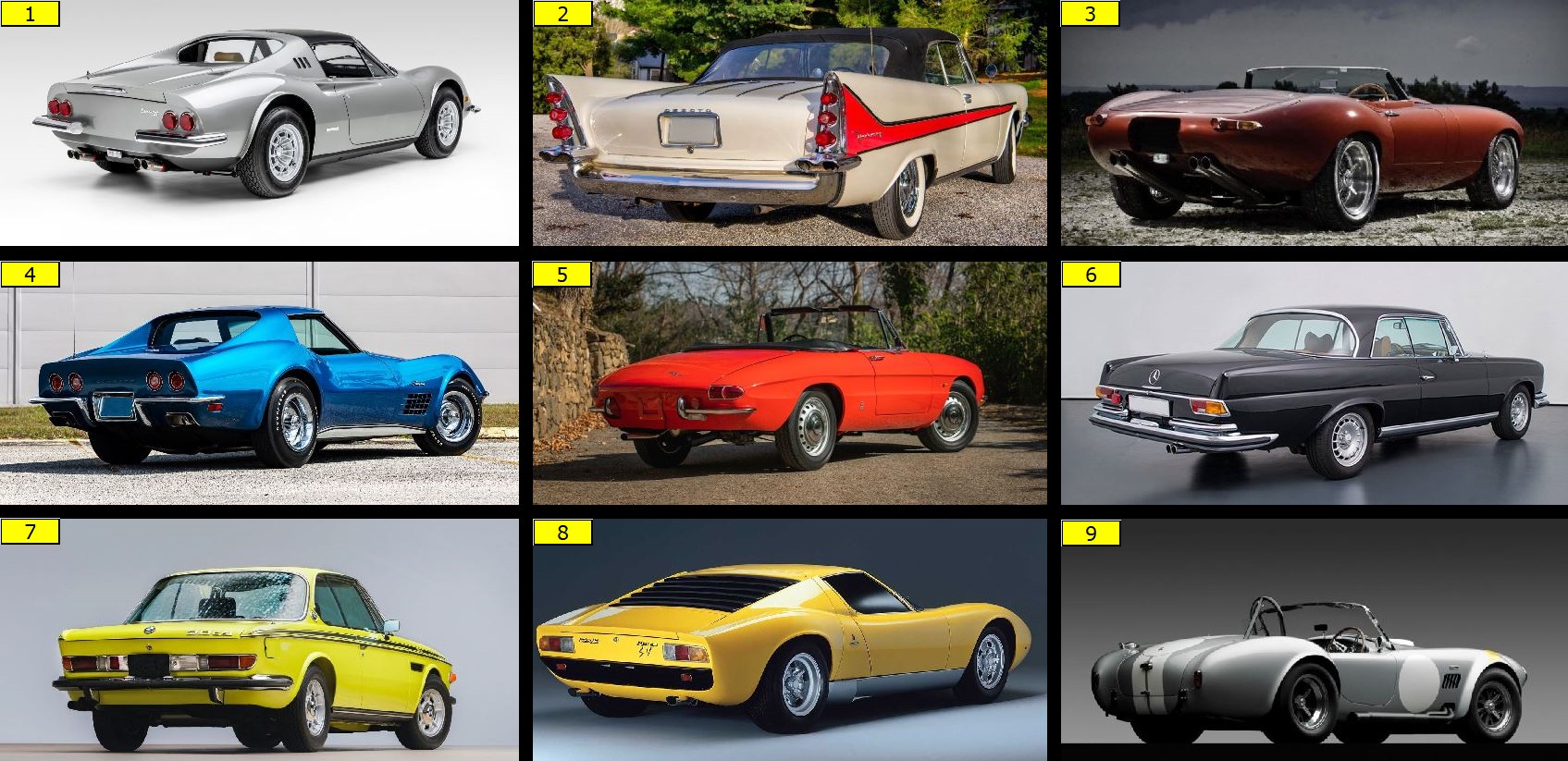
The adjective callipygian need not be restricted to the human form and can be applied anthropomorphically.  In different ways, stylists can apply to machinery the motifs of the baroque, the sensuous the athletic or the muscular.

1 1974 Dino 246 GTS (C&F) by Ferrari.

2 1958 De Soto Firesweep convertible by Chrysler.

3 1965 Jaguar E-Type (modified as Eagle Speedster 4.7).

4 1971 Chevrolet Corvette Coupé LS6 by General Motors.

5 1967 Alfa Romeo Spider 1600 (Duetto).

6 1971 Mercedes-Benz W111 (280SE 3.5 Coupé).

7 1973 BMW E9 (3.0 CSi).

8 1971 Lamborghini Miura P400SV.

9 1966 AC Shelby Cobra 427 S/C.