Showing posts sorted by relevance for query Cruise. Sort by date Show all posts

Friday, July 7, 2023

Cruise

Cruise (pronounced krooz)

(1) To sail about on a pleasure trip (often as cruising).

(2) To sail about, as a warship patrolling a body of water.

(3) To travel about without a particular purpose or destination.

(4) To fly, drive, or sail at a constant speed that permits maximum operating efficiency for sustained travel.

(5) In aeronautics, the portion of aircraft travel at a constant airspeed and altitude between ascent and descent phases.

(6) To travel at a moderately fast, easily controllable speed.

(7) To travel about slowly, looking for customers or for something demanding attention.

(8) As cruise missile, an intermediate-range weapon.

(9) Among male homosexuals, actively to seek a casual sexual partner by moving about a particular area known to be frequented by those there for such purposes, an area known to be productive known as “cruisy” (“to troll” & “trolling” were once used as a synonyms but those terms have now been claimed by their use on the internet).

(10) In informal use in the US military, a period spent in the Marine Corps.

(11) In casual use in sporting competition, easily to win.

1645-1655:  From the Dutch kruisen (to cross, sail to and fro), from kruis or cruis (cross), from the Middle Dutch cruce, from the Latin crux.  Root was the primitive Indo-European sker (to turn, to bend); etymologists suggest it may be cognate with the Latin circus (circle) and curvus (curve).  In English, it began to be used as a noun in 1706 in the sense of “a voyage taken in courses” and by 1906 as “a voyage taken by tourists on a ship".  It was related to the French croiser (to cross, cruise), the Spanish cruzar and the German kreuzen.  The alternative spelling cruize is obsolete.  Cruise & cruising are nouns & verbs, cruised is a verb, cruiser is a noun and cruisy is an adjective; the noun plural is cruises.

Welcome to the Cruise (1979) by Judie Tzuke (b 1956), cover art by Hipgnosis.

In the era of the mass-selling LP (long playing) vinyl records, they were distributed in 305 x 305 mm (12 x 12 inch) cardboard sleeves and the size was sufficient to create what became a genuine genre in graphic art: the album cover.  The era lasted until CD (compact disc) sales eclipsed vinyl; CD packaging being around a quarter the size, greatly the possibilities diminished and what had been a flourishing industry vanished.  Many books detailing the history of album cover art have been published.

Cruiser in the sense of "one who or that which cruises" (agent noun from the verb cruise) is from the 1670s, probably, borrowed from similar words in continental languages (such as the Dutch cruiser & French croiseur).  In older use, a cruiser was a warship built to patrol and protect commerce of the state to which it belongs and to chase hostile ships; cruisers were the classic gun boats used by the European colonial powers for patrolling their empires.  In this use they were often compared to the frigates of old in that they possessed good speed and were employed to protect the trade-routes, to glean intelligence, and to act as the “eyes of the fleet” and in casual use, during the eighteenth century, the term was often applied to the ships of privateers (pirates).  Cruiser was used to describe male homosexuals “cruising for sex partners" (ie frequenting or lingering in places notorious for such things) from 1903, as a boxing weight (cruiserweight) class, from 1920.  The meaning "police patrol car" is a 1929 adoption of US English.

Royal Navy battlecruiser HMS Hood entering Valletta harbor, Malta 1937.

In admiralty use, cruisers are now the largest of the conventional warships still in service.  Navies used to use the term “cruiser” more as a description of the tasks for which the ships were used rather than specific nature of the construction, the early cruisers those ships which were used for long-range missions such as costal raiding or scouting and it was only in the late nineteenth century as the fleets grew and ships became more specialized that the classic model of the corvette / frigate / destroyer / cruiser / battleship evolved.  Even then there were distinctions such as "light" & "heavy" cruisers but the most interesting development in warship architecture was the battlecruiser, built essentially because HMS Dreadnought (1906) had created “a gap in the market”.  Battlecruisers were battleships with less armor, therefore gaining speed at the cost of greater vulnerability.  The theory was they would have the firepower to out-gun all but the battleships and those they could out-run with their superior speed; on the high seas, a margin of even two knots could be decisive.  The concept seemed sound and in December 1914, at the Battle of the Falkland Islands, two Royal Navy battlecruisers vindicated the theory when they chased and destroyed the German East Asia Squadron but less than two years later, the performance of the battlecruisers in the Battle of Jutland (31 May-1 June 1916) forced the Admiralty to re-consider.

The Royal Navy's Battle Cruisers opening fire in the opening stages of the Battle of Jutland, 31 May 1916, (1919), oil on canvas by Lionel Wyllie (1851–1931).  It was the war's only great, set piece, mass engagement.

Fought by fleets of the Royal Navy and the forces of the German Empire (the so-called “Second Reich”), the battle of Jutland in was the closest the world got a cataclysmic clash of fleets of dreadnoughts, an event the navalists and theorists had for a generation be expecting or hankering for.  For a variety of reasons it proved anti-climatic (though at a cost of over 8,000 lives) but while a tactical victory for the Germans (in terms of ships sunk or damaged and causalities suffered), strategically the British succeeded in ensuring for the rest of of World War I (1914-1918) their opponents were confined to a pocket of the Baltic, denied access to the North Sea and thus the Atlantic; this enabled the Royal Navy’s blockade of Germany to be maintained.  Summing up, the New York Times concluded: “The prisoner gave his jailor a bloody nose but at the end of the day was back behind bars in his jail cell.”  Barely noticed except in the halls of the admiralties (where it made a great impression) was the vulnerability of the battlecruiser, a class of ship of which much had been expected although at Jutland they were used in a way the theorists who suggested the configuration had neither intended nor recommended.

Ultimately, both sides choose to avoid the decisive encounter which offered the prospect of victory because the consequences of defeat were so severe, especially for the British: Then serving as First Lord of the Admiralty (minister for the navy), Winston Churchill (1875-1965; UK prime minister 1940-1945 & 1951-1955) had early in the war been quite correct in cautioning the First Sea Lord (the most senior admiral) that while there was little the navy could do to win a continental war, it could "lose it in an afternoon".  Jutland did prove the naval theorists had been right: unless very lucky (not something to rely on at sea), the battlecruiser could not fight the battleship and if their paths threatened to cross, the less-armored vessel should retreat and rely on speed to make good her escape.  There were technical deficiencies in the British ships, without which perhaps three of their battlecruisers wouldn’t have been lost, but what happened in 1916 made it clear to the admirals that uneven contests between the big capital ships were to be avoided.  The consequence was that the battlecruiser became unfashionable and after the round of disarmament in the 1920s, none were built until, unexpectedly, the Soviet Navy commissioned four in the 1980s.  They proved the last of the breed and despite Donald Trump's (b 1946; US president 2017-2021 and since 2025) announcement of the USS Defiant, the USN (US Navy) are (sensibly) planning vessels on a smaller scale. 

Origin of cruise missiles

US Pershing II cruise missiles in Neu-Ulm military base, Swabia, Bavaria in the FRG (Bundesrepublik Deutschland (Federal Republic of Germany; the old West Germany, 1949-1990)), 1984.

Carrying large warheads long distances, cruise missiles are guided weapons, used against ground targets; they fly at both subsonic and supersonic speed, remain in the atmosphere and, self-propelled for the most of their flight, travel for mostly at a constant speed.  In this they differ from ballistic missiles which fly in an arc, often reaching suborbital flight with a final trajectory much like a bullet because, once the fuel is expended, the path from that point is determined by the speed and direction of launch and the force of gravity pulling towards Earth.  Both cruise and ballistic missiles can carry nuclear warheads but cruise missiles are most often equipped with conventional warheads.  Theorists and researchers were exploring the possibility of military missiles as early as 1908, described then as the aerial torpedo, envisaged as remote-controlled weapons with which to shoot-down airships bombing London, perceived then as the most credible airborne delivery system.  Between the World War I & II (1939-1945), the major powers all devoted resources to research but few projects reached even the prototype stage.

Annotated schematic of the V-1 (left) and a British Military Intelligence drawing (dated 16 June 1944, 3 days after the first V-1 attacks on London (right). 

First deployed in 1944 the German Vergeltungswaffen eins (“retaliatory weapon 1” or "reprisal weapon 1” and eventually known as the V-1) was the world’s first cruise missile.  One of the rare machines to use a pulse-jet, it emitted such a distinctive sound that those at whom it was aimed nicknamed it the “buzz-bomb” although it attracted other names including “flying bomb” and “doodlebug”.  In Germany, before Dr Joseph Goebbels (1897–1945; Reich Minister of Propaganda 1933-1945) decided it was the V-1, the official military code name was Fi 103 (The Fi stood for Fieseler, the original builder of the airframe and most famous for their classic Storch (Stork), short take-off & landing (STOL) aircraft) but there were also the code-names Maikäfer (maybug) & Kirschkern (cherry stone).  While the Allied defenses against the V-1 did improve over time, it was only the destruction of the launch sites and the occupation of territory within launch range that ceased the attacks.  Until then, the V-1 remained a highly effective terror weapon but, like the V-2 and so much of the German armaments effort, bureaucratic empire-building and political intrigue compromised the efficiency of the project.

A bronzed (not recommended) Lindsay Lohan on a cruise in the Maldives, January 2019.

The V-1 used a gyroscope guidance system and was fitted with an unusual triple-layer fuse system, the primary device and a backup augmented by a fail-safe designed to ensure destruction of “duds” (weapons which fail to detonate) so they couldn’t be examined.  The accuracy of the thing was sufficient only for use against very large targets (such as the general area of a city which made sprawling London ideal) while the range of 250 km (155 miles) was significantly less than that of a medium bomber carrying the same payload. The main advantages were speed (although not sufficient to outrun the fastest of the low-altitude propeller-driven interceptors), expendability and economy of operation.  Indeed, it was probably the war’s outstanding delivery system in terms of cost per ton of explosive, able to carry a warhead of 850 kg (1,870 lb) to London at a tiny fraction of the cost of using manned aircraft for the same task with the priceless additional benefit of not risking the loss of aircrew.  The production cost of a V-1 was also only a small fraction of that of the supersonic V-2 ballistic missile which carried a warhead only of a similar-size although once launched, effectively, it was invulnerable.  Unlike the V-2, the initial deployments of the V-1 required large, fixed launch ramps which were relatively easy to detect and susceptible to bombardment.  Later experiments produced much smaller launch facilities which provided for a greater rate of sustained fire.  Bomber-launched variants of the V-1 saw limited operational service near the end of the war, with the pioneering V-1's design reverse-engineered by the Americans as the Republic-Ford JB-2 cruise missile.
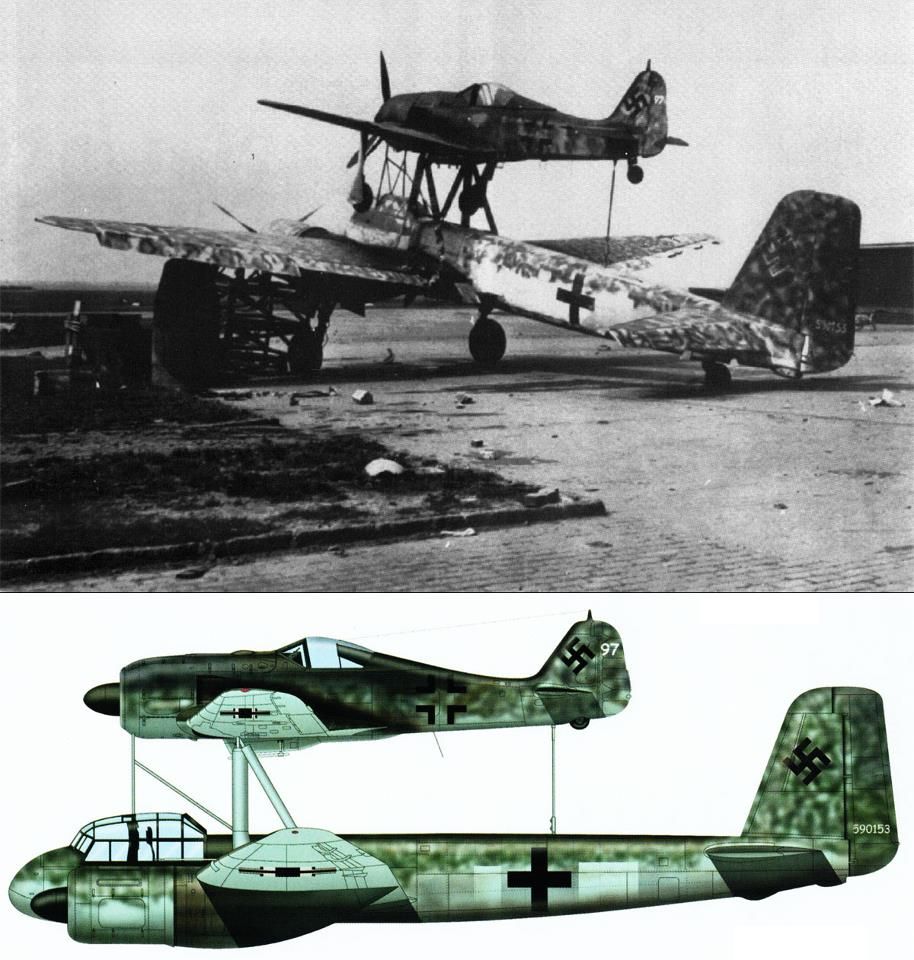
Luftwaffe Mistel Aircraft (Focke-Wulf Fw 190 (upper) & Junkers Ju 88 (lower)), Merseburg, Germany, 1945.

The "cruise missile" project which was the best example of the improvisation which characterized much of the ad-hoc weapon development of war time was the Mistel (mistletoe) or Beethoven-Gerät (Beethoven Device) composite aircraft program which the Germans developed in 1943.  It was a rudimentary air-launched cruise missile, made by a piloted fighter aircraft being mounted atop an unpiloted bomber-sized aircraft, packed with explosives and the larger aircraft would be released to glide towards the target.  Calling it the mistletoe reveals a sense of humor mot usually associated with the Luftwaffe but it was known rather more evocatively as the Vati und Sohn (Daddy and Son) or the Huckepack (Piggyback).  Although built in the hundreds, by the time it was available for deployment, the scope for attacking large targets with manned aircraft had reduced and the need was for precision delivery, something for which the Mistel was ill-suited and success was limited.

Wednesday, November 11, 2026

Riband

Riband (pronounced rib-uh-nd)

(1) A decorative ribbon, especially one awarded for some achievement.

(2) A flat rail attached to posts in a palisade

(3) In heraldry, a narrow diminutive of the bend, thinner than a bendlet.

(4) An archaic form of ribbon with excrescent -d.

1350–1400: From the Middle English ribane, (the spelling ryban does exist in the record but it seems not to have attained much currency and may simply have been a mistake which briefly spread) from the Old French riban (ribbon), a variant of reuban & ruban, probably from a Germanic compound.  The spelling riband endures as descriptor of awards, often in polo or other equestrian hobbies of the horsey set although the informal phrase “blue riband event” is applied also to what is considered the premier contest in a particular competition.  This includes things like the men’s 100 metre sprint at the Olympics, the Melbourne Cup during the Spring Racing Carnival or the Monaco Grand Prix in Formula One's calendar.  The origin of this use is in the wide blue ribbon worn by members of the highest order of knighthood, L'Ordre des chevaliers du Saint-Esprit, instituted by Henri III (1551–1589; King of France 1574-1589) in 1578, an order colloquially known as “Le Cordon Bleus” (the Blue Ribbons).  From this the world of cooking adopted Cordon Bleu, the famous French cooking school, founded in 1895, where chefs wear blue cord on their aprons, a color scheme still seen in many chefs’ uniforms.  Ribband & ribbandry are nouns; the noun plural is ribbands.

Lindsay Lohan in Phillip Lim (b 1973) Runway Tiered Ribbon Shell, Apple Lounge Grand Opening, West Hollywood, California, August 2008

Tiered ribbon constructions are based on the idea of successive layers of ribbons assembled (usually horizontally) and stitched to create a fabric that can be used for a variety of designs.  Because of the modularity, the layering makes possible multi-coloring or shifts in the texture but most designers using the technique seem to prefer solid colors in the same material.  The tiered ribbon concept produces a look similar to that seen on the bandage dress (a subset of the bodycon motif) except that, emulating ribbons, the layers tend to be of lesser depth and the construction not "body hugging" in the way the bandage generates its effect.  The term is used also in the wedding cake business where a thick ribbon is used to encircle each layer of the cake, the idea thematically to in some way tie in with the ceremony's optics, bridesmaid's dresses or table napkins often the match.  With the bride's gown, table cloths and cake icing all in white, Prussian blue is a good choice.

Young lady with tiered (panelled) dress.  The car is a first generation (1966-1969) 1967 Chevrolet Camaro SS Sport Coupe; this was the last season cars could be sold in the US without side-marker lights and the Camaro’s final appearance with quarter-vent windows, the 1968 range introducing the “Astro Ventilation” system, Chevrolet’s “groovy” term for “flow-through ventilation”.

In dressmaking, although tiered (panelled), bandage and ribbon dresses use variations of the same visual effect (and often the same technique of construction), the term “ribbon” is, by convention, restricted to designs in which the successive “layers” are narrow enough to suggest an aspect ratio similar to the ribbons typically used in the wrapping of presents or to tie plaits, pony-tails and such.  What all three types have in common is that despite the appearance, not all are built with separate pieces of fabric, some a single length of material with an illusion of “separateness” (specifically un-gathered horizontal tiers (also referred to as horizontal piecing or banded construction)) created by strategic stitching.  Although the concept is simple, execution of any of these demands precision because each seam (or its emulation) needs exactly to be parallel with  all others regardless of the detail differences.  While most tiered dresses gather each lower band for volume, a “straight column” or “sheath” skirt can be built from successive horizontal panels sewn together edge-to-edge. This creates visible horizontal seam lines down the length of the garment, the advantage of this being the line is preserved without additional fullness.  Although it may seem “fussy detailing”, designers often use tiers on straight skirts because the horizontal bands creates an “architectural structure”, the “visual breaks” in the long, narrow silhouette there for the same reason such things appear on buildings or cars with a large expanse of otherwise flat panel-work.  Done well, it can demand a close inspection to determine whether the seamstress has used separate pieces of fabric or emulated the look with ticked or lapped seams.  The bandage dress is quite specific to the “bodycon” genre but, as a general principle, the tiered technique can be used for just about any style of skirt or dress although designers caution that with any accessories, it’s usually better to conform to the “horizontal motif”.  For those wishing to use the effect to the greatest the empire-line is recommended.

Mr Andrew Mountbatten-Windsor (b 1960, formerly Prince Andrew, Duke of York, Admiral, Knight of the Most Noble Order of the Garter (an order of chivalry founded in 1348)).  Because of some "unpleasantness", he's now prohibited from donning his many military uniforms but remains entitled to wear his medals or the associated ribbon bars (although the latter are usually not paired with civilian dress).

Ribbon dates from the 1520s and was from the English riban, ryban & ryband, from Old French riban & ruban (persisting in modern French as ruban).  The origin is murky but etymologists suspect the source was likely from a Germanic compound with a second element cognate with English band (the Middle Dutch ringhband (necklace) translates literally as “ring-band”.  The Middle English forms displaced the native Old English þwǣle (strip, ribbon).  The modern spelling was (more or less) standardized in the sixteenth century, describing a “stripe in fabric”, the sense of a "narrow woven band of some find material" for ornamental or other purposes known by the 1520s while the familiar meaning (long, thin, flexible strips) dates from 1763.  The use to describe the "ink-soaked strip wound on a spool for use on a typewriter" was from 1883 and the idea of a “torn strip of anything” was in use by 1820 while the sense as a verb (adorn with ribbons) was in use by at least 1715.  The custom of wearing colored ribbon loops on the lapel to declare support for a cause (pink for breast cancer, copper for herpes etc) began is 1991 with AIDS red ribbons and there’s now such an array that of the hundreds of causes now ribboned, there are many duplications so the fabric (or its representation) sometimes include text, the other differentiation being to use multiple colors, teal & purple for example claimed by the suicide awareness community.  In military use, "ribbon bars" (or "military ribbons) are small, mounted fabric representations of military medals, decorations, or service awards worn on uniform dress shirts or service coats when full-sized medals are not appropriate.  The ribbon bars are a "slice" of the full ribbon used to connects the suspension to the brooch; made originally of silk synthetic materials such as polyester are now common.

Over 500-odd years, words fall in and out of fashion.

Google Ngram (a quantitative and not qualitative measure): Because of the way Google harvests data for their Ngrams, they’re not literally a tracking of the use of a word in society but can be usefully indicative of certain trends, (although one is never quite sure which trend(s)), especially over decades.  As a record of actual aggregate use, Ngrams are not wholly reliable because: (1) the sub-set of texts Google uses is slanted towards the scientific & academic and (2) the technical limitations imposed by the use of OCR (optical character recognition) when handling older texts (typically a scanner might misread an “f” for a long “s” or a “u” for an “n”) of sometime dubious legibility (a process AI (artificial intelligence) should improve).  Where numbers bounce around, this may reflect either: (1) peaks and troughs in use for some reason or (2) some quirk in the data harvested. 

SS United States.

Although not formalized until 1935, the Trans-Atlantic Blue Riband is the honor awarded to the passenger liner in regular service crossing the Atlantic Ocean in the fastest time (and thus the highest average speed).  Over more than a century, 35 liners have held the record, the accolade first (retrospectively) won by the British SS Sirius which, in May 1838, took 15 days to cross at 7.31 knots (13.54 km/h), the last by the SS United States which in 1952 made 35.59 knots (65.91 km/h).  The 1952 mark (set over 3 day, 10 hours, 40 minutes) remains unbroken; those vessels that subsequently have achieved higher speeds have not been ocean liners and the fastest have been built specifically to set the record.  Other awards have been created to acknowledge the absolute speed records in various classes of competition so the Blue Riband remains historically unique.  Once both the fastest, safest and most economical way to make the crossing, it was the advent of the jet-age that doomed the fast ocean-liner.  The Boeing 707 and Douglas DC8 both began regular trans-Atlantic services in 1958 and the business of the big ships went into decline, revived periodically during periods of economic buoyancy as cruise liners with an emphasis on packaged tourism for the middle-class and luxury for the rich rather than speed so the record of the SS United States seems unlikely to be broken.  Although as early as the mid-1950s piston-engine aircraft had eroded the market, by 1960 the jets made it clear the universe had shifted and the days of the mass-market trans-Atlantic liners were almost done. 

A “ribbon braid” and hoodie combo in (of course) pink.  Babes in Hairland provides detailed instructions for constructing (that really is the best word) a ribbon braid.  The concept is simple but execution demanding; it takes much practice to produce a result as accomplished as this.  For those wanting the most spectacular Instagram post, one should find a suitable acersecomic. 

Without the need for speed, the cruise ships have got bigger and what were once called “floating hotels” are now better imagined as “floating towns”, some with a capacity of close to 10,000 passengers and crew (including a maximum 7,600 passengers although most go to sea with fewer than 6,500).  The term “big ship” certainly has assumed a new significance in the twenty-first century, the largest maintained by the cruise operators measuring 1,198 feet (365 metres; close to a ¼ mile) stem to stern with a gross displacement over a quarter-million tons.  As pieces of nautical architecture, they are fine examples of the designers' art because although looking dangerously top heavy (imagine a 12-storey apartment block placed atop a ship's hull), their weight distribution is within acceptable limits because of the use of light-weight materials for the superstructure above a certain line.  According to designers, the greatest limitation is the need to account for the effects of side winds. 

Last moments of the biggest of the “Super Dreadnoughts”, a breed now extinct: Yamato under attack by carrier-based US aircraft, East China Sea, 7 April, 1945.

By comparison, the largest Dreadnought (battleship) ever launched was the IJN’s (Imperial Japanese Navy) 大和 (Yamato, 1940-1945) and she was 863 feet (263 metres) in length, displacing 72,000 tons and in that, Yamato and her sister ship 武蔵 (Musashi, 1940-1945) are a footnote in the study of the language of diplomacy.  At the time, Japan was a signatory to an international treaty limiting the armament & displacement of warships and when asked if rumors of a 50,000 ton battleship were true, the foreign ministry issued a statement assuring all: “Nippon is not building warships in the 50,000 ton class”.  That was of course true but what was not added was that under construction were two in the then novel 70,000 ton class; it was a classic exercise in being “economical with the truth”, a much admired art among those of the corps diplomatique.  The biggest of the modern cruise ships are rated for some 23 knots (42 km/h) and while as an exercise in nautical architecture it would in theory be possible to build an ocean liner able (under ideal conditions) to cross the Atlantic at 50 knots (93 km/h) or more while carrying at least as many passengers as the SS United States (around 2,000), such a venture would not be economically viable because demand at the price point(s) required to ensure profitability would not exist: Those with the money don't have the time and those with the time don't have the money.

Last days afloat for USS United States: Moored in Florida awaiting scuttling.

The only traditional ocean liner still sometimes used for the crossing is the RMS Queen Mary 2 (in service since 2004) and although in sea trials able to achieve 30 knots (56 km/h), her usual operating maximum is 26 knots (48 km/h).  In truth, even the Blue Riband winning run in 1952 was not typical of trans-Atlantic operations, the speed achieved at the cost of fuel consumption, the excess volume carried and burned over the 3½ days unsustainable in any commercial operation; the one-off sprint for the ship's maiden voyage was a publicity stunt to ensure the US regained the title from the British, the RMS Queen Mary between 10-14 August, having crossed in 3 days, 20 hours, 42 minutes at 31.69 knots (58.69 km/h).  Because most mail transported over distances is now carried by air, “RMS” (Royal Mail Ship) is now mostly a historic relic with the UK’s Royal Mail usually granting warrants for the prefix to be used only on the handful of vessels still used for the purpose.  Despite no longer being a mail carrier, Cunard’s Royal Mary 2 was granted an “RMS” because of the line’s long tradition.  When introduced in the nineteenth century the “SS” prefix stood for “Single-screw steamship” but, as technology evolved, use was clipped to a generic “steam ship”.  As a footnote, the tale that in 1945 the board of S.S. Cars in England voted to change the company’s name to “Jaguar” because of unpleasant memories of the Nazi era SS is an urban myth, the re-branding made just to achieve distinctiveness in the marketplace (ie product differentiation).

The SS (ᛋᛋ in Armanen runes; Schutzstaffel (literally “protection squadron” but translated variously as “protection squad”, “security section” etc)) was formed (under different names) in 1923 as a Nazi party squad to provide security at public meetings (then often rowdy and violet affairs) and was later re-purposed as a personal bodyguard for Adolf Hitler (1889-1945; Führer (leader) and German head of government 1933-1945 & head of state 1934-1945).  The SS name was adopted in 1925 and during the Third Reich the institution evolved into a vast economic, industrial and military apparatus more than two million strong to the point where some historians (and contemporaries) regarded it as a kind of “state within a state”.  The Waffen-SS (armed SS (ie equipped with military-grade weapons)) existed on a small scale as early as 1933 before Hitler’s agreement was secured to create a formation at divisional strength and growth was gradual even after the outbreak of hostilities in 1939; it was the invasion of the Soviet Union in 1941 that triggered the Waffen-SS’s expansion into a multi-national armoured force with over 700,000 men under arms.  As well as the SS’s role in the administration of the many concentration and extermination camps, the Waffen-SS widely was implicated in war crimes and crimes against humanity.

SS United States (upper) and SS America (lower), New York Harbor, 7 April, 1963 with the Manhattan skyline in the background.  This was a postcard issued by the Steelograph Company, One Broadway, New York City.

SS America had a desultory and often unhappy career after in 1964 being sold by USL (United States Line), her end coming in 1994 when she ran around in the Canary Islands while under tow to Thailand where a refit as a floating hotel was planned.  Over the decades, rough seas broke up the wreck and by 2026, even at low tide, nothing remained visible.  SS United States remained in trans-Atlantic service even after ceasing to be profitable and, in a sign of the times, USL struck it from their active list in 1969, the year in which the Anglo-French SST (supersonic transport) Concorde and Boeing 747 “jumbo-jet” undertook their maiden flights.  Between 1969 and 2026, remarkably, she never re-entered service or fulfilled any commercial purpose, instead passing between owners who had a variety of plans, all of which were abandoned once accountants, with due diligence, ran the numbers.  Finally, after all those peripatetic years moving from port to port, on Wednesday 11 November, 2026 (a day ahead of schedule to avoid bad weather), she was taken in tow and scuttled some 22 nautical miles north-west of Destin-Fort Walton Beach, Florida, creating (at 990 feet (302 metres) stem to stern) the planet's largest artificial reef, open as a shared space to both fish and divers.  The latter are able to use coordinates 30o 07.148' N, 86o 46.755' W (30.119133° N, 86.779250° W in decimal degrees) to locate the wreck's offshore deployment site, the former left to their own devices.  The event was live-streamed.

Friday, February 25, 2022

Phalanx

Phalanx (pronounced fey-langks or fal-angks)

(1) In Hellenic Greece, a group of heavily armed infantry formed in ranks and files close and deep, with shields joined and long spears overlapping.

(2) A body of troops in close array.

(3) A compact or closely massed body of persons, animals or things, usually united or aligned for a common purpose.

(4) A radar-controlled 20mm Gatling-type gun deployed on US Navy ships as a last line of defense against cruise missiles.

(5) In Fourierism, a group of about 1800 persons, living together and holding their property in common.

(6) In anatomy and zoology, any of the bones of the fingers or toes (the related adjective phalangeal).

(7) In printing, to arrange the distribution of work in a production house as evenly as possible.

(8) In botany, a bundle of stamens, joined together by their stalks (filaments).

(9)A form of vegetative spread in which the advance is on a broad front, as in the common reed.

1550s: From the Latin phalanx from phalangis & phalangem (compact body of heavily armed men in battle array) derived from Greek phalanx (genitive phalangos) (line of battle, battle array).  The origin of the use as a descriptor of finger or toe bone (originally "round piece of wood, trunk, log”) is unknown, most often thought to be from the from Old English balca (balk), from the primitive Indo-European root bhelg (plank, beam).  In anatomy, a phalanx was originally the whole row of finger joints, which fit together like infantry in close order.  The rare adjectival forms were phalangeal & phalangic.  The figurative sense of "number of persons banded together in a common cause" is attested from 1600, the most recent adaptation probably the 1937 Spanish Falangist, (a member of the fascist organization founded in 1933), from the Spanish Falange (Española) (Spanish), from the Latin phalanx.

Phalanx terminology.

The Macedonian military formation known as a phalanx consisted in theory of fifty close files, sixteen ranks deep, the men clad in armor, bearing shields, armed with swords and spears between 21 - 24 feet (6.4-7.3 m) in length.  In array, the shields formed a continuous bulwark, the ranks placed at such intervals that five spears which were borne pointed forward and upward protected every man in the front rank.  Properly handled, on level ground and with its flanks and rear adequately protected, the phalanx was a formidable formation but was cumbrous and slow in movement, and if once broken could only with great difficulty be reformed.  It was thus dependent on high-quality leadership and highly-trained troops and was notably vulnerable when, as inevitably happens under battlefield conditions, it was assembled, sometimes hastily, with whatever resources were available.

Phalanx live fire test, USS Monterey, November 2008.

Designed essentially to meet any incoming missile with a “wall of metal”, the Phalanx CIWS began life as a close-in weapon system installed on naval warships as defense against anti-ship missiles. Developed and manufactured by the General Dynamics Corporation’s Pomona Division (now a part of Raytheon), it’s based around a radar-guided 20 mm (0.79 in) Vulcan cannon mounted on a swiveling base and is used by more than a dozen navies on every class of surface combat ship.  The reliability and flexibility attracted wider interest and a land based variant known as C-RAM has been developed, deployed in a short range missile defense role to counter incoming rockets and even artillery fire.  The early models were (hydraulic driven) with a fire rate of 3,000 rounds per minute (rpm) and the magazine drum had a capacity of 989 rounds while the later, pneumatically driven modes fire at a rate of 4,500 rpm from a 1,550-round magazine.  Each round costs about US$30 and typically between 100-200 are expended during each targeting.  A combination of the appearance of the distinctive, barrel-shaped, radar dome (radome) and the automated operation, meant the Phalanx CIWS units soon attracted the nicknamed "R2-D2", named after the droid from the film Star Wars (1977).

Lindsay Lohan's fractured Phalanx

During an Aegean cruise in October 2016, Lindsay Lohan suffered a finger injury.  In this dreadful nautical incident, the tip of one digit was severed by the boat's anchor chain but details of the circumstances are sketchy although there was speculation that upon hearing the captain give the command “weigh anchor”, she decided to help but, lacking any background in admiralty jargon, misunderstood the instruction.

Detached chunk of a distal digit was salvaged from the deck and expertly re-attached by a micro-surgeon ashore, digit and the rest of the patient said to have both made full recoveries.  Despite the injury, Ms Lohan still managed to find a husband so all's well that ends well.

Tuesday, February 6, 2024

Clerestory

Clerestory (pronounced kleer-stawr-ee or kleer-stohr-ee)

(1) In architecture, a portion of an interior rising above adjacent rooftops, fitted with windows admitting daylight.

(2) In church architecture, a row of windows in the upper part of the wall, dividing the nave from the aisle and set above the aisle roof (associated particularly with the nave, transept and choir of a church or cathedral.

(3) In transportation vehicles (usually busses, railroad cars and occasionally cars & vans), a raised construction, typically appended to the roof structure and fitted with (1) windows to admit light or enhance vision or (2) slits for ventilation (or a combination of the two).

1375–1425: From the late Middle English, the construct being clere (clear (in the sense of “light” or “lighted”)) + story (from storey (a level of a building).  The word is obviously analyzed as “a story (upper level) with light from windows”.  Storey was from Middle English stori & storie, from the Anglo-Latin historia (picture), from the Latin, from the Ancient Greek ἱστορία (historía) (learning through research, narration of what is learned), from ἱστορέω (historéō) (to learn through research, to inquire), from ἵστωρ (hístōr) (the one who knows, the expert, the judge).  In the Anglo-Latin, historia was a term from architecture (in this case “interior decorating” in the modern sense) describing a picture decorating a building or that part of a building so decorated.  The less common alternative spellings are clearstory & clerstory.  Clerestory is a noun and clerestoried is an adjective; the noun plural is clerestories.

From here was picked up the transferred sense of “floor; level”.  The later use in church architecture of “an upper story of a church, perforated by windows” is thought simply to be a reference to the light coming through the windows and there is nothing to support the speculation the origin was related to a narrative (story) told by a series of stained glass windows, illuminated by sunlight.  Historians have concluded the purpose of the design was entirely functional; a way of maximizing the light in the interior space.  The related architectural design is the triforium.  The noun triforium (triforia or triforiums in the plural) (from the Medieval Latin triforium, the construct being tria (three) + for (opening) + -ium) describes the gallery of arches above the side-aisle vaulting in a church’s nave.  The –ium suffix (used most often to form adjectives) was applied as (1) a nominal suffix (2) a substantivisation of its neuter forms and (3) as an adjectival suffix.  It was associated with the formation of abstract nouns, sometimes denoting offices and groups, a linguistic practice which has long fallen from fashion.  In the New Latin, it was the standard suffix appended when forming names for chemical elements.

Clerestories which once shone: Grand Central Terminal (the official abbreviation is GCT although the popular form is "Grand Central Station" (often clipped to "Grand Central")), Midtown Manhattan, New York City, 1929 (left) and the same (now dimmed) location in a scene from the Lindsay Lohan film Just my Luck (2006) (right).  Because of more recent development in the surrounding space, the sunlight no longer enters the void through the clerestoried windows is such an eye-catching way.  In modern skyscrapers, light-shafts or atriums can extend hundreds of feet.

Tourist boat on a canal cruise, Amsterdam, the Netherlands.

Boats with clerestory windows are commonly seen on waterways like the canals of Amsterdam and are valued by tour-guides because they make excursions possible in (almost) all-weathers.  Those designing passenger busses and train carriages were also early adopters of clerestory windows, initially because they were a source of “free” light but as packaged tourism developed into “sightseeing”, tour operators recognized the potential and commissioned versions optimized for outward visibility, essentially a form of “value-adding” which made even the dreary business of bus travel from one place to the next more of a “sightseeing” experience, something probably most valued by those afforded a greater vista to observe in mountainous regions.

Greyhound Scenicruiser in original livery.

A variation of the idea was used for long-distance busses in North America, the best known of which remains the Greyhound Scenicruiser (PD-4501), featuring a raised upper deck with a clerestory windscreen.  Although the view through that was enjoyed by many passengers, the design was less about giving folk a view and more a way to maximize revenue within the length restrictions imposed by many US states.  What the upper deck did was allow a increase in passenger numbers because the space their luggage would absorb in a conventional (single layer) design could be re-allocated to people, their suitcases (and in some cases also freight, another revenue stream) relegated to the chassis level which also improved weight distribution and thus stability.

A predecessor: 1930 Lancia Omicron.

Famous as it became, the Scenicruiser, 1001 of which were built by General Motors (GM) between 1954-1956, was to cause many problems for both manufacturer and operator, the first of which caused by the decision to use twin-diesel engines to provide the necessary power for the new, heavy platform.  The big gas (petrol) units available certainly would have provided that but their fuel consumption would not only have made their operation ruinously expensive (both the fuel burn and the time lost by needing frequently to re-fill) and the volume of gas which would have to be carried would have both added to weight and reduced freight capacity.  Bigger GM diesel units weren’t produced in the early 1950s so the twin engines were a rational choice and the advantages were real, tests confirming that even when fully loaded, the coupled power-train would be sufficient for hill climbing while on the plains, the Scenicruiser happily would cruise using just a single engine.  However, as many discovered (on land, sea and in the air), running two engines coupled together is fraught with difficulties and these never went away, the busses eventually adopting one of GM’s new generation of big-displacement diesels as part of the major re-building of the fleet in 1961, a programme which also (mostly) rectified some structural issues which had been recognized.  Despite all that, by 1975 when Greyhound retired the model, the company still had hundreds in daily service and many of those auctioned off were subsequently used by other operators and in private hands, some are still running, often as motor homes or (mostly) static commercial displays or museum exhibits.

1951 Pegaso Z-403 (left) and 1949 Brill Continental (right).

GM’s Scenicruiser was influential and clerestory windscreens soon proliferated on North American roads although the idea wasn’t new.  The Spanish manufacturer Pegaso (a creation of Generalissimo Francisco Franco’s (1892-1975; Caudillo of Spain 1939-1975) industrial policy) between 1951-1957 produced the Z-403 (1951-1957) which used the same design and before even that a bus with an almost identical profile had been sold in the US by the JG Brill Company, albeit with a conspicuous lack of success.  As early as 1930 the Italian concern Lancia offered the Omicron bus with a 2½ half deck arrangement with a clerestoried upper windscreen.  The Omicron’s third deck was configured usually as a first-class compartment but at least three which operated in Italy were advertised as “smoking rooms”, the implication presumably that the rest of the passenger compartment was smoke-free.  History doesn't record if the bus operators were any more successful in enforcing smoking bans than the usual Italian experience.

1968 Oldsmobile Vista Cruiser.

One quirky offering which picked up the Scenicruiser’s clerestoried windscreen was the Oldsmobile Vista Cruiser (1964-1977), a station wagon which, until the release of the third series in 1973 featured one at the leading edge of a raised roof section, the glass ending midway over the backseat, the shape meaning it functioned also as a “skylight”.  Above the rear side windows were matching clerestories which might sound a strange thing to add above a luggage compartment but during those years, a “third seat” was a popular option to install in the space, transforming the things into eight or nine seat vehicles; families were bigger then.  The Vista Cruiser sold well and Buick later adopted the idea for some of its range until the concept was abandoned in 1972 because of concerns about upcoming safety regulations.  Such rules were however never imposed and both manufacturers revived the idea in the 1990s for their (frankly ugly) station wagons and when the Buick was discontinued in 1996, it was the last full-sized station wagon to be made in the US, the once popular market segment cannibalized to the point of un-viability by the mini-van (people-mover) and the sports utility vehicle (SUV).

The arrangement of a series of windows in a high-mounted row, borrowed from architecture, became familiar on train carriages and buses, especially those which plied scenic routes.  Usually these were added to the coachwork of buses built on existing full-sized commercial chassis which could seat 40-60 passengers but in the 1950s, there emerged the niche of the smaller group tour, either curated to suit a narrower market or created ad-hoc by hotels or operators; smaller vehicles were required and these offered the additional advantage of being able sometimes to go where big buses could not.  In places like the Alps, where those on the trip liked to look up as well as out, rows of clerestoried windows were desirable.

1959 Volkswagen Microbus Deluxe (23 Window Samba). 

The best known of these vehicles was the Volkswagen “Samba”, a variation of the Microbus, one of the range of more than a dozen a models built on the platform of the Type 2, introduced in 1950 after a chance sighting by a European distributer of a VW Beetle (Type 1) chassis which had been converted by the factory into a general-purpose utility vehicle.  The company accepted the suggestion a market for such a thing existed and in its original, air-cooled, rear-engined configuration, it remained in production well into the twenty-first century.  Between 1951-1966, the Microbus was available in a “Deluxe” version which featured both a folding fabric sunroof and rows of rows of clerestoried windows which followed the curve of the sides of the roof.  Available in 21 & 23 window versions, these are now highly collectable and such is the attraction there’s something of a cottage industry in converting Microbuses to the clerestoried specification but it’s difficult exactly to emulate the originals, the best of which can command several times the price of a fake (a perfectly restored genuine Samba in 2017 selling at auction in the US for US$302,000).  Such was the susceptibility to rust, the survival rate wasn’t high and many led a hard life when new, popular with the tour guides who would conduct bus-loads of visitors on (slow) tours of the Alps, the sunroof & clerestory windows ideal for gazing at the peaks.  To add to the mood, a dashboard-mounted valve radio was available as an option, something still for many a novelty in the early 1950s.  The Microbus Deluxe is rarely referred to as such, being almost universally called the “Samba” and the origin of that in uncertain.  One theory is it’s a borrowing from the Brazilian dance and musical genre that is associated with things lively, colorful, and celebratory, the link being that as well as the sunroof and windows, the Deluxe had more luxurious interior appointments, came usually in bright two-tone paint (other Type 2s were usually more drably finished) and featured lashings of external chrome.  It’s an attractive story but some prefer something more Germanic: Samba as the acronym for the business-like phrase Sonnendach-Ausführung mit besonderem Armaturenbrett (sunroof version with special dashboard).  However it happened, Samba was in colloquial use by at least 1952 and became semi official in 1954 when the distributers in the Netherlands added the word to their brochures.  Production ended in July 1967 after almost 100,000 had been built.

1966 Volkswagen Samba (21 Window, Left) and 1962 Volkswagen Samba (23 Window, Right).  The 23 Window van is a conversion of a Microbus and experts (of which there seem to be many, such is the following these things have gained) say it's close to impossible exactly to replicate a factory original.  In theory, the approach would be to take the parts with serial numbers (tags, engine, gearbox etc) from a real Samba which has rusted into oblivion (something not uncommon) and interpolate these into the sound body of a Microbus with as close a build date as possible.  Even then, such are the detail differences that an exact replication would be a challenge.  Because the Sambas received the same running changes and updates as the rest of the Microbus range, there was much variation in the details of the specification over the years but the primary distinction is between the “21” & “23” window vans, the difference accounted for by the latter’s pair of side-corner windows to the left & right of the rear top gate opening.  In 1964, when the rear doors were widened, the curved windows in the roof were eliminated because there would no longer be sufficient metal in the coachwork to guarantee structural integrity.