Showing posts sorted by relevance for query Doodlebug. Sort by date Show all posts

Wednesday, October 16, 2024

Doodlebug

Doodlebug (pronounced dood-l-buhg)

(1) In entomology the larva of an antlion (a group of some 2,000 species of insect in the neuropteran family Myrmeleontidae, the appellation “doodlebug” an allusion to the “doodle-like” marks they leave in the sand as tracks of their movement.

(2) In entomology (UK), a cockchafer (genus Melolontha).

(3) In entomology (US regional), a woodlouse.

(4) Any of various small, squat vehicles.

(5) A divining rod or similar device supposedly useful in locating underground water, oil, minerals etc.

(6) In World War II (1939-1945) UK slang, the German cruise missile the V1, (Fs-103, also known in formally as the “flying bomb” or “buzz bomb”, the latter an allusion to the distinctive sound made by the craft’s pulse-jet power-plant.  The slang began among RAF (Royal Air Force) personnel and later spread to the general population.

(7) In US rural slang, as “doodlebug tractor”, a car or light truck converted into tractor used for small-scale agriculture for a small farm during World War II.

(8) In informal use, a term of endearment (now rare).

(9) In informal use, a slackard (an archaic form of slacker) or time-waster (now rare).

(10) In informal, an idiot (the word used casually rather than in its once defined sense in mental health).

(11) In informal use, someone who habitually draws (or doodles) objects).

(12) Individual self-propelled train cars (obsolete).

(13) A device claimed to be able to locate oil deposits.

1865-1870: A coining in US English, the construct being doodle + bug, the first known use as a US dialectal form (south of the Mason-Dixon line) to describe certain beetles or larva.  Doodle dates from the early seventeenth century and was used to mean “a fool or simpleton”.  It was originally a dialectal form, from dudeldopp (simpleton) and influenced by dawdle (To spend time idly and unfruitfully; to waste time, pointlessly to linger, to move or walk lackadaisically; to “dilly-dally”), thus the later use of doodle to mean “a slackard (slacker) or time-waster”.  The German variants of the etymon included Dudeltopf, Dudentopf, Dudenkopf, Dude and Dödel (and there’s presumably some link with the German dudeln (to play the bagpipe)).  There is speculation the Americanism “dude” may have some link with doodle and the now internationalized (and sometimes gender-neutral) “dude” has in recent decades become one of slang’s more productive and variable forms.  The song Yankee Doodle long pre-dates the American Revolutionary War (1775-1783) but it was popularized in the era by being used as a marching song by British colonial troops and intended to poke fun at their rebellious opponents.  From this use was derived the verb of the early eighteenth century (to doodle), meaning “to swindle or to make a fool of”.  The predominant modern meaning (the drawings regarded usually as “small mindless sketches”) emerged in the 1930s either from this meaning or (s seems to have greater support), from the verb “to dawdle” which since the seventeenth century had been used to mean “wasting time; being lazy”.  In slang and idiomatic use, doodles uses are legion including “the penis” and any number of rhyming forms with meanings ranging from the very good to the very bad.

A doodled Volkswagen “bug” on Drawn Inside.

Bug dates from 1615–1625 and the original use was to describe insects, apparently as a variant of the earlier bugge (beetle), thought to be an alteration of the Middle English budde, from the Old English -budda (beetle) by etymologists are divided on whether the phrase “bug off” (please leave) is related to the undesired presence of insects or was of a distinct origin.  Bug, bugging & debug are nouns & verbs, bugged is a verb & adjective and buggy is a noun & adjective; the noun plural is bugs.  Although “unbug” makes structural sense (ie remove a bug, as opposed to the sense of “debug”), it doesn’t exist whereas forms such as the adjectives unbugged (not bugged) and unbuggable (not able to be bugged) are regarded as standard.  The array of compound forms meaning “someone obsessed with an idea, hobby etc) produced things like “shutterbug” (amateur photographer) & firebug (arsonist) seems first to have emerged in the mid nineteenth century.  The development of this into “a craze or obsession” is thought rapidly to have accelerated in the years just before World War I (1914-1918), again based on the notion of “bitten by the bug” or “caught the bug”, thus the idea of being infected with an unusual enthusiasm for something.  The use to mean a demon, evil spirit, spectre or hobgoblin was first recorded in the mid-fourteenth century and was a clipping of the Middle English bugge (scarecrow, demon, hobgoblin) or uncertain origin although it may have come from the Middle Welsh bwg (ghost; goblin (and linked to the Welsh bwgwl (threat (and earlier “fear”) and the Middle Irish bocanách (supernatural being).  There’s also speculation it may have come from the scary tales told to children which included the idea of a bugge (beetle) at a gigantic scale.  That would have been a fearsome sight and the idea remains fruitful to this day for artists and film-makers needing something frightening in the horror or SF (science fiction) genre.  The use in this sense is long obsolete although the related forms bugbear and bugaboo survive.  Dating from the 1570s, a bugbear was in folklore a kind of “large goblin”, used to inspire fear in children (both as a literary device & for purposes of parental control) and for adults it soon came to mean “a source of dread, resentment or irritation; in modern use it's an “ongoing problem”, a recurring obstacle or adversity or one’s pet peeve.  The obsolete form bugg dates from circa 1620 and was a reference to the troublesome bedbug, the construct a conflation of the middle English bugge (scarecrow, hobgoblin) and the Middle English budde (beetle).  The colloquial sense of “a microbe or germ” dates from 1919, the emergence linked to the misleadingly-named “Spanish flu” pandemic.  Doodlebug & doodlebugger are nouns and doodlebugging is a verb; the noun plural is doodlebugs.  The forms have sometimes been hyphenated.

A doodlebug (left) and his (or her) doodles in the sand (right).

That the word doodlebug has appeal is obvious because since the 1860s it has been re-purposed many time, often with the hint something “small but not cute”, that something understandable given the original creature so named (larva of an antlion) is not one of nature’s more charismatic creations.  Doodlebugs are squat little things which live mostly in loose sand where they create pit traps and genuinely are industrious creatures, their name earned not because they are idle time-wasters but because the tracks they leave in the sand are strikingly similar to the doodles people often wile away their time drawing.  The frankly unattractive ant leave their doodles behind because as they percolate over the sands, their big butts drag behind them, leaving the erratic trails.  So compelling is the name, it has been applied to a number of other, similar insects.  Another use is attributive from the link with the seventeenth century notion of a doodle being “a simpleton or time-waster”, extended later to “an idiot” (the word used casually rather than in its once defined sense in mental health); in the 1930s it came be used of those who incessantly sketch or draw stuff, the idea being they are squandering their time.  What they draw are called “doodles”, the source of the name for the artist.

Doodles on a rendering of Lindsay Lohan by Stable Diffusion.

The mid-twentieth century art (some of its practitioners claiming it was a science) of doodlebugging was practiced by doodlebuggers who used a method said to be not greatly different from the equally dubious technique of the water diviner.  All the evidence suggests there was a general scepticism of the claims that a bent rod waived about above the earth could be used to locate hydro-carbons and the use of “doodlebuging” to refer to the process was originally a slur but it became an affectionate name for those intrepid enough to trek into deserts seeking the “black gold”.  In the 1940s when the “profession” was first described, any reliable means of detecting sub-surface oil deposits simply didn’t exist (other than drilling a hole in the ground to see if it was there) and the early doodlebuggers were scam merchants.  The science did however advance (greatly spurred on by the demands of wartime) and when geologists came to be able to apply the modern machinery of seismic mapping and actually had success, they too were called doodlebuggers and happily adopted the name.

Texaco Doodlebug fuel tanker, one of eight built in 1934-1935 during the industry's "streamliner" era.  It was a time when art deco's lovely lines appeared in many fields of design. 

In the early twentieth century, a doodlebug was a self-propelled rail car, used on rail lines which were short in length and subject only to light traffic.  These were autonomous vehicles, powered both by gasoline (it was the pre-diesel era in the US) and electricity and were an economical alternative for operators, being much cheaper to run than the combination of large locomotives & carriage cars, eminently suited to lower passenger numbers.  The concept may be compared with the smaller (often propeller or turbo-prop) aircraft used on regional & feeder routes where the demand wouldn’t make the use of a larger airliner viable.  Although the doodlebugs carried relative few passengers, their operating costs were correspondingly lower so the PCpM (passenger cost per mile) was at least comparable with the full-sized locomotives.  While it may be a myth, the story is that one rail employee described the small, stumpy rail car as looking like a “potato bug” and (as English informal terms tend to do) this morphed into the more appealing doodlebug.

Some assembly required: a doodlebug tractor with hydraulic pump-driven crane, the agglomeration dating from circa 1934.

Although the mechanical specification of each tended to vary as things broke and were replaced with whatever fell conveniently to hand or could be purchased cheaply, when discovered it included a 1925 Chevrolet gasoline engine, Ford Model T firewall and steering, Ford Model A three-speed manual transmission, Ford Model TT rear end and AM General HMMWV rear wheels and tires.  The "mix & match" approach was typical of the genre and it's doubtful many were for long exactly alike.

A doodlebug could also be a DIY (do it yourself) tractor.  During the Great Depression of the 1930s, the smaller-scale farmers in the US no longer had the capital (or access to capital) to purchase plant and equipment on the same scale as in more prosperous times but they needed still to make their land productive and one of the modern tools which had transformed agriculture was the tractor.  New tractors being thus unattainable for many, necessity compelled many to turn to what was available and that was the stock of old cars and pickup trucks, now suddenly cheaper because the Depression had lowered demand for them as well.  With saws and welding kits, imaginative and inventive farmers would crop & chop and slice & dice until they had a vehicle which would do much of what a tractor could and according to the legends of the time, some actually out-performed the real thing because their custom design was optimized for a specific, intended purpose.  What made the modifications possible in the engineering sense was that it was a time when cars and pick-ups were almost always built with a separate chassis; the bodies could be removed and it was possible still to drive the things and it was on these basic platforms the “doodlebug” tractors were fashioned.  They were known also as “scrambolas”, “Friday night specials” and “hacksaw tractors” but it was “doodlebug” which really caught on and so popular was the practice that kits were soon advertised in mail-order catalogues (the Amazon of the day and a long tradition in the rural US).  Not until the post-war years when economic conditions improved and production of machinery for civilian use resumed at full-scale did the doodlebug industry end.

1946 Brogan Doodlebug (right) with 1942 Pontiac Torpedo (left).  In the US, some passenger car production continued in the first quarter of 1942. 

Although now what’s most remembered about the US cars of the post-war era are the huge and extravagantly macropterous creations, there were more than two dozen manufacturers in the 1940s & 1950s which offered “micro-cars”, aimed at (1) female drivers, (2) inner-city delivery services and (3) urban drivers who wanted something convenient to manoeuvre and park.  The market however proved unresponsive and as the population shift to the suburbs accelerated, women wanted station wagons (in many ways the emblematic symbol of suburban American of the 1950s) and the delivery companies needed larger capacity.  As the VW Beetle and a few other niche players would prove during that decade’s “import boom”, Americans would buy smaller cars, just not micro-cars which even in Europe, where they were for a time successful, the segment didn’t survive to see the end of the 1960s.  But there was the Brogan Doodlebug, made by the B&B Specialty Company of Rossmoyne, Ohio and produced between 1946-1950 although that fewer than three dozen were sold hints at the level of demand at a time when Detroit’s mass-production lines were churning out thousands of “standard sized” cars a day.

1946 Brogan Doodlebug.

Somewhat optimistically (though etymologically defensible) described as a “roadster”, the advertising for the Doodlebug exclusively featured women drivers and it certainly was in some ways ideal for urban use (except perhaps when raining, snowing, in cold weather, under harsh sun etc).  It used a three wheeled chassis with the single wheel at the front, articulated so the vehicle could turn within its own length so parking would have been easy, the thing barely 96 inches (2440 mm) in length & 40 inches (1020 mm) wide; weighing only some 442 lbs (200 kg), it was light enough for two strong men to pick it up and move it.  Powered by either a single or twin-cylinder rear-mounted engine (both rated at a heady 10 horsepower (7.5 kW)) no gearbox was deemed necessary thus no tiresome gear levers or clutch pedals were there to confuse women drivers and B&B claimed a fuel consumption up to 70 mpg (US gallon; 3.4 L/100 km) with a cruising speed of 45-50 mph (70-80 km/h).  All this for US$400 and remarkably, it seems it wasn’t until 1950 (after some 30 doodlebugs had been built over four years) the cost-accountants looked at the project and concluded B&B were losing about US$100 on each one sold.  A price-rise was ruled out so production ended and although B&B released the Broganette (an improved three-wheeler with the single wheel at the rear which provides much better stability), it was no more successful and the company turned to golf carts and scooters which proved much more lucrative.  B&B later earned a footnote in the history of motorsport as one of the pioneer go-kart manufacturers.

Annotated schematic of the V-1 (left) and a British Military Intelligence drawing (dated 16 June 1944, 3 days after the first V-1 attacks on London (right). 

First deployed in 1944 the German Vergeltungswaffen eins (“retaliatory weapon 1” or "reprisal weapon 1” and eventually known as the V-1) was the world’s first cruise missile.  One of the rare machines to use a pulse-jet, it emitted such a distinctive sound that those at whom it was aimed nicknamed it the “buzz-bomb” although it attracted other names including “flying bomb” and “doodlebug”.  In Germany, before Dr Joseph Goebbels (1897–1945; Reich Minister of Propaganda 1933-1945) decided it was the V-1, the official military code name was Fi 103 (The Fi stood for Fieseler, the original builder of the airframe and most famous for their classic Storch (Stork), short take-off & landing (STOL) aircraft) but there were also the code-names Maikäfer (maybug) & Kirschkern (cherry stone).  While the Allied defenses against the V-1 did improve over time, it was only the destruction of the launch sites and the occupation of territory within launch range that ceased the attacks.  Until then, the V-1 remained a highly effective terror weapon but, like the V-2 and so much of the German armaments effort, bureaucratic empire-building and political intrigue compromised the efficiency of the project.

Wednesday, June 14, 2023

Venge

Venge (pronounced venj)

To avenge; to punish; to revenge (archaic).

1250–1300: From the Middle English vengen from the Old French venger & vengier (take revenge, avenge, punish) from the Latin vindicāre (assert a claim, claim as one's own; avenge, punish; vindicate). Also archaic were the related forms were vengefully, vengefulness venged & venging whereas the adjective vengeful, although rare, endured.  The noun vengeance, from the same era as venge, flourished.  Vengeance was from the Anglo-French vengeaunce, from twelfth century Old French vengeance & venjance (revenge, retribution).  Venge & avenge are verbs, revenge is a noun & verb, vengeance & vengefulness are nouns, vengeful is an adjective and vengefully is an adverb; the most common noun plural is vengeances. 

Venge long ago became archaic and is now extinct except when used in a historical context or for literary effect.  Venge is the verb transitive, venges the third-person singular simple present, venging the present participle and venged the simple past and past participle.  Synonyms include vindicate, avenge, chasten, punish, chastise, revenge, repay, redress, requite, square, return, get, fix, retort, reciprocate, score, defend, match, justify and payback.  Venge is one of the unusual words in English which went extinct while various derived forms (vengeance; vengeful; avenge) flourished and the translations of the Bible probably encouraged use, God being vengeful, there’s much vengeance in the Bible:

Beloved, never avenge yourselves, but leave it to the wrath of God, for it is written, “Vengeance is mine, I will repay, says the Lord.” To the contrary, “if your enemy is hungry, feed him; if he is thirsty, give him something to drink; for by so doing you will heap burning coals on his head.” Do not be overcome by evil, but overcome evil with good.

Paul to the Romans; Romans 12:19–21

The vengeance weapons

The V-weapons deployed by Germany late in the World War II (1939-1945) all began as conventional projects of the military or the armaments industry but became known as the Vergeltungswaffen ("retaliatory weapons" or "reprisal weapons") after the label was in 1944 applied by Joseph Goebbels (1897–1945; Reich Minister of Propaganda 1933-1945) who used the word as a propaganda device, seeking to give civilians some hope there might be retaliation against (and perhaps even relief from) the area-bombing campaigns being conducted against cities all over the Reich.  The Allies generally translated Vergeltungswaffen as “vengeance weapons”, the best-known of the devices the V-1 & V-2. 

The terminology can be confusing, the vengeance weapons often conflated with the so-called Wunderwaffen (superweapons, or wonderweapons) of which there were literally dozens on drawing boards, in development or (occasionally) in use but the Vergeltungswaffen were just a highly-visible sub-set, although, being so well-publicized and relatively numerous, they do tend more to figure in the popular imagination.  Goebbels had been talking of the Wunderwaffen since 1943 and Adolf Hitler (1889-1945; Führer (leader), German head of government 1933-1945 & head of state 1934-1945) had hinted at their existence since 1939 although there’s still debate about the technology to which he alluded.  Confusingly, historians writing in English also use the term “miracle weapons”, perhaps because Hitler, once he realized the war was lost (and the timing of this is debated, a vague consensus being he probably understood it couldn’t be won after the strategic failure of Unternehmen Zitadelle (Operation Citadel or the Kursk offensive) in mid-1943 and that it was lost when the Ardennes counter-offensive (Battle of the Bulge) was abandoned early in January 1945) began increasingly to refer to the “Miracle of the House of Brandenburg”, a term coined by Frederick the Great (Frederick II, 1712–1786; King of Prussia 1740-1786) to describe the fortuitous series of political and military events which saved Prussia from defeat during the Seven Years' War (1756–1763).

By the latter stages of the war, in the remarkably frank reports compiled by the SD (the Sicherheitsdienst des Reichsführers-SS (Security Service of the Reichsführer-SS), the internal intelligence agency of the SS and Nazi Party), German civilians were noted  as being increasingly sceptical about the Wunderwaffen, using words like “wonder” and “miracle” with ill-disguised irony.  Despite the opinion of some today, Dr Goebbels understood the limits of propaganda and had by 1945 already toned-down the emphasis on the weapons and had switched the focus to matters at least slightly less implausible.  In the post-war German language, Wunderwaffe has survived as a (usually derisive) reference to any universal solution said to be something said (improbably) able to solve many or especially difficult problems.

The actual history of the Vergeltungswaffen became murky almost as soon as the war ended.  What are well documented are the V-1, V-2 & V-3 and there’s some evidence to suggest the V-4 label was, at least in some documents, applied to one or more weapon before the end of hostilities.  The confusion is thought to have been engendered by the normal military & industrial practice of using the "V" designation (denoting Versuchs (attempt, experimental)) plus a number to keep track of all the prototype or version numbers which had to be documented.  Although not mentioned in his dairies or elsewhere, Goebbels seemed just to have hijacked Versuchs (V) and done a rebrand, the word vengeance well-suited to the time and place to which the gangster Nazi state had delivered Germany.  He spoke in public only ever of the V-1 & V-2 and the V-3 is documented in the German military archive but for the V-4 and beyond, the application of the V-x nomenclature is speculative, V-4 having (after the war) been applied variously to a Nazi atomic bomb, the manned version of the V-1, a number of radiological devices and the A9/A10 rocket combination.

After the war, there was a great profusion of often duplicated records spread all over the Reich and it was almost all on paper.  Project codes weren’t standardized even within industries or branches of the military but what was adhered to was the universal allocation of a system of version identifiers, usually as numbers.  A "V" to designate Versuchsmuster (prototypes) was almost always used, usually in conjunction with whatever was the current model designation (eg Ta 189 v1, Me 210 v2 etc) but within project teams, a lot of working documents circulated with just a version number listed; that being all that was required by the team focusing on the one model.  It’s that, at least in part, that’s thought to account for so many different things being described as V-4, V-7 etc, misinformation the expansion of the internet appears to have made more prevalent.

Ironically, the dozens of Wunderwaffen to which so many resources were allocated ultimately achieved more for the Allies than the Germans.  After the war, the British, the Americans and the Russians all took whatever they could grab of the German military and scientific research establishment (equipment and personnel), carted it off, reassembled what they had and put the scientists to work.  In ballistics, rocketry and advanced aviation, the victorious powers of the late 1940s essentially had in their hands what represented probably decades of peace-time research.  It’s not that developments like trans-Atlantic airliners, the Intercontinental Ballistic Missiles (ICBM) or the moon landing wouldn’t have been possible without the windfall of the German research but these things almost certainly would have taken longer to achieve, presumably decades such was the pace of advancement during the war.

The Vergeltungswaffen eins (V-1) was the world’s first cruise missile.  One of the rare machines to use a pulse-jet, it emitted such a distinctive sound that those at whom it was aimed nicknamed it the “buzz-bomb” although it attracted other names including doodlebug.  In Germany, before Goebbels decided it was the V-1, the official military code name was Fi 103 (The Fi stood for Fieseler, the original builder of the airframe and most famous for their classic Storch (Stork), short take-off & landing (STOL) aircraft) but there were also the code-names Maikäfer (maybug) & Kirschkern (cherry stone).  Although not fast enough to be invulnerable either to air or ground-fire and insufficiently accurate to be used in precision attacks, it was nevertheless an outstandingly economical delivery system, able to carry a warhead of 850 kg (1,870 lb) to London at a tiny fraction of the cost of using manned aircraft for the same task with the priceless additional benefit of not risking the loss of aircrew.  While the Allied defenses against the V-1 did improve over time, it was only the destruction of the launch sites and the occupation of territory within launch range that ceased the attacks.  Until then, the V-1 remained a highly effective terror weapon but, like the V-2 and so much of the German armaments effort, bureaucratic empire-building and political intrigue compromised the efficiency of the project. 

The Vergeltungswaffen zwei (V-2) was developed first by the German military with the code name Aggregat 4 (A4) and was the first guided, long-range ballistic missile.  With a range of around 320 km (200 miles), it briefly entered the stratosphere (technically the mesosphere) on its trajectory towards the target and once in flight, there was no effective defense; falling to earth faster than the speed of sound, nor was there any warning.  Technologically, it was an extraordinary advance in delivery systems but it was a very expensive way (inaccurately) to deliver a relatively small payload of 725 kg (1,600 lb) of high explosive.  When nuclear warheads were developed, the economics of ballistic missiles were realized.  Deployed simultaneously too early in its development to be successful and too late in the war to realise its strategic purpose, the V2 was influential in the history of both ballistics and space exploration.  It (1) cost more to develop than the atom-bomb, (2) caused fewer casualties when deployed than died during its development and production (most of whom were slave-workers), (3) was the ancestor of the ICBMs and (4), saved the US one or two decades the of research required to produce both the ICBMs and the big Saturn rockets which powered the Apollo programme.  It’s a myth the V-2 had no strategic effect.  From the time the Allies were convinced the programme was a threat (and it took actual physical evidence to convince the British scientific establishment the V-2 was even theoretically possible), much attention was paid, even to the extent of diverting bomber command from their plans to instead concentrate some resources on the V-2.  As a terror weapon, the effectiveness was then unparalleled, the British government was forced to react to the effect on public morale.  Some historians still under-estimate just how many resources the Allies had to divert to deal with the V2s.

The Vergeltungswaffen drei (V-3) was a modern take on a very old-fashioned idea, the big-bore gun.  Essentially, the principle was of one barrel with the projectile launched with multiple charges, each successive propellant charge adding to the velocity and therefore the range.  The concept is something like that used in electronics whereby a signal transmitted along a wire is boosted at intervals by line-drivers to compensate for loses over distance.  To preserve secrecy during development, the project was known as the Hochdruckpumpe (High Pressure Pump or HDP) and, among engineers, it gained the nickname Fleißiges Lieschen (Busy Lizzie).  The idea in ballistics actually dates from the late nineteenth century and was conceived as a way of achieving a high-velocity, large calibre weapon while not requiting an excessively (and probably impossibly) large barrel.  Some of the V-3s were fired a brief operational life before the sites had to be abandoned because of the Allied advance and the two aimed at London were disabled in air attacks on their bunkers using 5,400-kilogram (11,900 lb) "Tallboy" deep-penetration “earthquake” bombs.  A number of claims have been made that certain weapons are the true Vergeltungswaffen vier (V-4) including a variety of missiles, nuclear devices and jet bombers but there’s no conclusive evidence any was ever labeled as such by either the German military or armaments industry.


The Pase Rock: Lindsay Lohan's Revenge.

Tuesday, October 6, 2020

Antinatal

Antinatal (pronounced ant-t- neytl)

A philosophical position that asserts a negative value judgment towards birth.

1968:  The construct was anti- + natal.  Anti was from the Ancient Greek ντι- (anti).  Natal was from the Latin nātālis (natal), from nātus, the perfect active participle of nāscor (I am born),from the earlier gnāscor, from the Proto-Italic gnāskōr, from the primitive Indo-European ǵenh.  It was cognate with the Ancient Greek γεννάω (gennáō) (to beget).  The first use of antinatal appears to be by the Belgium author Théophile de Giraud (b 1968) in L'art de guillotiner les procréateurs: Manifeste anti-nataliste ((The Art of Guillotining Procreators: An Anti-natalist Manifesto, 2006) although forms of anti-natalist thought appear in ancient Greek philosophy, Buddhism, Hinduism, and Manichaeism. It was also espoused by heretical gnostic Christian sects, such as the Bogomils, Cathars, Encratites, and Marcionites.  As an etymological point regarding the play on words, the reference is antenatal (before birth); ante a borrowing from the Latin.  As prefixes, anti- (against) should not be confused with ante- (before) but, anti- does exist as a variant spelling of ante- in some borrowed words, such as anticipate and antipasto, but cannot be used to coin English words.  Antinatal is an adjective and antinatalism & antinatalist are nouns; the noun plural is antinatalists.

Strains

Although nihilists are predictably drawn to antinatalism, it’s really not a fork of nihilism.  Instead, it’s the position that bringing someone into existence will always harm the person created, but failing to bring that person into existence will only deny them pleasures they’ll never know. Therefore, the only guaranteed way to avoid increasing the harm quotient of sentient life is for human procreation to be discontinued as a moral imperative. The inevitable consequence of this would be to hasten the extinction of the human species and within the internal logic of the counter-intuitive formulation that is antinatalism, it’s the only ethical outcome.  A legal basis has also been suggested (drawn from the traditions of natural law), which holds that giving birth to children is inherently wrong because the child can never consent to being born.

Structuralists call that a “consent-based deontological argument” but in common use it’s a variant of the “non-consensual harm argument”.  The structure is deontological (of or relating to ethics in the sense of “the study of principles relating to right and wrong conduct” rather than consequentialist because the focus primarily is not on outcomes (suffering, welfare, utility), but to a violation of a moral constraint (in this case the proscription on imposing a condition on another individual without their consent).  At the structural level, it may be compared with concepts such as non-consensual medical procedures (or those in which consent is deemed to be “not informed”), non-consensual risk imposition, or coercive contracts.  The general principle is that if an act in any way affects and individual in a morally significant way and the individual cannot consent, then the act should be held to be impermissible (there will in some circumstances be exceptions to this, many of them related to medical treatment).  However, as used by the antinatalists, the argument exists more as a way of drawing attention to their cause than a serious intellectual point, simply because it will always be defeated by the “impossibility-of-consent objection”, an individual prior to the point of conception being no more able to consent to being born than Oliver Cromwell’s (1599–1658; Lord Protector of the Commonwealth 1653-1658) horse.  In that sense it’s something well-beyond the legal issue of asymmetrical consent.  Given all that, it’s an interesting way to draw attention to the cause rather than a serious argument because both consent and refusal are impossible to gain and those who bother to work things to their logical conclusion tend to conclude one or both parents may be presumed to possess the power of consent by proxy.

Views do change.  In July 2023, Lindsay Lohan became a mother.

Motherhood definitely changed how Lindsay Lohan saw things but others didn’t allow the arrival of their offspring much to change their world view and sense of the place their children occupied in the hierarchy of their “possessions”.  In his diary, (edited by edited by Michael Davie (1924-2005) and published in 1976), the novelist Evelyn Waugh (1903-1966) on 13 November, 1943 noted:

There is a great deal of talk at the moment about the rocket guns which the Germans are said to have set up in France, with a range to carry vast explosive charges to London.  The fear is seriously entertained in the highest quarters.  I have accordingly given orders for the books I have been keeping at the Hyde Park Hotel to be sent to Piers Court [Waugh’s country house Stinchcombe, Gloucestershire, a wedding present from his second wife’s grandmother].  At the same time I have advocated my son [Auberon Waugh (1939–2001)] coming to London.  It would seem from this that I prefer my books to my son.  I can argue that firemen rescue children and destroy books, but the truth is that a child is easily replaced while a book destroyed is utterly eternal; but most that I have a sense of absolute possession over my library and not over my nursery.

The “rocket guns” mentioned were the first of the Vergeltungswaffen (retaliatory weapons), the first see the earliest type of cruise missile (the V-1, later to be dubbed “buzz-bomb” or “doodlebug” by those at which they were aimed).  The early Allied speculation was novel weapons were likely to be more destructive than they proved but even so, when deployed they caused considerable damage and loss of life; they also forced the high command to alter their immediate strategic plans after the D-Day (6 June, 1944) landings in an attempt to counter the threat.  The V-1 was one of war’s most economical delivery systems, the post-war British analysis calculating that at a unit cost of Stg£125 it was able to deliver (with reasonable accuracy for its purpose), about the same bomb load as a medium bomber which (including crew) cost some Stg£10,000, men and machine both subject to damage or death.  Had more resources been devoted to developing the cruise missile to ensure it was ready for deployment by 1940, the early years of World War II (1939-1945) would likely have unfolded differently; as it was, although the V-1 and V-2 (the first ballistic missile) were the most obvious of the Nazi’s many Wunderwaffen (wonderweapons), for a variety of reasons they were not decisive although their influence in the post-war years was profound.

Wedding day: Leonard (1880-1969) & Virginia Woolf (1882-1941), St Pancras, London, 10 August 1912; the couple did not have children.

Philanthropic anti-natalism is the position that humans should not have children for the good of the (unborn) children because, in bringing children in the world, parents are subjecting them to pain, suffering, illness, and finally death.  Virginia Woolf, in Mrs Dalloway (1925) explored the idea through the character of Septimus Warren Smith who said “One cannot bring children into a world like this. One cannot perpetuate suffering, or increase the breed of these lustful animals, who have no lasting emotions, but only whims and vanities, eddying them now this way, now that.”  Of the two main strains of the philosophy, misanthropic anti-natalism is the position that humans have a presumptive duty to desist from bringing into existence new members of our species because they cause harm.  Ecological anti-natalism (sometimes called “environmental anti-natalism”) is a subset of this in that it holds procreation is wrong because of the environmental damage caused by human beings and the suffering we inflict on other sentient organisms.  Its quasi-political manifestation is the Voluntary Human Extinction Movement.

Friday, July 7, 2023

Cruise

Cruise (pronounced krooz)

(1) To sail about on a pleasure trip (often as cruising).

(2) To sail about, as a warship patrolling a body of water.

(3) To travel about without a particular purpose or destination.

(4) To fly, drive, or sail at a constant speed that permits maximum operating efficiency for sustained travel.

(5) In aeronautics, the portion of aircraft travel at a constant airspeed and altitude between ascent and descent phases.

(6) To travel at a moderately fast, easily controllable speed.

(7) To travel about slowly, looking for customers or for something demanding attention.

(8) As cruise missile, an intermediate-range weapon.

(9) Among male homosexuals, actively to seek a casual sexual partner by moving about a particular area known to be frequented by those there for such purposes, an area known to be productive known as “cruisy” (“to troll” & “trolling” were once used as a synonyms but those terms have now been claimed by their use on the internet).

(10) In informal use in the US military, a period spent in the Marine Corps.

(11) In casual use in sporting competition, easily to win.

1645-1655:  From the Dutch kruisen (to cross, sail to and fro), from kruis or cruis (cross), from the Middle Dutch cruce, from the Latin crux.  Root was the primitive Indo-European sker (to turn, to bend); etymologists suggest it may be cognate with the Latin circus (circle) and curvus (curve).  In English, it began to be used as a noun in 1706 in the sense of “a voyage taken in courses” and by 1906 as “a voyage taken by tourists on a ship".  It was related to the French croiser (to cross, cruise), the Spanish cruzar and the German kreuzen.  The alternative spelling cruize is obsolete.  Cruise & cruising are nouns & verbs, cruised is a verb, cruiser is a noun and cruisy is an adjective; the noun plural is cruises.

Welcome to the Cruise (1979) by Judie Tzuke (b 1956), cover art by Hipgnosis.

In the era of the mass-selling LP (long playing) vinyl records, they were distributed in 305 x 305 mm (12 x 12 inch) cardboard sleeves and the size was sufficient to create what became a genuine genre in graphic art: the album cover.  The era lasted until CD (compact disc) sales eclipsed vinyl; CD packaging being around a quarter the size, greatly the possibilities diminished and what had been a flourishing industry vanished.  Many books detailing the history of album cover art have been published.

Cruiser in the sense of "one who or that which cruises" (agent noun from the verb cruise) is from the 1670s, probably, borrowed from similar words in continental languages (such as the Dutch cruiser & French croiseur).  In older use, a cruiser was a warship built to patrol and protect commerce of the state to which it belongs and to chase hostile ships; cruisers were the classic gun boats used by the European colonial powers for patrolling their empires.  In this use they were often compared to the frigates of old in that they possessed good speed and were employed to protect the trade-routes, to glean intelligence, and to act as the “eyes of the fleet” and in casual use, during the eighteenth century, the term was often applied to the ships of privateers (pirates).  Cruiser was used to describe male homosexuals “cruising for sex partners" (ie frequenting or lingering in places notorious for such things) from 1903, as a boxing weight (cruiserweight) class, from 1920.  The meaning "police patrol car" is a 1929 adoption of US English.

Royal Navy battlecruiser HMS Hood entering Valletta harbor, Malta 1937.

In admiralty use, cruisers are now the largest of the conventional warships still in service.  Navies used to use the term “cruiser” more as a description of the tasks for which the ships were used rather than specific nature of the construction, the early cruisers those ships which were used for long-range missions such as costal raiding or scouting and it was only in the late nineteenth century as the fleets grew and ships became more specialized that the classic model of the corvette / frigate / destroyer / cruiser / battleship evolved.  Even then there were distinctions such as "light" & "heavy" cruisers but the most interesting development in warship architecture was the battlecruiser, built essentially because HMS Dreadnought (1906) had created “a gap in the market”.  Battlecruisers were battleships with less armor, therefore gaining speed at the cost of greater vulnerability.  The theory was they would have the firepower to out-gun all but the battleships and those they could out-run with their superior speed; on the high seas, a margin of even two knots could be decisive.  The concept seemed sound and in December 1914, at the Battle of the Falkland Islands, two Royal Navy battlecruisers vindicated the theory when they chased and destroyed the German East Asia Squadron but less than two years later, the performance of the battlecruisers in the Battle of Jutland (31 May-1 June 1916) forced the Admiralty to re-consider.

The Royal Navy's Battle Cruisers opening fire in the opening stages of the Battle of Jutland, 31 May 1916, (1919), oil on canvas by Lionel Wyllie (1851–1931).  It was the war's only great, set piece, mass engagement.

Fought by fleets of the Royal Navy and the forces of the German Empire (the so-called “Second Reich”), the battle of Jutland in was the closest the world got a cataclysmic clash of fleets of dreadnoughts, an event the navalists and theorists had for a generation be expecting or hankering for.  For a variety of reasons it proved anti-climatic (though at a cost of over 8,000 lives) but while a tactical victory for the Germans (in terms of ships sunk or damaged and causalities suffered), strategically the British succeeded in ensuring for the rest of of World War I (1914-1918) their opponents were confined to a pocket of the Baltic, denied access to the North Sea and thus the Atlantic; this enabled the Royal Navy’s blockade of Germany to be maintained.  Summing up, the New York Times concluded: “The prisoner gave his jailor a bloody nose but at the end of the day was back behind bars in his jail cell.  Barely noticed except in the halls of the admiralties (where it made a great impression) was the vulnerability of the battlecruiser, a class of ship of which much had been expected although at Jutland they were used in a way the theorists who suggested the configuration had neither intended nor recommended.

Ultimately, both sides choose to avoid the decisive encounter which offered the prospect of victory because the consequences of defeat were so severe, especially for the British: Then serving as First Lord of the Admiralty (minister for the navy), Winston Churchill (1875-1965; UK prime minister 1940-1945 & 1951-1955) had early in the war been quite correct in cautioning the First Sea Lord (the most senior admiral) that while there was little the navy could do to win a continental war, it could "lose it in an afternoon".  Jutland did prove the naval theorists had been right: unless very lucky (not something to rely on at sea), the battlecruiser could not fight the battleship and if their paths threatened to cross, the less-armored vessel should retreat and rely on speed to make good her escape.  There were technical deficiencies in the British ships, without which perhaps three of their battlecruisers wouldn’t have been lost, but what happened in 1916 made it clear to the admirals that uneven contests between the big capital ships were to be avoided.  The consequence was that the battlecruiser became unfashionable and after the round of disarmament in the 1920s, none were built until, unexpectedly, the Soviet Navy commissioned four in the 1980s.  They proved the last of the breed and despite Donald Trump's (b 1946; US president 2017-2021 and since 2025) announcement of the USS Defiant, the USN (US Navy) are (sensibly) planning vessels on a smaller scale. 

Origin of cruise missiles

US Pershing II cruise missiles in Neu-Ulm military base, Swabia, Bavaria in the FRG (Bundesrepublik Deutschland (Federal Republic of Germany; the old West Germany, 1949-1990)), 1984.

Carrying large warheads long distances, cruise missiles are guided weapons, used against ground targets; they fly at both subsonic and supersonic speed, remain in the atmosphere and, self-propelled for the most of their flight, travel for mostly at a constant speed.  In this they differ from ballistic missiles which fly in an arc, often reaching suborbital flight with a final trajectory much like a bullet because, once the fuel is expended, the path from that point is determined by the speed and direction of launch and the force of gravity pulling towards Earth.  Both cruise and ballistic missiles can carry nuclear warheads but cruise missiles are most often equipped with conventional warheads.  Theorists and researchers were exploring the possibility of military missiles as early as 1908, described then as the aerial torpedo, envisaged as remote-controlled weapons with which to shoot-down airships bombing London, perceived then as the most credible airborne delivery system.  Between the World War I & II (1939-1945), the major powers all devoted resources to research but few projects reached even the prototype stage.

Annotated schematic of the V-1 (left) and a British Military Intelligence drawing (dated 16 June 1944, 3 days after the first V-1 attacks on London (right). 

First deployed in 1944 the German Vergeltungswaffen eins (“retaliatory weapon 1” or "reprisal weapon 1” and eventually known as the V-1) was the world’s first cruise missile.  One of the rare machines to use a pulse-jet, it emitted such a distinctive sound that those at whom it was aimed nicknamed it the “buzz-bomb” although it attracted other names including “flying bomb” and “doodlebug”.  In Germany, before Dr Joseph Goebbels (1897–1945; Reich Minister of Propaganda 1933-1945) decided it was the V-1, the official military code name was Fi 103 (The Fi stood for Fieseler, the original builder of the airframe and most famous for their classic Storch (Stork), short take-off & landing (STOL) aircraft) but there were also the code-names Maikäfer (maybug) & Kirschkern (cherry stone).  While the Allied defenses against the V-1 did improve over time, it was only the destruction of the launch sites and the occupation of territory within launch range that ceased the attacks.  Until then, the V-1 remained a highly effective terror weapon but, like the V-2 and so much of the German armaments effort, bureaucratic empire-building and political intrigue compromised the efficiency of the project.

A bronzed (not recommended) Lindsay Lohan on a cruise in the Maldives, January 2019.

The V-1 used a gyroscope guidance system and was fitted with an unusual triple-layer fuse system, the primary device and a backup augmented by a fail-safe designed to ensure destruction of “duds” (weapons which fail to detonate) so they couldn’t be examined.  The accuracy of the thing was sufficient only for use against very large targets (such as the general area of a city which made sprawling London ideal) while the range of 250 km (155 miles) was significantly less than that of a medium bomber carrying the same payload. The main advantages were speed (although not sufficient to outrun the fastest of the low-altitude propeller-driven interceptors), expendability and economy of operation.  Indeed, it was probably the war’s outstanding delivery system in terms of cost per ton of explosive, able to carry a warhead of 850 kg (1,870 lb) to London at a tiny fraction of the cost of using manned aircraft for the same task with the priceless additional benefit of not risking the loss of aircrew.  The production cost of a V-1 was also only a small fraction of that of the supersonic V-2 ballistic missile which carried a warhead only of a similar-size although once launched, effectively, it was invulnerable.  Unlike the V-2, the initial deployments of the V-1 required large, fixed launch ramps which were relatively easy to detect and susceptible to bombardment.  Later experiments produced much smaller launch facilities which provided for a greater rate of sustained fire.  Bomber-launched variants of the V-1 saw limited operational service near the end of the war, with the pioneering V-1's design reverse-engineered by the Americans as the Republic-Ford JB-2 cruise missile.

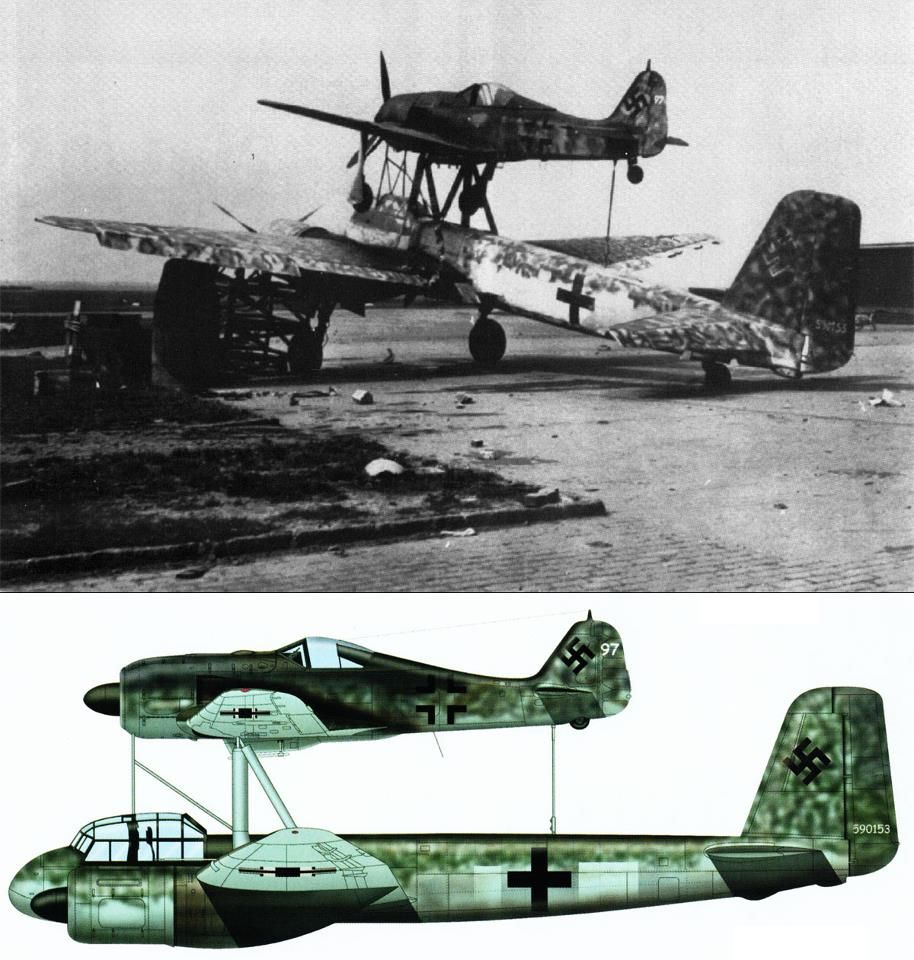
Luftwaffe Mistel Aircraft (Focke-Wulf Fw 190 (upper) & Junkers Ju 88 (lower)), Merseburg, Germany, 1945.

The "cruise missile" project which was the best example of the improvisation which characterized much of the ad-hoc weapon development of war time was the Mistel (mistletoe) or Beethoven-Gerät (Beethoven Device) composite aircraft program which the Germans developed in 1943.  It was a rudimentary air-launched cruise missile, made by a piloted fighter aircraft being mounted atop an unpiloted bomber-sized aircraft, packed with explosives and the larger aircraft would be released to glide towards the target.  Calling it the mistletoe reveals a sense of humor mot usually associated with the Luftwaffe but it was known rather more evocatively as the Vati und Sohn (Daddy and Son) or the Huckepack (Piggyback).  Although built in the hundreds, by the time it was available for deployment, the scope for attacking large targets with manned aircraft had reduced and the need was for precision delivery, something for which the Mistel was ill-suited and success was limited.