Showing posts sorted by date for query Doodlebug. Sort by relevance Show all posts

Sunday, November 9, 2025

Bug

Bug (pronounced buhg)

(1) Any insect of the order Hemiptera, especially any of the suborder Heteroptera (a hemipteran or hemipteron; a hemipterous insect), having piercing and sucking mouthparts specialized as a beak (rostrum) and known loosely as the “true bug”.

(2) Any of various species of marine or freshwater crustaceans.

(3) In casual use, any insect or insect-like invertebrate (ie used often of spiders and such because of their supposed “bug-like” quality).

(4) In casual use, any micro-organism causing disease, applied especially to especially a virus or bacterium.

(5) An instance of a disease caused by such a micro-organism; a class of such conditions.

(6) In casual (and sometimes structured) use, a defect or imperfection, most associated with computers but applied also to many mechanical devices or processes.

(7) A craze or obsession (usually widespread or of long-standing).

(8) In slang, a person who has a great enthusiasm for such a craze or obsession (often as “one bitten by the bug”).

(9) In casual (and sometimes structured) use, a hidden microphone, camera or other electronic eavesdropping device (a clipping of bugging device) and used analogously of the small and effectively invisible (often a single-pixel image) image on a web page, installed usually for the purpose of tracking users.

(10) Any of various small mechanical or electrical gadgets, as one to influence a gambling device, give warning of an intruder, or indicate location.

(11) A mark, as an asterisk, that indicates a particular item, level, etc.

(12) In US horse racing, the five pound (2¼ kg) weight allowance able to be claimed by an apprentice jockey and by extension (1) the asterisk used to denote an apprentice jockey's weight allowance & (2) in slang, US, a young apprentice jockey (sometimes as “bug boy” (apparently used thus also of young female jockeys, “bug girl” seemingly beyond the pale.)).

(13) A telegraph key that automatically transmits a series of dots when moved to one side and one dash when moved to the other.

(14) In the slang of poker, a joker which may be used only as an ace or as a wild card to fill a straight or a flush.

(15) In commercial printing, as “union bug”, a small label printed on certain matter to indicate it was produced by a unionized shop.

(16) In fishing, a any of various plugs resembling an insect.

(17) In slang, a clipping of bedbug (mostly UK).

(18) A bogy; hobgoblin (extinct).

(19) In slang, as “bug-eyed”, protruding eyes (the medical condition exophthalmos).

(20) A slang term for the Volkswagen Beetle (Type 1; 1938-2003 & the two retro takes; 1997-2011 & 2011-2019).

(21) In broadcasting, a small (often transparent or translucent) image placed in a corner of a television program identifying the broadcasting network or channel.

(22) In aviation, a manually positioned marker in flight instruments.

(23) In gay (male) slang in the 1980s & 1990s as “the bug”, HIV/AIDS.

(24) In the slang of paleontology, a trilobite.

(25) In gambling slang, a small piece of metal used in a slot machine to block certain winning combinations.

(26) In gambling slang, a metal clip attached to the underside of a table, etc and used to hold hidden cards (a type of cheating).

(27) As the Bug (or Western Bug), a river in Eastern Europe flows through Belarus, Poland, and Ukraine with a total length of 481 miles (774 km).  The Southern Bug (530 miles (850 km)) in south west Ukraine flows into the Dnieper estuary and is some 530 miles (850 km) long.

(28) A past tense and past participle of big (obsolete).

(29) As ISO (international standard) 639-2 & ISO 639-3, the language codes for Buginese.

(30) To install a secret listening device in a room, building etc or on a telephone or other communications device.

(31) To badger, harass, bother, annoy or pester someone.

1615–1625: The original use was to describe insects, apparently as a variant of the earlier bugge (beetle), thought to be an alteration of the Middle English budde, from the Old English -budda (beetle) but etymologists are divided on whether the phrase “bug off” (please leave) is related to the undesired presence of insects or was of a distinct origin.  Bug, bugging & debug are nouns & verbs, bugged is a verb & adjective and buggy is a noun & adjective; the noun plural is bugs.  Although “unbug” makes structural sense (ie remove a bug, as opposed to the sense of “debug”), it doesn’t exist whereas forms such as the adjectives unbugged (not bugged) and unbuggable (not able to be bugged) are regarded as standard.

Nerd humor.

The array of compound forms meaning “someone obsessed with an idea, hobby etc) produced things like “shutterbug” (amateur photographer) & firebug (arsonist) seems first to have emerged in the mid nineteenth century.  The development of this into “a craze or obsession” is thought rapidly to have accelerated in the years just before World War I (1914-1918), again based on the notion of “bitten by the bug” or “caught the bug”, thus the idea of being infected with an unusual enthusiasm for something.  The use to mean a demon, evil spirit, spectre or hobgoblin was first recorded in the mid-fourteenth century and was a clipping of the Middle English bugge (scarecrow, demon, hobgoblin) or uncertain origin although it may have come from the Middle Welsh bwg (ghost; goblin (and linked to the Welsh bwgwl (threat (and earlier “fear”) and the Middle Irish bocanách (supernatural being).  There’s also speculation it may have come from the scary tales told to children which included the idea of a bugge (beetle) at a gigantic scale.  That would have been a fearsome sight and the idea remains fruitful to this day for artists and film-makers needing something frightening in the horror or SF (science fiction) genre.  The use in this sense is long obsolete although the related forms bugbear and bugaboo survive.  Dating from the 1570s, a bugbear was in folklore a kind of “large goblin”, used to inspire fear in children (both as a literary device & for purposes of parental control) and for adults it soon came to mean “a source of dread, resentment or irritation; in modern use it's an “ongoing problem”, a recurring obstacle or adversity or one’s pet peeve.  The obsolete form bugg dates from circa 1620s and was a reference to the troublesome bedbug, the construct a conflation of the middle English bugge (scarecrow, hobgoblin) and the Middle English budde (beetle).  The colloquial sense of “a microbe or germ” dates from 1919, the emergence linked to the misleadingly-named “Spanish flu” pandemic.

Bugs: A ground beetle (left), a first generation der Käfer (the Volkswagen Beetle, 1938-2003) (centre) and an "New Beetle" (1997-2011).  Despite the appearance, the "New Beetle" was of front engine & FWD (front-wheel-drive) configuration, essentially a re-bodied Volkswagen Golf.  The new car was sold purely as a retro, the price paid for the style, certain packaging inefficiencies.  Few have ever questioned why the original VW Beetle picked up the nickname “bug”.

Nerd humor:  "That's not a bug; it's a feature."  As all programmers know, if the audience is "right", many a "bug" can (at least temporarily while rushing to do a "bug-fix") be "explained away" as "a feature"; the linguistically adventurous sometimes preferring "undocumented feature".

Like the rest of us, even scientists, entomologists and zoologists generally probably say “bug” in general conversation, whether about the insects or the viruses and such which cause disease but in writing academic papers they’ll take care to be more precise.  Because to most of us “bugs” can be any of the small, creepy pests which intrude on our lives (some of which are actually helpful in that quietly and unobtrusively they dispose of the really annoying bugs which bite us), the word is casually and interchangeably applied to bees, ants, bees, millipedes, beetles, spiders and anything else resembling an insect.  That use may be reinforced by the idea of the thing “bugging” us by their very presence.  To the professionals however, insects are those organisms in the classification Insecta, a very large class of animals, the members of which have a three-part body, six legs and (usually) two pairs of wings whereas a bug is a member of the order Hemiptera (which in the taxonomic system is within the Insecta class) and includes cicadas, aphids and stink bugs; to emphasize the point, scientists often speak of those in the order Hemiptera as “true bugs”.  The true bugs are those insects with mouthparts adapted for piercing and sucking, contained usually in a beak-shaped structure, a vision agonizingly familiar to anyone who has suffered the company of bedbugs.  That’s why lice are bugs and cockroaches are not but the latter will continue to be called bugs, often with some preceding expletive.

Bug #1, 9 September, 1947: The engineer's note (with physical evidence) of electronic computing's "first bug".

In computing, where the term “bug” came to be used to describe “glitches, crashes” and such, it has evolved to apply almost exclusively to software issues and even if events are caused by hardware flaws, unless it’s something obvious (small explosions, flame & smoke etc) most users probably assume a fault in some software layer.  The very first documented bug however was an interaction recorded on 9 September, 1947 between the natural world and hardware, an engineer’s examination of an early (large) computer revealing an insect had sacrificially landed on one of the circuits, shorting it out and shutting-down the machine.  As proof, the unfortunate moth was taped to the report.  On a larger scale (zoologically rather than the hardware), the problem of small rodents such as mice entering the internals of printers, there to die from various causes (impact injuries, starvation, heat etc) remains not uncommon, resulting sometimes in mechanical damage, sometimes just the implications of decaying flesh.

Revelle's Bug Bomb, 1970.

The idea of a bug as a “defect, flaw, fault or glitch” in a mechanical or electrical device was first recorded in the late 1800s as engineer’s slang, the assumption being they wished to convey the idea of “a small fault” (and thus easily fixed, as opposed to some fundamental mistake which would necessitate a re-design).  Some sources suggest the origin lies with Thomas Edison (1847-1931) who is reported as describing the consequences of an insect “getting into the works”.  Programmers append an array of adjectives to "bug" (major, minor, serious, critical & non-critical etc) although between themselves (and certainly when disparaging of the code of others) the most commonly heard phrases probably are “stupid bug” or fuckin' bug.  The “debugging” (also as de-bugging) process is something with a wide definition but in general it refers to any action or set of actions taken to remove errors.  The name of the debug.exe (originally debug.com) program included with a number of (almost all 16 & 32-bit) operating systems was a little misleading because in addition to fixing things, it could be used for other purposes and is fondly remembered by those who wrote Q&D (quick & dirty) work-arounds which, written in assembler (which “hit the hardware” directly), ran very fast.  The verb debug was first used in 1945 in the sense of “remove the faults from a machine” and by 1964 it appeared in field service manuals documenting the steps to be taken to “remove a concealed microphone”.  Although the origin of the use of “bug” in computing (probably the now most commonly used context) can be traced to 1947, the term wasn’t widely used beyond universities, industry and government sites before the 1960s when the public first began to interact at scale with the implications (including the bugs) of those institutions using computerized processes.  Software (or any machinery) badly afflicted by bugs can be called “buggy”, a re-purposing of the use of an adjective dating from 1714 meaning “a place infested with bugs”.

Some bugs gained notoriety.  In the late 1990s, it wasn’t uncommon for the press to refer to the potential problems of computer code using an alpha-numeric syntax, “Y2K bug” an indication of how wide was the vista of the common understanding of "bug" and one quite reasonable because that was how the consequences would be understood.  A massive testing & rectification effort was undertaken by industry (and corporations, induced by legislation and the fear of litigation) and with the coming of 1 January 2000 almost nothing strange happened and that may also have been the case had nothing been done but, on the basis of the precautionary principle, it was the right approach.  Of course switching protocols to use four-numeral years did nothing about the Y10K bug but a (possible) problem 8000 years hence was of little interest to politicians or corporate boards.  Actually, Ynnn~K bugs will re-occur (theoretically with decreasing frequency) whenever a digit needs to be added.  The obvious solution is trailing zeros although if one thinks in terms of infinity, it may be that, in the narrow technical sense, such a solution would just create an additional problem although perhaps one of no practical significance.  Because of the way programmers exploit the way computers work, there have since the 1950s been other date (“time” to a computer) related “bugs” and management of these and the minor problems caused has been handled well.  Within the industry the feeling is things like the “Y2038 problem” will, for most of the planet, be similarly uneventful.

The DOSShell, introduced with PC-DOS 4.0; this was as graphical as DOS got.  The text-based DOSShell was bug-free and a reasonable advance over what came before but the power users had already adopted Executive Systems' XTree as their preferred file handler.

Bugs can also become quirky industry footnotes.  As late as 1987, IBM had intended to release the update of PC-DOS 3.3 as version 3.4, reflecting the corporation’s roadmap of DOS as something of an evolutionary dead-end, doomed ultimately to end up in washing machine controllers and such while the consumer and corporate market would shift to OS/2, the new operating system which offered pre-emptive multi-tasking and access to bigger storage and memory addressing.  However, at that point, both DOS & OS/2 were being co-developed by IBM & Microsoft and agreement was reached to release a version 4 of DOS.  DOS 4 also included a way of accessing larger storage space (through a work-around with a program called share.exe) and more memory (in a way less elegant than the OS/2 approach but it did work, albeit more slowly), both things of great interest to Microsoft because they would increase the appeal of its upcoming Windows 3.0, a graphical shell which ran on top of DOS; unlike OS/2, Windows was exclusive to Microsoft and so was the revenue stream.  Unfortunately, it transpired the PC-DOS 4.0 memory tricks were “buggy” when used with some non-IBM hardware and the OS gained a bad reputation from which it would never recover.  By the time the code was fixed (an released as PC-DOS 4.01), Microsoft was ready to release its own version as MS-DOS 4.0 but, noting all the bad publicity, after some cosmetic revisions, the mainstream release was MS-DOS 4.01.  In the code of the earlier, bug-afflicted bits, there seems no substantive difference between MS-DOS 4.01 the few extant copies of MS-DOS 4.0.

Herbie, the love bug

Lindsay Lohan among the bugs and on the red carpet for the Los Angeles premiere of Herbie Fully Loaded (a 2005 remake of The Love Bug (1968)), El Capitan Theater, Hollywood, Los Angeles, 19 June 19, 2005.  The Beetle (right) was one of the many replica “Herbies” in attendance and, on the day, Ms Lohan (using the celebrity-endorsed black Sharpie) autographed the glove-box lid, removed for the purpose. 

In idiomatic and other uses, bug has a long history.  By the early twentieth century “bugs” meant “mad; crazy" and by then “bug juice” had been in use for some thirty years, meaning both “propensity of the use of alcoholic drink to induce bad behaviour” and “bad whiskey” (in the sense of a product being of such dubious quality it was effectively a poison).  A slang dictionary from 1811 listed “bug-hunter” as “an upholsterer”, an allusion to the fondness bugs and other small creatures show for sheltering in the dark, concealed parts of furniture.  As early as the 1560s, a “bug-word” was a word or phrase which “irritated or vexed”.  The idea of “bug-eyed” was in use by the early 1870s and that’s thought either to be a humorous mispronunciation of bulge or (as is thought more likely) an allusion to the prominent, protruding eyes of creatures like frogs, the idea being they sat on the body like “a pair of bugs”.  The look became so common in the movies featuring aliens from space that by the early 1950s the acronym BEM (bug-eyed monster) had become part of industry slang.  The correct term for the medical condition of "bulging eyes" is exophthalmos.

Lindsay Lohan in promotional poster for Herbie: Fully Loaded (2005).

To “bug someone” in the sense of “to annoy or irritate” seems not to have been recorded until 1949 and while some suggest the origin of that was in swing music slang, it remains obscure.  The now rare use of “bug off” to mean “to scram, to skedaddle” is documented since 1956 and is of uncertain origin but may be linked to the Korean War (1950-1953) era US Army slang meaning “stage a precipitous retreat”, first used during a military reversal.  The ultimate source was likely the UK, Australian & New Zealand slang “bugger off” (please leave).  The “doodle-bug” was first described in 1865 and was Southern US dialect for a type of beetle.  In 1944, the popular slang for the German Vergeltungswaffen eins (the V-1 (reprisal weapon 1) which was the first cruise missile) was “flying bomb” or “buzz bomb”) but the RAF (Royal Air Force) pilots preferred “doodlebug”.

The ultimate door-stop for aircraft hangers: Bond Bug 700.

The popularity of three wheeler cars in the UK during the post-war years was a product of cost breakdown.  They were taxed at a much lower rate than conventional four-wheel vehicles, were small and thus economical and could be operated by anyone with only a motorcycle licence.  Most were genuine (if not generous) four-seaters and thus an attractive alternative for families and, being purely utilitarian, there were few attempts to introduce elements of style.  The Bond Bug (1970-1974) was an exception in that it was designed to appeal to the youth market with a sporty-looking two-seater using the then popular “wedge-styling” and in its most powerful form it could touch 80 mph (130 km/h), faster than any other three wheeler available.  The bug was designed by Vienna-born British designer Tom Karen (1926–2022) who intended it as a “Ferrari for 16-year-olds” which may hint he knew more about cars than young males but in the 1970s such comparisons often were made, a tester in one magazine describing the diminutive Fiat 127 (1971-1983) as the 0.9 litre Ferrari” which was journalistic licence writ large but people knew what he meant.

An infestation of Bugs.  Shades of orange and brown seemed to stalk the 1970s.

However, the UK in 1973 introduced VAT (value-added tax, a consumption tax) and this removed many of the financial advantages three-wheelers offered (it also doomed much of the “kit-car” business in which customers could buy the parts and assemble them with their own labor).  In an era of rising prosperity, the appeal of the compromise waned and coupled with some problems in the early productions runs, in 1974, after some 2¼ thousand Bugs had been built, the zany little machine was dropped; not even the oil crisis of the time (which had doomed a good number of bigger, thirstier cars) and the nasty recession which followed could save it.  Even in its best years it was never all that successful, essentially because it was really a novelty and there were “real” cars available for less money.  Still, the survivors have a following in their niche at the lower end of the collector market and it's a machine truly like no other.

Bugging devices

The business of spying is said to be the “second oldest profession” and even if not literally true, few doubt the synergistic callings of espionage and war are among man’s earliest and most enduring endeavors.  Although the use of “bug” to mean “equip with a concealed microphone” seems not to have been in use until 1946, bugging devices probably go back thousands of years (in a low-tech sort of way) and those known to have been used in Tudor-era England (1485-1603) are representative of the way available stuff was adapted, the most popular being tubular structures which, if pressed against a thin wall (or preferably a door’s keyhole) enabled one to listen to what was being discussed in a closed room.  Bugging began to assume its modern form when messages began to be transmitted over copper wires which could stretch for thousands of miles and the early term for a “phone bug” was “phone tap”, based upon the idea of “tapping into” the line as one might a water pipe.  Bugs (the name picked-up because many of the early devices were small, black and “bug-like”), whether as concealed microphones or phone taps, swiftly became part of the espionage inventory in diplomacy, commerce and crime and as technology evolved, so did the bugging techniques.

Henry Cabot Lodge Jr (1902–1985), US Ambassador to the UN (United Nations) at a May 1960 session of the Security Council, using the Great Seal bug to illustrate the extent of Soviet bugging.  The context was a tu quoque squabble between the Cold War protagonists, following Soviet revelations about the flight-paths of the American's U2 spy planes.  Lodge would be Richard Nixon’s (1913-1994; US president 1969-1974) running mate in that year's presidential election.     

A classic bug of High Cold War was the Great Seal bug, (known to the security services as the thing), a Soviet designed and built concealed listening device which was so effective because it used passive transmission protocols for its audio signal, thereby rendering it invisible to conventional “bug-detection” techniques.  The bug was concealed inside large, carved wooden rendition of the US Great Seal which, in 1945, the Kremlin presented as a “gift of friendship” to the US Ambassador to the USSR Averell Harriman (1891-1986); in a nice touch, it was a group of Russian school children who handed over the carving.  Sitting in the ambassador’s Moscow office for some seven years, it was a masterpiece of its time because (1) being activated only when exposed to a low-energy radio signal which Soviet spies would transmit from outside, when subjected to a US “bug detection” it would appear to be a piece of wood and (2) as it needed no form of battery or other power supply (and indeed, no maintenance at all), its lifespan was indefinite.  Had it not by chance been discovered by a communications officer at the nearby British embassy who happened to be tuned to the same frequency while the Soviets were sending their signal, it may well have remained in place for decades.  Essentially, the principles of the Great Seal bug were those used in modern radio-frequency identification (RFID) systems.

Wednesday, October 16, 2024

Doodlebug

Doodlebug (pronounced dood-l-buhg)

(1) In entomology, the larva of an antlion (a group of some 2,000 species of insect in the neuropteran family Myrmeleontidae, the appellation “doodlebug” an allusion to the “doodle-like” marks they leave in the sand as tracks of their movement.

(2) In entomology (UK), a cockchafer (genus Melolontha).

(3) In entomology (US regional), a woodlouse.

(4) As “doodlebugger”, a dowser (divining rod) or similar device supposedly useful in locating underground water, hydrocarbons, minerals etc.  By extension, the word was applied to geophysicists or geologists undertaking field work (especially oil prospecting or mineral exploration); they were said to be doodlebugging.

(5) In World War II (1939-1945) UK slang, the German cruise missile the V1, (Fs-103), also known informally as the “flying bomb” or “buzz bomb”, the latter an allusion to the distinctive sound made by the craft’s pulse-jet power-plant.  The slang began among RAF (Royal Air Force) personnel and later spread to the general population.

(6) In US rural slang, as “doodlebug tractor”, a car or light truck converted into tractor used (usually for small-scale agriculture), first noted as a type during the Great Depression years of the 1930s.  During World War II, the improvisation continued because new tractors were in short supply because most production was allocated to the military. 

(7) Individual self-propelled train cars (obsolete).

(8) Any of various small, squat vehicles (as both nickname and official designation).

(9) In informal use, a term of endearment (now rare).

(10) In informal use, a slackard (an archaic form of slacker) or time-waster (now rare).

(11) In informal use, an idiot (as used casually rather than in its once codified sense in mental health).

(12) In informal use, someone who habitually draws (or doodles) objects.

1865-1870: A coining in US English, the construct being doodle + bug, the first known use as a US dialectal form (south of the Mason-Dixon Line) to describe certain beetles or larva.  Doodle dates from the early seventeenth century and was used to mean “a fool or simpleton”.  It was originally a dialectal form, from dudeldopp (simpleton) and influenced by dawdle (to spend time idly and unfruitfully; to waste time, pointlessly to linger, to move or walk lackadaisically; to “dilly-dally”), thus the later use of doodle to mean “a slackard (slacker) or time-waster”.  The German variants of the etymon included Dudeltopf, Dudentopf, Dudenkopf, Dude and Dödel (and there’s presumably some link with the German dudeln (to play the bagpipe)).  There is speculation the Americanism “dude” may have some connection and the now internationalized (and sometimes gender-neutral) “dude” has in recent decades become one of slang’s more productive and variable forms.  The song Yankee Doodle long pre-dates the American Revolutionary War (1775-1783) but it was popularized in the era by being used as a marching song by British colonial troops, the intention being to poke fun at their rebellious opponents; that didn't work out well.  From this use was derived the verb of the early eighteenth century (to doodle), meaning “to swindle or to make a fool of”.  The predominant modern meaning (the drawings regarded usually as “small mindless sketches”) emerged in the 1930s either from this meaning or (as seems to have greater support), from the verb “to dawdle” which since the seventeenth century had been used to mean “wasting time; being lazy”.  In slang and idiomatic use, doodles uses are legion including “the penis” and any number of rhyming forms with meanings ranging from the very good to the very bad.  The hyphenated doodle-bug has appeared and Urban Dictionary has the usual array of alternative, user-generated meanings.  Doodlebug, doodlebugging & doodlebugger are nouns; the noun plural is doodlebugs.

A doodled Volkswagen “bug” on Drawn Inside.

Bug dates from 1615–1625, the original use being to describe insects, apparently as a variant of the earlier bugge (beetle), thought to be an alteration of the Middle English budde, from the Old English -budda (beetle) but etymologists are divided on whether the phrase “bug off” (please leave) is related to the undesired presence of insects or was of a distinct origin.  Bug, bugging & debug are nouns & verbs, bugged is a verb & adjective and buggy is a noun & adjective; the noun plural is bugs.  Although “unbug” makes apparent sense (ie remove a bug, and thus synonymous with the modern “debug”), it doesn’t exist whereas forms such as the adjectives unbugged (not bugged) and unbuggable (not able to be bugged) are listed as standard.  The array of compound forms meaning “someone obsessed with an idea, hobby etc) produced things like “shutterbug” (amateur photographer) & firebug (arsonist) seems first to have emerged in the mid nineteenth century.  The development of this into “a craze or obsession” is thought rapidly to have accelerated in the years just before World War I (1914-1918), again based on the notion of “bitten by the bug” or “caught the bug”, thus the idea of being infected with an unusual enthusiasm for something.  The use to mean a demon, evil spirit, spectre or hobgoblin was first recorded in the mid-fourteenth century and was a clipping of the Middle English bugge (scarecrow, demon, hobgoblin) or uncertain origin although it may have come from the Middle Welsh bwg (ghost; goblin (and linked to the Welsh bwgwl (threat (and earlier “fear”) and the Middle Irish bocanách (supernatural being).  There’s also speculation it may have come from the scary tales told to children which included the idea of a bugge (beetle) at a gigantic scale.  That would have been a nightmarish thought and the idea remains fruitful to this day for artists and film-makers needing something frightening in the horror or SF (science fiction) genre.  The use in this sense is long obsolete although the related forms bugbear and bugaboo survive.  Dating from the 1570s, a bugbear was in folklore a kind of “large goblin”, used to inspire fear in children (both as a literary device & for purposes of parental control) and for adults it soon came to mean “a source of dread, resentment or irritation; in modern use it's an “ongoing problem”, a recurring obstacle or adversity or one’s pet peeve.  The obsolete form bugg dates from circa 1620 and was a reference to the troublesome bedbug, the construct a conflation of the middle English bugge (scarecrow, hobgoblin) and the Middle English budde (beetle).  The colloquial sense of “a microbe or germ” dates from 1919, the emergence linked to the misleadingly-named “Spanish influenza” pandemic.

A doodlebug (left) and his (or her) doodles in the sand (right).

That the word doodlebug has appeal is obvious because since the 1860s it has been re-purposed many time, often with the hint something “small but not cute”, that something understandable given the original creature so named (larva of an antlion) is not one of nature’s more charismatic creations.  Doodlebugs are squat little things which live mostly in loose sand where they create pit traps and genuinely are industrious creatures, their name earned not because they are idle time-wasters but because the tracks they leave in the sand are strikingly similar to the doodles people often wile away their time drawing.  The frankly unattractive ant leave their doodles behind because, as they percolate over the ground, their big butts drag behind them, leaving the erratic trails.  So compelling is the name, it has been applied to a number of other, similar insects.  Another use is attributive from the link with the seventeenth century notion of a doodle being “a simpleton or time-waster”, extended later to “an idiot” (the word used casually rather than as it once was codified in mental health); in the 1930s it came be used of those who incessantly sketch or draw stuff, the idea being they are squandering their time.  What they draw are called “doodles”, the source of the name for the artist.

Doodles on a rendering of Lindsay Lohan by Stable Diffusion.

The mid-twentieth century art (some of its practitioners claiming it was a science) of doodlebugging was practiced by doodlebuggers who used a method said to be not greatly different from the equally dubious technique of the water diviner.  All the evidence suggests there was a general scepticism of the claims that a bent rod waived about above the earth could be used to locate hydro-carbons and the use of “doodlebuging” to refer to the process was originally a slur but it became an affectionate name for those intrepid enough to trek into deserts seeking the “black gold” usuing more orthodox prospecting techniques.  In the 1940s when the “profession” was first described, any reliable means of detecting sub-surface oil deposits simply didn’t exist (other than drilling a hole in the ground to see if it was there) and the early doodlebuggers were scam merchants.  The science did however advance (greatly spurred on by the demands of wartime) and when geologists came to be able to apply the modern machinery of seismic mapping and actually had success, they too were called doodlebuggers and happily adopted the name.

Texaco Doodlebug fuel tanker, one of eight built in 1934-1935 during the industry's "streamliner" era.  It was a time when art deco's lovely lines appeared in many fields of design. 

In the early twentieth century, a doodlebug was a self-propelled rail car, used on rail lines which were short in length and subject only to light traffic.  These were autonomous vehicles, powered both by gasoline (petrol) (in the US, it was the the pre-diesel era) and electricity; they were an attractive alternative for operators, being much cheaper to run than the combination of large locomotives & carriage cars, eminently suited to routes with lower passenger numbers.  The concept may be compared with the smaller (often propeller or turbo-prop) aircraft used for shuttle services or on regional & feeder routes where demand be sufficient to make viable the use of larger airliners.  Although the doodlebugs carried relatively few passengers, their operating costs were correspondingly lower so the PCpM (passenger cost per mile) was at least comparable with the full-sized locomotives.  While it may be a myth, the story is that one rail employee described the small, stumpy rail car as looking like a “potato bug” and (as English informal terms tend to do) this morphed into the more appealing doodlebug.

Some assembly required: a doodlebug tractor with hydraulic pump-driven crane, the agglomeration dating from circa 1934.

Although the mechanical specification of each tended to vary as things broke and were replaced with whatever fell conveniently to hand or could be purchased cheaply, when discovered, it included a 1925 Chevrolet gasoline engine, Ford Model T firewall and steering, Ford Model A three-speed manual transmission, Ford Model TT (truck) rear end and AM General HMMWV rear wheels and tires.  The "mix & match" approach was typical of the genre and it's doubtful many were for long exactly alike.

A doodlebug could also be a DIY (do it yourself) tractor.  During the Great Depression of the 1930s, smaller-scale farmers (then more prevalent than today) in the US no longer had the capital (or access to loan-capital) to purchase plant and equipment on the same scale as in more prosperous times but needed still to make their land productive, a essential tool being the tractor, one of modernity's many devices which greatly had increased the efficiency of agriculture.  New tractors being thus for many being unattainable, necessity compelled farmers to turn to what was available and that was the stock of old cars and pickup trucks, now suddenly cheaper because the Depression had lowered demand for them as well.  With saws and welding kits, imaginative and inventive farmers would crop & chop and slice & dice until they had a vehicle which would do much of what a tractor could and according to the legends of the time, some actually out-performed the real thing because their custom design was optimized for a specific, intended purpose.  What made the modifications possible in the engineering sense was that it was a time when cars and pick-ups in the US always used a separate chassis; the bodies could be removed and it was possible still to drive the things and it was on these basic platforms the “doodlebug” tractors were fashioned.  They were known also as “scrambolas”, “Friday night specials” and “hacksaw tractors” but it was “doodlebug” which really caught on and so popular was the practice that kits were soon advertised in mail-order catalogues (the Amazon of the day and a long tradition in the rural US).  Not until the post-war years when economic conditions improved and production of machinery for civilian use resumed at full-scale did the informal industry of the doodlebug end.

1946 Brogan Doodlebug (right) with 1942 Pontiac Torpedo (left).  In the US, some passenger car production continued in the first quarter of 1942. 

Although now what’s most remembered about the US cars of the post-war era are the huge and extravagantly macropterous creations, there were more than two dozen manufacturers in the 1940s & 1950s offering “micro-cars”, aimed at (1) female drivers, (2) inner-city delivery services and (3) urban drivers who wanted something convenient to manoeuvre and park.  The market however proved unresponsive and as the population shift to the suburbs accelerated, women wanted station wagons (in many ways the emblematic socio-economic symbol of suburban American of the 1950s) and the delivery companies needed larger capacity.  As the Volkswagen Beetle (Type 1, 1938-2003) and a few other niche players would prove during that decade’s “import boom”, Americans would buy smaller cars, just not micro-cars which even in Europe, where they were for a time successful, the segment didn’t survive to see the end of the 1960s (although various factors would see later revivals).  But there was the Brogan Doodlebug, made by the B&B Specialty Company of Rossmoyne, Ohio and produced between 1946-1950 although that fewer than three dozen were sold hints at the level of demand at a time when Detroit’s mass-production lines were every day churning out thousands of “standard sized” cars.

1946 Brogan Doodlebug.

Somewhat optimistically (though etymologically defensible) described as a “roadster”, the advertising for the Doodlebug exclusively featured women drivers and it certainly was in some ways ideal for urban use (except perhaps when raining, snowing, in cold weather or the sun was harsh).  It used a three wheeled chassis with the single wheel at the front, articulated so the vehicle could turn within its own length making parking easy, the thing barely 96 inches (2,440 mm) in length & 40 inches (1,020 mm) wide; weighing only some 442 lbs (200 kg), it was light enough for two strong men to pick it up and move it (a characteristic with both advantages and drawbacks).  Powered by either a single or twin-cylinder rear-mounted engine (both rated at a heady 10 HP (horsepower ), no gearbox was deemed necessary, thus no tiresome gear levers or clutch pedals intruded to confuse women drivers.   B&B claimed a fuel consumption up to 70 mpg (84 mpg in Imperial gallons) with a cruising speed of 45-50 mph (70-80 km/h).  All this for US$400 and remarkably, it seems it wasn’t until 1950 (after some 30 doodlebugs had been built over four years) the cost-accountants looked at the project and concluded B&B was losing about US$100 on each one sold.  A price-rise was ruled out so production ended and although B&B released the Broganette (an improved three-wheeler with the single wheel at the rear which provides much better stability); it was no more successful and the company turned to golf carts and scooters which proved much more lucrative.  B&B later earned a footnote in the history of motorsport as one of the pioneer go-kart manufacturers.

Annotated schematic of the V-1 (left) and a British Military Intelligence drawing (dated 16 June 1944, 3 days after the first V-1 attacks on London (right). 

First deployed in 1944 the German Vergeltungswaffen eins (“retaliatory weapon 1” or “reprisal weapon 1” and eventually known as the V-1) was the world’s first cruise missile.  One of the rare machines to use a pulse-jet, it emitted such a distinctive sound that those at whom it was aimed nicknamed it the “buzz-bomb” although it attracted other names including “flying bomb” and “doodlebug”.  In Germany, before Dr Joseph Goebbels (1897-1945; Nazi Minister of Public Enlightenment and Propaganda 1933-1945) decided it was the V-1 (understood as vengeance weapon 1”), the official military code name was Fi 103 (The Fi stood for Fieseler, the original builder of the airframe and most famous for their classic Storch (Stork), short take-off & landing (STOL) aircraft) but there were also the code-names Maikäfer (maybug) & Kirschkern (cherry stone).  While the Allied defenses against the V-1 did improve over time, it was only the destruction of the launch sites and the occupation of territory within launch range that ceased the attacks.  Until then, the V-1 remained a highly effective terror weapon but, like the V-2 and so much of the German armaments effort, bureaucratic empire-building and political intrigue compromised the efficiency of the project.

Friday, July 7, 2023

Cruise

Cruise (pronounced krooz)

(1) To sail about on a pleasure trip (often as cruising).

(2) To sail about, as a warship patrolling a body of water.

(3) To travel about without a particular purpose or destination.

(4) To fly, drive, or sail at a constant speed that permits maximum operating efficiency for sustained travel.

(5) In aeronautics, the portion of aircraft travel at a constant airspeed and altitude between ascent and descent phases.

(6) To travel at a moderately fast, easily controllable speed.

(7) To travel about slowly, looking for customers or for something demanding attention.

(8) As cruise missile, an intermediate-range weapon.

(9) Among male homosexuals, actively to seek a casual sexual partner by moving about a particular area known to be frequented by those there for such purposes, an area known to be productive known as “cruisy” (“to troll” & “trolling” were once used as a synonyms but those terms have now been claimed by their use on the internet).

(10) In informal use in the US military, a period spent in the Marine Corps.

(11) In casual use in sporting competition, easily to win.

1645-1655:  From the Dutch kruisen (to cross, sail to and fro), from kruis or cruis (cross), from the Middle Dutch cruce, from the Latin crux.  Root was the primitive Indo-European sker (to turn, to bend); etymologists suggest it may be cognate with the Latin circus (circle) and curvus (curve).  In English, it began to be used as a noun in 1706 in the sense of “a voyage taken in courses” and by 1906 as “a voyage taken by tourists on a ship".  It was related to the French croiser (to cross, cruise), the Spanish cruzar and the German kreuzen.  The alternative spelling cruize is obsolete.  Cruise & cruising are nouns & verbs, cruised is a verb, cruiser is a noun and cruisy is an adjective; the noun plural is cruises.

Welcome to the Cruise (1979) by Judie Tzuke (b 1956), cover art by Hipgnosis.

In the era of the mass-selling LP (long playing) vinyl records, they were distributed in 305 x 305 mm (12 x 12 inch) cardboard sleeves and the size was sufficient to create what became a genuine genre in graphic art: the album cover.  The era lasted until CD (compact disc) sales eclipsed vinyl; CD packaging being around a quarter the size, greatly the possibilities diminished and what had been a flourishing industry vanished.  Many books detailing the history of album cover art have been published.

Cruiser in the sense of "one who or that which cruises" (agent noun from the verb cruise) is from the 1670s, probably, borrowed from similar words in continental languages (such as the Dutch cruiser & French croiseur).  In older use, a cruiser was a warship built to patrol and protect commerce of the state to which it belongs and to chase hostile ships; cruisers were the classic gun boats used by the European colonial powers for patrolling their empires.  In this use they were often compared to the frigates of old in that they possessed good speed and were employed to protect the trade-routes, to glean intelligence, and to act as the “eyes of the fleet” and in casual use, during the eighteenth century, the term was often applied to the ships of privateers (pirates).  Cruiser was used to describe male homosexuals “cruising for sex partners" (ie frequenting or lingering in places notorious for such things) from 1903, as a boxing weight (cruiserweight) class, from 1920.  The meaning "police patrol car" is a 1929 adoption of US English.

Royal Navy battlecruiser HMS Hood entering Valletta harbor, Malta 1937.

In admiralty use, cruisers are now the largest of the conventional warships still in service.  Navies used to use the term “cruiser” more as a description of the tasks for which the ships were used rather than specific nature of the construction, the early cruisers those ships which were used for long-range missions such as costal raiding or scouting and it was only in the late nineteenth century as the fleets grew and ships became more specialized that the classic model of the corvette / frigate / destroyer / cruiser / battleship evolved.  Even then there were distinctions such as "light" & "heavy" cruisers but the most interesting development in warship architecture was the battlecruiser, built essentially because HMS Dreadnought (1906) had created “a gap in the market”.  Battlecruisers were battleships with less armor, therefore gaining speed at the cost of greater vulnerability.  The theory was they would have the firepower to out-gun all but the battleships and those they could out-run with their superior speed; on the high seas, a margin of even two knots could be decisive.  The concept seemed sound and in December 1914, at the Battle of the Falkland Islands, two Royal Navy battlecruisers vindicated the theory when they chased and destroyed the German East Asia Squadron but less than two years later, the performance of the battlecruisers in the Battle of Jutland (31 May-1 June 1916) forced the Admiralty to re-consider.

The Royal Navy's Battle Cruisers opening fire in the opening stages of the Battle of Jutland, 31 May 1916, (1919), oil on canvas by Lionel Wyllie (1851–1931).  It was the war's only great, set piece, mass engagement.

Fought by fleets of the Royal Navy and the forces of the German Empire (the so-called “Second Reich”), the battle of Jutland in was the closest the world got a cataclysmic clash of fleets of dreadnoughts, an event the navalists and theorists had for a generation be expecting or hankering for.  For a variety of reasons it proved anti-climatic (though at a cost of over 8,000 lives) but while a tactical victory for the Germans (in terms of ships sunk or damaged and causalities suffered), strategically the British succeeded in ensuring for the rest of of World War I (1914-1918) their opponents were confined to a pocket of the Baltic, denied access to the North Sea and thus the Atlantic; this enabled the Royal Navy’s blockade of Germany to be maintained.  Summing up, the New York Times concluded: “The prisoner gave his jailor a bloody nose but at the end of the day was back behind bars in his jail cell.  Barely noticed except in the halls of the admiralties (where it made a great impression) was the vulnerability of the battlecruiser, a class of ship of which much had been expected although at Jutland they were used in a way the theorists who suggested the configuration had neither intended nor recommended.

Ultimately, both sides choose to avoid the decisive encounter which offered the prospect of victory because the consequences of defeat were so severe, especially for the British: Then serving as First Lord of the Admiralty (minister for the navy), Winston Churchill (1875-1965; UK prime minister 1940-1945 & 1951-1955) had early in the war been quite correct in cautioning the First Sea Lord (the most senior admiral) that while there was little the navy could do to win a continental war, it could "lose it in an afternoon".  Jutland did prove the naval theorists had been right: unless very lucky (not something to rely on at sea), the battlecruiser could not fight the battleship and if their paths threatened to cross, the less-armored vessel should retreat and rely on speed to make good her escape.  There were technical deficiencies in the British ships, without which perhaps three of their battlecruisers wouldn’t have been lost, but what happened in 1916 made it clear to the admirals that uneven contests between the big capital ships were to be avoided.  The consequence was that the battlecruiser became unfashionable and after the round of disarmament in the 1920s, none were built until, unexpectedly, the Soviet Navy commissioned four in the 1980s.  They proved the last of the breed and despite Donald Trump's (b 1946; US president 2017-2021 and since 2025) announcement of the USS Defiant, the USN (US Navy) are (sensibly) planning vessels on a smaller scale. 

Origin of cruise missiles

US Pershing II cruise missiles in Neu-Ulm military base, Swabia, Bavaria in the FRG (Bundesrepublik Deutschland (Federal Republic of Germany; the old West Germany, 1949-1990)), 1984.

Carrying large warheads long distances, cruise missiles are guided weapons, used against ground targets; they fly at both subsonic and supersonic speed, remain in the atmosphere and, self-propelled for the most of their flight, travel for mostly at a constant speed.  In this they differ from ballistic missiles which fly in an arc, often reaching suborbital flight with a final trajectory much like a bullet because, once the fuel is expended, the path from that point is determined by the speed and direction of launch and the force of gravity pulling towards Earth.  Both cruise and ballistic missiles can carry nuclear warheads but cruise missiles are most often equipped with conventional warheads.  Theorists and researchers were exploring the possibility of military missiles as early as 1908, described then as the aerial torpedo, envisaged as remote-controlled weapons with which to shoot-down airships bombing London, perceived then as the most credible airborne delivery system.  Between the World War I & II (1939-1945), the major powers all devoted resources to research but few projects reached even the prototype stage.

Annotated schematic of the V-1 (left) and a British Military Intelligence drawing (dated 16 June 1944, 3 days after the first V-1 attacks on London (right). 

First deployed in 1944 the German Vergeltungswaffen eins (“retaliatory weapon 1” or "reprisal weapon 1” and eventually known as the V-1) was the world’s first cruise missile.  One of the rare machines to use a pulse-jet, it emitted such a distinctive sound that those at whom it was aimed nicknamed it the “buzz-bomb” although it attracted other names including “flying bomb” and “doodlebug”.  In Germany, before Dr Joseph Goebbels (1897–1945; Reich Minister of Propaganda 1933-1945) decided it was the V-1, the official military code name was Fi 103 (The Fi stood for Fieseler, the original builder of the airframe and most famous for their classic Storch (Stork), short take-off & landing (STOL) aircraft) but there were also the code-names Maikäfer (maybug) & Kirschkern (cherry stone).  While the Allied defenses against the V-1 did improve over time, it was only the destruction of the launch sites and the occupation of territory within launch range that ceased the attacks.  Until then, the V-1 remained a highly effective terror weapon but, like the V-2 and so much of the German armaments effort, bureaucratic empire-building and political intrigue compromised the efficiency of the project.

A bronzed (not recommended) Lindsay Lohan on a cruise in the Maldives, January 2019.

The V-1 used a gyroscope guidance system and was fitted with an unusual triple-layer fuse system, the primary device and a backup augmented by a fail-safe designed to ensure destruction of “duds” (weapons which fail to detonate) so they couldn’t be examined.  The accuracy of the thing was sufficient only for use against very large targets (such as the general area of a city which made sprawling London ideal) while the range of 250 km (155 miles) was significantly less than that of a medium bomber carrying the same payload. The main advantages were speed (although not sufficient to outrun the fastest of the low-altitude propeller-driven interceptors), expendability and economy of operation.  Indeed, it was probably the war’s outstanding delivery system in terms of cost per ton of explosive, able to carry a warhead of 850 kg (1,870 lb) to London at a tiny fraction of the cost of using manned aircraft for the same task with the priceless additional benefit of not risking the loss of aircrew.  The production cost of a V-1 was also only a small fraction of that of the supersonic V-2 ballistic missile which carried a warhead only of a similar-size although once launched, effectively, it was invulnerable.  Unlike the V-2, the initial deployments of the V-1 required large, fixed launch ramps which were relatively easy to detect and susceptible to bombardment.  Later experiments produced much smaller launch facilities which provided for a greater rate of sustained fire.  Bomber-launched variants of the V-1 saw limited operational service near the end of the war, with the pioneering V-1's design reverse-engineered by the Americans as the Republic-Ford JB-2 cruise missile.

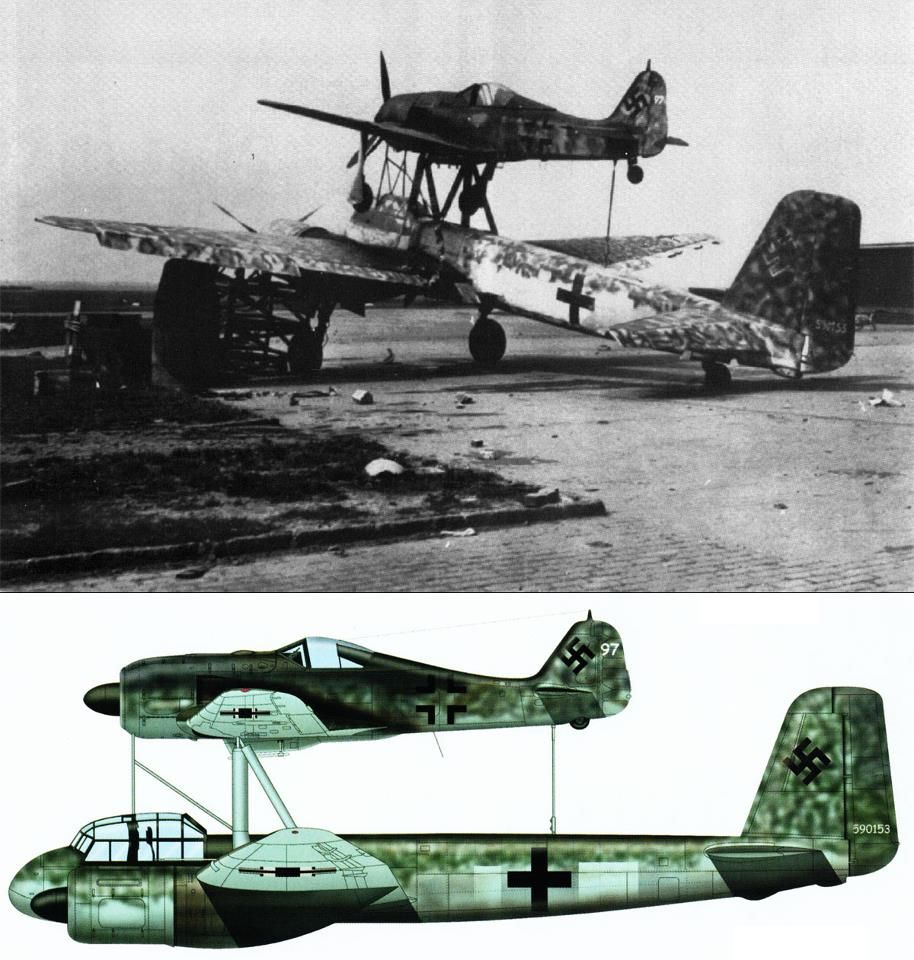
Luftwaffe Mistel Aircraft (Focke-Wulf Fw 190 (upper) & Junkers Ju 88 (lower)), Merseburg, Germany, 1945.

The "cruise missile" project which was the best example of the improvisation which characterized much of the ad-hoc weapon development of war time was the Mistel (mistletoe) or Beethoven-Gerät (Beethoven Device) composite aircraft program which the Germans developed in 1943.  It was a rudimentary air-launched cruise missile, made by a piloted fighter aircraft being mounted atop an unpiloted bomber-sized aircraft, packed with explosives and the larger aircraft would be released to glide towards the target.  Calling it the mistletoe reveals a sense of humor mot usually associated with the Luftwaffe but it was known rather more evocatively as the Vati und Sohn (Daddy and Son) or the Huckepack (Piggyback).  Although built in the hundreds, by the time it was available for deployment, the scope for attacking large targets with manned aircraft had reduced and the need was for precision delivery, something for which the Mistel was ill-suited and success was limited.