Showing posts sorted by relevance for query Bracelet. Sort by date Show all posts

Tuesday, November 23, 2021

Bracelet

Bracelet (pronounced breys-lit)

(1) An ornamental band or circlet for the wrist or arm or, sometimes, for the ankle.

(2) Slang in the criminal classes for a pair of handcuffs (almost always in the plural).

(3) In furniture design, types of collars.

(4) An expanding metal band for a wristwatch (usually used only as technical term within the industry).

(5) In law enforcement in some jurisdictions, as ankle bracelet (or tag), a device to monitor location or provide 24/7 real-time testing of drug or alcohol consumption (eg the SCRAM Bracelet (Secure Continuous Remote Alcohol Monitor)).

(6) In the field of combinatorics, a cyclical sequence of symbols used in combinatorial mathematics.

(7) An identification tag used by medical institutions to contain allergy, clinical or identity data or for religious or cultural purposes.

(8) In the history of armory, a type of personal body armor worn on the upper arm.

1400–1450: From the late Middle English from the Middle French, from the Old French bracel (literally “a little arm”), diminutive of bracelet, from the Latin bracchium (an arm; a forearm); the Latin brāchiāle (armlet) was a noun use of the neuter of brāchiālis + -et (from the Middle English & Old French -et, the suffix used to form diminutives, loosely construed, from the Late Latin –ittus).  Latin gained the word from the Ancient Greek brakhion (an arm) whereas the usual Latin word for an armlet (metal band or ring worn around the upper arm) was armilla which, in Late Latin, (1530s) meant also "a small intrusion of the sea into the land".  The migration from wrist to ankle as anklet (ornamental ring for an ankle) dates from 1810.  Synonyms include ornament, trinket, bangle, manacle, circlet, wristlet & armlet; the related adjective is armillary.  Bangle (an ornamental ring worn upon the arm or ankle), dating from 1787, was absorbed by English under the Raj, borrowed from the Hindi bangri (colored glass bracelet or anklet).  Bracelets and bangles are both worn predominately on the wrist, the difference being a bracelet is of free-form design, made often from links or other connecting components not molded to a particular shape.  Bangles tend to be ring-shaped (although need not be perfectly circular) and made from solid materials.

Electronic Surveillance Bracelets

Lindsay Lohan wearing court mandated alcohol monitoring bracelet (2007).  The black & white geometric peep toe wedge heel shoes are by Reed Krakoff (b 1964). 

The ubiquity in urban spaces of the global positioning system (GPS) has made possible electronic tagging, a form of surveillance using a device affixed to a person, secured most often around the ankle.  Curiously, both the industry and the agencies of law enforcement involved refer to them most often as monitoring or surveillance bracelets, even though the jewelry business from which bracelet is borrowed, uses the word to refer to things worn on the wrist, adornments around the ankle known as anklets.  Indeed, so specific are jewelers that they categorize their products with a range of self-explanatory coordinate terms derived from bracelet: armlet, kneelet, leglet and anklet.  To this they also add the seemingly superfluous necklet & wristlet but these are used to distinguish the loose-hanging necklace and bracelet from creations more close-fitting.  There appears to be no fingerlet or toelet, presumably because of the anatomical constraints in designing anything loose as companion products to rings and toe-rings, nipplelets a similarly improbable challenge of engineering.  Anklet is used also in some markets to describe a very short sock.

There appears no reason why surveillance devices attached around the ankle tend to be called bracelets other than the imitative inertia of use based on the early products being so-labelled.  That was despite anklet hardly being a novel form, having existed since 1810 and more venerable still was "bangle", dating from 1787 as a borrowing under the Raj of the Hindi bangri where it described a colored glass bracelet worn either on the wrist of ankle.  The original patents appear to have referenced “bracelet” so this may have influenced the pattern of use.  The phrase surveillance anklet certainly exists and is used commercially but is rare by comparison.

Lindsay Lohan in SCRAM bracelet (left), the SCRAM (centre) and Chanel's response from their Spring 2007 collection (right).

A very twenty-first century bracelet: Before Lindsay Lohan began her “descent into respectability” (a quote from the equally admirable Mandy Rice-Davies (1944-2004) of MRDA fame), Lindsay Lohan inadvertently became of the internet’s early influencers when she for a time wore a court-ordered ankle monitor (often called “bracelets” which etymologically is dubious but rarely has English been noted for its purity).  At the time, many subject to such orders often concealed them under clothing but Ms Lohan made her SCRAM (Secure Continuous Remote Alcohol Monitor) a fashion statement, something that compelled the paparazzi to adjust their focal length to ensure her ankle of interest appeared in shots.  The industry responded with its usual alacrity and “ankle monitor” purses were soon being strutted down the catwalks.

Chanel's boot-mounted ankle purse in matching quilted black leather.

In one of several examples of this instance of Lohanic influence on design, in their Spring 2007 collection, Chanel included a range of ankle bags.  Functional to the extent of affording the wearing a hands-free experience and storage for perhaps a phone, lipstick and credit card (seldom should the modern young spinster need more), the range was said quickly to "sell-out" although the concept hasn't been seen in subsequent collections so analysts of such things should make of that what they will.  Chanel offered the same idea in a boot, a design actually borrowed from the military although they tended to be more commodious and, being often used by aircrew, easily accessible while in a seated position, the sealable flap on the outer calf, close to the knee.

The chunky silver chain bracelet worn by Lindsay Lohan in The Canyons (2013) was the Boucle Sellier from Hermes Spring/Summer 2010 collection, the stylish double-prong buckle an exemplar of deliberately conspicuous over-engineering.

Saturday, December 14, 2024

Ferrule

Ferrule (pronounced fer-uhl or fer-ool)

(1) A ring or cap, traditionally of metal, put around the end of a post, cane, or the like, to prevent splitting.

(2) A short (still usually metal) sleeve for strengthening a tool handle at the end holding the tool.

(3) In engineering, a bushing or adapter holding the end of a tube and inserted into a hole in a plate in order to make a tight fit, used in boilers, condensers etc.

(4) In engineering, a bush, gland, small length of tube etc, especially one used for making a joint.

(5) In electrical engineering, a band crimped as part of a cable terminal.

(6) In bladesmithing, a fitting (often of brass) where the blade joins to the handle.

(7) A short ring for reinforcing or decreasing the interior diameter of the end of a tube.

(8) A short plumbing fitting, covered at its outer end and caulked or otherwise fixed to a branch from a pipe so that it can be removed to give access to the interior of the pipe.

(9) In angling, (1) either of two fittings on the end of a section of a sectional fishing rod, one fitting serving as a plug and the other as a socket for fastening the sections together or (2) one of two or more small rings spaced along the top of a casting rod to hold and guide the line.

(10) In mountaineering, the metal spike at the end of the shaft of an ice axe.

(11) In billiards, the plastic band attaching the tip to the cue.

(12) The pinched metal band which holds the bristles of a paintbrush.

(13) The pinched metal band which holds in place on the shaft the eraser of a pencil.

(14) To furnish or equip a device with a ferrule.

1605-1615: From the Middle English verel, virel, virole (ferrule; metal pivot on the end of an axle), altered under the influence of the Latin ferrum (iron), from the Old French virole (ferrule; collar), from the Latin viriola (little bracelet), diminutive of viria (bracelet worn by men) (influenced by the Latin ferrum (iron)), from the Gaulish, from the Proto-Celtic weiros (crooked) (which may be compared with the Middle Irish fiar (bent, crooked), the Welsh gŵyr and the Breton gwar (curved)), from the primitive Indo-European weyhros (threaded, turned, twisted), from weyh- (to turn, twist, weave).  The alternative spelling is ferule.  Ferrule is a noun and ferruled is a verb & adjective and ferruling is a verb; the noun plural is ferrules.

Comrade Stalin (left), diagram of an ice axe (centre) and comrade Trotsky (right).

Comrade Leon Trotsky (1879-1940; founder of the Fourth International) in The Revolution Betrayed: What Is the Soviet Union and Where Is It Going? (1936) had a feeling for the political phrase and labelled the state created by comrade Stalin (1878-1953; Soviet leader 1924-1953) a “Soviet Thermidor” because although Tsarist era capitalism wasn’t re-created (a la the monarchy in France not being restored in the 1790s), the combination of a bureaucracy supporting a personality cult (even if the latter was in 1936 still somewhat disguised) was “a counterrevolutionary regression” which betrayed what was achieved by comrade Vladimir Lenin (1870–1924; head of government of Russia or Soviet Union 1917-1924).  The phrase caught the imagination of many, notably those in the Partido Obrero de Unificación Marxista (The POUM, the Workers' Party of Marxist Unification), a non-communist Marxist party (a surprisingly populated fork of left-wing thought) which comrade Stalin correctly associated with Trotskyism.  The POUM was highly productive in thought but drifted increasingly far from the moorings of political reality although rhetoric which included polemics like “Stalinist Thermidorians have established in Russia the bureaucratic regime of a poisoned dictator.  Agents of the Narodný komissariat vnutrennih del (NKVD, The People's Commissariat for Internal Affairs and one of the many predecessors to the KGB), answerable only to comrade Stalin, killed dozens of POUM’s Central Committee which ended the organization’s effectiveness for a generation. In his prodigious memory, comrade Stalin filed away annoying phrases and in 1940 he had comrade Trotsky murdered in Mexico.  The murder weapon was a sawn-off ice-axe.  Ferrules are used on ice-axes as to absorb and distribute stresses, reducing the tendency of the timber handles to split or fragment.

The ferrule also played a role in the assassination by the Bulgarian Secret Service of comrade Georgi Ivanov Markov (1929–1978), a troublesome dissident writer who had annoyed the communist regime in the People's Republic of Bulgaria.  In 1969, comrade Markov defected to the West and gained political asylum in England where, based in London, he worked as a journalist and broadcaster for the BBC World Service, the US-funded Radio Free Europe and West Germany's Deutsche Welle.  On these platforms, his critique of the ruling party in Sofia became increasingly vitriolic which-obviously, annoyed the politburo even more.  Accordingly, they arranged his murder and the weapon was that ubiquitous feature of London life: the umbrella.

Replica of “Umbrella gun” produced by the KGB’s Moscow laboratory, 1978, International museum of spying.

The Soviet Union’s (USSR) KGB (Komitet Gosudarstvennoy Bezopasnosti), which translates literally at the “Committee for State Security” is better understood as “political secret police”.  It was the last of an alphabet-soup of similar agencies (Cheka, GPU, OGPU, NKGB, NKVD, SMERSH & MGB) which, building on the models of the many secret police forces maintained by Tsarist Russia (1547-1917), was responsible for the USSR’s internal security and beyond its borders, espionage, counter espionage and a range of activities conducted in support of Soviet foreign policy (including that not disclosed and that sometimes denied).  In post-Soviet Russia, the KGB evolved into the Federal Security Service (FSB), comrade Vladimir Putin (b 1952; president or prime minister of Russia since 1999) honing his skills in the institution he apparently joined in 1975.

Mean Girls themed pencils, the ferrule securing the eraser.

The “umbrella gun” used a hollow ferrule which housed a tiny (1.7 mm (.067 inch) in diameter), discharge triggered by a button on the handle used usually to raise the canopy.  Spring-loaded and powered from a small cylinder of compressed air, the pellet was projected at sufficient velocity to penetrate the victim’s clothing & skin and as soon as it became lodged, it began to warm; that was significant because a substance covering two holes in the pellet began melt at body temperature, releasing the poison.  It’s never been clear what the poison was but most authorities suspect it was probably Ricin, a highly potent toxin produced in the seeds of the castor oil plant.

Friday, December 8, 2023

Armillary

Armillary (pronounced ahr-muh-ler-ee or ahr-mil-uh-ree)

(1) A shape, object or conception consisting wholly or substantially of hoops or rings.

(2) Something resembling an armlet or bracelet.

(3) Of or relating to bracelets.

1655–1665: From the New Latin armillaris, the construct being the Classical Latin arm (illa) (bracelet; armlet; arm ring; hoop) + -ill(a) (the diminutive suffix) + -ary.  The suffix -illa was an inflection of -illus (nominative/vocative feminine singular & nominative / accusative / vocative neuter plural).  The suffix -illā was the ablative feminine singular of -illus, itself a misinterpretation of the diminutive suffix -lus on such nouns as sigillum (signum + -lus) and used freely, the example set by medieval translators.  It was used to form adjectives from nouns.  The suffix –ary (of or pertaining to) was a back-formation from unary and similar, from the Latin adjectival suffixes -aris and -arius; appended to many words, often nouns, to make an adjective form and use was not restricted to words of Latin origin.  The Latin noun armilla dates from the early eighteenth century and was from armus (shoulder, upper arm) from the primitive Indo-European root ar- (to fit together) and came to be used in many specialized senses in anatomy, engineering etc.  Armillary is an adjective (although informally it has been used as a (non-standard) noun).

The armillary sphere.

Ptolemaic Armillary Sphere of the mid-twentieth century, believed to have been built in Italy or Spain, pasteboard with printed paper on an ebonized wood base.

Armillary spheres seem first to have been constructed by the astronomers of Antiquity and drawings and documents relating to one used by Claudius Ptolemy of Alexandria (circa 100-170) who, in the way of the polymaths of the epoch was an astrologer, mathematician, musicologist and cartographer as well as an astronomer.  The devices were mathematical instruments used to demonstrate the movement of the celestial sphere about the unmoving earth which was the centre of all creation.  Although now understood fundamentally to be wrong, in the centuries from Antiquity, throughout the Middle Ages and into the Modern era, the armillary sphere remained the accepted model of orthodox understanding, despite the Ancient Greek mathematician & astronomer Aristarchus of Samos (circa 310-circa 230 BC) having proposed a heliocentric model (placing the Sun at the centre of the universe, the Earth revolving around the Sun once a year and rotating about its axis daily).  His ideas received little support and the geocentric model (with the Earth as the centre of the universe) prevailed, the Church coming to declare that to suggest otherwise was heresy.  It wasn’t until the Renaissance that advances in observational capacity and mathematical techniques that the heliocentric theory became compelling.

Wearing an array (the industry prefers “stacked”) of bracelets is called the “armillary effect”: Lindsay Lohan demonstrates.

However, as a model of a geocentric cosmos, the armillary sphere is a mechanical masterpiece.  At the centre sits static a small, brass sphere representing the Earth and about it rotate a set of rings representing the heavens, one complete revolution being the 24 hour day.  The classic spheres of the late medieval period were mounted at the celestial poles which defined the axis of rotation and they typically included an equatorial ring while parallel to this, two smaller rings representing the Tropics of Cancer and Capricorn each midway to the poles sat north & south.  Of especial interest to astrologers (for centuries an respectable academic discipline), touching each of these circles, and crossing the celestial equator at points representing the equinoxes (equal hours of night and day) was placed the “ecliptic circle” or Zodiac ring.  This ring tracked the annual path of the Sun as (independently of the other stars), it made its unique journey through the constellations of the Zodiac.  The signs of the Zodiac were engraved upon the ecliptic ring which, being calibrated with a calendar scale, enabled the device to be used to model the apparent motion of the Sun and the stars at any time of the year and though of course conceptually flawed, it could be use not only to model the movements and relative geometry of the heavens, but accurately to carry out calculations such as the times of sunrise and sunset and the length of a day.  The spheres could be relative simple and build for a single purpose or intricate (some for example including the Moon) and the charm of the design was that it was scalable, only the dimensions ever needing to be increased to incorporate added complexity; the basic design never changed.

Wednesday, April 21, 2021

Tamper

Tamper (pronounced tam-per)

(1) To meddle, especially for the purpose of altering, damaging, or misusing (usually followed by with).

(2) To make changes in something, especially in order to falsify (usually followed by with).

(3) Secretly or improperly to engage in something; to engage in underhand or corrupt dealings, especially in order to influence improperly (usually followed by with); to use corrupt practices such as bribery or blackmail.

(4) In the profession of blasting, an employee who tamps (to fill a hole containing an explosive with dirt or clay before blasting) or a device used to tamp.

(5) As “jury tampering”, an attempt by various means to influence a member or members of a jury.

(6) A device used to pack down tobacco in a pipe.

(7) In the construction of thermo-nuclear weapons, a casing around the core to increase specific efficiency by reflecting neutrons and delaying the expansion.

(8) In rail transport, a railway vehicle used to tamp down ballast.

(9) In law, to attempt to practice or administer something (especially medicine) without sufficient knowledge or qualifications (obsolete).

(10) In North America, to discuss future contracts with a player, against the rules of various sanctioning bodies in professional sports.

1560–1570: From the Middle English tamper, From the Middle French temprer (to temper, mix, meddle) and a doublet of temper.  The word began in Middle English as a verb, a figurative use of tamper “to work in clay etc, mixing it thoroughly”, probably originally a variant of the verb temper (and that original spelling persisted in places as late as the late eighteenth century), the shift to “tamper” possibly influenced by the dialectal pronunciation of workmen engaged in the process.  The noun tamper (one employed to tamp) emerged circa 1865 as an agent noun from the verb and almost simultaneously was used also as a descriptor of devices used for tamping.  The adjective tamperproof (also tamper-proof) dates from 1886 and the related forms (anti-tampering, tamper-evident, tamper-resistant) were coined as technology evolved.  Tamper & tampering are nouns & verbs, tamperer is a noun, tamperproof is a noun & adjective and tampered & tamperest are verbs; the common noun plural is tamperers.

The (almost) tamper-proof SCRAM

Alcohol monitoring bracelets are claimed by the manufacturer to be tamper-proof (as opposed to the less confident “tamper-resistant” sometimes used) and on the basis of the findings of the last decade-odd they may be close to correct.  The devices used to be marketed as the Secure Continuous Remote Alcohol Monitor (SCRAM) but SCRAM Systems re-branded as Alcohol Monitoring Systems Inc (AMS) and change the product name to AMS bracelets although in real-world use, both AMS SCRAM bracelets and the old SCRAM remain commonly heard.  Quite why they’ve always been called bracelets when, being attached around the ankle, they should properly be called anklets, is one of the mysteries of modern English.  One reason a SCRAM is so hard successfully to tamper with is its very simplicity: It keeps track of the wearer's alcohol intake by a sample of their sweat.  When someone drinks liquor, some 1% of it is emitted through the skin's pores and when these molecules are detected by a SCRAM’s sensors, the content is measured and recorded.  The sensors pass the data to an analysis chip which is calibrated to gauge exactly how much alcohol was consumed, this information transmitted wirelessly to an AMS server which hourly passes the findings to whichever court (or their agent) ordered the fitting of the SCRAM.

Lindsay Lohan in AMS SCRAM bracelet.

The simplicity of the process means that even if the wearer tampers with it by plunging their foot into cold water (thereby stopping the sweating), even that would flag a waring because the reading would be recorded as aberrant in the hourly data transmission and the inconsistency would trigger a response from the court.  Apparently, offenders are informed of the efficiency of the device when fitted but the manufacturer has noted some innovative attempts to bluff the booze box.  Some have tried to place cellophane, aluminium foil, animal membrane or condoms between skin sensor, others attempting to emulate human skin by using baloney, salami, sliced ham or even chicken skin.  All attempts have been defeated however because SCRAMs include other sensors including one which monitors temperature and another which triggers an alarm if the strap is stretched beyond a certain point.  Human skin has specific properties and if variations on an acceptable range of those parameters are detected, there’s an infrared beam which measures the volume of light reflected by the skin.  Cellophane, foil and other surfaces all trip the infrared alarm as they reflect differently than human skin.

Another popular attempt at tampering turned out to be known as “spiking the bracelet”, the preferred technique being liberally to spray the ankle with a perfume or other topical substance known to have a high alcohol content.  What this does is induce the sensor to report an impossibly high alcohol level and although it certainly masks any actual alcoholic intake, such tampering is itself a violation of the terms imposed by the court and an offender can be brought before a judge who may revoke the order imposing the use of the SCRAM (regarded as a privilege) and impose an immediate custodial sentence.

Thursday, March 2, 2023

Solidarity

Solidarity (pronounced sol-i-dar-i-tee)

(1) A state or feeling of union or fellowship arising from common responsibilities and interests, as between members of a group or between classes, peoples etc.

(2) A community of feelings, purposes etc; a unity of interests.

(3) In the Westminster political system, as cabinet solidarity, a principle in representative & responsible government whereby all members of the cabinet are required either publicly to support all decisions of cabinet or resign from the body.

(4) In inter-personal relations, a willingness to provide support of various kinds when another person is in need.

(5) A communist era Polish organization of independent trade unions founded in 1980 (solidarność (pronounced saw-lee-dahr-nawshch) in the Polish)).  It was in 1982 outlawed by the government of Poland before being made lawful and going on to form the basis of the non-communist government in 1989.

1829: The construct was the English solidary + -ity, from the French solidarité (solidarity; communion of interests and responsibilities, mutual responsibility), from solidaire (characterized by solidarity), from the Latin solidum (whole sum), neuter of solidus (solid).  The French solidarité was coined by and first appeared in the Encyclopédie (1765) and was from solidaire (interdependent, complete, entire) from solide.  Capitalized, it was ultimately from the French form the independent trade union movement in Poland gained its name.  The –ity suffix was from the French -ité, from the Middle French -ité, from the Old French –ete & -eteit (-ity), from the Latin -itātem, from -itās, from the primitive Indo-European suffix –it.  It was cognate with the Gothic –iþa (-th), the Old High German -ida (-th) and the Old English -þo, -þu & (-th).  It was used to form nouns from adjectives (especially abstract nouns), thus most often associated with nouns referring to the state, property, or quality of conforming to the adjective's description.  Solidarity is a noun, solid is a noun, adjective & adverb and solidarize & solidary are verbs; the noun, plural is solidarities.

Flag of Solidarność.

The Solidarity labor union was formed in Poland in September 1980 and was independent of both the state and the Polish Communist party.  Under the leadership of dockyard electrician Lech Wałęsa (b 1943; Polish dissident trade union leader, President of Poland 1990-1995), it came into existence at a time when the communist authorities in both Warsaw and Moscow had become more reticent in their internal suppression and by the early 1980s its membership was in the millions.  Eventually banned by the government in 1982, as an underground movement it continued to pursue the need for industrial and democratic reform and was a factor in the fall of communism in Poland.  Although Wałęsa won both the Nobel Peace prize (1983) and the presidency of his country, (1990-1995), by the end of the century, Solidarity’s historic moment had passed.

Looking their best: Arthur Sinodinos presenting to President Trump his credentials as Australia's ambassador to the US, the White House, Washington DC, February 2020.

In Australia, royal commissions are public investigations, established by but independent of government.  Not a court, royal commissions are created to enquire into matters of importance and, within their terms of reference, have broad powers to conduct public & in camera hearings and can call witnesses, compelling them (under oath) to provide testimony and they deliver recommendations to government about what should be done, consequent upon their findings.  These can include recommendations for legislative or administrative changes and the prosecution of institutions or individuals and they’re of great interest because they appear to be the only institution (at least theoretically) able to compel a politician to tell the truth.  Even that power is limited though because when appearing before royal commissions, politicians seem especially prone to suffering an onset of Sinodinos syndrome, a distressing condition which compels witnesses frequently to utter phrases like “I can’t remember”, “I don’t recall”, “not in my recollection” etc.  The condition is named after Arthur Sinodinos (b 1957; Australian Liberal Party functionary; senator for New South Wales 2011-2019) who, according to legal legend, while being questioned by an enquiry, set a record for the frequency with which the distressing condition manifested.  Happily, Mr Sinodinos' symptoms weren't thought serious by the Liberal Party government which in early 2020 appointed him Australia's ambassador to the United States. 

Looking his best: Eight photographs of Stuart Robert.

A royal commission is currently enquiring into matters associated with the “robodebt” affair which was an attempt by the previous government to use unlawful methods to calculate what it alleged were debts to the Commonwealth, owed by some who had in the past been in receipt of some sort of benefit, pension or welfare payment.  The commission is, inter alia, seeking to work out the usual “who knew what when” in relation to the unlawful conduct and so far, witnesses have provided contradictory evidence so it will be a matter for the commission to decide which sworn statements seem most compelling.  The appearance of one of the ministers responsible for robodebt, Stuart Robert (b 1970; minister in various portfolios in National-Liberal Party coalition governments 2013-2022) was anticipated more eagerly than most and he didn’t disappoint anyone hoping to see the odd symptom of Sinodinos syndrome, some of his answers among the contradictory responses through which the commission will have to sift.  If need be, the commissioner can recall Mr Robert if any clarifications are needed and there will be some looking forward to that.

Of interest also were Mr Robert’s thoughts on what is meant by “cabinet solidarity” which in the Westminster political system is a one of the principles of representative & responsible government whereby all members of the cabinet are required publicly to support all decisions of cabinet or else resign from the body.  The matter of cabinet solidarity arose after Mr Robert admitted to the commissioner that he publicly defended robodebt despite his own “personal misgivings” and further admitted that during 2019 he made several comments on the scheme he personally believed were false.

Asked several times by the commissioner why he had made comments which he believed at the time were false, Mr Robert told the commissioner he had done so because he was “bound by cabinet solidarity” and “as a dutiful cabinet minister…that’s what we do”.  When the commissioner asked if this meant he was bound by cabinet solidarity to “misrepresent things to the Australian public?”, he replied he wouldn’t “put it that way”.  It seems a generous interpretation to suggest Mr Robert may “misunderstand” what “cabinet solidarity” means but it may be with that degree of delicacy the commissioner chooses to comment on the matter in her final report.  What “cabinet solidarity” really means is that members of the cabinet are required publicly to defend the decision of cabinet even if they disagree with them.  If the disagreement is to an individual a matter of such significance they feel compelled publicly to oppose the decision, then they must resign from cabinet to be free to do so.  It has nothing to do with providing some cloak of cover to enable a cabinet minister to make statements representing something he believes to be false as truth and the system as it’s operated in Australia is actually quite flexible.  Some years ago it was arranged for a minister to resign from cabinet yet remain a minister in the “outer ministry”.  That trick enabled (1) the decision to stand, (2) the minister to keep a higher salary and lots of perks and (3) the “resignation” to be spun as a matter of principle although it was just a way to try to minimize the loss of votes in a particular electorate.

Looking her best: Lindsay Lohan with ankle braclet.

In July 2010, US Customs and Border Protection officers stationed on the Canadian border reported an ankle surveillance bracelet was being worn by Eugene Todie (b 1981) who was being questioned after attempting to re-enter the US using someone else's passport.  The report revealed Mr Todie claimed a friend in the probation service had given him the monitor, pursuant to his request for a way he could “show solidarity” with Lindsay Lohan, then wearing a court-ordered alcohol monitor on her ankle.  Record checks showed Mr Todie, a resident of Buffalo, New York, was on probation for criminal contempt, had surrendered his own passport after being banned from leaving the US and was wearing the bracelet by court order.  Mr Todie was remanded in custody and later appeared in Federal Court on charges including misuse of a passport.

Wednesday, July 17, 2024

Cloisonné

Cloisonné (pronounced kloi-zuh-ney or klwa-zaw-ney (French))

(1) A decorative technique for metalwork, especially brass, whereby colored enamel is baked between raised ridges of the metal; among those for whom "price-taggery" is the measure of things, it was sometimes disparaged as a cheaper alternative to jeweled encrustation or filigree.

(2) Pertaining to, forming, or resembling cloisonné or the pattern of cloisonné.

(3) As applied to metalwork, objects decorated by this technique collectively.

1863: From the French cloisonné (divided into compartments, partitioned (especially in reference to surface decoration)), from the twelfth century Old French cloison (partition), from cloisonner (enclosure; to divide into compartments) from the Provençal clausiō, from the Vulgar Latin clausiōn, stem of clausiō (closed), noun of action from past participle stem of claudere (to close; shut).  The alternative spelling cloisonne is now more common in English.  Cloisonné is a noun; the noun plural is cloisonnés.  The noun cloisonnism describes a school of postimpressionist painting and the verb cloisonner (to partition, to compartmentalize) is French.

Lindsay Lohan wearing vintage art deco bracelet in triangulated black & white, May 2007.

There were several steps in the cloisonné enamel process and they have been little changed since the process was first used in Egypt prior to 1800 BC when gold ornaments were inlaid with small pieces of turquoise, lapis lazuli, carnelian and garnet, the inlays held in position by ribs soldered to the gold base.  Although there’s no surviving evidence in archaeological digs, the speculation of Egyptologists is that goldsmiths and glass workers collaborated to forge or fabricate their creations using artificial gems.  Pieces of colored glass were substituted for the stones and some appear to have been cemented in place.  The modern sequence is usually:

(1) Design and Preparation: The artisan will create a two dimensional sketch which develops into a detailed design; this can be on paper or a digital rendering which is then transferred onto a metal object, made usually of bronze, copper or gold.

(2) Wire Application (Cloisons): Thin metal wires (usually of copper or gold) are shaped to suit the design; these are soldered or glued to the metal surface, forming compartments (cloisons).  It’s these wires which lend a three dimensional form to the design, acting as the barriers which will contain the various enamel colors.

(3) Enamel Filling: Enamel (powdered glass which is mixed with water to form a paste) is applied within the cloison compartments.  While there are designs which used only the one shade of enamel, historically the style is associated with contrasting colors, some vivid, some dark.

(4) Firing: Once the compartments have been filled, the object is fired in a high-temperature kiln.  This causes the enamel to melt, fusing it with the metal; depending on the design, multiple firings may be required to build up the enamel layers and achieve the desired thickness and finish.

(5) Polishing: After the final firing, the surface of the object is polished, this both smoothing the enamel to its final shape and enhancing the color.  As part of this process, some enamel may be removed so the metal wires are granted greater prominence better to define the shapes.

French Second Empire gilt cloisonné enamel carriage clock, circa 1870.

The intricate metalwork and detailed cloisonné engravings associated with the clocks of the First French Empire have always attracted collectors and there’s a view in the industry they’re superior in just about every way to those of the Second Empire.  They certainly tend to be more expensive.  There are those who prefer the later clocks, especially the more restrained.  For the discerning, a sub-genre of Second Empire horology was the carriage (or travelling) clock, small, sturdy and created in shapes suitable to packing in regular-sized boxes.  The earliest were purely functional with little embellishment but their diminutive form appealed to designers seeking to create exquisite miniatures.  From the mid-century on, an increasing number were produced for household use and it’s doubtful many were much used by those on the move.

The cloisonné "N.A.R.T." badge.

The Ferrari 275 GTB/4 NART Spider was a roadster commissioned by Ferrari's North American concessionaire, Italian-born Luigi Chinetti (1901–1994) who ran the N.A.R.T, (North American Racing Team) and wanted to offer something in the spirit of the charismatic 250 California Spiders (1957-1963).  Built by Ferrari's coachbuilder Scaglietti, the N.A.R.T. Spider was certainly a worthy successor but, being very much a traditional sports car with few of the luxury fittings to which buyers had quickly become accustomed, demand was subdued, most preferring its less raucous companion, the 330 GTS which pampered occupants with niceties like power steering, electric windows and air conditioning.  The NART's high price didn't help and of the planned run of 25, only ten were built.  Thus mostly unwanted when new, as a used car the performance of the 275 NART has been stellar, chassis #10709 selling at auction in 2013 for US$27.5 million.  Informally always known as the "NART Spider" despite the factory not using the designation, the only hint of its unusual gestation was a cloisonné badge with the N.A.R.T.'s logo, installed on the Kammback tail.


1967 Ferrari 275 GTB/4 NART Spider.

The NART's existence also created a footnote in the history of Ferrari nomenclature.  Although the ten made have always been regarded as official factory models, Enzo Ferrari (1898-1988) was noticeably restrained in his enthusiasm for the venture and instead of being named 275 GTS/4 as would have been the current practice, it was listed in the records of both Scaglietti and the factory as the 275 GTB/4 NART spider.  That may have been because there had already been a 275 GTS (1964-1966) although it had been replaced by the 330 GTS by the time the NART cars were built or it may simply have been Il Commendatore didn't like his plans being changed.  Because of the high prices the things attract when from time to time they are offered at auction, the sales are always well publicized and the modern practice seems sometimes to label them as "NART 275 GTB/4S", "NART 275 GTB/4s" or "NART 275 GTB/4*S".  Given the well-known history and status of the NARTs, the appended "S" seems superfluous however written.  Being are rare, pre-modern Ferrari, there is of course a pecking order of desirability among the ten and the ones most lusted for are the two built with aluminium coachwork, one of which came second in class (with two female drivers, (Denise McCluggage (1927–2015) & Marianne "Pinkie" Rollo (b 1933)) in the 1967 Sebring 12 Hours.  That machine had originally been finished in Giallo Solare (Sun Yellow) but was repainted in burgundy when used in the film The Thomas Crown Affair (1968) because the darker shade worked better for the cinematographer.

Monday, March 30, 2026

Jelly

Jelly (pronounced jel-ee)

(1) A food preparation of a soft, elastic consistency due to the presence of gelatin, pectin etc, especially fruit juice boiled down with sugar and used as a sweet spread for bread and toast, as a filling for cakes or doughnuts etc.

(2) A preserve made from the juice of fruit boiled with sugar and used as jam (jam the preferred term in much of the English-speaking world outside North America).

(3) Any object or substance having a jelly-like consistency.

(4) A fruit-flavored gelatin dessert (in the English–speaking world but less common in North America where “jello” or “jell-o” are preferred).

(5) A “jelly shoe”, a plastic sandal or shoe, often brightly colored.

(6) To bring or come to the consistency of jelly.

(7) In theatre, film & television production, the informal term for a colored gelatin filter which can be fitted in front of a stage or studio light.

(8) A slang term for the explosive gelignite.

(9) In Caribbean (Jamaica) English, a clipping of jelly coconut.

(10) A savory substance, derived from meat, with a similar texture to the sweet dessert (the gelatinous meat product also known as aspic).

(11) In the slang of zoology, a jellyfish.

(12) In slang (underworld & pathology), blood, especially in its congealed state.

(13) In slang, an attractive young woman; one’s girlfriend (US, probably extinct).

(14) The large backside of a woman (US, now rare).

(15) In internet slang, a clipping of jealous (rare).

(16) In Indian use, a vitrified brick refuse used as metal in road construction.

(17) As “royal jelly”, a substance secreted by honey bees to aid in the development of immature or young bees, supplied in extra measure to those young destined to become queen bees.

1350–1400: From the Middle English jelyf, gelly, gelye, gelle, gelee, gele & gely (semisolid substance from animal or vegetable material, spiced and used in cooking; chopped meat or fish served in such a jelly), from the Old French gelee (frost; frozen jelly), a noun use of feminine past participle of geler (to set hard; to congeal), from the Medieval Latin gelāta (frozen), from gelu (frost), the construct being gel- (freeze) + -āta (a noun-forming suffix).  The Classical Latin verb gelō (present infinitive gelāre, perfect active gelāvī, supine gelātum) (I freeze, cause to congeal; I frighten, petrify, cause to become rigid with fright) was from gelū (frost), from the primitive Indo-European gel- (cold) and was cognate with the Ancient Greek γελανδρόν (gelandrón).  Originally quite specific, by the early fifteenth century jelly was used of any jellied or coagulated substance and by the 1700s it came to mean also "thickened juice of a fruit prepared as food" which was both a form of preserving fruit and a substance used by chefs for flavoring and decorative purposes.  The adjective jellied (past-participle from the verb jelly) emerged in the 1590s with the sense of “of the consistency of jelly” and by the late nineteenth century this had been extended to include “sweetened with jelly”.  Because of the close historical association with foods, the preferred adjectival form for other purposes is jelly-like.  As a modifier jelly has proved productive, the forms including jelly baby, jelly bag, jellybean, jelly coat, jelly doughnut, comb jelly, jelly bracelet, jelly plant & royal jelly.  Jelly is a noun & verb, jellify & jellification are nouns, jellified & jellied are verbs & adjectives and jellying is a verb; the noun plural is jellies.

Aunger "jelly bean" aluminum wheels, magazine advertisement, 1974.  A design popular in the 1970s, different manufacturers used their own brand-names but colloquially the style was known as the “jellybean”, “slotted” or “beanhole”.  The advertisement appeared during the brief era in Australia between rigorous censorship and restrictions imposed by feminist critiques of the objectification of women's bodies.  

The verb jell (assume the consistence of jelly) is documented since 1869 and was a coining of US English, doubtlessly as a back-formation from the noun jelly.  The figurative use (organizations, ideas, design etc) emerged circa 1908 but with the spelling gel, a echo of the Middle English gelen (congeal) which was extinct by the late fifteenth century.  The jellyfish (also jelly-fish) was in the late eighteenth century a popular name of the medusa and similar sea-creatures, the name derived from the soft structure.  Figuratively, jellyfish was used from the 1880s for “a person of weak character” although publications from 1707 use the name for an actual vertebrate fish.  In what ichthyologists say is induced by a combination of (1) over-fishing, (2) rising ocean temperatures, (3) the increasing acidification of the water and (4) coastal areas becoming more nutrient-rich because of sewage run-off or agricultural waste, jellyfish numbers are increasing at a remarkable rate.  Although certain species are a delicacy in some Asian countries, the demand is a faction of the increasing supply and the scope for harvesting jellyfish for other purposes (pet food, fertilizers etc) remains limited.  In restaurants, jellyfish will sometimes be seen on menus but it's thus far a niche item.  The problem is not merely ecological because jellyfish exist in vast swarms and have sometimes been "sucked into" the under-water cooling ducts of nuclear power-plants and nuclear-powered warships, on several occasions temporarily disabling the machinery, rectification a time-consuming and expensive exercise.  The USN (US Navy) discovered the problem during the "jellyfish incident" in which an aircraft carrier, docked in a Japanese port, suffered a reactor shutdown following an ingestion of the troublesome fish.  To date therefore, jellyfish have proved more disruption to the navy's carrier group operations than then best-laid plans of any ayatollah.  Whether the jellyfish will emerge as a cheap and plentiful protein source (as the jellied eel became in eighteenth century England) remains to be seen. 

Jellied eels: According to one reviewer in London, it may be an acquired taste.

The dish jellied eel began in eighteenth century England as a cheap meal which provided a good protein-source for the working class.  Traditionally served cold, it was made with chopped eels boiled in a flavoured (there were many variants) stock which was left to cool, forming a jelly.  Because European eels were once common in the Thames and easily caught in bulk, for two centuries jellied eel was a staple for the poor and often served with mashed potato and ale but tastes change and the expanded industrial production of food, coupled with the ability to ship commodities world-wide at little more than marginal cost saw a rapid decline in the dish’s popularity in the post-war years.  Paradoxically, jellied eel is now an often quite expensive item sold in up-market delicatessens and the European eel has become an endangered species with smuggling to markets in Asia in the hands of organized crime.         

The jelly roll.

The jelly roll (also as jelly-roll) was a “cylindrical cake containing jelly or jam” which dates from 1873 and in some markets (notably Australia & New Zealand) was sold as a “jam roll” or “Swiss Jam Roll”.  The use of jelly roll as slang for both the vagina and the act of sexual intercourse was of African-American origin circa 1914 and was mentioned several times in blues music, one critic noting it appeared to be used more frequently in the derived fork “talking blues”.  The jellybean (also (rarely) jelly-bean) (small bean-shaped, multi-colored sugar candy with a firm shell and a thick gel interior) was introduced in 1905, the name obviously from the shape.  It entered US slang in the 1910s with the sense of “someone stupid; a half-wit which was apparently the source of the slang sense of bean as “head”.

Once were jelly rolls: 1967 Mercedes-Benz 600 (with Biskuitrolles (jam rolls) or Nackenrolles (neck rolls), left), 1969 Mercedes-Benz 600 (with “croissants” or “rabbits ears”, centre) and 1990 Mercedes-Benz 560 SEL (with boring “headrests”, right).

The shape of the jelly roll was noted by Germans when Mercedes-Benz introduced their Kopfstütze (literally “head support” although in the factory’s technical documents the design project was the Kopfstützensystem (head restraint system)) when the 600 (W100, 1963-1981) was displayed at the 1963 Frankfurt Motor Show, the early cars having only a rear-pair as standard equipment (there was an expectation many 600s would be chauffeur-driven) with the front units optional but the hand-built 600 could be ordered with one, two, three or four Kopfstützen (or even none although no 600s seem to have been ordered so-configured).  In the early press reports the shape was described with a culinary reference, comparisons made with a Biskuitrolle mit Marmelade (jam filled sponge roll) and the baker’s jargon was again used in 1969 when the design was revised, the critics deciding the new versions look like croissants although in the English-speaking world “rabbits ears” was preferred which was much more charming.  Uncharmed, the humorless types at the factory continued to call them teilt (split) or offener Rahmen (open-frame).   
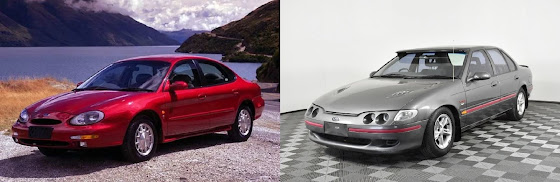
1996 Ford Taurus Ghia (left) and 1996 Ford EF Falcon XR8 (right).

In the 1990s, jellybean was the (usually disparaging) term often applied to the depressingly similarly-shaped cars which were the product of wind-tunnels; while aerodynamically efficient, few found the lines attractive.  In 1996, Ford Australia put the US-sourced Taurus into the showrooms alongside the locally-built and well-received EF Falcon.  As well as carrying the stigma of FWD (front wheel drive), the Taurus's “jellybean” styling alienated buyers, some of whom suggested the it looked as if it was awaiting repairs having suffered an accident.  The Taurus was withdrawn from the Australian market after two years of dismal sales, dealers managing to clear to unsold stock only after a further season of heavy discounting.

Champagne Jelly
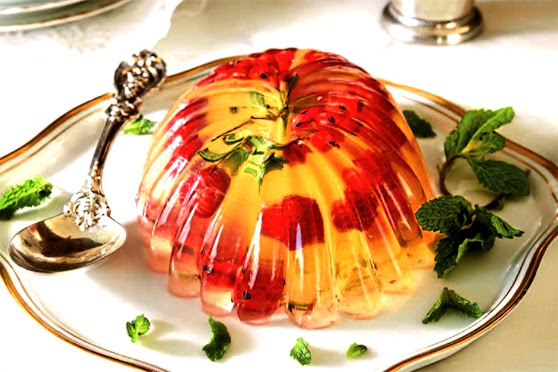
Champagne Jelly was served at the coronation banquet of Edward VII (1841–1910; King of the United Kingdom and Emperor of India 1901-1910) in 1902 and has since been a popular “nostalgia” dish, seen often at weddings or seasonal celebrations.

Ingredients (to serve six)

1 750 ml bottle of champagne
2 sachets (2½ tsp each) powdered gelatin (or 8 gelatin sheets)
2 tablespoons water (if using powdered gelatin)
115g (4 oz) white sugar
Berries and/or edible flowers (optional)
Fresh mint leaves, for garnish

Instructions

(1) Place champagne bottle in a freezer 30 minutes before beginning preparation (this will ensure jelly will retain the bubbles).

(2) In a small bowl, sprinkle the powdered gelatin (if using), over the water and let stand until softened (typically 3-5 minutes).  If using gelatin sheets, put sheets into a bowl and cover with cold water, soaking until floppy (typically 5-10 minutes).

(3) Open champagne and pour 120 ml into a small pan.  Return corked champagne to freezer, ensuring bottle remains upright.  If this is not possible, put bottle into fridge in upright position.

(4) Add the sugar to the pan, place over a medium heat, and heat, stirring, until the sugar dissolves at which point, remove from heat.  Liquefy the powdered gelatin by setting the bowl of softened gelatin into a larger bowl of very hot tap water (do not use boiling water).

(5) If using gelatin sheets, lift the sheets from the water, wring to release excess water, then put them into a bowl and liquefy as for the powdered gelatin.  Add the liquefied gelatin to the champagne mixture and stir until the gelatin dissolves.

(6) Strain the mixture through a fine sieve into a bowl or pitcher, then allow to cool to room temperature.

(7) Add 480 ml of chilled champagne to the cooled gelatin mixture and stir well.  If adding berries or edible flowers, pour half of the gelatin mixture into a 600 ml (1 pint) mould and chill until almost set (typically 30-45 minutes).  Arrange the embellishments on top, then add the remaining gelatin mixture.

(8) If serving the jelly without embellishments, pour all the gelatin mixture into the mould.  Cover and refrigerate until fully set (at least 12 hours and preferably longer).  At this point drink remaining champagne; if need be, open a second bottle.

(9) To serve, fill a bowl with hot water.  Dip the bottom of the mould into the hot water for a few seconds to loosen the jelly from the mould, then place on a serving plate and garnish with mint.

Lindsay Lohan, New York City, November 2022.

Lindsay Lohan in November 2022 appeared on ABC’s Good Morning America to promote the Netflix movie, Falling for Christmas.  What caught the eye was her pantsuit in a gallimaufry of colors from Law Roach’s (b 1978) Akris’ fall 2022 ready-to-wear collection, the ensemble including a wide-lapelled jacket, turtleneck top and boot cut pants fabricated in a green, yellow, red & orange Drei Teile print in an irregular geometric pattern.  Whether the color combination was inspired by champagne jelly wasn't discussed and the distinctive look was paired with a similarly eclectic combination of accessories, chunky gold hoop earrings, a crossbody Anouk envelope handbag, and Giuseppe Zanotti platform heels.  The enveloping flare of the trousers concealed the shoes which was a shame because, while hardly original, the Giuseppe Zanotti (b 1957) bebe-style pumps in gloss metallic burgundy leather deserved to be seen, distinguished by 2 inch (50 mm) soles, 6-inch (150 mm) heels, an open vamp, rakish counters and surprisingly delicate ankle straps.  The stylist's desire for the hem of the trousers to reach to the ground is noted but the shoes were nice pieces.  The fashion critics are a tough and unforgiving crew and it can be hard to predict which way they'll jump but the collective reaction was positive.