Showing posts sorted by relevance for query Basic. Sort by date Show all posts

Sunday, March 20, 2022

Basic

Basic (pronounced bey-sik)

(1) Of, relating to, or forming a base; fundamental.

(2) In chemistry, pertaining to, of the nature of, or containing a base; alkaline.

(3) In metallurgy, noting, pertaining to, or made by a steelmaking process (basic process) in which the furnace or converter is lined with a basic or non-siliceous material, mainly burned magnesite and a small amount of ground basic slag, to remove impurities from the steel.

(4) In geology, descriptor of a rock having relatively little silica.

(5) In military use, the lowest or initial form of anything (chiefly US).

(6) In popular culture, the adjectival part of a slang term for a sub-set of females characterized by predictable or unoriginal style, interests, or behavior.

(7) Of things elementary in character, essential, key, primary, basal, underlying.

(8) As a computer industry acronym, (BASIC and its forks, QBASIC, BASICA etc), a long-lived programming language: B(eginner's) A(ll-purpose) S(ymbolic) I(nstruction) C(ode).

1832:  Originally from chemistry (base + ic) and adopted by about every other field.  The programming language was created in 1964 by Hungarian-born US-based computer scientist John Kemeny (1926-1992) and US computer scientist Thomas Kurtz (b 1928).  Use to describe a female sub-set dates from 2005.

The Basic Bitch

Basic bitch, often truncated to the (sometimes affectionate) "basic", is a US pop-culture term.  Although use outgrew its origins, it was intended as a pejorative descriptor of white, middle class females with boringly predictable, mainstream tastes in consumer goods and culture.  Variously interpreted as a variation on the earlier airhead, a general expression of misogyny and another unsuccessful attempt to invent a term white people would find offensive, basic bitch briefly generated a sizable critique.  Although expressions of disapproval of hollow consumer culture had became common even before publication of JK Galbraith's (1908–2006) The Affluent Society (1958) made it a bit of a thing, basic bitch seemingly offended just about all the usual suspects in the grievance industry.

Feminists found it misogynistic and weren’t at mollified by the emergence of a term of male equivalence, their general position probably demanding the dismissal of all cultural feminine signifiers.  To them, the specifics were tiresomely irrelevant; basic bitch was just another way to demean women.  The left generally agreed, arguing it was unhelpful to target a stereotype of late capitalist femininity rather than adhere to their critique of consumer culture.  Western capitalism, neutral on the squabble, soon commodified:

Less predictable was the race-based criticism.  Basic bitch was considered yet another attempt to create a term of disparagement to describe the white folk which they would find actually offensive and in that, like all previous attempts, it didn’t work.  However, it clearly made sense only if applied to white, middle-class females so had the effect of creating yet another exclusive enclave of white privilege and one which, by definition, excluded other ethnicities, even if becoming a basic bitch was their aspiration.  First noted in 2005 in a sub-set of popular music, "basic bitch" entered mainstream use circa 2009 and use appears to have peaked in 2014 although term may persist because it references a mode of behavior rather than anything specific to a time or place; it’s thus adaptable and generationally transferrable.  It’s also an amusing example of one aspect of how Sisyphean battles in the pop-culture wars are waged.  All those who coined the alliterative basic bitch were saying was “our taste in pop music is better than their taste in pop music”.

In the matter of Judge Eugene Fahey

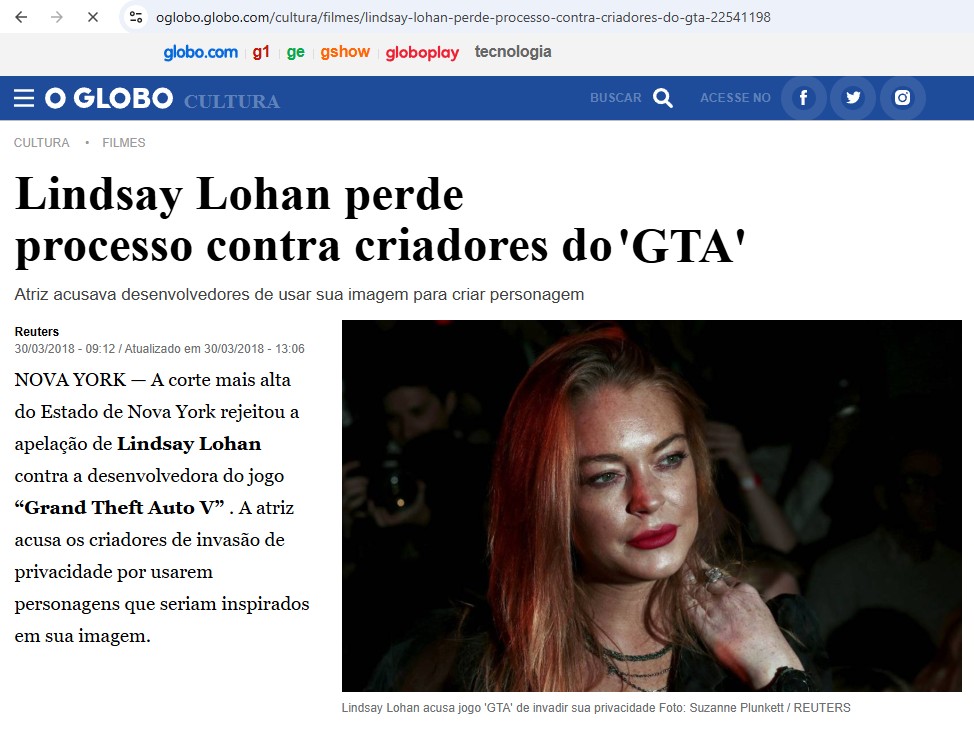
Lindsay Lohan v Take-Two Interactive Software Inc et al, New York Court of Appeals (No 24, pp1-11, 29 March 2018) was a case which took an unremarkable four years from filing to reach New York’s highest appellate court; Lindsay Lohan’s suit against the makers of video game Grand Theft Auto V was dismissed.  In a unanimous ruling in March 2018, six judges of the New York Court of Appeals rejected her invasion of privacy claim which alleged one of the game’s characters was based on her.  The judges found the "actress/singer" in the game merely resembled a “generic young woman” rather than anyone specific.  Unfortunately the judges seemed unacquainted with the concept of the “basic white girl” which might have made the judgment more of a fun read.

Beware of imitations: The real Lindsay Lohan and the GTA 5 ersatz, a mere "generic young woman".

Concurring with the 2016 ruling of the New York County Supreme Court which, on appeal, also found for the game’s makers, the judges, as a point of law, accepted the claim a computer game’s character "could be construed a portrait", which "could constitute an invasion of an individual’s privacy" but, on the facts of the case, the likeness was "not sufficiently strong".  The “… artistic renderings are an indistinct, satirical representation of the style, look and persona of a modern, beach-going young woman... that is not recognizable as the plaintiff" Judge Eugene Fahey (b 1951) wrote in his ruling.  Judge Fahey's words recalled those of Potter Stewart (1915–1985; associate justice of the US Supreme Court 1958-1981) when in Jacobellis v Ohio (378 U.S. 184 (1964) he wrote: I shall not today attempt further to define… and perhaps I could never succeed in intelligibly doing so.  But I know it when I see it…”  Judge Fahey knew a basic white girl when he saw one; he just couldn't name her.  Lindsay Lohan's lawyers did not seek leave to appeal.

Saturday, December 13, 2025

Narratology

Narratology (pronounced nar-uh-tol-uh-jee)

The study of narrative & narrative structure and the ways these affect human perception (with some mission creep over the years).

1967: The construct was narrate +‎ -ology, an Anglicization of the French narratologie, coined by Bulgarian-French historian, philosopher & structuralist literary critic Tzvetan Todorov (1939–2017), it first appeared in his book Grammaire du Décaméron (1967), a structural analysis of Decameron (The Decameron (1348-1353)) by the Italian writer Giovanni Boccaccio (1313–1375).  Although once thought an arcane appendage to literature and a mere academic abstraction, structuralism and narratology in the 1970s and 1980s became a very popular (and controversial) field and while postmodernism’s historic movement may have passed, the tools are an important part of the “learning” process used by generative AI (artificial intelligence) to produce meaning from the LLM (large language models.)

Title page from a 1620 printing of Decameron.

Boccaccio’s Decameron (literally “ten days”) was a collection of short stories, structured into a hundred tales of seven young women and three young men who had secluded themselves in a villa outside Florence, seeking to avoid the Black Death pandemic (1346-1353) then sweeping Europe.  Although not too much should be made of this comparison, the work in some aspects is not dissimilar to reality television, being a mash-up of erotic scenes, set-piece jokes, suspense and unrequited love.  Todorov’s Grammaire du Décaméron was a literary analysis of the work but “grammaire” must be understood as meaning “grammar” in the sense of the structural or narratological principles rather than as its used in its “everyday” sense.  Historians and literary scholars have for centuries regarded Decameron as a valuable document because, written in the Florentine vernacular of the era, although fictional, it’s a kind of “snapshot” of life in what was one of Europe’s many troubled times.  It was Boccaccio who dubbed Dante’s (Dante Alighieri (circa 1265–1321)) Divina Commedia (Divine Comedy (circa 1310-1321)) “divine” (in the sense of “very good” rather than “holy”).

Narrate (to relate a story or series of events (historically in speech or writing)) may for years (or even decades) have been in oral use in English before the first known use in print in 1656, etymologists noting that until the nineteenth century it was stigmatized as “Scottish” (long a slur among the more fastidious) although it’s thought it was derived from the “respectable” narration.  Narrative ((1) a story or account of events or (2) the art, process or technique or telling the story) was in use by the 1440s and was from the Middle French noun & adjective narrative, from the Late Latin narrātīvus (narration (noun) & suitable for narration (adjective)), the construct being narrāt(us) (related, told), past participle of narrāre (to relate, tell, say) + -īvus (the adjectival suffix).  Again, like “narrate”, narrative was once used exclusively of speech or writing but in recent decades the terms have been more widely applied and not restricted to describing the efforts of humans.

Since the nineteenth century, “-ologies” have proliferated.

The suffix -ology was formed from -o- (as an interconsonantal vowel) +‎ -logy.  The origin in English of the -logy suffix lies with loanwords from the Ancient Greek, usually via Latin and French, where the suffix (-λογία) is an integral part of the word loaned (eg astrology from astrologia) since the sixteenth century.  French picked up -logie from the Latin -logia, from the Ancient Greek -λογία (-logía).  Within Greek, the suffix is an -ία (-ía) abstract from λόγος (lógos) (account, explanation, narrative), and that a verbal noun from λέγω (légō) (I say, speak, converse, tell a story).  In English the suffix became extraordinarily productive, used notably to form names of sciences or disciplines of study, analogous to the names traditionally borrowed from the Latin (eg astrology from astrologia; geology from geologia) and by the late eighteenth century, the practice (despite the disapproval of the pedants) extended to terms with no connection to Greek or Latin such as those building on French or German bases (eg insectology (1766) after the French insectologie; terminology (1801) after the German Terminologie).  Within a few decades of the intrusion of modern languages, combinations emerged using English terms (eg undergroundology (1820); hatology (1837)).  In this evolution, the development may be though similar to the latter-day proliferation of “-isms” (fascism; feminism et al).

A narrative is a story and it can run to thousands of pages or appear in a few words on a restaurant menu describing their fish & chips: “Ethically sourced, line-caught Atlantic cod, liberated from the frigid depths, encased in a whisper-light, effervescent golden shroud of our signature micro-foamed artisanal lager batter and served with hand-sliced, elongated potato batons fried to a crisp perfection in sustainably produced vegetable oil.”  In the age of every customer being able to post from their phone a rating and review of a restaurant, wisely, some institutions include a footnote along the lines: “These narratives are a guide and because natural products vary greatly, there will be variation.”  That’s an aspect of narratology, a process which is not the reading and interpretation of individual texts but an attempt to study the nature of “story” itself, as a concept and as a cultural practice or construct.

Crooked Hillary Clinton's book tour (2017).

Narratologists know that what to a narrator can be a narrative, a naratee will receive as spin.  In What Happened (2017), a work of a few dozen pages somehow padded out to a two-inch thick wad of over 500 using the “how to write an Amazon best-seller” template, crooked Hillary Clinton (b 1947; US secretary of state 2009-2013) explained who was to blame for her loss in the 2016 US presidential election (spoiler alert: it was everybody except her).

Presumably not comparing what they’re doing with making “fish & chips” sound like something expensive, politicians and their operatives will often describe something they offer as a “narrative” although were mush the same stuff to come from their opponents it might be dismissed as “spin”.  A political narrative functions as a cognitive schema intended to simplify complexity, motivate support and legitimizes particular courses of action.  The concept has a long history but in recent decades the emphasis has been on “simplicity”, something illustrated by comparing a narrative like The Federalist Papers (1878-1788; a collection of several dozen essays advocating the ratification of the Constitution of the United States) with how things are now done (mostly fleshed-out, three-word slogans endlessly repeated).  That descent doesn’t mean both are not narratives in that both are crafted interpretive frame rather than objective descriptions although the extent of the deception obviously had tended to change.  Political spin can also be a narrative and should be thought a parallel stream rather than a tributary; variations on a theme as it were.  Although the purpose may differ (a narrative a storyline intended to set and define and agenda whereas spin is a “damage control” story designed to re-shape perceptions.  Given that, a narrative can be thought of a “macro-management” and spin “micro-management”, both providing fine case-studies for narratologists.

Narratology is a noun; the noun plural is narratologies.  The derived forms are the noun antenarratology (the study of antenarratives and their interplay with narratives and stories), the noun antenarrative (the process by which a retrospective narrative is linked to a living story (the word unrelated to the noun antinarrative (a narrative, as of a play or novel, that deliberately avoids the typical conventions of the narrative, such as a coherent plot and resolution)), the noun  econarratology (an approach to literary criticism combining aspects of ecocriticism (the interdisciplinary study of literature and ecology) and narratology), the noun narratologist (one who (1) studies or (2) practices narratology), the adjective narratological (of or pertaining to narratology) and the adverb narratologically (in terms of narratology).  Remarkably (given the literary theory industry), the adjective narratologistic seems never to have appeared; it can be only a matter of time.

Tzvetan Todorov on the rooftop of Casa Milà (La Pedrera), Barcelona, Spain, November 2014.

Although not a lineal descendent, what Todorov did in Grammaire du Décaméron was in the tradition of Aristotle’s (384-322 BC) work, especially ποιητικῆς (Peri poietikês (De Poetica De Poe in the Latin and traditionally rendered in English as Poetics).  Poetics is notable as the earliest known study of the structure of Greek drama and remains the oldest known text written exclusively in the form of what now would be called literary theory.  To a modern audience the word “poetics” can mislead because the author’s focus was ποιητική (literally “the poetic art”, from ποιητής (poet, author, writer) and his scope encompassed verse drama (comedy, tragedy, and the satyr play), lyric poetry, and the epic.  For centuries, Poetics loomed over the Western understanding of Greek theatre; it was revered by scholars of the late Medieval period and especially the Renaissance and their influence endured.  As far as in known, the Greeks were the first of the tragedians and it’s through the surviving texts of Aristotle that later understandings were filtered but all of his conclusions were based only on the tragedies and such was his historic and intellectual authority that for centuries his theories came to be misapplied and misused, either by mapping them on to all forms of tragedy or using them as exclusionary, dismissing from the canon those works which couldn’t be made to fit his descriptions.  However, as well as being an invaluable historic text explain how Greek theatre handled mimesis (imitation of life, fiction, allegory etc) Poetics genuinely was proto-critical theory and in it lies a framework for structuralism.

Paintings of Claude Lévi-Strauss: Portrait de Claude Lévi-Strauss, 1991 (1991), oil on panel by Bengt Lindström (1925-2008) (left) and Claude Lévi-Strauss (undated), oil on other by Cal Lekie (b 1999).

Narratology as a distinct fork of structuralism does pre-date Todorov’s use of the word in 1967, the seminal work in the parameters of the discipline by Russian folklorist & literary historian of the formalist school Vladimir Propp (1895-1970) who doubtlessly never anticipated “formalism” would come to be weaponized by comrade Stalin (1878-1953; Soviet leader 1924-1953).  Indeed, by the late 1920s the school of formalism had become unfashionable (something which in the Soviet Union could be dangerous for authors) and their works essentially “disappeared” until being re-discovered by structuralists in the 1950s.  In the West, the idea of narratology as the “theory, discourse or critique of narrative or narration” owes a debt to Belgian-born French anthropologist & ethnologist Claude Lévi-Strauss (1908–2009) who defined the structural analysis by narrative as its now understood.  His landmark text Anthropologie structurale (Structural Anthropology (1958)) suggested myths are variations on basic themes and that in their totality (which runs to thousands) their narratives contain certain constant, basic and universal structures by which any one myth can be explained.  In that way, myths (collectively) exist as a kind “language” which can be deconstructed into units or “mythemes” (by analogy with phonemes (an indivisible unit of sound in a given language)).  Although he didn’t pursue the notion of the comparison with mathematics, others did and that (inherently more segmented) field perhaps better illustrates “structural roles” within language in elements which, although individually standing as minimal contrastive units, can be combined or manipulated according to rules to produce meaningful expressions.  As in formal language theory, in mathematical logic, the smallest units are the primitive symbols of a language which can be quantifiers, variables, logical connectives, relation symbols, function symbols or punctuation.  Broken into the individual parts, these need have no (or only minimal) semantic meaning but gain much meaning when assembled or otherwise handled through syntactic combination governed by a recognized grammar (ie although conceptual primitives rather than “building blocks”, complex meaning can be attained by applying axioms and rules).

Azerbaijani folk art, following Layla and Majnun (1188), a narrative poem by the Persian poet Nizami Ganjavi (circa 1141–1209), printed in Morphology of the Folk Tale (1928) by Vladimir Propp.  In something of a Russian tradition, there are no known photographs of Propp smiling.

Levi-Strauss’s contribution was that myths can be read in relation to each other rather than as reflecting a particular version, thus the his concept of a kind of “grammar” (the set of relations lying beneath the narrative’s surface), thus the general principle of the “collective existence of myths”, independent of individual thought.  That was of course interesting but the startling aspect was the implication myths as related to other myths rather than truth and reality; they are, in a sense, “outside” decentred, and possess their own truth and logic which, when contemplated in a “traditional” way, may be judged neither truthful nor logical.  In that, Levi-Strauss applied something of the method of Propp who, in Morphology of the Folk Tale (1928), “reduced” all folk tales to seven “spheres of action” and 31 fixed elements or “functions” of narrative.  In Propp’s scheme, the function was the basic unit of the narrative “language’ and denoted or referred to the actions which constitute the narrative while the functions tend to follow a logical sequence.  The concept would have been familiar to engineers and shipbuilders but genuinely there was some novelty when applied to literature

Lithuanian semiotician A. J “Julien” Greimas (1917–1992) was among the many academics working in France who found Propp’s reductionism compelling and in Sémantique Structurale Recherche de méthode (Structural Semantics: An Attempt at a Method (1966)) he further atomized things, apparently seeking something like a “universal macro language”, a grammar of narrative which could be derived from a semantic analysis of sentence structure.  That was as ambitious as it sounds and to replace Propp’s “spheres of action” he suggested the “actant” (or role): a structural unit which is neither character or narrative.  To handle the mechanics of this approach he posited three pairs of binary oppositions which included six actants: subject/object; sender/receiver; helper/opponent.  The interactions of these binary oppositions served to account for or describe the three basic patterns which are to be found in narrative: (1) desire, search or aim (subject/object), (2) communication (sender/receiver) and (3) auxiliary support or hindrance (helper/opponent).

An eleven-volume first edition of Marcel Proust’s À la recherche du temps perdu (published originally in seven (1913-1927); in the the original French it contained some 1.267 million words.  By comparison, Leo Tolstoy's (1828-1910) War and Peace (1898) ran ran (depending on the edition) to 560-590 thousand.

While Greimas didn’t explicitly claim his model successfully could be mapped on to “any and every” narrative, he does appear to have built his model as a general theory and while not all critics were convinced, it seems generally to have been acknowledged his toolbox would work on a much wider range than that of Propp which did break down as narrative complexity increased.  Another French literary theorist associated with the structural movement was Gérard Genette (1930–2018) and in choosing a case study for his model he described in Discours du récit est un essai de méthode (Narrative Discourse: An essay in method (1972)) he selected Marcel Proust’s (1871-1922) À la recherche du temps perdu (1913–1927) (originally translated in English as “Remembrance of Things Past” and of late as “In Search of Lost Time”) which spans many volumes and narrative streams.  This time the critics seemed more convinced and seem to have concluded Genette’s approach was “more accessible” (these things are relative).  Noting the distinctions made in Russian Formalism between fabula (story) & syuzhet (plot), Genette distinguished between récit (the chronological sequence of a narrative’s events), historie (the sequence in which the event actually occurred and narration (the act of narrating itself); atop that framework, he built a complex discussion.  Being a French structuralist, he of course added to the field some new jargon to delight the academy, concluding there were three basic kinds of narrator: (1) the heterodiegetic' (where the narrator is absent from his own narrative), (2) the homodiegetic (the narrator is inside his narrative, as in a story told in the first person) and the autodiegetic (the narrator is inside the narrative and also the main character).  Genene’s approach was thus relational, envisaging narrative as a product or consequence of the interplay of its different components, meaning all and all aspects of narrative can be seen as dependent units (or, debatably, layers).

Narrator & protagonist: Lindsay Lohan as Cady Heron in Mean Girls (2004).  What in literary theory is known as homodiegetic narration is in film production usually called “subjective narration” or “first-person narration”, realized usually in a “voice-over narration by the protagonist”.

In formulating his three categories Genene nodded to Aristotle and Plato (circa 427-348 BC), the ancient worthies distinguishing three basic kinds of narrator: (1) the speaker or writer using their own voice, (2) (b) one who assumes the voice of another or others and (3) one who uses both their own voice and that of others.  These categories need not be exclusive for a story may begin in the voice of a narrator who may then introduce another narrator who proceeds to tell the story of characters who usually have their own voices and one or more of them may turn to narration.  Structurally (and even logically), there’s no reason why such a progression (or regression) cannot be infinite.  Although it’s obvious the term “narrate” denotes the person to whom a narrative is addressed, just because there is a narrative, it need not be axiomatic a narratee is present or ever existed, T. S. Eliot (1888–1965) in The Three Voices of Poetry (1953-1954) discerning three modes (voices) of poetic expression: (1) the poet speaking to himself, a personal, often obscure meditation, (2) the poet addressing an audience, aiming to teach, persuade, or amuse and (3) the poet creating a dramatic character, as in verse drama, something demanding complex communication between imagined characters.  Eliot argued that “good” poetry often was a blend of these voices and distinguishing them helps in understanding a poem's social and artistic purpose, beyond its mere self-expression.  However, Eliot did note that in “talking to himself”, the writer could also be “talking to nobody”.  He was at pains also to point out that when speaking in the third voice, the poet is saying not what he would say in his own person, but only what he can say within the limits of one imaginary character addressing another imaginary character.  More than many, Eliot knew narrative was not always reliable but the techniques of narratology (and structuralism generally) exist for purposes other than determining truth.

Roland Barthes (2015), oil and acrylic on canvas by Benoit Erwann Boucherot (b 1983).

Layers in narrative structure were identified by the French philosopher & literary theorist Roland Barthes (1915–1980) and his work had great appeal, something of an academic cult once surrounded him and, almost half a century after his death, he retains a following.  In Introduction à l'analyse structurale des récits (Introduction to Structural Analysis of Narrative (1966)), Barthes presumed a hierarchy of levels existed within narrative, suggesting that, up to a point, they can be discussed separately.  Narrative (at least for this purpose), he conceived as a “long sentence”, just as every constative (in linguistics, pertaining to an utterance relaying information and likely to be regarded as true or false) sentence can be the “rough outline” of a short narrative.  Barthes’ model was more building block-like in that he selects basic units of narrative (such as “function” & “index”, functions constituting a chain of acts while indices are a kind of metadata containing information about characters.

François Mitterrand (1984), acrylic on canvas by Bryan Organ (b 1935).

On X (formerly known as Twitter), one tweeter analysed the images on Barthes which exists and the indexed web, finding in 72% he was smoking a cigarette or cigar.  The statistical risks associated with routinely inhaling a known carcinogen have for decades been well-known but Barthes didn’t live long enter the age of “peak statistical risk”.  In February, 1980, having just taken lunch with François Mitterrand (1916–1996; President of France 1981-1995) in a restaurant on Paris’s Rue des Blancs-Manteaux, Barthes was using a zebra crossing on the Rue des Ecoles when knocked down by a laundry van; never recovering from his injuries, he died a month later.  The van’s driver was one Yvan Delahov, of Bulgarian nationality who tested positive for alcohol, but his reading of 0.6 fell below the legal maximum of 0.8; admitting he was late delivering his shirts, he claimed he’d not exceeded 60 km/h (37.3) mph.  At the time, Barthes was carrying no identity documents but was identified his colleague, the philosopher Michel Foucault (1926–1984).

Northrop Frye, Anatomy of Criticism (first edition, 1957).

Finally must be acknowledged the contribution of Canadian literary critic & literary theorist Northrop Frye (1912–1991) whose Anatomy of Criticism (1957) is regarded still as one of the more “remarkable and original” (in the words of the English historian and critic J.A. Cuddon (1928-1966)) works of literary theory in the English-speaking world.  In the narrow technical sense, Frye's theory is not structuralist (something which doubtless burnished its reputation among many) but it certainly contains strands which can be seen as structuralist.  Frye positioned literature as an “autonomous verbal structure”' unrelated to anything beyond itself, a world which contains “life and reality in a system of verbal relationships”.  In this “self-contained literary universe”, there were four radical “mythoi” (plot forms and basic organizing structural principles) which corresponded to the four seasons of the natural order and constitute the four main genres of comedy romance, tragedy and satire.  For those non-postmodernists who still long for l'art pour l'art (art for art's sake), Frye’s mythois are there to be used and he proved their utility in a wide range of texts, including the Bible.

Thursday, April 6, 2023

CONELRAD

CONELRAD (pronounced kon-ill-rad or kon-ill-rid)

The short form of CONtrol of ELectromagnetic RADiation.

Exclusive to the US, CONELRAD was a nationally standardized system of emergency public broadcasting (on the AM (amplitude modulation) medium-wave band at 640 & 1240 KHz) intended to operate in the event of enemy attack during the Cold War.  The original specifications for what emerged as CONELRAD was first discussed in March 1951 at the Informal Government-Industry Technical Conference and later published by the FCC (Federal Communications Commission):

"The primary plan for alerting broadcast stations that is currently being considered by the FCC Study Group is known as the Key Station System.  The arrangement requires certain telephone circuits (private wire or direct line to Toll Board) between the Air Defense Control Centers (ADCC) and specified radio stations to be known as Basic Key Stations & Relay Key Stations”.

The essence of the system was each Basic Key Station upon receiving an alert or warning signal from the ADCC would, upon instruction, broadcast a predetermined message and also relay the message by telephone to all Relay Key Stations assigned to each Basic Key Station.  As a diversified network designed to be able to continue functioning even if various parts were destroyed, it was conceptually similar to a later US military project which would later evolve into the internet.  Intended to be simple, robust and able to reach as wide a possible audience in the shortest possible time, CONELRAD used simple protocols for alerting the public and other "downstream" stations, consisting of a sequence of shutting the station off for five seconds, returning to the air for five seconds, again shutting down for five seconds, and then transmitting a tone for 15 seconds.  Key stations would be alerted directly and all other broadcast stations would monitor a designated station in their area.

In the event of an attack on the US, all domestic television and FM (frequency modulation) radio stations were required instantly to cease broadcasting and upon alert, all most AM stations shut down, those remaining on-air transmitting either on 640 or 1240 kHz.  No transmission would last more than a few minutes and upon one going “off-air” another would take over the frequency on a ”round robin” chain, this to confuse enemy aircraft which might be navigating using Radio Direction Finding (RDF), a technique first widely used in the early days of World War II (1939-1945).  In the US, all radio sets manufactured between 1953-1963 were required to have the two frequencies marked by the triangle-in-circle (CD Mark), the symbol of Civil Defense organizations.

Tuesday, December 5, 2023

Prompt

Prompt (pronounced prompt)

(1) Something done, performed, delivered etc at once or without undue delay.

(2) Ready & quick to act as the circumstances demand (archaic).

(3) Quick or alert.

(4) Punctual.

(5) To move or induce to action; to occasion or incite (often as “prompted”).

(6) To assist by suggesting something.

(7) To remind someone of what has been forgotten (formalized in live performance (the stage, singing etc) where a “prompt” is a supplied from the wings to remind a performer of a missed cue or forgotten line (the noun prompter can indicate both a person employed to deliver cues or the device used (printed or on a screen).

(8) In computing, the message or symbol on the screen which indicates where an entry is require, the most basic of which is the “command prompt” of text-based operating systems which stood ready to receive a structured command.

(9) In computing, in artificial intelligence (AI), machine learning algorithms (MLI) and related systems, to request particular output by means of instructions, questions, examples, context, or other input.

(10) In commercial use, a time limit given for payment of an account for produce purchased, this limit varying with different goods (archaic).

(11) In futures trading, the “front” (closest or nearest).

(12) The act of prompting.

1350-1400: From the Middle English prompte (ready, eager (adjective) & prompten (verb), from the French prompt, all forms ultimately from the Latin prōmptus (evident; manifest, at hand, ready, quick, prepared), participle of prōmō (to take or bring out or forth, produce, bring to light) and the adjectival use of past participle of prōmere (to bring forth, deliver, set forth), the construct being from prō- (forth, forward; for; on behalf of, in the interest of, for the sake of; before, in front of; instead of; about; according to; as, like; as befitting), a combining form of the preposition prō, from the Proto-Italic pro-, from the primitive Indo-European pro-, o-grade of per-) + emere (to buy, obtain, take).  The synonyms can include urge, spur, remind, refresh, instigate, impel, punctual, quick, rapid, hasty & timely.  Modifiers are applied as requited including over-prompt, quasi-prompt & un-prompt.  Prompt is a noun, verb & adjective, promptness & prompter are nouns, prompter & promptest are adjectives, promptly is an adverb and prompting & prompted are verbs; the noun plural is prompts.

The noun (in the phrase “in prompte”) emerged in the early fifteenth century in the sense of “readiness" and was from the Latin verb prōmptus while the more familiar meaning “hint, information suggested, act of prompting” dates from the mid-1500s.  The formal use of prompt in the sense of the indicator on a screen ready to accept user input dates only from 1977 although the concept had been in use for decades.  The ideas of coaching (someone) or assisting them by providing a reminder of that which clearly had been forgotten (or imperfectly learned) was first used in the early fifteenth century, the best-known use in live theatre (to assist a speaker with lines) dating from the 1670s.  The adjectival use (ready, prepared (to do something), quick to act as occasion demands) was from the thirteenth century Old French prompt and directly from Latin prōmptus (brought forth), hence “visible, apparent, evident, at hand”, a use now obsolete.  The commercial sense of the noun prompt “a time limit given for payment for merchandise purchased" dates from the mid-eighteenth and while the concept remains, the word is no longer formally use although the phrase “prompt payment requested” often remains as a reminder.  It remains unclear whether the verb was derived from the adjective or vice-versa and another oddity is that the first recorded instance of “prompting”, the gerund (the verbal noun logically derived from prompt and meaning “incitement or impulse to action” is from 1402, a quarter of a century before the verb.

The formal use of prompt in the sense of the indicator on a screen ready to accept user input dates only from 1977 although the concept had been in use for decades and predates screens, prompts emerging as soon as user input switched from the flicking of switches to character-based entries via a keyboard or similar input device.  The first prompts were those which sat (undifferentiated) on a plotter or printer, awaiting user input.  Command prompts were familiar from the late 1970s and appeared in early versions of Apple and CP/M systems among others but it was the IBM PC which introduced them to what was then the (still small) mainstream.  When the IBM PC was released in 1981, the user interface was exclusively text-based and the PC-DOS (or MS-DOS) command prompt was (almost) the only way for users to interact with their hardware and software.  The quirky exception to that was that on genuine IBM machines, the BIOS (Basic Input/Output System) included a BASIC (the Beginners All-Purpose Symbolic Instruction Code programming language) interpreter so it was possible to do certain things with the hardware even if an operation system (OS) wasn’t present.  IBM’s lawyers guarded their BIOS with rare efficiency so the numerous PC clones almost all needed an OS to be useful.

While programmers, nerds, and other obsessive types understood the charm of the command prompt and took to it fondly, most users had no wish to memorize even part of the sometime arcane command set needed and modern capitalism soon responded, menu systems soon available which allowed users to interact with their machine while hiding the essential ugliness beneath.  In time, these were augmented by graphical environments (some of which frankly overwhelmed the OS) and ultimately, the most successful of these would evolve into OSs, some of which included the ability to run multiple command prompts which at first contained and later emulated PC-MS-DOS.  The most elaborate of these was IBM’s OS/2 2.0 (and its successors) which permitted on a single machine literally hundreds of simultaneous command prompt sessions in a mix of 8, 16 & 32-bit flavors, some of which could even been launched as a bootable virtual machine, started from a floppy-diskette image.  Technically, it was an impressive achievement but around the planet, there were only a relative handful of organizations which needed such capabilities (typically those with megalomaniacs seduced by the idea of replacing perhaps dozens of MS-DOS based PCs each housing an interface handler of some type with one machine).  That could be made to work but the aggregate need was so limited that the direction proved a cul-de-sac.

The command prompt (with long file names, left) and the PowerShell prompt (right).  Both use the classic $p$g configuration.

The prompt didn’t however go away and in one form or another most OSs include one, Microsoft’s PowerShell (introduced in 2006 on Windows and ported to cross-platform compatibility within .NET in 2016) in its default configuration almost identical to that of the IBM-PC-1, all those years ago.  PowerShell included an enhanced list of commands but the earlier prompts were also not static and many options became available to customize the look, the list changing from release to release but a typical version included:

$Q (equal sign).
$$ $ (dollar sign).
$T (Current time).
$D (Current date).
$P (Current drive and path).
$V (OS version number).
$N (Current drive).
$G> (greater than sign).
$L & (less than sign).
$B| (pipe).
$E (Escape code (ASCII code 27)).
$_ (Carriage return and line feed).

Few actually customized their line beyond $P$G (so they would know the active sub-directory and that became the default with which most versions of PC/MS-DOS shipped) but $t $d$_$p$g had its followers (its displayed the time and the date above the prompt when in DOS.  Those for who aesthetics mattered could even set text and background colors and there were some genuinely nostalgic types who liked to emulate the bright orange or acid green screens they remembered from the world of the mainframes.  Most pleasing though was probably bright blue on black.

Prompt was one of the finalists for the Oxford University Press (OUP) 2023 Word Of The Year (WotY) although it didn’t make the cut for the shortlist.  Prompt was there not because the selection committee noted either a new international interest in punctuality or Microsoft’s PowerShell convincing a new generation to start enjoying a CLI (command-line interpreter) but because of the social and technological phenononom that is generative AI (artificial intelligence), the best-known of which is ChatGPT.  Of course, even those who weren’t dedicated command-line jockeys have for decades been interacting with the prompts of search engines but the influence of generative AI has been extraordinary and nudging “prompt” to OUP’s WotY finals is just a footnote, the editors noting even the emergence of a new job description: prompt engineer although, given the implications of generative AI, it might be a short-lived profession.  OUP also explained the expansion of meaning was a development of a wider sense: “Something said or done to aid the memory; a reminder” and that the earlier sense “prepared, ready” was long extinct although many clearly think of ChatGPT in this way.

Prompt would have been a worthy WotY and it’ll be with us for the foreseeable future, not something guaranteed for the winner: “Rizz”.  In its explanatory note, OUP sid rizz was “a popular Gen Z internet slang term”, a shortened form of the word “charisma”, used to describe someone’s ability to attract another person through style or charm, able also to be used as a verb (such as to “rizz up”, meaning to attract or chat up another person.  Rizz has about it the whiff of something which may quickly become cheugy (something once cool which became uncool by becoming too widely used by those who will never be cool) and the imprimatur of OUP’s WotY might be a nail in its coffin.  Time will tell but additionally, rizz is probably better click-bait than prompt, something to which even OUP's editors probably aren’t immune.  The other six finalists were:

Situationship: This describes a relationship (which may be sexual or romantic or neither) not thought (by the participants) formal or established (ie outside what are regarded as society’s conventions).  So, the state of relationship it describes in hardly new but it’s a clever use of language (the construct a portmanteau of situation + (relation)ship and it seems to have existed since around 2008-2011 (the sources differ) but its only recently that the use on social media and various dating apps and television shows that it’s achieved critical mass.

The anyway statuesque Taylor Swift, adding to the effect in 6 inch (150 mm) heels.

Swiftie: A (devoted / enthusiastic / obsessive etc) fan of the singer Taylor Swift (b 1989).  It was once pop culture orthodoxy that the particular conjunction of technological, demographic, economic and social conditions which were unique to the Western world in the 1960s meant what was described as the “claustrophobic hothouse” which produced “Beatlemania” couldn’t again happen.  While various pop-culture figures developed fan-bases which picked up descriptors (such as the “Dead Heads” associated with the Grateful Dead), the particular fanaticism surrounding the Beatles has never quite been replicated.  The Swifties however are said in devotion to go close and their numbers probably greater, Taylor Swift’s appeal truly cross-cultural and international; probably only the Ayatollahs and such are unmoved.  Etymologically, “Swiftie” is a conventional affectionate diminutive and among Swifties there are factions including die-hard Swifties, hardcore Swifties and self-proclaimed Swifties.  Someone a little ashamed of their fondness would presumably be a “confessed Swiftie” but none appear to exist and her appeal seems to transcend the usual pop-music boundaries.  Her songs are said to be "infectiously catchy" (a pleonasm she'd probably not allow in her lyrics).

Beige flag: Beige flag has a range and can be a trait which while not something distasteful or shocking, is of a nature which makes one pause and perhaps reconsider one’s relationship with whomever exhibits it.  It can be something which does little more than indicate the person isn’t interesting and is thus a adaptation of “red flag” and thus something to which the only rational reaction is an immediate sundering of a relationship.  So a red flag might be being a Scientologist, a Freemason or listening to country & western music whereas a beige flag might be driving a front wheel drive car; undesirable but perhaps not a deal-breaker.  It can also mean something which suggests someone is just not interesting though not actually evil.  Of late however, the meaning of beige flag has shifted, thus it’s making OUP’s list of finalists.  Now, it appears to be used to reference traits which can be thought “neutral” and it’s been further adapted to cover those situations or objects which cause one briefly to pause, before moving on and probably forgetting what they’ve just seen.  It just wasn’t interesting.

Lindsay Lohan, de-influencing.

De-influencing: De-influencing is one which will probably annoy the pedants.  In the social media era, the word influencer has come to mean “someone who seeks to influence the consumption, lifestyle, political behavior etc of their online audience by the creation of social media content, often as a part of a marketing campaign”.  A de-influencer is “someone who attempts to discourage consumption of particular products or consumption in general using the same platforms”.  So the de-influencers are the latest in the long tradition of anti-materialists who have existed at least since Antiquity, whole schools of philosophy sometimes constructed around their thoughts.  There’s said to be a discernible increase in their presence on the socials and many are linked also the various movements concerned with environmental concerns, notably climate change.  The pedants will object because the de-influencers are of course trying to exert influence but OUP are right to note the trend and the associated word.

Heat dome: A heat dome is a persistent high-pressure weather system over a particular geographic area, which traps a mass of hot air below it.  The weather phenomenon, the physics of which have for decades been understood by climate modelers and meteorologists, suddenly entered general in the high (northern) summer of 2023 when much of the northern hemisphere suffered from prolonged, unusually high temperatures, July measured as the hottest month ever recorded.  Under a heat dome, the atmospheric pressure aloft prevents the hot air from rising and dissipating, effectively acting as a lid or cap over the area, thus the image of a dome sitting over the land and they create their own feedback loop: Static areas of high pressure (which already contain warm or hot air trapped under the high) will become hotter and hotter, creating a heat dome.  Hot air will rise into the atmosphere, but high pressure acts as a lid and causes the air to subside or sink; as the air sinks, it warms by compression, and the heat builds. The ground also warms, losing moisture and making it easier to heat even more.  This is climate change in action and heat dome may well become as common an expression as “cyclone” or “hurricane”.

The UK's Royal Meteorological Service's simple illustration of the physics of a heat dome.  Heat domes are also their own feedback loop.  A static areas of high pressure which already contains warm or hot air trapped under the high will become hotter and hotter, creating a heat dome.  Hot air will rise into the atmosphere, but high pressure acts as a lid and causes the air to subside or sink; as the air sinks, it warms by compression, and the heat builds. The ground also warms, losing moisture and making it easier to heat even more.

Parasocial: The adjective parasocial designates a relationship characterized by the one-sided, unreciprocated sense of intimacy felt by a viewer, fan, or follower for a well-known or prominent figure (typically a pop-culture celebrity), in which the follower or fan comes to feel something similar to knowing the celebrity as they might an actual friend.  The parasocial is really a variation of fictosexual (an identity for someone for whom the primary form of sexual attraction is fictional characters) in that the pop-culture celebrity is also an at least partially fictional construct and the relationship is just as remote.  It’s almost irrelevant that one is flesh & blood and parasocial relationships do have certain advantages in that never having to have actual contact, one can never be rejected.  What appears most to have interested OUP is the idea that our relationship with celebrity culture is changing to something more intimate, presumably because the medium is the cell phone (mobile), increasingly our most personally intimate possession.

When one attempts transform a parasocial relationship into something conventional, one sometimes becomes a stalker.

Monday, March 27, 2023

Nothing

Nothing (pronounced nuhth-ing)

(1) No thing; not anything; naught.

(2) No part, share, or trace (usually followed by of).

(3) Something that is nonexistent; non-existence; nothingness.

(4) Something of no importance or significance.

(5) A trivial action, matter, circumstance, thing, or remark.

(6) A person of little or no importance; a nobody.

(7) Something that is without quantity or magnitude.

(8) A cipher or naught; the quantity or quality of zero.  The value represented by the numeral zero (and the empty set: {}).

(9) As “think nothing of it” and related forms, a procedural response to expressions of thanks.

(10) In no respect or degree; not at all.

(11) Amounting to nothing, as in offering no prospects for satisfaction, advancement, or the like.

(12) In architecture, the contents of a void.

Pre 900: From the Middle English nothyng, noon thing, non thing, na þing, nan thing & nan þing, from the Old English nāþing, nān þing & naðinc (nānthing & nathing) (nothing (literally “not any thing”), the construct being nān- (not one (source of the modern none)) + þing (thing).  The earlier Old English was nāwiht (nothing (literally “no thing”), related to the Swedish ingenting (nothing (literally “not any thing, no thing”).  The ultimate source was the primitive Indo-European ne- (not).  In slang and dialectical English there have been many non-standard forms including nuffin, nuffink, nuttin', nuthin, nuthin', nowt, nuthing & nothin'.  Slang has been productive (jack, nada, zip, zippo, zilch, squat, nix) as has vulgar slang (bugger all, jack shit, sod all, fuck all, dick).  Nothing is a noun & adverb and nothingness is a noun; the noun plural is nothings.

Lindsay Lohan wearing nothing (shoes don't count; everybody knows that).  Playboy magazine pictorial, January / February 2012.

The meaning "insignificant thing, a thing of no consequence" emerged circa 1600 (although as an adverb (not at all, in no degree), it was known in late Old English) whereas nothing in the sense of "not at all" had existed since circa 1300.  Phrases in the twentieth century were created as needed: “Nothing to it”, indicating something easily accomplished was noted from 1925 and “nothing to write home about” was really literal, recorded first and with some frequency by censors monitoring the letters written by soldiers serving at the front in Word War I (1914-1918); it appears to date from 1917, the extent of use apparently encouraged by it being a useful phrase exchanged between soldiers by word-of-mouth.  Nothing seems not to have been an adjective until 1961, an evolution of use (or a decline in standards depending on one’s view) which saw words like “rubbish” re-applied in a similar way.  A do-nothing (an idler) is from the 1570s, the noun an adoption from the from the verbal phrase and as an adjective to describe the habitually indolent, it’s noted from 1832.  The adjective good-for-nothing (a worthless person) is from 1711.  The term know-nothing (an ignoramus) is from 1827 and was later applied (though not deliberately) to the US nativist political party, active between 1853-1856, the bulk of which eventually migrated to the Republican Party.  The noun nothingness (non-existence, absence or negation of being) was first used in the 1630s but is most associated with the ideas around nihilism, the exploration of which became a mainstream part of philosophy in the nineteenth century.  Nothingness is distinct from the noun nothingarian which references "one who has no particular belief," especially in religious matters, a descriptive dating from 1789.  It's striking how often in religion, even when factions or denominations are in disputes with one another (sometime actually at war), one thing which seems to unite them is the feeling that whatever their differences, the nothingarians are the worst sinners of all.

The noun nihilist, in a religious or philosophical sense, is from the French nihiliste, from the Latin nihil (nothing at all).  Nihilism, the word first used in 1817, is “the doctrine of negation", initially in reference to religion or morals but later extended universally.  It’s from the German Nihilismus, from the Latin nihil (nothing at all) and was a coining of German philosopher Friedrich Heinrich Jacobi (1743-1819).  In philosophy, it evolved quickly into an extreme form of skepticism, the political sense of a "rejection of fundamental social and political structures", first used circa 1824 by the German journalist Joseph von Görres (1776-1848).  Most associated with a German school of philosophical thought including (rather misleadingly) GWF Hegel (1770–1831) and (most famously) Friedrich Nietzsche (1844–1900), the particular Russian strain was more a revolutionary political movement with something of a premium on violence (that would much influence Vladimir Lenin (1870–1924)).  Thus with an initial capital, Nihilism (Nigilizm in the Russian) as used in this context is specific to the movement of Russian revolutionary anarchism 1863-1917 and limited in that the meaning refers to the participants’ disapproval of all social, economic & political possibilities in pre-Soviet Russia; the sense they viewed “nothing” with favor.

A probably inaccurate representation of nothing.  

The idea of nothing, in a universal sense in which literally nothing (energy, matter, space or time) exists is difficult to imagine, imaginable presumably only as infinite blackness, probably because that’s the closest to a two-dimensional representation of the absence of any sense of the special, white implying the existence of light.  That nothingness is perhaps impossible to imagine or visualize doesn’t however prove it’s impossible but the mere fact matter, energy and time now exist in space does imply that because, were there ever nothing, it’s a challenge to explain how anything could have, from nothing, come into existence.  Some have mused that there are aspects of quantum theory which suggest even a state of nothingness can be inherently unstable and where there is instability there is the possibility of an event.  The argument is that under quantum theory, if long enough is allowed to pass (something which, bewilderingly, apparently can happen even if there is no time) then every possible event may happen and from this may evolve energy, matter space or time.  To speak of a time scale in all of this is irrelevant because (1) time may not exist and (2) infinity may exist but it can for administrative purposes be thought of as a very long time.  The intriguing link between time starting and energy, matter or space coming into existence as a consequence is that at that point (in time), it may be the only time “now” could exist in the absence of the past and future so everything would happen at the same time.  Clearly, the conditions operative at that point would be unusual so, anything could happen. 

That is of course wholly speculative but in recent decades, the “string theorists” have extended and refined their mathematical models to a degree which not long ago would have been thought impossible so some modelling of a unique point of “now” in nothing would be interesting and the basic framework of that would seem to demand the mathematics of a model which would describe what conditions would have to prevail in order for there truly to be nothing.  That may or may not be possible but might be an interesting basis from which to work for those trying to explain things like dark matter & dark energy, either or both of which also may or may not exist.  Working with the existing universe seems not to be helpful in developing theories about the nature of all this supposedly missing (or invisible) matter and energy whereas were one, instead of working backwards as it were, instead to start with nothing and then work out how to add what seems to be missing (while remaining still not visible), the result might be interesting and one thing which seems not much discussed is the notion the famous "dark energy" may be time itself.

It’s not a new discussion.  The thinkers from Antiquity were known to ponder the philosophers’ traditional concerns such as “why are we here?” and “what is the meaning of life?” but they also realized a more basic matter was “why does anything exist instead of there being nothing?” and for thousands of years this has been “explained” as the work of gods or a god but that really not a great deal of help.  In the Western tradition, this basic question seems not to have bothered angst-ridden Teutonic philosophers, the German Gottfried Leibniz (1646-1716) writing on the subject, as later would the Austrian Ludwig Wittgenstein (1889–1951).  Martin Heidegger (1889–1976, who was only briefly a Nazi) called it the “fundamental question of metaphysics”.  The English-speaking school, more tied to the empirical, noted the matter.