Showing posts sorted by relevance for query exoskeleton. Sort by date Show all posts

Friday, July 11, 2025

Exoskeleton & Endoskeleton

Exoskeleton (pronounced ek-soh-skel-i-tn)

(1) In zoology, an external covering or integument, any hardened external structure, as the shells of crustaceans or the scales and plates of fishes and reptiles, especially when it is of the nature of bone.

(2) All hard parts, such as hair, teeth, and nails which develop from the ectoderm or mesoderm in vertebrates (generally used only in technical literature).

(3) A wearable robotic machine used for aided or augmented mobility.

1841: The construct was exo- + skeleton.  The prefix endo- was used as a word-forming element meaning "inside, within, internal.  It was from the Ancient Greek νδον (éndon) (within; inner; internal) from the primitive Indo-European en-do- (an extended form of the root en (in)).  Skeleton was from the New Latin skeleton (bones, bony framework of the body), from the Ancient Greek skeleton soma (dried-up body, mummy, skeleton), from the neuter of σκελετός (skeletós) (dried up, withered, dried body (and as a noun: parched; mummy), from σκέλλω (skéllō & skellein) (dry, dry up, make dry, parch), from the primitive Indo-European (s)kelha- (to parch, wither); related was the Ancient Greek σκληρός (sklirós) (hard).  Exoskeleton is a noun; the noun plural is exoskeletons or exoskeleta.

Skelton was an early variant form.  The noun use of Greek skeletos passed into Late Latin as (sceletus), hence the French squelette and the rare English skelet (1560s), the Spanish esqueleto & the Italian scheletro.  The meaning "bare outline" was first recorded circa 1600; hence the term "skeleton crew" from 1778 used to describe minimal staffing, the skeleton key a similar allusion to some of a structure being removed.  The phrase "skeleton in the closet" (source of secret shame to a person, family or institution) is from 1812 and thought an adoption from the imagery in the fable Bluebeard (1697) by Charles Perrault (1628-1703). Exoskeleton was in 1841 coined by by English paleontologist Sir Richard Owen (1804–1892).  Exoskeleton has become more widely used in recent years because of the interest in fields such as engineering, robotics and medicine in using external structures, often to augment or replace human functions.  As early as the 1960s, the "exoskeleton look" became fashionable among architects who would no longer conceal features like plumbing pipes

Trilobites

Trilobite variants.

Trilobite (pronounced try-low-byte) translates literally as “three lobes".  Often casually referred to as bugs or sea-bugs, in taxonomy, all trilobites actually belong in the class of trilobite in the phylum arthropod and within the class are ten orders.  It’s not known how many species of trilobites existed but almost 21,000 have thus far been identified in the fossil record, their numbers and variety leading them to be regarded as one of history’s more successful animals.  They inhabited all the seas and oceans and endured some three-hundred million years, surviving several mass-extinction events.  Their long duration, their structure and living habits meant they became a common and frequently discovered fossil, noted since antiquity although the first attempt scientifically to classify one seems to have been by Wan Shizen of China who, in 1689 described trylobite pygidia (tails) as "batstones".  The first known scientific drawing was by Welsh botanist, the Reverend Edward Lhuyd (1660-1709) whose sketch of a trilobite was published in "The Philosophical Transactions of the Royal Society.  The drawing, now classified as being a Ogygiocarella debuchii, was then (not unreasonably), called the "flatfish".

Truly ancient, trilobites pre-date the Cambrian explosion (some 540 million years ago) and went extinct only towards the end of the Permian extinction event (some 250 million years ago) which ended the Paleozoic age which had lasted some 290 million years.  However, the earlier events took their toll, a few orders vanishing after the Ordovician event (some 445 million years ago) while the Devonian event (some 370 million years ago) removed all but one order, that last survivor dying out in the Permian event.  Why such a successful and prolific creature could not endure these extinctions remains a debate, the more popular theories including (1) environmental change happening with such rapidity there was no time for evolutionary adaptation and (2) the needed sources of nutrition vanishing because organisms lower in the food-chain went extinct.  All shared the same basic structure, having three lobes: a left pleural, a middle axial and a right pleural lobe, their bodies divided into a cephalon (dead), thorax (middle), and pygydium (tail).  Trilobites had a thick, protective exoskeleton which formed a hard calcite shell, something like that of the modern crab and is the reason for their frequency in the fossil record, the exoskeletons usually the only part to survive although, in the rare cases where certain surrounding conditions exist, traces of soft tissue such as antennae can survive fossilization.  As a trilobite grew, it molted its exoskeleton, and many of the fossils which exist are molted frames rather than dead creatures.

Before & after avian intrusion: 1952 Mercedes-Benz 300 SL (W194), Carrera Panamericana, Mexico, November 1952.

In nature, exoskeletons evolved over thousands of generations through the interplay of natural selection and adaptation to prevailing environmental conditions but with man-made objects such things, in cases of immediate need, can within hours be fashioned.  Returning to the circuits for the first time since the end of World War II (1939-1945), Mercedes-Benz had enjoyed immediate success with the new 300 SL (W194) race car which, despite being underpowered, proved its mettle with a combination of robustness, reliability and outstanding aerodynamics which both increased performance and improved fuel economy.  The W194, ten of which were built, is often referred to as “the first gullwing” (although the configuration had in 1939 been seen on a one-off Bugatti and was not uncommon in aviation and nautical use) but the distinctive doors were introduced only after those enforcing the regulations of sports car at Le Mans ruled the 300 SL’s original “doors” were no such things and were merely “elaborately framed windows”.  With re-designed doors fitted, the W194 promptly delivered the factory a 1-2 result in the 1952 24 hour endurance classic.

1952 Carrera Panamericana: The winning 300 SL in the factory museum.

Concluding things that year was the third Carrera Panamericana, a gruelling endurance event of eight stages over some 3,100 km (1,925 miles) between 19-23 November.  With typical thoroughness, the factory shipped three W194s along with a large support staff and all was going well until the lead car collided with a large bird (contemporary articles variously reporting the unfortunate creature as a vulture or buzzard) which smashed through the windscreen at an impact speed in excess of 215 km/h (135 mph), stunning the co-driver and leaving him bloodied.  Shook awake, he recovered and when the car reached the service point a new windscreen was fitted and, as a precaution against other vultures (or whatever) seeking vengeance, eight metal bars were fitted, the ad-hoc birdcage designed to keep them out, not in.  Without further avian “events”, the W194 repeated the result from Le Mans by finishing 1-2 and, fully restored, the winning car is part of the collection of the Mercedes-Benz Museum in Stuttgart.

1968 London-Sydney Marathon: The 1968 Porsche 911S which finished fourth (left) and after a full restoration (right).  A zoologist would insist this is only a "semiexoskeleton" on the basis of the partial coverage. 

As all in the Northern Hemisphere understand, in Australia, on land, sea & air, all the wildlife will try to kill you.  Noting this, when Porsche’s competition department prepared its three entries for the 1968 London-Sydney they limited their concern about sharks and crocodiles to a single paragraph in the drivers’ instruction sheets and decided the main threat to the cars were wandering “giant” kangaroos and low-flying wedge-tailed eagles (a bird with a wingspan wider even than Mexico’s vultures).  The first event of its type in the modern era, the 1968 London-Sydney Marathon spanned half the globe over a distance of 12,237 miles (16,934) and the route shows how times have changed, stages in Iran & Pakistan included; neither country now places many organizers of events would include in their itineraries but in 1968, kangaroos were still deemed more a threat than terrorism.  Accordingly, the factory designed a kind of exoskeleton, a robust external roll cage which essentially was the W194’s “birdcage” but “on steroids”.  As originally conceived, the structure had been of more modest proportions and while the final result may look like “overkill”, things were “beefed up” following one of the drivers writing off a rented VW Beetle after colliding with a kangaroo during pre-event testing in Australia.  Impressed by the extent of the damage, the engineers produced an impressively strong protective cage, content that whatever else might go wrong, it wouldn’t be a kangaroo which ended the venture.  Porsche 911S #58 finished fourth, victory going to a Hillman Hunter #75, one of the more improbable machines to win an international endurance event.

1968 London-Sydney Marathon: The winning 1968 Hillman Hunter (left) and restored 1967 Pakyan 1725 (right), the Iranian variants often noted for their additional bling.  Unlike the cautious Germans, most teams fitted only rudimentary additional protection against kangaroos and such; some ruefully later casting envious glances at Porsche's exoskeleton. 

In fairness, though an unlikely competition car, the Hillman Hunter (the “mainstream” model in the “Arrow” range which would sold also as “badge-engineered” Sunbeam, Singer & Humber variants) was a success in many countries, lasting in Europe from 1966 until 1979 although its most extraordinary longevity was achieved in the Islamic Republic of Iran.  In 1966, during the reign of Mohammad Reza Pahlavi (1919–1980; last Shah of Iran 1941-1979) assembly from CKD (completely knocked down) packs had begun with the car sold as the Paykan (پیکان, Romanized as Peykān and literally “Arrow”) and unlike many things, it survived the 1979 revolution to continue to flourish under the rule of Grand Ayatollah Ruhollah Khomeini (1900-1989; Supreme Leader, Islamic Republic of Iran, 1979-1989), full local manufacture starting in 1985.  Although theologically uncompromising, there’s no record of the Imam having complained of the presence on his assembly lines of a product from شیطان کوچک (Sheytān-e Koochak) (the UK & Israel being “Little Satan” and the US شیطان بزرگ (Sheytān-e Bozorg) “Great Satan” although in the West the terms are often misunderstood because in flavour of Shia Islam practiced in Iran, Satan is a pathetic rather than fearsome figure).  When in 1979 Grand Ayatollah Ali Khamenei (1939-2026; Supreme Leader, Islamic Republic of Iran 1989-2026) became supreme leader, the Pakyan carried on and although production of the salon finally ended in 2005, the pick-up variant continued to be sold for another decade, the last not leaving the line until almost 50 years after the first Hunter was sold in the UK.  From the modest Hunter, the ayatollah's got their money's worth.

Exoskeleton cars

MVE Exocet (left) & Exomotive’s Exocet Sport V8 (right).

Exoskeleton vehicles are numerous on farms, mine-sites and such but rarely seen on public roads.  They do though have a niche for those who want something which sacrifices just about everything (aerodynamics, weather protection, doors etc) for the nimbleness only extreme light-weight can deliver.  An example is the MVE Exocet, released for public sale in 2010.  It’s an inventive approach to the kit-car concept and takes the classic front-engined, rear-wheel drive approach, based on Mazda’s Miata (the MX-5, introduced in 1989 and a kind of clone of the Lotus Elan of the 1960s but without the problems), the advantage with the Japanese platform being its unusual sub-frame which permits the removal of the body, leaving the engine, drive-train and suspension as a rolling assembly to be transplanted to the Exocet chassis.

Because of the light weight, even when using sensible four-cylinder engines the Exocet delivers high-performance but the Americans in particular can’t resist the idea that just about any car can be improved by the installation of a V8 and quite outlandish power to weight ratios are possible.  An indicative example of Exomotive’s Exocet Sport used a 525 horsepower (LS3) version of one of the later evolutions of the small-block Chevrolet V8 which, fully fueled, weighed in at 1690 lb (767 kg, the 2026 Formula 1 regulations set a minimum dry-weight (ie excluding fuel) of 768 kg).  Because it possible to buy, off the shelf (as a “crate” engine), V8 engines with about the same power as a F1 power-plant generates, although there was be something a weight penalty, the potential does exist to build a two-seater roadster with a similar power-to-weight ratio and there are jurisdictions which even allow such a thing to be registered for use on public roads.  Opinions would differ on whether such a build is a good idea but the little machines, if the V8 was tuned more for low and mid-range torque rather than ultimate power, would seem to have great potential in competitions such as short-course events and hill-climbs although the dubious aerodynamics would render it less suited to high-speed tracks.

Art and money: Porsche 934 (left) by Benedict Radcliffe (b 1976) sold for US$249,002 while Comedian (a banana duct-taped to the wall, right) by Maurizio Cattelan (b 1960) realized US$6.2 million.

The exoskeleton concept inspired English artist and sculptor Benedict Radcliffe to create a number of small scale tubular steel sculptures in the shape of cars including the Lancia Stratos (1973-1978), Lamborghini Countach (1974-1990) and Ferrari F40 (1987-1992), mostly powdered-coated in lurid colors.  Usually, they sell for several thousand US dollars but in early 2025, one in 1:1 scale in the shape of a Porsche 934 sold for US$249,002; in a nod to history, it was painted in the same fluro-orange used for the Jägermeister livery used for the race cars in 1979-1977 and rolled on period-correct centre-locking BBS wheels shod with Avon slick tires.  At that price, it was little different from what one would pay for a new Porsche 911 GT3, straight from the showroom floor.  Still, it’s less than the US$1.5 million which is typical of what’s been paid in recent years on the rare occasions a 934 is offered for sale.  Produced between 1976-1977, Porsche built 31 934s, simply for the purpose of creating a version of the 930 (the 911 Turbo, 1975-1978) which would comply with the FIA Group 4 (GT Cars) rules (the 935 was the companion Group 5 (Special Production Cars) project).  The art market cannot be assessed with any form of conventional metrics but in paying a quarter-million odd for a tubular structure, one gets quite a lot compared with the Italian visual artist Maurizio Cattelan’s Comedian, (a banana duct-taped to the wall); a couple of months earlier, at auction, it had gone under the hammer for US$6.2 million.

Endoskeleton (pronounced en-doh-skel-i-tn)

(1) In zoology, the internal skeleton or framework of the body of an animal (generally the bony or cartilaginous skeleton of vertebrates).  Certain invertebrates, such as sponges and echinoderms, also have endoskeletons.

(2) For most (non-technical) purposes, a synonym for skeleton.

1838: The construct was endo- + skeleton  The prefix exo- was used as a word forming element in words of Greek origin meaning "outer, outside, outer part" and was used from the mid-nineteenth century.  It was from the Ancient Greek ξω (éxō) (outer; external) and was related to ex (out of).  Endoskeleton is used almost exclusively in the biological sciences.  For most general purposes, it’s synonymous with skeleton which is the default assumption of use because it’s familiar from humans and most familiar animals.  Endoskeleton is a noun; the noun plural is endoskeletons or endoskeleta.

The nicely defined shoulder blade and ribcage definition of Lindsay Lohan's endoskeleton.

The word endoskeleton may not have been needed had all creatures on earth had “conventional” skeletons like humans, cats, dogs, fish and such; there would have been just “skeletons”.  Of course, architects and engineers likely would have been unable to resist coining “exoskeleton” there seems no better word to describe an externally-located superstructure.  Both an endoskeleton and exoskeleton are structural frameworks to some degree (sometimes wholly) supporting and shaping an organism’s body and which form an animal evolved to adopt was a product of history and environment.  That’s best illustrated by those with hard outer shell (really the ultimate exoskeleton) which functions as a kind of armor-plate.  Among man-made objects, both models are used and easily identified although exoskeletons (such as the futtocks in nautical design) probably are more common in anything with a “skin” including buildings, aircraft and ships.

Endoskeleton cars

The Birdcage: The Maserati Tipo 60/61 (chassis #2549).

Endoskeleton cars are far from uncommon but some make the concept more obvious than others.  The Maserati Tipo 60/61 (1959-1961) gained the nickname “Birdcage” (by which it’s almost always known) because observers were much taken with the delicacy of the construction.  By the late 1950s, space-frames had become familiar to race-car builders but they were usually robust-looking arrangements whereas Maserati had rendered an intricate latticework of some 200 chromoly steel tubes welded often in triangulated form in the points of highest stress, the design delivering both lightness and rigidity.

Mercedes-Benz 300 SLR (W196S, upper) & 300 SL (W198, lower).

One of the reasons the Maserati’s skeleton looked so delicate was that the space-frame had become associated with Teutonic-flavored construction like that used by Mercedes-Benz for its 300 SL & 300 SLR.  Both shared the same method of construction but despite the names and the the visual similarity between the two, there were few common components beyond the nuts, bolts & screws.  The 300 SL (W198; 1954-1963) was a road car while the SLR (W196S; 1955) was a lengthened version of the W196R Formula One Grand Prix car with a sexy body and an enlarged (though somewhat detuned) straight-eight engine.  Despite appearing much more substantial than the Maserati's birdcage, the German space-frame was remarkably light.

Thursday, March 4, 2021

Vermiform

Vermiform (pronounced vur-muh-fawrm)

Resembling or having the long, thin, cylindrical shape of a worm; long and slender.

1720-1730: From the Medieval Latin vermiformis, the construct being vermis (worm) + forma (form).  Vermis was from the primitive Indo-European wr̥mis and cognates included the Ancient Greek όμος (rhómos) and the Old English wyrm (worm (which evolved into the Modern English worm)).  Form was from -fōrmis (having the form of), from fōrma (a form, contour, figure, shape, appearance, looks).  The root of the Latin vermis was the primitive Indo-European wer- (to turn, bend), an element most productive, contributing to: adverse; anniversary; avert; awry; controversy; converge; converse (as the adjectival sense of "exact opposite”); convert; diverge; divert; evert; extroversion; extrovert; gaiter; introrse; introvert; invert; inward; malversation; obverse; peevish; pervert; prose; raphe; reverberate; revert; rhabdomancy; rhapsody; rhombus; ribald; sinistrorse; stalwart; subvert; tergiversate; transverse; universe; verbena; verge (as the verb meaning "tend, incline"); vermeil; vermicelli; vermicular; vermiform; vermin; versatile; verse (in the sense of the noun "poetry") version; verst; versus; vertebra; vertex; vertigo; vervain; vortex; -ward; warp; weird; worm; worry; worth (in the adjectival sense of "significant, valuable, of value") worth (as the verb "to come to be"); wrangle; wrap; wrath; wreath; wrench; wrest; wrestle; wriggle; wring; wrinkle; wrist; writhe; wrong; wroth & wry.  Vermiform is an adjective.

Commonly used in medicine to describe the appendix, Modern French also gained the word from Latin as the adjective vermiforme (plural vermiformes), the spelling of the medical use apéndice vermiforme (plural apéndices vermiformes).  The only known derived form in English is the adjective subvermiform, used apparently exclusively in the disciplines of zoology, including entomology.  The meaning was defined in a dictionary from 1898 as “shaped somewhat like a worm” which is surprisingly imprecise for the language of science but that vagueness appears adequate for the purposes to which it’s put.  For whatever reason, vermiform was a word much favored by the US humorist HL Mencken (1880-1956).

The female Eumillipes persephone: 1,306 legs & 330 segments.  

Because the scientific literature has for some time been dominated by COVID-19 and all that flowed the brief, sudden prominence of two vermiform creatures, one ancient, the other more recent, was an amusing distraction.  The younger animal was a new species of millipede which boasted not only more legs than any other creature on the planet but was the first of its kind to live up to its name.    

Since circa 1600, the term millipede has been applied to any of the many elongated arthropods, of the class Diplopoda (a taxonomic subphylum within the phylum Arthropoda (the centipedes, millipedes and similar creepy-crawlies) with cylindrical bodies that have two pairs of legs for each one of their many body segments and, although milliped was long regarded as the correct spelling by scientists who work with myriapods, millipede is by far the most common form in general use (although there’s the odd specialist who insists on millepede).  Millipede was from the Latin millipeda (wood louse), the construct being mille (thousand) + pes (genitive pedis) (foot), from the primitive Indo-European root ped (foot) (probably a loan-translation of Greek khiliopous).  When named, it wasn’t intended as a mathematically precise definition, only to suggest the things had lots of legs though, certainly many fewer than a thousand.  The creature has always possessed a certain comical charm because, despite having usually twice the number of legs as centipedes, the millipede is entirely harmless whereas there are centipedes which can be quite nasty.  For centuries millipede was thought a bit of a misnomer, with no example ever observed with more than 750 legs and that deep-soil dweller was an outlier, most having fewer with a count in two figures quite common.  The new species also lives in the depths: Eumilipes persephone (Persephone, the daughter of Zeus who was taken by Hades to the underworld), a female was found to be sprouting 1,306 legs.  Pale and eyeless, it’s vermiform in the extreme, the body-length almost a hundred times its width and instead of vision, it used a large antennae to navigate through darkness to feed on fungi.

The sheer length of the thing does suggest a long lifespan by the standards of the species, most of which tend not to survive much beyond two years.  The persephone however, based on a count of the body segments which grow predictably in the manner of tree rings, seems likely to live perhaps as long as a decade.  One factor which accounts for the longevity is the absence of predators, the persephone’s natural environment banded iron formations and volcanic rock some 200 feet (60 m) beneath the surface of a remote part of Western Australia.  Entomologists didn’t actually venture that deep to explore, instead using the simple but effective method of lowering buckets of tempting vegetation down shafts drilled by geologists exploring for minerals, returning later to collect whatever creatures had been tempted to explore.

Artist’s impression of an Arthropleura: half a metre wide and perhaps nearly three metres in length, the latter dimension similar to a small car.  

Days after the announcement from the Western Australian desert, livescience.com also announced researchers in the UK found the fossilized exoskeleton of an Arthropleura, the largest arthropod yet known to have lived.  The length of a modern car, the giant millipede-like creatures appear to have done most of their their creeping and crawling during the Carboniferous Period, between 359 million and 299 million years ago.

Although the Arthropleura have long been known from the fossil record, there’d not before been any suggestion they ever grew quite so large and the find was quite serendipitous, discovered on a beach in a block of sandstone which had recently fallen and cracked apart.  The exoskeleton fragment is 30 inches (750 mm) long and 22 inches (550 mm) wide which means the giant millipede would have been around 102 inches (2600 mm) long and weighed around 110 lbs (50 kg)m making it the biggest land animals of the Carboniferous era.  Despite its bulk however, the physics of movement and the need to support its own weight mean the leg count is nowhere near as impressive as its young relation what is now on the other side of the world (what are now the Australian and European land masses were closer together during the Carboniferous) and it’s still not clear if Arthropleura had two legs per segment or every two segments but either way it adds up to much fewer than a hundred.

Ultimately, Arthropleura was a victim of changing conditions.  In its time, it would have been living in a benign equatorial environment but, over millions of years, the equator can shift because of the phenomenon of TPW (true polar wander) in which the outer layer of Earth shifts around the core, tilting the crust relative to the planet’s axis.  This last happened some eighty-four million years ago.  So, the conditions which for so long had been ideal changed and changed suddenly and Arthropleura was unable to adapt, going extinct after having flourished for nearly fifty-million years.  The reasons for their demise are those seen repeatedly in the fossil record: In an abruptly changed environment, there was suddenly more competition for fewer resources and the Arthropleura lost out to animals which were stronger, more efficient and better able to adapt.

The human appendix.

Thousands of years after first being described, the human appendix, a the small blind-ended vermiform structure at the junction of the large and the small bowel remains something of a mystery.  For centuries the medical orthodoxy was it vestigial, a evolutionary dead-end and a mere quirk of human development but the current thinking is it exists as a kind of “safe-house” for the good bacteria resident in the bowel, enabling them to repopulate as required.  However, being blind-ended, although intestinal contents easily can enter, in certain circumstances it can operate as a kind of one-way, non-return valve, making exit impossible which results in inflammation.  This is the medical condition appendicitis and in acute cases, the appendix must surgically be removed.  That's usually fine if undertaken in good time because it's a simple, commonly performed procedure but unfortunately, in a small number of cases, a residual "stump" of the structure may escape the knife and in this inflammation may re-occur, something surgeons resentfully label “stumpitis”.  Apparently the most useless part of the human anatomy, there is noting in the medical literature to suggest anyone has noticed any aspect of their life being changed by not having an appendix.

Friday, February 28, 2020

Bustle

Bustle (pronounced buhs-uhl)

(1) To move or act with a great show of energy (often followed by about).

(2) To abound or teem with something; display an abundance of something (often used as “bustling with” or bustled with”).

(3) Thriving or energetic or noisy activity; stir; ferment.

(4) In dressmaking, the fullness around or below the waist of a dress, as added by a peplum, bows, ruffles, etc.

(5) In nineteenth century dressmaking, (1) a pad, cushion, worn under the back of a woman's skirt to expand, support, and display the full cut and drape of a dress; (2) a metal or whalebone framework worn by women, typically only protruding from the rear as opposed to the earlier, more circular hoops.

(6) In the design of electronic office equipment, a cover to protect and hide the back panel of a computer or other office machine.

(7) In automotive design, latterly as “bustle-back”. a mid-twentieth century coachwork motif which integrated into the rear of the bodywork the previously separately-mounted trunks used to store luggage;  In the UK, the style was used in a tiny number of limousines until 1992 and in the US, there was an unfortunate revival in the 1970s.

(8) In the design of armored vehicles, an additional, external storage space added to the rear of a vehicle (on a tank, at the rear of the turret).

(9) In sailboat design, as bustle stern, a reference to a stern with a blister at the waterline designed to prevent the stern from "squatting" when getting underway.

1570s: The verb was from the Middle English bustlen, bustelen & bostlen (to hurry aimlessly along; bustling, noisy or excited activity) perhaps a frequentative of Middle English bresten (to rush, break), from Old English bersten (rushing about) of uncertain origin but perhaps (1) from the Old Norse busla & bustla (to splash about), (2) from the dialectal word busk from Old Norse būask (to prepare; to make oneself ready), (3), from the obsolete word buskle (energetically to prepare something) or (4), from the verb busk via the sixteenth century frequentative form buskle.  John Milton (1608–1674) in the 1630s used bustle to suggest "activity, stir, fuss, commotion.  In modern English use, the word is often heard in the phrases “hustle & bustle” or “hustle-bustle” (a large amount of activity and work, often in a busy, noisy environment).  Bustle is a noun & verb, bustler is a noun, bustled is a verb & adjective, bustling is a noun, verb & adjective, bustly & bustlesome are adjectives and bustlingly is an adverb; the noun plural is bustles.

Profile of the bustle dress: 1885 American example rendered in silk with rhinestones in a metal frame.

The origin of the use of bustle as a noun referring to "padding in the upper back part of a skirt" is of uncertain origin but may be connected with the German Buschel (bunch, pad) or (more speculatively) may be a special adaptation of the verb, a tribute to the "rustling” the fabric of the dresses made while in motion.  Apparently first used in 1788, the bustle was a specifically-shaped frame, stuffed with cotton, feathers etc, worn by women to kill two birds with one stone: affording a greater rotundity to the hips and emphasizing the narrowness of the of the waist-line.  It had the added practical attraction of causing the folds of the skirt to hang more gracefully and prevent the fabric from interfering with the feet when walking.

Fashions change: the bustle in the late nineteenth century.


Bustle dresses obviously pre-dated modern synthetic fabrics which can be engineered to assume and retain a defined shape so were created by using an internal frame, an exoskeleton assembled usually from metal, cane or bone using essentially the same technique as coachbuilders in the twentieth century, the space frame providing support and describing the arc of the desired curves.  The earliest of the breed were less exaggerated that what was to follow, used more to allow the fabric to fan-out and create a train and it was later, in the mid-nineteenth century, that the loops and hoops grew in number and size to allow the multi-gathered layers now most associated with the style.  It was about this time that trains began to retreat and the shape of the bustle adopted the more pronounced humped shape on the back of the skirt immediately below the waist, the voluminous material tending now to fall straight to the floor in a cut designers at the time called the “waterfall effect”.  A wonderfully elegant style in which a lady could waft around a ballroom, taking a seat could be difficult, trips to the loo presumably a matter of gymnastics.

Bridal gown promotional image.

As a piece of fashion, the bustle rose and fell in popularity, its most dramatic flourish in the late 1880s when the most extreme of the bustles were built with proportions even more extraordinary than the originals of the late 1700s.  Absurdity having been achieved, the bigger bustle quickly was banished to the wedding gown business dress where it remains to this day, used both better to display a clinched waist and sometimes support the fall of a train.  The engineering however endured into the twentieth century, structural support still required for what was were now only slightly exaggerated interpretations of the female form but by 1908 it was noted that but for wedding dresses, the bustle was extinct, supplanted by the long corset.  

Portrait of Maria Carolina of Austria (1752-1814), circa 1767, by Martin van Meytens (1695–1770).

In the late 1700s, the bustle was actually quite modest compared with the earlier pannier which seems to have existed only as court dress and then rarely, reserved for the most formal occasions.  Offering the advantage of rendering the skirt as a large, almost flat, square or rectangular shape in the manner of a painting, it permitted a large surface on which elaborate designs or embroidery could be displayed, transforming the wearer into something of a walking (or at least standing) billboard. 

The style began somewhere in Europe in the early 1700s, historians of fashion in several countries laying claim although whether that's as a proud boast or admission of guilt isn’t clear.  The term seems to have been applied retrospectively as a point of differentiation from the bustle, “pannier dresses” not described as such until 1869.  In their most imposing iterations, the panniers could extend the skirt by almost a metre (39 inches) either side so there may be a comeback for what would presumably be a practical garment in the #metoo era.  The word pannier dates from circa 1300, from the Old French panier & paniere (basket), from the Latin pānārium (breadbasket), the construct being pānis (bread) + ārium (place for).  As originally used in French, panniers were the wicker baskets slung either side of a beast of burden, the name still used to describe the side-mounted containers available as accessories for bicycles and motorbikes.

Un dimanche après-midi à l'Île de la Grande Jatte (A Sunday Afternoon on the Island of La Grande Jatte) (1884-1886) by Georges Seurat (1859-1891).

Seurat’s most famous painting is an indication of the state of the bustle art in the 1880s but is best remembered as an exemplar of the technique of divisionism (sometimes called chromoluminarism), most associated with neoimpressionist painting and defined by the colors being separated into individual dots or daubs, the optical result created in the brain of the viewer.  The eye is an outgrowth of the brain and, having “learned” the nature of color, what the eye sees, the brain intuitively blends and mixes, seeing the painting not as an agglomeration of dots but as an image.  The final processing is not by the painter but the viewer, an early example of a deconstruction of the the reader constructing the text, a direction of thought which would come to intrigue many theorists, some of whom unfortunately pursued the concept a little too long and much too often.

Nancy Cameron with parasol, Playboy magazine, May 1976.

In what was presumably intended as a post-modern touch, Playboy magazine superimposed an image of a slightly bustled Nancy Cameron on the painting for their May 1976 cover, the bunny logo hidden among the dots.  It’s not known how many of Playboy's readers were sufficiently taken with divisionism to devote much time to rabbit hunting.  Previously, Nancy Cameron (b 1954) had been chosen as the 20th Anniversary Playmate of the Month (PotM) for the January 1974 issue and, uniquely, enjoys the distinction of being the only PotM to have been honoured with a “double-sided centrefold”, her nude front & back both visible.  She looked good coming or going.

1928 Mercedes-Benz Nürburg 460 K Pullman Limousine (W08, 1928-1933).

The origin of the bustle-back style on motor cars was organic, a evolution from the luggage trunks which, borrowing from the practice used with horse-drawn carriages of many types, were attached to the rear, a practical arrangement which afforded easy access and didn’t impinge on passenger space.  Sometimes the trunks were provided by the manufacturer or coachbuilder but often, especially on lower-prices vehicles, were from third-party suppliers and not always specifically designed for the purpose, being made variously from steel, timber or leather and even woven with wicker.

1936 Studebaker Dictator 4-door sedan.

As all-metal bodies gradually replaced the mixture of steel, wood and fabric which had typified construction in the early days of the industry, the function of the once separate trunk was retained but integrated into the coachwork.  Ascetically, some were more successful than others but the trend did coincide with the move towards more sloping rear coachwork, replacing the upright designs which had been a direct inheritance from the horse-drawn stage coaches and this would have an important influence on what came to be known as the bustle-back motif.

1939 Lincoln Zephyr V12 Coupe (left) and 1937 Mercedes-Benz 540K (W29, 1936-1940) Special Roadster (originally delivered to Mohammad Zahir Shah (1914–2007; the last King of Afghanistan (1933-1973)).

The sweep of the fastback line did present an obvious stylistic challenge.  To augment one with the bustled trunk would defeat the purpose but the functional advantages of the added storage had come to be appreciated so the solution was complete integration, the once discernibly separate trunk now wholly encapsulated.  The price to be paid for that was the elongation of the rear body but, in the era of streamlining, the market took well to this latest incarnation of modernism and the style turned into a profitable niche for Detroit, the two-door “business coupe” long a favorite of travelling salesmen who were happy with the sacrifice of the back seat to provide an even more commodious trunk (boot) with which to secure samples of wares.

1953 Ford Zodiac (Mark 1) & 1959 Mercedes-Benz 220 SE (W180, 1954-1959).

By the early 1950s, a “three-box” form had evolved and it would become for several generations the standard for the mainstream sedan.  Typified by the Ford Zephyr & Zodiac (1951-1956) and the Mercedes-Benz “pontoons” (W105 / W120 / W121 /W128 / W180) (1951-1962), the style was described as “one loaf of bread atop another”.  Although many couldn’t resist embellishing the simplicity with fins and other unnecessary stuff, the basic outline endured for decades although it did tend to the "longer, lower and wider".

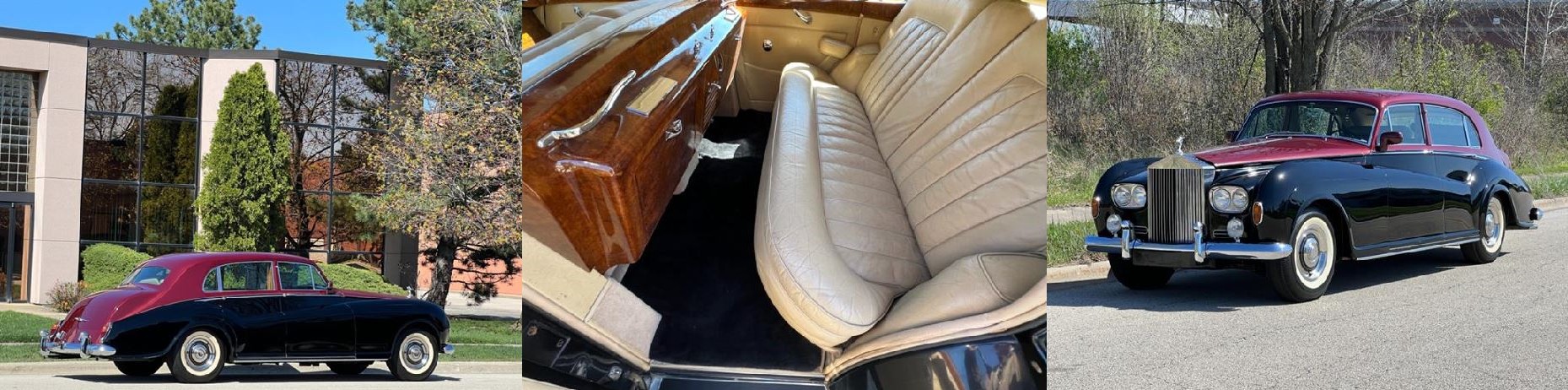
1954 Bentley Mark IV (left), 1963 Rolls-Royce Silver Cloud III (centre) & 1968 Daimler DS420 (right).

Not all however saw the need to advance beyond the bustle which, by an accident of economics, had come to define the traditional English limousine.  While mass-market vehicles evolved quickly with model cycles as little as 3-4 years, the low-volume and substantially hand-made limousines typically remained in production for sometimes a decade or more, reflecting the time it took to amortize the capital investment.  In the post-war years, Austin, Armstrong Siddeley, Bentley, Daimler, Rolls-Royce & Vanden Plas all persisted although production levels, never high, dwindled increasingly as the bustle-back came to be seen as an antiquated relic and by 1965, even Rolls-Royce had all but abandoned the bustle, only the low-volume Phantom V (1959-1968) & Phantom VI (1968-1990) still maintaining the link to the pre-war style (which .

The choices in 1968: Vanden Plas Princess 4-litre Limousine (left), NSU Ro80 (centre) & Daimler Majestic Major DR450 (right).

Emblematic of the troubles which beset British industry in the era, the most obviously antique of the English bustle-backs, the Vanden Plas Princess 4-litre Limousine, was still on sale in 1968 by which time that glimpse of the next century, the NSU Ro80 (1967-1977), had been in showrooms for over a year.  The Princess, still with a split windscreen, was a (mildly) updated version of the Austin Sheerline, introduced in 1947 when it was a genuinely new design although even then, few would have been surprised had they been told it came from before the war.  The eventual longevity wasn't planned but rather a product of the uncertainty in the future of corporate structure the industry would assume, plans for a successor put on hold, the same fate which befell the only slightly more modern-looking but remarkably rapid Daimler Majestic Major (1960-1968) which for various reasons also enjoyed a stay of execution.       

However, their new rarity made the bustle-back eventually an attraction, the very exclusivity creating a receptive and surprisingly wide market segment which included undertakers, wedding planners, Lord Mayors and anyone else to whom the sense of lost elegance and whiff of wealth appealed.  Jaguar understood and responded in 1968 with the Daimler DS420 (1968-1992) which didn’t encourage any imitators but there was room for one and it enjoyed a long, lucrative life, remaining in production for a quarter-century; over five thousand were built.

1966 Mercedes-Benz 600 (W100, 1963-1981, left) & 1962 Rolls-Royce Phantom V by Mulliner Park Ward (right).

The traditionalists didn’t however always insist on tradition.  Even before Mercedes-Benz had shown their 600 at the 1963 Frankfurt Motor Show, coachbuilders Mulliner Park Ward had built some of the 832 Rolls-Royce Phantom Vs without the pronounced bustle-back which adorned most.  Nothing of course matched the austerity of line of the 600, the most severe interpretation the “three-box” form ever applied to a limousine and, as an alternative to the bustle-back, MPW offered "de-bustled" variations on the theme until the last of the 374 Phantom VIs was built in 1990.

Rolls-Royce prefers turtleback

Actually, although bustleback seems to have become the generally used term, the coachbuilders always preferred “turtleback”, a term used of many forms which recall (sometimes vaguely) the shape of a turtle’s back (ie the curve of the shell).  Examples of use include:

(1) The shape used in the tail section of certain cars (ie synonymous with bustleback).

(2) In nautical use, a convex deck at the bow or stern of a vessel, designed to quickly shed seawater.

(3) In military use, (armoured vehicles & warships), a layout of external armor in which the slope of the structure is used to deflect shells on trajectories close to horizontal.  The classic example of effectiveness was the World War II (1939-1945) Soviet T-34 tank (a platform which remains in service with several militaries).

(3) A primitive stone celt formed to suggest the back of a turtle.

(4) In publishing, a library binding of a mass market paperback with a generic hardcover.

(5) Any plant of the genus Psathyrotes of annual and perennial forbs and low sub-shrubs native to dry areas of south-western North America.

1965 Rolls-Royce Silver Cloud (1955-1966) III (1963-1966) Touring Limousine by James Young.

In the catalogue of coachbuilder James Young, one rarely ordered version of the Rolls-Royce Silver Cloud was the LWB (long wheelbase) SCT100, described as the “Touring Limousine”.  In the industry slang, it was the “Baby Phantom”, an allusion to the much larger Phantom V & VI models which, on a larger scale, were visually similar.  Interestingly, although when the SCT100 designation was adopted the UK was still years away from adopting the metric system (and not until the Camargue (1975-1986) did the factory release a car designed to metric dimensions), the "100" was a reference to the wheelbase being extended by 100mm (4 inches).  The touring limousines were almost always fitted with a glass division between the front & rear passenger compartments and were noted too for featuring larger than typical rear fascias in burl walnut which housed tray tables and air-conditioning controls (at least one even included a duplicate fuel gauge which was an unusual addition although clocks, thermometers and speedometers were sometimes specified in the rear of many limousines).  As well as the James Young production, Rolls-Royce's in-house coachbuilder Park Ward (later Mulliner Park Ward) in London fabricated some touring limousines on the LWB chassis, returning the cars to the Crewe factory for finishing.  In Rolls-Royce collector circles, these are “turtlebacks”. 

1965 Oldsmobile 98 two-door hardtop.

Fins began to shrink from the “three box” US cars in the early 1960s and mostly were gone by mid-decade (although Cadillac, which in 1948 stated the trend couldn't let go and vestigial fins still sprouted well into the 1970s.  Having to go in some direction, the tails of the full-sized US cars noticeably lengthened, matching the growth at the front.  Aesthetically, the long hoods (bonnets) did have their attraction but were hardly an engineering necessity.  Although the biggest US V8s were wide and heavy, they weren’t, by either historic or even contemporary European standards, especially long yet in some of the full-sized cars of the era, a V16 would have fitted and there were those at Cadillac who, recalling the genuine exclusivity the sixteen cylinder engines lent the marquee during the 1930s, hankered for one and they actually built some V12 prototypes before corporate reality bit.  They contented themselves instead with a gargantuan 500 cubic inch (8.2 litre) V8 although another reality would soon come to bite that too.

The 1961 Cadillac: The long (left) and slightly less long (right) of it.  In 1958 the company had actually gone the other way with the Series 62 Extended Deck Sedan.  

Whether in response to or in anticipation of some owners preferring their Cadillac in a more conveniently sized package, between 1961-1963, a “short-deck” option was made available on certain body styles.  Offered first on the six-window Sedan DeVille, an encouraging 3,756 were built so the option was in 1962 offered on the four-window Sixty Two Town Sedan but sales actually dropped to 2600, the decline in interest confirmed the next year when only 1575 of the four-window Park Avenue Sedan DeVille were sold.  Using the same 129.5 inch (3289 mm) wheelbase as the regular models but eight inches (200 mm) shorter in overall length (215 vs 223 inches (5461 vs 5664 mm)), space utilization was obviously a little better but the market had spoken.  With fewer than eight-thousand of the short-deck models sold across three seasons while the standard editions shipped in the tens of thousands, the flirtation with (slightly) more efficient packaging was abandoned for 1964; in the course of the following decade, Cadillacs would grow another seven inches (178 mm) and gain over 400 lb (181 kg).

1971 Holden HG Premier (left) & 1968 Holden HK Brougham (right).

In Australia, Holden, General Motors's (GM) local outpost, took the opposite approach, the Brougham (1968-1971) created by extending the tail of the less exalted Premier by 8 inches (200 mm), the strange elongation a hurried and far from successful response to the Ford Fairlane (1967-2007).  The 1967 Fairlane had been crafted by stretching the wheelbase of the Falcon sedan from 111 inches (2819 mm) to 116 (2946 mm) and adding bling (the called gorp) to the interior.  Ford had since 1965 been locally assembling the full-sized Galaxies for the executive market but tariffs and the maintenance of the Australian currency peg at US$1.12 meant profitability was marginal, the locally concocted Fairlane, much more lucrative, produced as it was with high local content and a miniscule development cost (Ford Australia's engineers at the time joked it cost "three-quarters of four-fifths of fuck all").  The Fairlane name was chosen because of the success the company had had in selling first the full-sized Fairlanes (nicknamed by locals as the “tank Fairlane”) between 1959-1962 and later the compact version (1962-1965).

1977 Ford LTD Silver Monarch (P6).

The massive success of the 1967 car and its successors prompted Ford to cease local assembly of the Galaxie and revert to importing fully built-up cars for the small segment of the market which wanted the bigger vehicles, including the government executive fleets.  Available with both small and big-block V8s, the Galaxies, now badged as Galaxie-LTDs, would remain available until 1973 when Ford Australia created their own LTD (1973-2007), giving the Falcon’s wheelbase a final stretch to 121 inches (3073 mm) and adding lashings of real leather, fake timber and the novelty of a 24 hour analogue clock, along with that status symbol of the 1970s: the padded vinyl roof.

Lindsay Lohan photo-shoot by Tom Munro (b 1964) for Bustle, March 2024.

The “malaise era” bustle-backs (1980-1987) by Cadillac, Imperial and Lincoln.

In English, malaise was an unadapted loanword from the French malaise (ill ease), the construct being mal- (bad, badly) + aise (ease).  It was used to describe (1) a feeling of general bodily discomfort, fatigue or unpleasantness (sometimes associated with the onset of illness), (2) an ambiguous feeling of mental or moral depression (the sense tending more to “melancholy” than “angst”) and (3) ill will or hurtful feelings for others.  The US cars of the years between 1974-1984 (some say it went on a bit longer) came to be called “malaise era” cars, the name from the thoughtful but perhaps unfortunate “Crisis of Confidence” address Jimmy Carter (1924-2024; US president 1977-1981) delivered in July 1979.  Carter’s years of malaise remains emblematic the America of the late 1970s (a time of stagflation, oil-shock induced energy price-rises & shortages, high interest rates and general gloom) but the details have become blurred.  The use of the word “malaise” emerged from a retreat the president had convened at the Camp David retreat after concluding neither he, his advisors or the entire machinery of government could come up with solution to the nation’s many problems.  Attended by notables from the clergy, academia and other realms including the governor of Arkansas, BillClinton (b 1946; US president 1993-2001), the curious event prompted one historian to describe it as “…the most remarkable exercise in presidential navel-gazing in American history…” but what did lodge in Carter’s memory was an observation by the pollster Patrick Caddell (1950–2019) that after some fifteen years of trauma including assassinations, race riots, the war in Vietnam and Watergate, the nation was experiencing a “malaise” and the president decided this notion would be the centrepiece of his address to the people.

Malaise: 1978 Ford Mustang II King Cobra.

An emblematic malaise era machine, twenty-first century viewers would be surprised to learn it was possible for a relatively small, light car with a 302 cubic inch (4.9 litre) V8 to deliver such anaemic performance.  However, the Mustang II (1973-1978) was the the right car for the right car (debuting some weeks before the first oil shock) and was a great success.

The word “malaise” wasn’t included in the text of Carter’s speech but, replete with phrases like “…strikes at the very heart and soul and spirit of our national will…” & “…crisis of confidence…”, the tone was clear and almost universally the press called it the “malaise speech”.  Despite what has long been the popular perception, at the time the speech was not a political disaster and was well-received, Carter’s approval ratings surging; it was only as the year unfolded he came to be damned by his own words and if any single term is now associated with his unhappy single term, it's “malaise”.  As was customary for presidential addresses of this nature, the speech was nationally televised live by the three major commercial networks (ABC (American Broadcasting Company), CBS (Columbia Broadcasting System) & NBC (National Broadcasting Company)) and simultaneously broadcast by many radio stations, the total audience estimated at some 65 million (there was then no FoxNews but it's not difficult to predict what the nature of that commentary would have been).  Given the coverage, it’s certain the address contributed greatly to the eventual public disillusionment with the president and may thus have been an example of videomalaise (a term from late 1990s political science which linked voters’ decreasing trust in politicians with depictions of the latter on televised news).

Honorable exception: 1973 Pontiac Firebird Trans-Am SD-455.

Available only on the Firebird (Formula or Trans-AM) in 1973 & 1974, the SD-455 was one of the few bright spots of the malaise era although it did need slightly to be detuned for commercial release, its original 310 (HP) horsepower configuration able to pass the EPA's (Environmental Protection Authority) emission tests only if a devious "cheater" device was installed (shades of Volkswagen's later "dieselgate" although Pontiac got off with nothing more than a "slap on the wrist" rather than the billions it cost the equally guilty Germans).  The production version was rated at 290 HP which was still enough to make it the powerful US car of its time.

The "malaise era" cars were so named because compared with the previous generations, they were heavier, slower, thirstier and less pleasant to drive, a collection of characteristics which weren't the fault of President Carter but he had the misfortune to be in the White House at the same time.  They were of course safer and less polluting but those advantages were hidden while the ugliness of the battering-ram bumper-bars, reduced power and sometimes tiresome driving characteristics were obvious.  When speaking of these mostly unlamented machines, the phrase “Malaise Era” is believed to have been coined by writer Murilee Martin (the pen name of Phil Greden) who used it first in 2007 on the website Jalopnik.  In that era, while not yet able substantively much to improve the dynamics of the cars, Cadillac thought of a distraction: the bustle-back.  It proved a short-lived fad although one better remembered that some of what had gone before and much of what would follow.

1980 Cadillac Seville.

The 1980 Cadillac Seville was first, the advertising copy even trying to justify the appearance by claiming the design offered “more usable trunk space”, something which could neither be proved nor disproved which was good, given it offered 14.47 (.409 m3) cubic feet of space whereas last year’s model had 14.9 (.421 m3).  Still, what one got was “more usable”.  Cadillac were explicit about their plagiarism, the Seville’s lines based not on just any bustle-back but one with the most severe lines, the Hooper-bodied Rolls-Royces of the post-war years.  The critics were divided: some not liking it and some hating it, a spread of opinion seemingly shared by buyers, sales never matching those of its more conventional predecessor although there were other factors in the lukewarm response such as the switch to front wheel drive and some reliability issues with the power-train.  Production of the bustle-back Seville ceased in 1985; sales of its successor were higher.

Chrysler always claimed the design of the 1981 Imperial was locked-in long before their designers had laid eyes on the new Seville but it wasn’t until 1981 it was in the showrooms.  Based on the competent J-body Cordoba platform, it was offered only as a two-door coupé with a fuel-injected 318 cubic inch (5.2 litre) V8 and an automatic transmission.  After 1955, Chrysler had run Imperial as a separate division in an attempt to gain the cachet of Cadillac and Lincoln but, despite early success, the experiment failed and the brand was retired in 1975.  The bustle-back Imperial (1981-1983) ostensibly revived the division (although it was really, just the name, the corporate structure unchanged)and the car was well-equipped, including bits and pieces from Cartier although its best-remembered association with celebrity was the “Frank Sinatra Edition”.  Unexpectedly, a brief foray onto the fastest of the NASCAR ovals proved the bustle-back’s aerodynamic efficiency; it achieved an impressive top-speed despite not using the highest-powered engine.  It wasn’t enough to save the brand which was shut down for the last time in 1983 although Chrysler did continue to use “Imperial” on the odd tarted-up model and surprised everyone in 2006 by presenting an Imperial concept car.  Criticized at the time because it was so obviously influenced by the Rolls-Royce Phantom (the retrospective VII) and a pastiche of many clichés, if one didn't mind that sort of thing, it seemed a quite accomplished execution.  

Ford’s retro-take arrived last in 1982 but the Lincoln lingered longest, not replaced until 1987.  The bustle-back Lincoln actually used the most restrained implementation of the idea but, unable to resist the temptation to add lipstick, the designers applied to the trunk the fake spare tyre bump which had been on so many Continentals since the 1955 Mark II first sought to pay tribute to the 1940 original although this was the first time a Lincoln without a Continental badge had been humped. In common with the experience of the other manufacturers, the car attracted fewer buyers than its predecessor or successor and, while Detroit have pursued some other retro-projects with mixed results, none have attempted another reprise of the bustle-back.

Pre and post butt-lift, the 2001 and 2009 BMW 7 Series.

Nor has anyone else.  Although the 2001 BMW 7 Series (E65) is sometimes labelled a bustle-back (or, in more twenty-first century style, a bustle-butt), it really never was although, having allowed a decent interval to elapse so as not to (further) upset the designer, at the first facelift, it was toned down a little.