Showing posts sorted by relevance for query Solidarity. Sort by date Show all posts

Thursday, March 2, 2023

Solidarity

Solidarity (pronounced sol-i-dar-i-tee)

(1) A state or feeling of union or fellowship arising from common responsibilities and interests, as between members of a group or between classes, peoples etc.

(2) A community of feelings, purposes etc; a unity of interests.

(3) In the Westminster political system, as cabinet solidarity, a principle in representative & responsible government whereby all members of the cabinet are required either publicly to support all decisions of cabinet or resign from the body.

(4) In inter-personal relations, a willingness to provide support of various kinds when another person is in need.

(5) A communist era Polish organization of independent trade unions founded in 1980 (solidarność (pronounced saw-lee-dahr-nawshch) in the Polish)).  It was in 1982 outlawed by the government of Poland before being made lawful and going on to form the basis of the non-communist government in 1989.

1829: The construct was the English solidary + -ity, from the French solidarité (solidarity; communion of interests and responsibilities, mutual responsibility), from solidaire (characterized by solidarity), from the Latin solidum (whole sum), neuter of solidus (solid).  The French solidarité was coined by and first appeared in the Encyclopédie (1765) and was from solidaire (interdependent, complete, entire) from solide.  Capitalized, it was ultimately from the French form the independent trade union movement in Poland gained its name.  The –ity suffix was from the French -ité, from the Middle French -ité, from the Old French –ete & -eteit (-ity), from the Latin -itātem, from -itās, from the primitive Indo-European suffix –it.  It was cognate with the Gothic –iþa (-th), the Old High German -ida (-th) and the Old English -þo, -þu & (-th).  It was used to form nouns from adjectives (especially abstract nouns), thus most often associated with nouns referring to the state, property, or quality of conforming to the adjective's description.  Solidarity is a noun, solid is a noun, adjective & adverb and solidarize & solidary are verbs; the noun, plural is solidarities.

Flag of Solidarność.

The Solidarity labor union was formed in Poland in September 1980 and was independent of both the state and the Polish Communist party.  Under the leadership of dockyard electrician Lech Wałęsa (b 1943; Polish dissident trade union leader, President of Poland 1990-1995), it came into existence at a time when the communist authorities in both Warsaw and Moscow had become more reticent in their internal suppression and by the early 1980s its membership was in the millions.  Eventually banned by the government in 1982, as an underground movement it continued to pursue the need for industrial and democratic reform and was a factor in the fall of communism in Poland.  Although Wałęsa won both the Nobel Peace prize (1983) and the presidency of his country, (1990-1995), by the end of the century, Solidarity’s historic moment had passed.

Looking their best: Arthur Sinodinos presenting to President Trump his credentials as Australia's ambassador to the US, the White House, Washington DC, February 2020.

In Australia, royal commissions are public investigations, established by but independent of government.  Not a court, royal commissions are created to enquire into matters of importance and, within their terms of reference, have broad powers to conduct public & in camera hearings and can call witnesses, compelling them (under oath) to provide testimony and they deliver recommendations to government about what should be done, consequent upon their findings.  These can include recommendations for legislative or administrative changes and the prosecution of institutions or individuals and they’re of great interest because they appear to be the only institution (at least theoretically) able to compel a politician to tell the truth.  Even that power is limited though because when appearing before royal commissions, politicians seem especially prone to suffering an onset of Sinodinos syndrome, a distressing condition which compels witnesses frequently to utter phrases like “I can’t remember”, “I don’t recall”, “not in my recollection” etc.  The condition is named after Arthur Sinodinos (b 1957; Australian Liberal Party functionary; senator for New South Wales 2011-2019) who, according to legal legend, while being questioned by an enquiry, set a record for the frequency with which the distressing condition manifested.  Happily, Mr Sinodinos' symptoms weren't thought serious by the Liberal Party government which in early 2020 appointed him Australia's ambassador to the United States. 

Looking his best: Eight photographs of Stuart Robert.

A royal commission is currently enquiring into matters associated with the “robodebt” affair which was an attempt by the previous government to use unlawful methods to calculate what it alleged were debts to the Commonwealth, owed by some who had in the past been in receipt of some sort of benefit, pension or welfare payment.  The commission is, inter alia, seeking to work out the usual “who knew what when” in relation to the unlawful conduct and so far, witnesses have provided contradictory evidence so it will be a matter for the commission to decide which sworn statements seem most compelling.  The appearance of one of the ministers responsible for robodebt, Stuart Robert (b 1970; minister in various portfolios in National-Liberal Party coalition governments 2013-2022) was anticipated more eagerly than most and he didn’t disappoint anyone hoping to see the odd symptom of Sinodinos syndrome, some of his answers among the contradictory responses through which the commission will have to sift.  If need be, the commissioner can recall Mr Robert if any clarifications are needed and there will be some looking forward to that.

Of interest also were Mr Robert’s thoughts on what is meant by “cabinet solidarity” which in the Westminster political system is a one of the principles of representative & responsible government whereby all members of the cabinet are required publicly to support all decisions of cabinet or else resign from the body.  The matter of cabinet solidarity arose after Mr Robert admitted to the commissioner that he publicly defended robodebt despite his own “personal misgivings” and further admitted that during 2019 he made several comments on the scheme he personally believed were false.

Asked several times by the commissioner why he had made comments which he believed at the time were false, Mr Robert told the commissioner he had done so because he was “bound by cabinet solidarity” and “as a dutiful cabinet minister…that’s what we do”.  When the commissioner asked if this meant he was bound by cabinet solidarity to “misrepresent things to the Australian public?”, he replied he wouldn’t “put it that way”.  It seems a generous interpretation to suggest Mr Robert may “misunderstand” what “cabinet solidarity” means but it may be with that degree of delicacy the commissioner chooses to comment on the matter in her final report.  What “cabinet solidarity” really means is that members of the cabinet are required publicly to defend the decision of cabinet even if they disagree with them.  If the disagreement is to an individual a matter of such significance they feel compelled publicly to oppose the decision, then they must resign from cabinet to be free to do so.  It has nothing to do with providing some cloak of cover to enable a cabinet minister to make statements representing something he believes to be false as truth and the system as it’s operated in Australia is actually quite flexible.  Some years ago it was arranged for a minister to resign from cabinet yet remain a minister in the “outer ministry”.  That trick enabled (1) the decision to stand, (2) the minister to keep a higher salary and lots of perks and (3) the “resignation” to be spun as a matter of principle although it was just a way to try to minimize the loss of votes in a particular electorate.

Looking her best: Lindsay Lohan with ankle braclet.

In July 2010, US Customs and Border Protection officers stationed on the Canadian border reported an ankle surveillance bracelet was being worn by Eugene Todie (b 1981) who was being questioned after attempting to re-enter the US using someone else's passport.  The report revealed Mr Todie claimed a friend in the probation service had given him the monitor, pursuant to his request for a way he could “show solidarity” with Lindsay Lohan, then wearing a court-ordered alcohol monitor on her ankle.  Record checks showed Mr Todie, a resident of Buffalo, New York, was on probation for criminal contempt, had surrendered his own passport after being banned from leaving the US and was wearing the bracelet by court order.  Mr Todie was remanded in custody and later appeared in Federal Court on charges including misuse of a passport.

Tuesday, July 11, 2023

Sickle

Sickle (pronounced sik-uhl)

(1) In agriculture, an implement for cutting grain, grass, etc., consisting of a curved, hook-like blade mounted in a short handle.

(2) In astronomy, a group of stars in the constellation Leo, likened to this implement in formation (initial capital letter).

(3) In veterinary anatomy, any of the sickle-shaped middle feathers of the domestic cock.

(4) In pathology, as sickle-cell anemia, a severe hereditary condition in which mutated haemoglobin distorts red blood cells into a crescent shape, causing the cells to become stuck in capillaries; historically known as drepanocytosis.  The deformation of red blood cells into an abnormal crescent shape is called sickling and in medical slang a patient with the condition is a sickler.  

(5) As a stylized graphic, crossed with a hammer, used as a symbol of communism and the USSR and adopted by communist parties in many countries; metonymically, Socialism or communism itself.

Pre-1000: From the Middle English sikel (also assibilated in sichel), from the Old English sicol & siċel, the origin of which is uncertain, the most supported suggestion being it was a borrowing from Latin sēcula (sickle) or sīcīlis (sickle)”, cognate with the Dutch zikkel and the German Sichel.  The construct of the Latin sēcula was sec(āre) (to cut) + -ula or –ule (the diminutive suffix used to form taxonomic names, usually of genera).  The alternative explanation is it was a diminutive of the Proto-Germanic sikilō (ploughshare) from the primitive Indo-European seg-, a variant of sek- (to cut).  It was cognate with West Frisian systel, sisel & sizel (sickle), the Dutch sikkel (sickle) and the German Sichel (sickle).  It was related also to West Frisian sichte (sickle), the Dutch zicht (sickle), the Low German Sichte & Sicht (sickle) & Sech (blade of a sickle or scythe).  Sickle is a noun, verb & adjective, sickler & sickleman (sicklewomoman seem never to have been a thing although there must have been many and one would presumably now use sickleperson) are nouns, sickled is a verb and sickling is a noun & verb; the noun plural is sickles.

One of the standards used by the USSR after 1922.

The hammer and sickle (available on PCs as the Unicode symbol long before emojis) was created in 1917 to symbolise proletarian solidarity: the hammer representing the workers, the sickle the peasants (the intelligentsia ignored for representational purposes by the journalists, school-teachers and lawyers who would come to dominate the later dictatorship).  The design, formerly adopted as the USSR’s national symbol in 1922, was by Yevgeny Ivanovich Kamzolkin (1885–1957), his winning entry in a competition.  During the decades when the USSR enjoyed a better image than during the cold war, the hammer and sickle became widely used as a symbol both for communist parties and international proletarian unity even though the Soviet state had long been the dictatorship of the party elite rather than of the proletariat as Karl Marx (1818-1883) had predicted in his Communist Manifesto (1848).

Hammer and Sickle Set, (1977) by Andy Warhol (1928–1987), screen-printed montage on paper.

It remains a familiar sight in Russia and states like China, Laos and Vietnam which are, even if only nominally, still communist.  It’s less welcome in many former communist countries, some of which make public display a criminal offence, mirroring German legislation banning the swastika.  Even the French Communist Party, for much of its existence the most cravenly Stalinist and Moscow-centric of operations, abandoned the hammer and sickle in favour of a five-pointed star although the painful step wasn’t taken until 2014.  The British Labour Party, wimpier than the French, once used a crossed shovel and quill which, to some critics, came respectively to symbolise the workers who founded the party and the bourgeoisie who staged a hostile takeover a process which afflicted also the Australian Labor Party (ALP), described by one disillusioned veteran as "the cream of the working class overthrown by the dregs of the middle class".  By the the 1980s, the British Labour party had adopted a rose which meant everything in general and nothing in particular so the "New Labour" of the 1990s was, if not inevitable, at least anticipated.  In the Kremlin, Vladimir Putin (b 1952; president or prime minister of Russia since 1999) wasn’t going to let anything like that happen and in 2007 he intervened to stop modernisers among his own supporters removing the hammer and sickle from reproductions of the most hallowed relic of the Great Patriotic War (1941-1945), the Victory Banner, the flag Soviet troops raised over the Reichstag building in Berlin on 1 May 1945.  Mr Putin wasn't at all nostalgic about the Soviet economic model but he liked everything else and has tried to recreate as much of it as possible.

No sickle required: Lindsay Lohan with hammer used to attack a Volvo as part of a promotional stunt, New York City, March 2014.  Who hasn't wanted to attack a Volvo with a big hammer?

The flag of the Hezbollah (right), the public display of which is banned in some jurisdictions where both the organization's political & military wings are listed as "terrorist organizations" includes a depiction of  Kalashnikov AK-47 assault rifle but that of Mozambique (left) is the only national flag to feature the famous weapon and the Africans fixed a bayonet to the barrel which was a nice touch.  Mozambique gained independence from Portugal in 1975 although the flag wasn’t officially adopted until 1983 as a modified version of what was essentially the battle flag of the Frente de Libertação de Moçambique (FRELIMO, the Mozambique Liberation Front, the Marxist (later styled “democratic socialist”) resistance movement which fought a war of liberation (1964-1974) against the Portuguese colonial forces).  Artistically, just as Marxism (notably often in Stalinist form) had been politically influential in post-colonial Africa, the hammer & sickle exerted an artistic appeal.  The flag of Mozambique has an AK-47 crossed by a hoe sitting atop an open book and is the only national flag upon which appears a modern firearm, the handful of others with guns all using historic relics like muskets or muzzle-loaded cannons.  The Angolan flag has a machete crossing a half gear wheel and both these African examples follow the symbolic model of the hammer and sickle, representing variously the armed struggle against repression, the industrial workers and the peasantry.

Hammer & sickle pencil & mini-skirts.

Wednesday, March 11, 2026

Flute

Flute (pronounced floot)

(1) A woodwind instrument consisting of a tube with a row of finger-holes (or keys) which produce sound through vibrations caused by air blown across the edge of the holes, often tuned by plugging one or more holes with a finger; the Western concert flute, a transverse side-blown flute of European origin (in colloquial use, a recorder, also a woodwind instrument).

(2) An organ stop with wide flue pipes, having a flutelike tone.

(3) In architecture or engineering (particularly the manufacture of firearms), a semi-cylindrical vertical channel, groove or furrow, as on the shaft of a column, in a pillar, in plaited cloth, or in a rifle barrel to cut down the weight.

(4) Any groove or furrow, as in a ruffle of cloth or on a piecrust.

(5) One of the helical grooves of a twist drill.

(6) A slender, footed wineglass with a tall, conical bowl.

(7) A similar stemmed glass, used especially for champagne and often styled as "champagne flute".

(8) In steel fabrication, to kink or break in bending.

(9) In various fields of design, to form longitudinal flutes or furrows.

(10) A long bread roll of French origin; a baguette.

(11) In weaving, tapestry etc, a shuttle.

(12) To play on a flute; to make or utter a flutelike sound. 

(13) To form flutes or channels in (as in a column, a ruffle etc); to cut a semi-cylindrical vertical groove in (as in a pillar etc).

1350-1400; From the Middle English floute, floute & flote, from the Middle French flaüte, flahute & fleüte, from the twelfth century Old French flaute (musical), from the Old Provençal flaüt (thought an alteration of flaujol or flauja) of uncertain origin but may be either (1) a blend of the Provencal flaut or  flaujol (flageolet) + laut (lute) or (2) from the Classical Latin flātus (blowing), from flāre (to blow) although there is support among etymologists for the notion of it being a doublet of flauta & fluyt.  In other languages, the variations include the Irish fliúit and the Welsh ffliwt.  The form in Vulgar Latin has been cited as flabeolum but evidence is scant and all forms are thought imitative of the Classical Latin flāre and other Germanic words (eg flöte) are borrowings from French. 

Portrait of Archduchess Maria Antonia of Austria (later Queen Marie Antoinette of France (1774-1792)), circa 1768, oil on canvas by Martin van Meytens  (1695–1770).

Fluted & fluting both date from the 1610s while the verb (in the sense of "to play upon a flute") seems to bave been in use as early as the late fourteenth century.  The use to describe grooves in metalwork emerged in the 1570s and was applied to the tall, slender wine glass almost a century later although the term "champagne flute" didn't enter popular use until the 1950s.  The champagne flute is preferred by many to the coupé (or saucer) even though it lacks the (since unfortunately debunked) legend the shape of the latter was modelled on Marie Antoinette’s (1754-1793) left breast (historians gleefully recounting the tale all agree it definitely was the left).  Elegant though it is, the advantages of the flute are entirely functional, the design providing for less spillage than a coupé, something which comes to be more valued as lunch progresses to the third uncorking and the slender, tapered shape is claimed better to preserve the integrity of the bubbles, the smaller surface area and thus reduced oxygen-to-wine ratio longer maintaining aroma and taste.

Grand Cru's guide to the shape of champagne glasses.

Among musical instruments, there are a dozen or more distinct types of flute.  Early French flutes differed greatly from modern instruments in having a separate mouthpiece and were called flûte-a-bec (literally "flute with a beak").  The ancient devices were played directly, blown straight through a mouthpiece but held away from the player's mouth, the modern transverse (or "German") flute not appearing until the eighteenth century and the familiar modern design and key system of the concert flute were perfected 1834 by Bavarian court musician & virtuoso flautist Theobald Boehm (1794–1881), the fingering system known to this day as "Boehm system".  The architectural sense of "furrow in a pillar" dates from the mid-seventeenth century and was derived from the vague resemblance to the inside of a flute split down the middle.

Solidarity: Gay men supporting lesbians at the first “Dyke March”, Washington DC, April 1993.  The sign held by the protester at the far left uses the compound word for which the euphemism “playing the skin flute” was coined.

One imaginative linguistic re-purposing was the use in the 1940s (apparently first in the US) of “playing the skin flute” to mean “to perform fellatio” and while still in that sense used in certain LGBTQQIAAOP circles, in general use the meaning has shifted, no describing “a male engaged in the act of masturbation”.  Use shifted to fruit, either by virtue of use at the time being almost exclusively oral rather than written (linguistically, that’s classified as an example of an imperfect echoic) or because "fruit" was then in use as a gay slur.   The nouns flute-player, fluter & flutist can be used of flute players but the preferred term is flautist.  Presumably, someone employed to add flutes to an object could be designated “the fluter” but it’s doubtful such as specialist job-description has ever been written.  Flute is a noun & verb, flutiness, flautist, flutist & fluter are nouns, fluted is a verb & adjective, fluting is a noun, verb & adjective, flutelike is an adjective; the noun plural is flutes.  

Fluted grill on 1972 Series 1, 4.2 Litre Daimler Sovereign.

In British use, one who plays the flute is a flautist (pronounced flaw-tist (U) or flou-tist (non-U)), from the Italian flautista, the construct being flauto (flute) + -ista.  The -ist suffix was from the Middle English -ist & -iste, from the Old French -iste and the Latin -ista, from the Ancient Greek -ιστής (-ists), from -ίζω (-ízō) (the -ize & -ise verbal suffix) and -τής (-ts) (the agent-noun suffix).  It was added to nouns to denote various senses of association such as (1) a person who studies or practices a particular discipline, (2), one who uses a device of some kind, (3) one who engages in a particular type of activity, (4) one who suffers from a specific condition or syndrome, (5) one who subscribes to a particular theological doctrine or religious denomination, (6) one who has a certain ideology or set of beliefs, (7) one who owns or manages something and (8), a person who holds very particular views (often applied to those thought most offensive).  The alternative forms are the unimaginative (though descriptive) flute-player and the clumsy pair fluter although the odd historian or music critic will use aulete, from the Ancient Greek αλητής (aulēts), from αλέω (auléō) (I play the flute), from αλός (aulós) (flute).  The spelling flutist is preferred in the US and it's actually an old form, dating from circa 1600 and probably from the French flûtiste and it replaced the early thirteenth century Middle English flouter (from the Old French flauteor).

Daimler, the flutes and US trademark law

1972 Daimler Double-Six Vanden Plas.

Originally Belgium-based and noted for both the sporty and large bodies built for the chassis of Rolls-Royce, Lagondas, Daimlers, Bentleys and such, the coach-building house Vanden Plas was in 1946 acquired by Austin and through the British industry’s M&As (mergers and acquisitions) in the following decades, by the early 1970s it was British Leyland’s in-house coach-builder, one of its projects being to add still more luxurious appointments to the anyway lavish Daimler Double-Six.  Vanden Plas completed only 342 of the Series 1 (1972-1973) Daimler Double Sixes, the later S2 (1973-1979) & S3 (1979-1992) cars much more numerous and, in deference to the oil crisis which was the prime economic force in the decade, the S2 & S3 were available with the 4.2 litre (258 cubic inch) XK-six as were as the heroically thirsty 5.3 litre (326 cubic inch) V12.  The flutes atop the grill dated from the early twentieth-century and were originally a functional addition to the radiator to enhance heat-dissipation but later became a merely decorative embellishment.  Although some sources claim there were 351 of the Series 1 Double-Six Vanden Plas, the factory insists the total was 342.  British Leyland and its successor companies would continue to use the Vanden Plas name for some of the more highly-specified Daimlers but applied it also to Jaguars because in some markets the trademark to the Daimler name came to be held by Daimler-Benz AG (since 2022 Mercedes-Benz Group AG), a legacy from the earliest days of motor-car manufacturing and despite the English middle class often pronouncing the name as van-dem-plarr, it should said as van-dem-plass.  It's an error with the same origin as that suffered by Moët & Chandon: to English speaking ears, mow-eh sounds "more French" than mow-et. 

1976 Daimler Double-Six Vanden Plas two door.

The rarest Double-Six Vanden Plas was a genuine one-off, a two door built reputedly using one of the early prototypes, a regular production version contemplated but cancelled after the first was built.  Jaguar would once have called such things a FHC (fixed head coupé) but labelled the XJ derivatives as "two door saloons" and always referred to them thus, presumably as a point of differentiation with the XJ-S (later XJS) coupé produced at the same time.  Despite the corporate linguistic nudge, everybody seems always to have called the two-door XJs "coupés".  Why the project was cancelled isn't known but it was for the company a time of industrial and financial turmoil and distractions, however minor, may have been thought unwelcome.  Although fully-finished, apart from the VDP-specific trim, it includes also some detail mechanical differences from the regular production two-door Double-Six but both use the distinctive fluted finish on the grill and trunk (boot) lid trim; the car still exists.  The two-door XJs (1975-1978) rank with the earliest versions (1961-1967) of the E-Type (XKE; 1961-1974) as the finest styling Jaguar ever achieved and were it not for the unfortunate vinyl roof visually, it would be as close to perfect as any machine ever made.

1975 Jaguar XJC: The design perfected.  Even Jaguar's usually uncompromising originality police seem to approve.

The orthodoxy is the gluing-on of the vinyl was a necessity imposed by the inability of the paint of the era to cope with the slight flexing of the roof.  As a two-door hardtop, there was no B-pillar so the expanse of un-supported metal was larger than that of the sedans and thus more subject to higher stress-loads, resulting in the paint being subject to crazing.  Modern chemistry means suitable paints have long been available and many owners have taken the opportunity to fix the cars one visual flaw.  However, not all accept the “flexing roof” theory and claim the vinyl was a deliberate aesthetic choice, noting the 1972 Double-Six Vanden Plas (which appeared in 1972, three years before the two-door XJ went on sale) was fitted as standard with a vinyl roof, despite obviously there been no paint-related imperative.  Possibly it may have been a way of reducing interior noise but some argue it appeared just because the covering was then undeniably fashionable.  The inexcusable lapse in taste had been seen (then using leather) as early as the 1920s but it was in the US in the mid-1960s the motif hit the mass-market to attract those who wanted “a convertible’s rakish vibe” but needed something more practical; things soon got out of hand, the trend spreading to the UK and Australia.  For up-market models, the Australians even emulated the US practice of the “padded vinyl roof” which was a bad idea made worse the closer one got to the tropics, the foam in the “vinyl-metal sandwich” trapping moisture and leading quickly to rust.  The Europeans proved commendably resistant and by the 1980s the moment had passed in the UK and Australia but the Americans doubled-down and, until the mid-1990s, Detroit’s designers devoted much energy to styling elaborate variations on the theme, the marketing department doing its usual bit by labelling them with fanciful names.
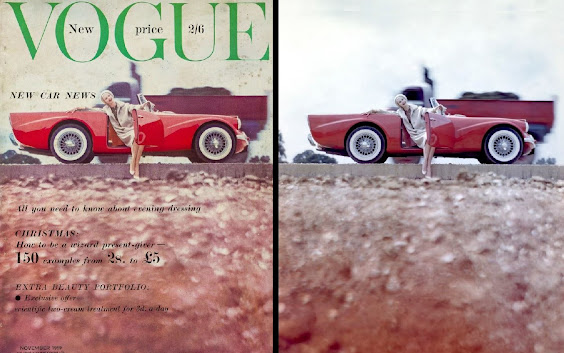
Using one of his trademark outdoor settings, Norman Parkinson (1913-1990) photographed model Suzanne Kinnear (b 1935) adorning a Daimler SP250, wearing a Kashmoor coat and Otto Lucas beret with jewels by Cartier.  The image was published on the cover of Vogue's UK edition in November 1959.

Although Daimlers had, in small numbers, been imported into US for decades, after Jaguar purchased the company in 1960, there was renewed interest and the first model used to test the market was the small, fibreglass-bodied roadster, probably the most improbable Daimler ever and one destined to fail, doomed by (1) the quirky styling and (2) the lack of product development.  It was a shame because what made it truly unique was the hemi-head 2.5 litre (155 cubic inch) V8 which was one of the best engines of the era and remembered still for the intoxicating exhaust note.  The SP250 was first shown to the public at the 1959 New York Motor Show and there the problems began.  Aware the small sports car was quite a departure from the luxurious but rather staid line-up Daimler had for years offered, the company had chosen the pleasingly alliterative “Dart” as its name, hoping it would convey the sense of something agile and fast.  Unfortunately, Chrysler’s lawyers were faster still, objecting that they had already registered Dart as the name for a full-sized Dodge so Daimler needed a new name and quickly; the big Dodge would never be confused with the little Daimler but the lawyers insisted.  Imagination apparently exhausted, Daimler’s management reverted to the engineering project name and thus the car became the SP250 which was innocuous enough even for Chrysler's attorneys and it could have been worse.  Dodge had submitted their Dart proposal to Chrysler for approval and while the car found favor, the name did not and the marketing department was told to conduct research and come up with something the public would like.  From this the marketing types gleaned that “Dodge Zipp” would be popular and to be fair, dart and zip(p) do imply much the same thing but ultimately the original was preferred and Darts remained in Dodge’s line-up until 1976, for most of that time one of the corporation's best-selling and most profitable lines.  The name was revived between 2012-2016 for an unsuccessful and unlamented small sedan.

Leaper, growler and flutes on US market 1999 Jaguar Vanden Plas (X308).  The retractable, solid-timber picnic tables in the back of the front seats were much admired.

Decades later, US trademark law would again intrude, this time on Jaguar’s low-volume business of selling Daimlers in the US.  There, the company had after 1967 ceased offering the Daimler because, it being clear the trickle of safety & emission regulations was soon to be a flood, with capital scarce, it was decided resources needed to be devoted to compliance and one form of economy was to re-allocate the funds absorbed by maintaining Daimler as a separate brand, most of which were spent on advertising.  In Stuttgart, the Daimler-Benz lawyers took note and decided to reclaim the name, eventually managing to secure registration of the trademark and Daimlers have not since been available in the US.  However, there was still clearly demand for an up-market Jaguar and so the Sovereign name (used on Daimlers between 1966-1983) was applied to Jaguar XJ sedans which, although mechanically unchanged, were equipped with more elaborate appointments.

Lindsay Lohan with stainless steel Rolex Datejust (Roman numeral dial) with fluted white gold bezel.  Note the blue eyes; it's not known if the effect was achieved with colored contact lens or digital editing.

Sales of the up-market Sovereign were good and the profit margins fatter so the US market also received some even more luxurious Vanden Plas models and during the XJ’s X308 model run (1997-2003), the VDP cars were fitted with the fluted grill and trunk-lid trim as an additional means of product differentiation; it would be the last appearance of the flutes in North America and the only occasion on which the leaper and growler were used in conjunction with them.  Although some might dismiss the interior fittings of the Vanden Plas models as “bling”, there were nice touches.  The ones based on the X308 featured the fold-down picnic-tables once so beloved by English coach-builders (the affection in the 1960s trickling down to the middle-class as they began to appear on blinged-up mass-market vehicles) but, rather than the usual burl walnut veneer, the pieces were of solid timber.  The factory seems never to have discussed the rationale but it may be it was cheaper to do it that way, the veneering process being labor-intensive.

Pim Fortuyn in his chauffeur-driven Daimler Super V8, February 2002 (left), paramedics attending to him at the scene of his assassination (centre) a few paces from the Daimler, 6 May, 2002 (he died at the scene) and the car when on sale, Amsterdam, June 2018 (right).  His assassin, memorably, was described in press reports deranged vegetarian”; perhaps it was the sight of meneer Fortuyn sprawled across those Connolly Leather hides which was triggering.

Jaguar became aware the allure of the flutes was real when it discovered a small but profitable industry had emerged in the wake of the company ceasing to use the Daimler name in European markets (by the 1990s, it was only in the UK, Japan, Australia & New Zealand they could be bought off the showroom floor).  Entrepreneurial types, armed with nothing more than a list of Jaguar part-numbers, had created kits containing the fluted trim pieces and Daimler-specific badges, these shipped to dealers or private buyers on the continent so Jaguar XJs could become “Daimlers”.  Being factory-supplied parts of no mechanical significance, their use did not affect warranties or insurance rates (though owners were required to inform registration authorities the badgework had changed) so, unlike many after-market modifications, administratively, it was a hassle-free process.  Jaguar took note of this uptick in the Daimler-demand curve and decided to meet it with supply, re-introducing the marque to Europe.  Because the company was, in effect, doing only what was being done by those buying the kits, it proved one of the industry's cheapest and quickest brand resurrections, Germany and the Netherlands especially receptive.  One notable owner of a real LWB (long wheelbase) Daimler Super V8 (X308) was the Dutch academic and politician Pim Fortuyn (1948-2002), assassinated by a left-wing environmentalist and animal rights activist during the 2002 national election campaign.

Friday, January 13, 2023

Naughty

Naughty (pronounced naw-tee)

(1) Disobedient; mischievous; wilful; wayward; misbehaving (used especially in speaking to or about children or pets).

(2) Improper, tasteless, indecorous, or indecent.

(3) Wicked; evil (obsolete).

(4) Sexually provocative; usually in a weakened playful sense, risqué or cheeky.

(5) Bad, worthless, sub-standard (obsolete).

1375-1400: From the Middle English naughty, nauȝty, nauȝti, naȝti, nowghty & noughti (needy, having nothing, also (also evil, immoral, corrupt, unclean)), from nought & naught (evil, an evil act; nothingness; a trifle; insignificant person; the number zero), from the Old English nawiht (nothing).  In the seventeenth century, as words like “bad” and “evil” came to be the preferred descriptors of the more extreme, naughty became something milder, used to describe the mischievous or those with a tendency to misbehave or act badly and this soon became most associated with children, a linguistic acknowledgment that bad behaviour unacceptable by an adult was excusable by in youth, This mitigated sense of "disobedient, bad in conduct or speech, improper, mischievous" to describe the delinquencies of children is attested from the 1630s.  The sense of "sexually promiscuous" is from 1869 but between the sixteenth and eighteenth centuries, a woman of bad character (which might include but was not limited to lose virtue) might be called “a naughty pack” and there is evidence this was occasionally extended also to men and later an especially recalcitrant child.  Naughty, naughtier & naughtiest are adjectives; naughtily is an adverb and naughtiness a noun.  The alternative spelling noughty is archaic and obsolete.

The construct was naught + -y.  Naught in the mid-fourteen century meant "evil, an evil act" and also " a trifle"; by circa 1400 it had come to mean "nothingness", hence the adoption by mathematicians in the early fifteenth century as “the number zero" (from noht & naht (nothing) both of which had existed since the twelfth century, from the Old English nawiht (nothing, literally "no whit" from the primitive Indo-European root ne- (not) + wiht (thing, creature, being).  It was cognate with the Old Saxon neowiht (nothing), the Old High German niwiht, the Gothic ni waihts, the Dutch niet, and the German nicht. In the Old English, it became and adjectival form meaning "good for nothing" which endured to evolve by the mid-sixteenth century to the more focused "morally bad, wicked", softened over the years to the way the modern adjective naughty is now variously applied.  Naughty is an adjective & verb, naughtiness is a noun and naughtily an adverb; naughty has been used as a (non-standard) noun, usually as a euphemism for something related to sex so the noun plural there would be naughties (on the model of nasties).

It certainly had a long gestation to get to the point where “naughty” now is used  to describe mischievous kittens, vegan restaurants, sex shops and patisseries.  The primitive Indo European roots ne (not) & wekti (thing) both date back almost seven thousand years and, at the time of Antiquity, proceeded through the Proto-Germanic to become the Old English word nawiht (not a thing; nothing).  With the same meaning the word existed in the Middle English as naht, nought & naught, the last spelling, though now quite rare, enduring to this day.  Naughty was a fourteenth century fork, with the addition of the –y it was used to convey the same quality but with a new meaning (poor, literally "having nothing").  In the way class systems work by association, the rich (and perhaps even more so, the less-poor) extended the definition to include lazy, lawless, dirty, malignant etc (as required) because of a perception of correlation between poverty and crime.  Naughty however mellowed somewhat and society adapted, finding many other words with which to demonise the poor.

Naughty and Nice

Before mobile bandwidth and faster hardware drove them extinct, there were free afternoon newspapers, handed to commuters to read on the bus, tram or train journey home.  They were a welcome replacement for the afternoon papers (for which people had to pay) which, years or even decades earlier had been killed off by television.

mX Newspaper 2012 London Olympics medal table, 2 August 2012.

During the 2012 London Olympic Games, Melbourne’s mX commuter daily noted North Korea (Democratic People’s Republic of Korea; the DPRK) and South Korea (Republic of Korea; the ROK) coincidently were running respectively fourth and fifth in the medal count so causing the ROK directly to sit atop the DPRK on their medal table.  Fearing confusion among readers not well acquainted with the peninsula’s geopolitics, mX decided to help, labelling the South “Nice Korea” and the North “Naughty Korea”.

In Pyongyang, the KCNA (Korean Central News Agency) was quick to respond, accusing capitalist lackey mX of "…sordid behavior…" and “…a bullying act little short of insulting the Olympic spirit of solidarity, friendship and progress and politicising sports.”  The news media, it added, was “…obliged to lead the public in today's highly-civilised world where [the] mental and cultural level of mankind is being displayed at the highest level.”  Warming to the topic, the agency damned mX’s editors a being “…so incompetent as to tarnish the reputation of the paper…" which will remain a “…symbol of a rogue paper which will long be cursed in Olympic history."  The unfailingly energetic KCNA (its headquarters at 1 Potonggang-dong in Pyongyang's Potonggang District) may be the world's most productive state news agency and is the best source for new Kim Jong-Un content. 

DPRK Supreme Leader Kim Jong-un (b 1983) inspecting the North Korean pastry production line.

In response, mX ran the agency's attack on the next day’s front page under the headline Pyongyang Goes Ballistic Over mX Tally, claiming the table was “…not intended to be offensive and just a “…humorous but harmless way…” for readers easily to differentiate between two countries with similar names.  It’s presumed Pyongyang was more upset at being labelled “naughty” than it was at the puppet state to the south being called “nice”.  Although nice has had many meanings, the agency probably well understood mX’s implication and acted appropriately against the imperialist propaganda.  The newspaper’s explanation was apparently accepted as an apology, the Supreme Leader not ordering any retaliatory missile strikes on the editorial office.

Naughty but Nice Patisserie, 39 Ilsham Road, Wellswood, Torquay, TQ1 2JG, UK.  Cakes, pastries, pies & rolls etc; it’s thought The Supreme Leader approves of pastry shops.

Naughty or Nice sex shop, 836 Main St, Lewiston, 83501 Idaho, USA.  Lingerie, toys, devices & accessories etc; it’s not known if The Supreme Leader approves of sex shops.

In December 2022, as a holiday season promotion, the Pepsi Corporation teamed with Lindsay Lohan to promote Pilk.  A Pilk is a mix of Pepsi Cola and milk, one of a class of dirty sodas created by PepsiCo which includes the Naughty & Ice, the Chocolate Extreme, the Cherry on Top, the Snow Float and the Nutty Cracker.  All are intended to be served with cookies (biscuits) and although Ms Lohan confessed to being “…a bit sceptical when first I heard of this pairing”, she was quickly converted, noting that “…after my first sip I was amazed at how delicious it was, so I’m very excited for the rest of the world to try it.”  

PepsiCo provided the instructions for mixing a Naughty & Ice: "For a pure milk taste that's infused with notes of vanilla, measure and combine 1 cup of whole milk, 1 tbsp of heavy cream and 1 tbsp of vanilla creamer.  From there, pour the mixture slowly into 1 cup of Pepsi and serve with a chocolate chip cookie."

Naughty and nice: Lindsay Lohan promotes Pilk.