Showing posts sorted by relevance for query Protocol. Sort by date Show all posts

Monday, July 17, 2023

Protocol

Protocol (pronounced proh-tuh-kawl, proh-tuh-kol or proh-tuh-kohl)

(1) In government (applied especially to the diplomatic service), the customs and regulations dealing with diplomatic formality, precedence, and etiquette.

(2) By extension, an accepted code of conduct; acceptable behavior in a given situation or group.

(3) In diplomacy or other intra- & inter-governmental relations, an original draft, minute, or record from which a document, especially a treaty, is prepared.

(4) An agreement between states (or other national or international entities) or a supplementary international agreement (some notably being secret).

(5) An annex to a treaty containing technical data, definitions etc.

(6) In clinical medicine, the plan of a patient's treatment regimen (which can be a generalized document).

(7) In academic research (especially in medical trials including living subjects), the details, standards & safeguards etc.

(8) In computing, a set of rules governing the format in which data must exist to communicate between devices.

(9) In philosophy, a statement reporting an observation or experience in the most fundamental terms (ie without any commentary or other interpretative layers (and sometimes taken as the basis of empirical verification, as of scientific laws).  It’s known also as the protocol statement, protocol sentence & protocol proposition

(10) To draft, submit for consideration or issue a protocol; to make a protocol of; to make or write protocols; to issue protocols (actual use now probably extinct although such forms do still exist in some diplomatic manuals).

(11) In the Roman Catholic Church, (1) the introduction of a liturgical preface, immediately following the Sursum corda (lift up your hearts) dialogue & (2) an official list (technical details or consequential documents) which, since the late nineteenth century have sometimes been appended (at the beginning or end) to documents such as charters and papal bulls.

1535–1545: From the earlier protocoll, from the Middle French protocolle & protocole (document, record), from the Medieval Latin prōtocollum, from the Byzantine Greek πρωτόκολλον (prōtókollon) (the first kóllēma (a leaf or tag) glued to a rolled papyrus manuscript, listing the contents), the construct being πρτος (prôtos) (first) + κόλλα (kólla) (glue).  A kóllēma was “something bound or glued together”.  Proto- was a learned borrowing from the Ancient Greek πρωτο- (prōto-) from πρτος (prôtos) (first), superlative of πρό (pró) (before).  In the mid-fifteenth century the spelling prothogol had been used (meaning literally “prologue”) and by the 1540s prothogall (draft of a document, minutes of a transaction or negotiation, original of any writing”, again from the thirteenth century French prothocole (which in Modern French persists as protocole) was in use.  Protocol is a noun & verb, protocolar is a noun, protocoled & protocolled are verbs and protocolary & protocolic are adjectives; the noun plural is protocols.

The plural form was kollēmata (sheets of papyrus glued together to form a roll) and on the basis of those extant or referenced elsewhere, each was typically between 16-24 sheets which, when un-rolled, extended to between 18-30 feet (5.5-9 m).  It’s not clear when use began but the earliest documented evidence of use is from the early medieval period.  A tube-like prōtókollon (usually of a rougher form of parchment but some seem to have been made from tree bark) protected a rolled-up scroll and the original was similar to what in modern publishing came to be called the colophon (containing variously copyright details, a mark of authentication, the date of publication, the font and typesetting data and the name of the author) although the usual function was to list a summary of the contents, any errata or the purpose of the work.

The Protocols of the Elders of Zion (with preface and explanatory notes), The Patriotic Publishing Co., Chicago, 1934.  Ludwig Rosenberger Library of Judaica.

All such things were of course those which comprised the framework of government & diplomacy and, by the mid-nineteenth century, French bureaucrats had formalized the protocol as (1) “an official record of a transaction & a diplomatic document” (especially an agreement between states to achieve certain things by peaceful means) and (2) “official norms of behavior or etiquette to be maintained between states and their ministers”.  The later sense was understood in English by at least 1896 and by 1952 it was in common use to describe “civilized behavior” in society generally, becoming a popular word in the etiquette guides which proliferated (along with the middle class) in the post-war years.  Long in thrall to all things French, the use relating to matters etiquette was late in the nineteenth century picked up by Russian diplomats and from the Tsar’s court it entered various state apparatuses (of which the Tsar had many), the foreign ministry creating protokóls for everything from the thickness of the carpet allowed in offices according to the rank of the occupant to the form of words to be used when declaring war.  The police used protokól as a heading of “official police records of a case, interview or incident” although the use in Russia will forever be associated with the infamous forgery Протоколы сионских мудрецов (Protokoly sionskikh mudretsov) (The Protocols of the (Learned) Elders of Zion (1903)), an anti-Semitic tract published in English under the title The Jewish Peril (1920).  Although debunked as a forgery as early as 1921, The Protocols of the Elders of Zion enjoyed a remarkable life in the twentieth century, accepted as authentic even by some otherwise respectable professors and it remains widely available.  It purports to be the minutes of a secret meeting held by Jewish leaders (known as the Elders of Zion), who met allegedly to conspire to control the world, manipulate governments, and establish a global Jewish domination.  There have been a number of theories about the origin of the protocols and its spread has been compared to the conspiracy theories published by QAnon on 4Chan and other places in that such things rely less on the authenticity of their content than the accessibility to an audience which, even in embryonic form, already maintains those views.

In computing, the terms "protocol" and "parameter" are (casually) sometimes used interchangeably and while it is true protocols contain many parameters, correctly, the two words refer to different concepts.  A protocol is a set of rules and conventions, the best known of which are those which govern the communication between devices in a network; it defines the format, timing, sequencing, and error control of the data packets which are the messages exchanged between these entities.  The significance of protocols is that they ensure diverse devices and systems can interact effectively, removing the need for the hardware to be substantially similar and in that they can be compared with operating systems which sit atop sometimes very different hardware.  The best known network protocols include HTTP (Hypertext Transfer Protocol), TCP/IP (Transmission Control Protocol/Internet Protocol) and SMTP (Simple Mail Transfer Protocol) although two of the oldest (RS-232, RS-422 & RS-485) serial communications protocols are still in use in the odd niche. By contrast, a parameter is a variable, a value passed to a function, procedure, or command in order to customize its behavior or provide input for its execution.  Parameters are helpful because they allow software to be flexible and adaptable by accepting different inputs without demanding changes to the code.  Parameters may be compared to the range of adjustments offered by the driver’s seat in a car.  Were no adjustments available, manufacturers would have to produce different models for people of different heights.

Lindsay Lohan released NFTs based on Trons’s TRC-721 protocol (functionally similar to Ethereum’s ERC-721).

The recent collapse in the non fungible token (NFT) market surprised few of the analysts who had predicted a bubble market based on selling something “non-fungible” which merely referenced something inherently fungible and infinitely duplicable wouldn’t long last and would be among the first victims of any instability in the wider economy.  Analysts always enjoy being able to say “I told you so”.  Still, the NFTs themselves (in the sense of the object on a blockchain) have a robustness which offers much promise as a kind of macro-title document and, if regulators can agree, the concept may have a future in fields like land title or ownership certificates for traded, high-value collectables.  The infrastructure is certainly beyond the embryonic because a number of blockchains have added support for NFTs since Ethereum created its ERC-721 standard.  ERC-721 is an “inheritable” protocol which means developers can create contracts by copying from a reference implementation, a contract able to be tracked to the owner of a unique identifier and it includes a mechanism by which ownership can be transferred.  Ethereum also developed the ERC-1155 protocol which (a little misleadingly), they described as offering a “semi-fungibility” whereby a token represents a class of interchangeable assets.  Ethereum did however demonstrate the inherent flexibility of the NFT approach even if they did little to improve the transactional speed although, if the protocols have a future in low-volume, high-value items such as land or collectable physical objects, that really matters little.  There were though other approaches and the Tron Network released their NFT model using Proof-of-Stake (PoS) which differs from Ethereum’s Proof-of-Work (PoW) based blockchain.  PoS & Tron’s TRC-721 protocol, cheaper and faster to use, attracted Lindsay Lohan when she released some “collectables” as NFTs.

Wednesday, November 4, 2020

Facsimile

Facsimile (pronounced fak-sim-uh-lee)

(1) An exact copy of something (most typically a book, painting, or manuscript).

(2) In telecommunications a method, protocol collection or device (ie the “fax” or “fax machine”) for transmitting data which exists in printed form (typically text documents, drawings, photographs etc) by means of radio or telephone for exact reproduction on a compatible device in another place; expressed usually as the clipping “fax”.

(4) An image transmitted by such a method (historically always in paper hard-copy but technically can be a digital file (e-Fax and similar systems).

(4) To reproduce in facsimile; make a facsimile of something (also as a modifier as in facsimile publication or facsimile transmission).

1655–1665: From the earlier fac simile! (make something like it!), the construct being the Latin fac (imperative of facere (to make; to render) (from the primitive Indo-European root dhe- (to set, put in place)) + simile, noun use of the neuter of similis (alike; similar).  In the English-speaking world, the one-word form was almost universal by the early twentieth century; that always used for the adjective which dates from 1877.  In the modern way, other languages tended to use “fax” unaltered from English use as the technology was adopted.  One exception was French where the older form fac-similé (plural fac-similés) was officially preferred even to facsimilé but even there the monosyllabic “fax” usually prevailed.  Facsimile (like fax) is a noun, verb & adjective, facsimiled (or facsimiled) & facsimileing (or facsimiling) are verbs (again, more familiar as faxed & faxing); the noun plural is either facsimiles or facsimilia (and of fax it is faxes).

There are a remarkable number of synonyms for facsimile (in the sense of copy) including copy, carbon copy, likeness, replica, clone, copy, ditto, double, dupe, duplicate, look-alike, mimeo, mirror, print, reduplication, replication & ringer (even “miniature” was often used and understood in context) but such was the influence of the fax machine that for other purposes “facsimile” tends now to be used only in historic reference.  One example of appropriate use was the celebration in 1943 of the 50th birthday of Joachim von Ribbentrop (1893–1946; Minister of Foreign Affairs of Nazi Germany 1938-1945), the highlight of which was a presentation to the minister of a diamond-studded casket containing facsimiles of all the treaties he had signed during (his admittedly busy if not productive) tenure.  When one of his aides remarked that there were only “a few treaties we had not broken”, Ribbentrop was briefly uncertain how to react until he saw “…Hitler’s eyes filled with tears of laughter”.  It was said to be a good party.  The casual dismissiveness towards treaties was shared by most of the Nazi regime, Hermann Göring (1893–1946; prominent Nazi 1923-1945 & Reichsmarschall of Germany 1940-1975) cheerfully gloating when under cross-examination during the Nuremburg Trial (1945-1946) that he regarded treaties as “…just so much toilet paper”.  Like Ribbentrop, he was convicted on all four counts and (planning aggressive war, waging aggressive war, war crimes & crimes against humanity) and sentenced to be hanged.

Facsimile copy of the secret protocol to the Ribbentrop-Molotov (Nazi-Soviet) Pact, signed in Moscow 23 August 1939.

The protocol defined (1) the parameters of the two countries respective spheres of interest in parts of Europe, (2) the actual borders of the Baltic States (Estonia, Latvia & Lithuania) and (3) the division of Poland.  In the case of Poland, the line of demarcation was essentially the same as the Curzon Line, drawn in 1919 by the UK's foreign secretary Lord Curzon (1859–1925), something which in discussions towards the end of World War II (1939-1645) would cause some embarrassment to British negotiators.

Fax machines are unfashionable though not quite extinct.  For most users, most of the time, the alternatives are better but fax across phone lines did have some real advantages, the most obvious being security; it was just about impossible to intercept a tax message unless one was able physically to tap into the physical copper wires attaching the send & receive devices to the telephone network.  There was also something pleasingly democratic about fax, the low transmission speed (the default for years was 14.4 kbit/s although support for the V34 standard (28.8 & 33.6) became common and digital modems even ran over ISDN at 64 kbit/s) meant just about everyone on the telephone network ran at about the same rate.  Sometimes too, legislation for a while cemented the fax’s place in communications, banks and the real estate industry long fond of the fax because a signature transmitted thus was accepted as evidence in matters of contract law while the electronic version was not (and with good reason).  Cultural factors too made a difference.  Long after their receptionists had switched to using computers and thus eMail and other forms of communications, medical practitioners seemed to be creatures of habit and thought if something wasn’t a fax then it wasn’t real.

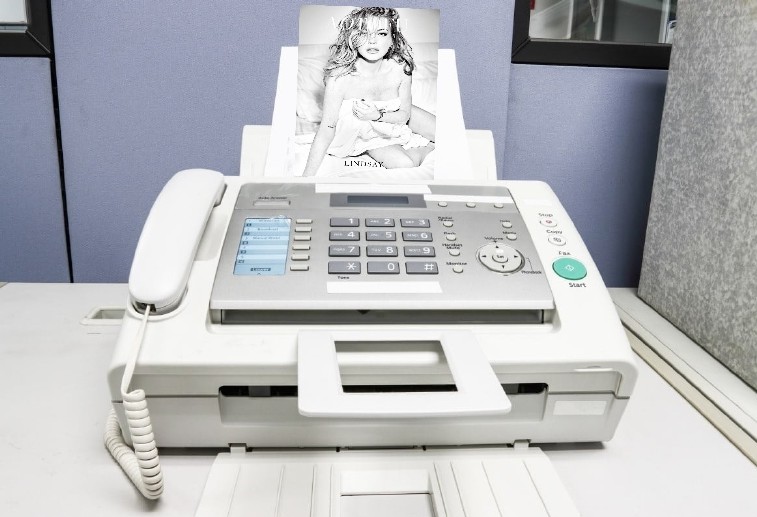
Lindsay Lohan, faxed.

Fax as short form of facsimile was wholly unrelated to the original fax which was from the Middle English fax, from the Old English feax (hair, head of hair), from the Proto-West Germanic fahs, from the Proto-Germanic fahsą (hair, mane), from the primitive Indo-European posom (hair (literally “that which is combed, shorn, or plucked”)), from the primitive Indo-European pe- (to comb, shear, pluck).  It was cognate with the Dutch vas (headhair), the German Fachs (head-hai”), the Norwegian faks (mane), the Icelandic fax (mane) and the Sanskrit पक्ष्मन् (pákman) (eyelash, hair, filament).  The Latin fax (torch, firebrand; fireball, comet; cause of ruin, incitement), from the primitive Indo-European ǵhwehk- (to shine) and cognate with facētus (elegant, fine; courteous, polite; witty, jocose, facetious) and the Lithuanian žvakė (candle) and there’s also a speculative link to the Etruscan word for face (which may also have meant torch).  In English (and apparently Scottish) dialectal use it used to mean “hair of the head” until the late fifteenth century.  The first recorded use as a clipping of facsimile (or in some countries “telefax”) to describe the consumer level telecommunications technology, its output and use is thought to date from 1979 but use as an oral form may slightly have predated this.  However, as a noun, “fax” had been in use by telegraphy engineers since 1948 and the verb in this context dates from at least 1970 although, in oral use it could have a longer history.

Brother FAX1820C fax machine.

Adding to the obsolescence was the switch in many countries away from the sometimes century-old analogue network of copper wires to a digital system, something which was the death knell of many fax machines.  In corporations, where internal PBXs (private branch exchange (also PABX (private automated branch exchange)), had usually provided a translation layer which provided both analogue and digital lines, the fax machines (usually as one of the components of a MFD (multi-function device which handled photocopying, faxing, scanning, OCR (optical character recognition) and sometimes even storage) carried serenely on although the evidence suggested use had diminished sometimes to zero.  Even in homes and small businesses without a PBX, adaptors are available which link a fax machine to a SIP/VoIP (Session Initiation Protocol/Voice over Internet Protocol) account, emulating the analogue original.  Unlike the old and robust telephone system, reliability could be patchy because the performance of the internet tends to bounce around more and (strangely) error correction is a less exact science.  There are more sophisticated solutions but they don’t use existing hardware so costs are higher and the take-up rate has been low, reflecting that most e-mail or other messaging solutions cover the needs of most users at zero or marginal cost.

The Imperial fax machine that never was

In the two decades between 1955-1975 when Chrysler in the US ran Imperial as a separate division rather than a badge to be used for up-market versions built on the corporate full-sized platform (although Imperials in their last generations did revert to such engineering), despite the odd encouraging season, the brand never threatened the dominance of Cadillac in the sector and rarely troubled Ford's Lincoln, the perennial runner-up.  The 1967 & 1968 Imperial range did however offer something truly unique.  The “Mobile Director Package” was available exclusively on the Imperial Crown Coupe and reflected (within the limits of what the available technology and fiscal realism would then permit) what Chrysler thought a company director would most value in an automobile being used as a kind of “office on the move” and it included: an extendable walnut-topped table which could be unfolded over the rear seats, a gooseneck (Tensor brand) high-intensity lamp which could be plugged into the cigarette lighter on either side of the car (in a sign of the times, Imperials had four cigarette lighters installed) and most intriguingly, the front passenger seat could rotate 180° to permit someone comfortably to use the tables and interact with those in the rear.  Unfortunately, the fax machine previewed on the well-publicized prototype didn't make the cut for the production version.  All the publicity material associated with the Mobile Director Package did suggest the rearward-facing seat would likely be occupied by a director’s secretary and as one might imagine, the configuration did preclude her (and those depicted were usually women) using a lap & sash seat-belt but she would always have been in arm’s reach of at least one cigarette lighter so there was that.  The package was available only for those two seasons and in its first years cost US$597.40 (some US$5500 adjusted for 2023 values).  The cost of the option was in 1968 reduced to US$317.60 (some US$2800 adjusted for 2023 values) but that did little to stimulate demand, only 81 buyers of Crown Coupes ticking the box so even if the new safety regulations hadn’t outlawed the idea, it’s doubtful the Mobile Director Package would have appeared on the option list in 1969 when the new (and ultimately doomed) “fuselage” Imperials debuted.

Imperial's advertising always emphasised the "business" aspect of the package but the corporation also circulated a photograph of the table supporting a (presumably magnetic) chessboard and another with a bunch of grapes tumbling seductively.  The latter may have been to suggest the utility of the package when stopping for a picnic with one's secretary; once advertising agency executives got ideas, they were hard to restrain.    

The advertising copy at the time claimed the package was “designed for the busy executive who must continue his work while he travels”, serving also as “an informal conference lounge”.  The Imperial was a big car (although the previous generations were larger still) but “lounge” was a bit of a stretch but “truth in advertising” laws were then not quite as onerous as they would become.  More accurate were the engineering details, the table able to “pivot to any of four different positions, supported by a sturdy chrome-plated pillar and in the forward position, it can convert into a padded armrest between the two front seats while extended, it opens out to twice its original size with a lever on the table swivel support to permit adjustments to the height”.  It was noted “a special tool is used for removing the table and storing it in the trunk” the unstated implication presumably that in deference to the secretary’s finger-nails, that would be a task for one’s chauffeur.  The US$597.40 the option listed at in 1967 needs to be compared with the others available and only the most elaborate of the air conditioning systems was more expensive.

Imperial option list, 1967.

The package as it appeared in showrooms was actually modest compared with the “Mobile Executive” car the corporation sent around the show circuit in 1966.  That Imperial had been fitted with a telephone, Dictaphone, writing table, typewriter, television, a fax machine, reading lamp and stereophonic sound system.  The 1966 show car was also Crown Coupe but it was much more ambitious, anticipating advances in mobile communications which would unfold over the next quarter century.  At the time, car phones were available (the first service in the US offered during the late 1940s) although they were expensive and the nature of the bandwidth used and the lack of data compression meant that the range was limited as was the capacity; only several dozen calls able simultaneously to be sustained.  In 1966, there was even the novelty of a Datafax, a "facsimile machine" (later to become the ubiquitous "fax") able to send or receive a US Letter-sized (slightly smaller than A4) page of text in six minutes.  That sounds unimpressive in 2023 (or compared even with the 14.4 kbit/s for Group 3 FaxStream services of the 1990s) but the appropriate comparison is with the contemporary alternatives (driving, walking or using the US Mail) and six minutes would have been a considerable advance.  As it was, the tempting equipment awaited improvements in infrastructure such as the analogue networks of the 1980s and later cellular roll-outs and these technologies contributed to the extent of use that delivered the economies of scale which, eventually, would make possible smart phones.

The 1966 car which toured the show circuit demonstrated the concept which, in simplified form, would the next year appear on the option list but things like telephones and fax machines anticipated the future by many years (although fax machines in cars (Audi one of a handful to offer them) never became a thing).  The Dictaphone did however make the list as one of Chrysler's regular production options (RPO) in the early 1970s and the take-up rate was surprisingly high although the fad quickly passed, dealers reporting the customers saying they worked well but they "never used them".

Monday, April 6, 2026

Scum

Scum (pronounced skuhm)

(1) A film or layer of foul or extraneous matter that forms on the surface of a liquid as a result of natural processes such as the greenish film of algae and similar vegetation on the surface of a stagnant pond.

(2) A layer of impure matter that forms on the surface of a liquid as the result of boiling or fermentation.

(3) As disparaging slang, a person though low, worthless, or evil (often as “scumbag” or “scumbucket”.

(4) Such persons collectively (often as “scum of the earth”).

(5) An alternative name for scoria, the slag or dross that remains after the smelting of metal from an ore.

1200–1250: From the Middle English scume, derived from the Middle Dutch schūme (foam, froth) cognate with German schaum, ultimately of Germanic origin, drawn from the Old High German scūm and Old French escume.  In Old Norse word was skum, thought derived from the primitive root (s)keu (to cover, conceal).  By the early fourteen century, the word scummer (shallow ladle for removing scum) had emerged in Middle Dutch, a borrowing from the Proto-Germanic skuma, the sense deteriorated from "thin layer atop liquid" to "film of dirt," then just "dirt" and from this use is derived the modern skim.  The meaning "lowest class of humanity" is from the 1580s; the familiar phrase “scum of the earth” from 1712.  In modern use, the English is scum, the French écume, the Spanish escuma, the Italian schiuma and the Dutch schuim.  Scum is a noun & verb, scumbag, scumbaggery, scumbagginess & scumbucket are nouns, and scumlike, scummy & scumbaggy are adjectives; the noun plural is scums.


Rendezvous: New Zealand-born cartoonist David Low's (1891-1963) famous take on the 1939 German-Soviet Nonaggression Pact.

The document usually is called the Nazi-Soviet Pact or Molotov-Ribbentrop Pact because it was signed by comrade Vyacheslav Molotov (1890–1986; Soviet foreign minister 1939-1949 & 1953-1956) and Joachim von Ribbentrop (1893–1946; Nazi foreign minister 1938-1945).  To illustrate the pact's cynical nature, Low depicted Adolf Hitler (1889-1945; Führer (leader) and German head of government 1933-1945 & head of state 1934-1945, left) exchanging artificial pleasantries with comrade Stalin (1878-1953; Soviet leader 1924-1953, right) both knowing it was only a matter of time before their nations would be at war.  Although Low at the time couldn't have known it, comrade Stalin (1878-1953; Soviet leader 1924-1953) was not unaware of public opinion and when presented with the pact's draft text, decided the rather flowery preamble extoling German-Soviet friendship was just too absurd, telling the visiting delegation that "...after years of pouring buckets of shit over each-other...", it'd be more convincing were the document to be as formal as possible.  Sensational as news of the pact was in 1939, what became more notorious still was the appended "secret protocol" which defined the line of delineation by which Poland would be "carved-up" between Germany and the USSR after the German invasion.  Because of geography and demographic reality, the line on the map was remarkably close to the Curzon Line, first proposed in 1919 by Lord Curzon (1859–1925; Viceroy of India 1899-1905 & UK Foreign Secretary 1919-1924) as the border between Soviet Russia and a reconstituted Poland.

Cautiously, comrade Stalin waited a couple of weeks to ensure the German victory was secure before sending the Red Army over the border, an act the Poles would remember as "a stab in the back".  The defense counsel at the first Nuremberg Trial (1945-1946) obtained a copy of the secret protocol and attempted to have it introduced as evidence but the judges denied the motion, the compromise being it could be referred to but the contents could not be discussed.  The irony of two Soviet judges dealing with the charges of a conspiracy to wage aggressive war (Count 1) and waging aggressive war (Count 2) when knowledge of the secret protocol (a conspiracy to invade Poland) was afoot attracted much comment.  One unmoved by the perception of cynicism was comrade Stalin for whom all politics was realpolitik.  At the Yalta Conference in February 1945, during the difficult negotiations over Polish borders, Molotov habitually would refer to “the Curzon Line” and the UK foreign secretary, Anthony Eden (1897–1977; thrice UK foreign secretary & prime minister 1955-1957), in a not untypically bitchy barb, observed the more common practice was to call it “the Molotov-Ribbentrop line”.  Call it whatever you like” replied Stalin, “we still think it's fair and just”.  Rarely did comrade Stalin much care to conceal the nature of the regime he crafted in his own image.      
 
The Society for Cutting Up Men: The S.C.U.M. Manifesto

S.C.U.M. Manifesto (post shooting, 1968 paperback Edition).

Although celebrated in popular culture as the summer of love, not everyone shared the hippie vibe in 1967.  The S.C.U.M. Manifesto was a radical feminist position paper by Valerie Solanas (1936-1988), self-published in 1967 with a commercial print-run a year later.  Although lacking robust theoretical underpinnings and criticized widely within the movement, it remains both feminism’s purest and most uncompromising work and an enduring landmark in the history of anarchist publishing.  In the abstract, S.C.U.M. suggested little more than the parlous state of the word being the fault of men, it was the task of women to repair the damage and this could be undertaken only if men were exterminated from planet Earth.  The internal logic was perfect.

As well as the Society for Cutting Up Men, Acronym Finder’s list of the use of SCUM as an acronym includes (1) Subculture Urban Marketing, (2) Santa Clara United Methodist, (3) Sensitive Caring Urban Male (though being one of those wouldn’t save them and they’re as likely (after ordering their Venti Iced Caramel Macchiato with almond milk and an extra shot of espresso) as a (4) Self-Centered Urban Male to get Solanas’ “six-inch blade” between the ribs), (5) Southern California Unified Malacologists (malacology is the study of molluscs), (6) South Coast United Motorcyclist and (7) Socialist Cover-Up Media (how Fox News and those in the MAGA (Make America Great Again) cult think of the “fake news media).

The use of Scum as an acronym for Society for Cutting Up Men existed in printed form from 1967 (though not in the manifesto’s text) although Solanas later denied the connection, adding that S.C.U.M. never existed as an organization and was just “…a literary device”.  The latter does appear true, S.C.U.M. never having a structure or membership, operating more as Solanas’ catchy marketing label for her views; dubbing it a literary device might seem pretentious but, given her world-view, descending to the mercantile would have felt grubby.  That said, when selling the original manifesto, women were charged US$1, men US$2.  While perhaps not as elegant an opening passage as a Jean-Jacques Rousseau (1712–1778) might have penned, Solanas’ words were certainly succinct.  "Life in this society being, at best, an utter bore and no aspect of society being at all relevant to women, there remains to civic-minded, responsible, thrill-seeking females only to overthrow the government, eliminate the money system, institute complete automation and eliminate the male sex.”  Ominously, “If S.C.U.M. ever strikes” she added, “it will be in the dark with a six-inch blade.”  No ambiguity there, men would know what to expect.

On set, 1967, Andy Warhol (1928-1987) & Nico (1938-1988).

Author and work were still little-known outside anarchist circles when, on 3 June 1968, Solanas attempted to murder pop-artist Andy Warhol, firing three shots, one finding the target.  The year 1968 was in the US a time of violence and tumult but amid it all, the celebrity connection and the bizarre circumstances ensured this one crime would attract widespread coverage.  Valerie Solanas with her two guns had entered Mr Warhol’s sixth-floor office at 33 Union Square West convinced he was intent on stealing the manuscript of the play Up Your Ass she’d repeatedly tried to persuade him to produce.  Warhol and his staff had reviewed the work and decided it simply wasn’t very good (Warhol giving the the back-handed compliment of it being "well-typed") but because he’d “misplaced” the manuscript (it was later discovered in a trunk) Solanas concluded that was just a trick and he was going to steal what she thought of as her brilliant play, claiming it as her own.  Although she’d for some time hovered around the fringes of the Warhol “Factory”, she seems not to have had much success as an advocate.  Her S.C.U.M. Manifesto envisioned a world without men which was at the time heady stuff with a certain mid-1960s appeal but Warhol also declined her offer to become a member of the Scum’s “Men’s Auxiliary” (a group for men sufficiently sympathetic to Scum’s aims to begin “working diligently to eliminate themselves.”)  As offers go, it really wasn't compelling.

New York Daily News, 4 June 1968.

Not best pleased by the headline, “Actress Shoots Andy Warhol”, Solanas demanded a retraction claiming that she was "a writer, not an actress."  The paper had based the headline on her appearance in Warhol's films I, a Man (1967) and Bike Boy (1967).  Warhol later admitted he'd cast her in I, a Man (for which she received a US$25 fee) in the hope she'd stop nagging him about the play she'd written.  She never complained about anything else the press wrote about her but apparently the label "actress" was beyond the pale.

Solanas’ state of mind about the fate of her intellectual property can be explained by it being no secret Warhol was inclined to “use” (the words “borrow”, “appropriate” “steal” also often used but “sample” was not yet a thing) and rebrand it all as “his art”.  For weeks leading up to the attempt on his life, repeatedly she’d called his office with first requests and then demands about her manuscript, culminating with threats at which point Warhol stopped taking her calls; the next call she made was in person and she shot him and an art gallery owner with who he was discussing an exhibition (he (as collateral damage) received minor injuries); Warhol was declared dead but paramedics arrived to stabilize him.  Calmly, Solanas left the building and several hours later, approached a policeman in Times Square, handed over her two guns and told him: “He had too much control over my life.  Unsurprisingly, a judge ordered a psychiatric evaluation and she received a diagnosis of paranoid schizophrenia but despite this, she was found competent to stand trial and pleaded guilty to “reckless assault with intent to harm”; sentenced to three years incarceration (including time served) in the Matteawan Hospital for the Criminally Insane (1892-1977); she was released late in 1971.  Solanas never renounced the S.C.U.M. manifesto nor lost faith in its capacity to change the world but her her mental health continued to decline and reports indicate she became increasingly paranoid and unstable. She spent her last years in a single-occupancy welfare hotel in San Francisco, where, alone, she died in 1988, the official cause of death listed as "pneumonia".  
  
A (fake) montage of Lindsay Lohan as Andy Warhol (1928–1987) might have rendered.  Ms Lohan was not yet 12 months old when Warhol died (the start of her modeling career still two years off) but had he lived another two decades he'd almost certainly have painted her.

Ms Solanas' infamy lasted beyond fifteen minutes and one unintended consequence of her act was the S.C.U.M. Manifesto finally finding a commercial publisher, thus becoming what is publishing is known as succès de scandale (a work which owes its success or very existence to some notoriety or scandalous element).  In certain feminist and anarchist circles she remains a cult figure although, it takes some intellectual gymnastics to trace a lineal path from her manifesto to the work of even the more radical of the later-wave feminists such as Andrea Dworkin (1946-2005), Susan Brownmiller (b 1935) or Catharine MacKinnon (b 1946).  Solanas to this day still is usually described as a “feminist” or “radical feminist” but, given the implication of the manifesto, it would seem more accurate to label her a misandrist (one who exhibits a hatred of or a prejudice against men), a world view which attracts many because, to be fair, there are any number of reasons to hate men.  Although one suspects among women the "all men are bastards" school of thought is ancient, the noun "misandry" was a late nineteenth century formation, the construct being mis- (in the sense of “hatred”) + -andry (men), by analogy with the more commonly used misogyny (hatred of or a prejudice against women); the inspiration was the Ancient Greek μισανδρία (misandría), the construct being μισέω (miséō) (hate) + νήρ (anr) (man).


Cause and effect: The (attempted) murder weapon (Beretta M1935 automatic in .32ACP, left) and Warhol's post-operative torso (right).

Warhol required surgery to his spleen, stomach, liver, esophagus and lungs; the damage he suffered to a range of internal organs not uncommon among those shot at close range; the bullet ricocheted off a rib, accounting for the lateral trajectory.  Although the Beretta M1935 automatic (in .32ACP) she used is not regarded as a “big calibre” (the .32 listed by most as a “small bore”), a single shot from one, especially at close-range, can be lethal and an wound from even a smaller load (like the .22 she was also carrying) can be fatal.  In the context of handguns, a “big calibre” load usually is defined as one with a diameter of .40 inches (10mm) or larger and of those there are many including .44, .45 & .50 although “magnum” versions of smaller bore ammunition (.22, .357 etc) can match many larger loads in “stopping power”.  Interviewed later, Warhol reflected: “Before I was shot [June, 1968], I always thought that I was more half-there than all-there - I always suspected that I was watching TV instead of living life. People sometimes say that the way things happen in the movies is unreal, but actually it’s the way things happen to you in life that’s unreal. The movies make emotions look so strong and real, whereas when things really do happen to you, it’s like watching television - you don’t feel anything. Right when I was being shot and ever since, I knew that I was watching television. The channels switch, but it’s all television.

Gun (1982), synthetic polymer paint and silkscreen ink on canvas by Andy Warhol.

Artistically, the shooting had consequences.  Warhol became more guarded, abandoning projects like filmmaking which required so much contact with people and stopping the production of controversial art which might attract more murderous types and focusing on business, in 1969 founding what in 1969 became Interview magazine.  Although there had in his previous output been evidence of an interest in death and violence, after the shooting, often he would visited the theme of death, painting a series of skulls and one of guns, a weapon with which he now had an intensely personal connection.  He was certainly not unaware what happened that day in June 1968 was a turning point in his life, some twenty years later noting in his diary: “I said that I wasn’t creative since I was shot, because after that I stopped seeing creepy people.

Tuesday, September 8, 2020

Ping

Ping (pronounced ping)

(1) To produce a short, high-pitched resonant sound, like that of a bullet striking a sheet of metal (as a verb used without object).

(2) In computing, to send an echo-request packet to an IP address and use the echo reply to determine whether another computer on the network is operational and the speed at which the data is being transferred.

(3) Informally, to make contact with someone by sending a brief electronic message (text messages and later variations).  A ping can also be a notification in response to a message.

(4) A pinging sound.

(5) An infrasonic or ultrasonic sound wave created by sonar in echolocation or an acoustic signal transmitted to indicate a location.

(6) The Lord Chancellor, one of the courtiers in Giacomo Puccini's (1858-1924) opera Turandot (1926).

(7) In colloquial use, to flick something, usually with a finger-tip.

(8) In colloquial use, to be detected committing an offence (by a police officer, an umpire or referee) and subsequently penalized.

(9) In internal combustion engines (also referred to as pinking, knocking or detonation), when the combustion of the fuel/air mixture in the cylinder does not begin correctly in response to ignition by the spark plug.  The usual form in this context is the adjective "pinging".

1835: Partly onomatopoeic (imitative of the sound of a bullet whistling through the air or striking something sharply) and partly reflecting the influence of the (continuing) Middle English pingen (to push, shove, pierce, stab, prod, goad, urge, feel remorse, incite), from the Old English pyngan (to prick); used as a verb since 1855.  The meaning "short, high-pitched electronic pulse" is attested from 1943, the reference being to the sonar systems used on both submarines and surface vessels.  The noun plural was pings, the present participle pinging, the past participle pinged.  The non-standard forms are pang & pung (past participle) although one can understand why those learning English might assume they should exist.  Pingdemic was an invention of computer programmers.

The noun ping-pong was also based on sound and dates from 1901 as Ping-Pong, the trademark for table tennis equipment registered by Parker Brothers, both words imitative of the sound of the ball hitting a hard surface (said by some to have been attested since 1823; the game was much in vogue in the US 1900-1905.  In the figurative sense of "move or send back and forth without progress, resolution, or purpose", use dates from 1952, later extended (though a little more hopefully) to “ping-pong diplomacy” which referred to the US and the PRC (Communist China) agreeing to exchange ping-pong teams before sending diplomats.  The electronic arcade game “Pong” (1972) was an abbreviation of ping-pong although there is evidence pong had for some years been a truncated reference to the game proper.

Sample pings.

Ping is one of a small subset of commands which constitute the lingua franca of computer network administration software, included in almost all network tool bundles regardless of the local or network operating systems.  It is a utility which tests the connectivity and speed of a host running on any Internet Protocol (IP) network by measuring the round-trip time for messages sent from the originating host to a destination computer, echoed back to the source.  Originally run exclusively from a command prompt, GUI (graphical user interface) versions have long been available and are handy for infrequent users who have never needed to memorize the syntax.  Ping sends Internet Control Message Protocol (ICMP) echo request packets to the target host and waits for an ICMP echo reply, reporting errors, packet loss, and a statistical summary of the results, most usefully the duration (in milliseconds) of the minimum, maximum & mean round-trips.

The name ping was a borrowing from naval sonar terminology that sends a pulse of sound and listens for the echo to detect objects under water to determining their location, direction and speed.  The sonar systems used at sea included audible pings and some computer ping utilities include one as a novelty.  The original software was a Q&D (quick & dirty) utility created in 1983 to diagnose tiresome problems on a network, the name chosen because the method was analogous with sonar's echolocation.  The occasionally mentioned Packet InterNet Groper is a backronym created some years after the first versions of ping were distributed.

Turandot

Turandot (1926) was Giacomo Puccini's (1858-1924) last opera and one which remained uncompleted at his death.  Puccini based the opera on the play Turandot (1762) by Venetian playwright Count Carlo Gozzi (1720–1806) which borrowed from one of the seven stories in the epic-length work by Persian poet Nizami (circa 1141–1209), the motif of seven aligned with the days of the week, the Persian seven-color scheme and the seven planets at that time known.  Turandot as told by Nizami is the story attached to Tuesday, the protagonist a Russian princess (Turan-Dokht (daughter of Turan)), a name often used in Persian poetry for Central Asian princesses.  Puccini seems to have moved the site of his Opera to China for no reason other than his interest in incorporating into the work Chinese musical themes, much as he’d been attracted to Japanese sounds for his earlier Madama Butterfly (1904).  Most people on the planet have never heard of Puccini and his operas but many will be at least vaguely familiar with one fragment of Turandot, Nessun dorma (Let no one sleep), among the most famous of the tenor arias, because of the global broadcast of a performance during the 1990 FIFA World Cup.

Puccini completed the three-act structure before his death and it was in this form it was first performed at La Scala in Milan in April 1926, conducted by Arturo Toscanini (1867-1957), the conductor refusing to go beyond the point where Puccini stopped.  With an ending added by Franco Alfano (1875-1954), it was presented again the very next evening but performances have varied over the years, a few sticking to the original, some using one of the variations written by Alfano and others with different ending entirely, some better received than others.  Opera buffs and professional musicians have always been drawn to Turandot because it’s Puccini at his most musically innovative but audiences have never embraced it quite as they did the seductive butterfly which is a set-piece love story packed with melodies.  However, it’s now viewed also through a political lens, the specter of cultural appropriation and accusation of racial stereotyping looming over every aria.

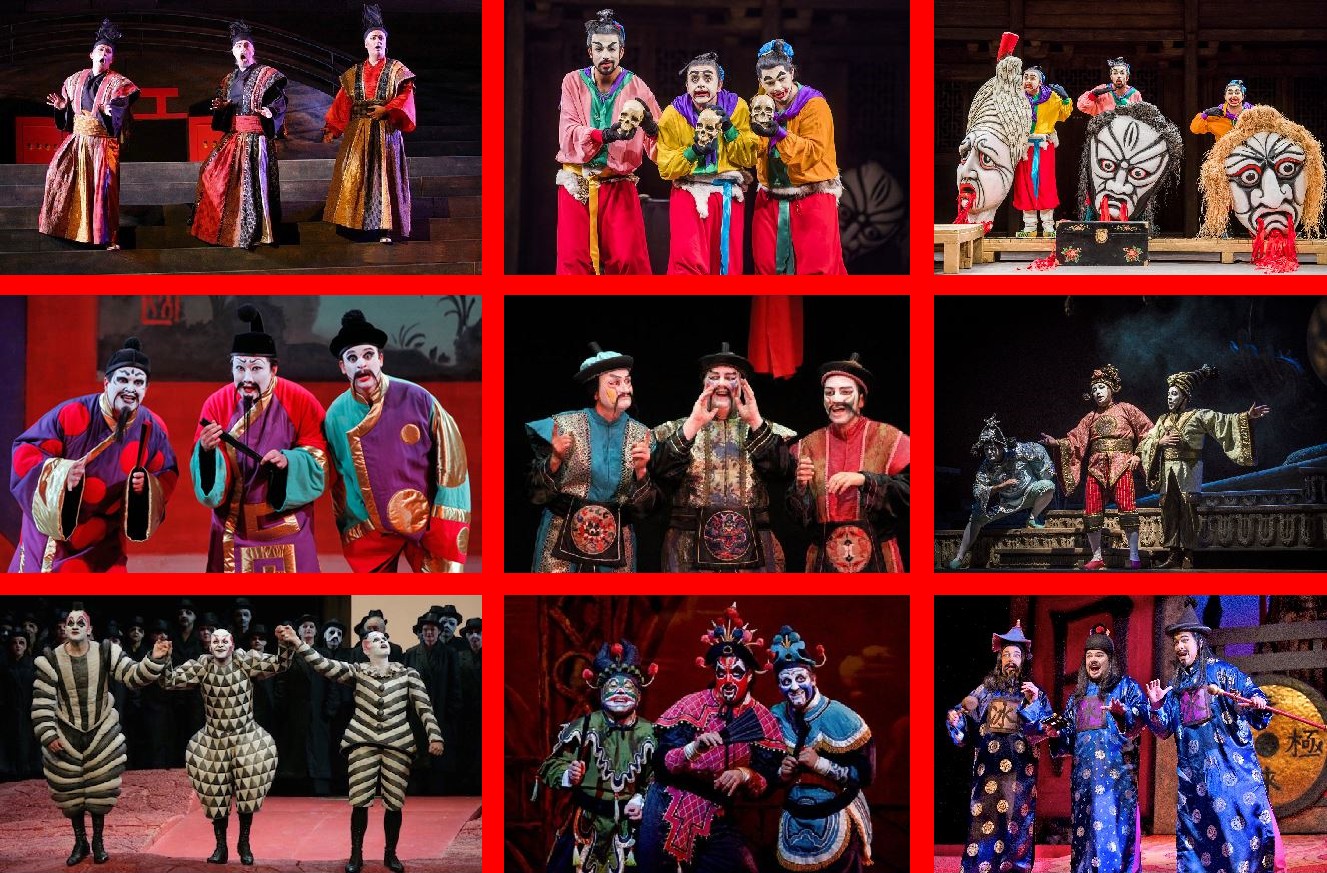
From various stage productions: Ping, Lord Chancellor (baritone), Pang, Chief Steward of the Imperial Household (tenor) & Pong, Executive Chef of the Imperial Kitchen (tenor) are the triumvirate of courtiers in Puccini's Turandot.

The critique is that the depiction of a barbaric Chinese princess is an outdated orientalist construct of Chinese people and the idea of white people dressing and being made up as caricatures of those from the far east goes beyond mere cultural appropriation, the use of Chinese music, traditional dress and the perpetuating historical Western imagery being demeaning.  Beyond that, white audiences who are either oblivious to these concerns or dismissive of them are (at the very least) guilty of committing microaggressions and are casually asserting cultural superiority, if not actual white supremacy.