Showing posts sorted by relevance for query Clamshell. Sort by date Show all posts

Saturday, October 1, 2022

Clamshell

Clamshell (pronounced klam-shel)

(1) The shell of a clam.

(2) Any of a variety of object with two hinged parts and that opens and closes like a clamshell, as a laptop computer or a box with a cover joined on one side (clamshell phone; clamshell computer, clamshell packaging etc).

(3) In dredging and earth-moving machinery, a dredging bucket opening at the bottom, consisting of two similar pieces hinged together at the top (also called the clamshell bucket); a machine equipped with such a bucket.

(4) In printing, a platen press.

(5) Of, pertaining to or noting an object that opens and closes like a clamshell; the opening and closing actions of this object (ie anything resembling the bivalve shell of a clam).

(6) In anatomy, another name for eyelid (technical use only).

(7) In aviation, (1) an aircraft cockpit canopy hinged at the front and rear or (2) the hinged door of a cargo aircraft.

(8) In slang, the mouth (US archaic).

(9) In architecture, an amphitheater, especially an outdoor amphitheater; the semi-circular acoustic backdrop behind and above the performers (a use based (unusually) on the appearance of the shell in only its open state).

(10) In manufacturing, to deform a die in a shape resembling the shell of a clam, as a result of uneven extrusion pressure.

1490–1500: the construct was clam + shell.  Clam was from the Middle English clam (pincers, vice, clamp), from the Old English clamm (bond, fetter, grip, grasp), from the Proto-Germanic klamjaną (press, squeeze together).  Shell was from the Middle English schelle, from the Old English sċiell, from the Proto-West Germanic skallju, from the Proto-Germanic skaljō, from the primitive Indo-European skelh & kelh (to split, cleave).  It was related to the West Frisian skyl (peel, rind), the Dutch schil (peel, skin, rink), the Low German Schell (shell, scale), the Irish scelec (pebble), the Latin silex (pebble, flint) & siliqua (pod) and the Old Church Slavonic сколика (skolika) (shell).  Although sharing a source, the adjective clammy is otherwise unrelated, being from the Middle English clam (in the literally descriptive sense of “viscous, sticky, slimy”) & clammen (“to smear, bedaub”), from the Old English clǣman (to smear, bedaub) and related to the German klamm (clammy) & klemmen (to be stuck, stick).  Clamshell is a noun, the present participle is clamshelling and the past participle clamshelled; the noun plural is clamshells.

Lindsay Lohan with T-Mobile flip-phone Sidekick II, T-Mobile Sidekick II party, The Grove, Los Angeles, August 2004.

In (mostly archaic) US slang, a clam was one dollar (used usually in the plural) and it’s though the origin of this was an allusion to the wampum (a traditional shell bead of the Eastern Woodlands tribes of Native Americans.  It includes white shell beads hand-fashioned from the North Atlantic channeled whelk shell and white and purple beads made from the quahog or Western North Atlantic hard-shelled clam.).  Clams are of some note in the strange history of the Church of Scientology, a tax-exempt operation created by L Ron Hubbard (1911–1986) who constructed its ethos from an amalgam of his science fiction and fantasy stories, combined with pseudo-scientific explanations about the human condition.  His idea (a central tenet of Scientology) that human “thetans” (souls) previously inhabited clams he expanded upon in Scientology: A History of Man (1961) (first published as What to Audit (1952)), explaining that interactions between jellyfish and cave walls were responsible for the emergence of “a shell as in the clam” and that the clam itself suffered from a split personality when he described as a “double-hinge problem” in which “…one hinge wishes to stay open, the other tries to close, thus conflict occurs".  That does of course explain much about the problems of man and, more prosaically, because the clam’s hinges would become the Clam “hinges of the human jaw”, the Clam's method of issuing spores to reproduce is why we suffer toothache.  Who knew?

Trendsetter: The influential clamshell and some of its many imitators.

What engineers and designers liked once to call the “clam shell form factor” was shortened inevitability to “clamshell” but for portable computers and cellular (mobile) phones neither term caught on, laptop soon the ubiquitous choice and phone users preferred the punchier flip-phone.  Laptop endured as the generic description of all such devices and the distinction manufacturers applied to models technically classed as notebooks and netbooks escaped most, any clamshell computer since first they appeared in the early 1980s most often referred to as a laptop.  The flip-phone was a turn of the century fad and actually a good example of packaging efficiency, especially for those who carried their phones in handbags although men, most of whom had only pockets, were never as enthusiastic.  As it was the sleek iPhone and the smartphones which followed in its wake killed off most flips although there was the occasional retro-themed revival.  However, advances in materials had by 2020 made folding screens both durable and economical to produce in volume so these have become the latest variation to use the clam shell, offering all the packaging advantages of old with the benefit of being able to offer a flip screen in a thin form factor, thus appealing also to men, few of whom have been convinced by the utility of that other turn of the century fad: the man bag.

1983 Ferrari 512BBi.  All versions of the BB (1973-1984) used the clamshell design front & rear.

In automotive design, clamshells are used for both front and rear sections of the bodywork, some cars using both.  It was a popular idea on racing machinery like the Ford GT40 or the Porsche 917 because the method of construction used meant the panels carried little load, providing just coverage and aerodynamic optimization.  Some road cars also adopted the idea including Triumph’s Spitfire (and the GT6 derivative) and Jaguar’s E-Type (XKE) and there were real advantages in accessibility for servicing and that’s probably why the bulky Jaguar V12 enjoyed a better reputation among mechanics when under the clamshell than it did in the tighter confines of the XJ or XJ-S (later XJS).  Few mass-market vehicles used the idea and the Triumph Herald and Vitesse (which provided the platforms for the Spitfire & GT6) was one of the few but it was unusual in being built on a separate chassis after most of the industry had switched to unitary construction.

Friday, April 2, 2021

Sconce

Sconce (pronounced skons)

(1)  A bracket for candles or other lights, placed on a wall, mirror, picture frame etc (a development of the earlier use relating to candles).

(2) The hole or socket of a candlestick (for holding the candle).

(3) A fortification; a small detached fort or defense work, as to defend a pass, bridge etc; a protective screen or shelter (obsolete but there was a revival in video gaming).

(4) A hut for protection and shelter; a stall.

(5) In architecture, a squinch (a structure constructed between two adjacent walls to aid in the transition from a polygonal to a circular structure, as when a dome is constructed on top of a square room).

(6) A fixed seat or shelf.

(7) The head or skull; sense or wit (now rare, probably obsolete); a piece of armor for the head; headpiece; helmet (now for historic reference only).

(8) A fragment of a floe of ice.

(9) A poll tax; a mulct or fine.

(10) In the University of Oxford, informally to fine an undergraduate for a breach of rules or etiquette (the alternative to paying the penalty being to drink a specified quantity of ale); a fine so imposed; a mug or tankard used in sconcing (typically a beer bong).

(11) To shut within a sconce; to imprison.

(12) As the verb ensconce, to place in a secure environment; comfortably to settle.

1350–1400: From the Late Middle English sconce, sconce & sconse (defensive fortification or fortification work), from the Old French esconce (hiding place; lantern) from the Medieval Latin scōnsa, an aphetic variant of abscōnsa (noun use of feminine past participle of abscondere (to conceal; dark lantern) (also the source of the modern abscond)).  The Latin absconsus (hidden) was the perfect passive participle of abscond (hide).  Related was the Dutch schans (defensive fortification or fortification work) and the Middle High German Schanze (bundle of brushwood).  The Dutch word also had an interesting evolution, used to mean (1) a type of small fort or other fortification, especially as built to defend a pass or ford, (2) a hut for protection and shelter; a stall, (3) a fragment of a floe of ice ( (4) as fixed seat or shelf.  In English, while other meanings emerged, in military use sconce continued to be used to refer to fortifications or defensive works and during the English Civil War (1642-1651) a sconce was a small fortification or earthwork that was built quickly to defend a position.  Sconce & sconcing are nouns & verbs and sconced is a verb; the noun plural is sconces. 

An Oxford tradition

Sconce: Beer bong half-yard.

A tradition of the Oxford colleges, a sconcing was a demand a person drink a tankard of ale as a penalty for some breach of etiquette.  The word in this context is attested from 1617 and originally described a monetary fine imposed for a more serious breach of discipline, the use as a kind of high table drinking game becoming common only in the early nineteenth century.  Offences which might have attracted a sconce included talking at dinner about women, religion, politics, one's work, the portraits hung in the college hall or making some error in the reciting of the Latin Grace.  Originally reserved for the senior scholar or fellow at each table, the right to demand a sconce (usually in Classical Latin (and mixing in later variants was not tolerated) or Ancient Greek) was later extended to all.  The quantity of a sconce varied from two imperial pints (1.1 litres) and three and three-quarters (2.1 litres) although the larger measures are believed to have been "rare".  The Oxford tradition was essentially the same as "fining" at Cambridge although in the narrow technical sense, a sconce was the act of issuing a penalty rather than the penalty itself, a distinction often lost on undergraduates, especially after a couple of sconces.  In 1945, while at Oxford on a Rhodes Scholarship, Bob Hawke (1929–2019; Prime Minister of Australia 1983-1991) was sconced (fined) for neglecting to wear his academic grown (then daytime wear for students and dons).  Not wishing to pay the fine, he opted to scull a yard glass of ale (2½ imperial pints (3 US pints, 1.4 litres) achieving the feat in 11 seconds, setting the world record.  In his memoir (The Hawke Memoirs (1994)), wryly he observed setting this mark was remembered by more Australians than any of the reforms or achievements of his seven year premiership.

Lindsay Lohan with bandaged sconce: Falling for Christmas (2022).

In the Netflix film Falling for Christmas, the plot line includes Lindsay Lohan suffering trauma-induced amnesia after a blow to the sconce.  In English slang (UK and most of the Commonwealth although it seems not to have reached the critical mass needed for survival in the US & Canada) the use of sconce (which may have peaked in the early nineteenth century although any measure of oral use is difficult to estimate) to mean "the head, the skull" remained common until just after World War I (1914-1918).  Etymologists suspect the decline may have been the result of UK & Commonwealth troops mixing with those from other nations and developing a preference for their slang, reflecting the trend of US English (formal & informal) for well over a century being the most influential "change dynamic".  An aspect of cultural imperialism (often called linguistic imperialism), US forms "infecting" use in other parts of the English-speaking world is just the organic way languages evolve and users settle on whatever works best for their purposes.  

1960 Volkswagen Type 2 with factory-ordered Westfalia conversion SO23 (camper with small roof hatch) in Sealing Wax Red and Beige Grey over Grey vinyl and plaid cloth upholstery.  The clamshell light sconces are original Westfalia part numbers but the switches are after-market.  Sconces with the original switches appear in the two images at the lower right.

Part of Westfalia’s SO23 conversion package was a pair of interior lamps with clamshell sconces, described by the company as providing “a warm light”.  The Volkswagen Type 2 (sometimes referred to generically as “Microbus” or “Kombi” although those were specific variants) played a role in post-war culture on both sides of the Atlantic and the most desirable of the classic, early “split screen” (1950–1967 (and built in Brazil 1953–1975)) models such as the 21 & 23 window “Sambas” have become a cult and in the bubble market which inflated in the immediate post-pandemic period, some restored examples sold at auction for over US$200,000.  The VW originality police are no less exacting than those who examine Ferraris, Jaguars or Corvettes and they can tell the difference between a light’s original clamshell sconce and one of the 3D-printed reproductions now available.  The original, quite delicate switch has for years been unobtainium and the usual replacement is the “Euro-type” push-button unit once common on bedside table-lamps.

Saturday, September 26, 2026

Electra

Electra (pronounced ih-lek-truh)

(1) In Greek mythology, (also as Elektra or Laodice), any of several mythical women, most famously as the daughter of Agamemnon and Clytemnestra; she incited her brother Orestes to avenge the death of their father by killing his murderess Clytemnestra and her lover Aegisthus.

(2) In Astronomy, one of the six visible stars in the Pleiades.

(3) A female given name from Ancient Greek (now rare).

(4) In psychoanalytic theory, as “Electra complex”, a young girl's sub-conscious competition with her mother for her father's affection.  Still much associated Sigmund Freud (1856-1939), the term was in 1913 coined by Carl Jung (1875–1961) but Freud, proprietorial in such matters, added layers to his “Oedipus complex” (originally detailing a son's sexual attitude towards his mother and concomitant hostility toward his father) publishing the refinement as the “feminine Oedipus attitude”.  It can (generously) be interpreted as Freud’s contribution to gender-equality.

First century BC (of the name, although the literary tradition stretched back several millenia): From the Ancient Greek Ἠλέκτρα (Ēléktra (literally “shining bright)), from ἤλεκτρον (ḗlektron) (amber) and related to ἠλέκτωρ (ēléktōr) (shining sun; beaming sun).  Although etymologists regard the possibility as dubious, there may be a connection with the Sanskrit उल्का (ulkā́) (meteor) and/or the Latin Vulcānus (god of fire and metalworking) and the Ancient Greek ἥλιος (hḗlios) (sun).  The ultimate source may even be pre-Greek so it’s not surprising the exacting lexicographers list the origin as “uncertain”.  The Latin noun ēlectra was the nominative/accusative/vocative plural of ēlectrum (from Ancient Greek ḗlektron) and the best known adaptation was electrum (amber; an alloy of gold and silver, used in Antiquity and now specifically a natural alloy with between 20 and 50 per cent silver (once commonly called “German silver plate).  Electra is a proper noun; the noun plural is Electras (about the only use of the plural form is of sopranos or Buicks).

The legend of Electra (Ηλέκτρα)

While some of the myths of Antiquity have a unique storyline and there are characters who appear in a single role with a known lineage, in many cases the tales are tangled and figures from one myth may appear in others with different parents and children.  As an example, consider the literary career of Electra who variously was (1) One of the daughters of Oceanus and Tethys, who married Thaumas and then gave birth to Iris and to the Harpies; (2) One of Persephone's companions and was present when she was carried off by Hades; (3) One of the Pléiades.  Zeus fathered her child Dardanus who left Samothrace and went to the Troad, where he founded the royal dynasty of Troy.  Electra had another son, Iasion.  Electra is also said to have had a third son, named Emathion, who ruled over Samothrace, but more frequently this third child of hers by Zeus is named as Harmonia; (4) In the Italian version of Electra's legend, she was the wife of the Etruscan King Corythus and Dardanus and Iasion were born in Italy; (4) Electra is also linked to the legend of the Palladium.  She was later transformed with her sisters into the constellation of the Pleiades.

Elektra (Frankfurt, 1953).

The 1967 recording of Richard Strauss's (1864–1949) Elektra with Swedish soprano Birgit Nilsson (1918–2005) and the Wiener Philharmoniker (Vienna Philharmonic Orchestra) under Hungarian-British conductor, Sir Georg Solti (1912–1997) is regarded still by many critics as the finest studio recording.  Given the virtuosity on show, it's hard to argue but among the opera cognoscenti there’s a faction that insists Electra's hatreds and lust for vengeance were never better captured than in the 1953 recording with German soprano Inge Borkh (1921–2018) and the Sinfonieorchester dem Hessischen Rundfunk (Frankfurt Radio Symphony Orchestra of the state of Hesse), under German composer and conductor Kurt Schröder (1888–1962), a release noted also for German mezzo-soprano Christa Ludwig's (1928–2021) appearance as first maid.  In all the repertoire of opera, Electra is one of the roles demanding much range from a soprano and listeners can choose the Electra they prefer: technical ecstasy or thrilling intensity.

Most famously however she was (6) the daughter of Agamemnon and Clytemnestra.  After Agamemnon was murdered by Aegisthus and Clytemnestra, Electra was treated as a slave, spared only on the intervention of her mother.  In some accounts Electra saved her brother (the young Orestes) by entrusting him to their old tutor who took him away from Mycenae.  To prevent her giving birth to a son who might avenge her father, Electra was either married to a peasant who lived far from the city, or, having been betrothed to Castor and then Polymestor, was imprisoned at Mycenae.  On Orestes' return, she recognized him at Agamemnon's tomb and played an active part in the assassination of Aegisthus and Clytemnestra. When the Erinyes pursued Orestes for this crime, she devoted herself to his welfare.  In Euripides' Orestes she fought at her brother's side against the local populace who wanted the murderers condemned to death.  Electra was the main character in Sophocles' (now lost) Aletes: when Orestes and Pylades went to Tauris, rumours started at Mycenae that they had died, and that Electra's sister Iphigenia had killed Orestes.  Aegisthus's son Aletes assumed the throne and Electra went to Delphi, where she met Iphigenia who had gone there with Orestes.  Electra was about to blind her when she saw her brother.  Electra and Orestes returned to Mycenae and killed Aletes.  Electra married Pylades and went with him to Phocis; their children were Medon (3) and Strophius.

Electracy

Actor Carmen Electra (stage name of Tara Leigh Patrick, b 1972) and Lindsay Lohan (b 1986), The Art of Elysium Launches Betty and Veronica Apparel Line in Association with Miramax Films and Archie Comics, Beverly Hills, California, May 2004.

Electracy is the “skill and facility necessary to exploit the potential of modern electronic media”, a idea that has come to attract more attention after the disclosures of AI (Artificial Intelligence) systems “going rogue”, something of interest not only because of the reported events but the suspicion there have likely been many more “undisclosed incidents”.  First appearing in Teletheory (1989), the concept of electracy was constructed by US literary theorist Professor Gregory Ulmer (b 1944, then holding the chair in the Department of English at the University of Florida and a professorship of Electronic Languages and Cybermedia at the European Graduate School in Saas-Fee, Switzerland) and it appeared at a time when the internet had expanded beyond the US.  What had come to be known as the internet (until circa 2016 often with an initial capital) had been restricted mostly to universities, the military and some government agencies but by the late 1980s it had extended to research institutions in the UK, Europe, Australia, New Zealand and Japan but looked nothing like whate the www (world wide web) would transform it to in the following decade.  According to Professor Ulmer, electracy was “to digital media what literacy is to print”, the concept encompassing the broader cultural, institutional, pedagogical, and ideological implications inherent in “…the major societal transition from print to electronic media”.  A portmanteau word, the construct was electr(icity) + trac(e) + -y with “trace” used in the sense made famous by French philosopher Jacques Derrida (1930-2004).  Trace was a core concept in Derridian deconstruction; it denoted the principle that every sign, word, or present experience carries within it the mark of what it is absent, not present, and different from itself.  Instead of meaning coming from a pure, self-contained origin or a direct connection to reality, the trace means that every “present meaning” is already inhabited by the “ghost” of other “past and future signs”.  Unlike some of the concepts from deconstruction and other forks of postmodernism, la trace could, at the definitional level, be understood by most.

Jung, Freud and the Electra complex

The pioneers of psychoanalysis gathered at Clark University, Worcester, Massachusetts, September 1909. Front Row (left to Right): Sigmund Freud, Granville Stanley Hall (1844–1924) & Carl Jung.  Back Row (left to right): Sándor Ferenczi (1873–1933), Ernest Jones (1879–1958) & Abraham Arden Brill (1874–1948).

The group photograph was shot during a conference on psychology hosted by Dr Hall, then president of Clark University and the first in the US to earn a doctorate in the discipline.  Although even then psychoanalysis was established in the US, the conference would prove a landmark and trigger not only a wealth of publications but also the legitimization of the field to the extent departments of psychology began to proliferate in US institutions.  This was Freud's only trip to the US, a place where his influence would for generations be profound but, within half a decade, his estrangement from Jung had begun, producing the profession’s most famous schism that to some extent endures to this day.

Although in the public consciousness Sigmund Freud (1856-1939) does seem to loom over psychiatry and his theories continue to flavour the writing of at least some clinicians and academics, the editors of the APA's (American Psychiatric Association) DSM (Diagnostic and Statistical Manual of Mental Disorders) have moved on and in mainstream contemporary psychiatry, the Freudian “feminine Oedipus attitude” seems to be regarded primarily as a historical psychoanalytic concept rather than an acknowledged human developmental process or a psychiatric diagnosis.  It was Carl Jung (1875–1961) who coined the term “Electra complex” and explicitly Freud rejected it, not because he dismissed the notion but because his original conception was of his “Oedipus complex” as something applicable to both sexes and it was only later he constructed a more intricate model of female psychosexual development, thus the need for his term: “feminine Oedipus attitude”.

Electra Receiving the Ashes of her Brother, Orestes (circa 1927). oil on canvas by Jean-Baptiste Joseph Wicar (1762–1834), Worcester Art Museum, Worcester, Massachusetts, USA.

In Freud’s construct of female development: (1) the mother was the primary love object until (2) the child discovers the anatomical difference between the sexes, thus developing (3) what Freud styled “penis envy”, leading her to (4) blame her mother for rendering her with what she perceives as a “deficiency”, something that compelled her to (5) shift her affections towards her father meaning she (6) became her mother’s competitor for the father’s affection before (7) eventually identifying with her mother and accepting the defined “feminine role”.  Freud seems not to have commented on whether he was annoyed by Jung’s “Electra complex” becoming one of the most popular pieces of jargon to leak from the profession to popular discourse but he’d made clear his thoughts, writing in From the History of an Infantile Neurosis (the Wolfman case history) (1918) that he saw “no progress or advantage” in introducing the term and did not advocate its use.  That presumably was a clinician’s considered view though there’s no reason to suspect Austrian neurologists are any less prone than the rest of us to professional jealousy and in little more than a decade his position significantly had shifted; by 1931 Freud was arguing the pre-Oedipal attachment of girls to their mothers was much more important in than his earlier formulations had suggested.  So, although among Freudians, neo-Freudians and the wider community, his particular take on the Electra complex retains a following, the theory wasn’t a single, fixed proposition.

The Return of Orestes (from Electra by Sophocles) (1782), oil on canvas by John Downman (1749–1824), National Trust Collections, Hinton Ampner, Alresford.

The figure at the far left is Charles James Fox (1749–1806), a British Whig statesman whose career in politics endured for some four decades; he’s best remembered for his part in the Fox-North coalition government (April-December 1883 with Lord North (1732-1792)), dismissed by a then not quite mad George III (1738–1820; King of the UK 1760-1820) after the loss of the American colonies.  The episode was of note in the development of Westminster parliamentary conventions because the coalition had taken office despite the king’s opposition and when George III a few months later took the opportunity to “clear out that rotten crew”, it would be the last time the sovereign’s reserve powers would be invoked to sack a prime minister until in 1975 Sir John Kerr (1914–1991; Governor-General of Australia 1974-1977) sundered the commission of Gough Whitlam (1916–2014; Prime Minister of Australia 1972-1975), proving the royal prerogative still existed (although paradoxically perhaps now only in the hands of a monarch’s representative rather than their own).  There had been William IV’s (1765–1837; King of the UK 1830-1837) in 1834 dismissing Lord Melbourne (1779–1848; prime minister of the UK 1834 & 1835-1841) but historians seem to treat that more as a “gentlemen’s agreement” and most of those few Australians who by 1975 much thought about such things probably believed the days of meddling viceroys were done.

Fox’s other (and far-reaching) contribution to political evolution was that in refusing to serve in the administration of Lord Shelburne (1737-1805; Prime Minister of the UK 1782–1783), he accelerated the morphing of the Tory faction into a formalized party and no prime minister since Shelburne has attempted to govern without the support of a party.  In the literature, the relationship between George III and Fox often was described as “mutual antipathy” but “mutual hatred” better describes things and there have been few loathings so well documented as public knowledge, the king in a letter to North as early as 1775 saying of Fox he had: “…cast off every principle of common honour and honesty ... [a man who is] as contemptible as he is odious ... [and has an] aversion to all restraints.”  It was deeply personal view because the king attributed this dissolute lifestyle of his son and heir (George IV (1762–1830) King of the UK 1820-1830) to Fox’s corrosive influence.  Despite that, Fox’s appearance in the painting was likely playful rather than political, the artist often including public figures in his works with no overt purpose; Downman was not a “political artist”.

Despite’s Freud’s place in the history of the profession and his continue presence within factions in mainstream psychiatric science, in the “standard” diagnostic literature (the DSM & the WHO's (World Health Organization’s) ICD (International Classification of Diseases)), there are only traces of his legacy.  The DSM-5-TR (2022) is the APA’s most comprehensive diagnostic classification system yet and it includes no mention of the Electra complex, feminine Oedipus complex, penis-envy syndrome, or Oedipal developmental stage, either as diagnoses or as elements in diagnostic criteria and that reflects the path of the modern (ie post 1980) DSM’s evolution as concepts not technically diagnoses came gradually to be removed or renamed, the framework shifting from the classic psychoanalytic explanations of psychopathology Freud, Jung and others had pioneered in the late nineteenth and early twentieth centuries.  That doesn’t imply parent–child attachment, identification, rivalry and such has been downgraded in importance, indeed the volume of literature would suggest the opposite; it means just that modern developmental psychology studies these things extensively but generally without Freud's specific (and still famous) assumptions.  Less well-known than the DSM, the APA also publishes a psychology dictionary in which the Oedipus complex is discussed as a concept of classical psychoanalytic theory, noting that contemporary psychoanalytic thinking substantially has reduced its centrality and instead focuses more on empirical findings about earlier mother–child relationships.

Electra and the Chorus bearing vessels for libation on the tomb of Agamemnon (undated), illustration from The Choephori by Aeschylus (circa 525-circa 456 BC), pencil, pen and ink on paper by John Flaxman (1755–1826), an English sculptor and draughtsman in the neoclassical tradition, Royal Academy of Arts, London.

In modern parlance all that might suggest “Freud was cancelled by the DSM”.  That would be overstating things but it’s true than prior to the DSM-III (1980), the earlier editions (DSM-I (1952) & DSM-II (1968)) conceptualized mental disorders predominantly in psychodynamic terms with psychoanalytic concepts consequently afforded some prominence although despite the emphasis, neither the Oedipus or Electra complexes were ever listed in the DSM as a diagnosis; they were theoretical explanations of personality development and psychopathology rather than a disorder with diagnostic criteria.  It was in DSM-III the change really began, the editors deliberately moving psychiatric classification toward operationalized diagnostic criteria and away from competing psychodynamic theories, one consequence being explicit mention of the Oedipal theories disappeared from the DSM's diagnostic architecture; the threads could still be detected but that required prior knowledge, a not unreasonable assumption given the publication at the time tended circulate mostly within the profession; its high public profile would come later.  Psychoanalysis however has not disappeared and there are psychoanalytic theorists who continue to use Oedipal language meaning the concepts not infrequently appear in the literature although that does not imply modern psychiatry universally has empirically validated Freud's theory.

So if “Freud was cancelled” is the wrong phrase, it’s necessary to nominate one better and either “somewhat restricted” or “much diminished” better capture what happened (certainly if what’s being discussed is the DSM rather than psychiatry or psychotherapy as a whole).  Prior to the DSM-III, disorders commonly were described in terms of underlying psychological mechanisms and conflicts, emphasizing the primacy of psychoanalytic theory as an important influence in both DSM-I & DSM-II.  It was DSM-III that was the watershed in that it built the framework upon which all subsequent editions have been constructed, up to the current DSM-5-TR.  A major break from what had been established (reflecting a generational change in the profession), DSM-III introduced explicit operational diagnostic criteria and deliberately adopted an approach intended to be neutral concerning etiology (the establishment of a cause, origin, or reason for something).  Henceforth, the DSM would describe what a disorder looked like rather than discuss theories explaining why it manifested.

Psychodynamic Diagnostic Manual, Third Edition (PDM-3, 2026).  The PDM is less popular with a general readership because it focuses on “why we’re mad” while the DSM defines exactly “how we’re mad” and offers hints on what to do about it.  The PDM is however useful for those who (in themselves or others) detect madness but wish to determine just when & why the instability began.

However, just because Freud's metapsychology ceased explicitly to appear in the DSM’s organizing framework doesn’t mean Freud has no influence on contemporary psychiatry; a number of the concepts he developed or modified have, to varying degrees, survived including unconscious processes; defense mechanisms; transference and countertransference; the importance of early relationships; attachment and interpersonal development and (vitally) the idea that psychological processes can operate outside conscious awareness.  As that implies, much modern work has been built Freudian concepts that became mainstream orthodoxy.  What happened was those concepts have been reformulated or interpolated into broader psychological theories, rather than being accepted simply because Freud proposed them and, in a nod to Freud’s seminal role, there is now the PDM (Psychodynamic Diagnostic Manual, first published in 2006 and now in its third edition (2026)) which, able to be read as a complement to the DSM or a stand-alone title, deliberately incorporates psychodynamic concepts.  That the DSM & PDM peacefully can co-exist does indicate why it’s at least misleading to speak of Freud being “cancelled”; it was more that the DSM was becoming a different sort of publication and Freud needed a new home.

Buick Electra

1973 Buick Electra 225 Custom Four-door Hardtop.

Richard Nixon's (1913-1994; VPOTUS 1953-1961 and POTUS 1969-1974) last full-year in office, 1973 was the last “good year” of the old US economy but events in the Middle East that October would trigger the first oil shock and legislation would impose on cars battering-ram like bumpers and crude emission control devices that impaired driveability reduced power and increased fuel consumption.  It’s remarkable behemoths like the Electra lasted another three seasons.

Over six generations, GM’s (General Motors) Buick division produced the Electra between 1959 and 1990.  For its whole existence the Electra was the flagship of division’s full-size line and, at various points, was available with just about every style of coachwork Detroit offered in the era including two & four-door hardtops, four door sedans, two door convertibles and five door station wagons.  While there were no four-door convertibles, or station wagons with two-doors or in hardtop configuration, some coach-builders used also the platform as the basis of ambulances, limousines or hearses.  The best-known of the breed was the Electra 225 that gained its name from being an impressive 225 inches (5.715 m) in length and while dimensions continue commonly to be used as product descriptions in many industries, explicit mention of length does seem rare in cars although allusions were once common (SWB, LWB, EWB, an appended “L” etc). The Maybach revival used “57” (5.7 m long) & “62” (6.2 m) and some of the Land Rovers were designated according to the wheelbase in inches (88, 110 etc); there was the Ford GT40 but that was about height.  The classic Electra 225s (they wouldn’t always measure 225 inches stem to stern but the name stuck) were built on the GM corporate C platform and although part of the “great down-sizing” in 1977, it retained the RWD (rear-wheel-drive) configuration until 1985 when, along with the equivalent ranges built by Cadillac, Oldsmobile, Pontiac & Chevrolet, the “full-size” lines shifted to FWD (front-wheel-drive).  The most famous Electra 225 was a 1966 four-door hardtop in which the actor Jayne Mansfield (1933–1967) was killed after the car slammed into the back of a stationary truck;  the protective “Mansfield bars” on trucks are named after her.  Because of the name, it was used for the Buick Electra E5, a battery electric mid-size crossover SUV manufactured since 2023 in China by SAIC-GM under the Buick brand.

Powered clamshell tailgate on 1971 Buick Estate Wagon.  The 1971 Estate used the Electra platform and was Buick's first full-sized station wagon since 1953.  It was a very cool feature.  

A footnote in the Electra’s history is the powered clamshell tailgate used on the Estate Wagon between 1971 and 1976.  Built on a 127 inch (3.23 m) wheelbase, the Estate Wagons truly were large machines and the clamshell tailgate appeared on all GM’s big wagons in the era, the novelties being the powered rear glass sliding up into the roof as the tailgate slid into a recess under the cargo floor; very cool.  The power tailgate (the first ever seen on station wagons) was operated by switches on the instrument panel or a key switch on the rear quarter panel but while wagons had the powered glass, the powered tailgate was optional and, if the manual version, there was a small handle on the tailgate and an additional chrome “ring” with “flippers” around the keyhole.  The apparatus operated by turning the key to raise the glass into the roof cavity with the tailgate lowered by turning the chrome ring.  A clever design of the type engineers really would have enjoyed perfecting, the tailgate used counter-weights of sizes & springs of tension (a la garage doors) calculated exactly to allow the structure to drop under the force of gravity while demanding only a light action manually to raise it; it was a case-study in the difference between mass & weight (mass x gravity).  Although heavy and intricate, the system proved admirably reliable but the design wasn’t carried over to the new generation of smaller station wagons because, in the unforgiving new world, there was a quest to reduce weight in the hunt for improved fuel economy and lower exhaust emissions.

Lockheed Electra

TEAL Lockheed L-188 Electra ZK-TEB 1963 (left) & 1965 (right).  The TEAL livery was retained when the corporate name was changed in 1965, the aircraft not immediately re-painted, “Air New Zealand” replacing “TEAL JET PROP” on the fuselage as required by the rules of the Convention on International Civil Aviation (better known as the “Chicago Convention” (1944).

The airline TEAL (Tasman Empire Airways Limited) emerged from the Tasman Sea Agreement, an intergovernmental treaty between the Australia, New Zealand and the UK, concluded in London early in 1940.  The purpose of the operation was to provide for the trans-Tasman traffic of passengers, cargo and mail, something disrupted by the outbreak of World War II (1939-1945).  In the manner of a number of wartime agreements, the treaty contained a sunset clause stipulating a termination within three months of the end of the war with Germany but such was the state of post-war civil aviation that arrangements were carried over, the pre-war practices not returning to the trans-Tasman route until 1954.  As part of that re-organization, the shareholdings, previously spread between the New Zealand Government (20%), Union Airways (19%), BOAC (38%) and Qantas (23%), were dissolved and the two governments assumed co-ownership until 1961 when both decided to maintain separate national carriers, TEAL and Qantas, the relationship having been strained since the Australians had insisted TEAL order the turboprop Lockheed Electra to maintain fleet standardization with Qantas while the New Zealanders wanted to upgrade to jets.  In 1965, TEAL was re-named Air New Zealand.

Two Lockheed P-3 Orions of the Japanese SDF (Self-Defense Force), on anti-submarine patrol over the Sea of Japan.

The naming of the sea is contested.  Japan asserts “Sea of Japan” has since the early 1800s been the internationally accepted term while the RoK (Republic of Korea (South Korea)) claims “East Sea” predates the period of Japanese colonial rule and the DPRK (Democratic Republic of Korea (North Korea)) Korea advocates use of “East Sea of Korea”.  Unlike the Electra L-188 on which it was based, the Orion proved a great commercial success and between 1960-1990 over 750 were built, the aircraft adopted by over 20 countries; some remain in service.  The distinctive “tail “stinger” is a “MAD boom”, used for the magnetic anomaly detection (MAD) of submarines.

Re-cycling a name the company had in the 1930s used for a smaller airliner, US manufacturer Lockheed between 1957-1961 built 170 Electra L-188s, the first large turboprop airliner built in the US.  With a number of unique design features that made it suitable for use on short runways or airfields located at high altitudes, there should have been great scope for international sales but a combination of two well-publicized crashes (caused by a design fault in the engine-mounts) and the new generation of jet aircraft suppressed demand meaning production ended a decade earlier than planned.  Ironically, whether in passenger service or as the freighters many were later converted into, the Electra proved robust, reliable and provided stellar service to many operators as late as the 1990s, the airframe also serving as the basis for the Lockheed P-3 Orion maritime patrol aircraft that saw service with many nations.  The Electra’s darkest chapter was that a flight of three was purchased by the military junta that between 1976-1983 ruled Argentina and, during the “Dirty War” (1974-1973) the three flew missions to dump some of the detenidos-desaparecidos (detained-disappeared), political opponents of the regime, of which there may have been as many as 25,000) into the South Atlantic Ocean.  The Argentine Navy’s Electra’s proved ideal for the gruesome task because they were configured with wide cargo doors.

Sunday, January 5, 2020

Bucket

Bucket (pronounced buhk-it)

(1) A deep, cylindrical vessel, usually of metal, plastic, or wood, with a flat bottom and a semi-circular bail, for collecting, carrying, or holding water, sand, fruit etc; a pail.

(2) Any container related to or suggesting this.

(3) In earth-moving and related machinery, any of the scoops attached to or forming the endless chain in certain types of conveyors or elevators.

(4) The scoop or clamshell of a steam shovel, power shovel, or dredge.

(5) A vane or blade of a waterwheel, paddle wheel, water turbine, or the like.

(6) In dam design, a concave surface at the foot of a spillway for deflecting the downward flow of water.

(7) In basketball, an informal term for the field goal; the part of the keyhole extending from the foul line to the end line.

(8) In seat design, as "bucket seat", most associated with cars, an individual seat for one person (as opposed to the bench seat for two or more).

(9) In ten-pin bowling, a "leave" of the two, four, five, and eight pins, or the three, five, six, and nine pins.

(10) To lift, carry, or handle in a bucket (often followed by up or out).

(11) In slang, to ride a horse fast and without concern for tiring it; also, used as slang for driving fast, both mostly UK use.

(12) To handle (orders, transactions, etc.) in or as if in a "bucket shop".

(13) In computer operating systems, as download bucket, a unit of storage on a direct-access device from which data can be stacked and retrieved; a storage space in a hash table for every item sharing a particular key.

(14) A unit of measure equal to four (Imperial) gallons (UK archaic).

(15) In Canadian (mostly Toronto) disparaging slang, a suggestion someone uses crack cocaine.

(16) In slang, an old vehicle that is not in good working order (often as rust bucket).

(17) In variation management, a mechanism for avoiding the allocation of targets in cases of mismanagement.

(18) As "bucket bag", the leather socket for holding the whip when driving (horses and sled-dogs), or for the carbine or lance when mounted (cavalry use).

(19) The pitcher in certain orchids.

(20) A type of narrow brimmed hat, and as slang, hats in general; the use as “brain bucket” is specific to crash helmets.

(21) In rowing, to make, or cause to make (the recovery), with a certain hurried or unskilful forward swing of the body.

(22) A pulley (a now obsolete Norfolk dialectical use).

(23) As "bucket bong", an improvised form of drug paraphernalia assembled for the purpose of smoking weed and consisting of a bucket filled with water and a plastic bottle with the bottom surface removed.  Social media platforms host instructional video clips for those who wish to hone their technique. 

(24) As "bucket list", (1) a list of tasks to be undertaken following discussions (the idea of them being put "in a bucket") and (2) a list of the things one wishes to have done before one dies (ie "kicks the bucket"). 

1250–1300: From the Middle English buket & boket, partly from the Anglo-Norman buket & buqet (tub, pail) and partly from the Old English bucc (bucket, pitcher), (a variant of būc (vessel, belly (cognate with the Old High German būh & the German Bauch)) + the Old French –et.  The suffix –et was from the Middle English -et, from the Old French –et & its feminine variant -ette, from the Late Latin -ittus (and the other gender forms -itta & -ittum).  It was used to form diminutives, loosely construed. The Anglo-Norman words (which in Norman had existed as boutchet & bouquet) were from the Old French buc (abdomen; object with a cavity), from the Vulgar Latin būcus (similar forms were the Occitan and Catalan buc, the Italian buco & buca (hole, gap), from the Frankish būk (belly, stomach).  Both the Old English and Frankish terms derive ultimately from the Proto-Germanic būkaz (belly, stomach).  The modern meaning "pail or open vessel for drawing and carrying water and other liquids" emerged by the mid-thirteenth century, the link to the idea conveyed by the Old English buc (pitcher, bulging vessel (originally "belly")) is that buckets were originally crafted from leather before being made of word and later metal.

Lindsay Lohan taking the #ALSIceBucketChallenge on the Jimmy Fallon show, August 2014.  The Ice Bucket Challenge was a viral event to promote awareness of amyotrophic lateral sclerosis (ALS, also known as motor neuron disease and in the United States as Lou Gehrig's disease) and raise money for research.

In idiomatic use, a “drop in the bucket” is a small, usually inadequate amount in relation to what is needed or requested.  To “kick the bucket” (dating from 1785) means “to drop dead” which may be from the unrelated (1570s) bucket (beam on which something may be hung or carried), from the French buquet (balance), a beam from which slaughtered animals were hung (by the heels or hooves).  This may also have been reinforced by the notion of suicide by hanging after standing on an upturned bucket (apparently once a most popular choice for the purpose).  The related “bucket list” is the list of things one should do before dropping dead dates only from 2007 but had earlier been used in coding to describe algorithm sorting.  To “drop the bucket on” is (mostly Australian slang) to implicate, incriminate, or expose, used also in the form to “give (someone) a bucketing”..

Wet & Dry: Lindsay Lohan takes the #ALSIceBucketChallenge on the Jimmy Fallon show, August 2014.  

Showing a concern for public opinion (an under-researched aspect of the dynamics of totalitarian systems), comrade Stalin (1878-1953; Soviet leader 1924-1953) used the phrase in this sense in 1939 during the negotiations for the Nazi-Soviet Pact when he observed it would be wise to tone down the effusive language describing the friendship between the two dictatorships which were, at least on paper, ideologically opposed (although the various similarities between the two were, even then, acknowledged as quite striking): "For many years now, we have been pouring buckets of shit on each other's heads, and our propaganda boys could not do enough in that direction. And now, all of a sudden, are we to make our peoples believe that all is forgotten and forgiven? Things don't work that fast."  In most of the English-speaking world, bucket is the preferred term.  Both bucket and pail are used throughout the US, pail most popular in the north, bucket more common elsewhere, especially in the mid-west and the south.  Bucket is a noun, verb and (less commonly) an adjective, the present participle bucketing and the past and past participle bucketed; the noun plural is buckets.  To say the rain is “bucketing down” suggests hard rain or anything in great quantity and later Nobel literature laureate Bob Dylan included the track Buckets of Rain on his album Blood on the Tracks (1975).  Presumably untypically in popular song, the word from the title appears in the first four lines and not thereafter:

Buckets of rain
Buckets of tears
Got all them buckets comin' out of my ears
Buckets of moonbeams in my hand

More ominous was the use in 1997 by Tim Fischer (1946–2019; leader of the National Party of Australia 1990-1999).  In Wik Peoples v Queensland [1996] HCA 40-187 CLR 1, the High Court of Australia (HCA) had handed down a judgement which, in certain limited circumstances, granted to certain indigenous peoples (the “traditional owners of the land”) a “native title” which could exist concurrently if events since European settlement had not “extinguished” that status.  In September 1997, John Howard (b 1939; prime minister of Australia 1996-2007) introduced to the parliament his government’s legislative response to the decision: the Native Title Amendment Bill (1997 and known as the “Ten Point Plan”) which proposed to broaden the power of governments to extinguish native title, remove the right to claim over urban areas and make the initiation of claims more burdensome.  Mr Howard explained things thus: “My aim has always been to strike a fair balance between respect for native title and security for pastoralists, farmers and miners.  The fact is that the Wik decision pushed the pendulum too far in the Aboriginal direction.  The 10 point plan will return the pendulum to the centre.”  Mr Fischer was earthier, telling the National Party faithful the purpose of the Ten Point Plan was to deliver “…bucket loads of extinguishment.”

Mercedes-Benz 220 SE Coupé (foreground) & cabriolet (background) with standard rear bench seats, Frankfurt, September 1961 (left) & 1965 220 SE coupé with safari seat option (right).

One rarely specified option on the early Mercedes-Benz W111 (1961-1971; 220 SE, 250 SE, 280 SE & 280 SE 3.5) & W112 (1962-1967; 300 SE) coupés and cabriolets was the fitting of two individual (bucket) seats in the rear instead of the usual bench.  Individual seats in a car’s rear compartment had actually been not uncommon in the early days of motoring but by 1961, when the W111 coupé was released at the Geneva Motor Show, except for a few coach-built rarities, the option was unique.  The factory called then “safari seats”, the source of that being their special metal frame which actually permitted them to be removed and placed on the ground outside, the implication presumably that this would be handy for those on safari who wished to sit outside and watch the zebras.  Whether many of these machines were taken on safari isn’t known but the concept was transferrable to those going on picnics or watching the polo.  On both sides of the Atlantic, the fitting of individual rear-seats caught on for some high-end models but other than in some utility vehicles intended mostly for off-road use, no manufacturer made them removable.

Rear buckets, top row, left to right: 1986 Ferrari 412, 2021 Mercedes-Benz GLS 600 Maybach edition, 1974 Jensen Interceptor and 1975 Lamborghini Jarama S.  Bottom row, left to right: 1973 Ford (Australia) Landau, 2014 Bentley Continental GTC Speed, 1974 Lamborghini Espada Series III and 1988 BMW M6.  The sheer volume of the surface area can make the four-seat machines expensive to restore, something the Jensen Interceptor demanding as many as seven hides, a high-quality re-trim in the US costing usually in excess of US$20,000.   

As a marker of the things which increase appeal as the price rises (extravagance, exclusivity, impracticality) rear bucket sets became popular in the 1970s, installed increasingly with the full-length consoles which offered an accessible housing for cigar lighters & ashtrays (then still a thing) and stowage compartments though nobody had yet thought of cup-holders.  Like many forms of design they represented one implementation of the trade-off inherent in engineering: optimizing one aspect can be achieved only at the cost of compromising another.  The Ford Australia’s 1973 Landau was based on the humble Falcon which, configured with bench seats front and rear, was designed to seat, in reasonable comfort, six adults.  The Landau was strictly a four seater but both comfort and visual impact greatly were enhanced.

1966 Dodge Hemi Charger.

One mainstream manufacturer which anticipated the adoption of the motif was Dodge which in 1966 released the first generation (1966-1967) of the Charger, an intermediate-sized fastback which suffered in the market because (1) the price was high and (2) the ungainly slab-sided styling.  Still, the aerodynamic qualities of the fastback’s lines worked well (after a few tweaks) at high-speed on the NASCAR ovals so at least one department in Dodge division was happy.  In an attempt to stimulate demand, Dodge “de-contented” the 1967 models, one sacrifice being the rear bucket seats which were replaced by a more utilitarian (and cheaper to produce) bench.  The market didn’t respond but it did in 1968 when a sleek new body debuted with the second generation (1968-1970), sales increasing more than three-fold.  Unfortunately (in another example of trade-offs), the stylish shape which persuades so many buyers didn’t impress the laws of physics and it proved quite unstable at racing speeds, something it would take the corporation two attempts (and the assistance of genuine rocket scientists who became available as one unintended consequence of Richard Nixon’s (1913-1994; US president 1969-1974) arm-control initiatives, a prelude to the later police of détente with the Soviet Union) to resolve.  The 1966 Charger possessed a most unusual combination of virtues, able to be ordered with the 426 cubic inch (7.0) Street Hemi V8 (a slightly detuned version of the one used in NASCAR competition) yet the twin rear bucket seats could be folded down to create a large space for cargo (a la station wagon), accessible from the truck (boot).

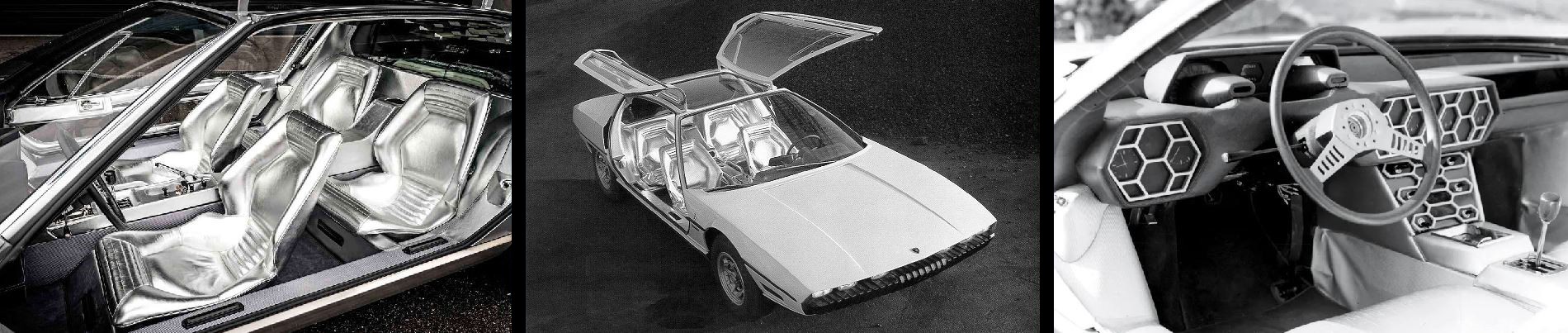
1967 Lamborghini Marzal, perhaps the purest implementation ever of the “four-bucket” look.

A one-off concept car first shown at the 1967 Genera Auto Salon, the Marzal was a marvellously impractical design by Bertone’s Marcello Gandini (1938–2024) which featured two vast gull-wing doors, providing access to what genuinely was a four-seat interior, noted for the thematic use of hexagons.  It was powered by a transversely-mounted 2.0 litre (120 cubic inch) straight-six (essentially half of the company’s V12) which was fitted behind the rear axle, making the rear-bias in weight distribution rather pronounced.  It was one of the most dramatic designs of the decade and although production was never contemplated, traces of the silhouette can be seen in the Lamborghini Espada (1968-1978) which adopted a conventional front-location for its 3.9 litre (240 cubic inch) V12 and was also a creditable four-seater although the gull-wing doors used on early design studies quickly were abandoned.  The Espada featured notably less glass than the Marzal and many have expressed doubts the air-conditioning system able to be used in the Marzal would in high temperatures have coped with the heat-soak and build-up.

Cockpit of a replica Porsche 907K (Kurzheck (short tail); note the balsa-wood gearshift knob, used not for weight-saving but as a way of reducing the heat-soak reaching the driver's hand although it saved a few grams and while that may not sound worthwhile, by 1968 competition in Group 6 was fierce and nobody was giving anything away.

The Porsche 907 competed under the Fédération Internationale de l'Automobile’s (the FIA; the International Automobile Federation) Group 6 (Prototype class) in the World Sportscar Championship and one rule was the cars have “two seats”.  Accordingly, just about every Group 6 Machine on the grid had bolted to the floor a lightweight, shell-like “bucket seat” (the Group 7 (unlimited displacement) Can-Am cars also used the trick) although, as the lack of seat belts and the location of the fire extinguisher suggest, it wasn’t a seat in which someone was intended to sit.  The approach had a long tradition, as early as the 1920s, cars used in European racing were sometimes fitted with tiny doors just conform with the rules which demanded they be in place; some were even “fake doors”, blatant cheating being another long tradition in motorsport.

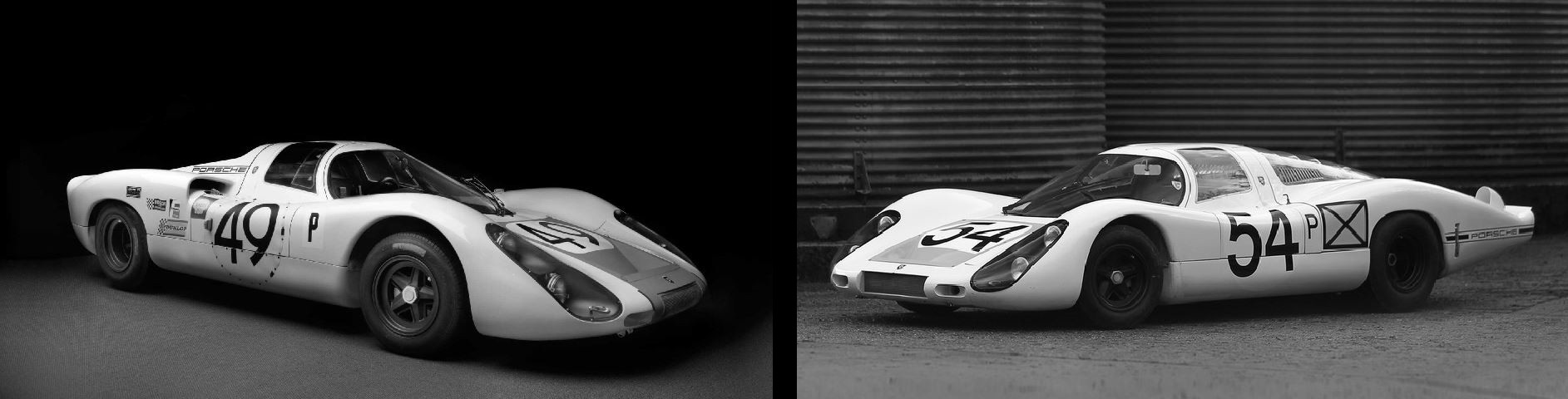
Porsche 907 K (left) and Porsche 907LH (right).

Built in 1967-1968 and victorious in 12 Hours of Sebring and the Targa Florio in 1968, the 907K was used on circuits where really high speeds couldn’t be attained, the rear bodywork designed to increase the down-force most beneficial in places with lots of corners.  The companion 907LH (Langheck (long-tail)) was allocated to the high speed tracks where the long straights put a premium on top speed, the drivers having to adjust their techniques to compensate for the increased tendency for the LH in certain circumstances to lift.  That approach (again, trade-offs in action) proved manageable, even with speed the 907s could attain (Kurzheck: 302 km/h (188 mph) & Langheck: 330 km/h (205 mph)) but the instability inherent in Langheck shape became apparent in 1969 when the much more powerful 917 was released: At the 386 km/h (240 mph) it could reach on the longest straights, the fluid dynamics of the airflow made the long tail behave more like the way an aircraft’s wing creates lift, something discovered only when the first cars reached the circuits because Porsche had no access to a test track where such a speed could be reached, computer simulations then decades away.

1967 Porsche 910 (Chassis 910001).

There were though occasions on which a harness was fitted to the fibreglass “fake seats”.  Sometimes passengers were present during high-speed testing but a Porsche 910 (Chassis 910001) was in 1969 registered in Austria for road use, thus the need for restraints.  That what was so obviously a race car could be registered for use on the streets but Austria was not then a member of the EEC (the European Economic Community, predecessor of the EU (European Union)) and thus not as riddled with bureaucracy, rules & regulations and anyway, in the era, there was more freedom in the air.  A half-decade on, by having his lawyers thread a clause through a loophole, a well-connected (and resourced) Italian aristocrat was able to use the registration granted (in never wholly explained circumstances) by the Alabama DMV (Department of Motor Vehicles) to be able to register a Porsche 917 for use on European roads and another 917 to this day remains registered in Monaco, one of those jurisdictions where some definitely are more equal than others.  In fairness to the Austrians, the 910 was a less extreme machine than the 917 and demanded fewer modifications to render it a plausible road-car; there are still street-legal 910s in the US.

Porsche 908/2 Spyder, Road Atlanta, Round 7 of the 1970 Can-Am season, September 1970.  Can-Am cars also used a "fake" bucket seat because "two seats" was one of the few rules.

Based on the Porsche 906 (1966) the 910 was produced during 1966-1967 with all 28 coupés built in 1967.  Most used 2.0 & 2.2 litre (121 & 132 cubic inch) flat-sixes but some were fitted with a 2.0 litre flat-eight and these were dubbed 910/8 rather than being separately designated.  The 910/8 proved faster but also more fragile and it was the six-cylinder 910 which in the 1967 Nürburgring 1000 km (625 mile) endurance race delivered the factory its “breakthrough” victory, securing Porsche its first trophy in a major World Sportscar Championship event since 1960; subsequently, a910 would also be victorious in the 1967 Targa Florio.  Development continued and a 3.0 litre (182 cubic inch) flat-eight 908 would even win the 1970 Road Atlanta round of the 1970 Canadian-American Challenge Cup (the Group 7 Can-Am for unlimited displacement sports cars), a remarkable event remembered for the drivers escaping with noting more than bruising, despite there being 16 accidents (four collisions and 12 spinouts).  Although the 908 was not a factory entry (it was a second-hand race car being run by an unsponsored privateer) and, against the seven and eight litre V8 monsters was not the fastest, the flat-eight proved reliable and prevailed; it was the first time in 20 Can-Am races a McLaren had not taken the chequered flag.  It was a harbinger of what was to come, the Porsche 917 dominating in 1972 and 1973.

Subaru BRAT with “outdoor bucket seats” in use.

It wasn’t only machines made for Group 6 & 7 racing which were fitted with lightweight, plastic seats to comply with the letter of the law.  The Subaru BRAT was (depending on linguistic practice) (1) a coupé utility, (2) a compact pick-up or (3) a small four wheel drive (4WD) ute (utility) and the name an acronym (Bi-drive Recreational All-terrain Transporter), the novel idea of “bi-drive” (4WD) being the notion of both axles being driven, something dictated by the need to form the acronym.  Although now in some places a cult vehicle (especially in Japan where it was never sold), the BRAT is now most remembered as a “Chicken Tax car”.  Tax regimes have a long history of influencing or dictating automotive design, the Japanese system of displacement-based taxation responsible for the entire market segment of “Kei cars” (a clipping of kei-jidōsha (軽自動車) (light automobile), the best known of which have been produced with 360, 600 & 660 cm3 (22, 37 & 40 cubic inch) engines in an astonishing range of configurations ranging from micro city cars to roadsters and 4WD dump trucks.  In Europe too, the post-war fiscal threshold resulted in a wealth of manufacturers (Mercedes-Benz, Jaguar, BMW, Ford, Maserati, Opel etc) offering several generations of 2.8 litre (171 cubic inch) sixes while the that imposed by the Italian government saw special runs of certain 2.0 litre (122 cubic inch) fours, sixes & even V8s.  The US government’s “Chicken Tax” (a part of the “Chicken War”) was different in that it was a 25% tariff imposed in 1963 by the Johnson administration on potato starch, dextrin, brandy and light trucks; it was a response to the impost of a similar tariffs by France and the FRG (Federal Republic of Germany, the old West Germany) on chicken meat imported from the US.

Two 1987 BRATs with retro-fitted seats, the one on the right also with an after-market roll-bar, something which, all things considered, seems a sensible addition.  Of the physics, those familiar Sir Isaac Newton's (1642–1727) First Law of Motion (known also as the Law of Inertia: "An object at rest will remain at rest, and an object in motion will continue in motion with the same speed and in the same direction unless acted upon by an unbalanced external force") can ponder the possibilities while wondering whether to bother buckling up the seat belt or just rely on the "grab handles" (and probably never was that term used more appropriately).  Although the seats weren't factory-fitted after 1985, the parts could still be ordered and many later models have been retro-fitted.  The adjustable headrests were a nice touch although some did note they could be classified also as "rear window protectors".

In Fuji Heavy Industries’ (then Subaru’s parent corporation) Ebisu boardroom, the challenge of what probably was described as the “Chicken Tax Incident” was met by adding to the BRAT two plastic, rear-facing jump seats, thereby qualifying the vehicle as a “passenger car” subject in the US only to a 2.5 and not a 25% import tax.  Such a “feature” probably seems strange in the regulatory environment of the 2020s but there was a time when there was more freedom in the air.  Subaru’s US operation decided the BRAT’s “outdoor bucket seats” made it an “open tourer” and slanted the advertising thus, the model enjoying much success although the additional seating wasn’t available after 1985 and the model was withdrawn from the US market after 1987.

1966 Lamborghini 350 GT in the rare 2+1 configuration with central rear bucket seat (left), the later rear storage area shared by most 350 GTs and the 23 400 GT “Interims” (centre) and 1968 Lamborghini 400 GT 2+2 (right).

Lamborghini’s 350 GT was the company’s first production car, 131 of which were made between 1964-1966 and while that might sound modest, by the standards of contemporary European exotica, it was mass-production.  Powered by a 3.5 litre (211 cubic inch) version of the company’s first V12 (which would serve the line for over 50 years), the shape was based on the slinky 350 GTV prototype which left an impression but was wholly unsuited to series production.  Either nine or ten of the early GT 350s were configured with an unusual 2+1 seating arrangement (two buckets in the front and one, centrally located, in the rear).  On the later 350 GTs, the central bucket wasn’t fitted and the whole space was configured as a storage area with an upholstered shelf so it can be thought of as Lamborghini’s take on the two-door business coupé, a US creation of the 1930s which was a conventional two-door sedan with no rear-seat, the area added to the trunk (boot), providing travelling salesmen with a large, lockable storage space for their wares.  When the 400 GT (1966-1968 and powered by a 3.9 litre (240 cubic inch) V12) was released, the first 23 were configured with the upholstered shelf (and known semi-formally as the “400 GT Interim”) while the remainder of the 247 featured 2+2 seating.

Seatbelt not required: 1964 Mercedes-Benz 230 SL with Kindetsitz.  Like the un-belted baby in the Corvair, the occupant of the kinder seat would be subject to Newton's First Law of Motion.

There were other 2+1s and for all of the 1960s Mercedes-Benz offered the not uncommonly ordered option of transverse single seat (centre) made the W113 (230, 250 & 280 SL, 1963-1971)  roadster, making it one of the rare post-war 2+1s.  While it could accommodate an adult-sized human, the factory listed it as the Kindetsitz (child's seat, code 565) although German men often preferred Schwiegermutterplatz or Schwiegermuttersitz (mother-in-law seat).  That the factory would offer (in a convertible!) a "child's seat" which sat sideways and was fitted with no restraint system is an indication of how things have changed.

Donald Healey Motor Company’s Speed Equipment Catalogue 1960-1961.

Dubious though the safety credentials of the Kindetsitza may now seem, at least Mercedes-Benz secured it to the structure with good, German high-tensile nuts and bolts and that can be C&Ced (compared & contrasted) with the approach the British once took when designing a child’s seat.  Listed in the 1960-1961 Speed Equipment Catalogue from the Donald Healey Motor Company was a child’s seat for the Austin-Healey Sprite, a diminutive roadster which was definitely a two-seater (although “rear seats” were at times offered, both third-party miniature “buckets” and a factory “bench” although the latter, supplied without a squab, is better described as a “padded parcel shelf”).  Unlike the Germans, the Healey product was held in place only by the pressure the four steel prongs exerted on the transmission tunnel on which it sat and while that meant it was quick and easy to fit and remove, were one’s Sprite suddenly to come to a halt (ie crashing into something), child and (depending on velocity at point of impact) seat would be subject to Newton’s second law of motion.  Clearly, the UK’s latter day reputation as a latter-day hotbed of H&S (health & Safety) legislation and enforcement was unknown in 1960.

Awaiting "installation" and lucky young passenger: Donald Healey Motor Company’s Child's Seat for Austin-Healey Sprite.

Pros: Looks comfortable for a child; finished in leathercloth with contrasting piping to match interior trim; can be installed or removed literally in seconds; location permits child to use feet to play with gear shifter, keeping them amused on long trips.

Cons: Unsecured installation means in the event of an accident, depending on speed of impact, it would function like an ejector seat and, were the roadster’s roof at the time not erected, trajectory of seat and child would be either (1) into or (2) over windscreen; location permits child to use feet to play with gear shifter, possibly knocking car out of gear or selecting incorrect gear.

US market 1958 Austin-Healey Sprite ("Bugeye" or "Frogeye") with Healey's "child's seat" in place. 

The “child's seat” was a Donald Healey Motor Company part number and not one which appeared in the lists of BMC (British Motor Corporation) which was the corporate umbrella under which Healey operated.  Although advertised only during the era of the Austin-Healey Sprite Mark 1 (1958-1961; the so-called “bugeye” or “frogeye”), the useful option could be fitted to any subsequent Sprite or the companion (and substantially identical) MG Midget. When the Sprite first was revised in 1961, simultaneously the MG Midget was released and it continued until 1980 while the Sprite lasted only until 1971 (and in its final season sold as the “Austin Sprite” after the contract with Donald Healey expired).  Perhaps predictably, Healy’s child’s seat was not a big seller and although (hopefully) no longer used for its intended purpose, the rarity and shock value (to twenty-first century eyes) make it a prized option in the Sprite community.

A full bucket of VPOTUS.

In the US during the nineteenth century there was a joke about two brothers: "One ran off to sea and the other became vice-president; neither were ever heard of again."  That was of course an exaggeration but it reflected the general view of the office which has very few formal duties and can only ever be as powerful or influential as a president allows although the incumbent is "a heartbeat from the presidency".  John Nance Garner III (1868–1967, vice president of the US 1933-1941), a reasonable judge of these things, once told Lyndon Johnson (LBJ, 1908–1973; US president 1963-1969) being VPOTUS was "not worth a bucket of warm piss" (which is polite company usually is sanitized as "...bucket of warm spit").  In the US, a number of VPOTUSs (Vice-President of the United States) have become POTUS (President of the United States) and some have worked out well although of late the record has not been encouraging, the presidencies of Lyndon Johnson (LBJ, 1908–1973; VPOTUS 1961-1963, POTUS 1963-1968), Richard Nixon (1913-1994; VPOTUS 1953-1961, POTUS 1969-1974), George H. W. Bush (George XLI, 1924-2018; VPOTUS 1981-1989, POTUS 1989-1993) and Joe Biden (b 1942; VPOTUS 2008-2017, POTUS 2021-2025) 1963-1968, all ending badly, in despair, disgrace, defeat and decrepitude respectively.

Microsoft Internet Explorer 1.0 (1995).

Microsoft's Internet Explorer (usually referred to as IE (IE7, IE8 etc by nerds) was in June 2022, officially retired.  It was released in 1995 as part of the Plus! package for Windows 95 which, remarkable as it now seems, shipped to an expectant and receptive market without any vision of it being a platform for internet access, Microsoft's preferred model their proprietary walled-garden the Microsoft Network (MSN).  The public’s reaction meant corporate belief in that model didn't last and MSN was soon re-positioned as just another place to go on the internet.  IE had its early controversies because of the use of code belonging to other companies and subsequently because it was given away or bundled with Microsoft's operating systems, thereby undermining the business model of competing companies which had developed browsers as shrink-wrap products to be sold for a profit.  With a few twists and turns, those issues worked their way (slowly) through US and European courts, Microsoft often using what had become the industry's preferred  solution: Throw money at the problem and it goes away.  That approach was applied too to product development and sometimes it needed to be, Windows 95, IE4 and the then mysterious “Active Desktop” ensemble resisting many attempts to secure stability.

Lindsay Lohan in bucket hat.

Still, most competition thus eliminated, IE went on to great things and early in the century enjoyed a market-share which at its peak exceeded 90%, the penetration assisted greatly by IE being the choice of many corporations which began using the browser as their default interface for internal as well as external access.  However, this very success was what ultimately doomed IE as Microsoft was compelled to retain much legacy support within the browser to accommodate the corporations which generated so much of Microsoft’s revenue.  Newer competitors were able to offer faster, more flexible browsers with modernized interfaces and gradually gained critical mass, IE by 2020 confined mostly to those corporations using legacy applications with a specific dependence.  Indeed, although noting IE’s retirement, for the affected corporations Microsoft is retaining a small subset of software support on Windows Server 2019 and the Windows 10 LTSC (Long-Term Servicing Channel), the latter in five and ten year programmes.

Pol Roger Champagne ice bucket by Argit of France in nickel plated brass, circa 1920.

Unfashionable though it became, there was one aspect of IE which for years worked better than the implementation on other browsers: The handling of download buckets.  Download buckets are the places on operating systems which permit users to tag files for downloading as a batch, rather than having to download each individually.  For whatever reason, IE’s download buckets seemed for years always more stable than the newer entrants.  Even today, Microsoft’s own update catalogue offers support for a download bucket on IE but not on other browsers although, helpfully, Microsoft’s own (Chromium-based) Edge browser can be configured with an “IE mode” which continues to support the bucket, the “Add” and “Remove” options appearing as before.

Microsoft Update Catalog on IE (and Edge in IE mode).

Microsoft Update Catalog on Chromium-based browsers (and Firefox) in native mode.