Showing posts sorted by relevance for query Aesthete. Sort by date Show all posts

Friday, December 10, 2021

Aesthete

Aesthete (pronounced es-theet or ees-theet (especially British))

(1) A person who has or professes to have refined sensitivity toward the beauties of art or nature.

(2) A person who affects great love of art, music, poetry, etc and indifference to practical matters.

1880–1885: From the Ancient Greek ασθητής (aisthēts) (one who perceives), the construct being aisthē- (variant stem of aisthánesthai (to perceive)) + -tēs (the Greek noun suffix denoting agent).  It was a Victorian back formation from aesthetics, from either the German Ästhetik or the French esthétique, both from Ancient Greek ασθητικός (aisthētikós) (of sense perception), from ασθάνομαι (aisthánomai) (I feel).  There is probably no exact synonym, the closet being connoisseur but it conveys a slightly different implication and the derived noun hyperaesthete is used sometimes as a term of derision directed at the excessively civilized.  The rarely used alternative spellings esthete & æsthete are now used only as literary devices and are otherwise obsolete.  Aesthete is a noun and aesthetic is a noun & adjective; the noun plural is aesthetes.

Aestheticism

View of Amalfi (1844), pencil, ink & water colour by noted aesthete John Ruskin (1819-1900).

Aestheticism was a nineteenth century movement in European art now best remembered for the doctrine that art exists for the sake of its beauty alone, with no need for it to serve any political, didactic or other purpose.  The modern expression most associated with the movement is l’art pour l’art (art for art’s sake).  The movement is held to have been a reaction to the prevailing utilitarian social philosophies and what was said to be the ugliness of the industrial age and the philistinism of the newly prominent mercantile class.   Its philosophical framework was built in the eighteenth century by German philosopher Immanuel Kant (1724–1804) who argued for the autonomy of aesthetic standards, set apart from considerations of morality, utility or pleasure.  The idea attracted many including Goethe (Johann Wolfgang von Goethe (1749–1832), Samuel Taylor Coleridge (1772–1834) and Thomas Carlyle (1795–1881) and it was the French philosopher Victor Cousin (1792–1867) who, in 1818, coined the phrase l’art pour l’art.  It was at the time controversial.  The establishment regarded art and literature as part of the ethical and social construct, something certainly challenged by what seemed a decadent display of sensuality and a flaunting of sexual and political experimentation.  The phrase art for art’s sake became identified with the energy and creativity of aestheticism but was adopted also by those who feared the implications of a decoupling of art and morality: that the dangerous ideas of art could infect politics and challenge the social order.

Aesthete is now rare and the more familiar related form is the noun & adjective aesthetic (1) concerned with beauty, artistic effect, or appearance; appealing to one's sense of beauty or art & (2) the study of art or beauty; that which appeals to the senses; the artistic motifs defining a collection of things.

Thursday, June 6, 2024

Aesthetic

Aesthetic (pronounced es-thet-ik or ees-thet-ik (mostly non-US))

(1) Relating to the philosophy of aesthetics; concerned with what is regarded as attractive and what is not.

(2) Relating to the science of aesthetics; concerned with the study of the mind and emotions in relation to the sense of beauty.

(3) Having a sense of the beautiful; characterized by a love of beauty (and, used loosely: “good taste”).

(4) Relating to, involving, or concerned with pure emotion and sensation as opposed to pure intellectuality.

(5) The philosophical theory or set of principles governing the idea of beauty at a given time and place.

(6) A particular individual’s set of ideas about style and taste, along with its expression:

(7) An individual’s (or a collective’s) set of principles or worldview as expressed through outward appearance, behavior, or actions.

1798: From the mid-eighteenth century German Ästhetisch or the German-derived French esthétique, from the New Latin, ultimately from the Ancient Greek aisthetikos (pertaining to sense perception, perceptible, sensitive perceptive and (of things) perceptible), the construct being aisthēt(s) (aesthete) + -ikos (-ic), from aisthanesthai (to perceive (by the senses or by the mind), to feel, from the primitive Indo-European awis-dh-yo-, from the root au- (to perceive).  The ikos suffix was from κός (kós) with an added i, from i-stems such as φυσι-κός (phusi-kós) (natural), through the same process by which ῑ́της (ī́tēs) developed from της (tēs), occurring in some original case and later used freely.  It was cognate with the Latin icus and the Proto-Germanic igaz, from which came Old English (which in Modern English ultimately was resolved as y), the Old High German ig and the Gothic eigs.  The historic alternative spelling is æsthetics, still see in the odd literary novel.  Derived forms include the adjectives nonaesthetic (which if hyphenated seems to be used as a neutral descriptive and if not, as a critique) & pseudoaesthetic (which is always in criticism).  Aesthetic is a noun & adjective, aesthete & aestheticism are nouns and aesthetically is an adverb; the noun plural is aesthetics.

The noun aesthete (person of advanced and fine artistic sensibilities) dates from the early 1880s and was from Ancient Greek ασθητής (aisthēts) (one who perceives), the construct being aisthē- (variant stem of aisthánesthai (to perceive)) + -tēs (the Greek noun suffix denoting agent).  It was a Victorian back-formation from aesthetics and there no exact synonym, the closet being “connoisseur” but it conveys a slightly different implication and the derived noun hyperaesthete is used sometimes as a term of derision directed at the “excessively civilized”.  The rarely used alternative spellings esthete & æsthete are now used only as literary devices and are otherwise obsolete.  Aesthete is a noun and aesthetic is a noun & adjective; the noun plural is aesthetes and the idea long predates the word, descriptions of such figures appearing (sometimes as slurs hinting at a lack of manliness) in texts from Antiquity and aesthetician (professor of taste) was in use by 1829, aestheticist by 1868.  The original edition (1911) of the Concise Oxford English Dictionary (COD) noted that in English university slang the opposite of an aesthete was a “hearty”, the former tribe devotes of John Ruskin (1819–1900), the latter lot lusting after a rugby blue.

Ms Andrea Ivanova who is pursuing (from head to toe) a particular aesthetic.

For specific purposes, estheticians can induce localized instances of angioedema (in pathology, a swelling that occurs just beneath the surface of the skin or mucous membranes).  Ms Andrea Ivanova (b 1998), a student from the Bulgarian capital Sofia, has had over twenty injections of hyaluronic acid in her quest to have the world’s plumpest lips but, seeking additional fullness, indicated recently she intends to pursue another course of injections.  Ms Ivanova is also a collector of Barbie dolls, the aesthetic of which she admires, and these are said to provide the inspiration for some of the other body modifications and adjustments she's undertaken.  Like the lips, other bits remain a work-in-progress, Ms Ivanova documenting things on Instagram where she enjoys some 32K followers.

The alternative spelling esthetic began life as one of those Americanisms which annoy some but it reflected simply the wholly sensible approach in US English that it’s helpful if spelling follows pronunciation.  However, in the early twentieth century the US cosmetic surgery industry (even then inventive and profitable), re-purposed the word; linguistic differentiation to create product differentiation: “esthetic surgery”, the business of performing surgery for aesthetic purposes rather than reasons strictly medical or reconstructive and the most significant figure in this was the German-Jewish cosmetic physician Jacques Joseph (1865–1934), now remembered as the “father of modern cosmetic surgery”.  Under the auspices of first the American Society of Plastic Surgeons (ASPS, 1931) and the American Society for Aesthetic Plastic Surgery (ASAPS, 1967), the business of esthetic surgery has since boomed and related (even if remotely) professions such as nail technicians, the lip-plumpers and the body-piercers also append “esthetic” to their advertising; the first “estheticians” were the skin care specialists (exfoliation, massage, aromatherapy, facials and such) but the title soon proliferated.  

A classic reference which can be read for pleasure (by word nerds).

JA Cuddon (1928-1996) was a writer of extraordinary range and one of the great characters of twentieth century literary life in England and while some of his works sold more, none have been of more enduring than his typically comprehensive and amusing Dictionary of Literary Terms & Literary Theory, first published in 1977 by Penguin and the entry on aestheticism is typical of his style, beginning with the observation the term was “'pregnant' with many connotations” before exploring the history.  In English, “aesthetic” first came into wider use after appearing in translations of the work of the German philosopher of the Enlightenment Immanuel Kant (1724–1804) although the original use was in the classically correct sense “science which treats of the conditions of sensuous perception” and Kant’s use had been an attempt at reclamation on behalf of academic philosophy in reaction to his fellow German philosopher Alexander Baumgarten (1714–1762) heretically using it in his Aesthetica (1750) to mean “criticism of taste”, something which so appealed to English speakers it became (despite the doughty scholarly rearguard) after the 1830s (in the wake of the Romantic poets) the dominant meaning, freeing the word from the jealous grasp of the philosophers.  This was cemented by the literary critic Walter Pater (1839–1894 and one of the century’s most exquisite stylists of language) who in 1868 applied it to the l'art pour l'art (art for art's sake) movement, a place which proved its natural home.  The English academic polymath William Whewell (1794–1866) had suggested callesthetics for “the science of the perception of the beautiful” but that never caught on.  The shift is illustrated by the track of the adjective which was in 1798 was recorded to mean “of or pertaining to sensual perception” while by 1821 there was the parallel “of or pertaining to appreciation of the beautiful.

Cuddon defined an aesthete as “one who pursues and is devoted to the 'beautiful' in art, music and literature” while aestheticisrn was the “term given to a movement, a cult, a mode of sensibility (a way of looking at and feeling about things) in the nineteenth century [which] fundamentally… entailed the point of view that art is self-sufficient and need fulfil no other purpose than its own ends. In other words, art is an end in itself and need not be (or should not be) didactic, politically committed, propagandist, moral - or anything else but itself; and it should not be judged by any non-aesthetic criteria such as whether or not it is useful). Cuddon reminded his readers that Kant as well as Goethe (Johann Wolfgang von Goethe, 1749–1832), Friedrich Schelling (1775–1854) & Friedrich von Schiller (1759–1805) were all in the vanguard of the l'art pour l'art movement or cult”, arguing “art must be autonomous”, the political implication being “the artist should not be beholden to anyone.  From this, in turn, it followed that the artist was someone special, apart, from others and from this came the post-Romantic idea of the artist as superior to ordinary mortals”, a view which infected many who concluded they deserved to be judged on the basis of being artists, rather than by virtue of the art they produced.  In the dark mist of late Romanticism, this had a certain appeal but it cumulated in post-modernism and while it’s true that even in the nineteenth century high art there really wasn’t one agreed construct of the aesthetic, by the late twentieth century there were so many that Cuddon was probably right in suggesting it was the long-term result of Romantic subjectivism and self-culture; of the cult of the individual ego and sensibility.

Cuddon detected “a widespread disenchantment in the literature of the aesthetes, and especially in their poetry” which he contrasted with the popular novelists of the era such as early realists like Charles Dickens (1812–1870) or Émile Zola (1840–1902).  The poets showed a “tendency to withdrawal or aversion”, aspiring to “sensuousness and to what has become known as ‘pure poetry'” and while that was criticized by figures as diverse as Benjamin Disraeli (1804-1881, UK prime-minister 1868 & 1874-1880) and Karl Marx (1818-1883), at “its best, aestheticism was a revitalizing influence in an age of ugliness, brutality dreadful inequality & oppression, complacency, hypocrisy and Philistinism.  It was a genuine search for beauty and a realization that the beautiful has an independent value.  At its worst it deteriorated into posturing affectation and mannerism, to vapid idealism and indeed to a kind of silliness which is not wholly dead.  Cuddon was writing in the mid-1970s and it’s doubtful anything he saw in the last decades of his life much changed his mind.

Deconstructing the Lindsay Lohan aesthetic

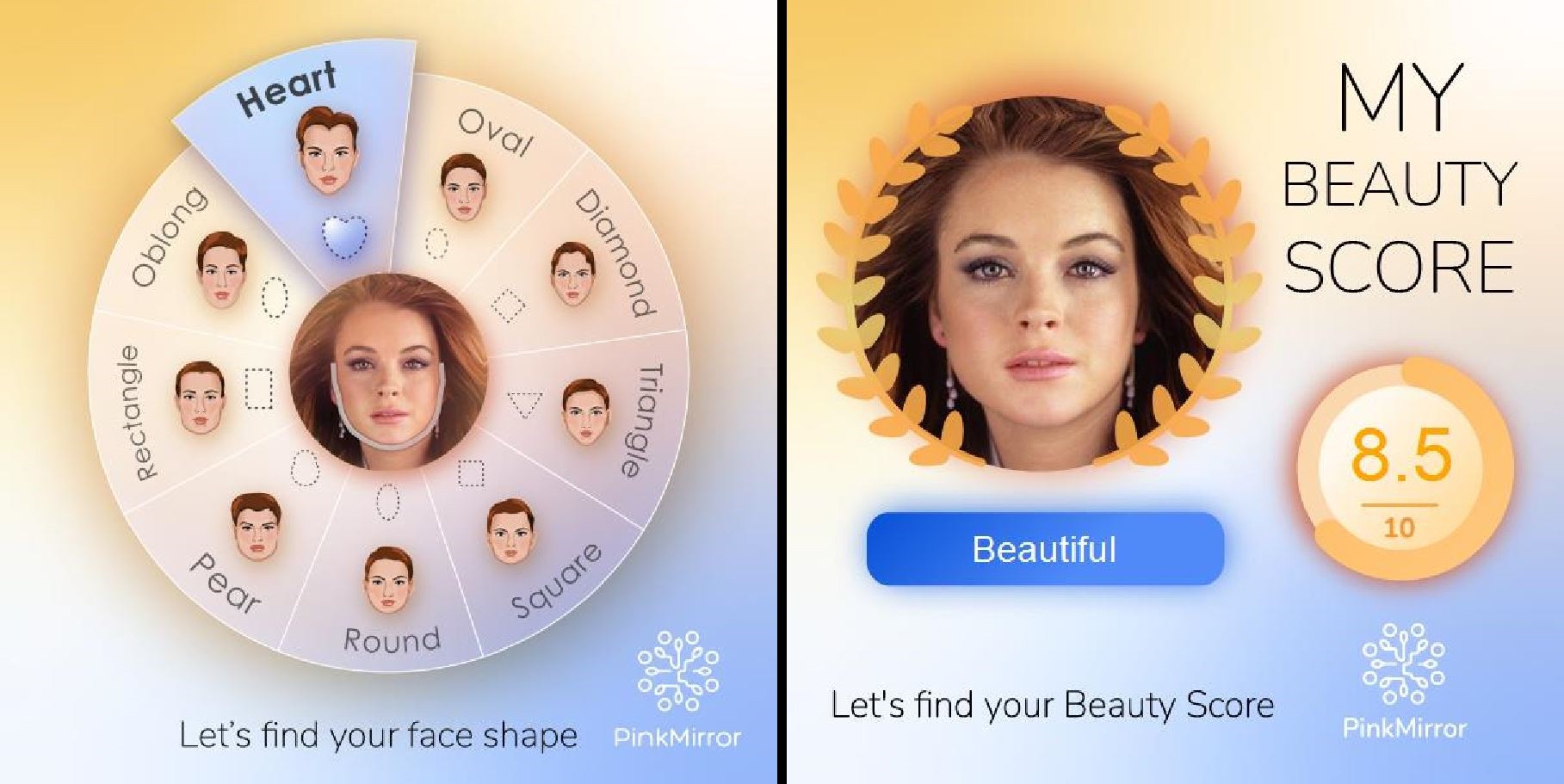
PinkMirror is a web app which helps users optimize their facial aesthetics, using an artificial intelligence (AI) engine to deconstruct the individual components an observer’s brain interprets as a whole.  Because a face is for these purposes a collection of dimensions & curves with certain critical angles determined by describing an arc between two points, it means things can be reduced to metrics, and the interaction of these numbers can used to create a measure of attractiveness.  Pinkmirror cites academic research which confirms a positive canthal tilt is a “power cue” for female facial attractiveness and while it’s speculative, a possible explanation for this offered by the researchers was linked to (1) palpebral (of, pertaining to, or located on or near the eyelids.) fissure inclination being steeper in children than adults (classifying it thus a neonatal feature) and (2) it developing into something steeper still in females than males after puberty (thus becoming a sexually dimorphic feature).  Pinkmirror notes also that natural selection seems to be operating to support the idea, data from Johns Hopkins Hospital finding that in women, the intercanthal axis averages +4.1 mm (.16 of an inch) or +4o, the supposition being that women with the advantage of a positive medial canthus tilt are found more attractive so attract more mates, leading to a higher degree of procreation, this fecundity meaning the genetic trait producing the characteristic feature is more frequently seen in the population.  Cosmetic surgeons add another layer to the understanding, explaining the canthal tilt is one of the marker’s of aging, a positive tilt exuding youth, health, and exuberance where as a line tending beyond the negative is associated with aging, this actually literally product of natural processes, the soft tissue gradually descending under the effect of gravity, as aspect of Vogue magazine’s definition of the aging process: “Everything gets bigger, hairier & lower”.

The Pinkmirror app exists to quantify one’s degree of attractiveness.  It’s wholly based on specific dimension and thus as piece of math, is not influenced by skin tone although presumably, its parameters are defined by the (white) western model of what constitutes attractiveness.  Users should therefore work within those limitations but the model would be adaptable, presumably not to the point of being truly cross-cultural but specifics forks could certainly be created to suit any dimensional differences between ethnicities.  Using an industry standard known as the Photographic Canthal Index (PCI), one’s place on Pinkmirror’s index of attractiveness is determined by the interplay of (1) Nose width, (2) Bi-temporal to bi-zygomatic ratio, (3) chin length, (4) chin angle, (5) lower-lip height & (6) eye height.

Lindsay Lohan scored an 8.5 (out of 10), was rated as “beautiful” and found to be “very feminine, with great features of sexual dimorphism”, scoring highly in all facets except lower lip height and eye height.  Her face shape is the heart, distinguished by a broad forehead and cheekbones, narrowing in the lines of down to the jaw-line, culminating in a cute pointy chin.  Pinkmirror say the most attractive face shape for women has been found to be the triangle, scoring about the same as the oval while the heart, round, diamond, rectangle and square are also attractive to a lesser degree.  Within the app, pears and oblongs are described as “not typically seen as attractive” and while the word “ugly” isn’t used, for the unfortunate pears and oblongs, that would seem the implication.

Other aesthethetics

A functional magnetic resonance imaging (fMRI) machine.

The mysterious “experimental aesthetics” is a discipline in psychology taking “a subject-based, inductive approach to aesthetics”; it was founded by German physicist and experimental psychologist Gustav Fechner (1801–1887) who had a background in psychophysics before changing direction so experimental aesthetics is the second oldest research area in psychology.  It is a field of study which investigates how individuals perceive and evaluate aesthetic experiences using empirical methods, merging principles and techniques from psychology, neuroscience and the arts to understand the underlying mechanisms of aesthetic appreciation and creativity.  Essentially, it was the examination of the way people perceive beauty, art and design, and how they form aesthetic judgments, the resulting metrics gleaned from measuring sensory processes, cognitive mechanisms and emotional responses.  Given these things are inherently hard to quantify in a way which is both statistically sound and has some meaning, what Fechner was attempting was really quite adventurous and those who have continued his work have produced something sprawlingly interdisciplinary, involving collaborations between psychologists, neuroscientists, artists, designers, and philosophers, all with their own traditions of measurement. From this interplay emerged the sub-field of neuroaesthetics which focuses on the neural basis of aesthetic experiences, something made possible by the development of various brain imaging techniques like Functional magnetic resonance imaging (fMRI) and the electroencephalogram (EEG).  Being academics who publish, experimental aesthetics has also yielded theoretical models, the most pleasing of which is the “processing fluency theory of aesthetic pleasure” which explores what contributes to the ease with which information is processed in the human mind, a significant factor in the way people experience beauty.

In the same vein as ethnomusicology (the study of non-Western musical forms), ethnoaesthetics is the study or description of “the aesthetics specific to or adopted by a particular culture”.  Perhaps surprisingly, both continue to be used although some might consider them at least microaggressions which can be read as implying a cultural hierarchy and even if not, it certainly suggests “separate but equal”, a concept with its own troubled history.  Phonoaesthetics is the study of the aesthetic properties of sounds, particularly in the context of language. The phono- prefix (relating to sound) was from the Ancient Greek φωνή (phōn) (voice, sound).  The word φωνή primarily referred to articulated human or animal sounds in contrast to ἠχή (from which is derived “echo”) which referred to sounds in general.  Phonoaesthetics involves the analysis of how certain sounds, words, or phonetic patterns are perceived as pleasing or displeasing to the ear, the field combining elements of linguistics, psychology, and aesthetics to explore the sensory and emotional responses elicited by different sounds.  If ever you’ve wondered why a word like “succulent” is so “delicious” to say, phonoaesthetics has the answer.  The inherent beauty or appeal of sounds exists both in isolation and within linguistic structures, most obviously in the phonemes, syllables & prosody but there are also associative factors; a word with a positive association can impart pleasure and that experience can exist across a culture or be specific to one individual.  Somaesthetics is an interdisciplinary field that studies the body (soma, from the New Latin, from the Ancient Greek σμα (sôma) (body) as both a site of sensory appreciation (aesthesis) and creative self-fashioning.  Not taken seriously by all critics, it’s seems essentially the “New Age” with an academic gloss.

Tuesday, September 28, 2021

Siren

Siren (pronounced sahy-ruhn)

(1) In classical mythology, one of several sea nymphs, sometimes depicted as part-woman, part-bird (and sometimes as as sisters), who with their seductive singing (their “siren song” or “siren call”) lured mariners to destruction on the rocky shore.

(2) A woman who sings sweetly and charms.

(3) In slang, a seductively beautiful or charming woman, especially one who beguiles men; a seductress, temptress or vamp; a dangerous women who preys on the weaknesses of men.

(4) An acoustical instrument for producing musical tones, consisting essentially of a disk pierced with holes arranged equidistantly in a circle, rotated over a jet or stream of compressed air, steam, or the like, so that the stream is alternately interrupted and allowed to pass.

(5) An variation of this implement which makes a piercingly loud sound and used as a whistle, fog signal, or warning device; the sound made by such a device.

(6) In zoology, (1) any of several aquatic, eel-like salamanders of the family Sirenidae, having permanent external gills, small forelimbs, and no posterior limbs, (2) a member of Sirenia, an order of mammals or (3) any of various nymphalid butterflies of the genus Hestina.

(7) Anything seductive or tempting, especially dangerously or harmfully.

(8) In music, a musical instrument (one of the few aerophones in the percussion section of the symphony orchestra).

(9) An instrument for demonstrating the laws of beats and combination tones.

(10) In astronomy & astrophysics, an astrophysical event which can be used for calculating cosmic distances. 

1300-1350: From the Middle English sirensereyn from the Old French sereine, (the Modern French sereine dating from the twelfth century), from the Late Latin sīrēna and the Classical, Latin Sīrēn & Sīrēna, from the Ancient Greek Σειρήν (Seirḗn).  The Seirēnes were the alluring sea nymphs of classical mythology and the figurative sense of "one who sings sweetly and charms" was first noted in the 1580s although the classical descriptions of them were mangled in medieval translations, resulting in some odd and fantastical notions of their appearance and they were often conflated with mermaids.  The Vulgate (the Biblia Vulgata, the fourth century translation of the Bible which, through the choices of words and senses made by the translator had a profound effect on Christianity and Christendom) also gifted to Middle English the use of the word to describe an imaginary species of flying serpents, based on glossary explanations of the Latin sirenes in Isaiah 13:22.    In the Greek the word was used also to mean "a deceitful woman" although etymologists note that may have been literally "binder, entangler", from seira (cord, rope).  In zoology, the mammalian sense appeared first in was first attested in French in Les entretiens d'Ariste et d'Eugène (Conversations between Ariste & Eugène) by the French Jesuit priest Dominique Bouhours (1628–1702) while the use to describe the aquatic salamander was introduced in 1766 by Swedish zoologist & physician Carl Linnaeus (1707–1778 and styled as Carl von Linné after 1761) for a genus of reptiles.  In organic chemistry, the scientists noted the attraction exerted by the sirens and coined “sirenin” to describe a sexual attraction pheromone in some fungi of the genus Allomyces.  Less charmingly, in early twentieth century Australian urban slang, a “stem siren” was a prostitute; in the Australian way, often it was clipped to “stem”.

The use to describe the mechanical device which "makes a warning sound" was first recorded in 1879 when they were installed on steamboats and this may have been imitative of the similar French word.  In the course of the twentieth century, the things were adapted as audible warning devices for many purposes including air raids, emergency service vehicles and fire alarms.  In schools, workplaces and other geographically large sites, they were used to mark the start and finish of shifts, meal breaks etc.  As late as the 1940s, the spelling variation sireen also existed but it (like the Elizabethan adjectives sirenean, sirenian, sirenic, sirenical & sireny) is extinct although the writer & critic John Ruskin (1819–1900 and known for his fondness for nymphs), used sirenic so with that imprimatur, some modern aesthete might be tempted to revive the form.  Siren is a noun & verb, sirenize is a verb, sirenlike, sirenless, sirenical & sirenic are adjectives; the noun plural is sirens or sirenes.   

Odysseus and the Sirens

In Greek mythology, the sirens were deadly creatures who used their lyrical and earthly charms to lure sailors to their death.  Attracted by their enchanting music and voices, the seduced seafarers would sail their ships too close to the rocky coast of the nymphs' island and there be shipwrecked.  Not untypically for the myths of antiquity, the sirens are said to have had many homes.  The Romans said they lived on some small islands called Sirenum scopuli while later authors place them variously on the islands of Anthemoessa, on Cape Pelorum, on the islands of the Sirenuse, near Paestum, or in Capreae.  All were places with rocky coasts and tall cliffs.

Sirens and the Night (1865), oil on canvas by William Edward Frost (1810-1877).

It was Odysseus who most famously escaped the sirens.  Longing to hear their songs but having no wish to be shipwrecked, he had his sailors fill their ears with beeswax, rendering them deaf.  Odysseus had them tie him to the mast.  Sailing the rocks, when he heard the lovely voices, he ordered his men to release him but they tightened the knots, not releasing him till the danger had passed.  Some writers claimed the sirens were fated to die if a man heard their singing and escaped them and that as Odysseus sailed away they flung themselves into the water and drowned but among the myths that was a rare fate.  The idea of the sirens persists in idiomatic use: the term “siren sound” refers to words or something which exerts a particular compelling attraction but “siren song” or “siren call” can be used of something not directly audible such as the thoughts evoked by a painting or even a concept; populism, fascism & communism have all been described thus.  That idiomatic use describes an enticing but dangerous appeal, especially a misleading one.

Lindsay Lohan (2011) by Richard Phillips (b 1962), hosted by Vimeo by courtesy of Richard Phillips and Gagosian Gallery.  Lindsay Lohan as a siren; it would seem almost a calling.

Screened in conjunction with the 54th international exhibition of the Venice Biennale (June 2011), Lindsay Lohan was a short film the director said represented a “new kind of portraiture.”  Filmed in Malibu, California, the piece was included in the Commercial Break series, presented by Venice’s Garage Center for Contemporary Culture and although the promotional notes indicated it would include footage of the ankle monitor she helped make famous, the device doesn't appear in the final cut.

Directed by: Richard Phillips & Taylor Steele
Director of Photography: Todd Heater
Costume Designer: Ellen Mirojnick
Creative Director: Dominic Sidhu
Art Director: Kyra Griffin
Editor: Haines Hall
Color mastering: Pascal Dangin for Boxmotion
Music: Tamaryn & Rex John Shelverton

The Chrysler Air Raid Siren and the Firepower V8  

According to Guinness World Records, the loudest sirens ever were the 350-odd built by Chrysler for the US government in the early 1950s and installed around the country to warn of an impending nuclear attack by the Soviet Union.  The maximum volume the devices generated was recorded (at a distance of 100 feet (30.5 m)) as 138 decibels (dB), a level which meant a human would be deafened if within 200 feet (61 m) during their operation.  Guinness noted the compressor discharge throughput at peak volume was 74 m³ (2,610 cubic feet at 7 lb per square inch) of air per second and the physics of fluid dynamics (air a fluid in this context) was such that this would have caused a sheet of paper in the path spontaneously to ignite.  By comparison the now retired SST (supersonic transport) airline Concorde at take-off produced noise levels between 112-114 dB at a distance of 100 feet and even the afterburner equipped military jets (F-16, F-35 etc) haven’t been recorded as generating levels as high as 138 dB.

Although there were ebbs in the tensions, the “High Cold War” is regarded as the time between the early 1950s and late 1960s, the public perception of which was dominated by the fear of nuclear war. The US government made many preparations for such an event, notably building vast underground facilities where essential personnel (members of the administration, the Congress, their families and servants) could live until it was safe to emerge into the post-apocalypse world).  The tax-payers who paid for these facilities were of course rather less protected but the government in 1952 did install warning sirens in cities; people might still be vaporized by comrade Stalin's (1878-1953; Soviet leader 1924-1953) H-Bombs but they would know what was coming so there was that.

The early version was co-developed by Chrysler and Bell Labs and named the CBVS (Chrysler Bell Victory Siren) which sounded optimistic but although the acoustic properties met the specification, the drawback was the devices were manually controlled and required someone physically to be on-location to start the thing and, being directional, rotate it so the sound would be broadcast 360o.  The obvious flaw was that were there to be a nuclear attack in the area, the job-description potentially was was self-sacrificial, something comrade Stalin would doubtless have thought just the part of the cost of war with the unfortunate patriotic soul posthumously to be awarded the coveted Герой Советского Союза (Hero of the Soviet Union) decoration.  However, neither the White House or the Pentagon liked the optics of that and revised specifications were issued.

Photograph by Rob Storms of Chrysler Air Raid Siren atop Rochester Fire Department Maintenance Building, Rochester, Monroe County, New York.

Chrysler responded with a more elaborate device which was automated and remotely administrated, the CARS (Chrysler Air Raid Siren) introduced in 1952.  It was powered by the corporation’s new 331 cubic inch (5.4 litre) Hemi-head V8, rated at what was then a stellar 180 HP (134 kW), a three-stage compressor added to increase output.  Instead of demanding a potentially doomed operator, there was a control panel connected (with nothing more than the two-pair copper cables which became familiar as Cat3) to dedicated phone lines so it could be activated either by local civil defense authorities or the military.  The big V8 provided sufficient power to both increase the dB and the geographical coverage, the siren able to be heard over an area of some 15.8 square miles (41 km2), an impressive number given the electric sirens used today for tornado and tsunami warnings have an effective footprint of only some 3.9 square miles (10 km2).  The siren suit was unrelated to the seductive nymphs of Antiquity and owered its name to the mechanical device.  Pragmatically adopted by the British during World War II (1939-1945), it was a garment something like a mechanic's overalls though designed for warmth as well as coverage.  It gained its name for the notion of the sound of air-raid sirens being the trigger to put one one's siren suit over one's pyjamas and head for the air-raid shelter. 

Chrysler Air Raid Siren being delivered, 1953.

In 1952, there was no engine better suited to the task than Chrysler’s new “FirePower” V8.  Applying their wartime experience building a number of high-output, multi-cylinder engines (the most remarkable a V16 aero-engine rendered obsolete by jet technology before it could be used), the FirePower featured hemispherical combustion chambers and was the corporation’s first use in passenger vehicle engines of OHV (overhead-valves).  Both designs had been around for decades but in time, Chrysler would make a (trade-marked) fetish of “Hemi”, continuing cheerfully to use the name for a range of V8s introduced in 2003 even though they were no longer a truehemi-head, the design unable to be adapted to meet modern exhaust emission laws.  The so-called “third generation” Hemi remains available still although how long it will last will be a matter of the interplay of politics and demand.  Doubtless, it’s on Greta Thunberg’s (b 2003) hit-list and that she and the engine debuted in the same year will impress her not at all.

Chrysler FirePower 392 cubic inch V8 in 1957 Chrysler 300C Convertible.

The FirePower was first sold in 1950 in 331 cubic inch (5.4 litre) form, growing over the decade first to 354 (5.8) and then 392 (6.4) before being retired in 1959, the wedge-headed alternative with increased displacement a cheaper path to power.  Chrysler and Imperial shared the engines but remarkably, in an approach which today must shock accountants and efficiency experts, the companion divisions (De Soto & Dodge) produced nine different hemi-head V8s with capacities between 241 (4.0) and 345 (5.6) with relatively little commonality of components between them all.  The last of the FirePowers were noted also for being one of the first offered with electronic fuel injection which offered real advantages over the mechanical systems then available in a handful of models in Europe and the US but the technology was then too fragile to be reliable and most of the 16 sold (reputedly all but one) were recalled and retro-fitted with a pair of faithful four barrel carburetors.  In 1964, the hemi-head was revived for a racing engine and, to satisfy the regulatory body which had been unimpressed with the use of such a thing in a series for “stock” cars, it was made available to the public between 1966-1971, this time actually called “Hemi”.  In 426 cubic inch (7.0 litre) form, it was this iteration which built the reputation which Chrysler still exploits.

Some 350 CARS were built, all by the Marine & Industrial Engine division based in Trenton, Michigan, some still in service as late as the 1970s.  During the era of détente, the last were retired, some sold to museums or collectors while some were just abandoned because, mounted atop tall buildings to maximize their acoustic coverage, the cost of removal far exceeding their value as units to be re-purposed or scraped.  Three fully functioning Chrysler Air Raid Sirens still exist, one in a remote part of Texas where it’s safe to stage the occasional demonstration of the sound.  During these displays, the clear zone (minimum safe distance) extends 320 feet (97.5 m) but even at this range, anyone standing directly in front of the projection horns would find the experience uncomfortable, prolonged exposure likely to damage one’s hearing.  Although directional, there’s much “sound soak” otherwise in the proximity in the device just operating the siren from the side control panel requires a minimum hearing protection of 30 dB.

Chrysler Air Raid Siren at the Don Garlits Museum of Drag Racing, re-awakened after decades, 1997.

One collector attracted to them was Don Garlits (b 1932) who in the post-war years was among the most innovative and successful drivers and builders in the sport of drag-racing which became wildly popular and it was with Chrysler Hemis he built his reputation.  In 1997, a documentary crew from the UK visited Garlits and saw one of the old sirens sitting neglected in the storeroom where it’d sat for decades after having spent some twenty years in the salt-laden air atop a Florida high-rise.  Remarkably, after doing little more than connecting a battery and checking the oil and coolant, once a carburetor had been bolted on with a can of gas (petrol) rigged up, it started almost immediately.  What was most surprising was that it had never before run on gasoline because the sirens had always used propane.  As Garlits over the decades discovered a ¼ mile at a time, the FirePower was a tough old thing.

Wednesday, March 25, 2026

Exquisite

Exquisite (pronounced ek-skwi-zit or ik-skwiz-it)

(1) Of special beauty or charm, or rare and appealing excellence and often associated with objects or great delicacy; of rare excellence of production or execution, as works of art or workmanship; beautiful, delicate, discriminating, perfect.

(2) Extraordinarily fine or admirable; consummate.

(3) Intense; acute, or keen, as pleasure or pain; keenly or delicately sensitive or responsive; exceeding; extreme; in a bad or a good sense (eg as exquisite pleasure or exquisite pain).

(4) Recherché; far-fetched; abstruse (a now rare early meaning which to some extent survives in surrealist’s exercise “exquisite corpse”).

(5) Of particular refinement or elegance, as taste, manners, etc or persons.

(6) A man excessively concerned about clothes, grooming etc; a dandy or coxcomb.

(7) Ingeniously devised or thought out (obsolete).

(8) Carefully adjusted; precise; accurate; exact (now less common except as an adverb.

(9) Of delicate perception or close and accurate discrimination; not easy to satisfy; exact; fastidious (related to the sense of “exquisite judgment, taste, or discernment”.

1400–1450: From the Late Middle English exquisite (carefully selected), from the Latin exquīsītus (excellent; meticulous, chosen with care (and literally “carefully sought out”)), perfect passive participle of exquīrō (to seek out), originally the past participle of exquīrere (to ask about, examine) the construct being ex- + -quīrere, a combining form of quaerere (to seek). The construct of exquīrō was ex- + quaerō (seek).  The ex- prefix was applied to words in Middle English borrowed from the Middle French and was derived from the Latin ex- (out of, from) and was from the primitive Indo-European eǵ- & eǵs-.  It was cognate with the Ancient Greek ξ (ex-, out of, from) from the Transalpine Gaulish ex- (out), the Old Irish ess- (out), the Old Church Slavonic изъ (izŭ) (out), the Russian из (iz) (from, out of).  Exquisite is a noun & adjective, exquisiteness & exquisitiveness are nouns and exquisitively & exquisitely are adverbs; the noun plural is exquisites.

1972 Lancia Fulvia 1600 HF Series II.  

Everything about the Lancia Fulvia (1965-1976) appeared exquisitely delicate but the little machine was tough and was for half-a-decade a dominant force in international rallying.  A Lancia legend is that when the hood was opened on one of the first to reach the US, a mechanic, brought up on a diet of hefty V8s, upon seeing the tiny, 1.2 litre (75 cubic inch) narrow-angle V4 is said to have remarked: “Don’t ask me, take it to a jeweler.

The etymology of the Latin quaerō (seek) is mysterious.  It may be from the Proto-Italic kwaizeō, from the primitive Indo-European kweh (to acquire) so cognates may include the Ancient Greek πέπαμαι (pépamai) (to get, acquire), the Old Prussian quoi (I/you want) & quāits (desire), the Lithuanian kviẽsti (to invite) and possibly the Albanian kam (I have).  Some have suggested the source being the primitive Indo-European kwoys & kweys (to see) but there has been little support for this.  The authoritative Lexikon der indogermanischen Verben (Lexicon of the Indo-European Verbs (LIV)), the standard etymological dictionary of the Proto-Indo-European languages, suggests it’s a derivation of hzeys (to seek, ask), via the form koaiseo.  "Exquisite corpse" is a calque of the French cadavre exquis (literally “exquisite cadaver”).  Dating from 1925, it was coined by French surrealists to describe a method of loosely structured constructivism on the model of the parlour game consequences; fragments of text (or images) are created by different people according to pre-set rules, then joined together to create a complete text.  The name comes from the first instance in 1925: Le cadavre exquis boira le vin nouveau (The exquisite corpse will drink new wine).  Exquisite corpse is noted as a precursor to both post-modernism and deconstructionist techniques.

Although not infrequently it appears in the same sentence as the word “unique”, exquisite can be more nuanced, the comparative “more exquisite, the superlative most exquisite” and there has certainly been a change in the pattern of use.  In English, it originally was applied to any thing (good or bad, art or torture, diseases or good health), brought to a highly wrought condition, tending among the more puritanical to disapprobation.  The common modern meaning (of consummate and delightful excellence) dates from the late 1570s while the noun (a dandy, a foppish man) seems first to have been used in 1819.  One interesting variant which didn’t survive was exquisitous (not natural, but procured by art), appearing in dictionaries in the early eighteenth centuries but not since.  The pronunciation of exquisite has undergone a rapid change from ek-skwi-zit to ik-skwiz-it, the stress shifting to the second syllable.  The newer pronunciation attracted the inevitable criticism but is now the most common form on both sides of the Atlantic and use seems not differentiated by class. 

The exquisite wimp: Baldur Benedikt von Schirach

Exquisite is used almost exclusively as an adjective, applied typically to objects or performances but it’s also a noun, albeit one always rare.  As a noun it was used to describe men who inhabited that grey area of being well dressed, well coiffured, well mannered and somewhat effeminate without being obviously homosexual; it was a way of hinting at something without descending to the explicit.  PG Wodehouse (1881-1975) applied it thus in Sam the Sudden (1925) and historians Ann (1938-2021) & John Tusa (b 1936) in The Nuremberg Trial (1983) found no better noun to apply to former Hitler Youth Leader Baldur von Schirach, noting (as did his many enemies in the party) his feminine tastes in furnishings and propensity to pen poor poetry.  The companion word to describe a similar chap without of necessity the same hint of effeminacy is “aesthete”.  In The Anatomy of the Nuremberg Trials: A Personal Memoir (1992), Brigadier General Telford Taylor (1908–1998; lead US counsel at the Nuremberg Trial) wrote of him that: “at thirty-nine, was the youngest and, except perhaps for Joachim von Ribbentrop (1893–1946; Nazi foreign minister 1938-1945) and Hans Fritzsche (1900–1953; Nazi propagandist), the weakest of the defendants.  If wimps had then been spoken of, Schirach would have been so styled.

Nazi poetry circle on the terrace at the Berghof on the Obersalzberg.

Left to right: Adolf Hitler (1889-1945; Führer (leader) and German head of government 1933-1945 & head of state 1934-1945), Martin Bormann (1900–1945), Hermann Göring (1893–1946; leading Nazi 1922-1945, Hitler's designated successor & Reichsmarschall 1940-1945), and Baldur von Schirach (1907-1974; head of the Hitlerjugend (Hitler Youth) 1931-1940 & Gauleiter (district party leader) and Reichsstatthalter (Governor) of Vienna (1940-1945)), Berchtesgaden, Bavaria, Germany, 1936.  Of much, the other three were guilty as sin and would (at the last possible moment) commit suicide but von Schirach would survive to die in his bed at 67.  There seems no record to confirm if that bed was in a “a snow white bedroom with delicate lace curtains” as the rougher types in the Nazi Party had once derided him for having.

Airey Neave (1916–1979) was the British military lawyer who served the indictments on the defendants at Nuremberg and in On Trial at Nuremberg (1978) he recalled the experience, cell by cell.  His first impression of von Schirach was that his appearance was “…bi-sexual and soft with thé dansant eyes [thé dansant was a dance held while afternoon tea was served and in idiomatic use “thé dansant eyes” suggested the coquettish fluttering of the lashes a flirtatious young lady might deploy]”, adding “He looked a man who might be dangerous to small boys.  At a second glance, I imagined him beneath the palms at Cannes in co-respondent shoes.”  In this context, Neave used “co-respondent” in the sense of the man cited in divorce proceedings as the one who slept with the adulterous wife and a “co-respondent shoes (or car, suit, tie etc)” were distinguished by flashiness rather than quality.

Von Schirach went on trial before the IMT (International Military Tribunal) in the first Nuremberg trial (1945-1946), an event the author Rebecca West (1892–1983) attended in her capacity as a journalist and among her impressions she wrote of him, admitting she was at first “startled” because “…he was like a woman in a way not common among men who look like women.  It was as if a neat and mousy governess sat there, not pretty but with never a hair out of place, and always to be trusted never to intrude when there were visitors: as it might be Jane Eyre.”  Although indicted also under Count 1 (conspiracy to commit crimes against peace), for his role as head (1931-1940) of the Hitlerjugend (Hitler Youth), von Schirach was convicted only under Count 4 (crimes against humanity) for his part in deporting Viennese Jews to the death camps while Gauleiter and Reichsstatthalter of Vienna.  Cunningly, and not without ostentation, he admitted some guilt for his role in “corrupting German youth” although by that he meant the political indoctrination to which he subjected them, rather than conduct many in the Nazi party liked to hint he enjoyed with the boys under his command; however defined, it’s certain he corrupted more youth than Socrates (circa 470–399 BC).  Applying common law principles, the IMT found his actions as head of the Hitlerjugend didn’t reach the threshold of “conspiracy” and thus acquitted him on Count 1, his 20 year sentence handed down for his conduct in Vienna.  The preparation for the trial had been rushed and had subsequently discovered evidence against him been presented at the trial, doubtlessly and deservedly he’d have been hanged.  Had that sentence been imposed, whether like Göring he’d have followed Socrates and taken hemlock will never be known.

Exquisite: A style guide

Lindsay Lohan in a Gucci Porcelain Garden Print Silk Gown with an all-over Dutch toile in blue and white, high ruffled collar and bib, flared sleeves, pussy bow and a blue and red patent leather belt around a high waist, Savoy Hotel, London, June 2017.

The gown was said to have a recommended retail price (RRP) of Stg£4,040 (US$7300).  The occasion was the launch of the charitable organization One Family, dedicated to combating child trafficking.  While there was a fussiness about the detailing, the quality of the construction was obvious and successfully to use, at this scale, a pattern of this intricacy is not easy and demands a skilled eye.  On the move, it swished around nicely and although the whims of critics can be hard to predict, on the night, most seemed to like this and it was a perhaps welcome relief from the expanses of skin of the "naked dress" movement, then beginning to dominate red carpets.

Designers find inspiration where it's found: Four dinner plates from Wedgewood's Enoch "Countryside Blue" collection, circa 1967.

Within the one critique, the word exquisite can appear, used as a neutral descriptor (an expression of extent), a paean to beauty and even an ironic dismissal.  A gown for example can be “exquisitely detailed” but that doesn’t of necessity imply elegance although that would be the case of something said to be an “exquisite design”.  That said, most were drawn to the Lindsay Lohan's Gucci gown in some way, the references to Jane Austen (1775–1817) many (although historians of fashion might note Gucci’s creation as something evocative more of recent films made of Ms Austen's novels than anything representative of what was worn in her era) and the fabric’s patterning & restraint in the use of color produced a dreamily romantic look.