Flute (pronounced floot)
(1) A woodwind instrument consisting of a tube with a row of finger-holes (or keys) which produce sound through vibrations caused by air blown across the edge of the holes, often tuned by plugging one or more holes with a finger; the Western concert flute, a transverse side-blown flute of European origin (in colloquial use, a recorder, also a woodwind instrument).
(2) An
organ stop with wide flue pipes, having a flutelike tone.
(3) In
architecture or engineering (particularly the manufacture of firearms), a semi-cylindrical vertical channel, groove or furrow, as on the shaft of a column, in a pillar, in plaited cloth, or in a rifle barrel to cut down the weight.
(4) Any
groove or furrow, as in a ruffle of cloth or on a piecrust.
(5) One
of the helical grooves of a twist drill.
(6) A
slender, footed wineglass with a tall, conical bowl.
(7) A
similar stemmed glass, used especially for champagne and often styled as "champagne flute".
(8) In
steel fabrication, to kink or break in bending.
(9) In
various fields of design, to form longitudinal flutes or furrows.
(10) A long bread roll of French origin; a baguette.
(11) In weaving, tapestry etc, a shuttle.
(12) To play on a flute; to make or utter a flutelike sound.
(13) To form flutes or channels in (as in a column, a ruffle etc); to cut a semi-cylindrical vertical groove in (as in a pillar etc).
1350-1400;
From the Middle English floute, floute & flote, from the Middle French flaüte,
flahute & fleüte, from the twelfth century Old French flaute (musical), from the Old Provençal flaüt (thought an alteration of flaujol
or flauja) of uncertain origin but may be either (1) a blend of the Provencal flaut or flaujol (flageolet) + laut (lute) or (2) from the Classical Latin flātus (blowing), from flāre (to blow) although there is support among etymologists for the notion of it being a doublet of flauta & fluyt. In other languages, the variations include the Irish fliúit and the Welsh ffliwt. The form in Vulgar Latin has
been cited as flabeolum but evidence
is scant and all forms are thought imitative
of the Classical Latin flāre and other Germanic words (eg flöte)
are borrowings from French.
Portrait of Archduchess Maria Antonia of Austria (later Queen Marie Antoinette of France (1774-1792)), circa 1768, oil on canvas by Martin van Meytens (1695–1770).
Fluted & fluting both date from the 1610s while the verb (in the sense of "to play upon a flute") seems to have been in use as early as the late fourteenth century. The use to describe grooves in metalwork emerged in the 1570s and was applied to the tall, slender wine glass almost a century
later although the term "champagne flute" didn't enter popular use until the 1950s. The champagne flute is preferred by many to the coupé (or saucer) even though it lacks the (since unfortunately debunked) legend the shape of the latter was modelled on Marie Antoinette’s (1754-1793) left breast (historians gleefully recounting the tale all agree it definitely was the left). Elegant though it is, the advantages of the flute are entirely functional, the design providing for less spillage than a coupé, something which comes to be more valued as lunch progresses to the third uncorking and the slender, tapered shape is claimed better to preserve the integrity of the bubbles, the smaller surface area and thus reduced oxygen-to-wine ratio longer maintaining aroma and taste.

Grand Cru's guide to the shape of champagne glasses.
Among musical instruments, there are a dozen or more distinct types of flute. Early French flutes differed greatly from modern instruments in having a separate mouthpiece and were called flûte-a-bec (literally "flute with a beak"). The ancient devices were played directly, blown straight through a mouthpiece but held away from the player's mouth, the modern transverse (or "German") flute not appearing until the eighteenth century and the familiar modern design and key system of the concert flute were perfected 1834 by Bavarian court musician & virtuoso flautist Theobald Boehm (1794–1881), the fingering system known to this day as "Boehm system". The architectural sense of "furrow in a pillar" dates from the mid-seventeenth century and was derived from the vague resemblance to the inside of a flute split down the middle.
Solidarity:
Gay men supporting lesbians at the first “Dyke March”, Washington DC, April
1993. The sign held by the protester at
the far left uses the compound word for which the euphemism “playing the skin flute”
was coined.
One
imaginative linguistic re-purposing was the use in the 1940s (apparently first in
the US) of “playing the skin flute” to mean “to perform fellatio” and while still in that sense used in certain LGBTQQIAAOP circles, in general use the meaning has shifted, no describing “a male engaged in the act of masturbation”. Use
shifted to fruit, either by virtue of use at the time being almost
exclusively oral rather than written (linguistically, that’s classified as an
example of an imperfect echoic) or because "fruit" was then in use as a gay slur. The nouns flute-player, fluter & flutist can be used of flute players but the preferred term is flautist. Presumably, someone employed to add flutes to an object could be designated “the fluter” but it’s doubtful such as specialist job-description has ever been written. Flute is a noun & verb, flutiness, flautist, flutist & fluter are nouns, fluted is a verb & adjective, fluting is a noun, verb & adjective, flutelike is an adjective; the noun plural is flutes.
Fluted grill on 1973 S1 (Series 1) Daimler Double-Six Vanden Plas (the companion six-cylinder version was the Daimler Sovereign, the pair both "badged-engineered" versions respectively of the Jaguar XJ12 & XJ6. In British use, one
who plays the flute is a flautist (pronounced flaw-tist (U) or flou-tist
(non-U)), from the Italian flautista,
the construct being flauto (flute) + -ista. The
-ist suffix was from the Middle
English -ist & -iste, from the Old French -iste and the Latin -ista, from the Ancient Greek -ιστής
(-istḗs),
from -ίζω (-ízō) (the -ize & -ise
verbal suffix) and -τής (-tḗs) (the agent-noun
suffix). It was added to nouns to denote
various senses of association such as (1) a person who studies or practices a
particular discipline, (2), one who uses a device of some kind, (3) one who
engages in a particular type of activity, (4) one who suffers from a specific
condition or syndrome, (5) one who subscribes to a particular theological
doctrine or religious denomination, (6) one who has a certain ideology or set
of beliefs, (7) one who owns or manages something and (8), a person who holds
very particular views (often applied to those thought most offensive). The alternative forms are the unimaginative (though
descriptive) flute-player
and the clumsy pair fluter although the odd historian or music
critic will use aulete, from the
Ancient Greek αὐλητής (aulētḗs), from αὐλέω (auléō) (I play the flute), from αὐλός (aulós) (flute). The spelling flutist is preferred in the US and it's actually an old form, dating from circa 1600 and probably from the French flûtiste and it replaced the early thirteenth century Middle English flouter (from the Old French flauteor).
Daimler, the flutes and US trademark law

1972 Daimler
Double-Six Vanden Plas. The "Double-Six" name was a revival of that used by Daimler between 1926-1938 for a number of V12 models.
Carrosserie Van den Plas began operations during the last days of the "horse & buggy" era, starting out in Brussels as a Flemish coach-building house, specializing in horse-drawn carriages, large and small. Branches were later established in France and the UK and by early in the new century, the company's focus had switched wholly to designing and fashioning the bodies for high end automobiles, most at that end of the market supplied to customers as a "rolling chassis" (ie driveable with an engine and transmission but no body or interior) to be sent to a coachbuilder of choice for completion. Financially troubled as were many such operations, the company in 1923 became bankrupt but, under new ownership, entered a period of relative stability. Although there was never any sort of "exclusivity clause", during the first decade of the inter-war era (1919-1939) Vanden Plas (the factory in 1923 established in Kingsbury, London), became especially associated with the big machines (Ettore Bugatti (1881–1947) quipped the racing versions were the "world's fastest lorries") produced by engineer W. O. Bentley (1888–1971), over 700 of his chassis receiving the bodies. After the distressed Bentley concern was in 1931 absorbed by Rolls-Royce, the designs were adapted to suit a range of chassis including those from Alvis,
Armstrong Siddeley, Bentley (Derby), Daimler, Lagonda, Rolls-Royce and Talbot. The French
branch continued until 1934 and the original Belgian operation until 1949 while the British was in 1946 acquired by Austin, specifically to produce the A120 Princess (a descendent of which, remarkably didn't end end production until 1968 when (complete with a split windscreen!), alongside the then new XJ6, it was so obviously a relic). Still, with modern methods of unit-body construction taking over the industry, the scope for supplying customers with bodies for the diminishing number of rolling chassis was narrowing and ownership by Austin afforded Vanden Plas a long stay of execution, the name surviving as around the continent, many illustrious names from the coach-building tradition vanished.
Austin's ownership also ushered in a new business model for the company: Taking models in volume production and adding luxury appointments (leather, burl walnut veneer, cut-pile carpet, picnic tables and such) to the interior and somtimes modifying external panels, especially by integrating a traditional, upright radiator grill. That proved lucrative with the Vanden Plas variants attracting a premium and there was even a small but consistent volume if sales to the Dominions of the British Commonwealth, a commercial legacy of the old Empire. Through M&A (mergers and acquisitions) activities, by the late 1960s Vanden Plas was British Leyland’s in-house coach-builder and adding still more luxurious appointments to the anyway lavishly trimmed Daimler Double-Six one of the long running projects. Vanden Plas completed only 351 of the S1 (Series 1, 1972-1973) Double-Sixes (346 in RHD (right-hand-drive)), the later S2 (1973-1979) & S3 (1979-1992) cars much more numerous and, as a consequence of the first oil shock (1973) that was the central economic dynamic of the decade, the S2 & S3 were available with the 4.2 litre (258 cubic inch) XK-six as well as the heroically thirsty 5.3 litre (326 cubic inch) V12. The flutes
atop the grill dated from the early twentieth-century and were originally a
functional addition to the radiator to enhance the metal's heat-dissipation qualities but later became
a merely decorative embellishment. British Leyland and its successor companies would continue to use the Vanden Plas name for some of the more highly-specified Daimlers but applied it also to Jaguars because in some markets the trademark to the Daimler name came to be held by Daimler-Benz AG (since 2022 Mercedes-Benz Group AG), a legacy from the earliest days of motor-car manufacturing and despite the English middle class often pronouncing the name as van-dem-plarr, it should said as van-dem-plass. It's an error with the same origin as that suffered by Moët &
Chandon: to English speaking ears, mow-eh sounds "more French" than mow-et. The non-US rights to the Vanden Plas brand have passed to a Chinese corporation and no vehicle using the name has been sold since 2009.

1976 Daimler
Double-Six Vanden Plas two door.
The rarest
Double-Six Vanden Plas was a genuine one-off, a two door built reputedly using one
of the early prototypes, a regular production version contemplated but cancelled after the first was built. Jaguar would once have called such things a FHC (fixed head coupé) but labelled the XJ derivatives as "two door saloons" and always referred to them thus, presumably as a point of differentiation with the XJ-S (later XJS) coupé produced at the same time. Despite the corporate linguistic nudge, everybody seems always to have called the two-door XJs: "coupés". Why the project was cancelled isn't known but it was for the company a time of industrial and financial turmoil and distractions, however minor, may have been thought unwelcome. Although fully-finished, apart from the
VDP-specific trim, it includes also some detail mechanical differences from the
regular production two-door Double-Six but both use the distinctive fluted finish on the grill and trunk (boot) lid trim; the car still exists. The two-door XJs (1975-1978) rank with the earliest versions (1961-1967) of the E-Type (XKE; 1961-1974) as the finest styling Jaguar ever achieved and were it not for the unfortunate vinyl roof visually, it would be as close to perfect as any machine ever made.

1975 Jaguar XJC: The design perfected. Even Jaguar's usually uncompromising originality police seem to approve.
The
orthodoxy is the gluing-on of the vinyl was a necessity imposed by the
inability of the paint of the era to cope with the slight flexing of the roof. As a two-door hardtop, there was no B-pillar
so the expanse of un-supported metal was larger than that of the sedans and
thus more subject to higher stress-loads, resulting in the paint being subject
to crazing. Modern chemistry means
suitable paints have long been available and many owners have taken the
opportunity to fix the design's one visual flaw.
However, not all accept the “flexing roof” theory and claim the vinyl
was a deliberate aesthetic choice, noting the 1972 Double-Six Vanden Plas
(that appeared in 1972, three years before the two-door XJ went on sale) was fitted as
standard with a vinyl roof, despite obviously there been no paint-related
imperative. Possibly it may have been a
way of reducing interior noise but some argue it appeared just because the
covering was then undeniably fashionable.
The inexcusable lapse in taste had been seen (then using leather) as
early as the 1920s but it was in the US in the mid-1960s the motif hit the
mass-market to attract those who wanted “a convertible’s rakish vibe” but
needed something more practical; things soon got out of hand, the trend
spreading to the UK and Australia. For
up-market models, the Australians even emulated the US practice of the “padded vinyl roof” which was a bad idea made worse the closer one got to the tropics,
the foam in the “vinyl-metal sandwich” trapping moisture and leading quickly to
rust. The Europeans proved commendably
resistant and by the 1980s the moment had passed in the UK and Australia but
the Americans doubled-down and, until the mid-1990s, Detroit’s designers devoted
much energy to styling elaborate variations on the theme, the marketing
department doing its usual bit by labelling them with fanciful names. The implications of "roof flexing" in cars without a B-pillar is also a source of dispute among collectors of the memorable fourth generation Lincoln Continental (1961-1969), the matter discussed the decision not to include a four-door hardtop in the range after a dozen-odd prototypes using the body-style had been built. There are two competing theories, argued respectively by the "flex faction" & "window mechanism faction".
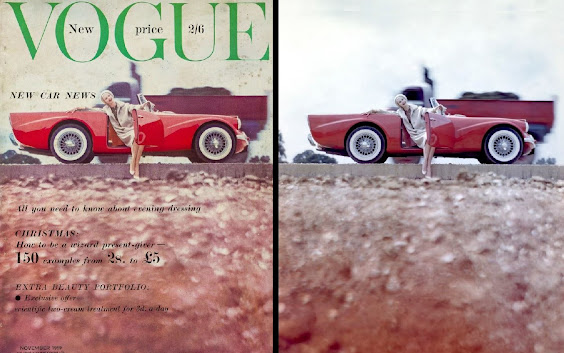
Using one of his trademark outdoor settings, Norman Parkinson (1913-1990) photographed model Suzanne Kinnear (b 1935) adorning a Daimler SP250, wearing a Kashmoor coat and Otto Lucas beret with jewels by Cartier. The image was published on the cover of Vogue's UK edition in November 1959.
Although Daimlers had, in small numbers, been imported into US for decades, after Jaguar purchased the company in 1960, there was renewed interest and the first model used to test the market was the small, fibreglass-bodied roadster, probably the most improbable Daimler ever and one destined to fail, doomed by (1) the quirky styling and (2) the lack of product development. It was a shame because what made it truly unique was the hemi-head 2.6 litre (155 cubic inch) V8 which was one of the best engines of the era and remembered still for the intoxicating exhaust note. The "micro-V8" and the companion 4.5 liter (278 cubic inch) version were two of the best engines produced in the 1960s and their under-utilization was one of many mistakes made by the UK's industry in the post war years although the blame is shared (substantially) by successive governments. The smaller V8 would have been transformative if used by a number of Triumphs & MGs while the larger unit would have made Jaguars & Daimlers competitive in the lucrative US market in a way the XK-six never could.
The SP250 was first shown to the public at the 1959 New York Motor Show and there the problems began. Aware the small sports car was quite a departure from the luxurious but rather staid line-up Daimler had for years offered, the company had chosen the pleasingly alliterative “Dart” as its name, hoping it would convey the sense of something agile and fast. Unfortunately, Chrysler’s lawyers were faster still, objecting they had already registered Dart as the name for a full-sized Dodge so Daimler needed a new name and quickly; the daunting Dodge would never be confused with the diminutive Daimler but the lawyers insisted. Imagination apparently exhausted, Daimler’s management reverted to the engineering project name and thus the car became "SP250" which was innocuous enough even for Chrysler's attorneys and for the US corporation things could have been worse. Dodge had submitted their Dart proposal to Chrysler for approval and while the car found favor, the name did not and the marketing department was told to conduct research and come up with something the public would like. From this the marketing types gleaned “Dodge Zipp” would be popular and to be fair, dart and zip(p) do imply much the same thing but ultimately the original was preferred and Darts remained in Dodge’s line-up until 1976, for most of that time one of the corporation's best-selling and most profitable lines. Internationally it was also a success, produced in Brazil until 1981 and although the Australians retired the body shape in 1971, there Chrysler Australia would use the platform for a further decade. In the US, the name was revived between 2012-2016 for a dreary, unsuccessful and unlamented small sedan.

Leaper, growler and flutes on US market 1999 Jaguar Vanden Plas (X308). The retractable, solid-timber picnic tables in the back of the front seats were much admired.
Decades
later, US trademark law would again intrude, this time on Jaguar’s low-volume business of selling Daimlers in the US. There, the company had, after 1967, ceased offering Daimlers because, it being clear the trickle of safety & exhaust emission regulations was soon to become a flood, with capital scarce, it was decided resources needed to be devoted to compliance and one form of economy was to re-allocate the funds absorbed by maintaining Daimler as a separate brand, most of which were spent on advertising. In Stuttgart, the Daimler-Benz
lawyers took note and decided to reclaim the name, eventually managing to
secure registration of the trademark and Daimlers have not since been available
in the US. However, there was still
clearly demand for an up-market Jaguar and so the Sovereign name (used on
Daimlers between 1966-1983) was applied to Jaguar XJ sedans which, although
mechanically unchanged, were equipped with more elaborate appointments.

Lindsay Lohan with stainless steel Rolex Datejust (
Roman numeral dial) with fluted white gold bezel. Note the blue eyes; it's not known if the effect was achieved with colored contact lens or digital editing.
Sales of the up-market Sovereign were good and the profit margins fatter so the US market also
received some even more luxurious Vanden Plas models and during the XJ’s X308
model run (1997-2003), the VDP cars were fitted with the fluted grill and trunk-lid
trim as an additional means of product differentiation; it would be the last appearance of the flutes
in North America and the only occasion on which the leaper and growler were used in conjunction with them. Although some might dismiss the interior fittings of the Vanden Plas models as “bling”, there were nice touches. The ones based on the X308 featured the fold-down picnic-tables once so beloved by English coach-builders (the affection in the 1960s trickling down to the middle-class as they began to appear on blinged-up mass-market vehicles) but, rather than the usual burl walnut veneer, the pieces were of solid timber. The factory seems never to have discussed the rationale but it may be it was cheaper to do it that way, the veneering process being labor-intensive.

Pim Fortuyn in his chauffeur-driven Daimler Super V8, February 2002 (left), paramedics attending to him at the scene of his assassination (centre) a few paces from the Daimler, 6 May, 2002 (he died at the scene) and the car when on sale, Amsterdam, June 2018 (right). His assassin, memorably, was described in press reports “deranged vegetarian”; perhaps it was the sight of meneer Fortuyn sprawled across those Connolly Leather hides that was triggering.
Jaguar
became aware the allure of the flutes was real when it discovered a small but
profitable industry had emerged in the wake of the company ceasing to use
the Daimler name in European markets (by the 1990s, it was only in the UK, Japan, Australia & New Zealand they could be bought off the showroom floor). Entrepreneurial types, armed with
nothing more than a list of Jaguar part-numbers, had created kits containing the
fluted trim pieces and Daimler-specific badges, these shipped to dealers or
private buyers on the continent so Jaguar XJs could become “Daimlers”. Being factory-supplied parts of no mechanical significance, their use did not affect warranties or insurance rates (though owners were required to inform registration authorities the badgework had changed) so, unlike many after-market modifications, administratively, it was a hassle-free process. Jaguar took note of this uptick in the Daimler-demand curve and decided to meet it with supply, re-introducing the marque to Europe. Because the company was, in effect, doing only what was being done by those buying the kits, it proved one of the industry's cheapest and quickest brand resurrections, Germany and the Netherlands especially receptive. One notable owner of a real LWB (long wheelbase) Daimler Super V8 (X308) was the Dutch academic and politician Pim Fortuyn
(1948-2002), assassinated by a
left-wing environmentalist and animal rights activist during the 2002 national election campaign.


