Sunday, February 26, 2023

Fungible

Fungible (pronounced fuhn-juh-buhl)

In law, finance and commerce, being of such nature or kind as to be freely exchangeable or replaceable, in whole or in part, for another of like nature or kind (especially as applied to physical goods).

1765: From the Medieval Latin fungibilis, the construct being fung(ī) (to perform the office of) + -ibilis (-ible) (a variant of -bilis, the suffix usually added to certain verbs to form an adjective denoting passive qualities).  Root was the Latin fungor (I perform; I discharge a duty), source of the Modern English function, it was originally a legal term in Medieval Latin drawn from Roman civil law, res fungibilis (replaceable things), used typically in proceedings in phrases such as fungi vice (to take the place).  The adjectival form was first used in 1818.  The synonyms are interchangeable, exchangeable & replaceable.  Of late, the word has acquired a new life in the NFT, the non-fungible token, an entry in the digital ledger the blockchain which, thus far, provides an owner with an unimpeachable, blockchain-verified proof of ownership.  Fungible is a noun and adjective, fungibility is a noun and nonfungible & unfungible are adjectives that of late have come more frequently to be used; the noun plural is fungibles.  

Fungible and non-fungible

In law, finance and commerce, the general principle of fungibility is of a thing able to be substituted for something of equal value or utility.  The classic fungible is physical cash.  If one lends $10,000 to another, it usually matters not if the loan is repaid in different banknotes than those used in the initial transaction.  However, a rare US$10,000 note is non-fungible and ten thousand one dollar notes are not a substitute in the same way that to a coin collector, a rare nickel (five cent) is not interchangeable with another whereas most nickels are in just about any transaction.  A commodity like crude oil is fungible.  When a futures trader executes a contract for 100,000 barrels of Tapas Crude six months hence, the oil may be in the ground, in a tanker or in storage tank somewhere.  Precious diamonds are often not perfectly fungible because each is unique and cannot always be substituted with another, even if of similar size and identical nominal value whereas industrial diamonds are fungible and need only conform to a specification to be an acceptable substitute.  The concept is important in criminal law.  As a general principle, when alleging theft, the state has to prove the items in position of accused are those stolen.  If the theft involves fungibles (petrol, money etc) where it may not be possible to establish the physical relationship, the state must provide other evidence.

Images associated with some of Lindsay Lohan's NFTs. 

Non-fungible tokens

A non-fungible token (NFT) is an entry on a blockchain, a digital ledger.  All the NFT does is certify the uniqueness of the token itself and it’s created usually to guarantee an exclusive (legal) ownership of some asset, typically material stored in digital format such as image and audio files.  Of themselves, NFTs don’t restrict access to a file or prevent its duplication and dissemination; they are just a proof of ownership.  Transactional volumes by 2021 had reached US$ billions; future growth will depend of (1) whether the blockchain proves as robust as it appears and (2) whether NFT prove to be actual tangible asset or bubble although there’s no reason they can’t assume a different trajectory from cryptocurrency.  Technically, a blockchain need not be associated with a cryptocurrency but to date most NFT transactions have been on the Ethereum blockchain, its infrastructure well understood and at one layer of that structure, any blockchain is just another file system, an NFT differing from a ETH coin only in that different (and additional) data are entered.  The NFT can be associated with a digital or physical asset or a license to use the asset on whatever basis may be granted and may be traded.  The underlying mechanism of the blockchain means as database entries, NFTs work like any cryptographic tokens but, unlike cryptocurrencies, NFTs are not interchangeable and are thus inherently non-fungible.  However, although every bitcoin is exactly the same, inevitability, someone will work out a way to find some unique aspect of some bitcoin (such as the “first” one) and at that point, the NFT will be created.

No NFT required.  A 1962 Ferrari 250 GTO in silver (US$70 million) and a fine replica by Tempero of a 1963 model in rosso corsa (US$1.2 million).

NFTs address one aspect of the problem associated with anything digital: the ease of creation of perfect replicas and real world analogies are illustrative of the need.  Ferrari made only thirty-nine 250 GTOs and one has sold for US$70 million but it’s possible for experts to create an almost exact replica, indeed one often of higher quality than an original but it will only ever be worth a fraction of the real thing.  With something digital, just about anyone can create an exact duplicate, indistinguishable from the source, hence the attraction of the NFT which, thus far, can’t be forged.  NFTs have been linked to real-world objects, as a sort of proof of ownership which seems strange given that actual possession or some physical certificate is usually sufficient, certainly for those with a 250 GTO in the garage but there are implications for the property conveyancing industry, NFTs possibly a way for real-estate transactions to be handled more efficiently.  For those producing items subject to much piracy (running shoes, handbags etc), there’s interest in attaching NFTs as a method of verification.

Saturday, February 25, 2023

Errant & Arrant

Errant (pronounced er-uhnt)

(1) Deviating from the regular or proper course; erring; straying outside established limits (often used in sport as “errant shot”, “errant punch” etc).

(2) Prone to error; misbehaved; moving in an aimless or lightly changing manner (often used in a non-human context: breezes, water-flows etc).

(3) Journeying or traveling, as a medieval knight in quest of adventure; roving adventurously (archaic, although it may in this sense still be a literary device).

(4) Utter, complete (obsolete, the meaning now served by “arrant”).

1300–1350: From the Middle English erraunt (traveling, roving), from the Anglo-Norman erraunt, from the Middle French, from the Old French errant, present participle of errer & edrer (to travel or wander), from the unattested Vulgar Latin iterāre (to journey) (and influenced by the Classical Latin errāre (to err)), from the Late Latin itinerārī, a derivative of iter (stem itiner-) (journey) and source of the modern English itinerary), from the root of ire (to go), from the primitive Indo-European root ei- (to go).  Understandably, in the Medieval era, the word was often confused with the Middle French errant (present participle of errer (to err)) so the use in old translations need to be read with care and the Old French errant in its two senses (1) the present participle of errer (to travel or wander) & (2) past participle of errer were often confused even before entering English.  In any event, much of the latter sense went with arrant (which was once a doublet of errant).  All the muddle is attributable to the link between the Old French errant with the Latin errāns, errāntem & errāre (to err) and the present participle of errer (to wander), which was from the Classical Latin iterō (I travel; I voyage) rather than errō, which is the ancestor of the etymology of error (to err; to make an error).  The comparative is more errant and the superlative most errant and the synonyms (depending on context) include aberrant, erratic, offending, stray, unorthodox, wayward, deviating, devious, drifting, errable, fallible, heretic, meandering, misbehaving, mischievous, miscreant, naughty, rambling, ranging & roaming.  The obsolete alternative spelling was erraunt.  Errant is a noun & adjective (often postpositive) and errantly is an adverb; the noun plural is errants.

Arrant (pronounced ar-uhnt)

(1) Downright; thorough-going; flagrant, utter, unmitigated; notorious (the latter in the non-derogatory sense).

(2) Wandering; errant (obsolete).

1350–1400: From the Middle English, a variant of errant (wandering, vagabond), the sense developed from its frequent use in phrases like “arrant thief” which became synonymous with “notorious thief”.  Etymologists tracking the late fourteenth century shift note that as a variant of errant, it was first merely derogatory in the sense of “a wandering vagrant” and remembered as an intensifier due to its use as an epithet because of poetic phrases such as “arrant thieves and arrant knaves” (ie “wandering bandits”).  In the 1500s the word gradually shed its opprobrious force and acquiring the meaning “thorough-going, downright and notorious (the latter in the non-derogatory sense)”.  In a limited number of specific uses, arrant can still convey a negative sense such as “arrant nonsense!” (utterly untrue) and the meaning is preserved when Shakespeare’s “arrant knaves” (from the nunnery scene in Hamlet, Act 3, Scene 1) is invoked.  Remarkably, there are still dictionaries which list arrant simply as an alternative form of errant, despite in practice use having separated centuries earlier and some style guides suggest arrant should be avoided because (1) some may confuse it with errant and (2) it’s an adjective which seems used mostly in clichés.  The obsolete alternative spelling was arraunt, the obsolete comparative was arranter and the obsolete superlative, arrantest.  Arrant is an adjective and arrantly an adverb.

Errant driving: The aftermath of three Lindsay Lohan car crashes although the Maserati Quattroporte (right; borrowed from her father) suffered little more than a nudge and it's said her assistant was at the wheel at the time.

Friday, February 24, 2023

Peradventure

Peradventure (pronounced pur-uhd-ven-cher (U) or per-add-ven-chur (non-U)

(1) Chance, doubt or uncertainty (rare & archaic).

(2) Surmise (obsolete).

(3) It may be; perchance or maybe; possibly; perhaps (a definitely obsolete adverb).

1250–1300: From the Middle English peraventure, & per aventure, from Old French par aventure, the spelling in English modified in the seventeenth century to emulate Latin, providing a gloss of classical respectability.  The earliest form (circa 1300) was per aventure, paradventure adopted in the fourteenth and peradventure (sometimes in the old form as peraduenture) the final change.  Adventure evolved from the Middle English aventure, aunter & anter, from the Old French aventure, from the Late Latin adventurus, from the Latin advenire & adventum (to arrive), which in the Romance languages took the sense of "to happen, befall".  Aventure was from the Vulgar Latin adventura, from the Late Latin adventurus, from the Classical Latin adventus, the construct being adveniō (arrive) + -tus (the action noun–forming suffix).  Peraventure is a noun & adverb, the noun plural is peradventures.

Peradventure in the sense of “chance, doubt or uncertainty” is both rare and archaic, a combination characterizing those words Henry Fowler (1858–1933) in his A Dictionary of Modern English Usage (1926) listed as archaisms, words he suggested were “…dangerous except in the hands of an experienced writer who can trust his sense of congruity”, adding that the use of archaisms was “…more likely to irritate the reader than to please…” and the word does seem to appear when people seek either (1) variety, (2) a flourish or (3) a display of their “pride of knowledge”, one of the many linguistic habits of Henry Fowler damned.  Peradventure means “chance, doubt or uncertainty” (the other meanings wholly obsolete) and is used in the forms “beyond peradventure” & “beyond a peradventure”, the more usual ways of expressing the sentiment including “beyond question” & “without doubt”. 

The reason it should be avoided in normal discourse is that unlike some deliberate archaisms, (such as “afforce” which is sufficiently close in construction and meaning to “reinforce”), there is nothing in the word which would allow a interlocutor to pick up the meaning.  That’s because the element “adventure” id derived from a linguistic fork which evolved into extinction, the aventure in the Old French per aventure coming from the adventura, a future form of the verb advenire (to happen (ie something which may occur).  However by the time it entered the Old French, variously it could mean destiny or fate, a chance event, an accident, fortune or luck and it was the sense of “a chance or uncertain event” that attached to the word when it was adopted in the Middle English.  That eventually produced peradventure but “adventure” also came to be used in English as an event with some risk of danger or loss, that sense persisting in law (In admiralty law, marine insurers use adventure in the technical sense of ”the period during which insured goods are at risk” and there’s the technical term “medical misadventure”, used when doctors murder their patients).  The sense thus shifted from “a chance event” to “a hazardous undertaking or audacious exploit to the modern form” (which still exists in law) before assuming the modern meaning: “a novel or exciting experience”.  Thus, it’s unlikely to occur to most that “peradventure” means what it does.

It can of course be used among word nerds and others where a pride of knowledge is something admired.  John Parker (1885–1958), the US alternate judge sitting on the International Military Tribunal trying the Nazi leadership (the first Nuremberg Trial (1945-1946)), used the phrase “…conspiracy has been proved beyond peradventure” when resisting the objection from the French judges that the charge of “criminal conspiracy” (Count One: Conspiracy to Wage Aggressive War) was not sustainable because it was unknown in international or continental law, too vague and a conspiracy is anyway absorbed by the crime one committed.  It was an interesting discussion which didn’t convince the French although, in the circumstances, they were inclined to compromise… a little.  The primary US judge, Francis Biddle (1886–1968), noted on hearing “peradventure” that Judge Parker “liked such old-fashioned phrases, which, when he used them, sounded like the crack of a long whip, tearing other arguments to shreds”.  He might have added Parker came from the North Carolina bar, where old-fashioned phrases are perhaps more often heard.

It does also enjoy that ultimate imprimatur of authenticity, as an adverb appearing seventeen times in the plays of William Shakespeare (1564–1616), two examples being:

Henry V, Act IV, Scene I.

Some, peradventure, have on them the guilt of peradventure premeditated and contriued Murther; some, of beguiling Virgins with the broken Seales of Periurie; some, making the Warres their Bulwarke, that haue before gored the gentle Bosome of Peace with Pillage and Robberie.

Coriolanus Act II, Scene I.

…peraduenture some of the best of 'em were hereditarie hangmen.  Godden to your Worships, more of your conuersation would infect my Braine, being the Heardsmen of the Beastly Plebeans.  I will be bold to take my leaue of you.

Trend of use of peradventure, tracked by the Collins English Dictionary.

The trend however, the odd eighteenth century spike notwithstanding, is down, one of the few supporting gestures in recent years (2015) by UK Labor MP Harriet Harman (b 1950) and such was the reaction from friend and foe that, beyond peradventure, she’s unlikely to use it again.

Thursday, February 23, 2023

Cutter

Cutter (pronounced kuht-er)

(1) A person employed to cut something, applied especially to one who cuts fabric for garments.

(2) A machine, tool, knife or other device for cutting.

(3) In nautical use, a single-mast sailing vessel, very similar to a sloop but having its mast set somewhat farther astern, about two-fifths of the way aft measured on the water line.

(4) In nautical use, a ship's boat having double-banked oars and one or two lugsails.

(5) In nautical use, a lightly armed government vessel used to prevent smuggling and enforce the customs regulations (known also as a revenue cutter).

(6) In psychiatry & psychology, a patient who repeatedly inflicts self-injury by cutting their flesh, a behavior traditionally associated with negative emotions.

(7) A person employed as a film editor, the titled derived from when physical film stock was physically cut with blades and re-joined.

(8) A small, light sleigh, usually single-seated and pulled by one horse.

(9) In construction, a brick suitable for cutting and rubbing, traditionally yellow and used for face-work (also called a rubber and now mostly obsolete but still use in restoration work).

(10) In industrial meat production (in the US government’s grading of beef), a lower-quality grade between utility and canner, used mostly in processed products such as hot dog sausages.

(11) In industrial meat production, a pig weighing between 68-82 kg (150-181 lb), from which fillets and larger joints are cut.

(12) In industrial meat production, an animal yielding inferior meat, with little or no external fat and marbling.

(13) In baseball, a variation of the fastball pitch.

(14) In cricket, as "leg cutter", a ball bowled by a fast bowler using finger spin to move the ball from leg to off (when delivered to a right-handed batsman); unrelated to the cut shot ("leg cut" & "off cut") except in the adjectival sense whereby a batsman might be described as “an expert cutter”, “an inept cutter” etc.  The "off cutter" is a delivery which moves in the other direction. 

(15) In dental classification, a foretooth; an incisor.

(16) In UK prison slang, a ten-pence (10p) piece, so named because it is the coin most often sharpened by prison inmates to use as a weapon.

(17) In medical slang, a surgeon (also modified to reflect specialties, neurosurgeons being “head cutters”, thoracic surgeons “chest cutter” etc).

(18) In the slang of criminology, an offender who habitually uses balded weapons to inflict injuries (also known as “slashers”).

(19) In film & television production, a flag, plate or similar instrument for blocking light.

(20) An officer in the exchequer who notes by cutting on the tallies the sums paid (obsolete).

(21) In slang, a disreputable ruffian (obsolete).

(22) As Cutter Expansive Classification (CEC), a library classification system, now obsolete although the core structure remains the basis for the system used by the US Library of Congress.

1375–1425: From the Middle English kittere & cuttere, the construct being cut(t) + -er.  Cut was from the Middle English cutten, kitten, kytten & ketten (to cut) (the Scots form was kut & kit), of North Germanic origin, from the Old Norse kytja & kutta, from the Proto-Germanic kutjaną & kuttaną (to cut), of uncertain origin, though there may be links with the Proto-Germanic kwetwą (meat, flesh) (related to the Old Norse kvett (meat)).  It was akin to the Middle Swedish kotta (to cut or carve with a knife) (the Swedish dialectal forms were kåta & kuta (to cut or chip with a knife)), the Swedish kuta & kytti (a knife), the Norwegian Bokmål kutte (to cut), the Norwegian Nynorsk kutte (to cut), the Icelandic kuta (to cut with a knife), the Old Norse kuti (small knife) and the Norwegian kyttel, kytel & kjutul (pointed slip of wood used to strip bark).  It displaced the native Middle English snithen (from the Old English snīþan) although the German schneiden survives still in some dialects as snithe or snead.  The –er suffix was from the Middle English –er & -ere, from the Old English -ere, from the Proto-Germanic -ārijaz, thought most likely to have been borrowed from the Latin –ārius where, as a suffix, it was used to form adjectives from nouns or numerals.  In English, the –er suffix, when added to a verb, created an agent noun: the person or thing that doing the action indicated by the root verb.   The use in English was reinforced by the synonymous but unrelated Old French –or & -eor (the Anglo-Norman variant -our), from the Latin -ātor & -tor, from the primitive Indo-European -tōr.  When appended to a noun, it created the noun denoting an occupation or describing the person whose occupation is the noun.

A glove cutter at his bench at Omega srl Gloves (the Omega Glove Factory), Rione Sanità district, Naples, Italy.  In American Pastoral (1997), Philip Roth (1933–2018) wrote that no one was able to make gloves as well as “some small factory in Rione Sanità in Naples.”  In the 1980s, most glove production moved from Europe to the Far East and it's believed there are now fewer than a hundred master-certified glove cutters left in the world, the title formalized in seventeenth century France and conferred only after years of mentorship.

Night Suspect, a British Coast Guard Cutter in Pursuit (1958), oil on canvas by Montague Dawson (1890-1973). 

As a surname derived from occupation, Cutter emerged in the late twelfth century, based on the agent noun cutter (“one who cuts something” or “one who shapes or forms by cutting") from the verb cut From the 1630s it came to be used to describe an "instrument or tool for cutting", the use spreading as specialized tools and machines were developed.  In nautical use, beginning in 1792, it was applied to a range of small, single-mast vessels, a borrowing from the earlier use for a “double-banked boat belonging to a ship of war”, noted since 1745 and the rationale is unrecorded but it may have been either because of the similar lines of the hull or the more romantic idea of “cutting through” (moving quickly) the water.

Cake cutter: Lindsay Lohan cutting her chocolate birthday cake.

The original ships were the “revenue cutters", lightly-armed government vessels commissioned for the prevention of smuggling and the enforcement of the customs regulations.  The use was therefore for some time restricted to vessels cutter-rigged, but the name has survived to transcend the original specification, almost all revenue ships now powered while the handful of sailed-ships are schooner-rigged.  Modifiers are used to describe various specialized tools used for cutting including biscuit cutter, cigar cutter, bolt cutter, box-cutter, gem cutter, glass cutter, leaf-cutter etc.  The original box cutters, dating from 1871, were those employees with the task of “cutting boxes” while the installed box cutters were pieces of large industrial plant, first noted in 1890; the familiar modern box cutter (hand-held bladed tool for cutting cardboard) first sold in 1944.  A cookie cutter is literally a device used to cut shapes from a sheet of pastry dough but is also used figuratively to describe to things which are un-original or un-imaginative.  Cutter is a noun & adjective; the noun plural is cutters.

Cutters: Non-Suicidal Self-Injury (NSSI)

Fresh cuts.

Cutters are the best known example of self-harmers, the diagnosis of which is described in the American Psychiatric Association's (APA) Diagnostic and Statistical Manual of Mental Disorders (DSM) as non-suicidal self-injury (NSSI).  NSSI is defined as the deliberate, self-inflicted destruction of body tissue without suicidal intent and for purposes not socially sanctioned; it includes behaviors such as cutting, burning, biting and scratching skin.  Behaviorally, it’s highly clustered with instances especially prevalent during adolescence and the majority of cases being female although there is some evidence the instances among males may be under-reported.  It’s a behavior which has long interested and perplexed the profession because as something which involves deliberate and intentional injury to body tissue in the absence of suicidal intent (1) it runs counter to the fundamental human instinct to avoid injury and (2) as defined the injuries are never sufficiently serious to risk death, a well-understood reason for self-harm.  Historically, such behaviors tended to be viewed as self-mutilation and were thought a form of attenuated suicide but in recent decades more attention has been devoted to the syndrome, beginning in the 1980s at a time when self-harm was regarded as a symptom of borderline personality disorder (BPD) (personality disorders first appeared in the DSM-III (1980), distinguished by suicidal behavior, gestures, threats or acts of self-mutilation.

US Coast Guard (USCG) Legend Class National Security Cutter.

Clinicians however advanced the argument the condition should be thought a separate syndrome (deliberate self-harm syndrome (DSHS)), based on case studies which identified (1) a patient’s inability to resist the impulse to injure themselves, (2) a raised sense of tension prior to the act and (3) an experience of release or at least partial relief after the act.  That a small number of patients were noted as repeatedly self-harming was noted and it was suggested that a diagnosis called repetitive self-mutilation syndrome (RSMS) should be added to the DSM.  Important points associated with RSMS were (1) an absence of conscious suicidal intent, (2) the patient’s perpetually negative affective/cognitive which was (temporarily) relieved only after an act of self-harm and (3) a preoccupation with and repetitiveness of the behavior.  Accordingly, NSSI Disorder was added to the DSM-5 (2013) and noted as a condition in need of further study.

KEIBA Side Cutters.

Although interest in the cutters spiked in the 1990s, papers had been published as early as the 1930s and the literature suggests something of a consensus among clinicians it should be regarded a matter of self-mutilation, such acts a form of attenuated suicide.  Accordingly, all non-fatal and deliberate forms of self-injury tended to be viewed as suicide attempts, regardless of whether there was any expressed suicidal intent and it wasn’t until the 1960s that any volume of doubt emerged.  That was significant, not only because self-injury was coming to be understood as something distinct from attempted suicide but that it implied the instance of attempted suicide was significantly overstated, something of interest to many.  This led to the coining of the novel word “parasuicide”, perhaps an indication the profession still preferred to think cutting a sub-set rather than anything distinct.

Cutters' scars, fresh & fading.

For clinicians, NSSI can at the margins be a difficult diagnosis.  To fit the diagnostic criteria in the DSM-5, NSSI must be intentional and deliberate but acts sometimes occurs during dissociative episodes so a judgment needs to be made determining whether an act can be held to be intentional if the patient is detached from reality.  As a definitional matter. there’s also the issue that if the motivation is to “feel something” some degree of intentionality seems at least implied but these examples do illustrate why NSSI among those suffering an episode of dissociation need even more carefully to be assessed before a diagnosis is decided.  There’s also a threshold criterion for the injury suffered, wounds needing to be “moderately intense” to qualify, thus the exclusion of such as lip-biting, scab & skin picking, hair pulling and nail-biting, even if these injuries might demand clinical care in another context (and may well be relevant in assessment measures).  Some extent of a “destruction of body tissue” is thus required and the current DSM-5 definition specifies bleeding or bruising.  However, it’s noted in cases studies that while minor and highly normative behaviors such as lip-biting, skin picking and hair pulling are excluded: (1) When severe they may be indicative of another specific condition such as trichotillomania (hair-pulling disorder) or excoriation (skin-picking disorder) rather than NSSI and (2) repeated and obsessional instances of behavior that might otherwise be considered mild and normative might appropriately be diagnosed as NSSI.

Case Fatality Rates by Suicide Method (8 indicative US states, 1989-1997)

Although the instances of death resulting from cutting are low, it’s clear many patients engage in NSSI behaviors while experiencing thoughts of suicide and while the evidence suggests many report being resigned to death as a consequence of cutting, actual suicidal thoughts and hopes for death are markedly higher in those exhibiting suicidal behaviors.  Intriguingly, it seems some may engage in NSSI as a way to avoid acting on thoughts of suicide; NSSI for these patients serving to regulate and reduce suicidal thoughts and intentions.  So it’s clear that in both thought and behavior, there’s some overlap between NSSI and suicidal thoughts meaning that even if a cutter’s injuries are (medically) minor, the condition should not be thought trivial although, for practical purposes, NSSI and suicidal behaviors need still to be categorized separately.  Cutting is also special in that it is so overt, unlike other forms of self-harm such as alcohol & drug abuse, risky behavior or neglecting to follow a prescribed treatment for a chronic condition.  There does however seem to be a pronounced co-morbidity between NSSI and eating disorders, the obvious link being a patient’s relationship with their body, NSSI being in some sense a compensatory behavior and form of self-punishment.  Data is clearly accumulating but the APA’s editorial committee seem not yet ready to make major structural changes: in the DSM-5-TR (Text Revision, 2022) although codes were included both suicidal behavior and NSSI, Suicidal Behavior Disorder (SBD) and NSSI Disorder remained in the section “Conditions for Further Study”.

Tuesday, February 21, 2023

Ambergris

Ambergris (pronounced am-ber-grees or am-ber-gris)

The waxy, sometimes opaque (the color from ash-gret to jet black) morbid secretion of the sperm whale intestine, usually found floating on the ocean or washed ashore: used in perfumery and (historically), in cooking & folk medicine.

1375–1425: From the Old & Middle French ambre gris (literally gray amber) which replaced the Middle English imbergres.  The construct was thus amber + gris.  Amber was from the Middle English ambre & aumbre, from the Old French aumbre & ambre, from the Arabic عَنْبَر‎ (ʿanbar), (ambergris), from the Middle Persian anbar & ambar (ambergris).  The word displaced the Middle English smulting (from Old English smelting (amber)), the Old English eolhsand (amber), the Old English glær (amber), and the Old English sāp (amber, resin, pomade).  Most etymologists seem to conclude the Arabic anbar entered European languages via Medieval Latin.  Gris was from the Old French or the Old Occitan gris (grey), both from the Frankish grīs, from the Proto-Germanic grīsaz (grey) and was akin to the Old High German grīs (grey) (source of the modern German greis) and the Dutch grijs (grey).  The now largely obsolete spellings were amber-gris & amber gris and the latter was for centuries the usual form, the single-word spelling not predominate until the nineteenth century.  During the seventeenth century, folk etymologies interpreted the form as “amber grease” or “amber of Greece” and regionally both were for some time in common use.  Until the twentieth century, the clipping “amber” was also in use and this was the original form, the “grey” element appended in the fourteenth century as a point of differentiation after the adoption in Romance languages of “amber” as the term to describe Baltic amber (the resin associated with fossils) and gradually, that use came to replace “yellow amber” (ambre jaune).  In modern use, amber is understood as the color and the resin white ambergris is the whale secretion.  Ambergris is a noun; the noun plural is plural ambergrises (although ambergris is in common use).

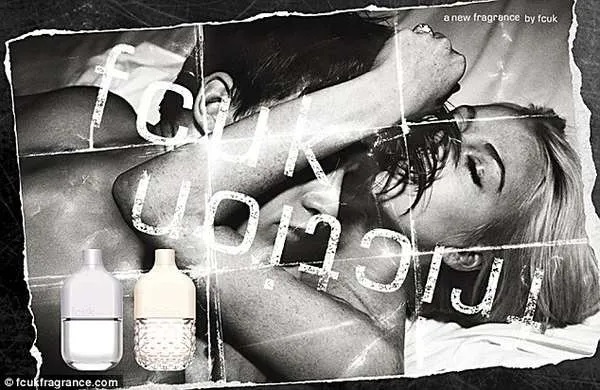
Lindsay Lohan in an advertisement for FCUK (French Connection UK).  According to FCUK, their fragrances have never used ambergris in the mix.

Curiously, the knowledge of the origin of ambergris was for centuries lost to European science.  Notes about the relationship of the substance to whales were later found in the papers of the eleventh century physician Constantinus Africanus (a Muslim of North African origin who spent the latter part of his life practicing his profession in Italy) but as late as the eighteenth century the matter was still subject to speculation, some of the theories as bizarre as anything contemplated during Antiquity to explain the existence of the mysterious eel and others were also baffled; both the Malays and the Chinese attributed the source of ambergris to either sea-dragons or sea-serpents.  It was though prized for its scent and authors noted the relationship between color and fragrance: the darker the less pleasing one was to the nose.  However, chefs had to be cautious because as noted by the English poet & satirist Alexander Pope (1688-1744): A little whiff of it, by snatches, is very agreeable; but when a man holds a whole lump of it to his nose, it is a stink and strikes you down”.  It was thus much enjoyed but only in small doses and rather as a little truffle might be grated today over a plate of scrambled eggs, so was ambergris once used, eggs with a dusting said to be the favorite dish of Charles II (1630–1685; King of Scotland 1649-1651, King of Scotland, England and Ireland 1660-1685).

Chanel No.5 concentrate.

That a waxy substance which is a mixture of steroid derivatives (consisting mainly of cholesterol) and secreted by the intestinal tract of the sperm whale should be a prized ingredient of the most expensive scents amuses many, some of who enjoy telling those daubed with the stuff they’re wearing “whale shit”, “whale vomit” or “whale snot”.  That’s of course not correct and in some cases, there’s not even a direct connection with the big mammals, even some high-end perfume houses using a synthetic ambroxide rather than ambergris and recent research has determined a gene from balsam fir is a most efficient producer of ambroxide so use of the traditional ingredient might become more rare still.  There’s long been speculation about whether the famous Chanel No.5 even included ambergris and the conclusion of most is that certainly once it did but now nobody is quite sure; Chanel have always declined to comment.  Both the natural and synthetic compounds produce an apparently unique chemical called ambrein and while the fragrance is the most obvious property, the perfume houses prized it also as a fixative, something which extends the endurance of the potency of the fluid (and thus the appeal to the olfactory senses) by reducing the natural propensity to evaporate.  In some jurisdictions the trade in (and even the gathering of) ambergris is prohibited, a reflection of the practice applied to trade in the body parts of other threatened species but the ban has be criticized because no whale is harmed (or even approached) in the harvesting process.

Three shades of grey: White, brown & black ambergris.

Ambergris is expensive for the most obvious reason in a world of supply and demand: rarity.  For reasons not understood, it appears fewer than 2% of sperm whales produce the substance and chunks of it can drift for years in the ocean currents before washing ashore to be collected, either by a lucky beachgoer or (more probably) by professional harvesters who study tidal charts and the migration patterns of whale herds to determine the most likely spots for a crop.  It can certainly be a lucrative business, brokers or perfumers paying thousands of dollars a kilogram and it’s the color (there are three color-based grades) and quality which determines the value, not the volume.  The white ambergris is the highest grade and thus the most expensive, possessing what aficionados describe as a “well-rounded, delicately soft, sweet, marine scent” and one which intensifies with age, an ambergris left undiscovered for years will “cure” finally to mature as a dusty, bright white chunk.  While less exalted, brown ambergris is the most versatile of the three and adaptable for use in more variations of scent, straddling the qualities and characteristics of the white and black.  Brown ambergris is noted for its woodier, tobacco-like fragrance and is probably closest in nature to musk.  Black ambergris is said by some to be almost brutish but, lack the delicate tones of the light shades, this can be an advantage for those formulating something like an aromatherapy oil which will be dispersed over a large space.  Noted for a pungent smell, it uses are limited because to most it seems more faecal than brown or white ambergris, but it’s very primitiveness makes it attractive for the niche market it serves.  In a sense it’s just another commodity so the retail prices do bounce around but the lighter shades tend to sell for as much as US$35 a gram.

Monday, February 20, 2023

Meme

Meme (pronounced meem)

(1) Any unit of cultural information, such as a practice or idea, that is transmitted orally or by repeated action (by imitation) from one mind to another, through generations, in a manner comparable to the transmission of genes; the synonym is culturgen

(2) On the internet, a cultural item in the form of an image, video, phrase etc, that is spread and often altered in a creative or humorous way.

(3) In Internet slang, a derogatory term to describe something not to be taken seriously (meme job, meme degree etc).

(4) To turn into a meme; to use a meme.

1976: From the Ancient Greek mīmeîsthai (to imitate, copy) and a shortening of mimeme, from the Ancient Greek μίμημα (mīmēma) (imitated thing) from μιμεῖσθαι (mīmeîsthai) (to imitate), from μῖμος (mimos) (imitation, copy; mime).  Structurally, the word was shortened (following the model of gene) from mimeme and anglicized to emulate the form of a noun derived from the Ancient Greek mīméomai with the deverbal suffix -μα (-ma), from μῖμος (mîmos).  The word was coined by British evolutionary biologist Richard Dawkins (b 1941) and used first in his 1976 book The Selfish Gene.  The construct was m(ime) +‎ -eme and Dawkins apologized to classical scholars for what they would think a most improper form, explaining he wanted something monosyllabic and if they preferred they could think of it as related to the French word même (“same or alike” although the meaning does shift with the context of use).  Helpfully, he added it should be pronounced to rhyme with “cream”.  In the way English forms proliferate (often with short lives) on the internet, meme has been the source of many coining including dank meme, memeable, memedom, memesque, meme-maker, memeable, memed, memeplex, memeish, memester, memeishness, meme-pool, memescape, memetic, memeworthy, memey, memome & memeable.  Meme is a noun, verb & adjective and meamed & meaming are verbs; the noun plural is memes.

Barack Obama (b 1961; POTUS 2009-2017, left) & crooked Hillary Clinton (b 1947; US secretary of state 2009-2013, right).

The more widely used concept of “a cultural fragment distributed on the internet” was created by lawyer Michael Godwin (b 1956) of the EFF (Electronic Frontier Foundation) and was first documented in 1994, use beginning to spike in 1997.  Godwin was the author also of Godwin's law (rule) which states that the longer an online exchange lasts, the greater the probability that some comparison with Adolf Hitler (1889-1945; German head of government 1933-1945 & head of state 1934-1945) or the Nazi regime will be invoked.  There’s some evidence suggesting the rule may not (statistically) operate as described but it remains a useful tool for determining the point at which a discussion (certainly if conducted on platforms like X (formerly known as Twitter) or Reddit) has passed a certain threshold.  The concept of the meme is very old, examples noted in the graffiti of Antiquity and anthropologists have cited prehistoric example; the pre-internet exemplar in the modern age being "Kilroy was here" which proliferated with extraordinary rapidity during World War II (1939-1945).  Many languages have adopted meme, some in the original sense from biological science, most in the more recent application used on the internet but there are other meanings.  There was the French même and the Turkish meme was from the Ottoman Turkish ممه‎ (nipple, breast (and described by most dictionaries as “a childish term”)), following the Ancient Greek μ́μμη (mámmē) and the Persian ممه‎ (mame).

Watched by crooked Hillary (whose gaze was said to suggest either disbelief or hatred depending on who was writing the commentary), her husband (Bill Clinton (b 1946; POTUS 1993-2001)) delivers his infamous “I did not have sexual relations with that woman… Miss Lewinsky” [former White House intern Monica Lewinsky (b 1973)] line. (left) and Chelsea Clinton (b 1980; FDOTUS (First Daughter of the United States 1993-2001)) & Bill Clinton watching crooked Hillary on stage with Donald Trump (b 1946; POTUS 2017-2021 and since 2025) during the second presidential debate, Washington University, St. Louis, Missouri, 9 October, 2016 (right).

Even in the years before internet trends made memes a common device for expressing ideas, critiques or jokes good & bad, "Hill-Bill" (Bill & crooked Hillary Clinton) was the gift which kept giving, humorists, political commentators and conspiracy theorists never short of material while they were in the White House.  Subsequent presidents have of course for their own reasons also been memeable although Barack Obama was a disappointment, his earnestness and scandal-free life meaning the possibilities were scant although, thankfully, during his administration, crooked Hillary remained an omnipresence and from Foggy Bottom provided the necessary content, including non-existent snipers in Bosnia, a still not fully-explained private mail server and the circumstances surrounding events in Benghazi, Libya in 2012 when four Americans (including the US Ambassador) were killed.  Even after leaving office in 2013, crooked Hillary has remained a fixture in US political culture and she and her husband may yet return to centre-stage as various agencies on both sides of the Atlantic continue their investigations into matters associated with convicted paedophile sex trafficker Jeffrey Epstein (1953–2019).

Looking over her shoulder: Donald Trump watching wife Melania (b 1970, FLOTUS 2017-2021 and since 2025) voting.

Dawkins coined meme to describe the concept of the intra- and trans-generational cultural spread of ideas and cultural phenomena, his construct being analogous with the agent of evolutionary biology, the gene.  He didn’t claim the idea was new, noting the earlier work of geneticists & ethologists and as early as 1904 German zoologist Richard Semon (1859-1918) had published The Mneme and mneme in which he included his theory which explored a vaguely similar idea although one later disproved as understandings of genetics improved.  Closer to the thoughts of Dawkins was La Vie des Termites (The Life of White Ants (1926)), an entomological book by Nobel laureate in literature Maurice Maeterlinck (1862–1949) which remains controversial because of the extent of the author’s plagiarism although he would later acknowledge a debt to the nineteenth century work of English biologist T.H. Huxley (1825–1895).

Memes can be self-generated for purposes of ambush marketing.  Lindsay Lohan risked going straight to Hell by purloining Pope Francis (1936-2025; pope 2013-2025) to promote Xanax.

Dawkins' point was that evolution depended ultimately only a self-replicating unit of transmission which, in biological evolution, was the gene and by analogy, human behaviour and cultural evolution could helpfully be described, at least in part, by memes, subject as they were to the influences and pressures of evolution.  Also, just as genes don’t always replicate as exact duplicates, memes existed and replicated imperfectly, things being combined, refined and rejected, the interactions creating new memes and thus, over time, cultures in some ways stayed the same; in others, things changed.  The concept was well-received by cultural theorists and critics but less effusive were many scientists, some of whom felt the gene/meme analogy a bit strained because, unlike genetic material, memes couldn’t be studied by the scientific method nor reduced to mathematical description, there being nothing even vaguely similar to the DNA which is the definable code of the gene.

Churchill, Roosevelt & Stalin, Yalta, 1945.  Things weren't always happy between the three.  In software, the colorization process depends on user input for an emulation of authenticity

Held in the Livadia, Yusupov, and Vorontsov palaces at Yalta in the Crimea between 4-11 February 1945, the Yalta Conference was the second of the three decisive meetings between the leaders of government of the UK, US and USSR, the first being Tehran (the capital of Iran (Persia), 28 November-1 December 1943) and the third Potsdam (in what soon would become the GDR (Deutsche Demokratische Republik (German Democratic Republic; the old East Germany, 1949-1990), 17 July-2 August 1945).  Of the three, it was the business done at Yalta which was most decisive and what was agreed (and, just as significantly, not agreed and left sufficiently vague to be open to comrade Stalin's interpretation) there decided for decades the political and military dynamics in Europe and beyond.  In fairness to Churchill and Roosevelt, because of the reality "on the ground" of the Red Army's presence in conquered ("liberated" in Kremlinspeak") lands, whether more could have been achieved by them is unlikely but what over the decades unfolded in Eastern & Central Europe was very different from what they had hoped.  Of the leaders, only comrade Stalin (1878-1953; Soviet leader 1924-1953) was there from start to finish, Harry Truman (1884–1972; POTUS 1945-1953) attending the Potsdam conference because of the death of Franklin Delano Roosevelt (FDR, 1882–1945, POTUS 1933-1945) while midway through that event, Clement Attlee (1883–1967; UK prime minister 1945-1951) replaced Winston Churchill (1875-1965; UK prime-minister 1940-1945 & 1951-1955) after the latter’s defeat in the general election.  If comrade Stalin needed any proof democracy was a bad idea, the results of the UK’s 1945 election provided plenty.  The group photographs from the Yalta Conference were among the most re-produced images from World War II  (1939-1945) and have been repurposed by the meme-makers:

Comrade Bernie Sanders, (b 1941; US senator (independent) for Vermont since 2007 and "Crazy Bernie" in Donald Trump's naming system bookends the Yalta Conference with comrade Stalin.

The image of comrade Bernie was from him in mittens at Joe Biden's (b 1942; POTUS 2021-2025) inauguration, Washington DC, 20 January 2021.  Vermont folk are used to cold winters and the mittens were knitted by Vermont elementary school teacher Jen Ellis.  The publicity generated by the inauguration photograph saw a sudden spike in demand and within hours of the posting, orders for thousands of pairs had been received.  Noting the interest, Ms Ellis immediately made three pairs for auction, the proceeds split between charities and her daughter's college fund.  An artisan creator and not in a position to support mass-production, the mitten-maker entered an arrangement with a manufacturer to produce a range of socks with the same pattern, the proceeds going to Vermont food banks, a cause which doubtlessly comrade Bernie supported.

Lindsay Lohan sitting at Churchill's right hand.

The image of Lindsay Lohan in 2007, resting (just before dawn) in a Cadillac Escalade in Los Angeles in May 2007 was one of that year's most widely circulated memes, creators taking advantage of the striking similarity between her sleeping form and that of L'Estasi di Santa Teresa (The Ecstasy of Saint Teresa; sometimes called The Transverberation of Saint Teresa), a sculptural group in white marble, carved by Gianlorenzo Bernini (1598-1680) in 1652 and located in the Cornaro Chapel (1626), at Santa Maria della Vittoria, Rome.  The famous photo of Lindsay Lohan was taken during her "troubled starlet" phase.

A quadrilateral meeting to discuss German war guilt reparations and allied debts accumulated during World War I (1914-1918): Raymond Poincaré (1860–1934; President of France 1913-1920, left), Andrew Bonar Law (1858–1923; Prime Minister of the United Kingdom 1922-1923. centre-left), Benito Mussolini (1883-1945; Duce (leader) & Prime-Minister of Italy 1922-1943, centre right) and Georges Theunis (1873–1966; Prime Minister of Belgium 1921-1925 & 1934-1935, right), 10 Downing Street, London, December 1922.  At this time, the Duce had been in office only a few weeks.

Memes can be retrospective.  This was an obscure photograph which until the twenty-first century had appeared only in some specialist history texts but as the internet achieved critical mass, memes became a thing and Mussolini’s sanpaku eyes were a gift for the meme-makers, most captions suggesting the duce may have had a sudden premonition of his own unfortunate end although others offered: I feel naked without a moustache”, I think I have imposter syndromeOh God, I just pooped my pants”, I know one of these men is a Freemason but I don't know which”, Maybe drinking those two triple-shot, short blacks was a bad idea and “I wonder if they can tell I've smoked some weed”.  However, although not noted as a mystic, he may have sensed another's impending death “sitteth at the right hand”, Andrew Bonar Law then having only months to live.