Showing posts sorted by relevance for query Brat. Sort by date Show all posts

Saturday, November 2, 2024

Brat

Brat (pronounced brat)

(1) A child, especially one is ill-mannered, unruly, annoying, spoiled or impolite etc (usually used either playfully or in contempt or irritation, often in the phrase “spoiled brat”.

(2) As “military brat”, “army brat” etc, a child with one or more parent serving in the military; most associated with those moving between military bases on a short-duration basis; the derived form is “diplomatic brat” (child living with parents serving in overseas missions).

(3) In the BDSM (bondage/discipline, dominance/submission, sadism/masochism) community, a submissive partner who is disobedient and unruly (ie a role reversal: to act in a bratty manner as the submissive, the comparative being “more bratty”, the superlative “most bratty”).

(4) In mining, a thin bed of coal mixed with pyrites or carbonate of lime.

(5) A rough makeshift cloak or ragged garment (a now rare dialectal form).

(6) An apron fashioned from a coarse cloth, used to protect the clothing (a bib) (a now obsolete Scots dialect word).

(7) A turbot or flatfish.

(8) The young of an animal (obsolete).

(9) A clipping of bratwurst, from the German Bratwurst (a type of sausage) noted since 1904, from the Middle High German brātwurst, from the Old High German, the construct being Brāt (lean meat, finely shredded calf or swine meat) + wurst (sausage).

(10) As a 2024 neologism (technically a re-purposing), the qualities associated with a confident and assertive woman (along the lines of the earlier “bolshie woman” or “tough broad” but with a more overtly feminist flavor).

1500–1520: Thought to be a transferred use (as slang for “a beggar's child”) of the early Middle English brat (cloak of coarse cloth, rag), from the Old English bratt (cloak) of Celtic origin and related to the Old Irish brat (mantle, cloak; cloth used to cover the body).  The origin of the early Modern English slag use meaning “beggar's child” is uncertain.  It may have been an allusion, either to the contemporary use meaning “young of an animal” or to the shabby clothing such a child would have worn", the alternative theory being some link with the Scots bratchet (bitch, hound).  The early sense development (of children) may have included the fork of the notion of “an unplanned or unwanted baby” (as opposed to a “bastard” (in the technical rather than behavioral sense)) had by a married couple.  The “Hollywood Brat Pack” was a term from the mid-1980s referring to a grouping of certain actors and modeled on the 1950s “Rat Pack”.  The slang form “brattery” (a nursery for children) sounds TicTokish but actually dates from 1788 while the generalized idea of “spoiled and juvenile” became common in the 1930s.  The unrelated use of bratty (plural bratties) is from Raj-era Indian English where it describes a cake of dried cow dung, used for fuel.  Brat is a noun, verb & adjective, brattishness & brattiness are nouns, bratting & bratted are verbs, brattish & bratty are adjectives and brattily is an adverb; the noun plural is brats.

New York magazine, 10 June, 1985.

First published in 1968, New York magazine is now owned by Vox media and, unlike many, its print edition still appears on surviving news-stands.  The editorial focus has over the decades shifted, the most interesting trend-line being the extent to which it could be said to be very much a “New York-centred” publication, something which comes and goes but the most distinguishing characteristic has always been a willingness (often an eagerness) to descend into pop-culture in a way the New Yorker's editors would have distained; it was in a 1985 New York cover story the term “Brat Pack” first appeared.  Coined by journalist David Blum (b 1955) and about a number of successful early twenty-something film stars, the piece proved controversial because the subjects raised concerns about what they claimed was Blum’s unethical tactics in obtaining the material.  The term was a play on “Rat Pack” which in the 1950s had been used of an earlier group of entertainers although Blum also noted another journalist's coining of “Fat Pack”, used in restaurant-related stories.

LBJ, the "Chicken Tax" and the Subaru BRAT

Subaru BRAT, advertising in motion (in a US publication and thus a left-hand drive model).

The Subaru BRAT was (depending on linguistic practice) (1) a coupé utility, (2) a compact pick-up or (3) a small four wheel drive (4WD) ute (utility).  The name was an acronym (Bi-drive Recreational All-terrain Transporter), the novel idea of “bi-drive” (4WD) being the notion of both axles being driven, that linguistic construction dictated by the need to form the acronym.  Bi-Drive Recreational All-Terrain Transporter” certainly was more imaginative (if opportunistic) than other uses of BRAT as an acronym which have included: ”Behaviour Research And Therapy” (an academic journal), “Bananas, Rice, Applesauce and Toast” (historically a diet recommended for those with certain stomach disorders), “Brush Rapid Attack Truck” (a fire-fighting vehicle), “Basenji Rescue and Transport” (a dog rescue organization), “Behavioral Risk Assessment Tool” (used in HIV/AIDS monitoring), Beautiful, Rich and Talented (self-explanatory), the “Bureau de Recherche en Aménagement du Territoire” (the Belgium Office of Research in Land Management (in the French)), “Beyond Line-Of-Sight Reporting and Tracking” (a US Army protocol for managing targets not in visual range) and “Battle-Management Requirements Analysis Tool” (a widely used military check-list, later interpolated into a BMS (Battle Management System).

Ronald Reagan on his Santa Barbara ranch with Subaru BRAT.  Like many owners who used their BRATs as pick-up trucks, President Reagan had the jump seats removed.

Built on the platform of the Leone (1971-1994) and known in some markets also as the MV Pickup, Brumby & Shifter, the BRAT was variously available between 1978-1994 and was never sold in the JDM (Japanese domestic market) although many have been “reverse imported” from other places (Australia favored because salt isn't used on the roads so rust is less of an issue) and the things now have a cult following in Tokyo.  The most famous BRAT owner was probably Ronald Reagan (1911-2004; US president 1981-1989) who kept a 1978 model on his Californian ranch until 1988, presenting something of a challenge for his Secret Service detail, many of whom didn’t know how to drive a stick-shift (manual transmission).  That though would have been less frightening than the experience of many taken for a drive by Lyndon Johnson (LBJ, 1908–1973; US president 1963-1969) in the Amphicar 770 (1961-1965) he kept at his Texas ranch.  LBJ suddenly would turn off the path, driving straight into the waters of the dam, having neglected to tell his passengers of the 770’s amphibious capabilities.  Although “770” has been used in the industry (in the US and Australia) as a trim-level designation (often as part of the sequence 440, 550, 660 etc) , on the amphibious Amphicar it was a reference to it being able to achieve speeds of 7 knots (8 mph; 13 km/h) on water and 70 mph (110 km/h) on land, both claims verified by testers although the nautical performance did demand reasonable calm conditions.

The Subaru BRAT is remembered also as a “Chicken Tax car”.  Tax regimes have a long history of influencing or dictating automotive design, the Japanese system of displacement-based taxation responsible for the entire market segment of “Kei cars” (a clipping of kei-jidōsha (軽自動車) (light automobile), the best known of which have been produced with 360, 600 & 660 cm3 (22, 37 & 40 cubic inch) engines in an astonishing range of configurations ranging from micro city cars to roadsters and 4WD dump trucks.  In Europe too, the post-war fiscal threshold resulted in a wealth of manufacturers (Mercedes-Benz, Jaguar, BMW, Ford, Maserati, Opel etc) offering several generations of 2.8 litre (171 cubic inch) sixes while the that imposed by the Italian government saw special runs of certain 2.0 litre (122 cubic inch) fours, sixes & even V8s.  The US government’s “Chicken Tax” (a part of the “Chicken War”) was different in that it was a 25% tariff imposed in November 1963 (to come into effect in January 1964) by the Johnson administration on potato starch, dextrin, brandy and light trucks; it was a response to the impost of a similar tariffs by France and the FRG (Federal Republic of Germany, the old West Germany) on chicken meat imported from the US.

Wheeling & dealing: Walter Reuther (left) and LBJ (right), scheming something, November 1963.

In any president’s political horse trading there are always hidden agendas and ulterior motives and in LBJ’s White House there were more than usual because that’s the way he’d always done business and had he written a guide to the process, he might have called it "The Art of the Deal".  He was in his generation the most skilled of all, historians concluding after in 1937 having been initiated into the fraternity of Freemasons, he took the only first degree (as an “Entered Apprentice”) and opted not further to progress because soon he understood there was little even the Masons could teach him about the dark arts of plotting & scheming.  Year after the imposition of the chicken tax, the contents of the surviving tape-recordings of discussions in the White House revealed LBJ was negotiating with UAW (United Auto Workers’) president Walter Reuther (1907–1970) in the run-up to the 1964 congressional & presidential elections and the tariffs aimed at curtailing Volkswagen’s increasing market share were just one of the “quid pro quo chips” on the table.  Although it was the taping system used by Richard Nixon (1913-1994; US president 1969-1974) that became infamous, devices of this kind had been installed in the White House as early as the during the administration of Franklin Delano Roosevelt (FDR, 1882–1945, US president 1933-1945) and Nixon actually had LBJ’s devices removed before his staff came to understand their usefulness and Nixon agreed to having them re-fitted, the rest being history. 
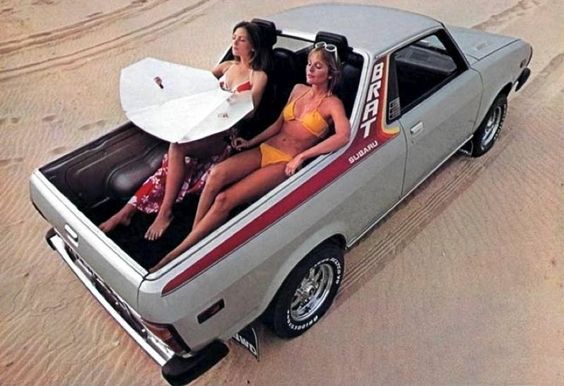
Subaru BRAT in use.

The post-war development in the US of large scale, intensive chicken farming had both vastly expanded production of the meat and radically reduced the unit cost of production which was good but because supply quickly exceeded the demand capacity of the domestic market, the surplus was exported, having the effect in Europe of transforming chicken from a high-priced delicacy to a staple consumer protein; by 1961, imported US chicken had taken some 50% of the European market.  This was at a time when international trade operated under the General Agreement on Tariffs and Trade (the GATT (1947)) and there was nothing like the codified dispute resolution mechanism which exists in the rules of the successor World Trade Organization (the WTO (1995)) and the farming lobbies in Germany, France and the Netherlands accused the US producers of “dumping” (ie selling at below the cost of production) with the French government objecting that the female hormones US farmers used to stimulate growth were a risk to public health, not only to those who ate the flesh but to all because nature of the substances was such that a residue enter the water supply.  The use of the female hormones in agriculture does remains a matter of concern, some researchers linking it to phenomena noted in the last six decades including the startling reduction in the human male's sperm count, the shrinking in size of the penises of alligators living in close proximity to urban human habitation and early-onset puberty in girls.

Subaru BRAT Advertising (US).

Eventually, the tariffs on potato starch, dextrin and brandy were lifted but the protection for the US truck producers remained, triggering a range of inventive “work-arounds” concocted between various engineering and legal offices, most of which involved turning two-seater trucks & vans into vehicles which technically could quality as four-seaters, a configuration which lasted sometimes only until the things reached a warehouse where the fittings could be removed, something which would cost the Ford Motor Company (one of the corporations the tax had been imposed to protect) over US$1 billion in penalties, their tactics in importing the Transit Connect light truck from Turkey (now the Republic of Türkiye) just too blatant.  In New Zealand, in the mid 1970s, the government found the “work-arounds” working the other way.  There, changes had been implemented to make the purchase of two seater light vans more attractive for businesses so almost instantly, up sprang a cottage industry of assembling four-door station wagons with no rear seat which, upon sale, returned to the workshop to have a seat fitted.  Modern capitalism has always been imaginative.

Subaru "Passing Lamp" on Leone 1600 GL station wagon (optional on BRATs, 1980-1982).

In Fuji Heavy Industries’ (then Subaru’s parent corporation) Ebisu boardroom, the challenge of what probably was described as the “Chicken Tax Incident” was met by adding to the BRAT two plastic, rear-facing jump seats, thereby qualifying the vehicle as a “passenger car” subject in the US only to a 2.5 and not a 25% import tax.  Such a “feature” probably seems strange in the regulatory environment of the 2020s but there was a time when there was more freedom in the air.  Subaru’s US operation decided the BRAT’s “outdoor bucket seats” made it an “open tourer” and slanted the advertising thus, the model enjoying much success although the additional seating wasn’t available for its final season in the US, the BRAT withdrawn after 1987.  Another nifty feature available on the BRAT between 1980-1982 was the “Passing Lamp” (renamed “Center Lamp” in 1982 although owners liked “Third Eye” or “Cyclops”), designed to suit those who had adopted the recommended European practice of flashing the headlights (on high beam) for a second prior to overtaking.  The BRAT was not all that powerful so passing opportunities were perhaps not frequent but the “passing lamp” was there to be used if ever something even slower was encountered.  The retractable lamp was of course a complicated solution to a simple problem given most folk so inclined just flash the headlights but it was the sort of fitting with great appeal to men who admire intricacy for its own sake.

BRAT seat mountings 1983 (left) and 1984 (centre).  The BRAT on the right has been retro-fitted with the seats (note the safety wire attached to the frame!) using U-bolts, a satisfactory method provided (1) the U-bolts are of high-tensile steel and (2) there is a backing place of adequate strength and size.

The seats were bolted to a frame (the design of which changed) which was welded to the bed.  The use of welding rather than bolts was dictated by the regulations because, had the frame been bolted (and thus defined as “removable”), the BRAT's classification would have changed from “passenger vehicle” to “truck” and been subject to the very tax the seats were installed to avoid.  Amusingly though, the side impact regulations which applied to the BRAT were in a different act and for those purposes the thing was defined as a truck which meant the doors could be fitted with lighter reinforcing bars than those mandated for the Subaru Leone sedans, station wagons and hatchbacks.  The stronger mechanism can be installed in a BRAT's doors so safety conscious owners do have that option.

Two 1987 BRATs with retro-fitted seats, the one on the right also with an after-market roll-bar, something which, all things considered, seems a sensible addition.  Of the physics, those familiar Sir Isaac Newton's (1642–1727) First Law of Motion (known also as the Law of Inertia"An object at rest will remain at rest, and an object in motion will continue in motion with the same speed and in the same direction unless acted upon by an unbalanced external force") can ponder the possibilities while wondering whether to bother buckling up the seat belt or just rely on the "grab handles" (and probably never was that term used more appropriately).  Although the seats weren't factory-fitted after 1985, the parts could still be ordered and many later models have been retro-fitted.  The adjustable headrests were a nice touch although some did note they could be classified also as "rear window protectors".

Brat: Charli XCX's Summer 2024 album

Charli XCX, BRIT Awards, O2 Arena,  London, February 2016; the "BRITs" are the British Phonographic Industry's annual popular music awards.

“Brat” has been chosen by the Collins English Dictionary as its 2024 Word of the Year (WotY), an acknowledgement of the popular acclaim which greeted the word’s re-purposing by English singer-songwriter Charli XCX (the stage-name of Charlotte Emma Aitchison (b 1992)) who used it as the title for her summer 2024 album.  The star herself revealed her stage name is pronounced chahr-lee ex-cee-ex; it has no connection with Roman numerals and XCX is anyway not a standard Roman number.  XC is “90” (C minus X (100-10)) and CX is “110” (C plus X (100 +10)) but XCX presumably could be used as a code for “100” should the need arise, on the model of something like the “May 35th” reference Chinese Internet users used in an attempt to circumvent the CCP's (Chinese Communist Party) "Great Firewall of China" when speaking of the “Tiananmen Square Incident” of 4 June 1989.  In 2015, Ms XCX revealed “XCX” was an element of her MSN screen name (CharliXCX92) when young (it stood for “kiss Charli kiss”) and she used it on some of the early promotion material for her music.

Charli XCX with Brat album (vinyl pressing edition) packaging in "brat green".

According to Collins, the word “resonated with people globally”.  The dictionary had of course long had an entry for the word something in the vein of: “someone, especially a child, who behaves badly or annoys you”, but now it has added “characterized by a confident, independent, and hedonistic attitude”.  In popular culture, the use spiked in the wake of the album's released but it may be “brat” in this sense endures if the appeal is maintained, otherwise it will become unfashionable and fade from use, becoming a “stranded word”, trapped in the time of its historic origin.  So, either it enters the vernacular or by 2025 it will be regarded as “so 2024”.  The lexicographers at Collins seem optimistic about its future, saying in the WotY press release that “brat summer has established itself as an aesthetic and a way of life”.

Lindsay Lohan in Jil Sander (b 1943) "brat green" gown, Disney Legends Awards ceremony, Anaheim, Los Angeles, October 2024.  For anyone wanting to describe a yellowish-green color with a word which has the virtues of (1) being hard to pronounce, (2) harder to spell and (3) likely to baffle most of one’s interlocutors, there’s “smaragdine” (pronounced smuh-rag-din), from the Latin smaragdinus, from smaragdus (emerald), from the Ancient Greek σμάραγδινος (smáragdinos), from σμάραγδος (smáragdos).

The “kryptonite green” used for Brat’s album’s packaging seems also to have encouraged the use in fashion of various hues of “lurid green” (the particular shade used by Ms XCX already dubbed “brat green” although some which have appeared on the catwalks seem more of a chartreuse) and an online “brat generator” allowed users replicate the cover with their own choice of words.  The singer was quite helpful in fleshing out the parameters of the aesthetic, emphasizing it didn’t revolve around a goth-like “uniform” and nor was it gender-specific or socially restricted.  In an interview with the BBC (British Broadcasting Corporation), Ms XCX explained the brat thing was a spectrum condition extending from “luxury” to “trashy” and was a thing of attitude rather than accessories: “A pack of cigs, a Bic lighter, and a strappy white top with no bra.  That’s kind of all you need.”  Although gender-neutral, popular use does seem to put the re-purposed “brat” in the tradition of the earlier “bolshie woman” or “tough broad” but with a more overtly feminist flavor, best understood as “the qualities associated with a confident and assertive woman”.  In its semantic change, “brat” has joined some other historically negative words & phrases (“bitch”, “bogan”, the infamous “N-word(s)” etc) which have been “reclaimed” by those at whom the slur was once aimed, a tactic which not only creates or reinforces group identity but also re-weaponizes what was once a spent-insult so it can be used to return fire.

Thursday, November 6, 2025

Nude & Naked

Nude (pronounced nood or nyood)

(1) Naked or unclothed, as a person or the body.

(2) Without the usual coverings, furnishings etc; bare.

(3) In art, being or prominently displaying a representation of the nude human figure.

(4) In law, a contract made without a consideration or other legal essential and therefore invalid (nudum pactum).

(5) In historic commercial use (usually for underwear), a light grayish-yellow brown to brownish-pink color (no longer in common use; now considered offensive because of the cultural implications of its association with white skin).

1531: As an artistic euphemism for naked, use was first applied to sculpture first emerged in the 1610s but the term not common in painting until the mid-nineteenth century when the idea of "the nude" was recognized as a genre.  The origin of the use in painting in the sense of "the representation of the undraped human figure in visual art" is said to date from 1708 and be derived from the French nud, an obsolete variant of nu (naked, nude, bare) also from the Latin nūdus.  The phrase idea of being in the nude (in a condition of being unclothed) emerged in the 1850s in parallel with the use in art criticism.

The adjective nude in legal use dates from the 1530s and meant "unsupported, not formally attested", the use from the Latin nūdus (naked, bare, unclothed, stripped) from the primitive Indo-European root nogw- (naked).  In legal matters it was typically applied in contract law (hence the "nude contract") and, by extension, the general sense of "mere, plain, simple" emerged twenty years later.  is attested from 1550s. In reference to the human body, "unclothed, undraped," it is an artistic euphemism for naked, dating from 1610s (implied in nudity) but not in common use in this sense until mid-nineteenth century.  The noun nudie (a nude show) dates from 1935 while the much earlier noun nudification (making naked) was from 1838, presumably a direct borrowing of the French nudification which had been in use since 1833.  The practice of nudism actually has roots in Antiquity but nudist (as applied to both practitioners and practice) came into use only in 1929 as an adjective and noun, both influenced by the French nudiste.  The noun nudism (the cult and practice of going unclothed) also dates from 1929 and in the UK, however inaccurately, it was described as a cult of German origin which had been picked up also by the more bohemian of the French, the more respectable London press linking the practice with vegetarianism, physical exercise, pagan worship and the eating of seeds.  Nude, nudeness  & nudist are nouns & adjectives and nudity & nudism are nouns; the noun plural is nudes.

Naked (pronounced ney-kid (U) or neck-ed (non-U))

(1) Being without clothing or covering; nude.

(2) Without adequate clothing.

(3) A natural environment bare of any covering, overlying matter, vegetation, foliage, or the like.

(4) Bare, stripped, or destitute.

(5) A descriptor of the most basic version of something sometimes more elaborate or embellished.

(6) In optics, as applied to the eye, sight etc, unassisted by a microscope, telescope, or other instrument.

(7) Defenseless; unprotected; exposed.

(8) Not accompanied or supplemented by anything else.

(9) In botany, (of seeds) not enclosed in an ovary; (of flowers) without a calyx or perianth; (of branches etc) without leaves; (of stalks, leaves etc) without hairs or pubescence.

(10) In zoology, having no covering of hair, feathers, shell etc.

(11) In motorcycle design, a machine in which the frame and engine are substantially exposed by virtue of screens and fairings not being fitted.

Pre 900: From the Middle English nakedenaked (without the usual or customary covering" (of a sword etc)) from the Old English nacod (nude, bare, empty or not fully clothed); related to the Old High German nackot, the Old Norse noktr and Latin nudus; cognate with the Dutch naakt, the German nackt, the Gothic naqths; akin to the Old Norse nakinn, the Latin nūdus, the Greek gymnós and Sanskrit nagnás.  Source was the Proto-Germanic nakwathaz, also the root of the Old Frisian nakad, the Middle Dutch naket, the Old Norse nökkviðr, the Old Swedish nakuþer and the Gothic naqaþs and ultimate source the primitive European nogw (naked), related to the Sanskrit nagna, the Hittite nekumant, the Old Persian nagna, the Lithuanian nuogas, the Old Church Slavonic nagu, the Russian nagoi, the Old Irish nocht and the Welsh noeth.  As applied to qualities, actions, etc, use emerged in the early thirteenth century, the phrase “naked truth” first noted in 1585 in Alexander Montgomerie's (circa 1550-1598) The Cherry and the Slae.  The phrase “naked as a jaybird (1943) was earlier referenced as “naked as a robin” (1879); the earliest known comparative based on it was the fourteenth century “naked as a needle”.  “Naked eye” is from 1660s, the form unnecessary in the world before improvements in lens grinding technology led to the invention of telescopes and microscopes.  The adjective nakedly (without concealment, plainly, openly) was from circa 1200.  The noun nakedness was from the Old English nacedness (nudity, bareness).  Naked is a verb & adjective and nakedness & nakedhood are nouns.  The special use of naked as a noun applies to motorcycles in which case the noun plural is nakeds.

Naked motorcycles:  2010 Ducati 1098 Streetfighter (left) and 2015 MV Agusta Stradale (right).

Those with a fondness for such things can spend a long time admiring the intricacy of machines like these, the exposed pipework of exhaust systems exerting a particular fascination.  On the BMW motorcycle forums (fora for those who insist on the Latin plural) it’s not uncommon to read of longings for the factory to produce a naked version of the straight-six K1600, a machine available since 2011 only with extensive fairings, befitting its role as a “touring bike”.  What the aficionados want is to see are the curves of the six stainless exhaust headers which would be as pleasing as those on the old Benelli Sei (Six, 1973-1978).

1976 Benelli Sei 750.  This is the appeal of the naked look; it would be sad to conceal the sensuous steel beneath some sort of plastic.

The concept of the naked motorcycle is a machine reduced to its essence of a frame, wheels and an engine, thereby making it lighter than more exotically configured models which may include flashings, windshields, saddlebags or fairings.  Simple physics mean a machine with less mass accelerates, turns and stops with less demand of energy and at low speed they tend to be easier to manoeuvre, are lighter to hold up when static and certainly easier to mount on a centre-stand.  There's also the attraction there are fewer things to break, fibreglass fairings being notorious for getting cracked, scratched or broken and Perspex screens are, with age, prone to cloudiness.  The look however is why some buy naked bikes, the intricacies of the exposed mechanicals appealing especially to engineers anxious to display the quality of the frame's welding or the indefinable but real attraction of Allen-headed bolts.  They're also quick.  Although sacrificing the aerodynamic advantages gained by fairings means in some cases the naked machines can have lower top speeds, they tend to accelerate with more alacrity, offer instant responsiveness and, in street use, top speeds are now anyway rarely approached.

1936 John Deere Model B Row Crop Tractor (“Unstyled”).

The concept known to motorcyclists as the “naked” existed also in agricultural machinery, all of which presumably began in a “naked” form with protective housings added later.  As such equipment became big business in commerce, decorative embellishments would have been the last appendages to appear.  Until the 1939 model-cycle, John Deere’s (JD) row crop tractors were “naked” in execution with the steering post, radiator and most of the engine exposed, the wheels often with spokes running from hub to rim.  However, in 1938, JD hired the industrial designer Henry Dreyfuss (1904-1972) and he created the shapes of the sheet metal which was added to cover many of the exposed areas, including the radiator, the new grill unmistakably from the art deco era and perhaps influenced by the memorable “coffin-nosed” Cords (810-812, 1936-1937).  Mr Dreyfuss’s distinctive radiator cowling was for generations a signature element of many of JD’s Tractors.

1956 John Deere Model 60 Row Crop Tractor (“Styled”).

At the time, such ventures were thought “styling” rather than “designing” so the new JD ranges came to be dubbed the “Styled” and the predecessors retrospective this became the “Unstyled” and also a marker of the new was the use of solid steel wheels to replace the spoke units.  Although heavier and using more steel, the solid wheels were cheaper to produce because they eliminated the use of much labor.  JD’s switch to “Styled” versions was phased in over several years with the models “D” & “G” being the last to appear in the original “naked” configuration.  JD and Mr Dreyfuss put effort and capital into the “Styled” project and as the company’s product line for decades indicated, they were well-pleased with the result and no doubt would not have predicted that early in the twenty-first century, with vintage tractors a collectable item (and definitely there are identifiable cults among the calling), there would be those who would take a 1942  “Styled” JD and lovingly transform it into an “Unstyled”.

Trimline phone in white, available also in designer colors.  Western Electric's original Trimline was available in 36 finishes (33 shades plus faux teak or walnut and the obviously daring “Transparent”) including JD’s signature green & yellow.

Although his name remains well-known in the field, Henry Dreyfuss is somewhat neglected in the public imagination although his breadth was remarkable, encompassing both industrial and consumer products ranging from vacuum cleaners, typewriters and alarm clocks to heavy locomotives, tractors and office buildings.  His most enduring contribution to daily American life was his involvement in the design of telephone handsets, his models for Western Electric serving as standard household and office fixtures between the 1940s and 1990s while the wall-mountable Trimline (1965) and twelve-digit touch-phone (1968) to this day remain available as retro items.

Nude or naked?

In many places the words may correctly be used interchangeably.  In law, a nude and a naked contract are the same, a pact which is unenforceable because if doesn’t possess all the elements required to be valid.  The legal maxim nuda pactio obligationem non parit signifies a naked promise which is a promise without anything being provided in return.  Nuda pactio obligationem non parit thus does not create a legal obligation.

The Nude: A Study in Ideal Form (1956) by Kenneth Clark, Bollingen Series, Pantheon Books, New York, 1956.

Lord Clark (Kenneth Clark, 1903-1983), a cultural elitist of a kind now perhaps either extinct or rendered silent by a less deferential culture, opened The Nude: A Study in Ideal Form by noting naked implied something embarrassing yet nude “…carries, in educated usage, no uncomfortable overtone.”  Clark certainly wrote for an “educated” audience and his view was there were works of art in which there were nudes but other depictions were just variations of nakedness for whatever purpose.  The nude, he concluded, “…is not the subject of art, but a form of art.”  In critical circles that's now mostly the accepted orthodoxy but since Antiquity not all elites (even the “educated” ones) have shared the view and it wasn't just medieval popes who sought to cover up the unclothed, sometimes with draping and sometimes fig leaves, all judiciously placed.  Other have been more destructive, burning or reducing to rubble that which should offend thine eye”. 

Highly qualified content provider Busty Buffy (b 1996) who, as is done in her profession, appears sometimes “in the nude” although Lord Clark would have called that state of undress: “nakedness”.

In other words, the models in men's magazines were photographed naked while figures rendered in fine art were part of the tradition of the nude.  Photographers who thought their work artistic didn't agree and the onset of cultural relativism means such debates, whatever opinions may be held, are now rare.  However, the adoption by some that nude was something to used exclusively about works of art dates only from the eighteenth century, a movement led by critics and the commercial art industry which wanted the English market again to start buying the many nudes available for sale but which, even before the Victorian era, had fallen from fashion.

New York Magazine, February 2008 (Spring Fashion Issue).

Bert Stern’s (1929-2013) nude photo shoot of Marilyn Monroe (1926–1962) was commissioned by Vogue magazine and shot over three days, some six weeks before her death.  In book form, the images captured were compiled and published as The Last Sitting (first edition, William Morrow and Company (1982) ISBN 0-688-01173-X).  Stern reprised his work in 2008 with Lindsay Lohan, the photographs published in February 2008’s spring fashion issue of New York magazine.  Stern chose the medium of forty-six years earlier, committing the images to celluloid rather than using anything digital.  The reprised sessions visually echoed the original with a languorous air though the diaphanous fabrics were draped sometimes less artfully than all those years ago.  He later expressed ambivalence about the shoot, hinting regret at having imitated his own work but the photographs remain an exemplar of peak-Lohanary.

First published in 1968, New York magazine is now owned by Vox media and, unlike many, its print edition still appears on surviving news-stands.  The editorial focus has over the decades shifted, the most interesting trend-line being the extent to which it could be said to be very much a “New York-centred” publication, something which comes and goes but the most distinguishing characteristic has always been a willingness (often an eagerness) to descend into pop-culture in a way the New Yorker's editors would have distained; it was in a 1985 New York cover story the term “Brat Pack” first appeared.  Coined by journalist David Blum (b 1955) and about a number of successful early twenty-something film stars, the piece proved controversial because the subjects raised concerns about what they claimed was Blum’s unethical tactics in obtaining the material.  The term was a play on “Rat Pack” which in the 1950s had been used of an earlier group of entertainers although Blum also noted another journalist's coining of “Fat Pack”, used in restaurant-related stories.

Lindsay Lohan, Playboy magazine cover, January/February 2012.

Nudity & nakedness are defined by both context & circumstances.  The cover photograph for Lindsay Lohan's 2012 Playboy shoot was, in the narrow technical sense, ambiguous because the chair could have been concealing a pair of delicate lace knickers.  Importantly, even though there are stilettos on the feet, this is still a nude shot because, in this context, shoes don't count; everybody knows that.

Actually, in the context of nude shots it’s probably more correct to say stilettos can be part of the construct of "the nude", the shoes having a long history as an element in such photo sessions, the connotation well-understood.  For that reason, the motif was the one addition to a “nude pin-up calendar” published in 2010 by EIZO Corporation (株式会社, EIZO Kabushiki-gaisha), a Japanese visual technology company which began in 1968 as a television manufacturer.  The name EIZO is an unaltered use of the Japanese 映像 (eizō) (image).  As electronics became progressively cheaper and more powerful there was a proliferation in the use of screens for many purposes and EIZO responded by diversifying into products such as arcade game hardware, computer monitors, VCRs (video cassette recorders) and cassette players.  In 2002, a range of monitors for medical imaging was introduced and the novel calendar appeared to promote its radiological devices.

Eizo Pin-up calendar, 2010.

Advertising Agency: Butter, Berlin & Duesseldorf, Germany
Creative Director: Matthias Eickmeyer
Art Director: Nadine Schlichte
Illustrator/CGI: Carsten Mainz
Copywriter: Reinhard Henke

The theme of the calendar was a model scanned in twelve stereotypical “pin-up” poses, the young lady nude except for her stilettos with the images in the form of classic X-Ray film.  What that meant was the model was in a sense more naked than most nudes because all that was visible (except for the stilettos) was the skeleton and an adumbrated outline of the skin; like the more “artistic” pornography, much was achieved by having a viewer’s mind “fill in the gaps” as it were.  It attracted much interest but it soon was revealed no model was irradiated in the making of the calendar, the images all created with CGI (computer-generated imagery).  The concept came from Berlin-based creative agency Butter and in terms of brand-recognition was an outstanding success because before images of the calendar went viral, it’s doubtful many outside the Japanese electronics industry had heard of EIZO and their highly-regarded monitors.

What a stiletto imposes on the wearer’s “metatarsophalangeal joint between the metatarsal and proximal phalangeal bones” attracted some comment.  It seems a small price to pay for the pleasure men gain from seeing a foot in these classic shoes.

Being the internet, the images were of course deconstructed even before Butter revealed the truth.  Those well acquainted with medical imaging pointed out it was obvious they were digital composites because some things appeared as “white” when they should have been “black”, Miss July’s nipples apparently an obvious clue (for those with a trained eye) while others pointed out a “conspicuous absence of bowel gas and pulmonary vascularity.  What the careful analysis of the images did proved was just how well-trained those eyes must be because (presumably) no radiologists have ever before had to assess subjects imaged in quite these positions.

Butter's “
No model was harmed in the making of EIZO's calendar” explanation of the production process: (1) The wireframe skeleton (top left) and skin (top right), (2) Rendering the skeleton (middle left) and skin (middle right), (3) Combining and inverting the skin & skeleton renderings (bottom right) and (4) the final image after detail editing.   It was at stage (4) that, had a trained consultant been on hand, something like the color of Miss July's nipples would have been corrected but that seems a minor quibble about what was an imaginative project.

In high fashion, there has for some time been pressure on the industry (in Europe in some jurisdictions this has even assumed a legislative form) to move away from the use of untypically (even unusually) thin models on catwalks and in advertising in favor of those with bodies more representative of the population.  Although it's obvious this has resulted in something of a "quota-system" of "plus-sized" models, to date the industry has proved remarkably adept in keeping the catwalks and photo-shots "thin" and unattributed sources within the agencies have been quoted as saying they are still requested by the fashion houses and publications to supply the traditional shape with "just enough" of the larger types added (thrown-in, as it were).  So, in an era when the "please do not feed the models" meme cut a bit close to the bone, to reassure the internet their calendar had required no model to be exposed to a high-dose of radiation, Butter published pictures of the physical wireframes constructed for the CGI modelling; while that proved she was all pixels and there was no exploitation, a feminist critique would still detect the gratuitous objectification of the female form.  Still, neither agency or client could resist the tagline: “The EIZO Medical pin-up calendar – just like EIZO monitors – really does show every detail.


Nude bras by Flora & Fauna (left) and Capeizo (right).

The concept of the “nude bra” was one of the unanticipated consequences of the emergence of DEI (diversity, equality & inclusion) as part of the West’s linguistic and cultural framework.  The beige bra has long been an industry staple and although the products are sometimes described as a “boring beige bra”, their usual qualities (comfortable, supportive and unobtrusive) made them an “everyday essential”.  However, the functional, if unexciting, garments tended once to be marketed as “skin-tone” which obviously was intrinsically exclusionary because it implied skin was “beige” and thus one of the many examples of “white privilege”.  Accordingly, mostly the industry shifted to value-free descriptors such as beige, black, brown, green, grey, ivory, pink, purple, red, white etc.  The purpose of a nude bra is to be nearly imperceptible under clothing, achieved by the fabric as closely as possible matching the skin tone and the obvious implication is what is a nude bra for one might be quite the opposite for another.  Glamour has a a helpful on-line guide based on the idea of skin's undertones able to be classified as cool, warm, or neutral and notes that while in underwear "black" and "white" tend to be universal, colors like beige or brown are spectrums and there are variations, both between manufacturers and even within their ranges,  That's good because even within a construct like "black skin" or "white skin", there are variations so ideally the selection of a nude bra will involve a consumer comparing fabric with flesh.