Tuesday, January 5, 2021

Cryptic

Cryptic (pronounced krip-tik)

(1) Deliberately mysterious in meaning; puzzling.

(2) A message which is abrupt; terse; short, ambiguous, obscure (ie the effect rather than the intent).

(3) Of things secret; the occult.

(4) Involving use of a code or cipher etc (the stuff of cryptography).

(5) In zoology, fitted for concealing; serving to camouflage (applied especially to the coloring or shape of animals); living in a cavity or small cave (also as cryptozoic).

(6) In cruciverbalism (the compilation of crosswords), the puzzle, or a clue in such a puzzle, using, in addition to definitions, wordplay such as anagrams, homophones and hidden words to indicate solutions (the “cryptic crossword” usually distinguished from the “standard”, “basic” or “simple”.

(7) In biology, apparently identical, but actually genetically distinct.

(7) In biology, as “cryptic ovulation”, a phenomenon noted in certain species where the female shows no perceptible signals indicating a state of fertility (also as “concealed ovulation”).

1595-1605: From the Late Latin crypticus, from the Ancient Greek κρυπτικός (kruptikós) (fit from concealing), from κρυπτός (kruptós) (hidden), from κρύπτω (krúptō) (to hide).  The construct was crypt + -ic.  Crypt was from the Latin crypta (vault), again from the Ancient Greek κρυπτός (kruptós) (hidden).  The suffix -ic was from the Middle English -ik, from the Old French -ique, from the Latin -icus, from the primitive Indo-European -kos & -os, formed with the i-stem suffix -i- and the adjectival suffix -kos & -os.  The form existed also in the Ancient Greek as -ικός (-ikós), in Sanskrit as -इक (-ika) and the Old Church Slavonic as -ъкъ (-ŭkŭ); A doublet of -y.  In European languages, adding -kos to noun stems carried the meaning "characteristic of, like, typical, pertaining to" while on adjectival stems it acted emphatically; in English it's always been used to form adjectives from nouns with the meaning “of or pertaining to”.  A precise technical use exists in physical chemistry where it's used to denote certain chemical compounds in which a specified chemical element has a higher oxidation number than in the equivalent compound whose name ends in the suffix -ous; (eg sulphuric acid (H₂SO₄) has more oxygen atoms per molecule than sulphurous acid (H₂SO₃).  The alternative spelling cryptick is obsolete.  Cryptic is a noun and adjective, cryptical is an adjective and cryptically an adverb; the noun plural is cryptics.

Cryptic’s synonyms can include ambiguous, arcane, enigmatic, equivocal, incomprehensible, mysterious, strange, vague, veiled, abstruse, apocryphal, cabalistic, dark, esoteric, evasive, hidden, inexplicable, murky, mystic, mystical & perplexing.  However, it’s often necessary to distinguish between that thought deliberately obscure in meaning and messages either badly written or too brief for the meaning to be clear.  The familiar modern meaning “mysterious or enigmatic” is surprisingly modern, emerging only in the 1920s.  The noun cryptography (the art & science of writing in secret characters) sates from the 1650s and was either from the French cryptographie or directly from the Modern Latin cryptographia, the construct being the Ancient Greek κρυπτός (kruptós) (hidden) + graphia (of or relating to writing), the practitioner or code-breaker (the latter sense now more common and known also as crypto-analysts) being a cryptographer, the discipline cryptography (or cryptoanalytics) and the adjectival form the cryptographic.

Novelty birthday card on the theme of Freaky Friday (2003).

In English, the Ancient Greek κρυπτός (kruptós) (hidden) proved productive.  A cryptogram can be just about any form of puzzle although as a commercial name (sometimes as crypto-gram) it has been used (on the model of telegram a la the strippergram, gorillagram, kissogram etc).  The idea of cryptocurrency gained the name from (1) the use of cryptography when storing the underlying data in the blockchain (a big-machine distributed database) and (2) the notion of the blockchain as a secure crypt (vault).  In biology, cryptobiosis is a state of life in which all metabolic activity is temporarily halted (a cryptobiont any organism capable of cryptobiosis).  In critical political discourse, crypto- was used (crypto-communist, crypto-Nazi, crypto-fascist etc) to label someone as something they were attempting to conceal.  In medicine, the unfortunate condition cryptorchism (the plural (where required) cryptorchisms) was the failure of one or both testes to descend into the scrotum.  In geology, a cryptoclastic rock is one composed of minute or microscopic fragments.

Pope Benedict XVI with Cardinal George Pell (1941-2023), Australia 2008. 

In his theological writings Pope Benedict XVI (1927–2022; pope 2005-2013, pope emeritus 2013-2022) could be cryptic but when speaking to his flock of 1.3 billion-odd, his thoughts were expressed usually in simple language, his meaning clear.  Not all pontiffs have managed this so Benedict’s pontificate of plain-speaking was welcome, even if his messages didn’t please all.  Even so however, he never manage to issue anything with the raw honesty Pope Adrian VI (1459–1523; pope 1522-1523) showed in the instructions he gave to his nuncio, Francesco Chieregati (1479-1539) his representative at the Diet of Nuremberg, a gathering of the princes of the Holy Roman Empire convened in 1552.  Adrian’s words, a statement of repentance unique in the Church’s history was an admission of the need to reform the corrupted institution which instructed Chieregati to make clear:

“…we frankly confess that God permits this persecution to afflict His Church because of the sins of men, especially of the priests and prelates of the Church. For certainly the hand of the Lord has not been shortened so that He cannot save, but sins separate us from Him and hide His face from us so that He does not hear. Scripture proclaims that the sins of the people are a consequence of the sins of the priests, and therefore (as Chrysostom says) our Savior, about to cure the ailing city of Jerusalem, first entered the Temple to chastise first the sins of the priests, like the good doctor who cures a sickness at its source.

We know that for many years many abominable things have occurred in this Holy See, abuses in spiritual matters, transgressions of the commandments, and finally in everything a change for the worse (et omnia denique in perversum mutata). No wonder that the illness has spread from the head to the members, from the Supreme Pontiffs to the prelates below them. All of us (that is, prelates and clergy), each one of us, have strayed from our paths; nor for a long time has anyone done good; no, not even one.

Therefore, we must all give glory only to God and humble our souls before Him, and each one of us must consider how he has fallen and judge himself, rather than await the judgment of God with the rod of His anger. As far as we are concerned, therefore, you will promise that we will expend every effort to reform first this Curia, whence perhaps all this evil has come, so that, as corruption spread from that place to every lower place, the good health and reformation of all may also issue forth.

We consider ourselves all the more bound to attend to this, the more we perceive the entire world longing for such a reformation. (As we believe others have said to you) we never sought to gain this papal office. Indeed we preferred, so far as we could, to lead a private life and serve God in holy solitude, and we would have certainly declined this papacy except that the fear of God, the uncorrupt manner of our election, and the dread of impending schism because of our refusal forced us to accept it. Therefore we submitted to the supreme dignity not from a lust for power, nor for the enrichment of our relatives, but out of obedience to the divine will, in order to reform His deformed bride, the Catholic Church, to aid the oppressed, to encourage and honor learned and virtuous men who for so long have been disregarded, and finally to do everything else a good pope and a legitimate successor of blessed Peter should do.

Yet no man should be surprised if he does not see all errors and abuses immediately corrected by us. For the sickness is of too long standing, nor is it a single disease, but varied and complex. We must advance gradually to its cure and first attend to the more serious and more dangerous ills, lest in a desire to reform everything at the same time we throw everything into confusion. All sudden changes (says Aristotle) are dangerous to the state. He who scrubs too much draws blood.

We know how prejudicial it has been to the honor of God and the salvation and edification of souls that ecclesiastical benefices, especially those involving the care and direction of souls, for so long have been given to unworthy men.”

Probably plenty of popes could over the centuries have been justified in saying much the same thing but if any were tempted, none did.  Benedict did of course issue the odd statement of (carefully drafted) apology for this and that but they bore the mark of a lawyer’s careful vetting to avoid legal troubles rather than a sinner repenting and seeking forgiveness.  Most of the Church’s problems and scandals were of course not of his making and it was unfortunate his time on the throne came when scandals stretching back decades were being exposed because the publicity these attracted meant there was less attention paid to some of Benedict’s genuinely interesting thoughts on the state of Western Civilization.  Unfortunately, there were occasions on which he should perhaps have been rather more cryptic when discussing these matters, such as the famous address delivered at the University of Regensburg in 2006, entitled Faith, Reason and the University, none of which attracted the attention of the popular press except the one notorious sentence:

Show me just what Muhammad brought that was new and there you will find things only evil and inhuman, such as his command to spread by the sword the faith he preached.”

The comment was originally written in 1391 as an encapsulation of the view of the Manuel II (1350–1425; Byzantine emperor 1391-1425) but the thoughts were not new to Benedict and nor was its expression but what one says as an academic theologian is less scrutinized than when it comes from the vicar of Christ on earth.  That one brief fragment from the lecture overshadowed what was a thoughtful warning to Western civilization about its internal threats and contradictions, specifically the retreat from reason in moral and political life.  Among academics, the similarity of Benedict’s ideas to those of the German philosopher Leo Strauss (1899-1973) seemed striking and poignant too, the pope among the last of then generation of Germans who, like Strauss, had seen Nazism, probably the most evil of the totalitarianism which was such a feature of the twentieth century.  In their time, Strauss and Benedict both knew the West was facing a crisis, something identified by the philosopher as the very modern culture which had lost “its faith in reason’s ability to validate its highest aims”, understood as the view that notions of right and wrong are historically variable, changing as intellectual fashions shifted.  The pope knew this as moral relativism and understood that a “crisis of political reason… is a crisis of politics as such” which has relegated moral and political knowledge to the realm of radical subjectivity.

Benedict XVI lying in state.

The mortal remains of Pope Emeritus Benedict XVI were moved early in the morning on Monday 2 January 2023, from his former residence in the Vatican's Mater Eccle.  The archpriest of the basilica, Cardinal Mauro Gambetti, received the remains with a liturgical act that lasted about 30 minutes.

As a historical decline, Benedict traced the retreat from the Reformation, through the liberal theology of the last two-hundred years to the latter-day descent of Christendom to cultural relativism.  That didn’t mean the pope wished to undo the Enlightenment, it was rather that scientific positivism should run in parallel with moral certainty.  It might have been better, certainly for the quality of the press coverage, if Benedict had adhered a little more to one of Strauss’ techniques of didacticism: cultured crypticism.  Strauss held that Friedrich Nietzsche (1844–1900) was no proto-Nazi but had written in such an accessible manner that it was simply for the Nazis to twist and appropriate his words for their purposes.  Strauss therefore sought to be more elusive, not wishing to be another misused German philosopher, his words were sometimes cryptic, the meaning able to be unlocked only by the few who had long been immersed.  Benedict too might have been well advised on occasion to remain a little more obscure because he had many interesting things to say which could have been plainly spoken.

Pope Francis conducting the Solemn Requiem Mass.  It's the first time a pope has presided over the funeral of his predecessor since Pius VII (in somewhat different circumstances) attended the funeral of Pius VI in 1802.

A Solemn Requiem Mass was conducted in St Peter’s Square on Thursday 5 January, presided over by Pope Francis.  The readings for the Mass were Isaiah 29:16–19 in Spanish; Psalm 23 sung in Latin; 1 Peter 1: 3–9 in English, and the Gospel of Luke 23: 39–46 read in Italian.  At the conclusion of the service, the coffin was carried to his place of burial in the crypt of St. Peter’s Basilica, accompanied by the choir singing the Magnificat in Latin.

Sunday, January 3, 2021

Colonnade

Colonnade (pronounced kol-uh-neyd)

(1) In architecture, a series of regularly spaced columns supporting an entablature and often one side of a roof.

(2) In design (usually as "colonnaded"), any array of upright structures which emulate the style of architectural colonnades. 

(3) A series of trees planted in a long row, as on each side of a driveway or road.

(4) The descriptor for the body style used in the US on the General Motors (GM) “A-Body” platform 1973-1977.

1718: From the French colonnade, from the Italian colonnato, from colonna (column), from the Latin columna (pillar), a collateral form of columen (top, summit), from the primitive Indo-European root kel- (to be prominent; hill).  The related term is colonnette which in architecture is a small slender column, sometimes merely decorative but also structural, supporting a beam or lintel). In interior decorating and furniture design, colonettes are also used, featuring in objects as diverse as chairs, tables and mantle-clocks, the motif noted by archeologists in excavations from Antiquity.  The –ette suffix was from the Middle English -ette, a borrowing from the Old French -ette, from the Latin -itta, the feminine form of -ittus.  It was used to form nouns meaning a smaller form of something.  Colonnade is a noun and colonnaded is an adjective; the noun plural is colannades.

Colonnades at Piazza San Pietro, leading to St Peter's Basilica, Vatican City.

The noun peristyle described "a range or ranges of columns surrounding any part or place".  It dates from the 1610s and was from the mid sixteenth century French péristyle (row of columns surrounding a building), from the Classical Latin peristȳlum & peristȳlium, from the Ancient Greek περιστ́λιον (peristū́lion) & περίστυλον (perístulon), a noun use of the neuter form of περίστυλος (perístulos) (surrounded by columns), the construct being περί (perí) + στλος (stûlos) (pillar), from the primitive Indo-European root sta- (to stand, make or be firm).  In voodoo, it has the special meaning of “a sacred roofed courtyard with a central pillar (the potomitan), used to conduct ceremonies, either alone or as an adjunct to an enclosed temple or altar-room.

1974 Buick Century Luxus Colonnade Sedan

Under the traditional naming system used by General Motors (GM), the code "A-body" was use for the intermediate platform, a body-on-frame design in which the driveline and suspension were pre-assembled on a perimeter-frame chassis to which the body subsequently was attached.  The 1973-1977 GM A-Body cars were thus structurally similar to the highly regarded 1964-1972 models but the body style was radically different for a number of reasons, including some imposed by legislation.  One feature eliminated from the A-Body after 1973 was the hardtop, a body-style which used frameless side-windows and no central (B) pillar.  The much admired hardtop style had to be sacrificed (though the fameless-windows were carried-over) because the new federal legislation demanded improved roll-over protection, thus the need for B-pillars to form a kind of integral roll-cage.  This was the era when safety and anti-pollution regulation first became stringent and the 1973-1977 cars would be the first with the 5 mph (8 km/h) crash bumpers, most early versions of which looked something like battering rams.

1973 Oldsmobile Colonnade Cutlass.  In the 1970s, the Cutlass would become the best-selling car in the US but it's the previous generation A-Bodies (1964-1972) which are much sought.

General Motors dubbed the style “Colonnade”, an allusion to the array of three pillars where once there had been but two.  Built at the time in big numbers with production (spread between the Chevrolet, Buick, Oldsmobile & Pontiac divisions) exceeding seven million, the survival rate was low compared with their more illustrious (though sometimes lethally unsafe) predecessors and because few attained “collectable” status, no industry of replacement and re-production parts emerged to make restorations conveniently possible.  While the Colonnade cars don’t mark the dawn of the “malaise era” for which the Carter administration is remembered (although in the “Crisis of Confidence” speech which is taken as its marker, Jimmy Carter (b 1924, US president 1977-1981) never spoke the word “malaise”), the hints are certainly there that worse was to come.

1977 Pontiac Can Am advertising was apparently the only time Pontiac officially used the popular "GOAT" (greatest of all time) allusion to the GTO.

One (not especially bright) highlight of the Colonnade years came almost at the end when Pontiac released the Can Am.  By 1977, Pontiac was no longer making genuinely fast or exciting cars (and in fairness, nor were many others) but with machines like the Firebird Trans-Am, they were certainly making stuff which looked the part and it was this flair for keeping-up-appearances which inspired the Can Am.  One model which had disappointed the Pontiac hierarchy was the LeMans which, even by Colonnade standards was an unhappy looking thing, the sloping rear end and buff-front apparently the work of two different committees, both comprised of not especially gifted members.  Fundamentally, it couldn’t be fixed but the Detroit’s marketing people had worked before with unpromising material and knew all about “tarting-up”.

1977 Pontiac Can Am.

The first proposal added a ducktail spoiler to the rear which was quite effective in disguising the drooping lines and revived the “Judge” name, a muscle-car moniker from Pontiac’s recent past, added stripes and finished the thing in a lurid red which was close to the Judge’s signature shade.  Officially, the Pontiac management were said to be “unenthusiastic” but apparently they were appalled and knew something so obviously fake would not be well-received.  There the project might have died but the marketing team had a second go, adding the Firebird Trans Am’s 400 cubic inch (6.6 litre) V8, keeping the spoiler and changing the color to stark white, complemented with red, yellow and orange stripes, the Swiss-Guardesque combination looking better than it sounds.  The interior gained additional appointments, borrowed from the Grand Prix, one Pontiac which was selling well and the name came from a famous racing series which in its halcyon years had been contested by the FIA’s Group 7, unlimited displacement sports cars.  The Pontiac was a long way removed from that but at the time, so was just about everything and the project was duly approved for a mid-season (early 1977) introduction.

The spoiler which broke the mold: The 1977 Pontiac Can Am’s rear styling reflected GM’s thoughts on styling at the time, the same motifs appearing on contemporary Holdens in Australia (the HJ-HX-HZ sedans (1974-1980) and a similar spoiler was used for the HJ-HX Monaro coupés (1974-1977).

Sales began in January and the critical response was polite, the performance noted as being about as good as could be expected at the time and the handling receiving the usual praise, one improvement of the Colonnade era which was real.  In a sign of the times, only an automatic transmission was offered and, in deference to California’s more exacting anti-pollution rules, Can Ams sold there were fitted with the less powerful Oldsmobile 403 cubic inch (6.6 litre) V8 also used in high-altitude regions.  Sales projections were initially a modest 2500 units but the public clearly liked the look, dealers reporting high demand so the production schedule was doubled and the first batch of just over a 1000 cars was shipped.  Unfortunately, it was at this point the hand-crafted mold used to form the ducktail spoiler broke and such had been the rush to market than there was no spare.  Had the distinctive molding not been such a prominent part of the Can Am’s marketing materials, perhaps it might have been possible to proceed spoiler-less but it was decided to cancel the programme.  Whether or not it’s an industry myth, the story has always been that because the Can Am depended on so many parts (especially the interior) from the parts bin of the fast-selling (and highly profitable) Grand Prix, Pontiac decided they’d rather have more of them.  Total Can Am production is uncertain but the most often quoted number by NRS (normally reliable sources) is 1277 and they’re now regarded with more fondness than much of the machinery from the malaise era, the rarity and flamboyance of the Colonnade lines gaining them a small but seemingly secure niche in the lower reaches of the collector market, the best-preserved examples achieving over US$50,000 at auction.

Lindsay Lohan in Falling for Christmas (Netflix, 2022).  Any structure, small or large which adopts the architectural language of the colonnade (an array of vertical pillar-like structures) can be said to be colonnaded.  These are doors with colonnaded windows.

In English, malaise was an unadapted loanword from the French malaise (ill ease), the construct being mal- (bad, badly) + aise (ease).  It was used to describe (1) a feeling of general bodily discomfort, fatigue or unpleasantness (sometimes associated with the onset of illness), (2) an ambiguous feeling of mental or moral depression (the sense tending more to “melancholy” than “angst”) and (3) ill will or hurtful feelings for others.  The US cars of the years between 1974-1984 (some say it went on a bit longer) came to be called “malaise era” cars, the name from the thoughtful but perhaps unfortunate “Crisis of Confidence” address Jimmy Carter (1924-2024; US president 1977-1981) delivered in July 1979.  Carter’s years of malaise remains emblematic the America of the late 1970s (a time of stagflation, oil-shock induced energy price-rises & shortages, high interest rates and general gloom) but the details have become blurred.  The use of the word “malaise” emerged from a retreat the president had convened at the Camp David retreat after concluding neither he, his advisors or the entire machinery of government could come up with solution to the nation’s many problems.  Attended by notables from the clergy, academia and other realms including the governor of Arkansas, Bill Clinton (b 1946; US president 1993-2001), the curious event prompted one historian to describe it as “…the most remarkable exercise in presidential navel-gazing in American history…” but what did lodge in Carter’s memory was an observation by the pollster Patrick Caddell (1950–2019) that after some fifteen years of trauma including assassinations, race riots, the war in Vietnam and Watergate, the nation was experiencing a “malaise” and the president decided this notion would be the centrepiece of his address to the people.

Malaise: 1978 Ford Mustang II King Cobra.

An emblematic malaise era machine, twenty-first century viewers would be surprised to learn it was possible for a relatively small, light car with a 302 cubic inch (4.9 litre) V8 to deliver such anaemic performance.  However, the Mustang II (1973-1978) was the the right car for the right car (debuting some weeks before the first oil shock) and was a great success.

The word “malaise” wasn’t included in the text of Carter’s speech but, replete with phrases like “…strikes at the very heart and soul and spirit of our national will…” & “…crisis of confidence…”, the tone was clear and almost universally the press called it the “malaise speech”.  Despite what has long been the popular perception, at the time the speech was not a political disaster and was well-received, Carter’s approval ratings surging; it was only as the year unfolded he came to be damned by his own words and if any single term is now associated with his unhappy single term, it's “malaise”.  As was customary for presidential addresses of this nature, the speech was nationally televised live by the three major commercial networks (ABC (American Broadcasting Company), CBS (Columbia Broadcasting System) & NBC (National Broadcasting Company)) and simultaneously broadcast by many radio stations, the total audience estimated at some 65 million (there was then no FoxNews but it's not difficult to predict what the nature of that commentary would have been).  Given the coverage, it’s certain the address contributed greatly to the eventual public disillusionment with the president and may thus have been an example of videomalaise (a term from late 1990s political science which linked voters’ decreasing trust in politicians with depictions of the latter on televised news).

Honorable exception: 1973 Pontiac Firebird Trans-Am SD-455.

Available only on the Firebird (Formula or Trans-AM) in 1973 & 1974, the SD-455 was one of the few bright spots of the malaise era although it did need slightly to be detuned for commercial release, its original 310 (HP) horsepower configuration able to pass the EPA's (Environmental Protection Authority) emission tests only if a devious "cheater" device was installed (shades of Volkswagen's later "dieselgate" although Pontiac got off with nothing more than a "slap on the wrist" rather than the billions it cost the equally guilty Germans).  The production version was rated at 290 HP which was still enough to make it the powerful US car of its time.

The "malaise era" cars were so named because compared with the previous generations, they were heavier, slower, thirstier and less pleasant to drive, a collection of characteristics which weren't the fault of President Carter but he had the misfortune to be in the White House at the same time.  They were of course safer and less polluting but those advantages were hidden while the ugliness of the battering-ram bumper-bars, reduced power and sometimes tiresome driving characteristics were obvious.  When speaking of these mostly unlamented machines, the phrase “Malaise Era” is believed to have been coined by writer Murilee Martin (the pen name of Phil Greden) who used it first in 2007 on the website Jalopnik.

Saturday, January 2, 2021

Cosmopolite

Cosmopolite (pronounced koz-mop-uh-lahyt)

(1) A person cosmopolitan in their ideas, lifestyle, etc; one who is at home in every place; a citizen of the world; a cosmopolitan person.

(2) In biology, an animal or plant of worldwide distribution; having a wide geographical distribution.

(3) An alternative word for cosmopolitan (now rare to the point of being probably misleading).

(4) In lepidopterology, the painted lady butterfly (Vanessa cardui); the use restricted mostly to the US.

(5) In cultural anthropology, oriented, exposed to or open to ideas and influences outside one's own social system or group.

1590-1600: From the French cosmopolite (man of the world; citizen of the world), from the Latin cosmopolītēs from the Koine Greek κοσμοπολίτης (kosmopolítēs), (citizen of the world), the construct being the Ancient Greek κόσμος (kósmos) (world) + πολίτης (polítēs) (citizen (the pólis a city or state)) + -ītēs (the noun forming suffix denoting adherence to someone or some school of thought.  The -ite suffix was from the French -ite, from the Old French, from the Latin -ītēs, from the Ancient Greek -́της (-ī́tēs).  It had a wide application including (1) the formation of nouns denoting the followers or adherents of a individual, doctrine or movement etc, (2) the formation of nouns denoting descendants of a certain historic (real or mythical) figure (widely used of biblical identities), (3) the formations of demonyms, (4) in geology the formation of nouns denoting rocks or minerals, (5) in archeology, the formation of nouns denoting fossil organisms, (6) in biology & pathology to form nouns denoting segments or components of the body or an organ of the body, (7) in industry & commerce to form nouns denoting the product of a specified process or manufactured product & (8) in chemistry to form names of certain chemical compounds (historically especially salts or esters of acids with names with the suffix -ous.  Cosmopolite and cosmopolitism are nouns; the noun plural is cosmopolites.

Cosmopolite was in common use in the seventeenth century but faded from used until a revival in the early 1800s though the use then was often derogatory (in the sense of hinting at a lack of patriotism towards one’s own state), a sense which has endured in instances such as comrade Stalin’s (1878-1953; Soviet leader 1924-1953) description of the Jews as “rootless cosmopolitans” and the critique of elites by those of the anti-globalist movement (and others) as “anywhere” people (as opposed to “somewhere” people” with a specific attachment to a nation-state.).

In the milieu of the Congress of Vienna (1814-1815) which convened to re-establish the primacy and stability of the nation-states after Napoleon’s Napoleon Bonaparte (1769–1821; leader of the French Republic 1799-1804 & Emperor of the French from 1804-1814 & 1815) supra-natural project was thwarted, the adjective cosmopolitan emerged in 1815.  It convey the sense of “one free from local, provincial, or national prejudices and attachments” and was an explicit development of cosmopolite (citizen of the world) on model of metropolitan (one who lives in a city).  In academic use (notably the embryonic discipline of sociology), by 1833 it meant “belonging to all parts of the world, limited to no place or society” and this was extended in political discourse by 1840 to “composed of people of all nations; multi-ethnic” although it seems to have been racially exclusive in application, the notion of a cosmopolitan then usually white.  The adoption as the title of the US women's magazine in 1886 was capitalism using the word in the elitist sense the publication’s buyers would thing a positive association.

Modern cosmopolite Lindsay Lohan wandering our little spot in the cosmos: Istanbul, Nice, Los Angeles & Mykonos (top row), Dubai, Athens, London & Tokyo (middle row) and Washington DC, Melbourne, New York & Venice (bottom row).

Although the idea of radical cosmopolitanism is assumed by many to be a modern concept and one associated with the implications of globalism and neo-liberalism, its antecedents long pre-date the thoughts of comrade Stalin or even the nineteenth century nationalists.  Cosmopolitanism as an expression of human unity was a feature of the philosophy of the Stoics of Antiquity, from Cleanthes (circa 330-circa 230 BC) & Seneca the Younger (circa 4 BC–65) to Cicero (106–43 BC) but long before them, there were the Cynics.  Diogenes the Kynic (from kyon & kynos (dog)) (circa 404-323 BC) was the founder of school and identified as a kosmopolitē on the basis of a rejection of the vanities of life: wealth, luxury and all that was not essential for mere survival.  The cosmopolism of the Cynics was an expression that the earthly, natural world provided all that was needed for a simple, satisfied life, thus Diogenes, except for his own existence, commanded nothing and owned nothing, living (according to the legend) in an upturned storage jar.  The life of the Cynics was thus simple but as unappealing to most Greeks as it would be to modern tastes, Diogenes’ explanation that the ability to manifest a non-coercive, emancipatory power (the power to control oneself) was a gift attainable only if worldly goods and ambitions were forsaken persuaded few.

Diogenes (1860), oil on canvas by Jean-Léon Gérôme (1824-1904).

Diogenes here is depicted in his “home” (an upturned earthenware tub in the Metroon, Athens).  He’s lighting the lamp in daylight with which it was his habit (later abandoned as futile) to wander the streets looking for “an honest man”, his companions the dogs which became emblematic of the Cynic’s (from the Greek kynikos (dog-like)) philosophy of an austere existence.

In his time though, he was a celebrity philosopher and though the tale may be apocryphal, the Greek writer and historian Plutarch (circa 46–circa 127) claimed even an intrigued Alexander III of Macedon (Alexander the Great, 356-323 BC), no stranger to the lure of wealth and power, sought a meeting.  When he visited Diogenes at Corinth, Alexander offered to grant the (doubtlessly scruffy and even dirty) Cynic any wish he’d care to make, the king receiving the famous reply: "Move away, you're blocking my sun".   That’s always been thought a demonstration of the striking autonomy enjoyed by the Cynics, “sovereign spirits” living an authentic life free from the intimidation and coercion of others or even their own unworthy desires.  Asked where it was from which he came, Diogenes is said to have replied: “I am a cosmopolite, a citizen of the cosmos”.  From that fragment of Cynical thought came not only the word cosmopolitan but the core of its meaning which endures still, the individual around whom moves the world from which the individual takes what he needs, the assertions of kings, nations and states that their sovereignty exists over spaces through which an individual may travel either unnoticed or ignored as irrelevant.  However impractical as a mode of existence in a civilized society, the internal logic is perfect because, the cosmopolite being a citizen of the cosmos (the universe), it’s possible to recognize it’s only the universal which deserves priority.

Friday, January 1, 2021

Satellite

Satellite (pronounced sat-l-ahyt)

(1) In astronomy, celestial body orbiting around a planet or star; a moon.

(2) In geopolitics, as “satellite state”, a country under the domination or influence of another.

(3) Something (a county, sub-national state, office, building campus etc), under the jurisdiction, influence, or domination of another entity; Subordinate to another authority, outside power, or the like (also known as a “satellite operation”, “satellite campus”, “satellite workshop” etc).

(4) An attendant or follower of another person, often subservient or obsequious in manner; a follower, supporter, companion, associate; lackey, parasite, sycophant, toady, flunky; now used usually in the derogatory sense of “a henchman” although, applied neutrally, it can be used of someone’s retinue or entourage (and even the machinery of a motorcade).

(5) A man-made device orbiting a celestial body (the earth, a moon, or another planet etc) and transmitting scientific information or used for communication; among astronomers and others form whom the distinction matters, man-made devices are sometimes referred to as “artificial satellites” to distinguish them for natural satellites such as the Earth’s Moon.  The standard abbreviation is “sat” and the situation in which a satellite is hit by some object while in orbit (which at the velocities involved can be unfortunate) is called a “sat-hit”.

(6) As “derelict satellite”, a man-made device (including the spent upper-stages of rockets) in orbit around a celestial body which has ceased to function.

(7) In medicine, a short segment of a chromosome separated from the rest by a constriction, typically associated with the formation of a nucleolus.

(8) In biology, a colony of microorganisms whose growth in culture medium is enhanced by certain substances produced by another colony in its proximity.

(9) In formal grammar, a construct that takes various forms and may encode a path of movement, a change of state, or the grammatical aspect (highly technical descriptor no longer used in most texts).

(10) In television, as satellite TV, the transmission and reception of television broadcasts (and used also in narrowcasting) using satellites in low-earth orbit.

(11) In the military terminology of Antiquity, a guard or watchman.

(12) In entomology, as satellite moth, the Eupsilia transversa, a moth of the family Noctuidae.

1540-1550: From the fourteenth century Middle French satellite, from the Medieval Latin satellitem (accusative singular of satelles) (attendant upon a distinguished person or office-holder, companion, body-guard. courtier, accomplice, assistant), from the Latin satelles, from the Old Latin satro (enough, full) + leyt (to let go) and listed usually as akin to the English “follow” although the association is undocumented.  Although the Latin origin is generally accepted, etymologists have pondered a relationship with the Etruscan, either satnal (klein) (again linked to the English “follow”) or a compound of roots: satro- (full; enough) + leit- (to go) (the English “follow” constructed of similar roots).  Satellite is a noun, verb & adjective and satellitic & satellitious are adjectives; the noun plural is satellites.  Satellitious (pertaining to, or consisting of, satellites) is listed by most dictionaries as archaic but is probably the best form to use in a derogatory sense, best expressed in the comparative (more satellitious) or the superlative (most satellitious).

Lindsay Lohan promoting the Sick Note series, TV & Satellite Week magazine, 21-27 July 2018.

The adjectival use is applied as required and this has produced many related terms including satellite assembly (use of committees or deliberative bodies created by a superior authority), satellite broadcasting (in this context distinguished from transmissions using physical (point-to-point) cables or ground-based relays), satellite campus, satellite DNA (in genetics, an array in  tandem of repeating, non-coding DNA), satellite-framing (in linguistics, the use of a grammatical satellite to indicate a path of motion, a change of state or grammatical aspect (as opposed to a verb framing)), satellite navigation (the use of electronic positioning systems which use data from satellites (often now as “SatNav”)) and satellite station (either (1) as ground-base facility used for monitoring or administrating satellites or (2) a manned facility in orbit such as the ISS (International Space Station)), satellite telephone (telephony using satellites as a transmission vector)

Sputnik, 1957

Sputnik 1 blueprint, 1957.

The original sense in the 1540s was "a follower or attendant of a superior person" but this use was rare before the late eighteenth century and it seemed to have taken until the 1910s before it was applied in a derogatory manner to suggest "an accomplice or accessory in crime or other nefarious activity” although the Roman statesman Cicero (Marcus Tullius Cicero, 106-43 BC) often used the Latin form in this way.  In the seventeenth century, as telescopes became available, the idea was extended to what was then thought to be "a planet revolving about a larger one" on the notion of "an attendant", initially a reference to the moons of Jupiter.  In political theory, the “satellite state” was first described in 1800, coined by John Adams (1735-1826; US president 1797-1801) in a discussion about the United States and its relationships with the other nations of the Americas although in geopolitics the term is most identified with the “buffer states”, the members of the Warsaw Pact which were within Moscow’s sphere of influence.  The familiar modern meaning of a "man-made machine orbiting the Earth" actually dates (as scientific conjecture) from 1936, something realized (to the surprise of most) in 1957 when the USSR launched Sputnik 1.  Sputnik was from the Russian спу́тник (sputnik) (satellite (literally "travelling companion” and in this context a shortened form of sputnik zemlyi (travelling companion of the Earth), from the Old Church Slavonic supotiniku, the construct being the Russian so- (as “s-“ (with, together)) + пу́тник (pútnik) (traveller), from путь (put) (way, path, journey) (from the Old Church Slavonic poti, from the primitive Indo-European pent- (to tread, go)) + ник (-nik) (the agent suffix).

Soviet Sputnik postcard, 1957.

The launch of Sputnik shocked the American public which, in a milieu of jet aircraft, televisions and macropterous Cadillacs, had assumed their country was in all ways technologically superior to their Cold War enemy.  Launched into an elliptical low-Earth orbit, Sputnik was about twice the size of a football (soccer ball) and it orbited for some three more months before falling towards earth, the on-board batteries lasting long enough for it to broadcast radio pulses for the first three weeks, transmissions detectable almost anywhere on earth.  It sounds now a modest achievement but it needs to be regarded as something as significant as the Wright Flyer in 1903 travelling 200 feet (61 m), at an altitude of some 10 feet (3 m) and in the West the social and political impact was electrifying.  There were also linguistic ripples because, just as a generation later the Watergate scandal would trigger the –gate formations (which continue to this day), it wasn’t long before the –nik prefix (which had actually been a part of Yiddish word creation for at least a decade) gained popularity.  Laika, the doomed stray dog launched aboard Sputnik 2 in November 1957 was dubbed muttnik (although the claims it was the first living thing in space have since been disproved because "living" entities were both on board the Nazi V2 rockets (1944-1945) which often briefly entered the stratosphere and have long been present in the upper atmosphere where they’re ejected into space by natural atmospheric processes) while the early US satellites (quickly launched to display the nation’s scientific prowess) failed which gave the press the chance to coin kaputnik, blowupnik, dudnik, flopnik, pffftnik & stayputnik.

Sputnik 1's launch vehicle (left), the satellite as it orbited the earth (centre) and in expanded form (right).  A model of Sputnik 1 would make an appearance as a propaganda piece for the PCI (Partito Comunista Italiano, the Communist Party of Italy, 1921-1991) in the 1958 Italian general election.  Those in the PCI certainly were communists but they were also Italians so even the campaign props were stylish.  

Although not a great surprise to either the White House or the better-informed in the Pentagon, the American public was shocked and both the popular and quality press depicted Sputnik’s success as evidence of Soviet technological superiority, stressing the military implications.    This trigged the space race and soon created the idea of the “missile gap” which would be of such significance in the 1960 presidential election and, although by the early 1960s the Pentagon knew the gap was illusory, the arms race continued and the count of missiles and warheads actually peaked in the early 1970s.  It also began a new era of military, technological, and scientific developments, leading most obviously to the moon landing in 1969 but research groups developed weapons such as the big inter-continental ballistic missiles (ICBMs) and missile defence systems as well as spy satellites.  Satellites were another step in the process of technology being deployed to improve communications.  When in 1865 Abraham Lincoln (1809–1865; POTUS 1861-1865) was assassinated, the news didn’t reach Europe until the fastest clipper had crossed the Atlantic a fortnight later.  By the time of William McKinley's (1843–1901; POTUS 1897-1901) assassination, the news was within minutes transmitted around the world through undersea cables (thus the still sometimes heard use in this context of “cable” and “cabled”).  In 1963, while news of John Kennedy's (JFK, 1917–1963; POTUS 1961-1963) death was close to a global real-time event, those many miles from Dallas had to wait sometimes 24 hours or more to view footage, the physical film stock delivered in canisters by land, sea or air.  By 1981, when an attempt was made on Ronald Reagan’s (1911-2004; POTUS 1981-1989) life, television stations around the planet were, sometimes within seconds, picking up live-feeds from satellites.

Two comrades with their 1960 Trabant P50 in stylish two-tone pastellblau (pastel blue) over creme (cream) admiring the Leipzig Opera building, Saxony, circa 1961 (left) and a 1990 Trabant 601 in a by then more typical beige (right).

In the GDR (German Democratic Republic, the old East Germany), the long-running (1957-1991) Trabant's bodywork was made with Duroplast, a composite thermosetting plastic (and a descendant of Bakelite).  It was a resin plastic reinforced with fibres (the GDR used waste from both cotton & wool processing) which structurally was similar to fibreglass although the urban myth Trabants were made from reinforced cardboard persists.  The first Trabants left the Saxony production line in November 1957, only weeks after the Soviet Union had startled the world by launching Sputnik and while the first man-made Earth satellite did nothing other than transmit radio pulses, the significance was that was something which had never before been done and, launched into an elliptical low Earth orbit where it circulated for three months, because of the flight path, the little sphere's "beeps" could at various times be detected just about anywhere below.  Compared with what space programmes would become, it sounds now a modest achievement but was at the time a sensation and the event which triggered the “space race”.

Two comrades approaching their 1957 Trabant P50 in stylish korallenrot (coral red) over creme (cream).  Note the amber turn signals; Trabants were factory-fitted with flashers at a time Rolls-Royce and other manufacturers in the “advanced West” were still installing antiquated semaphores.

In the Eastern Bloc there weren’t many marketing departments but there was a vast propaganda apparatus and opportunistically, the name Trabant was derived from the Middle High German drabant (satellite; companion; foot soldier) which at the time was a positive association with the famous Sputnik but it later became emblematic of the economic and moral bankruptcy of the whole communist project: While by the fall of the Berlin Wall (1961-1989) Soviet satellites and related technologies greatly had advanced, the “Trubi” remained a little changed “1957 time capsule”.  Although much despised in the early 1990s in the aftermath of the break-up of the Soviet Union (1922-1991), opinions softened and the survivors of the more than three million produced (a greater volume than BMC's (British Motor Corporation) Mini (1959-2000)) gained a cult following.  More correctly, the marque gained a number of cult followings, some attracted by the “retro-cuteness”, some with genuine, Putinesque nostalgia for the old Soviet system and other with a variety of projects as varied as EV (electric vehicle) conversions, the installation of V8s for drag-racing and the re-purposing in many forms of competition.  The Trubi is now a fixture in the lower reaches (a notch above the Austin Allegro) of the collector market.

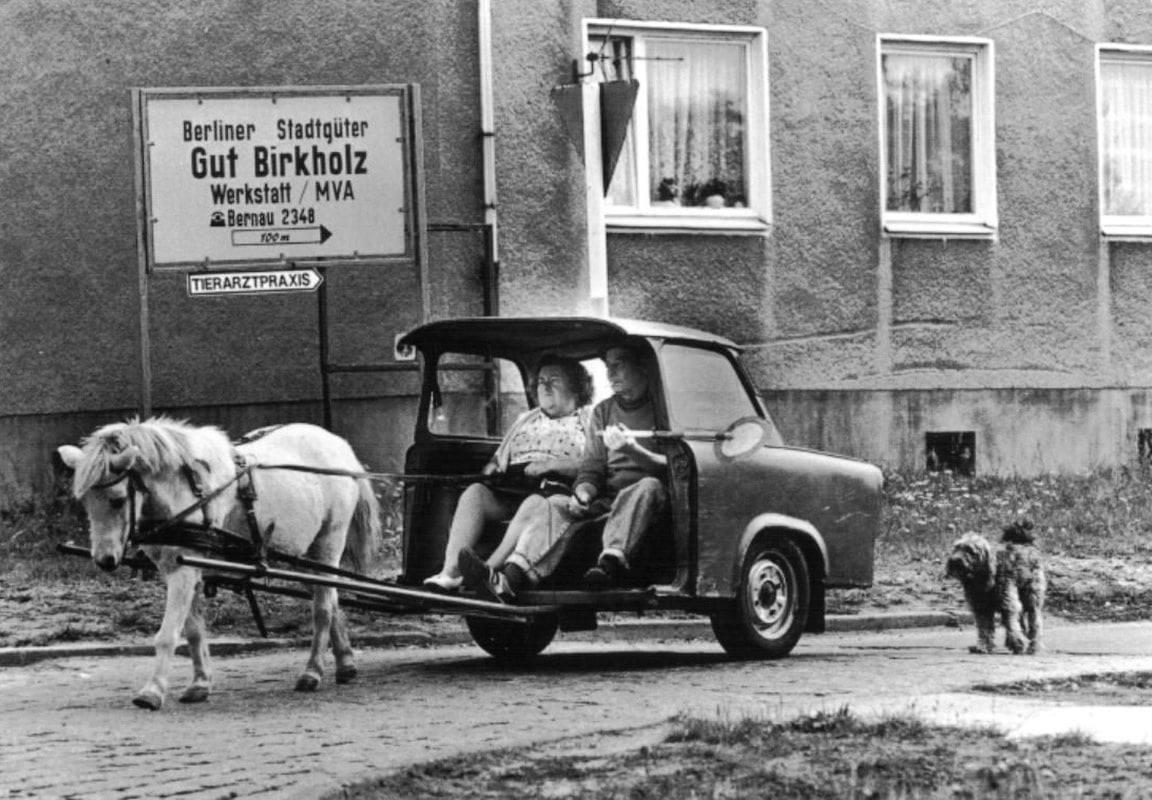
Low-emission Trabant (rated at 1 PP (pony-power)) with driver using semaphore signal to indicate intention to turn left, Barnim district, Bernau bei, Berlin, GDR, 1981.

As late as the 1960s, in some places, trucks & vans still were being built with a hand-operated semaphore mounted on the driver’s door and specialized vehicles likely also to have an occupant on the passenger-side (such as fire-engines) sometimes had two.  If need be they could also be improvised, as in the low-tech “lollipop” sign being used in this image of a two-seater buggy, a vehicle crafted using the salvageable section of a Trabant which may have suffered frontal damage in a crash.  Trabants really could go fast enough to have damaging crashes and although not engineered with the “crumple zones” which were introduced in the West as a way of absorbing an impact’s energy before it reached the occupants, in their own way, crumple Trabants did.  The photograph of the horse-drawn Trubi, while not representative of the entire Eastern Bloc experience under communist rule, captures a sight which would not have been uncommon away from large urban centres (which could be grim enough).  Dr Henry Kissinger (1923-2023; US national security advisor 1969-1975 & secretary of state 1937-1977) said his abiding memory of Eastern Bloc cities was of “the smell of boiled cabbage and an unrelenting greyness.  In fairness, English cooks probably inflicted worse on the noble cabbage than anything done behind the Iron Curtain but his sense of “greyness” was literal, the appalling air pollution of the GDR (its industrial base powered by burning lignite (from the Latin lignum (wood)) and other forms of low-grade, “dirty coal”), thus the griminess of the buildings.  Places like London similarly were affected and it was only after the 1952 “Great Smog of London” that the Clean Air Act (1956) became law, meaning air quality began slowly to improve.  That the photographs of the era look so drab was not because of the film stock; buildings literally were “dirty”.  Because of various other advances in health care, it’s difficult to quantify the contribution to reducing mortality achieved by reducing air pollution but few doubt it was significant.

The Plymouth Satellites

1967 Plymouth Satellite convertible.

Chrysler's Plymouth division introduced the Satellite on the corporation's intermediate ("B") platform in 1965 as the most expensive trim-option for the Belvedere line.  Offered initially only with two-door hardtop and convertible coach-work, the range of body-styles was later expanded to encompass four-door sedans and station wagons.  In a manner, typical of the way the industry applied their nomenclature as marketing devices to entice buyers, the Belvedere name was in 1970 retired while Satellite remained the standard designation until it too was dropped after 1974.

1970 Plymouth Road Runner, 440 Six Barrel.

Were it not for it being made available in 1966 with the 426 cubic inch (7.0 litre) Street Hemi V8, the Belvedere and Satellite would have been just another intermediate but with that option, it was transformed into a (slightly) detuned race-car which one could register for the road, something possible in those happier times.  The Street Hemi was an expensive option and relatively few were built but the demand for high-performance machinery was clear so in 1968, Plymouth released the Road Runner, complete with logos (licensed from the Warner Brothers film studio for US$50,000) and a “beep beep” horn which reputedly cost US$10,000 to develop.  The object was to deliver a high-performance machine at the lowest possible cost so the Road Runner used the basic (two-door, pillared) body shell and eschewed niceties like carpet or bucket seats, the only addition of note a tuned version of the 383 cubic inch (6.3 litre) V8 engine; for those who wanted more, the Street Hemi was optional.  Plymouth set what they thought were ambitious sales targets but demand was such production had to be doubled and the response encouraged the usual proliferation: a hardtop coupé and convertible soon rounding out the range.

1970 Plymouth Hemi Road Runner Superbird.

The option list later expanded to include the six-barrel version which used the of the 440 cubic inch (7.2 litre) V8, a much cheaper choice than the Street Hemi and one which (usually) displayed better manners on the street while offering similar performance until travelling well over 100 mph (160 km/h) although it couldn't match the Hemi’s sustained delivery of top-end power which, with the right gearing, would deliver a top speed in excess of 150 mph (240 km/h), something of little significance to most.  However, by the early 1970s sales were falling.  The still embryonic safety and emission legislation played a small part in this but overwhelmingly the cause was the extraordinary rise in insurance premiums being charged for the high-performance vehicles, something which disproportionately affected the very buyers at which the machines were targeted: single males aged 19-29.  However, the platform endured long enough to provide the basis for the Road Runner Superbird, a “homologation special” produced in limited numbers to qualify the frankly extreme aerodynamic modifications for use in competition.  At the time, the additions were too radical for some buyers with dealers unable to find buyers forced to convert the things back to standard specifications just to shift them from their lots.  They’re now prized collectables, the relatively few with the Street Hemi especially sought.

As a footnote, corporate stablemate Dodge called their six barrel 440s the "Six Pack" (which was a much snappier name) and in the UK this was in 1972 picked up by Jensen which was able to buy (at a bargain price) a tranche of the engines Chrysler had stored in a warehouse after US emission regulations rendered them unlawful for road-registered passenger vehicles.  Jensen called the model created the "Interceptor SP" but it proved an unfortunate experience for both company and customers for while the engine delivered a lift in performance, for a variety of reasons it was, in that configuration, not suitable for the car (or its target market) and a number had to be converted to use the standard Interceptor's single four barrel carburetor.  Its brief existence did though produce something for the automotive trivia buffs: While the accepted orthodoxy is "the factory never installed air-conditioning (AC) in any car fitted with the six barrel 440s or the Street Hemi", strictly speaking that applies only to "No Chrysler factory ever installed..." because Jensen did so equip the SP.  More exclusive still was the single Street Hemi-powered Hai built in 1970 by the much-missed Swiss boutique operation Monteverdi, also with AC. 

1971 Plymouth Hemi Road Runner.

The intermediate line was revised in 1971 using the then current corporate motif of “fuselage styling” and it was probably more aesthetically pleasing there than when applied to the full-sized cars which truly were gargantuan.  The 1971 Satellites used distinctly different bodies for the two and four-door models and while there were no more convertibles, the Street Hemi and Six-Barrel 440 enjoyed a swansong season although sales were low, the muscle car era almost at an end.  Although the Hemi had outlived its corporate usefulness, Chrysler had planned to continue to offer the triple carburetor option on the 440, glossy sales brochures for the Plymouth Six Barrel and Dodge Six Pack printed before it became clear the configuration could not be engineered to meet the EPA's (Environment Protection Authority) tightened exhaust emission standards coming into effect on 1 January, 1972.  However, as part of the normal development process, some (a reputed two 1972 Plymouth Road Runner GTXs and six Dodge Charger Rallyes) were completed as "pilot cars" (vehicles in final form sent down the assembly line to ensure there were no quirks in the specification that would either have to be changed to permit mass-production).  These were built in late July or early August 1971 as a "final shakedown" in preparation for the 1972 model season beginning that September.  After the triple carburetor option was cancelled, it wouldn't have been unusual for the cars to have been crushed but nor was it unknown for such things to be sold through "internal channels" (ie well-connect employees, those in the dealer network etc) and at least some of the eight must have escaped the crusher because a one blue and one red 1972 440+6 Road Runner GTXs have been verified, along with one yellow and one red 1972 440-6 Charger Rallyes.  Few corners of the industry have attracted as many tales of "mythical machines" as the original muscle car era but these 1972 triple carburetor 440s have been authenticated as "factory built".