Brougham (prounced broo-uhm,
broom-uhm or broh-uhm)
(1) In
horse-drawn passenger transport, a four-wheeled, boxlike, closed carriage for
two or four persons, having the driver's seat outside.
(2) In
automotive use, an early designation for a car with an open driver's compartment.
(3) In
automotive use, an early designation for a style of coachwork resembling a
coupé but tending to be powered by an electric motor.
(4) In
automotive use, a post-war designation used (mostly in the US) as a model name
(more commonly a sub-name) for luxury versions of mass-produced models.
1849:
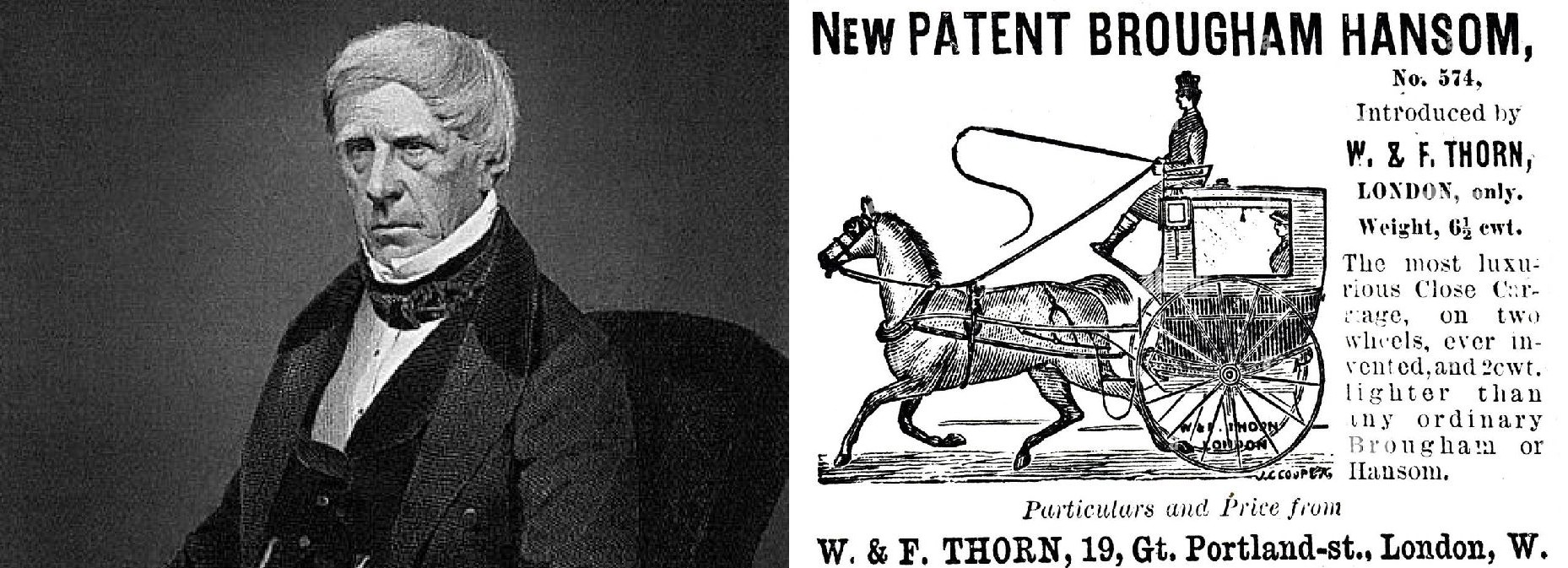
The coach was named after Henry Peter Brougham, (Lord Brougham and Vaux, 1778–1868; Lord High Chancellor of Great Britain 1830-1834) who in 1839 took delivery of one in the style, built to his specifications. Although he would sometimes prove a difficult colleague, Lord Brougham’s
achievements during his political career were notable and it was while he was
Lord High Chancellor the parliament passed both the first Reform Act (1832)
(the first substantial building block that would build the democratic
nature the British political system eventually attained in the twentieth century)
and the Slavery Abolition Act (1833). While Lord Brougham was born in Edinburgh, the surname “Brougham” is of English
origin and thought derived from a place name in Westmorland (now part of
Cumbria, in north-west of England). Genealogists
believe the name was originally locational, the construct from burg (fort or castle) + hām (homestead or village) and thus
understood as “the homestead or village by the fort”. Brougham Manor (purchased by Lord Brougham in
1926) and the nearby Cumbrian village of Brougham have a long association with
the Brougham family. Brougham is a noun, the noun plural is broughams
(initial upper case if used as a proper noun).

The forbidding
visage of Lord Brougham (left) and a mid-nineteenth century advertisement by London coach-builder W & F Thorn (right) for a Hansom Cab based on the brougham's concept, the compact dimensions ideal for European inner-cities, many with districts still built around systems of narrow streets dating from Medieval or even Roman times.
British
Constitution (1844) by Lord Brougham.A sound (though uncompromising) lawyer, Brougham’s
character was something of a curate’s egg, assessments of his time in office a mash-up of terms such as “genius and eloquence” & “most learned”
with “unprincipled
and execrable judgement” & “notorious and reprobate figure”. As Lord High Chancellor (1830-1834), he had a “strained”
relationship with his prime minister (Lord Grey (1764–1845; prime minister of
the UK 1830-1834) and on one occasion took with him on holiday to Scotland the Great Seal
of the Realm (applied to symbolise the sovereign's approval of state documents), his dubious constitutional interpretation being he’d be insulated from dismissal were the seal not to hand in London to formalize the process of his axing. In his well-regarded study British Constitution (1844), he made no mention of the novel theory and nor has anyone since. An often less than convivial colleague, it’s telling that later in life formed a close friendship with the equally uncompromising William Ewart Gladstone (1809–1898; prime-minister 1868–1874, 1880–1885, Feb-July 1886 & 1892–1894). To his supporters, Gladstone was the “G.O.M.” (Grand Old Man), the initialization repurposed by his detractors as “God’s Only Mistake”.
Lord
Brougham’s design was very much to suit his requirements and he drew up the
specifications simply because no coach was then available with the combination of
features he desired. What he wanted was
a compact carriage designed to seat two in an enclosed compartment (the driver sitting outside) with a particular emphasis of ease of ingress and egress. Some subsequent versions would, for occasional use, often include two small, foldable “jump” seats, a concept later included in the rear compartments of many limousines (the vis-a-vis arrangement in those relatively rare). The low mass and easy manoeuvrability
made the brougham ideal for urban use and the style was influential, not only
widely imitated but also productive in that variations (smaller and larger)
appeared and it soon became the preferred middle-class carriage of the
era (think Mercedes-Benz C-Class). It differed from the earlier Hansom
Cab that was even smaller and designed to accommodate strictly two in a cabin often not enclosed, less than ideal in a London winter. The Hansom Cab was
the ancestor of the modern taxi and they were produced almost exclusively for
the use by hire-operators whereas the larger, better appointed brougham was
aimed also at the private market.

Harold Wilson (1916–1995; UK prime minister 1964-1970 & 1974-1976) outside 10 Downing Street with his Rover 3.5 saloon (P5B, 1967-1973, left), the 3.5 coupé with the rakish, lowered roofline (the first of the four-door breed of coupé, centre), and Lindsay Lohan with Porsche Panamera 4S (introduced in 2009 in response to the Mercedes-Benz CLS (2004-2023) that had revived the concept of the "four-door coupé", right). Porsche doesn't use the designation "four door coupé".
Confusingly
for modern audiences, in the nineteenth century, the terms “brougham” and “coupé”
often were used interchangeably. In
English, coupé (often and increasingly as “coupe”) was from the French coupé (low, short, four-wheeled, close
carriage without the front seat, carrying two inside, with an outside seat for
the driver (also “front compartment of a stage coach”)), a shortened form of carrosse coupé (a cut-off or shortened
version of the Berlin (from Berliner) coach, modified to remove the
back seat), the past participle of couper
(to cut off; to cut in half), the verbal derivative of coup (blow; stroke); a doublet of cup, hive and keeve, thus the
link with goblets, cups & glasses.
It was first applied to two-door automobiles with enclosed coachwork by
1897 while the Coupe de ville (or Coup de ville) dates from 1931,
describing originally a car with an open driver's position and an enclosed
passenger compartment.
Brougham moments
1957 Cadillac Eldorado Brougham. Cadillac in the 1950s used "Brougham" as just a model name, the same approach as in 1916 when it had no direct relationship with the historic coach-building styles (although, in the abstract, a historian of coach-building might see some tenuous links).
In the
coach-building business, the critical part of the etymology was “a shortened
form” and the coupé thus came to be understood as a “smaller” version of the
original; originally this meant “shorter” but the industry soon came to use the
term to apply to vehicles which were lower, lighter or in any other way
down-scaled. It’s for this reason the use of coupé
(usually coupe in US use) came during the 1930s to be (sort of) standardized as
a two-door version of a platform which typically appeared also in other forms. Coupes in the US were by the later 1930s
usually enclosed vehicles of a particular style (typically more rakish than
two-door “sedans”) but the English clung more closely to the origin of the word
by coining “fixed head coupé” (the FHC, ie what in the US would be a “coupe” of
some sort) and the “drop-head coupé (the DHC, what would in other places be called
a convertible or cabriolet (though not to be confused with a roadster or
phaeton).

1961 Cadillac Brougham Jacqueline by Pinninfarina.
Named as a homage to the style of Jacqueline Kennedy (1929-1994; FLOTUS 1961-1963), Pinninfarina's memorable, one-off, Cadillac "Brougham Jacqueline" presented an extraordinary contrast with the 1961 Cadillac on which it was based. Shown at the 1961 Paris Motor Show, it was a glimpse of what Lancia might have built had they been able to offer 390 cubic inch (6.4 litre) V8s. The subsequent mishandling of the storied Lancia marque, first by Fiat and latterly the muddled minds of the Stellantis conglomerate is a tale mismanagement ranking with the worst of British Leyland's (1968-1986) many bad decisions.
During
the twentieth century, there was significant fragmentation of meaning in the
terms which to coach-builders had once meant something quite specific. By the 1960s, cars sold as coupés could have
four doors and although the earliest versions of these made some
concession to the etymology by being configured with a lowered roof-line, for
others it was just a model name which might be indicative of sleeker lines but
not always and the fate of “brougham” was more quixotic still, eventually for a
time becoming the US industry’s term of choice when wanting to impart the
impression of “up-market”, “luxurious” etc.
That wasn’t something out of the blue because as early as 1916 Cadillac
introduced a model called “Brougham” which owed little to the obvious features
of Lord Brougham’s carriage, the fully-enclosed, four-door Cadillac being now
understood as a saloon, sedan or limousine depending on where one lives. Those things which distinguished Lord
Brougham’s design: (1) the enclosed passenger compartment and (2) the open
section for the driver came instead to be associated with something called the "sedanca de ville" although few of these combined this with any quality of
compactness. Cadillac would from time to
time flirt with the Brougham name but it’s now best remembered for what’s
called “the great Brougham era”. That
term seems to have been invented by Curbside Classic, a curated website a gallimaufry of interesting content, built around the theme of once-familiar
and often everyday vehicles which are now a rare sight until discovered by Curbside
Classic’s contributors (who self-style as "curbivores"), parked next to some curb. These are the often the machines neglected by
automotive historians and collectors who prefer things which are fast, lovely and
rare. According to Curbside Classic, the
“great brougham era” began in 1965 with the release of the LTD option for the
mass-market Ford Galaxie and that approach was nothing new because even the
Galaxie name had in 1959 been coined for a "luxury" version of the Fairlane 500,
a trick the US industry had been using for some time.
For whatever reason, Ford’s LTD in 1965 created what would now be called a
paradigm and it caught not only the public imagination but more importantly convinced
them to spend their money buying one and sales were strong. Profits were also strong because it cost Ford
considerably less to tart up a Galaxie than the premium they charged for the
LTD package (it was originally an option before becoming a separate model line) and the other mass-market players scrambled to respond, the most blatantly imitative
being the Chevrolet Caprice and Plymouth VIP, both released within months of Ford's venture. Of course, Ford, GM (General Motors) and Chrysler all had other brands, the purpose of which once had been to
use the same platform in tarted up form so this internal corporate cannibalization
is an interesting case-study in marketing and it’s worth remembering once
somewhat up-market brand-names like Mercury and Oldsmobile no longer exist. By the standards of Broughams which would
follow, the “luxury” fittings of the LTD were modest enough
but the trend had been started and soon what came to be called the “gingerbread”
was being laid on with a trowel: faux wood (plastic), faux chrome (anodized
plastic), faux silk (polyester brocade), faux wire wheels (these were at least
mostly metal) and that status symbol of the age, the vinyl roof, sometimes with a wholly phoney coat of arms. The first cars actually to wear a “Brougham” badge
seem to have appeared in late 1966 for the 1967 model year and over the decades
there would be literally dozens using the nomenclature, each understood as being
something “more expensive” and therefore “better”.

The 1965 LTD is remembered now for the extra trim and the effect on
the industry but in fairness to Ford, the car benefited greatly from the redesigned
chassis which included coil-spring suspension on all four wheels. There was also much attention (Ford spoke in
terms of man-years) devoted to the then novel art & science of NVH (noise,
vibration & harshness) and fearlessly they advertised the thing as being quieter than a new Rolls-Royce, spending a lot of money (including buying a new Rolls-Royce) to prove exactly that Many probably
thought the claim mere puffery but Ford had hired acoustic
engineers who installed their equipment, ran their tests and confirmed the Ford was indeed quieter at a number of speeds. As a piece of marketing, the
extra trim proved quite an enticement and LTD buyers, although they got as
standard a 289 cubic inch (4.7 litre) V8 and automatic transmission, got little
else and many ticked the boxes on the option list, adding features such as power
brakes, power steering, brakes, electric windows and even air-conditioning,
then a rarity. Once all those boxes had been ticked, it wasn’t uncommon for LTDs
to be sold for more than the cost of many a nominally up-market Mercury and
even the cheapest Lincoln could be remarkably close in price. So it was all a matter of what one wanted from life: A "loaded" air-conditioned Ford with all the accessories, a less well-equipped Mercury or the most basic Lincoln lacking many of the well-optioned LTD's amenities?

1994 Mercedes-Benz E 500 Limited.
The
Ford Motor Company seems never to have discussed the meaning of “LTD” and the
consensus is it was probably an attempt to summon in buyers’ minds the idea of “Limited
Edition” and thus impart a hint of exclusivity.
Over the years there were suggestions it stood for “Lincoln Type Design”,
“Luxury Trim Decor” or “Limited Trim Design” but there’s no evidence to support
any of these and “LTD” came to be understood (in the US & Australia) as “a
fancy Ford” of the type which would come later to be described as “blinged up”. Among mechanics at the time, the joke was LTD
stood for “Lots of Tin from Detroit” and the more erudite used “Lots of Tin from Dearborn” (Dearborn the suburb in
Detroit, Michigan where Ford was headquartered). There was also a Mercedes-Benz commonly
referred to as the “E 500 Ltd” although the factory only ever used the word “Limited”. It had been intended to offer the model as a
genuine “limited edition” with a run of 500 planned but although the most
expensive of the anyway costly 5.0 litre (303 cubic inch) version (500 E (1991-1993)
& E 500 (1993-1995)) of the W124 sedans (1958-1995), such was the demand
951 “Limited” editions left the line.
Very much in the tradition of the old 300 SEL 6.3 (1967-1972) the E 500
probably was the company’s best ever high-performance sedan and if that wasn’t
enough, the “Limited” could be optioned with the E60 package which included a 6.0
litre (364 cubic inch) V8.

1968 Holden HK Brougham (left) and 1970 Holden Premier (right).
The
Holden Brougham (1968-1971) was not so much a landmark of the era as a
cul-de-sac but it did indicate how quickly the “brougham” label had come to be
associated with prestige and, like Chevrolet’s Caprice, the Brougham was a
response to a Ford. In Australia, Ford
had been locally assembling the full-sized Galaxies for the government and executive markets but tariffs and the maintenance of the Australian currency peg at US$1.12 meant
profitability was marginal, so the engineers (with a budget said to be: "three-quarters of four-fifths of fuck all") took the modest, locally made
Falcon, stretched the wheelbase by five inches (125 mm), tweaked the front and
rear styling (the changes, although hardly radical, resulted in a remarkably different look),
added some bling (though that word was not then in use) and named it Fairlane.
The Fairlane name was chosen because of the
success the company had had in selling first the full-sized US Fairlanes
(nicknamed by locals as the “Tank Fairlane” because whatever its other virtues it was big) between 1959-1962 and later the smaller version (1962-1965) which Robert McNamara (1916–2009 and briefly the president of Ford Motor Company before serving as US Secretary of Defense (1961-1968) under John Kennedy (JFK, 1917–1963; POTUS 1961-1963) & Lyndon Johnson (LBJ, 1908–1973; VPOTUS 1961-1963 and POTUS 1963-1969)) described as "the size of car Americans should be driving". In that at least McNamara was right and what came in the 1960s to be called the "intermediates" (ie between the "compact" & "full-size" lines) proved a sweet spot in the market; the intermediates were essentially the size of the "standard" US automobile before the breed became oversized in the mid-late 1950s. The Australia Fairlane was for decades a successful and profitable product and eventually Holden (GM's local outpost) followed the formula but not before the curious diversion of the Brougham. For 1968, Holden chose what even at the time was thought a bizarre approach in trying to match the Fairlane; instead of a longer wheelbase (and thus more interior space), the Brougham was conjured up by extending the tail of the less exalted Premier by 8 inches (200 mm), the
strange elongation a hurried and less than successful response. Unwanted for decades when the could be bought for Aus$250, the handful of surviving Broughams became twenty-first century collectables, advertised for sale at as much as $Aus$90,000, some Holden connoisseurs (as one-eyed a crew as any) even finding a previously undetected elegance in the lines.

1958
Cadillac Series 62 Extended Length Sedan (Body Style 6239EDX, left) and 1958
Cadillac Series 62 Sedan (Body Style 6239, right).
In their defense, Holden could have pointed to a corporate precedent, the 1958 Cadillac range including the “Series 62 Extended Length Sedan”. The Series 62 Sedan was already an impressive 216.8 inches (5.5 m) long but the Extended Length version measured an even more imposing 225.3 (5.7), the additional 8.5 inches (216 mm) all in the rear deck, creating a more capacious trunk. There can’t have been many Cadillac buyers with that much luggage (although, impressionistically, golf club car parks did suggest there would be those for whom the ability to carry several sets of clubs might be compelling) but the new model did attract buyers, either despite or because of the healthy industry in jokes about Mafia functionaries and other figures in organized crime grateful finally to have more space to transport the bodies. Unfortunately for Cadillac, there were only so many golfers and Mafia hit-men and despite 20,952 of the 103,455 (excluding Eldorados and “chassis only” sales) Series 62s produced in 1958 being the Extended Length Sedan (some 20%), it proved a single-season one-off which perhaps should have been a warning to Holden.

Cadillac's
other take on the “long & slightly less long” of it: 1963 Cadillac Four-Window Sedan De Ville (Body
Style 6239, left) and 1963 Cadillac Sedan De Ville Park Avenue (Body Style 6389, right).
Strangely, Cadillac’s
next venture in rear-deck management went the other way, “short deck” versions
of certain models offered between 1961-1963, the things created by removing 7
inches (178 mm) of aft bodywork, the effect more noticeable for the final
season when the truncation was 8 inches (203 mm). Demand, anyway muted, quickly declined and
there ended Cadillac’s experiments with rear deck length. There was at the time much criticism that “full-size”
US cars had become too big but the “short deck” venture was most un-Cadillac like
and, by international standards, the truck capacity of even the abbreviated models
was still quite generous, able effortlessly to accommodate two sets of gold
clubs, something which later became a de-facto standard in assessing the practicality
of sports cars. Jaguar used this feature
as a selling point when the XK8 (1996-2006) was introduced because it wasn’t possible
with all versions of the old E-Type (1961-1974). For a variety of reasons, by the 1970s, there would be a smaller Cadillac and the first generation Seville (1975-1979) was most accomplished but of the even smaller Cimarron (1982–1988) there are few fond memories. It wasn't that the Cimarron was, by the standards of its time, an especially bad car; it just wasn't "a Cadillac" as that construct was then understood.

1967 Ford GT40 Mark III (left) and 1967 Ford GT40 Mark I (road version, right).
From 1967 there was also a more contemporary example to inspire the antipodean engineers although it’s unlikely it much caught their eye; that was the Ford GT40 (1964-1969), one of the most successful machines in 1960s sports car racing which beat not only the competition but also the attempts by the Fédération Internationale de l'Automobile (the FIA; the International Automobile Federation) to legislate it into un-competitiveness, Then (as now), the FIA was international sport’s dopiest regulatory body. In the happy era when it was possible to make a few minor modifications and register a Le Mans race car for the road, 31 of the 105 GT40s were so configured (even a cigarette lighter was installed) but the driving experience was still very much that of a (slightly) quieter race car, the accommodation cramped, the ventilation marginal and the luggage space fit for little more than a proverbial topless bikini. But some hardly souls bought them because there were few things on the road faster so thoughts turned to making a “more civilized” version with the creature comforts now expected. Thus the 1967 GT40 Mark III with a slightly detuned engine, improved ventilation, a conventional, centrally mounted gear shift, sound deadening, more compliant suspension settings and even a reasonably sized ashtray to compliment the cigarette lighter. However, only seven were built because they cost as much as a middle-class house, were still cramped (with challenging ingress and egress for all but the young or athletic) and in appearance differed in several aspects from the cheaper (Mark I) GT40 road cars still available from John Wyer (1909–1989).

Herbert von Karajan's 1967 Ford GT40 Mark III; of the seven produced, it was one of four LHD (left hand drive) versions. The trunk would have be large enough for his conductor's baton and maybe a little more.
By virtue of the long tail, the Mark III did though have more luggage space (for soft baggage rather than suitcases) and it appealed to some, the most famous purchaser being the Austrian conductor Herbert von Karajan (1908–1989). The Mark III was fitted with additional sound deadening and the exhaust system made the sometimes Wagnerian sound of the 289 cubic inch (4.7 litre) V8 less intrusive but inside it was no Rolls-Royce and certainly not a 1965 Ford LTD (which Ford paid acoustic engineers to prove was quieter than a Rolls-Royce Silver Cloud III) so whether Karajan ever tried to fit a radio or tape deck ("sound-systems would come later) is unlikely. It would anyway have been better to focus on the road because even in its detuned form the GT40 Mark III could be a handful, especially to those unacquainted with the then still novel characteristics of mid-engined road cars although Karajan also for a while drove a Mercedes-Benz 300 SL Gullwing (W198, 1954-1957) so he may have been not unfamiliar with quirky handling. Wisely, he never drove his GT40 on wet roads.

1957 Continental Mark II (left) and 1972
Oldsmobile Ninety-Eight Regency (right). The Continental Mark II (1956-1957) was at the time the most expensive car produced in the US and substantially "hand made" but the relative austerity of the interior compared with the various "broughams" of later decades illustrates how profoundly the manufacturers shaped consumer tastes during the era.
By 1972, there were so many “Broughams” on the
market Oldsmobile must have thought the tag was becoming a bit common so to
mark the company’s 75th anniversary, they called their new creation the “Regency”. Vague as most Americans might have been about
the origin of “brougham”, most probably knew “regency” often had something to
do with royalty so as an associative pointer it was good. The Ninety-Eight Regency in 1972 was however as
audacious as the LTD had half-a-decade earlier been tentative because it seemed
the target was Oldsmobile’s senior stable-mate (two rungs up the ladder in the GM hierarchy), the top-of-the-range Cadillac and
there was nothing in Cadillac’s showrooms which could match the conspicuous opulence
of the black or covert gold “pillow effect”, tufted velour upholstery. Each Regency was registered at Tiffany's which
supplied the specially designed clock and provided the owner with a distinctive
sterling silver key ring; if lost, the keys could be dropped in a mailbox and
Tiffany's would return them to the owner. Take that Cadillac. A limited run of 2,650 75th anniversary
Ninety-Eight Regency cars was built, all of them four-door hardtops and the (non-anniversary)
model continued in 1973. By 1982,
Oldsmobile concluded the message needed again to be drummed into buyers and
introduced the Regency Brougham.

Peak brougham: 1977 Chrysler New Yorker Brougham four-door hardtop.
The high-water mark of the great brougham era was set by the Cadillac Fleetwood Talisman (1974-1976), the Cadillac Fleetwood Brougham D'Elegance (those produced in 1988-1989) and the most expensive cars from Chrysler Corporation (the Imperials and Chrysler New Yorkers) during the last days of the full-sized cars (1974-1978). After this, designers really could go no further in this direction and had to think of something else.