Showing posts sorted by relevance for query Diet. Sort by date Show all posts

Sunday, June 21, 2020

Diet

Diet (pronounced dahy-it)

(1) Food and drink considered in terms of its qualities, composition, and its effects on health.

(2) A particular selection of food, especially as designed or prescribed to improve a person's physical condition or to prevent or treat a disease.

(3) Such a selection or a limitation on the amount a person eats for reducing weight.

(4) The foods eaten, as by a particular person or group.

(5) Food or feed habitually eaten or provided.

(6) Anything (food and otherwise) habitually provided or partaken of.

(7) To regulate the food of, especially in order to improve the physical condition.

(8) Legislative bodies of certain countries.

(9) The general assembly (Reichstag) of the estates of the Holy Roman Empire.

(10) In the law of Scotland, the date fixed by a court for hearing a case.

(11) In the law of Scotland, a single session of a court.

(12) In microbiology, the abbreviation of Direct Interspecies Electron Transfer.

1175-1225: From the Middle English diete or dieten (pittance, fare) and the Old French diete (diet, pittance, fare), from the Medieval Latin dieta (parliamentary assembly (also "a day's work”; daily food allowance, food) from diaeta (prescribed way of life) from the Ancient Greek díaita (way of life, regimen, dwelling), from diaitan & diaitasthai (separate, select (food and drink) which later had the sense “to direct or lead one's life”), frequentative of diainysthai (take apart), the construct being dia (apart) + aita (akin to aîsa share, lot) from ainysthai (take), from the primitive Indo-European root ai- (to give, to allocate).

As a verb, diet began its evolution to the current modern meaning from the late fourteenth century with a range of meanings such as “customary way of eating", "food considered in relation to its quantity and effects" & "a course of food regulated by a physician or by medical rules", the latter often a restriction of food or certain foods, hence the sense of “putting someone on a diet” which was attested by the 1650s in the sense of the specific meaning "to regulate oneself as to food" and applied especially against growing fat; from here came “dieted” & “dieting”.  A long obsolete word for this was banting (an early system for weight loss through diet control, named after its inventor, William Banting (1797-1878), the English undertaker(!) who self-tested the programme and advertised it in his 1863 pamphlet: Letter on Corpulence, Addressed to the Public").  The undertaker lived a long life and was inspired to enter the embryonic field which would become such a huge industry because, in the course of his work, he noted, impressionistically, a striking correlation between obesity and those who died young.  Because of the linguistic coincidence, although the word is a surname, it was used as a verbal noun as in “she needs to start banting".  The system was similar to some modern diet advice in that it advocated eating lean meats and limiting the intake of fat, starch, and sugar.

As a noun applied to legislative bodies (assembly of delegates, etc., held from day to day for legislative, political, or other business), it came into use in the fifteenth century, the Medieval Latin diēta (public assembly) apparently the same word as Latin diaeta, from the Ancient Greek diaita (way of life, regimen, dwelling) but associated with Latin dies (day).  Technically, diēta was a variant of diaeta (daily office of the Church) most often translated as daily duty or an assembly or meeting of counsellors.  In Latin diēta meant also "a day's work, diet, daily food allowance", derived from diaeta (prescribed way of life), from the Greek diaita and the best-known early assemblies were the German and Austrian of the Holy Roman Empire, “diet” used as a descriptor by both French and English authors.  The (now rare) adjective dietal (pertaining to a diet in the “assembly” sense) entered the language in 1845.
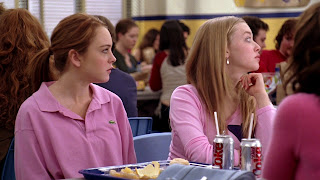
Product placement: Diet Coke in Mean Girls (2004).

The verbal noun “dieting” from the verb diet was first noted circa 1400 and the first practicing (or at least one advertised as such) dietician (one who practices some theory of diet) dates from 1845, from the noun diet on the model of physician, replacing the older dietist from circa 1600 although it seems curious dietist hasn’t been picked up as an Instagram niche; one can hardly think of a better tag for many an influencer.  The adjective dietary (pertaining to diet) is from the 1610s, from the Medieval Latin dietarius, from the Classical Latin diaetarius.  The old adjectives are listed by dictionaries thus: diætetic (archaic), dietetical (dated) and dietetic (obsolete).  All meant “pertaining to the rules for regulating the kind and quantity of food taken” and again were from the diaeteticus, from the Ancient Greek διαιτητικός (diaitētikós).  The adjective “diet” as a trade-name meaning (or at least implying) “slimming, having reduced calories” was first used in the US in 1958 when the Diet Rite soft drink was released, its novelty being sugar-free and the Coca-Cola Company responded in 1963 with the similar Tab which remained available in a gradually dwindling number of markets until 2020.  Interestingly, the Coca-Cola Company which since 1983 had been selling Diet Coke, discovered from its extensive market research that “diet” was off-putting to male consumers and thus in 2005 released Coca-Cola Zero though they must have though consumers just didn’t get it because in 2017 it was re-named Coca-Cola Zero Sugar.

Japanese Diet: Upper (2013 & 2016) and Lower House (2017) Election Results

Elections for the lower house (House of Representatives) of the Japanese diet became rambunctious sometime in the 1950s but those for the upper house (House of Councillors) were usually rather sleepy affairs which seemed to matter little until, in retrospect, the polls of 2013 and 2016 seemed to assume an unexpected importance after the Liberal Democratic Party’s (LDP) unexpectedly decisive victory in the 2017 (lower house) general election.  What the 2017 landslide meant was that Prime Minister Shinzo Abe’s (b 1954; Prime Minister of Japan 2006-2007 & 2012-2020) LDP suddenly enjoyed a two-thirds majority in both houses, a type of control of the legislature called a supermajority, giving Mr Abe the legal means, if perhaps not a mandate, to attempt to amend Japan’s pacifist constitution which had been a long-held ambition of members of certain LDP factions.

Adopted in 1947 when Japan was under US occupation, the constitution has ensured Japan’s so-called Self-Defense Forces have never been deployed in combat although successive LDP administrations have for decades stretched policy well-beyond what the constitution technically permits.  The critical matter is Article 9 of the constitution which prohibits war as a means to settle international disputes and its repeal would be controversial in the region where the conduct of Imperial Japan’s military remains in living memory.  Nor is it universally popular at home, some fearing a government might be tempted by risky military adventurism.  However it’s analyzed, the people of post-war Japan have done very well out of their “pacifist” constitution and even with his double-chamber supermajority, constitutional revision was no simple thing, a change requiring a national referendum and the opinion polls indicated there was no certainty voters would approve what would have been the be the first change to the document which has been the nation’s basic law for some seventy-five years.  It is now the world’s oldest, un-amended constitution.

Under the terms of Article 9, the Japanese people “…forever renounce war as a sovereign right of the nation and the threat or use of force as means of settling international disputes".  That would seem to make illegal the waging of offensive war, confirmed by the phrase “The right of belligerency of the state will not be recognized” but Article 9 also stipulates "…land, sea, and air forces, as well as other war potential, will never be maintained".  Article 9 needs obviously to be read in conjunction with more recent documents, given the Japan Self-Defense Force (JSDF) consists of: Ground Self-Defense Force (Rikujou Jieitai, GSDF; includes aviation), Maritime Self-Defense Force (Kaijou Jieitai, MSDF; includes naval aviation), Air Self-Defense Force (Koukuu Jieitai, ASDF); Japan Coast Guard (Ministry of Land, Transport, Infrastructure and Tourism) (2021) with an establishment of approximately 240,000 active personnel (145,000 Ground; 45,000 Maritime; 45,000 Air; 4,000 Joint Forces); 14,000 Coast Guard (2021).

JSDF helicopter carrier Hyūga (DDH-181) on exercises with a US carrier strike group.  Listed as an escort ship according to JSDF naming conventions, the two Hyūga-class carriers are the largest largest ships commissioned by the Japanese navy since the Second World War.

The emphasis admittedly is certainly on self-defense because the official overseas deployment in January 2022 stood at 175, all attached to the US base in Djibouti (2021).  Still, most analysts rate the JSDF as the fifth most powerful (in non-nuclear capability) military on the planet so the idea that “…land, sea, and air forces, as well as other war potential, will never be maintained” clearly needs a bit of mental gymnastics to be understood.  Indeed, in the years immediately after Japan regained its sovereignty in 1954, some black-letter law judges in lower courts felt compelled to declare the JSDF unconstitutional but appellate courts found a number of ways to rationalize matters and have always regarded it as a political matter, declining to be involved and in recent years it’s never been tested.  Political it certainly is, the US, authors of Article 9 (in the years before the Chinese Communist Party (CCP) conquered mainland China), soon began to review its position, re-equipping the embryonic forces which would become the JSDF, the constitutional constraints apparently no impediment.  In the years since, the US has more than once encouraged Japan to amend Article 9, the Pentagon not unhappy at the thought of the JSDF’s impressive capabilities being able to augment US forces in overseas deployments.  Those capabilities may be more impressive still, some analysts claiming the country has the capacity to commission and equip existing delivery systems with nuclear warheads within weeks or even days, depending on who is running the numbers.  According to some, lurking deep in (the inevitably secret underground) bunkers, the warheads lie in an almost complete state, awaiting only the placement of the weapons-grade plutonium.  A marvelous conspiracy theory, no evidence has ever been presented other than the circumstantial matters of technical capability and a supposed ability use the capacity of the local nuclear industry for the purpose.  It became an especially interesting theory after the passage of a “Regional Affairs” law in 1999 which permitted Japan automatically to participate as "rear support", were the US to be engaged in armed conflict involving "regional affairs”.  Nobody has ever suggested the South China Sea is anything but a “regional affair”.

Neither Beijing nor Seoul have suggested Tokyo is planning a second attempt at an East-Asia Co-prosperity Sphere but a change meaning Japan can again declare or wage war remains controversial at home and abroad although given how the force has evolved since 1954 and the doubtless ability of Japanese governments to be most expansive in just what “regional” means, the status of Article 9 may be less significant than once it appeared.  As things transpired, the implications of Mr Abe’s rare dual chamber supermajority remained unexplored and he retired from office in 2020 as Japan’s longest-serving prime-minister.

In praise of dieting: Lindsay Lohan before and after.

Thursday, March 26, 2020

Macro

Macro (pronounced mak-roh)

(1) Anything large in scale, scope, or capability.

(2) In the colloquial language of economics, of or relating to macroeconomics.

(3) In computing, an instruction that represents a sequence of instructions in abbreviated form (also rarely called macroinstruction) or a statement, typically for an assembler, that invokes a macro definition to generate a sequence of instructions or other outputs.

(4) In photography, producing larger than life images, often a type of close-up photography or as image macro, a picture with text superimposed.

(5) As the acronym MACRO, the Museum of Contemporary Art of Rome (Museo d'Arte Contemporanea di Roma).

1933: A word-forming element from the Ancient Greek μακρός (macros), a combining form of makrós (long), cognate with the Latin macer (lean; meagre) and from the primitive Indo-European root mak (long, thin); now a general purpose prefix meaning large.  The English borrowing from French appears to date from 1933 with the upsurge in writings on economics during the great depression.  It subsequently became a combining form meaning large, long, great, excessive etc, used in the formation of compound words, contrasting with those prefixed with micro-.  In computing, it covers a wide vista but describes mostly relatively short sets of instructions used within programs, often as a time-saving device for the handling of repetitive tasks, one of the few senses in which macro (although originally a clipping in 1959  of macroinstruction) has become a stand-alone word rather than a contraction.  Other examples of use vis-a-vis include macrophotography (photography of objects at or larger than actual size without the use of a magnifying lens (1863)), macrospore (in botany, "a spore of large size compared with others (1859)), macroeconomics (pertaining to the economy as a whole (1938), macrobiotic (a type of diet (1961)), macroscopic (visible to the naked eye (1841)), macropaedia (the part of an encyclopaedia Britannica where entries appear as full essays (1974)), macrophage (in pathology "type of large white blood cell with the power to devour foreign debris in the body or other cells or organisms" (1890)).

Dieting and the macro fad

In the faddish world of dieting, the macrobiotic (macro- + -biotic (from the Ancient Greek βιωτικός (biōtikós) (of life), from βίος (bios) (life)) diet is based on the precepts of Zen Buddhism.  It’s said to seek to balance what are described as the yin & yang elements of food and even the cookware used in its preparation.  The regime, first popularised by George Ohsawa san (1893-1966) in the 1930s, suggests ten food plans which, if followed, will achieve what is said to be the ideal yin:yang ratio of 5:1.  Controversial, there’s no acceptance the diet has any of the anti-cancer properties its proponents often claim beyond that expected if one follows the generally recommended balanced diets which differ little from the macrobiotic.  It was Ohsawa san's 1961 book Zen Macrobiotic which introduced the word to a wider audience although he acknowledged the system had been practiced in Germany in the late eighteenth century.

In macro: Lindsay Lohan's left eye.

A later fad, macronutrients, is distinct from macrobiotics and describes another form of a balanced diet, the three classes of macronutrients being the familiar proteins, fats, and carbohydrates.  The macro diet puts a premium on whole rather than processed foods and requires calorie counting because of the need to track intake and maintain the metrics within a certain range.  Where the macro diet differs is that the metrics vary between individuals rather than requiring conformity to the unchanging yin:yang ratio .  Depending on factors such as body type, life-style, age and health, a nutritionist will construct a target macro ratio (eg 40% carbohydrates, 40% protein and 20% fat) although that may change depending upon outcomes achieved.  The pro ana community seems to view the macrobiotic diet with uninterest rather than scepticism, noting it’s optimised around a concept of balance rather than weight-loss and, while perhaps useful in some aspects, is just another fad diet and that’s fine because, if followed, all diets probably work but for pro ana purposes there are better, faster, more extreme ways.

Macrophotography (also known as photomacrography, macrography or macro-photography) is a specialised niche in imagery, usually in the form of close-up photographs of small subjects, typically living organisms like insects, the object being to create an image greater than life size.  The word is used also by processing technicians to refer to the creation of physically large photographs regardless of the size of the subject or the relation between subject size and finished photograph.

When macro photography depended on a camera with a macro lens committing images to film stock, it was a genuinely specialised skill.  Now, advances in the sensor technology used in small, general purpose digital cameras mean anyone can produce raw images very close to those attainable using a DSLR (digital single-lens reflex) or SLR (single-lens reflex) with a true macro lens and editing software exists to enhance the images.  The emergence of very high definition (8K+) OLED (organic light-emitting diode) televisions in sizes larger than human beings has introduced a new subset to macrophotography for home use.  The 8K devices are currently available in sizes up to 150" (3.8m) and the technology exists to join together edgeless screens to create one vast panel, the size limited only by the software support.

Friday, June 19, 2026

Pro-ana

Pro-ana (pronounced pro-anna)

(1) Of or relating to the position anorexia is a legitimate lifestyle choice.

(2) The on-line community advocating this view.  The most uncompromisingly pure among the community actively deny anorexia nervosa is a clinical condition.

(3) A movement for the promotion of behaviors related to anorexia nervosa. 

(4) A member of this movement or one of the related communities.

Circa 1998-2001:  The construct is pro + ana.  Pro was from the Classical Latin prō (in favor of, on behalf of), from the Proto-Italic por-, from the primitive Indo-European pr- & pro.  Ana is a clipping of of anorexia (an(orexi)a), a phonetic diminutive of the 1957 scientific term anorexia nervosa, the construct being the Ancient Greek ν (an) (without) + ρεξις (órexis) (appetite, desire) + the Latin nervōsa (nervous).  The clipping of "anorexia" was created both as verbal shorthand and coded language (so the matters of diet and related matters could be discussed without the risk of "outsiders" understanding.  "Ana" was thus a form of personification and a "cover", the outsiders hopefully assuming a young lady named Anna was being spoken of.  Pro-ana is a noun; the noun plural is pro-anas.

Only a matter of time: Lonaniana.

Ana in this context is thus obviously unrelated to the suffix -ana (familiar in forms such as “Victoriana” (of the era of the rein of Victoria (1819–1901; Queen of the UK 1837-1901)), “Americana” (of matters specific to US culture, politics etc), Holmesiana (memorabilia or writings related to the fictional detective Sherlock Holmes created by Sir Arthur ConanDoyle (1859–1930)) etc) that became popular after being adopted in continental literature.  It was from the Latin -āna (neuter plural of –ānus (feminine -āna, neuter -ānum) and was applied to create formations meaning “of or pertaining to”.  In English the specific sense originally was “a collection of things that relate to a specific place, person etc”; the suffices -ic & -ica now fulfil a similar function.  All formations created by appending –ana are pluralia tantum (from the Latin plūrāle tantum (plural as such; plural only); the term describes a noun (either in certain or all its senses) that does not generally have a singular form.  In his A Dictionary of the English Language (1755), Samuel Johnson (1709-1784) defined the suffix thus: “Books so-called from the last syllables of their titles; as Scaligerara, Thuaniana; they are loose thoughts, or casual hints, dropped by eminent men, and collected by their friends.  An early exemplar was Thraliana, something of a gallimaufry of diary entries, jokes, poems and anecdotes, complied between 1776-1809 by Dr Johnson's dear friend by Mrs Hester Thrale (1741-1821) although those wanting something meatier will more enjoy the two volume Addisoniana (1803), a two-volume biographical and anecdotal anthology of the writings and conversations of the English essayist politician Joseph Addison (1672-1719), compiled and edited by Sir Richard Phillips (1767–1840); it’s a fine relic of a troubled time.

Palindromic elements: A collection of material relating to pro-ana would properly be titled “Pro-anaiana”.

Dr Johnson’s notion of “loose thoughts, or casual hints, dropped by eminent men, and collected by their friends” is familiar also as “table talk”.  Table talk literally is conversation (especially if informal or gossipy) among a group seated together for a meal or other social activity.  The point about table talk is it’s held to represent an individual’s “true” thoughts in unvarnished form (ie not “sanitized” for public consumption and for that reason the table talk of the illustrious or infamous often attracts interest when assembled and published.  However, such collections rarely are true transcripts and even if not deliberately misleading in that what can appear can be a verbatim account of what was spoken and an accurate summary of views and opinion, much can be lost in the transcription.  Classic examples of the difficulties historians encounter in the absence of audio recordings are the several editions of Tischgespräche im Führerhauptquartier (Table Talks at the Führer's Headquarters), published between the 1950s and 1980s, containing what were alleged to be transcriptions of (mostly) monologues delivered by Adolf Hitler (1889-1945; Führer (leader) and German head of government 1933-1945 & head of state 1934-1945) to guests at his lunches or dinners between 1941-1944.  As well as being edited at the time they were written, Albert Speer (1905–1981; Nazi court architect 1934-1942; Nazi minister of armaments and war production 1942-1945) pointed out the printed copy omits so much of the repetition, pauses and linguistic stumbles that could make meals with Hitler “stiflingly boring” for “the regulars who’d heard it all, many times before”.

Etymologists are inclined insist the correct form can be only "pro-ana" and there are traditions in English which supports this but the community itself uses ana, pro ana and proana interchangeably, the most common form the short-form ana, following the practice with anorexia nervosa which is truncated to anorexia in all but formal academic or clinical work.  Over two-odd decades, pro-ana has also spawned words such as thinspiration (often clipped to thinspo) and thinology, used to describe specialized editorial content of the calling; the much less-used term pro-mia referring to bulimia nervosa.  Pro-anas are purists who maintain high-standards; those who aspire to the anahood but in some way fail are dismissed as wannarexics.

Lindsay Lohan wearing (non-ana) red wrist-string.

The ana's standard means of social identification is a simple, beaded red bracelet, the beading of some significance because variations of red bracelets, some as simple as a wrist-string, have long been used by many cultures, usually with some sort of link to the idea of a good-luck charm.  Famously, a חוט השני (the khutt hasheni, a thin scarlet or crimson string) is sometimes worn as Jewish folk custom as a way to seek protection from those misfortunes which may be aimed at one by the עין הרע (evil eye).  It's most associated with the Kabbalah sect and Kabbalic scholars say there's nothing in ancient Jewish texts about wrist-strings of any color and the "tradition" is a recent folk practice which seems to have begun in the north-eastern United States early in the twentieth century.  Anas thus need always to check for beading before reaching out.

Notes

Although at the time it never reached the critical-mass needed to coalesce into a movement, the pro-ana concept actually pre-dates the web.  Among the bulletin boards the nerdiest connected to with 1200 or 2400 baud modems in the 1980s and early 1990s were both anorexia support boards and those which celebrated the condition but, once the indexed www (world-wide-web) was "bolted-on" to the internet the spread was rapid and, by the mid-late 1990s, pro-ana was global.

Pro-ana content tends to be (1) victim stories, (2) images & clips where ribcages & shoulder blades are often seen and clavicles much admired and (3), lists of helpful tricks and techniques.  Politically, the accepted pro-ana world view is they are not suffering from an illness; ana is a human right, an essential part of their identity and just another lifestyle choice.  As pieces of design, the sites tend to use pre-defined templates and in that are unremarkable although the preponderance of monochromic (in gray-scale) imagery is noted.  The pro-ana sites began to attract wider attention early in the twenty-first century, the irony being that much of the criticism came from the very publications many suggest contribute to eating disorders.  Off and on since then, pressure from the public and anti-ana organizations has compelled many hosts to shut down pro-ana sites although these efforts are Sisyphean, the relocations usually quick.

Sixteen Pro Ana Tips & Tricks for Beginners

If followed with sustained rigor, what's in this list should result in weight-loss and the ability to maintain a lower mass.  If adhered to, there should be no need to resort to using the new generation of GLP (Glucagon-Like Peptide) receptor agonists which, while effective, are (1) expensive, (2) introduce often novel chemicals to the body and (3) don't in all cases mean weight loss will be sustained once the course of treatment stops.  The GLPs should be regarded (like the various surgical options available) as "last resorts" because D&E (diet & exercise) is the better path to follow and the pro-ana path, though demanding, is straight, narrow and well-lit.   

(1) Keep track of your calories.  Set an absolute number and NEVER exceed it while trying always, gradually, to lower the number.  Within the calorie limit, aim for a diet which is 75% leafy-green vegetables & legumes, 20% tart fruit and 5% nuts. Added sugar should be zero because enough is in the fruit but, if absolutely necessary, one daily barley-sugar boiled sweet (taken early) is OK (brush teeth immediately after; as well as good oral practice this will diminish the possibility of the appetite being stimulated).  This diet mix can at the margins be varied but must stay vegan.

(2) Drink lots of water; try to aim for seven litres a day but anything over five is OK.  Being hydrated is anyway healthy and drinking water before taking food helps fill your stomach faster so you’ll eat less.  Remember to not drink a lot of water at once; instead keep hydrated by drinking little amount after every few minutes.  Always drink it as cold as possible, it forces the burning of more calories to restore body temperature.  Unless operating in extreme conditions with high fluid loss, do not go over eight litres a day; water can in extreme case be toxic and death has been reported among those who have ingested around 20 litres (less may be fatal in certain individuals, especially those with a lower body mass, hence the 5-7 litre recommendation). 

(3) Place a full-length mirror in your bedroom and evaluate yourself on daily basis. This is one of the best ways to stay motivated and remember, you’re there to be critical as well as admire.  If you can arrange multiple mirrors to provide for a 360view that's even better because it makes it easier to focus on problem areas (these can persist even as overall weight is falling).  Hanging a thinspiration photograph next to the mirror is recommended. 

(4) Have small meals.  It’s easier for the body to burn three 100 calorie meals than one of 300 and lends your body the illusion you’re eating enough to keep the stomach full, whereas you’re eating less.  Always eat slowly and chew thoroughly, it will hasten the digestive process.  After every meal, brush teeth; again, this is good dental hygiene but with freshly brushed teeth, you'll be less inclined to eat. 

(5) Find an ana-buddy.  The pro-ana routine can be a harsh mistress so an ana-buddy with whom you can talk about your problems and diet related stuff can be helpful but only if they're a kindred spirit.  This works not only by keeping each other motivated but you'll find also you'll teach each other new tricks or exercise routines.  You both must be 100% committed to the system and such noble souls are rare so, if need be, replace them with someone wholly committed.  You're in a war with weight so be harsh and accept only allies who will help in the fight.

(6) With the aggressive pro-ana diet, it’s very important to take vitamin pills.  Research suggests that for most people on what is the orthodox "balanced diet", vitamin supplements are probably unnecessary (some researchers suggest they can even be counter-productive) but because pro-ana doesn't include certain food groups, a daily multi-vitamin is recommended and usually adequate so resist the temptation to take two and do so only if you become light-headed or faint with any frequency; you may need specific additional supplements.  The most publicized deficiency associated with pro-ana is iron and it may thus be necessary greatly to increase the intake of leafy greens like spinach or peas, broccoli & string beans; seeds high in iron include pumpkin, sesame, hemp and flaxseeds.  One's family physician can obtain the tests to determine specific deficiencies and these should be dealt with by adjustment to the diet.  Remember though that doctors are inclined to be dictatorial and the recommended technique to deal with their negativity is just to agree with whatever they say.  Try to appear sincere and be deferential; they like that.   

(7) Avoid butter and oils.  Treat them like sugar or drugs of dependency.

(8) Resist the temptation to smoke or vape.  While it's true some short-term weight loss often is achieved by smoking cigarettes, (1) in the medium-long term weigh-gain is the typical consequence, (2) the nicotine in cigarettes is addictive making it difficult to use tobacco as a short-term or occasional "quick-fix" and (3) it's a carcinogenic product which, on average, appears to reduce life-expectancy by around a decade.  Not enough is yet known about vapes but there are many reports of adverse outcomes, presumed to be a consequence of inhaling that many chemicals.       

(9) Sleep at least eight hours a day, preferably more.  Less sleep means tiredness and hunger and you can’t eat while asleep.

(10) Keep setting a target weight.  Because of fluid retention and other cyclical variations, it’s probably counter-production to set daily targets and a weekly goal is better although true obsessives will monitor at least once and maybe several times a day; this is not discouraged.  To stay motivated, hang on the wall thinspiration photographs of slender models to observe while weighing-in.  Many non-ana diet sites suggest avoiding weighing-in daily and clinically they may be right it achieves little but they just don't understand the nature of obsessions.  Record the weigh-ins so you can chart progress over weeks and months; this requires nothing more demanding than the most basic open-source spreadsheet but math nerds who enjoy such things can do it with pen & paper.  Although for most purposes pencils are better than pens, ink is permanent so it's harder to cheat.  You will be tempted to cheat but you must not; pro-ana does often demand you lie to others but you must never lie to yourself.

Example of a thinspiration photo: Model Lululeika Ravn Liep (b 1998), Cover magazine, February 2015.  Although the use of this image was condemned by the thought police, a true pro-anaite should think: “She could lose a few pounds.

(11)  Do NOT drink any alcoholic beverages; for variety only soda-water or carbonated mineral water are acceptable.  Coffee and tea are good appetite suppressants so drink only black coffee or tea and NO milk or sugar.  Avoid caffeine drinks; either they’ll contain sugar or chemicals about which there exists no reliable research on how they affect the appetite.  Avoid the inherently sweet herbal teas; they do tend to stimulate the appetite in a way black tea and coffee don't.  Black tea and coffee are also useful in training the palette away from sweetness and towards the tart.  After a while, this will start to influence your choice of fruits and vegetables; as a general principle the darker and more bitter in taste, the better.  Care must of course be taken.  In its pure form, caffeine can be fatal in tiny quantities although in the form usually enjoyed (coffee), one would need to drink dozens of cups in a day to approach toxicity.  The French philosopher Voltaire (François-Marie Arouet; 1694–1778) (1694–1778), often at the Café de Procope in Paris, drank a reputed forty-odd cups a day, enjoying it so much he ignored the advice of his doctors to stop.  He lived to 84 but there’s no evidence the often attributed quotation: “It may be poison, but I have been drinking it for sixty-five years, and I am not dead yet” was his.  The more likely source is French author Bernard Le Bovier de Fontenelle (1657–1757) whose actual words were: “I think it must be [a slow poison], for I’ve been drinking it for eighty-five years and am not dead yet.”   Fontenelle died a month short of his hundredth birthday.  The sensible approach is to restrict yourself to one strong (ie short black and such) coffee at the start of the day and otherwise just have cups of weak (even decaffeinated) instant coffee; think of it not as a stimulant but a companion.

(12) Wearing short clothes can be very motivating. Wear short or revealing clothes so when looking at yourself in the mirror it will be obvious there's still work to do, something often disguised by the garments never worn in public.  Wear in private clothes you'd never dare to wear in public and make it a goal to be able to wear them out without looking fat.    

(13) Drink the juice of a squeezed lemon in hot water first thing each morning and last thing each evening; it has the general effect of adding to the stomach acids which break up food.  Because of this acid, always brush teeth afterwards.

(14) If you have to eat in company (it can be unavoidable), wear baggy clothes with big pockets able to be lined with plastic bags.  Then, when no one is looking, you can dispose of food and people will think you eat normally.  It sounds a difficult thing surreptitiously to manage and to start with it will be but you’ll learn to adopt techniques like always sitting in a corner or at the end of the table and soon become an expert.  It's easier than it sounds.

(15) Exercise every day.  Gyms are optional because you can do even better with ana-specific routines such as running up stairs or hills, both of which have an extraordinary multiplier-effect on whatever distance is achieved.  Unlike gyms, it's also free; remember the goal is weight-loss, not abstractions such as muscle tone or fitness.  If possible, exercise in darkness to avoid sun exposure; if this is not possible (and there may be good reasons to restrict this to daylight hours) cover as much skin as possible with protective clothing and use the highest available SPF (sun protection factor) sun-block lotion, wear a wide brim hat and never forget the sunglasses.  Never use elevators and escalators; always take the stairs.  Wherever possible, replace travel by cars, trains and busses with walking or biking.  This is also good for the planet which is the only one we have.

(16) Eat ice; ice can be an alternative to a meal, it really works.  Shaved ice is best because it avoids dental damage; there are many things to consider when eating ice and curiously, sometimes it's advantageous to take more, sometimes less.  For a discussion on the mechanics of ice-eating: The eating of ice

Anorexia nervosa was included in the (1952) first edition of the American Psychiatric Association's (APA) Diagnostic and Statistical Manual of Mental Disorders (DSM) as a psycho-physiological reaction. The DSM-II (1968) moved it to Special Symptoms–Feeding Disturbances and in 1980, a new eating disorders section was created for the DSM-III.  The most significant structural change came in 1994 when in DSM-IV the condition was afforded its own section.  The DSM-5 (2013) relaxed some of the diagnostic criteria including, for the first time, rendering it all entirely gender-neutral, a gesture to conform with practices elsewhere rather than anything suggesting clinical experience was noting a greater gender-spread in the patient count.  Announcing DSM-5, the board noted it wished to reduce the number of patients in the former EDNOS (Eating Disorder Not Otherwise Specified) category, now reclassified as the OSFED (Other Specified Feeding or Eating Disorder) group.  Thus the psychiatrists staked their claim in this low-cal demarcation dispute by capturing the wannarexics.

Friday, April 3, 2020

Cormorant

Cormorant (pronounced kawr-mer-uhnt)

(1) A large, black swimming and diving bird, any of several voracious, totipalmate seabirds of the family Phalacrocoracidae, as Phalacrocorax carbo, of the Americas, Europe, and Asia, having a long neck and a distensible pouch under the bill for holding captured fish: used still in China (with a restrictor-band on the throat to prevent the swallowing of larger fish) for catching fish.

(2) A greedy person or organization; a voracious eater; a glutton; by extension it has been used to describe thing which consume on a grand scale (blast furnaces etc).

1300-1350: From the Middle English cormera(u)nt, from the twelfth century Old French cormarenc & cormareng (source also of the Modern French cormoran), from the Late Latin corvus marinus (sea raven; translated by some Medieval writers as “the sea mare”) + the Germanic suffix –enc, the -t in English exists probably because of confusion with words including -ant.  The birds are proverbially voracious, hence the word has been applied to greedy or gluttonous persons since the 1530s.

Thought remarkable for the number of fish it can eat in a single session, the water bird has since antiquity been associated with voraciousness.  In literature, as imagery to represent gluttony and greed, the cormorant figured as Satan in Milton’s Paradise Lost and represented the insatiable rapacity of time in Shakespeare’s Love’s Labour’s Lost (1:1).

Let fame, that all hunt after in their lives,
Live register'd upon our brazen tombs
And then grace us in the disgrace of death;
When, spite of cormorant devouring Time,
The endeavor of this present breath may buy
That honour which shall bate his scythe's keen edge
And make us heirs of all eternity.

The Consequences of Cormorancy

Barnaby Joyce (b 1967; Deputy Prime Minister of Australia variously 2016-2018 & since June 2021).

What is described variously the obesity problem, crisis or epidemic, in 2016 attracted the concern of noted fitness advocate, Australia’s deputy prime-minister, Barnaby Joyce.  In response to suggestions the imposition of a tax on sugar, thereby raising the price of sugary drinks, could be part of a strategy of amelioration, Mr Joyce said the increasing obesity of Australians was caused by people sitting on their backsides” and “eating too much food, adding that the National Party would never support such a tax.  If you want to deal with being overweight, here's a rough suggestion, stop eating so much and do a bit of exercise Mr Joyce was quoted as saying, adding it was not the job of the taxation office to promote healthy lifestyles.  Perhaps sensing a plot by a lean, Green Party-voting, inner-city elite, Mr Joyce said it was objectionable the suggested impost would apply to soft drinks but not lattes.

Portion control, two slices at a time.  Barnaby Joyce taking morning tea.

A Grattan Institute (a think-tank that tends to neutrality) report delivered to government recommended a sugar content tax of 40 cents per 100 grams of sugar on water-based, non-alcoholic, sugar-sweetened beverages which, if imposed, it estimated would increase the average cost of a two litre bottle of soft drink by about 80 cents, assuming the producers passed the increase to the consumer.  The institute’s modelling suggested this would reduce overall consumption of sugar contained in soft drink by around 15 per cent.  Mr Joyce seemed not persuaded by the research, arguing that rather than taxes to discourage consumption, the solution was for people to try “…jumping in the pool and going for a swim and when ordering food, “…reducing your portion size.

Portion control, one fish at a time.  A cormorant taking morning tea.

In an indication Mr Joyce may be right the whole thing is a plot by a mineral water quaffing urban elite to deny simple country folk their humble lemonade, the Green Party quickly issued a statement saying they would push for a parliamentary inquiry into the rise of obesity and whether a sugar tax on soft drinks is one way to combat the problem.  When asked about the tax, the Green’s leader said if the government didn't act, his party would introduce a private member's bill for a sugar tax.  There is empirical evidence to suggest sugar taxes do work to reduce consumption.  The UK imposed a two-tiered system, graduated according to the sugar content and this had the effect of reducing the quantity of sugar in soft drinks purchased by households by 10% while maintaining aggregate sales at existing levels.

George Christensen (b 1978; member for Dawson (Queensland) since 2010).

The political economy of the UK however differs from Australia where some politicians, not always with safe margins, represent seats where the sugar industry is a significant source of employment and industrial activity.  In the UK, the nature and distribution of its sugar beet sector means it’s less able to generate fear among politicians fearing the loss of their seats if industry-specific taxes are imposed.  Although it wasn't clear if his parliamentary colleague George Christensen intended to follow Mr Joyce’s diet and exercise guidelines, he endorsed the leader’s opinion that personal responsibility is the answer, not a tax.  I'm a fat bloke but I made choices, Mr Christensen helpfully revealed.  He's since made the choice that surgery is preferable to diet and exercise, undergoing a sleeve gastrectomy (effectively reducing the capacity of the stomach) in Malaysia and has lost weight, all without the need for what former prime minister Tony Abbott (b 1957; Prime Minister of Australia 2013-2015) called "a big fat tax".

Lindsay Lohan, Mykonos, Greece, September 2017.  Visiting the Greek Islands is a good opportunity to enjoy the benefits of the "Mediterranean diet".

The Mediterranean diet is not exactly defined but it represents the patterns of consumption in the traditional diets of those living in countries bordering the Mediterranean Sea and is thought an especially healthy choice because it is based on "whole foods" as opposed to the modern Western diet with its high volume of highly processed foods.  The key elements include: (1) Olive oil which is rich in monounsaturated fats, (2) a daily intake of fish and other seafood and although the mechanisms of the process is still not fully understood, the benefits appear real. (3) fresh plant-based foods (whole grains, nuts 7 seeds, fruits & vegetables, legumes (lentils, beans, peas) which provide essential vitamins, minerals, fiber, and antioxidants, (4) poultry, eggs & dairy although the point is (4a) these are consumed in moderation & (4a) the cheese & yogurt are produced in a traditional manner, unlike much of what's sold in the West, (5) a limited intake of red meat (some exclude it completely), red wine in moderation although it does appear whatever benefit exists (an it remains controversial) is obtained only if the wine is taken with food and doesn't alter the fact the main fluid intake of the diet should be water and (6) a reliance on herbs & spices to flavor food instead of large quantities of salt.