Bugeye (pronounced buhg-ahy)
(1)
A nautical term for a ketch-rigged sailing vessel used on Chesapeake Bay.
(2)
A slang term, unrelated to the nautical use, used to describe objects or
creatures with the bulging eyes resembling those of certain bugs.
1883: An Americanism, the construct being bug + eye, coined to describe the 1880s practice of shipwrights painting a large eye on each bow of the ketches used for oyster dredging in Chesapeake Bay, an estuary in the US states of Maryland and Virginia. Bug dates from 1615–1625 and the original use was to describe insects, apparently as a variant of the earlier bugge (beetle), thought to be an alteration of the Middle English budde, from the Old English -budda (beetle) but etymologists are divided on whether the phrase “bug off” (please leave) is related to the undesired presence of insects or was of a distinct origin. Although “unbug” makes structural sense (ie remove a bug, as opposed to the sense of “debug”), it doesn’t exist whereas forms such as the adjectives unbugged (not bugged) and unbuggable (not able to be bugged) are regarded as standard. Eye pre-dates 900 and was from the Middle English eie, yë, eighe, eyghe, yȝe, eyȝe & ie, from the Old English ēge, a variant of ēage, from the Proto-West Germanic augā, from the Proto-Germanic augô (eye). It was cognate with the German Auge & the Icelandic auga and akin to the Latin oculus (eye), the Lithuanian akìs (eye), the Slavic (Polish) oko (eye), the Old Church Slavonic око (oko) (eye), the Albanian sy (eye), the Ancient Greek ὄψ (óps) (in poetic use, “eye; face”) & ὄσσε (ósse) (eyes), the Armenian ակն (akn), the Avestan aši (eyes) and the Sanskrit अक्षि (ákṣi). A related Modern English form is “ogle”. Bugeye is a noun and bugeyed is an adjective; the noun plural is bugeyes. Hyphenated use of all forms is common.
Frogeye (pronounced frog-ahy or frawg-ahy)
(1)
In botany, a small, whitish leaf spot with a narrow barker border, produced by
certain fungi.
(2)
A plant disease so characterized.
(3)
A slang term, unrelated to the botanical use, used to describe objects or
creatures with the bulging eyes resembling those of frogs.
1914–15: A descriptive general term, the construct being frog + eye, for the condition Botryosphaeria obtusa, a plant pathogen that causes Frogeye leaf spot, black rot and cankers on many plant species. The fungus was first described by in 1832 as Sphaeria obtusa, refined as Physalospora obtusa in 1892 while the final classification was defined in 1964. Frog (any of a class of small tailless amphibians of the family Ranidae (order Anura) which typically move by hopping and in zoology often referred to as “true frog” because in general use “frog” is used loosely or visually similar creatures) pre-dates 1000 and was from the Middle English frogge, from the Old English frogga, from the Proto-West Germanic froggō (frog). It was cognate with the Norwegian Nynorsk fraug (frog) and Old Norse frauki and there may be links with the Saterland Frisian Poage (frog) and the German Low German Pogg & Pogge (frog). The alternative forms in English (some still in regional use at least as late as the mid-seventeenth century were frosk, frosh & frock. Eye pre-dates 900 and was from the Middle English eie, yë, eighe, eyghe, yȝe, eyȝe & ie, from the Old English ēge, a variant of ēage, from the Proto-West Germanic augā, from the Proto-Germanic augô (eye). It was cognate with the German Auge & the Icelandic auga and akin to the Latin oculus (eye), the Lithuanian akìs (eye), the Slavic (Polish) oko (eye), the Old Church Slavonic око (oko) (eye), the Albanian sy (eye), the Ancient Greek ὄψ (óps) (in poetic use, “eye; face”) & ὄσσε (ósse) (eyes), the Armenian ակն (akn), the Avestan aši (eyes) and the Sanskrit अक्षि (ákṣi). A related Modern English form is “ogle”. Frogeye is a noun and frogeyed is an adjective; the noun plural is frogeyes. Hyphenated use of all forms is common.
Bugeye or frogeye: The Austin-Healey Sprite

1960 Austin-Healey Sprite (left) & 1972 MG Midget (right).
The Austin-Healey Sprite was produced between 1958 and 1971 (although in the last year of production they were badged as the Austin Sprite, reflecting the end of the twenty year contract with Donald Healey's (1898–1988) eponymous company). Beginning in 1961, the car was restyled and a more conventional frontal appearance was adopted, shared with the almost identical MG Midget, introduced as at the same time as a corporate companion and the Midget outlived the Sprite, the last built in 1980. Upon release, the Sprite immediately picked up the nicknames frogeye (UK & most of the Commonwealth) and bugeye (North America) because the headlights were mounted as protuberances atop the hood (bonnet), bearing a resemblance to the eyes of some frogs and bugs. The original design included retractable headlights but to reduce both cost and weight, fixed-lights were used. As purely functional mountings, such things continue to be fitted to rally-cars. The linguistic quirk that saw the Sprite nicknamed bugeye in North America and frogeye in most of the rest of the English-speaking world is a mystery. Etymologists have noted the prior US use of bugeye as a nautical term but it was both geographically and demographically specific and that use, visually, was hardly analogous with the Sprite. No other explanation has been offered; the English language is like that.

1963 Lightburn Zeta (left) 1964 Lightburn Zeta Sports (centre) & Lightburn Zeta Sports with "sports lights" (right). Not everything in the 1960s was groovy.

Although distinctive, the look wasn’t new, familiar from the use of the Triumph TR2 (1952) and Crosley in the US had used a similar arrangement for their "Hotshot" & "Super Sport" (1949-1952 and notable for being fitted with four-wheel disk brakes although heey didn't work very well) and in Australia, Lightburn (previously noted for their well-regarded washing machines and cement mixers) were in 1964 forced to adopt them for the woeful Zeta Sports to meet headlight-height regulations. The Zeta Sports was better looking than the Trabant-like "two-door sedan" which preceded it but truly that is damning with faint praise. An adaptation (development seems not the appropriate word) of the Meadows Frisky microcar of the mid-1950s, the Zeta Sports was built in South Australia and initially it wasn't realized headlight-height rules in New South Wales (NSW) were such that the low-slung Zeta couldn't comply, even were the suspension to be raised, an expedient MG was compelled to use in 1974 to ensure the bumpers of the Midget & MGB sat at the height specified in new US rules. Instead "sports lights" were added to the bonnet (hood) which lent more more cartoon-like absurdity to the thing but did little to increase its appeal, only a few dozen built in the two years it was available.

1959 Alfa Romeo Giulietta Sprint Speciale, Tipo (type) 101.20.
Ungainly the bugeye lights may have been but they were a potentially handy addition given the original headlights doubled as bumper bars. That seems a silly idea and it is but it wasn't unique to the Zeta and some examples had exquisite (if vulnerable) coachwork, such as the early (low-nose) versions of the much-admired Alfa Romeo Giulietta SS (Sprint Speciale, Tipo (type) 101.20; 1957-1962). It was only the first 101 cars which were produced in lightweight, bumper-bar less form, that run to fulfil the FIA's homologation rules which demanded a minimum of 100 identical examples to establish eligibility in certain classes of production-car racing.

Lindsay Lohan in "bugeye" sunglasses, the look made popular by Jacqueline Kennedy (1929-1994; US First Lady 1961-1963).
So aerodynamically efficient (the drag coefficient (CD) a reputed .28) was Carrozzeria Bertone's design that although using only a 1290 cm3 (79 cubic inch) engine with barely 100 hp (75 kW), the SS could achieve an even now impressive 200 km/h (124 mph). Fitted with a 498 cm3 engine which yielded 21 hp (15.5 kW), the Zeta Sedan thankfully wasn't that fast but did feature a four speed manual gearbox with no reverse gear; to reverse a Zeta, the ignition key was turned the opposite direction so the crankshaft turned the other way. All four gears remained available so top speed in reverse would presumably have been about the same as going forward but, as Chrysler discovered during the testing for the doomed Airflow (1934-1937), given the vagaries of aerodynamics, it may even have been faster, something which certainly may have been true of the Sports, (at least with the soft top erected) given the additional drag induced by the bugeye lights. This was never subject to a practical test because unlike the sedan, the diminutive roadster had a reverse gear.

The class-winning Austin-Healey Sprite, Coupe des Alpes rally, 1958. With its goofy bugeyes and "grinning grill", the Sprite was often anthropomorphized. It was part of the little machine's charm and, cheap to run and easy to tune, Sprites were for decades a mainstay of entry-level motorsport and still appear in historic categories. For years they were cheap so predictably were repowered by more powerful engines including V8s, the transplantation of which could be challenging, as was the subsequent driving experience.
An Italian Bugeye: Pininfarina's Ferrari 330 GTC Speciale

Introduced at the 1966 Geneva Auto Show, the 330 GTC was an important model for Ferrari and something of a watershed, the model defining the template which would be used for a succession of grand touring models which profitably could be manufactured and sold in volumes which, by Ferrari’s historic standards, constituted mass-production. Between 1966-1968 597 were built (the of-quoted 598 said to be a double-counting of one chassis number), buyers attracted not only by the style but also creature comforts like air-conditioning and electric windows. Additionally, there had been refinements to extend the appeal beyond those drawn to the faster but more raucous sports cars, independent rear suspension meaning the ride was softer and the attention paid to NVH (noise, vibration and harshness although the acronym wasn’t then in use in Italy where all three qualities still had a following) meant merely the thing was less tiring (noise is a source of stress); the 330 GTC was said to be the first Ferrari in which the radio genuinely was usable. Styled by Pininfarina, taking cues from the 500 Superfast (1964-1966) at the front and the 275 GTS (1964-1966) to the rear, it shared the 2,400 mm (94½ inch) wheelbase of the 275 GTB (1964-1968). A lovely, elegant shape which aged well, it wouldn’t seem to need enhancement but Pininfarina did just that, using the 330 GTC as a test-bed for a number of design studies, some of the details almost imperceptible and some obvious.

1964 Ferrari 330 GT 2+2 (left) and 1967 Ferrari 365 California Spyder (right).
Of the latter, the most obvious was the addition of a pair of Supervis (super vision) driving lights in retractable housings, as used on the Ferrari 365 California Spyder (1966-1967). By the mid 1960s, integrated quad headlights had for a decade been a part of mainstream design but their appearance on a Ferrari had not met with universal praise, the 330 GT 2+2 (1964-1967) produced for its first two seasons with four but reverting to what was judged a more aesthetically accomplished pair for the rest of its run. Speeds however were rising and the networks of European roads designed for high speed cruising rapidly were being extended and the need for better headlights was acknowledged. Soon, technology would provide that but in the short term the solution was to add another pair and the retractable units on the Superfast were a way to do that without compromising the marque’s recognizable design language. It was only on the Superfast the Supervis lights were standard equipment and they appeared on only two of the four 330 GTC Speciales along with a handful of regular production 330 GTC (fitted upon customer request, most sources suggest only three took up the option) and the clearly limited demand, coupled with the labor-intensive installation process, dissuaded Ferrari from extending availability as early as 1965 they appear to have vanished from the option list. Not until compelled by US regulators a half-decade later would the factory return to retractable headlights, by then in a symmetrical quad.

Ferrari 330 GTC Speciale (serial number 8727, Pininfarina construction number CO 004, left) and in bug-eye mode (right). This does hint why rarely are the the 365 California Spyders photographed with headlights raised.
The brace of Supervis on chassis 8727 had a history. Sometime prior to 1988 the front of the car had been damaged and when repairs were effected, the bug-eye lights simply were removed, the suddenly gaping apertures covered with a plug from sheet aluminium; once painted, the nose again resembled that of the standard 330 GTC the car had once been. It was only during a later restoration the plugs were discovered and information was sought from Pininfarina which provided details of the history. Obviously the rotating mechanisms were no longer available so those on one of the 14 365 California Spyders were removed and disassembled, allowing every part exactly to be duplicated, a process as expensive as it sounds and, adding to the cost, it was necessary to fabricate a new nose-cone because the existing metal surrounding the plugs had become too fragile to support the weight.

skinnytoker Trindalyn Mackenzie.
The bug-eye look was adopted by the skinnytokers because the exaggerated size of frames and lens creates a visual illusion, making the face appear thinner, although, Trindalyn Mackenzie seems anyway splendidly slender. On TikTok, skinnytok is one of the spiritual homes of the pro-ana community and a place where they find thinspiration. According to some modern conventions, the expected form would be “SkinnyTok” but typically they eschew the CamelCase (partial capitalization), preferring “skinnytok” because letters have a physical character, lower case denoting “thin” and upper case “fat”. An illustrative example of content is skinnytoker Trindalyn Mackenzie skinnysplaining: “skinny isn't owned, it's rented”. Her concept is right, the phrase encapsulating the pro-ana world view.
A French bugeye: The Matra 530SX

Matra’s 1967 advertising copy for the last of the Sports Jets (left) and a 530 (right).
René
Bonnet (1904–1983) was a self-taught French designer and engineer who joined the
long list of those unable to resist the lure of building a car bearing his
name. It ended badly but his venture
does enjoy a place in history because briefly he produced the first mid-engined
road cars offered for general sale, some four years after the configuration had
in Formula One racing begun to exert a dominance which endures to this day. His diminutive sports car (marketed
variously as René Bonnet Djet, Matra-Bonnet Djet, Matra Sports Djet & Matra
Sports Jet) were produced by his company between 1962-1964 and by Matra for a
further two years, the French manufacturer taking over the concern when Bonnet
was unable to pay for the components earlier supplied. While Matra continued production of the Djet,
it used the underpinnings for a much revised model which would in 1967 emerge
as the Matra 530.

Matra R.530 surface to air missile (1962, left) and René Bonnet Missile (1959-1962).
It
was only force of circumstances which would lead Matra to producing the
Djet. As Bonnet’s largest creditor when
the bills grew beyond his capacity to pay, the accountants worked out the only
hope of recovering their stake was to take the equity and continue the
operation. Although asset-stripping wasn’t
then the thing it would later become, there’s nothing to suggest this was
contemplated and the feeling was the superior administrative capacity of Matra
would allow things to be run in a more business-like manner although there was
genuine interest in the workforce’s skills with the then still novel fibreglass. However, although Djet production resumed
under new management, Bonnet’s other offerings such as the Missile (1959-1962) were
retired. The missile, a small,
front-wheel drive (FWD) convertible was a tourer in the pre-war vein rather
than a sports car but while the idea probably had potential, the price was high,
the performance lethargic and the styling quirky even by French standards. In looks, it had much in common with the
contemporary Daimler SP250 including the tailfins and catfish-like nose but
while the British roadster was genuinely a high-high performance (if flawed) sports
car, the missile did not live up to its name; under the hood (bonnet) sat small
(some sub 1000 cm3) four cylinder engines rather than the Daimler’s sonorous
V8. One influence did however carry over:
Matra named the 530 after one of their other products: the R.530 surface to air
missile which had entered service in 1962 after a five year development.

Vis-à-vis: Matra 530: The LX (left) and the SX (right).
Using three-numeral numbers for car names is not unusual but usually the reference is to engine capacity (in the metric world a 280 being 2.8 litres, a 350, 3.5 litres etc while in imperial terms 350, 427 etc stood as an indication of the displacement in cubic inches). Buick proved a contrarian, their 445 V8 gaining the name from its torque rating and the company used 225 in honor of the impressive 225 inch (5.7 m) length of the the 1959 Electra (Jayne Mansfield (1933–1967) died in a 225), sticking to to it for years even as the thing grew and shrunk and there have been many three-digit numbers which indicated a model's place in the hierarchy, the choice sometimes seemingly arbitrary. Porsche in 1963 thought 901 was innocuous but Peugeot objected, claiming an exclusive right (for cars sold in France) to the use of three digit numbers with a central "0". At that point Mercedes-Benz had in France been for a decade been selling the 300 and were about to release the 600 so it seemed an ambitious claim but, given the advice the case would be heard in a French court (which meant the French would win), Porsche renamed the thing 911 and the rest is history. The "Letter Series" Chrysler 300 gained the name from its industry-leading 300 horse power, 331 cubic inch (5.4 litre) V8 and such was the reputation the thing soon established that even though over the following eleven years displacement and power both rose, the "300" model designation was retained, the allure so strong there was a twenty-first century revival. Even now, 300 sounds an impressive number if linked to horsepower while the "110" used by both Austin and Wolseley doesn't stir the imagination, even though it denoted a useful 11% jump in horsepower from the previous 99. The three-dozen odd models of the French Monica (1971-1975) were all called "560" because although Chrysler invoiced the company for "340 cid" (cubic inch displacement) V8s, to have called it the 340 would have baffled many in Europe for whom inches were mysterious so 560 it was, a familiar allusion to its 5.6 litres. Unfortunately, after the ripples of the first oil shock washed over Europe after 1973, engines of that size become suddenly unfashionable and Monica was doomed along with most of the once lucrative trans-Atlantic ecosystem.

Perhaps because 220, 440, 330 and such can be multiples of amicable numbers (and thus possess a beauty for mathematicians), they seem to have been used as model designations unrelated to the three numeral string’s usual function of (usually with some rounding up or down) indicating engine displacement (Kawasaki 440=440 cm3; Mercedes-Benz 220=2.2 litres; Oldsmobile 330=330 cid etc). AMC (American Motor Corporation) had the most complete sequence, using 220, 330, 440, 550, 660, 770, 880 & 990 to tag a model’s place in the hierarchy and in Australia Chrysler used 660 and 770 for their blinged-up Hillman Hunter and Valiant respectively; they also called the Hunter a “Royal” in case 660 was too abstract for the colonials. There, Ford's Mark 1 Cortina was sold as a 220 (the so-called "poverty" model which was a two-door without even a standard heater so it could be advertised at the lowest possible price) & 440 (the better equipped four-door version). When a two door version with the 440 equipment levels was released, instead of 330 it was called 240. Confusingly, in the US during the late 1960s and early 1970s, some of Chrysler Corporation's models used 440 as a trim level designation at the same time their 440 cubic inch (7.2 litre) V8 was widely available although the 440 V8 wasn't available in the "440" models; that must have made sense to someone on the executive floor. 550 is also a footnote because the Mercedes-Benz R230 (2001-2011) was unusual because of the quirk of the SL 550 (2006-2011), a designation used exclusively in the North American market, the RoW (rest of the world) cars retaining the SL 500 badge even though both used the 5.5 litre (333 cubic inch) V8 (M273).

Apparently, the number "7" is among people with a preference for such things the "most popular number" and this seems to be neither culturally no gender nor specific. Having a "favorite number" for reasons unrelated to connection with anything else is a real phenomenon and is not restricted to synesthetes although presumably their experiences provide at least some empirical rationale for a preference. Historically there are things in seven ("seven seas", "seven wonders of the ancient world" etc) and Christianity, as well as assuring us God rested on the seventh day after creating all in six, lists the "seven deadly sins" for us to avoid, lest we been damned for eternity to Hell. Mathematicians note that of the ten numerals it has certain unique properties but this isn't thought to account for the attraction and it may be nothing more than the character "7" being thought visually attractive and the pronunciation of "seven" being pleasing. Since 1995 Boeing has produced the 777 airliner and as well Chrysler and AMC, there have been other cars called 770, including one which became infamous for its later association with Adolf Hitler (1889-1945; Führer (leader) and German head of government 1933-1945 & head of state 1934-1945): The Mercedes-Benz 770 & 770K, produced in two generation (W07, 1930-1938 & W150, 1938-1943), known also as the Grosser (grand) Mercedes. The 770's gained their name from the 7.7 litre (468 cubic) inch straight-eight engines (many of which were supercharged) although when the Soviet 7.0 litre (425 cubic inch) V8 ZIL 117 was upgraded (as the 4104) to a 7.7 litre V8, there was no use of "7" in the title and only one did one appear in the nomenclature used for its successors (1985-2010).

The big ZILs were allocated almost exclusively to senior figures in the Communist Party and that was true of its Chinese counterpart, the Hongqi CA770; like the Soviet ZILs, the Honqqis owed much (borrowed, stolen, copied) to the West and in some case the Chinese even used some US built-V8 engines. Among the most photographed of the CA770s were the four-door cabriolets (complete with suicide doors) in which would stand CCP (Chinese Communist Party) worthies like comrade Chairman Mao Zedong (1893–1976; CCP chairman 1949-1976), comrade Lin Biao (1907–1971; CCP vice chairman 1958-1971) and comrade Zhou Enlai (1898–1976; premier of the People's Republic of China (PRC) 1949-1976), waiving to dutifully assembled peasants, hopefully grateful for being able to buy their bicycles. Neither the CA770 or its successors used engines as large as the Mercedes-Benz or the ZILs but all consumed fossil fuel and discharged greenhouse gasses in volumes which would have appalled Greta Thunberg (b 2003).
Nor is a link with the materiel of the military unusual, the names of warships have been borrowed and Chevrolet used Corvette as a deliberate allusion to speed and agility but an air-to-air missile was an unusual source although Dodge did once display a Sidewinder show car. Eventually the Corvette did live up to its name although the humble Triumph Spitfire was a far cry from the fighter aircraft which became famous in the Battle of Britain (1940). At the time though, it wasn't the Matra's name which attracted most comment. There have been quite a few French cars which looked weirder than the 530 but the small, mid-engined sports car was visually strange enough although, almost sixty years on, it has aged rather well and the appearance would by most plausibly be accepted as something decades younger. The automotive venture wasn’t a risk for Matra because it was a large and diversified industrial conglomerate with profitable interests in transport, telecommunications, aerospace and of course defence (missiles, cluster-bombs, rockets and all that). As things transpired, the automotive division would for a while prove a valuable prestige project, the participation in motorsport yielding a Formula One Constructors’ Championship and three back-to-back victories in the Le Mans 24 hour endurance classic.

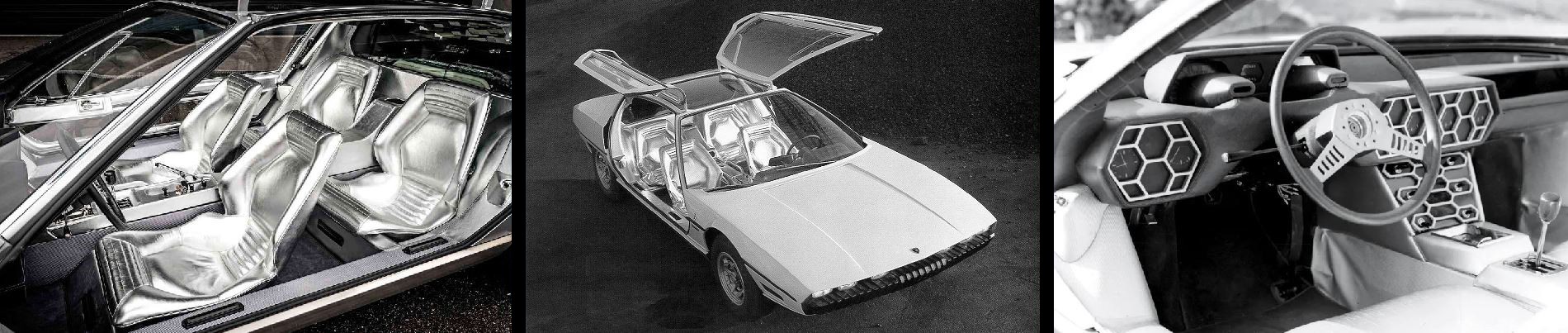
Matra 530: The LX (left) and the SX (right).
The
road-car business however proved challenging and Matra never became a major
player. Although the British and
Italians would prove there was a market for small, economical sports cars,
buyers seemed mostly to prefer more traditionally engineered roadsters which were
ruggedly handsome rather than delicately avant-garde. Although as a niche model in a niche market,
the volumes were never high, the 530 was subject to constant development and in
1970 the 530LX was released, distinguished by detail changes and some
mechanical improvements. Most distinctive
however was next year’s 530SX, an exercise in “de-contenting” (producing what
the US industry used to call a “stripper”) so it could be offered at a lower
price point, advertised at 19,000 Fr against the 22,695 asked for the LX. It was a linguistic coincidence the SX label was
later chosen for the lower price 386 & 486 CPUs (central processing unit)
by the US-based Intel although they labeled their full-priced offerings DX.
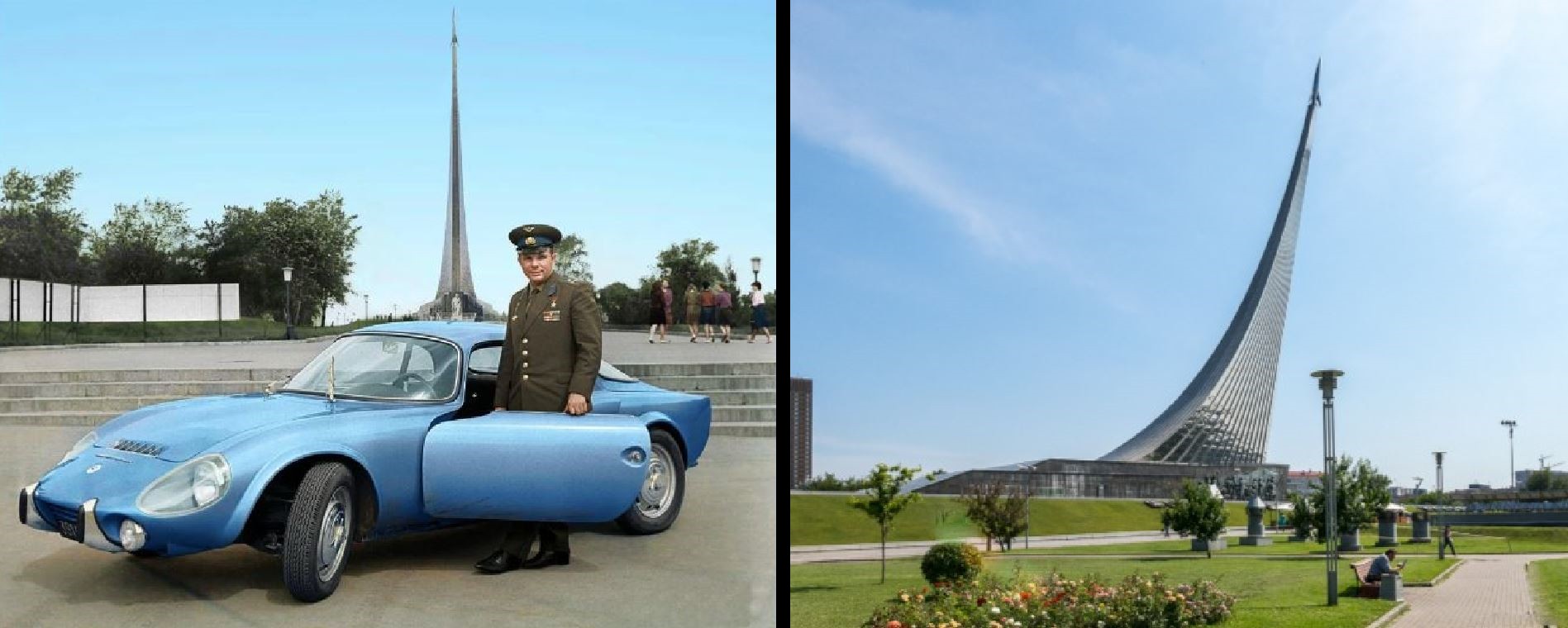
Yuri Gagarin (1934–1968; Soviet pilot and cosmonaut and the first human to travel to “outer space”) with his 1965 Matra Djet (left), standing in front of the Покори́телям ко́смоса (Monumént Pokorítelyam kósmosa) (Monument to the Conquerors of Space), the titanium obelisk erected in 1964 to celebrate the USSR's pioneering achievements in space exploration. The structure stands 351 feet (107 metres) tall and assumes an incline of 77° which is a bit of artistic licence because the rockets were launched in a vertical path but it was a good decision however because it lent the monument a greater sense of drama. Underneath the obelisk sits the Музей космонавтики (Memorial Museum of Cosmonautics (known also as the Memorial Museum of Astronautics or Memorial Museum of Space Exploration)) and in the way which was typical of projects in the Brezhnev-era (Leonid Brezhnev (1906–1982; Soviet leader 1964-1982) USSR, although construction was begun in 1964, it wasn't until 1981 the museum opened to the public. In the Soviet Union, while it was common for projects to be delayed for years, they were usually described as "ahead of schedule".
The reduction in the cost of production of the SX was achieved in the usual way: remove whatever expensive stuff can be removed. Thus (1) the retractable headlights were replaced with four fixed “bugeyes”, a single engine air vent was fitted instead of the LX’s four, (3) the rear seat and carpet were deleted, (4) the front seats were non-adjustable, (5) the trimmed dashboard was replaced by one in brushed aluminium (which was much-praised), the removable targa panels in the roof were substituted with a solid panel and, (7) metal parts like bumpers and the grille were painted matte black rather than being chromed. In the the spirit of the ancien regime, the Frensh adopted the nicknames La Matra de Seigneur (the Matra of a Lord) for the LX & La Matra Pirate (the Matra of a pirate) for the SX.

Who wore the bugeye best? Austin-Healey Sprite (1958, left), Lightburn Zeta Sports (1964, centre) and Matra 530SX (1971, right).
The SX did little to boost sales and even in 1972 which proved the 530’s most prolific year with 2159 produced, buyers still preferred the more expensive model by 1299 to 860. Between 1967-1973, only 9609 530s were made: 3732 of the early models, 4731 of the LX and 1146 of the bugeyed SX and, innovative, influential and intriguing as it and the Djet were, it was a failure compared with something unadventurous like the MGB (1963-1980), over a half-million of which were delivered. One 530 however remains especially memorable, a harlequinesque 1968 model painted by French artist Sonia Delaunay (1885–1979), a founder of the school of Orphism (a fork of Cubism which usually is described as an exercise in pure abstraction rendered in vivid colors). The work was commissioned by Matra's CEO Jean-Luc Lagardère (1928–2003) for a charity auction and still is sometimes displayed in galleries. In 2003, after some thirty years of co-production with larger manufacturers, Matra’s automotive division was declared bankrupt and liquidated.

The auxiliary headlights on the frunk lid polarize opinion (a genuine “love it or hate it” look) but they’re in a long tradition of “bug-eye” lights and part of the 911’s heritage. On the 911 & 912 the original Cibié “Pallas” Biode 150 mm (6 inch) auxiliary headlights were until 1976 a factory option but were also stocked and fitted by dealers in jurisdictions where use was lawful. Cibié’s Biodes (advertised at the time also as “Bi-Iode”) were among the earliest to halogen headlights (originally also called “Quartz Iodine”) and were a considerable advance on sealed-beam technology (protectionist legislation would prevent them being used in the US until 1983 and there they first appeared on the Lincoln Mark VII (1983-1992)). The “Pallas” name came from their original use as a Citroën part number when in 1965 first they appeared on the DS Pallas (an up-market edition of the DS with additional appointments) but they proved ideal for the 911’s sloping frunk lid and Porsche’s competition department first used them on the 911T which won the 1968 Monte Carlo Rally. Later, they appeared also on the mid-engined 914 (1969-1976) and, however much they divide opinion among Porsche cultists, the “pro-bugeye” faction is sufficiently numerous for reproductions still to be produced by several manufacturers.

In the age of the LED (light emitting diode) in which relatively small headlights can “turn night into day” there’s not the same need for multiple accessory light (although some certainly like the look) but in the 1960s there was no other way to more light. Cibié’s Biodes (advertised at the time also as “Bi-Iode”) were among the earliest to halogen headlights (originally also called “Quartz Iodine”) and were a considerable advance on the sealed-beam technology (protectionist legislation would prevent them being used in the US until 1983 and there they first appeared on the Lincoln Mark VII (1983-1992)). The “Bi-Iode” was an allusion to the twin-reflector technology which provided the low/high-beam capability although when twin-bulbs were later made lawful, these also appeared.

1955 Mi-Val Mivalino with PAV 40 single-wheel trailer (left & right). The frog (centre) is a ceramic by Fantastic Froggos.
Founded in 1950 in Gardone, Valtrompia, Italy to produce economical transport vehicles for the home market, Mi-val (Metalmeccanica Italiana Valtrompia) in 1953 gained a licence from FRG (Bundesrepublik Deutschland (Federal Republic of Germany; the old West Germany, 1949-1990) manufacturer Messerschmitt to produce a version of their three-wheel micro-car. Although using an Italian engine (an air cooled, 2-stroke, 171.7cm3 (10.5 cubic inch) single-cylinder unit) and a number of locally produced trim parts, most of the components were supplied as a kit to be assembled in Gardone but although the construction quality was high, demand never matched what Messerschmitt achieved in the FRG and the last of the 100-odd Mivalinos was made in 1955.

In the aftermath of World War II (1939-1945), there was a resolve among the victorious allied powers that Germany should be prevented from again building the military capacity to threaten the peace in Europe as had happened twice in the twentieth century, each time resulting in history’s most destructive wars. Among the many restrictions imposed on German industry was a prohibition on the manufacture of aircraft, a technology which had emerged as a decisive strategic weapon and at the time the only creditable delivery system for the then novel atom bomb. Germany’s surviving aircraft industry thus turned to other sectors, choosing where possible products most suited to their experience, plant and workforce, cars an obvious venture. Like others, Messerschmitt had expertise in steel fabrication, the use of aluminium and advanced aerodynamics and there being a demand for small, economical and low-cost vehicles, the company created a “micro-car”, a three-wheeler which was a kind of motorcycle with enveloping bodywork, designed to accommodate two or three (although, as the contemporary photographs confirm, often more were crammed in). The aptly-named Messerschmitt Kabinenroller (Cabin Scooter) was produced in both three and four wheeled form between 1953-1956 and although the engines were small, the performance was adequate even for Autobahn use because, reflecting the experience in aviation, the small machines were light and drag was low, the aerodynamics sound. The most distinctive feature was the Perspex canopy, recalling the company’s wartime fighter aircraft and it afforded outstanding all-round visibility but on sunny days the heat build-up created a mini-greenhouse effect so removable shades were soon popular.

1959 Fahrzeug- und Maschinenbau (Messerschmitt) “Tiger” Tg500.
It wasn’t long after the end of hostilities that the threat of the Soviet Union’s divisions (and after 1949 its nuclear arsenal) replaced the fear of a resurgent Germany in the West’s strategic world view so in 1955, the FRG was admitted to membership of NATO (North Atlantic Treaty Organization, 1949). One implication of all this was that West Germany was allowed to re-enter the aviation business so the Kabinenroller business was in 1956 sold to Fahrzeug und Maschinenbau which, in ever reducing volumes, continued production until 1964. By then, demand for micro-cars had fallen below the level required for profitability, the quirky sector suffering not only from the effects of the increasing prosperity delivered by the FRG’s post-war Wirtschaftswunder (economic miracle) but also the new generation of small cars such as the BMC (British Motor Corporation) Mini (1959-2000) and Fiat 500 (1957-1975) which, for only slightly more money, were perceived as scaled-down versions of “real cars” rather than a motorcycle with a body.