Monday, October 20, 2025

Etching

Etching (pronounced ech-ing)

(1) The art, act or process of making designs or pictures on a metal plate, glass etc, by the corrosive action of an acid instead of by a burin.

(2) An impression, as on paper, taken from an etched plate.

(3) The design so produced.

(4) A flat (usually metal) plate bearing such a design.

1625–1635: The construct was etch + -ing.  The verb etch was from the Dutch etsen (to engrave by eating away the surface of with acids), from the German ätzen (to etch), from the Old High German azzon (to cause to bite or feed), from the Proto-Germanic atjaną, causative of etaną (to eat), from the primitive Indo-European root ed- (to eat) (from these sources English gained “eat”).  The suffix –ing was from the Middle English -ing, from the Old English –ing & -ung (in the sense of the modern -ing, as a suffix forming nouns from verbs), from the Proto-West Germanic –ingu & -ungu, from the Proto-Germanic –ingō & -ungō. It was cognate with the Saterland Frisian -enge, the West Frisian –ing, the Dutch –ing, The Low German –ing & -ink, the German –ung, the Swedish -ing and the Icelandic –ing; All the cognate forms were used for the same purpose as the English -ing).  The “etching scribe” was a needle-sharp steel tool for incising into plates in etching and the production of dry points.  Etching is a noun & verb; the noun plural is etchings.

The noun was the present participle and gerund of etch (the verbal noun from the verb etch) and was used also in the sense of “the art of engraving”; by the 1760s, it was used also to mean “a print etc, made from an etched plate" and the plates themselves.  The term etching (to cut into a surface with an acid or other corrosive substance in order to make a pattern) is most associated with the creation of printing plates for the production of artistic works but the technique was used also as a way to render decorative patterns on metal.  In modern use, it’s also a term used in the making of circuit boards.  In idiomatic use (often as “etched in the memory”), it’s used of events, ideas etc which are especially memorable (for reasons good and ill) and as a slang word meaning “to sketch; quickly to draw”.  The Etch A Sketch drawing toy was introduced 1960 by Ohio Art Company; a kind of miniature plotter, it was a screen with two knobs which moved a stylus horizontally & vertically, displacing an aluminum powder to produce solid lines.  To delete the creation, the user physically shook the device which returned the powder to its original position, blanking the screen.

Rembrandt's Jan Asselyn, Painter (1646) (left) and Faust (circa 1652).  Rembrandt (Rembrandt Harmenszoon van Rijn (1606-1669)) wasn’t the most prolific etcher but remains among the most famous and his output provides an illustrative case-study in the evolution of his mastering of the technique, his early work really quite diffident compared with his later boldness.

What came to be known as etching gained the name from the Germanic family of words meaning “eat & “to eat”, the transferred sense an allusion to the acid which literally would “eat the metal”.   Etching is an intaglio (from the Italian intagliare (to engrave)) technique in printmaking, a term which includes methods such as hard and soft ground etching, engraving, dry-point, mezzotint and aquatint, all of which use an ink transferring process.  In this, a design is etched into a plate, the ink added over the whole surface plate before a scrim (historically starched cheesecloth) is used to force the ink into the etched areas and remove any excess.  Subsequently, the plate (along with dampened paper) is run through a press at high pressure, forcing the paper into etched areas containing the ink.  The earliest known signed and dated etching was created by Swiss Renaissance goldsmith Urs Graf (circa 1485-circa 1525) in 1513 and it’s from those who worked with gold that almost all forms of engraving are ultimately derived.

Lindsay Lohan, 1998, rendered in the style of etchings.

A phrase which was so beloved by comedy writers in the early-mid twentieth century that it became a cliché was “Want to come up and see my etchings?”, a euphemism for seduction.  Probably now a “stranded phrase”, the saying was based on some fragments of text in a novel by Horatio Alger Jr (1832–1899), a US author regarded as the first to formalize as genre fiction the “rags-to-riches” stories which had since the early days of the republic been the essence of the “American Dream” although it wasn’t until the twentieth century the term came into common use (often it’s now used ironically).

The practice of making etchings, woodcuts or engravings of famous paintings became popular, both artistically and commercially (which may for this purpose be much the same thing) in the late sixteenth century and developed over the next 250-odd years, an evolution tied closely to technological progress in printmaking and the materials available to artists.  The trend seems to have been accelerated by the spread in northern Europe (notably certain districts in Antwerp, Rome and Paris) of copperplate etching & engraving and while it may be dubious to draw conclusions from the works which have survived, the artists most re-produced clearly included Titian (Tiziano Vecellio, circa 1490-1576), Raphael (Raffaello Sanzio da Urbino, 1483–1520) and Michelangelo (Michelangelo di Lodovico Buonarroti Simoni; 1475–1564), the most prolific in the business of reproductive engraving including the Dutch specialist Cornelis Cort (circa 1533–circa 1578 and known in Italy where he spent his final years as Cornelio Fiammingo) and the Flemish Sadeler family, scions of which operated in many European cities.

Melencolia I (Melancholy I (1514)), etching by the German painter & printmaker Albrecht Dürer (1471–1528).

By the seventeenth century, the practice was well established and an entrenched part of the art market, fulfilling some of the functions which would later be absorbed by photography and Peter Paul Rubens (1577-1640), among others, employed in his studio engravers whose task was to reproduce his paintings for sale with those etchings available in a variety of sizes (and thus price-points so there’s little which is new in the structures of the modern art market).  Again, in the eighteenth century, technological determinism interplayed with public taste as techniques were refined to adapt the works to what wasn’t exactly a production line but certainly an arrangement which made possible larger and more rapid volumes with printing houses commissioning runs (which could be in the hundreds) of engravings following (faithfully and not) British and Continental paintings, advances in mezzotint meaning a greater tonal range had become possible, mimicking the light and shade of oil paintings.  In genteel homes, various institutions and even museums, it was entirely respectable to have hanging: “prints after the Old Masters”.

But as technology giveth, so can it taketh away and it was the late eighteenth century invention of lithography and, a few decades later photography, which triggered a decline in demand, the constantly improving quality of the new mediums gradually displacing reproductive etching in the marketplace although the tradition didn’t die as artists such as Francisco Goya (1746–1828), Eugène Delacroix (1798–1863) and Édouard Manet (1832–1883) maintained (or, in a sense, “revived”) etching as a creative rather than reproductive discipline and historians regards the early-mid nineteenth century as the era in which etching became a legitimate genre in art and not merely a means cheaply of distributing representations of existing works.

Self portrait: reflection (1996), etching by Lucian Freud (1922–2011).

Under modern copyright law, as a general principle, the selling of etchings of works still in copyright is not lawful without the permission from the holder of the rights and while details differ between jurisdictions, the basic rule of modern law (the Berne Convention, EU directives, national statutes) is that the sale (or even public display) of a reproduction or derivative work (the latter something which obviously follows without being an obvious duplicate of a copyrighted artwork) requires the consent of the copyright owner.  That protection tends in most jurisdictions to last 70 years after the death of the artist (the “life + 70” rule) and what matters is not that a reproduction is new (in the sense of the physical object) but that it is derivative because (1) to a high degree it emulates the composition, form(s), and expression of the original and (2) in appearance it to a high degree resembles a pre-existing, protected work.  Thus, if produced and offered for sale without permission, the object will infringe on the rights of whoever holds exclusive or delegated rights of reproduction or adaptation.  With exact or close replicas it’s not difficult for court to determine whether rights have been violated but at the margins, such as where works are “in the style of”, of “influenced by”, judgments are made on a case-by-case basis, the best publicized in recent years being those involving pop music.

The Lovers (circa 1528), etching by Parmigianino (Girolamo Francesco Maria Mazzola, 1503-1540) of the Italian Mannerist school.

All that means is one (usually) can sell reproductions of works by those dead for at least 70 years and even works “in their style” as long as there’s no attempt to misrepresent them as the product of their original artist’s hand.  There are in copyright exceptions such as “fair dealing” & “fair use” but their range is narrow and limited to fields such as criticism, review, education or satire and does not extend to normal commercial transactions.  Additionally, there’s a work-around in that if something is found to have been sufficiently “transformed”, it can be regarded as a new work but this exception tightly is policed and the threshold high.  Additionally, in recent years, as museums and galleries have put content on-line, what has emerged is the additional complication of such an institution hanging on its walls paintings long out of copyright yet asserting copyright on its commissioned photographs of those works.  That development must have delighted lawyers working in the lucrative field but the courts came to read-down the scope, most following the principles explained in an action before the US Federal District Court (Bridgeman Art Library v. Corel Corp., 36 F. Supp. 2d 191 (S.D.N.Y. 1999), which held (1) copyright in a photograph can in many cases exist but, (2) if a photograph is a “purely mechanical copy of a public-domain work” there usually no protection, even if the taking of the image required technical skill in lighting, angle selection and such.

Morphinomanes (Morphine Addicts, 1887), etching and and drypoint by French artist Albert Besnard (1849–1934).

There was still something for the lawyers because inherently there remained two separate layers of rights at play: (1) copyright (intellectual property) which belongs usually to the artist or their estate and (2) the property rights (ownership of the physical object) which are held by whomever may possess lawful title to the object (this may align with possession but not of necessity).  In other words a museum will likely own the paint & canvas yet not the copyright, something analogous with the discovery made by the few diligent souls who troubled themselves to read the small print they’d agreed to when installing software: in most cases one had lawful title to the physical media (diskette, CD, DVD etc) but often nothing more than a revocable licence to use a single instance of the software. It’s possible lawfully to produce and sell etchings of Goya (the artist having had the decency to drop dead more than 70 years ago) but one may not without permission reproduce or trace from a museum’s copyrighted photo of a Goya (and institutions sometimes maintain separate conditions of use for low and high-resolution images).  Even if one paints, draws or etches by hand, depending on this and that, a court can still hold there’s been a “substantial reproduction” of the composition, colour and such has been effected and thus there’s been an infringement of the underlying copyright.  So, the rules in this area are (1) proceed with caution if producing art not wholly original and (2) if a young lady is asked: “Want to come up and see my etchings?”, she should proceed with caution.

Saturday, October 18, 2025

Gorp

Gorp (pronounced gawrp)

(1) Greedily to eat (obsolete).

(2) A mixture of nuts, raisins, dried fruits seeds and such, often packed as a high-energy snack by hikers, climbers and others undertaking strenuous outdoor activities.

(3) By extension, in the slang of late 1950s US automobile stylists (and subsequently their critics), the notion of adding many design elements to a car, even if discordant.

(4) In fashion criticism, an adoption of the automotive use, used to describe an excessive use of decorative items, especially if loosely fitted and inclined to “stray”.

Early 1900s: Of uncertain origin (in the sense of “greedily to eat”) but assumed by most etymologists to be a merging of gorge & gulp, the construct being gor(p) + (gul)p.  The mid-fourteenth century verb gorge (to eat with a display of greediness, or in large quantities) was from the Middle English gorgen (greedily to eat) and was from the Old French gorger & gorgier (which endures in modern French as gorger (greedily to eat; to gorge)), from gorge (throat).  The Middle English noun gorge (esophagus, gullet; throat; bird's crop; food in a hawk's crop; food or drink that has been take consumed) came directly from the Old French gorge (throat) (which endures in modern French as gorge (throat; breast)), from the Vulgar Latin gorga & gurga, from the Classical Latin gurges (eddy, whirlpool; gulf; sea), of uncertain origin but perhaps linked with the primitive Indo-European gwerhs- (to devour, swallow; to eat).  The English word was cognate with the Galician gorxa (throat), the Italian gorga & gorgia (gorge, throat (ravine long obsolete)), the Occitan gorga & gorja, the Portuguese gorja (gullet, throat; gorge) and the Spanish gorja (gullet, throat; gorge).  The duality of meaning in French meant the brassiere (bra) came to be called “un soutien-gorge (with derived forms such as “soutien-gorge de sport” (sports bra) with “soutif” the common colloquial abbreviation; the literal translation was thus “throat supporter” but it’s better understood as “chest uplifter”.

Lindsay Lohan gulping down a Pure Leaf iced tea; promotional image from the brand's “Time for a Tea Break” campaign.

The mid-fifteenth century noun gulp (eagerly (and often noisily) to swallow; swallow in large draughts; take down in a single swallow) was from the Middle English gulpen and probably from the West Flemish or Middle Dutch gulpen &, golpen, of uncertain origin.  Although not exactly onomatopoeic, the word may have been of imitative origin, or even an extension of meaning of the Dutch galpen (to roar, squeal) or the English galp & gaup (to gape).  It was related to the German Low German gulpen (to gush out, belch, gulp), the West Frisian gjalpe, gjalpje & gjealpje (to gush, spurt forth), the Danish gulpe & gylpe (to gulp up, disgorge), the dialectal Swedish glapa (to gulp down) and the Old English galpettan (to gulp down, eat greedily, devour).  The derived senses (to react nervously by swallowing; the sound of swallowing indicating apprehension or fear) may have been in use as early as the sixteenth century.  Gorp is a noun; the noun plural is gorps.  In fashion (technically perhaps “anti-fashion appropriated by fashion”) “gorpcore” describes the use as streetwear of outerwear either designed for outdoor recreation (in the sense of hiking, wilderness tracking etc) or affecting that style.  Exemplified by the ongoing popularity of the puffer jacket, gorpcore is something much associated with the COVID-19 pandemic but the look had by the time of the outbreak already been on-trend for more than a year.  The name comes from the stereotypical association of trail mix (gorp) with such outdoor activities.  The verbs gorping and gorped (often as “gorped-up”) were informal and used among stylists and critics when discussing some of Detroit’s excessively ornamented cars of the late 1950s & early 1960s.  Acronym Finder lists eleven GORPs including the two for trail-mix which seem peacefully to co-exist:

GORP: Great Outdoor Recreation Pages (a website).
GORP: Good Old Raisins and Peanuts (trail mix).
GORP: Granola, Oats, Raisins, and Peanuts (trail mix).
GORP: Garry Ork Restoration Project (An ecosystem restoration project in Saanich, Canada, designed to save the endangered Garry Oak trees, British Columbia’s only native oak species.
GORP: Georgia Outdoor Recreational Pass (Georgia Wildlife Resources Division).
GORP: Graduate Orthodontic Residents Program (University of Michigan; Ann Arbor).
GORP: Grinnell Outdoor Recreation Program (Grinnell College, Iowa)
GORP: Good Organic Retailing Practices.
GORP: Get Odometer Readings at the Pump.
GORP: Gordon Outdoor Recreation Project (Gordon College, Wenham, Massachusetts).
GORP: Growing Outdoor Recreation Professionals (University of California, Berkeley).

Lexicographers acknowledge the uncertainty of origin in the use of “gorp” to describe the mix of nuts, raisins, seeds and such in the packaged, high-energy snack now often known by the description most common in US commerce: “Trail mix”.  So common and conveniently packaged are the ingredients of gorp that doubtlessly variations of the combination have been carried by travellers since the origins of human movement over distance but the first known references to the concept to appear in print were seen in the “outdoors” themed magazines of the early twentieth century.  Deconstructed however, the notion of “high-energy, long-life, low volume” rations were for centuries a standard part of a soldier’s rations with different mixes used by land-based or naval forces, something dictated by availability and predicted rates of spoilage; as early as the seventeenth century, recommended combinations appeared in military manuals and quartermaster’s lists.  Not until the mid-1950s however is there any record of the stuff being described as “gorp” although the oft quoted formations: “Good Old Raisins and Peanuts” & “Granola, Oats, Raisins, and Peanuts” may both be backronyms.

Lindsay Lohan (b 1986, either left or right) and Erin Mackey (b 1986, either left or right), hiking scene in The Parent Trap (1998).  They would have packed some trail mix in their back-packs.

In various places around the planet, similar concoctions (the composition influenced by regional tastes and product availability) were described by different names including the antipodean scroggin or schmogle (the latter apparently restricted to New Zealand) and beyond the English-speaking world, there’s been a myriad of variants among those in schools or universities including “student mix”, “study mix”, “student fodder” & “student oats”.  That variety has faded as US linguistic imperialism has exerted its pull and even before the internet attained critical mass, the product name familiar in US supermarkets and grocery stores had begun to prevail: “Trail mix”.

Packaged gorp and trail mix.  Historically, gorp bars lived up to their name, a typical ingredients list including "peanuts, corn syrup, rasins, salt & lecithin" so commercially available gorp often was "the truth if not the whole truth".  Oddly, even when manufactured in disk-shapes, the product still tended to be described as a "bar".  With the contents of trail mix, there's been a bit of "mission creep" and the packaged product can now include chunks of chocolate and other stuff not envisaged in years gone by.

1958 Buick Special Convertible (left) and 1958 Buick Limited Convertible (right).If asked to nominate one from the list of usual suspects, many might pick Cadillac as the most accomplished purveyor of gorp but historians of the breed usually list the 1958 Buicks as "peak gorp" and for the sheer number and variety of decorative bits and pieces, it probably is unsurpassed.  Unfortunately for the division, a combination of circumstances meant between 1956 & 1958, Buick sales more than halved and while "excessive" gorp wasn't wholly to blame, after GM (General Motors) re-organized things, gorp never made a comeback quite as lavish.       

In automotive styling “gorp” is not synonymous with “bling” although there can be some physical overlap.  The word “bling” long ago enjoyed the now obsolete meaning “a want of resemblance” but in modern use it means (1) expensive and flashy jewelry, clothing, or other possessions, (2) the flaunting of material wealth and the associated lifestyle or (3) flashy; ostentatious.  It seems in these senses first to have been recorded in 1997 and is thought to be from the Jamaican English slang bling-bling, a sound suggested by the quality of light reflected by diamonds.  In the Caribbean, bling-bling came to be used to refer to flashy items (originally jewelry but later of any display of wealth) and the term was picked up in the US in African-American culture where it came to be associated with rap & hip-hop (forks of that community’s pop music) creators and their audiences.  There were suggestion the word bling was purely onomatopoeic (a vague approximation of pieces of jewelry clinking together) but most etymologists list it as one of the rare cases of a silent onomatopoeia: a word imitative of the imaginary sound many people “hear” at the moment light reflects off a sparkling diamond.  The long obsolete meaning “a want of resemblance” came from earlier changes in pronunciation when dissem′blance became pronounced variously as dissem′bler and dissem′ bling with bling becoming the slang form.  There is no relationship with the much older German verb blinken (to gleam, sparkle).

1958 Continental Mark III by Lincoln.

Some critics of design insist "gorp" (like "bling") really applies only to stuff "added on" (ie glued, screwed, bolted etc) but some claim there's no better word when discussing the cars which were a "mash-up" of disparate elements and there's no better example than the Ford Motor Company's (FoMoCo) 1958 Continental which was actually a "Lincoln with more stuff" but named simply "Continental" in the hope it would fool people into thinking it was an exclusive line following the genuinely unique Continental Mark II (1956-1957).  The Continental division had however been shuttered as another victim of the recession and the propaganda proved unequal to reality.  The Mark III's huge body (a remarkable technical achievement because even the convertibles were unit-bodies with no separate chassis) lingered for three dismally unsuccessful seasons and remains as the period's most confused agglomeration of motifs, a reasonable achievement given some of the weird creations Chrysler would release.  Although the sheer size does somewhat disguise the clutter, as one's eye wanders along the length, one finds slants and different angles, severe straight-lines, curves soft and sudden, scallops, fins and strakes.  On McMansions, it's not uncommon to find that many architectural traditions in on big suburban house but it's a rare count in one car.  Despite the diversity, it's not exactly "post-modernism in metal" so even if a re-purposing, "gorp" seems to fit.

In the English-speaking world, bling & bling-bling began to appear in dictionaries early in the twenty-first century.  Many languages picked up bling & bling-bling unaltered but among the few localizations were the Finnish killuttimet and the Korean beullingbeulling (블링블링) and there was also the German blinken (to blink, flashing on & off), a reference to the gleam and sparkle of jewels and precious metals.  Blinken was from the Low German and Middle Low German blinken, from the root of blecken (to bare) and existed also in Dutch.  As viral-words sometimes do, bling begat some potentially useful (and encouraged) derivations including blingesque, blingtastic, blingbastic blingiest, blingest, a-bling & blingistic; all are non-standard forms and patterns of use determine whether such pop-culture constructs endure.  Bling & blinger are nouns, blinged, blingish, blingy & blingless are adjectives, bling-out, blinged-out & bling-up are verbs; the noun plural is blingers (bling and bling-bling being both singular & plural).

Gingerbread: 1974 Imperial LeBaron four-door hardtop (left) in chestnut tufted leather though not actually “fine Corinthian leather” which was (mostly) exclusive to the Cordoba (1975-1983) until late 1975 when not only did the Imperial's brochures mention "genuine Corinthian leather (available at extra cost)" but for the first time since 1954 the range was referred to as the "Chrysler Imperial", a harbinger the brand was about to be retired.  Imperial's advertising copy noted of the brochure photograph above: “...while the passenger restraint system with starter interlock is not shown, it is standard on all Imperials.”; the marketing types didn't like seat-belts messing up their photos.  While all of the big three (GM, Ford & Chrysler) had tufted interiors in some lines, it was Chrysler which displayed the most commitment to the gingerbread motif.  After 1958, exterior gorp, while it didn't every entirely go away, it did go into decline but in the mid 1960s, as increasingly elaborate and luxurious interiors began to appear in the higher-priced models of even traditionally mass-market marques, those who disapproved of this latest incarnation of excess needed a word which was both descriptive and dismissive.  The use "gorp" might have been misleading and according to the authoritative Curbside Classic (which called the trend the start of "the great brougham era"), the word of choice was "gingerbread" and truly that was bling's antecedent.

In the stylists’ (they weren’t yet “designers”) studios in the 1950s, what would come to be called “bling” certainly existed (and in the “age of chrome” was very shiny) but the idea of gorp was different in that it was quantitative and qualitative, the notion of adding to a design multiple decorative elements or motifs, even if this meant things clashed (which sometimes they did).  Why this happened has been debated but most historians of the industry have concluded it was the result of the unexpected, post-war boom which delivered to working and middle-class Americans a prosperity and wealth of consumer goods the like of which no mass-society had ever known.  In material terms, “ordinary” Americans (ie wage and salary earners), other than in measures like the provision of servants or hours of leisure, were enjoying luxuries, conveniences and an abundance unknown even to royalty but a few generations earlier.  Accordingly, noting the advice that the way to “avoid gluts was to create a nation of gluttons” (a concept used also in many critiques of rampant consumerism), the US car industry, awash with cash and seeing nothing in the future but endless demand, resolved never to do in moderation what could be done in excess and as well as making their cars bigger and heavier, began to use increasing rococo styling techniques; wherever there appeared an unadorned surface, the temptation was to add something and much of what was added came casually to be called “gorp”, based on the idea that, like the handy snack, the bits & pieces bolted or glued on were a diverse collection and, in the minds of customers, instantly gratifying.  Gorp could include chrome strips, fake external spare tyre housings, decorative fender and hood (bonnet) accessories which could look like missiles, birds of prey in flight or gunsights, the famous dagmars, fake timber panels, moldings which recalled the shape of jet-engine nacelles, taillights which resembled the exhaust gasses from the rockets of spacecraft (which then existed mostly in the imagination) and more.

A young lady wearing gorpcore, Singapore, 2022.  Along with Kuwait, Hong Kong, Monaco and Vatican City, Singapore is listed by demographers as "100% urbanized" but it's good always to be prepared.

Had any one of these items been appended as a feature it might well have become a focus or even an admired talking point but that wasn’t the stylistic zeitgeist and in the studios they may have been reading the works of the poet Matthew Arnold (1822-1888) who attributed to Benjamin Disraeli (1804–1881; UK prime- minister 1868 & 1874-1880) a technique he claimed the prime-minister adopted during his audiences with Victoria (1819–1901; Queen of the UK 1837-1901): “Everyone likes flattery and when you come to royalty, you should lay it on with a trowel”.  Detroit in the late 1950s, certainly laid on the gorp with a trowel and the men and women (there was in the era the odd woman employed in the studios, dealing typically with interiors or color schemes) were students also of the pamphlet Ending the Depression Through Planned Obsolescence, published in 1932 by US real estate broker (and confessed Freemason) Bernard London (b circa 1873 but his life is something of a mystery) and in the post-war years came the chance to put the theory to the test.  This meant not only was there much gorp but each year there had to be “different” gorp so the churn rate was high. Planned obsolescence began as a casual description of the techniques used in advertising to stimulate demand and thus without the negative connotations which would attach when it became part of the critique of materialism, consumerism and the consequential environmental destruction.  Like few before or since, the US car industry quickly perfected planned obsolescence and not content with “annual model changes” sometimes added “mid-season releases” thus rendering outdated something purchased only months earlier.  Unfortunately, just as “peak gorp” began with the release late in 1957 (replete with lashings of chrome and much else) of the 1958 ranges, an unexpected and quite sharp recession struck the American economy and a new mood of austerity began.  That would pass because the downturn, while unpleasant, was by the standard of post-war recessions, relative brief although the effects on the industry would be profound, structurally and financially.

1970 Plymouth 'Cuda AAR in Lemon Twist over Black.  The AAR stood for All American Racers, the teams which campaigned the 'Cuda in the Trans-Am series for 5.0 litre (305 cubic inch) modified production cars.

Not all "added-on" stuff can however be classed as "gorp", "bling" or "gingerbread" and the most significant threshold is "functionalism"; if stuff actually fulfils some purpose, it's just a fitting.  Thus the additional stuff which appeared on the 1970 Plymouth AAR ’Cuda (and the companion Dodge Challenger T/A) were “fittings” because they all fulfilled some purpose, even if the practical effect away from race tracks was sometimes marginal.  Added to the pair was (1) a fibreglass hood (bonnet) with functional air-intake scoop, (2) front and rear spoilers, (3) side outlet dual exhaust system, (4) hood locking pins and (5) staggered size front & rear wheels.  Of course, there were also “longitudinal strobe stripes” which did nothing functional but that seems a minor transgression and in the world of stripes, there have been many worse. 

Thursday, October 16, 2025

Demand

Demand (pronounced dih-mand (U) or dee–mahnd (non-U))

(1) To ask for with proper authority; claim as a right.

(2) To ask for peremptorily or urgently.

(3) To call for or require as just, proper, or necessary.

(4) In law, to lay formal claim to.

(5) In law, to summon, as to court.

(6) An urgent or pressing requirement.

(7) In economics, the desire to purchase, coupled (hopefully) with the power to do so.

(8) In economics, the quantity of goods that buyers will take at a particular price.

(9) A requisition; a legal claim.

(10) A question or inquiry (archaic).

1250-1300: From Middle English demaunden and Anglo-French demaunder, derived from the Medieval Latin dēmandāre (to demand, later to entrust) equivalent to dē + mandāre (to commission, order).  The Old French was demander and, like the English, meant “to request” whereas "to ask for as a right" emerged in the early fifteenth century from Anglo-French legal use.  As used in economic theory and political economy (correlating to supply), first attested from 1776 in the writings of Adam Smith.  The word demand as used by economists is a neutral term which references only the conjunction of (1) a consumer's desire to purchase goods or services and (2) hopefully the power to do so.  However, in general use, to say that someone is "demanding" something does carry a connotation of anger, aggression or impatience.  For this reason, during the 1970s, the language of those advocating the rights of women to secure safe, lawful abortion services changed from "abortion on demand" (ie the word used as an economist might) to "pro choice".  Technical fields (notably economics) coin derived forms as they're required (counterdemand, overdemand, predemand etc).  Demand is a noun & verb, demanding is a verb & adjective, demandable is an adjective, demanded is a verb and demander is a noun; the noun plural is demands.

Video on Demand (VoD)

Directed by Tiago Mesquita with a screenplay by Mark Morgan, Among the Shadows is a thriller which straddles the genres, elements of horror and the supernatural spliced in as required.  Although in production since 2015, with the shooting in London and Rome not completed until the next year, it wasn’t until 2018 when, at the European Film Market, held in conjunction with the Internationale Filmfestspiele Berli (Berlin International Film Festival), that Tombstone Distribution listed it, the distribution rights acquired by VMI, Momentum and Entertainment One, and VMI Worldwide.  In 2019, it was released progressively on DVD and video on demand (VoD), firstly in European markets, the UK release delayed until mid-2020.  In some markets, for reasons unknown, it was released with the title The Shadow Within.

Video on Demand (VoD) and streaming services are similar concepts in video content distribution but there are differences.  VoD is a system which permits users to view content at any time, these days mostly through a device connected to the internet across IP (Internet Protocol), the selection made from a catalog or library of available titles and despite some occasionally ambiguous messaging in the advertising, the content is held on centralized servers and users can choose directly to stream or download.  The VoD services is now often a sub-set of what a platform offers which includes content which may be rented, purchased or accessed through a subscription.

Streaming is a method of delivering media content in a continuous flow over IP and is very much the product of the fast connections of the twenty-first century.  Packets are transmitted in real-time which enables users to start watching or listening without waiting for an entire file (or file set) to download, the attraction actually being it obviates the need for local storage.  There’s obviously definitional and functional overlap and while VoD can involve streaming, not all streaming services are technically VoD and streaming can also be used for live events, real-time broadcasts, or continuous playback of media without specific on-demand access. By contrast, the core purpose of VoD is to provide access at any time and streaming is a delivery mechanism, VoD a broad concept and streaming a specific method of real-time delivery as suited to live events as stored content.

The Mercedes-Benz SSKL and the Demand Supercharger

Modern rendition of Mercedes-Benz SSLK in schematic (left) and re-rendered with with "blueprint effect" (right), illustrating the drilled-out chassis rails (here depicted without the reinforcing metal sheets added to ensure structural integrity)  The title is misleading because the four SSKLs built all were commissioned in 1931 (although it's possible one or more used a modified SSK chassis constructed in 1929).  All SSK chassis were built between 1928-1932 although the model remained in the factory's catalogue until 1933. 

The Mercedes-Benz SSKL was one of the last of the road cars which could win a top-line Grand Prix.  An evolution of the earlier S, SS and SSK, the SSKL (Super Sports Kurz (short) Leicht (light)) was notable for the extensive drilling of its chassis frame to the point where it was compared to Swiss cheese; reducing weight with no loss of strength (although the longitudinal spars adjacent to the engine and the front bearing points of the rear leaf springs were reinforced with metal sheets concealing some of the drilled holes).  The SSKs and SSKLs were famous also for the banshee howl from the engine when the supercharger was running; nothing like it would be heard until the wail of the BRM V16s twenty years later.  It was called a demand supercharger because, unlike some constantly-engaged forms of forced-induction, it ran only on-demand, in the upper gears, high in the rev-range, when the throttle was pushed wide-open.  Although it could safely be used for barely a minute at a time, when running, engine power jumped from 240-odd horsepower (HP) to over 300.  The number of SSKLs built has been debated and the factory's records are incomplete because (1) like many competition departments, it produced and modified machines "as required" and wasn't much concerned about documenting the changes and (2) many archives were lost as a result of bomb damage during World War II (1939-1945); most historians suggest there were four or SSKLs, all completed (or modified from earlier builds) in 1931.  The SSK had enjoyed great success in competition but even in its heyday was in some ways antiquated and although powerful, was very heavy, thus the expedient of the chassis-drilling intended to make it competitive for another season.  Lighter than the SSK by 125 kg (275 lb), at 1352 kg (2980 lb), the SSLK was by race-car standards still a heavyweight but the reduction in mass did to a degree ameliorate the issues of brake & tyre wear but the higher speeds attained also made the anyway marginal braking capabilities more of a challenge for the drivers.  The SSKL enjoyed a long Indian summer and even on tighter circuits where the bulk meant it could be out-manoeuvred, sometimes it still prevailed by virtue of durability and sheer power.

Rudolf Caracciola (1901–1959) and SSKL in the wet, German Grand Prix, Nürburgring, 19 July, 1931.  Alfred Neubauer (1891–1980; racing manager of the Mercedes-Benz competition department 1926-1955) maintained Caracciola "...never really learned to drive but just felt it, the talent coming to him instinctively."

Sheer power there certainly was because in parallel with the chassis engineers trimming weight, the engine-development team massaged more power from the SSK’s supercharged, 7.1 litre (431 cubic inch) straight-six.  The approach was wholly conventional including increasing the throughput of the 18-vane Roots supercharger so to ensure advantage was taken of the increased flow-rate, the size of the intake and exhaust valves were enlarged by 7%.  All of this of course increased internal stresses so the crankshaft was modified, complimented by larger counterweights on the crank pins.  The tough old engine responded well.  In racing trim, the SSK had generated 180 (HP) horsepower which rose to 250 with the supercharger engaged but in the SSKL the revisions saw power rise to 240 or a remarkable 300 with the blower running.  Fuel consumption was of course high and the increased power increased tyre wear but none of the competition could match the power-to-weight ratio of 4½ per HP.

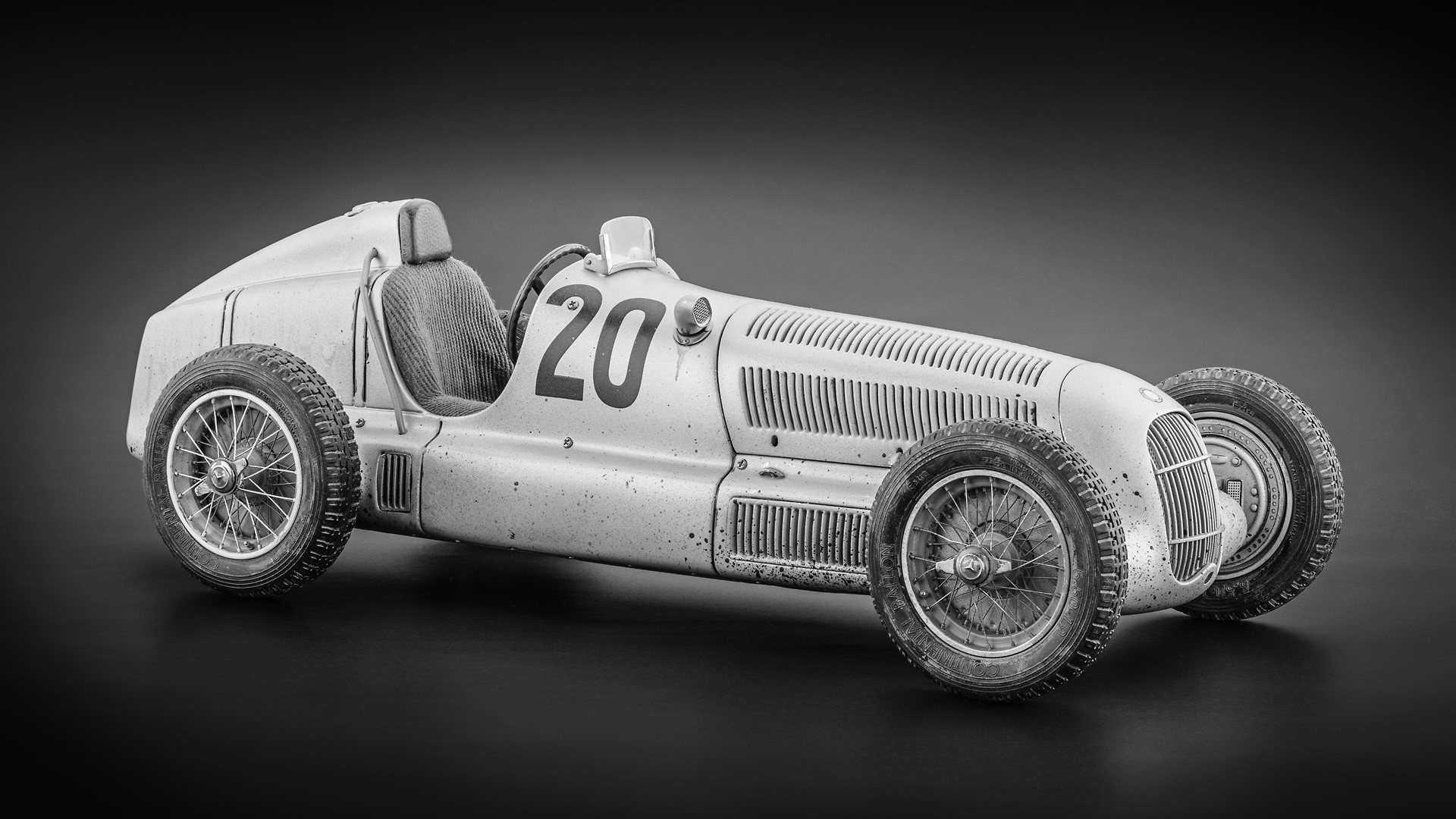
The Amalgam Collection's 1:8 scale model of the Mercedes-Benz SSKL that won the 1931 Mille Miglia: US$26,995.

Sometimes too it got lucky.  When the field assembled in 1931 for the Fünfter Großer Preis von Deutschland (fifth German Grand Prix) at the Nürburgring, even the factory acknowledged that at a race-weight of 1350 kg-odd, the SSKLs, whatever their advantage in horsepower, stood little chance against the nimble Italian and French machines which weighed-in at some 200 KG (440 lb) less.  However, on the day there was heavy rain with most of race conducted on a soaked track and the twitchy Alfa Romeos, Maseratis and the especially skittery Bugattis proved less suited to the slippery surface than the truck-like but stable SSKL, the lead built up in the rain enough to secure victory even though the margin narrowed as the surface dried and a visible racing-line emerged.  Time and the competition had definitely caught up by 1932 however and it was no longer possible further to lighten the chassis or increase power so aerodynamics specialist Baron Reinhard von Koenig-Fachsenfeld (1899-1992) was called upon to design a streamlined body, the lines influenced both by his World War I (1914-1918 and then usually called "the World War") aeronautical experience and the "streamlined" racing cars which had been seen in the previous decade.  At the time, the country greatly was affected by economic depression which spread around the world after the 1929 Wall Street crash, compelling Mercedes-Benz to suspend the operations of its competitions department so the one-off "streamliner" was a private effort (though with some tacit factory assistance) financed by the driver (who borrowed some of the money from his mechanic!).

The streamlined SSKL crosses the finish line, Avus, 1932.

The driver was Manfred von Brauchitsch (1905-2003), nephew of Major General (later Generalfeldmarschall (Field Marshal)) Walther von Brauchitsch (1881–1948; Oberbefehlshaber (Commander-in-Chief) of OKH (Oberkommando des Heeres (the German army's high command) 1938-1941).  An imposing but ineffectual head of the army, Uncle Walther also borrowed money although rather more than loaned by his nephew's mechanic, the field marshal's funds coming from the state exchequer, "advanced" to him by Adolf Hitler (1889-1945; Führer (leader) and German head of government 1933-1945 & head of state 1934-1945).  Quickly, Hitler learned the easy way of keeping his mostly aristocratic generals compliant was to loan them money, give them promotions, adorn them with medals and grant them estates in the lands he'd stolen during his many invasions.  His "loans" proved good investments.  Beyond his exploits on the circuits, Manfred von Brauchitsch's other footnote in the history of the Third Reich (1933-1945) is the letter sent on April Fools' Day 1936 to Uncle Walther (apparently as a courtesy between gentlemen) by Baldur von Schirach (1907-1974; head of the Hitlerjugend (Hitler Youth) 1931-1940 & Gauleiter (district party leader) and Reichsstatthalter (Governor) of Vienna 1940-1945) claiming he given a "horse whipping" to the general's nephew because a remark the racing driver was alleged to have made about Frau von Schirach (the daughter of Hitler's court photographer!).  It does seem von Schirach did just that though it wasn't quite the honorable combat he'd claimed: in the usual Nazi manner he'd arrived at von Brauchitsch's apartment in the company of several thugs and, thus assisted, swung his leather whip.

Stromlinienrennwagen (streamlined racing car): A replica of the 1932 Mercedes-Benz SSKL built by the factory in 2018-2019.

Von Brauchitsch the younger denied ever making the remarks and von Schirach was lucky not to have been hanged by the IMT (International Military Tribunal) which tried some of the surviving Nazis in the first Nuremberg Trial (1945-1946).  Had evidence of his conduct in Vienna been brought before the court, he'd have received the death sentence he deserved.  Unlike the German treasury, the mechanic got his money back and that loan proved a good investment, coaxing from the SSKL a victory in its final fling.  Crafted in aluminum by Vetter in Cannstatt, the body was mounted on von Brauchitsch's race-car and proved its worth at the at the Avusrennen (Avus race) in May 1932; with drag reduced by a quarter, the top speed increased by some 12 mph (20 km/h) and the SSKL won its last major trophy on the unique circuit which rewarded straight-line speed like no other.  It was the last of the breed; subsequent grand prix cars would be pure racing machines with none of the compromises demanded for road-use.

Evolution of the front-engined Mercedes-Benz grand prix car, 1928-1954

1928 Mercedes-Benz SS.

As road cars, the Mercedes-Benz W06  S (1927-1928) & SS (1928-1930) borrowed unchanged what had long been the the standard German approach in many fields (foreign policy, military strategy, diplomacy, philosophy etc): robust engineering and brute force; sometimes this combination worked well, sometimes not.  Eschewing refinements in chassis engineering or body construction as practiced by the Italians or French, what the S & SS did was achieved mostly with power and the reliability for which German machinery was already renowned.  Although in tighter conditions often out-manoeuvred, on the faster circuits both were competitive and the toughness of their construction meant, especially on the rough surfaces then found on many road courses, they would outlast the nimble but fragile opposition.

1929 Mercedes-Benz SSK.

By the late 1920s it was obvious an easier path to higher performance than increasing power was to reduce the SS's (Super Sport) size and weight.  The former easily was achieved by reducing the wheelbase, creating a two-seat sports car still suitable for road and track, tighter dimensions and less bulk also reducing fuel consumption and tyre wear, both of which had plagued the big, supercharged cars.  Some engine tuning and the use of lighter body components achieved the objectives and the SSK was in its era a trophy winner in sports car events and on the grand prix circuits.  Confusingly, the "K" element in the name stood for kurz (short) and not kompressor (supercharger) as was applied to some other models although all SSKs used a supercharged, 7.1 litre (433 cubic inch) straight-six. 

1931 Mercedes-Benz SSKL.

The French, British and Italian competition however also were improving their machinery and by late 1930, on the racetracks,  the SSK was becoming something of a relic although it remained most desirable as a road car, demand quelled only by a very high price in what suddenly was a challenging economic climate.  Without the funds to create anything new and with the big engine having reached the end of its development potential, physics made obvious to the engineers more speed could be attained only through a reduction in mass so not only were body components removed or lightened where possible but the chassis and sub-frames were drilled to the point where the whole apparatus was said to resemble "a Swiss cheese".  The process was time consuming but effective because, cutting the SSK's 1520 kg (3350 lb) heft to the SSKL's more svelte 1352, combined with the 300-odd HP which could be enjoyed for about a minute with the supercharger engaged, produced a Grand Prix winner which was competitive for a season longer than any had expected and one also took victory in the 1931 Mille Miglia.  Although it appeared in the press as early a 1932, the "SSKL" designation is retrospective, the factory's extant records listing the machines either as "SSK" or "SSK, model 1931".  No more than four were built and none survive (rumors of a frame "somewhere in Argentina" apparently an urban myth) although some SSK's were at various times "drilled out" to emulate the look and the appeal remains, a replica cobbled together from real and fabricated parts sold at auction in 2007 for over US$2 million; this was when a million dollars was still a lot of money.  

Stromlinienrennwagen (streamlined racing car): 1932 Mercedes-Benz SSKL.

The one-off bodywork (hand beaten from aviation-grade sheet aluminum) was fabricated for a race held at Berlin's unique Automobil-Verkehrs- und Übungsstraße (Avus; the "Automobile traffic and training road") which featured two straights each some 6 miles (10 km) in length, thus the interest in increasing top speed and while never given an official designation by the factory, the crowds dubbed it die Gurke (the cucumber).  The streamlined SSKL won the race and was the first Mercedes-Benz grand prix car to be called a Silberpfeil (silver arrow), the name coined by radio commentator Paul Laven (1902-1979) who was broadcasting trackside for Südwestdeutsche Rundfunkdienst AG (Southwest German Broadcasting Service); he was struck by the unusual appearance although the designer had been inspired by an aircraft fuselage rather than arrows or the vegetable of popular imagination.  The moniker was more flattering than the nickname Weiße Elefanten (white elephant) applied to S & SS which was a reference to their bulk and not a use of the phrase in its usual figurative sense.  The figurative sense came from the Kingdom of Siam (modern-day Thailand) where elephants were beasts of burden, put to work hauling logs in forests or carting other heavy roads but the rare white (albino) elephant was a sacred animal which could not be put to work.  However, the owner was compelled to feed and care for the unproductive creature and the upkeep of an elephant was not cheap; they have large appetites.  According to legend, if some courtier displeased the king, he could expect the present of a white elephant.  A “white elephant” is thus an unwanted possession that though a financial burden, one is “stuck with” and the term is applied the many expensive projects governments around the world seem unable to resist commissioning.

Avus circuit.  Unique in the world, it was the two long straights which determined die Gurke's emphasis on top speed.  Even the gearing was raised (ie a numerically lower differential ratio) because lower engine speeds were valued more than low-speed acceleration which was needed only once a lap.

The size of the S & SS was exaggerated by the unrelieved expanses of white paint (Germany's designated racing color) although despite what is sometimes claimed, Ettore Bugatti’s (1881–1947) famous quip “fastest trucks in the world” was his back-handed compliment not to the German cars but to W. O. Bentley’s (1888–1971) eponymous racers which he judged brutish compared to his svelte machines.  Die Gurke ended up silver only because such had been the rush to complete the build in time for the race, there was time to apply the white paint so it raced in a raw aluminum skin.  Remarkably, in full-race configuration, die Gurke was driven to Avus on public roads, a practice which in many places was tolerated as late as the 1960s.  Its job at Avus done, die Gurke was re-purposed for high-speed tyre testing (its attributes (robust, heavy and fast) ideal for the purpose) before "disappearing" during World War II.  Whether it was broken up for parts or metal re-cycling, spirted away somewhere or destroyed in a bombing raid, nobody knows although it's not impossible conventional bodywork at some point replaced the streamlined panels.  In 2019, Mercedes-Benz unveiled what it described as an "exact replica" of die Gurke, built on an original (1931) chassis.    

1934 Mercedes-Benz W25.

After building the replica Gurke, Mercedes-Benz for the first time subjected it to a wind-tunnel test, finding (broadly in line with expectations) its cd (coefficient of drag) improved by about a third, recording 0.616 against a standard SSK's 0.914.  By comparison, the purpose-built W25 from 1934 delivered a 0.614 showing how effective Baron Koenig-Fachsenfeld's design had been although by today's standards, the numbers are not of shapes truly "slippery".  Although "pure" racing cars had for years existed, the W25 (Werknummer (works number) 25) was the one which set many elements is what would for a quarter-century in competition be the default template for most grand prix cars and its basic shape and configuration remains recognizable in the last front-engined car to win a Word Championship grand prix in 1960.  The W25 was made possible by generous funding from the new Nazi Party, "prestige projects" always of interest to the propaganda-minded party.  With budgets which dwarfed the competition, immediately the Mercedes-Benz and Auto Unions enjoyed success and the W25 won the newly inaugurated 1935 European Championship.  Ironically, the W25's most famous race was the 1935 German Grand Prix at the Nürburgring, won by the inspired Italian Tazio Nuvolari (1892–1953) in an out-dated and under-powered Alfa-Romeo P3, von Brauchitsch's powerful W25 shredding a rear tyre on the final lap.  However, the Auto Union's chassis design fundamentally was more farsighted; outstanding though the engine was, the W25's platform was, in many ways, eine bessere Gurke (a better cucumber) and because its limitations were inherent, the factory "sat out" most of the 1936 season to develop the W125.

1937 Mercedes-Benz W125.

Along with the dramatic, mid-engined,  V16 Auto Union Type C, the W125 was the most charismatic race car of the "golden age" of 1930s European circuit racing.  When tuned for use on the fastest circuits, the 5.7 litre (346 cubic inch) straight-eight generated over 640 HP and in grand prix racing that number would not be exceeded until the turbocharged engines (first seen in 1977) of the 1980s.  The W125 used a developed version of the W25's 3.4 (205) & 4.3 (262) straight-eights and the factory had assumed this soon would be out-performed by Auto Union's V16s but so successful did the big-bore eight prove the the Mercedes-Benz V16 project was aborted, meaning resources didn't need to be devoted to the body and chassis engineering which would have been required to accommodate the bigger, wider and heavier unit (something which is subsequent decades would doom a Maserati V12 and Porsche's Flat-16.  The W125 was the classic machine of the pre-war "big horsepower" era and if a car travelling at 100 mph (160 km/h) passed a W125 at standstill, the latter could accelerate and pass that car within a mile (1.6 km).


A W125 on the banked Nordschleife (northern ribbon (curve)) at Avus, 1937.  At Avus, the streamlined bodywork was fitted because a track which is 20 km (12 miles) in length but has only four curves puts an untypical premium on top-speed.  The banked turn was demolished in 1967 because increased traffic volumes meant an intersection was needed under the Funkturm (radio tower), tower and today only fragments of the original circuit remain although the lovely art deco race control tower still exists and was for a time used as restaurant.  Atop now sits a Mercedes-Benz three-pointed star rather than the swastika which flew in 1937. 

1938 Mercedes-Benz W154.

On the fastest circuits the streamlined versions of the W125s were geared to attain 330 km/h (205 mph) and 306 km/h (190 mph) often was attained in racing trim.  With streamlined bodywork, there was also the Rekordwagen built for straight-line speed record attempts and one set a mark of 432.7 km/h (268.9 mph), a public-road world speed record that stood until 2017.  Noting the speeds and aware the cars were already too fast for circuits which had been designed for, at most, velocities sometimes 100 km/h (50 mph) less, the governing body changed the rules, limiting the displacement for supercharged machines to 3.0 litres (183 cubic inch), imagining that would slow the pace.  Fast though the rule-makers were, the engineers were quicker still and it wasn't long before the V12 W154 was posting lap-times on a par with the W125 although they did knock a few km/h off the top speeds.  The rule change proved as ineffective in limiting speed as the earlier 750 KG formula which had spawned the W25 & W125.

1939 Mercedes-Benz W165.

An exquisite one-off, the factory built three W165s for the single purpose of contesting the 1939 Tripoli Grand Prix.  Remarkable as it may now sound, there used to be grand prix events in Libya, then a part of Italy's colonial empire.  Anguished at having for years watched the once dominant Alfa Romeos enjoy only the odd (though famous) victory as the German steamroller flattened all competition (something of a harbinger of the Wehrmacht's military successes in 1939-1940), the Italian authorities waited until the last moment before publishing the event's rules, stipulating the use of a voiturette (small car) with a maximum displacement of 1.5 litres  (92 cubic inch).  The rules were designed to suit the Alfa Romeo 158 (Alfetta) and Rome was confident the Germans would have no time to assemble such a machine.  However, knowing Adolf Hitler (1889-1945; Führer (leader) and German head of government 1933-1945 & head of state 1934-1945), still resenting what happened at the Nürburgring in 1935, would not be best pleased were his Axis partner (and vassal) Benito Mussolini (1883-1945; Duce (leader) & Prime-Minister of Italy 1922-1943) to enjoy even this small victory, the factory scrambled and conjured up the V8-powered (a first for Mercedes-Benz) W165, the trio delivering a "trademark 1-2-3" finish in Tripoli.  As a consolation, with Mercedes-Benz busy building inverted V12s for the Luftwaffe's Messerschmitts, Heinkels and such, an Alfa Romeo won the 1940 Tripoli Grand Prix which would prove the city's last.      
 
1954 Mercedes Benz W196R Strómlinienwagen (literally "streamlined car" but translated usually as "Streamliner".

A curious mix of old (drum brakes, straight-eight engine and swing axles) and new (a desmodromic valve train, fuel injection and aerodynamics developed in a wind-tunnel with the help of engineers then banned from being involved in aviation), the intricacies beneath the skin variously bemused or delighted those who later would come to be called nerds but it was the sensuous curves which attracted most publicity.  Strange though it appeared, it was within the rules and clearly helped deliver stunning speed although the pace did expose some early frailty in road-holding (engineers have since concluded the thing was a generation ahead of tyre technology).  It was one of the prettiest grand prix cars of the post war years and the shape (sometimes called "type Monza", a reference to the Italian circuit with long straights so suited to it) would later much appeal to pop-artist Andy Warhol (1928–1987) who used it in a number of prints.

1954 Mercedes-Benz W196R.  In an indication of how progress accelerated after 1960, compare this W196R with (1) the W25 of 20 years earlier and (2) any grand prix car from 1974, 20 years later. 

However, although pleasing to the eye, the W196R Strómlinienwagen was challenging even for expert drivers and it really was a machine which deserved a de Dion rear suspension rather than the swing axles (on road cars the factory was still building a handful with these as late as 1981 and their fudge of semi-trailing rear arms (the "swing axle when you're not having a swing axle") lasted even longer).  Of more immediate concern to the drivers than any sudden transition to oversteer was that the aluminium skin meant they couldn't see the front wheels so, from their location in the cockpit, it was difficult to judge the position of the extremities, vital in a sport where margins can be fractions of a inch.  After the cars in 1954 returned to Stuttgart having clouted empty oil drums (those and bails of hay was how circuity safety was then done) during an unsuccessful outing to the British Grand Prix at Silverstone, a conventional body quickly was crafted and although visually unremarkable, the drivers found it easier to manage and henceforth, the Strómlinienwagen appeared only at Monza.  There was in 1954-1955 no constructor's championship but had there been the W196R would in both years have won and it delivered two successive world driver's championships for Juan Manuel Fangio (1911–1995).  Because of rule changes, the three victories by the W196R Strómlinienwagen remain the only ones in the Formula One World Championship (since 1950) by a car with enveloping bodywork.