Tuesday, November 12, 2024

Undecennial

Undecennial (pronounced uhn-duh-seh-nee-uhl)

(1) Occurring or observed every eleventh year.

(2) As “undecennial magnetic period”, the Sun’s solar cycle.

1858: The construct was undec-, (from the Latin undecim, (eleven), the construct being unus (one) + decem (ten)) + -ennial.  The -ennial suffix was from the Latin -enniālis, the construct being annus (year (and figuratively “time, season, epoch”)) + -ium (the suffix used to form abstract nouns) + -ālis (suffixed to nouns or numerals creating adjectives of relationship).  It was a combining form denoting years.  The Latin undecentesimus was from ūndēcentum (ninety-nine; 99).  In Roman numerals, 99 was written as XCIX, the construct of which was XC (90: 100 minus 10) + IX (9: 10 minus 1) thus XC (90) plus IX (9) equals XCIX (99).  The fear of the number 11 is described as hendecaphobia.  The alternative adjective (and non-standard noun) is undecennary (once every eleven years) and the adjective in Portuguese is undecenal.  Undecennial & undecennary are adjectives and a (non-standard) noun; the noun plural is undecennials.

Centennial (every hundred years; commemoration of an event that happened a hundred years earlier) is the best known of the words suffixed with “-ennial” but there are fun constructs with meanings not immediately obvious including demisesquicentennial (75 years), the construct being demi- (half-of) +‎ sesqui- (one-and-a-half) +‎ centennial (of 100 years) and quadranscentennial (twenty-fifth anniversary (now often called “silver jubilee)), the construct being quad, from the Latin quadrans (quarter) + -ennium (a variant of annus) + -ālis (the “quad” thus a reference to the four 25 year quarter-centuries in a century).  Unfortunately, sexennial (pertaining to a period of six years; taking place once every six years) (the construct being sexennium (a period of six years) + -al) means just a “six year period or cycle” although in August 2024, in Boston Massachusetts there was the Sexennial: A Sex-Positive Variety Show.

In modern use, there’s also been some re-purposing.  The first use of “postmillennial” was to describe the world after the year 1000 and it has been used of things Pos-2000 but it was also adopted in the nineteenth century by certain Christian sects to describe the doctrine the Second Coming of Christ will take place after the millennium; the antonym was premillennial (pertaining to the belief the Second Coming will take place before the millennium.).  In the 21st century, it’s used also of “Generation Z”, the one following the “Millennial Generation”.  Premillennial seems not to be used in this context (that would be the (Baby) Boomers).  The construct of the adjective perennial was the Latin perenn(is) (lasting through the whole year or for several years, perennial; continual, everlasting, perpetual”) + the English -al (the adjective-forming suffix imparting the meaning “of or pertaining to”.  It’s familiar from its use in botany where it describes plants active throughout the year, or having a life cycle of more than two growing seasons (and thus used sometimes in the sense of “appearing again each year; annual”) but is used also (sometime loosely) of waterways and such.  In figurative use, “perennial” is used widely (and loosely) of just about anything (art, music, politics etc) with the quality of or tending to “continuing without cessation or intermission for several years, or for an undetermined or infinite period; never-ending or never failing; perpetual, unceasing”.

Images from NASA’s Solar Dynamics Observatory highlight the appearance of the Sun at solar minimum (December 2019, left) versus solar maximum (May 2024, right).  These images are in the 171-angstrom wavelength of extreme ultraviolet light, which reveals the active regions on the Sun that are more common during solar maximum.

The Sun’s 11-year cycle was first detected in 1843 by German apothecary & amateur astronomer Heinrich Schwabe (1789–1875). Schwabe noticed a pattern in the number of sunspots that appeared on the Sun's surface over time.  In 1825 Herr Schwabe obtained his first telescope and between then and 1867 (on every day the skies were clear) he recorded the size & shape of sunspots and it was in 1838 he first suspected the phenomenon might be cyclical, his initial findings suggesting a ten-year cycle.  The discovery was wholly serendipitous because he wasn’t interested in sunspots (then thought random events) but was one of a number of astronomers searching for “Vulcan” a speculative planet in an orbit between Mercury which theories suggested should exist because its presence would account for the otherwise inexplicable peculiarities in Mercury's orbital path.  As a theory, the science was sound because earlier the same math had been used correctly to predict the existence of Neptune, based on calculation which determined the gravitational influence required to explain disturbances in the orbit of Uranus.  Over the decades, sightings of Vulcan had been reported but all quickly were discounted and the search continued until Albert Einstein’s (1879-1955) theory of general relativity (1915) was confirmed and Mercury's variation from the orbit predicted by Newtonian physics was understood to be a manifestation of the curvature of space-time induced by the mass of the Sun.

Because of Vulcan’s predicted proximity to the Sun, it would have been very difficult to observe with the telescopes of the nineteenth century, the only plausible method being to view it during its transit in front of the Sun.  The reason Herr Schwabe kept notebooks with almost daily sketches of the Sun and its spots was that he wanted to ensure he would never confuse a spot with the passing Vulcan and mush have be surprised when he noticed the suggesting of a cyclical pattern.  In 1843 he published his initial findings which indicated sunspot activity appeared to peak every ten-odd years and which his paper attracted little interest, it did inspire a Swiss professional astronomer to begin his own regular observations and these, combined with Herr Schwabe’s earlier drawings confirmed the sun’s undecennial pattern.  The use in 1858 of “undecennial” to describe the solar cycle seems to have been the first use of the word in English.

Visible light images from NASA’s Solar Dynamics Observatory highlight the appearance of the Sun at solar minimum (Dec 2019, left) versus solar maximum (May 2024, right). During solar minimum, often the Sun is "spotless".

The Sun's eleven-year cycle (the solar cycle) is driven almost wholly by changes in the body’s magnetic field dynamics.  The Sun’s magnetic field isn’t as stable as that of Earth which, although subject to some ongoing movement, retains its essential polarity for at least hundreds of thousands of years.  Deep within the Sun there exists a layer called the convection zone (where hot plasma rises, cools, and sinks) and these interactions, over time, cause the Sun’s magnetic field lines to twist and tangle.  Things are influenced also by differential rotation, the Sun rotating faster at its equator than at its poles (the equatorial regions taking some 25 days to complete a rotation, the polar regions around 35.  What this does is “stretches and wind up” the magnetic field lines, resulting in what astronomers describe as “a twisted, complex magnetic environment”.  All this combines to produce the “solar maximum & minimum”: Every eleven years the “twisted & tangled” magnetic field lines stretch to the point where suddenly they “snap”, creating a realigning process in which they are “straightened out”.  During solar maximum, the Sun has many sunspots (regions of intense magnetic activity), solar flares, and coronal mass ejections.  When the cycle resets to solar minimum, these activities reduce as the Sun's magnetic field temporarily stabilizes.  The other obvious effect of the undecennial magnetic period is the periodic polarity flip:  Every 11 years, the Sun’s magnetic poles reverse, north becoming south and vice-versa, something which happens on earth every few hundred-thousand years.

Quantum Tech Club's chart of the solar cycle: This cycle of low-high-low sun activity operates on a cycle of about eleven years though there are always variations, the length of each cycle not exact and the volume of activity also varies.  The previous Solar Cycle (24) was classified "not particularly active" and the current cycle (25) was predicted to be similar but it turned out to be more vibrant.  So, while the numbers bounce around, the undecennial pattern remains constant. 

For cultural reasons, an eleven year cycle sounds somehow strange to us and we’re unaccustomed to such things being associated with prime numbers although in entomology there are insects with no aversion to primes.  In entymology, there are insects with no fear of the number 17.  In the US, the so-called “periodical cicadas” (like those of the genus Magicicada) exist in a 17 year life cycle, something thought to confer a number of evolutionary advantages, all tied directly to the unique timing of their mass emergence: (1) The predator satiation strategy: The creatures emerge in massive numbers (in the billions), their sheer volume meaning it’s physically impossible for predators (both small mammals & birds) to eat enough of them to threaten the survival of the species. (2) Prime number cycles: Insects are presumed to be unaware of the nature of prime numbers but 17 is a prime number and there are also periodic cicadas with a 13 year cycle.  The 13 (Brood XIX) & 17-year (Brood X) periodic cicadas do sometimes emerge in the same season but, being prime numbers, it’s a rare event, the numbers' least common multiple (LCM) being 221 years; the last time the two cicadas emerged together was in 1868 and the next such even is thus expected in 2089.  The infrequency in overlap helps maintain the effectiveness of the predator avoidance strategies, the predators typically having shorter (2-year, 5-year etc) cycles which don’t synchronize with the cicadas' emergence, reducing chances a predator will evolve to specialize in feeding on periodical cicadas. (3) Avoidance of Climate Variability: By remaining underground for 17 years, historically, periodical cicadas avoided frequent climate changes or short-term ecological disasters like droughts or forest fires. The long underground nymph stage also allows them to feed consistently over many years and emerge when the environment is more favorable for reproduction.  Etymologists and biological statisticians are modelling scenarios under which various types of accelerated climate change are being studied to try to understand how the periodic cicadas (which evolved under “natural” climate change) may be affected. (4) Genetic Isolation: Historically, the unusually extended period between emergences has isolated different broods of cicadas, reducing interbreeding and promoting genetic diversity over time, helping to maintain healthy populations over multiple life-cycles.

Lohanic undecenniality: Lindsay Lohan at eleven year intervals: 2002 (left), 2013 (centre) and 2024 (right).

A “year” as defined (one orbit of our world around the sun) on Earth is a standard measure and on this planet it makes complete sense but in other places (such as the Sun) it’s just an abstraction although we map “years” onto many remote places, vast distances best understood as expressed in “light years” although cosmologists for many purposes prefer the parsec (a unit of astronomical length, based on the distance from Earth at which a star would have a parallax of one second of arc which is equivalent to 206,265 times the distance from the earth to the sun or 3.26 light-years.  Its lineal equivalent is about 19.1 trillion miles (30.8 trillion km)).  It takes Pluto 248 Earth years to make its orbit of the Sun so that’s the length of one Plutoian year, meaning that between being discovered in 1930 and the humorous cosmic clerks at the International Astronomical Union (IAU) in 2006 voting re-classify Pluto as a dwarf planet (on the basis that the icy orb failed to meet a set of criteria which the IAU claimed had been accepted for decades), not even on year had there passed.

So it’s only on Earth one of our “years” is of direct relevance and we tend to measure anniversaries with the numbers we prefer (1, 2, 5, 10, 20, 25, 50. 100, 250, 500, 1000, 10,000 etc) (21 is a special case) but this meaning nothing to the physics of the Sun and even here there have been cultures in which some things have tended to the undecennial.  In India, the Kumbh Mela (or Kumbha Mela) is one of the great pilgrimage festivals in Hinduism (the pre-Covid gathering in 2019 said to be the largest (peaceful) assembly of people ever known) and although it is celebrated in what tends to be a twelve year cycle, because of the complexity and regional distribution of some celebrations, there have been times when things have happened at an eleven year interval.  Among the indigenous peoples of North America (notably the Hopi), there were also reports from anthropologists of ceremonial cycles based on natural and astronomical cycles that can approximate an eleven year pattern due to environmental changes or social cycles, although it doesn’t appear the intervals ever assumed a precise, recurrent eleven-year pattern.  Certain ceremonies were linked with observations of the sun (and other celestial bodies), aligning closely with solar maximums in some cases.

Sunday, November 10, 2024

Astroturf

Astroturf (pronounced as-truh-turf)

(1) A trademarked (as AstroTurf) brand of carpet-like covering made of vinyl and nylon to resemble turf, used for athletic fields, decks, patios and such (initial capital).

(2) The widely used generic term for artificial grass (no initial capital).

(3) To fake the appearance of popular support for something, such as a cause or product, the use based on the idea of faking “grassroots support” from the public the way AstroTurf is a “fake grass” (although some insist it’s really “faux grass” because usually there’s no attempt to claim the artificial product is natural).

1966: The construct was astro- + turf, the product name an allusion to the Astrodome, the baseball stadium in Houston, Texas, where first the product was laid at scale.  The astro- prefix was from the Ancient Greek ἄστρον (ástron) (celestial body), from ἀστήρ (astr) (star).  It was used by the astronomers of Antiquity to refer to celestial bodies which they classified as (1) fixed stars & (2) wandering stars (planets) as well as of space generally.  The word turf pre-dates 900 and was from the Middle English terf & torf (turves sometimes was used as plural but wholly un-related to the phrase “topsy-turvy”), from the Old English turf & tyrf (turf, sod, slab of soil, roots cut from the earth, piece of grass-covered earth, greensward), from the Proto-West Germanic turb (turf, peat), from the Proto-Germanic turbz (turf, lawn), linked possibly to the primitive Indo-European derbh- (to wind, to compress).  It was cognate with the Dutch turf, the Old Norse torf, the Middle Low German torf (peat, turf), (from which German & German Low German gained Torf) the Danish tørv, the Swedish torv, the Norwegian torv, the Icelandic torf, the Russian трава (trava) (grass), the Old Frisian turf, and the Old High German zurba; it was akin to the Sanskrit दर्भ (darbhá) (a kind of grass) & दूर्वा (dū́rvā) (bent grass).  Turf in its original sense developed as a part of the agrarian economy, describing the top layer of soil in which seeds were planted and roots (hopefully) took hold.  Use (apparently rapidly) expanded to encompass concepts in some way related to the upper layer of the ground or what sprouted from it including sods, slabs of soil with the root systems preserved (ie a piece of grass covered earth) and expanses of grassed surfaces.  To this day, the general literal understanding of “turf” is the grassed, top layer of soil.

Lindsay Lohan and the turf: On 1 October, 2023, Lindsay Lohan (by Emcee out of Requebra) won the Grande Prêmio Costa Ferraz over 1,000 metres (left), her fourth victory in ten starts; Jockey Club Brasileiro, Praça Santos Dumont, Gávea, Rio de Janeiro, Brazil and Lindsay Lohan in The Birdcage (right), Flemington Racecourse, Melbourne, Victoria (Spring Carnival Derby Day), 2 November, 2019.

The use of turf as a synecdoche for (especially thoroughbred) horse racing (as “the turf”) dates from 1755, that use emerging from the original technical use by those maintaining the grassed surface over which the horses galloped.  From this evolved the modern occupational euphemisms (1) turf accountant (a bookmaker (bookie) with whom one places bets) and (2) turf advisor (one who for a fee provides “tips” suggesting which horse(s) on which bets should be placed).  The phrase “comes with the turf” means one must “take the rough with the smooth” and accept less pleasant aspects of a chosen profession, location etc.  In figurative use the “turf war” was a demarcation dispute between parties over territory which can be literal physical space or something more abstract.  The idea of “our turf” in the sense of “streets or parts of a suburb in which a gang had an exclusive right to conduct criminal activities” must be old but the use of “turf” to describe the concept seems not to have been recorded prior to 1953.  On a gang’s turf, “civilians” might well stroll un-molested but it’d be dangerous for members of other gangs to trespass.  The term “turf war” is said to have come into use only in 1962 but the notion of “one’s turf” to which one had an exclusivity of possession or right was documented from at least the mid nineteenth century when it was almost formalized as a set of boundaries in the streets on which prostitutes plied their trade, the unmarked borders administered both by the sex workers and police officers who (usually with the extraction of some sort of fee in cash or kind) “enforced the rules”.  Astroturf & astroturfing are nouns & verbs, astroturfer is a noun and astroturfed is a verb & adjective; the noun plural is astroturfs.  AstroTurf is a registered trademark.

AstroTurf being laid in preparation for the first baseball game to be played in Veterans Stadium, Philadelphia, 1971.  The AstroTurf was in 2001 replaced with NexTurf and the stadium was demolished in 2006.

The use of “Astrodome” as the name for the baseball stadium in Houston, Texas, was an allusion to city's association with the US space program, a link not wholly unrelated to Texan Lyndon Johnson (LBJ, 1908–1973; VPOTUS 1961-1963 & POTUS 1963-1969), while vice-president, being appointed by John Kennedy (JFK, 1917–1963; POTUS 1961-1963) to assume nominal responsibility for the program; Houston became home to NASA's (National Aeronautics and Space Administration) MSC (Manned Spacecraft Center, now the Johnson Space Center).  Old LBJ was well-acquainted with baseball stadiums.  On the opening day (13 April) of the 1964 MLB (Major League Baseball) season at Washington DC’s District of Columbia Stadium (now the Robert F. Kennedy Memorial Stadium (named after Robert F. Kennedy (RFK, 1925–1968; US attorney general 1961-1964)) he set the record for the most hot dogs eaten by a sitting president on Opening Day, all four scoffed down in the approved manner (without resort to knife & fork).  The record still stands.  Built in the early 1960s, the Astrodome was the world’s first multi-purpose, domed sports and even before the new name was unveiled, Houston was already widely known as “Space City”.  When in 1956 the structure was completed, many had assumed it would be called the “Space City Stadium” but most seemed to agree Astrodome was a better choice and the city’s baseball team was the same year renamed the Houston Astros.  Dating from the early sixteenth century, dome was from the Middle French domme & dome (a town-house; a dome, a cupola) (which persists in modern French as dôme), from the Provençal doma, from the Italian duomo (cathedral), from the Medieval Latin domus (ecclesiae; literally “house (of the church)”), a calque of the Ancient Greek οἶκος τῆς ἐκκλησίας (oîkos tês ekklēsías).

Cats are not fooled by AstroTurf but are pragmatic.

AstroTurf is a trademarked brand name for a type of artificial surface which emulates the appearance of grass and to various degrees, also the “feel and behavior”.  When referring to the commercial product, the two upper-case characters should be used but (on the model of Hoover & hoover, Google & google, Xerox & xerox etc) the word has come frequently to be used as a generic term for any artificial turf and in these instances no initial capital should appear; style guides anyway recommend that to avoid confusion, a term such as “artificial turf” is preferred.  When used of the practice of faking the appearance of popular support for something, definitely no initial capital should appear.  Because Astroturf is “fake grass”, when used in slang, the inference is always negative, especially in relation to politics and unethical marketing.  AstroTurf has changed much in the 60-odd years of its existence with the green color about the only constant, advances in chemistry and computing meaning the surface now is more durable, cheaper to produce and more “grass-like” in its behaviour although in an age of increasing global temperatures use in the urban environment is becoming controversial because whereas grass is absorptive and tends to have a cooling effect, synthetics radiate heat and, over large surfaces, the difference in the air above can be many degrees.  Some local authorities have banned artificial turf in domestic settings although not all have jurisdiction over private property.  When first patented in 1965, it was sold as “ChemGrass” which, in retrospect, sounds a bad choice but in the mid-1960s, as a word-forming element, “chem-” didn’t carry quite the negative connotations which later became so associated.  It was rebranded as AstroTurf in 1966 to tie in with opening of the Houston Astrodome stadium.

The word Astroturf dates from 1966 when it was released as a commercial product, a synthetic grass for use in sports arenas.  The use of “astroturf” as a slang term meaning “to fake the appearance of popular support for something, such as a cause or product” emerged in the last days of the 1990s although the origin of the use of the word in this context has been traced to 1985 when then Senator (Democratic, Texas) Lloyd Bentsen (1921–2006; US Secretary of the Treasury 1993-1994) used the word to distinguish between “real mail from real people” and the “mountain of cards and letters” sent to his office in a campaign organized by the insurance industry: “…a fellow from Texas can tell the difference between grass roots and AstroTurf... this is generated mail.”  Lloyd Bentsen is remembered also for the most memorable retort (which probably was rehearsed) from the 1988 presidential election in which he was the Democratic Party’s nominee for VPOTUS.  In a debate with the Republican’s Dan Quayle (b 1947; VPOTUS 1989-1993), he responded to Mr Quayle comparing himself to President Kennedy by saying: “Senator, I served with Jack Kennedy.  I knew Jack Kennedy.  Jack Kennedy was a friend of mine.  Senator, you're no Jack Kennedy.”  The other coincidental link between the two candidates was that in the 1970 mid-term congressional elections. Bentsen defeated George H.W. Bush (George XLI, 1924-2018; VPOTUS 1981-1989 & POTUS 1989-1993) for a Texas senate seat and it was Dan Quayle Bush choose as a running mate in his successful 1988 presidential campaign.  Mr Qualye's other contribution to US political history was being filmed visiting a school in New Jersey school where he “corrected” a student’s spelling of “potato” by adding a final “e”.  That a man aspiring to be elected to an office “a heartbeat away from the presidency” and thus the authority to launch nuclear missiles didn’t know how to spell “potato” was disturbing enough but what made it really funny (at least in one sense) was he read the incorrect spelling from flashcards prepared in advance, confirming the public’s perception politicians obediently parrot whatever is fed to them by the party machine.

One of the internet’s more inexplicable juxtapositions; even the poster admitted there was nothing to link Lindsay Lohan with Coca-Cola drink AstroTurf cozies but her name remains attractive as click-bait.

The senator’s reference to the “mountain of cards and letters” as early as 1985 is an indication the technique predates the internet and historians have identified examples from Antiquity which suggest the practice is likely as old as politics itself but what the internet did was offer the possibility of scaling campaigns to a global scale at a lower (sometimes marginal or close to zero) unit cost.  When done, it is called astroturfing those coordinating such things are astroturfers.  Astroturfers are, like scammers in this calling, engaged in a constant arms race against those who detect and expose the tactic and the dramatic rise in the use of AI bots (artificial intelligence (ro)bots) has made the detection process simultaneously both easier (because at this stage it’s still a relatively simple matter for one algorithm to detect another) and more challenging because of the extraordinary rise in volume.  It’s not clear how many social media accounts are fake (run by people or bots generally receiving a payment for each post not deleted by the gatekeepers) and certainly it’s not something the platforms seem anxious to discuss although they will sometimes disclose how many have been deleted if some form of astroturfing has been so especially blatant or egregious as to induce adverse publicity.  More subtle are the “shadow organizations” set up by the usual suspects (fossil fuel companies, extractive miners, big polluters, political parties etc) which can even have bricks & mortar offices and paid staff.  The purpose of these outfits is to engage in controversial debates and attempt to both “nudge” things in the direction sought by those providing the funding and create the impression certain views enjoy wider support than may be the reality.

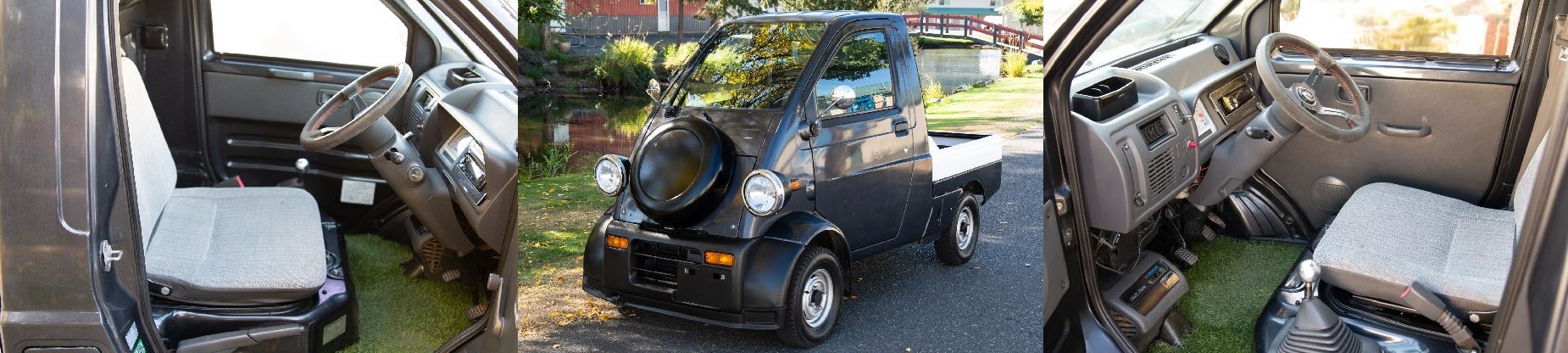
1996 Daihatsu Midget with custom AstroTurf carpets.

The Daihatsu Midget began life as a single-seater, three wheel mini-truck (1957-1972) powered by a 250cm3 (15 cubic inch) single cylinder, two-stroke engine although some were built also with a 305 cm3 (19 cubic inch) unit which may in the vernacular be thought of as the “big block” or muscle car” version.  Produced under licence in several nations in the Far East, it’s still produced in Thailand where its compact dimensions, surprising load capacity and economy of operation make it uniquely suited to confined urban environments.  Daihatsu revived the Midget name for a four-wheel version which was produced between 1996-2001, manufactured under the “Kei Car” (a clipping of kei-jidōsha (軽自動車 (light automobile)) rules which limit mass, external dimensions and restrict displacement to 660 cm3 (40 cubic inches).  In a sign of the times, these diminutive Midgets (surely an irresistible tautology in the Kei Car business) were available with options like 4WD (four-wheel drive) and A/C (air conditioning).  Small they may have been but, within their limitations, they were remarkably capable machines and like most things Japanese, very thoughtful designs with much attention to detail.

Saturday, November 9, 2024

Ficelle

Ficelle (pronounced fis-elle or fis-elle-ah (French))

(1) A variant of baguette (a type of French bread), similar in composition and appearance except much thinner.

(2) String or twine (in French), used literally & figuratively.

(3) In literary theory, a confidant (a confidante if a female), whose role within the text is to elicit information, conveyed to the reader without narratorial intervention

1880s: From the French ficelle (string; twine), from the Old French ficel, & ficelle (small cord; thread), probably from the Vulgar Latin filicella, from fibrilla, a diminutive form of fibra (fiber; filament) from fīlum (thread).  The French phrase ficelles du metier (tricks of the trade) appears of the in the form apprendre les ficelles du metier which translates best as “to learn the ropes”.  The French verb ficeler translates as “to tie up, to truss”.  In French, as well as the literal meanings (of string and certain breads), ficelle also has figurative uses.  It can be used to refer to a subtle trick or stratagem but it’s most popular as an allusion to “string pulling”, suggesting “behind the scenes” manipulation or “back channel” deals.  In English, it evolved to enjoy two niches: (1) in literary theory and (2) in culinary and artisanal bakery use.  Ficelle is a noun & verb; the noun plural is ficelles.

In literary theory, a ficelle is the confidant character whose role within the text is to elicit information, conveyed to the reader without narratorial intervention.  The term was introduced by the author Henry James (1843–1916) who used the word in the sense it appeared in French théâtre de marionnettes (marionette theatre) to refer to the strings with which the puppeteer manipulated their puppets.  What James wanted was a word to inhabit the literary grey area between the confidant and the narrator, his idea being the character in a novel who is presented as the friend of another but whose purpose as a literary device was to be the “friend of the reader”, imparting vital information without the disruptive intervention of a narrator.

Cady Heron (Lindsay Lohan (b 1986)) & Karen Smith (Amanda Seyfried (b 1985)) in Mean Girls (2004),  Cady Heron was an unusual ficelle in that as the protagonist, she was also a confidante and narrator.

The society masseuse Mrs Heaney in the tragi-comedy of manners The Custom of the Country (1913) by US novelist & interior decorator Edith Wharton (1862–1937) was a ficelle.  Acting as a kind of mentor and even a surrogate mother to Ms Spragg, she uses her keen (but remote) observation of New York’s high society to live a kind of vicarious existence in those circles through the young protagonist, but Wharton’s literary purpose was to use her to flesh out the text with facts helpful to the reader’s understanding.  The classic ficelle however was James's own Maisie Farange in What Maisie Knew (1897) the naive but preternaturally wise child in whom the warring parents, step-parents and lovers casually confide, and through whose eyes the story is told.  There can be overlap in the literary roles of confidant, narrator and ficelle (Lindsay Lohan’s Cady Heron in Mean Girls (2004) has elements of all three) but according to literary theory (1) a ficelle usually is a confidant but must not be a narrator, (2) a confidant can be a narrator if not a ficelle.  In the literary tradition Cady Heron was an untypical protagonist in that most confidants have only a marginal role in the plot, their main function to listen to the intimate feelings and intentions of the protagonist; someone like Horatio in William Shakespeare’s (1564–1616) Hamlet (circa 1600) or the Sir Arthur Conan Doyle’s (1859–1930) Dr Watson who was the “sounding board” for Sherlock Holmes.

They heard, and were abash'd, and up they sprung (Book 1, line 331).  Illustration by French printmaker & illustrator Gustave Doré (1832–1883) from an 1866 edition of John Milton's (1608-1674) Paradise Lost (1667) edited by US journalist & historian Henry Walsh (1863–1927).

The narrator has a longer tradition and was one of the features of Greek theatre and both Plato (circa 427-348 BC) and Aristotle (384-322 BC) defined three types: (1) the speaker or poet (or any kind of writer) who uses his own voice, (2) one who assumes the voice of another person or persons, speaking in a voice not his own and (3) one who uses a mixture of his own voice and that of others.  In both drama and fiction there are countless examples of each technique but authors could combine the modes, all three appearing in John Milton’s Paradise Lost: Milton begins in his own voice in the first person to invoke the “Heavenly Muse” but later the impression is created that the Muse (ie the Holy Ghost or Holy Spirit) responds to Milton's formal invocation, thus beginning the main narrative.  When first Satan speaks, the third voice is introduced and it’s not until Book III Milton returns to his “own voice” although of course, as the author, all is Milton’s own.  TS Eliot (1888–1965) in his essay The Three Voices of Poetry (1954) interpreted the notion as it could be mapped onto modern verse: “The first voice is the voice of the poet talking to himself - or to nobody.  The second is the voice of the poet addressing an audience, whether large or small.  The third is the voice of the poet when he attempts to create a dramatic character speaking in verse when he is saying not what he would say in his own person, but only what he can say within the limits of one imaginary character addressing another imaginary character.

La baguette et la ficelle. A ficelle (bottom) is more slender than a baguette (top) although in many parts of the English-speaking world the term "French stick" is used generically.  Some of what's sold as "French sticks" must appal French bakers.

Charles de Gaulle (1890-1970; President of France 1959-1969) in 1962 famously observed of his nation: “How can you govern a country which has two hundred and forty-six varieties of cheese?” and he’d probably be amused to learn that by 2024 some 1,600 distinct types had been identified.  There aren’t quite than many types of baguette but there are still a few including the “artisan baguette”, “moulded baguette”, “floured baguette”, “chocolate baguette”, “multicereal baguette”, “whole wheat baguette, “baguette a l’ancienne” (old-fashioned), “Viennoise baguette”, “Sourdough baguette”, “Baguette de Seigle”, “Baguette en épis” (corn baguette) and the “ficelle”.  The difference between the classic baguette of the popular imagination is essentially the size and shape.  A typical baguette is 610-710 mm (24-26 inches) in length with a slender, elongated shape, the crust crispy crust and the centre airy.  The ficelle is both narrower and shorter (usually around 300-400 mm (12-16 inches) long and renowned for its chewier texture and slightly thinner crust, characteristics which make it less versatile than a baguette but they are popular for making gourmet rolls or as an alternative to crackers when serving dips or spreads.  Something like the ficelle may genuinely have been the original form of the modern baguette but the name was adopted only late in the nineteenth century to distinguish them from the larger creations which had become popular; it was an allusion to a “piece of string”, the diminutive ficelle long and narrow by comparison with what had become the “standard” baguette.

Beware of imitations: The baguette de tradition française.

The origin of the baguette (as it's now understood) is truly a mystery and there are so many tales that it's recommended people choose to believe which ever most appeals to the.  In France, a true baguette (Baguette artisanale) is made from ingredients and with a method defined in law while the famous shape is a convention.  Typically, baguettes have a diameter between 50-75 mm (2-3 inches) and are some 610-710 mm (24-26 inches) in length although the 1 m (39 inch) baguette is not unusual, popular especially with the catering trade.  It’s a little misleading to suggest the baguette was invented because for centuries loaves in the shape existed in many places around the world and recipes for the mixing of dough were constantly subject to changes imposed by the success of harvests, economics, supply-chain disruptions and simple experimentation.  The baguette instead evolved and its popularity was a thing of natural selection; it survived because people preferred the taste, texture and convenience of form while other breads faded from use.  It seems clear that the long, stick-like direct ancestors of the baguette began to assume their recognizably modern form in French towns and cities in the eighteenth century although doubtless there was much variation between regions and probably even between bakers in the same place.  The daily bread being the classic market economy, bakers would be influenced by losing sales to a more popular shop and so would adjust their mixes or techniques to attract customers back.  In this way a standardized form would have emerged and, in the French way, by 1920 the assembly had passed a law codifying the critical parameters (weight, size and price), formalizing the popular name baguette.  In 2003, the jocular slang "freedom bread" emerged to describe the baguette, an allusion to the "Freedom Fries" which replaced "French Fries" in US government staff canteens while there was tension between the White House and the Élysée Palace over France's attitude to the proposed invasion of Iraq.   

Lindsay Lohan in promotion for @lilybakerjewels, 2020.  The Rainbow Baguette Ring (centre) using stones cut in a true “baguette” rectangle whereas the Rainbow Bracelet used squares.

Globalization and modern techniques of mass production however intruded on many aspects of French lives and bakeries weren’t immune from the challenge of the cheap “baguette” sold by supermarkets.  Even among the boulangerie (a French bakery in which the bread must, by law, be baked on-premises) there were some who resorted to less demanding methods of production to compete.  As a matter of cultural protection, the assembly in 1993 enacted Le Décret Pain (The Bread Decree) which stipulates that to be described as pain maison (homemade bread), a bread needs to be wholly kneaded, shaped, and baked at the place of sale.  To limit the scope of the supermarkets (some of which were importing frozen, pre-prepared dough), rules also defined what pain traditionnel français (traditional French bread) may be made from and banning any pre-made components from baguettes.  Also retained was the relevant provision of the 1920 labor legislation which prohibits the employment of people in bread and pastry making between ten in the evening and four in the morning.  So, when visiting a boulangerie, it’s recommended to ask for a baguette de tradition française (usually as baguette de tradition) which is made from wheat flour, water, yeast, and common salt (reflecting modern practice, one may contain up to 0.5% soya flour, up to 2% broad bean flour and up to 0.3% wheat malt flour) and the dough must rest between 15-20 hours at a temperature between 4-6o C (43-46F).  The less exalted baguettes ordinaires, are made with baker's yeast and a less exacting specification.

The French Ministère de la Culture’s (Ministry of Culture) L'inventaire national du Patrimoine culturel immatériel (National Inventory of Intangible Cultural Heritage) in 2018 added the baguette to its index and in 2022, the artisanal know-how and culture of the baguette was added to UNESCO’s (the United Nations Educational, Scientific and Cultural Organization) list of Intangible Cultural Heritage.  Already preserving the information about some 600 traditions from more than 130 countries, UNESCO noted the addition by saying it celebrated the French way of life, something of which the baguette, as a central part of the French diet for at least 100 years, was emblematic.  With some 16 million consumed in France every day, the “…the baguette is a daily ritual, a structuring element of the meal, synonymous with sharing and conviviality", a statement from UNESCO read, concluding it was “…important that these skills and social habits continue to exist in the future."

Thursday, November 7, 2024

Comeback

Comeback (pronounced kuhm-bak)

(1) A return to a former higher rank, popularity, position, prosperity etc, typically after an extended period of obscurity, under-performance etc.

(2) In sporting competition, a team or individual overcoming a substantial disadvantage in points to win or draw.

(3) Of products, ideas, practices etc, to again become fashionable.

(4) To reply after a period of consideration (as in “to come back” to someone).

(5) A clever or effective retort; a rejoinder; a retort; a riposte (especially if recriminatory).

(6) In informal use, a basis or cause of complaint.

(7) To return (in the sense “come back”).

(8) Of something forgotten, to return to one's memory.

1815–1825: A noun use of verb phrase “come back”, the construct being come + back.  Come was from the Middle English comen & cumen, from the Old English cuman, from the Proto-West Germanic kweman, from the Proto-Germanic kwemaną (to come), from the primitive Indo-European gwémt (to step), from gwem- (to step).  Back was from the Middle English bak, from the Old English bæc, from the Middle Low German bak (back), from the Old Saxon bak, from the Proto-West Germanic bak, from the Proto-Germanic baką, possibly from the primitive Indo-European bheg- (to bend). The adverb represents an aphetic (in phonetics, linguistics & prosody, of, relating to, or formed by aphesis (the loss of the initial unstressed vowel of a word)) form of aback.  Similar forms included the West Frisian bekling (chair back), the Old High German bah and the Swedish and Norwegian bak.  The use of comeback (for long used also as “come-back”) in the sense of a verbal (usually oral) retort dates form 1889 and was an adaptation of the verbal phrase, the implication especially of a “quick or clever response”.  The familiar modern meaning “recovery, return to former position or condition after retirement or loss” was a creation of American English, documented since 1908.  Comeback is a noun (the use as a verb is a misspelling of “come back”; the noun plural is comebacks.

In idiomatic use a “comeback kid” is a person who on more than one occasion had demonstrated a propensity to overcome tragedy, reversal or failure and rebound to triumph and victory.  It has also been used of someone who has achieved such a thing only once but in an especially notable or dramatic way such as Bill Clinton (b 1946; US president 1993-2001) who recovered from a mediocre performance in the 1992 Iowa Caucus but managed to secure an unexpected second place in the New Hampshire primary, despite (cynics would say “because”) reports of his extramarital affair with Gennifer Flowers (b 1950; “Gennifer with a ‘G’”).  Variations include “comeback king”, “comeback queen”, “comeback specialist” etc and those for whom comebacks seem to be a calling are said to stage “serial comebacks”.  When writing of comebacks (usually in sport, politics or entertainment), it not uncommon for them to be described as a “rebound”, “resurgence”, “return”, “revival”, “resurrection” or “resuscitation” (or a “redux” for those wanting something more literary).  In gambling, “comeback money” is that used by an agent of a bookie to place a large bet on a horse at large odds, thereby causing the odds on that horse to decline, reducing the bookie's potential losses in the event that the horse wins.

Thames Comeback Sauce.

Comeback sauce is a dipping sauce and salad dressing, most associated with central Mississippi and while there are variations, the classic recipes typically are based on mayonnaise and chili sauce.  A creamy & tangy Southern condiment, someback sauce is a Mississippi staple and has spread far beyond the city of Jackson, where it originated as an example of “fusion cuisine” (in this case Greek + Mississippi influences).  It’s thought the sauce's name is merely the idea “it tastes so good diners keep ‘coming back’ for more”.  It was first served in Greek-owned restaurants (some claim the Mayflower Cafe was first) in Mississippi in the mid-twentieth century and it has much evolved and in addition to the base of mayonnaise and chili sauce, other popular ingredients include ketchup, spices and Worcestershire hot sauce.

Noted comebacks in modern US politics

F Scott Fitzgerald’s (1896–1940) oft-quoted phrase “there are no second acts in American lives” appears as a fragment in his posthumously published, unfinished novel The Last Tycoon (1941) but he first published it in the early 1930s in the essay My Lost City, a kind of love letter to New York.  The quote is frequently misunderstood as an observation that for those Americans who suffer disgrace or destitution, there is no redemption, no comeback.  However, from politics to pop culture (there is still some slight distinction), there are many examples of temporarily disreputable Americans resurrecting their public lives from all but the most ignominious opprobrium.  Fitzgerald was a professional writer and his observation was an allusion to the structure used by playwrights in traditional three-act theater: (1) problem, (2) complication & (3) solution.  He thought the nature of the American mind was to prefer to skip the second act, going straight from a problem to finding a solution.  His point was well-made and it’s one of the themes of the narrative which underlies the discussions (which became arguments and sometimes squabbles) of military and political strategy between Washington and London during the World War II (1939-1945).

The concept of the comeback is well understood and the zeitgeisters at The Cut (an online publication of New York magazine) noted the phenomenon, in September 2024 posting a piece which looked at Lindsay Lohan’s latest comeback and reviewed those of the last ten-odd years.

That photograph by Doug Mills (b 1960), who has shot (in the photographic sense) every president since Ronald Reagan (1911-2004; US president 1981-1989).

What Donald Trump (b 1946; US president 2017-2021; president elect since 5 Nov 2024) did in regaining the presidency in the 2024 presidential election was perhaps the most remarkable comeback in modern US political history and as notable as any that has happened anywhere.  When one considers the prelude to the 2024 triumph, (Trump (1) lost the popular vote in 2016, (2) lost the popular vote and the electoral college (and thus the presidency) in 2020 and (3) suffered between 2021-2024 a myriad of legal problems including civil judgements in which he was found liable for hundreds of millions in damages and even a felony conviction, a historic first for a US president), his comeback seems more remarkable still.  It’s something even the Trump haters (of which there seem to be a few) must acknowledge, even if it’s not a thing of which they dare speak.

The analysis of the voting patterns in 2024 have revealed some interesting findings but talk of a “political realignment” (such as the shift of the South from the Democrats to the Republicans in the wake of the civil rights legislation of the 1960s) may be premature because there seems still not to be an understanding of just how bizarrely unique a political figure Mr Trump is.  His effect on the political dynamic is undeniable but it may be that it’s something unique to his very existence and that when he departs (God forbid), the construct called MAGA Republicanism, while it may live on as a label, ceases to exert its pull.  These personal creations do seem to behave like that, Gaullism (from Charles de Gaulle (1890-1970; President of France 1959-1969) in France and Peronism (from Juan Perón (1895–1974; President of Argentina 1946-1955 & 1973-1974) in Argentina both surviving as labels but those who have in recent decades appropriated them haven’t always pursued policies of which the two men would have approved; nor have they always aligned with the definitions political scientists have constructed.

The 2024 election:  Conde Nast's Vanity Fair makes clear its editorial position.

It was a strange election campaign.  Trump actually talked much about specifics, there were a lot of policies and many specific details: what he was going to do and to whom.  Kamala Harris (b 1964; US vice president since 2021) however appeared to have only three items on the campaign clipboard: (1) I am not Donald Trump, (2) I am not Joe Biden and (3) abortion on demand.  Had the Trump brand been as toxic as her team seemed to believe the her tactic of basing every appearance around platitudes, slogans and clichés endlessly recited (obediently to be repeated by the crowd), that might have won the election (it’s been done before) but clearly, Trump had more appeal for enough of those in the demographics the Democrats had pencilled in as “ours”.  Quickly, the analysts “scoped down” on the voting patterns and discovered (1) there were women for whom abortion was not the central issue (although it is clear women also took advantage of differential voting where possible, voting to making abortion available in their state wheen the option was on the ballot while also voting for Trump), (2) a significant proportion of Latino voters appeared to be motivated by self-interest rather than ethnic solidarity (which the Democrats seemed to assume they’d made compulsory) and (3) the black male vote for the Democrats was lower that was achieved by Barack Obama (b 1961; US president 2009-2017) in 2008 & 2012.  That last statistic intrigued some who drew what may have been a long bow in speculating that while black men don’t like being told what to do by a white man, at least they’ve had several centuries to get used to it whereas the thought of being told what to do by a black woman is just unthinkable.  It was an opportunistic conclusion to draw from an electoral behaviour which happened only at the margins but it was that sort of election.

Interest now shifts to the second Trump administration and whether it will be Trump 1.1 (ie more of the same which was experienced in the first term) or Trump 2.0 (something different).  Many analysts are suggesting it will be combination of both and structurally, the possibilities available to Mr Trump if the Republicans hold working majorities in both chambers of congress are more inviting.  Mr Trump will have learned lessons from his first term and at least some mistakes (not a word he's believed often to have used of himself) presumably won't be repeated and it's no secret a whole industry of lobbyists, specialists and obsessives have been for four years at work crafting documents detailing how they think things should be done so he won't lack for advice.  There is much talk about the "shift to conservatism" in the US (and elsewhere) but a second Trump administration promises to be one of the more radical seen since the 1960s.    

Four dead white men, left to right: Barry Goldwater, Dwight Eisenhower, Richard Nixon and Thomas Dewey, meeting to discuss the Republican platform for the 1966 mid-term elections, Washington DC, 1 June 1965.  It was a meeting of some significance because this period was the high point of the Democratic Party's control of all branches of government.

Until Trump did what he did, the greatest political comeback in the US was probably that achieved in 1968 by Richard Nixon (1913-1994; US president 1969-1974).  After two terms as VPOTUS (Vice President of the United States) to Dwight Eisenhower (1890-1969; US president 1953-1961), Nixon lost the 1960 presidential election to John Kennedy (JFK, 1917–1963; US president 1961-1963), the margin described at the time as “an electoral eyelash”.  Although it was made clear to Nixon JFK’s victory had probably been made possible by old Joe Kennedy (1888–1969 and JFK’s father) using his money to arrange some blatant vote rigging, Nixon declined to pursue his right to mount a legal challenge, arguing the institution of the office was too important to taint with scandal and telling aides: “Nobody steals the presidency of the United States”, a very different attitude that that taken in 2020 by Mr Trump  Politically, the loss in 1960 may not have been fatal but what did seem to write finis was his loss in 1962 in the Californian gubernatorial contest, an event which would now be forgotten had not Nixon, the day after, held what he called his “last press conference”.  California was then a solidly Republican state and Nixon’s loss was a surprise to most and a shock to some, most conspicuously the defeated candidate who, at the Beverly Hilton Hotel, delivered a quarter-hour tongue-lashing to the assembled press pack, accusing them, not without justification, of having hated him since first he came to prominence in 1948 and having since assiduously and unfairly worked against him.  He concluded: “I leave you gentlemen now.  And you will now write it.  You will interpret it.  That's your right.  But as I leave you, I want you to know—just think how much you're going to be missing.  You don't have Nixon to kick around anymore.  Because, gentlemen, this is my last press conference.  Nixon sat out the 1964 presidential election, appearing at the Republican National Convention only as “a simple soldier in the ranks” to nominate Barry Goldwater (1909–1998) who he described as “Mr Conservative” and the 1964 convention was the only one between 1952-1972 from which Nixon didn’t emerge as the party’s nominee for POTUS (President of the United States) or VPOTUS.  Goldwater lost the 1964 election to Lyndon Johnson (LBJ, 1908–1973; US president 1963-1969) in one of the biggest landslides ever but Goldwater managed to engineer his own, somewhat abstract, comeback, later arguing the victory of Ronald Reagan (1911-2004; US president 1981-1989) was really him winning, sixteen years on.  Barry invented the “proto-virtual comeback”.

Harry Truman, St. Louis Union Station, St. Louis, Missouri, 3 November 1948.  United States.  In Florida, 76 years later, Donald Trump would wear the same smile.

Harry Truman’s (1884–1972; US president 1945-1953) comeback victory in the 1948 presidential election was one of those events remember for one photograph: that of a smirking Truman holding aloft the 3 November 1948 edition of the Chicago Daily Tribune, the front page’s banner headline reading: “DEWEY DEFEATS TRUMAN”.  Really, the Tribune was unlucky because for reasons both technical and related to labor relations, the Wednesday edition had “gone to bed” and been printed earlier that the historic practice, the staff relying on the early returns which they interpreted as guaranteeing a solid Republican victory, not only Thomas Dewey (1902–1971) taking the White House but also both houses of congress; as things turned out, the Democrats secured all three.  For Truman, the 1948 victory was a remarkable comeback because he’d inherited the presidency only because Franklin Delano Roosevelt (FDR, 1882–1945, US president 1933-1945) had died on the eve of victory in World War II (1939-1945) and, compared with his illustrious predecessor, he seemed plain and uncharismatic, his reputation not helped as post-war economic struggles, labor strikes, and internal divisions within the Democratic Party soon took the gloss of the celebrations which had greeted the end of four years of war.  By 1948, almost universally he was expected to lose the 1948 election.

What Truman did was return to what seemed to most a kind of “pre-modern” campaign strategy in which he embarked on what came to be known as the “Whistle Stop Tour”, traveling around the nation by train, speaking in person to the voters rather than having them receive his words on the airways or in the newspapers.  Although now remembered more as part of the political lexicon, the term “whistle stop” was originally US railroad jargon and terminology and referred to small towns or rural stations where trains would only stop “on signal” and usually only if there was something or someone to pick-up or deliver (or if the conductor had, in advance, been notified).  Such stops often had little infrastructure (sometimes only the most rudimentary “platform”) and as the trains slowed down, the driver would blow the “whistle” to announce their arrival.  Although now rarely undertaken by train, the term “whistle-stop tour” remains widely used to describe campaigns that involve making multiple brief appearances in many locations.  Truman’s trip proved a great success, often delivering his speeches from the back of the railcar, his team having travelled ahead to ensure he always had an audience and in the pre internet age, he had the advantage also of being able to recycle the same text, often changing only the odd reference to “localize” the context.  His straightforward, relatable and fiery style was quite a change from the elegant, patrician FDR but it resonated with the voters who warmed to his populist message of fighting the “…do-nothing [Republican] Congress."  Against all expectations (possibly even his own), Truman enjoyed a comeback victory in what was a major upset, proving a persistent campaign with the right message can succeed even the most daunting odds.