Sunday, June 9, 2024

Vantage

Vantage (pronounced van-tij or vahn-tij)

(1) A position, condition, or place affording some advantage or a commanding view, expressed usually as "vantage point".

(2) An advantage or superiority (almost obsolete except when used by Aston-Martin).

(3) In lawn tennis, short for advantage, a "vantage game" the first game played after the set is deuce (40-40) (now thought rare as deliberate use but "advantage" is often heard that way although some umpires may well prefer the clipping).

1250-1300: From the Middle English, from the Anglo-French, by apheresis from the Old French avantage (advantage or profit).  The English advantage was from the early fourteenth century Middle English avantage & avauntage (position of being in advance of another), from the twelfth century Old French avantage (advantage, profit; superiority), from avant (before), either via an unrecorded Late or Medieval Latin abantaticum or from the Latin abante (in front; before), from the primitive Indo-European root ant (front, forehead).  The spelling with a "d" was one of those mistakes which endured to become "correct English", the “a-”, being supposed to be from the Latin ad-(from the preposition ad (to, towards), from the Proto-Italic ad, from the primitive Indo-European héd (near, at).  The meaning “any condition favorable to success, a favoring circumstance” (ie the opposite of “a disadvantage”) emerged in the late fifteenth century while the use in the scoring in tennis is documented from the 1640s.  The familiar modern phrase take advantage of was in used by the late fourteenth century in the sense of (“avail oneself of” & “impose oneself upon” while the meaning “to have the advantage of (someone) (ie have superiority over) dates from the 1560s.  The phrase "vantage point" was first noted in 1865, a variation of the earlier "vantage ground" which was in military & hunting use by the early seventeenth century.  The early English alternative vauntage, soon faded from use and the derived forms, vantages (third-person singular simple present) vantaging (present participle) and vantaged (simple past and past participle) are now wholly obsolete. Vantahe is a noun & verb; the noun plural is vantages.

The phrase “coigne of vantage” (a good position for observation, judgment, criticism, action etc) was from Act 1, Scene 6 in William Shakespeare’s (1564–1616) Macbeth (circa 1605) in which King Duncan and his cohort ride up to Macbeth's castle.

DUNCAN

This castle hath a pleasant seat. The air
Nimbly and sweetly recommends itself
Unto our gentle senses.

BANQUO

This guest of summer,
The temple-haunting martlet, does approve,
By his loved mansionry, that the heaven’s breath
Smells wooingly here. No jutty, frieze,
Buttress, nor coign of vantage, but this bird
Hath made his pendant bed and procreant cradle.
Where they most breed and haunt, I have observed,
The air is delicate.

Coigne was a variant of quoin, from coin and has been used variously to mean (1) a projecting corner or angle; a cornerstone, (2) the keystone of an arch, (3) a wedge used in typesetting, (4) in crystallography, a corner of a crystal formed by the intersection of three or more faces at a point and (5) in geology, an original angular elevation of land around which continental growth has taken place.

Vantage points: Traditionally, the best way to secure a vantage point is to seek a degree of elevation to achieve the desired "line of sight" (Lindsay Lohan (photo shoot for Vogue (Spanish edition) August 2009, left) but the functionality of just about any spot can usually be enhanced by the use of a telescope, binoculars, opera glasses of any appropriate form of magnification (Kim Jong-un (Kim III, b 1982; Supreme Leader of DPRK (North Korea) since 2011, right).

DB2 Vantage DHC

The word Vantage was first used by Aston Martin in 1950 on the DB2.  The title indicated an uprated engine specification: a pair of larger carburetors and a higher compression ratio which added 20bhp to the standard DB2’s 105.  Almost 250 were built with both saloon (AM’s term for a two door coupé) and drophead coupé (DHC, the term then often used by English manufacturers to refer to "formal convertibles (which some call cabriolets)" (as opposed to the more performance-oriented roadsters)) coachwork.

DB4 Vantage Saloon

Strangely, although the Vantage moniker caught on with aficionados, it wouldn’t be again used by the factory for almost a decade.  The DB4 Vantage was released with the Series IV cars in 1961, now with triple carburetors and a higher compression ratio, the cylinder head was also revised with bigger valves, the package yielding 266bhp, some ten per cent more than a standard DB4.  The Vantage this time was visibly distinct as well as technically upgraded, gaining the faired-in headlights and bright aluminum trim from the earlier DB4 GT.

DB5 Vantage Saloon

While mechanically almost identical to the Series IV, the more spacious Series V Vantage of 1962, the last in the DB4 line, was stylistically different, being essentially a prototype for the upcoming DB5.  The two are virtually indistinguishable; indeed one Series V DB4 Vantage was used alongside a DB5 in the filming of the James Bond film Goldfinger (1964).  Of the 141 built, the rarest and most desirable were the half-dozen with the optional DB4 GT engine.

DB5 Vantage DHC

The Vantage option remained on the books when the DB5 was released in 1965.  Now with triple Weber carburetors, the factory rated the Vantage at 325bhp, a jump of 40 over the standard engine and only 68 of the 887 saloons were built to the Vantage specification.  More rare still was the DB5 Vantage convertible, a mere eight of the 123 built although, over the decades, a great many of both have be upgraded to the Vantage standard.

DB6 Vantage Saloon

Introduced in 1965 and made in two series, the now Kham-tailed DB6 remained in production until 1970.  The DB6 Vantage was mechanically identical to its predecessor but there were detail changes.  Retained was the Vantage badge introduced with the DB5, but the nomenclature was now added as a discreet script on the side strakes and much attention was devoted to improving passenger comfort.  At this point, while coupés continued to be labelled saloons, convertibles were now styled Volantes (a derivation of the Italian word for "flying").  Spread between two series, out of a total DB6 production of 1739, 405 Saloons and 42 Vantage Volantes were built.

DBS Vantage Saloon

By the mid 1960s, the market in which Aston Martin competed, although larger, was more contested than even a decade earlier.  As early as 1961, Jaguar’s E-Type had, at a fraction of the cost, matched the DBs in style and performance, if not quality and their V12 project was known to be well-advanced.  The Italian thoroughbreds, Ferrari, Maserati and Lamboghini, all with eight and twelve cylinder engines, were setting new standards and there was now an array of trans-Atlantic hybrids which combined exquisite European coachwork with cheap, effortless and reliableAmerican V8 power.  Aston Martin’s six cylinder engine, Vantage tweaked or not, was starting to look technologically bankrupt.  Accordingly, the factory developed both a new car, the DBS, and their own V8.  For a variety of reasons, the V8 wasn’t ready by the time the DBS, a typical Aston Martin mix of traditional and modern, was released in 1967 so the familiar six, again available in Standard or Vantage form was carried over from the DB6 although, to counter increased weight, the Vantage version boasted revised camshafts.

Vantage Saloon

The DBS and DB6 were produced in parallel until 1970, the last few DB6s built after the DBS V8’s release the previous year.  The last of the six cylinder DBSs came in a run of seventy named simply Vantage, all with the revised twin-headlight coachwork introduced in 1972 which would serve the line essentially unchanged until 1989.  Historically, the final seventy were then a unique anomaly, the first time a Vantage was not the most but the company's least potent offering.  After the last was built in 1973, there would not for twenty years be another six-cylinder Aston Martin.

V8 Vantage Volante

That historical quirk was certainly rectified after the Vantage’s half-decade hiatus, during which the first oil crisis of the early 1970s had transformed the market.  Most of the trans-Atlantic hybrids had been driven extinct, Jaguar had moved in a different direction, Mercedes-Benz had chosen not to compete, Lamborghini, Aston Martin and Maserati all had their own brushes with bankruptcy, Porsche were moving up-market to become a competitor and governments were imposing more and more regulations.  The 1977 Aston Martin Vantage took a different approach to the mid-engined Italian or turbo-charged German opposition.  Although there was much attention to aerodynamics and chassis dynamics, mostly it was about simple brute force, the additional power over the standard V8 gained by the traditional methods used in Vantages past and it proved effective, able to run with the Lamborghini Countach, the Ferrari BB and even the Porsche 911 Turbo of the time.  This time, the factory didn’t release a claimed power output, describing it instead as “adequate”.  Introduced in 1969, by the time production ended in 1989, the V8 range was regarded as "a glorious anachronism".

V8 Vantage Zagato Saloon

The Vantage, as both saloon and volante, remained in production until 1989 and served as the basis of the shorter, radical, and very rare, V8 Vantage Zagato coupé & convertible (presumably in deference to the Italian contribution, the tags "saloon" & "volante" were never used).  Zagato's coachwork during the 1950s had been sometimes quirky (the double-bubble roof a signature) but they tended to the orthodoxy of the era, exemplified by the DB4 GT Zagato coupé, twenty of which were built between 1960-1963.  As the century unfolded however, Zagato's lines became increasingly rectilinear and "interestingly unique" were sometimes described as "not conventionally beautiful" and the Vantage Zagato (1986-1990) was one of the less confronting.  Still, Zatago survives to this day while many European coachbuilders did not and the business has been in continuous operation since 1919, some half-dozen years after the formation of Aston Martin.

Virage Vantage V550 Saloon

High-priced brute force remained a gap in the market and Aston Martin continued its commitment with a Virage-based supercharged Vantage in 1993 which, by 1998, was running twin superchargers, its 600bhp making it then the most powerful production powerplant in the world, making the Vantage capable of close to 200 mph (320 km/h) and for those who wanted even more power there was a run of forty V8 Vantage Le Mans" versions, built to mark the fortieth anniversary of the victory in the 24 hour endurance classic of Carroll Shelby (1923–2012) & Roy Salvadori (1922–2012) in an Aston Martin DBR1/300; Shelby would go on to found Shelby American and produce the AC Cobra, the mid century's benchmark in brute force.  Virage production ended in 2000 and for a platform which started life in 1969 it endured remarkably well.  By the year 2000, some of the competition were objectively "better cars" but there was nothing else like the big Aston Martins left and its retirement was regretted by many.

DB7 Vantage Saloon

The DB7, first shown at the now defunct Geneva Motor Show in 1993, was the first six-cylinder Aston Martin in twenty years.  It was conservatively styled but the lines were greeted with acclaim and it proved an immediate success.  In 1999, a Vantage version was released and with the company now under the Ford corporate umbrella, it used a 5.9 litre (362 cubic inch) V12 engine developed in co-operation with Cosworth Technology.  It was the first time a Vantage wasn’t a development of the standard engine, the straight six in the DB7 being a different configuration and remarkably, by historic standards, the DB7 Vantage verged on mass-production: over four-thousand built were built over a four and a half year run which ended in 2003.

VH V8 Vantage Coupé

Ford were pleased by the sales and in 2003, again at the Geneva Motor Show, unveiled on the VH platform the AMV8 Vantage Concept, so well-received the order books were bulging by the time the production version was released in 2005.  It proved to be the most successful car in Aston Martin’s history and this time it really was mass-produced, necessitating construction of a second production line; eventually more than fifteen thousand would leave the factory.  Less brute force than before, the new V8 Vantage relied on technology to exceed the performance of most of its predecessors.  For those attracted by more performance or more exclusivity, in 2009, Aston Martin unveiled the V12 Vantage, weighing little more than its V8 sibling but boasting an additional hundred-odd horsepower and able to reach 190 mph (305 km/h).  In 2012, the V12 Vantage Zagato was added to the books.

V12 Vantage S

However, after the GFC (Global Financial Crisis), the expansion of the money supply (essentially governments giving cash to the rich) at the upper end of the market meant there was increasing taste for conspicuous consumption.  Like other manufacturers anxious to meet demand with supply, Aston Martin responded with a bespoke programme, offering degrees of customisation to the point of one-off creations but also, new product lines, hence the 2013 V12 Vantage S.  It joined the new generation of machines now able routinely to attain the 200mph (320 km/h) speeds first promised by the Italians in the early 1970s but not realised because of the means available at the time to defeat the formidable opposition of physics.  At a tested 205mph (330 km/h), the terminal velocity of the V12 Vantage S made it the fastest Aston Martin ever and, in a nicely nostalgic touch, in 2016, even a manual gearbox was offered.

Vantage Roadster

The times were changing and there was an end-of-an-era feel when the new Vantage was released in 2018.  Fitted with a Mercedes-Benz-AMG four litre V8 (with fuel consumption and emissions generation numbers which even half a decade earlier would have been thought unfeasibly low), it didn't quite match the top-end performance of the V12 but was judged by reviewers to be a more practical day-to-day proposition to own while being less environmentally thuggish.  There was some regret that things were not quite the way things used to be done but to the surprise of many, the factory late in 2021 announced there would be one, last V12 Vantage and it was released the following March, 333 of the 700 horsepower machines produced, a convertible version announced some months later in a run limited to 249.  For 2024 and beyond, the 4.0 litre V8 Vantage will continue and advances in electronics and aerodynamics now guarantee each will top 200 mph.  The commendable reductions in emissions notwithstanding, Aston Martin will not have been struck from any of Greta Thunberg’s (b 2003) lists so those who can are advised to enjoy a V8 or V12 Vantage while they can.

Aston Martin Vantage Production Numbers

DB2 Vantage: 248 saloon and DHC

DB4 Vantage: 135 (plus 6 DB4 GT Vantages)

DB5 Vantage: 68 saloon (plus 8 DHCs)

DB6 Vantage: 335 saloon (plus 29 Volantes)

DB6 Vantage MkII: 70 saloon (plus 13 Volantes)

DBS Vantage:290 saloons

Vantage 70 saloons

V8 Vantage: 372 saloon (plus 194 Volantes)

V8 Vantage Zagato: 52 coupés (plus 37 convertibles)

Vantage/V8 Vantage: 273 saloon (plus 40 specials)

DB7 V12 Vantage: 2,086 coupe (plus 2,056 Volantes)

V8 Vantage (VH): 15,458 coupe (plus 6,231 Roadsters)

V12 Vantage: 2,957 (all types including V12 Vantage S)

V12 Vantage (2021-2022) (333 coupés plus 249 convertibles)

Saturday, June 8, 2024

Vile

Vile (pronounced vahyl)

(1) Wretchedly bad.

(2) Highly offensive, unpleasant, or objectionable.

(3) Repulsive or disgusting, as to the senses or feelings; repellent.

(4) Morally debased, depraved, or despicable; vulgar, obscene.

(5) Foul; filthy.

(6) Poor; wretched.

(7) Of mean or low condition; menial; lowly.

(8) Degraded; ignominious.

(9) Of little value or account; paltry

(10) Vicious, evil iniquitous.

(11) Unpleasant or bad weather.

1250–1300: From the Middle English vil, from the Anglo-French ville, from the Old French vil (shameful, dishonorable; low-born; cheap; ugly, hideous), from the Latin vīlis (cheap, worthless, base, common), possibly from the primitive Indo-European wes-li, a deverbal adjective with passive meaning (which can be bought), from the root of venus (sale).  It was cognate with the Latin vīlis, the Ancient Greek νος (ônos) & νέομαι (ōnéomai) (to buy), the Sanskrit वस्नयति (vasnayati) (to haggle) and वस्न (vasna) (price).  Related forms are the adjectives viler and vilest, the adverb vilely and the noun vileness (the thirteenth century vilety appears to be extinct).  Handy synonyms include repugnant, horrid, contemptible, depraved, noxious, vulgar, humiliating, vicious, disgusting, sleazy, ugly, despicable, repulsive, revolting, miserable, nasty, appalling, immoral, shocking and disgraceful.  The verb revile was from the late fourteenth century revilen (debase, degrade (a sense now obsolete)) and by the mid-fourteenth century meant "insult, taunt, vilify, assail with abusive language".  It was from the Old French reviler (consider vile, despise, scorn).  The mid-fifteenth century vilify (to lower in worth or value) was from the Late Latin vilificare (to make cheap or base; to esteem of little value) is from the Latin vilis (cheap, worthless, base, common).  The meaning "to slander, speak evil of" dates from the 1590s.  Vile, viler (the comparative) & vilest (the superlative) are adjectives and forms like vilish & vilishness are non-standard, usually used humorously.  

Lindsay Lohan pouring from modern civilization's most ubiquitous phial (or vial), PepsiCo Pilk promotion, December 2022.  

The aluminium can used to contribute much to litter, both as thoughtlessly they were discarded when empty and because the sealing tabs were detachable, beaches & parks in the 1970s notorious for being strewn with the things.  The problems substantially were solved by (1) making a fee payable when the cans were handed in to a recycling centre and (2) changing the tab's design so the whole mechanism remains attached.  Aluminium does consume large amounts of electricity during the production process but if "green energy" can be used it's one of the less environmentally destructive metals and, (1) being light it reduces the fuel load required during transportation & storage and (2) being non-ferrous it doesn't rust.  It is one of the best and most economical efficient metals to recycle.

Phial is a doublet of vial.  In technical use (in science), some institutions have drawn distinctions between the two: (1) phials being larger than vials and (2) vials are for liquids related to medicine and phials for other fluids but in general use they remain interchangeable (although consistency within documents is obviously recommended) although phial is now rare.  In the US, early in the twentieth century, phial became close to extinct after hundreds of years of being nearly as common as vial while elsewhere in the English-speaking world, vial emerged as the preferred form during the post-war years and, except in laboratories, phial seems now a romantic form restricted to fiction, historical and spiritual writing.

Crooked Hillary Clinton (b 1947; US secretary of state 2009-2013), probably deleting something.

But for the judgment of the Trump election campaign team, she might now be remembered as "vile Hillary Clinton".  Like phial, vial must never be confused with its homophone vile, another example of an aspect of English which must annoy those learning the finer nuances of the language,  So a vial (or phial) is a noun describing a vessel in which liquids are kept while vile is an adjective, applied most often to morally dubious or otherwise unpleasant and objectional characters.  Donald Trump's (b 1946; US president 2017-2021) use of monikers for political opponents (and others) had been a little noticed feature of his conversation before becoming one of the features of the 2016 presidential election ("low energy Jeb" (Bush), "lying Ted" (Cruz), "little Marco" (Rubio), "crazy Bernie" (Sanders) et al but by far the most effective was "crooked Hillary" (Clinton) which is being recycled as "crooked Joe Biden" for the 2024 contest.  Mr Trump's team apparently puts some effort into finding the best (ie most appropriately insulting) although it seems a beltway myth that focus groups were assembled for testing to determine some sort of metric of effectiveness.  Bridget Jones in Helen Fielding's (b 1958) Bridget Jones's Diary (1996) liked "vile" and "vile Richard" was so evocative for readers, the word for some reason genuinely a pleasure to say the word, the meaning emphasized by lengthening the sound.  "Vile Hillary" works well.

Friday, June 7, 2024

Esthetic

Esthetic (pronounced es-thet-ik)

(1) An alternative spelling of aesthetic (mostly North American).

(2) In US commercial use, a term applied to cosmetic surgery (as esthetic surgery) and other fields in the beauty business.

1920s: A re-purposing of an existing word (originally in the form “esthetic surgery” by a US doctor as a means of product differentiation (plastic surgery for cosmetic rather than reconstructive purposes).  Esthetic is an adjective (and when used as an alternative spelling of aesthetic the comparative is more esthetic, the superlative most esthetic) and esthetician is a noun; the noun plural is estheticians.  The alternative spelling esthetic began life as one of those Americanisms which annoy some but it reflected simply the wholly sensible approach in US English that it’s helpful if spelling follows pronunciation and esthetic remains the alternative spelling of aesthetic, used predominately in North America although, as the internet has achieved for so many variants, it is now an internationalism.

Often, when an image appears in which a celebrity seems somewhat “changed”, Instagram lights up with speculation about possible esthetic surgery.  If there’s enough interest, this will spread to the mainstream celebrity sites which will deconstruct the possibilities and sometimes publish interviews with esthetic surgeons who will offer an opinion.  Once, esthetic interventions were almost always denied but now they’re sometimes admitted and even publicized.

In the early twentieth century the US cosmetic surgery industry (even then inventive and profitable), re-purposed the word; linguistic differentiation to create product differentiation: “esthetic surgery”, the business of performing surgery for aesthetic purposes rather than reasons strictly medical or reconstructive and the most significant figure in this was the German-Jewish cosmetic physician Jacques Joseph (1865–1934), now remembered as the “father of modern cosmetic surgery”.  Under the auspices of first the American Society of Plastic Surgeons (ASPS, 1931) and the American Society for Aesthetic Plastic Surgery (ASAPS, 1967), the business of esthetic surgery has since boomed and related (even if remotely) professions such as nail technicians, the lip-plumpers and the body-piercers also append “esthetic” to their advertising; the first “estheticians” were the skin care specialists (exfoliation, massage, aromatherapy, facials and such) but the title soon proliferated.

Forbes on Miami Swim Week 2024

With their coverage of Miami Swim Week (MSW 2024; South Beach, Miami, 29 May-5 June 2024), Forbes must have delighted etymologists looking for case studies.  MSW is self-described as “The premier fashion event of the year!” which may elicit a wry smile from some in New York, Paris, London or Milan but the phase “swim week” is no perhaps too modest from an event which has grown from being in 1998 essentially somewhere for manufacturers and retailers to display the new season’s swimsuits to a place where, in addition to hundred of vendor spaces and multiple runways (no catwalks at MSW) there are seminars, panel discussions and “beach lifestyle events” like yoga + mimosas; MSW is now very much a “vibe occasion”, noted for vendor hospitality and after-parties.  It has of course also moved with the times and those times have changed from when DEI (diversity, equity and inclusion) was achieved with a smattering of brunettes among the bronzed blondes on what then were the catwalks.  Now there is obvious ethnic diversity and some “plus-size” models (up to a certain point) and it’d be interesting to have an artificial intelligence (AI) engine review the footage of the last few MSW and similar events to calculate if there’s appears to be an industry “quota” for those not of the (still secretly) desired body type and skin color.  The suspicion is there may be such quotas and those numbers are “creeping up”, presumably to plateau at some “threshold of plausible acceptability”.

What Forbes explored in the headline: "Aesthetics meets Esthetics" was one of the panel discussions conducted at the Gabriel Hotel as part of the Art Hearts Fashion run of show which included runway shows from men’s swimwear line Hunk and The Black Tape Project with its conceptualized futurist swimwear designs.  On Friday, the intriguingly named “Snatched Plastic Surgery” hosted an intimate panel discussion exploring the symbiotic relationship between body trends and fashion.  On the panel were industry experts including designers & fashion house CEOs, magazine editors and a plastic surgeon specializing in cosmetic procedures (esthetic surgery).  The symbiosis explored was about (1) the part esthetic procedures (not all are surgical) contribute to demand for clothing which reveals more of the body’s surface (ie skin) of which swimwear is the most extreme example and (2) the demand for such procedures generated by the desire to wear such clothing.  There are technical aspects to that which involve the intricate details of surgeries which make certain cuts of swimwear wearable by those who would otherwise be precluded but that didn’t appear to make the panel’s agenda.

Structural determinism in action: At MSW 2024, rosettes came in sizes to suit the coverage required (or desired).

What MSW 2024 did reveal was that the trend which disproportionately was over-represented in the coverage continued to be the most minimal but one notable return was one of the industry’s older fig leaves: the rosette.  Having lost the association with high-society and neglected in political campaign wear (except in the UK and to some extent in New Zealand) since the advent of digital advertising, rosettes in fashion were last seen at scale (and occasionally en masse) in the years around the turn of the twentieth century but on the MSW runways they were back.  Although coverage in the press was limited, whether as a three dimensional attachment or a printed motif, rosettes appeared often on the swimwear designed actually to be worn in the water but what caught the eye of photographers were the most minimal, most of which would be unlikely long to survive secure in the surf.  Still, that was unlikely to have been a design objective and as a static display or worn while walking (carefully), they probably work well.

MSW 2024: External superstructure was more apparent al la the exposed plumbing in some of the architecture of mid-century modernism.

The other thing the critics noted was the increasing migration of the “cage bra” look to swimwear.  If well designed, the exposed superstructure can genuinely function as a structural device but the real attraction was that it permits the volume of material (already hardly generous) further to be reduced.  That certainly is a design objective but one which creates the problem of having less surface area with which to work to create something, hence the attraction of making the superstructure a feature.  It’s essentially an underwire which is shaped rather more than is required to fulfil the functional purpose and sometimes even a little wider (a rare case of a minimalist bikini’s component getting bigger) so accessories can be added or more of the fabric covering is displayed.

Thursday, June 6, 2024

Aesthetic

Aesthetic (pronounced es-thet-ik or ees-thet-ik (mostly non-US))

(1) Relating to the philosophy of aesthetics; concerned with what is regarded as attractive and what is not.

(2) Relating to the science of aesthetics; concerned with the study of the mind and emotions in relation to the sense of beauty.

(3) Having a sense of the beautiful; characterized by a love of beauty (and, used loosely: “good taste”).

(4) Relating to, involving, or concerned with pure emotion and sensation as opposed to pure intellectuality.

(5) The philosophical theory or set of principles governing the idea of beauty at a given time and place.

(6) A particular individual’s set of ideas about style and taste, along with its expression:

(7) An individual’s (or a collective’s) set of principles or worldview as expressed through outward appearance, behavior, or actions.

1798: From the mid-eighteenth century German Ästhetisch or the German-derived French esthétique, from the New Latin, ultimately from the Ancient Greek aisthetikos (pertaining to sense perception, perceptible, sensitive perceptive and (of things) perceptible), the construct being aisthēt(s) (aesthete) + -ikos (-ic), from aisthanesthai (to perceive (by the senses or by the mind), to feel, from the primitive Indo-European awis-dh-yo-, from the root au- (to perceive).  The ikos suffix was from κός (kós) with an added i, from i-stems such as φυσι-κός (phusi-kós) (natural), through the same process by which ῑ́της (ī́tēs) developed from της (tēs), occurring in some original case and later used freely.  It was cognate with the Latin icus and the Proto-Germanic igaz, from which came Old English (which in Modern English ultimately was resolved as y), the Old High German ig and the Gothic eigs.  The historic alternative spelling is æsthetics, still see in the odd literary novel.  Derived forms include the adjectives nonaesthetic (which if hyphenated seems to be used as a neutral descriptive and if not, as a critique) & pseudoaesthetic (which is always in criticism).  Aesthetic is a noun & adjective, aesthete & aestheticism are nouns and aesthetically is an adverb; the noun plural is aesthetics.

The noun aesthete (person of advanced and fine artistic sensibilities) dates from the early 1880s and was from Ancient Greek ασθητής (aisthēts) (one who perceives), the construct being aisthē- (variant stem of aisthánesthai (to perceive)) + -tēs (the Greek noun suffix denoting agent).  It was a Victorian back-formation from aesthetics and there no exact synonym, the closet being “connoisseur” but it conveys a slightly different implication and the derived noun hyperaesthete is used sometimes as a term of derision directed at the “excessively civilized”.  The rarely used alternative spellings esthete & æsthete are now used only as literary devices and are otherwise obsolete.  Aesthete is a noun and aesthetic is a noun & adjective; the noun plural is aesthetes and the idea long predates the word, descriptions of such figures appearing (sometimes as slurs hinting at a lack of manliness) in texts from Antiquity and aesthetician (professor of taste) was in use by 1829, aestheticist by 1868.  The original edition (1911) of the Concise Oxford English Dictionary (COD) noted that in English university slang the opposite of an aesthete was a “hearty”, the former tribe devotes of John Ruskin (1819–1900), the latter lot lusting after a rugby blue.

Ms Andrea Ivanova who is pursuing (from head to toe) a particular aesthetic.

For specific purposes, estheticians can induce localized instances of angioedema (in pathology, a swelling that occurs just beneath the surface of the skin or mucous membranes).  Ms Andrea Ivanova (b 1998), a student from the Bulgarian capital Sofia, has had over twenty injections of hyaluronic acid in her quest to have the world’s plumpest lips but, seeking additional fullness, indicated recently she intends to pursue another course of injections.  Ms Ivanova is also a collector of Barbie dolls, the aesthetic of which she admires, and these are said to provide the inspiration for some of the other body modifications and adjustments she's undertaken.  Like the lips, other bits remain a work-in-progress, Ms Ivanova documenting things on Instagram where she enjoys some 32K followers.

The alternative spelling esthetic began life as one of those Americanisms which annoy some but it reflected simply the wholly sensible approach in US English that it’s helpful if spelling follows pronunciation.  However, in the early twentieth century the US cosmetic surgery industry (even then inventive and profitable), re-purposed the word; linguistic differentiation to create product differentiation: “esthetic surgery”, the business of performing surgery for aesthetic purposes rather than reasons strictly medical or reconstructive and the most significant figure in this was the German-Jewish cosmetic physician Jacques Joseph (1865–1934), now remembered as the “father of modern cosmetic surgery”.  Under the auspices of first the American Society of Plastic Surgeons (ASPS, 1931) and the American Society for Aesthetic Plastic Surgery (ASAPS, 1967), the business of esthetic surgery has since boomed and related (even if remotely) professions such as nail technicians, the lip-plumpers and the body-piercers also append “esthetic” to their advertising; the first “estheticians” were the skin care specialists (exfoliation, massage, aromatherapy, facials and such) but the title soon proliferated.  

A classic reference which can be read for pleasure (by word nerds).

JA Cuddon (1928-1996) was a writer of extraordinary range and one of the great characters of twentieth century literary life in England and while some of his works sold more, none have been of more enduring than his typically comprehensive and amusing Dictionary of Literary Terms & Literary Theory, first published in 1977 by Penguin and the entry on aestheticism is typical of his style, beginning with the observation the term was “'pregnant' with many connotations” before exploring the history.  In English, “aesthetic” first came into wider use after appearing in translations of the work of the German philosopher of the Enlightenment Immanuel Kant (1724–1804) although the original use was in the classically correct sense “science which treats of the conditions of sensuous perception” and Kant’s use had been an attempt at reclamation on behalf of academic philosophy in reaction to his fellow German philosopher Alexander Baumgarten (1714–1762) heretically using it in his Aesthetica (1750) to mean “criticism of taste”, something which so appealed to English speakers it became (despite the doughty scholarly rearguard) after the 1830s (in the wake of the Romantic poets) the dominant meaning, freeing the word from the jealous grasp of the philosophers.  This was cemented by the literary critic Walter Pater (1839–1894 and one of the century’s most exquisite stylists of language) who in 1868 applied it to the l'art pour l'art (art for art's sake) movement, a place which proved its natural home.  The English academic polymath William Whewell (1794–1866) had suggested callesthetics for “the science of the perception of the beautiful” but that never caught on.  The shift is illustrated by the track of the adjective which was in 1798 was recorded to mean “of or pertaining to sensual perception” while by 1821 there was the parallel “of or pertaining to appreciation of the beautiful.

Cuddon defined an aesthete as “one who pursues and is devoted to the 'beautiful' in art, music and literature” while aestheticisrn was the “term given to a movement, a cult, a mode of sensibility (a way of looking at and feeling about things) in the nineteenth century [which] fundamentally… entailed the point of view that art is self-sufficient and need fulfil no other purpose than its own ends. In other words, art is an end in itself and need not be (or should not be) didactic, politically committed, propagandist, moral - or anything else but itself; and it should not be judged by any non-aesthetic criteria such as whether or not it is useful). Cuddon reminded his readers that Kant as well as Goethe (Johann Wolfgang von Goethe, 1749–1832), Friedrich Schelling (1775–1854) & Friedrich von Schiller (1759–1805) were all in the vanguard of the l'art pour l'art movement or cult”, arguing “art must be autonomous”, the political implication being “the artist should not be beholden to anyone.  From this, in turn, it followed that the artist was someone special, apart, from others and from this came the post-Romantic idea of the artist as superior to ordinary mortals”, a view which infected many who concluded they deserved to be judged on the basis of being artists, rather than by virtue of the art they produced.  In the dark mist of late Romanticism, this had a certain appeal but it cumulated in post-modernism and while it’s true that even in the nineteenth century high art there really wasn’t one agreed construct of the aesthetic, by the late twentieth century there were so many that Cuddon was probably right in suggesting it was the long-term result of Romantic subjectivism and self-culture; of the cult of the individual ego and sensibility.

Cuddon detected “a widespread disenchantment in the literature of the aesthetes, and especially in their poetry” which he contrasted with the popular novelists of the era such as early realists like Charles Dickens (1812–1870) or Émile Zola (1840–1902).  The poets showed a “tendency to withdrawal or aversion”, aspiring to “sensuousness and to what has become known as ‘pure poetry'” and while that was criticized by figures as diverse as Benjamin Disraeli (1804-1881, UK prime-minister 1868 & 1874-1880) and Karl Marx (1818-1883), at “its best, aestheticism was a revitalizing influence in an age of ugliness, brutality dreadful inequality & oppression, complacency, hypocrisy and Philistinism.  It was a genuine search for beauty and a realization that the beautiful has an independent value.  At its worst it deteriorated into posturing affectation and mannerism, to vapid idealism and indeed to a kind of silliness which is not wholly dead.  Cuddon was writing in the mid-1970s and it’s doubtful anything he saw in the last decades of his life much changed his mind.

Deconstructing the Lindsay Lohan aesthetic

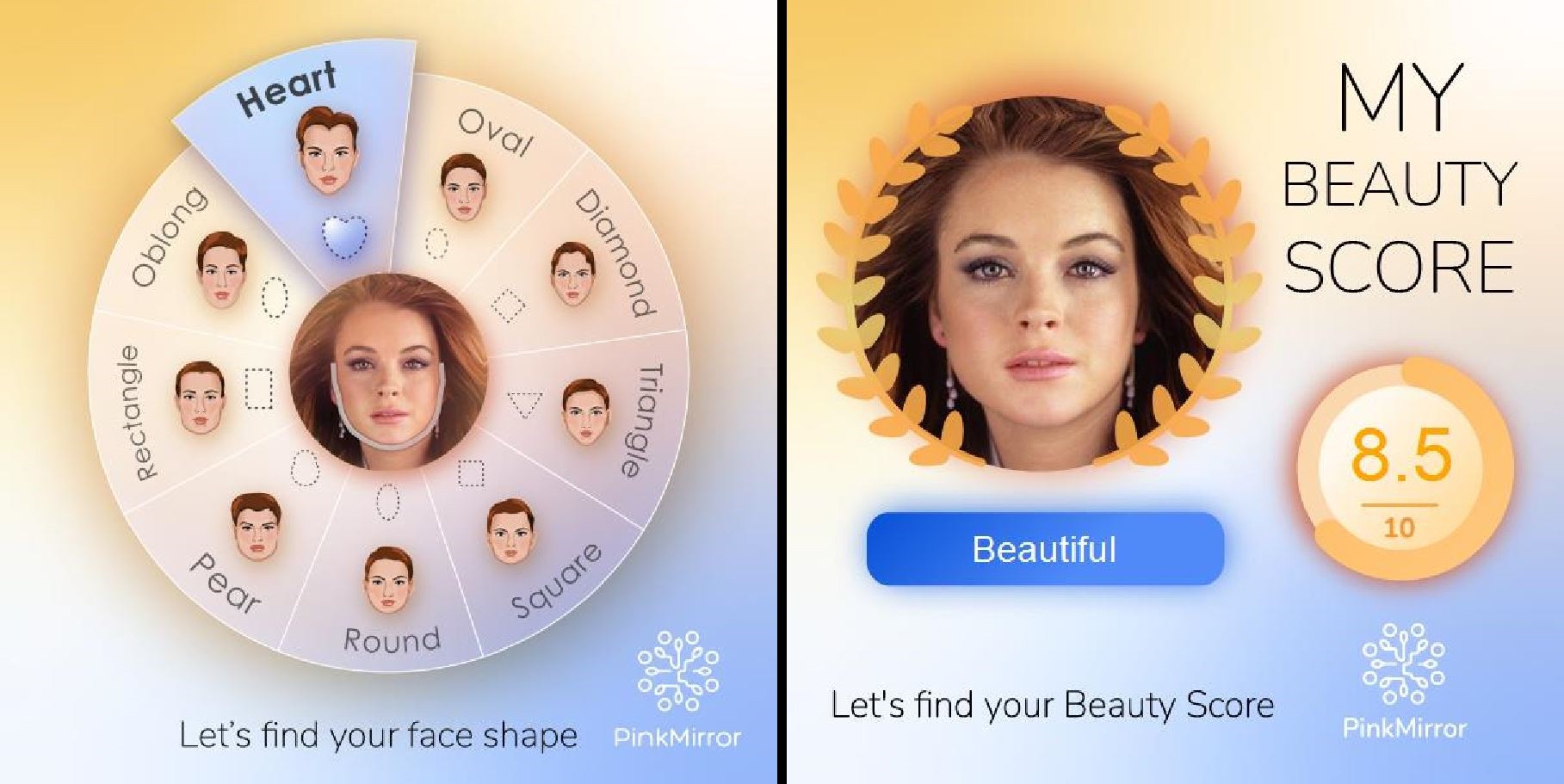
PinkMirror is a web app which helps users optimize their facial aesthetics, using an artificial intelligence (AI) engine to deconstruct the individual components an observer’s brain interprets as a whole.  Because a face is for these purposes a collection of dimensions & curves with certain critical angles determined by describing an arc between two points, it means things can be reduced to metrics, and the interaction of these numbers can used to create a measure of attractiveness.  Pinkmirror cites academic research which confirms a positive canthal tilt is a “power cue” for female facial attractiveness and while it’s speculative, a possible explanation for this offered by the researchers was linked to (1) palpebral (of, pertaining to, or located on or near the eyelids.) fissure inclination being steeper in children than adults (classifying it thus a neonatal feature) and (2) it developing into something steeper still in females than males after puberty (thus becoming a sexually dimorphic feature).  Pinkmirror notes also that natural selection seems to be operating to support the idea, data from Johns Hopkins Hospital finding that in women, the intercanthal axis averages +4.1 mm (.16 of an inch) or +4o, the supposition being that women with the advantage of a positive medial canthus tilt are found more attractive so attract more mates, leading to a higher degree of procreation, this fecundity meaning the genetic trait producing the characteristic feature is more frequently seen in the population.  Cosmetic surgeons add another layer to the understanding, explaining the canthal tilt is one of the marker’s of aging, a positive tilt exuding youth, health, and exuberance where as a line tending beyond the negative is associated with aging, this actually literally product of natural processes, the soft tissue gradually descending under the effect of gravity, as aspect of Vogue magazine’s definition of the aging process: “Everything gets bigger, hairier & lower”.

The Pinkmirror app exists to quantify one’s degree of attractiveness.  It’s wholly based on specific dimension and thus as piece of math, is not influenced by skin tone although presumably, its parameters are defined by the (white) western model of what constitutes attractiveness.  Users should therefore work within those limitations but the model would be adaptable, presumably not to the point of being truly cross-cultural but specifics forks could certainly be created to suit any dimensional differences between ethnicities.  Using an industry standard known as the Photographic Canthal Index (PCI), one’s place on Pinkmirror’s index of attractiveness is determined by the interplay of (1) Nose width, (2) Bi-temporal to bi-zygomatic ratio, (3) chin length, (4) chin angle, (5) lower-lip height & (6) eye height.

Lindsay Lohan scored an 8.5 (out of 10), was rated as “beautiful” and found to be “very feminine, with great features of sexual dimorphism”, scoring highly in all facets except lower lip height and eye height.  Her face shape is the heart, distinguished by a broad forehead and cheekbones, narrowing in the lines of down to the jaw-line, culminating in a cute pointy chin.  Pinkmirror say the most attractive face shape for women has been found to be the triangle, scoring about the same as the oval while the heart, round, diamond, rectangle and square are also attractive to a lesser degree.  Within the app, pears and oblongs are described as “not typically seen as attractive” and while the word “ugly” isn’t used, for the unfortunate pears and oblongs, that would seem the implication.

Other aesthethetics

A functional magnetic resonance imaging (fMRI) machine.

The mysterious “experimental aesthetics” is a discipline in psychology taking “a subject-based, inductive approach to aesthetics”; it was founded by German physicist and experimental psychologist Gustav Fechner (1801–1887) who had a background in psychophysics before changing direction so experimental aesthetics is the second oldest research area in psychology.  It is a field of study which investigates how individuals perceive and evaluate aesthetic experiences using empirical methods, merging principles and techniques from psychology, neuroscience and the arts to understand the underlying mechanisms of aesthetic appreciation and creativity.  Essentially, it was the examination of the way people perceive beauty, art and design, and how they form aesthetic judgments, the resulting metrics gleaned from measuring sensory processes, cognitive mechanisms and emotional responses.  Given these things are inherently hard to quantify in a way which is both statistically sound and has some meaning, what Fechner was attempting was really quite adventurous and those who have continued his work have produced something sprawlingly interdisciplinary, involving collaborations between psychologists, neuroscientists, artists, designers, and philosophers, all with their own traditions of measurement. From this interplay emerged the sub-field of neuroaesthetics which focuses on the neural basis of aesthetic experiences, something made possible by the development of various brain imaging techniques like Functional magnetic resonance imaging (fMRI) and the electroencephalogram (EEG).  Being academics who publish, experimental aesthetics has also yielded theoretical models, the most pleasing of which is the “processing fluency theory of aesthetic pleasure” which explores what contributes to the ease with which information is processed in the human mind, a significant factor in the way people experience beauty.

In the same vein as ethnomusicology (the study of non-Western musical forms), ethnoaesthetics is the study or description of “the aesthetics specific to or adopted by a particular culture”.  Perhaps surprisingly, both continue to be used although some might consider them at least microaggressions which can be read as implying a cultural hierarchy and even if not, it certainly suggests “separate but equal”, a concept with its own troubled history.  Phonoaesthetics is the study of the aesthetic properties of sounds, particularly in the context of language. The phono- prefix (relating to sound) was from the Ancient Greek φωνή (phōn) (voice, sound).  The word φωνή primarily referred to articulated human or animal sounds in contrast to ἠχή (from which is derived “echo”) which referred to sounds in general.  Phonoaesthetics involves the analysis of how certain sounds, words, or phonetic patterns are perceived as pleasing or displeasing to the ear, the field combining elements of linguistics, psychology, and aesthetics to explore the sensory and emotional responses elicited by different sounds.  If ever you’ve wondered why a word like “succulent” is so “delicious” to say, phonoaesthetics has the answer.  The inherent beauty or appeal of sounds exists both in isolation and within linguistic structures, most obviously in the phonemes, syllables & prosody but there are also associative factors; a word with a positive association can impart pleasure and that experience can exist across a culture or be specific to one individual.  Somaesthetics is an interdisciplinary field that studies the body (soma, from the New Latin, from the Ancient Greek σμα (sôma) (body) as both a site of sensory appreciation (aesthesis) and creative self-fashioning.  Not taken seriously by all critics, it’s seems essentially the “New Age” with an academic gloss.