Saturday, February 20, 2021

Mongoose

Mongoose (pronounced mong-goos or mon-goos)

(1) Slender, ferret-like carnivores, any small predatory viverrine mammal of the genus Herpestes edwardsi and related genera, occurring in Africa and from southern Europe to South-East Asia, typically having a long tail and brindled coat; feeds on rodents, birds, and eggs, noted especially for its ability to kill cobras and other venomous snakes; known in Italian as the mangusta.

(2) Any of several other animals of this genus or related genera.

(3) Any species of the Malagasy mongoos; only distantly related to the Herpestidae, these are members of the family Eupleridae; they resemble mongooses in appearance and habits, but have larger ears and ringed tails.

1698: From the Portuguese mangusto, from the Marathi मुंगूस (mugūs), from the Old Marathi mugusa, from the Telugu ముంగిస (mugisa).  The Portuguese mangusto was concocted to refer to the "snake-killing ichneumon of India, from an Indic language (of which the Mahrathi variations are the best known), probably ultimately from Dravidian.  Other Indian forms documented during the Raj were the Telugu mangisu, the Kanarese mungisi and the Tamil mangus.  The English form is mongoose but in most languages where the word exists, it’s as a variation of the Portuguese mangusto (mangusta the spelling in Italian, Polish and Lithuanian).  In the eighteenth & nineteenth centuries, the spelling in English was mungoose, derived from the names used in India including the Hindi mugūs (magūs in the classical Hindi), the Marathi mugūs, the Telugu mungisa and the Kannada munguli, mungi & mungisi, the form displacing the native Old English nǣderbita (literally “snake biter”). The spelling mungoose emerged in 1698, the “-goose” part adopted by virtue of folk etymology with goose and the noun plural is mongooses, not the occasionally seen mongeese, the mistake an understandable by-product of the example of "goose" and an example of why English must sometimes seem strange to those learning the language. There is no accepted collective noun, suggestions including troop, committee and delegation.  The correct plural is mongooses because of the origin in India; the plural thus built in the regular English way.  Goose is different and one of only seven common nouns (all of which can be traced back to the Old English) in which changing a vowel in the middle is involved in the construction of a plural.  Three are beasts (louse/lice; mouse/mice & goose/geese) two are body parts (foot/feet & tooth/teeth) and two are humans (man/men & woman/women).  The woman/women this is unique in that the first vowel also changes sound, even though the “o” stays in place.

The mongoose is a small terrestrial carnivorous mammal of the family Herpestidae, split into two subfamilies, the Herpestinae and the Mungotinae; in the former there are some two-dozen species native to southern Europe, Africa and Asia while the later exists in half that number, all native to Africa.  A famously efficient hunter of snakes, in the 1870s, mongooses were introduced to the Caribbean colony of St Lucia as a control measure against the deadly fer-de-lance (from either the French or Créole and translated variously as “iron of the lance”, “iron spear point”, “lancehead” or “spearhead”), the local name for the Terciopelo (Bothrops asper), a species of pit viper.  The voracious little killers proved more effective than the Governor's bounty of sixpence per fer-de-lance which had yielded a disappointing 1200 victims in seven months.

Mongooses enjoying morning tea, Queen Elizabeth National Park, Uganda: The interaction between the mongoose and the usually disagreeable common warthog (Phacochoerus africanus; an un-domesticated member of the pig family (Suidae) endemic in the savanna & forests of sub-Saharan Africa) is an example of symbiosis in nature.  In what behavioral zoologists call a "mutualistic partnership" (which they distinguish from true symbiosis), a resting warthog will allow mongooses to gather and perform some grooming, snacking on the annoying biting ticks which infest their coats.  

The De Tomaso Mangusta

Dance of death: Cobra and Mongoose.

Argentine-born Alejandro de Tomaso (1928-2003) in 1955 fled to his father’s native Italy after being linked to a plot to overthrow President Juan Perón (1895–1974; Argentine president 1946-1955 & 1973-1974).  In Latin America, that wasn’t something at the time unusual, young, middle-class men having long been attracted to scheming against left-wing rulers to the point where in some families, it was a calling.  In Italy, he married a rich heiress, spending her money to go racing (without notable success) and, (rather more productively), building fast cars.

Shelby American Cobra: Fiftieth Anniversary 427 SC Continuation (2014, 50 of which were built, allocated serial #CSX4500-CSX4599).

In 1964, he met Le Mans winner, Carroll Shelby (1923–2012), famous also for his Anglo-American hot-rod, the AC Shelby Cobra.  They entered into an agreement to build racing cars for the up-coming Can-Am series but squabbles between the two ensued, the arrangement ending in acrimony.  De Tomaso continued to develop the vehicle, this time as a road car which, in revenge, he named Mangusta (mongoose), a beast renowned for its skill in hunting and killing snakes including Cobras.  Designed by Giorgetto Giugiaro (b 1938) of Ghia, between 1967-1971 some four-hundred Mangustas were produced and although the details are contested, the 150-odd are said to have been powered by the same highly-tuned 289 cubic-inch (4.7 litre) Ford (Windsor) V8 as the most numerous of Shelby’s Cobras, the remainder using a milder 302 (4.9 litre) Windsor for the lucrative US market, the 302 compliant with their more onerous emission regulations.
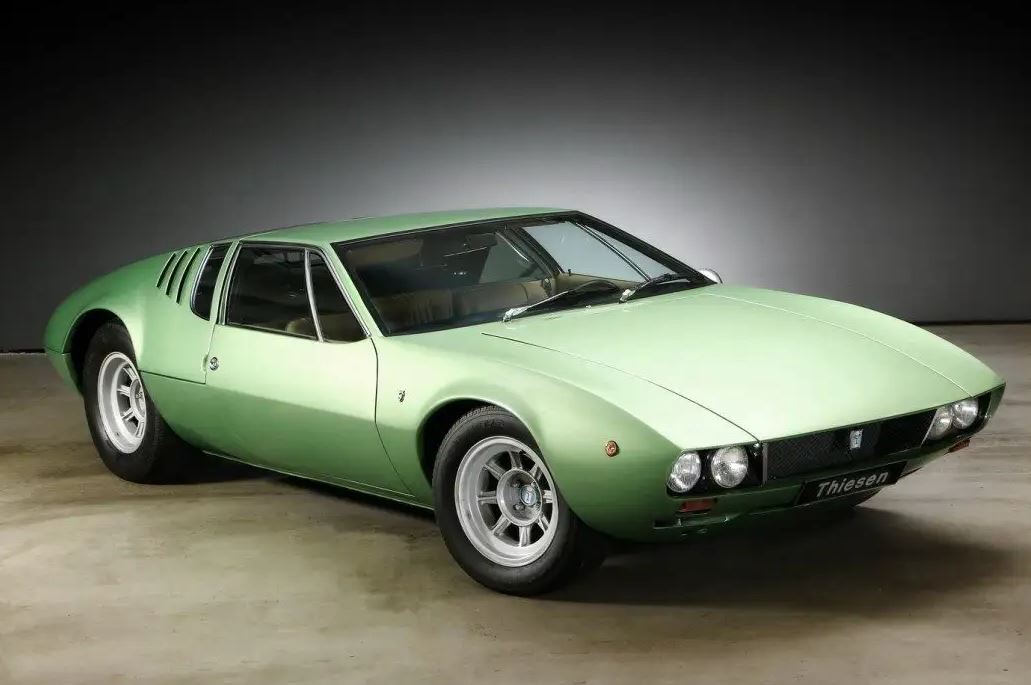
1969 De Tomaso Mangusta (289).

Achingly lovely though it was, adapting a race car for the road necessitates compromises and the Mangusta had not a few.  A 32/68% front/rear weight distribution delights racing-car drivers but induces characteristics likely to frighten everybody else and the interior was cramped, something tolerated in competition vehicles but not endearing to buyers looking for something with which to impress the bourgeoisie.  However, it sold well enough to encourage de Tomaso to pursue the concept and the better designed (if less beautiful) replacement, the Pantera (Italian for "panther"), lasted from 1971 to 1993, over seven-thousand being sold, some with the Australian-built Ford 351 (5.8 litre) V8 (which continued usually to be referred to as the "Cleveland" (a reference to the Ohio plant where the US versions were first built) even though most of the blocks were cast in the foundry attached to Ford Australia's manufacturing facility in Geelong, Victoria.  The idea of a "351 Geelong" never caught on but a footnote in Ford's V8 history is the Australians also concocted a unique "302 Cleveland" (all other pre-modern 302s using the earlier "Windsor" block).

1970 De Tomaso Mangusta (289).

As a road car, the Mangusta was fundamentally so flawed it really couldn’t be fixed; seen first in 1966, it came from those innocent times before Ralph Nader (b 1934) got politicians interested drawing up rules, some of which admittedly were both desirable and overdue.  However, even had it been possible to re-engineer the thing into something well-behaved enough for real people safely to drive (and what Porsche's engineers achieved with the 911 proved such things could be done), there was no way it could have been adapted to conform to the laws which began with severity to be imposed in the 1970s.  The solution was the Pantera, designed with a copy of the regulations in one hand and a cheque from the Ford Motor Company in the other, FoMoCo interested in having in their showrooms a competitor for Chevrolet’s Corvette.  Discarding the Mangusta’s steel backbone chassis for a steel unibody, with a 44/56% front/rear weight distribution, inherently the Pantera was safer in non-expert hands and contemporary testers praised the handling characteristics.  Its sales volumes never challenged those of the Corvette but in the four years it was available in the US through Ford's Lincoln-Mercury dealer network, well over 5000 were sold although Ford was required to inject significant resources to ensure quality control was maintained (infamously, the US singer Elvis Presley (1935-1977) one morning shot his when it refused to start).  

1972 De Tomaso Pantera.

This time, De Tomaso used the 351 cubic inch version of Ford's new 335 series (Cleveland) V8, which, although somewhat bigger and heavier than the earlier Windsor, did offer some advantages in that it was designed with emission controls in mind and used a more efficient cylinder head.  None of that much helped in the market conditions which prevailed in the recession induced after the first oil shock in 1973 and sales declined to the point where Ford concluded any continuing investment was no longer viable; in 1975 the arrangement with De Tomaso was terminated.  After the withdrawal from the US market, De Tomaso maintained production on a smaller scale, the majority sold in Europe and it enjoyed a long Indian summer, the final examples not leaving the factory until 1993 by which time output had slowed to a trickle; the final count when production ended after 19 years was 7260.  After 1988, there was a switch to the Windsor V8 because Ford Australia (Cleveland V8 production moved to the Geelong foundry after 1974), reacting to both the second oil shock in 1979 and changing customer behavior, in 1983 closed the line (they would later realize that had been a mistake and in 1991 began importing US built V8s which would remain available until the Australian operation was closed in 2016).  De Tomaso accordingly warehoused Australian 351s which powered the Panteras until the stockpile was exhausted.

1985 De Tomaso Pantera GTS.

Disappointingly, despite on paper appearing to possess a promising specification, there was never a stellar career in competition although factory support was offered and private teams ran regular campaigns.  Conspiracy theorists have long attributed the paucity of success to the more established players like Ferrari and Porsche having undue influence on the regulatory bodies (such as the habitually dopey Fédération Internationale de l'Automobile (the FIA; the International Automobile Federation)), nudging them always in directions favouring their machines.  It had been done before.  Doubts had always been expressed about the suitability of the Cleveland engine for competition because the lubrication system lacked the passages which made the Windsor so robust but there were work-arounds for that and the factory arranged small runs of Panteras which conformed to the FIA's Group 3 and Group 4 racing regulations (some of which owners later converted to Group 5 specifications) but consistent success proved elusive.  De Tomaso however knew his market.  Even if he couldn’t often beat the Porsches and Ferraris on the track, as the years went by the Panteras adopted increasingly wild styling and they certainly looked the part although it'll always be remembered as a car for the boulevard rather than the track, one in 1972 memorably awarded to Playboy's playmate of the year (PotY), finished in the magazine's then traditional pink.

1991 De Tomaso Pantera 90 Si in Giallo Cromo (chrome yellow) over Nero (black) leather.

For its final run, the bodywork was updated by Bertone’s Marcello Gandini (1938–2024) and given the designation Pantera 90 Si, 41 of which would be built; two were sacrificed to crash-testing, one (chassis #9641) was allocated to the de Tomaso museum and 38 were offered for general sale.  The touches of Gandini (noted for his work on Lamborghini’s Miura (1966-1973) & Countach (1974-1990, first displayed in 1971), the Lancia Stratos HF (1973-1978) and Alfa Romeo Carabo (1968)) were more subtle than previous revisions to the design.  The 90 Si (it was sold in the UK market as the Pantera 90) used the Windsor 302 (Type 99E) although it was much updated from the unit which had powered the US bound Mangustas two decades earlier, fitted with electronic fuel injection, revised cylinder heads, camshafts, pistons valves and intake manifolds.  The underpinnings were also modernized with revised suspension geometry and the addition of ventilated and cross-drilled disc brakes, the four-piston Brembo calipers familiar from the appearance on the Ferrari F40 (1987-1992).

1991 De Tomaso Pantera 90 Si in Rosso Corsa (racing red) over Beige leather.

Based on the GT5S, beneath the skin was used a modified version of the original steel unibody, now featuring a tubular rear subframe for the engine, transaxle and suspension, the new design both lighter and more rigid.  The wheels were 17 inch Fondmetal cast in magnesium wheels (the front 9 inches wide, the rear 12) which replaced the various Campagnolo units used since 1971; originally they were shod with Michelin MXX tyres (235/45ZR/17 front, 335/35/ZR/17 rear).  Supplied from the US in the form fitted to the Ford Mustang (with a 9.0:1 compression ratio (CR) and rated at 225 hp at 4200 rpm), de Tomaso’s modifications included lifting the CR to 11.0 and the factory claimed 305 hp at 5800 rpm, a number more plausible than the 306 hp Shelby American allocated (somewhat arbitrarily) to the original 289 Cobras.  The 90 Si continued to use the 5-speed ZF transaxle but two (chassis # 9637 & 9639) were fitted with Getrag 6-speed units.

1991 De Tomaso Pantera 90 Si in Rosso Corsa (racing red) over Beige leather.

With air-conditioning, electric windows, a CD player, wood veneer inserts on the dash, centre console and door panels and much leather, the 90 Si was the most lavishly appointed Pantera ever.  The mechanical modifications made it also the best behaved and most civilized but although the design brief had included making it suitable to be certified for sale in the US, none were exported there and the recession of the early 1990s saw demand for such machines collapse and sales never approached the optimistic expectation of 75 a year justified its conception and development.  Production ceased late in 1993.  One was even made in RHD (right-hand-drive) and in the UK the importer (Emilia Concessionaires) offered the option of twin turbochargers, advertising it as the Pantera 200 (an allusion to the claimed top speed of 200 mph (322 km/h) although it seems not certain that was ever verified.

1993 1991 De Tomaso Pantera 90 Si Targa by Carrozzeria Ernesto Pavesi in Stratos Blu (blue) over Beige Leather.  This is chassis #9637, one of two with a Getrag 6-speed transaxle.

Between 1993-1994, four of the 38 90Si Panteras (chassis #9636, 9637, 9638 & 9639) were converted to targas by Carrozzeria Ernesto Pavesi (1929-2012), a coach-building house with a decades-long association with Alejandro de Tomaso, the company having produced the 14 Longchamp spyders (and reputedly also the two convertible Maserati Kyalamis which were Longchamp-based).  The quality of Pavesi's work attracted the attention of some Longchamp owners who had their cars converted to spyders.   Founded in Milan by Ernesto Pavesi (1901-1974) in 1929, Carrozzeria Ernesto Pavesi (1929-2012) proved adaptable to a changing environment and survived the Great Depression, World War II (1939-1945) and the post-war decline of coach-building but succumbed finally to the effects of the GFC (global financial crisis, 2008-2012).  Pavesi completed the last of the four Pantera Targas in 1994, demand further hampered by it being some 50% more expensive than the coupé.

Friday, February 19, 2021

Scoop

Scoop (pronounced skoop)

(1) A ladle or ladle-like utensil, especially a small, deep-sided shovel with a short, horizontal handle, for taking up flour, sugar etc.

(2) A utensil composed of a palm-sized hollow hemisphere attached to a horizontal handle, for dishing out ice cream or other soft foods.

(3) A hemispherical portion of food as dished out by such a utensil.

(4) The bucket of a dredge, steam shovel etc.

(5) In medicine, a spoon-like surgical apparatus for removing substances or foreign objects from the body; a special spinal board used by emergency department staff that divides laterally (ie literally “scooping up” patients).

(6) A hollow or hollowed-out place.

(7) The act of ladling, dipping, dredging etc.

(8) The quantity held in a ladle, dipper, shovel, bucket etc.

(9) In journalism, a news item, report, or story revealed in one paper, magazine, newscast etc before any other outlet; in informal use, news, information, or details, especially as obtained from experience or an immediate source.

(10) A gathering to oneself, indicated usually by a sweeping motions of the hands or arms.

(11) In informal use, a big haul of something.

(12) In television & film production, a single-lens large floodlight shaped like a flour scoop and fitted with a reflector.

(13) To win a prize, award, or large amount of money.

(14) In bat & ball sports, to hit the ball on its underside so that it rises into the air.

(15) In hydrological management, a part of a drain used to direct flow.

(16) In air-induction management (to the engines in cars, boats, aircraft etc), a device which captures external the air-flow and directs it for purposes of cooling or combustion.

(17) In Scots English, the peak of a cap.

(18) In pinball, a hole on the playfield that catches a ball, but eventually returns it to play in one way or another.

(19) In surfboard design, the raised end of a board.

(20) In music (often as “scoop up”), to begin a vocal note slightly below the target pitch and then to slide up to the target pitch, prevalent particularly in country & western music.

1300–1350: From the Middle English scope & schoupe, from the Middle Dutch scoep, scuep, schope & schoepe (bucket for bailing water) and the Middle Dutch schoppe, scoppe & schuppe (a scoop, shovel (the modern Dutch being schop (spade)), from the Proto-Germanic skuppǭ & skuppijǭ, from the primitive Indo-European kep & skep- (to cut, to scrape, to hack).  It was cognate with the Old Frisian skuppe (shovel), the Middle Low German schōpe (scoop, shovel), the German Low German Schüppe & Schüpp (shovel), the German Schüppe & Schippe (shovel, spade) and related to the Dutch schoep (vessel for baling).  The mid-fourteenth century Middle English verb scōpen (to bail out, draw out with a scoop) was from the noun and was from the Middle Low German schüppen (to draw water), from the Middle Dutch schoppen, from the Proto-Germanic skuppon (source also of the Old Saxon skeppian, the Dutch scheppen, the Old High German scaphan and the German schöpfen (to scoop, ladle out), from the primitive Indo-European root skeubh- (source also of the Old English sceofl (shovel) and the Old Saxon skufla.

Sherman L Kelly's (1869–1952) ice-cream scoop (the dipper; 1935) was a masterpiece of modern industrial design and thought sufficiently aesthetically pleasing to be a permanent exhibit in New York's Museum of Modern Art (MoMA).  Its most clever feature was the fluid encased in the handle; being made from cast aluminum, the heat from the user's hands was transferred to the cup, obviating the need for the moving parts sometimes used to separate the ice-cream for dishing out.  The dipper is like the pencil, one of those designs which really can't be improved.  In the industry, the technical term for the small but annoyingly intrusive globule of ice cream which appears at the base of a scoop is “skirt”.  Some manufacturers of ice cream scoops (the advertising folk also like “scooper”) promote their product's ability to avoid “over-serving & wasteful skirt”.

A New York Post scoop, 29 June 2007.  This was the Murdoch press's biggest scoop since the publication in 1983 of the "Hitler Diaries".  The "diaries" turned out to be forgeries; the picture of Lindsay Lohan resting in a Cadillac was genuine.

The meaning “hand-shovel with a short handle and a deep, hollow receptacle” dates from the late fifteenth century while the extended sense of “an instrument for gouging out a piece” emerged by 1706 while the colloquial use to mean “a big haul” was from 1893.  The journalistic sense of “the securing and publication of exclusive information in advance of a rival” was an invention of US English, first used in 1874 in the newspaper business, echoing the earlier commercial verbal slang which imparted the sense of “appropriate so as to exclude competitors”, the use recorded in 1850 but thought to be considerably older.  The meaning "remove soft or loose material with a concave instrument" dates from the early seventeenth century while sense of “action of scooping” was from 1742; that of “amount in a scoop” being from 1832.  The noun scooper (one who scoops) was first used in the 1660s and the word was adopted early in the nineteenth century to describe “a tool for scooping, especially one used by wood-engravers”, the form the agent noun from the verb scoop.  Scoop is a noun & verb, scooper & scoopful are nouns and scooped & scooping are verbs; the noun plural is scoops.

XPLR//Create’s fluid dynamics tests comparing the relative efficiency of ducts (left) & scoops (right).

In air-induction management (to the engines in cars, boats, aircraft etc), a scoop is a device which captures external the air-flow and directs it for purposes of cooling or combustion.  An air scoop differs from an air duct in that a scoop stands proud of a structure's surface allowing air to be "rammed" into its ducting while a duct is an aperture integrated into the structure, "sucking" air in from the low pressure zone created by its geometry.  For a given size of aperture, a scoop can achieve an airflow up to twice that of a duct but that doesn't of necessity mean as scoop is always preferable, the choice depending on the application.  In situations where optimal aerodynamic efficiency is desired, a duct may be chosen because scoops can increase frontal area and almost always, regardless of placement, leave a wake of turbulent air, further increasing drag.  It's thus one of those trade-offs with which engineers are familiar: If a scoop is used then sufficient air is available for purposes of cooling & combustion but at the cost of aerodynamic efficiency while if a duct is fitted, drag is reduced but the internal air-flow might be inadequate.

NACA Ducts: 1969 Shelby Mustang GT500 (left), 1971 Ford Mustang Mach 1 351 (centre) & 1972 Ford Falcon GTHO Phase IV (Right).

When Ford introduced NACA ducts on the 1971 Mustangs (subsequently adopted by Ford Australia for the XB (1973-1976) & XC (1976-1979) Falcon), whether in error or to take advantage of the public’s greater “brand-awareness” of the National Aeronautics & Space Administration (NASA), they were promoted as “NASA ducts”.  In fairness, the two institutions were related, NASA created in 1958 after the National Advisory Committee for Aeronautics (NACA) was dissolved, the process essentially a name change although much had changed since the NACA’s formation in 1915, the annual budget then US$5000 and the dozen committee members unpaid.  The NACA duct was one of many innovations the institution provided to commercial and military aviation and in the post-war years race cars began to appear with them, positioned variously to channel air to radiators, brakes and fuel induction systems as required.

Scoops: 1969 Ford Mustang Boss 429 (left), 1969 Ford Mustang Mach 1 428 CobraJet (with shaker scoop) (centre) & 1974 Pontiac Trans Am 455 SD (with rearward-facing scoop) (right).

From those pragmatic purposes, the ducts migrated to road cars where often they were hardly a necessity and, in some cases, merely decorative, no plumbing sitting behind what was actually a fake aperture.  Scoops appeared too, some appearing extravagantly large but there were applications where the volume of air required was so high that a NACA duct which would provide for the flow simply couldn’t be fashioned.  That said, on road cars, there were always suspicions that some scoops might be fashionably rather than functionally large, the lines drawn in the styling and not the engineering office.  There was innovation in scoops too, some rearward facing to take advantage of the inherently cool, low pressure air which accumulated in the cowl area at the base of the windscreen although the best remembered scoops are probably the “shakers”, assemblies protruding through a hole in the hood (bonnet) and attached directly to the air-cleaner which sat atop the carburetor, an arrangement which shook as the engine vibrated.  By such things, men are much amused.

The inaugural meeting of the NACA (National Advisory Committee for Aeronautics), 23 April 1915.

The NACA remains a useful case-study in the way a bureaucracy can contribute first to the development of an ecosystem which enables the institution's growth yet ultimately outlives its purpose in the sense of becoming a victim of its own success.  When World War I (1914-1918) war broke out, the US army possessed only 23 aircraft (at a time when France possessed 1,400 airplanes, Germany 1,000 and Russia 800), reflecting the historic view in Washington DC that aviation was an amusing diversion for the rich rather than a strategic matter for government.  Rapidly, the blast of war changed that view and in the way these things still are done, Congress added a rider to Navy appropriation legislation that established the NACA; to this day the first response of politicians is to form a committee.  In that spirit the NACA soon established four expert sub-committees to focus on the fields it had recognized as critical: airframe structures, aerodynamics, methods of propulsion and aircraft operations.  The NACA’s original mandate was (loosely) to coordinate the nation’s efforts in aeronautical research but because in the inter-war years both military and civilian aviation rapidly advanced and new industries emerged, the committee soon was transformed into an independent research organization with labs and workshops staffed by engineers, scientists and technicians, its wind tunnels, the biggest and best in the US.  Even prior to the outbreak of World War II (1939-1945), NACA was spread over multiple sites and, in conjunction with industry, universities and the military, it made substantial contributions to supersonic flight, jet propulsion and improvements to airframes.  The NACA was disbanded in 1958 to become the foundation for the National Aeronautics and Space Administration (NASA), the creation of which was prompted by the shock caused by the Soviet’s successful launch of Sputnik 1 in October, 1957.

The NACA's "C" being removed to make way for the NASA's "S", NASA’s Aircraft Engine Research Laboratory, Cleveland, Ohio, 1958.

One potential economy which could have been achieved by the re-branding in 1958 was the signage on the buildings would have demanded only the scrapping of the “C” and its replacement with a “S”.  That sounds DOGE (Department of Government Efficiency) friendly but lateral-thinker Elon Musk (b 1971) would probably have suggested the name should have been National Aeronautics and Cosmic Administration, thus meaning the signage could stay.  As things turned out, NASA got a new logo.  Compared with some of the NACA’s contributions (which led ultimately to the space program) the NACA duct seems slight but after it first appeared on race cars in the 1960s it became well-known although when a pair were included on the 1971 “ram-air” Mustangs, Ford’s advertising agency promoted it as the “NASA duct” undoubtedly because the Moon-landings had made NASA famous while NACA was known to few.

Shelby American Mustang GT500: 1969 (left) and 1970 (right).

The 1969 & 1970 Shelby Mustangs featured an impressive five NACA ducts on the hood (three to let air in, two to allow it to escape) and one able to admire them was Connie Kreski (1946-1995, left) who received a pink GT500 as her prize for being judged Playboy magazine’s PotY (Playmate of the Year), an honor the photographs suggest richly she deserved.  Five NACA ducts is at least three more than most cars in the era had but one owner of a 1970 GT500 (right) decided it just wasn’t enough and added a scoop atop.  It was a era of annual styling changes but the reason the 1969 & 1970 Shelby Mustangs look so similar is that Shelby American and Ford agreed not to continue production in 1970 but because there was an unsold stock of 798 1969 cars, they were (under the supervision of the FBI (Federal Bureau of Investigation)) issued new VINs (vehicle identification numbers) and sold as 1970 models.  Visually, the only things which distinguish the 1970 cars are a chin spoiler and two black hood (bonnet) strips which pass over the outer pair of NACA ducts.  The owner of the green car (not in the sense Greta Thunberg (b 2003) uses the phrase) must have decided the stripes and spoiler might have detracted from the impact of the big scoop. 

Japanese gold-lined sugar scuttle & sugar scoop with laurel leaf detailing (circa 1970s, left) and William IV sterling silver sugar bowl (1832) by John Fry II, London, England (right).

Sugar scoops are used to scoop sugar from a “sugar scuttle” whereas if one’s sugar is in a “sugar bowl”, a “sugar spoon” is used.  A lump of sugar is handled with a pair of “sugar tongs” (another of those cases in which the nominally plural “pair” is correct when describing a singular object because the first “pairs of tongs” literally were “two tongs” manipulated in unison.  The difference between a “sugar spoon” and a “tea spoon” is the former has a deeper and usually more rounded bowl and most are supplied as part of a “tea set” or “tea service”, often with the same decorative elements.  Among antique dealers, all are often bundled for sale with a tea tray” although in many instances, such agglomerations are a case of “mix & match”.

Jaguar E-Type: S1 with covered headlight (left), S1.25 with early "sugar scoop" (centre) and S2 with later "sugar scoop" (right). 

After the Jaguar E-type's (1961-1974; sometimes known in the US as XK-E or XKE) lovely headlight covers were legislated to extinction by the newly created US DOT (Department of Transportation, established by an act of Congress on 15 October 1966 and beginning operation on 1 April 1967), the replacement (uncovered) apparatus came to be called the “sugar scoop”, a term earlier used for the Volkswagens & Porsches sold in North America US market which had to be fitted with sealed-beam headlights because of protectionist rules designed for the benefit of US manufacturers.  The use of “sugar scoop” for the E-Type was appropriate because the visual link with the utensil was much more obvious than on the Volkswagens & Porsches.

UUA 368 is an Australian-registered 1968 (S2) Jaguar E-Type and is available for hire at a daily rate of Aus$890.00 (including 200 km (124 miles)); the hire company has dubbed her (the car) "Penelope".  Not all jurisdictions allow the registration plate to be painted on the hood (bonnet), a practice made famous in 1961 by the photographs of 9600 HP, a pre-production E-Type used as one of the factory’s original press-cars.  It was 9600 HP which The Autocar magazine took to Belgium, successfully verifying the then astonishing claim of a top speed of 150 mph (241 km/h) although, years later, it was revealed there had been a few subtle tweaks and an E-Type off the showroom floor wouldn’t quite hit the magic number.  Painting the registration on the hood avoided disfiguring the lovely lines with a plate (no flat surfaces on the front of an E-Type) and many followed the lead, some places allowing it, some not.  A S2 E-Type, UUA 368 has the more elevated of the two styles of open headlight but, being delivered in Australia, it retains the triple SU carburettors by then denied to customers in North America so its response will be more lively, especially above 100 mph (160 km/h).

The lure of the headlight covers: 1973 E-Type with headlight covers subsequently added (left) and with the original "sugar scoops" (left).  These are US market cars with the additional "dagmars" appended to the bumperettes.  Even by 1973, thin whitewall tyres were still a popular option on US Jaguars and they remained available until the last were sold in 1975 but the wide whitewalls often supplied in the early 1960s had long fallen from favor.  Although the judges in the JCNA (Jaguar Clubs of North America) confederation are usually uncompromising members of the originality police, they make a rare exception in usually not deducting points from late-build S1 (1967) E-Types (the so-called S1.25 & S1.5) which have been fitted with the headlight covers.  Although the covers never appeared on the S3 E-Types, their presence clearly doesn't dissuade buyers because the S3 pictured above (left), in February, 2021 sold at auction for US$230,000.  It was an exceptionally low-mileage example (8000-odd miles (13,000 km)) but even given that it represented an impressive premium for what was a "modified" vehicle. 

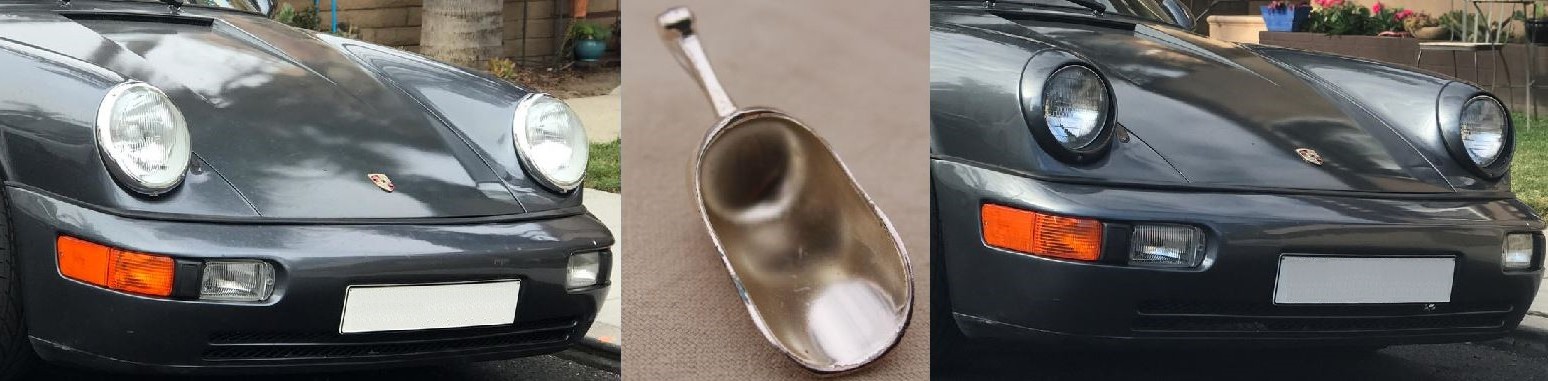
A US market 1977 Porsche 911 (1964-1989), fitted with the front bumper assembly of a later 911 (964 (1989-1994)):  The original “sugar scoops” are seen on the right and the replacement Hella H4 lights are to the left (in RoW (rest of the world) cars both H2 & H4 units were fitted).  Conceptually identical, a sugar scoop (centre) is similar in form to some smaller "coal scuttles", differing only in scale.

Thursday, February 18, 2021

Golconda

Golconda (pronounced gol-kon-duh)

(1) A ruined fortress city in Telangana in West Andhra Pradesh near Hyderabad city, India, capital of one of the five Muslim kingdoms of the Deccan (1512-1687) which was then annexed to the Mogul empire; it was once famed as a centre of diamond cutting.

(2) A rich mine or other source of great wealth (usually without initial capital).

(3) An ostentatious display of jewelry (usually without initial capital).

(4) As Golconda diamond, either a diamond with an origin in the Golconda region or (informally), a diamond of the highest quality (graded Type IIa, of pure carbon and devoid of nitrogen, large and of the highest clarity.

Pre 1200: The Urdu گولکنڈہ‎ (Golkaṇḍa), an Urduization of the the Telugu గొల్లకొండ (gollakoṇḍa (literally “shepherd’s hill)), the construct being గొల్ల (golla) (of or pertaining to shepherds) + కొండ (koṇḍa) (hill); it was Romanized as Gullakōna.  The first Golconda fort was erected during the eleventh century, and, modest by later standards, was originally a small mud-brick structure built as a military outpost of the Kakatiya Empire.  On the basis of archaeological excavations, it’s believed the Kakatiya ruler Ganapatideva (1199–1262) re-constructed the fort in stone and on a larger scale although it’s not clear when the name “Golconda fort” came into use, the earliest known written records dating from the mid-1400s.  In the early sixteenth century, the fort was transformed into a fortified citadel by Sultan Quli Qutb-ul-Mulk (1485–1543), founder of the Qutb Shahi dynasty, which ruled the Sultanate of Golconda between 1518-1687 with Golconda its capital city.  Golconda has been borrowed as a locality name in the US (Illinois New York & Nevada), Trinidad and Tobago and Australia (Tasmania).  Golconda is a noun, proper noun, golcondic is an adjective; the noun plural is plural golcondas.

Before the nineteenth century, India’s mines were the world’s only known source of abundant diamonds and those found in the Golconda region remain among the finest known.  Because of geographic convenience and the existence of the fortified citadel as a secure facility, Golconda was for more than a century the world’s preeminent centre for diamond cutting and polishing.  It was these associations which led to the word Golconda becoming (1) a descriptor of the finest diamonds, (2) a metonym for a rich mine or other lucrative venture and (3) an ostentatious display of jewelry (as both noun “a golconda of ropes and gems”) and adjective (“a golcondic array”)).

A golcondic display: Mary, Crown Princess of Denmark (b 1972) wearing the Danish parure including the Ruby Tiara.

The grand ruby and diamond wreath tiara from the Danish ruby parure is an illustrious piece with a notable provenance.  Worn by generation of women from the Swedish and Danish royal houses, it was constructed from hair ornaments worn at Napoleon Bonaparte’s (1769–1821; leader of the French Republic 1799-1804 & Emperor of the French from 1804-1814 & 1815) imperial coronation, a grand event befitting the status of an emperor who saw himself as Charlemagne’s successor albeit one who would preside over something more dynamic than the recently dissolved Holy Roman Empire.  Attuned to the importance of spectacle, Napoleon actually provided funds for his marshals to purchase jewels for their wives so his coronation procession at Notre-Dame would glitter.  That wasn’t an inexpensive matter because in the euphoria of victory, Napoleon had created a remarkable (though politically shrewd) eighteen, topping even the dozen batons a similarly intoxicated Adolf Hitler (1889-1945; German head of government 1933-1945 & head of state 1934-1945) would hand out in 1940.

The postmodern improvisation of youth; Coca-Cola bottle cap necklace: Lindsay Lohan as Lola Steppe in Confessions of a Teenage Drama Queen (2004).

One of the wives ended up with a suite which included a necklace, girandole earrings, a large corsage brooch and two hair ornaments in the shape of branches, with pavé-set diamond leaves & ruby berries.  In the way the royal families of Europe operated, jewels often accompanied daughters and nieces as they were passed from palace to palace, country to country as marriage arrangement demanded and the coronation suite moved for some time to Sweden before, in 1869 arriving in Denmark where they’ve since remained, their destination chosen because the ruby set is red & white, the colors of the Danish flag.  In 1898 the ornaments were connected to become a kind of bandeau which, in 1935, was re-modelled into a full wreath tiara which, in an unusual disposition, Ingrid of Sweden (1910–2000; Queen of Denmark 1947-1972) didn't include in the many jewels she left to her three daughters but bequeathed instead to her grandson, Crown Prince Frederik of Denmark (b 1968).  The ruby parure was thus earmarked for his spouse although at law, the arrangement had the historically unusual effect of meaning the title to a tiara passed to a man rather than a woman.

Golconda (1953), oil on canvas by René Magritte (1898–1967), The Menil Collection, Houston, Texas.

Depicting a vision of almost identically dressed figures against a background of ordinary Belgium suburban architecture, the men in bowler hats and dark overcoats may be falling like rain drops, floating upwards or suspended in mid-air, indeed, some may be in one state and others in another, the painter giving no hint, movement neither implied nor denied.  The bowler hat was a favourite motif of Magritte and is best known from his later The Son of Man (1964) and although his work is most associated with the traditions of impressionism and surrealism, Magritte was of bourgeois origin and often wore a bowler hat, critics making of that and its relationship to his art what they chose.  The title Golconda was suggested by Magritte’s friend, the poet Louis Scutenaire (1905-1987) and it’s been the subject of much interpretation, commentators variously finding themes of alienation, individualism, repression and economic exploitation.

Wednesday, February 17, 2021

Acephalous

Acephalous (pronounced ey-sef-uh-luhs)

(1) In zoology, a creature without a head or lacking a distinct head (applied to bivalve mollusks).

(2) In the social sciences, political science & sociology, a system of organisation in a society with no centralized authority (without a leader or ruler), where power is in some way distributed among all or some of the members of the community.

(3) In medicine, as (1) acephalia, a birth defect in which the head is wholly or substantially missing & (2), the congenital lack of a head (especially in a parasitic twin).

(4) In engineering, an internal combustion piston engine without a cylinder head.

(5) In botany, a plant having the style spring from the base, instead of from the apex (as is the case in certain ovaries).

(6) In information & communications technology (ICT), a class of hardware and software (variously headless browser, headless computer, headless server etc) assembled lacking some feature or object analogous with a “head” or “high-level” component.

(7) In prosody, deficient in the beginning, as a line of poetry that is missing its expected opening syllable.

(8) In literature, a manuscript lacking the first portion of the text.

1725-1735: From French acéphale (the construct being acéphal(e) + -ous), from the Medieval Latin acephalous, from the Ancient Greek κέφαλος (aképhalos) (headless), the construct being - (a-) (not) + κεφαλή (kephal) (head), thus synchronically: a- + -cephalous.  The translingual prefix a- was from the Ancient Greek ἀ- (a-) (not, without) and in English was used to form taxonomic names indicating a lack of some feature that might be expected.  The a- prefix (with differing etymologies) was also used to form words imparting various senses.  Acephalous & acephalic are adjectives, acephalousness, acephalia & acephaly are nouns and acephalously is an adverb; the noun plural is acephali.

In biology (although often literally synonymous with “headless”), it was also used to refer to organisms where the head(s) existed only partially, thus the special use of the comparative "more acephalous" and the superlative "most acephalous", the latter also potentially misleading because it referred to extreme malformation rather than absence (which would be something wholly acephalous).  In biology, the companion terms are anencephalous (without a brain), bicephalous (having two heads), monocephalous (used in botany to describe single-headed, un-branched composite plants) & polycephalous (many-headed).

Acephalous: Lindsay Lohan “headless woman” Halloween costume.

The word’s origins were in botany and zoology, the use in political discussion in the sense of “without a leader” dating from 1751.  The Acephali (plural of acephalus) were a people, said to live in Africa, which were the product of the imagination of the writers of Antiquity, said by both the Greek historian Herodotus (circa 487-circa 425 BC) and Romano-Jewish historian Flavius Josephus (circa 37–circa 100) to have no heads (sometimes removable heads) and Medieval historians picked up the notion in ecclesiastical histories, describing thus (1) the Eutychians (a Christian sect in the year 482 without a leader), (2) those bishops certain clergymen not under regular diocesan control and later a class of levelers in the time of Henry I (circa 1068–1135; King 1100-1135).  The word still sometimes appears when discussing religious orders, denominations (or even entire churches) which reject the notion of a separate priesthood or a hierarchical order including such as bishops, the ultimate evolution of which is popery.

Acephalousness in its age of mass production: Marie Antoinette (1755–1793; Queen Consort of France 1774-1792) kneeling next to her confessor, contemplates the guillotine on the day of her execution, 16 October 1793.  Colorized version of a line engraving with etching, 1815.

In political science, acephalous refers to societies without a leader or ruler in the Western sense of the word but it does not of necessity imply an absence of leadership or structure, just that the arrangements don’t revolve around the one ruler.  Among the best documented examples were the desert-dwelling tribes of West Africa (notably those inhabiting the Northern Territories of the Gold Coast (now Ghana)), the arrangements of which required the British colonial administrators (accustomed to the ways of India under the Raj with its Maharajas and institutionalized caste system) to adjust their methods somewhat to deal with notions such as distributed authority and collective decision making.  That said, acephalous has sometimes been used too freely.  It is inevitably misapplied when speaking of anarchist societies (except in idealized theoretical models) and often misleading if used of some notionally collectivist models which are often conventional leadership models in disguise or variations of the “dictatorship of the secretariat” typified by the early structure of Stalinism.

The Acephalous Commer TS3

A curious cul-de-sac in engineering, Commer’s acephalous TS3 Diesel engine (1954-1972) was a six-cylinder, two-stroke system, the three cylinders in a horizontal layout, each with two pistons with their crowns facing each other, the layout obviating any need for a cylinder head.  The base of each piston was attached to a connecting rod and a series of rockers which then attached to another connecting rod, joined to the single, centrally located crankshaft at the bottom of the block, a departure from other “opposed piston” designs, almost all of which used twin crankshafts.  The TS3 was compact, powerful and light, the power-to-weight ratio exceptional because without components such as a cylinder heads, camshafts or valve gear, internal friction was low and thermal efficiency commendably high, the low fuel consumption especially notable.  In other companies, engineers were attracted to the design but accountants were sceptical and there were doubts reliability could be maintained were capacity significantly increased (the TS3 was 3.3 litres (200 cubic inch)) and when Chrysler purchased Commer in 1967, development ceased although an eight-piston prototype had performed faultlessly in extensive testing.  Production thus ceased in 1972 but although used mostly in trucks, there was also a marine version, many examples of which are still running, the operators maintaining them in service because of the reliability, power and economy (although the exhaust emissions are at the shockingly toxic levels common in the 1960s).

Acephalous information & communications technology (ICT)

A headless computer (often a headless server) is a device designed to function without the usual “head” components (monitor, mouse, keyboard) being attached.  Headless systems are usually administered remotely, typically over a network connection although some still use serial links, especially those emulating legacy systems.  Deployed to save both space and money, numerous headless computers and servers still exist although the availability of KVM (and related) hardware which can permit even dozens of machines to be hard-wired to the one keyboard/mouse/monitor/ combination has curbed their proliferation.

A headless browser is a web browser without a graphical user interface (GUI) and can thus be controlled only be from a command-line interface or with a (usually) automated script, often deployed in a network environment.  Obviously not intended for consumer use, they’re ideal for use in distributed test environments or automating tasks which rely on interaction between web pages.  Until methods of detection improved, headless browsers were a popular way of executing ploys such as credential stuffing, page-view building or automated clicking but there now little to suggest they’re now anymore frequently used as a vector for nefarious activity than conventional browsers with a GUI attached.

Browsing for nerds: Google’s acephalous Headless Chrome.

Headless software is analogous with but goes beyond the concept of a headless computer in that it’s designed specifically to function without not just a GUI or monitor but even the hardware necessary to support the things (notably the video card or port).  Whereas some software will fail to load if no video support is detected, headless software proceeds regardless, either because it’s written without such parameter checking or it includes responses which pass “false positives”, emulating the existence of absent software.  Headless software operated in a specialized (horizontal in terms of industries supplied but vertical in that the stuff exists usually in roles such as back-to-front-end comms on distributed servers) niche, the advantage being the two ends can remain static (as some can be for years) while the bridge between the two remains the more maintenance intensive application programming interface (API), the architecture affording great flexibility in the software stack.

Tuesday, February 16, 2021

Inquisition

Inquisition (pronounced in-kwuh-zish-uhn)

(1) An official investigation, especially one of a political or religious nature, historically characterized by lack of regard for individual rights, prejudice on the part of the examiners, and recklessly cruel punishments.

(2) In informal use, harsh, difficult, or prolonged questioning.

(3) The act of inquiring; inquiry; research; an inquest; questioning.

(4) An investigation or process of inquiry, especially a judicial or official inquiry.

(5) In technical use, the finding of a jury, especially such a finding under a writ of inquiry.

(6) Historically, a judicial institution (1232–1820) of the Roman Catholic Church, founded to discover and suppress heresy.

1350–1400: From the Middle English inquisicioun & inquisicion, from the twelfth century Old French inquisicion (inquiry, investigation (inquisition in modern French)), from the Latin inquisitionem (the nominative form in Legal Latin was inquīsītiō) (a seeking of grounds for accusation; a searching into, legal examination) the noun of action from past participle stem of inquirere.  The construct was inquīsīt(us) (past participle of inquīrere (to inquire)) + iōn.  The –ion suffix was from the Middle English -ioun, from the Old French -ion, from the Latin -iō (genitive -iōnis).  It was appended to a perfect passive participle to form a noun of action or process, or the result of an action or process.  The word is now most often used, sometime critically, to describe bodies such as royal commissions which are by nature inquisitorial.  Inquisition, inquisitionist & inquisitor are nouns and inquisitorial & inquisitional are adjectives; the noun plural is inquisitions.

In 2008, the (not updated since 2017) blog Metal Inquisition was most impressed by Lindsay Lohan donning a vintage Iron Maiden T-shirt.  Whether any inquisitor (or anyone else) ever used the "iron maiden" (reputed to be one of many apparatuses of gruesome torture known in medieval & pre-Enlightenment Europe) for its alleged purpose is doubted by many historians.

The noun inquisitor dates from the early fifteenth century and was the title of the inspector (one who makes inquiries), from the Anglo-French inquisitour, from either the Old French inquisiteur or directly from the Latin inquisitor (searcher, examiner; a legal investigator, collector of evidence), the agent noun from the Latin inquirere.  In the Church, it was the formal title of an officer of the Inquisition from the 1540s.  The feminine forms were inquisitress (1727) & inquisitrix (1825).  In the Church, the role (though not the title) of inquisitor dates from 382, but the ecclesiastical court charged with finding, suppressing and punishing heretics wasn’t formed as an institutionalized standing body until appointments were made by Pope Innocent III (1161–1216; pope 1198-1216) early in the thirteenth century to what was first called the Congregation of the Holy Office.  The English word inquisition began to be used in this sense (and with a capital initial letter) during the 1490s and in the popular imagination has long most been associated with office's reorganization (1478-1483) in Spain, where it fell under the control of the state as what is commonly called the Spanish Inquisition, noted especially for its obsessional secrecy, the severity of its methods of torture and the numbers burned at the stake.

Principle tortures of the Inquisition, woodcut by unknown artist, printed in History of the Inquisition (1850) by Charles H Davie.

Technically, the Inquisition was a group of institutions within the system of the Catholic Church which interacted to varying degrees with the judicial and investigatory offices of secular authorities and it began significantly to grow in response to the Protestant Reformation and the Catholic Counter-Reformation.  It expanded from its French origins to other European countries, most famously in the form of the Spanish and Portuguese Inquisitions, both of which operated as inquisitorial courts throughout their empires in Africa, Asia, and the Americas.  In 1808, Napoleon conquered Spain and ordered the Inquisition there to be abolished although after Napoleon Bonaparte’s (1769–1821; leader of the French Republic 1799-1804 & Emperor of the French from 1804-1814 & 1815) defeat in 1814, Ferdinand VII (1784–1833; King of Spain 1808 & 1813-1833) attempted a revival but was prevented by the French government upon which his tenuous hold on the throne depended.  With the exception of the Papal States, the institution of the Inquisition was defunct by 1834, surviving only in the Roman Curia, renamed in 1908 the Supreme Sacred Congregation of the Holy Office and known since 1965 as the Congregation for the Doctrine of the Faith (CDF).

The Inquisitor and a recalcitrant.  The "...not the time to be making enemies." is often attributed to Voltaire (François-Marie Arouet; 1694–1778) but there's no proof of origin.  Certainly it's something Voltaire on his deathbed would like to have liked to have said to an earnest priest and it's hard to thing of anyone more likely to have done so. 

Except among historians and Church scholars, all of who have their own favourites, the best known Inquisitor is doubtlessly Cardinal Joseph Ratzinger (1927-2022; the future Pope Benedict XVI, pope 2005-2013, pope emeritus 2013-2022), appointed by Pope Saint John Paul II (1920–2005; pope 1978-2005) to the office of Prefect (the new (touchy-feely) brand-name for the Inquisitor) of the CDF.  The quarter-century Benedict spent as Inquisitor was both an interesting prelude to his still under-estimated pontificate and the just reward for his abandonment of the youthful indiscretion that was his enthusiasm for reform and change in the Church.  He’d been hopeful, optimistic even, about the possibilities for modernization offered by the Second Vatican Council (Vatican II 1962-1965) but having witnessed the social convulsions and the riots across Europe in 1968, which at some moments seemed to verge on revolution, he became disturbed at the effect on youth and the challenge to Church teachings.  He was then the ideal Inquisitor with which the Church could enter the third millennium and updated the philosophical doctrine under which he’d been trained, realizing the great enemies of the Church were no longer communism, homosexuality & Freemasonry but were now Islam, homosexuality & Freemasonry.  Unfortunately, his time as Inquisitor coincided with the need to deal with distasteful, worldly matters rather than the heresy and fine theological points in which he’d more happily have allowed himself to become immersed.  Regrettably too, the powers of the CDF were more limited than in medieval times and a defrocking (laicization) was the most extreme punishment he was able to recommend, the last hanging by the Inquisition being a Spanish schoolmaster in 1826, the last burning at the stake seventy years earlier.