Showing posts sorted by date for query Zombie. Sort by relevance Show all posts

Saturday, August 8, 2026

Hikikomori

Hikikomori (pronounced hic-hee-kee-koh-moh-ree)

(1) A mode of behaviour in which an individual becomes a recluse from society, typically remaining isolated, sometimes for decades, in a single room at home.

(2) An individual exhibiting this behaviour for a sustained period.

1990s: From the Japanese noun 引きこもり or 引き籠もり (hikikomori), (literally “pulling inward; being confined”), from the verb hikikomoru (引きこもる).  The construct was 引く (hiku) (to pull, to draw back, to withdraw) + 籠る or こもる (komoru) (to shut oneself away; to remain secluded; to stay inside).  So, the literal translation is something like “to withdraw and remain shut in” but, used to mean “one who has withdrawn into seclusion”, the more common verbal shorthand is “shut in” (in the sense of “acute social withdrawal” or something in that vein).  Although once regarded as a uniquely Japanese phenomenon, it’s not now thought culturally specific, that perception a product of the condition and its extent first being widely documented in Japanese publications.  In Japan, the usual clipping is hikki.  Hikikomori is a noun; the noun plural is plural hikikomori or hikikomoris.

The element komoru is not recent; historically it referred not only to people but also generally to the concept of “being shut away or enclosed” or natural features such as a mountain at times when it was encircled by clouds or a land mass visible only at low tide (a tidal island or tombolo (a sand bar or path of dirt that connects this land to the coastline when the tide falls)).  More typically however it was use of individuals opting for whatever reason to “remain indoors” (such as those who, for religious reasons, might retreat to a mountain hermitage, either for a period of contemplation (that might last a lifetime) or to escape a society they had come to view as in some way “unsatisfactory”.  The concept of hikikomori is different in that those “afflicted” are not deemed to be motivated by a religious calling or philosophical position but instead “suffering” a visceral reaction to the condition of society or their life, manifesting as an urge to retreat from the outside world to a “safe” enclosed space.  This aligns with the modern use in psychiatry.

So use of the verb hikikomoru goes back generations but the noun hikikomori came into use only in the 1990s when the psychiatric sense was popularized in the book Shakaiteki Hikikomori: Owaranai Shishunki (Social Withdrawal: Adolescence Without End, 1998) by Japanese psychiatrist Dr Tamaki Saitō san (b 1961).  For reasons both structural and historic, it’s rare for concepts in psychiatry to have origins in Japan so hikikomori enjoys an unusual place in modern nosology (the characteristics or scientific understanding of a specific disease).  Internationally however, hikikomori “caught on” and became part of the standard jargon; that was not because there was any particular interest in categorizing uniquely Japanese phenomena but because clinicians in other places had for some time been aware the behaviour was not uncommon in their countries.  The Western media soon took an interest in hikikomoru because editors knew stories about “disaffected adolescents locking themselves in their bedrooms for years” would be good productive clickbait, readers likely to be attracted by tales of troubled geniuses or depressed emos.

The companion terms are the English language acronym NEET (Not in Employment, Education or Training) and the Japanese オタク (Otaku).  Otaku (best translated as “geek” or “nerd”, reflecting the bias in use towards computers or other tech) emerged from fandom community associated with Macross (a Japanese science fiction mecha anime media franchise), the use derived from お宅 (otaku) (you), from the honorific form (taku) (home), thus the notion of Macross being “your home” (ie one’s natural environment”).  From the Macross obsessives, use extended to “obsessive interest in something” (especially (and often exclusively) Japanese anime or manga).  While originally a derogatory term, fandom communities “reclaimed” otaku as a self-descriptor although it does continue to be applied disparagingly.  In the West, it tends to be neutral, used to refer to anyone with a strong interest (obsessive or not) in anime or manga.  NEET is applied not to all those “unemployed” but only those thought apathetic or who exhibit the characteristics of a hikikomori but in sub-groups, the play on words with the English “neat” (in the sense “excellent, desirable; interesting; cool”) prevails.

Mental Health Daily's choice of an image capturing the hikikomori experience.

The hikikomori came to be known as “the lost generation” and that it was a thing identified in the 1990s and celebrated (in a sense, that can be the right word) in Dr Saitō san’s 1998 book is interesting because it was the 1990s that came to be known as “the lost decade”).  Although there were of course the inevitable fluctuations in the growth curve, over the 40 years between 1949-1989, the trend for the Japanese economy in most indicative measures (GDP (gross domestic product), GNP (gross national product), RPP (relative purchasing power), AMWE (average male weekly earning), corporate profits, exports, trade surplus etc) tended upwards and while, given the country’s paucity of natural resources, that was an achievement in some ways even more remarkable than the Wirtschaftswunder (“economic miracle”) witnessed in the FRG (Bundesrepublik Deutschland (Federal Republic of Germany; the old West Germany, 1949-1990) over the same period, the stellar performance was not without consequences and some of those consequences triggered reactions.  The strength of Japanese economy was by the 1980s producing notable distortions in the world’s production and trading systems and that of course affected currencies, as aspect of the international system distorted still further by this happening at a time when currencies weren’t allowed to “float” to the extent now familiar, governments and central banks (in some places, for this purpose, the distinction between the two institutions not significant) sometimes literally “setting the rate” by fiat.  All this required trips to Tokyo by the US Treasury Secretary to negotiate the devaluation of the US dollar and it was in the 1970s & 1980s the deindustrialization of the US economy really began, later forces such as automation, computing, the CCP (Chinese Communist Party) proving most adept at capitalism and AI (artificial intelligence) being building blocks in what continues to evolve as the “new model”.  US politicians of course responded to this by inducing Japan, the FRG and others running substantial trade surpluses with the US to shift some production to the US and that to some extent reduced the imbalances but, factories and assembly lines in the 1980s not being what they were a generation earlier, US employment levels or incomes certainly weren't restored.

The Japanese economy continued to flourish and the fear in the US was often expressed as “Japan taking over the world”.  That this might be done by the use of Japanese money was a thought bad enough but to add insult to injury, much of the money was in US dollars gained by Americans paying Japanese companies for the sort of stuff once manufactured in their now shuttered factories.  Against that threat, the world’s most potent military (a chunk of which was allocated to the defense of Japan) and an impressive arsenal of thermo-nuclear weapons able to be delivered anywhere on the planet was not a great deal of help.  What was a help was economic reality because by 1989 one part of the Japanese economy had developed into a disproportionately large bubble; at this bubble’s peak, the notional value of Tokyo real estate market was greater than the entire continental US.  Although obviously not something that could have been realized in the “real world” (ie had every piece of real estate in Tokyo been offered for sale at its nominal valuation), the numbers were indicative of one of economic history’s most notable imbalances.  In a kind of national hubris (an exuberance as “irrational” as anything seen since the Dutch “tulip bubble”), the combination of extreme over-confidence by speculators and ultra-loose credit policies by lenders had resulted in land values in Japanese cities (Tokyo the most extreme example) coming to be decoupled from economic reality (and, because of the “extrapolation effect” by which especially the value of commercial floor-space was calculated within markets), ultimately, basic mathematical reality too.

Hikikomore by 1gorman on Deviant Art.

An (extreme) example of a similar disconnection from reality would be Donald Trump (b 1946; POTUS 2017-2021 and since 2025) applying the metrics and methods of valuation (that for decades have served him well) to news cosmologists had used their new “big telescopes” to discover a “perfect Earth-like” planet (one of the so-called exoplanets (any planet located outside of our solar system)) a “mere” hundred light-years distant.  Obviously, this planet (or at least what it was a century ago). with an ideal climate, ample resources, stable geology etc, would contain much desirable real estate so the valuations attached to this unspoiled paradise would’ in other circumstances, be high.  There might be some uncertainly if it couldn’t be determined if the place had inhabitants (on Earth such folk have proved troublesome in land-grabs) but that’s just something speculators have to “factor in”.  The problem however is that however desirable might be the exoplanet’s lands and seas, they’re a “stranded asset” because of the distance from Earth; we cannot contemplate travelling a single light-year, let alone a hundred.

Safely tucked up: Lindsay Lohan in Hikikomori mode.

So distance can be an intrusive reality, “stranding an asset”.  That’s what the math in 1989 did to Japanese real estate values, the extrapolated numbers meaning floor space in office buildings became at once “the most expensive on the planet” and unrealizable as convertible into cash; the asset became stranded in its bubble.  Still, the frothy days of 1989 must trigger a warm glow of nostalgia among the few able to take their profits and “exit” before the crash of 1990.  When the “bubble burst”, the effects were profound because, unlike the Dutch “tulip bubble” now understood to have had relatively little long-term effect on the wider economy of the Netherlands, in Japan, the crash in the real estate market trigged a cascade of consequences affecting the stock market, over-exposed banks and the wider economy.  In retrospect, that it was a bubble seems so obvious but then, in retrospect, much often does: In 1989, the cumulative value of the Japanese property market was four times that of the US (the latter with more than twice the population and 25 times the land mass); metropolitan Tokyo alone was worth more than the entire continental US and the 1.15 km2 grounds of the Imperial Palace were valued at up to US$5.1 trillion (greater than the entire state of California).  So assets can become “stranded” in a number of ways but the concept is much the same: Whatever may appear the “book value”, if this number can never be translated to “real” economic value (not necessarily cash), that asset is stranded.  The Gaza strip is less distant from New York’s Trump Tower than the desirable real estate on an exoplanet a hundred light away but, with a population tiresomely showing no wish to go somewhere else so sea-front resorts can be built, it may as well be as distant.

Four episodes of Welcome to the N.H.K. (note the “Parental Warning” advisor stickers).

Among the most intriguing of the anime projects was Welcome to the N.H.K., based on a series of novellas by Tatsuhiko Takimoto san (b 1978).  Featuring a very anime-friendly cast of characters (with all that implies), as might be expected in a work about hikikomori, the text explored issues such as social isolation, depression, anxiety and existential dread but the novelty was the appearance of the mysterious N.H.K. (Nihon Hikikomori Kyoukai (Japan Hikikomori Association), a Masonic-like institution responsible for the increasing number of recluses “shut up” in their bedrooms.  The hook is the tale is that the N.H.K. is the shadowy creation of NHK (Nippon Hōsō Kyōkai (Japan Broadcasting Corporation)), the national public broadcaster.

What came to be called “Japan's Lost Decade” of the 1990s was marked severe economic stagnation, a “banking crisis” (bad loans left sitting on the books as if there was a prospect of repayment), a stock market collapse and deflation.  Between 1989-1991 the Nikkei 225 prime index would slump from near 39,000 to around 6,600 and in an era when many governments were fretting about apparently “entrenched” inflation, in Tokyo, what was being observed was deflation.  Central bankers at least know how to “fix” inflation (they engineer a recession), but deflation is a fabulous beast that convinces people not to spend because they know the same commodity will next week likely be cheaper; like the inverse process in an inflation-ridden state, deflation “feeds on itself” in a spiralling “feedback loop”.  Solutions proved elusive.  While central banks fighting inflation could continue raising interest rates until the pain of spending became too much for consumers, the concept of “negative interest rates” (ie one has to pay the bank to store one’s money) was of limited utility because savers’ “work arounds” to evade this would likely make the situation worse before it induced them to open the purse-strings.  Pulling the textbook off the shelf, after blowing off the dust, Japanese governments embarked on “fiscal stimulus programmes” that (with borrowed money) sustained banks continuing to loan to anyway insolvent borrowers, this creating both “zombie banks and “zombie companies”; institutions “not alive yet not quite dead”.  If anything is likely to stifle efficient resource reallocation in an economy, it’s having “zombies at scale”.  In a quirk of the uniqueness of the Japanese economy however, although government debt is now somewhere between 210-240% of GDP (the methods of calculation can vary) this is said “not to be a problem” because so much of the debt is in Yen and locally held (a benefit of all that saving induced by living in deflationary times).  Like the US government debt of US$40 trillion odd (120-135% of GDP), it may take some time before it’s confirmed whether or not these numbers are “a problem”.


Why I Became a Hikikomori (Shut-In), SillyPau explains.  Now we know.

All this happened in conjunction with GDP consistently under 1% and an aging population (a demographic trend that had become structural and continues to this day) and while those “salary men” in employment tended to remain so (although suffering “career stagnation”), the young, despite graduates being the most educated in history, faced what was dubbed the shūshoku hyōgaki (employment ice age), the jobs available for most being low paid, unstable and often non-permanent.  For a generation brought up with high expectations and a sense of unlimited possibilities, it was an unpleasant welcome to the new decade that would come to be called “the lost decade” and even that proved optimistic; by early in the twenty-first century the use had been updated to “lost decades” as the sluggishness persisted.  While it had come to be understood things were not going back to what they were in the happy days of 1989 (because what then was “was not real”), the young in particular still longed for something better.

Some continued their longing and some “just gave up”.  It was in the 1990s the “lost decade” produced the “lost generation” that came to be called the hikikomori, withdrawing from a society that seemed to offer little other than a dreary, meaningless existence.  By becoming recluses hardly ever leaving their bedrooms, maybe that was just another form of meaningless dreariness but at least it was on their terms and lent life some sense of “control”, illusory though that may have been.  According to Japanese researchers, the number of hikikomori had by 2024 grown to over a million and the phenomenon has, on a smaller scale, been noticed in other countries.  In Japan, having a million-odd modern-day hermits sitting in their bedrooms refusing to face the outside world remains unlikely to do much to stimulate the economy or the rapidly declining birth-rate.  Indeed, in mid-2026, the Ministry of Internal Affairs and Communications disclosed the population of domestic citizens had for the first time fallen below 120 million, a 0.76% decrease from the previous year; with 670,467 births against 1,593,475 deaths, deaths are outpacing births by more than two to one.

If something is happening in Japan, there will be anime documenting it in every aspect.  Titles include ReLIFE (2016), Recovery of an MMO Junkie (2017) and the ominous sounding Forbidden Deductions (2023).

Some have argued there is an element of technological determinism is all this.  Whether or not one chooses to label it “internet addiction”, there’s no doubt the ecosystem of the web and apps (especially hyper-realistic gaming) had made it possible as never before to lead a kind of fulfilling life without ever leaving one's bedroom.  With accommodating parents (an ample supply found in Japan) and a good internet connection, the bedroom can become one’s universe, a place without the awfulness one know lies beyond one’s four walls.  There is nothing new about those who either cannot cope with or have no wish to deal with the demands of modern society retreating to the margins but, for the first time in history, it has become possible for these recluses to exist in a rich, diverse, entertaining world that is wholly virtualized; relationships and even love affairs able to be conducted with AI (artificial intelligence) bots.  Because of the dynamics of the ways these bots can be constructed, many users (and by, implication, many hikikomori) probably find these relationships more satisfactory than anything experienced with one with a creature of flesh and blood; in many ways, for the tech industry, the COVID-19 pandemic was a “perfect storm”, contributing to some finding social isolation as “normalized”. The Japanese Government acknowledges hikikomori exists and defines it as something affecting people who have stayed at home for at least six months.

Hikikomori is discussed in the APA’s (American Psychiatric Association) DSM (Diagnostic and Statistical Manual of Mental Disorders) but not as a distinct mental disorder. Instead, it’s listed as a behavioral or psychosocial phenomenon that may occur in association with a variety of psychiatric conditions (and even, in some cases, without any diagnosable mental disorder).  In other words, the DSM treats hikikomori as a symptom rather than a pathology.  That would make sense to clinicians (if not all behavioural sociologists) and in DSM-5-TR (2022), hikikomori is mentioned in the section dealing with “Cultural Concepts of Distress”, the characteristics including (1) marked social withdrawal, (2) remaining at home (often confined to one room) for at least six months and (3) an association with significant functional impairment.  So, in the DSM, hikikomori is not classified as a separate diagnosis and clinicians are encouraged to consider whether the withdrawal is better explained by disorders such as: (1) autism spectrum disorder, (2) major depressive disorder, (3) schizophrenia spectrum disorders, (4) social anxiety disorder, (5) avoidant personality disorder or (6) OCD (obsessive-compulsive disorder).  If a patient seems not a good fit for any of those, helpfully, the DSM includes (7) other psychiatric illnesses and presumably, that cohort will be thought diagnostically the most interesting.  It would not be surprising if the profession settles on an acceptance of hikikomori as something transdiagnostic, a behavioral endpoint that can arise from various causes.

The Hikikomori: The Girl Who Couldn't Go Outside (2022) by Mark Vrankovich.

There is much thematic variation in hikikomori literature, ranging from the hopeful to the nihilistic.  There are also redemption tales.  In The Hikikomori: The Girl Who Couldn't Go Outside, Miko Nishimura san is a hikikomori who has become convinced she is the most insignificant person in Japan.  Crippled by anxiety, she never leaves her bedroom, occupying just about every waking moment playing racing games (she’s a most modern girl) on her computer.  However, a crisis ensues when the batteries in her wireless mouse die during a time when her parents are absent.  It’s made clear not many things could induce Miko san to leave the house but not being able to continue her gaming was such a rare  circumstance.  Miko san should of course have had spare batteries to hand (or, better still, used a wired mouse needing no batteries) but what’s done is done and can’t be undone and she knew she was compelled to make the terrifying trip to the shop to buy new batteries. As courageously she ventures forth, what unfolds is a tale intertwining contemporary Japanese culture, ancient magic powers and the finding of love.

Although in the west there’s a long tradition of “the recluse” (from the briefly installed Celestine V (circa 1212-1296; pope Jul-Dec 1294) to the film star Greta Garbo (1905–1990) and the multi-faceted Howard Hughes (1905–1976)) when in 1998 Dr Saitō san published his book, it seemed in the West fashionable to see hikikomori as something culturally specific, an example of one of the tradition-bound syndromes that delight writers who regard “Japanese weirdness” as the last acceptable form of the “orientalism” that was for decades a standard paradigm of academic and popular analysis of stuff east of Suez.  It’s still claimed (though increasingly unconvincingly) there are many of these “Japanese” syndromes relating to fields such as education, employment the family and attitude to psychiatric treatment but the modern view is that in these matters, between Japan and other cultures (certainly in East Asia), there are as many similarities as differences.  It has also become clear hikikomori–like behaviour exists in clinically significant numbers in a number of countries including South Korea, China, Hong Kong, Singapore, Spain, Italy, France, New Zealand, Canada, the US, Australia, the UK, Brazil and India.  Despite that, it is still most associated with Japan because it was there first identified (a la the “Spanish flu” process of 1919) but there’s no doubt the conjunction of the nation’s “lost decades” and the subsequent overlays of (1) the internet, (2) social media, (3) the COVID-19 pandemic and (4) consumer-packaged AI algorithms that made possible “life-like virtual relationships” created economic and social conditions that made the phenomenon both more prevalent and visible.

Wednesday, March 4, 2026

Solecism

Solecism (pronounced sol-uh-siz-uhm or soh-luh-siz-uhm)

(1) In language, a non-standard or ungrammatical usage.

(2) A breach of good manners or etiquette.

(3) Any error, impropriety, absurdity or inconsistency.

1570-1580: From the Latin soloecismus, from the Greek soloikismos, from soloikos (speaking incorrectly), the construct being Sólo(i) + -ic (from the Middle English -ik, from the Old French -ique, from the Latin -icus, from the primitive Indo-European -kos, formed with the i-stem suffix -i- and the adjectival suffix –kos.  The Ancient Greek form was -ικός (-ikós), the Sanskrit  (śa),  (ka) and the Old Church Slavonic -ъкъ (-ŭkŭ); doublet of –y; on noun stems, it carried the meaning “characteristic of, like, typical, pertaining to” and on adjectival stems, it acted emphatically) + -ism (ultimately from either the Ancient Greek -ισμός (-ismós), a suffix that forms abstract nouns of action, state, condition, doctrine; from stem of verbs in -ίζειν (-ízein) (from which English gained -ize), or from the related suffix Ancient Greek -ισμα (-isma), which more specifically expressed a finished act or thing done).  Solecism & solecist are nouns, solecistic & solecistical are adjectives and solecistically is an adverb; the noun plural is solecisms.

solecism in sandals & socks, the look proscribed almost universally.

The meaning “gross grammatical error” or "any absurdity or incongruity" dates from the 1570s, a borrowing directly from the sixteenth century Middle French solécisme, from the Latin soloecismus (mistake in speaking or writing), which gained the word from the Greek soloikismos (to speak (Greek) incorrectly), from soloikos (an ungrammatical utterance), the literal translation of which was "speaking like the people of Sóloi, an Athenian colony in Cilicia (Mezitli in the modern-day Republic of Türkiye); there, the dialect spoken was a corrupt form of Attic Greek which Athenians condemned as barbarous.  The English, perhaps predictably, later extended the meaning to matters of etiquette, thus the sense of “awkward or rude in manners” and, by the late twentieth century, sins against fashion and good taste.

A solecism in blusher: Lindsay Lohan in court, Los Angeles October 2011.

The zombie-like look presumably wasn't intentional and it attracted some comment from professional make-up techs.  Speculation about how this happened ranged from the blusher being applied (1) in less than ideal lighting conditions, (2) in a car with only the rear-vision mirror available and (3) with bare fingers because a brush couldn't be found.  The consensus was the goal was a contoured blush look which, if applied with some delicacy, can accentuate the cheekbones but this was heavy handed and ended up as a smear across the cheeks.

Nicolás Maduro (b 1962; President of Venezuela 2013-2026, left) meeting with Grand Ayatollah Seyyed Ali Hosseini Khamenei (1939-2026; Supreme Leader of the Islamic Republic of Iran 1989-2026, right), the pair watched over by the official portrait of the Islamic Republic’s ever-unsmiling founder, Grand Ayatollah Ruhollah Khomeini (1900-1989; Supreme Leader, Islamic Republic of Iran, 1979-1989).  Ayatollah Khamenei seemed in 1989 an improbable choice as Supreme Leader because others were better credentialed but though cautious and uncharismatic, he was for almost four decades a great survivor in a troubled region but finally was killed by the sheer weight of US firepower and the effectiveness of its intelligence gathering (at least some of which is assumed to have come from within the Iranian regime).  What the death of the Supreme Leader reminded everyone was that bunkers have their limits so, just as recent events will have strengthened the ayatollahs' view that possession of an IND (independent nuclear deterrent) is both wise and Godly, they'll also want deeper holes dug and more concrete poured.

The socks & sandals combo is not not solecistical if on the Supreme Leader's feet.  It’s true that for men the pairing of sandals with socks is probably more than a mere solecism and constitutes an actual crime against fashion but when one is (1) a grand ayatollah and (2) Supreme Leader, one sets the rules.  As a general principle, the Supreme Leader cannot make a fashion mistake because what the Supreme Leader does is the fashion.  Even if challenged (on a basis presumably not theological), the Supreme Leader could have cited the precedent of Grand Ayatollah Khomeini having been photographed with his feet in socks and sandals.  It's quite agreeable to live in a theocracy if one is the ruling theocrat.

The Supreme Leader meets three wise men of the Hamas.

In the Middle East, everything is of course political and that includes clothing.  Best known (and most contentious) is what is demanded of women (which can range from a minimalist (verging on symbolic) hijab to an enveloping burka) but also of interest are the feet, shoes being objects of great significance because what is done with them can be vested with political and social messaging.  This was in 2024 illustrated when the Supreme Leader met with Ismail Haniyeh (1962-2024; third chairman of the Hamas Political Bureau 2017-2024) and two members of his entourage; on a number of sites what attracted most interest was not the substantive matters discussed but the shoeless feet of the Hamas apparatchiks.  In the ensuing debate what was pondered was whether this was merely Iranian protocols being followed or whether any disrespect had been created or intended.  One theory was the Supreme Leader was wearing “indoor” sandals with his socks while the Hamas operatives, travelling only with “outdoor” shoes, removed them in deference to local practice.  The alternative conjecture was the threesome were compelled by their hosts to appear in socks in an attempt to “undermine their dignity” and diminish their status as leaders of the Palestinian resistance, the rationale for that argument being the Islamic Republic of Iran is regime of the Shia tradition (specifically the Twelver Shi'ism branch) of Islam while the Hamas substantially was Sunni.  The consensus was it was less a conspiracy than an unexceptional example of the custom of removing shoes when entering indoor spaces, customary in homes and places of prayer and widespread also in many Islamic countries.  After the event concluded, IRNA (Islamic Republic News Agency) reported that during the meeting the Supreme Leader had observed Iran: “…will not hesitate to support the Palestinian cause and the oppressed and resistant people of Gaza, praising the exemplary resilience of the Palestinian resistance forces and the people of Gaza.  The exemplary patience and steadfastness of the people of Gaza and the resistance forces during these six months, resulting from their strong faith, have prevented the Zionist enemy from achieving any of its strategic objectives in the Gaza war.”  Clearly, the “shoe incident” had not weakened Persian-Palestinian solidarity.

A young lady in Birkenstocks and socks.

Although it has long been an orthodoxy that for men not ayatollahs, wearing sandals over sock is a solecism, that rule does not apply to attractive young women (upon whom a different sub-set of rules is imposed) and for them, the fashionistas have declared the combo is now normcore (used in the attributive sense of describing a look which should be thought unremarkable).  There are still those who for any purpose reject the embrace of socks & sandals but, done well, matched with an over-sized blazer, Vogue calls the look “deconstructed business casual”.

Sunday, December 10, 2023

Agathokakological

Agathokakological (pronounced ag-uh-thuh-kak-loj-uh-kuhl)

Composed of both good and evil.

1834: The construct was the Greek ἀγαθός (agathós) (good) + κακός (kakós) (bad) + logical.  Agathós was from the Proto-Hellenic əgathós, possibly from the primitive Indo-European m̥ǵhdhós (made great; whose deeds are great), the construct being ǵhs (great) + dheh- (do) + -ós (the Latin magnificus was from the same roots) although there are etymologists who discount and Indo-European connection and suggest it was a borrowing from some Pre-Greek source.  The source of kakka- & kaka- is unknown but there may be some connection with the primitive Indo-European root kakka- & kaka- (to defecate) and it may be compared with the Phrygian κακον (kakon) (harm) and Albanian keq (bad).  Again, there are etymologists who prefer a Pre-Greek origin.  In English slang, to be “cack handed” (cackhandedly & cackhandedness the related forms) describes someone clumsy, someone prone to dropping or breaking things.  The association was with the Old English cack (excrement; dung) and in Old English a cachus was a privy (toilet), both from the Latin cacare (to defecate).  Apparently, the ultimate origin or cack-handed was from the ancient practice (developed among people who were of course mostly right-handed), that the left hand should be reserved for cleaning oneself after defecation, the right used for all other purposes (something related to the significance of shaking hands with the right).  It’s from kakka- & kaka- that poppycock, kakistocracy, cacophony, cacology and cacography are derived.

Lindsay Lohan and her lawyer in court, Los Angeles, December 2011.

The suffix -logical was used to form adjectival forms of nouns ending in –logy although few terms are directly derived using this suffix. Terms ending in logical are often derived from words formed in other languages or by suffixing -ical to a word ending in logy (biological = biology + -ical; genealogical = genealogy + -ical).  The suffix -ology was formed from -o- (as an interconsonantal vowel) + -logy.  The origin in English of the -logy suffix lies with loanwords from the Ancient Greek, usually via Latin and French, where the suffix (-λογία) is an integral part of the word loaned (eg astrology from astrologia) since the sixteenth century.  French picked up -logie from the Latin -logia, from the Ancient Greek -λογία (-logía).  Within Greek, the suffix is an -ία (-ía) abstract from λόγος (lógos) (account, explanation, narrative), and that a verbal noun from λέγω (légō) (I say, speak, converse, tell a story).  In English the suffix became extraordinarily productive, used notably to form names of sciences or disciplines of study, analogous to the names traditionally borrowed from the Latin (eg astrology from astrologia; geology from geologia) and by the late eighteenth century, the practice (despite the disapproval of the pedants) extended to terms with no connection to Greek or Latin such as those building on French or German bases (eg insectology (1766) after the French insectologie; terminology (1801) after the German Terminologie).  Within a few decades of the intrusion of modern languages, combinations emerged using English terms (eg undergroundology (1820); hatology (1837)).  In this evolution, the development may be though similar to the latter-day proliferation of “-isms” (fascism; feminism etc).  The -al suffix was from the Middle English -al, from the Latin adjectival suffix -ālis, ((the third-declension two-termination suffix (neuter -āle) used to form adjectives of relationship from nouns or numerals) or the French, Middle French and Old French –el & -al.  It was use to denote the sense "of or pertaining to", an adjectival suffix appended (most often to nouns) originally most frequently to words of Latin origin, but since used variously and also was used to form nouns, especially of verbal action.  The alternative form in English remains -ual (-all being obsolete).

As far as is known, “agathokakological” was coined by the English Romantic poet Robert Southey (1774–1843), noted for his introduction into English of many novel forms, the Oxford English Dictionary (OED) listing him as the earliest known author of some 400 words.  Few have survived except as linguistic curiosities in the many lists of such things the internet has encouraged many to compile.  In The Doctor (1834), Southey included the passage: “For indeed upon the agathokakological globe there are opposite qualities always to be found.” but it suffers from being as unwieldy a way of saying “composed of both good and evil” as his epistolization was of “letter writing” and batrachophagous of frog-eating.  Although the latter usefully existed to distinguish between those who enjoyed the delicacy cuisses de grenouilles (frog legs) and those who digested the whole unfortunate amphibian, it never caught on.  He is though credited for being the first writer in English to use the word “zombie” (he use the Haitian French speeling zombi) when it appeared in his essay History of Brazil (1819) and one sadly neglected creation remains futilitarian (a person devoted to futility) which would seem to be crying out for wider use.

1974 Triumph Stag in magenta.

Agathokakological is an adjective, the comparative being “more agathokakological” and the superlative “most agathokakological”.  To be “most agathokakological” presumably implies something like “most polarized” in that one’s qualities of good and bad are especially exaggerated.  That presumably would be the understanding of psychiatrists who would regard agathokakological as a synopsis of the human condition and a spectrum condition, some individuals containing more good than others, others more bad.  Engineers would also be familiar with the concept, few machines being either perfect or so flawed as to be useless, most a mix of virtues and vices, the Triumph Stag a classic example and one which probably moved some owners to recall Henry Wadsworth Longfellow’s (1807–1882) poem There was a little girl:

There was a little girl,
And she had a little curl
Right in the middle of her forehead.
When she was good
She was very, very good,
And when she was bad she was horrid.

Thursday, September 14, 2023

Defenestration

Defenestration (pronounced dee-fen-uh-strey-shuhn)

(1) The act of throwing a person out of a window.

(2) In casual, often humorous use, to throw anything out of a window.

(3) A sardonic term in the business of politics which refers to an act which deposes a leader).

(4) In nerd humor, the act of removing the Microsoft Windows operating system from a computer in order to install an alternative.

1618: From New Latin dēfenestrātiō, the construct being dē (from; out) + fenestra (window) + -atio (the suffix indicating an action or process).  It was borrowed also by the Middle French défenestrer (which persists in Modern French) & défenestration.  The German form is Fenstersturz; the verb defenestrate formed later.  The related forms are defenestrate (1915) & defenestrated (1620).  Derived terms (which seem only ever used sardonically) include autodefenestration (the act of hurling oneself from a window), dedefenestration (the act of hurling someone back through the window from which recently they were defenestrationed and redefenestration (hurling someone from a window for a second time, possibly just after their dedefenestration).  Use of these coinings is obviously limited.

The de- prefix was from the Latin -, from the preposition (of; from)  It was used in the sense of “reversal, undoing, removing”; the similar prefix in Old English was æf-.  The –ation suffix is from the Middle English –acioun & -acion, from the Old French acion & -ation, from the Latin -ātiō, an alternative form of -tiō (from which Modern English gained -tion).  It was used variously to create the forms describing (1) an action or process, (2) the result of an action or process or (3) a state or quality.  Fenestra is of unknown origin.  Some etymologists link fenestra with the Greek verb phainein (to show) while others suggest an Etruscan borrowing, based on the suffix -(s)tra, as in the Latin loan-words aplustre (the carved stern of a ship with its ornaments), genista (the plant broom) or lanista (trainer of gladiators).  Fenestration dates from 1870 in the anatomical sense, a noun of action from the Latin fenestrare, from fenestra (window, opening for light).  The now rare but once familiar meaning "arrangement of windows" dates from 1846 and described a certain design element in architecture.  The related form is fenestrated.

Second Defenestration of Prague (circa 1618), woodcut by Matthäus Merian der Ältere (1593–1650).

Although it was already known in the Middle French, defenestrate entered English to lament (or celebrate, depending on one’s view of such things) the Defenestration of Prague in 1618, when Two Roman Catholic regents of Ferdinand II, representing the Holy Roman Emperor in the Bohemian national assembly, were tossed from a third floor window of Hradshin Castle by Protestant radicals who accused them of suppressing their rights.  All three survived, landing either in a moat or rubbish heap defending on one’s choice of history book and thus began the Thirty Years’ War.  The artist called his painting the "Second Defenestration" because he was one of the school which attaches no significance to the 1438 event most historians now regard as the second of three.

The defenestration of 1618 that triggered the Thirty Years’ War wasn’t the first, indeed it was at the time said it had been done in "…good Bohemian style" by those who recalled earlier defenestrations, although, in fairness, the practice wasn’t exclusively Bohemian, noted in the Bible and not uncommon in Medieval and early modern times, lynching and mob violence a cross-cultural political language for centuries.  The first governmental defenestration occurred in 1419, second in 1483 and the third in 1618, although the term "Defenestration of Prague" is applied exclusively to the last.  The first and last are remembered because they trigged long wars of religion in Bohemia and beyond, the Hussite Wars (1419-1435) associated with the first and the Thirty Years’ War (1618-1648) with the Third.  The neglected second ushered in the religious peace of Kutná Hora which lasted decades, clearly not something to remember.  The 1618 event is the third defenestration of Prague).

The word has become popular as a vivid descriptor of political back-stabbing and is best understood sequentially, the churn-rate of recent Australian prime-ministers a good example: (1) Julia Gillard (b 1961) defenestrated Kevin Rudd (b 1957), (2) Kevin Rudd defenestrated Julia Gillard, (3) Malcolm Turnbull (b 1954) defenestrated Tony Abbott (b 1957), (4) Peter Dutton (b 1970) defenestrated Malcolm Turnbull (although that didn’t work out quite as planned, Mr Dutton turning out to be the hapless proxy for Scott Morrison (b 1968)).  Given the recent history it's surprising no one has bother to coin the adjective defenestrative to describe Australian politics although given it's likely there are more defenestrations will be to come, that may yet happen.  Mr Dutton, currently the leader of the Liberal Party of Australia, has never denied being a Freemason.

Some great moments in defenestration

King John of England (1166-1216) killed his nephew, Arthur of Brittany (1187-1203), by defenestration from the castle at Rouen, France, in 1203 (the method contested though not the death).

In 1378, the crafts and their leader Wouter van der Leyden occupied the Leuven city hall and seized the Leuven government.  In an attempt to regain absolute control, they had van der Leyden assassinated in Brussels. Seeking revenge, the crafts handed over the patrician to a furious crowd. The crowd stormed the city hall and threw the patricians out of the window. At least 15 patricians were killed during this defenestration of Leuven.

In 1383, Bishop Dom Martinho (1485-1547) was defenestrated by the citizens of Lisbon, having been suspected of conspiring with the enemy when Lisbon was besieged by the Castilians.

In 1419 Hussite mob defenestrates a judge, the burgomaster, and some thirteen members of the town council of New Town of Prague. (First defenestration of Prague).

Death of Jezebel (1866) by Gustave Doré (1832–1883).

In the Bible, Jezebel was defenestrated at Jezreel by her own servants at the urging of Jehu. (2 Kings 9:33).  Jezabel is used today to as one of the many ways to heap opprobrium upon women although it now suggests loose virtue, rather than the heresy or doctrinal sloppiness mentioned in the Bible.

Jezebel encouraged the worship of Baal and Asherah, as well as purging the prophets of Yahweh from Israel.  This so damaged the house of Omride that the dynasty fell.  Ever since, the Jews have damned Jezabel as power-hungry, violent and whorish.  However, she was one of the few women of power in the Bible and there is something of a scriptural dislike of powerful women, an influence which seems still to linger among the secular.

In the Book of Revelation (2:20-23), Jezebel's name is linked with false prophets:

20 Nevertheless, I have this against you: You tolerate that woman Jezebel, who calls herself a prophet. By her teaching she misleads my servants into sexual immorality and the eating of food sacrificed to idols.

21 I have given her time to repent of her immorality, but she is unwilling.

22 So I will cast her on a bed of suffering, and I will make those who commit adultery with her suffer intensely, unless they repent of her ways.

23 I will strike her children dead. Then all the churches will know that I am he who searches hearts and minds, and I will repay each of you according to your deeds.

Lorenzo de' Medici (circa 1534) by Giorgio Vasari (1511-1574).

On 26 April 1478, after the failure of the "Pazzi conspiracy" to murder the ruler of Florence, Lorenzo di Piero de' Medici (Lorenzo the Magnificent 1449–1492), Jacopo de' Pazzi (1423-1478) was defenestrated.

In 1483, Prague's Old-Town, the bodies of seven murdered New-Town aldermen were defenestrated.  (Second defenestration of Prague).

On 16 May 1562, Adham Khan (1531-1652), The Mughal emperor Akbar the Great’s (1542-1605) general and foster brother, was defenestrated (twice!) for murdering a rival general, Ataga Khan (d 1562).  Akbar was woken up in the tumult after the murder. He struck Adham Khan down personally with his fist and immediately ordered his defenestration by royal order. The first time, his legs were broken but he remained alive.  Akbar ordered his defenestration a second time, killing him. Adham Khan had wrongly counted on the influence of his mother and Akbar's wet nurse, Maham Anga (d 1562) to save him as she was almost an unofficial regent in the days of Akbar's youth.  Akbar personally informed Maham Anga of her son's death, to which, famously, she commented, “You have done well”.  After forty days and forty nights, she died of acute depression.

On the morning of 1 December 1640, in Lisbon, a group of supporters of the Duke of Braganza party found Miguel de Vasconcelos (1590-1640), the hated Portuguese Secretary of State of the Habsburg Philip III (1605-1665), hidden in a closet, killed and defenestrated him.  His corpse was left to the public outrage.

On 11 June 1903, a group of Serbian army officers murdered and defenestrated King Alexander (1876-1903) and Queen Draga (1866-1903).

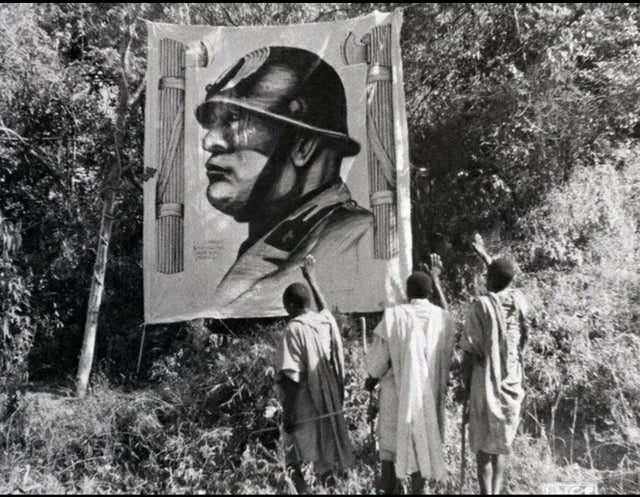
Poster of Benito Mussolini (1883-1945; Duce (leader) & prime-minister of Italy 1922-1943), Ethiopia, 1936.

In 1922, Italian politician and writer Gabriele d'Annunzio (1863-1938) was temporarily crippled after falling from a window, possibly pushed by a follower of Benito Mussolini.  The Duce might almost have been grateful had he suffered the illustrious fate of defenestration, the end of not a few kings and princes.   Instead, Italian communist partisans found him hiding in the back of a truck with his mistress Clara Petacci (1912-1945), attempting to flee to neutral Switzerland.  Taken to a village near Lake Como, on 28 April 1945, both were summarily executed by firing squad, their bodies hung upside down outside a petrol station where the corpses were abused by the mob.  When Hitler saw the photographs, he quickly summoned Otto Günsche (1917–2003), his personal SS adjutant, repeating his instruction that nothing must remain of him after his suicide.

On 10 March 10 1948, the Czechoslovakian minister of foreign affairs Jan Masaryk (1886-1948) was found dead (in his pajamas), in the courtyard of the Foreign Ministry below his bathroom window. The initial (KGB) investigation stated that he committed suicide by jumping out of the window although a 2004 police investigation concluded that he was defenestrated by the KGB.  Mr Putin (Vladimir Vladimirovich Putin; b 1952; president or prime minister of Russia since 1999) started life in the KGB and may have learned his lessons well.

In 1968, the son of the PRC's (People's Republic of China) future paramount leader Deng Xiaoping (2004-1997), Deng Pufang (b 1944), was thrown from a window by Red Guards during the Cultural Revolution (1966-1976).

In 1977, as a result of political backlash against his album Zombie, musician Fela Kuti's (1938-1997) mother (Chief Funmilayo Ransome-Kuti, 1900-1978) was thrown from a window during a military raid on his compound.  In addition, the commanding officer defecated on her head, while the soldiers burned down the compound, destroying his musical equipment, studio and master tapes.  Adding insult to injury, they later jailed him for being a subversive.

On 2 March 2007, Russian investigative journalist Ivan Safronov (1956-2007), who was researching the Kremlin's covert arms deals, fell to his death from a fifth floor window.  There was an investigation and the death was ruled to be suicide, a cause of death which of late has become uncommonly common in Russia, people these days often falling from windows high above the ground.

Dominion Centre, Toronto.

On 9 July 1993, in an unusual case of self-defenestration, Toronto attorney Garry Hoy (1955-1993) fell from a window after a playful attempt to prove to a group of new legal interns that the windows of Toronto’s Dominion Centre were unbreakable.  The glass sustained the manufacturer’s claim but, intact, popped out of the frame, the unfortunate lawyer plunging to his death.  Mr Hoy also held an engineering degree and is said to have many times performed the amusing stunt.  Unfortunately he didn’t live to explain to the interns how the accumulation of stresses from his many impacts may have contributed to the structural failure.