Showing posts sorted by date for query Requiem. Sort by relevance Show all posts

Sunday, May 14, 2023

Situationism

Situationism (pronounced sich-oo-ey-shuh-niz-uhm)

(1) A fork of Marxist political philosophy, a collection of (often abstract) theories used to build critiques of existing structures.  The overt political project emerged from the merging of a number of politically-minded, mid-twentieth century avant-garde art movement.  

(2) A theory in psychology which holds that personality and behavior is influenced more by external, situational factors than internal traits or motivations.

1955: A compound word: situation + ism.  Situation was from the early fifteenth century Middle English situacioun & situacion (place, position, or location), from Middle French situation, from the Old French situacion, from the Medieval Latin situationem (nominative situatio) (position, situation), the construct being situare (to locate, to place), from situs (a site, a position), thus situate +‎ -ion.  The Latin situs was from the primitive Indo-European root tkei (to settle, dwell, be home).  The meaning "state of affairs" was from 1710, extended specifically by 1803 to mean "a post of employment".  The suffix -ion was from the Middle English -ioun, from the the Old French -ion, from the Latin -iō (genitive -iōnis).  It was appended to a perfect passive participle to form a noun of action or process, or the result of an action or process.  The –ism suffix was from the Ancient Greek ισμός (ismós) & -isma noun suffixes, often directly, sometimes through the Latin –ismus isma (from where English picked up ize) and sometimes through the French –isme or the German –ismus, all ultimately from the Ancient Greek (where it tended more specifically to express a finished act or thing done).  It appeared in loanwords from Greek, where it was used to form abstract nouns of action, state, condition or doctrine from verbs and on this model, was used as a productive suffix in the formation of nouns denoting action or practice, state or condition, principles, doctrines, a usage or characteristic, devotion or adherence (criticism; barbarism; Darwinism; despotism; plagiarism; realism; witticism etc).  The use in political philosophy technically dates from 1955 (as situation ethics) although its origins can be traced to (at least) the nineteenth-century beginnings of sociology.  It was first seen in applied psychology in 1968 (as situational ethics) with publication of a monograph by Walter Mischel (1930-2018) who in later writings displayed some ambivalence.  Situationism is a noun, situationist is a noun & adjective and situationally is an adverb; the noun plural is situationisms.

The Internationale Situationiste (Situationist International)

Formed in 1957, dissolved in 1972 and eventually more a concept than a movement, the Situationist International (SI) was a trans-European collective of avant-garde artists and political radicals envisaged as a fusion of art & revolutionary activism; although originally a loose structure, it was later noted for its rigidity and its core critique was of modern consumer society, particularly under advanced capitalism. Influenced by criticism that philosophy had tended increasingly to fail at the moment of its actualization, the SI, although it assumed the inevitability of social revolution, always maintained many (cross-cutting) strands of expectations of the form(s) this might take but, just as a world-revolution did not follow the Russian upheavals of 1917, the events of May, 1968 failed to realize the predicted implications; the SI can be said then to have died with the discursive output between 1968-1972 treated either as a lifeless aftermath to an anti-climax or a bunch of bitter intellectuals serving as mourners at their own protracted funeral.

SI art: The Change (1957), paint on hardwood by Ralph Rumney (1934-2002).

The SI’s origins were in the north-western Italian town Cosio di Arroscia where, during a conference, several experimental art movements resolved to merge, the most prominent being (1) the Lettrist International, (2) the International Movement for an Imaginist Bauhaus and (3) the London Psychogeographical Association.  Tellingly, although many original members were focused on the imagery of art, the most influential figure was the French theorist Guy Debord (1931-1994) who had in left-wing circles become fashionable after the publication of a number of essays in which he argued modern capitalist societies had become dominated by what he called “spectacle”.  That was the thesis he most fully explored in his most famous work, The Society of the Spectacle (1967) which asserted: (1) social life had become mediated by images, media & commodities, (2) real human relations were being replaced by a passive consumption of representations and (3) individuals increasingly experienced life as spectators rather than participants.  What all this meant was Western society had become a system where appearance (depictions of a “construct of reality” which were simulacrums) had replaced lived experience.

SI Agitprop.

Despite the political slant, when formed, the SI certainly retained an identity as something artistic and although membership was erratic with factional alignments constantly shifting, there always was a strain which valued the art for its intrinsic qualities at least as much as for any utility as propaganda pieces; indeed, it was the notion of art abstracted from some purpose which was the SI's constant fault-line.  Those most influential in the early days of the SI had been much affected by the physical damage suffered by so many European cities during World War II (1939-1945) and especially the possibilities offered by re-building, thus the interest in concepts like unitary urbanism and psychogeography, essentially a response to the sociological aspects of the re-construction of those cities in the immediate post-war period.

SI propaganda: The Situationist Times 6: International Parisian Edition, Paris, December 1967.

The Situationist Times was an international, English-language periodical created and edited by Dutch artist Jacqueline de Jong (1939–2024), six issues published between 1962-1967.  Envisaged as a radical compendium encompassing Situationist tactics such as détournement and a printed form of dérive, the journals included essays, artwork, “found” images, and fragments of works concerned with such issues as topology, politics, and spectacle culture.  In the anarchist sprit of the collective, Ms De Jong insisted the periodical must be a “completely free magazine, based on the most creative of the Situationist ideas” and what appears on the pages does over the years show traces of the political and aesthetic schisms which would characterize the SI.  As well as the SI’s usual suspects, contributors included the English astrophysicist Sir Fred Hoyle (1915–2001) who (inadvertently) coined the term “big bang” and the French writer Noël Arnaud (pen name of Raymond Valentin Muller (1919- 2003) of the school of pataphysics (one of the late nineteenth century’s more curious alternatives to orthodox science which may (as QAnon seems to have) begun as a joke but took on a life because it so appealed to people who “wanted it to be true”).  With the failures of the Parisian revolutionaries in 1968, SI’s historic moment passed and the seventh edition of The Situationist Times, (The Pinball Issue) remained incomplete and was not published although extracts of the content have appeared.

SI Art: Untitled (Peinture collective situationniste) (1961).

As was done with the SI's “pieces by the collective”, Guy Debord and Jeppesen Victor Martin (1930–1993) signed along with eight other artists; within two years all except Debord and Martin had been expelled so in that sense, no work better illustrates the creative tensions which rent the SI.  Those “cancelled” in some cases regarded their erasure from the SI rolls as a badge of honor and Debord couldn't have them burned at the stake or taken outside and shot (which had over the years been the fate of a few artists who displeased a dictator) so there was that.  

Prior to the formation of the SI, some of what had been written about the form the physical reconstruction of post-war Europe should take had attracted interest from political theorists, especially those in anti-authoritarian Marxist circles who would come to position themselves as the inheritors of western political liberalism, notably the Lettrist International (formed in 1952).  In the way the European left did things in the early post-war years, the SI was conceived as an even more radical collective movement which wholly would renounce any connection with high-art and deal instead with the functional business of psychogeography, dissolving rather than exploring the boundaries between life and art.  However, whatever might have been the purity of the founders' intentions, because what the SI produced was eye-catchingly visual, it attracted practitioners in many fields of art and an audience which enjoyed the supposedly subversive pieces as just another spectacle.  That was tribute to the striking posters but wasn’t something which best pleased the uncompromising activists who viewed art merely as something with a revolutionary political purpose; factions formed and any commonality of interest between the utilitarians and the artists proved insufficiently strong to maintain the SI as a unified movement.  From formation to extinction, inherently it was fissiparous although, while members could be kicked out of the SI, it didn't mean their work ceased and the Scandinavian Drakabygget group (noted for the memorably titled Journal for art against atomic bombs, popes and politicians) essentially ignored their expulsion and continued to exhibit and publish in the Situationists vein.

SI art: Industrial Painting (1958), monoprinted oil paint, acrylic paint & typographic ink on canvas by Giuseppe Pinot-Gallizio (1902–1964).

Unrolled from a wooden spool and extending just over 75 metres (246 feet) Industrial Painting was one of a series of abstract works Pinot-Gallizio painted in this mode.  Unspooling in a swirl of blotches of colors, the idea was to recall the vibrancy of figures moving along a city’s streets and a deliberate limitation of the design was only some 9 metres (30 feet) could be displayed at one time, the idea being to emulate a journey in which much of what’s just been seen fades or vanishes from memory as the traveller proceeds along their path.  In an indication of the way the SI worked in an industrial age, Pinot-Gallizio made these works on his “painting machine” which he built with mechanical rollers attached to a long table.  What emerged was, in contrast to most of what came from “conveyor-belt” mass production, chaotic and wholly unique.

Modern situationist; modern spectacle: French content creator & author Léna Situations (Léna Mahfouf, b 1997), in Georges Hobeika (b 1962) black gown with inverted V-neckline (technically a wedge), Academy Awards ceremony, Los Angeles, March 2026.

Ms Mahfouf uses “Léna Situations” as an online pseudonym because that was the name of the fashion & lifestyle-focused blog she, as a teen-ager, created in 2012; it gained her a “brand identity” and was thus for some purposes retained in adulthood.  The blog would have seemed familiar to the members of the SI because her concept was sharing fragments of her life in different “situations” which might be defined by the place, the outfit worn or what was being experienced so was thus a series of spectacles, able to be understood as individual relics of time & place or a series of narratives.  Using that model, platforms like Instagram have allowed just about everybody to become a situationist and while Debord didn’t live to see such things, he’d have recognized (if not approved) “social lives mediated by images, media & commodities”.

Charli XCX (stage-name of English singer Charlotte Emma Aitchison (b 1992)) in a Christopher John Rogers (b 1993) white fit & flare dress with ruffled peplum and a more conventional implementation of the V-neckline.

Ms Mahfouf's retention of a youthful online pseudonym is not unique, the English singer-songwriter Charli XCX another example.  The star herself revealed the stage name is pronounced chahr-lee ex-cee-ex; it has no connection with Roman numerals and XCX is anyway not a standard Roman number.  XC is “90” (C minus X (100-10)) and CX is “110” (C plus X (100 +10)) but XCX presumably could be used as a code for “100” should the need arise, on the model of something like the “May 35th” reference adopted by Chinese internet users in an attempt to circumvent the CCP's (Chinese Communist Party) “Great Firewall of China” censorship apparatus when speaking of the “Tiananmen Square Incident” of 4 June 1989.  In 2015, Ms XCX revealed the text string was an element in her MSN screen name (CharliXCX92) when young (it stood for “kiss Charli kiss”) and it was used in some of the early publicity for her music; it gained critical mass so Charlie XCX we still have.

SI art: Lettre à mon fils (Letter to my son, 1956-1957), oil on canvas by Asger Jorn (1914-1973).

What quickly coalesced as the core of situationist theory was the concept of the spectacle, an explanation of the mechanism of advanced capitalism’s modern tendency towards expression and mediation of social relations through objects and for structuralists it was a compelling model.  It was beyond a critique of materialism and might have been more effective had the SI been able to resist using the increasingly layered and complex language of the mid-twentieth century Marxist discourse, a sub-set of language which would come to delight academic deconstructionists but often baffled others.  As well as Debord’s writings, Belgium philosopher Raoul Vaneigem’s (b 1934) The Revolution of Everyday Life (1968) was a seminal work; in the riots of 1968, both proved influential, less as entire texts than as sources for the epigrammatic and graffiti-friendly phrases (Sous les pavés, la plage! (Under the paving stones, the beach!), L’ennui est contre-révolutionnaire (Boredom is counter-revolutionary) and Ne travaillez jamais (Never work!) among the most replicated) which appeared all over French cities during the uprising.  In that, the SI thus proved the primacy of objects in social relations (whether hegemonic or not) although the SI generally held that “situationism” was a meaningless term, a position necessitated by their inherent rejection of ideologies, all of which they dismissed either as useless utopian myths or constructed superstructures existing only to create the social controls required to serve the economic interests of a ruling elite.  Much of the history of the SI was one faction rejecting another; indeed, the SI’s transition from artistic to political movement was less organic than disruptive.

Lindsay Lohan and her lawyer in court, Los Angeles, December 2011.

The critique of the consumer society resonated strongly with student radicals who were the failed revolutionaries of 1968 but, remarkably for a crew which was so influential on mass-movements, the SI was always tiny (it wasn’t untypical for there to be fewer than two-dozen active members) with internal conflicts and expulsions common, Debord given frequently to banishing members he believed had compromised the group’s revolutionary aims, the worst sin of heretics apparently the creation of art which shocked by virtual of its appearance but did nothing to in anyway transform society; comrade Stalin (1878-1953; Soviet leader 1924-1953) might have called such transgressors “formalists”.  Neglected for decades, the concepts developed by the SI attracted renewed interest in the social media age as much of what they’d described suddenly seemed familiar.  Key SI concepts included (1) psychogeography (the study of how urban environments affect emotions and behaviour, (2) dérive (drift) in which a wander through a city was documented with illustrative images, (3) détournement (appropriating using existing cultural elements (advertisements, comics, artworks etc) and, in subversive ways, repurposing them to undermine their original ideological message) and (4) constructed situations which were “moments of life” (events, environments, experiences) created for no purpose other than breaking the passivity of everyday existence.  If all that sounds something like what may have appeared in the check-list used by the designers of Instagram, TikTok and such, it hints (1) the SI may have been onto something and (2) as US billionaire investor Warren Buffett (b 1930) put it when explaining the outcome of class warfare: “We won”.

A requiem for SI art: No Title (1975-1976), lithograph on paper by Constant Niewwenhuys (1920-2005).

Debord no more wanted the SI to be what would come to be called a “think tank” any more than he wanted an artist’s colony but certainly envisaged it as a theoretical vanguard rather than a conventional political organization, his view being that even if created as something “revolutionary”, such movements tended to be “captured” (ie absorbed into the very system they were created to subvert or at least oppose).  That was why the orthodox SI position was not to exhibit their works in galleries or museums because, in the spirit of Marshall McLuhan (1911-1980) notion “the medium is the message”, once radical art was hung in such places, it became merely another commodity in the “spectacle”, dissenters accused of “recuperation” (a SI concept in which radical ideas had been neutralized and absorbed by mainstream culture).  So, members who were judged to have misunderstood or diluted Situationist orthodoxy (ie disagreed with Debord) were expelled, the rationale being what was valued in adherents was “quality rather than quantity”.  Although supposedly in the tradition of Marxist collective decision-making, Debord exercised extraordinary informal authority within the SI (despite the group officially rejecting hierarchy) and in practice, personally defined the SI’s theoretical parameters.  In a nice touch which would be familiar in places like the Soviet Union, the DPRK (Democratic People's Republic of Korea (North Korea)) or the modern Republican Party’s MAGA (Make America Great Again) faction, the “culture of exclusion” was ritualized in the journal Internationale Situationniste which regularly would publish lists of those un-personed (including the reasons), the former members denounced in harsh language, the worst insults including accusations of “theoretical confusion” and the practicing of mere “pseudo-Situationism”; by the time of dissolution in 1972, the membership consisted of Debord and one remaining loyal soul.  The SI, at least in the more reductionist works, did create some genuinely interesting critiques of the post-war West and some of the early art was, if not exactly novel, certainly stark and compelling.  However, it remains hard to identify enough ideas to justify the volume of text produced and phrasing it in what was surely deliberately difficult language does suggest there was an attempt to conceal the repetition of thought.

Thursday, August 4, 2022

Requiem

Requiem (pronounced rek-wee-um)

(1) In the rituals of churches, (notably the "Requiem Mass" of the Roman Catholic Church), a form of religious service to honor and remember a dead person and celebrate the repose of the souls of the dead.

(2) A musical composition, hymn, or dirge for the repose of the dead (sometimes attached specifically to religious services).

(3) Rest; peace (obsolete).

(4) In Ichthyology, (as requiem shark), any member of the taxonomic family Carcharhinidae (order Carcharhiniformes).

1275-1325: From the Middle English requiem (mass for repose of the soul of the dead), from the Latin requiem, accusative singular of requiēs (rest, repose (after labour)) from the opening of the introit, Requiem aeternam dona eis (Rest eternal grant unto them).  The construct was re- (used here as an intensive prefix) + quies (quiet) (from a suffixed form of the primitive Indo-European root kweie- (to rest; be quiet).  In Latin, the formal descriptions, Missa pro defunctis (Mass for the dead) or Missa defunctorum (Mass of the dead) were both used and requium was the first word of the Mass for the Dead in the Latin liturgy: Requiem æternam dona eis, Domine... (Rest eternal grant them, O Lord...).  In the Roman Catholic Church, the requiem ritual (Roman Missal) was revised during Vatican II and since 1970 has used this phrase as the first entrance antiphon.  Like many of the changes wrought by the Second Vatican Council (Vatican II, 1962-1965, published 1970) the newer rituals weren’t always adopted.  Although Rome pointed out the term Requiem Mass was never official terminology, resistance to replacing it with the preferred Mass of the Resurrection continues to this day.  By the early seventeenth century, requiem was used to describe any dirge or solemn chant for repose of the dead.  Requiem is a noun; the noun plural is requiems.  The adjectives (requiemlike, requiemesque) are non-standard but have been used although no composer of dirges seems ever to have been described as a "requiemist".

Part of Mozart’s original score for the Requiem.

Wolfgang Amadeus Mozart's (1756–1791) Requiem in D minor is probably the best known requiem, famous less for its musical qualities than the legends and myths which surround its composition.  Mozart wrote part of the work in Vienna in late 1791, but it was unfinished at his death on 5 December that year.  A completed version (dated 1792), by Austrian composer and conductor Franz Xaver Süssmayr (1766-1803) was delivered to the noted amateur musician Count Franz von Walsegg (1763–1827) who had commissioned the piece to commemorate the anniversary of his wife's death.


Mozart's Requiem in D minor, Berliner Philharmoniker under Herbert von Karajan (1908–1989), Berlin, 1976.

Constanze Mozart (1782), oil on canvas by Joseph Lange (1751–1831).

Mozart's widow Constanze (1762-1842) was responsible for a number of tales including the claims that Mozart received the commission from a messenger who did not reveal his or the commissioner's identity, and that Mozart came to believe that he was writing the requiem for his own funeral.  Mozart received only half the payment in advance, so upon his death his widow Constanze ensured the work completed by someone else so the balance of the bill could be collected.  Exactly who was responsible for what remains controversial among musicologists and historians although the most usually performed version (Süssmayr) is widely accepted as the standard version.  Adding to the romance attached to Mozart's requiem is that so distraught was the count at the death of his young wife, although himself only 28, he would never re-marry.

Tuesday, February 2, 2021

Asseveration

Asseveration (pronounced uh-sev-uh-rey-shuhn)

(1) A vehement assertion, emphatic affirmation or asseveration; vehemence, rigor.

(2) The act of asseverating.

(3) In the technical rules of grammar, a word of emphasis (a rare form, used only by scholars using the word in the sense it was used in Latin).

1550–1560: From the Middle English asseveration (an emphatic assertion), from the Classical Latin asseverationem (nominative asseveratio) (vehement assertion, protestation), the construct being ad- (to) + severus (serious, grave, strict, austere) which was probably from the primitive Indo-European root segh- (to have, hold) on the model of "steadfastness, toughness".  The Latin assevērātiōn (stem of assevērātiō, from assevērō), (vehement assertion, protestation) was the noun of action from past participle stem of asseverare.  Asseveration is a noun, asseverate & assever are verbs; the noun plural is asseverations.

Asseverations: some stay and some go

Mr Abbott at Cardinal Pell's requiem mass, Saint Mary’s Cathedral, Sydney, Australia, 1 February 2023.

Asseverations are sometime heat of the moment things and later (something quickly) withdrawn as calmer thoughts intrude or wiser counsels prevail though not always.  Almost immediately the Holy See announced the death of Cardinal George Pell (1941—2023), noted Roman Catholic layman Tony Abbott (b 1957; Australian prime-minister 2013-2015) felt moved to praise him as “…an ecclesiastical and cultural conservative…” whose “…incarceration on charges the High Court ultimately scathingly dismissed was a modern form of crucifixion…” and his “…prison journals should become a classic: a fine man wrestling with a cruel fate and trying to make sense of the unfairness of suffering.  In his own way, by dealing so equably with a monstrous allegation, he strikes me a saint of our times.  Like everyone who knew him, I feel a deep sense of loss but am confident that his reputation will grow and grow that he will become an inspiration for the ages.”

Mourners queue to enter the cathedral.

So polarizing a figure was Pell that it’s doubtful Mr Abbott’s thoughts much influenced anyone (one way or the other) but there were those who thought he might retreat a little on the matter of good Saint George.  He didn’t and at the cardinal’s requiem mass doubled down and asseverated further, eulogizing Pell as “the greatest man I’ve ever known”, observing he was “one of our country’s greatest sons”, a “great hero” and a “saint for our times”.  To those familiar with the findings of the five-year royal commission into child sexual abuse and the criticism of the legal devices Pell set up in both Melbourne & Sydney which operated to limit the Church’s financial liability in such matters, Mr Abbott’s words must have seemed at least hyperbolic but the former prime-minister made no mention of the commission’s findings, preferring to dwell on those of the High Court of Australia (HCA) which, on appeal, unanimously (7-0) quashed the finding of a jury (upheld on a first appeal) that Pell had committed an act of sexual abuse against a minor.  Not only did Mr Abbott praise the decision to quash the conviction (on the grounds the prosecution had not beyond reasonable doubt proved the offence took place, as described, in the place, at the time alleged) but damned the charges even being laid, saying: “He should not have been charged in the absence of corroborating evidence and should never have been convicted in the absence of a plausible case, as the HCA so resoundingly made plain”, adding the cardinal had been “made a scapegoat for the church itself”.  To clarify just why Saint George it should be, he praised especially Pell’s ability to accept this “modern-day crucifixion” which was the “heroic virtue that makes him to my mind, a saint for our times”.  So the example of the late cardinal might continue to inspire others, Mr Abbott called for “Pell study courses, Pell spirituality courses, Pell lectures, Pell high schools and Pell university colleges, just as there are for the other saints” concluding that: “The ultimately triumphant life of this soldier for truth to advance through smear and doubt to victory should drive a renewal of confidence throughout the Universal Church”.  Presumably, Mr Abbott’s line of Saint George Pell T-shirts, baseball caps and swimming trunks can’t be far off.

Not all who turned up agreed with Mr Abbott.

Harvey Weinstein heading for court.

Some asseverations however quickly are deleted as the reaction makes clear what seemed at the time a good idea might need to be reconsidered.  However, in the age of Twitter and Instagram, totally to delete something is at least difficult and often impossible.  In 2017, as a twitterstorm flared around about the sexual assault allegations against film produced Harvey Weinstein (b 1952), a sympathetic Lindsay Lohan took to Instagram saying she was “feeling bad” for Weinstein and chastised his estranged wife, Georgina Chapman, for announcing she was leaving him.  “He's never harmed me or did anything to me—we've done several movies together” Ms Lohan added, concluding “I think everyone needs to stop—I think it's wrong. So stand up”.  The posts were soon deleted and in an attempt to calm the controversy they engendered, she issued a statement in which she said: “I am saddened to hear about the allegations against my former colleague Harvey Weinstein.  As someone who has lived their life in the public eye, I feel that allegations should always be made to the authorities and not played out in the media”.  In a final public atonement, she added: “I encourage all women who believe Harvey harmed them to report their experiences to the relevant authorities”.  Weinstein was later quoted as saying:  I’m not doing OK, but I’m trying. I gotta get help, we all make mistakes.  Second chance, I hope.”

Tuesday, January 5, 2021

Cryptic

Cryptic (pronounced krip-tik)

(1) Deliberately mysterious in meaning; puzzling.

(2) A message which is abrupt; terse; short, ambiguous, obscure (ie the effect rather than the intent).

(3) Of things secret; the occult.

(4) Involving use of a code or cipher etc (the stuff of cryptography).

(5) In zoology, fitted for concealing; serving to camouflage (applied especially to the coloring or shape of animals); living in a cavity or small cave (also as cryptozoic).

(6) In cruciverbalism (the compilation of crosswords), the puzzle, or a clue in such a puzzle, using, in addition to definitions, wordplay such as anagrams, homophones and hidden words to indicate solutions (the “cryptic crossword” usually distinguished from the “standard”, “basic” or “simple”.

(7) In biology, apparently identical, but actually genetically distinct.

(7) In biology, as “cryptic ovulation”, a phenomenon noted in certain species where the female shows no perceptible signals indicating a state of fertility (also as “concealed ovulation”).

1595-1605: From the Late Latin crypticus, from the Ancient Greek κρυπτικός (kruptikós) (fit from concealing), from κρυπτός (kruptós) (hidden), from κρύπτω (krúptō) (to hide).  The construct was crypt + -ic.  Crypt was from the Latin crypta (vault), again from the Ancient Greek κρυπτός (kruptós) (hidden).  The suffix -ic was from the Middle English -ik, from the Old French -ique, from the Latin -icus, from the primitive Indo-European -kos & -os, formed with the i-stem suffix -i- and the adjectival suffix -kos & -os.  The form existed also in the Ancient Greek as -ικός (-ikós), in Sanskrit as -इक (-ika) and the Old Church Slavonic as -ъкъ (-ŭkŭ); A doublet of -y.  In European languages, adding -kos to noun stems carried the meaning "characteristic of, like, typical, pertaining to" while on adjectival stems it acted emphatically; in English it's always been used to form adjectives from nouns with the meaning “of or pertaining to”.  A precise technical use exists in physical chemistry where it's used to denote certain chemical compounds in which a specified chemical element has a higher oxidation number than in the equivalent compound whose name ends in the suffix -ous; (eg sulphuric acid (H₂SO₄) has more oxygen atoms per molecule than sulphurous acid (H₂SO₃).  The alternative spelling cryptick is obsolete.  Cryptic is a noun and adjective, cryptical is an adjective and cryptically an adverb; the noun plural is cryptics.

Cryptic’s synonyms can include ambiguous, arcane, enigmatic, equivocal, incomprehensible, mysterious, strange, vague, veiled, abstruse, apocryphal, cabalistic, dark, esoteric, evasive, hidden, inexplicable, murky, mystic, mystical & perplexing.  However, it’s often necessary to distinguish between that thought deliberately obscure in meaning and messages either badly written or too brief for the meaning to be clear.  The familiar modern meaning “mysterious or enigmatic” is surprisingly modern, emerging only in the 1920s.  The noun cryptography (the art & science of writing in secret characters) sates from the 1650s and was either from the French cryptographie or directly from the Modern Latin cryptographia, the construct being the Ancient Greek κρυπτός (kruptós) (hidden) + graphia (of or relating to writing), the practitioner or code-breaker (the latter sense now more common and known also as crypto-analysts) being a cryptographer, the discipline cryptography (or cryptoanalytics) and the adjectival form the cryptographic.

Novelty birthday card on the theme of Freaky Friday (2003).

In English, the Ancient Greek κρυπτός (kruptós) (hidden) proved productive.  A cryptogram can be just about any form of puzzle although as a commercial name (sometimes as crypto-gram) it has been used (on the model of telegram a la the strippergram, gorillagram, kissogram etc).  The idea of cryptocurrency gained the name from (1) the use of cryptography when storing the underlying data in the blockchain (a big-machine distributed database) and (2) the notion of the blockchain as a secure crypt (vault).  In biology, cryptobiosis is a state of life in which all metabolic activity is temporarily halted (a cryptobiont any organism capable of cryptobiosis).  In critical political discourse, crypto- was used (crypto-communist, crypto-Nazi, crypto-fascist etc) to label someone as something they were attempting to conceal.  In medicine, the unfortunate condition cryptorchism (the plural (where required) cryptorchisms) was the failure of one or both testes to descend into the scrotum.  In geology, a cryptoclastic rock is one composed of minute or microscopic fragments.

Pope Benedict XVI with Cardinal George Pell (1941-2023), Australia 2008. 

In his theological writings Pope Benedict XVI (1927–2022; pope 2005-2013, pope emeritus 2013-2022) could be cryptic but when speaking to his flock of 1.3 billion-odd, his thoughts were expressed usually in simple language, his meaning clear.  Not all pontiffs have managed this so Benedict’s pontificate of plain-speaking was welcome, even if his messages didn’t please all.  Even so however, he never manage to issue anything with the raw honesty Pope Adrian VI (1459–1523; pope 1522-1523) showed in the instructions he gave to his nuncio, Francesco Chieregati (1479-1539) his representative at the Diet of Nuremberg, a gathering of the princes of the Holy Roman Empire convened in 1552.  Adrian’s words, a statement of repentance unique in the Church’s history was an admission of the need to reform the corrupted institution which instructed Chieregati to make clear:

“…we frankly confess that God permits this persecution to afflict His Church because of the sins of men, especially of the priests and prelates of the Church. For certainly the hand of the Lord has not been shortened so that He cannot save, but sins separate us from Him and hide His face from us so that He does not hear. Scripture proclaims that the sins of the people are a consequence of the sins of the priests, and therefore (as Chrysostom says) our Savior, about to cure the ailing city of Jerusalem, first entered the Temple to chastise first the sins of the priests, like the good doctor who cures a sickness at its source.

We know that for many years many abominable things have occurred in this Holy See, abuses in spiritual matters, transgressions of the commandments, and finally in everything a change for the worse (et omnia denique in perversum mutata). No wonder that the illness has spread from the head to the members, from the Supreme Pontiffs to the prelates below them. All of us (that is, prelates and clergy), each one of us, have strayed from our paths; nor for a long time has anyone done good; no, not even one.

Therefore, we must all give glory only to God and humble our souls before Him, and each one of us must consider how he has fallen and judge himself, rather than await the judgment of God with the rod of His anger. As far as we are concerned, therefore, you will promise that we will expend every effort to reform first this Curia, whence perhaps all this evil has come, so that, as corruption spread from that place to every lower place, the good health and reformation of all may also issue forth.

We consider ourselves all the more bound to attend to this, the more we perceive the entire world longing for such a reformation. (As we believe others have said to you) we never sought to gain this papal office. Indeed we preferred, so far as we could, to lead a private life and serve God in holy solitude, and we would have certainly declined this papacy except that the fear of God, the uncorrupt manner of our election, and the dread of impending schism because of our refusal forced us to accept it. Therefore we submitted to the supreme dignity not from a lust for power, nor for the enrichment of our relatives, but out of obedience to the divine will, in order to reform His deformed bride, the Catholic Church, to aid the oppressed, to encourage and honor learned and virtuous men who for so long have been disregarded, and finally to do everything else a good pope and a legitimate successor of blessed Peter should do.

Yet no man should be surprised if he does not see all errors and abuses immediately corrected by us. For the sickness is of too long standing, nor is it a single disease, but varied and complex. We must advance gradually to its cure and first attend to the more serious and more dangerous ills, lest in a desire to reform everything at the same time we throw everything into confusion. All sudden changes (says Aristotle) are dangerous to the state. He who scrubs too much draws blood.

We know how prejudicial it has been to the honor of God and the salvation and edification of souls that ecclesiastical benefices, especially those involving the care and direction of souls, for so long have been given to unworthy men.”

Probably plenty of popes could over the centuries have been justified in saying much the same thing but if any were tempted, none did.  Benedict did of course issue the odd statement of (carefully drafted) apology for this and that but they bore the mark of a lawyer’s careful vetting to avoid legal troubles rather than a sinner repenting and seeking forgiveness.  Most of the Church’s problems and scandals were of course not of his making and it was unfortunate his time on the throne came when scandals stretching back decades were being exposed because the publicity these attracted meant there was less attention paid to some of Benedict’s genuinely interesting thoughts on the state of Western Civilization.  Unfortunately, there were occasions on which he should perhaps have been rather more cryptic when discussing these matters, such as the famous address delivered at the University of Regensburg in 2006, entitled Faith, Reason and the University, none of which attracted the attention of the popular press except the one notorious sentence:

Show me just what Muhammad brought that was new and there you will find things only evil and inhuman, such as his command to spread by the sword the faith he preached.”

The comment was originally written in 1391 as an encapsulation of the view of the Manuel II (1350–1425; Byzantine emperor 1391-1425) but the thoughts were not new to Benedict and nor was its expression but what one says as an academic theologian is less scrutinized than when it comes from the vicar of Christ on earth.  That one brief fragment from the lecture overshadowed what was a thoughtful warning to Western civilization about its internal threats and contradictions, specifically the retreat from reason in moral and political life.  Among academics, the similarity of Benedict’s ideas to those of the German philosopher Leo Strauss (1899-1973) seemed striking and poignant too, the pope among the last of then generation of Germans who, like Strauss, had seen Nazism, probably the most evil of the totalitarianism which was such a feature of the twentieth century.  In their time, Strauss and Benedict both knew the West was facing a crisis, something identified by the philosopher as the very modern culture which had lost “its faith in reason’s ability to validate its highest aims”, understood as the view that notions of right and wrong are historically variable, changing as intellectual fashions shifted.  The pope knew this as moral relativism and understood that a “crisis of political reason… is a crisis of politics as such” which has relegated moral and political knowledge to the realm of radical subjectivity.

As a historical decline, Benedict traced the retreat from the Reformation, through the liberal theology of the last two-hundred years to the latter-day descent of Christendom to cultural relativism.  That didn’t mean the pope wished to undo the Enlightenment, it was rather that scientific positivism should run in parallel with moral certainty.  It might have been better, certainly for the quality of the press coverage, if Benedict had adhered a little more to one of Strauss’ techniques of didacticism: cultured crypticism.  Strauss held that Friedrich Nietzsche (1844–1900) was no proto-Nazi but had written in such an accessible manner that it was simply for the Nazis to twist and appropriate his words for their purposes.  Strauss therefore sought to be more elusive, not wishing to be another misused German philosopher, his words were sometimes cryptic, the meaning able to be unlocked only by the few who had long been immersed.  Benedict too might have been well advised on occasion to remain a little more obscure because he had many interesting things to say which could have been plainly spoken.

Benedict XVI lying in state.

The mortal remains of Pope Emeritus Benedict XVI were moved early in the morning on Monday 2 January 2023, from his former residence in the Vatican's Mater Eccle.  The archpriest of the basilica, Cardinal Mauro Gambetti, received the remains with a liturgical act that lasted about 30 minutes.

Pope Francis conducting the Solemn Requiem Mass.  It's the first time a pope has presided over the funeral of his predecessor since Pius VII (in somewhat different circumstances) attended the funeral of Pius VI in 1802.

A Solemn Requiem Mass was conducted in St Peter’s Square on Thursday 5 January, presided over by Pope Francis.  The readings for the Mass were Isaiah 29:16–19 in Spanish; Psalm 23 sung in Latin; 1 Peter 1: 3–9 in English, and the Gospel of Luke 23: 39–46 read in Italian.  At the conclusion of the service, the coffin was carried to his place of burial in the crypt of St. Peter’s Basilica, accompanied by the choir singing the Magnificat in Latin.

Thursday, August 13, 2020

Mania

Mania (pronounced mey-nee-uh or meyn-yuh)

(1) Excessive excitement or enthusiasm; craze; excessive or unreasonable desire; insane passion affecting one or many people; fanaticism.

(2) In psychiatry, the condition manic disorder; a combining form of mania (megalomania); extended to mean “enthusiasm, often of an extreme and transient nature,” for that specified by the initial element; characterized by great excitement and occasionally violent behavior; violent derangement of mind; madness; insanity.

(3) In mythology, the consort of Mantus, Etruscan god of the dead and ruler of the underworld.  Perhaps identified with the tenebrous Mater Larum, she should not be confused with the Greek Maniae, goddess of the dead; In Greek mythology Mania was the personification of insanity.

(4) In popular use, any behavior, practice, cultural phenomenon, product etc enjoying a sudden popularity.

1350–1400: From the Middle English mania (madness), from the Latin mania (insanity, madness), from the Ancient Greek μανία (manía) (madness, frenzy; enthusiasm, inspired frenzy; mad passion, fury), from μαίνομαι (maínomai) (I am mad) + -́ (-íā).  The –ia suffix was from the Latin -ia and the Ancient Greek -ία (-ía) & -εια (-eia), which form abstract nouns of feminine gender.  It was used when names of countries, diseases, species etc and occasionally collections of stuff.  The Ancient Greek mainesthai (to rage, go mad), mantis (seer) and menos (passion, spirit), were all of uncertain origin but probably related to the primitive Indo-European mnyo-, a suffixed form of the root men- (to think)," with derivatives referring to qualities and states of maenad (mind) or thought.

The suffix –mania was from the Latin mania, from the Ancient Greek μανία (mania) (madness).  In modern use in psychiatry it is used to describe a state of abnormally elevated or irritable mood, arousal, and/or energy levels and as a suffix appended as required.  In general use, under the influence of the historic meaning (violent derangement of mind; madness; insanity), it’s applied to describe any “excessive or unreasonable desire; a passion or fanaticism” which can us used even of unthreatening behaviors such as “a mania for flower arranging, crochet etc”.  As a suffix, it’s often appended with the interfix -o- make pronunciation more natural.  The sense of a "fad, craze, enthusiasm resembling mania, eager or uncontrollable desire" dates from the 1680s, the use in English in this sense borrowed from the French manie.  In Middle English, mania had sometimes been nativized as manye. The familiar modern use as the second element in compounds expressing particular types of madness emerged in the 1500s (bibliomania 1734, nymphomania, 1775; kleptomania, 1830; narcomania 1887, megalomania, 1890), the origin of this being Medical Latin, in imitation of the Greek, which had a few such compounds (although, despite the common perception, most were actually post-classical: gynaikomania (women), hippomania (horses) etc).

The adjective maniac was from circa 1600 in the sense of "affected with mania, raving with madness" and was from the fourteenth century French maniaque, from the Late Latin maniacus, from the Ancient Greek maniakos, the Adoption in English another borrowing from French use; from 1727 it came also to mean "pertaining to mania." The noun, "one who is affected with mania, a madman" was noted from 1763, derived from the adjective.  The adjective manic (pertaining to or affected with mania), dates from 1902, the same year the clinical term “manic depressive” appeared in the literature although, perhaps strangely, the condition “manic depression” wasn’t describe until the following year although the symptoms had as early as 1857 been noted as defined as “circular insanity”, from the from French folie circulaire (1854).  It’s now known as bi-polar disorder.  The constructions hypermania & submania are both from the mid-twentieth century.  The adjective maniacal was from the 1670s, firstly in the sense of "affected with mania" and by 1701 "pertaining to or characteristic of a maniac; the form maniacally emerged during the same era.  Mania is quite specific but craving, craze, craziness, enthusiasm, fad, fascination, frenzy, infatuation, lunacy, obsession, passion, rage, aberration, bee, bug, compulsion, delirium, derangement, desire & disorder peacefully co-exist.

Noted manias

Anglomania: An excessive or undue enthusiasm for England and all things English; rarely noted in the Quai D'Orsay.

Anthomania: An extravagant passion for flowers; although it really can’t be proved, the most extreme of these are probably the orchid fanciers.  Those with an extravagant passion for weed are a different sub-set of humanity and are really narcomanics (qv) although there may be some overlap. 

Apimania: A passionate obsession with bees; beekeepers tend to be devoted to their little creatures so among the manias, this one may more than most be a spectrum condition.

Arithmomania: A compulsive desire to count objects and make calculations; noted since 1884, it’s now usually regarded as being within the rubric of obsessive-compulsive disorder (OCD).

Bibliomania: A rage for collecting rare or unusual books.  This has led to crime and there have been famous cases.

Cacodaemomania: The obsessive fixation on the idea that one is inhabited by evil spirits.  To the point where it becomes troublesome it’s apparently rare but there are dramatic cases in the literature, one of the most notorious being Anneliese Michel (1952–1976) who was subject to the rites of exorcism by Roman Catholic priests in the months before she died.  The priests and her parents (who after conventional medical interventions failed, also become convinced the cause of her problems was demonic possession) were convicted of various offences related to her death.  Films based on the events leading up to death have been released including The Exorcism of Emily Rose (2005), Requiem (2006) and Anneliese: The Exorcist Tapes (2011).

Callomania: The obsessive belief in one’s own beauty, even when to all others this is obviously delusional.

Dipsomania: The morbid craving for alcohol; in pre-modern medicine, it was used also to describe the “temporary madness caused by excessive drinking”, the origin of this being Italian (1829) and German (1830) medical literature.

Egomania: An obsessive self-centeredness; it was known since 1825 but use didn’t spike until Freud (and others) made it widely discussed after the 1890s and few terms from the early days of psycho-analysis are better remembered.

Erotomania: Desperate love, a sentimentalism producing morbid feelings.

Flagellomania: An obsessive interest in flogging and/or being flogged, often as one’s single form of sexual expression and thus a manifestation of monomania (qv).  The English Liberal Party politician Robert Bernays (1902-1945), the son of a Church of England vicar, was a flagellomanic whose proclivities were, in the manner of English society at the time, both much discussed and kept secret.  He was also an illustration of the way such fetishes transcend other sexual categories.

Gallomania: An excessive or undue enthusiasm for France and all things French; rarely noted in the British Foreign Office.

Graphomania: A morbid desire to write.  Niccolò Machiavelli (1469-1527; Italian diplomat, philosopher and political advisor of the Renaissance) attributed many of the problems he suffered to his graphomania and he was right, his sufferings because of what he wrote, when it was written and about whom.

Hippomania: An excessive fondness for horses; an affliction which often manifests as the intense and passionate interest in horses developed by some girls who join pony clubs and fall in love.

Hypermania: There’s a definitional dualism to hypermania; it can mean either an extreme example of any mania or, as used by clinicians, specifically (and characterized usually by a mental state with high intensity disorientation and often violent behavior), a severe case of bipolar disorder (the old manic-depression).  The earlier term was hypomania (A manic elation accompanied by quickened perception), one of the earliest (1882) clinical terms from early-modern psychiatry.

Kleptomania: The obsessive desire to steal; in early (1830s) use, the alternative form was cleptomania.  The klepto element was from the Ancient Greek kleptes (thief, a cheater), from kleptein (to steal, act secretly), from the primitive Indo-European klep- (to steal), from the root kel- (to cover, conceal, save) and was cognate with the Latin clepere (to steal, listen secretly to), the Old Prussian au-klipts (hidden), the Old Church Slavonic poklopu (cover, wrapping) and the Gothic hlifan (to steal) & hliftus (thief).  The history of the word kleptomania is of interest also to sociologists in that as early as the mid-nineteenth century, there was controversy about the use by those with the capacity to buy the services of doctors and lawyers were able to minimize or escape the consequences of criminal misbehavior by claiming a psychological motive.  The argument was that the “respectable” classes were afforded the benefit of this defense while the working class were presumed to be inherently criminal and judged accordingly.  The same debate, now also along racial divides, continues today.

Lindsaymania: A specific instance of mania suffered by those obsessed with Lindsay Lohan (manifested often on Instagram and other social media platforms), including those poor deluded souls who curate blogs with substantial Lohanic content.  They are sometimes referred to as "Lindsaiacs".  Those who focus on Ms Lohan's feet were historically labeled podophiles but the DSM has since re-classified them as "foot particularists"; if their interest is restricted to her feet alone they are a subset of the Lindsaymaniacs whereas if their interest includes the feet of others, they are pure foot particularists. 

Logomania: An obsession with words.  It differs from graphomania (qv) which is an obsession to write; logomania instead is a fascination with words, their meanings and etymologies.

Megalomania: Delusions of greatness; a form of insanity in which the subjects imagine themselves to be great, exalted, or powerful personages.  It was first used in the medical literature in 1866 (from the French mégalomanie) and came to be widely applied to many politicians and potentates the twentieth century.

Micromania:  "A form of mania in which the patient thinks himself, or some part of himself, to be reduced in size", noted first in 1879 and twenty years later used also in reference to insane self-belittling.  In the twentieth century and beyond, micromania was widely used, sometimes humorously, to refer to things as varied as the sudden consumer in interest in small cars to the shrinking size of electronic components.   

Monomania: An insane obsession in regard to a single subject or class of subjects; applied most often in academic, scientific or political matters but can be used about anything where the overriding mental impulses are perverted to a specific delusion or the pursuit of a particular thing.

Morphinomania: A craving for morphine; one of the earliest of the words which noted specific addictions, it dates from 1885 but earlier still there had been morphiomania (1876) and morphinism (1875) from the German Morphiumsucht.  In the medical literature, morphinomaniac & morphiomaniac rapidly became common.

Narcomania: The uncontrollable craving for narcotic drugs and a term which is so nineteenth century, the preferred modern form being variations of "addiction".

Necromania: An obsession to have sexual relations with the bodies of the dead although, perhaps surprisingly, practitioners (those who treat rather than practice the condition) classify many different behaviors which they list under the rubric of necromania, some of the less confronting being a morbid interest in funeral rituals,  morgues, autopsies, and cemeteries.   Those whose hobbies include the study of the architecture of crypts and tombs or the coachwork of funeral hearses might be shocked to find there are psychiatrists who classify them in the same chapters as those who enjoy intimacy with corpses.

Nymphomania: The morbid and uncontrollable sexual desire in women.  Perhaps the most celebrated (and often sought) of the manias, it dates from 1775, in the English translation of Nymphomania, or a Dissertation Concerning the Furor Uterinus (1771) by French doctor Jean Baptiste Louis de Thesacq de Bienville (1726-1813), the construct being the Ancient Greek nymphē (bride, young wife; young lady) + mania.  The actual condition is presumed to have long pre-dated the term and in use, deserves to be distinguished from less pleasing modern forms such as the "skanky ho".

Onomatomania: One obsessively compelled to respond with a rhyming word to the last word spoken by another (something possible even with orange and silver).  It’s thought to co-exist with other conditions, especially schizophrenia.

Phonomania: An uncontrollable urge to murder; those who suffer this now usually described as the more accessible “homicidal maniac”.  When applied especially to serial killers, the companion condition (just further along the spectrum) is androphonomania which, if properly argued, could be a defense against a charge of mass-murder but counsel would need to be most assiduous in jury selection.

Plutomania: The obsessive pursuit of wealth (and used sometimes in a clinical setting to describe an "imaginary possession of wealth").

Pyromania: A form of insanity marked by a mania for destroying things by fire.  It was used in German in the 1830s and seemed to have captured the imagination of Richard Wagner (1813–1883); the older word for the condition was incendiarism.

Rhinotillexomania: Nose picking. Gross, but a thing which apparently often manifests when young but fades, usually of its own volition or in reaction to the disapprobation of others.

Trichotillomania: The compulsion to pull-out one’s hair.  The companion condition is trichtillophagia which is the compulsive eating of one’s own hair, one of a remarkable number of eating disorders.

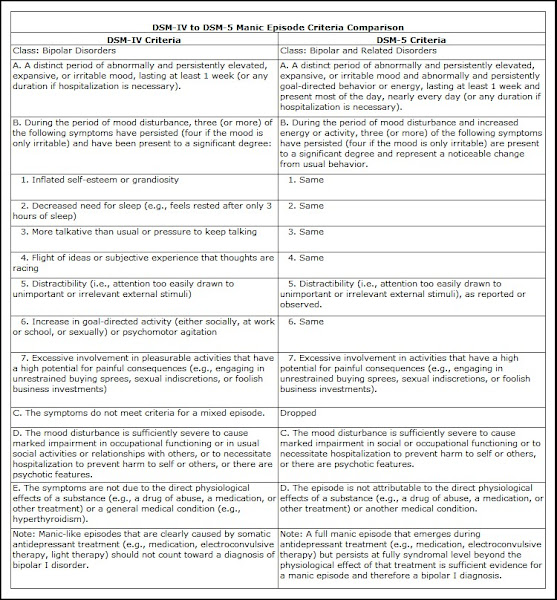
Definitional variations in the criteria for mania, DSM-IV & DSM-5

The study and classification of idea of manias had been part of psychiatry almost from its origin as a modern discipline although the wealth of details and fragmentation of nomenclature would come later, the condition first noted “increased busyness”, the manic episodes characterized by Emil Kraepelin (1856-1926; a founding father of psychiatric phenomenology) as those of someone who was “…a stranger to fatigue, his activity goes on day and night; work becomes very easy to him; ideas flow to him.” 

Whatever the advances (and otherwise) in treatment regimes, little has changed in some aspects of the condition.  In the fifth edition of the Diagnostic and Statistical Manual of Mental Disorders (DSM-5, 2013), the primary criterion of mania remains “a distinct period of abnormally and persistently elevated, expansive, or irritable mood” and “abnormally and persistently increased goal-directed activity or energy” but did extend duration of the event to qualify for a diagnosis.  In the DSM-IV (1994), the criterion for a manic episode only required “a distinct period of abnormally and persistently elevated, expansive, or irritable mood, lasting at least one week” whereas DSM-5 now requires in addition the presence of “abnormally and persistently increased goal-directed activity or energy”; moreover, these symptoms must not only last at least one week, they must also be “present most of the day, nearly every day.

The changes certainly affected the practice of the clinician, DSM-5 substantially increasing the complexity associated with the diagnosis and treatment of bipolar disorder, no longer requiring that clinically significant symptoms which may be present should be ignored.  All those years ago, Kraepelin conceptualized manic-depression as a single illness with a continuum of episodic presentations including admixtures of symptoms which have long since been considered opposing polarity.  DSM-5 thus represents an advance with the possibility of improved treatment outcomes because it enables clinicians to diagnose mood episodes and specify the presence of symptoms inconsistent with pure episodes; a major depressive episode with or without mixed features and manic/hypomanic episodes with or without mixed features.

The revisions in DSM-5 also reflect the efforts of the editors over several decades to simplify diagnostic criteria while developing more precise categories of classification.  In the DSM-IV, both bipolar disorder and major depressive disorder were included in one chapter of mood disorders and a “mixed state” was a subtype of bipolar I mania, a diagnosis of a mixed state requiring that criteria for both a manic episode (at least three or four of seven manic symptoms) and a depressive episode (at least five of nine depressive symptoms) were met for at least one week.  In DSM-5, bipolar disorder and depressive disorders have their own chapters, and “mixed state” was removed and replaced with “manic episode with mixed features” and “major depressive disorder with mixed features.