Showing posts sorted by relevance for query Garland. Sort by date Show all posts

Tuesday, November 30, 2021

Garland

Garland (pronounced gahr-luhnd)

(1) A wreath or festoon of flowers, leaves, or other material, worn for ornament or as an honor or hung on something as a decoration; an accolade or mark of honor.

(2) To crown, adorn or deck with such an object.

(3) A representation of such a wreath or festoon.

(4) In publishing, a collection of short literary pieces, as poems and ballads; a literary miscellany.

(5) In nautical use, a band, collar, or grommet or ring of rope lashed to a spar for convenience in handling.

(6) In admiralty jargon, a netted bag used by sailors to store provisions.

(7) In mining, a metal gutter installed around the inside of a mineshaft, to catch water running down inside the shaft and funnel it into a drainpipe.

1275–1325: From the Middle English gerlande, gerelande, garlande & garland (used to mean both "wreath of flowers" & "crown of gold or silver), from the Old French garlande, garlaunde, gerlande & guerlande (from which Modern French gained guirlande) from the Frankish wierlōn & wieralōn, a frequentative form of the Frankish wierōn (to adorn, bedeck), from wiera (a gold thread), akin to the Old High German wieren (to adorn) & wiara (gold thread).  The Frankish forms alluded to the notion of "an ornament of refined gold" (most likely "of twisted gold wire"), from the Proto-Germanic wira- & wera-, a suffixed form of the primitive Indo-European root wei- (to turn, twist).  Variations of garland exist in many Romanic languages including the Old Spanish guarlanda, the French guirlande, the Italian ghirlanda and the Portuguese grinalda.  The verb in the sense of "to make a garland" or "to crown with a garland" emerged in the late sixteenth century.  Garland & garlanding are nouns & verbs, garlanded is a verb & adjective, garlander is a noun and garlandless is an adjective; the noun plural is garlands.

Commitment issues: Hamlet and Ophelia by Agnes Pringle (1853-1934)

Flowers appealed to William Shakespeare (1564–1616) as a literary device because their myriad of attributes, color, shape, fragrance, thorns, fragility etc, offered so many metaphors for the human condition.  In the plays, over two-hundred species of plants are mentioned and thirty-odd scenes are set in gardens or orchids.  In Hamlet (Act IV, scene 5), there’s a harvest in Ophelia’s garland speech to her brother Laertes:

There's rosemary, that's for remembrance. Pray you, love, remember.  And there is pansies, that's for thoughts.  There's fennel for you, and columbines. There's rue for you, and here's some for me; we may call it herb of grace o' Sundays.  O, you must wear your rue with a difference.  There's a daisy.  I would give you some violets, but they withered all when my father died. (Act IV, scene 5)

There were fantastic garlands did she come. Of crow-flowers, nettles, daisies and long purples, that liberal shepherds give a grosser name, but our cold maids do dead men’s fingers call them. (Act IV, Scene 7)

There were fantastic garlands did she come, Of crow-flowers, nettles, daisies and long purples. (Act IV, Scene 7)

Rosemary (Salvia rosmarinus or Rosmarinus officinalis (pre 2017).

Since Antiquity, rosemary has been associated with remembrance, Athenian students at study wore garlands of rosemary as a memory improvement tool.  The name is derived from the Latin rosmarinus (dew of the sea), a reference to its blue petals and habitat atop Mediterranean cliffs.  In Shakespeare's day, rosemary was in both the wedding bouquets carried by bridesmaids and the wreaths laid at funeral wreaths.  A contemporary poet, Robert Herrick (1591-1674) , wrote in a verse “Grow it for two ends, it matters not at all, Be it for my bridall or buriall."  In English folklore, a man who couldn't smell the fragrant shrub was thought incapable of loving a woman though in the same tradition, if rosemary was planted in front of a cottage, it was held to mean the woman was the head of the household.  That was one folk belief said to have caused the up-rooting of not a few plants.  Helpfully, it was said also to repel plague and witches while sleeping with a sprig beneath the pillow prevented nightmares.  But for Ophelia, distraught at her father's death and Hamlet's odd behavior, the mention of rosemary indicates to her brother and the Elizabethan audience her brittle feelings and lack of confidence: "Pray you, love, remember."

Daisy (Bellis perennis, bruisewort or woundwort).

The Daisy’s botanical name is friom the Latin bellis (pretty), the English from the Anglo Saxon daeges eage (day’s eye); poetically, that was because the petals open during the day and close at night.  Long associated with childhood and innocence, in Scotland and the north of England it’s known also as Bairnwort (bairn a dialectical word for child).  In Roman mythology, the daisy was the virginal nymph Belides who transformed herself into the flower to escape the sexual advances of the orchard god Vertumnus.  The flower was symbolic of the Greco-Roman goddesses Aphrodite and Venus as well as Freya, the Norse goddess of beauty and love for whom Friday is named. The legend is that daisies picked between noon and one can be dried and carried as a good luck charm and in English fields, to this day some children still make daisy chains although those who do grow up to become emos.  Unlike the other plants in Ophelia's garland, the daisy seems to possess only good connotations but Shakespeare has Ophelia announce the daisy but not hand it out, the implication being there’s no innocence or purity at court.

Pansy (Viola × wittrockiana).

The word pansy is from the French pensée (for thoughts), the botanical name tricolor a referece to the three main shades, white, purple and yellow, the heart shaped petals thought to help heal a broken heart, so it was known also as heartease.  Pansies, as Ophelia notes, are for thoughts and it was also used medicinally, a curative for cramps, hysteria and diarrhea in children.  In A Midsummer Night's Dream, the fairy King Oberon mixes a potion with the flower's juice: if dropped on the eyelids of a sleeper, it was said they would awake to fall in love with whatever they first see, hence the unfortunate Titania, Oberon's wife, falling in love with a donkey.

Fennel (Foeniculum vulgare).

Apparently, fennel is among the vegetables children most dislike.  Pre-dating Shakespeare, Fennel was long regarded as an emblem of false flattery, noted famously in Robert Greene’s (1558-1592) Quip for an Upstart Courtier (1592), the link apparently being the seeds popularity as an appetite suppressant to aid fasting pilgrims, thus becoming symbolic of things that appear to give sustenance but have none.  Empty flattery to hunger.  Shakespeare used fennel often, Falstaff mentioning it in Henry IV, Part 2 and for Ophelia, it’s an allusion to her sterile love affair with Hamlet.

Columbine (Aquilegia or granny's bonnet).

The Columbine, known also as granny’s bonnet, was a wild flower but its beauty made it a popular Elizabethan garden flower, the botanical name from the Latin aquila (eagle) because the petals were thought to resemble an eagle’s talons.  In a more gentle avian vein, the English is derived from the Latin columba (dove), a reference to its nectaries being vaguely reminiscent of the heads of doves.  To Shakespeare, the columbine had a number of symbolic associations.  The poet George Chapman (1559-1634) suggested it was emblematic of ingratitude and William Browne (1590–1645) declared it stood only for forsaken and neglected love for in England it also symbolized cuckoldom as the nectaries did look like horns.  More helpfully, as the "thankless flower", the seeds, if taken with wine, were said to induce labor.

Rue (Ruta graveolens or herb-of-grace).

By Shakespeare’s time, rue had been for centuries a symbol of sorrow and repentance and it’s a long, fabled history. Rue was the plant that King Mithridates VI of Pontus (135-16 BC) imbibed to protect himself against poisoning and the Greek physician Hippocrates (circa 460-circa 370 BC) recommended it to relieve rheumatic pains, heart palpitations and menopausal symptoms.  The herb's name is derived from the Greek ruta (repentance) and the Athenians used it while dining with foreigners to ward off evil demons, spells and spirits whereas in Ancient Rome it was said to improve eyesight.  Its other names, Herb o' Grace or Herb o' Sundays, refers to the sorrow and resulting grace one feels after true repentance and the suit of clubs in a deck of cards was modeled after rue's fleshy, oblong leaves.  It remains a call to regret and repent past evil deeds; due to its strong aromatic smell and bitter taste, the plant has long been symbolic of sorrow, regret and repentance, hence the expression “you’ll rue the day”.  In Elizabethan England (1558-1603), it was carried around as protection against plague and witchcraft and even as an insect repellent. When Ophelia hands it to Queen Gertrude in Hamlet, it is a subtle rebuke of her faithlessness.  In moderation, rue was used to hasten labor but in larger doses, was known to be an abortifacient, hence the speculation that when Ophelia utters the lines "there's rue for you, and here's some for me", it’s a confession of unwanted pregnancy and another reason for ending her life.

Violet (Viola).

Francis Bacon (1561-1626) in his essay Of Gardens (1625) wrote the violet was “that which above all others yields the sweetest smell” and they’ve always been prized too for their beauty.  Despite this, there’s the association with melancholy and early death, expressed in Hamlet when Ophelia laments she has no Violets to give to the court because “they withered when my father died” and it’s Laertes’ wish that violets “may spring” from Ophelia’s grave.  There’s a duality of meaning in Ophelia’s statement; she’s lamenting not only the death of her father the lack of faithfulness and fidelity in the court.

Lindsay Lohan in sheer black gown with embroidered garlands, Francesco Scognamiglio's (b 1975) spring 2015 collection, Naples, June 2015.

Thursday, April 13, 2023

Coronet

Coronet (pronounced kawr-uh-nit, kawr-uh-net, kor-uh-nit, or kor-un-net)

(1) A small crown.

(2) A crown worn by nobles or peers (as distinct from those worn by sovereigns).

(3) A crown-like ornament for the head, as of gold or jewels.

(4) An ornament, tending to the pedimental in form, situated over a door or window.

(5) The lowest part of the pastern of a horse or other hoofed animal, just above the hoof.

(6) In heraldry, a crown-like support for a crest, used in place of a torse; also called crest coronet.

(7) The margin between the skin of a horse's pastern and the horn of the hoof.

(8) The knob at the base of a deer's antler.

(9) The traditional lowest regular commissioned officer rank in the cavalry (the equivalent of an ensign in the infantry or navy).

(10) Any of several hummingbirds in the genus Boissonneaua.

(11) A species of moth, Craniophora ligustri.

1350–1400: From the Middle English crownet & corounet, from the Middle French couronnette, from the Old French coronete (little crown) a diminutive of corone (crown) from the Latin corona (third-person singular present active subjunctive of corōnō) (crown), from the Ancient Greek κορώνη (kornē) (garland, wreath; a type of crown; a type of sea-bird, perhaps shearwater; a crow; anything curved or hooked (like a door handle or the tip of a bow).  Related in form, if not always function are diadem, wreath, crown, chaplet, circle, tiara, headdress, headband & anadem (a headband, particularly a garland of flowers).  Coronet is a noun; the noun plural is coronets.

Lindsay Lohan in coronet: Mean Girls (2004).

Crowns and coronet are both types of headgear worn as symbols of authority but there are technical differences between the two.  The crown is the traditional symbolic headpiece worn by a monarch and (in some cases) certain other members of royal families.  Fabricated usually from precious metals and adorned with jewels, crowns are by convention taller and more ornate than coronets but this is not an absolute rule and the symbolism of a crown as something representing sovereign power and regal authority doesn’t rely on its size.  Despite that, coronets tend to be smaller, less elaborate versions of crowns and they’re worn by members of the nobility who do not hold the rank of monarch and the consort of a monarch.  According to authoritative English sources, the general specification for a coronet dictates a small crown of ornaments  fixed on a metal ring and, as a general principle, a coronet has no arches and unlike a tiara, it wholly encircles the head.  Helpful as that may be, coronets in the wild are obviously rare (although that depends on the circles in which one moves) but are commonly seen as rank symbols in heraldry, emblazing coats of arms.  More opportunistically, they’re a popular symbol used in commerce.

Coronets of the United Kingdom.

In the UK, a country where there are more coronets than most, those worn by members of the House of Lords are of a defined designed according to the notch on the peerage one inhabits but surprisingly, they’re worn usually only for royal coronations (donning them for a lying in state or state funeral not the modern practice) so the 2023 event will be their first appearance en masse since 1953.  Outside of royalty, they were once exclusive to dukes but the right was granted to marquesses in the fifteenth century, to earls in the fifteenth, to viscounts (of which there are surprisingly few) in the sixteenth and barons in the seventeenth.  Coronets may not bear any precious or semi-precious stones.

1959 Dodge Silver Challenger

Chrysler’s Dodge division used the Coronet nameplate in a way typical of Detroit’s mid-century practices.  Between 1949-1959 it was a full-sized Dodge, beginning as a top-of-the-range trim before in 1955 being shifted downwards, seeing out its first iteration as an entry-level model.  One mostly forgotten footnote of the first Coronets is the 1959 range saw Dodge's first use of the Challenger name; in 1959 the Coronet-based Challenger was an early example of a model bundled with a number of usually optional accessories and sold at an attractive discount.  The concept would become popular and the Challenger name would later be twice revived for more illustrious careers as pony cars (and although the first attempt (1969-1974) was a financial disaster, the cars now much sought-after which, in their most desired configurations trade in the collector community well into six figures with the odd sale above US$1 million).

1979 Dodge Challenger (a "badge-engineered" Mitsubishi).

Although the Mopar crew don't much dwell on the matter, between 1978-1983, Dodge also applied the Challenger name to a "captive import" (the then current term describing an overseas-built vehicle sold under the name of domestic manufacturer through its dealer network), a Mitsubishi coupé sold in other markets variously as the Sapporo, Lambda and Scorpion.  Although somewhat porcine (until a mid-life facelift tightened things up), it was popular in many places (Australians especially took to it) but never achieved the same level of success in the US (where Plymouth also sold it as the Sapporo), even though that was where the "personal coupé" had become a very lucrative market segment.   

1969 Dodge Hemi Coronet.  By 1969 the writing was on the wall for engines like the Hemi and just 97 Coronet hardtops and ten convertibles were built.  In 1970, when the last two-door Coronets were made, production had dropped to 13 hardtops and just a brace of convertibles (one manual, one automatic).

The Coronet’s second run was as an intermediate between 1965–1976 and it’s the 1968-1970 models which are best remembered, based on the corporate B-body platform shared with the Plymouth Belvedere and Dodge Charger.  Plymouth gained great success with their take on the low-cost, high-performance intermediate when they released the Road Runner, a machine stripped of just about all but the most essential items except for its high performance engines, including the 426 cubic inch (7.0 litre) HEMI V8.  It was a big hit, the sales wildly exceeding projections and it encouraged Dodge to emulate the approach with the Coronet Super Bee although for whatever reason, it didn’t capture the imagination as had the Road Runner and in the three seasons both were available, sold less than a third of its corporate stablemate.

1967 Dodge “Road Runner” advertisement.

Curiously though, Dodge may have missed what proved to be the priceless benefit of using the Road Runner name.  In 1967, Dodge had run advertisements for the Coronet R/T (“Road & Track” although “street & strip” would have been closer to the truth but Chevrolet had for years been using "SS" and S/S might have been thought slavishly imitative although the lawyers would have confirmed it would have been OK) which used the words “Road” & “Runner” although spaced as far apart as perhaps the lawyers advised would be sufficiently distant to avoid threats of litigation.  Plymouth solved that problem by legitimization, paying Warner Brothers US$50,000 for the Road Runner name and the imagery of the Wile E Coyote and Road Runner cartoon depictions, spending a reputed (though unverified) additional US$10,000 for the distinctive "beep, beep" horn sound, the engineering for which seems to have been as as simple as replacing the aluminium strands in the mechanism with copper windings.

Donald Trump (b 1946; US president 2017-2021 and since 2025) admiring the coronet worn by Miss USA Kristen Dalton (b 1986), Miss USA 2009 Pageant, Las Vegas, Nevada.  Although the beauty contest business called them crowns or cornets, most, like that worn by Ms Dalton, technically were tiaras.

Monday, April 10, 2023

Chelengk

Chelengk (pronounced kel-legge)

A headdress or turban ornament traditionally worn by Ottoman and the Mughal rulers in South Asia and Asia Minor.

Circa 1740: From the Ottoman Turkish چـلنك (Çelenk) (wreath or garland).

First awarded during the reign of Mahmud I (Mahmud the Hunchback, 1696–1754; Sultan of the Ottoman Empire from 1730-1754), the model for the Çelenk was the tradition of attaching a bird's feather to one’s turban as a symbol of bravery and by 1798 it had become a stylized decoration awarded for military merit (ranking above the Gallipoli Star and below the Order of Osmanieh in the Ottoman order of precedence) as late as the 1820s.  Çelenks were awarded as a gift to honor distinguished military commanders or other high-ranking officials and, worn usually on a turban or cap, were a noted symbol of honor and prestige in the Ottoman court.  Çelenks were crafted from gold or silver (the most illustrious of which were diamond-studded) and consisted of a central flower with leaves and buds, topped by upward-facing rays and although no longer part of military tradition, the motif remains popular in modern Türkiye where it’s rendered as a wreath or garland, a circular decoration made from flowers and leaves, usually for ornamental purposes.

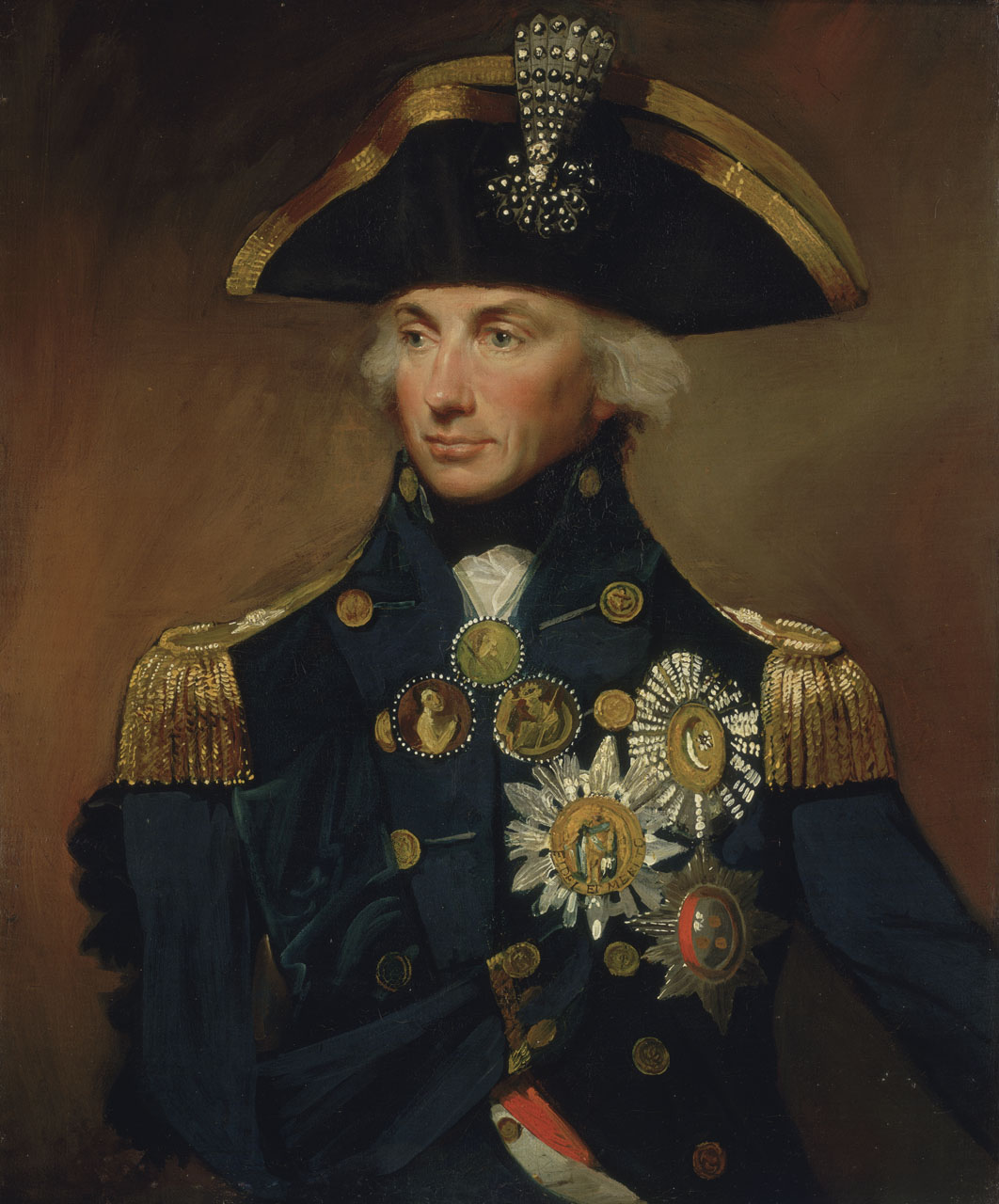
Lemuel “Francis” Abbott’s (circa 1760–1803) classic portrait of Nelson (1799) with Chelengk pinned to hat; oil on canvas and completed after his victory in the Battle of the Nile.  Historians of art suspect Abbott painted his work despite having never seen the Chelengk because his depiction is far removed from the actual jewel. 

One of the most famous Chelengks was that awarded to the Royal Navy’s Admiral Lord Nelson (1758-1805) by Selim III (1761–1808; Sultan of the Ottoman Empire 1789-1807) after the Battle of the Nile in 1798, the thirteen diamond encrusted rays representing the French ships captured or destroyed during the engagement.  A clever aspect of the engineering was that the central diamond star was connected to a clockwork mechanism so it would rotate while being worn and it was a particular distinction, being the first Çelenk awarded to a non-Ottoman and the thirteen rays were a departure from the traditional seven.  The admiral wore the Chelengk on his naval hat in much the same manner as Ottoman officers adorned their turbans and he turned out to be a trend-setter, sparking a demand in England for similar jewels and they became one of the most fashionable accessories of the era.  Selim III also awarded a Çelenk  to Russian Admiral Fyodor Ushakov (1745-1817) after the capture of Corfu from the French in 1799.  After Nelson’s death in the Battle of Trafalgar (1805), the Chelengk passed to his family and was frequently seen at the royal court until it was sold at auction in 1895, purchased eventually by the Society for Nautical Research in 1929 and placed on display at the National Maritime Museum in Greenwich where it was a star exhibit.  In 1951 the piece was by “an infamous cat-burglar” and has not since been seen.

Lindsay Lohan as she would appear if wearing the replica of Lord Nelson’s chelengk, Paris, March 2015 (digitally altered image).  The replica is said exactly to have duplicated the appearance of the original and features a central flower made of sixteen petals with leaves and buds.  The stalk of the flower is tied by a bow, extending from which are the thirteen rays.  The replica was made for the film Bequest to the Nation (1973) and was subsequently presented to the National Maritime Museum by the production house.

Monday, November 16, 2020

Wither

Wither (pronounced with-er)

(1) To shrivel; fade; decay.

(2) To lose the freshness of youth, as from age (often followed by away).

(3) To make flaccid, shrunken, or dry, as from loss of moisture; cause to lose freshness, bloom, vigour, etc.

(4) Harmfully to affect.

(5) To abash, as by a scathing glance (the withering look).

(6) The singular of withers (part of the back of a four-legged animal that is between the shoulder blades).

1530s: From the Middle English as an alteration of the late fourteenth century wydderen (dry up, shrivel), intransitive, apparently a differentiated and special use of wederen (to expose to weather), from the Old English hwider, an alteration of hwæder, from the Proto-Germanic hwadrê.  In German, there was verwittern (to become weather-beaten), from Witter (weather).  The transitive sense emerged in the 1550s.  Wither is a verb & adverb, withered is an adjective &  adverb, withering is a noun, verb & adjective and witheringly is an adverb.

Readers ancient & modern

There's also whither (To what place?) which is functionally equivalent to the relative adverb "whereto".  Except in poetry or other literary forms, "whither" is now rare to such an extent that it can be said to have vanished from popular use.  For many students, Shakespeare in the original is close to something in a foreign language and it’s not uncommon for high-school texts to be rendered more accessible.  This has be criticised as dumbing down (and at tertiary level probably is) but is probably a good idea.  One editor actually thought young readers would manage with wither but thought "riggish" too difficult.  In Antony and Cleopatra (Act 2 Scene 2), Shakespeare had Enobarbus say:

Never. He will not.
Age cannot wither her, nor custom stale
Her infinite variety. Other women cloy
The appetites they feed, but she makes hungry
Where most she satisfies, for vilest things
Become themselves in her, that the holy priests
Bless her when she is riggish.

The editor “translated” thus:

He’ll never leave her.
Age won’t wither her,
And her charms are so varied that she never grows boring.
With other women, the longer you know them the less appealing they become. 
Cleopatra, on the other hand, makes you desire her the more you see her.
Even her worst faults are charming
Holy priests bless her even when she acts the slut.


The Withered Garland (1800) by Karl Wilhelm Friedrich von Schlegel (1772–1829)

It was yet May when these you broke,
and in those flowers spoke,
yet a blossom yourself,
that which, now blooming, in your own heart
was awakening and,
in sacred wise, did already stir,
that childlike something your friend, ah! so cherished
when she her heart did lay
upon his own,
where now I do eternally weep.
 
These violets, which as a sign the child did send,
now do so soften my heart
that my eyes
may never bring to an end
the pain they now suck in,
and oft do still to her turn,
now finding but this garland, withered, in my hands.
Like this wreath did she,
chosen early to end,
lose herself self-unbeknownst.
 
Take hither this lofty, precious gift,
the only thing yet left to me
of the precious one,
that it might her image yet renew
when amid tears
my yearning so willingly flees
into death arms, escaping life’s vain notions.
Though let me first in tears
immerse my sweet remembrance!
 
We who found life in the pleasure of death,
who boldly nature understood
amid the flames,
where love and pain together
us unite:
let our foreheads be encircled
by the sign whose sense we have long since found.
For did not from these wounds
oft spring forth roses
in painful caress?
 
Hence may this girl’s own shadow surround us, hovering,
to melancholy devoted,
till in death as one we may again more intimately live,
and this deep striving wholly unite
those who, smiling, for one another weep.

Thursday, June 30, 2022

Nautical

Nautical (pronounced naw-ti-kuhl)

(1) Of or relating to ships, navigation, sailors & other admiralty matters.

(2) As nautical mile, a measure of distance.

1545-1555: From the Middle French nautique (pertaining to ships, sailors, or navigation) from the Latin nautic(us) (of or relating to ships or sailors), from the Ancient Greek ναυτικός (nautikós) (seafaring, naval), from nautes (sailor), from naus (ship), from the primitive Indo-European nau (boat).  Nautical is the adjective, nauticality the noun and nautically the adverb; associated words include navigational, seafaring, maritime, marine, aquatic, naval, oceanic, pelagic, salty, ship, abyssal, thalassic, boating, deep-sea, navigating, oceangoing, oceanographic, rowing, sailing & seagoing.

The nautical mile

A unit of distance measurement used in maritime, air and space navigation, one nautical mile was defined originally as one minute (one sixtieth of a degree) of latitude along any line of longitude.  It’s since been re-defined several times and although the international nautical mile is set at 1852 metres (about 1.15 miles), other definitions co-exist: a US Navy nautical mile being 1853.2480 metres (6080.2 feet) whereas UK Admiralty charts use an even 6080 feet.  No standardized nautical mile symbol has ever been agreed with M, NM, nmi and nm variously used.

The derived unit of speed is the knot, a vessel at one knot along a meridian travels approximately one minute of geographic latitude in one hour.  The word knot was originally an admiralty term to measure speed, derived from counting the number of knots unspooled from a real of rope in a certain time.  Curiously, although kn is the ISO standard symbol for the knot, kt is also widely used, particularly in civil aviation.

The reason the generally accepted definition of national territorial waters was set at three nautical miles (5.6 km) was wholly military; it was maximum range of the big ordnance of the age, the cannon-ball.  Developments in ballistics and politics soon rendered the three mile limit irrelevant and states began to claim larger areas but, although the League of Nations Codification Conference began discussions in 1930, nothing was resolved either then or at the subsequent United Nations Conferences on the Law of the Sea (UNCLOS I 1956-1958 & UNCLOS II 1960).  It took a ten-year process (UNCLOS 1973-1982) to secure international agreement that the national territorial limit was set at twelve nautical miles, the provision coming into force in 1994.

Lindsay Lohan's nautically themed Vanity Fair photo shoot, Marina del Rey, California, October 2010.  The location was the Sovereign, a motor yacht built in 1961 for the film star Judy Garland (1922-1969).

Tuesday, August 22, 2023

Sovereign

Sovereign (pronounced sov-rin (U), sov-er-in (non U) or suhv-rin)

(1) A monarch; a king, queen, or other supreme ruler.

(2) A person who has supreme power or authority.

(3) A group or body of persons or a state having sovereign authority.

(4) A gold coin of the United Kingdom, the value set at 22s 6d in the fifteenth century and re-valued to £1 sterling; it was removed from circulation after 1914.  In UK slang, “sov” (“sovs” the more commonly used plural) endures among certain classes to describe £1 sterling.   

(5) Belonging to or characteristic of a sovereign or sovereign authority; royal.

(6) Supreme; preeminent; indisputable.

(7) In clinical pharmacology, of a medicine or remedy, extremely potent or effective (archaic).

(8) A former Australian gold coin, minted 1855–1931, with a face value of £1 Australian.

(9) A large champagne bottle with the capacity of about 25 liters, equivalent to 33 standard bottles.

(10) Any butterfly of the tribe Nymphalini, or genus Basilarchia, as the ursula and the viceroy.

(11) In regional UK, slang, a large, garish ring.

1250-1300: From the Middle English soverain (alteration by influence of reign) & sovereyn, from the Old French soverain (sovereign, lord, ruler (noun use of the adjective meaning "highest, supreme, chief")) (which exists in modern French as souverain), from the Vulgar Latin superānus (chief, principal (and source also of the Italian soprano & sovrano and the Spanish soberano)) from the classical Latin super (over; above) from the primitive Indo-European uper (over).  The spelling was influenced by folk-etymology association with reign and Milton spelled it sovran, perhaps a nod to the Italian sovrano and scholars caution that though widely accepted, the link to the Vulgar Latin superānus is unattested.  The now obsolete medical sense of “remedies or medicines potent in a high degree" was from the fourteenth century.

In law, there are strands of meaning:  In a constitutional monarchy, a king or queen can be known as the sovereign while the state itself is sovereign and sovereignty is said often to reside in some elected assembly which, being representative of the people, can be said to derive it from them.  The noun sovereignty emerged in the late fourteenth century to designate "pre-eminence".  It was from the Anglo-French sovereynete, from the Old French souverainete, from soverain and referenced "authority, rule, supremacy of power or rank".  The modern meaning as “sovereign state” which is defined literally as "existence as an independent state" is from 1715 and remains an exact meaning, the state of statehood a binary in that a state is either independent (and thus sovereign) or not.  Attempts therefore by sub-state entities like defined regions of federal states to asset sovereignty under the guise of state’s rights are usually doomed to fail either because, like the Australian states, they were non-sovereign colonies prior to federation or have always been part of a larger whole.  That is not to say that powers and authority cannot be shared and some heads of it may exclusively be vested in a sub-national construct but that is a constitutional arrangement within a sovereign state; sovereignty is indivisible.  The concept of “personal sovereignty” invoked by those resisting such thing as COVID-19 related face-mask or vaccine mandates is drawn from the theories of natural law but has no basis in positive law.

Lindsay Lohan, Vanity Fair photo shoot, Marina del Rey, California, October 2010.  The location was the Sovereign, a motor yacht built in 1961 for the film star Judy Garland (1922-1969).

The noun suzerain (sovereign, ruler) dating from 1807, was from French suzerain, from the fourteenth century Old French suzerain (noun use of the adjective meaning "sovereign but not supreme") from the adverb sus (up, above) on analogy of soverain.  The Old French sus is from the Vulgar Latin susum, from the Classical Latin sursum (upward, above), a contraction of subversum, from subvertere.  It was the French suzerain which vested the English sovereign it’s meaning in the political sense.  In international it came to mean a “dominant nation or state that has control over the international affairs of a subservient state which otherwise has domestic autonomy”, a sense similar but different from “client state” or relationships such as those of Moscow to the states of the former Warsaw Pact.  Historically the suzerain was the feudal landowner to whom vassals were forced to pledge allegiance.

In May 1910, European royalty gathered in London for the funeral of Edward VII and among the mourners were nine reigning kings.  This is believed the only photograph ever taken of nine sovereign kings and would be the last gathering of the old European order before the Great War.  The photograph circulated widely in both monochrome and sepia tones and recently has been colorized.  Notable absentees include Tsar Nicholas II of Russia (overthrown in 1917), Victor Emmanuel III of Italy and Emperor Franz Joseph (died in 1916, the dual monarchy abolished and the empire dissolved in 1918) of the Austro-Hungarian Empire.

Standing, left to right: King Haakon VII of Norway, Czar Ferdinand of the Bulgarians, King Manuel II of Portugal and the Algarve, Kaiser Wilhelm II of Germany and Prussia, King George I of the Hellenes and King Albert I of the Belgians.

Seated, left to right: King Alfonso XIII of Spain, King George V of the United Kingdom and King Frederick VIII of Denmark.

Norway – Monarchy still going.

Bulgaria – Monarchy overthrown in 1946.  While "the rich are different" is a common saying, royalty is more different still.  While attending Edward VII's funeral, the other sovereigns reportedly were "irritated" by Ferdinand insisting on being style "Czar" and it became known he kept in a wooden chest "the full imperial regalia of a Byzantine Emperor (obtained from theatrical costume suppliers in Paris & London), ready for him to don when the old Byzantine dominions would be reassembled under his crown & sceptre".  In neither Sofia nor Constantinople did things work out quite as Ferdinand had hoped.    

Portugal – Monarchy overthrown in 1910.

Germany – Monarchy extinct since the act of abdication in 1918.

Greece – Monarchy overthrown in 1924, restored in 1935, overthrown in 1973.

Belgium – Monarchy still going and notably more predictable than the local parliamentary politics in that while it’s often not possible for the politicians to agree on who should be prime-minister, the line of succession to the throne is not disputed.

Spain – Monarchy overthrown in 1931, re-established in 1975 and still going (with the odd scandal).  One quirk of Spanish constitutional history and one about which not all lawyers agree (political scientists and historians finding the arguments either tiresome or amusing) is that despite the proclamation of a republic in 1931, between then and 1975 when the monarchy was said to have been restored, Spain may anyway have continued to be a monarchy because, whatever the outcome on the streets or later Franco's battlefields, there may never have been executed the necessary legal mechanism of dissolution.

When the king (Alfonso XIII 1886–1941; King of Spain 1886-1931) went (with a fair chunk of his nation's exchequer) into exile in 1931, he departed the soil but did not abdicate which most regard of no constitutional significance, the subsequent declaration of the Second Spanish Republic thought sufficient and most agree this abolished both monarchy and kingdom, sovereignty residing with the republican state which General Franco (1892-1975; Caudillo of Spain 1939-1975) took over in 1939.  In curious twist however, in 1947 Franco re-established Spain as a Kingdom which he ruled as head of state of the Kingdom of Spain through the Law of Succession.  A sovereign kingdom thus but without a king on the throne on which, figuratively at least, Franco sat until peacefully he died in 1975.  A king then returned to the kingdom because, again amending the Law of Succession, Franco appointed Alfonso XIII's grandson, Juan Carlos I de Borbón (b 1938; King of Spain 1975-2014, styled Rey Emérito (King Emeritus) since) as his successor and he assumed the throne in 1975, the nature of the new, constitutional monarchy, promulgated in 1978 after a referendum.  Despite the fine technical points raised, most agree Spain was a republic 1931-1947, the kingdom was restored in 1947 and monarchical rule has existed since 1975, its constitutional form assumed in 1978.  Sovereignty was probably vested successively in the republic (1931-1939), Franco personally (1939-1975), Juan Carlos personally 1975-1978 and the Spanish state since.    

United Kingdom – Monarchy still going though not without the odd squabble at the margins.  Although having undergone the occasional change in dynastic management, it has since the ninth century existed continuously except for the uncharacteristic republican interregnum (1649-1660).  Territorially, it has been a shifting jigsaw, comprised of various permutations of all or part of England, Ireland, Scotland & Wales, the odd temporary European augmentation and of course the colonies, territories and Dominions linked to the old British Empire and the still extant Commonwealth.  The relationship between the monarchy and the Commonwealth varies from state to state and even in those independent states where the UK monarch remains the head of state, sovereignty in almost all cases resides wholly somewhere in the local political construct.

Dating from 21 April 1926, a two-part prediction was made by Henry "Chips" Channon (1897-1958), a US born resident of the UK who became (1) more English than the English, (2) a member of parliament (1935-1958) and (3) in his final years, a knight of the realm (although the peerage he for decades coveted eluded him).  On the day of the birth of the future Queen Elizabeth II (1926-2022; Queen of the UK 1952-2022) he noted in his diary that he expected the child to become "Queen of England and perhaps the last sovereign".  Channon thought the Prince of Wales (Prince Edward 1894–1972; briefly (in 1936) King Edward VIII of the United Kingdom & Emperor of India), whom he knew, to be so temperamentally unsuitable for the role of king he would either renounce his claim to the throne or abandon it once crowned.  His first part of the prediction proved accurate although he was diffident about the second and the monarchy has thus far endured.  Channon's diaries, published in the 1960s (in heavily redacted form) were amusing enough but the (mostly) unexpurgated editions (in three volumes 2021-2022) are as juicy as any published in the past century.

Denmark – Monarchy still going.

That approaching the second quarter of the twenty-first century a dozen European nations (Andorra, Belgium, Denmark, Liechtenstein, Luxembourg, Monaco, the Netherlands, Norway, Spain, Sweden, the United Kingdom & Vatican City (the pope the only absolute sovereign and the city-state a theocracy)) remain monarchies would have surprised some.  In 1948, the already embattled (and soon to be overthrown) King Farouk (1920–1965; King of Egypt 1936-1952) gloomily predicted that soon only five kings would remain: "The King of England and the kings of hearts, clubs, diamonds and spades."  While prescient about his own fate, he was wrong in that but while there are certainly fewer than there were, the institution, while on paper a pretty silly basis on which to depend for a head of state, has proved durable in those cases where royal families have been sufficiently adaptable to evolve into reliable ciphers and become frequent, if sometimes unscripted, content providers for pop culture platforms.

End of the Jaguar 3.8 era.  Jim Clark and Jack Sears in the Ford Galaxie 427s ahead of Graham Hill and Roy Salvadori in Jaguar 3.8s, Guards Trophy Race, Brands Hatch, 1963.

A blend of the ancient and modern which characterized much of what Jaguar produced until well into the twenty-first century, the Daimler Sovereign was the final evolution of the Jaguar 2.4, introduced in 1955 as the “small” car of the range and known retrospectively as the Mark 1 after 1959 when a revised model was released as the Mark 2.  The bigger-engined versions of the Mark 2 were the outstanding sports saloons of their day and dominated production car racing until the new generation of fast Fords, the Lotus Cortina, the Mustang and, somewhat improbably, the big Galaxies began to prevail but, as road cars, the power delivered by the 3.8 litre XK-Six was probably close to the limit of the platform’s capability.  This was addressed in 1963 when a version of the more capable independent rear suspension introduced in 1961 on the Mark X and E-Type (XK-E) was grafted to a slightly enlarged structure and released as the S-Type.  The new sophistication was appreciated but the unusual combination of styling techniques was less admired, the front and rear generally felt discordant and tellingly, the Mark 2 was not discontinued and continued to sell well.

1963 Jaguar S-Type 3.8.

The aesthetic objections were noted and in 1966, a new nose, reminiscent of that on the Mark X, was grafted on to the S-Type and the result, while clearly not modernist in the manner of a contemporary like the NSU Ro80, was generally acknowledged to be more harmonious.  The new model, acknowledging the fitment for the first time in the platform of the 4.2 litre XK-Six, was called the 420 and, in a (brief) attempt to create a naming convention with some familial relationship, the big Mark X was re-named 420G and the Mark 2 became the 240 or 340 depending on engine capacity, the 3.8 litre version discontinued although a few were built to special order (albeit still badged as 340s).  Strange as it seems, for a number of reasons, the 240, 340, S-Type and 420 all remained available until all were replaced by the XJ6, introduced in 1968.  Only the 420G received a stay of execution, the flagship lingering until 1970 by which time production had slowed to a trickle.

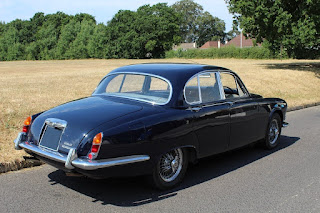
1968 Daimler Sovereign.

Launched simultaneously in 1966 with the 420 and around 7% more expensive was the Daimler Sovereign.  The Sovereign was essentially the 420 with all the Jaguar’s optional extras fitted as standard, a higher grade of timber and leather for the interior fittings and the traditional details distinguishing the marquee, most notably the elegant fluting atop the grill and the rear number plate valance.  Unfortunately, unlike the earlier Daimler version of the Mark 2 (later named 250 to align with the 240 & 340) which was powered by Daimler’s fine 2.5 litre V8, the Sovereign was mechanically identical to the 420, the opportunity to create something special by using the 4.6 litre version of the V8 not taken, the same mistake which may have doomed the Mark X and 420G to their indifferent sales performance; although excessively large for many markets, a V8 Mark X would have been ideal in the US.  Nonetheless, although nothing more than a fancy Jaguar, it was a success and despite the higher price, Sovereign sales totaled more than six-thousand, the 420 managing only four-thousand odd more.

1967 Daimler Sovereign.

The 420-based Sovereign continued to be offered well into 1969 because the high demand for the XJ6 meant there was not immediately the capacity to produce a Daimler version of the new car.  It was finally retired in 1969 (the last survivor of the platform introduced in 1955) when an XJ6-based Sovereign was released in 2.8 and 4.2 litre versions, notionally replacing the Mark 2-based 250 and the previous Sovereign respectively.  Jaguar continued to use the Sovereign name on the six-cylinder Daimlers until 1983 when they were re-badged simply as “Daimler” although the name would for years be applied to various up-market XJs, especially in overseas markets where others held the trademark to the Daimler name.  When equipped with the Jaguar's 5.3-litre V12, the Sovereign was named Double Six, a revival of a name Daimler used between 1926-1938 for an earlier twelve cylinder model.  The Sovereign name was the choice of the Jaguar board; although the chairman had suggested “Royal” it seemed he was persuaded Sovereign was a better fit.

1976 Daimler Sovereign two door.

Most memorable of the Sovereigns were the elegant coupés offered between 1975-1977; the factory insisting they were a “two door” and not a coupé, the rationale presumably to provide a distinction between the XJ and XJ-S (1975-1996 and later named XJS).  The vinyl-roof, one of the many unfortunate aspects of style which so afflicted the 1970s, attracted criticism even at the time of release, the suspicion being it might have been glued on to hide some rather obviously hasty welding used to create the lovely roofline, a expedient Plymouth adopted in 1970 for the Superbird and Ford Australia repeated on the Landau three years later.  However, it transpired the necessity was not the finish of the sheet metal but the inability of the paints of the era to accommodate the slight flexing of the roof caused by using the same gauge of steel on the pillar-less coupé as the saloon which was a little more rigid.  With the availability of modern paints, many have since taken the opportunity to ditch the vinyl and allow the lovely lines to appear unspoiled.  Being produced under the ownership of British Leyland, predictability, roof-flex wasn’t the only flaw.  The sealing of the frameless windows was never perfected so wind noise is more intrusive than the saloon and, over time, the heavy doors will sag, Jaguar using the same hinges as those which supported the saloon’s smaller, lighter pressings.  

Picture of the sovereign on a 1963 mock-up of the proposed Australian Royal.

Royal as a name seemed not to be popular in other places (although Chrysler did use it for a while and it's applied to a few alcoholic beverages), earlier rejected in the antipodes as the name for a new legal tender.  In early 1963, Robert Menzies (1894–1978; Prime-Minister of Australia 1939-1941 & 1949-1966) had said Australia would adopt a decimal currency and later in the year it was announced its name would be “the royal”.  Said to be the preferred choice of the prime-minister himself, cabinet had been persuaded, presumably because the other suggestions including "kwid", "champ", "deci-mate", "austral" and "emu", were thought worse.  Proving that social media isn’t necessary for public opinion to become quickly known, within days the derision expressed was enough to convince the government to change.  The cabinet documents (released in 1993 under the (then) thirty-year rule) recorded the treasurer telling the cabinet “…royal had been a terrible mistake” and in September, it was announced the pound would be replaced by the Australian dollar; it was introduced on Valentine’s Day 1966.

Currency matters had troubled Menzies before.  He’d been much criticized in 1952 when, upon Elizabeth II’s accession, the inscription FD abruptly was omitted from Australian coins.  FD (Defender of the Faith (the Latin Fidei Defensor (feminine Fidei Defensatrix)), had been in use since 1507 when the title "Protector and Defender of the Christian Faith" was granted by Pope Julius II (1443–1513; pope 1503-1513) to James IV of Scotland (James VI and I (1566–1625) King of Scotland as James VI (1567-1625) & King of England and Ireland as James I (1603-1625)) and had been inscribed on all English (and subsequently UK) coins minted since the Medici Pope Leo X (1475–1521; pope 1513-1521) in 1521 conferred it on Henry VIII (1491–1547; King of England (and Ireland after 1541) 1509-1547).  A grateful Leo had been most impressed by Henry’s book Assertio Septem Sacramentorum (Defense of the Seven Sacraments), a powerful assertion of both the sacramental nature of marriage and the supremacy of the pope, his words at the time celebrated in Rome as the "Henrician Affirmation".  Although Henry would go on to interpret the marriage ritual, papal authority and the defense of the faith in his own way, FD nevertheless remains on the UK's to this day.  There, it is not without constitutional significance, the sovereign, Queen Elizabeth, being supreme governor (ie the titular head) of the Church of England, the nation's established (ie the official state) church.  

A year is a long time in politics: the 1953 & 1954 Australian florins.

In the Australia of 1952, then a country still marked by the sectarian divide between Catholic and Protestant, there was much outrage, Anglicans calling it an affront to Her Majesty and their church and nothing but a cynical ploy by a (Presbyterian) prime-minister to curry favor with Roman Catholics in search of their votes.  Surprisingly to some, prominent among the affronted was the former high court judge, Dr HV Evatt (1894–1965; leader of the opposition 1951-1960) who, although condemned by the right-wing fanatics of the day as the “arch defender of the godless atheistic communists” was a staunch Anglican who proved a doughty opponent of the change.  It at the time was quite a furore with questions in parliament, strident editorials, letters (of outrage) to the editor (the social media of the era) and ecclesiastical denouncements from a number of reverend and very reverend gentlemen.  Menzies relented and intervened personally to ensure the mint secured Fidei Defensor dies in time for a commemorative florin (the modern 20c coin, then often referred to as "two bob") to be struck for the 1954 royal visit.