Showing posts sorted by relevance for query Florin. Sort by date Show all posts

Monday, July 27, 2020

Florin

Florin (pronounced flawr-in or flor-in)

(1) A cupronickel coin of Great Britain, formerly equal to two shillings or a tenth part of a pound and retained in circulation (equal to 10 new pence) after decimalization in 1971; first issued in 1849 as a silver coin.

(2) An alternative name for the guilder (the standard unit in the former (pre-Euro) currency of the Netherlands).

(3) A former gold coin of Florence, first issued in 1252 and widely imitated.

(4) A former gold coin of England, first issued under Edward III (1312–1377; King of England 1327-1377).

(5) A former gold coin of Austria, first issued in the mid-fourteenth century.

(6) As the Aruban Florin, the standard monetary unit of Aruba (A Caribbean island and a constituent country within the Kingdom of the Netherlands), divided into 100 cents

(7) In Australia, a coin minted between 1910-1963 and the ancestor of the 20c coin (two bob in the vernacular)  The New Zealand equivalent was issued between 1933-1965.

(8) A style of women's dress, in a flowing (originally wrap-around) style, dating from the mid-nineteenth century.

1275–1325: From Middle English florin & floren, from the Middle French floren, from the Old Italian fiorino (little flower), from fiore (flower), from the Latin flōrem (accusative of flōs (flower)).  Florin was the name of an English gold coin from the late fifteenth century, reprising an earlier use and a fiorino was the monetary unit of Tuscany between 1826-1859, subdivided into 100 quatrini; a florin.   The Florentine coin was stamped on the obverse with a lily, the symbol of the city.  Florin is a noun; the noun plural is florins.

Florentine gold florins (left) and pre-war Australian florins.

The florin pattern (the term "wrap" a little misleading and a historic relic of the style's origin.

The term florin dress refers to a style which became popular in the late Victorian era, attaining its classic form during the early twentieth century Edwardian era.  It was characterized by a fitted bodice and a full skirt, the fabric of which tended to “flow” as the wearer moved.  During the inter-war years (1919-1939), the bodices became tighter and the necklines lower but the “swish” of the flowing lines remained the dominant motif.  The volume of fabric mean it was a style which could be adapted to the formality suggested by dark solid colours, the bright floral patterns which emerged in the late nineteenth century as the mass-production of dyes by industrial chemistry or the embellishment with lace and ribbons which some found attractive.

Lindsay Lohan in Florin dress.

Although conservative, there was a timelessness about the style which ensured its survival into the twenty-first century and most mainstream fashion houses (at whatever price-points they target) have florin dresses in their lines, the cut so adaptable the “wrap-around-look” (even if not always literal) able to be implemented with hemlines extending from knee to ankle, some with sleeves, some not.  The name “florin dress” has nothing to do with coinage but was a tribute to the many statutes of women depicted clothed in such a manner which were found in Florence and historians of fashion note the original name was “Florentine Dress” but for whatever reason, quickly this was clipped.

Statua dell'Abbondanza (The Abundance; 1637), in white marble with wheat bouquet of bronze by Pietro Tacca (1577–1640), an Italian sculptor associated with both the school of mannerism and the later baroque, Boboli Gardens, Florence.

It was the representation of clothing in this flowing style which inspired the Victorians to dub the dresses the “Florin”, many of the the finest sculptures of the (clothed) female form found in the parks and museums of Florence.

Friday, October 31, 2025

Bob

Bob (pronounced bobb)

(1) A short, jerky motion.

(2) Quickly to move up and down.

(3) In Sterling and related currencies, a slang term for one shilling (10c); survived decimalisation in phrases like "two bob watch", still used by older generations).

(4) A type of short to medium length hairstyle.

(5) A docked horse’s tail.

(6) A dangling or terminal object, as the weight on a pendulum or a plumb line.

(7) A short, simple line in a verse or song, especially a short refrain or coda.

(8) In angling, a float for a fishing line.

(9) Slang term for a bobsled.

(10) A bunch, or wad, especially a small bouquet of flowers (Scottish).

(11) A polishing wheel of leather, felt, or the like.

(12) An affectionate diminutive of the name Robert.

(13) To curtsy.

(14) Any of various hesperiid butterflies.

(15) In computer graphics (using "Bob" as a contraction of Blitter object), a graphical element (GEL) used by the Amiga computer (the first consumer-level computer which handled multi-tasking convincingly).  Technically, Bobs were hardware-generated objects which could be moved on the screen by the blitter coprocessor.  Bobs were an object of some veneration among the demosceners (the computer art subculture that produces and watches demos (audio-visual computer programs)), Bobs rated according to their the volume and dynamics of movement.

(16) In Scotland, a bunch, cluster, or wad, especially a small bouquet of flowers.

(17) A walking beam (obsolete).

1350–1400: From the Middle English bobben (to strike in cruel jest, beat; fool, make a fool of, cheat, deceive), the meaning "move up and down with a short, jerking motion," perhaps imitative of the sound, the sense of mocking or deceiving perhaps connected to the Old French bober (mock, deride), which, again, may have an echoic origin. The sense "snatch with the mouth something hanging or floating," as in bobbing for apples (or cherries), is recorded by 1799 and the phrase “bob and weave” in boxing commentary is attested from 1928.  Bob seems first to have been used to describe the short hair-style in the 1680s, a borrowing probably of the use since the 1570s to refer to "a horse's tail cut short", that derived from the earlier bobbe (cluster (as of leaves)) dating from the mid fourteenth century and perhaps of Celtic origin and perhaps connected in some way with the baban (tassel, cluster) and the Gaelic babag.  Bob endures still in Scots English as a dialectical term for a small bunch of flowers.  Bob is a noun & verb, bobber & boggy are nouns, bobbing is a noun & verb, bobbed is a verb & adjective, bobbish is an adjective and bobbingly & bobbishly are adverbs; the noun plural is bobs.  When used as a proper noun, there's an initial capital.

Australian politician Bob Katter (b 1945) with cane toad.

An introduced pest (ie the cane toad), Mr Katter's idea is children should be given guns (air rifles) to hunt them, each carcass attracting a bounty of 40 cents ("four bob" in the old slang).  This photograph is thus potentially "a five bob".  Affectionately, Mr Katter is known as “his Bobness” and, depending on who is asked, is either (1) an intellectual or (2) barking mad.  Between 1974-1992, Mr Katter served in the Queensland state parliament but since 1993 has been the member for Kennedy (at 567,377 km² (219,066 sq miles) about the size of metropolitan France) in the Commonwealth House of Representatives.  Until 2001 he was a member of the National Party (the old Country Party), after which he sat as an independent.  The suggestion which circulated implying he was asked by the Nationals to vacate his seat after an IQ test revealed he was "too intelligent for the National Party" was fake news and wholly malicious.   

Two two bob coins: Obverse (heads, left) and reverse (tails, right) of two 1945 Australian florins, minted in the same year as Mr Katter.

The coin at the top is one which spent some time in circulation while the more lustrous example below is a UNC (uncirculated coin) which would likely have spent its entire existence in collections.  Numismatists (coin collectors) will pay a premium for a UNC, a 1945 UNC Australian florin typically trading at four times the price of a circulated coin in good condition.  Now nominally equivalent to 20 cents (although a florin’s purchasing power was greater), it was worth two shillings (thus “two bob” in slang).  The group of "bob words" in English is beyond obscure and mostly mysterious.  Most are surely colloquial in origin and probably at least vaguely imitative, but have long become entangled and merged in form and sense (bobby pin, bobby sox, bobsled, bobcat etc).  As a noun, it has been used over the centuries in various senses connected by the notion of "round, hanging mass" and of weights at the end of a fishing line (1610s), pendulum (1752) or plumb-line (1832).  As a description of the hair style, although dating from the 1680s, it entered popular use only in the 1920s when use spiked.  As a slang word for “shilling” (the modern 10c coin), it’s recorded from 1789 but no connection has ever been found and the origin of this is unknown.  In certain countries, among older generations, the term in this sense endures in phrases like “two bob watch” to suggest something of low quality and dubious reliability.

UK Prime Minister Lord Salisbury (Robert Arthur Talbot Gascoyne-Cecil, 1830–1903; UK Prime Minister for thirteen years variously 1885-1902.

The third marquess was, in the words of of Winston Churchill (1875-1965; UK prime-minister 1940-1945 & 1951-1955): "prime-minister since God knows when" and the affectionate diminutive of his grandson (Robert Arthur James Gascoyne-Cecil 1893-1972; Fifth Marquess of Salisbury 1947-1972) was "Bobbety".  The phrase "Bob's your uncle" is said often to have its origin in the nepotism allegedly extended by Lord Salisbury to his favorite nephew Arthur Balfour (1848–1930; UK Prime Minister 1902-1905), unexpectedly promoted to a number of big jobs during the 1880s.  The story has never convinced etymologists but it certainly impressed the Greeks who made up a big part of Australia's post-war immigration programme, "Spiro is your uncle" in those years often heard in Sydney and Melbourne to denote nepotism among their communities there.

The other potential source is the Scottish music hall, the first known instance in in a Dundee newspaper in 1924 reviewing a musical revue called Bob's Your Uncle.  The phrase however wasn't noted as part of the vernacular until 1937, six years after the release of the song written by JP Long, "Follow your uncle Bob" which alluded to the nepotistic in the lyrics:

Bob's your uncle
Follow your Uncle Bob
He knows what to do
He'll look after you

Partridge's Dictionary of Slang and Unconventional English (1937) notes the phrase but dates it to the 1890s though without attribution and it attained no currency in print until the post-war years.  Although it's impossible to be definitive, the musical connection does seem more convincing, the connection with Lord Salisbury probably retrospective.  It could however have even earlier origins, an old use noted in the Canting Dictionary (1725) in an entry reporting "Bob ... signifies Safety, ... as, It's all Bob, ie All is safe, the Bet is secured."

Of hair

A bob cut or bob is a short to shoulder-length haircut for women.  Historically, in the west, it’s regarded as a twentieth-century style although evidence of it exists in the art of antiquity and even some prehistoric cave-paintings hint it may go way back, hardly surprising given the functionality.  In 1922, The Times (of London), never much in favor of anything new, ran a piece by its fashion editor predicting the demise of the fad, suggesting it was already passé (fashion editors adore the word passé) although the photographic record for the rest of the decade does suggest it took the bright young things of the age a while to take the paper's hint.  Certainly, bobs were less popular by the difficult 1930s but in the 1960s, a variety of social and economic forces saw a resurgence which has never faded and the twenty-first century association with the Karen hasn't lessened demand (although the A-line variant, now known in the industry as the "speak to the manager" seems now avoided by all except those for whom there are few viable alternatives).  The connection with the Karen is the second time the bob has assumed some socio-political meaning; when flaunted by the proto-feminists of the 1920s, it was regarded as a sign of radicalism.  The popularity in the 1920s affected the millinery trades too as it was the small cloche which fitted tightly on the bobbed head which became the hat of choice.  Manufacturer of milliner's materials, hair-nets and hair-pins all suffered depressed demand, the fate too of the corset makers, victims of an earlier social change, a phenomenon which would in the post-war years devastate the industries supporting the production of hats for men.  In the 1970s, some optimists (some of whom may have been men), noting one well-publicized (though not widely practiced) aspect of second-wave feminism, predicted the demise of the bra but that garment endured and flourishes to this day.

Actor Lily Collins (b 1989) in a semi-sheer white Calvin Klein ensemble, the cropped spaghetti-strap top and knee-length pencil skirt both embellished with scale sequins, New York Fashion Week,  New York City, September 2025.  Note the pleasing definition of the sinews (arrowed, centre).  The hair-style is a chin-length bob.

Variations on a theme of bob, Marama Corlett (b 1984. left) and Lindsay Lohan (b 1986, right), Sick Note, June 2017.

Hairdressers have number of terms for the variations.  The motifs can in some cases be mixed and even within styles, lengths can vary, a classic short bob stopping somewhere between the tips of the ears and well above the shoulders, a long bob extending from there to just above the shoulders; although the term is often used, the concept of the medium bob really makes no sense and there are just fractional variations of short and long, everything happening at the margins.  So, a bob starts with the fringe and ends being cut in a straight line; length can vary but the industry considers shoulder-length a separate style and the point at which bobs stop and something else begins. Descriptions like curly and ringlet bobs refer more to the hair than the style but do hint at one caveat, not all styles suit all hair types, a caution which extends also to face shapes.

Greta Thunberg: BB (before-bob) and AB (after-bob).

The style received an unexpected imprimatur when Greta Thunberg (b 2003) opted for a bob (one straddling chin & shoulder-length).  Having gained fame as a weather forecaster, the switch to shorter hair appears to have coincided with her branching out from environmental activism to political direct action in the Middle East.  While there's no doubt she means well, it’s something that will end badly because while the matter of greenhouse gasses in the atmospheric can (over centuries) be fixed, some problems are insoluble and the road to the Middle East is paved six-feet deep with good intentions.  Ms Thunberg seems not to have discussed why she got a bob (and how she made her daily choice of "one braid or two" also remained mysterious) but her braids were very long and she may have thought them excessive and contributing to climate change.  While the effect individually would be slight, over the entire population there would be environmental benefits if all those with long hair got a bob because: (1) use of shampoo & conditioner would be lowered (reduced production of chemicals & plastics), (2) a reduction in water use (washing the hair and rinsing out all that product uses much), (3) reduced electricity use (hair dryers, styling wands & straighteners would be employed for a shorter duration) and (4) carbon emissions would drop because fewer containers of shampoo & conditioner would be shipped or otherwise transported.

Sydney Sweeney (b 1997) with new bob, Variety's Power of Women 2025 Event, Beverly Hills Hotel in Los Angeles, California, October 2025.

Actor Sydney Sweeney (b 1997) seemed not to have revealed whether it was Greta Thunberg who inspired her to get a bob but the symmetrical cut made quite a splash when she appeared on the red carpet at Variety's Power of Women 2025 Event.  The reaction universally was favourable but also noted by critics was her sparkling silver full-length gown from the spring 2026 collection of Christian Cowan (b 1995) & Elias Matso (b 2002); it’s fair to say dress overshadowed hair, fetching though the latter was.  The gown was called “Twisted Crystal Mesh Tee” and for deconstructionist fashionistas, the piece was a delight of detail in sheer fabric including bell sleeves, a scooped neckline, a form-fitting bodice with an intricately crafted twisted waist, lending a cinched effect which merged effortlessly to a lace-up fastener at the back, constructed with a corset-tie motif: coming or going, she looked good.  So lovely is Sydney Sweeney she would look good in just about anything but she certainly knows how to get the most from a garment, her underwear limited to “nude knickers” with diamond drop earrings and rings from EFFY.

Variety's clip of Sydney Sweeney (moving slightly) with new bob.

Her appearance in that dress of course provoked the digital traffic she would have expected and it’s hard to disagree with the feminist critics who suggested the juxtaposition of well-filled gown with the speech she delivered at the event was a device intended deliberately to illustrate the behavioral phenomenon she’d discussed in earlier interviews: That women can be defined as sexy or serious but not both simultaneously.  As evidence of that, the extent of the on-line coverage of how Ms Sweeney looked in the dress may be compared with the minimal attention afforded the speech she delivered from the podium, the former already joining the Alexandre Vauthier (b 1971) LRD (little red dress) worn by & Bella Hadid (b 1996) Cannes Film Festival in May 2016 as one of the dresses of the twenty-first century.  Of her words, most of the “cultural commentators” seemed intent on criticizing what they deemed the apparent discontinuity between her wishing to be taken seriously while looking so stunningly sexy, apparently missing the point that in bundling her body, the garment in which it was wrapped and the text she delivered as a single installation, she made her point well, dress and body just part of her text.

Sydney Sweeney with new bob.

Ever since the Canadian theorist Marshall McLuhan (1911–1980) explained the concept in Understanding Media: The Extensions of Man (1964), it’s been understood “the medium is the message”, his theory being it is the channel or technology through which information is transmitted which matters more than the content in the shaping human experience and society.  While that obviously wasn’t an absolute rule, the notion was helpful, decades before TikTok, in providing a model of the way a structure can have social effects independent of its content.  To define “medium”, McLuhan cast a wide net, including not only the then familiar (and dominant) television & print, but any channel through which information passes, including speech, gesture and appearance.  The person delivering a message is thus a medium and the reaction of an audience to the words of a glamorous, attractive woman can be very different to that extended to someone plain, even if both recite the same text with the same tonal technique.

Sydney Sweeney with new bob.

So, Ms Sweeney’s dress wasn’t just packaging, it was part of the meaning and that was not what she implied but what the audience inferred; what “the medium is the message” meant was the form of delivery and the embodied qualities of the communicator are inseparable from the content’s impact.  This was heady stuff in 1964 and, thirty-odd years on, the internet would gain critical mass and, at scale, prove his principle but his idea wasn’t new, the line of thought running through Western philosophy from Aristotle (384-322 BC) who called it “ethos” to Leo Strauss (1899–1973) who wrote of a kind of “authenticity”.  Unfortunately, Strauss was disturbed by way the writings of Friedrich Nietzsche (1844–1900) were so accessible they were there for Nazis and others to make of them something else so his meaning(s) existed in a kind of elaborated code it took some time to learn but definitely he was in the Aristotelian tradition McLuhan would have understood.  It’s a long way from Nietzsche to Sweeney but from her back to McLuhan, it’s not that far.

Bob identification: By their bob they shall be known

Asymmetrical Bob: Another general term which describes a bob cut with different lengths left and right; they can look good but should not be applied to all styles.  The effect is often most dramatic when combined with some variant of the Shaggy (JBF).

A-line bob: A classic bob which uses slightly longer strands in front, framing the face and, usually, curling under the chin; stylists caution this doesn’t suit all face shapes.

Buzz-cut bob: Known also as the undercut (pixie) bob, and often seen as an asymmetric, this is kind of an extreme inverted mullet; the the usual length(s) in the front and close-cropped at the back.  It can be a dramatic look but really doesn’t suit those above a certain BMI or age (although the former seem often unable to resist the look).

Chin-length bob: Cut straight to the chin, with or without bangs but, if the latter is chosen, it’s higher maintenance, needing more frequent trims to retain the sharpness on which it depends.  Depending on the face shape, it works best with or without fringe.

Inverted bob: A variation on the A-line which uses graduated layers at the back, the perimeter curved rather than cut straight. Known also as the graduated bob, to look best, the number of layers chosen should be dictated by the thickness of growth.

Shaggy bob: A deliberately messy bob of any style, neatness depreciated with strategic cutting either with scissors or razor, a styling trick best done by experts otherwise it can look merely un-kept.  The un-kept thing can be a thing if that’s what one wants but, like dying with gray or silver, it's really suitable only for the very young.  Some call this the choppy and it’s known in the vernacular of hairdressing as the JBF (just been fucked).

Spiky bob: This differs from a JBF in that it’s more obviously stylised.  It can differ in extent but with some types of hair is very high maintenance, demanding daily application of product to retain the directions in which the strands have to travel.  Not all hair is suited to the look and while product can compensate for much, beyond a certain point, there is a law of diminishing returns. 

Shingle bob: A cut tapered very short in the back, exposing the hairline at the neck with the sides shaped into a single curl, the tip of which sits at a chosen point on each cheek.  This needs to be perfectly symmetrical or it looks like a mistake.

Shoulder-length bob: A blunt bob that reaches the shoulders and has very few layers; with some hair it can even be done with all strands the same length.  Inherently, this is symmetrical and a remarkably different effect is created depending on whether it's done with or without a fringe although hairdressers caution this is not a style best suited to "round" faces and with those it can be necessary to experiment, a fringe sometimes improving things, sometimes not.

Speak to the manager bob: Not wishing to lose those customers actually named Karen, the industry shorthand for the edgy (and stereotypically in some strain of blonde) bob didn’t become “Karen”.  The classic SttM is an asymmetric blonde variation of the A-line with a long, side-swept fringe contrasted with a short, spiky cut at the back and emblematic of the style are the “tiger stripes”, created by the chunky unblended highlights.  It's now unfashionable though still seen because it remains the "go to cut" for women of a certain age who have been persuaded the style they've stuck to since they were 19 is no longer flattering.

Tuesday, August 22, 2023

Sovereign

Sovereign (pronounced sov-rin (U), sov-er-in (non U) or suhv-rin)

(1) A monarch; a king, queen, or other supreme ruler.

(2) A person who has supreme power or authority.

(3) A group or body of persons or a state having sovereign authority.

(4) A gold coin of the United Kingdom, the value set at 22s 6d in the fifteenth century and re-valued to £1 sterling; it was removed from circulation after 1914.  In UK slang, “sov” (“sovs” the more commonly used plural) endures among certain classes to describe £1 sterling.   

(5) Belonging to or characteristic of a sovereign or sovereign authority; royal.

(6) Supreme; preeminent; indisputable.

(7) In clinical pharmacology, of a medicine or remedy, extremely potent or effective (archaic).

(8) A former Australian gold coin, minted 1855–1931, with a face value of £1 Australian.

(9) A large champagne bottle with the capacity of about 25 liters, equivalent to 33 standard bottles.

(10) Any butterfly of the tribe Nymphalini, or genus Basilarchia, as the ursula and the viceroy.

(11) In regional UK, slang, a large, garish ring.

1250-1300: From the Middle English soverain (alteration by influence of reign) & sovereyn, from the Old French soverain (sovereign, lord, ruler (noun use of the adjective meaning "highest, supreme, chief")) (which exists in modern French as souverain), from the Vulgar Latin superānus (chief, principal (and source also of the Italian soprano & sovrano and the Spanish soberano)) from the classical Latin super (over; above) from the primitive Indo-European uper (over).  The spelling was influenced by folk-etymology association with reign and Milton spelled it sovran, perhaps a nod to the Italian sovrano and scholars caution that though widely accepted, the link to the Vulgar Latin superānus is unattested.  The now obsolete medical sense of “remedies or medicines potent in a high degree" was from the fourteenth century.

In law, there are strands of meaning:  In a constitutional monarchy, a king or queen can be known as the sovereign while the state itself is sovereign and sovereignty is said often to reside in some elected assembly which, being representative of the people, can be said to derive it from them.  The noun sovereignty emerged in the late fourteenth century to designate "pre-eminence".  It was from the Anglo-French sovereynete, from the Old French souverainete, from soverain and referenced "authority, rule, supremacy of power or rank".  The modern meaning as “sovereign state” which is defined literally as "existence as an independent state" is from 1715 and remains an exact meaning, the state of statehood a binary in that a state is either independent (and thus sovereign) or not.  Attempts therefore by sub-state entities like defined regions of federal states to asset sovereignty under the guise of state’s rights are usually doomed to fail either because, like the Australian states, they were non-sovereign colonies prior to federation or have always been part of a larger whole.  That is not to say that powers and authority cannot be shared and some heads of it may exclusively be vested in a sub-national construct but that is a constitutional arrangement within a sovereign state; sovereignty is indivisible.  The concept of “personal sovereignty” invoked by those resisting such thing as COVID-19 related face-mask or vaccine mandates is drawn from the theories of natural law but has no basis in positive law.

Lindsay Lohan, Vanity Fair photo shoot, Marina del Rey, California, October 2010.  The location was the Sovereign, a motor yacht built in 1961 for the film star Judy Garland (1922-1969).

The noun suzerain (sovereign, ruler) dating from 1807, was from French suzerain, from the fourteenth century Old French suzerain (noun use of the adjective meaning "sovereign but not supreme") from the adverb sus (up, above) on analogy of soverain.  The Old French sus is from the Vulgar Latin susum, from the Classical Latin sursum (upward, above), a contraction of subversum, from subvertere.  It was the French suzerain which vested the English sovereign it’s meaning in the political sense.  In international it came to mean a “dominant nation or state that has control over the international affairs of a subservient state which otherwise has domestic autonomy”, a sense similar but different from “client state” or relationships such as those of Moscow to the states of the former Warsaw Pact.  Historically the suzerain was the feudal landowner to whom vassals were forced to pledge allegiance.

In May 1910, European royalty gathered in London for the funeral of Edward VII and among the mourners were nine reigning kings.  This is believed the only photograph ever taken of nine sovereign kings and would be the last gathering of the old European order before the Great War.  The photograph circulated widely in both monochrome and sepia tones and recently has been colorized.  Notable absentees include Tsar Nicholas II of Russia (overthrown in 1917), Victor Emmanuel III of Italy and Emperor Franz Joseph (died in 1916, the dual monarchy abolished and the empire dissolved in 1918) of the Austro-Hungarian Empire.

Standing, left to right: King Haakon VII of Norway, Czar Ferdinand of the Bulgarians, King Manuel II of Portugal and the Algarve, Kaiser Wilhelm II of Germany and Prussia, King George I of the Hellenes and King Albert I of the Belgians.

Seated, left to right: King Alfonso XIII of Spain, King George V of the United Kingdom and King Frederick VIII of Denmark.

Norway – Monarchy still going.

Bulgaria – Monarchy overthrown in 1946.  While "the rich are different" is a common saying, royalty is more different still.  While attending Edward VII's funeral, the other sovereigns reportedly were "irritated" by Ferdinand insisting on being style "Czar" and it became known he kept in a wooden chest "the full imperial regalia of a Byzantine Emperor (obtained from theatrical costume suppliers in Paris & London), ready for him to don when the old Byzantine dominions would be reassembled under his crown & sceptre".  In neither Sofia nor Constantinople did things work out quite as Ferdinand had hoped.    

Portugal – Monarchy overthrown in 1910.

Germany – Monarchy extinct since the act of abdication in 1918.

Greece – Monarchy overthrown in 1924, restored in 1935, overthrown in 1973.

Belgium – Monarchy still going and notably more predictable than the local parliamentary politics in that while it’s often not possible for the politicians to agree on who should be prime-minister, the line of succession to the throne is not disputed.

Spain – Monarchy overthrown in 1931, re-established in 1975 and still going (with the odd scandal).  One quirk of Spanish constitutional history and one about which not all lawyers agree (political scientists and historians finding the arguments either tiresome or amusing) is that despite the proclamation of a republic in 1931, between then and 1975 when the monarchy was said to have been restored, Spain may anyway have continued to be a monarchy because, whatever the outcome on the streets or later Franco's battlefields, there may never have been executed the necessary legal mechanism of dissolution.

When the king (Alfonso XIII 1886–1941; King of Spain 1886-1931) went (with a fair chunk of his nation's exchequer) into exile in 1931, he departed the soil but did not abdicate which most regard of no constitutional significance, the subsequent declaration of the Second Spanish Republic thought sufficient and most agree this abolished both monarchy and kingdom, sovereignty residing with the republican state which General Franco (1892-1975; Caudillo of Spain 1939-1975) took over in 1939.  In curious twist however, in 1947 Franco re-established Spain as a Kingdom which he ruled as head of state of the Kingdom of Spain through the Law of Succession.  A sovereign kingdom thus but without a king on the throne on which, figuratively at least, Franco sat until peacefully he died in 1975.  A king then returned to the kingdom because, again amending the Law of Succession, Franco appointed Alfonso XIII's grandson, Juan Carlos I de Borbón (b 1938; King of Spain 1975-2014, styled Rey Emérito (King Emeritus) since) as his successor and he assumed the throne in 1975, the nature of the new, constitutional monarchy, promulgated in 1978 after a referendum.  Despite the fine technical points raised, most agree Spain was a republic 1931-1947, the kingdom was restored in 1947 and monarchical rule has existed since 1975, its constitutional form assumed in 1978.  Sovereignty was probably vested successively in the republic (1931-1939), Franco personally (1939-1975), Juan Carlos personally 1975-1978 and the Spanish state since.    

United Kingdom – Monarchy still going though not without the odd squabble at the margins.  Although having undergone the occasional change in dynastic management, it has since the ninth century existed continuously except for the uncharacteristic republican interregnum (1649-1660).  Territorially, it has been a shifting jigsaw, comprised of various permutations of all or part of England, Ireland, Scotland & Wales, the odd temporary European augmentation and of course the colonies, territories and Dominions linked to the old British Empire and the still extant Commonwealth.  The relationship between the monarchy and the Commonwealth varies from state to state and even in those independent states where the UK monarch remains the head of state, sovereignty in almost all cases resides wholly somewhere in the local political construct.

Dating from 21 April 1926, a two-part prediction was made by Henry "Chips" Channon (1897-1958), a US born resident of the UK who became (1) more English than the English, (2) a member of parliament (1935-1958) and (3) in his final years, a knight of the realm (although the peerage he for decades coveted eluded him).  On the day of the birth of the future Queen Elizabeth II (1926-2022; Queen of the UK 1952-2022) he noted in his diary that he expected the child to become "Queen of England and perhaps the last sovereign".  Channon thought the Prince of Wales (Prince Edward 1894–1972; briefly (in 1936) King Edward VIII of the United Kingdom & Emperor of India), whom he knew, to be so temperamentally unsuitable for the role of king he would either renounce his claim to the throne or abandon it once crowned.  His first part of the prediction proved accurate although he was diffident about the second and the monarchy has thus far endured.  Channon's diaries, published in the 1960s (in heavily redacted form) were amusing enough but the (mostly) unexpurgated editions (in three volumes 2021-2022) are as juicy as any published in the past century.

Denmark – Monarchy still going.

That approaching the second quarter of the twenty-first century a dozen European nations (Andorra, Belgium, Denmark, Liechtenstein, Luxembourg, Monaco, the Netherlands, Norway, Spain, Sweden, the United Kingdom & Vatican City (the pope the only absolute sovereign and the city-state a theocracy)) remain monarchies would have surprised some.  In 1948, the already embattled (and soon to be overthrown) King Farouk (1920–1965; King of Egypt 1936-1952) gloomily predicted that soon only five kings would remain: "The King of England and the kings of hearts, clubs, diamonds and spades."  While prescient about his own fate, he was wrong in that but while there are certainly fewer than there were, the institution, while on paper a pretty silly basis on which to depend for a head of state, has proved durable in those cases where royal families have been sufficiently adaptable to evolve into reliable ciphers and become frequent, if sometimes unscripted, content providers for pop culture platforms.

End of the Jaguar 3.8 era.  Jim Clark and Jack Sears in the Ford Galaxie 427s ahead of Graham Hill and Roy Salvadori in Jaguar 3.8s, Guards Trophy Race, Brands Hatch, 1963.

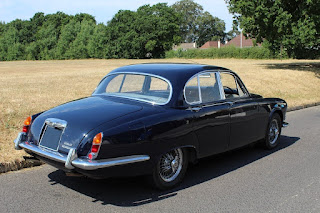
A blend of the ancient and modern which characterized much of what Jaguar produced until well into the twenty-first century, the Daimler Sovereign was the final evolution of the Jaguar 2.4, introduced in 1955 as the “small” car of the range and known retrospectively as the Mark 1 after 1959 when a revised model was released as the Mark 2.  The bigger-engined versions of the Mark 2 were the outstanding sports saloons of their day and dominated production car racing until the new generation of fast Fords, the Lotus Cortina, the Mustang and, somewhat improbably, the big Galaxies began to prevail but, as road cars, the power delivered by the 3.8 litre XK-Six was probably close to the limit of the platform’s capability.  This was addressed in 1963 when a version of the more capable independent rear suspension introduced in 1961 on the Mark X and E-Type (XK-E) was grafted to a slightly enlarged structure and released as the S-Type.  The new sophistication was appreciated but the unusual combination of styling techniques was less admired, the front and rear generally felt discordant and tellingly, the Mark 2 was not discontinued and continued to sell well.

1963 Jaguar S-Type 3.8.

The aesthetic objections were noted and in 1966, a new nose, reminiscent of that on the Mark X, was grafted on to the S-Type and the result, while clearly not modernist in the manner of a contemporary like the NSU Ro80, was generally acknowledged to be more harmonious.  The new model, acknowledging the fitment for the first time in the platform of the 4.2 litre XK-Six, was called the 420 and, in a (brief) attempt to create a naming convention with some familial relationship, the big Mark X was re-named 420G and the Mark 2 became the 240 or 340 depending on engine capacity, the 3.8 litre version discontinued although a few were built to special order (albeit still badged as 340s).  Strange as it seems, for a number of reasons, the 240, 340, S-Type and 420 all remained available until all were replaced by the XJ6, introduced in 1968.  Only the 420G received a stay of execution, the flagship lingering until 1970 by which time production had slowed to a trickle.

1968 Daimler Sovereign.

Launched simultaneously in 1966 with the 420 and around 7% more expensive was the Daimler Sovereign.  The Sovereign was essentially the 420 with all the Jaguar’s optional extras fitted as standard, a higher grade of timber and leather for the interior fittings and the traditional details distinguishing the marquee, most notably the elegant fluting atop the grill and the rear number plate valance.  Unfortunately, unlike the earlier Daimler version of the Mark 2 (later named 250 to align with the 240 & 340) which was powered by Daimler’s fine 2.5 litre V8, the Sovereign was mechanically identical to the 420, the opportunity to create something special by using the 4.6 litre version of the V8 not taken, the same mistake which may have doomed the Mark X and 420G to their indifferent sales performance; although excessively large for many markets, a V8 Mark X would have been ideal in the US.  Nonetheless, although nothing more than a fancy Jaguar, it was a success and despite the higher price, Sovereign sales totaled more than six-thousand, the 420 managing only four-thousand odd more.

1967 Daimler Sovereign.

The 420-based Sovereign continued to be offered well into 1969 because the high demand for the XJ6 meant there was not immediately the capacity to produce a Daimler version of the new car.  It was finally retired in 1969 (the last survivor of the platform introduced in 1955) when an XJ6-based Sovereign was released in 2.8 and 4.2 litre versions, notionally replacing the Mark 2-based 250 and the previous Sovereign respectively.  Jaguar continued to use the Sovereign name on the six-cylinder Daimlers until 1983 when they were re-badged simply as “Daimler” although the name would for years be applied to various up-market XJs, especially in overseas markets where others held the trademark to the Daimler name.  When equipped with the Jaguar's 5.3-litre V12, the Sovereign was named Double Six, a revival of a name Daimler used between 1926-1938 for an earlier twelve cylinder model.  The Sovereign name was the choice of the Jaguar board; although the chairman had suggested “Royal” it seemed he was persuaded Sovereign was a better fit.

1976 Daimler Sovereign two door.

Most memorable of the Sovereigns were the elegant coupés offered between 1975-1977; the factory insisting they were a “two door” and not a coupé, the rationale presumably to provide a distinction between the XJ and XJ-S (1975-1996 and later named XJS).  The vinyl-roof, one of the many unfortunate aspects of style which so afflicted the 1970s, attracted criticism even at the time of release, the suspicion being it might have been glued on to hide some rather obviously hasty welding used to create the lovely roofline, a expedient Plymouth adopted in 1970 for the Superbird and Ford Australia repeated on the Landau three years later.  However, it transpired the necessity was not the finish of the sheet metal but the inability of the paints of the era to accommodate the slight flexing of the roof caused by using the same gauge of steel on the pillar-less coupé as the saloon which was a little more rigid.  With the availability of modern paints, many have since taken the opportunity to ditch the vinyl and allow the lovely lines to appear unspoiled.  Being produced under the ownership of British Leyland, predictability, roof-flex wasn’t the only flaw.  The sealing of the frameless windows was never perfected so wind noise is more intrusive than the saloon and, over time, the heavy doors will sag, Jaguar using the same hinges as those which supported the saloon’s smaller, lighter pressings.  

Picture of the sovereign on a 1963 mock-up of the proposed Australian Royal.

Royal as a name seemed not to be popular in other places (although Chrysler did use it for a while and it's applied to a few alcoholic beverages), earlier rejected in the antipodes as the name for a new legal tender.  In early 1963, Robert Menzies (1894–1978; Prime-Minister of Australia 1939-1941 & 1949-1966) had said Australia would adopt a decimal currency and later in the year it was announced its name would be “the royal”.  Said to be the preferred choice of the prime-minister himself, cabinet had been persuaded, presumably because the other suggestions including "kwid", "champ", "deci-mate", "austral" and "emu", were thought worse.  Proving that social media isn’t necessary for public opinion to become quickly known, within days the derision expressed was enough to convince the government to change.  The cabinet documents (released in 1993 under the (then) thirty-year rule) recorded the treasurer telling the cabinet “…royal had been a terrible mistake” and in September, it was announced the pound would be replaced by the Australian dollar; it was introduced on Valentine’s Day 1966.

Currency matters had troubled Menzies before.  He’d been much criticized in 1952 when, upon Elizabeth II’s accession, the inscription FD abruptly was omitted from Australian coins.  FD (Defender of the Faith (the Latin Fidei Defensor (feminine Fidei Defensatrix)), had been in use since 1507 when the title "Protector and Defender of the Christian Faith" was granted by Pope Julius II (1443–1513; pope 1503-1513) to James IV of Scotland (James VI and I (1566–1625) King of Scotland as James VI (1567-1625) & King of England and Ireland as James I (1603-1625)) and had been inscribed on all English (and subsequently UK) coins minted since the Medici Pope Leo X (1475–1521; pope 1513-1521) in 1521 conferred it on Henry VIII (1491–1547; King of England (and Ireland after 1541) 1509-1547).  A grateful Leo had been most impressed by Henry’s book Assertio Septem Sacramentorum (Defense of the Seven Sacraments), a powerful assertion of both the sacramental nature of marriage and the supremacy of the pope, his words at the time celebrated in Rome as the "Henrician Affirmation".  Although Henry would go on to interpret the marriage ritual, papal authority and the defense of the faith in his own way, FD nevertheless remains on the UK's to this day.  There, it is not without constitutional significance, the sovereign, Queen Elizabeth, being supreme governor (ie the titular head) of the Church of England, the nation's established (ie the official state) church.  

A year is a long time in politics: the 1953 & 1954 Australian florins.

In the Australia of 1952, then a country still marked by the sectarian divide between Catholic and Protestant, there was much outrage, Anglicans calling it an affront to Her Majesty and their church and nothing but a cynical ploy by a (Presbyterian) prime-minister to curry favor with Roman Catholics in search of their votes.  Surprisingly to some, prominent among the affronted was the former high court judge, Dr HV Evatt (1894–1965; leader of the opposition 1951-1960) who, although condemned by the right-wing fanatics of the day as the “arch defender of the godless atheistic communists” was a staunch Anglican who proved a doughty opponent of the change.  It at the time was quite a furore with questions in parliament, strident editorials, letters (of outrage) to the editor (the social media of the era) and ecclesiastical denouncements from a number of reverend and very reverend gentlemen.  Menzies relented and intervened personally to ensure the mint secured Fidei Defensor dies in time for a commemorative florin (the modern 20c coin, then often referred to as "two bob") to be struck for the 1954 royal visit.