Showing posts sorted by relevance for query Blueprint. Sort by date Show all posts

Wednesday, November 11, 2020

Blueprint

Blueprint (pronounced bloo-print)

(1) A process of photographic printing, used chiefly in copying architectural and mechanical drawings, which produces a white line on a blue background; also called a cyanotype.

(2) A physical print made by this process.

(3) A slang term for a digital rendition of the process.

(4) A slang term for such a drawing, whether blue or not.

(5) By analogy, a detailed outline or plan of action (in text or image).

(6) To make a blueprint.

(7) A technique for optimizing the performance of internal combustion engines by machining (or matching) components to their exact specifications.

1887: The construct was blue + print (blue print and blue-print (1882) were the rarely used alternative spellings).  The figurative sense of "detailed plan" dates from 1926 and use as a verb is from 1939.  Blue dates from the sixteenth century and was from the Middle English blewe, from the Anglo-Norman blew (blue), from the Frankish blāu (blue) (possibly via the Medieval Latin blāvus & blāvius (blue)), from the Proto-Germanic blēwaz (blue, dark blue), from the primitive Indo-European bhlēw (yellow, blond, grey).  It was cognate with the dialectal English blow (blue), the Scots blue, blew (blue), the North Frisian bla & blö (blue), the Saterland Frisian blau (blue), the Dutch blauw (blue), the German blau (blue), the Danish, Norwegian & Swedish blå (blue), the Icelandic blár (blue).  It was cognate also with the obsolete Middle English blee (color) related to the Welsh lliw (color), the Latin flāvus (yellow) and the Middle Irish blá (yellow). A doublet of blae.  The present spelling in English has existed since the sixteenth century and was common by circa 1700.  Many colors have in English been productive in many senses and blue has contributed to many phrases in fields as diverse as mental health (depression, sadness), semiotics (coolness in temperature), popular music (the blues), social conservatism (blue stocking; blue rinse), politics (conservative (Tory) & Whig identifiers and (unrelated) the US Democratic Party), labor-market segmentation (blue-collar), social class (blue-blood), stock market status (blue-chip) and, inexplicably, as an intensifier (blue murder).  Print dates from circa 1300 and was from the Middle English printen, prenten, preenten & prente (impression, mark made by impression upon a surface), an apheretic form of emprinten & enprinten (to impress; imprint).  It was related to the Dutch prenten (to imprint), the Middle Low German prenten (to print; write), the Danish prente (to print), the Swedish prenta (to write German letters).  The late Old French preinte (impression) was a noun use of the feminine past participle of preindre (to press, crush), altered from prembre, from the Latin premere (to press, hold fast, cover, crowd, compress), from the primitive Indo-European root per- (to strike). The Old French word was also the source of the Middle Dutch (prente (the Dutch prent) and was borrowed by other Germanic languages.  A blueprinter is a machine used to produce blueprints but, by convention, someone who is blueprinting an engine is not "a blueprinter" but is described variously as am "engineer" mechanic", technician etc.  Blueprint is a noun & verb; blueprinter is a noun, blueprinting & blueprinted are verbs and blueprintable is an adjective; the noun plural is blueprints.

Lindsay Lohan, blueprinted.    

The sense of "a printed publication" (applied later particularly to newspapers) was from the 1560s.  The meaning "printed lettering" is from the 1620s and print-hand (print-like handwriting) from the 1650s.  The sense of "picture or design from a block or plate" dates from the 1660s while the meaning "piece of printed cloth or fabric" appeared first in 1756.  The photographic sense emerged apparently only by 1853, some three decades after the first photographs, the use evolving as printed photographs became mass-market consumer products.  Print journalism seemed to have been described as such only from 1962, a form of differentiation from the work of those employed by television broadcasters.

Blueprinting internal combustion engines is the practice of disassembling the unit and machining the critical components (piston, conrods etc) to the point where they exactly meet the stated specifications (dimensions & weight).  Essentially, the process is one of exactitude, using precision tools to make components produced using the techniques of mass production (which inherently involves wider tolerances) and modifying them by using tighter tolerances, meeting exact design specifications.  It’s most associated with high-performance racing cars, especially those which compete in “standard-production” classes which don’t permit modifications to most components.  In some cases, especially with factory-supported operations, the components might be specially selected, prior to assembly.  As a cost-containment measure (a means of creating a "level playing field" to ensure the competitiveness of less well-resourced teams), some competitions for "standard production vehicles" explicitly banned blue-printing.

Blueprint of the USS Missouri (BB-63), an Iowa-class battleship launched in 1944.  Missouri was the last battleship commissioned by the US Navy.

The first blueprint was developed in 1842 by English mathematician, astronomer, chemist & experimental photographer Sir John Herschel (1792-1871).  What he then termed a “cyanotype process” eliminated the need to copy original drawings by means of hand-tracing, a cumbersome, time consuming (and therefore expensive) process.  At what was then an astonishingly low cost, it permitted the rapid and accurate production of an unlimited number of copies.  The cyanotype process used a drawing on semi-transparent paper that was weighted down on top of a sheet of paper which was then placed over another piece of paper, coated with a mix of ammonium iron citrate and potassium ferrocyanide (derived from an aqueous solution and latter dried).  When the two papers were exposed to light, the chemical reaction produced an insoluble blue compound called blue ferric ferrocyanide (which became famous as Prussian Blue), except where the blueprinting paper was covered and the light was blocked by the lines of the original drawing. After the paper was washed and dried to preserve those lines, the result was a negative image of white (or whatever color the blueprint paper originally was) against a dark blue background.  White was by far the most used paper and the most common cyanotypes were thus blue with white lines.  At least by 1882 they were being described as “blue prints” but by 1887, they were almost universally called blueprints and in engineering and architecture had become ubiquitous, Herschel’s photochemical process producing copies at a tenth the cost of hand-tracing.

"Blueprint" came to refer to the process as much as the product and not all blueprints were "blue": Factory blueprint (quotation drawing produced on diazo machine) of 1955 Mercedes-Benz 300 SLR (W196S Uhlenhaut Coupé).  Two were built, one of which sold in June 2022 for a record US$142 million at a private auction held at the Mercedes-Benz Museum in Stuttgart, making it the world's most expensive used car.

Refinements and economies of scale meant that during the early twentieth century the quality of blueprints improved and costs further fell but by the 1940s, they began to be supplanted by diazo prints (known also as “whiteprints” or “bluelines”).  Diazo prints were rendered with blue lines on a white background, making them easier to read and they could be produced more quickly on machinery which was simpler and much less expensive than the intricate photochemical devices blueprints demanded.  Accordingly, reprographic companies soon updated their plant, attracted too by the lower running costs, the diazo machinery not requiring the extensive and frequent maintenance demanded by the physically big and intricate photochemical copiers.

Modern rendition of Mercedes-Benz SSLK in schematic (left) and re-rendered with with "blueprint effect" (right), illustrating the drilled-out chassis rails (here depicted without the reinforcing metal sheets added to ensure structural integrity)  The title is misleading because the four SSKLs built all were commissioned in 1931 (although it's possible one or more used a modified SSK chassis constructed in 1929).  All SSK chassis were built between 1928-1932 although the model remained in the factory's catalogue until 1933. 

One tradition of the old ways did however endure.  The diazo machines caught on but “diazo print”, “whiteprint” & “blueline” never did; the drawings, regardless of the process used, the color of the paper or the lines (and many used black rather than blue) continued to be known as “blueprints”.  That linguistic tribute persisted even after diazo printing was phased-out and replaced with the xerographic print process, the standard copy machine technology using toner on bond paper.  Used for some time in commerce, large-size xerography machines became available in the mid-1970s and although originally very expensive, costs rapidly fell and the older printing methods were soon rendered obsolete.  As computer-aided design (CAD) software entered the mainstream during the 1990s, designs increasingly were printed directly from a computer to printer or plotter and despite the paper used being rarely blue, the output continued to be known as the blueprint.

Blueprint of the Chrysler Building, New York City, 1930.  Not universally admired when built, the Chrysler Building is now regarded as an art deco classic and one of New York City's landmark skyscrapers.

Even now, although often viewed only as multi-colored images on screens (which might be on tablets or phones), such electronic drawings still are usually called blueprints.  Nor have blueprints vanished.  There are many things (buildings, bridges, roads, power-plants, railroads, sewers etc) built before the 1990s which have an expected life measured in decades or even centuries and few of these were designed using digital records.  The original blueprints therefore remain important to those engaged in maintenance or repair and can be critical also in litigation.  Old blueprints can be scanned and converted to digital formats but in many cases, the originals are fragile or physically deteriorated and finer details are sometimes legible only if viewed on the true blueprint.  Centuries from now, magnifying glasses in hand, engineers may still be examining twentieth century blueprints.

Wednesday, June 12, 2024

Reduction

Reduction (pronounced ri-duhk-shuhn)

(1) The act of reducing or the state of being reduced.

(2) The amount by which something is reduced or diminished.

(3) The form (result) produced by reducing a copy on a smaller scale (including smaller scale copies).

(4) In cell biology, as meiosis, especially the first meiotic cell division in which the chromosome number is reduced by half.

(5) In chemistry, the process or result of reducing (a reaction in which electrons are gained and valence is reduced; often by the removal of oxygen or the addition of hydrogen).

(6) In film production when using physical film stock (celluloid and such), the process of making a print of a narrower gauge from a print of a wider gauge (historically from 35 to 16 mm).

(7) In music, a simplified form, typically an arrangement for a smaller number of parties  such as an orchestral score arranged for a solo instrument.

(8) In computability theory, a transformation of one problem into another problem, such as mapping reduction or polynomial reduction.

(9) In philosophy (notably in phenomenology), a process intended to reveal the objects of consciousness as pure phenomena.

(10) In metalworking, the ratio of a material's change in thickness compared to its thickness prior to forging and/or rolling.

(11) In engineering, (usually as “reduction gear”), a means of energy transmission in which the original speed is reduced to whatever is suitable for the intended application.

(12) In surgery, a procedure to restore a fracture or dislocation to the correct alignment, usually with a closed approach but sometimes with an open approach.

(13) In mathematics, the process of converting a fraction into its decimal form or the rewriting of an expression into a simpler form.

(14) In cooking, the process of rapidly boiling a sauce to concentrate it.

(15) During the colonial period, a village or settlement of Indians in South America established and governed by Spanish Jesuit missionaries.

1475–1485: From the Middle English reduccion, from the earlier reduccion, from the Middle French reduction, from the Latin reductiōnem & reductiōn- (stem of reductiō (a “bringing back”)) the construct being reduct(us) (past participle of redūcere (to lead back) + -iōn- (the noun suffix).  The construct in English was thus reduc(e), -ion.  Reduce was from the Middle English reducen, from the Old French reduire, from the Latin redūcō (reduce), the construct being re- (back) + dūcō (lead).  The –ion suffix was from the Middle English -ioun, from the Old French -ion, from the Latin -iō (genitive -iōnis).  It was appended to a perfect passive participle to form a noun of action or process, or the result of an action or process.  Reduction, reductivism, reductionistic & reductionism are nouns, reductionist is a noun & adjective, reductional & reductive are adjectives; the noun plural is reductions.  Forms like anti-reduction, non-reduction, over-reduction, pre-reduction, post-reduction, pro-reduction, self-reduction have been created as required.

Actor Ariel Winter (b 1998), before (left) and after (right) mammaplasty (breast reduction).  Never has satisfactorily it been explained why this procedure seems to be lawful in all jurisdictions.

In philosophy & science, reductionism is an approach used to explain complex phenomena by reducing them to their simpler, more fundamental components.  It posits that understanding the parts of a system and their interactions can provide a complete explanation of the system as a whole an approach which is functional and valuable is some cases and to varying degrees inadequate in others.  The three generally recognized classes of reductionism are (1) Ontological Reductionism, the idea that reality is composed of a small number of basic entities or substances, best illustrated in biology where life processes are explained by reducing things to the molecular level.  (2) Methodological Reductionism, an approach which advocates studying systems by breaking into their constituent parts, much used in psychology where it might involve studying human behavior by examining neurological processes.  (3) Theory Reductionism which involves explaining a theory or phenomenon in one field by the principles of another, more fundamental field as when chemistry is reduced to the physics or chemical properties explained by the operation of quantum mechanics.  Reduction has been an invaluable component in many of the advances in achieved in science in the last two-hundred-odd years and some of the process and mechanics of reductionism have actually been made possible by some of those advances.  The criticism of an over-reliance on reductionism in certain fields in that its very utility can lead to the importance of higher-level structures and interactions being overlooked; there is much which can’t fully be explained by the individual parts or even their interaction.  The diametric opposite of reductionism is holism which emphasizes the importance of whole systems and their properties that emerge from the interactions between parts.  In philosophy, reductionism is the position which holds a system of any level of complexity is nothing but the sum of its parts and an account of it can thus be reduced to accounts of individual constituents.  It’s very much a theoretical model to be used as appropriate rather than an absolutist doctrine but it does hold that phenomena can be explained completely in terms of relations between other more fundamental phenomena: epiphenomena.  A reductionist is either (1) an advocate of reductionism or (2) one who practices reductionism.

Reductionism: Lindsay Lohan during "thin phase".

The adjective reductive has a special meaning in Scots law pertaining to reduction of a decree or other legal device (ie something rescissory in its effect); dating from the sixteenth century, it’s now rarely invoked.  In the sense of “causing the physical reduction or diminution of something” it’s been in use since the seventeenth century in fields including chemistry, metallurgy, biology & economics, always to convey the idea of reduces a substance, object or some abstract quantum to a lesser, simplified or less elaborated form.  At that time, it came to be used also to mean “that can be derived from, or referred back to; something else” and although archaic by the early 1800s, it existence in historic texts can be misleading.  It wasn’t until after World War II (1939-1945) that reductive emerged as a derogatory term, used to suggest an argument, issue or explanation has been “reduced” to a level of such simplicity that so much has been lost as to rob things of meaning.  The phrase “reductio ad absurdum” (reduction to the absurd) is an un-adapted borrowing from the Latin reductiō ad absurdum, and began in mathematics, logic (where it was a useful tool in deriving proofs in fields like).  In wider use, it has come to be used of a method of disproving a statement by assuming the statement is true and, with that assumption, arriving at a blatant contradiction; the synonyms are apagoge & “proof by contradiction”.

Single-family houses (D-Zug) built in 1922 on the principle of architectural reductionism by Heinrich Tessenow in collaboration with Austrian architect Franz Schuster (1892–1972), Moritzburger Weg 19-39 (the former Pillnitzer Weg), Gartenstadt Hellerau, Dresden, Germany.

As a noun, a reductivist is one who advocates or adheres to the principles of reductionism or reductivism.  In art & architecture (and some aspects of engineering) this can be synonymous with the label “a minimalist” (one who practices minimalism).  As an adjective, reductivist (the comparative “more reductivist”, the superlative “most reductivist”) means (1) tending to reduce to a minimum or to simplify in an extreme way and (2) belonging to the reductivism movement in art or music.  The notion of “extreme simplification” (a reduction to a minimum; the use of the fewest essentials) has always appealed some and appalled others attracted to intricacy and complexity.  The German architect Professor Heinrich Tessenow (1876-1950) summed it up in the phrase for which he’s remembered more than his buildings: “The simplest form is not always the best, but the best is always simple.”, one of those epigrams which may not reveal a universal truth but is probably a useful thing to remind students of this and that lest they be seduced by the process and lose sight of the goal.  Tessenow was expanding on the principle of Occam's Razor (the reductionist philosophic position attributed to English Franciscan friar & theologian William of Ockham (circa 1288–1347) written usually as Entia non sunt multiplicanda praeter necessitatem (literally "Entities must not be multiplied beyond necessity" which translates best as “the simplest solution is usually the best”.

Reductio in extrema

1960 Lotus Elite Series 1 (left) and at the Le Mans 24 Hour endurance classic, June 1959 (left) Lotus Elite #41 leads Ferrari 250TR #14. The Ferrari (DNF) retired after overheating, the Elite finishing eighth overall, winning the 1.5 litre GT class.

Weighing a mere 500-odd kg (1100 lb), the early versions of the exquisite Lotus Elite (1957-1963) enchanted most who drove it but the extent of the reductionism compromised the structural integrity and things sometimes broke when used under everyday conditions which of course includes potholed roads.  Introduced late in 1961 the Series 2 Elite greatly improved this but some residual fragility was inherent to the design.  On the smooth surfaces of racing circuits however, it enjoyed an illustrious career, notable especially for success in long-distance events at the Nürburgring and Le Mans.  The combination of light weight and advanced aerodynamics meant the surprisingly powerful engine (a lightweight and robust unit which began life powering the water pumps of fire engines!) delivered outstanding performance, frugal fuel consumption and low tyre wear.  As well as claiming five class trophies in the Le Mans 24 hour race, the Elite twice won the mysterious Indice de performance (an index of thermal efficiency), a curious piece of mathematics actually intended to ensure, regardless of other results, a French car would always win something.

Colin Chapman (1928–1982), who in 1952 founded Lotus Cars, applied reductionism even to the Tessenow mantra in his design philosophy: “Simplify, then add lightness.”  Whether at the drawing board, on the factory floor or on the racetrack, Chapman seldom deviated from his rule and while it lent his cars sparking performance and delightful characteristics, more than one of the early models displayed an infamous fragility.  Chapman died of a heart attack which was a good career move, given the likely legal consequences of his involvement with John DeLorean (1925–2005) and the curious financial arrangements made with OPM (other people's money) during the strange episode which was the tale of the DMC DeLorean gullwing coupé.

Mercedes-Benz SSKL blueprint (recreation, left) and the SSKL “streamliner”, AVUS, Berlin, May 1932 (right).  The blueprint's title is misleading because all SSKLs (it's thought four were built) were completed in 1932 but it's possible one or more of the SSK chassis used dated from 1929. 

The Mercedes-Benz SSKL was one of the last of the road cars that could win top-line grand prix races.  An evolution of the earlier S, SS and SSK, the SSKL (Super Sports Kurz (short) Leicht (light)) was notable for the extensive drilling of its chassis frame to the point where it was compared to Swiss cheese; reducing weight with no loss of strength.  The SSK had enjoyed success in competition but even in its heyday was in some ways antiquated and although powerful, was very heavy, thus the expedient of the chassis-drilling intended to make it competitive for another season.  Lighter (which didn't solve but at least to a degree ameliorated the high tyre wear) and easier to handle than the SSK (although the higher speed brought its own problems, notably in braking), the SSKL enjoyed a long Indian summer and even on tighter circuits where the bulk meant it could be out-manoeuvred, sometimes it still prevailed by virtue of sheer power.  By 1932 however the engine’s potential had been reached and no more metal could be removed from the structure without dangerously compromising safety; in engineering (and other fields), there is a point at which further reduction becomes at least counter-productive and even dangerous.  The solution was an early exercise in aerodynamics (“streamlining” the then fashionable term), an aluminium skin prepared for the 1932 race held on Berlin’s AVUS (Automobil-Versuchs und Übungsstraße (automobile traffic and practice road)).  The reduction in air-resistance permitted the thing to touch 255 km/h (158 mph), some 20 km/h (12 mph) more than a standard SSLK, an increase the engineers calculated would otherwise have demanded another (unobtainable) 120 HP (horsepower).  The extra speed was most useful at the unique AVUS which comprised two straights (each almost six miles (ten kilometres) in length) linked by two hairpin curves, one a dramatic banked turn.  The SSKL was the last of the breed, the factory’s subsequent Grand Prix machines all specialized racing cars.

Reduction gears: Known casually as "speed reducers", reduction gears are widely used in just about every type of motor and many other mechanical devices.  What they do is allow the energy of a rotating shaft to be transferred to another shaft running at a reduced speed (achieved usually by the use of gears (cogs) of different diameters.

In chemistry, a reduction is the process or result of reducing (a reaction in which electrons are gained and valence is reduced; often by the removal of oxygen or the addition of hydrogen) and as an example, if an iron atom (valence +3) gains an electron, the valence decreases to +2.  Linguistically, it’s obviously counterintuitive to imagine a “reduced atom” is one which gains rather than loses electrons but the term in this context dates from the early days of modern chemistry, where reduction (and its counterpart: “oxidation”) were created to describe reactions in which one substance lost an oxygen atom and the other substance gained it.   In a reaction such as that between two molecules of hydrogen (2H2)and one of oxygen (O2) combining to produce two molecules of water (2H2O), the hydrogen atoms have gained oxygen atoms and were said to have become “oxidized,” while the oxygen atoms have “lost them” by attaching themselves to the hydrogens, and were thus “reduced”.  Chemically however, in the process of gaining an oxygen atom, the hydrogen atoms have had to give up their electrons and share them with the oxygen atoms, while the oxygen atoms have gained electrons, thus the seeming paradox that the “reduced” oxygen has in fact gained something, namely electrons.

Secretary of Defence the younger (left) and elder (right).  Donald Rumsfeld (left) with Gerald Ford (1913–2006; POTUS 1974-1977) and George W Bush (George XLIII, b 1946; POTUS 2001-2009).

Donald Rumsfeld (1932–2021; US Secretary of Defense 1975-1977 & 2001-2006) may or may not have been evil but his mind could sparkle and his marvellously reductionist principles can be helpful.  His classification of knowledge was often derided but it remains a useful framework:

(1) Known unknowns.
(2) Known knowns.
(3) Unknown unknowns.
(4) (most intriguingly) Unknown knowns.

A expert reductionist, he reminded us also there are only three possible answers to any question and while there's a cultural reluctance to say “don’t know”, sometimes it is best:

(1) I know and I’m going to tell you.
(2) I know and I’m not going to tell you.
(3) Don’t know.

While (1) known unknowns, (2) known knowns and (3) unknown unknowns are self-explanatory, examples of (4) unknown knowns are of interest and a classic one was the first “modern” submarine, developed by the Germans during the last months of World War II (1939-1945).

German Type XII Elektroboot (1945).

In World War II, the course of the war could have been very different had OKM (Oberkommando der Marine (the Kriegsmarine's (German Navy) high command)) followed the advice of the commander of the submarines and made available a fleet of 300 rather than building a surface fleet which wasn’t large enough to be a strategic threat but of sufficient size to absorb resources which, if devoted to submarines, could have been militarily effective.  With a fleet of 300, it would have been possible permanently to maintain around 100 at sea but at the outbreak of hostilities, only 57 active boats were on the navy’s list, not all of which were suitable for operations on the high seas so in the early days of the conflict, it was rare for the Germans to have more than 12 committed to battle in the Atlantic.  Production never reached the levels necessary for the numbers to achieve critical mass but even so, in the first two-three years of the war the losses sustained by the British were considerable and the “U-Boat menace” was such a threat that much attention was devoted to counter-measures and by 1943 the Allies could consider the battle of the Atlantic won.  The Germans’ other mistake was not building a true submarine capable of operating underwater (and therefore undetected) for days at a time.

It was only in 1945 when Albert Speer (1905–1981; Nazi court architect 1934-1942; Nazi minister of armaments and war production 1942-1945) and Grand Admiral Karl Dönitz (1891–1980; head of the German Navy 1943-1945, German head of state 1945) were assessing the “revolutionary” new design that they concluded there was no reason why such craft couldn’t have been built in the late 1930s because the engineering capacity and technology existed even then.  It was a classic case of what Donald Rumsfeld would later call an “unknown known”: The Germans in 1939 knew how to build a modern submarine but didn’t “know that they knew”.  Despite the improvements however, military analysts have concluded that even if deployed in numbers, such was the strength of forces arrayed against Nazi Germany that by 1945, not even such a force could have been enough to turn the tide of war.  However, had the German navy in 1939-1940 had available a fleet of even 100 such submarines (about a third what OKM (Oberkommando der Marine (the Kriegsmarine's (German Navy) high command) calculated was the critical strategic size given at any point only a third would be at sea with the others either in transit or docked), the battle in the Atlantic would have been much more difficult for the British.

Mr Rumsfeld however neglected to mention another class of knowledge: the “lost known”, examples of which have from time-to-time appeared and there may be more still to be discovered.  The best known were associated with the knowledge lost after the fall in the fifth century of the Western Roman Empire when Europe entered the early medieval period, once popularly known as the “Dark Ages”.  The lost knowns included aspects of optics such as lens grinding and the orthodoxy long was the knowledge was not “re-discovered” or “re-invented” until perfected in Italy during the late thirteenth century although it’s now understood that in the Islamic world lens continued during the late Medieval period to be ground and it’s suspected it was from Arabic texts the information reached Europe.  What really was a lost known was how the Romans of Antiquity made their long-lasting opus caementicium (concrete) so famously “sticky” and resistant to the effects of salt water.  Unlike modern concrete, made using Portland cement & water, Roman concrete was a mix of volcanic ash & lime, mixed with seawater, the later ingredient inducing a chemical reaction creating a substance stronger and more durable.  When combined with volcanic rocks, it formed mineral crystalline structures called aluminum tobermorite which lent the mix great strength and resistance to cracking.  After the fall of Rome, the knowledge was lost and even when a tablet was discovered listing the mix ratios, caementicium couldn’t be replicated because the recipe spoke only of “water” and not “sea water”, presumably because that was common knowledge.  It was only modern techniques of analysis which allowed the “lost known” to again become a “known known”.

Friday, January 1, 2021

Satellite

Satellite (pronounced sat-l-ahyt)

(1) In astronomy, celestial body orbiting around a planet or star; a moon.

(2) In geopolitics, as “satellite state”, a country under the domination or influence of another.

(3) Something (a county, sub-national state, office, building campus etc), under the jurisdiction, influence, or domination of another entity; Subordinate to another authority, outside power, or the like (also known as a “satellite operation”, “satellite campus”, “satellite workshop” etc).

(4) An attendant or follower of another person, often subservient or obsequious in manner; a follower, supporter, companion, associate; lackey, parasite, sycophant, toady, flunky; now used usually in the derogatory sense of “a henchman” although, applied neutrally, it can be used of someone’s retinue or entourage (and even the machinery of a motorcade).

(5) A man-made device orbiting a celestial body (the earth, a moon, or another planet etc) and transmitting scientific information or used for communication; among astronomers and others form whom the distinction matters, man-made devices are sometimes referred to as “artificial satellites” to distinguish them for natural satellites such as the Earth’s Moon.  The standard abbreviation is “sat” and the situation in which a satellite is hit by some object while in orbit (which at the velocities involved can be unfortunate) is called a “sat-hit”.

(6) As “derelict satellite”, a man-made device (including the spent upper-stages of rockets) in orbit around a celestial body which has ceased to function.

(7) In medicine, a short segment of a chromosome separated from the rest by a constriction, typically associated with the formation of a nucleolus.

(8) In biology, a colony of microorganisms whose growth in culture medium is enhanced by certain substances produced by another colony in its proximity.

(9) In formal grammar, a construct that takes various forms and may encode a path of movement, a change of state, or the grammatical aspect (highly technical descriptor no longer used in most texts).

(10) In television, as satellite TV, the transmission and reception of television broadcasts (and used also in narrowcasting) using satellites in low-earth orbit.

(11) In the military terminology of Antiquity, a guard or watchman.

(12) In entomology, as satellite moth, the Eupsilia transversa, a moth of the family Noctuidae.

1540-1550: From the fourteenth century Middle French satellite, from the Medieval Latin satellitem (accusative singular of satelles) (attendant upon a distinguished person or office-holder, companion, body-guard. courtier, accomplice, assistant), from the Latin satelles, from the Old Latin satro (enough, full) + leyt (to let go) and listed usually as akin to the English “follow” although the association is undocumented.  Although the Latin origin is generally accepted, etymologists have pondered a relationship with the Etruscan, either satnal (klein) (again linked to the English “follow”) or a compound of roots: satro- (full; enough) + leit- (to go) (the English “follow” constructed of similar roots).  Satellite is a noun, verb & adjective and satellitic & satellitious are adjectives; the noun plural is satellites.  Satellitious (pertaining to, or consisting of, satellites) is listed by most dictionaries as archaic but is probably the best form to use in a derogatory sense, best expressed in the comparative (more satellitious) or the superlative (most satellitious).

Lindsay Lohan promoting the Sick Note series, TV & Satellite Week magazine, 21-27 July 2018.

The adjectival use is applied as required and this has produced many related terms including satellite assembly (use of committees or deliberative bodies created by a superior authority), satellite broadcasting (in this context distinguished from transmissions using physical (point-to-point) cables or ground-based relays), satellite campus, satellite DNA (in genetics, an array in  tandem of repeating, non-coding DNA), satellite-framing (in linguistics, the use of a grammatical satellite to indicate a path of motion, a change of state or grammatical aspect (as opposed to a verb framing)), satellite navigation (the use of electronic positioning systems which use data from satellites (often now as “SatNav”)) and satellite station (either (1) as ground-base facility used for monitoring or administrating satellites or (2) a manned facility in orbit such as the ISS (International Space Station)), satellite telephone (telephony using satellites as a transmission vector)

Sputnik, 1957

Sputnik 1 blueprint, 1957.

The original sense in the 1540s was "a follower or attendant of a superior person" but this use was rare before the late eighteenth century and it seemed to have taken until the 1910s before it was applied in a derogatory manner to suggest "an accomplice or accessory in crime or other nefarious activity” although the Roman statesman Cicero (Marcus Tullius Cicero, 106-43 BC) often used the Latin form in this way.  In the seventeenth century, as telescopes became available, the idea was extended to what was then thought to be "a planet revolving about a larger one" on the notion of "an attendant", initially a reference to the moons of Jupiter.  In political theory, the “satellite state” was first described in 1800, coined by John Adams (1735-1826; US president 1797-1801) in a discussion about the United States and its relationships with the other nations of the Americas although in geopolitics the term is most identified with the “buffer states”, the members of the Warsaw Pact which were within Moscow’s sphere of influence.  The familiar modern meaning of a "man-made machine orbiting the Earth" actually dates (as scientific conjecture) from 1936, something realized (to the surprise of most) in 1957 when the USSR launched Sputnik 1.  Sputnik was from the Russian спу́тник (sputnik) (satellite (literally "travelling companion” and in this context a shortened form of sputnik zemlyi (travelling companion of the Earth), from the Old Church Slavonic supotiniku, the construct being the Russian so- (as “s-“ (with, together)) + пу́тник (pútnik) (traveller), from путь (put) (way, path, journey) (from the Old Church Slavonic poti, from the primitive Indo-European pent- (to tread, go)) + ник (-nik) (the agent suffix).

Soviet Sputnik postcard, 1957.

The launch of Sputnik shocked the American public which, in a milieu of jet aircraft, televisions and macropterous Cadillacs, had assumed their country was in all ways technologically superior to their Cold War enemy.  Launched into an elliptical low-Earth orbit, Sputnik was about twice the size of a football (soccer ball) and it orbited for some three more months before falling towards earth, the on-board batteries lasting long enough for it to broadcast radio pulses for the first three weeks, transmissions detectable almost anywhere on earth.  It sounds now a modest achievement but it needs to be regarded as something as significant as the Wright Flyer in 1903 travelling 200 feet (61 m), at an altitude of some 10 feet (3 m) and in the West the social and political impact was electrifying.  There were also linguistic ripples because, just as a generation later the Watergate scandal would trigger the –gate formations (which continue to this day), it wasn’t long before the –nik prefix (which had actually been a part of Yiddish word creation for at least a decade) gained popularity.  Laika, the doomed stray dog launched aboard Sputnik 2 in November 1957 was dubbed muttnik (although the claims it was the first living thing in space have since been disproved because "living" entities were both on board the Nazi V2 rockets (1944-1945) which often briefly entered the stratosphere and have long been present in the upper atmosphere where they’re ejected into space by natural atmospheric processes) while the early US satellites (quickly launched to display the nation’s scientific prowess) failed which gave the press the chance to coin kaputnik, blowupnik, dudnik, flopnik, pffftnik & stayputnik.

Sputnik 1's launch vehicle (left), the satellite as it orbited the earth (centre) and in expanded form (right).  A model of Sputnik 1 would make an appearance as a propaganda piece for the PCI (Partito Comunista Italiano, the Communist Party of Italy, 1921-1991) in the 1958 Italian general election.  Those in the PCI certainly were communists but they were also Italians so even the campaign props were stylish.  

Although not a great surprise to either the White House or the better-informed in the Pentagon, the American public was shocked and both the popular and quality press depicted Sputnik’s success as evidence of Soviet technological superiority, stressing the military implications.    This trigged the space race and soon created the idea of the “missile gap” which would be of such significance in the 1960 presidential election and, although by the early 1960s the Pentagon knew the gap was illusory, the arms race continued and the count of missiles and warheads actually peaked in the early 1970s.  It also began a new era of military, technological, and scientific developments, leading most obviously to the moon landing in 1969 but research groups developed weapons such as the big inter-continental ballistic missiles (ICBMs) and missile defence systems as well as spy satellites.  Satellites were another step in the process of technology being deployed to improve communications.  When in 1865 Abraham Lincoln (1809–1865; POTUS 1861-1865) was assassinated, the news didn’t reach Europe until the fastest clipper had crossed the Atlantic a fortnight later.  By the time of William McKinley's (1843–1901; POTUS 1897-1901) assassination, the news was within minutes transmitted around the world through undersea cables (thus the still sometimes heard use in this context of “cable” and “cabled”).  In 1963, while news of John Kennedy's (JFK, 1917–1963; POTUS 1961-1963) death was close to a global real-time event, those many miles from Dallas had to wait sometimes 24 hours or more to view footage, the physical film stock delivered in canisters by land, sea or air.  By 1981, when an attempt was made on Ronald Reagan’s (1911-2004; POTUS 1981-1989) life, television stations around the planet were, sometimes within seconds, picking up live-feeds from satellites.

Two comrades with their 1960 Trabant P50 in stylish two-tone pastellblau (pastel blue) over creme (cream) admiring the Leipzig Opera building, Saxony, circa 1961 (left) and a 1990 Trabant 601 in a by then more typical beige (right).

In the GDR (German Democratic Republic, the old East Germany), the long-running (1957-1991) Trabant's bodywork was made with Duroplast, a composite thermosetting plastic (and a descendant of Bakelite).  It was a resin plastic reinforced with fibres (the GDR used waste from both cotton & wool processing) which structurally was similar to fibreglass although the urban myth Trabants were made from reinforced cardboard persists.  The first Trabants left the Saxony production line in November 1957, only weeks after the Soviet Union had startled the world by launching Sputnik and while the first man-made Earth satellite did nothing other than transmit radio pulses, the significance was that was something which had never before been done and, launched into an elliptical low Earth orbit where it circulated for three months, because of the flight path, the little sphere's "beeps" could at various times be detected just about anywhere below.  Compared with what space programmes would become, it sounds now a modest achievement but was at the time a sensation and the event which triggered the “space race”.
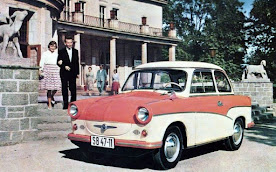
Two comrades approaching their 1957 Trabant P50 in stylish korallenrot (coral red) over creme (cream).  Note the amber turn signals; Trabants were factory-fitted with flashers at a time Rolls-Royce and other manufacturers in the “advanced West” were still installing antiquated semaphores.

In the Eastern Bloc there weren’t many marketing departments but there was a vast propaganda apparatus and opportunistically, the name Trabant was derived from the Middle High German drabant (satellite; companion; foot soldier) which at the time was a positive association with the famous Sputnik but it later became emblematic of the economic and moral bankruptcy of the whole communist project: While by the fall of the Berlin Wall (1961-1989) Soviet satellites and related technologies greatly had advanced, the “Trubi” remained a little changed “1957 time capsule”.  Although much despised in the early 1990s in the aftermath of the break-up of the Soviet Union (1922-1991), opinions softened and the survivors of the more than three million produced (a greater volume than BMC's (British Motor Corporation) Mini (1959-2000)) gained a cult following.  More correctly, the marque gained a number of cult followings, some attracted by the “retro-cuteness”, some with genuine, Putinesque nostalgia for the old Soviet system and other with a variety of projects as varied as EV (electric vehicle) conversions, the installation of V8s for drag-racing and the re-purposing in many forms of competition.  The Trubi is now a fixture in the lower reaches (a notch above the Austin Allegro) of the collector market.

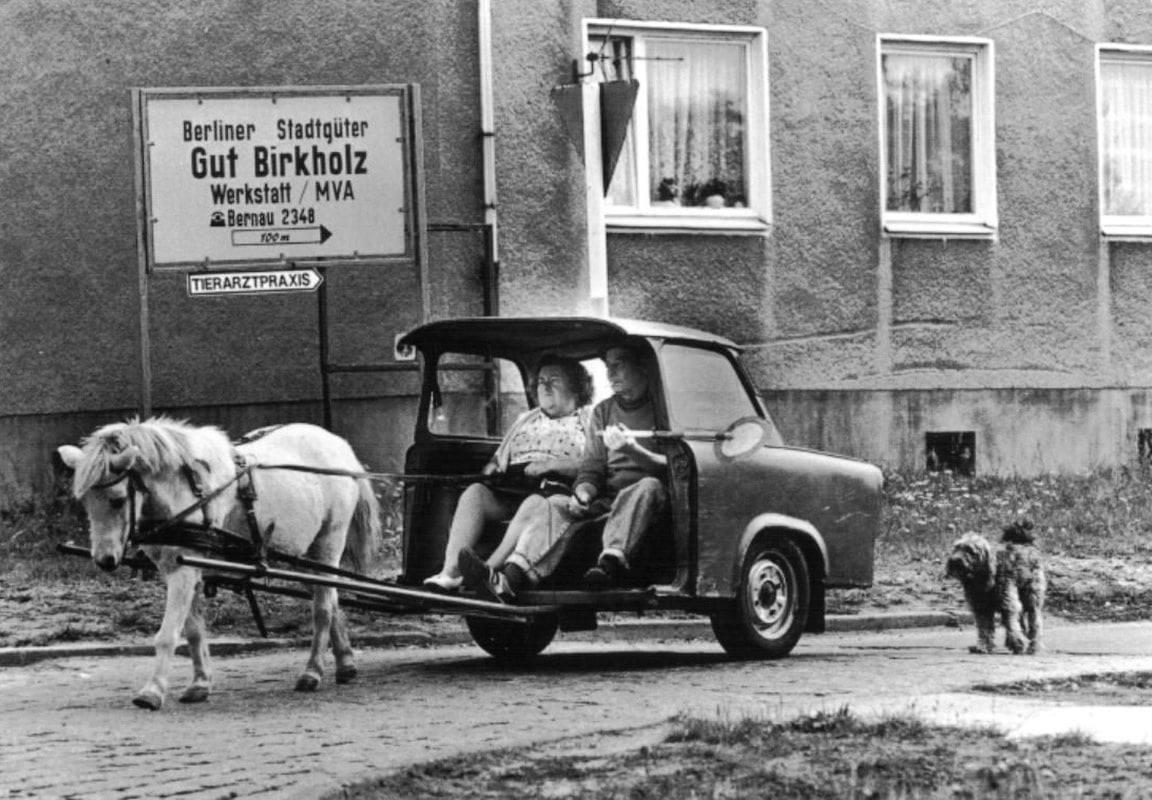
Low-emission Trabant (rated at 1 PP (pony-power)) with driver using semaphore signal to indicate intention to turn left, Barnim district, Bernau bei, Berlin, GDR, 1981.

As late as the 1960s, in some places, trucks & vans still were being built with a hand-operated semaphore mounted on the driver’s door and specialized vehicles likely also to have an occupant on the passenger-side (such as fire-engines) sometimes had two.  If need be they could also be improvised, as in the low-tech “lollipop” sign being used in this image of a two-seater buggy, a vehicle crafted using the salvageable section of a Trabant which may have suffered frontal damage in a crash.  Trabants really could go fast enough to have damaging crashes and although not engineered with the “crumple zones” which were introduced in the West as a way of absorbing an impact’s energy before it reached the occupants, in their own way, crumple Trabants did.  The photograph of the horse-drawn Trubi, while not representative of the entire Eastern Bloc experience under communist rule, captures a sight which would not have been uncommon away from large urban centres (which could be grim enough).  Dr Henry Kissinger (1923-2023; US national security advisor 1969-1975 & secretary of state 1937-1977) said his abiding memory of Eastern Bloc cities was of “the smell of boiled cabbage and an unrelenting greyness.”  In fairness, English cooks probably inflicted worse on the noble cabbage than anything done behind the Iron Curtain but his sense of “greyness” was literal, the appalling air pollution of the GDR (its industrial base powered by burning lignite (from the Latin lignum (wood)) and other forms of low-grade, “dirty coal”), thus the griminess of the buildings.  Places like London similarly were affected and it was only after the 1952 “Great Smog of London” that the Clean Air Act (1956) became law, meaning air quality began slowly to improve.  That the photographs of the era look so drab was not because of the film stock; buildings literally were “dirty”.  Because of various other advances in health care, it’s difficult to quantify the contribution to reducing mortality achieved by reducing air pollution but few doubt it was significant.

The Plymouth Satellites

1967 Plymouth Satellite convertible.

Chrysler's Plymouth division introduced the Satellite on the corporation's intermediate ("B") platform in 1965 as the most expensive trim-option for the Belvedere line.  Offered initially only with two-door hardtop and convertible coach-work, the range of body-styles was later expanded to encompass four-door sedans and station wagons.  In a manner, typical of the way the industry applied their nomenclature as marketing devices to entice buyers, the Belvedere name was in 1970 retired while Satellite remained the standard designation until it too was dropped after 1974.

1970 Plymouth Road Runner, 440 Six Barrel.

Were it not for it being made available in 1966 with the 426 cubic inch (7.0 litre) Street Hemi V8, the Belvedere and Satellite would have been just another intermediate but with that option, it was transformed into a (slightly) detuned race-car which one could register for the road, something possible in those happier times.  The Street Hemi was an expensive option and relatively few were built but the demand for high-performance machinery was clear so in 1968, Plymouth released the Road Runner, complete with logos (licensed from the Warner Brothers film studio for US$50,000) and a “beep beep” horn which reputedly cost US$10,000 to develop.  The object was to deliver a high-performance machine at the lowest possible cost so the Road Runner used the basic (two-door, pillared) body shell and eschewed niceties like carpet or bucket seats, the only addition of note a tuned version of the 383 cubic inch (6.3 litre) V8 engine; for those who wanted more, the Street Hemi was optional.  Plymouth set what they thought were ambitious sales targets but demand was such production had to be doubled and the response encouraged the usual proliferation: a hardtop coupé and convertible soon rounding out the range.

1970 Plymouth Hemi Road Runner Superbird.

The option list later expanded to include the six-barrel version which used the of the 440 cubic inch (7.2 litre) V8, a much cheaper choice than the Street Hemi and one which (usually) displayed better manners on the street while offering similar performance until travelling well over 100 mph (160 km/h) although it couldn't match the Hemi’s sustained delivery of top-end power which, with the right gearing, would deliver a top speed in excess of 150 mph (240 km/h), something of little significance to most.  However, by the early 1970s sales were falling.  The still embryonic safety and emission legislation played a small part in this but overwhelmingly the cause was the extraordinary rise in insurance premiums being charged for the high-performance vehicles, something which disproportionately affected the very buyers at which the machines were targeted: single males aged 19-29.  However, the platform endured long enough to provide the basis for the Road Runner Superbird, a “homologation special” produced in limited numbers to qualify the frankly extreme aerodynamic modifications for use in competition.  At the time, the additions were too radical for some buyers with dealers unable to find buyers forced to convert the things back to standard specifications just to shift them from their lots.  They’re now prized collectables, the relatively few with the Street Hemi especially sought.

As a footnote, corporate stablemate Dodge called their six barrel 440s the "Six Pack" (which was a much snappier name) and in the UK this was in 1972 picked up by Jensen which was able to buy (at a bargain price) a tranche of the engines Chrysler had stored in a warehouse after US emission regulations rendered them unlawful for road-registered passenger vehicles.  Jensen called the model created the "Interceptor SP" but it proved an unfortunate experience for both company and customers for while the engine delivered a lift in performance, for a variety of reasons it was, in that configuration, not suitable for the car (or its target market) and a number had to be converted to use the standard Interceptor's single four barrel carburetor.  Its brief existence did though produce something for the automotive trivia buffs: While the accepted orthodoxy is "the factory never installed air-conditioning (AC) in any car fitted with the six barrel 440s or the Street Hemi", strictly speaking that applies only to "No Chrysler factory ever installed..." because Jensen did so equip the SP.  More exclusive still was the single Street Hemi-powered Hai built in 1970 by the much-missed Swiss boutique operation Monteverdi, also with AC. 

1971 Plymouth Hemi Road Runner.

The intermediate line was revised in 1971 using the then current corporate motif of “fuselage styling” and it was probably more aesthetically pleasing there than when applied to the full-sized cars which truly were gargantuan.  The 1971 Satellites used distinctly different bodies for the two and four-door models and while there were no more convertibles, the Street Hemi and Six-Barrel 440 enjoyed a swansong season although sales were low, the muscle car era almost at an end.  Although the Hemi had outlived its corporate usefulness, Chrysler had planned to continue to offer the triple carburetor option on the 440, glossy sales brochures for the Plymouth Six Barrel and Dodge Six Pack printed before it became clear the configuration could not be engineered to meet the EPA's (Environment Protection Authority) tightened exhaust emission standards coming into effect on 1 January, 1972.  However, as part of the normal development process, some (a reputed two 1972 Plymouth Road Runner GTXs and six Dodge Charger Rallyes) were completed as "pilot cars" (vehicles in final form sent down the assembly line to ensure there were no quirks in the specification that would either have to be changed to permit mass-production).  These were built in late July or early August 1971 as a "final shakedown" in preparation for the 1972 model season beginning that September.  After the triple carburetor option was cancelled, it wouldn't have been unusual for the cars to have been crushed but nor was it unknown for such things to be sold through "internal channels" (ie well-connect employees, those in the dealer network etc) and at least some of the eight must have escaped the crusher because a one blue and one red 1972 440+6 Road Runner GTXs have been verified, along with one yellow and one red 1972 440-6 Charger Rallyes.  Few corners of the industry have attracted as many tales of "mythical machines" as the original muscle car era but these 1972 triple carburetor 440s have been authenticated as "factory built".