The
site presumably settled on "allegro.pl" to convey the idea of speed (fast
service, fast delivery etc). Although
the word allegro was never absorbed into the Polish language, because it appeared with such frequency in augmenting musical notation, it’s a familiar form throughout
Europe. Polish
composer Frédéric Chopin (1810–1849) used it as a
title for Allegro de concert in A major, Opus 46 and his work also included three
“allegro” movements: Allegro maestoso (the first movement of the Piano Concerto
No. 1 in E minor, Opus. 11), Allegro vivace (the third movement of the Piano
Concerto No. 1 in E minor, Opus 11) and Allegro vivace (the third movement of
the Piano Concerto No. 2 in F minor, Opus 21). In an appalling
example of an attempt at normative moral relativism, while on trial before the
International Military Tribunal (IMT) at Nuremberg (1945-1946), Hans Frank
(1900–1946; Nazi lawyer and governor of the General Government (1939-1945) in
German-occupied Poland during World War II) suggested that in mitigation for
his direct complicity in mass-murder, he should receive some credit for
establishing the Chopin Museum in Krakow, something “the Poles had never done”.
Voraciously corrupt (even by Nazi standards),
Frank was protected by virtue of his past service as Adolf Hitler’s (1889-1945;
Führer (leader) and German head of government 1933-1945 & head of state
1934-1945) personal lawyer and remained in his palace until the military collapse of the General
Government in 1945; under his rule, some four million were murdered. Remarkably, he handed to the
Allies dozens of volumes of his highly incriminating diaries and the IMT found
him guilty under Count 2 (War Crimes) & Count 3 (Crimes Against Humanity),
sentencing him to death by hanging. His
response to the sentence was to say: “I expected it, I deserved it”, adding: “A thousand years
will pass and still this guilt of Germany will not have been erased.” The latter sentiment he recanted while
awaiting execution, suggesting the trial had provided something of a cleansing
effect but at the time most regarded that as cynically as they noted the rediscovery
of his long abandoned Roman Catholic faith. Although
power corrupted him and led him down a path to depravity, Frank never quite
lost his respect for the idea of the rule of law and its fundamental importance
in a civilized society but was not in his mind able to resolve the conflict
between the legal mystique in which he’d been trained and the reality of the Führerstaat (Führer state) in which the
word of Hitler was the law. Frank did attempt to build a framework in
which the many contradictions could be reconciled but soon was made to understand
his mental gymnastics would (rightly) be thought mere legal sophistry and anyway be
ignored by those in the state who held authority. Awaiting trial, he told one interrogator Hitler’s
lack of reverence for the law was the “one defect in this great man” and regretted he’d
never been able to change the Führer’s view he “would not rest until Germans realize it is
shameful to be a lawyer.”

The Allegro typeface by German graphic artist Hans Bohn (1891–1980)
Although book burning infamously was associated
with the era, much publishing was still done in Germany during the 1930s and
the centre of the industry was Frankfurt.
In 1936, the city’s Ludwig & Mayer type foundry released the Allegro
typeface which was in the tradition of Didone style which became popular in the nineteenth century but
influenced also by art deco designs which had flourished during the inter-war years (1919-1939). A serif design which relied for its impact on
the alternation of thick and thin strokes, it used breaks in the letter where
thin strokes might be expected, hinting at the style of stencils with a touch
of the inclination associated with calligraphy.
It was a popular typeface for decorative purposes such as book jackets
or headings of musical notation but, very
much a display font, it worked well only above a certain point size and thus was used at scale, almost exclusively for titles.
The Ford Allegro

Ford
Allegro concept cars: 1963 (left & centre) and the 1967 Allegro II (right).
Ford’s Allegro
was a concept car developed between 1961-1962 which was well-received during
its time on the show circuit, viewers much taken by the dramatic interior which
included a cantilever-arm, movable steering wheel with an electronic memory
unit and adjustable pedals, features which would appear in production cars
within a decade. Built on the unibody platform
of the compact Falcon which had been introduced in 1959, it was powered by a V4 manufactured by Ford’s
European operation in Cologne, FRG (Bundesrepublik Deutschland (Federal Republic of Germany; the old West Germany, 1949-1990). Noting the use in music, the
company settled on the “Allegro” name to convey the idea of “brisk and lively performance” but
company documents confirm the team responsible for such things pondered “Avventure”
and “Avanti” before settling on “Allegro”.
The more obviously speculative Allegro II was displayed in 1967 and a
number of the design motifs from both would appear on subsequent Fords as well as Chevrolet’s Vega (1970-1977) and second generation Camaro (1970-1981).
The Austin Allegro

Aesthetic success
& failure: The Alfa-Romeo Alfasud (left) and the Austin Allegro (right).
Often
featured (usually with several other products of BL) in the 1970s) in lists as among the worst cars ever made, the Austin Allegro was in
production between 1973-1982 and actually sold in respectable numbers for most
of that time although at only a third the rate of its remarkably popular
predecessor (ADO16, the Morris 1100/1300 and its five badge-engineered
siblings (Austin, MG, Wolseley, Riley & Vanden Plas). One much criticized aspect
of the Allegro was the appearance; it was thought a bloated blob in an era of
sharp-edges and wedges and the critique does illustrate just how narrow can be the
margin between success and failure in the execution of a concept. The Alfa Romeo Alfasud (1971-1983 (variants of the original produced until 1989)) adopted
essentially the same shape and dimensions yet was praised as an elegant and
well-balanced design. Seen in silhouette,
the shapes are similar yet in the metal, the detail differences, a mere inch
(25 mm) or two here and there or a subtle change in an angle or curve and one
emerges lithe, the other ponderous.

Harris
Mann’s 1968 conceptual sketch for the Allegro project.
The Allegro’s portly appearance wasn’t the original intent.
Tasked with designing a replacement for ADO16, the stylist Harry Mann
(1938-2023) sketched a modernist wedge, designed to accommodate what was at the
time an advanced specification which included all-independent hydraulic
suspension, front wheel drive, disk brakes and crucially, new, compact
engines. Mann however began the project
while employed by BMC (British Motor Corporation of which Austin was a part) but by the time substantive work on the Allegro began, BMC had been absorbed into
the BL conglomerate, a sprawling entity of disparate and now competing
divisions which, if agonizingly reorganized, might have succeeded but such were
the internal & external obstacles to re-structuring that, coupled with political turmoil and the economic shocks of the 1970s, it staggered to
failure, something the later nationalization could only briefly disguise. Mann’s team learned the clean-lined wedge would have to be fattened-up because, not only were the old, tall, long-stroke engines
to be re-used but the new units to be offered as options were bulkier
still.
If installed at an angle (which would have demanded some re-engineering but would have been possible), that might
have been manageable but what was not was the decision to use the corporate heater unit, developed at an apparently extraordinary cost; it could be installed just one way and it was a tall piece of machinery. Allegro production ended in 1982 but what its appearance of all those "worst car ever" lists tends to obscure is it wasn't a commercial failure. Although it sold only about a third the volume of its predecessor (the ADO16 ranges) which was for most of the 1960s the UK's best-selling car (and an export success, especially in New Zealand), the Allegro existed in a much more competitive market. Essentially, the Allegro was nearly a very good car and had it been produced by an outfit less inept than BL, it'd probably now be better-remembered. While it's now sometimes dismissed as "all agro" ("agro" a slang form of "angry", the phrase meaning something like "nothing but trouble"), in its time the Allegro sold well and enjoyed a better than average reliability record.

1976 Triumph TR7 coupé (left) and 1980 Triumph TR8 convertible (right). It is wholly emblematic of BL that just as the TR8 had become a good car with much unexplored potential, production ceased.
Mann
didn’t forget his 1968 sketch and when the opportunity later came to design a
new sports car, his wedge re-appeared as one of the cars which most
represented the design ethos of the 1970s: The Triumph TR7 (1974-1981) & TR8
(1977-1982) which weren't quite trouble-free but which sold quite well
and, as the TR8 (which used the 3.5 litre (215 cubic inch) Rover V8), represented something in which the potential of the original
was finally realized but it was too late for by then the disaster that was BL had eaten itself.

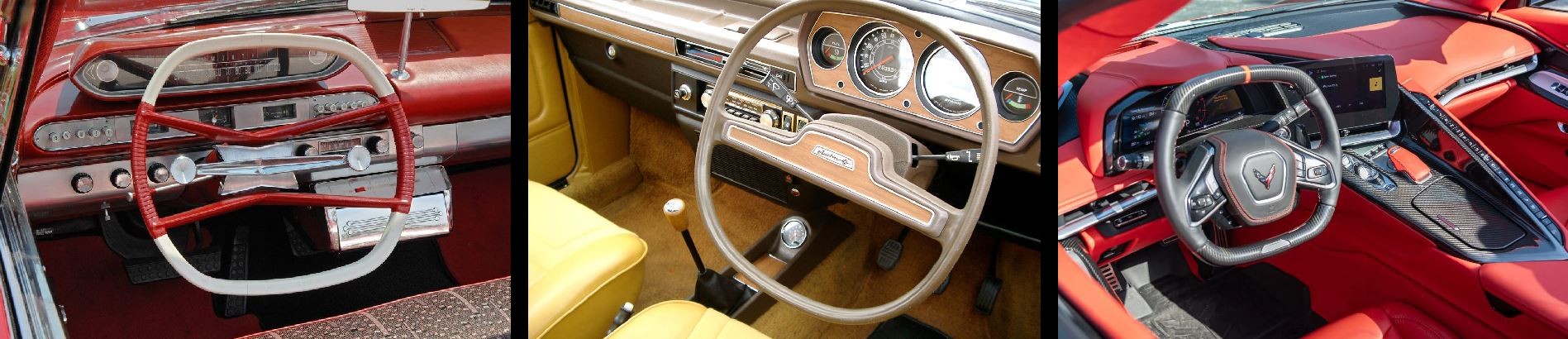
1960 Plymouth Fury four-door hardtop (left), 1974 Austin Allegro 1750 Sport Special (centre) and 2024 Chevrolet Corvette Z06 coupe (right).
The
Allegro is remembered also for a steering wheel which was neither circular yet
not exactly square. Dating back decades, the idea
wasn’t novel and such things had in the early 1960s appeared of a few American
cars but, fitted to the Allegro, it attracted much derision,
something not diminished by BL's explanation it afforded "an ideal view of the instruments".
BL also attracted the scorn of mathematicians when they called the
shape “quartic” on the basis of it being “a square with rounded corners”. However, technically, a quartic is “an algebraic equation or function of the fourth degree or a curve describing such an equation or function” while sqound (a portmanteau word, the construct being sq(uare) + (r)ound) is the ultimate niche word, the only known use by collectors of certain Chevrolet C4 Corvettes (1984-1996), describing the shift in 1990 from round to “a square with rounded corners” taillights. Mathematicians insist the correct word for a "square with rounded corners" is "squircle" (in algebraic geometry "a closed quartic curve having properties intermediate between those of a square and a circle"), the construct being squ(are) +c(ircle).
Few etymologists (and certainly no lexicographers) appear to have listed sqound as a "real" word but it's of minor interest because as a rare example of a word where "q" is not followed by "u"; such constructs do exist but usually in the cases where initialisms have become acronyms such as Qantas (Queensland and Northern Territory Aerial Services). Such words do appear in English language texts but they tend to be foreign borrowings including (1) qat (or khat) (a plant native to East Africa and the Arabian Peninsula, often chewed for its stimulant effects, (2) qi (a term from Chinese philosophy referring to life force or energy), qibla (the direction Muslims face when praying, towards the Kaaba in Mecca and (4) qiviut (the soft under-wool of the musk-ox, valued when making warm clothing). For a while, BL pretended to ignore the pedants but within a year replaced the wheel with a conventional
circular design. Whatever the name, variations
of the shape have since become popular with high-end manufacturers, Ferrari,
Aston-Martin, Lamborghini and others all pursuing non-circular themes and one
is a feature of the latest, mid-engined, C8 Chevrolet Corvette in which, unlike the appearance on the despised Allegro, it's much admired.

How to make an Allegro look worse: 1976 Vanden Plas 1500, the variant coming too late to receive the "quartic" steering wheel. The consensus among testers was the best place to enjoy a Vanden Plas 1500 was sitting inside, amid the leather and walnut, most readers drawing the inference that was because one wouldn't have to look at the thing. One less charitable scribe described it as "mutton dressed up as hogget".
In another sign of the times, unlike ADO16, one basic vehicle which was badge-engineered to be sold under six brands (Austin, Morris, Riley, Wolseley, MG & Vanden Plas with the Italian operation Innocenti among the overseas builders, some of which added "modernized" front and rear styling), the only variation of the Allegro was a luxury version by in-house coach-builder Vanden Plas (although there were Belgium-built Allegros and BL's Italian operation produced some 10,000 between 1974-1975 as the Innocenti Regent), laden with leather, cut-pile carpeting and burl walnut trim including the picnic tables so beloved by English coach-builders. It didn't use the Allegro name and has always elicited condemnation, even from those who admired the Vanden Plas ADO16, presumably because the traditional upright grill attached to the front suited the earlier car's lines whereas the version which had to be flattened to fit the Allegro's pinched, pudgy nose was derided as coming from the hand of a vulgarian. Still, there's clearly some appeal because the Vanden Plas cars have the highest survival rate of all Allegros and now enjoy a niche (one step below the GDR's (Deutsche Demokratische Republik (German Democratic Republic; the old East Germany, 1949-1990) Trabant (the infamous "Trabbi")) on the bottom rung of the collector car market. One thing which may disappoint collectors is the Vanden Plas 1500 & 1750 (1974-1982) never used the "quartic" steering wheel although a photograph of one so-equipped did appear in the early brochures, printed before the decision in mid-1974 to replace it with a conventional (circular) design. The photograph was of what the the industry calls a "final pre-production prototype", a common practice.
Leyland's other misadventure in 1973: The P76

The antipodean Edsel: 1973 Leyland P76 Super V8. Although
1973 was the last “good year” for the “old” UK economy and one during which
BL was looking to the future with some optimism, the corporation’s
troubles that year with steering wheels were, in retrospect, a harbinger. In addition to the Allegro, also introduced in 1973,
on the other side of the planet, was the P76, a large (then a “compact” in US
terms) sedan which LA (Leyland Australia) hoped would be competitive with the then
dominant trio, GMH’s (General Motors Holden) Holden, Ford’s Falcon and Chrysler’s
Valiant, the previous attempts using modified variants of UK models less than
successful although the adaptations had been both imaginative and achieved at remarkably low cost. Whatever the hope and dreams, publicly, LA kept
expectations low, claiming the target was nothing more than a 10% market share
and the initial reception the P76 received suggested this might more than be
realized, the consensus of press reports concluding the thing was in many
aspects at least as good as the opposition and in some ways superior, the
country’s leading automotive periodical that year awarding the V8 version the coveted CotY
(Car of the Year) trophy.

The answer to the question nobody asked: 44 gallon drum in a P76 boot. In fairness, the marketing gimmick was a device to illustrate the car had "a bigger boot than the competition" rather than an indication many buyers routinely (if ever) carted such a thing but it soon became a matter of ridicule.
Unfortunately,
the circumstances of 26 June 1973 when the P76 was launched didn’t last, the
first oil crisis beginning some four months later which resulted in a spike in
the price of oil which not only suddenly dampened demand for larger cars but
also triggered what was in the West then the most severe and longest-lasting recession of
the post-war years. Some basic design flaws and indifferent quality control contributed to the debacle
which is now remembered as the Australian industry’s Edsel and in October 1974 production
of the P76 ended; BL wound up LA and closed its Australian manufacturing facilities,
never to re-open. Not even the much-vaunted ability of the P76 effortlessly to carry a 44 (imperial) gallon (53 US gallon; 205 litre) drum in its trunk (boot) had been enough to save the outpost of the old empire.

1973 P76 with the original (sharp-edged) steering wheel (left) and the later version, designed for the Force 7 (right) which was fitted also to the Targa Florio version released to celebrate a P76 setting the fastest time on the stage of the 1974 London–Sahara–Munich World Cup Rally held on the historic Targa Florio course in Sicily (in the rally, the P76 finished a creditable 13th). The steering wheel was one of many flaws which were planned to be rectified (or at least ameliorated) in the "facelifted" version scheduled for 1975 but, before the end of 1974, the decision had been taken in London to axe the entire LA manufacturing venture.
Given
the geo-political situation, rampant inflation and troubled industrial
relations of the time, the P76’s steering wheel is really just a footnote in
the sad tale but, like the Allegro’s “quartic” venture it was emblematic of the
self-inflicted injuries to which BL would subject itself, both in the UK
and its antipodean offshoot. When the P76 made its debut in 1973, there was some comment that the steering wheel’s
boss had a horn-pad in the shape of a boomerang, emphasizing its credentials as a locally developed product, but what was criticized was the rim which had bizarre, concave
cross-section, meaning a quite sharp edge faced the driver, leaving an impression
on the palms of the hands after only a few minutes driving. The industry legend is the shape was a
consequence of the typist (second wave feminism hadn't yet left the bookshelves and arrived in boardrooms so in 1973 it remained SOP (standard operating practice) to wherever possible "blame the woman") who prepared the final specification-sheet having mixed up “concave”
& “convex” but even if true it’s remarkable such an obvious design-flaw wasn't rectified at the prototype stage.
Some have doubted the veracity of the story but such things do
happen including in space. The problems of the HST (Hubble Space Telescope, 1990) were a famous example and on 23 September, 1999, NASA (the US National
Aeronautics and Space Administration) lost the US$125 million Mars Climate Orbiter
spacecraft after its 286-day journey to Mars and that was a time when US$125
million was still a lot of money. There
was of course the inevitable review which found the craft’s directional thrusters
had, over the course of several months, been incorrectly fired because the
control data had been calculated in incorrect units. The contractor (Lockheed Martin, responsible
for the calculations) was sending data in Imperial measures (pounds) to NASA,
while NASA's navigation team, expecting metric units, interpreted the numbers
as Newtons. As far as is known, neither contractor nor agency attempted to blame a typist.
1974 Leyland Force 7V.
Compounding the error on an even grander scale, LA even planned to release a P76 coupé. Of the 60-odd built, only 10 of the prototype Force 7V coupés survived the crusher and although it offered the novelty of a practical hatchback, the styling was ungainly and the execution expensive (no external panels shared with the sedan, then the standard practice for such variants). However, what was more critical was the very market segment for which it was intended was close to extinction and the five vehicles intended as its competitors (Ford's Falcon Hardtop & Landau, Holden's Monaro coupé and Chrysler's Valiant Hardtop & Charger) would be all dropped from production by 1978. Even had the range survived beyond 1974, success would thus have seemed improbable although the company should be commended for having intended to name the luxury version the Tour de Force (from the French and translated literally as "feat of strength"), the irony charming although En dépit de tout (In spite of everything) might better have captured the moment. Industry historians have long concluded that even had the P76 survived, the Force 7 would have been a short-lived failure.

Seriously, the New Zealanders did, by at least the hundreds.
One darkly amusing
footnote in the dismal decline and fall of the P76 is that between 1971-1976, Rover's highly regarded 3500 (P6B, 1968-1977) was assembled from CKD (completely knocked down) packs at the NZMC (New Zealand Motor Corporation)
plant in Nelson, some 2,400 finished cars shipped to Australia. To an economist that probably sounds an unexceptional trans-Tasman commercial
transaction but in return, NZMC received from LA CKD packs of P76 V8s to an equivalent NZ$ value.
Most concluded the Australians got the better part of the deal although the P76 is now a fixture in the lower reaches of the local collector market where they sell for rather more than 3500s so there's that.
There seems no publicly available record of how many CKD packs were shipped to New Zealand but a fully-assembled,
ADR (Australian Design Rules) compliant 3500 would have had a higher book value than a CKD pack P76 of
any specification so, given the retail pricing at the time, a ratio between
3-4:1 may be a reasonable guess, the labor component in any assembly a substantial part of the calculated value. That means it must have been a partial exchange because however calculated, 650 CKD packs of P76s would be only a fraction the value of 2400 complete P6s. During the mid 1970s, the NZ$-Aus$
exchange rate bounced between (roughly) 1.10-1.22 so, depending on contractual
terms, that may also have influenced the two-way volumes. By the mid-1970s the Bretton Woods system
(1944-1973) of fixed exchange rates was over but Western countries still set
rates in a system called a “managed float”, periodically using a “basket” of
currencies (US$ the benchmark; cross-rates from the basket). “Managed float” sounds an oxymoron but the
process wasn’t wholly different from modern practice (the interplay of forex
markets and central bank interventions).

GQ Magazine (British edition), September 1995. GQ stands for “Gentleman's Quarterly” but perhaps, by the 1990s, there was some irony in the title.
While it may be unfair, the P6-P76 exchange may be compared with the “Seriously, would you trade her in for Paula Yates?” caption which appeared on the September, 1995 cover of the British edition of the periodical GQ, used for a photograph of an alluringly posed Helena Christensen. The piece was a comment on the news Australian singer Michael Hutchence (1960–1997) had “traded in” Danish supermodel Helena Christensen (b 1968 and his long-time girlfriend) for English media personality Paula Yates (1959–2000), the unsubtle implication being Ms Christensen was rather more attractive than Ms Yates, GQ's view apparently a woman's desirability should be determined on no other basis. There are reasons the grimier end of English journalism gained its reputation.
Paula Yates.Many might make a similar point between the Rover P6 and the
Leyland P76 although, like the two women, the pair do share some fundamental DNA,
both V8s based on the original aluminium unit developed by GM (General Motors) for
BOP (the corporation’s Buick, Oldsmobile & Pontiac divisions); not wholly
suited to US use, GM produced the 215 cubic inch (3.5 litre) V8 only between 1960-1963
before selling the rights and tooling to Rover.
GM would come to regret that decision but nevertheless got good value
from the design, similar engines with iron blocks used between 1964-1980
although the greatest benefit came from a V6 derivative which, in various forms
in places around the world, was in continuous production between 1964-2008. Best remembered as the long-serving “3800”, the
V6 proved one of Detroit’s most robust, reliable and easily serviced engines. For the P6, Rover used the original 3.5 litre configuration (although the
company made the first of their many improvements) while LA
created a “tall deck” block and achieved a 4.4 litre (269 cubic inch) displacement
with a perfectly square bore & stroke (both 88.9 mm (3.5 inch)). Had the rest of the car been up to the
standard of the 4.4, the P76 might have survived even the the troubled 1970s because there were plans to auggment the range with a station wagon and commercial variants (the "ute" and panel van), all solid, reliable market segments in Australia. The brief moment for the Force 7 had however passes an it would anyway have been doomed.

Introduced in 1963 as the Rover 2000 (with a
unique 2.0 litre (121 cubic inch) in-line four-cylinder engine), the P6 was one of the
outstanding products of the post-war British car industry (genuinely, despite
the perceptions of some, there were a few fine machines) with an advanced specification in a
conveniently sized package. It was the first ECotY (European Car of the Year) and all it
needed was more power (a flirtation with enlarging the 2.0 to a 2.5 litre (151
cubic inch) in-line five aborted), that deficiency in 1968 addressed
with the release of the 3500, the range in 1971 augmented by the 3500S (unrelated
to the automatic 3500S sold briefly in the US) with a four-speed manual
gearbox, the revised configuration making these P6s genuine 125 mph (200 km/h) cars. Although by then a nearly decade-old platform, the 3500S impressed testers with it pace, the usual competence of the de Dion rear suspension and brakes which were state of the (pre-ABS) art; the fuel gauge also attracted comment, praised for an accuracy at the time not always encountered. Regrettably, the P6's fine platform was under-exploited although the Swiss coach-builder Graber was among several which built nicely-executed coupés & cabriolets while in England there were the inevitable estates (station wagons) although the latter were not ascetically pleasing because of the need to follow the slope of the roof-line. Along with much of the UK industry,
Rover rather lost its way after the high water mark of the P6 3500.
The fate of many Alfasuds.
Sea water played a part in the story of the Alfasud. The Alfasud name (the construct being Alfa + sud) was an allusion to it being produced in a newly built factory in the Naples region, the decision taken after financial inducements were offered by the government, anxious to do something about the levels of unemployment and lack of economic development in the south of the country. The Italian sud (south) was from the French sud, from Old English suþ, from Proto-Germanic sunþrą. As a plan it made sense to politicians and economists but, industrial relations being what they were at the time, the outcome was less than ideal.
In one
aspect, the Allegro and Alfasud (1971-1989) were wholly un-alike, the latter infamous for its propensity to rust, a trait shared with many mass-produced Italian cars of
the era, the only consolation for Alfasud owners being the contemporary Lancia
Beta (1972-1984) suffered even more. The Alfasud's rust-resistance did improve over the years but it remained a problem until the end of production and the industry story has
always been that in the barter economy which was sometime conducted between the
members of the EEC (European Economic Community (1957), the Zollverein that would evolve into the EU (European Union (1993)) and those of the Warsaw Pact (the alliance between the USSR
and the satellite states within Moscow's sphere of influence which essentially duplicated the structure of NATO (North Atlantic Treaty Organization, 1949), Italian manufactured goods were exchanged for
Russian steel which reputedly was re-cycled but anyway turned out to be of poor quality and essentially
porous. The story certainly is a good fit for the narrative of mal-administration and corruption that was Italy in the 1970s but subsequent research has revealed it to be a myth, the sheet metal used in the Neapolitan factory at Pomigliano d’Arco where Alfasuds were made the same stuff Alfa Romeo used in the facility at Arese in Milan where the Giulia range was produced and its reputation for resisting rust was above average. The evidence suggests all the steel used by the company's local operations came from the state owned Taranto steel mills and intriguingly, the factories south & north all used the same paints and the ovens & paint booths were a decade-odd newer in Naples.

Variations on the Alfasud theme: The Sprint (1976-1989, left) and Giardinetta (station wagon or estate-car) (1975-1980, right).
Given all that, the startlingly premature corrosion surprised many within Alfa Romeo and in 1977 a project-team was formed to investigate the causes and it was afforded some urgency given the reputational damage being suffered by the whole company (worse still, profits were down). Having determined the core components (paint & steel) weren't to blame, the engineers deconstructed the production process including the system of movement (how the partially completed cars proceeded from start to finish). What the team found was that while the electrophoresis baths at Pomigliano were state of the art, the inexperienced (and sometimes indifferently-minded) workforce operated them without adequate supervision and quality control, something exacerbated by the chronically bad labor relations, the factory beset by rolling strikes which meant unpainted bodies were often sitting for days. In the humid climate of the south, condensation gathered, many cars already rusting even before eventually receiving a coat of paint and that the plant was less than 10 miles (16 km) from the coast and prevailing winds blew from the sea added to the problem, the unpainted Alfasuds often for days sitting unpainted accumulating salty moisture.

1983 Alfa Romeo Alfasud Ti Quadrifoglio Verde (Green Cloverleaf), one of the industry's longer model names and clipped usually to "Alfasud QV".
The team's findings resulted in a change to the production process for the revised Series 2 Alfasuds launched in December 1977. The critical parts of the bodyshell now used "Zincrometal" (steel coated with a primer) which was a mix of chromium, zinc and an organic bonding resin, baked at 160°C (320°F) and that was as good a system as anything then used in the European industry. As a added precaution, a polyurethane foam was injected into the body's boxed sections with a flexible plastic sealant applied at the seams to prevent moisture intrusion. That had the added benefit of reducing noise vibration & harshness (NVH) while adding only a little extra weight. Unfortunately, the tests the engineers conducted to prove the design was waterproof relied on perfectly applied sealant at the junctions but the poor quality control continued so many seams were improperly sealed which meant the foam acted as a moisture store, making the problem worse. By contrast, whatever its other
faults (and there were a few), the Allegro resisted rust like few cars built
anywhere during the era, the body-engineering sound and that 1970s BL paint was thick and durable. In the years that
followed, many would criticize the sometimes lurid and even sickly shades but
as a protective coating, it did the job.

Ultimate Alfasud: The Giocattolo (left), the world's best Alfa Romeo Sprint which included the world’s best tool kit (right). Unrelated to either, Il giocattolo (the Toy, 1979) was an Italian film noir from the Anni di piombo (Years of lead) era, directed by Giuliano Montaldo (1930-2023).
The much admired coupé variant of the Alfasud was sold as the Alfasud Sprint (1976-1983) and Sprint (1983-1989); it proved rather more rust resistant. It was subject to continuous product improvement and fitted with progressively bigger and more powerful engines although none were larger than 1.7 litres (104 cubic inches) which limited its use in competition to events where outright speed mattered less than balance and agility. The handling was about as good as FWD (front wheel drive) then got and in events such as hill climbs the things are competitive even today. However, rising to the challenge, between 1986-1989, an Australian company solved the two problems afflicting the Sprint (FWD & lack of power). Thus the Giocattolo (a play on the Italian word meaning “toy”), a batch of 15 built in the Queensland coastal town of Bundaberg before the economic downturn (remembered locally as "the recession we had to have", the then treasurer's (Paul Keating (b 1944; Prime Minister of Australia 1991-1996)) rationalization of why it was essential to kill off the inflation which had become entrenched in the mid 1970s) ended the fun. The Giocattolo was fitted with a mid-mounted 304 cubic inch (5.0 litre) Holden V8, driving the rear wheels through a ZF five-speed transaxle, the combination yielding a top speed of 160 mph (257 km/h), a useful increase of 40 mph (65 km/h) over the fastest of the factory's Sprints. As impressive as the mechanical specification was, the Giocattolos are remembered also for the unusual standard feature of a 375 ml bottle of Bundaberg Rum (the region's most famous product which began as a way to use a waste-product of sugar-cane processing) and two shot glasses as part of the toolkit. Many who worked on Italian cars probably thought they deserved a drink so it was a good idea but these days, a company would risk being cancelled for such a thoughtful inclusion.