Showing posts sorted by relevance for query Bottle. Sort by date Show all posts

Friday, April 24, 2020

Bottle

Bottle (pronounced bot-l)

(1) A portable vessel, usually of plastic or glass (the original containers of this type were of leather) and typically (though by no means exclusively) cylindrical with a narrow neck that can be closed with a cap or cork, for containing liquids

(2) The contents of such a container; as much as such a container contains.

(3) As “the bottle”, a verbal shorthand for alcohol, strong drink, intoxicating beverages; liquor.

(4) To put into or seal in a bottle.

(5) To preserve (usually fruits or vegetables) by heating to a sufficient temperature and then sealing in a jar (not a common use in the US).

1325–1375: From the Middle English botel (bottle, flask, wineskin), from the Anglo-French, from the Old French boteille (the Modern French is bouteille), from botel, from botte (bundle) probably from the Vulgar Latin butticula (literally “a little cask”), the construct being the Late Latin butti(s) (cask) + -cula (ultimately an alternative form of -ulus; added to a noun to form a diminutive of that noun) although etymologists note the origin remains disputed and there may be a Germanic link (although some maintain it was actually from Archaic Greek), possibly with the Low German Buddel and the Old High German būtil, the latter the source for the German Beutel).  The Latin was the source also of the Spanish botella and the Italian bottiglia.  The third-person singular simple present is bottles, the present participle bottling and the simple past & past participle bottled.  The noun plural is bottles.

The borrowings by other languages make an impressive list including the Assamese বটল (botol (which may be via the Portuguese botelha)), the Bengali বোতল (botôl), the Bislama botel, the Cornish botel, the Brunei Malay butul, the Dutch bottel, the Ese butorua, the Fiji Hindi botal, the Gamilaraay baadhal, the Georgian ბოთლი (botli), the Gujarati: બાટલી (), the Hindi: बोतल (botal (which may be via the Portuguese botelha)), the Dari بوتل‎ (bôtal), the Jamaican Creole bokl & bakl, the Kannada: ಬಾಟಲಿ (ali), the Malay & Indonesian botol, the Min Nan 帽突 (bō-tu̍t), the Papiamentu bòter, the Maori pātara, the Marathi: बाटली (), the Nepali बोतल (botal), the Pashto بوتل‎ (botál), the Pennsylvania German Boddel, the Persian بطری‎ (botri), the Punjabi: ਬੋਤਲ (botal), the Samo botolo, the Sranan Tongo batra, the Scottish Gaelic botal, the Shona bhotoro, the Sinhalese: බෝතලය (bōtalaya), the Swahili libhodlela, the Tok Pisin botol, the Welsh potel, the Xhosa ibhotile & imbodlela, the Yiddish: באָטל‎ (botl) and the Zulu bhodlela.

Bottle features much in UK slang.  The phrase “to bottle” refers to (1) a bottle as a weapon (usually involving it either as a blunt instrument or (when broken) as an improvised bladed weapon to slash or stab (“glassing” the equivalent if a glass drinking receptacle is used), (2) to pelt (a musical act on stage, a sporting team on the field of play etc) with bottles as a sign of disapproval, (3) to refrain from doing something at the last moment because of a sudden loss of courage (that use based on the cockney rhyming slang "bottle and glass" (meaning "ass" as an expression of courage or nerve)) or (4) money collected by street entertainers or buskers.  In printing, it can refer to (1) pages printed several on a sheet (to rotate slightly when the sheet is folded two or more times) or (2) as “bottle-arsed”, the old printers' slang for a typeface wider at one end than the other.  Bottle (with variations such as bottle-fed & bottle-baby) is also a general term to reference infants fed from a bottle with baby formula or some milk other than the mother’s natural supply; that from which the infant is fed is the baby-bottle (wholly replacing the suckling-bottle from 1844).  A bottle-neck is any point in a system which is a cause of inefficiency or congestion, based on the idea of the neck of a bottle being the narrowest part and thus establishing the maximum flow-rate; use in this context dates from 1896 in the specific sense of “narrow entrance, spot where traffic becomes congested”, extended to “anything which obstructs a flow” by 1922, the verb in this sense used since 1928.  To “bottle (something) up” is not to deal with problems or emotions; letting something “out of the bottle” is the less common companion term.  Interestingly, the figurative use “bottling-up” in this context is from the 1620s, pre-dating the literal use (putting stuff in bottles for storage) by two decades.  In a variety of forms (“on the bottle”, “hitting the bottle”, “to drown one’s troubles in the bottle” etc), bottle has since the seventeenth century been a generalized reference to alcohol and its (usually excessive) consumption.

Natural red-head Lindsay Lohan during bottle-blonde phase with bottle of Fiji Water.  As a modifier for various hair-colors (though almost always blonde if applied to women and something more youthfully dark with men), “bottle” was a suggestion of the use of dye, bottle-blonde the most frequently used.

First sold in 1996, Fiji Water quickly became a celebrity favorite, many attracted presumably by the claim that, coming from an “ancient artesian aquifer”, it was "Earth's finest water" but it attracted controversy because at the time when the company began shipping to high-income countries what was a high-priced, premium product, almost half the Fijian population lacked access to clean drinking-water (the Fijian government claims fewer than 10% are now so deprived).  Analysis also revealed an extraordinary environmental impact by the time it reached the consumer, more water consumed in the extraction, production and distribution processes to produce one bottle of Fiji Water than was in the delivered product.  A combination of the use of diesel-fueled machinery, plastic packaging and the vast distances over which what is a very heavy product was shipped meant a effective carbon footprint per litre well over a thousand time higher than the safe tap water available just about anywhere it was sold.

A magnetic bottle is a machine created by placing two magnetic mirrors in close proximity; they’re used in experimental physics temporarily to trap charged particles, preferably electrons because they’re lighter than ions, the best known use of the device to isolate high energy particles of plasma in fusion experiments.  A message in a bottle is literally that, a written note placed in a sealed bottle and cast to the ocean currents, hopefully to be found somewhere some day; these may be distress messages requesting rescue or for no particular purpose.  Although long obsolete, a bottle was once also something tied in a bundle, especially (hay), the link being to the Old French botte (bundle).  The zoological term bottle-nose dates from the 1630s, applied to the porpoise from the 1660s although as a general descriptor in engineering and architecture, it’s noted from the 1560s.  The bottle-washer is from 1837, the bottle-shop a surprisingly recent 1929 and the first mechanical bottle-opener was advertised in 1875.  A jar, jug, urn, vial, canteen, carafe, cruet, decanter, ewer, flagon, flask, phial, soldier, dead soldier or vacuum bottle can also be used to store liquids and certain designs of some of these are in some cases classified as bottles but the use is technical and a bottle is usually defined and understood in its most simple and traditional form.  

The UK dialectal use to describe a dwelling, building or house is obsolete.  It was from the Middle English bottle, botel & buttle, from the Old English botl (building, house), from the Proto-West Germanic bōþl, from the Proto-Germanic budlą, buþlą & bōþlą (house, dwelling, farm), from the primitive Indo-European bhow & bow (literally “to swell, grow, thrive, be, live, dwell”).  It was cognate with the North Frisian budel, bodel, bol & boel (dwelling, inheritable property), the Dutch boedel, boel (inheritance, estate), the Danish bol (farm), the Icelandic ból (dwelling, abode, farm, lair) and related to the Old English bytlan (to build).

The anatomy of the bottle

The finish (also called the closure) is the very top where the bottle is sealed with a cork (natural, composite or some alternative) or screw-top cap, the latter increasingly popular but now that the problem of cork taint (caused usually by trichloroanisole (TCA)), appears to have been solved, cork is making something of a comeback, aided perhaps by the tactile experience of opening a bottle with a corkscrew.  Collectively, the finish is made of a lip and collar, the collar the lower part of the finish, below the lip.  Structurally, the finish is all that is above the distinctive upper terminus of the neck, the term “finish” a glassmakers reference to the final process of making a mouth-blown bottle (ie the final step or the "finishing") and it’s sometimes also referred to sometimes as a "top," "lip" or "mouth".  The wrapping (metal or some form of composite) which is applied around the finish is called the capsule.

The bore (also called the aperture, corkage, opening, mouth, orifice or throat) is the opening at the top of the finish from which the bottle's contents are poured.  The relationship between bore & stopper in a bottle is exactly the same as that of cylinder & piston in an internal combustion engine.  The neck is the (almost always) constricted part of a bottle that lies above the shoulder and below the finish.  The sealing surface sits atop the bore and is where the closure and finish mesh to seal the contents inside.  The extreme top portion of the finish (rim) is sometimes referred to as the sealing surface though that is dependent on the type of finish.  It varies with the technology, the sealing surface on a cork finish is primarily the inside of the bore whereas if an external threaded finish combination is used, the rim becomes the sealing surface against which the screw cap twists down and seals.

An embossed bottle.

The shoulder is the portion of the bottle which lies between the point of change in vertical tangency of the body and the base of the neck.  In the design of bottles, the shoulder is the upper of the two transition zones between portions, the other being the heel, the body the part where most of a bottle’s contents are stored.  The body lies between the shoulder and heel (insweep) and it’s on the body that most labels appear.  Some bottles feature an embossing, raised lettering, designs, or graphics on the surface of the bottle that are formed by incising or engraving on the inside mold surface(s).  The embossing was often effected by the use of interchangeable (usually cast-iron) engraved plates which could be swapped in the same bottle mold so runs of different embossing patterns could be applied to the same type bottle.  The use of these transformed the economics of bottle production; simply with a swap of the plate, the same mold could be used to produce scores of unique and individually embossed bottles of the same shape and design.  The plates are collectables and are called "slug plates" by collectors although the industry insists they were for centuries never known as anything but “plates”.  Bottles thus produced are said to have emerged from a "plate mold".  Mold seams are raised lines on the body, shoulder, neck, finish, and/or base of the bottle that are formed where the edges of different mold sections parts came together, some manufacturers preferring "mold line(s)" although in the long history of glass-making, they’ve also been known as "joint-marks" & "parting lines".

Pol Roger Vintage Brut (1947).

The heel (also called the insweep) is the lowest portion of the bottle where the body begins to curve into the base, terminating usually at the resting point of the bottle (ie the extreme outer edge of the base so the heel may be thought of as the transition zone between the horizontal plane of the base and the vertical plane of the body).  Wine aficionados like to call this the "basal edge", a kind of masonic code-word with which they identify each-other.  The base, as the name implies, is the very bottom of the bottle; the surface upon which it stands.  Traditionally, manufacturers’ quoted measurements of a base are of the greatest diameter (round) or greatest width and depth (non-round) and the "resting point" of a bottle is usually the extreme outside edge of the base.  The kick-up (also called the punt or push-up) is the steep rise or pushed-up portion of the base which slightly reduces the internal volume of the bottle.  Originally, kick-ups were included certainly to enhance strength & stability but historians remain divided on whether the shape was crafted to collect any sediment in the liquid.  In the early twentieth century, some US glassmakers called this feature a "shove-up" but the term never caught on.


Monday, February 10, 2020

Cokebottle

Cokebottle (pronounced koke-bott-el)

A descriptor for a design where objects either resemble or are inspired by the shape of the classic Coca-Cola bottle.

1965: From an unsuccessful trademark application file in the US by the Chevrolet division of General Motors (GM), cokebottle thus word that never was.  The Coca-Cola name was a deliberately alliterative creation which referred to two of the original ingredients (leaves of the coca plant and kola nuts (source of the caffeine).  Coca is from the Erythroxylaceae family of cultivated plants native to western South America and renowned as the source of the psychoactive alkaloid.  Used since the drink’s debut in 1886, the cocaine was removed from Coca-Cola in 1903, the remainder of the recipe remaining famously secret.  Coke dates from 1908 in US English and was a clipping of clipping of cocaine although it’s not known when the word was first used to refer to the drink but given the rapidity with which slang forms emerge to describe popular products, it’s at least possible it pre-dated the drug reference although the company did not lodge a trade-mark application for Coke until 1944 although in internal company documents it appears at least as early as 1941.  While the drink produced a number of derived forms (Diet Coke, Coke-Bottle, frozen Coke, Coke-float, Coke Zero and the most unfortunate New Coke), those attached to the narcotic are more evocative and include coke dick, cokehead, coke whore and coke-fucked.  Bottle was from the Middle English botel (bottle, flask, wineskin), from the Old French boteille (from which Modern French gained bouteille), from the Medieval Latin butticula, ultimately of uncertain origin but thought by most etymologists to be a diminutive of the Late Latin buttis (cask, barrel).  Buttis was probably from a Greek form related to the Ancient Greek πυτίνη (putínē) (flask) and βοττις (boûttis), from the imitative primitive Indo-European bhehw (to swell, puff).

Lindsay Lohan seems to tend to prefer her Coca-Cola in cans but occasionally is seen drinking from the bottle.

Between its unpromising origin in 1926 as a lower-cost alternative to the anyway non-premium Oakland brand and its demise (with a whimper) in 2010, Pontiac in the 1960s did enjoy a brief, shining moment of innovation and style.  Pontiac had been one of a number of companion brands introduced by GM as part of a marketing plan to cover every price segment (the so-called "Sloan Ladder" conceived by Alfred P Sloan (1875–1966; president of General Motors (GM) 1923-1937 and Chairman of the Board 1937-1946)) with a distinct nameplate, Cadillac gaining LaSalle, Oldsmobile gaining Viking, Oakland gaining Pontiac and Buick gaining Marquette; only the high-volume Chevrolet stood alone.  The idea was that as one's wealth increased, one would take the "next step on the ladder" so that after the ninth and final step, the man who once bought a Chevrolet now bought a Cadillac, after which there was nowhere else to go except another new Cadillac.  The effects of the Great Depression meant the experiment didn’t last and GM would soon to revert six divisions, the newcomers Viking and Marquette axed while Pontiac, which had proved both more successful and profitable than the shuttered Oakland, survived, joined LaSalle which lingered until 1940 and then there were five.  Pontiac also returned to the line-up when car production resumed late in 1945 and, benefiting from the buoyant post-war economy, enjoyed success although much of the engineering was based on that of Chevrolet while the side-valve engines were obsolescent.  Things began to change in 1955 when a new overhead-valve (OHV) V8 was introduced, a power-plant which faithfully would serve the line for a quarter century in displacements between 265 cubic inches (4.3 litres) and 455 (7.5L) and, unusually for US manufacturers during the era, Pontiac used the one basic block for all iterations.  By 1955, all Pontiacs sold in the US were V8 powered (some sixes were still made for overseas markets) and the division began to become more adventurous, joining the power race, fielding cars in competition and moving up-market.  However, the first real master-stroke (one of several innovations which would contribute to such stellar growth in both sales and reputation in the decade to come) was the introduction in 1959 of the "wide-track" advertising campaign.

1959 Pontiac convertibles:  A Canadian Parisienne (left) built on the Chevrolet X-Frame and a US Catalina (right) on Pontiac’s wide-track frame; note the gaping wheel-wells on the Canadian car.

There were not a few visual exaggerations in the wide-track advertising campaign but the underlying engineering was real, the track (the distance between the centre of the tyre-tracks across each axle-line) increased by 5 inches (125 mm).  This improved the handling, giving the Pontiacs a more sure-footed stance than most of the competition and an attractive low-slung look,  If anyone had any doubts about the veracity of the “wide track” claim, the Canadian Pontiacs were there for comparison.  Because of internal corporate agreements, the bodies of the Canadian Pontiacs were mounted on the Chevrolet X-frame with its narrow track and the difference is obvious, the wheels looking lost inside the cavernous lacunas created by the overhanging bodywork.  In the US, sales soared and while a comparison with the recession-hit 1958 is probably misleading, the success of the wide-track programme did propel the division from sixth to fourth place in the industry and for much of the 1960s Pontiac Motor Division (PMD) was one of the industry's most dynamic name-plates.

1960s Pontiac Wide-Track advertising graphic art by Art Fitzpatrick (1919–2015) & Van Kaufman (1918-1995).

Memorable as the 1960s Pontiacs were, of note too was the graphic art produced by Art Fitzpatrick (1919–2015) & Van Kaufman (1918-1995) whose renderings were ground-breaking in the industry in that rather than focusing on the machine, they were an evocation of an life-style, albeit one which often bore little relationship to those enjoyed  by typical American consumers.  Still, that was and remains the essence of aspirational advertising and Fitzpatrick & Kaufman influenced their industry with techniques still seen today and students of art history would identify elements from mannerism.  The pair didn't take things so far they became surrealists but truth-in-advertising rules in the 1960s were not as demanding as they would become; although the big Pontiacs after 1959 genuinely were wide-tracked, they weren’t quite as wide as Fitzpatrick & Kaufman made them appear.  Never had "longer, lower & wider" really been that wide.

Envious of what Pontiac had achieved in trade-marking wide-track for the wide track advertising campaigns, GM’s Chevrolet division attempted to claim both cokebottle and coke-bottle for similar purposes, wishing to run a campaign to tie in with their new styling idea for its big cars, using similar curves to those seen on the classic coke bottle. The authorities in Detroit declined the application and legal advice to Chevrolet suggested there was little chance of success against likely opposition from the Coca-Cola Corporation.

Chevrolet Impala two-door hardtops: 1965 (left), 1966 (centre) & 1967 (right).

However, along with much of the industry, Chevrolet did produce cars inspired by the shape which came to be known as coke bottle styling and on the big cars, the cokebottle motif was expressed mostly in the curves applied to the rear-coachwork.  Chevrolet toned-down the look in 1968-1969 but by then it had spread to other manufacturers, including those across the Atlantic and Pacific Oceans and although by the early 1970s it was dated, the realities of production-line economics meant the look in some places lingered, even into the 1980s, the odd revival (usually in the rear-fender shape) still seen from time-to-time though modern interpretations do (except on sports cars and their ilk) tend to be more subtle than the exuberant lines of the 1960s.  Essentially bodies with outward curving fenders with a narrow centre, the technique had also been adopted by the aeroplane designers as a necessary means of dealing with the aerodynamic challenges created by supersonic speeds and although the National Advisory Committee for Aeronautics (NACA) labelled the design principle area rule, most engineers referred to it as coke bottle or, among themselves, the Marilyn Monroe.

1969 Chevrolet Corvette L88 convertible.  The classic example of cokebottle styling is the third generation (S3) Chevrolet Corvette (1968-1982) where the idea is executed front and rear.  In the design of twenty-first century sports cars, the motif still appears.

Coca-Cola bottles and a replica of the 1914 A.L.F.A. Aerodinamica Prototipo (aerodynamic prototype) which used the shape of the bottle introduced in 1900).  The replica is now exhibited at the Alfa Romeo Historical Museum in Arese. 

In the narrow technical sense, cokebottle styling had been done as early as 1914 although there’s nothing to suggest Coca Cola's bottle design of 1900-1914 provided any inspiration.  The A.L.F.A. 40/60 HP Aerodinamica Prototipo was built by Italian coachbuilder Carrozzeria Castagna in 1914 on a commission from Milanese Count Marco Ricotti (the distinctive machine at the time described as the Siluro Ricotti (the Ricotti Torpedo)).  Although relatively large & heavy, the designers assumed the aerodynamic properties of the teardrop-shaped body (the coach-builder listed it as a "droplet", an instance of Italian borrowing from English) would permit the then impressive top speed of 150 km/h (93 mph), a useful increase of 25 km/h (16 mph) over the standard 40/60.  Unfortunately, the additional weight meant rendered it no faster although the appearance certainly was memorable.  The 40/60 used an overhead valve (OHV) in-line four cylinder engine with a displacement of 6.1 litres (371 cubic inches) with a rating of 70 HP (51 kW).

Going topless: The count takes countess and children for a post-roofectomy drive.

It took the industry some decades to work out that while men might be signing the checks (cheques), women exerted much influence on the choice of car to be purchased and as early as the 1930s some manufacturers did add women to their design teams for "look and feel" stuff like interiors (it took longer for them to infiltrate the engineering offices).  Countess Ricotti however made her impact early.  The shape of the Siluro Ricotti was optimized to achieve the best possible aerodynamic efficiency while providing enough internal space comfortably to accommodate six, the original benchmark the top-speed number.  That proved illusory but, dictated by the fluid dynamics of air-flow, the radiator and engine had been placed within the passenger compartment and while this had certain advantages, it also meant heat soak through the aluminium skin and a tendency for the cabin to fill with fumes of gas (petrol) and oil.  That was what the countess disliked and she refused to let her children be driven in the thing.  The count had envisaged it as the ideal family car so in a spirit of marital compromise had Carrozzeria Castagna remove most of the roof, turning it into a kind of phaeton to be enjoyed during Milan's many warm, sunny days.

Sometime during Italy's turbulent inter-war period the Siluro Ricotti was lost but over two years during the 1970s, Alfa Romeo's engineers, using old photos and the extant original blueprints, created a replica on a surviving 40/60 chassis.  That machine is now on display at the Alfa Romeo Historical Museum in Arese and the website confirms the top speed as only the 139 km/h (86 mph) the factory had verified for the Corsa (racing) version of the 40-60 which used distinctly non-aerodynamic bodywork but with an engine tuned to deliver 73 HP (54 kW).

Saturday, March 27, 2021

Jelly

Jelly (pronounced jel-ee)

(1) A food preparation of a soft, elastic consistency due to the presence of gelatin, pectin etc, especially fruit juice boiled down with sugar and used as a sweet spread for bread and toast, as a filling for cakes or doughnuts etc.

(2) A preserve made from the juice of fruit boiled with sugar and used as jam (jam the preferred term in much of the English-speaking world outside North America).

(3) Any object or substance having a jelly-like consistency.

(4) A fruit-flavored gelatin dessert (in the English–speaking world but less common in North America where “jello” or “jell-o” are preferred).

(5) A “jelly shoe”, a plastic sandal or shoe, often brightly colored.

(6) To bring or come to the consistency of jelly.

(7) In theatre, film & television production, the informal term for a colored gelatin filter which can be fitted in front of a stage or studio light.

(8) A slang term for the explosive gelignite.

(9) In Caribbean (Jamaica) English, a clipping of jelly coconut.

(10) A savory substance, derived from meat, with a similar texture to the sweet dessert (the gelatinous meat product also known as aspic).

(11) In the slang of zoology, a jellyfish.

(12) In slang (underworld & pathology), blood, especially in its congealed state.

(13) In slang, an attractive young woman; one’s girlfriend (US, probably extinct).

(14) The large backside of a woman (US, now rare).

(15) In internet slang, a clipping of jealous (rare).

(16) In Indian use, a vitrified brick refuse used as metal in road construction.

(17) As “royal jelly”, a substance secreted by honey bees to aid in the development of immature or young bees, supplied in extra measure to those young destined to become queen bees.

1350–1400: From the Middle English jelyf, gelly, gelye, gelle, gelee, gele & gely (semisolid substance from animal or vegetable material, spiced and used in cooking; chopped meat or fish served in such a jelly), from the Old French gelee (frost; frozen jelly), a noun use of feminine past participle of geler (to set hard; to congeal), from the Medieval Latin gelāta (frozen), from gelu (frost), the construct being gel- (freeze) + -āta (a noun-forming suffix).  The Classical Latin verb gelō (present infinitive gelāre, perfect active gelāvī, supine gelātum) (I freeze, cause to congeal; I frighten, petrify, cause to become rigid with fright) was from gelū (frost), from the primitive Indo-European gel- (cold) and was cognate with the Ancient Greek γελανδρόν (gelandrón).  Originally quite specific, by the early fifteenth century jelly was used of any jellied or coagulated substance and by the 1700s it came to mean also "thickened juice of a fruit prepared as food" which was both a form of preserving fruit and a substance used by chefs for flavoring and decorative purposes.  The adjective jellied (past-participle from the verb jelly) emerged in the 1590s with the sense of “of the consistency of jelly” and by the late nineteenth century this had been extended to include “sweetened with jelly”.  Because of the close historical association with foods, the preferred adjectival form for other purposes is jelly-like.  As a modifier jelly has proved productive, the forms including jelly baby, jelly bag, jellybean, jelly coat, jelly doughnut, comb jelly, jelly bracelet, jelly plant & royal jelly.  Jelly is a noun & verb, jellify & jellification are nouns, jellified & jellied are verbs & adjectives and jellying is a verb; the noun plural is jellies.

Aunger "jelly bean" aluminium wheels, magazine advertisement, 1974.  A design popular in the 1970s, different manufacturers used their own brand-names but colloquially the style was known as the “jellybean”, “slotted” or “beanhole”.

The verb jell (assume the consistence of jelly) is documented since 1869 and was a coining of US English, doubtlessly as a back-formation from the noun of jelly.  The figurative use (organizations, ideas, design etc) emerged circa 1908 but with the spelling gel, a echo of the Middle English gelen (congeal) which was extinct by the late fifteenth century.  The jellyfish (also jelly-fish) was in the late eighteenth century a popular name of the medusa and similar sea-creatures, the name derived from the soft structure.  Figuratively, jellyfish was used from the 1880s for “a person of weak character” although publications from 1707 use the name for an actual vertebrate fish.  

The jelly roll.

The jellyroll (also jelly-roll) was a “cylindrical cake containing jelly or jam” which dates from 1873 and in some markets (notably Australia & New Zealand) it is sold as a “jam roll” or “Swiss Jam Roll”.  The use of jelly roll as slang for both the vagina and the act of sexual intercourse was of African-American origin circa 1914 and was mentioned several times in blues music.  The jellybean (also (rarely) jelly-bean) (small bean-shaped, multi-colored sugar candy with a firm shell and a thick gel interior) was introduced in 1905, the name obviously from the shape.  It entered US slang in the 1910s with the sense of “someone stupid; a half-wit which was apparently the source of the slang sense of bean as “head”.  In the 1990s, jellybean was the (usually disparaging) term often applied to the depressingly similarly-shaped cars which were the product of wind-tunnels.  While aerodynamically efficient, few found the lines attractive.

1996 Ford Taurus Ghia (left) and 1996 Ford EF Falcon XR8 (right).

In 1996, Ford Australia put the US-sourced Taurus into the showrooms alongside the locally-built and well-received EF Falcon.  As well as carrying the stigma of front wheel drive (FWD), the “jellybean” styling alienated buyers, some of whom suggested the Taurus looked as if it had already been in an accident.  The Taurus was withdrawn from the Australian market after two years of dismal sales, dealers managing to clear to unsold stock only after a further year of heavy discounting.

Champagne Jelly

Champagne Jelly was served at the coronation banquet of Edward VII (1841–1910; King of the United Kingdom and Emperor of India 1901-1910) in 1902 and has since been a popular “nostalgia” dish, seen often at weddings or seasonal celebrations.

Ingredients (to serve 6)

1 bottle 750 ml bottle of Champagne
2 sachets (2½ tsp each) powdered gelatin (or 8 gelatin sheets)
2 tablespoons water (if using powdered gelatin)
115g (4oz) white sugar
Berries and/or edible flowers (optional)
Fresh mint leaves, for garnish

Instructions

(1) Place Champagne bottle in a freezer 30 minutes before beginning (this will ensure jelly will retain the bubbles

(2) In a small bowl, sprinkle the powdered gelatin, if using, over the water and let stand until softened (typically 3-5 minutes).  If using gelatin sheets, put sheets into a bowl and cover with cold water, soaking until floppy (typically 5-10 minutes).

(3) Open Champagne and pour 120ml into a small pan.  Return the Champagne to the freezer, ensuring bottle remains upright.  If this is not possible, put bottle into fridge in upright position.

(4) Add the sugar to the pan, place over a medium heat, and heat, stirring, until the sugar dissolves at which point, removed from the heat.  Liquefy the powdered gelatin by setting the bowl of softened gelatin into a larger bowl of very hot tap water (do not use boiling water).

(5) If using gelatin sheets, lift the sheets from the water, wring to release excess water, then put them into a bowl and liquefy as for the powdered gelatin.  Add the liquefied gelatin to the Champagne mixture and stir until the gelatin dissolves.

(6) Strain the mixture through a fine sieve into a bowl or pitcher, then allow it cool to room temperature.

(7) Add 480ml of chilled Champagne to the cooled gelatin mixture and stir well.  If adding berries or edible flowers, pour half of the gelatin mixture into a 600ml (1pint) mould and chill until almost set (typically 30-45 minutes).  Arrange the embellishments on top, then add the remaining gelatin mixture.

(8) If serving the jelly without embellishments, pour all the gelatin mixture into the mould.  Cover and refrigerate until fully set (at least 12 hours and preferably longer).  At this point drink remaining Champagne.  If need be, open a second bottle.

(9) To serve, fill a bowl with hot water.  Dip the bottom of the mould into the hot water for a few seconds to loosen the jelly from the mould, then place on a serving plate and garnish with mint.

Lindsay Lohan in outfit inspired by Champagne Jelly, ABC’s Good Morning America, November 2022.  The suit was from Law Roach’s (b 1978) Akris’ fall 2022 ready-to-wear collection, the ensemble including a wide-lapelled jacket, turtleneck and boot cut pants fabricated in a green, yellow, red & orange Drei Teile print in an irregular geometric pattern.  The distinctive look was paired with a similarly eclectic combination of accessories, chunky gold hoop earrings, a cross-body Anouk envelope handbag, and Giuseppe Zanotti platform heels.

Sunday, May 10, 2020

Sabre

Sabre (pronounced sey-ber)

(1) A stout single-edged cavalry sword, having a curved blade.

(2) A sword used in fencing, having a narrow V-shaped blade, a semicircular guard, and a slightly curved hand.

(3) In historic military slang, a cavalry soldier.

(4) To injure or kill with a sabre.

1670s: From the French sabre (heavy, curved sword), an alteration of sable (dating from the 1630s), from the 1630s German dialectal Sabel & Säbel, from the Middle High German sebel, probably from the perhaps from the fourteenth century Hungarian (Magyar) szabla (rendered laser as száblya) (saber, literally "tool to cut with" from szabni (to cut) and it’s thought the spread of the Hungarian word to neighboring languages occurred during the Ottoman wars in Europe of the fifteenth to seventeenth centuries.  The origin of the Hungarian word is mysterious.  It was long thought most likely from the South Slavic (the Serbo-Croatian сабља or the Common Slavic sablja) which would mean the ultimate source is Turkic but more recent scholarship suggests it may ultimately be from the Tungusic, via the Kipchak Turkic selebe, with later metathesis (the letters transposing l-b to b-l) and apocope changed to seble, which would have changed its vocalization in Hungarian to the recorded sabla (perhaps under the influence of the Hungarian word szab- (to crop; cut (into shape).  It was cognate with the Danish sabel, the Russian са́бля (sáblja) and the Serbo-Croatian сабља.  The Balto-Slavic words (Russian sablya, Polish and Lithuanian šoblė) may have come via German, but the Italian sciabla is said to have been derived directly from Hungarian.  The US spelling since the late nineteenth century was saber but sabre is also often used by those who prefer the traditional spellings for archaic nouns (eg theatre is in learned use sometimes used to distinguish live high-culture performances from popular forms).  Sabre is a noun and verb and the (omninous sounding) sabring & sabred are verbs; the noun plural is sabres.

Sabrage is the opening of a bottle, traditionally champagne, by striking with a sabre, the annulus (the donut-shape ring of glass between the neck and cork) of the bottle, held at an angle of about 30o, slicing off the bottle's neck.  The trick is said to be to ensure the bottle is as cold as possible and the practice is claimed to be safe, any shards of glass being propelled away under pressure. For those for whom a sabre might not conveniently fall to hand, another heavy-blade can be used, even a meat-cleaver.  The sabre-tooth tiger, dating from 1849, is but one of a species of saber toothed cats from the genus Smilodon, noted for the pair of elongated teeth in the upper jaw although “sabre-tooth tiger” is often incorrectly used to describe all of the type, correctly known as saber-tooth cats and them a subset of a number of extinct groups of predatory therapsids with the famous teeth.  Saber-toothed mammals roamed the planet for over forty-million years until driven to extinction, presumably by modern humans, towards the end last period of glacial expansion during the ice age, an epoch which, by one definition, remains on-going.

Although some sources maintain “saber-rattling” (ostentatious or threatening display of military power; implied threat of imminent military attack; militarism) is derived from certain interactions between civilian government and the military in South American in 1924, the phrase had been in the English newspapers as early as 1879, spreading across the Atlantic early in the next century.  However, even before “saber-rattling” emerged as such an enticingly belligerent semantic mélange, the elements were often in close proximity usually as “the rattling of sabres”, used to describe the clatter a sabre in its scabbard is wont to make as its wearer proceeds on foot or horseback.  The use dates from a time when in many a European city a sword-carrying soldier was not an uncommon sight and bother phrases are used to describe bellicose posturing but only “sabre rattling” is exclusive in this sense.  It’s the sound which matters rather than the particular bladed weapon; the phrase “mere sword rattling” is attested in a US publication in 1882 and, strictly speaking, the use of naval forces in a threatening manner should presumably be “cutlass rattling” but that never caught on.  The figurative use could presumably exist in just about any dispute but seems most documented when threatening legal proceedings, often in cases of alleged defamation.

The strong association of sabre rattling with events in Chile in 1924 has led some to suppose the phrase dates from this time and place; that’s not so but what happened in Santiago was one of the few occasions when the sabers were literally rattled.  It was a time of heightened political conflict between the government and one of the few laws which seemed likely to proceed was a pay-rise for the politicians.  This wasn’t received well by most of the population, including the army officers who had long be denied any increase in their salaries.  Accordingly, several dozen officers, mostly subalterns, attended the congressional session at which the politician’s pay was listed for discussion, sitting in the public gallery.  Among the politicians, their presence caused some disquiet and the president of the chamber, noting the air of quiet intimidation, ordered the public gallery cleared, as the discussion was to be secret.  As the officers departed, they rattled the scabbards (chapes) against the floor, interpreted as a threat of military intervention.  The fears were not unfounded and by September that year, a military Junta had been established to rule the country and not until 1932 would it relinquish power to a civilian government.

Sabre rattling and Mr Putin.

As a set-piece of sabre-rattling, the Kremlin’s deployment of around eight army divisions to the Ukraine border and six amphibious ships with a supporting flotilla to the Black Sea, is the loudest heard since the end of the Cold War yet it has the curiously nineteenth century feel of those old stand-offs between two colonial powers, squabbling over some patch of desert somewhere, building seemingly towards a war which never quite happened.  Perhaps the true state of tension was revealed by a statement a German military spokesperson: “We are ready to go”, the Luftwaffe remarked of their deployment of three Eurofighter aircraft.

Still, few know Mr Putin’s (Vladimir Putin, b 1952; leader of Russia as president or prime-minister since 1999) thoughts on how the crisis should be encouraged to unfold although the Western political establishment is making sure the possibilities are spelled out.  The US president has his motives for doing this as does the British prime-minister and, to be fair, there is some overlap and imaginative suggestions have included the trick the Nazis in 1939 used to trigger Fall Weiss (plan white), the invasion of Poland, Germany staging a fake “attack” by the Poles, complete with German “victims”, the corpses conveniently available from the nearby concentration camps.  Quite whether there are many well-informed politicians who actually believe Russian armored divisions will be unleashed across the Ukrainian border isn’t clear but the alacrity with which many have been beating a path to Mr Putin’s door (or screen), certainly suggests they've reacted well to a growing crisis, the Russian president, in a nice touch, conducting some of the meetings in Saint Petersburg's Mariinsky Palace, the last neoclassical Imperial pile built by the Tsars.  Thought pragmatic rather than romantic, conventional wisdom would suggest Mr Putin will be not much be attracted to a massed invasion, even one with a bit of pretext, but the rebel regions in the east are attractive building blocks for the construction of a land bridge to the already annexed Crimean peninsular and from there, it's not that far to Odesa and the tantalizing prospect of sealing off Ukraine from the Black Sea, a more with critical economic and strategic implications.  Political recognition would be a handy prelude and one likely to provoke only a manageable reaction, the West probably as enthusiastic about sanctions which might be self-harming as they were in 1935 when League of Nations tried to do something about Italy's invasion of Abyssinia and it may be when things settle down a bit and the sabre rattling subsides, the Kremlin's strategy will remain the same but the tactical emphasis will switch.  As thinkers of such diverse subtlety as the wickedly clever Talleyrand (Charles-Maurice de Talleyrand-Périgord, 1754–1838; French diplomat whose career lasted from Louis XVI to Louis-Philippe) and the slow-witted Joachim von Ribbentrop (1893–1946; Nazi foreign minister 1938-1945) understood, between some states there's always a war going on; sometimes with guns and bombs, sometimes by other means and there are more "other means" than once there were.  Still the concerns about an invasion (which presumably would be styled a "state of armed conflict" rather than a "war") are not unfounded and the recent success of the Russian military in the Crimea and Belarus are probably as encouraging as the subdued Western reaction to these adventures.  How "prompt, resolute and effective" would be the response to invasion by the Ukrainians is the subject of speculation in many capitals, the professional military opinion seemingly that if the pattern of battle is an old-style contest of artillery and armor (Battle of Kursk) then the advantage will lie with the attacker but if fought street by street (Battle of Stalingrad), with the defenders.

Advanced in technology have meant that most uses of the phrase “sabre rattling” are now figurative and even when used in the context of the threat of armed force, “sabre” is acting not literally but as a synecdoche for “military power”.  Other figurative use can be more remote still, including the threat of litigation.  Although her dabbling in cryptocurrency markets would later attract the interest of US regulators, it’s believed Lindsay Lohan's name has been mentioned only once during the hearings conducted by the US Senate’s Banking, Housing and Urban Affairs Committee and that was in October 2017.  During that hearing, Senator John Kennedy (b 1951; junior senator from Louisiana (Republican) since 2017), searching for a phrase to illustrate the inappropriateness of a US$7.25 million IRA (Internal Revenue Service) for identity verification services being awarded to a Equifax (a company which had just suffered a massive hack resulting in the release of sensitive data belonging to 145 million people), settled on it being akin to “giving Lindsay Lohan the keys to the mini-bar.”  Richard Smith (b circa 1961; chairman and chief executive officer of Equifax 2005-2017), after pausing to digest the analogy, replied to the senator: "I understand you point."

Quickly, Lindsay Lohan’s parents declared the comment an “inappropriate, slanderous and unwarranted” and indicated they were seeking legal advice, labelling the senator “unprofessional”.  Whether the pair were serious wasn’t clear but their legal sabre rattling was said by experts to be an “empty threat” because (1) the protection available under the first amendment (free speech) to the US Constitution, (2) the immunity enjoyed by senators during committee hearings and (3) Ms Lohan being a living adult of full mental capacity, her parents would not enjoy the legal standing to litigate on her behalf.  Ms Lohan didn’t comment on the matter and no legal proceedings were filed.  

Replica of 1796 British light cavalry saber with steel scabbard.

The saber gained fame as a cavalry sword, having a slightly curved blade with a sharp edge, ideal for slashing from horseback.  They were first employed in the early sixteenth century by the hussars, a crack cavalry formation from Hungary and so obvious was their efficiency in the charge or the melee they quickly were adopted by armies throughout Europe.  Union and Confederate cavalries carried sabers during the US Civil War (1861-1865) although, with the advent of heavy artillery and rapid-fire weapons (including the limited use of the 600 rounds per minute (rpm) Gatling gun, while still deadly, they were no longer often a decisive battlefield weapon.  The glamour however lingered and sabres remain part of many full-dress military uniforms worn on ceremonial occasions.

North American F-86 Sabre.

Built between 1948-1957, the North American F-86 Sabre was the first US, swept-wing, transonic jet fighter aircraft.  A revision of a wartime jet-fighter programme and much influenced by the German air-frames and technical material which fell into US hands at the end of World War II, the Sabre was first used in combat after being rushed to the Far East to counter the threat posed by the sudden appearance of Soviet-built MiG-15s (NATO reporting name: Fagot) in the skies.  The Sabre was outstanding success in the Korean War (1950-1953), credited with nearly eight-hundred confirmed kills for little more than a hundred losses and the pedigree attracted the interest of many militaries, the Sabre serving in more than two dozen air-forces, the last aircraft not retired from front-line service until 1997.  Capable beyond its original specification (it could attain supersonic speed in a shallow dive), it was upgraded throughout its production with modern radar and other avionics and there was even a naval version called the FJ-3M Fury, optimized for carrier operations.  One footnote the Sabre contributed to feminist history came in 18 May 1953 when Jacqueline Cochran (1906-1980) became the first woman to break the sound barrier, accomplished in a Canadair F-86E.  The combined Sabre and Fury production numbered nearly ten-thousand, including 112 built under licence by the Commonwealth Aircraft Corporation in Australia.  It was replaced by the F-100D Super Sabre.

The big Sabre

Napier Sabre H-24.

The Napier Sabre was a H-24 cylinder, liquid-cooled, aero engine, designed & developed by the British manufacturer Napier before, during and after World War II.  Although there were many teething problems, later versions evolved to become one of the most powerful piston aero-engines, rated at up to 2,400 horsepower (1,800 kW) while prototypes with advanced supercharger designs yielded in excess of 3,500 horsepower (2,600 kW).  The H-24 configuration (essentially two flat-12s one atop the other and geared together) was chosen because it offered the chance to increase the cylinder count without the excessive length a V-16 or V-24 would entail and, combined with the combination of a short stroke and big bore, permitted high engine speeds, thereby yielding more power without the need greatly to increase displacement and this was vindicated in early testing, the Napier Sabre in 1938 generating 2,400 horsepower (1,800 kW) with a 2,238 cubic inch (37 litre) capacity whereas the early Rolls-Royce Merlin V12 produced just over 1,000 horsepower (750 kW) from a 1,647 cubic inch (27 litre) displacement.

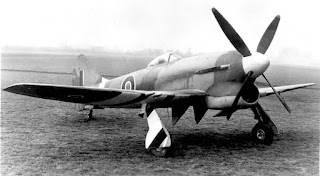
1945 Hawker Tempest powered by Napier Sabre H-24.

Problems however soon emerged, related mostly to quality control in the hurried development and manufacturing processes of wartime and inadequacies in the metallurgy used in the complex cylinder liners required by the sleeve valves.  Once these issues were solved, the Napier Sabre proved an outstanding power-plant, powering the Typhoon, the definitive British ground-attack fighter of the war.  Development continued even after the problems had been solved with the intention of using a redesigned supercharged to produce an engine which could power a high-altitude interceptor but the days of the big piston-engined fighters was drawing to a close as the jet age dawned.  Physics also intervened, whatever power a piston engine could generate, the need to use a spinning propeller for propulsion was a limiting factor in performance; above a certain speed, a propeller is simply torn off.

The little sabre

The short stature of Victor Emmanuel III (1869–1947; King of Italy 1900-1946) with: (left to right), Aimone of Savoy, King of Croatia (Rome, 1943), Albert I, King of the Belgians (France, 1915), his wife, Princess Elena of Montenegro (Rome 1937) & Adolf Hitler (1889-1945; Führer (leader) and German head of government 1933-1945 & head of state 1934-1945), observing navy manoeuvres (Gulf of Naples, 1938).  Note his sometimes DPRKesque hats.

Technically, Victor Emmanuel didn’t fit the definition of dwarfism which sets a threshold of adult height at 4 feet 10 inches (1.47 m), the king about 2 inches (50 mm) taller (or less short) and it’s thought the inbreeding not uncommon among European royalty might have been a factor, both his parents and grandparents being first cousins.  However, although not technically a dwarf, that didn’t stop his detractors in Italy’s fascist government calling him (behind his back) il nano (the dwarf), a habit soon picked up the Nazis as der Zwerg (the dwarf) (although Hermann Göring was said to have preferred der Pygmäe (the pygmy)).  In court circles he was know also, apparently affectionately as la piccola sciabola (the little sabre) a nickname actually literal in origin because the royal swordsmith had to forge a ceremonial sabre with an unusually short blade for the diminutive sovereign to wear with his many military uniforms.  His French-speaking Montenegrin wife stood a statuesque six feet (1.8 m) tall and always called him mon petit roi (my little king).  It was a long and happy marriage and genetically helpful too, his son and successor (who enjoyed only a brief reign) very much taller although his was to be a tortured existence Still, in his unhappiness he stood tall and that would have been appreciated by the late Duke of Edinburgh who initially approved of the marriage of Lady Diana Spencer (1960-1997) to the Prince of Wales (b 1948) on the basis that she “would breed some height into the line”.

From Sabre to Sabra

The early (left) and later (right) frontal styling of the Reliant Sabre.  The catfishesque look recalled the last of the Packards (1958) and the Daimler SP250 (1959-1964) but was revised in 1962, the update conceptually similar to that used by both MG (for the MGB GT (1965-1980)) and Triumph (for the Spitfire-based GT6 (1966-1973)) to render roadsters as hatchback coupés).  With the facelift, the bizarre and rather lethal looking dagmars were retired.

The origins of the Reliant Sabre (1961-1964) were typical of many English sports which emerged during the 1940s & 1960s as designers with alacrity began to exploit the possibilities offered by fibreglass, a material which had first been used at scale for larger structures during World War II (1939-1945).  The Sabre was thus the marriage of a chassis from one manufacture with the body of another; that’s how things sometimes were done at a time when there were few design rules or safety regulations with which to conform.  The era produced a few successes and many failures, the attraction being with only small amounts of capital, what would now be called “start-ups” could embark on small-volume production of cars which could be shown at motor shows alongside Aston Martins and Ferraris.

Reliant, a Stafford-based niche manufacturer since the 1930s, were contracted to handle the production and in the normal manner such things were then done, the parts-bins from many places (not all automotive) provided components from engines & transmission to door handles.  As a roadster, the Sabre was launched in 1961 and while on paper the specification was attractive, it had many of the crudities and foibles which afflicted many low-volume products and it was slightly more expensive than the more refined, better equipped MGA and later MGB.  Taking a traditional approach to the problem, Reliant in 1962 released the Sabre Six, fitted with the Ford Zephyr's 2.6 litre (156 cubic inch) straight-six in place of the 1.7 litre (104 cubic inch) four.  That resolved any performance deficit and the new car was as fast as anything in its price bracket but it remained in many ways crude and sales were always sluggish; of the 77 produced, all but two were coupés.

1963 Autocars Sabra Sport GT advertisement with corporate tsabár logo.  Note the woman driver, something then done quite selectively in advertising in the West.

So the Sabre was a failure but the chassis was fundamentally sound and it was used as the basis for the Scimitar coupé, a better developed vehicle with enough appeal to remain available until 1970 but it was as a shooting brake, released in 1968 the car found great success, available in a number of versions until 1986.  A quirkier second life for the Sabre however came in Israel where in 1961 it entered production as the Autocars Sabra (Autocars the the operation behind the Reliant version).  Sabra was from the Hebrew צַבָּר (tsabár) (prickly pear cactus), the word re-purposed in the Modern Hebrew created after the creation of the state to mean “a Jewish person born in Israel”.  In this context, sabra predated the establishment of the Jewish state (1948) and use was widespread during the British mandate for Palestine (1922-1948).  Etymologists tracing the history suggest it was used originally as a derogatory term, those from recent waves of immigration thought “rough and lacked social polish” but by the 1950s, it had become positive, the new settlers lauded as being like the prickly pear: “tough on the outside, sweet under the skin”.  For Autocars, the emphasis was on the “born in Israel” aspect, a bit of a leap considering the international origin of the design and much of the componentry but Autocars (founded in 1957), was at the time the country’s only manufacturer of passenger vehicles so it was something to emphasize.  The Sabra's association of the cactus with such people was intended to be suggest something positive and the tsabár (in the botanical sense) also provided the inspiration for the green on yellow corporate logo.