Sunday, October 9, 2022

Gaiter

Gaiter (pronounced gey-ter)

(1) In fashion, a covering of cloth or leather for the ankle and instep and sometimes also the lower leg, worn over the shoe or boot.

(2) A waterproof covering for the ankle worn by climbers and walkers to prevent snow, mud, or gravel entering over the top of the boot.

(3) A cloth or leather shoe with elastic insertions at the sides.

(4) An overshoe with a fabric top.

1765-1775: From the French guêtre (belonging to peasant attire) from the Middle French guiestres (guestes the plural), from the Old French gueste, possibly from the Frankish wasta &  wastija (wrist) from the Proto-Germanic wastijō (garment; dress) and thus related to the German rist (wrist, ankle (and the source of the English wrist and the German Rist (instep)), from the primitive Indo-European root wer- (to turn, bend).  It was cognate with the Middle High German wester (a child's chrisom-cloth), the Middle High German westebarn (godchild), the Old English wæstling (a coverlet) and the Gothic wasti (garment; dress).  The original sense in English was "leather cover for the ankle".  Gaiter is a noun, the present participle is gaitering and the past participle gaitered; the noun plural is gaiters.

The related noun spat (short gaiter covering the ankle) which (except in technical and commercial use) is used only in the plural dates from 1779 and was a shortening of spatterdash (long gaiter to keep trousers or stockings from being spattered with mud), the construct being spatter + dash, the same idea as the noun dashboard which was a timber construction attached to the front of horse-drawn carriages to protect the passengers from mud or stones thrown up when the beasts were at a dash.  The figurative use of spats to refer the coverings used to conceal the (usually rear) wheels of a car by encapsulating the aperture described by the wheel-arch persisted in the UK and most of the old British Empire but in North America, "fender skirts" came to be preferred.

Spats (left) and gaiters (centre & right).  Historically, gaiters were either medium (mid-calf) or long (reaching to the knee) while the shorter variations, extending from ankle to instep, were known as spats.  In the fashion industry, the terms gaiters and spats are often used interchangeably and except among the equestrian and other horse-oriented crowds, they now exist only as a fashion item, improvements in the built-environment meaning the need for them as functional devices has diminished.  These days, spats tend to be seen only in places like the Royal Enclosure at Ascot or smart weddings (used as a wealth or class signifier) although variations are still part of some ceremonial full-dress military uniforms.  Technically, a spat probably can be called a “short” or “ankle-length” gaiter but it’s wise to use “spat” because gaiters are understood as extending higher towards the knee.

Lindsay Lohan in boots with emulated gaiters, on her way to frozen yoghurt shop, Los Angeles, 2009.

Historically, gaiters were detachable and secured with a variety of fastenings (buttons, ties, buckles and even zips and Velcro), the advantage being they could be cleaned separately from the clothing they were used to protect.  Particularly in the longer versions, the leg-warmer fad of the 1980s was a borrowing of the look.  Boots with what is essentially a contrasting panel (often of a suede-like material) extending from the ankles sometimes as high as just below the knee capture the look of the gaiter.

Saturday, October 8, 2022

Angioedema

Angioedema (pronounced an-jee-oh-i-dee-muh)

In pathology, a swelling that occurs just beneath the surface of the skin or mucous membranes.

1888: The construct was angio- + edemaAngio was from the Ancient Greek γγεον (angeîon) (vessel, urn, pot), a word-forming element meaning "vessel of the body," now often "covered or enclosed by a seed or blood vessel," from a Latinized form of the Greek angeion (case, capsule, vessel of the body), diminutive of angos (vessel, jar, vat, vase) of unknown origin but perhaps a Mediterranean loan-word.  The spelling if used before a vowel is angi-.  Edema (excessive accumulation of serum in tissue spaces or a body cavity) dates from circa 1400 (also as idema (a swelling filled with phlegmatic humors) and is from the Ancient Greek οδημα (genitive oidēmatos)(oídēma) (a swelling tumor), from οδέω (oidéō) (I swell), oidos (tumor, swelling) & oidéin (to swell) from the primitive Indo-European oid (to swell), source also of the Latin aemidus (swelling), the Armenian aitumn (a swelling) & aytnum (to swell), the Old Norse eista (testicle) the Old High German eittar (pus) and the Old English attor (poison (which which makes the body swell)).  Famously it's the first element in Oedipus.  In historic English texts are the alternative forms oedema & œdema, both non-standard and archaic except in historic reference.

Angioedema: pathologic and induced

Manifesting particularly in younger females, frequently as an allergic reaction to foods or drugs, the condition was originally called angioneuroticedema when described in 1882 by German internist and surgeon Heinrich Quincke (1842–1922).  There had been earlier clinical discussions in the literature but until Quincke published his reports, the condition had never been named.  In 1888, the Canadian physician Sir William Osler (1849–1919), coined the term "hereditary angio-neurotic edema" after noting there may be some hereditary basis and the words "angioneuroticedema" (directly from the German) and the simplified "angioedema" were soon in use.  The official (but now rarely used) alternative name is "Quincke disease: and in casual use there’s also "giant hives", "giant urticaria" and "periodic edema".

For specific purposes, it’s possible to induce localized instances of angioedema, the best known of which are those created from the use of "lip fillers" (in the West almost always some form of synthetic hyaluronic acid).

Angioedema is often seen in conjunction with hives (urticaria), a condition up to one in five people will develop at some time in their life and of these, a third will suffer angioedema as well.  Angioedema as an isolated condition, without hives, is much less common.  If the conditions occur together, the hives will itch and the angioedema will be itchy, hot or painful.  In isolation, angioedema will manifest either as itchy, hot and red swellings which are often large and uncomfortable or as skin-colored swellings which, while neither itchy nor burning, are often unresponsive to antihistamines.  In most patients, angioedema eventually disappears though it may reoccur following infection, when under stress or indeed with no obvious cause.  Although it tends to be a recurrent problem that reappears throughout life, angioedema is seldom caused by a serious underlying disease, nor does it cause serious illness or induce damage to internal organs.

Most commonly affected are the face, lips, tongue, throat and genital areas, the swelling lasting usually between one to three days although, in rare cases, there can be swelling of internal organs like the oesophagus, stomach or bowel which can trigger chest or stomach pains.  While itchy, tingling, or burning, often there are no symptoms other than the discomfort of the swelling.  Angioedema does not damage internal organs like kidneys, liver or lungs, the only danger being if the throat or the tongue swell severely, causing difficulties breathing and severe cases can demand the early use of medications such as adrenaline for anaphylaxis or icatibant for hereditary angioedema (HAE).  If the condition does not respond to these treatments, hospitalization may be required.

Ms Andrea Ivanova, before & after.

Few influencers have revealed a purpose more specific than Ms Andrea Ivanova (b 1998), a student from the Bulgarian capital Sofia, who has had over twenty injections of hyaluronic acid in her quest to have the world’s plumpest lips.  The results have been "encouraging" but, seeking additional fullness, she indicated recently she intends to pursue another course of injections.  Ms Ivanova is also a collector of Barbie dolls, the aesthetic of which she admires, and these are said to provide the inspiration for some of the other body modifications and adjustments she's undertaken.  Like the lips, other bits remain a work-in-progress, Ms Ivanova documenting things on Instagram where she enjoys some 32K followers.

Ms Andrea Ivanova: Instagram progress report.

Friday, October 7, 2022

Balkanize

Balkanize (pronounced bawl-kuh-nahyz)

(1) To divide a country, political entity or other geographical territory into small, quarrelsome, ineffectual states (can be initial upper or lower case depending on context of use).

(2) To divide groups or other constructs into contending and usually ineffectual factions (should always be initial lower case).

Circa 1920: A compound word balkan + ize.  Balkan is (1) the descriptor of the geographical Balkan Peninsula and (2) a general term of description for all or some of the countries within and beyond that geographical space.  Word is of Turkic origin, related to the Turkish balkan (wooded mountain range).  The ize suffix is from the Middle English isen (ise, ize), from the Old French iser (ize) from the Latin izāre (ize), derived from the Ancient Greek ίζειν (ízein), the ultimate root being the primitive Indo-European verbal suffix idyé.  It was cognate with other verbal suffixes, the Gothic itjan, the Old High German izzen and the Old English ettan.  It’s often used in conjunction with the suffix ation to produce the suffix forming nouns denoting the act, process, or result of doing something, or of making something, ie a noun of action (eg balkanization).  It’s from the Middle English acioun & acion, from the Old French acion & ation, derived from the Latin ātiō, an alternative form of tiō (from whence tion).  The alternative spelling is balkanise, a mostly British form.

Geopolitics: The Balkans.

Balkanize was coined to describe the turmoil on the Balkan Peninsula circa 1878-1913 when the nominally European section of the Ottoman Empire fragmented into small, warring nations.  There’s no consensus among etymologists regarding the author, most preferring, on the basis of documentary evidence, the English writer James Louis Garvin (1868-1947) while other suggests earlier Germanic sources. The geographical concept of the Balkan Peninsula dates from 1808 which conveniently aligned with the European provinces of the Ottoman Empire although the first known use of the word appears in a fourteenth century Arab map which named the Haemus Mountains and Balkan and Ottoman diplomats used the word in the 1560s.  Otto von Bismarck (1815–1898; Chancellor of the German Empire 1871-1890), Chancellor of Germany during the early decades of the Second Reich, well understood the instability of the Balkans and the threat its squabbles posed to European civilization.  While he affected a complete uninterest in the place, once saying the Balkans wasn’t worth “the bones of one German soldier” and claimed never to bother opening the diplomatic bag from Constantinople, the troubles of the place often absorbed much of his time.  Although the quote "…the great European War would come out of some damned foolish thing in the Balkans" attributed to him may be apocryphal, he may have predicted the origins of World War I (1914-1918), many sources documenting his prophecy “…it will start in the east” although, much of what he wrote in his memoirs may be retrospective foresight.  Some though recorded their thoughts on the Balkans when memory was fresh.  While working at the UK Foreign Office in 1915, the future politician Duff Cooper (1890–1954) was dealing with the seemingly intractable disputes between Serbia and Bulgaria while managing the effects on Macedonia and Roumania (sic),  He noted in his diary: "If only all those damned little states could be persuaded to pull together."  In the hundred-odd years since, that must have been a sentiment felt by many foreign ministers.  

Geography: The Balkan Peninsula.

To geographers, the Balkans is the peninsula south of Eastern Europe, surrounded by the Adriatic, the Ionian, the Aegean and the Black Sea; to the east lies Asia Minor.  Although there's little dispute among geographers, there have been many disputes about which states should be thought of as "Balkan".  Scholars have their reasons for their particular construct of what makes a geopolitical entity characteristically "Balkan" while others have their own agenda.  At the moment, the closest to a consensus is that eleven nations constitute (politically) the Balkans: (1) Albania, (2) Bosnia and Herzegovina, (3) Bulgaria, (4) Croatia, (5) Kosovo, (6) Moldova, (7) Montenegro, (8) North Macedonia, (9) Romania, (10) Serbia & (11) Slovenia.  It’s because of the historic construct of Greece as a cradle of Western civilization that, despite the geography, it’s not considered Balkan.  A different reservation is applied to the small portion of Türkiye (formerly Turkey) that lies northwest of the Sea of Marmara; because most of the Turkish land-mass lies in Asia-Minor, it’s thought part of West Asia although historically, when it constituted the core of the Old Ottoman Empire, it wasn’t unusual for it to be spoken of as “European”, Nicholas I’s (1796–1855; Tsar of Russia 1825-1855) the memorable phrase describing Turkey as the “sick man of Europe” ever since recycled when criticizing whichever European country was most obviously in economic decline.  In one form or another, Türkiye's application for membership of the EU has languished in various in-trays since 1959 (it was then seeking associate membership of the EEC (European Economic Community)) so the moment of it being thought European may have passed; even Ankara seems to have lost hope.

Lindsay Lohan on the cover of the Croatian edition of Cosmopolitan, May 2006.  Hearst also publishes a Serbian edition.

For centuries, wars, conquest and population movements have meant cross-cutting cleavages have beset the Balkan Peninsula, the bloody break-up in 1992 of the former Yugoslavia (formed at the end of World War II (1939-1945)) the most recent major event and some Balkan states are also considered "Slavic states" as they are typically defined as Slavic-speaking communities (Bosnia and Herzegovina, Bulgaria, Croatia, Kosovo, Macedonia, Montenegro, Serbia, and Slovenia), something which influences their relations with nations to the east.  The other regional phrase of note is “Western Balkans”, used to refer to the countries on the western edge, along the Adriatic coast (Albania, Bosnia and Herzegovina, Croatia, Kosovo, Macedonia, Montenegro, and Serbia).  The ripples of the convulsions of the last round of balkanization, triggered by the wars of 1991-1995 which followed the breakup of Yugoslavia, may have played out with the constructs of North Macedonia, Kosovo and Montenegro now formalized (although Kosovo remains a work in political progress).  Although there remains the hope the gradual integration of the Balkan states into the EU may impose a permanent peace, the history of the region does suggest it’s one of those places best managed by competing spheres of influence which can administer rolling truces punctuated by occasional, small ethnic wars to effect minor adjustments to borders.  One hopeful sign however is that whatever the antagonistic bellicosity of Balkan politicians, the countries do tend to vote for each other in the Eurovision Song Contest.

Thursday, October 6, 2022

Plastic

Plastic (pronounced plas-tik)

(1) Any of a group of synthetic (and usually hydrocarbon-based) polymer materials which may be shaped when soft and subsequently hardened.

(2) In slang, a credit card, or credit cards collectively (an allusion to the material typically used in their manufacture); money, payment, or credit represented by the use of a credit card or cards.

(3) Something (or a number of things), made from or resembling plastic (sometimes merely descriptive, sometimes as a slur suggesting inferiority in quality).

(4) Capable of being molded or of receiving form; having the power of molding or shaping formless or yielding material.

(5) In psychology, the quality of being easily influenced; impressionable.

(6) In biology of or relating to any formative process; able to change, develop, or grow; capable of adapting to varying conditions; characterized by environmental adaptability.

(7) Figuratively and in slang, something superficially attractive yet unoriginal or artificial; insincerity or fakeness in an individual or group.

(8) A widely used combining form (plastic surgery, plastic bullet, plastic explosive, chloroplastic, protoplastic etc).

(9) A sculptor or molder; any solid but malleable substance (both obsolete).

In physiology, producing tissue (obsolete).

1625–1635: From the Latin plasticus (that which may be molded or relating to that which has been molded), from the Ancient Greek πλαστικός (plastikós) (fit for molding, capable of being molded into various forms; pertaining to molding), from πλάσσω (plássō) (to mold, to form).  In Hellenic use, in relation to the arts, there was plastos (molded, formed) the verbal adjective from plassein (to mold) and from the Greek plastikós was derived both plaster and plasma.  Words vaguely or exactly synonymous (depending on context) include elastic, molded, synthetic, bending, giving, yielding, cast, chemical, ersatz, phony, pseudo, substitute, ductile, fictile, formable, moldable, pliable, pliant, resilient, shapeable, flexible & amenable.  Plastic is a noun, verb & adjective, plastically & plasticly are adverbs and plasticity is a noun; the noun plural is plastics and the seventeenth century spelling plastick is long obsolete.

Three decades of progress in consumer products, Soviet style: Two comrades approaching their 1957 Trabant P50 in stylish korallenrot (coral red) over creme (cream) and 1990 Trabant 601 in a by then more typical beige (right).  In fairness, a 1959 and 2000 Mini enjoy a not dissimilar degree of visual similarity.  Note the 1957 Trabant's amber turn signals; Trabants were factory-fitted with flashers at a time Rolls-Royce and other manufacturers in the “advanced West” were still installing antiquated semaphores.

Materials with plastic properties were attractive for car producers for different reasons.  It made low-volume production runs viable because the tooling costs were a fraction of the cost of those using steel or aluminum and in some cases the light weight and ease of modification was an attraction.  In the GDR (German Democratic Republic, the old East Germany), the long-running (1957-1991) Trabant's bodywork was made with Duroplast, a composite thermosetting plastic (and a descendant of Bakelite).  It was a resin plastic reinforced with fibres (the GDR used waste from both cotton & wool processing) and structurally was similar to fibreglass although the urban myth Trabants were made from reinforced cardboard persists.  The first Trabants left the Saxony production line in November 1957, only weeks after the Soviet Union had startled the world by launching Sputnik, the first man-made Earth satellite.  Launched into an elliptical low Earth orbit where it circulated for three months, it did nothing other than transmit radio pulses which, because of the flight path, could at various time be detected just about anywhere below.  Compared with what space programmes would become, it sounds now a modest achievement but at the time was a sensation and the event which triggered the “space race”.

Low-emission Trabant (rated at 1 PP (pony-power)) with driver using semaphore signal to indicate intention to turn left, Barnim district, Bernau bei Berlin, GDR, 1981.

In the Eastern Bloc there weren’t many marketing departments but there was a vast propaganda apparatus and opportunistically, the name Trabant was derived from the Middle High German drabant (satellite; companion; foot soldier) which at the time was a positive association with the famous Sputnik but it later became emblematic of the economic and moral bankruptcy of the whole communist project: While by the fall of the Berlin Wall (1961-1989) Soviet satellites and related technologies greatly had advanced, the “Trubi” remained a little changed “1957 time capsule”.  Although much despised in the early 1990s in the aftermath of the break-up of the Soviet Union (1922-1991), opinions softened and the survivors of the more than three million produced (a greater volume than BMC's (British Motor Corporation) Mini (1959-2000)) gained a cult following.  More correctly, the marque gained a number of cult followings, some attracted by the “retro-cuteness”, some with genuine, Putinesque nostalgia for the old Soviet system and other with a variety of projects as varied as EV (electric vehicle) conversions, the installation of V8s for drag-racing and the re-purposing in many forms of competition.  The Trubi is now a fixture in the lower reaches (a notch above the Austin Allegro) of the collector market.
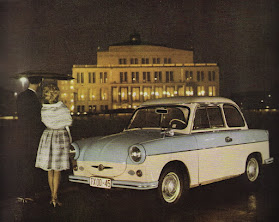
Two comrades with their 1960 Trabant P50 in stylish two-tone pastellblau (pastel blue) over creme (cream) admiring the Leipzig Opera building, Saxony, circa 1961.

The photograph of the horse-drawn Trubi, while not representative of the entire Eastern Bloc experience under communist rule, captures a sight which would not have been uncommon away from large urban centres (which could be grim enough).  Dr Henry Kissinger (1923-2023; US national security advisor 1969-1975 & secretary of state 1937-1977) said his abiding memory of Eastern Bloc cities was of “the smell of boiled cabbage and an unrelenting greyness.  In fairness, English cooks probably inflicted worse on the noble cabbage than anything done behind the Iron Curtain but his sense of “greyness” was literal, the appalling air pollution of the GDR (its industrial base powered by burning lignite (from the Latin lignum (wood)) and other forms of low-grade, “dirty coal”), thus the griminess of the buildings.  Places like London similarly were affected and it was only after the 1952 “Great Smog of London” that the Clean Air Act (1956) became law, meaning air quality began slowly to improve.  That the photographs of the era look so drab was not because of the film stock; buildings literally were “dirty”.  Because of various advances in health care, it’s difficult to quantify the contribution to reducing mortality achieved by reducing air pollution but few doubt it was significant.

1953 Chevrolet Corvette (C1).

By 1952 the success in the US of MG and Jaguar had made it clear to Chevrolet that demand existed for sports cars and the market spread across a wide price band so with the then novel GRP (glass reinforced plastic, soon better as “fibreglass”) offering the possibility of producing relatively low volumes of cars with complex curves without the need for expensive tooling or a workforce of craftsmen to shape them, a prototype was prepared for display at General Motors’ (GM) 1953 Motorama show.  Despite the perception among some it was the positive response of the Motorama audience which convinced GM’s management to approve production, the project had already be signed-off but the enthusiastic reaction certainly encouraged Chevrolet to bring the Corvette to market as soon as possible.  The name Corvette was chosen in the hope of establishing a connection with the light, nimble naval vessels.

1969 Chevrolet Corvette (C3) L88 Convertible.

The haste brought its own, unique challenges.  In 1953, Chevrolet had no experience of large-scale production of GRP-bodied cars but neither did anybody else, GM really was being innovative.  The decision was thus taken to build a batch of three-hundred identical copies, the rationale being the workers would be able to perfect the assembly techniques involved in bolting and gluing together the forty-six GRP pieces produced by an outside contractor.  Thus, by a process of trial and error, were assembled three hundred white Corvettes with red interiors, a modest beginning but the sales performance was less impressive still, fewer than two-hundred finding buyers, mainly because the rate of production was erratic and with so few cars available for the whole country, dealers weren’t encouraged to take orders; uncertainty surrounded the programme for the whole year.  Seldom has GM made so little attempt actually to sell a car, preferring to use the available stock for travelling display purposes, tantalizing those who wanted one so they would be ready to spend when mass-production started.

2023 Chevrolet Corvette (C8) Z06 Coupe.

From this tentative toe in the plastic pond, seventy years on, the Corvette remains in production as one of GM’s most profitable lines.  Introduced in 2020, the eighth generation (C8) Corvette is for the first time mid-engined and the materials used are radically different from the steel & GRP of 1953.  The platform is now a spaceframe (of six die-cast aluminium-alloy assemblies, augmented with stampings, extrusions, castings and hydro-formed tubes augmented by a single CFRP (carbon fiber-reinforced composite) piece) atop which is attached a body fashioned from CFRP.  Radically different though the C8 is in design, construction and the use of materials, the concept of a “plastic” body over a metal structure remains true to the 1953 C1. 

The notion of being "capable of change or of receiving a new direction" emerged in 1791 and this idea was picked up in 1839 when the term plastic surgery was first used to describe a procedure undertaken to "remedy a deficiency of structure" is recorded by 1839 (in plastic surgery).  The most familiar use referring to the hydrocarbon-based polymers dates from 1909 when the expression "made of plastic" gained currency which remained literal until 1963 when the US counterculture adopted it as slang meaning "false, superficial", applying it both the political and consumer culture.  The noun plastic (solid substance that can be molded) however appears first to have been used in 1905 and was applied originally to dental molds.  Our plastic age can be said to have begun in 1909 when a US patent was issued for Polyoxybenzylmethylenglycolanhydride (marketed as Bakelite), a resin created by the reaction between phenol & formaldehyde.  Chemists had for years been experimenting with various compounds, much of the research funded by the petroleum industry which was seeking some profitable use for its by-products but Bakelite was the first plastic material which had characteristics which made it suitable for manufacture at scale and adaptability to a wide range of uses.  Thus the first commercially available plastic made from synthetic components which retained its formed shape if heated, it was developed by Belgian chemist Leo Baekeland (1863-1944) while working in the US.

The “plastics” at lunch with product-placement, plastic packaging and plastic trays, Mean Girls (2004).  Note the plastic straws.

On 10 March 2025 the White House issued a fact sheet advising Donald Trump (b 1946; US president 2017-2021 and since 2025) had signed an executive order to “end the procurement and forced use of paper straws.”  Explaining the policy of the previous administration had been an “irrational campaign” which “forced Americans to use non-functional paper straws”, Executive Order 90 FR 9585 (2025-02735) was part of the “BRINGING BACK COMMON SENSE” theme of the second Trump administration.  To avoid the fake news media being able to accuse the fact sheet of pedalling “alternative facts”, the White House provided a scientific rationale, noting “paper straws use chemicals that may carry risks to human health – including ‘forever chemical’ PFAS (per- and polyfluoroalkyl substances) which are known to be highly water soluble and can bleed from the straw into a drink. A study found that while PFAS were found in paper straws, no measurable PFAS were found in plastic straws.”  Additionally, “Paper straws are more expensive than plastic straws, and often force users to use multiple straws.  Paper straws are not the eco-friendly alternative they claim to be – studies have shown that producing paper straws can have a larger carbon footprint and require more water than plastic straws.  Paper straws often come individually wrapped in plastic, undermining the environmental argument for their use.”  Executive Order 90 FR 9585 (2025-02735) was an indication the second Trump administration will not be “…caving to pressure from woke activists who prioritize symbolism over science.”  Like face-mask wearing during the COVID-19 pandemic whether one uses paper or plastic straws may enter the culture wars as a marker of one’s political position.

Plastic explosive (explosive material with a putty-like consistency) became familiar to the military only in the Second World War and more generally in the 1950s but the first use of the term dates from 1894.  Earlier uses include describing the creative or formative processes in art generally as plastic, an echo of the use which sometime prevailed in Hellenic culture but this faded after a few decades during the seventeenth century although the noun plasticity (capability of being molded or formed; property of giving form or shape to matter) endured after first being noted in 1768.  A nineteenth century adoption was in the biological sciences in the sense of “organisms capable of adapting to varying conditions; characterized by environmental adaptability and in the same era, in engineering it came to mean “of or pertaining to the inelastic, non-brittle, deformation of a material”.

The success of Bakelite triggered a rush of development which produced the early versions of the numerous substances that can be shaped and molded when subjected to heat or pressure.  Plastics gain their plasticity because they consist of long-chain molecules known as polymers which flex but don’t break their bonds when subjected to all but extreme stresses.  They’re almost always artificial resins (but can be made from some natural substances such as shellac) and the best known are Polyvinyl chloride (PVC) and polystyrene.  Useful as it is, plastic (with a life measured in some cases in centuries) has emerged as a significant environmental threat, both as visible waste (and thus a threat in many way to wildlife) and as micro-plastic, microscopic-sized fragments which exist in the environment including the human food chain.

Piet Mondrian, neo-plastic painting and adhesive tape

Piet Mondrian’s (1872-1944) 1941 New York City 1 is a series of abstract works created with multi-colored adhesive paper tape.  One version first exhibited at New York’s Museum of Modern Art (MOMA) in 1945 has since 1980 hung in the Düsseldorf Museum as part of the Kunstsammlung Nordrhein-Westfalen’s collection and recently it was revealed for the past 77 years it has been hanging upside down.  The work is unsigned, sometimes an indication the artist deemed it unfinished but Mondrian left no notes.

Mondrian’s 1941 New York City 1 as it (presumably correctly) sat in the artist's studio in 1944 (left) and as it was since 1945 exhibited (upside-down) in New York and Düsseldorf (right).  Spot the difference. 

The decades-long, trans-Atlantic mistake came to light during a press conference held to announce the Kunstsammlung’s new Mondrian exhibition.  During research for the show, a photograph of Mondrian’s studio taken shortly after his death showed the work oriented in the opposite direction and this is being treated as proof of the artist’s intension although experts say the placement of the adhesive tape on the unsigned painting also suggests the piece was hung upside down.  How the error occurred is unclear but when first displayed at MOMA, it may have been as simple as the packing-crate being overturned or misleading instructions being given to the staff.  However, 1941 New York City 1 will remain upside because of the condition of the adhesive strips.  The adhesive tapes are already extremely loose and hanging by a thread,” a curator was quoted as saying, adding that if it were now to be turned-over, “…gravity would pull it into another direction.  And it’s now part of the work’s story.”

1941 New York City 1, Paris Museum of Modern Art.

The curator made the point that as hung, the interlacing lattice of red, yellow, black and blue adhesive tapes thicken towards the bottom, suggesting a sparser skyline but that “…the thickening of the grid should be at the top, like a dark sky” and another of Mondrian’s creations in a similar vein (the oil on canvas New York City I (1942)) hangs in the Musée National d’Art Moderne in Paris with the thickening of lines at the top.  Whether Mondrian intended 1941 New York City 1 to be part of his oeuvre or it was just a mock-up in adhesive tape for the oil-on canvas composition to follow isn’t known, artists having many reasons for leaving works unsigned.  Mondrian was one of the more significant theorists of abstract art and its withdrawal from nature and natural subjects.  "Denaturalization" he proclaimed to be a milestone in human progress, adding: "The power of neo-plastic painting lies in having shown the necessity of this denaturalization in painterly terms... to denaturalize is to abstract... to abstract is to deepen."   

Plasticity in catwalk fashion

Bella Hadid, Coperni show, Paris Fashion Week, October 2022.

Although many in the industry prefer to talk about natural fibres like silk or linen, it’s plastics like nylon or polyester which make possible both the shape and behavior of many modern garments and their mass-production.  One possibility offered by plastics was illustrated at the 2022 Paris Fashion Week in October when as the concluding set-piece of the Coperni show, Bella Hadid (b 1996) appeared on the catwalk wearing only G-string knickers.  There she paused while for about a quarter hour, two men sprayed her body with what appeared to be white paint.  Once done, a woman emerged to cut a thigh-high asymmetric slit and adjusted things slightly to render an off-the-shoulder look.  Essentially a free-form exercise in 3D printing, the spray-on dress was left deliberately unfinished so as not to detract from the performance; had such a creation been built behind closed doors, either on a human or mannequin, re-usable and adjustable formwork would likely have been used to catch overspray and allow things like hems, straps and splits more precisely to be rendered.  On the night though, the fraying at the edges was just part of the look and Ms Hadid looked wonderful, a thinspiration to the whole pro-ana community.  The term “sprayed on” had long been used to describe skin-tight clothing but the Coperni show lent it a literalism new to most.

On the catwalk, spray-painting a model had been done before, two robots used in Alexander McQueen’s spring 1999 show to adorn Shalom Harlow (b 1973) after the fashion of those used in car assembly plants but that was literally just paint onto a conventional fabric whereas Ms Hadid’s dress appeared over bare (though presumably some sort of lotion was used to suit the properties of the plastic) skin.  The spray-on material is called Fabrican, created by Dr Manel Torres who first demonstrated its properties in 2006.  It’s a liquid fibre, bound by polymers, bio polymers and greener solvents which evaporate on contact with a surface (like Ms Hadid’s skin and including water).  As a fabric, it’s said to have a similar texture to suede and can be manipulated like any other but the feel can be altered depending on the fibers (natural or synthetic) used in the mix and the shape of the nozzle used on the spray device.

Although an eye-catching example of the technology, Fabrican’s place in fashion business is likely to be as an adjunct device rather than one used to create whole garments.  It would be invaluable for Q&D (quick and dirty) solutions such as effecting repairs or adding something but it’s been demonstrated as long ago as 2010 at London Fashion Week without demand emerging though it may yet find a niche.  What more likely beckons is a role in medicine (perhaps especially for military medics in the field) as a sterilized (perhaps even an anti-bacterial) bandage-in-a-can.  Indeed, the style of dress created in Paris is known as the “bandage” dress.

Bella Hadid, Coperni’s 2023 show, Paris, 2022

Shalom Harlow, Alexander McQueen’s spring show, London, 1999.

Wednesday, October 5, 2022

Muse

Muse (pronounced myooz)

(1) To think or meditate in silence, as on some subject; to meditate upon.

(2) To gaze meditatively or in wonder (archaic though used still in poetry).

(3) A state of abstraction (archaic).

(4) Thoughtfully to comment or ruminate upon some topic.

(5) In Classical Mythology, originally the goddesses of song, meditation & memory, but latterly and more commonly as the nine daughters of Zeus and Mnemosyne who presided over various arts.

(6) The goddess or the power regarded as inspiring a poet, artist, thinker, or any goddess presiding over a particular art (sometimes lowercase); just about any source of inspiration.

(7) The genius or powers characteristic of a poet (always lowercase).

(8) As the acronym MUSE (Mainstream US English), the strain of US English considered to be standard or unmarked by dialectal variation in pronunciation, syntactic structures, or vocabulary, used in the mainstream news media and taught in (almost all) schools.

(9) A bar or poet (obsolete).

(10) A gap or hole in a hedge or fence through which a wild animal is accustomed to pass; a muset (rare though the concept is now often part of road or railroad construction as under or overpasses for the use of wildlife).

1300–1350: From the Middle English muse & musen (to mutter, gaze meditatively on, be astonished), from the Middle French muser, from the Old French (which may have been influenced by the Medieval Latin mūsus & mūsum (snout)).  The fourteenth century verb muse (to reflect, ponder, meditate; to be absorbed in thought) has a murky history, one strain of etymological thought being it was based on the idea of “standing with one's nose in the air” or even “to sniff about” (in the manner of a dog which has lost the scent), thus the link to muse (muzzle) from the Old French & Classical Latin mūsa (snout) of unknown origin.  The fourteenth century noun muse (one of the nine Muses of classical mythology) was from the Old French Muse and directly from the Classical Latin mūsa, from Ancient Greek Μοσα (Moûsa) (a muse (also music, song)), ultimately from the primitive Indo-European root men- (to think).  The sense of (an inspiring goddess of a particular poet (with a lower-case m-)) dates from the late fourteenth century.  Synonyms of the verb include brood, cogitate, consider, contemplate, deliberate, dream, feel, meditate, moon, percolate, ponder, reflect, revolve, roll, ruminate, speculate, think, weigh, chew over & mull over

The noun musing (act of pondering, meditation, thought) emerged at much the same time as a verbal noun from the verb.  The noun museum was first used in the 1610s to describe the university building in Alexandria and was from the Latin museum (library, study), from the Ancient Greek mouseion (place of study, library or museum, school of art or poetry (originally “a temple or shrine of the Muses”).  The earliest use in reference to English institutions was in the mid-seventeenth century when it was applied to libraries (in the sense of collections of books, documents and other manuscripts) for scholarly study (1640s) while the modern idea of a physical "building or part of a building set aside as a repository and display place for objects relating to art, literature, or science" dates from the 1680s.  Muse is a noun & verb, muser & musing are nouns, musing is a verb museful an adjective and musingly & musefully are adverbs; the noun plural is muses.

Portrait of Emma, Lady Hamilton (circa 1782) by George Romney.  Emma Hamilton (1765-1815) was the mistress of Vice-Admiral Lord Nelson (1758-1805) and muse of the portraitist, George Romney (1734-1802).

The acronym MUSE (Mainstream US English) seems first to have appeared in 1997 and describes what used to be called GA (General American), the unofficial standard accent of the United States.  It’s essentially the accent of much of the Midwest and the West and remains by far the most frequently heard on US broadcast news (regardless of political leanings or affiliation).  It’s thus something of an unofficial standard but does differ from the previous “prestige accent”, the so-called “trans-Atlantic” which was clipped and precise but without the exaggerated form of the UK’s RP (received pronunciation).  The critique of MUSE is that (MUSE) is often treated as morally superior, a view which of course implies negative perceptions of “non-standard languages”, a process of stigmatization which perpetuates dialect discrimination which can result in the disparagement or other mistreatment of users of non-standard varieties.  The acronym MUSE is merely descriptive among academics in the field but is politically divisive in that it’s thought by many as the superior accent in a hierarchy (an idea familiar in the UK) in which the regional forms (such as the Southern Accent) or those influenced by ethnic identity (such as African-American Vernacular English (AAVE)) are thought deviations from what is defined as “correct”.  A similar political movement is now promoting Ebonics (the construct a portmanteau of ebony + phonics which originally referenced the languages spoken by the descendants of slaves in the Caribbean, and North America but which was in the 1970s appropriated by African-American academic psychologist Professor Robert Williams 1930-2020), a defined sociolect of what technically is a sub-set of African-American English as an equally legitimate form of the language.  The dialect certainly differs from standard American English and its adoption as a political marker reflects the strain of multi-stranded separatism which now characterizes the positions taken by activists.  It’ll be interesting to see what happens because Ebonics is an example of how English has in the past evolved and, under the Raj, the British noted the adaptations their colonized peoples made to English and even adopted some of the words or expressions which proved useful.  Identity politics have of course evolved since the Raj and there’s now a view that to plunder something like Ebonics for the odd handy phrase would be an act of cultural appropriation and use must remain exclusive to people of color.

Lindsay Lohan, MUSE Magazine photo-shoot, January 2010.

Amuse (to divert the attention, beguile, delude) was a mid-fifteenth century verb from the Old French amuser (fool, tease, hoax, entrap; make fun of (literally "cause to muse" (in the sense of being distracted from some useful purpose)), the context being a- (from Latin ad- (through; towards), but here thought a causal prefix) + muser (ponder, stare fixedly).  This original sense in English is technically obsolete but echoes of the meaning live on in critiques the more serious-minded sometimes make of the more banal examples of popular culture.  For most of the eighteenth century, the word assumed the usual meaning “to deceive or cheat by first diverting attention”; the modern “bemuse” thus retaining something of the old meaning.  In the Ancient Greek amousos meant "without Muses (and hence "uneducated"), another connection some like to link to popular culture.  The Oxford English Dictionary (OED) noted “amuse” was never used by Shakespeare, indicating it wasn’t in widespread use before the seventeenth century.

In Classical Greek Mythology, the original three goddesses were Aoede (song), Melete (meditation), and Mneme (memory) but later writers fleshed-out the roll-call and scholars consider the standard canon to be the nine daughters of Zeus and Mnemosyne who presided over various arts: Calliope (epic poetry), Clio (history), Erato (lyric poetry), Euterpe (music), Melpomene (tragedy), Polyhymnia (religious music), Terpsichore (dance), Thalia (comedy), and Urania (astronomy).  In Roman mythology the Camenae were goddesses thought originally water deities, inhabiting a sacred grove and spring located outside the Porta Capena (gate in Rome's Servian Wall).  They were believed imbued with magic powers which could cure ailments and prophesy the future so in Roman religious rituals, the Camenae were offered libations of water and milk and it was the poet Quintus Ennius (circa 239–circa 169 BC) who identified them with the Muses; there they’ve remained.

Marilyn Monroe 1962 (left) & Lindsay Lohan 2011 (right).

Marilyn Monroe (1926–1962) has since her death been a visual muse for many in popular culture including Andy Warhol (1928-1987), Cynthia Sherman (b 1954), Richard Avedon (1923–2004), James Rosenquist (1933–2017), Richard Hamilton (1922-2011) & Richard Pettibone (b 1938), all of who followed their pursuit with a seriousness quite unfairly never afforded to her acting while she was alive.  Lindsay Lohan twice made a muse of Marilyn Monroe, in 2008 & 2011 reprising two of her photo sessions.