Wednesday, August 19, 2020

Fiat

Fiat (pronounced fee-aht, fee-at, fahy-uht or fahy-at)

(1) An authoritative decree, sanction, or order.

(2) A fixed form of words containing the word fiat, by which a person in authority gives sanction, or authorization; official sanction; authoritative permission.

(3) An arbitrary decree or pronouncement, especially by a person or group of persons having absolute authority to enforce it.

(4) As FIAT, the acronym for Fabbrica Italiana Automobili Torino (originally Italian Automobiles Factory, Turin, now Fiat Automobiles SpA and part of FCA (the Fiat Chrysler Automobiles conglomerate).  The companion initialism (as derogatory slang) in certain places (as an allusion to perceptions of unreliability) was “fix it again Tony”.

(5) In the law of England and some Commonwealth countries, an authority for certain actions issued by the Lord Chancellor (England) or the attorney-general (elsewhere).

(6) In the law of England, a warrant issued by a judge for certain purposes.

(7) As fiat currency, a government-issued currency backed not by the possession of a physical commodity (typically gold) but inherently by the issuing government (also called fiat money).

1625–1635: From the Latin fiat (literally “let it be done”, the third singular present subjunctive of fierī (be done, become, come into existence).  The original meaning was "authoritative sanction", fiat thus understood as it was used in the preamble of Medieval Latin proclamations and commands.  The Latin fierī was from the primitive Indo-European root bheue- (to be, exist, grow), used as passive of facere (to make, do).  The meaning "a decree, command, order" became formalized circa 1750 and remains in the legal vocabulary of English (and of some Commonwealth countries) law to this day.  Fiat is the third-person singular, fiats the simple present, fiating the present participle and fiated the simple past and past participle.  The noun plural is fiats.  In the transitive, it’s used in academic debate and in role-playing games although use is now less frequent.

It’s also sometimes is a reference to fiat lux (the famous “let there be light") in the biblical Book of Genesis.  In the Latin Vulgate Bible, the Hebrew phrase יְהִי אוֹר‎ (let there be light) is translated in Latin as fiat lux, the relevant scriptural passage (Genesis 1:3 in the Torah (the first part of the Hebrew Bible)) being dixitque Deus fiat lux et facta est lux (And said God let there be light, and there was light) although Fiat lux would actually translate literally as "let light be made" (fiat the third person singular present passive subjunctive form of the verb facio, meaning "to do" or "to make").  Fashions of form and conventions of use in language do however change and translators adjust their work to render sentences in a form familiar to the audiences of the day: The Douay–Rheims Bible (an English translation from the Vulgate made by members of the English College, Douai, under a commission from the Catholic Church and first published in 1858 in Reims, France) translated the phrase as "Be light made. And light was made."  In translations from the Old Testament, the Greek was usually γενηθήτω φς (genēthtō phôs) and the Latin fiat lux and lux sit.

Although the words authorization, directive, ruling, mandate, diktat, ukase, command, decree, dictate, dictum, edict, endorsement, mandate, ordinance, permission, precept, sanction & warrant often (in practical application and effect) overlap with fiat, fiat retains at law a precise technical meaning.  While there are variations, the power of an attorney-general in the Australian states to issue a fiat is broadly indicative of the scope (where it exists) in the English-speaking world (although in England all or some of these powers may instead be discharged by the Lord Chancellor).  Essentially, an attorney-general will grant a fiat if it is held to be in the public interest or for the efficient administration of justice.  In order to participate in a legal proceeding, a person must have "standing" which means their legal rights or interests have been or will be adversely affected by the conduct of another party.   If a person lacks standing, they can request the attorney-general to grant a fiat, or consent to bring the action in the AG's name, a practice sometimes called a "relator action".  An attorney-general has a personal discretion in the matter of fiats but will tend to consent to an issue only if things involve the enforcement or protection of a public right or interest.  What constitutes the public interest is a matter for the attorney and there are no circumstances in which they're obliged to grant a fiat but some jurisdictions require the reasons for a refusal to be provided in writing and tabled in parliament and provision for judicial review is sometimes possible.

FIAT (Fabbrica Italiana Automobili Torino)

Since 2021, the Italian car manufacturer FIAT has been a subsidiary of the Stellantis conglomerate, through its Italian division, Stellantis Europe.  In business since 1899, sometime in the late twentieth century, FIAT lost its way, essentially because of the need to respond to the challenge of the much-improved Japanese cars which, even if their dynamic qualities were uninspiring, offered very competitive pricing, reliability, superb build-quality, responsive dealer networks and high levels of standard equipment.  FIAT’s response was the same as that of many others which hadn’t expected the rapidity of improvement from the manufacturers of the far-east: they tried to produce “Japanese” cars only to find out the Nipponese were better at it and in the years since have never really recovered the spirit which for decades, once made even modest, low-priced FIATs genuinely exciting cars which sometimes were a joy to look at and often a pleasure to drive.

Some notable Fiats

Fiat 850 Spider (1965-1973).

Between 1964-1973 (although the commercial derivative, the 850 Familiare would last until 1976), Fiat produced a range of 850s, all rear-engined (which seemed at the time a good idea).  Most were utilitarian family cars or stubby coupés but most memorable were the 850 Spiders, exquisite little roadsters designed by Giorgetto Giugiaro (b 1938) while at Carrozzeria Bertone.  The lovely lines were uncluttered and the restraint extended to the engineering, resulting in a light, aerodynamic body which permitted the engine, although a modest 843 cm3 (51.44 cubic inch), busily to deliver surprising sprightly performance.  Notably too, in a masterpiece of design which eluded generation of English manufacturers, the convertible top folded effortlessly in a one-handed operation and tucked neatly away under a metal lid.

In 1968, except for the US market, the engine was enlarged to 903 cm3 (55.10 cubic inch) which sounds slight but in percentage terms was about the same increase Chevrolet during the same era performed on their small-block (327 (5.3 litre) to 350 cubic inch (5.7 litre)) & big-block (396 (6.5) to 427 (7.0)) V8s so the effect was noticeable, torque and top speed both benefiting (a little) and despite the bump in displacement, instead of being re-named to 900, the new model was instead called the 850 Sport.  US buyers got an engine with a slightly smaller bore, reducing the displacement to 817 cm(49.9 cubic inch), a quick and (literally) dirty solution to the new emission-control rules in that the regulations weren't imposed on engines smaller than 50 cubic inches.  Adding insult to injury, the US lighting laws forced Fiat to replace the elegant faired-in headlamps with rather ungainly sealed-beam units, a fate also suffered by machines as diverse as the Jaguar E-Type (XKE), Porsche 911 & 1912 and the Volkswagen Types 1 (Beetle) & 2 (Kombi, Microbus and such).  Between 1965-1973, 125,010 were built, 87,360 of which were sold in the US and the few survivors (rust was quite an issue) are a collectable, collectors attracted especially to the limited-production variations, the rare, highly-tuned Abarth version the most coveted.

Fiat 500 (2023), watercolor on paper by Monika Jones.  While the artist hasn't provided notes, it's tempting to imagine the inspiration was something like “Lindsay Lohan in white sun dress during a Roman summer, leaning on Fiat 500, painted in the tradition of Impressionism.”

A classic of the La Dolce Vita (1960) era, the rear-engined Fiat 500 was in continuous production between 1957-1975 and was the successor to the pre-war Fiat 500 Topolino, an even more diminutive machine which proved its versatility in roles ranging from race tracks to inner-city streets to operating as support vehicles used by the Italian Army in the invasion of Abyssinia (1935).  Almost 3.9 million of the post-war 500s (dubbed the Nuova Cinquecento (New 500)) were produced and as well as the two-door saloon (almost all fitted with a folding sunroof) there were three-door station wagons (the Giardiniera) & panel vans.  Although not all wore the 500 badge, in the home market, universally Italians called them the Cinquecentro.  There was also the unusual 500 Jolly, a cut down version built by Carrozzeria Ghia which featured wicker seats and a removable fabric roof in the style of the surrey tops once used on horse-drawn carriages.  The Jolly was intended as “beach car”, some carried on the yachts of the rich and although Ghia built only 650 originals, many 500s have since been converted to “Jolly Spec”, one of coach-building’s less-demanding tasks.  Being an Italian car, there were of course high-performance versions, the wildest of which was the Steyr-Puch 650 TR2 (1965-1969) which ran so hot it was necessary to prop open the engine cover while it was in use.  The Nuova 500’s successors never achieved the same success but such was the appeal of the original that in 2007 a retro-themed 500 was released although, al la Volkswagen’s “new Beetles” (1997-2019), the configuration was switched to a water-cooled front-engine with FWD (front-wheel-drive).

Fiat 130 Sedan (1969-1976).  Only four of the estates were made, the design undertaken in-house but construction was handled by Officina Introzzi (1960-1996), a coach-building house in Lombardy’s Como province with much experience in creating “long-roof” (station wagons, hearses, ambulances and such) versions of sedans and the 130 wagon was dubbed Familiare (Family).  The 130's rectilinear roofline meant the conversion was most accomplished, avoiding the ungainly lines which resulted when sedans with a sloping upper structure (notably the Rover P6 and Jaguar XJ) were given the treatment.

Had the Fiat 130 been sold badged as a Lancia or even (with a V8 engine) as a Ferrari (both marques at the time owned by FIAT), it might now be remembered as a great success rather than a failure.  It’s debatable whether brand-name consciousness was any less then than now but perceptions certainly counted against the 130 which moved FIAT suddenly into the upper middle-class market where not only were Mercedes-Benz and Jaguar-Daimler long dominant but the newer, bigger BMWs were also becoming established, building on the successes enjoyed by their smaller models.  Some at the time criticized the styling of the sedan, suggesting it showed little more imagination than increasing the dimensions of the company’s smaller, three-box designs but this was after all exactly the approach which had proved such as success for Mercedes-Benz and the 130 was a well-executed, balanced shape with an interior which displayed true Italian flair, offering something more modern than the leather & walnut of the Jaguar or the austere functionality of the German competition.  However, as a driving experience, the 130 was very much in line with the smaller Fiat sedans, demanding involvement from the driver to extract the most from the 2.9 litre (175 cubic inch) V6 but rewarding with fine handling and high levels of adhesion though ultimately not the refinement and effortlessness to which Jaguar and Mercedes drivers had become accustomed.  Not even increasing the engine capacity to 3.2 litres (197 cubic inch) helped sales and when production ending in 1976, only 15,089 had been built, Mercedes-Benz in the same time having produced 243,234 of their comparable (six cylinder) W114 sedans (230.6, 250, 280 & 280E).

Fiat 130 coupé (let, top), 130 Maremma (left, centre) and 130 Opera (left, bottom).  For years the orthodoxy was the Maremma & Opera were were both one-offs but the Italian Fiat Club claims Pininfarina built three of the shooting brakes (one in the Pininfarina museum, one now in the possession of the president of the Lancia Club (fitting given that all 130s should have been sold as Lancias) and one yet to be found.  The 130 Coupé was sometimes trimmed in pumpkin-orange Draylon velour (right) which was in the 1970s a more popular option than it likely would be today.  Other hues in velour and leather were also offered but students of the period will be pleased to lean the orange fabric could be paired with brown paint. 

If the avant-garde had thought the appearance of the 130 sedan underwhelming, few were less than effusive in praising the coupé when first it was displayed in 1971.  Styled by Paolo Martin (b 1943) of Carrozzeria Pininfarina , it makes an interesting contrast with the Citroën SM (1970-1975) on which barely a straight-line could be found and the 130’s knife-edged lines so defined the European rectilinear motif that no manufacturer has since attempted to push the envelope further.  In Europe, like the sedan, it was available with a five-speed manual gearbox which really suited the characteristics of the high-revving V6 but in most exports markets it was offered only with an uninspiring three-speed automatic, resulting in performance which, while not exactly anaemic, was lethargic by comparison. Again, the badge meant that sales suffered but Pininfarina saw the possibilities offered by the severe lines and fabricated two prototypes, the Maremma (a two-door shooting brake) in 1974 and the four-door Opera the following year.  Both were much admired but FIAT, disappointed and financially chastened by what would be their last foray into the (European) large-car market, had already decided to abandon the segment and neither project proceeded.  When production of the 130 coupé ended in 1977, only 4,498 had been made.  Those drawn to period pieces of 1970s styles are attracted especially by the 130 Coupés fitted with pumpkin-orange Draylon velour upholstery which, once seen, can't easily be forgotten

1973 Fiat 124 Sport Coupé (1967-1975).

The versatile platform on which FIAT built the 124 sedan (1966-1974) is now probably best recognized as the remarkable Russian-made Lada VAZ-21xx (Zhiguli in the home market but often known by the nickname Kopeyka) which in modified but substantially original form remained in production until 2012 (lasting ever longer in the license-built versions produced in Egypt).  However, FIAT also leveraged the platform even before selling designs and tooling to the USSR, in 1967 producing the stylish Fiat 124 Sport Coupé on a shortened wheelbase but otherwise using most of the sedan's mechanical and structural components.  Sold over three generations with three engine displacements (1438 cm3 (88 cubic inch), 1608 cm3 (98 cubic inch) & 1756 cm3 (107 cubic inch), it was an immediate hit in both home and export markets, and worldwide, often in short supply, sales constrained only by FIAT’s inability to increase production.  One quirk was the 1592 cm3 (97 cubic inch) version produced for the home market to take advantage of tax regulations, a regime which also produced oddities such as the two litre (122 cubic inch) Lamborghini & Ferrari V8s.  Over 285,000 had been built when in 1975, production ended and another 24,000 odd were built under licence by the Spanish manufacturer SEAT between 1970 and 1975.

Fiat 124 Sport Spider.  The purple 124 is a US model (identified by the "battering-ram" bumpers and fitted here with aftermarket Panasport wheels, roll bar and exhaust system) and the paint is a Ford part number called Ford Royal Plum; while not a factory shade, it really suits the car.  Resident in California's Napa Valley, rarely has there been a better color & licence plate combo.

Long lived though the 124 coupé was, the 124 roadster lasted another decade, produced by FIAT until 1982 and then by Pininfarina as a separate line until 1985.  The 124 Sport Spider used the same mechanical components as the coupé although in 1979, a two litre version of the familiar twin-cam four was made available, eventually gaining fuel-injection and a turbocharger although the most powerful of all was the Volumex, a supercharged model which for reasons of compatibility reverted to carburetors; it was sold only in Europe, there being no prospect of engineering the induction system to conform with US emission rules.  Despite being available only in left-hand drive, over 200,000 124 spiders were made in the two decades it was produced and, perhaps improbably, the roadster also enjoyed an illustrious career in competition, Abarth in 1971 co-operating with FIAT in homologating it in the FIA’s Group 4 for entry into the World Rally Championship where it proved competitive, winning the 1972 European Rally Championship despite competing against more obviously credentialed machinery.  The experience gained proved useful when the factory later embarked on more serious campaigns using the Lancia Stratos and the Fiat-Abarth 131.

Fiat G.55 Centauro (Centaur) (1943-1948).

The Fiat G.55 Centauro was a single-engine, single-seat fighter aircraft used by the Regia Aeronautica (though not in combat) and the Aeronautica Nazionale Repubblicana between 1943–1945.  Acknowledged by both sides as the best Italian fighter produced during the war, it was in some aspects as good as most competitive types of the era, only the very last of the Allied fighters demonstrably superior.  It was an extensively re-designed development of the earlier G.50 Freccia, distinguished by a highly efficient wing, a more slender fuselage, heavier armament and the use of the much more powerful Daimler-Benz 605A V12 engine or the FIAT-built RA 1050 equivalent.  Manufacture began early in 1943 but it wasn’t until shortly before Italy’s capitulation in September 1943 that the first planes were delivered to operational squadrons, too late to be deployed in combat.  Instead, it entered service with the pro-Nazi Aeronautica Nazionale Repubblicana, partly equipping six fighter groups operating with Luftwaffe units defending the skies of northern Italy.  Fewer than 300 had been completed by the end of hostilities in 1945 but the quality of the airframe was noted and production resumed in 1946, almost all of which were exported, used by the military in Argentina, Egypt and Syria.  Demand continued however and, once stocks of the now out-of-production Daimler-Benz and Fiat engines were exhausted, the front sub-frames were re-designed to use the Rolls-Royce Merlin V12; in this form production continued in 1948 as the G.59.

Fiat 127 (1971-1983).

Replacing the rear-engined 850s, the 127, along with the Peugeot 104 and Renault 5 set the template for what would be called the European “supermini” class, the design imperatives of which would last for three decades, the influences seen still today.  What however distinguished the Fiat 127 from the French (and soon the Japanese) competition was its Italian flair, the driving experience genuinely involving though admittedly at the expense of NVH (noise, vibration & harshness) to which others paid more attention but Italian drivers probably didn’t object, enjoying pushing the little (903 cm3 (55.10 cubic inch)) engine to the redline with one hand on the stubby gear lever, the other hovering close to the horn button.  One magazine tested a 127 and called it "the .9 litre Ferrari" which was hyperbolic but made the point the thing was fun (if a little raucous) to drive.  Like the 124, the 127’s platform also had a long life even after Fiat ceased production in 1983, made in Spain for another year and in South America until 1996.  Ominously too, the 127 was the basis for some of the Yugos, the Jugoslav-built cars which feature so frequently on lists like “the ten worst cars ever built”.

Fiat Dino (1966-1973) Coupé (left) and Spider (right).

The Fiat Dino (Type 135) was from a happy era when manufacturers built road cars with racing car engines so a sufficient number would exist to homologate them for use in competition.  In what was at the time a novel arrangement (and similar to the later agreement between Volkswagen and Porsche for the 914), the all aluminum 2.0 litre (122 cubic inch) V6 would be used in the front-engined Fiat Dinos and Ferrari’s mid-engined Dino (1967-1974).  It was the Dino spider which Fiat first displayed, the coupé released a few months later and the Dino 206 (made by Ferrari), some weeks later still.  In 1969, Ferrari and Fiat almost simultaneously announced revised Dinos, the engine now with an iron block and enlarged to 2.4 litres (146 cubic inch), the configuration and tune more suited to use on the road, the highly-strung two litre version most at home at high revs on a race track.  Now named the Fiat Dino 2400, it also gained an independent rear suspension, revised gearing and upgraded brakes.  The Fiat Dinos were always expensive and very much a niche product so production was accordingly low: 6225 coupés and 1583 spiders, most being the earlier, two litre versions.  Interestingly, the pattern was reversed at Ferrari which, having made only 152 Dino 206 GTs, entered almost mass-production when the more manageable 2.4 liter Dino 246 GT was released, 3569 being sold, 1274 as the 246 GTS with a (Porsche targa style) removable roof-panel.

1954 Fiat 8V Coupé, one of the 34 8Vs with a body by the factory rather than an external coach-builder.

The Fiat 8V (Otto Vu, 1952-1954) was powered by a 2.0 litre (122 cubic inch) V8 intended originally for a luxury car but when that project was cancelled, the power-plant became available for re-deployment, the curious name 8V adopted, according to industry legend, because FIAT’s in-house legal department became convinced Ford held a world-wide trademark to “V8”.  Displayed first at the 1952 Geneva Motor Show, the car generated great publicity for the company but few sales and apparently little or no profit as it shared few parts with other Fiats although production costs were reduced somewhat by most of the 8Vs being supplied only as a rolling chassis, external coach-builders being contracted by customers to fabricate the bodywork, Zagato, Ghia, and Vignale all building their own versions although the factory’s experimental division did make one fibreglass body, FIAT’s first ever use of the composite material.  Most were coupés although a handful of roadsters were also made and eventually 114 were built, 34 of which were bodied by FIAT’s Dipartimento Carrozzerie Derivate e Speciali (Special Bodies Department).  Being light, powerful and by the standards of the time, apparently aerodynamic, they enjoyed some success in competition, over 200 km/h (120 mph) attainable in racing trim and the 8V gained a class wins at the 1955 Targa Florio and the 1957 Mille Miglia, taking the 1956 Italian Sports Car Championship in the two litre class.

1953 Fiat 8V Zagato Berlinetta (with the house's trademark "double bubble" roof, left) and 1953 Fiat 8V Ghia Supersonic (right).

The 8V remains a genuine one-off, the only Fiat ever fitted with a V8 engine and while there have been many one-off or low volume racing V8s, among series-production models it was one of the shortest-lived engines of this configuration.  There have been other V8s which lasted two years or less including (1) the Riley 8/90 (1937-1938) of which it's believed only 39 were built), (2) the Packard unit (an impressive 110,000-odd of which between 1955-1956 appeared in various models of Packard, Nash, Hudson and Studebaker), (3) the Mitsubishi Proudia (production of which ended in early 2001 after some 16 lacklustre months in the market during which a derisory 1287 were sold although Hyundai (which has co-developed the engine) found Korean buyers more receptive and in their range it remained available until 2009) and (4) the Cadillac Blackwing (1200 produced in two batches 2018-2020; while a fine piece of engineering, the Blackwing was too expensive for its intended use).  Probably no configuration of internal combustion engine (ICE) has been more discussed (and fetishized) than the V8 and while there have been a few “two season wonders”, there have been others which deserved longer lives (the Daimler V8s, 1959-1969) and one which should never have been produced (the Triumph Stag, 1970-1977).

Tuesday, August 18, 2020

Covet

Covet (pronounced kuhv-it)

(1) Wrongfully or inordinately to desire, or without due regard for the rights of others:

(2) To wish for, especially eagerly.

Mid 1200s: From the Middle English coveiten (to desire or wish for inordinately or without regard for the rights of others) from the Old French coveitier (desire, lust after) (from which Modern French gained convoiter), thought ultimately derived from Latin cupiditā and cupiditas (passionate desire, eagerness, ambition).  The Latin root was cupidus (very desirous) from cupere (long for or desire).  From this comes also the familiar cupid; The Vulgar Latin was cupidiētāre, a verbal derivative of cupidiētās.  Related forms are covetable (adjective), coveter (noun), covetingly (adverb), uncoveted (adjective), uncoveting (adjective), covetable (adjective) and coveter (noun).  From the mid-fourteenth century, it began to be used without the negative connotations, simply a neutral "desire or wish for eagerly; desire to obtain or possess".  Covet is a verb, covetousness, coveter & covetess are nouns, coveting is a noun & verb, covetous & covetable are adjectives, and covetingly & covetously are adverbs; the most common noun plural is coveters but the plural form of the rare (and probably obsolete) covetess would be covetesses.

Handbag and shoe covetess Lindsay Lohan with Hermes Birkin Cyclamen Bag in Ostrich Fuschia and Charlotte Olympia Kitty Moccasins, Mayfair, London, April, 2015.

Awarded annually since 1991 and sponsored by the periodical Annals of Improbable Research, the Ig Nobel Prizes are not exactly a parody of the Nobel Prizes but a way to bring to wider attention unusual, bizarre or otherwise thought-provoking achievements in science, literature and engineering.  One worthy subject for research likely to draw the eye of the Ig Nobel committee is the matter of which object of desire women covet more: handbags or shoes.  Inherently subjective and likely to much to vary within and between cultures, for reliable conclusions to be drawn the sample size would have to be large and include cohorts from many countries (excluding perhaps Afghanistan where women are not permitted covetous thoughts) but the larger the scale of the project, the more obviously it would deserve one or more Ig Nobels.

What should also be explored is whether shoes and handbags inhabit different psychological niches in fashion, one supposition being shoes are expressions of style, sexuality and status whereas handbags are symbols of identity, taste and wealth.  Both items are of course usually functional to some degree but that’s not of necessity what can make either highly coveted and while it might be helpful to analyse economic data, much weighting would be needed because although handbags generate more revenue per item, shoes are purchased more frequently (probably reflecting the shorter product life rather than any indication of the extent of the desire they exert upon covetesses).  It would appear there has never been published a largescale, peerreviewed psychological study which directly measures women’s qualitative desire (covetousness) for shoes vs handbags and while there are many fashion sites which discuss women’s interest in both categories, impressionistically, the theme seems usually to suggest such desires operate in parallel rather than in competition.  Most non-academic publications tend to present data in certain ways (luxury vs non-luxury; spend vs frequency; brand preference etc) but not “handbag vs shoes” in emotional terms.  So, it’s an unexplored topic and an obvious path to an Ig Nobel although, these days, a Ph.D many not be impossible.

The ass in thought crime

Thou shalt not covet is one of the biblical Ten Commandments (or Decalogue), regarded by most scholars as moral imperatives.  Both Exodus and Deuteronomy describe the commandments as having been spoken by God, inscribed on two stone tablets by the finger of God, and, after Moses shattered the originals, rewritten by God on others.

Thou shalt not covet thy neighbor’s house. Thou shalt not covet thy neighbor’s wife, or his male or female servant, his ass, or anything that belongs to thy neighbor.

Thy neighbor's ass (pronounced ass).

It differs from the other nine in that while they’re concerned with the actions of sinners, the prohibition on being a coveter is about a sinner's thoughts and thus, an early description of thoughtcrime (a word coined by George Orwell (1903-1950) for his dystopian 1949 novel Nineteen Eighty-Four).  Indeed Matthew (5:28) anticipates Orwell in saying it’s not enough merely to obey the commandment “thou shalt not commit adultery because “I say unto you, That whosoever looketh on a woman to lust after her hath committed adultery with her already in his heart.” (King James Version (KJV, 1611)).  Jimmy Carter (1924-2024; US President 1977-1981) quoted this in his Playboy interview, a statement of presidential probity neither shared nor always adhered to by all his successors and predecessors.  In that context, it should be remembered there's an (unwritten) eleventh commandment: "Thou shall not get caught".

Monday, August 17, 2020

Perfidious

Perfidious (pronounced per-fid-e-us)

Deliberately faithless; treacherous; deceitful.

1590-1600: From the Latin perfidiōsus (faithless, dishonest, treacherous), the construct being perfidia + -ōsus.  The source of perfidia was perfidus (faithless), the construct being per (through) + fidēs (trust), from the primitive Indo-European per + the Proto-Italic feiðos from the root bheydh.  The English suffix –ious (full of, overly, prone to), used to form adjectives from nouns, was from the Latin –ōsus, from the Proto-Italic -owonssos from -o-wont-to-s, the last form a combination of two primitive Indo-European suffixes, (1) -went- (also -wont-) and (2) -to-.  The Latin was related to the Ancient Greek -εις (-eis).  Perfidious is an adjective, perfidiously is an adverb and perfidiousness is a noun; the noun plural is perfidiousnesses.

UK prime-minister Anthony Eden (1897-1977; UK prime-minister 1955-1957, later Lord Avon) with his French counterpart, Guy Mollet (1905–1975; French prime-minister 1956-1957), March 1956.

Used memorably in the phrase perfidious Albion (Albion is a poetic name for Britain), the adjective perfidious is an Anglophobic pejorative phrase used in histories of international relations to refer to diplomatic slights or acts of treachery and infidelity by the British (and especially the English).  There being many from which to choose, complaints about British foreign policy have not been without foundation but duplicity is the lingua franca of diplomacy and the UK Foreign Office probably tended just to be better at it than many.  In the Foreign Office, a word like "faithless" is thought "charming but not a great deal of help" and if they're thought manipulative or duplicitous in their dealings with others, it's because that's just the way business is done.  It's not known if terms like "faithless" or "perfidious Albion" were on Lindsay Lohan's mind while she was tweeting in support of the #remain cause on the day of the Brexit referendum.

Before Broken English (1979) changed it all: Marianne Faithfull (1946-2025), Faithless (1978 NEMS Cat: NEL 6012), repackaged re-release of Dreamin' My Dreams (1976). 

Although the sentiment exists in documents from the thirteenth century, origin of the phrase in its current form, is usually attributed to Augustin Louis de Ximénès (1728-1817), a French playwright who included the line "Attaquons dans ses eaux la perfide Albion" (Let us attack perfidious Albion in her waters) in his poem L'Ère des Français (1793), written at the start of the French Revolutionary wars.  In the Second Reich, das perfide Albion became frequently used especially during the reign of Kaiser Wilhelm II (1859–1941; German Emperor & King of Prussia 1888-1918) and later the Duce (Benito Mussolini (1883-1945; Duce (leader) & prime-minister of Italy 1922-1943) liked it; Mussolini complaining of perfida Albione whenever British foreign policy didn’t suit, which was often.  Even the English aren’t averse to its use.  Anthony Eden, (sort of) answering some criticism from the Quai d'Orsay over his government's conduct during the 1956 Suez crisis, answered simply “perfidious Albion”.

Sunday, August 16, 2020

Mausoleum

Mausoleum (pronounced maw-suh-lee-uhm or maw-zuh-lee-uhm)

(1) A stately and magnificent tomb or a building containing tombs (a burial place for the bodies or remains of many individuals, often of a single family, usually in the form of a small building).

(2) In casual use, a large, gloomy, depressing building, room, or the like.

(3) As one of the Seven Wonders of the Ancient World, the tomb erected at Halicarnassus in Asia Minor in circa 353 BC.

1375–1425: From the late Middle English mausoleum, from the Latin mausōlēum, from the Ancient Greek Μαυσωλεον (Mausōleîon), from Μαύσωλος (Maúsōlos) (the tomb of satrap of the Persian empire and ruler of Caria, built at Halicarnassus in Asia Minor in circa 353 BC and one of the Seven Wonders of the Ancient World).  The general use to describe "any stately burial-place" (now usually one designed to contain a number of tombs) is from circa 1600.  Synonyms include burial vault, cemetery, coffin, monument, crypt, sepulcher, catacomb & grave.  Mausoleum is a noun and mausolean is the adjective; the noun plural forms are mausoleums or mausolea, the former now most prevalent.  Although “tomb” is now more common, mausoleum has long been used to refer to any large, above-ground tomb.

Mausoleum at Halicarnassus (1886), engraving by Frederick Knab (1865-1918).

The Μαυσωλεον τς λικαρνασσο (Mausoleum at Halicarnassus) was one of the Seven Wonders of the Ancient World.  Built between 353-350 BC in Halicarnassus on the coast of Asia Minor (modern-day Turkey), it was destroyed by a number of earthquakes from the twelfth to fifteenth century; when finally if fell, of the seven wonders from Antiquity, only the pyramids at Giza remained.  The name Mausolus  translates as “much blessed” and his wife Artemisia II of Caria was also his sister, something far from unknown at the time.  Nominally a satrap of the Achaemenid Empire, Mausolus was the ruler of Caria between 377–353 BC) having inherited the throne from his father Hecatomnus who became king after assassinating the previous Satrap Tissaphernes, something also far from unknown at the time and since.

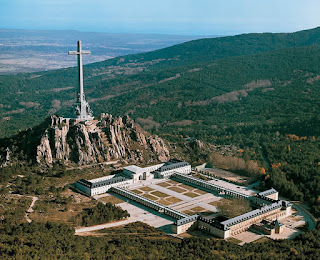
Valle de los Caídos.

The Valle de los Caídos (Valley of the Fallen) is a Roman Catholic basilica and mausoleum which lies in the Cuelgamuros Valley the Sierra de Guadarrama mountain range close to Madrid.  Ordered built by Generalissimo Francisco Franco (1892-1975; Caudillo of Spain 1939-1975) at the end of the Spanish Civil War (1936-1939), it was inaugurated in 1959, the structure proclaimed by the government to be a national act of atonement”, memorial and symbol of reconciliation.  On a monumental scale, the grounds are 5.25 square miles (13.6 km2) of Mediterranean woodlands and granite and towering over all is a 500 foot (150 m) high Christian cross, still the tallest on Earth and visible 20 miles (32 km) away.  It was built partly by some of the regime's many political prisoners but, in a nice touch, it was noted that in exchange for their labour, they received some remission of their sentences.

Something of a Valhalla of the south and for decades the last resting place of forty-thousand-odd dead from both sides in the Spanish Civil War (1936-1939), the most controversial corpse in the place was that of Franco himself although obviously, he was not a battlefield casualty.  There were those who on that basis objected but, because the mausoleum was also a basilica, under the rules of the Roman Catholic Church, he was ruled entitled to a place because of his role in “building the church”, a double irony being the Caudillo himself specified he be buried elsewhere.  Franco’s body originally was interred in a granite and marble crypt beneath the basilica's floor and the government's decision to permit that ensured ensured the site would both become a shrine for those who venerate his memory and an ongoing controversy because the bitter disputes about the war and Franco’s subsequent dictatorship were only ever suppressed; in the decades after his death the political and legal manoeuvres to remove from public display all the many relics of the glorification of the victory and dictatorship gathered strength.  In October 2019, his remains were exhumed from the mausoleum and re-interred in the Mingorrubio Cemetery in El Pardo, this time in a family crypt, an event which much divided opinion.  The forces unleashed by the civil war and its decades-long aftermath remain a cleavage in Spanish society and political scientists expect the tensions to continue, even after the war passes from living memory.  In his last public speech a few weeks before his death, Franco had warned the country it remained threatened by a conspiracy involving “communists, left-wing terrorists and Freemasons”.

Adolf Hitler visiting Napoleon's sarcophagus in Les Invalides, Paris, June 1940.

Adolf Hitler (1889-1945; Führer (leader) and German head of government 1933-1945 & head of state 1934-1945)  made only one visit to Paris, less as a victorious warlord and more as a tourist looking at the architectural highlights.  From years of somewhat haphazard study, Hitler was well acquainted with the buildings of the city and genuinely knowledgeable about details such as the interior fittings of the Paris Opera House but told his architect: “The moment in Paris where I saluted Napoleon's tomb was one of the proudest of my life.”  Hitler had always intended a mausoleum for himself in Linz, the centrepiece of which would be a Napoleonic sarcophagus in the centre of a Pantheon-like structure with an oculus directly above, exposed to the elements and thus “directly linked to the universe."  He made a number of sketches, all predictably in the classical style and distinguished mostly by their massive dimensions.

There is an urban myth the chamber in which Napoleon's sarcophagus is placed was designed in such as way that if seen from the lower lever, the viewer must look-up as if in awe and if seen from above, one must bow.  However, Les Invalides was completed in 1706 and the two levels of the chapel were included so the king might attend Mass with his soldiers; the lower level for soldiers & patients, the upper for the royal court.  Only in 1861 was the chapel converted to a mausoleum after Napoleon’s body was returned by the British, almost half a century after his death.

Saturday, August 15, 2020

Viceroy

Viceroy (pronounced vahys-roi)

(1) A person appointed to rule a country or province as the deputy of the sovereign and exercising the powers of the sovereign.

(2) A brightly marked American butterfly (Limenitis archippus), closely mimicking the monarch butterfly in coloration but slightly smaller, hence the analogy with a sovereign and their representative.

1515–1525: From the Middle French, the construct being vice- + roy.  Vice was from the Old French vice (deputy), from the Latin vice (in place of), an ablative form of vicis.  In English (and other languages) the vice prefix was used to indicate an office in a subordinate position including air vice-marshal, vice-admiral, vice-captain, vice-chair, vice-chairman, vice-chancellor, vice-consul, vice-director, vice president, vice-president, vice-regent & vice-principal.  Roy was from the Middle English roy & roye, from the Old French roi (king), from the Latin rēgem, accusative of rēx (king) and related to regere (to keep straight, guide, lead, rule), from the primitive Indo-European root reg- (move in a straight line) with derivatives meaning “to direct in a straight line" thus the notion of "to lead, rule".  It was a doublet of loa, rajah, Rex, rex and rich.  The noun plurals was roys.  The wife of a viceroy was a vicereine, the word also used for female viceroys of whom there have been a few.  The American butterfly was named in 1881.  Viceroy and viceroy are nouns and viceregal is a noun and adjective; the noun plural is viceroys.

The noun viceregent (the official administrative deputy of a regent) attracted the attention of critics because it was so frequently confused with vicegerent (the official administrative deputy of a ruler, head of state, or church official).  Despite the perceived grandiosity of vicegerent, gained from association with offices such as the Pope as Vicar of Christ on Earth or the regent of a sovereign state, it’s merely generally descriptive of one person substituting for another and can be as well-applied to the shop assistant minding the store while the grocer has lunch.  The area of regency can be a linguistic tangle because a regent is a particular kind of viceregent and there was a time when viceregent was used instead of the correct vicegerent and was sometimes used pleonastically for regent.  The grammar Nazis never liked this and attributed the frequency of occurrence to the preference of viceregal rather than vicereoyal as the adjective of viceroy.

Under the Raj, under the pith helmets: King George V, Emperor of India with Lord Hardinge, Viceroy of India, Government House, Calcutta 1911.

In the rather haphazard way British rule in India evolved, the office of Governor-General of India was created by the Charter Act of 1833 and in an early example of the public-private partnership (PPP), the post was essentially administrative and was both appointed by and reported to the directors of the East India Company, functioning also as an informal conduit between the company and government.  The system lasted until 1858 when, in reaction to the Indian Mutiny (1857), the parliament passed the Government of India Act, creating the role of Viceroy (wholly assuming the office of Governor General), the new office having both executive and diplomatic authority and reporting (through the newly-established India Office) to the British Crown.  The viceroy was appointed by the sovereign on the advice of the parliament (ie the prime-minister) and it is this structure which is remembered as the British Raj (from the Hindi rāj (state, nation, empire, realm etc), the rule of the British Crown on the subcontinent although the maps of empire which covered the whole region as pink to indicate control were at least a bit misleading.

Viceroy butterfly.

The best-known viceroys were probably those who headed the executive government of India under the Raj although other less conspicuous appointments were also made including to Ireland when the whole island was a constituent part of United Kingdom of Great Britain and Ireland (1801-1922).  As a general principle (and there were exceptions), in British constitutional law, the Dominions and colonies that were held in the name of the parliament of Great Britain were administered by Governors-General while colonies held in the name of the British Crown were governed by viceroys.  Between 1858-1947, there were twenty viceroys of India including some notable names in British politics such as Lord Lansdowne (1888–1894) who introduced the Indian Councils Act and raised the age of consent for girls from ten to twelve, Lord Curzon (1899–1905) who introduced the Indian Universities Act and presided over the partition of Bengal, Lord Hardinge (1910-1916) who was in office during the Mesopotamian Campaign, Lord Irwin (1926–1931) (better known as Lord Halifax) who summoned the first round table conference and Lord Mountbatten (1947), the last Viceroy of India who, reflecting the change in constitutional status upon independence, was between 1947-1948 briefly the new nation's first Governor-General.  He was also the second-last, the office abolished in 1950 when the Republic of India was proclaimed.

Lindsay Lohan’s NFT for Lullaby with viceroy butterflies.

In 2021, it was announced Lindsay Lohan's non-fungible token (NFT) electronic music single Lullaby had sold for 1,000,001 in Tron (TRX) cryptocurrency (US$85,484.09).   Lullaby featured a vocal track over a beat produced by Manuel Riva and was the first NFT by a woman to be sold on #fansForever, a marketplace created for dealing in celebrity NFTs.  The graphics of the NFT Tron had a viceroy butterfly flapping its wings in unison with Ms Lohan’s eyelids to the beat of Lullaby.  Because of the underlying robustness, the blockchain and the NFT concept has an assured future for many purposes but to date the performance of celebrity items as stores of value has been patchy.

1936 Rolls-Royce Phantom III (7.7 litre (447 cubic inch) V12; chassis 3AZ47, engine Z24B, body 8594 in style 6419) by Hooper, built for the Marquess of Linlithgow (1887-1952) who served as Viceroy of India (1936-1944), seen in its original configuration with a chauffeur (left) and as re-bodied during 1952-1953 (right).  In the centre is a British plumed helmet, circa 1920, this one with a skull in gilt metal, mounted with unusually elaborate gilt ornamentation including helmet-plate (itself mounted with a white metal hobnail star bearing gilt Royal Arms), ornate gilt chins-scales with claw ends and an untypically extravagant white swan's feather plume, notably longer than regulation length.  It was used by the Honourable Corps of Gentlemen-at Arms, a body formed in 1539 and staffed by former army officers as the “nearest guard” to the sovereign. The helmet is based on the “Albert” pattern for Household Cavalry, a style in use for some 150 years.

Viceroys of India were always rather exalted creatures, their status reflecting India’s allure as the glittering prize of the empire and upon recall to London, were usually raised to (or in) the peerage as marquesses while a retiring prime-minister might expect at most an earldom, one notch down.  Their special needs (and some were quite needy) in office also had to be accommodated, an example of which is Lord Linlithgow’s 1937 Rolls-Royce Phantom III, built with a capacity for seven passengers (although no luggage which was always carried separately).  The coachwork by Hooper was most unusual, the engine’s side-panels being 1½ inches taller than standard, a variation required to somewhat balance the very tall passenger compartment, the dimensions of which were dictated by the viceroy’s height of 6’ 7” (2.0 m), the plumed hats of his role elongating things further.  Such high-roof-lines were not uncommon on state limousines and have been seen on Mercedes-Benz built for the Holy See and the Daimlers & Rolls-Royces in the British Royal Mews.  Delivered in dark blue with orange picking out lines and coronets on the rear doors, the interior was trimmed in dark blue leather with two sets of loose beige covers, the woodwork in solid figured walnut rather than veneer.  Signed-off 21 July 1936 and shipped to Bombay (now Mubai) on the SS Bhutan on 24 July, Hooper’s invoice to the India Office listed the price of the chassis at Stg£1405, the coachwork at Stg£725 and a total cost of Stg£2130.

After the Raj, the car passed into private hands and in 1952 was returned to the Hooper works in Westminster for re-modeling, the most obvious aspects of which were the lowering of the roof-line and a re-finishing in grey.  The high cowl (scuttle) and hood (bonnet) line were however retained so the re-configuration actually replaced one discontinuity with another but the changes certainly made it an interesting period piece and its now one of three Phantom IIIs in the collection assembled by Pranlal Bhogilal (1937-2011), displayed in his Auto World Vintage Car Museum in Kathwada, on the outskirts of Ahmedabad.

Friday, August 14, 2020

Hobnail

Hobnail (pronouned hob-neyl)

(1) A large-headed nail for protecting the soles of heavy boots and shoes, thus, when used as a modifier: hobnail boots.

(2) A small allover pattern consisting of small tufts, as on fabrics, or of small studs, as on glass.

(3) A rustic (obsolete).

(4) In medicine, a Slang term used by clinicians to describe the appearance of the organ in those suffering cirrhosis of the liver.

(5) In medicine, cellular morphology pathognomonic for clear cell adenocarcinoma of the ovary.

1585-1595: The construct is hob + nail.  Hob is related to hub, but the ultimate origin of both words is so obscure few etymologists have attempt to disentangle.  Nail in the sense of that which grows from the ends of digits is pre 900 from the Middle English nail & nayl, from the Old English negel (tapering metal) & nægl (fingernail (handnægl)).  It was cognate with the Old Frisian neil, the Old Saxon & Old High German nagal, the Dutch nagel & German Nagel and the Old Norse nagl (fingernail), all from the unattested Germanic naglaz; akin as derivative to the Lithuanian nãgas & nagà (hoof), the Old Prussian nage (foot) and the Old Church Slavonic noga (leg, foot). Nail in the sense used in "hobnail" is from the Middle English naylen, from the Old English næġlan, again, words with long, tortured histories.  The original sense was of the “short, thick nail with a large head", the construction using the element hob probably as an identification with the "rounded peg or pin used as a mark or target in games", that form of unknown origin and dating from the 1580s.  Because they were used to make heavy boots and shoes, the word was used figuratively from the seventeenth century for a "rustic person or simpleton", John Milton (1608–1674) in Colasterion (1645) writing “…the word Politician is not us'd to his maw, and therupon he plays the most notorious hobbihors, jesting and frisking in the luxury of his non-sense with such poor fetches to cog a laughter from us, that no antic hobnaile at a Morris, but is more hansomly facetious”.

From fireplace to fashion

Lindsay Lohan wearing hobnailed fabric.

Dating from 1505–1515, hub was a variant of obsolete hub hob (in a fireplace) and related to the obsolete hubbe from the 1510s and an etymology unrelated to the thirteenth century use as an affectionate diminutive for Robert or Robin.  Hob as a word to describe the side (the flat projection or iron shelf at the side of a fire grate, where things are put to be kept warm) of a fireplace was common by 1670s and in some English-speaking countries is used still to refer to the top cooking surface on a cooker or stove (the cooktop typically comprising several (often four) cooking elements also known as “rings” or elements”).  Etymologists are divided on whether the use of hob to describe a "clown, prankster" is a equating of such people with the yokels to whom it had long been applied or, a shortening for hobgoblin (the phrase “to play (the) hob" is documented in 1834 as meaning “to make mischief").  In quoits, a hob is a rounded peg used as a target.  In machine tools, it’s a kind of cutting tool, used to cut the teeth of a gear and can be used to refer to the hub or a wheel.  In zoology, a hub is a male ferret.  The long established meanings (1) the thin, horny plate at the ends of fingers and toes on humans and some other animals and (2) a spike-shaped metal fastener used for joining wood or similar materials ran in parallel.  It also one referred to a round pedestal on which merchants conducted business and a (now archaic) English unit of (usually cloth) measure length equivalent to 1 twentieth of an ell or one sixteenth of a yard (2 ¼ inches (57.15mm)).  The sense "fingernail" seems to have been the original.

The best known use of "hobnail" is in footwear.  The hobnailed boot (left) has been used since antiquity, both by workmen and the military and for the same reasons: durability and traction.  In the army of Ancient Rome, they were called caligae and remained common in military formations until well into the twentieth century, supplanted only as techniques with rubber and synthetic materials improved.  Before the development of crampons, they were widely used in mountaineering.  In Scotland, they're known also as "tackety boots").  Hobnail glassware (right) is a mass-produced novelty item and not part of the glass-blower's technique; it has no traditions.