Showing posts sorted by relevance for query War. Sort by date Show all posts

Monday, March 7, 2022

War

War (pronounced wawr)

(1) A conflict carried on by force of arms, as between nations or between parties within a nation; warfare, as by land, sea, or air; in the singular, a specific conflict (eg Second Punic War).

(2) A state or period of armed hostility or active military operations.

(3) A contest carried on by force of arms, as in a series of battles or campaigns.

(4) By extension, a descriptor for various forms of non-armed conflict (war on poverty, trade war, war on drugs, war on cancer, war of words etc).

(5) A type of card game played with a 52 card pack.

(6) A battle (archaic).

(7) To conduct a conflict.

(8) In law, the standard abbreviation for warrant (and in England, the county Warwickshire.

Pre 1150: The noun was from the Middle English werre, from the late Old English were, were & wyrre (large-scale military conflict) (which displaced the native Old English ġewinn), from the Old Northern French were & werre (variant of Old French guerre (difficulty, dispute; hostility; fight, combat, war)), from the Medieval Latin werra, from the Frankish werru (confusion; quarrel), from the Old Norse verriworse and was cognate with the Old High German werra (confusion, strife, quarrel), the German verwirren (to confuse), the Old Saxon werran (to confuse, perplex), the Dutch war (confusion, disarray) and the West Frisian war (defense, self-defense, struggle (also confusion).  Root was the primitive Indo-European wers- (to mix up, confuse, beat, perplex) and the Cognates are thought to suggest the original sense was "to bring into a state of confusion”.  The verb was from the Middle English, from the late Old English verb transitive werrien (to make war upon) and was derivative of the noun.  The alternative English form warre was still in use as late as the seventeenth century.

Developments in other European languages including the Old French guerrer and the Old North French werreier.  The Spanish, Portuguese, and Italian guerra also are from the Germanic; why those speaking Romanic tongues turned to the Germanic for a word meaning "war" word is speculative but it may have been to avoid the Latin bellum (from which is derived bellicose) because its form tended to merge with bello- (beautiful).  Interestingly and belying the reputation later gained, there was no common Germanic word for "war" at the dawn of historical times.  Old English had many poetic words for "war" (wig, guð, heaðo, hild, all common in personal names), but the usual one to translate Latin bellum was gewin (struggle, strife (and related to “win”).

Lindsay Lohan making the pages of Foreign Policy (FP), July 2007.  Despite the title, FP’s content is sometimes discursive and popular culture figures can appear.

Foreign Policy (FP) was in 1970 founded by Harvard’s Professor Samuel Huntington (1927-2008) and was always intended to be a clearing house for lively, punchy articles in the field of international relations yet not constrained by formal, academic traditions, exemplified by a magazine like Foreign Affairs, published by the US think-tank the Council on Foreign Relations.  Professor Huntington is best remembered for his “Clash of Civilizations” (CoC, 1993) theory which, noting one of threads in world history of the last 1300-odd years, argued the defining conflict of the future would between Western civilization and the multi-national Islamic world, the old order of wars between nation-states rendered obsolete by changes in technology and geopolitics.  The unusual period at the end of the Cold War (1946-1991) was a time of TLAs (three-letter acronym), the era remembered also for US political scientist Francis Fukuyama’s coining of the “End of History” (EoH, 1992) the thesis being that with Western liberal democracy prevailing over the Soviet communist model, the end-point of humanity’s search of the ideal political and economic systems had been reached and it was that Western liberal democracy which would be the universal form, history in that sense, thus ended.  Unfortunately, since the EoH was declared, wars, if no longer declared, have continued to be waged.

War-time appeared first in the late fourteenth century; the territorial conflicts against Native Americans added several forms including warpath (1775), war-whoop (1761), war-dance (1757), war-song (1757) & war-paint (1826) the last of which came often to be applied to war-mongering (qv) politicians (as in "putting on their war-paint"), a profession which does seem to attract blood-thirsty non-combatants.  War crimes, although widely discussed for generations, were first discussed in the sense of being a particular set of acts which might give rise to specific offences which could be codified in International Law: A Treatise (1906) by LFL Oppenheim (1858–1919).  The war chest dates from 1901 although even then it’s use was certainly almost always figurative; in the distant past there presumably had in treasuries been chests of treasure to pay for armies.  War games, long an essential part of military planning, came to English from the German Kriegspiel, the Prussians most advanced in such matters because the innovative structure of their general staff system.

In English, war is most productive as a modifier, adjective etc and examples include: Types of war: Cold War, holy war, just war, civil war, war of succession, war of attrition, war on terror etc; Actual wars: World War I, Punic Wars, First Gulf War, Korean War, Hundred Years' War, Thirty Years' War, Six-day War etc; Campaigns against various social problems: War on Poverty, War on Drugs, War on cancer; The culture wars: War on Christmas, war on free speech; In commerce: Price wars, Cola Wars, turf war; In crime: turf war (also used in conventional commerce), gang war, Castellammarese War; In technology: Bus wars, operating system wars, browser wars; Various: pre-war, post-war, inter-war, man-o'-war, war cabinet, warhead, warhorse, warlord, war between the sexes, war bond, war reparations, war room.

Film set for the War Room in Dr Strangelove (1964).

Pre-war and post-war need obviously to be used in context; “pre-war” which in the inter-war years almost always meant pre-1914, came after the end of WWII to mean pre-1939 (even in US historiography).  “Post-war” tracked a similar path and now probably means the years immediately after WWII, the era generally thought to have ended (at the latest) in 1973 when the first oil shock ended the long boom.  Given the propensity over the centuries for wars between (tribes, cities, kings, states etc) to flare up from time to time, there have been many inter-war periods but the adjective inter-war didn’t come into wide use until the 1940s when it was used exclusively to describe the period (1918-1939) between the world wars.  The phrase “world war”, although tied to the big, multi-theatre conflicts of the twentieth century, had been used speculatively as early as 1898, then in the context of the US returning the Philippines (then a colonial possession) to Spain, trigging European war into which she might be drawn.  “Word War” (referring to the 1914-1918 conflict which is regarded as being “world-wide” since 1917 when the US entered as a belligerent) was used almost as soon as the war started but “Great War” continued to be the preferred form until 1939 when used of “world war” spiked; World War II came into use even before Russian, US & Japanese involvement in 1941.  For as long as there have been the war-like there’s presumably been the anti-war faction but the adjectival anti-war (also antiwar) came into general use only in 1812, an invention of American English, in reference to opposition to the War of 1812, the use extending by 1821 to describe a position of political pacifism which opposed all war.  War-monger (and warmonger) seems first to have appeared in Edmund Spenser’s (circa 1552-1599) Faerie Queene (1590) although it’s possible it may have prior currency.  The warhead was from 1989, used by engineers to describe the "explosive part of a torpedo", the use later transferred during the 1940s to missiles.  The warhorse, attested from the 1650s, was a "powerful horse ridden into war", one selected for strength and spirit and the figurative sense of "seasoned veteran" of anything dates from 1837.  The (quasi-offensive though vaguely admiring) reference to women perceived as tough was noted in 1921.

Man-o'-war (also as man-of-war) was an old form meaning "fighting man, soldier" while the meaning "armed ship, vessel equipped for warfare" was from the late fifteenth century and was one of the primary warships of early-modern navies, the sea creature known as the Portuguese man-of-war (1707) so called for its sail-like crest.  The more common form was “man o' war”.  The Cold War may have started as early as 1946 but certainly existed from some time in 1947-1948; it was a form of "non-hostile belligerency” (although the death–toll in proxy-wars fought for decades on its margins was considerable);  it seems first to have appeared in print in October 1945 in a piece by George Orwell (1903—1950).  The companion phrase “hot war” is actually just a synonym for “war” and makes sense only if used in conjunction with “cold war”.  The cold war was memorably defined by Lord Cherwell (Professor Frederick Lindemann, 1886–1957) as “two sides for years counting their missiles”.

On June 6, 2025, Friedrich Merz (b 1955, German chancellor since 2025) visited the White House.  He mentioned the war!  Donald Trump (b 1946; US president 2017-2021 and since 2025) would have been pleased by that because his aides would repeatedly have told him: “Don’t mention the war!

The chancellor’s reference was to “D-Day”, the Allied amphibious invasion of France on 6 June, 1944 and coincidently, the chancellor was born 11 November 1955, 37 years to the day after the signing of the armistice which ended World War I (1914-1918); the eleventh of November is now marked as “Remembrance Day” in the Commonwealth and “Veterans Day” in the US.  The D-Day invasion was the Allies biggest single combined operation of World War II (1939-1945) and remains the largest triphibious invasion in the history of warfare.  The portmanteau adjective triphibious was a blend of tri-(three) + (am)phibious and referred to the combined use of air, naval and ground forces.  The tri- prefix was from the Latin tri- (three) and the Ancient Greek τρι- (tri-) (three) while amphibious was from the Ancient Greek μφίβιος (amphíbios), the construct being μφί (amphí) (in this context “about, concerning”) + βίος (bíos) (life).  Military historians like triphibious but not all etymologists approve.

A civil war (battles among fellow citizens or within a community (as opposed to between tribes, cities, nations etc)) is civil in the sense of "occurring among fellow citizens" and the term dates from the fourteenth century batayle ciuile (civil battle), the exact phrase “civil war” attested from late fifteenth century in the Latin bella civicus.  In Ancient Rome, the rather nasty squabbles between the Optimates and the Senate Elites were known as bellum civile but should in English be understood as “governance war” because what was being described was a factional power-struggle for the control of Rome rather than a “civil war” as it is now understood.  The instances of what would now be called civil war pre-date antiquity but the early references typically were in reference to ancient Rome where the conflicts were, if not more frequent, certainly better documented.  A word for the type of conflict in the Old English was ingewinn and in Ancient Greek it had been polemos epidemios.

The struggle in England between the parliament and Charles I (1600-1649) has always and correctly been known as the English Civil War (1642-1651) whereas there are scholars who insist the US Civil War (1861-1865) should rightly be called the “War of Secession”, the “war between the States" or the “Federal-Confederate War”.  None of the alternatives ever managed great traction and “US Civil War” has long been the accepted form although, when memories were still raw, if there was ever a disagreement, the parties seem inevitability to have settled on “the War”.  The phrases pre-war and post-war are never applied the US Civil War, the equivalents being the Latin forms ante-bellum (literally “before the war”) and post-bellum (literally “after the war”).  The word “civil” of course is used in other ways and there has rarely be much that in another sense is “civil” about civil wars so when fought in what is thought to be in accordance with the “rules of war”, phrases like “chivalrous war” or “clean war” tend to be used although however fought, wars are a ghastly business are there are simply degrees of awfulness.
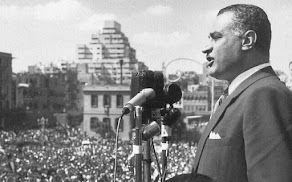
Colonel Nasser, president of Egypt, Republic Square, Cairo, 22 February 1958.

During the centuries when rules were rare, wars were not but there was little discussion about whether or not a war was happening.  There would be debates about the wisdom of going to war or the strategy adopted but whether or not it was a war was obvious to all.  That changed after the Second World War when the charter of the United Nations was agreed to attempt to ensure force would never again be used as a means of resolving disputes between nations.  That's obviously not been a success but the implications of the charter have certainly affected the language of conflict, much now hanging on whether an event is war or something else which merely looks like war.  An early example of the linguistic lengths to which those waging war (a thing of which they would have boasted) would go, in the post-charter world, to deny they were at war happened after British, French and Israeli forces in 1956 invaded Egypt in response to Colonel Gamal Nasser's (1918–1970; president of Egypt 1954-1970) nationalization of foreign-owned Suez Canal Company.  The invasion was a military success but it soon became apparent that Israel, France and Britain were, by any standards, waging an aggressive war and had conspired, ineptly, to make it appear something else.  The United States threatened sanctions against Britain & France and the invading forces withdrew.  There's always been the suspicion that in the wake of this split in the Western Alliance, the USSR seized the opportunity to intervene in Hungary which was threatening to become a renegade province.

Suez Canal, 1956.

In the House of Commons (Hansard: 1 November 1956 (vol 558 cc1631-7441631)), the prime minister (Anthony Eden, 1897–1977, UK prime-minister 1955-1957) was asked to justify how what appeared to be both an invasion and an act of aggressive war could be in conformity with the Charter of the United Nations.  Just to jog the prime-minister's memory of the charter, the words he delivered at the UN's foundation conference in San Francisco in 1945 were read out: “At intervals in history mankind has sought by the creation of international machinery to solve disputes between nations by agreement and not by force.”  In reply, Mr Eden assured the house there had been "...no declaration of war by us.", a situation he noted prevailed for the whole of the Korean War and while there was in Egypt clearly "...a state of armed conflict...", just as in Korea, "...there was no declaration of war.  It was never admitted that there was a state of war, and Korea was never a war in any technical or legal sense, nor are we at war with Egypt now."

Quite how the comparison with Korea, a police action under the auspices of the UN and authorized by the Security Council (the USSR was boycotting the place at the time) was relevant escaped many of the prime-minister's critics.  The UK had issued an ultimatum to Egypt regarding the canal which contained conditions as to time and other things; the time expired and the conditions were not accepted.  It was then clear in international law that in those circumstances the country which delivers the ultimatum is not entitled to carry on hostilities without a declaration of war so the question was what legal justification was there for an invasion?  The distinction between a “state of war" and a "state of armed conflict", whatever its relevance to certain technical matters, seemed not to matter in the fundamental question of the lawfulness of the invasion under international law.  Mr Eden continued to provide many answers but none to that question.

The aversion to declaring war continues to this day, the United States, hardly militarily inactive during the last eight-odd decades, last declared war in 1942 (against Italy, Hungary, Bulgaria & Romania, the latter three apparently at the insistence of the state department which identified certain legal technicalities).  There seems no an aversion even to the word, the UK not having had a secretary of state (minister) for war since 1964 and the US becoming (nominally) pacifist even earlier, the last secretary of war serving in 1947; the more UN-friendly “defense” the preferred word on both sides of the Atlantic.  In the Kremlin, Mr Putin (b 1952; prime-minister or president of Russia since 1999) seems also have come not to like the word.  While apparently sanguine at organizing “states of armed conflict”, he’s as reluctant as Mr Eden to hear his “special military operations” described as “invasions” or “wars” and in a recent legal flourish, arranged the passage of a law which made “mentioning the war” unlawful.

Not mentioning the war (special military operation): Mr Putin.

The bill which the Duma (lower house of parliament) & Federation Council (upper house) passed, and the president rapidly signed into law, provided for fines or imprisonment for up to fifteen years in the Gulag for intentionally spreading “fake news” or “discrediting the armed forces”, something which includes labelling the “special military operation” in Ukraine as a “war” or “invasion”.  Presumably, given the circumstances, the action could be described as a “state of armed conflict” and even Mr Putin seems to have stopped calling it a “peacekeeping operation”; he may have thought the irony too subtle for the audience.  Those who post or publish anything on the matter will be choosing their words with great care so as not to mention the war.

However, although Mr Putin may not like using the word “war”, there’s much to suggest he’s a devotee of the to the most famous (he coined a few) aphorism of Prussian general & military theorist Carl von Clausewitz (1780–1831): “War is the continuation of policy with other means.  The view has many adherents and while some acknowledge its cynical potency with a weary regret, for others it has been a world view to pursue with relish.  In the prison diary assembled from the huge volume of fragments he had smuggled out of Spandau prison while serving the twenty year sentence he was lucky to receive for war crimes & crimes against humanity (Spandauer Tagebücher (Spandau, the Secret Diaries), pp 451 William Collins Inc, 1976), Albert Speer (1905–1981; Nazi court architect 1934-1942; Nazi minister of armaments and war production 1942-1945) recounted one of Adolf Hitler’s (1889-1945; Führer (leader) and German head of government 1933-1945 & head of state 1934-1945) not infrequent monologues and the enthusiastic concurrence by the sycophantic Joachim von Ribbentrop (1893–1946; Nazi foreign minister 1938-1945):

"In the summer of 1939, On the terrace of the Berghof [Hitler’s alpine retreat], Hitler was pacing back and forth with one of his military adjutants. The other guests respectfully withdrew to the glassed-in veranda.  But in the midst of an animated lecture he was giving to the adjutant, Hitler called to us to join him on the terrace. “They should have listened to Moltke and struck at once” he said, resuming the thread of his thought, “as soon as France recovered her strength after the defeat in 1871.  Or else in 1898 and 1899.  America was at war with Spain, the French were fighting the English at Fashoda and were at odds with them over the Sudan, and England was having her problems with the Boers in South Africa, so that she would soon have to send her army in there.  And what a constellation there was in 1905 also, when Russia was beaten by Japan.   The rear in the East no threat, France and England on good terms, it is true, but without Russia no match for the Reich militarily. It’s an old principle: He who seizes the initiative in war has won more than a battle.  And after all, there was a war on!”  Seeing our stunned expressions, Hitler threw in almost irritably:There is always a war on. The Kaiser [Wilhelm II (1859–1941; German Emperor & King of Prussia 1888-1918)] hesitated too long."

Such epigrams usually transported Ribbentrop into a state of high excitement.  At these moments it was easy to see that he alone among us thought he was tracking down, along with Hitler, the innermost secrets of political action.  This time, too, he expressed his agreement with Hitler with that characteristic compound of subservience and the hauteur of an experienced traveller whose knowledge of foreign ways still made an impression on Hitler.  Ribbentrop’s guilt, that is, did not consist in his having made a policy of war on his own. Rather, he was to blame for using his authority as a supposed cosmopolite to corroborate Hider’s provincial ideas. The war itself was first and last Hitler’s idea and work.  “That is exactly what neither the Kaiser nor the Kaiser’s politicians ever really understood,” Ribbentrop was loudly explaining to everyone.  There’s always a war on. The difference is only whether the guns are firing or not.  There’s war in peacetime too. Anyone who has not realized that cannot make foreign policy.

Hider threw his foreign minister a look of something close to gratitude.  “Yes, Ribbentrop,” he said, “yes!"  He was visibly moved by having someone in this group who really understood him. “When the time comes that I am no longer here, people must keep that in mind.  Absolutely.”  And then, as though carried away by his insight into the nature of the historical process, he went on:Whoever succeeds me must be sure to have an opening for a new war.  We never want a static situation where that sort of thing hangs in doubt In future peace treaties we must therefore always leave open a few questions that will provide a pretext.  Think of Rome and Carthage, for instance. A new war was always built right into every peace treaty. That's Rome for you! That's statesmanship.

Pleased with himself, Hitler twisted from side to side, looking challengingly around the attentive, respectful circle.  He was obviously enjoying the vision of himself beside the statesmen of ancient Rome.  When he occasionally compared Ribbentrop with Bismarck—a comparison I myself sometimes heard him make—he was implying that he himself soared high above the level of bourgeois nationalistic policy.  He saw himself in the dimensions of world history. And so did we.  We went to the veranda.  Abruptly, as was his way, he began talking about something altogether banal."

Saturday, March 21, 2026

Unrestricted

Unrestricted (pronounced uhn-ri-strik-tid)

(1) Not restricted or confined.

(2) In the classification of documents, having no security classification.

1766: The construct was un-+ restrict + -ed.  The un- prefix was from the Middle English un-, from the Old English un-, from the Proto-West Germanic un-, from the Proto-Germanic un-, from the primitive Indo-European n̥-.  It was cognate with the Scots un- & on-, the North Frisian ün-, the Saterland Frisian uun-, the West Frisian ûn- &  on-, the Dutch on-, the Low German un- & on-, the German un-, the Danish u-, the Swedish o-, the Norwegian u- and the Icelandic ó-.  It was (distantly) related to the Latin in- and the Ancient Greek ἀ- (a-), source of the English a-, the Modern Greek α- (a-) and the Sanskrit अ- (a-).  The verb restrict was in use by at least the 1530s in the sense of “to limit, bound, confine (someone or something), prevent from passing a certain limit in any kind of action” and was from the Latin restrictus, past participle of restringere (bind fast, restrain) and perfect passive participle of restringō (draw back tightly; restrain, restrict), the construct being re- (back, again) + stringō (press, tighten, compress); as an adjective, it was a doublet of ristretto. By the eighteenth century, the word had come to be regarded as a Scotticism but the infection spread quickly to Standard English.  As the past-participle adjective from restrict (in the sense of “limited, confined”), restricted has become associated with the classification of government documents, in the sense of “not for public release”, use seems not to have been routine until 1944 when a system of classification was codified by the US government.  Prior to that, although restrictions of distribution were common, concepts such as “Restricted to [names or designations]”, “Secret”, “Top Secret” etc were used but there was no standardization within departments or even between branches of the military.  When used as a suffix to form possessional adjectives from nouns, -ed was from the Middle English -ed, from the Old English -od (the adjectival suffix), from the Proto-Germanic -ōdaz, from the primitive Indo-European -ehtos.  It was cognate with the Latin -ātus. 

Glory road: A “Derestricted” sign in Australia's Northern Territory from the days of “no speed limits”.

In use, the older adjectival use was simply “restrict” and although “unrestricted” would seem an absolute (ie something either is restricted or it is not), dictionaries confirm the comparative is “more unrestricted” and the superlative “most unrestricted” although at least one style guide notes those forms can be regarded in a similar way as “very unique” (ie technically incorrect but widely used and well-understood.  The related adverb “restrictedly” was and remains rare.  In the US, well into the twentieth century, the appearance of the word “restricted” in advertisements, signage and such was verbal shorthand for (depending on context and location): “No Jews”, “No coloreds” etc.  Although the words “unrestricted” & “derestricted” describe similar states, different histories are implied and that’s a product of the ways in which the absence of restrictions came about.  Unrestricted means literally “no restrictions” (access to something or somewhere; rights to engage in trade etc).  “Derestricted” means that previously restrictions must have been imposed but those have since been removed.  The use applies to document classifications and in the now rare cases of roads with no speed limits (although some of those were something of a linguistic outlier because in many cases they never had any restrictions to be derestricted.  For obvious reasons, in English, “unrestricted” is the more commonly used form.  Unrestricted, unrestrictive & unrestrictable are adjectives, unrestrictedness is a noun and unrestrictedly is an adverb.

1978 Mercedes-Benz 450 SEL 6.9 on the Northern Territory's derestricted roads.  Although the factory only ever claimed 225 km/h (140 mph), top speed of UK-delivered “Euro spec” 6.9 (ie one not fitted with the power-sapping anti-emission devices fitted to those built for sale in the US or Australia) turned out to be a verified 237 km/h (147 mph) which reflected the experience of European testers who achieved 238 km/h (148 mph) on the German Autobahns.  Unexceptional now, in such pace was in the 1970s a reasonable achievement for a heavy cruiser with pre-modern aerodynamics; at high-speed, the fuel consumption was awe inspiring.    

Idealistic lawyers (they do exist) and others have for centuries argued it is the existence of and adherence to laws which makes possible civilized societies, the alternative often expressed as “the law of the jungle”, best understood in the vernacular “kill or be killed” world in which life of man was “solitary, poor, nasty, brutish, and short”, memorably described in Leviathan (1651) by the very clever and deliciously wicked English philosopher Thomas Hobbes (1588-1679).  However, what the lawyers, at least privately, acknowledge is the extent of adherence to laws closely is tied to (1) their enforcement and (2) a layered system of punishments for transgressions.  In domestic legal systems, this is comprehended as the apparatus extending from receiving a fine for overstaying one’s time at a parking meter to being hanged for murder; the existence of laws does not prevent crime but the perception of the chance of detection and the subsequent penalty for many operates as a deterrent and the debates about relationship between certain penalties and their deterrent effect continue.

Mahan's The Influence of Sea Power upon History 1660-1783.  In the last decade of the nineteenth century, probably no book was more read in palaces, chancelleries & admiralties.

In war, although usually the opposing sides have geo-political objectives, for those doing the fighting, historically the business was about killing each other and in practice that of course quickly and understandably came to imply “by whatever means possible” but for many centuries there have been conventions which form of “rules of war”, the most celebrated the various chivalric codes (codified during of the Middle Ages) which sought to regulate the behaviour of soldiers, particularly towards civilians.  However, as US Navy Captain Alfred Mahan (1840–1914) pointed out in the epoch-making The Influence of Sea Power upon History, 1660–1783 (1890), it’s impossible by mere agreement to outlaw the use of a militarily effective weapon so is it any more plausible for a statute, treaty or agreement to limit “mission creep” in the methods?  Whatever knightly codes may have existed, there seems little doubt that on the battlefield (or the towns subject to rape & pillage) habits do tend towards “unrestricted warfare”, military historians and legal theorists often pondering whether in “existential conflicts”, law reasonably can be expected to retain its intended force.

In what was a rhetorical flourish rather than a substantive legal point, in the dock before the IMT (International Military Tribunal) which in 1945-1946 sat in Nuremberg to try 22 of the surviving senior Nazis, Hermann Göring (1893–1946; leading Nazi 1922-1945, Hitler's designated successor & Reichsmarschall 1940-1945) claimed to be quoting Winston Churchill (1875-1965; UK prime-minister 1940-1945 & 1951-1955) in citing: “In the struggle for life and death there is in the end no legality.  Like William Shakespeare (1564–1616), a few phrases have been attributed to Churchill on the basis of “sounding Churchillian” and although there’s nothing in the record to support the case those exact words ever passed his lips, Göring’s paraphrase was not unreasonable.  After the fall of France in 1940, Churchill did make clear his view “there could be no justice if, in a mortal struggle, the aggressor tramples humanity while those resisting remain bound by violated conventions” by which he meant if the Nazis ignored international law, it was an absurdity for the Allies fully to remain constrained by it while fighting for their very survival.  Churchill was not advocating the rejection of established law as a principle; he was saying when a state faces the prospect of destruction at the hand of an enemy ignoring the accepted rules of war, strict legalism must not be allowed to prevent an effective defence.  That wasn’t a novel idea Churchill formed upon assuming the premiership.  Months earlier, when serving as First Lord of the Admiralty (minister for the navy), he’d discussed whether the UK should regard itself still restricted by the legal conventions Germany’s forces were ignoring: “The Germans have torn up the conventions and the usages of war.  We cannot allow ourselves to be bound by rules which the enemy does not observe if by doing so we place our country in mortal danger.”  While not exactly the words used by Göring in the dock, he captured the spirit of Churchill’s meaning.

Lindsay Lohan on the cover of Vogue Arabia, March 2026.  Among the topics raised in discussion about her not uneventful life was “…coming of age in the spotlight in a time of unrestricted paparazzi access and near-constant tabloid scrutiny.

Of course on 15 March 1946, borrowing the thoughts of …one of our greatest, most important, and toughest opponents…to support his argument modern, industrial, total war had rendered irrelevant traditional legal restraints, he was still harbouring the (faint) hope he might escape the noose and thus has a good motive in seeking to undermine the moral authority of the tribunal by suggesting even Churchill had acknowledged that in existential war, legal rules collapse.  This was not the construction of legal theory in the abstract, just as Churchill was explaining the pragmatic nature of military necessity because as he pointed out: “without victory there is no survival” and were the UK unilaterally to obey the rules while its opponents did not, the nation might lose the war.  Neither man ever sought to maintain that in war laws vanish, only that as demanded in extraordinary and reprehensible circumstances, they may need to be ignored.  Essentially, Churchill was asserting he wasn’t prepared to behave with the propriety of Caesar’s wife while Göring cavorted with Caesar’s whores; with that the Reichmarshall gleefully would have agreed and although his hopes the tribunal might find his paraphrased defence exculpatory were by then faint indeed, he still had an eye on the figure he hoped to cut in the history books.  

The doctrine of military necessity of course dates from the first time some prehistoric character picked up a stick or rock to gain tactical advantage in an argument and despite the various codes of warfare promulgated over millennia by philosophers, priests and politicians, that doctrine survived into the age of musketry and later, atomic bombs.  It’s the Prussian general and military theorist Carl von Clausewitz (1780–1831) who often is quoted because, with his commendable economy of phrase, succinctly he explained why necessity so often prevails over legality in existential war.  In On War (1832), he observed “War is an act of force, and there is no logical limit to the application of that force” and, anticipating the idealists, added: “Kind-hearted people might of course think there was some ingenious way to disarm or defeat an enemy without too much bloodshed… Pleasant as it sounds, it is a fallacy.  What Clausewitz called Kriegsräson (necessity in war) meant in practice was (1) war has an inherent tendency toward escalation, because each side must use whatever means are necessary to defeat the other and (2) “arms races” will tend to ensue.

Imperial Chancellor Theobald von Bethmann Hollweg in field uniform including the famous Prussian Pickelhaube (spiked helmet, the construct being Pickel (pimple, pickaxe) +‎ Haube (hood, cap)), Berlin, 1915.  Even when serving as chancellor (prime minister) von Bethmann Hollweg sometimes wore military uniform; Germans adore uniforms (note the jackboots).

Later in the century, German military jurists expressed this logic through the principle Kriegsräson geht vor Kriegsmanier (military necessity overrides the customary rules of war) by which they meant the laws and customs of war could be followed only to the extent adherence did not impose an unacceptable military cost; if survival (and in practice: “immediate advantage”) demanded those rules be violated, necessity prevails.  What was at the time the most outrageous admission of the application of the doctrine came in 1914 after Germany violated Belgium’s neutrality and was delivered by Theobald von Bethmann Hollweg (1856–1921) who between 1909-1917 served as one of a series of inadequate replacements of Otto von Bismarck (1815-1989; chancellor of the German Empire (the “Second Reich”) 1871-1890); imperial chancellor of the German Empire 1909-1917).  In what must remain among the more ill-advised statements delivered by a politician, von Bethmann Hollweg on 4 August 1914 stood in the Reichstag (lower house of the imperial parliament) and explained to assembled members the German war-plan required the army marching Belgium to attack France and that Germany being a signatory to the Treaty of London (1839) which guaranteed Belgium’s neutrality had been rendered irrelevant by military necessity, the always quoted passage being: “We are violating international law, but necessity knows no law.  Not all historians agree Realpolitik held a greater fascination for Germans than others but for students of the art, the chancellor’s speech appears in just about every text-book on the subject.  Warming to his theme, when the British ambassador to Germany protested the violation, von Bethmann Hollweg responded it would be an absurdity were Britain to go to war “just for a scrap of paper” (that scrap being the treaty the Germans had in 1839 signed as co-guarantors of Belgian neutrality).  That cynical turn of phrase was echoed a generation later when, under cross-examination in the dock at Nuremberg, Göring almost gloatingly admitted he and the other leading Nazis had regarded the many treaties they’d signed as “just so much toilet paper.

Like many a defendant, the defrocked Reichmarshall was at times evasive or dissembling but on the matter of the regime’s attitude to treaties, he was truthful.  A highlight of the 50th birthday celebration for Joachim von Ribbentrop (1893–1946; Minister of Foreign Affairs of Nazi Germany 1938-1945) had been the presentation to the minister of a diamond-studded casket containing facsimiles of all the treaties he had signed during (his admittedly busy if not productive) tenure.  When one of his aides remarked that there were only “a few treaties we had not broken”, Ribbentrop was briefly uncertain how to react until he saw “…Hitler’s eyes filled with tears of laughter.  It was said to be a good party which must have been welcome because by 1943 there wasn't much to celebrate in Berlin.  Like Göring, Ribbentrop, was convicted on all four counts (planning aggressive war, waging aggressive war, war crimes & crimes against humanity) and sentenced to be hanged; his life did end on the gallows, unlike Göring who, in circumstances never explained, cheated the hangman by taking poison.


Periscope cam: Footage of USN submarine strike on the Iranian Navy’s frigate IRIS Dena (released by the Pentagon (unclassified)).

One of the intriguing legal matters explored before the IMT was the matter of the lawfulness of “unrestricted submarine warfare” and those discussions were recalled when, early in March, 2026, the Pentagon announced a USN (US Navy) submarine had torpedoed and sunk the Iranian Navy’s IRIS Dena (a Moudge-class frigate) with the loss of more than half the ship’s compliment of 130-odd.  Pete Hegseth (b 1980; US Secretary of Defense (and War) since 2025) described the act as one of “quiet death” although that was a reference to the torpedo’s stealthy approach rather than the explosions which doomed ship and crew.  It was the USN’s first sinking of an enemy warship by torpedo since World War II (1939-1945) and because (1) the US and Iran undeniably are in a “state of armed conflict” (any legal distinction between that and “war” as traditionally defined ceasing decades earlier much to matter), (2) the Dena was a warship and (3) the action took place in international waters, the attack doubtlessly was within the rules of war and the reaction of Tehran in branding it an “atrocity at sea” was a political rather than legal claim.

Defendants in the dock, Nuremberg, 1946.  All were guilty of something and a dozen were sentenced to be hanged (including one in absentia) but the IMT acquitted three who subsequently were prosecuted by German courts.

What however remains of interest is the recent change in tactics by the US which now uses military-level missiles to target and sink what appear to be civilian vessels from Central America, the White House claiming the boats are being used to smuggle narcotics.  When considering the lawfulness of “unrestricted submarine warfare”, the IMT in 1946 held that while international law did limit the conduct of navies in their interactions with non-military (ie merchant craft, fishing boats etc) vessels, because the British merchantmen were from the beginning of the war armed and captains had been ordered by the Admiralty to if possible ram U-boats, they were not entitled to the warning provisions of the protocol.  Beyond that, with reference to the failure on the part of German U-boat (submarine) commanders to rescue their shipwrecked victims, the tribunal observed:

The evidence further shows that the rescue provisions [of the Protocol] were not carried out and that the defendant [Großadmiral Karl Dönitz (1891–1980; head of the German Navy 1943-1945, German head of state 1945)] ordered that they not be carried out.  The argument of the defense is that the security of the submarine is, as the first rule of the sea, paramount to rescue and that the development of aircraft made rescue impossible.  This may be so, but the Protocol is explicit.  If the commander cannot rescue, then under its terms he cannot sink a merchant vessel and should allow it to pass harmless before his periscope.  These orders, then, prove Doenitz is guilty of a violation of the Protocol.  Had the judgement at that point ended the legal position would have been clear in that having at least tacitly conceded the defense’s point that rescue was no longer practicable in light of the limitations of the submarine and modern technological developments, the use of submarines as commerce destroyers would have been deemed against international law.  However Doenitz’s counsel introduced evidence (including affidavits from Allied admirals) that the USN & Royal Navy had from the outbreak of hostilities also practiced the “unrestricted submarine warfare” of which the Germans were being accused and this was not a classic Tu quoque gambit (in international law, a justification of action based on an assertion that the act with which the accused is charged was also committed by the accusing parties.  It was from the Latin Tū quoque (translated literally as “thou also” and latterly as “you also”; the translation in the vernacular is something like “you did it too”, thus the legal slang “youtooism” & “whataboutyouism”)).  What counsel argued was that in practicing “unrestricted submarine warfare”, all navies were acting in accordance with international law because such law makes sense only if it is cognizant of the prevailing circumstances (ie reality).  The IMT’s judgement in the Doenitz case was difficult to read (it was only later it was revealed to have been written by a judge who voted for his acquittal) but what it said was (1) the defendant had violated the protocols which were the rules of international law as they at the time stood but (2) the nature of total war had so changed the reality of war at sea that those protocols were no longer law, rendered obsolete and thus defunct.  That was as close as the tribunal came to allowing a tu quoque defense.

Unclassified footage released by the Pentagon of one of dozens of strikes on alleged “narco-terrorist” boats by US Southern Command.  The video included a message from Secretary of War Pete Hegseth: “TO ALL NARCO-TERRORISTS WHO THREATEN OUT HOMELAND - IF YOU WANT TO STAY ALIVE, STOP TRAFFICKING DRUGS.”  As far as is known, in all cases of these strikes, all on board the boats were killed.

So, while the US military (and for this purpose that includes the Coast Guard, National Guard etc) have a free hand to attack on the high seas warships of a hostile combatant, does the doctrine of “unrestricted warfare” extend to civilian vessels allegedly being used for unlawful activities?  Legal scholars have explored this novel development (something genuinely new and introduced during the second administration of Donald Trump (b 1946; US president 2017-2021 and since 2025)) and the consensus seems to be sinking manned civilian vessel with missiles as an instance in peacetime law enforcement is of dubious legality unless strict conditions are met.  The first thing to consider is whether it’s a matter of (1) peacetime law enforcement in international waters (something governed by the UNCLOS (United Nations Convention on the Law of the Sea)), customary international law and any bilateral interdiction agreements and thus a criminal matter rather than an act of war or (2) armed conflict at sea (and thus coming under the laws of naval warfare) which depends of a “state of armed conflict” existing between sovereign states.

However, whichever is held to be operative, as a general principle, civilian vessels are protected from missile attacks and enjoy freedom of navigation (certainly on the high seas); forces from warships may board, inspect, and arrest, but not arbitrarily destroy and under the UNCLOS there are explicit provisions under which a warship can stop a vessel suspected of statelessness or certain crimes but use of force must be necessary and proportionate.  Conceptionally, the notion of “proportionality” is little different from what is the domestic law of many states concerning matters such as self-defense: (1) there is no reasonable alternative and (2) force must not exceed what is needed to achieve a lawful objective.  Because these are events happening “on the water” there are also “graduations” in the use of force which are unique to the nautical environment including signals and warnings, maneuvering to compel a stop, warning shots (the classic “shot across the bows”) and disabling fire.  When civilian vessels are involved, historically, only in extremis (presenting a clear & present threat) would lethal force be deemed appropriate.  In other words, using missiles, without warning, to sink a civilian vessel would, in the context of law enforcement, be thought “disproportionate” especially if the crew’s lives are put at serious risk (inherent in missile attacks).  That’s all based on the precept that whether on land or at sea, states are expected to respect the right to life under international human rights law.  Because the adoption of this technique was so sudden, legal theorists are still working through the implications but it would appear an extension of the concept of “unrestricted warfare” beyond military targets.

Saturday, February 26, 2022

Aggression

Aggression (pronounced uh-gresh-uhn)

(1) The action of a state in violating by force the rights of another state, particularly its territorial rights; an unprovoked offensive, attack, invasion, or the like.

(2) Any offensive action, attack, or procedure; an inroad or encroachment.

(3) The practice of making assaults or attacks; offensive action in general.

(4) In clinical psychiatry, overt or suppressed hostility, either innate or resulting from continued frustration and directed outward or against oneself.

(5) In the study of animal behavior and zoology, behavior intended to intimidate or injure an animal of the same species or of a competing species but is not predatory.  Aggression may be displayed during mating rituals or to defend territory, as by the erection of fins by fish and feathers by birds.

1605–1615: English borrowed the word directly from the French aggression, derived from the Latin aggressionem (nominative aggressio (a going to, an attack)), a noun of action from past participle stem of aggredi (to approach; attack) a construct of ad (to) + gradi (past participle gressus (to step)) from gradus (a step).  The Classical Latin aggressiōn (stem of aggressiō), was equivalent to aggress(us) + iōn derived from aggrēdi (to attack).  Psychological sense of "hostile or destructive behavior" had its origin in early psychiatry, first noted in English in 1912 in a translation of Freud.  Related forms are antiaggression (adjective), counteraggression and preaggression (nouns); most frequently used derived form is aggressor (noun).

Aggression and International Jurisprudence, Locarno, Kellogg–Briand and the Nuremberg Trial

For centuries, philosophers, moral theologians and other peripheral players had written of the ways and means of outlawing wars of aggression but in the twentieth century, in the aftermath of the carnage of World War I (1914-1918), serious attempts were made to achieve exactly that, the first of which was the Locarno Pact.

Gustav Stresemann, Austen Chamberlain & Aristide Briand, Locarno, 1926.

Although usually referred to as the Locarno Pact, technically the pact consisted of seven treaties, the name derived from the Swiss city of Locarno at which the agreements negotiated between 5-16 October, 1925 although the documents were formally signed in London on 1 December.  Cynically, it can be said the Locarno Pact was a device by the western European powers to ensure they’d not again be the victims of German aggression which, if and when if were to happen, would be directed against those countries on its eastern border.  Of the seven treaties, it was the first which mattered most, a guarantee of the existing frontiers of Belgium, France, and Germany, underwritten by the UK and Italy.  Of the other agreements, two were intended to reassure the recently created Czechoslovakia and the recreated Poland, both of which, presciently as it turned out, felt some threat from Germany.

Whatever the implications, the intent was clear and about as pure as anything in politics can be: an attempt to ensure European states would never again need to resort to war.  Although the structural imbalances appear, in retrospect, obvious, at the time there were expectations of continued peaceful settlements and there arose, for a while, what was called the "spirit of Locarno": Germany was admitted to the League of Nations in September 1926, with a permanent seat on its council and Nobel Peace Prizes were awarded to the lead negotiators of the treaty, Sir Austen Chamberlain (1863-1937; UK foreign secretary 1924-1929), Aristide Briand (1862-1932; French foreign minister 1926-1932) and Gustav Stresemann (1878-1929; German foreign minister 1923-1929).

Members of the Cabinet, Senate, and House are seen gathered in the East Room of the White House, after President Coolidge and Secretary of State Kellogg signed the Kellogg-Briand Pact.

The spirit of Locarno proved infectious and inspired the noble notion it might be possible for men to gather around tables and sign papers which for all time would outlaw war and the Kellogg–Briand Pact (known also as the Pact of Paris and technically the General Treaty for Renunciation of War as an Instrument of National Policy) was a product of this optimism.  Signed in 1928 and named after the two main authors, Briand and Frank Kellogg (1856-1937; US Secretary of State 1925-1929), it was soon ratified by dozens of countries, all the signatory states promising not to use war to resolve "disputes or conflicts of whatever nature or of whatever origin they may be, which may arise among them".  It gained Kellogg his Nobel Peace Prize but peace proved elusive and in little more than a decade, the world was at war.  Another point cynics note is that the real consequence of the pact was not the prevention of war but the unfashionability of declaring war; wars continuing with a thin veneer of legal high-gloss.  Anthony Eden (1897-1977; UK prime-minister 1955-1957) during the Suez Crisis (1956), noting no declaration had been made, distinguished between being “at war” and being in “a state of armed conflict” although those on the battlefield doubtless noticed no difference.  Because the pact was concluded outside the League of Nations, it remains afoot and the influence lingers; although hardly militarily inactive since 1945, the last declaration of war by the United States was in 1942.

Defendants at the International Military Tribunal for the Far East (IMTFE), popularly known as the Tokyo War Crimes Tribunal.

Kellogg–Briand thus failed but was a vitally important twentieth century instrument.  It was from Kellogg-Briand the prosecutors at the Nuremberg Trial in 1945-1946 were able to find the concept of a crime against peace as pre-existing law that was of such importance in establishing the legal validity of the incitements, both there and at the subsequent Tokyo Tribunal.  Without that legal framework from the 1920s, the construction of the legal basis for the concept of crimes against peace (the first two of the four articles of indictment at Nuremberg), may not have been possible.

At Nuremburg, the indictments served by the International Military Tribunals were:

(1) Conspiracy to plan the waging of wars of aggression.

(2) Planning, initiating and waging wars of aggression.

(3) War crimes.

(4) Crimes against humanity.

It’s always been the fourth which has attracted most attention because the crimes committed were of such enormity and on such as scale, the word genocide had to be invented.  However, the greater effect on international law was the creation of the notion that those who plan wars of aggression can be punished for that very act, punishments wholly unrelated to the mechanics or consequences of how the wars may be fought.  Form this point can be traced the end of the centuries-old legal doctrine of sovereign immunity for those waging wars of aggression.

So, after Nuremberg, the long tradition of the preemptive and preventative war as an instrument of political policy was no longer the convenient option it had for thousands of years been.  With section 4 of the United Nations (UN) Charter prohibiting all members from exercising "the threat or use of force against the territorial integrity or political independence of any state", there was obvious interest in the charter's phrase phrase of exculpation: "armed attack" which effectively limited the parameters of the circumstances in which the use of military force might be legitimate under international law.  Stretching things as far as even the most accommodating of impartial lawyers were prepared to reach, if no armed attack has been suffered, for an act of preemptive self-defense to be lawful, (1) a threat must be demonstratively real and not merely a perception of the possible and (2), the force applied in self-defense must be proportional to the harm threatened.  All this is why General Colin Powell's (1937–2021; US Secretary of State 2001-2005) statement of justification to the Security Council seeking authority to invade Iraq in 2003 took the tortured form it did.

Mr Putin.

The state of international law is why President Vladimir Putin (b 1952; prime-minister or president of Russia since 1999) has resorted to some unusual terminology and some impressive, if not entirely convincing, intellectual gymnastics in his explanations of geography and history.  While hardly the direct and unambiguous speech used by some of his predecessors in the Kremlin, it's certainly kept the Kremlinologists and their readers interested.  As early as December 2020, Mr Putin was already using the phrase "military-technical measures" should NATO (again) approach Russia's borders and the charm of that presumably was that having no precise meaning, it could at any time mean what Mr Putin wanted it to mean at that moment.  Mr Putin also claimed the government in the Ukraine is committing genocide against ethnic Russians within the territory and, in an echo of similar claims from the troubled 1930s "seemed to believe his own atrocity stories", later doubling-down, calling the Ukranian government a "Nazi regime" and said he was seeking a process of "de-Nazification" (an actual structured and large-scale programme run in post-war Germany by the occupying forces aimed at removing the worst elements of the Third Reich from public life).  

Most interestingly, Mr Putin said Ukraine wasn’t a real country, a significant point if true because it's only foreign countries which can be invaded.  If a government moves troops into parts of their own territory, it's not an invasion; it might be a police action, a counter-insurgency or a military exercise or any number of things but it can't be an invasion.  Technically of course, that applies also to renegade provinces.  It seemed an adventurous argument to run given Ukraine has for decades been a member of the UN and recognized by just about every country (including Russia) as a sovereign state.  To clarify, Mr Putin added the odd nuance, claiming Ukraine was "...not a real country..." and had "...never had its own authentic statehood. "There has never been a sustainable statehood in Ukraine.”  The basis of that was his assertion that Ukraine was created by the Soviet Union's first leader, Vladimir Lenin (1870–1924; Leader of Soviet Russia 1917-1924 & the USSR 1922-1924) as either a sort of administrative zone or just as a mistake depending on interpretation.  Ignoring the wealth of historical material documenting the pre-Soviet history of the Ukraine, Mr Putin insisted it was part of Russia, an "...integral part of our own history, culture, spiritual space.”

Having established his case the Ukraine was no foreign country but just another piece of Russia, Mr Putin turned his thoughts to the nature of the threat the obviously renegade province posed.  Although after the collapse of the USSR, the Ukraine voluntarily (and gratefully) gave up the nuclear weapons in its territory in exchange for a security guarantees issued by the US, UK, and Russia, Mr Putin expressed concern the neo-Nazi regime there had both the knowledge and the desire to obtain nuclear weapons and delivery systems, adding: If Ukraine acquires weapons of mass destruction, the situation in the world and in Europe will drastically change, especially for us, for Russia... we cannot but react to this real danger, all the more so since, let me repeat, Ukraine’s Western patrons may help it acquire these weapons to create yet another threat to our country.”

The internal logic of this was perfect to satisfy international law: (1) The territory which on maps is called Ukraine is not a country and just a part of Russia and (2), the illegal administration running the renegade province of Ukraine is plotting to acquire weapons of mass-destruction.  Under those conditions, military action by Moscow would be valid under international law but just to make sure, Mr Putin recognized Donetsk and Luhansk (two separatist regions in the Donbas), and deployed Russian troops as "peacekeepers".  Around the world, just about everybody except the usual suspects called it an invasion.

Many also discussed the legal position, perhaps not a great consolation to the citizens of Ukraine and the limitations of international law had anyway long been understood by those who were most hopeful of their civilizing power.  In his report to President Truman (1884–1972; US president 1945-1953) at the conclusion of the Nuremberg trial (1945-1946), Justice Robert Jackson (1892–1954; sometime justice of the US Supreme Court, US solicitor general & attorney general and chief US prosecutor at the Nuremberg trials), noted the judgment had "...for the first time made explicit and unambiguous what was theretofore, as the Tribunal has declared, implicit in International Law, namely, that to prepare, incite, or wage a war of aggression, or to conspire with others to do so, is a crime against international society, and that to persecute, oppress, or do violence to individuals or minorities on political, racial, or religious grounds in connection with such a war, or to exterminate, enslave, or deport civilian populations, is an international crime, and that for the commission of such crimes individuals are responsible. This agreement also won the adherence of nineteen additional nations and represents the combined judgments of the overwhelming majority of civilized people. It is a basic charter in the International Law of the future."  However, his idealism tempered by what he knew to be the nature of men, he conceded it would be "... extravagant to claim that agreements or trials of this character can make aggressive war or persecution of minorities impossible." although he did add that there was no doubt "they strengthen the bulwarks of peace and tolerance."  One of the US judges at Nuremburg had, whatever the theoretical legal position, reached an even more gloomy conclusion, Francis Biddle (1886–1968; US solicitor general 1940-1941 & attorney general 1941-1945 and primary US judge at the Nuremberg Trials) writing to the president that the judgements he'd helped deliver couldn't prevent war but might help men to "... learn a little better to detest it."  "Aggressive war was once romantic, now it is criminal."

Biddle was a realist who understood the forces which operated within legal systems and nation states.  Even the long-serving liberal judge William O Douglas (1898–1980; associate justice of the US Supreme Court 1939-1975) couldn’t bring himself to accept that the aggression which led to World War II (1939-1945) in which as many a sixty millions died was not reason enough to overcome his aversion to ex post facto law (the construct being the Latin ex (from) + post (after) + facto, ablative of factum (deed), (that which retrospectively changes the legal consequences of actions from what would have applied prior to the application of the law).  Douglas deplored the way the IMT had not only convicted but imposed capital sentences of those indicted for conduct which has at time been legal under metropolitan and international law:

No matter how many books are written or briefs filed, no matter how finely the lawyers analyzed it, the crime for which the Nazis were tried had never been formalized as a crime with the definiteness required by our legal standards, nor outlawed with a death penalty by the international community. By our standards that crime arose under ex post facto law. Goering et al. deserved severe punishment. But their guilt did not justify us in substituting power for principle.

Developments since in international law have seen progress.  The United Nations Charter, adopted in 1945, prohibits the use of force by one state against another, except in cases of self-defense or when authorized by the UN Security Council for the purpose of maintaining or restoring international peace and security, Article 2(4) of the UN Charter stating “all Members shall refrain in their international relations from the threat or use of force against the territorial integrity or political independence of any state."  That works in conjunction with the Nuremberg Principles which declared the planning, preparation, initiation, or execution of a war of aggression is a crime against peace and a violation of international law, a more concrete underpinning of customary international law than the Kellogg-Briand Pact which was in the same vein but always was of limited practical application because there existed no mechanism of enforcement or codification of penalties.  Despite that, the core concept of just what does constitute the crime of “aggressive war” has never been generally agreed and although the UN’s 1974 statement: “Aggression is the use of armed force by a State against the sovereignty, territorial integrity or political independence of another State, or in any other manner inconsistent with the Charter of the United Nations.” seems compelling, the debate continues.