Showing posts sorted by relevance for query Auburn. Sort by date Show all posts

Sunday, February 23, 2020

Auburn

Auburn (pronounced aw-bern)

(1) A reddish-brown or golden-brown color.

(2) Of something colored auburn (most often used to describe hair).

(3) A widely used locality name.

(4) As the Auburn system (also known as the New York system and Congregate system), a notably severe penal method created in the early nineteenth century and implemented in Auburn Prison, Auburn, New York.

1400–1450: From the late Middle English abron, abrune aborne & abourne (light brown, yellowish brown), a sixteenth century alteration (because of a conflation with the later spelling auburne with the Middle English broune & brun (brown) which also changed the spelling) of the earlier auborne (yellowish-white, flaxen) from the Middle French & Old French auborne & alborne (blond, flaxen, off-white) from the Medieval alburnus (fair-haired, literally “like white or whitish”) and related to alburnum (the soft, newer wood in the trunk of a tree found between the bark and the hardened heartwood, often paler in color than the heartwood) from alba & albus (white).  Since the meaning shifted from blonde to hues of red, auburn has tended to be used exclusively of women’s hair.  The noun use dates from 1852.  Auburn is often associated with the Venetian painter Tiziano Vecellio (circa 1490-1576; known usually in English as Titian), especially the works of his early career when the colors tended to be more vivid but the modern practice is to apply auburn to darker shades although there’s much imprecision in commercial applications such as hair dyes and what some call some sort of auburn, others might list as some variation of burgundy, brown, chestnut, copper, hazel, henna, russet, rust or titian.

PSA.

As a courtesy to Lindsay Lohan and other redheads, Harper's Bazaar published Exactly How to Choose the Perfect Lipstick Shade for Redheads which included a list of “dos & don’ts” by celebrity make-up artist Emma Day (b 1974).  Lipstick for redheads is a “special case” because with the overwhelming majority of lipsticks being red, the chance of a jarring clash is greater for redheads and the interplay between skin-tone, hair color and lipstick demands greater attention.  It would of course be simpler were the term “red head” actually to mean “person with red hair” but the hues grown are typically coppersambers, gingers, oranges, auburns etc, not color ranges which typically mesh well with most reds, thus the need for expert advice.

The term “medieval scholar” is not of course oxymoronic though the language is replete with errors of translation and misunderstandings replicated and re-enforced over a thousand-odd years.  However, as English began to assume its recognizably modern form, nor were errors unknown and it does seem strange such a well-documented Latin word as alburnus (fair-haired, literally “like white or whitish”) which had evolved in Middle English as auburne could be conflated with the Middle English broune & brun (brown), leading eventually to the modern auburn having morphed from blonde to a range of reddish browns.  Some etymologists however suggests it was deliberate, the late fifteenth century blond being preferred while auburne was re-purposed to where it could be more useful in the color-chart.  The modern blond & blonde were from the Old French & Middle French blund & blont (blond, light brown, feminine of blond) thought most likely of Germanic origin and related to the Late Latin blundus (yellow) from which Italian picked up biondo and Spanish gained blondo.  It was akin to the Old English blondenfeax (gray-haired), derived from the Classical Latin flāvus (yellow) and in Old English, there was also blandan (to mix).  There exists an alternative etymology which connects the Frankish blund (a mixed color between golden and light-brown) to the Proto-Germanic blundaz (blond), the Germanic forms derived from the primitive Indo-European bhlnd (to become turbid, see badly, go blind) & blend (blond, red-haired)).  If so, it would be cognate with the Sanskrit bradhná (ruddy, pale red, yellowish).  In his dictionary (1863-1873), Émile Littré (1801–1881) noted the original sense of the French word was "a color midway between golden and light chestnut" which might account for the notion of "mixed."  In the Old English beblonden meant "dyed," so it is a possible root of blonde and the documentary record does confirm ancient Teutonic warriors were noted for dying their hair.

However the work of the earlier French lexicographer, Charles du Fresne (1610-1688), claimed that blundus was a vulgar pronunciation of Latin flāvus (yellow) but cited no sources.  Another guess, and one discounted universally by German etymologists, is that it represents a Vulgar Latin albundus from the Classical Latin alba & albus (white).  The word came into English from Old French where it had masculine and feminine forms and the English noun imported both, thus a blond is a fair-haired male, a blonde a fair-haired female and even if no longer a formal rule in English, it’s an observed convention.  As an adjective, blonde is now the more common spelling and can be applied to both sexes, a use once prevalent in the US although most sources note the modern practice is to refer to women as blonde and men as fair.  Even decades ago, style guides on both sides of the Atlantic maintained, to avoid offence, it was better to avoid using blond(e) as a stand-alone noun-descriptor of women.

Paintings by Titian (left to right), Portrait of a Lady (circa 1511), National Gallery, London, Flora (1515), Uffizi Gallery, Florence, St Margaret and the Dragon (circa 1559) Museo del Prado, Madrid & Portrait of a Lady in White (circa 1561), Gemäldegalerie Alte Meister, Dresden.

Even the understanding of auburn as “reddish brown” or “golden brown” has changed over the years.  The Venetian painter Tiziano Vecellio (circa 1490-1576 and known in English usually as Titian) lent the name “titian auburn” to the tint of reddish-brown hair which appeared so often in his work.  As so often happens in art, his output darkened as he aged so the term “titian auburn” as a literal descriptor of a particular tincture needs to be understood as a spectrum.  While his fondness for redheads seems not to have diminished with age, the vivid hues which characterized the flowing locks he favored in his youth were later sometimes rendered in more subdued tones.

Lindsay Lohan illustrates the shift from the Latin alburnus to the modern English Auburn.

(1) Alburnus as a Roman would have understood the description; now called blond or blonde depending on context.

(2) The classical understanding of “titian auburn”, a light and vivid shade reddish-brown.

(3) A more cooper-tinged hue, representative of what the hair-dye industry would call something like “light auburn”.

(4) This is a dark alburn; any darker and depending on the tint, it would be described either as burgundy or chestnut.

The Auburn Speedster

1935 Auburn 851 SC Speedster.

Under a variety of corporate structures, the Auburn company produced cars in the US between 1900-1937 and is remembered now for the Speedster 851 & 852, one of the most romantic designs of the art deco era.  Although Auburn, along with its corporate stablemates Cord and Duesenberg, succumbed to the affects of the Great Depression, the company’s financial problems long-predated the 1929 Wall Street crash, the conglomerate of the three manufacturers assembled in 1925 as a restructuring of necessity.  After this, in the growing economy of the 1920s Auburn began again to prosper and it was in 1925 the company introduced the model which would be the basis of the later 851 & 852.  Auburn-Cord-Duesenberg (A-C-D) actually enjoyed a logical structure in that the brand-names existed at different price points but it lacked any presence in the low-cost mass-market, relying instead on lower volume vehicles which relied on their style, engineering and value for money for their appeal.  Had the Depression not happened, the strategy might have worked but, given the austerity of the 1930s, what’s remarkable is that A-C-D endured until 1937.             

1932 Auburn 12-160.  The color is said to be a 1932 factory option and is similar to the apple green with which Duesenberg painted their 6.9 litre (420 cubic inch) straight-eights.

Although now celebrated for their stylish lines, A-C-D’s cars were at the time also noted for innovation and the quality of their engineering.  Cord’s front-wheel-drive proved a cul-de-sac to which US manufacturers wouldn’t for decades return but other aspects of their designs were influential although A-C-D’s trademark quixotic offerings sometimes suggested a sense of disconnection from economic reality; in 1932, in the depth of the depression, Auburn announced a model powered by a 391 cubic inch (6.5 litre) V12, a perhaps questionable approach in an environment which had seen demand collapse for the twelve and sixteen cylinder Lincolns, Packard and Cadillacs.  Elegant and powerful, in less troubled times it would likely have succeeded but was wholly unsuited to the world into which it was released despite being priced from an extraordinary US$1,105; while that was 40% more than even the most expensive Ford V8, it was a fraction the cost of the more comparable Packard or Lincoln V12.

1936 Auburn 852 SC Speedster.

The Boattail Speedster was less ambitious but had already carved its niche.  It was designed in 1928 to create the signature product that encapsulated what A-C-D wished the Auburn marque to represent: fast, sleek, stylish and a value for money no other could match; had the company anticipated the slogan “grace, space & pace” it would have been well understood for what is now called a mission statement was exactly what made Jaguar such a success in the post-war years.  Using Lycoming's smooth, powerful and reliable straight-eight engine, the sleek Speedster delivered the performance the lines promised; it was a genuine 100 mph (160 km/h) roadster 9such pace then rare) which set speed records when taken to Daytona Beach.  The Speedster’s classic iteration was the 851 (the subsequent 852 all but identical), introduced in 1934, the design clearly a homage to the much-admired (if infrequently purchased) Duesenberg Weymann Speedster though where the Duesenberg was long & elegant, the Auburn was squat & sporty but for those who wanted something more charismatic still, the 280 cubic inch (4.6 litre) straight-eight could be ordered with a Schwitzer-Cummins centrifugal supercharger.  The market responded to the speed and the art deco style but the investment had been considerable, something the under-capitalized A-C-D undertook only because the improving economy provided some confidence sales would be sufficient to ensure profitability.  Had the recovery been sustained, A-C-D may have survived, unemployment in 1937 still high but significantly lower in the demographic which was their target market.  As in was, in mid-1937, the US economy suffered a sudden, sharp, recession which would last over a year, the effects lingering until late 1940 when the combined effected of increased armaments production and a presidential election had a simulative effect.  A-C-D, its finances in a perilous state since the Wall Street Crash, couldn’t survive and the companies all entered bankruptcy, Auburn succumbing in 1937.

A-C-D’s fate provides a cautionary tale which for decades was often ignored by those unable to resist the siren call to make beautiful, fast cars bearing their name.  Unless volumes were sufficient (thereby diluting the lure of exclusivity which tended to be much of the attraction) or else subsidized by the profits of some mass-market offering, enduring success was rare and few of those which did initially flourish were capitalized to the extent necessary to survive the inevitable downturns which disproportionally affects those depending on the more self-indulgent sectors sustained by discretionary expenditure.

Friday, September 16, 2022

Axe

Axe or Ax (pronounced aks)

(1) An instrument with a bladed head on a handle or helve, used for hewing, cleaving, chopping etc.  Axes appear to date from circa 6000 BC.

(2) In the slang of jazz musicians, various musical instruments.

(3) In slang, dismissal from employment.

(4) In slang, any usually summary removal or curtailment.

(5) In rock music, twelve or (especially) six-string electric guitars, a device with both is called a “doubleneck”.

Pre 1000: From the Middle English ax, axe, ex & ex(edged instrument for hewing timber and chopping wood; battle weapon), from the Old English æx and æces (ie ces (the Northumbrian acas)) (axe, pickaxe, hatchet)from the Proto-Germanic akusjo, related to the Old Frisian axa.  All were akin to the Gothic aquizi, the Old Norse øx ǫx, the Old Frisian axe, the Old High German accus, acchus, akusackus (from which modern German gained Axt) and the Middle High German plural exa.  Source was the Germanic akwiz, (which existed variously as akuz, aksi, ákəs, áks) from the Latin acsiā and the Ancient Greek axī́nē, from the primitive Indo-European agwsi & agwsi- (axe).  The word hatchet (a smaller axe) was an imperfect echoic, an evolution of the earlier axxette.  Squabbles surrounded the spelling in the twentieth century and in Modern English Usage (1926), Henry Fowler (1858-1933) noted with regret that while ax, though “…better on every ground, of etymology, phonology and analogy” appeared so strange to modern eyes that “…it suggests pedantry and is unlikely to be restored.”  The phrase "my grandfather's axe" explores the nature of authenticity, the expanded quotation being "This is my grandfather's axe; my father replaced the handle and I replaced the head."

The Axeman Cometh: Eighteenth century line engraving of the execution of Mary, Queen of Scots (1542–1587; Mary Stuart, Queen of Scotland 1542-1567) at Fotheringhay Castle, Northamptonshire, 8 February 1587.  Perhaps remarkably, this image is available as a greeting card.

Although there was a long history of regicide, this was the first lawfully sanctioned killing of an anointed European monarch but it joined the roll call of botched executions, the decapitation requiring three blows with the axe rather than the “best practice” single strike.  The executioner’s first blow was misdirected and struck the back of her head and although the second almost completely severed the neck, a third attempt was needed for a last, recalcitrant piece of sinew.  Following protocol, the executioner took the head by the hair and held it aloft and spoke the words: “God save the Queen” (Elizabeth I (1533–1603; Queen of England & Ireland 1558-1603).  At that moment, it was revealed the luxuriant auburn tresses in his hand were part of a wig and the head tumbled to the floor, the deceased 44 year old having cropped, grey hair.  The reports of the aftermath of her death are contradictory with one account saying as she lay dead, a tiny dog she’d concealed in her petticoats scrambled from the folds, curled up in a pool of her blood and died but what is not disputed is the garment’s fabric was velvet in crimson brown, the liturgical colour of martyrdom in the Roman Catholic Church to which she’d remained attached.  Her last words were: “In manus tuas, Domine, commendo spiritum meum” (Into thy hands, O Lord, I commend my spirit).2009. 

Jimmy Page of Led Zeppelin with Gibson EDS-1275 Doubleneck, Earl’s Court, London, May 1975.

The sense of an axe as a "musical instrument" dates from 1955, originally from the jazz scene where it referred to the saxophone, the now more common use to describe electric guitars emerging only in the summer of love (1967).  The phrase "to have an axe to grind" was first used in 1810 in a matter involving the US politician Charles Miner (1780-1865) but has since the late nineteenth century been often misattributed since to Benjamin Franklin (1706-1790), the latter in this case a victim of the phenomenon of "quotation celebrity" which affects also figures such as William Shakespeare (1564–1616) and Winston Churchill (1875-1965; UK prime-minister 1940-1945 & 1951-1955).  In the case of the bard that always seems strange because all his words exist in print but it does seem that when some see a familiar fragment containing a word like "hath", they assume it comes from Shakespeare.

An Auburn haired Lindsay Lohan in crop top, AXE Lounge, Southampton, New York, June 2009. 

Battleaxes (don't call them old).  Bronwyn Bishop (b 1942) (left), Nancy Pelosi (b 1940) (centre) & crooked Hillary Clinton (b 1947) (right).

The verb axe dates from the 1670s in the sense of "to shape or cut with an axe" and was a direct development from the noun.  The figurative use meaning "to remove" (a person, from a position) or "severely reduce" (expenditure) began circa 1923 and soon extended to the sense of severely cutting the levels of anything to do with money.  Surprisingly, there seems to be no reference to the noun axe-handle or ax-handle prior to 1798.  The noun battleaxe (also as battle-axe & battle-ax) was a military term which referred specifically to a weapon of war, typically a double headed device which cut when swung in either direction although, despite the way they're often depicted in popular culture, they weren't always large and heavy, something not surprising given soldiers' traditional preference for lightweight tools.  The figurative sense meaning "formidable woman" was US slang, dating from 1896.  Unlike most gender-loaded (this one by historical association) terms, it may in some circumstances be still OK to use because "formidable" does have positive connotations although anyone brave enough to try might be well-advised to field "battleaxe" rather than "old battleaxe" and let it do its work synecdochally.

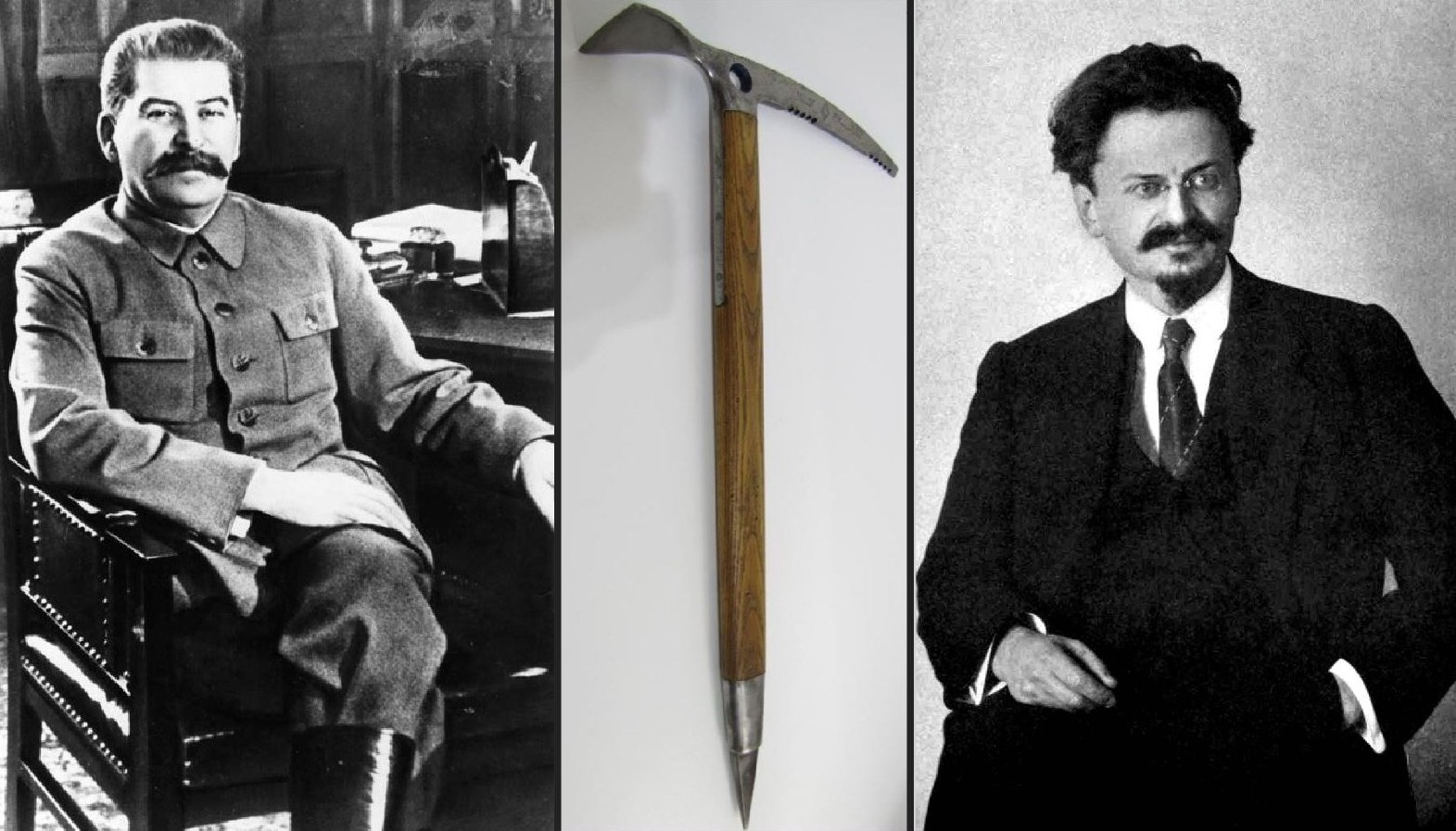
Comrade Stalin (left), an ice axe (centre) and comrade Trotsky (right).

Comrade Leon Trotsky (1879-1940; founder of the Fourth International) in The Revolution Betrayed: What Is the Soviet Union and Where Is It Going? (1936) had a feeling for the political phrase and labelled the state created by comrade Joseph Stalin (1878-1953; Soviet leader 1924-1953) a “Soviet Thermidor” because although Tsarist era capitalism wasn’t re-created (a la the monarchy in France not being restored in the 1790s), the combination of a bureaucracy supporting a personality cult (even if the latter was in 1936 still somewhat disguised) was “a counterrevolutionary regression” which betrayed what was achieved by comrade Vladimir Lenin (1870–1924; head of government of Russia or Soviet Union 1917-1924) between 1917-1924.  The phrase caught the imagination of many, notably those in the Partido Obrero de Unificación Marxista (The POUM, the Workers' Party of Marxist Unification), a non-communist Marxist party (a surprisingly populated fork of left-wing thought) which comrade Stalin correctly associated with Trotskyism.  The POUM was highly productive in thought but drifted increasingly far from the moorings of political reality although rhetoric which included polemics like “Stalinist Thermidorians have established in Russia the bureaucratic regime of a poisoned dictator.”  Agents of the Narodný komissariat vnutrennih del (NKVD, The People's Commissariat for Internal Affairs and one of the many predecessors to the KGB), answerable only to comrade Stalin, killed dozens of POUM’s Central Committee which ended the organization’s effectiveness for a generation.  In his prodigious memory, comrade Stalin filed away annoying phrases and in 1940 he had comrade Trotsky murdered in Mexico.  The murder weapon was an sawn-off ice-axe.

Cloak and axe of Giovanni Battista Bugatti (1779–1869), official executioner for the Papal States 1796-1864, Criminology Museum of Rome.  Woodcuts and other depictions from the era suggest the blood-red cloak wasn't always worn during executions. 

Giovanni Battista Bugatti began his career at a youthful 17 under Pius VI (1717–1799; pope 1775-1799) and diligently he served six pontiffs before being pensioned off by Pius IX (1792–1878; pope 1846-1878), his retirement induced not by the Holy See losing enthusiasm for the death penalty because one Antonio Balducci succeeded him in the office which fell into disuse only with the loss of the Papal States (756-1870; a conglomeration of territories in the central & northern Italian peninsula under the personal sovereignty of the pope), after the unification of Italy.  Unlike his illustrious predecessor, history has recorded little about Signor Balducci although it’s known he performed his final execution in 1870.  Signor Bugatti was by far the longest-serving of the Papal States’ many executioners and locals dubbed him Mastro Titta, a titular corruption of maestro di giustizia (master of justice) and his 69 year tenure in his unusual role can be accounted for only by either (1) he felt dispatching the condemned a calling or (2) he really enjoyed his work, because his employers were most parsimonious: he received no retainer and only a small fee per commission (although he was granted a small, official residence).  His tenure was long and included 516 victims (he preferred to call them “patients”, the term adopted also by Romans who enjoyed the darkly humorous) but was only ever a part-time gig; most of his income came from his work as an umbrella painter (a part of the labour market which still exists as a tint, artisan niche).  Depending on this and that, his devices included the axe, guillotine, noose or mallet while the offences punished ranged from the serious (murder, conspiracy, sedition etc) to the petty (habitual thieves and trouble-makers).

Cardinal Pietro Gasparri (1852–1934; Cardinal Secretary of State 1914-1930, left) and Benito Mussolini (1883-1945; Duce (leader) & prime-minister of Italy 1922-1943, right), signing the Lateran Treaty, Lateran Palace, Rome, 11 February 1929.

Although as early as 1786 the Grand Duchy of Tuscany became the first Italian state to abolish the death penalty (torture also banned), the sentence remained on the books in the Papal States; then as now, the poor disproportionately were victims of the sanction, similar (or worse) crimes by the bourgeoisie or nobility usually handled with less severity, “hushed-up” or just ignored.  With the loss of the Papal States, the pope’s temporal domain shrunk to little more than what lay around St Peter’s Square; indeed between 1870 and the signing of Lateran Treaty (1929) after which the Italian state recognized Vatican City as a sovereign state, no pope left the Vatican, their status as self-imposed prisoners a political gesture.  The Lateran treaty acknowledged the validity of the sentence (Article 8 of the 1929 Vatican City Penal Code stating anyone who attempted to assassinate the pope would be subject to the death penalty) although this provision was never used, tempted though some popes must have been.  Paul VI (1897-1978; pope 1963-1978) in 1969 struck capital punishment from the Vatican's legal code and the last reference to the sanction vanished in 2001 under Saint John Paul II (1920–2005; pope 1978-2005).

Wednesday, June 25, 2025

Ranga

Ranga (pronounced rang-ah)

In Australian slang, a person with red (ginger, auburn etc) hair.

1990s: Based on the name orangutan (pronounced aw-rang-oo-tan, oh-rang-oo-tan or uh-rang-oo-tan), any of three endangered species of long-armed, arboreal anthropoid great ape, the only extant members of the subfamily Ponginae, inhabiting Borneo (Pongo pygmaeus) and Sumatra (P. abelii).  The three species are Bornean orangutan (Pongo pygmaeus), Sumatran orangutan (Pongo abelii) and Tapanuli orangutan (Pongo tapanuliensis).  Ranga is a noun; the noun plural is rangas.  Australians tend to be linguistic reductionists and one is deemed either a ranga or not but presumably there can be "gray areas" (there may, in this context, be a better way of putting that) so adjectives such as rangaish or rangaesque could be coined as required.

A ketchup of gingers?  Roodharigendag in the Netherlands.

Since 2005 (except in 2020 when the COVID-19 pandemic put a stop to the fun), the Netherlands has hosted what is described as the "world's largest gathering of redheads".  Were the three-day festival (which attracts participants from over eighty nations) staged in certain other countries it might have gained a playful, fanciful name but the practical Dutch unadventurously used Roodharigendag (Redhead Day) which does have the virtue of being unambiguous.  There are a variety of events including lectures and pub-crawls; presumably, coffee shops are visited and perhaps the proprietors offer special blends of red-themed weed for the event.  If not, presumably "Fanta Orange" (€13 per gram in mid 2024) sales spike.

An Orangutan in the Sumatran jungle.  International Orangutan Day is 19 August.

Despite the first element of orangutan (orang) appearing to be a clipping of “orange” (a reasonable assumption given the creature’s vaguely orange-hued coat although zoologists describe it usually as “reddish-brown”), the term has nothing to do with coloration and is not derived from English sources.  Orangutan describes any of the three species of arboreal anthropoid ape, which comprise the genus Pongo, native to Borneo and Sumatra and as late as 1996 were listed as a single species in the taxonomic, based on the first scientific classification (as Homo Sylvestris) in 1758 by Swedish zoologist & physician Carl Linnaeus (1707–1778 and styled as Carl von Linné after 1761).  After being divided in 1996, the third species definitively was identified in 2017.  Even in English there are a dozen-odd alternative spellings and unmodified and variant forms appear in many languages.  The construct of orang-utan was from the Malay: orang (person, man) + hutan (forest) thus literally “forest man”.

Thomas Love Peacock (1785–1866) was an English novelist and poet but despite a background in literature and little else, through family connections he was in 1819 appointed an administrator in the East India Company (which “sort of” ran British India in the years before the Raj).  It was an example of the tradition of “amateurism” much admired by the British establishment, something which didn’t survive the harsher economic realities of the late twentieth century although some still affect the style.  Despite being untrained in such matters, his career with the company was long and successful so he must have had a flair for the business although his duties were not so onerous as to preclude him from continuing to write both original compositions and works of literary analysis.  Peacock's second novel was the Regency-era three volume novel Melincourt (1817).  It was an ambitious work which explored issues as diverse as slavery, aspects of democracy and potential for currency destabilization inherent in the issue of paper money.  Another theme was the matter of differentiating between human beings and other animals, a central character being Sir Oran Haut-ton, an exquisitely mannered, musically gifted orangutan standing for election to the House of Commons.  The idea was thus of “an animal mimicking humanity” and the troubled English mathematician Dr Alan Turing (1912–1954) read Melincourt in 1948, some twelve months before he published a paper which included his “imitation game” (which came to be called the “Turing test”).  Turing was interested in “a machine mimicking humanity” and what the test involved was a subject reading the transcript of a natural-language conversation between a human and a machine, the object being to guess which interlocutor was the machine.  The test was for decades an element in AI (artificial intelligence) research and work on “natural language” computer interfaces but the field became a bit of a minefield because it was so littered with words like “feelings”, learning”, “thinking” and “consciousness”, the implications of which saw many a tangent followed.  Of course, by the 2020s the allegation bots like ChatGPT and character.ai have been suggesting their interlocutors commit suicide means it may be assumed that, at least for some subjects, the machine may have assumed a convincing human-like demeanour.  The next great step will be in the matter of thinking, feelings and consciousness when bio-computers are ready to be tested.  Bio-computers are speculative hybrids which combine what digital hardware is good at (storage, retrieval, computation etc) with a biological unit emulating a brain (good at thinking, imagining and, maybe, attaining self-awareness and thus consciousness).

PSA.

As a courtesy to Lindsay Lohan and other redheads, Harper's Bazaar published Exactly How to Choose the Perfect Lipstick Shade for Redheads which included a list of “dos & don’ts” by celebrity make-up artist Emma Day (b 1974).  Lipstick for redheads is a “special case” because with the overwhelming majority of lipsticks being red, the chance of a jarring clash is greater for redheads and the interplay between skin-tone, hair color and lipstick demands greater attention.  It would of course be simpler were the term “red head” actually to mean “person with red hair” but the hues grown are typically coppersambersgingers, oranges, auburns etc, not color ranges which typically mesh well with most reds, thus the need for expert advice.

Because, of the origin, to call someone a ranga is to compare them to a sub-human primate, so it might have been thought offensive but it remains widely used and is one of the additions to English which has spread from Australia.  Possibly the fact the world's redheads are almost exclusively white meant the comparisons with the orangutan weren't historically or culturally "loaded" so it never became more than a minor micro-aggression.  It certainly can be offensive and is often (though apparently mostly by children) used that way but it can also be a neutral descriptor or a form of self-identification by the red-headed.  It may be that many of those who deploy ranga (for whatever purpose) are unaware of the connection with sub-human primate and treat it as just another word; in that sense it’s actually less explicit than some of the many alternatives with a longer linguistic lineage including "ginger minge", "fire crotch", "carrot top", Fanta (not always capitalized) pants", "rusty crotch" and "blood nuts".  Whether ranga is more or less offensive than any of those (none of which reference apes) is something on which not all redheads may agree but in 2017 (some months on from ranga being added to the Australian Macquarie Dictionary), presumably so there was a forum to discuss such matters, RANGA (the Red And Nearly Ginger Association) was formed, finding its natural home on social media where it operates to provide social support rather than being a pressure group.  

There was also the Australian moniker “blue” (and, being Australia, the inevitable “bluey”) to describe redheads and most dictionaries of slang suggest the origin was in the tradition of “lofty” or “stretch” sometimes being applied to the notably short (ie the stark contrast between “red” and “blue”).  There is the suggestion it may have been an allusion to the propensity of “hot-headed” redheads to “start a blue” (ie start a fight, that use another of the nation’s many re-purposings of the word) but there’s no documentary evidence.  However, there is an established connection between “orange” & “blue”, a number of orange-flavored liqueurs dyed blue, Blue Curaçao the best-known.  According to historians of the industry, the blue dye came to be used just for the visual novelty, blue uncommon in natural foods or drinks and the striking colour was a point of differentiation with the many other orange-colored beverages.  Curaçao liqueur originated on the Caribbean island of Curaçao and was made using the dried peel of the laraha (a bitter orange).  Originally distilled as a clear or amber fluid, various vivid artificial colors (blue, green, orange, red) were added just to create different brands and Blue Curaçao became the most popular becoming almost synonymous with the striking blue cocktails (Blue Lagoon, Blue Hawaiian etc) in which it is an ingredient.  Because the blue dye (typically Brilliant Blue FCF, aka E133) has no taste, the orange flavour remains unaffected.

Ginger, copper, auburn & chestnut are variations on the theme of red-headedness: Lindsay Lohan demonstrates the possibilities.  Red hair is the result of a mutation in the melanocortin 1 receptor (MC1R) gene responsible for producing the MC1R protein which plays a crucial role also in determining skin-tone. When the MC1R gene is functioning normally, it helps produce eumelanin, a type of melanin that gives hair a dark color.  However, a certain mutation in the MC1R gene leads to the production of pheomelanin which results in red hair.  Individuals with two copies of the mutated MC1R gene (one from each parent) typically have red hair, fair skin, and a higher sensitivity to ultraviolet (UV) light, a genetic variation found most often in those of northern & western European descent.

Just as blonde women have long been objectified and derided as of limited intelligence (ie the "dumb" blonde), redheads have been stereotyped as sexually promiscuous (women) or having fiery tempers (men & women) but there is no evidence supporting any relationship between hair color, personality type or temperament.  The sample sizes are inherently small (redheads less than 2% of the global population) but there are populations in which the predominance is higher, so further research would be interesting but such questions are of course now unfashionable.  Most style guides list "red-haired”, “redhead” & “redheaded” as acceptable descriptors but the modern practice is wherever possible to avoid references which apply to physical characteristics, much as the suggestion now is not to invoke any term related to race or ethnic origin.  That way nothing can go wrong.  If it’s a purely technical matter, such as hair products, then descriptors are unavoidable (part-numbers not as helpful at the retail level) and there’s quite an array, ranging from light ginger at the lighter end to chestnuts and and auburns at the darker and there was a time when auburn was used as something of a class-identifier.

Jessica Gagen, Miss England, 2022.

Winner of Miss England 2022 (the first redhead to claim the crown (which really was a crown rather than the tiara some contests award)), Miss World Europe 2023 & Miss United Kingdom 2024, Jessica Gagen (b 1996) holds a bachelor's degree in aerospace engineering from the University of Liverpool, and is an advocate for women and girls in STEM (science, technology, engineering & math).  Having been subject to "rangaphobia" bullying as a child, Ms Gagen used her platform to spread a positive message to those who have also suffered cruel taunts about being red-headed.  After leaving school, Ms Gagen discovered one advantage her locks afforded was they attracted modeling agencies and, as a multi-tasker, she pursued a lucrative international career in conjunction with her studies.  Her interest in encouraging women to enter STEM fields came while at university when the paucity of female participation in her engineering course was obvious in male-dominated lecture theatres and tutorial rooms.

Peak Jessica: Jessica Gagen pictured cooling off during one of England's increasingly frequent heat-waves when temperatures reached a record 42o C (108o F), something long thought impossible because of the interplay of the movement of water and sea currents around the British Isles.  It's an urban myth redheads (being "hot-headed" in the popular imagination) need more than most to "cool down" when the temperature is high. 

Interestingly, Ms Gagen says participation in beauty contests changed her perception of them as sexist displays, regarding that view as archaic, noting the women involved all seemed to have their own motives, usually involving raising awareness about something of personal interest.  Being part of the subset of humanity likely to do well in beauty contests (a matter of concern among some critical theorists) is of course just a form of comparative advantage in the way some benefit from  a genetic mix which makes them ideal basketball players.  The beauty contest is thus an economic opportunity and choosing to participate in one can be a rational choice in that one's allocation of time and resources can yield greater returns than the alternatives.  Another notable thing about Jessica Gagen is that being born in 1996, she is part of that sub-set of the population called “peak Jessica”, the cohort which reflected the extraordinary popularity of the name between 1981-1997, overlapping slightly with peak Jennifer” which occurred between 1970-1984.

Saturday, August 24, 2024

Apostrophe

Apostrophe (pronounced uh-pos-truh-fee)

(1) The punctuation mark (') used variously: (1) to indicate the omission of one or more letters in a word, whether pronounced or unpronounced, (2) to indicate the possessive case or (3) to indicate plurals of abbreviations and symbols.

(2) In formal rhetoric (as the literary apostrophe), a digression in the form of an address to someone not present, or to a personified object or idea.

(3) In sociolinguistics & orthography, the text character (’) which serves as a punctuation mark in various languages and as a diacritical mark in certain rare contexts.

1525–1535: The use as a rhetorical device was from the Late Latin, from the Classical Latin apostrophe, from the Ancient Greek ποστροφή (apostroph) (a turning away; a digression), the construct being apostroph-, verbid of apostréphein (to turn away) + -ē (the noun suffix).  The punctuation mark dates from 1580–1590 and was from the Middle French, replacing the earlier apostrophus, from the Late Latin, from the Ancient Greek πόστροφος (apóstrophos) (accent of elision) (prosōidía) (eliding (mark) (literally “(mark) of turning away”), noun use of an adjective from ποστρέφω (apostréphō) (I turn away), verbid of apostréphein, the construct being πό (apó) (away (which sometimes appeared as aph)) + στρέφω (stréphō or stréphein (to turn).  The now rare alternative forms were apostrophë & apostrophy and in non-US use apostrophise etc is more common than apostrophize etc.  Apostrophe & apostrophization are nouns, apostropher, apostrophizing & apostrophize are verbs, apostrophic & apostrophed are adjectives and apostrophically is an adverb; the noun plural is apostrophes.

Lindsay Lohan with pram, JFK airport, New York, January 2024.  In English, names with apostrophes are uncommon (almost all from other languages) but the punctuation mark is sometimes used as a guide to pronunciation.  Ms Lohan named her son (b 2023) Luai which in the Arabic is pronounced Lou’aye with the apostrophe operating as “a kind of break or a cut”.

There are a number of derived terms.  Some are purely descriptive (such as the “curly apostrophe”, the “perpendicular apostrophe”, “vertical apostrophe” and the “straight apostrophe” which in publishing are distinguished as the “typographic apostrophe” (an apostrophe that has a curved, asymmetrical form) (known also as the printer's apostrophe) and the “typewriter apostrophe” (an apostrophe with a straight, vertically symmetrical form).  In sociolinguistics & orthography, the apologetic apostrophe is imposed upon a Scots word in to lend it the appearance of being a contraction of an English word such as wi' (equivalent to the English “with”) and a' (equivalent to the English “all”).  The humorous apostrophectomy is a clinical procedure used by the grammar nazis ruthlessly to excise incorrect apostrophes, usually those used wrongly to form plurals.  The construct was apostrophe + -ectomy (from the Ancient Greek -εκτομία (-ektomía) (a cutting out of), from κτέμνω (ektémnō) (to cut out), the construct being κ (ek) (out) + τέμνω (témnō) (to cut). The reverse procedure (inserting an apostrophe where one is required) was apostrophplant. the construct being apostroph(e) + (in)plant.  The grammar nazis operate usually on the “greengrocer's apostrophe” one where the symbol is used in error when forming a noun plural.  It’s probably a slight on greengrocers in that others are just as guilty but the most commonly cited examples are usually something like “Banana’s, 99c lb” rather than “Vegetarian Burger’s available”.  Among those in England who speak RP (Received Pronunciation, the “correct” form insisted on by the BBC (British Broadcasting Corporation) until the 1960s (with the odd quirky exception)), the greengrocer's apostrophe is still sometimes known as the “Yorkshire apostrophe”; it’s a form of (southern) linguistic snobbery because the phenomenon certainly isn’t unique to those from the county.

The literary apostrophe is a figure of speech in which a thing, a place, an abstract quality, an idea, a dead or absent person, is addressed as if present and capable of understanding. Classic instances include Oliver Goldsmith’s (1728–1774) opening in The Deserted Village (1770): “Sweet Auburn, loveliest village of the plain…”; Antony's cry in William Shakespeare’s (1564–1616) Julius Caesar (1599): “'O Judgement! thou art fled to brutish beasts…”; William Wordsworth’s (1770–1850) passionate appeal in London 1812: “Milton! Thou should'st be living at this hour…” and the biblical: “O death, where is thy sting? O grave, where is thy victory?” (1 Corinthians 15:55; King James Version (KJV, 1611)).

The star cross'd lovers: Romeo and Juliet (1884), oil on canvas by Frank Bernard Dicksee (1853–1928), Southampton City Art Gallery.

As a mark indicating “an omitted letter”, the apostrophe was in common (though far from universal) use by the early sixteenth century and the origin of use as a possessive marker lay in one representing the loss of -e- in words ending in –es; by the mid eighteenth century, it was being applied to all possessives, whether or not they were ever once spelled with an additional “e”.  Another of the grammar Nazis bugbears (they have many) is the incorrect use of “it’s” as a neuter possessive pronoun, the late sixteenth century construct being it + the genitive/possessive ending “'s”.  The correct use of “it’s” is as a contraction of “it is” etc but as a possessive form it endured until the early nineteenth century and etymologists suggest the decline in use was due to either because the contraction of “it is” had become established or to align use with the general practice of omitting apostrophes in personal pronouns (yours, hers, theirs etc.).  One of the best known instances of a word with a “apostrophe substitution” appears in Shakespeare’s Romeo and Juliet (1597) where “star cross’d lovers” is used to describe the doomed pair.

1967 Ford Mustang (left), 1970 Plymouth 'Cuda (the 1971 grill an aesthetic choice), the apostrophe indicating a clipping of “Barracuda”, the model designation used on the non high-performance models) (centre) and 1968 Chevrolet Camaro (right) at the Pikes Peak International Hill Climb (PPIHC) (the “Race to the Clouds”).  The three compete in the "Vintage Car" class.  The PPIHC is a marvelously anarchic event, run continuously since 1916 (except in 1917-1919 & 1942-1945 because of wartime restrictions) and an example of how good things can be if the FIA (the Fédération Internationale de l'Automobile (International Automobile Federation), world sport’s dopiest regulatory body) isn’t involved.

Pikes Peak in the US state of Colorado was in 1820 named (as Pike’s Peak) after Brigadier General Zebulon Pike (1779–1813) who led an earlier expedition (which failed to reach the summit).  It a shame the landmark wasn't named "Zebulon's Peak"; so much more evocative.  The name Zebulon was from the Latin Zabulon, from the Ancient Greek Ζαβουλών (Zaboulṓn), from the Biblical Hebrew זְבוּלוּן (z'vulún).  In the Hebrew, Zebulon was a male name meaning “exalted house,” “dwelling,” “lord,” or “prince” (the alternative spelling was Zebulun.  In biblical times, Zebulun was one of the twelve tribes of Israel and it was the given name for the sixth son of Jacob and his wife, Leah.  Prior to European settlement, the native peoples of the region called the peak variously Tava (Sun) or Heey-otoyoo' (Long mountain).  In 1890, the US Board on Geographic Names (BGN) introduced a policy avoiding the use of apostrophes in the possessive form in place names, the intent being: (1) a standardization convention to remove confusion, (2) to simplify the printing of maps by ensuring there were fewer clashes with special characters and (3) to remove another source of imaginative interpretation by lawyers.  An additional benefit was realized when computer databases began to be created and, especially in the early post-war years, many problems in indexing and formatting were avoided by restricting entries to letters & numbers.  In 1890, Pike’s Peak thus became Pikes Peak and just to make sure no grammar Nazis ever attempted a revival, in 1978 the Colorado state legislature outlawed the use of an apostrophe in Pikes Peak, apparently one of the world’s few laws about punctuation.  The BGN does make the odd exception in the case of places of historical significance and Martha's Vineyard was one of the few places to emerge with apostrophe intact.  

It’s a pity the BGN doesn’t set the other rules for the use of the apostrophe, a matter which so concerned Henry Fowler (1858–1933) that he devoted several paragraphs to the topic in A Dictionary of Modern English Usage (1926).  One helpful reform would be to standardize the placement when making a possessive of names ending in “s” and that rule should be: (1) when a name ends in a letter other than “s” the apostrophe sits before the appended (plural) “s” (Lindsay Lohan’s car) and (2) when a name ends in “s” the apostrophe follows (the so-called “trailing apostrophe”) (Britney Spears’ car).  That has the benefit of simplicity and would mean one wouldn’t have to choose between the various options published in style guides, some of which are based on the number of syllables and some on the sound of the word when pronounced.  It’s a layer of complication as unnecessary as adding pronunciation guides to printed numbers (1st, 2nd, 3rd, 4th etc) in that it’s a needless tribute by the written to the spoken; the human brain can manage without them.

Kamala Harris (b 1964; US vice president since 2021) and Tim Walz (b 1964; governor of Minnesota since 2019), on stage, Philadelphia, Pennsylvania, 6 August 2024.

The issue flared when Kamala Harris announced Tim Walz as her running mate in the 2024 US presidential election for not only does “Harris” end in “s” but “Walz” when spoken sounds like it too ends thus, something which style guides variously suggest should exist in the possessive either as Walz’s or Walz’.  Clearly, he’s a trouble-maker.  Most of the grammar nazis (X (formerly known as Twitter) their natural home where debate ensued) seemed to conclude “Walz’s” was correct but Harris’ or Harris’s divided opinion, the factions forming to defend either (1) if the “s” is sounded, spell the “s” and (2) if it ends in an “s” regardless of pronunciation, it’s a trailing apostrophe.  Most dictionaries say either practice is acceptable provided use is consistent which is fence-sitting but reflects reality although there is the sense many editors would be happy if a universal appended “’s” was the “rule” so the tiresome debate would go away.  Presumably that would also please the Harris-Walz campaign team which has issued press releases which included “Harris’s positive vision” and “Harris’ seventh trip to Nevada.”

Henry Fowler’s A Dictionary of Modern English Usage has been influential for almost a century and it’s the original and the second edition (1965) edited by Sir Ernest Gowers (1880–1966) which remains the standard (the third (1996) and fourth (2015) editions less helpful although some readers might appreciate being “spoken with” rather than “dictated to” as was Henry Fowler’s way).  However, in the TikTok age, it may prove the singer Taylor Swift (b 1989) is now the final arbitrator of the language’s squabbles.  In mid 2024, Ms Swift released the album The Tortured Poets Department and while most (Swifties and others) focused on the music, some couldn’t help but notice what appeared to be the “missing apostrophe”.  However, whether or not it’s missing depends on how the title is read:  If it's a possessive form then one should appear but if “poets” is operating as descriptive modifier of “department” then none is required.  Understanding the distinction is easiest if the phrase is deconstructed and imagined as a department in a university which contains tortured poets; there morosely they sit for a time but they don’t “possess” the department; instead, tortured poets come and go and over generations the membership changes but the department endures.  In that sense, Ms Swift’s "Tortured Poets Department" is like a "Farmers Market" rather than a "driver’s license".  So, it’s really a matter of what Ms Swift intended and she seems a bit of a word nerd so it may be assumed she says what she means and means what she says.