Showing posts sorted by relevance for query Unrestricted. Sort by date Show all posts

Saturday, March 21, 2026

Unrestricted

Unrestricted (pronounced uhn-ri-strik-tid)

(1) Not restricted or confined.

(2) In the classification of documents, having no security classification.

1766: The construct was un-+ restrict + -ed.  The un- prefix was from the Middle English un-, from the Old English un-, from the Proto-West Germanic un-, from the Proto-Germanic un-, from the primitive Indo-European n̥-.  It was cognate with the Scots un- & on-, the North Frisian ün-, the Saterland Frisian uun-, the West Frisian ûn- &  on-, the Dutch on-, the Low German un- & on-, the German un-, the Danish u-, the Swedish o-, the Norwegian u- and the Icelandic ó-.  It was (distantly) related to the Latin in- and the Ancient Greek ἀ- (a-), source of the English a-, the Modern Greek α- (a-) and the Sanskrit अ- (a-).  The verb restrict was in use by at least the 1530s in the sense of “to limit, bound, confine (someone or something), prevent from passing a certain limit in any kind of action” and was from the Latin restrictus, past participle of restringere (bind fast, restrain) and perfect passive participle of restringō (draw back tightly; restrain, restrict), the construct being re- (back, again) + stringō (press, tighten, compress); as an adjective, it was a doublet of ristretto. By the eighteenth century, the word had come to be regarded as a Scotticism but the infection spread quickly to Standard English.  As the past-participle adjective from restrict (in the sense of “limited, confined”), restricted has become associated with the classification of government documents, in the sense of “not for public release”, use seems not to have been routine until 1944 when a system of classification was codified by the US government.  Prior to that, although restrictions of distribution were common, concepts such as “Restricted to [names or designations]”, “Secret”, “Top Secret” etc were used but there was no standardization within departments or even between branches of the military.  When used as a suffix to form possessional adjectives from nouns, -ed was from the Middle English -ed, from the Old English -od (the adjectival suffix), from the Proto-Germanic -ōdaz, from the primitive Indo-European -ehtos.  It was cognate with the Latin -ātus. 

Glory road: A “Derestricted” sign in Australia's Northern Territory from the days of “no speed limits”.

In use, the older adjectival use was simply “restrict” and although “unrestricted” would seem an absolute (ie something either is restricted or it is not), dictionaries confirm the comparative is “more unrestricted” and the superlative “most unrestricted” although at least one style guide notes those forms can be regarded in a similar way as “very unique” (ie technically incorrect but widely used and well-understood.  The related adverb “restrictedly” was and remains rare.  In the US, well into the twentieth century, the appearance of the word “restricted” in advertisements, signage and such was verbal shorthand for (depending on context and location): “No Jews”, “No coloreds” etc.  Although the words “unrestricted” & “derestricted” describe similar states, different histories are implied and that’s a product of the ways in which the absence of restrictions came about.  Unrestricted means literally “no restrictions” (access to something or somewhere; rights to engage in trade etc).  “Derestricted” means that previously restrictions must have been imposed but those have since been removed.  The use applies to document classifications and in the now rare cases of roads with no speed limits (although some of those were something of a linguistic outlier because in many cases they never had any restrictions to be derestricted.  For obvious reasons, in English, “unrestricted” is the more commonly used form.  Unrestricted, unrestrictive & unrestrictable are adjectives, unrestrictedness is a noun and unrestrictedly is an adverb.

1978 Mercedes-Benz 450 SEL 6.9 on the Northern Territory's derestricted roads.  

Although the factory only ever claimed 225 km/h (140 mph), top speed of a UK-delivered “Euro spec” 6.9 (ie one not fitted with the power-sapping anti-emission devices fitted to those built for sale in the US or Australia) turned out to be a verified 237 km/h (147 mph) which reflected the experience of European testers who achieved 238 km/h (148 mph) on the German Autobahns.  Unexceptional now, such pace was in the 1970s a reasonable achievement for a heavy cruiser with pre-modern aerodynamics; at high-speed, the fuel consumption was as awe inspiring as one might expect from a 6.8 litre (417 cubic inch) V8 at full throttle.  The most powerful of the W116 range (1972-1980), technically the 6.9 was a V116 (the "V" denoting the 100 mm (4 inch) longer wheelbase) and was the spiritual successor to the old (W109) 300 SEL 6.3 (1967-1972) which adopted the classic muscle car formula for the 1964 Pontiac GTO by taking the 6.3 litre (386 cubic inch) V8 (M100) from the huge 600s (W100, 1963-1981) and putting it in a mid-sized car previously powered by nothing larger than a 3.0 litre (183 cubic inch) straight-six.  The distinct "hot rod" flavor of the 6.3 made it a more entertaining drive than the 6.9 but the latter was a vastly improved machine and the template on which the factory would build decades of success.  One quirk of the 6.9 was the use of a dry sump; with the lower hood (bonnet) line of the W/V116, the V8 was simply too tall to fit if conventionally lubricated.   

Idealistic lawyers (they do exist) and others have for centuries argued it is the existence of and adherence to laws which makes possible civilized societies, the alternative often expressed as “the law of the jungle”, best understood in the vernacular “kill or be killed” world in which life of man was “solitary, poor, nasty, brutish, and short”, memorably described in Leviathan (1651) by the very clever and deliciously wicked English philosopher Thomas Hobbes (1588-1679).  However, what the lawyers, at least privately, acknowledge is the extent of adherence to laws closely is tied to (1) their enforcement and (2) a layered system of punishments for transgressions.  In domestic legal systems, this is comprehended as the apparatus extending from receiving a fine for overstaying one’s time at a parking meter to being hanged for murder; the existence of laws does not prevent crime but the perception of the chance of detection and the subsequent penalty for many operates as a deterrent and the debates about relationship between certain penalties and their deterrent effect continue.

Mahan's The Influence of Sea Power upon History 1660-1783.  In the last decade of the nineteenth century, probably no book was more read in palaces, chancelleries & admiralties.

In war, although usually the opposing sides have geo-political objectives, for those doing the fighting, historically the business was about killing each other and in practice that of course quickly and understandably came to imply “by whatever means possible” but for many centuries there have been conventions which form of “rules of war”, the most celebrated the various chivalric codes (codified during of the Middle Ages) which sought to regulate the behaviour of soldiers, particularly towards civilians.  However, as US Navy Captain Alfred Mahan (1840–1914) pointed out in the epoch-making The Influence of Sea Power upon History, 1660–1783 (1890), it’s impossible by mere agreement to outlaw the use of a militarily effective weapon so is it any more plausible for a statute, treaty or agreement to limit “mission creep” in the methods?  Whatever knightly codes may have existed, there seems little doubt that on the battlefield (or the towns subject to rape & pillage) habits do tend towards “unrestricted warfare”, military historians and legal theorists often pondering whether in “existential conflicts”, law reasonably can be expected to retain its intended force.

In what was a rhetorical flourish rather than a substantive legal point, in the dock before the IMT (International Military Tribunal) which in 1945-1946 sat in Nuremberg to try 22 of the surviving senior Nazis, Hermann Göring (1893–1946; leading Nazi 1922-1945, Hitler's designated successor & Reichsmarschall 1940-1945) claimed to be quoting Winston Churchill (1875-1965; UK prime-minister 1940-1945 & 1951-1955) in citing: “In the struggle for life and death there is in the end no legality.”  Like William Shakespeare (1564–1616), a few phrases have been attributed to Churchill on the basis of “sounding Churchillian” and although there’s nothing in the record to support the case those exact words ever passed his lips, Göring’s paraphrase was not unreasonable.  After the fall of France in 1940, Churchill did make clear his view “there could be no justice if, in a mortal struggle, the aggressor tramples humanity while those resisting remain bound by violated conventions” by which he meant if the Nazis ignored international law, it was an absurdity for the Allies fully to remain constrained by it while fighting for their very survival.  Churchill was not advocating the rejection of established law as a principle; he was saying when a state faces the prospect of destruction at the hand of an enemy ignoring the accepted rules of war, strict legalism must not be allowed to prevent an effective defence.  That wasn’t a novel idea Churchill formed upon assuming the premiership.  Months earlier, when serving as First Lord of the Admiralty (minister for the navy), he’d discussed whether the UK should regard itself still restricted by the legal conventions Germany’s forces were ignoring: “The Germans have torn up the conventions and the usages of war.  We cannot allow ourselves to be bound by rules which the enemy does not observe if by doing so we place our country in mortal danger.”  While not exactly the words used by Göring in the dock, he captured the spirit of Churchill’s meaning.

Lindsay Lohan on the cover of Vogue Arabia, March 2026.  Among the topics raised in discussion about her not uneventful life was “…coming of age in the spotlight in a time of unrestricted paparazzi access and near-constant tabloid scrutiny.”

Of course on 15 March 1946, borrowing the thoughts of “…one of our greatest, most important, and toughest opponents…” to support his argument modern, industrial, total war had rendered irrelevant traditional legal restraints, he was still harbouring the (faint) hope he might escape the noose and thus has a good motive in seeking to undermine the moral authority of the tribunal by suggesting even Churchill had acknowledged that in existential war, legal rules collapse.  This was not the construction of legal theory in the abstract, just as Churchill was explaining the pragmatic nature of military necessity because as he pointed out: “without victory there is no survival” and were the UK unilaterally to obey the rules while its opponents did not, the nation might lose the war.  Neither man ever sought to maintain that in war laws vanish, only that as demanded in extraordinary and reprehensible circumstances, they may need to be ignored.  Essentially, Churchill was asserting he wasn’t prepared to behave with the propriety of Caesar’s wife while Göring cavorted with Caesar’s whores; with that the Reichmarshall gleefully would have agreed and although his hopes the tribunal might find his paraphrased defence exculpatory were by then faint indeed, he still had an eye on the figure he hoped to cut in the history books.  

The doctrine of military necessity of course dates from the first time some prehistoric character picked up a stick or rock to gain tactical advantage in an argument and despite the various codes of warfare promulgated over millennia by philosophers, priests and politicians, that doctrine survived into the age of musketry and later, atomic bombs.  It’s the Prussian general and military theorist Carl von Clausewitz (1780–1831) who often is quoted because, with his commendable economy of phrase, succinctly he explained why necessity so often prevails over legality in existential war.  In On War (1832), he observed “War is an act of force, and there is no logical limit to the application of that force” and, anticipating the idealists, added: “Kind-hearted people might of course think there was some ingenious way to disarm or defeat an enemy without too much bloodshed… Pleasant as it sounds, it is a fallacy.”  What Clausewitz called Kriegsräson (necessity in war) meant in practice was (1) war has an inherent tendency toward escalation, because each side must use whatever means are necessary to defeat the other and (2) “arms races” will tend to ensue.

Imperial Chancellor Theobald von Bethmann Hollweg in field uniform including the famous Prussian Pickelhaube (spiked helmet, the construct being Pickel (pimple, pickaxe) +‎ Haube (hood, cap)), Berlin, 1915.  Even when serving as chancellor (prime minister) von Bethmann Hollweg sometimes wore military uniform; Germans adore uniforms (note the jackboots).

Later in the century, German military jurists expressed this logic through the principle Kriegsräson geht vor Kriegsmanier (military necessity overrides the customary rules of war) by which they meant the laws and customs of war could be followed only to the extent adherence did not impose an unacceptable military cost; if survival (and in practice: “immediate advantage”) demanded those rules be violated, necessity prevails.  What was at the time the most outrageous admission of the application of the doctrine came in 1914 after Germany violated Belgium’s neutrality and was delivered by Theobald von Bethmann Hollweg (1856–1921) who between 1909-1917 served as one of a series of inadequate replacements of Otto von Bismarck (1815-1989; chancellor of the German Empire (the “Second Reich”) 1871-1890); imperial chancellor of the German Empire 1909-1917).  In what must remain among the more ill-advised statements delivered by a politician, von Bethmann Hollweg on 4 August 1914 stood in the Reichstag (lower house of the imperial parliament) and explained to assembled members the German war-plan required the army marching Belgium to attack France and that Germany being a signatory to the Treaty of London (1839) which guaranteed Belgium’s neutrality had been rendered irrelevant by military necessity, the always quoted passage being: “We are violating international law, but necessity knows no law.”  Not all historians agree Realpolitik held a greater fascination for Germans than others but for students of the art, the chancellor’s speech appears in just about every text-book on the subject.  Warming to his theme, when the British ambassador to Germany protested the violation, von Bethmann Hollweg responded it would be an absurdity were Britain to go to war “just for a scrap of paper” (that scrap being the treaty the Germans had in 1839 signed as co-guarantors of Belgian neutrality).  That cynical turn of phrase was echoed a generation later when, under cross-examination in the dock at Nuremberg, Göring almost gloatingly admitted he and the other leading Nazis had regarded the many treaties they’d signed as “just so much toilet paper.”

Like many a defendant, the defrocked Reichmarshall was at times evasive or dissembling but on the matter of the regime’s attitude to treaties, he was truthful.  A highlight of the 50th birthday celebration for Joachim von Ribbentrop (1893–1946; Minister of Foreign Affairs of Nazi Germany 1938-1945) had been the presentation to the minister of a diamond-studded casket containing facsimiles of all the treaties he had signed during (his admittedly busy if not productive) tenure.  When one of his aides remarked that there were only “a few treaties we had not broken”, Ribbentrop was briefly uncertain how to react until he saw “…Hitler’s eyes filled with tears of laughter.”  It was said to be a good party which must have been welcome because by 1943 there wasn't much to celebrate in Berlin.  Like Göring, Ribbentrop, was convicted on all four counts (planning aggressive war, waging aggressive war, war crimes & crimes against humanity) and sentenced to be hanged; his life did end on the gallows, unlike Göring who, in circumstances never explained, cheated the hangman by taking poison.


Periscope cam: Footage of USN submarine strike on the Iranian Navy’s frigate IRIS Dena (released by the Pentagon (unclassified)).

One of the intriguing legal matters explored before the IMT was the matter of the lawfulness of “unrestricted submarine warfare” and those discussions were recalled when, early in March, 2026, the Pentagon announced a USN (US Navy) submarine had torpedoed and sunk the Iranian Navy’s IRIS Dena (a Moudge-class frigate) with the loss of more than half the ship’s compliment of 130-odd.  Pete Hegseth (b 1980; US Secretary of Defense (and War) since 2025) described the act as one of “quiet death” although that was a reference to the torpedo’s stealthy approach rather than the explosions which doomed ship and crew.  It was the USN’s first sinking of an enemy warship by torpedo since World War II (1939-1945) and because (1) the US and Iran undeniably are in a “state of armed conflict” (any legal distinction between that and “war” as traditionally defined ceasing decades earlier much to matter), (2) the Dena was a warship and (3) the action took place in international waters, the attack doubtlessly was within the rules of war and the reaction of Tehran in branding it an “atrocity at sea” was a political rather than legal claim.

Defendants in the dock, Nuremberg, 1946.  All were guilty of something and a dozen were sentenced to be hanged (including one in absentia) but the IMT acquitted three who subsequently were prosecuted by German courts.

What however remains of interest is the recent change in tactics by the US which now uses military-level missiles to target and sink what appear to be civilian vessels from Central America, the White House claiming the boats are being used to smuggle narcotics.  When considering the lawfulness of “unrestricted submarine warfare”, the IMT in 1946 held that while international law did limit the conduct of navies in their interactions with non-military (ie merchant craft, fishing boats etc) vessels, because the British merchantmen were from the beginning of the war armed and captains had been ordered by the Admiralty to if possible ram U-boats, they were not entitled to the warning provisions of the protocol.  Beyond that, with reference to the failure on the part of German U-boat (submarine) commanders to rescue their shipwrecked victims, the tribunal observed:

“The evidence further shows that the rescue provisions [of the Protocol] were not carried out and that the defendant [Großadmiral Karl Dönitz (1891–1980; head of the German Navy 1943-1945, German head of state 1945)] ordered that they not be carried out.  The argument of the defense is that the security of the submarine is, as the first rule of the sea, paramount to rescue and that the development of aircraft made rescue impossible.  This may be so, but the Protocol is explicit.  If the commander cannot rescue, then under its terms he cannot sink a merchant vessel and should allow it to pass harmless before his periscope.  These orders, then, prove Doenitz is guilty of a violation of the Protocol.”  Had the judgement at that point ended the legal position would have been clear in that having at least tacitly conceded the defense’s point that rescue was no longer practicable in light of the limitations of the submarine and modern technological developments, the use of submarines as commerce destroyers would have been deemed against international law.  However Doenitz’s counsel introduced evidence (including affidavits from Allied admirals) that the USN & Royal Navy had from the outbreak of hostilities also practiced the “unrestricted submarine warfare” of which the Germans were being accused and this was not a classic Tu quoque gambit (in international law, a justification of action based on an assertion that the act with which the accused is charged was also committed by the accusing parties.  It was from the Latin Tū quoque (translated literally as “thou also” and latterly as “you also”; the translation in the vernacular is something like “you did it too”, thus the legal slang “youtooism” & “whataboutyouism”)).  What counsel argued was that in practicing “unrestricted submarine warfare”, all navies were acting in accordance with international law because such law makes sense only if it is cognizant of the prevailing circumstances (ie reality).  The IMT’s judgement in the Doenitz case was difficult to read (it was only later it was revealed to have been written by a judge who voted for his acquittal) but what it said was (1) the defendant had violated the protocols which were the rules of international law as they at the time stood but (2) the nature of total war had so changed the reality of war at sea that those protocols were no longer law, rendered obsolete and thus defunct.  That was as close as the tribunal came to allowing a tu quoque defense.

Unclassified footage released by the Pentagon of one of dozens of strikes on alleged “narco-terrorist” boats by US Southern Command.  The video included a message from Secretary of War Pete Hegseth: “TO ALL NARCO-TERRORISTS WHO THREATEN OUT HOMELAND - IF YOU WANT TO STAY ALIVE, STOP TRAFFICKING DRUGS.”  As far as is known, in all cases of these strikes, all on board the boats were killed.

So, while the US military (and for this purpose that includes the Coast Guard, National Guard etc) have a free hand to attack on the high seas warships of a hostile combatant, does the doctrine of “unrestricted warfare” extend to civilian vessels allegedly being used for unlawful activities?  Legal scholars have explored this novel development (something genuinely new and introduced during the second administration of Donald Trump (b 1946; US president 2017-2021 and since 2025)) and the consensus seems to be sinking manned civilian vessel with missiles as an instance in peacetime law enforcement is of dubious legality unless strict conditions are met.  The first thing to consider is whether it’s a matter of (1) peacetime law enforcement in international waters (something governed by the UNCLOS (United Nations Convention on the Law of the Sea)), customary international law and any bilateral interdiction agreements and thus a criminal matter rather than an act of war or (2) armed conflict at sea (and thus coming under the laws of naval warfare) which depends of a “state of armed conflict” existing between sovereign states.

However, whichever is held to be operative, as a general principle, civilian vessels are protected from missile attacks and enjoy freedom of navigation (certainly on the high seas); forces from warships may board, inspect, and arrest, but not arbitrarily destroy and under the UNCLOS there are explicit provisions under which a warship can stop a vessel suspected of statelessness or certain crimes but use of force must be necessary and proportionate.  Conceptionally, the notion of “proportionality” is little different from what is the domestic law of many states concerning matters such as self-defense: (1) there is no reasonable alternative and (2) force must not exceed what is needed to achieve a lawful objective.  Because these are events happening “on the water” there are also “graduations” in the use of force which are unique to the nautical environment including signals and warnings, maneuvering to compel a stop, warning shots (the classic “shot across the bows”) and disabling fire.  When civilian vessels are involved, historically, only in extremis (presenting a clear & present threat) would lethal force be deemed appropriate.  In other words, using missiles, without warning, to sink a civilian vessel would, in the context of law enforcement, be thought “disproportionate” especially if the crew’s lives are put at serious risk (inherent in missile attacks).  That’s all based on the precept that whether on land or at sea, states are expected to respect the right to life under international human rights law.  Because the adoption of this technique was so sudden, legal theorists are still working through the implications but it would appear an extension of the concept of “unrestricted warfare” beyond military targets.

Saturday, November 18, 2023

Laconic

Laconic (pronounced luh-kon-ik)

(1) Using few words; expressing much in few words.

(2) A reply or phrase of this character.

1580–1590: From the Latin Lacōnicus (Spartan) from the Ancient Greek Λακωνικός (Lakōnikós) (Laconian) from Lakōn (a Laconian).  Laconia was the region inhabited and ruled by the Spartans, noted for their economical use of language.  The alternative spelling laconick is long obsolete.  Because of the long history, there's no exact synonym but words in a similar vein include terse, brusque, pithy, brief, compact, compendious, concise, crisp, curt, sententious, short and sweet, succinct, breviloquent & brevity.  Laconic & laconical are adjectives, laconism is a noun and laconically is an adverb; the noun plural is laconisms.

Taking Hemlock with Socrates, gracefully

In Antiquity, Laconia was the region inhabited and ruled by the Spartans, known for their brevity in speech and in English, the meaning "concise, abrupt" emerged in the 1580s (although laconical was created and went extinct a decade earlier).  The origin of this sense was when Philip II of Macedon (382–336 BC; king (basileus) of Macedonia 359-336) threatened the Spartans with the words: "If I enter Laconia, I will raze Sparta to the ground." to which the Spartans' replied: "If."  Although allied when faced with the threat of Persian invasion, Athens and Sparta had a long tradition of enmity, realized most famously in the Peloponnesian War (431–404 BC).  Their differences were cultural as well as political for while the Spartans were known for their dry, understated wit (which we now call "laconic humor"), the Athenians more readily displayed their "Attic wit" (the Attic peninsula the region encompassing the city of Athens), something refined, poignant and delicate, though often not brief.

Death of Socrates (1787), oil on canvas by Jacques-Louis David (1748–1825), Metropolitan Museum of Art, New York.

In Ancient Greece, it was in Athens that art, education and literature was most valued, virtues never forgotten by modern historians, many of whom contrast the earthier Spartans unfavorably although, at the time, perhaps not all Athenians shared the view.  Socrates (circa 470–399 BC), in Plato's (circa 427-348 BC) dialogue Protagoras, detected some cleverness in the Spartans' economy of language which hid their wisdom, revealing sometimes with a brief remark a sophistication of thought and understanding.  Scholars tend however to take this with a grain of Attic salt, noting Socrates’ fondness for a little gentle irony.

Lindsay Lohan and her lawyer in court, Los Angeles, December 2011.

The Laconia Order

The Laconia-Befehl (Laconia Order) was one of the more controversial documents submitted by the prosecution to the International Military Tribunal (IMT) which in 1945-1946 presided over the trial of the leading Nazis.  The order was issued in 1942 by Grand Admiral Karl Dönitz (1891–1980; head of the German Navy 1943-1945, German head of state 1945) which he was commanding officer of the Kriegsmarine's (the German Navy) Befehlshaber der Unterseeboote (BdU) (U-boat or submarine) fleet and was pursuant to what became known as the Laconia Incident.  RMS Laconia was a Cunard ocean liner which the British Admiralty had converted to an armed merchant cruiser, making her a legitimate military target.  On 12 September 1942, she was sunk in a U-Boat attack and in the aftermath, while several U-Boats were rescuing survivors with the intention of transferring them to other vessels, they were attacked by US bombers, despite having informed Allied forces by radio that both the Allied soldiers and women and children had been rescued and were sheltering on the decks of the submarines.

In response, the Germans abandoned the rescue operation and cast the survivors adrift.  The new policy was formalized on 17 September when the Laconia Order was signalled to the fleet, dictating, inter alia, henceforth no rescue attempts of survivors were to be attempted unless it was to secure prisoners of military value (captains or ships' engineers) and then only if there was no risk to the U-Boat.  The British prosecution team introduced the order as evidence of a war crime ordered by Dönitz which effectively amounted to ordering the murder of shipwrecked survivors and treated it as the beginning of "unrestricted submarine warfare".  However, the British seem genuinely to have been unaware of the circumstances which led to the issuing of the order and the Americans certainly didn't wish to discuss the conduct of their air-crews, some of whom had been awarded medals for the attack, even though their claim to have sunk the U-Boat were erroneous (though understandable, a crash dive and a sinking visually similar when viewed from the air.  The IMT noted the ambiguity in the order but in the circumstances granted Dönitz the benefit of the doubt and they were further swayed by the affidavit of Fleet Admiral Chester Nimitz (1885–1966) who commanded US forces in the Pacific.  Nimitz's submission, supported by others was that the US had conducted unrestricted submarine warfare from the point of the nation's entry into the conflict in December 1941 and that such a policy was wholly lawful under the rules of war at sea.

Defendants in the dock at Nuremberg, Dönitz (in sun glasses), sitting in the back row.

Thus the partial success of Dönitz's sophisticated variation of a tu quoque defense, an attempt by an accused to deny the legitimacy of a charge by alleging those mounting the prosecution committed exactly the same offence and thus stand equally guilty.  The IMT had explicitly banned the use of tu quoque but allowed the argument in this one case because it hung on the notion that unrestricted submarine warfare was, as practiced by both sides, entirely lawful and within the rules of war at sea.  A great many British & US sea captains and admirals agreed (“admirals are a trade union” Anthony Eden (1897-1977; UK prime-minister 1955-1957) would later remark in another context).  The judges must have been impressed but the eventual judgement was certainly murky.  Although convicted on counts two (crimes against peace) and three (war crimes), he received only a ten-year sentence, the shortest term of the seven imposed on those not hanged or acquitted.  Perhaps tellingly, one has to read the summary of the verdicts to work out against which of the indictment's four counts he had been convicted; it really isn't possible to work it out from the judgment and it wasn't until later it emerged it had been written by one of the judges who had voted for his acquittal.

Saturday, August 31, 2024

Trammel

Trammel (pronounced tram-uhl)

(1) A hindrance or impediment to free action or movement; restraint (used usually in the plural as trammels); an inhibition.

(2) An instrument for drawing ellipses.

(3) In engineering, as trammel wheel, a circular plate or a cross, with two or more cross grooves intersecting at the centre, used on the end of a shaft to transmit motion to another shaft not in line with the first.

(4) A device for drawing ellipses consisting of a flat sheet of metal, plastic or wood having, a cruciform slot (a cross with two grooves at right angles to each other) in which run two pegs attached to a beam, the free end of the beam describing an ellipse, usually by means of an attached pencil (known also as a Trammel of Archimedes).

(5) A gauge-like device used to align or adjust parts of a machine (also known as a tram).

(6) A net (for the trapping of fish or birds) in three sections the two outer nets having a large mesh and the middle a fine mesh (also called a trammel net or a fowling net).

(7) A vertical bar with several notches or chain of rings suspended over a fire, used to hang cooking pots by a hook (the mechanism providing a simple means of adjusting the height(s)).  They would originally have been improvised and known also as “trammel rings”.

(8) Braids or plaits of hair (the idea being the “trameling” of the hair in the sense of restraining its natural movement).

(9) An alternative name for the beam compass (often in the plural).

(10) A fetter or shackle, especially one used in training a horse to amble (the trammel tying together each pair of a horse's legs (on the same side), forcing the horse to amble.

(11) To involve or hold in trammels; restrain; to hobble or curb; to obstruct, impede, hinder or encumber; to impose a drag upon.

(12) To catch or entangle in or as in a net.

(13) To hinder or restrain

(14) To catch or ensnare

(15) To produce an accurate setting of a machine (the adjustment not necessarily effected with the use of a trammel).

1325–1375: From the Middle English tramayle, from the Old & Middle French tramail (fine-gauged fishnet, a variant of tremail (three-mesh net)), from the Medieval Latin tramallum, from the Late Latin trēmaculum (assumed to mean “a net made from three layers of meshes”), the construct being the Latin trē(s) (three) + macula (hole; mesh in a net, spot, speck; cell).  It was cognate with the Spanish trasmallo (drift net) and the Italian tramaglio (trammel), both French loan words.  The meaning “anything that hinders” dates from the 1650s, the original sense being the late fifteenth century use to mean “a hobble for a horse”.  In English in the 1580s it was used also to mean a “net for binding up a woman's tresses” (ie a hair-net) while the seemingly curious use as “trammel-wheel” dates from 1877 and picked up the name because the slots were vaguely reminiscent of trammels already in use.  The verb entrammel (to entangle) was in use by the 1590s while the adjective untrammeled dates from at least the 1790s and is the form of the word in widest use today (in the sense of “unhindered; unrestricted”).  The verb in the figurative sense of “hinder; restrain” dates from 1727 and developed from the idea of “binding a horse’s legs with a trammel”, a technique first noted in the late sixteenth century.  The earlier use of the verb was to describe “the binding of a corpse”, first noted in the 1530s.  Trammel & trammeling are nouns & verbs, trammeler is a noun and trammeled is a verb; the noun plural is trammels.

Because of the way Google harvests data for their ngrams, they’re not literally a tracking of the use of a word in society but can be usefully indicative of certain trends, (although one is never quite sure which trend(s)), especially over decades.  As a record of actual aggregate use, ngrams are not wholly reliable because: (1) the sub-set of texts Google uses is slanted towards the scientific & academic and (2) the technical limitations imposed by the use of OCR (optical character recognition) when handling older texts of sometime dubious legibility (a process AI should improve).  Where numbers bounce around, this may reflect either: (1) peaks and troughs in use for some reason or (2) some quirk in the data harvested.

Lindsay Lohan with trammeled hair (braids are plaits can be so described because the hair is being “restrained”).

The multiple (and often disparent (in the obsolete sense)) meanings of “trammel” are an example of the way in English language evolves, words developing new meanings through processes like metaphorical extension, functional shift, and semantic broadening.  The original use was to describe a type of fishing net with three layers and this idea of “catch or entangle” was later used by metaphorical extension to refer to things restricting or hindering movement (as a net certainly does to confined fish).  Over time, this led to many meanings related to restraint, especially in equine training where a “trammel” was an apparatus (made almost always from leather & cord) restricting the movement of a horses legs, compelling them to restrict their gait to an amble.  In engineering, there have been a number of tools in both carpentry and metalworking called “trammel” and they tend to be used either (1) to describe circles or arcs or (2) a gauge-like device used to align or adjust parts of a machine (also known as a tram).  In linguistics, such a process is sometimes described as a “broader semantic shift” but in the matter of “trammel” it was more of a “cumulative build” in that although sometimes any connection to the original seemed remote, there was always some link and from the original fish nets, “trammel” has come to be used of anything that restrains or impedes, whether physical, legal, or metaphorical; the form “untrammeled” (often as untrammelled in non-North American use) now in more common use.

Trammel of Archimedes (an ellipse generator mechanism).

The ellipsograph is a mechanism used to generate the shape of an ellipse and one of the best known is the “Trammel of Archimedes, built with two shuttles which are confined (ie trammeled within) two perpendicular channels or rails and a rod which is attached to the shuttles by pivots at fixed positions along the rod.  As the shuttles move back and forth, each along its channel, the rod moves in an elliptical path and the size of the ellipse described can be varied by the location at which a pencil is attached.  Despite the name, there’s no evidence linking the design to the Ancient Greek polymath Archimedes of Syracuse (circa 287–circa 212 BC) and the name was chosen as a tribute to his seminal contributions to science and engineering, notably his study of the geometry of ellipses.

Tuesday, March 25, 2025

Liberal

Liberal (pronounced lib-ruhl (U) or lib-er-uhl (non U))

(1) Favorable to progress or reform, as in political or religious affairs (and in this context a synonym of progressive and antonyms of reactionary.

(2) Noting or pertaining to a political party advocating measures of progressive political reform (used often with an initial capital letter, something in some cases perhaps influenced by the existence of political parties with the name (where the initial capital is correct)).

(3) Of, pertaining to, based on, or advocating liberalism, especially the freedom of the individual and governmental guarantees of individual rights and liberties.

(4) Favorable to or in accord with concepts of maximum individual freedom possible, especially as guaranteed by law and secured by governmental protection of civil liberties (now better described as libertarian now the definitions of “liberal” are so fluid).

(5) As “liberal education”, of or relating to an education that aims to develop general cultural interests and intellectual ability (as distinct from specific vocational training).

(6) Favoring or permitting freedom of action, especially with respect to matters of personal belief or expression.

(7) Of or relating to representational forms of government rather than aristocracies and monarchies.

(8) Free from prejudice or bigotry; tolerant, unprejudiced, broad-minded

(9) Open-minded, free of or not bound by traditional or conventional ideas, values etc.

(10) Characterized by generosity and willingness to give in large amounts; unstinting, munificent, openhanded, charitable, beneficent; lavish.

(11) Given or supplied freely or abundantly; generous.

(12) Abundant in quantity; lavish.

(13) Not strict or rigorous; not literal (often of translations, interpretations etc).

(14) Of, relating to, or based on the liberal arts.

(15) Of, relating to, or befitting a freeman (now rare).

(16) A person of liberal principles or views, especially in politics or religion.

(17) A member of a “liberal” party in politics (if applied to a part actually named “Liberal”, in some contexts an initial capital should be used).

(18) Unrestrained, licentious (obsolete although the sense seems still to be understood by the Fox News audience).

1350–1400: From the Middle English, from the twelfth century Old French liberal (befitting free people; noble, generous; willing, zealous), from the Latin līberālis (literally “of freedom, pertaining to or befitting a free person” and used also in the sense of “honorable”), the construct being līber (variously “frank, free, open unrestricted, unimpeded; unbridled, unchecked, licentious”) + -ālis.  The –alis suffix was from the primitive Indo-European -li-, which later dissimilated into an early version of –āris and there may be some relationship with hel- (to grow); -ālis (neuter -āle) was the third-declension two-termination suffix and was suffixed to (1) nouns or numerals creating adjectives of relationship and (2) adjectives creating adjectives with an intensified meaning.  The suffix -ālis was added (usually, but not exclusively) to a noun or numeral to form an adjective of relationship to that noun. When suffixed to an existing adjective, the effect was to intensify the adjectival meaning, and often to narrow the semantic field.  If the root word ends in -l or -lis, -āris is generally used instead although because of parallel or subsequent evolutions, both have sometimes been applied (eg līneālis & līneāris).  The noun came into use early in the nineteenth century.  The antonym in the sense of “permitting liberty” is “authoritarian” while in the sense of “open to new ideas and change”, it’s “conservative”.  Liberal is a noun & adjective, liberalism, liberalizer, liberalization, liberalist & liberality are nouns, liberalize is a verb and liberally is an adverb; the noun plural is liberals.

The mid-fourteenth century adjective meant “generous” (in the sense of “quantity”) and within decades this has extended to “nobly born, noble, free” and from the late 1300s: “selfless, magnanimous, admirable” although, as a precursor of what would come, by early in the fifteenth century it was used with bad connotations, demoting someone “extravagant, undisciplined or unrestrained”; Someone something of a libertine (in the modern sense) therefore and it was in this sense Don Pedro in William Shakespeare’s (1564–1616) Much Ado About Nothing (1599) spoke of the lustful villain in Act 4, Scene 1:

Why, then are you no maiden, Leonato,
I am sorry you must hear. Upon mine honor,
Myself, my brother, and this grievèd count
Did see her, hear her, at that hour last night
Talk with a ruffian at her chamber window
Who hath indeed, most like a liberal villain,
Confessed the vile encounters they have had
A thousand times in secret.

The evolution in use continued and while in the sixteenth & seventeenth centuries “liberal” was used as a term of reproach suggesting “lack of restraint in speech or action”, with the coming of the Enlightenment there was a revival of the positive sense, the word now used also to mean “free from prejudice, tolerant, not bigoted or narrow” and that seems to have emerged in the late 1770s although by the nineteenth century, use often was theological rather than political, a “liberal” church (Unitarians, Universalists etc) one not so bound the rigidities in doctrine & ritual as those said to be “orthodox” (not to be confused with the actual Orthodox Church).  It was also in the nineteenth century that in England the phrase “liberal education” became widely used although what to claimed to described had a tradition in pedagogy dating from Antiquity although the it path to modernity was hardly uninterrupted, various forms of barbarism intervening and in this context it probably is accurate to speak of some periods of the Medieval era as “the Dark Ages”.  There was never anything close to a standard or universal curriculum but theme understood in the nineteenth century was it was the only fitting education for what used to be called “a gentlemen” (a term related in sense development to the Classical Latin liber (a free man)) and contrasted with technical, specialist or vocational training.  Historically, the “liberal arts” inherited from the late Middle Ages were divided into the trivium (grammar, logic & rhetoric) and the quadrivium (arithmetic, geometry, music & astronomy).

Much associated with the worst of America’s “corrupting coasts” (New York City & Hollywood), Lindsay Lohan is a classic liberal.

The now familiar use in politics began in the first decade of the nineteenth century, one of the many ripples from the French Revolution (1789) when it was used to suggest a tendency to “favor freedom and democracy” over the long dominant hierarchical systems which characterized feudal European society.  In English, the label was initially applied by opponents to whichever party or politicians championed individual political freedoms and it seems the word often was spoken with a French accent, the implications being that such notions were associated with chaos and ruin; the revolution of 1789 had shocked and frightened the ruling establishment(s) just about everywhere.  However, there seems to have been a fork in the sense development in the US which came from a tradition which of course viewed more approvingly revolutions which swept away tyranny and there, certainly by the 1820s, “liberal” was already being used to mean “favorable to government action to effect social change” and some historians have linked this to the religious sense of “free from prejudice in favor of traditional opinions and established institutions” (and thus open to new ideas and plans of reform); this theme has continued to this day.  From the very foundations of the first colonial settlements, in what became the US there has always been a tension between the lure of freedom & democracy and that of religious purity, the notion what was being created was a society ordained by God.

In politics the usual brute-force distinction is of course between “liberals” and “conservatives” and while the nuances and exceptions are legion, it does remain the core template by which politics is reported and it applies to institutions as varied as the Roman curia, the Israeli cabinet, the Church of England and presidential elections in the Islamic republic or Iran; while not entirely accurate, it remains useful.  What is less useful is the noun “liberalism” which in the nineteenth century did have a (more or less) accepted definition but which since has become so contested as to now be one of those words which means what people want it to me in any given time and place.  That the title of the “true inheritor” of liberalism has been claimed groups as diverse as certain neo-Marxists and the now defunct faction of the US Republican Party which used to be called the “Rockefeller Republicans” illustrates the problem.  Also suffering from meaning shifts so severe as to render it a phrase best left to professional historians is “neo-liberal”, first used in 1958 as a reference to French politics and theology but re-purposed late in the twentieth century to describe a doctrine which was a synthesis of laissez-faire economics, deregulation and the withdrawal of the state from anything not essential to national security, law & order and economic efficiency.  Some critics of latter day neo-liberalism call it "an attempt to repeal the twentieth century" which captures the spirit of the debate.

1972 Chrysler Valiant Charger R/T E49 (left) and 1974 Ford Falcon XB GT Hardtop (right), 1974 RE-PO 500K endurance race, Phillip Island, Victoria, Australia, November 1974.

The fifth round of the 1974 Australian Manufacturers' Championship, the 1974 RE-PO 500K event was run under Group C (Touring Cars) regulations over 106 laps (501 km (311 miles)) and one quirky thing about the race was it being a footnote in Australian political history, both the E49 Charger of Lawrie Nelson (b 1943) and the Falcon GT of Murray Carter (b 1931) carrying “Liberal” signage as part of a paid sponsorship deal arranged by the Liberal Party of Australia.  Carter finished second (Nelson a DNF (did not finish)), like the Liberal Party in that year's federal election (ie, they lost), although then party leader, Sir Billy Snedden (1926–1987), provided one of history's more memorable post election statements when he claimed "We didn't lose, we just didn't win enough votes to win." and he'd today be most remembered for that had it not be for the circumstances of his death which passed into legend.  Carter would later reveal that despite his solid result, the Liberal Party never paid up, the sponsorship deal apparently what later Liberal Party leader John Howard (b 1939; prime minister of Australia 1996-2007) might have called a "non-core promise".      

Death of former Australian Liberal Party leader Sir Billy Snedden.

The Liberal Party was in 1944 founded by Sir Robert Menzies (1894–1978; prime-minister of Australia 1939-1941 & 1949-1966 and a confessed Freemason) as essentially an “anti-Labor Party” aggregation of various groups and he emphasized at the time and often subsequently that he wanted his creation truly to be a “liberal” and not a “conservative” party; it was to be a “broad church” in which some diversity of opinion was not merely tolerated but encouraged.  Mostly he stuck to that although some would note as the years passed, perhaps he became a little less tolerant.  By 2024, the Liberal Party of Australia has fallen under the control of right-wing fanatics, religious fundamentalists, soft drink salesmen & suspected Freemasons and it doubtful someone like Sir Robert would now want to join the party, even if they’d have him.  In retirement, Menzies did become disillusioned with the party he'd help create and admitted he'd at least once voted for the DLP (Democratic Labor Party, a Roman-Catholic based outfit which was probably the most country's most awful political excrement until One Nation crawled from the sewer of discontent).  The current party leader is Peter Dutton (b 1970; leader of the opposition and leader of the Australian Liberal Party since May 2022).    When in government (and sometimes in opposition too) the Liberal Party forms a coalition with the National Party, the names of both those entities now somewhat misleading.  The Liberal Party is no longer recognizably "liberal" while the National Party's (which used to be called the "Country Party") support substantially is confined to a small number or rural regions.

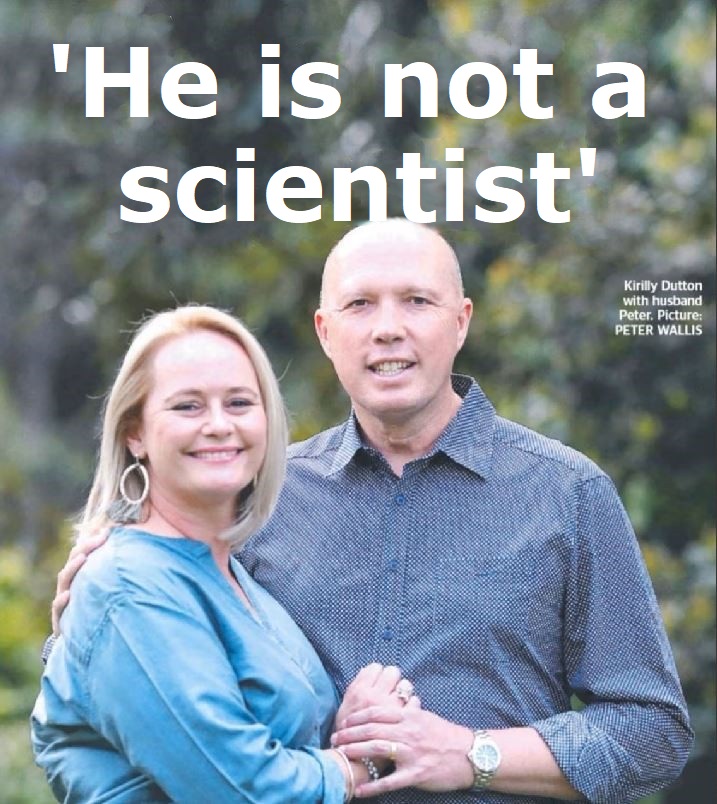
The Australian arm of Rupert Murdoch's (b 1931) media empire has become essentially the propaganda unit of the Liberal Party of Australia.  In 2018 Brisbane’s Murdoch-owned Courier-Mail (known to sceptical locals as the “Curious Snail”) was able to run a gushing puff-piece on Mr Dutton, headed (left) by a statement from his wife Kirilly (b 1974): “He is not a monster.”  People might give him the benefit of the doubt on that one but the Courier-Mail has never been able to run the one on the right because neither Mr Dutton or his wife have ever denied he’s a Freemason.

Whether the Courier Mail will be tempted to run another advertorial under the heading “He is not a scientist” is doubtful but if it does it won't be fake news.

During the televised leaders' debate with Anthony Albanese (b 1963; prime-minister of Australia since 2022) on 16 April, 2025, Mr Dutton was asked whether climate change was making weather events more serious.  He agreed there was “an impact” but when asked if recent natural disasters were examples of climate change happening now, he responded: “I don’t know because I’m not a scientist”, adding he'd “let scientists pass that judgment”.  Conceptually, that’s not unreasonable and is way the most of us relate to stuff like number theory or quantum mechanics: we don’t “know” because we don’t have the background to understand but we “accept” the explanations of those who do understand.  That of course means accepting “facts” which one day turn out to be wrong because the history of science is a tale of disproving long-held orthodoxies but the approach does allow civilized life to unfold.  However, it’s believed Mr Dutton’s statement reflects more a need to pander to his constituency of climate change deniers who variously (with some multi-membership) are (1) those with a vested financial interest in the fossil fuel industry, (2) right wing fanatics and (3) pig-ignorant.  Demonstrating some intellectual flexibility, Mr Dutton doesn’t let his lack of scientific training prevent him from being an enthusiastic advocate of nuclear power generation.

Never denied: A depiction of Peter Dutton in the regalia of a Freemason Grand Master (digitally altered image).  Note the ceremonial apron being worn underneath jacket, a style almost unique to The Ancient and Accepted Scottish Rite of Freemasonry.

The arrival of political parties called “Liberal Party” & “Conservative Party” (often with modifiers (Liberal Democrats, Liberal Movement etc) created the need for labels which distinguish between the “liberal” and “conservative” factions within each: while all members of a Liberal Party are “big L Liberals” some will be “small c conservatives” and some “small l liberals” which sounds a clumsy was of putting things but it’s well-understood.  Some though noted there were sometimes more similarities than differences, the US writer Ambrose Bierce (1842-circa 1914) in an entry in his Devil's Dictionary (1911) recording: "Conservative (noun), a statesman who is enamored of existing evils, as distinguished from the Liberal, who wishes to replace them with others."  These days, he might be called a cynical structuralist.  Bierce, a US Civil War (1861-1865) veteran, never lost his sense of adventure and, aged 71, vanished without a trace in one of the great mysteries in American literary history.  The consensus was he probably was shot dead in Mexico and in one of his last letters there’s a hint he regarded such as fat as just an occupational hazard: “Good-bye. If you hear of my being stood up against a Mexican stone wall and shot to rags, please know that I think it is a pretty good way to depart this life.  It beats old age, disease, or falling down the cellar stairs. To be a Gringo in Mexico--ah, that is euthanasia!”

So, “liberal” being somewhat contested, while the comparative was “more liberal” and the superlative “most liberal”, modified forms appeared including anti-liberal, half-liberal, non-liberal, over-liberal, pre-liberal, pseudo-liberal, quasi-liberal, semi-liberal, uber-liberal, ultra-liberal, arch-liberal, classical-liberal, neoclassical-liberal and, of course, liberal-liberal & conservative-liberal.  In modern use there have been linguistic innovations including latte-liberal (the sort of “middle class” liberal who, stereotypically, orders complicated forms of coffee at the cafés & coffee shops in up-market suburbs, the term very much in the vein of “Bollinger Bolshevik” or “champagne socialist”.  A latte liberal is a variation of the earlier wishy-washy liberal (someone who will express fashionable, liberal views but will not deign to lift a finger to further their cause) with the additional implication they are of the middle class and committed only to the point of "virtue signaling".  The portmanteau word milliberal (the construct being mil(ennial) +‎ liberal is a liberal of the millennial generation (those born between 1981-1986).  The term boba-liberal comes from internet-based (notably X, formerly known as Twitter) political discourse (mostly in the US it seems) and is a slur describing a liberal-leaning Asian American with politics or attitudes considered too tepid or whitewashed by other Asian Americans, stereotyped as focusing on superficial gestures over more meaningful actions especially in regards to Asian American activism.  Those who comment on stories on Fox News have also contributed to the lexicon, the portmanteau libtard (the construct being lib(eral) + (re)tard) and the meaning self explanatory, as it is for NazLib, the construct being Naz(i) + Lib(eral).  So, especially in the US, “liberal” is a word which must be handled with care, to some a mere descriptor, to some a compliment and to others an insult.  While there are markers which may indicate which approach to adopt (is one's interlocutor carrying a gun, driving a large pick-up truck, listening to country & western music etc), none are wholly reliable and probably the best way is to work into the conversation a “litmus paper” phrase like “liberal gun laws”.  From the reaction, one's path will be clear.

But although there are some for who it seems a calling, being a liberal is not in the DNA and there have been some who became conservative, just as there are conservatives who converted to liberalism.  Indeed, were the views of many to be assessed, it’d like be found they are various to some degree liberal on some issues and conservative on others, a phenomenon political scientists call “cross-cutting cleavages”.  Political journeys are common and may be endemic to one’s aging (and certainly financial) path, there being many youthful anarchists, socialists and nihilists who have ended up around the boardroom table, very interested in preserving the existing system.  The path from liberalism can also be a thing of blatant opportunism.  It is no criticism of Donald Trump (b 1946; US president 2017-2021) that he re-invented himself as an anti-liberal because that was the way to become POTUS (president of the United States), despite for decades his stated positions on many social issues revealing his liberal instincts.  It’s just the way politics is done.  It’s also the way business is done and it was unfortunate Rupert Murdoch (b 1931) elected to settle in the matter of Dominion Voting Systems v. Fox News to ensure no more of Fox’s internal documents entered the public domain.  Those which did appear were interesting in that far from Fox’s anti-liberal stance being Mr Murdoch’s ideological crusade, it was more the path to profit and were Fox’s audience to transform into something liberal, there would go Fox News.

Once was liberal: Candace Owens Farmer (née Owens and usually styled “Candace Owens”; b 1989) with "Candace Coffee Mug", one item in a range of Candace merchandise.

Because race remains the central fault-line in US politics, political cartoonists and commentators have never been prepared to have as much fun with the black conservatives as they enjoyed with “gay Republicans”, the latter a breed thought close to non-existent as late as the 1980s.  Black conservatism is to some extent aligned with black Christian religiosity but it’s a creature also of that under-reported demographic, the successful, black middle class, a diverse group but one which appears to have much in common with the priorities of their white counterparts.  In that sense Candace Owens is not wholly typical but she is much more entertaining and here early political consciousness was as a self-declared (though apparently retrospectively) liberal before moving to a nominally conservative stance although whether this was an ideological shift or a pursuit of clicks on the internet (on the model Mr Murdoch values to maximize revenue from Fox News) isn’t clear.  What is clear is Ms Owens knows about the Freemasons, her research into the cult beginning apparently when she “freaked out” after learning Buzz Aldrin (b 1930; who in 1969 was the second man to set foot on the Moon) is a confessed Freemason.  On 30 September, 2024, she discussed the Freemasons on her YouTube channel:

What is Freemasonry?  OK, so during the late Middle Ages, the world was united under the holy Roman Catholic church.  OK?  So if you had any opposition to the church throughout Europe, you were forced to go underground.  Right?  We were a Christian society.  And among the only organized groups that were able to move freely throughout Europe were these guilds of stonemasons, and they would then be, therefore, because they could move freely, hence, Freemasons.  They were able to maintain the meeting halls or lodges in virtually every major city, and the Masons were, essentially, very talented at architecture, and they had a bunch of secret knowledge — sometimes secret knowledge of architecture and of other topics.  And that knowledge was dated back to the times of Egypt. Right?  And it was essential maintaining this knowledge in the construction of European churches and cathedrals.

So one of the things that is well known is that Freemasons were in opposition to the church.  Right? They wanted to crush the church, which is why it is not ironic that the person who founded the Mormon church, as just one example — many of the churches, the very many Protestant faiths that we have — was Joseph Smith and he was a Freemason.  That's a fact, just as one example. Now, you may know some people that are Freemasons and you're going, well, I know this person and he goes to a lodge and he's completely harmless.  Yes. It is a known thing that 97 — like, something like 97% of Freemasons are not in the top tier degree of Freemasonry.  And it is understood that at the top tier degree of Freemasonry, you essentially become one of the makers of the world.

So I'm — just for those of you guys who've never even heard of that, and like I said, I would have been among you. I'm very new to relearning American history through the lens of Freemasonry. Some known Freemasons — George Washington was a Freemason, Thomas Jefferson was a Freemason, Benjamin Franklin was a Freemason, Buzz Aldrin was a Freemason — don't get me started. For those of you that have been listening to this podcast for a long time, you already know where I'm at — or where I'm at when it comes to NASA and the weird satanic chants that they were doing to establish the Apollo program and all the weird stuff that happened leading up to the moon landing. So I freaked out when I learned Buzz Aldrin was a Freemason.  It's not helping my case in believing those moon landings, I'll tell you that for free.  Franklin Roosevelt was another Freemason.

They're even on the moon: Autographed publicity photo of confessed Freemason Buzz Aldrin issued by NASA (National Aeronautics and Space Administration) prior to the Apollo 11 Moon mission (16-24 July 1969).

Most have concluded Mr Aldrin secretly would have left on the surface of the moon some sort of Masonic symbol or icon.  Of the other eleven men to have walked on the moon, only Apollo 15's James Irwin (1930–1991) and Apollo 16's John Young (1930–2018) are known to have been confessed Freemasons but so secretive is the cult there could be others.  As a footnote, as a member of New Jersey's Montclair Lodge No. 144 which is associated with the Scottish Rite, Mr Aldrin presumably would have worn his apron underneath his jacket, something unique to the Scottish tradition. 

Whether Ms Owens changed her views on matters Masonic after hearing Mr Aldrin had endorsed Mr Trump isn’t known but he issued an unambiguous statement of support, sentiments with which presumably she’d concur.  The former astronaut was especially impressed the Republican candidate had indicated in a second term he would elevate space exploration as a “policy of high importance again” and that his first administration had “reignited national efforts to get back to the Moon and push on to Mars.”  Beyond that, Mr Aldrin noted: “The Presidency requires clarity in judgement, decisiveness, and calm under pressure that few have a natural ability to manage, or the life experience to successfully undertake. It is a job where decisions are made that routinely involve American lives – some urgently but not without thought.  For me, for the future of our country, to meet enormous challenges, and for the proven policy accomplishments above, I believe we are best served by voting for former President Trump. I wholeheartedly endorse him for President of the United States. Godspeed President Trump, and God Bless the United States of America.”  Masonic votes having the same value as any other, Mr Trump welcomed the support.

They're everywhere: Confessed Freemason Most Worshipful Brother Harry S. Truman (1884–1972; US president 1945-1953) in Masonic regalia including Worshipful Master collar and apron (over jacket) with Provincial Honours.  Although he served as US president or vice president for eight years, Truman later wrote: “The greatest honor that has ever come to me, and that can ever come to me in my life, is to be Grand Master of Masons in Missouri.”

Masonic aprons are obligatory wear for any Mason when in a lodge or temple and they’re worn always on the outside except in Scotland where the tradition is for them to sit under the jacket.  Like much else in the cult of Freemasonry, the apron is a symbol of a mason’s place in the hierarchy (as codified a system as the precedence afforded to the orders of knighthood in the UK's imperial honors) and although variations exist, there are essentially five layers of apron-wear:

(1) Enterered Apprentice: The apron of an entered apprentice is plain white to symbolise purity and innocence and usually made of lamb's leather.

(2) Fellow Craft: The Fellowcraft apron has the same white background as that of the Enterered Apprentice except for the addition of two blue rosettes.  Despite much research and speculation, it’s not known why the color blue is used.

(3) Master Mason: The decoration on a Master Mason’s apron is much more elaborate and is recognizably Masonic in a way the simpler constructions are not.  Because many Master Masons elect not to progress to the status of Worshipful Master, for many this will be the apron they wear for their entire Masonic career.

(4) Worshipful Master: The only change to the apron when one enters the chair as Worshipful Master is the blue rosettes are replaced by three levels.  The symbols are distinctive so the wearer instantly is recognizable as being a present or past Worshipful Master of a Lodge.

(5) Provincial Honours: Once a mason has gone through the chair and become Worshipful Master, his title changes from Brother to Worshipful Brother.  As the years pass, he may be granted Provincial honours and his apron will then be changed from light blue to dark blue with gold braid.

Knowing masons are everywhere among us, Ms Owens had been scheduled to speak at a number of engagements in Australia  & New Zealand but interestingly, in October 2024, the Australian government issued a press statement confirming her visa had been "canceled", based on her "capacity to incite discord", leading immediately to suspicions her silencing had been engineered by the Freemasons.  It’s good we have Ms Owens to warn us about liberals and the Freemasons, an axis of evil neglected by political scientists who tend often to take a structralist approach to the landmarks in the evolution of the use of the term “liberal” which they classify thus:

(1) Classical Liberalism which emerged in the seventeenth & eighteenth centuries, was rooted in the ideas of the Enlightenment with an emphasis on limited government, a free market (ideas as well as goods & services), individual liberty, freedom of speech, the rule of law and the enforcement of private property rights.  The movement was a reaction to absolute monarchies and state-dominated mercantilist economies.

(2) Social Liberalism (understood as “liberal” in modern US use) was a layer of rather than a fork off classical liberalism but it did accept a greater role for the state in regulating the economy and providing social welfare to ensure a fairer distribution of wealth and opportunity.  It was a nineteenth century development to address the excesses of “unbridled” capitalism” and its critique of economic inequality was remarkably similar to that familiar in the twenty-first century.

(3) Neoliberalism as a term first appeared in the late 1950s but in the familiar modern sense it was defined in the era of Ronald Reagan (1911-2004; US president 1981-1989) & Margaret Thatcher (1925–2013; UK prime-minister 1979-1990) who embarked on project built around a philosophy which afforded primacy to free markets, deregulation, privatization and a reduction in government spending, often combined with globalization.  Their program simultaneously to restrict the money supply while driving up asset prices had implications which wouldn’t be understood for some decades.  The Reagan-Thatcher neoliberal project was a reaction to the post oil-crisis stagflation (a portmanteau word, the construct being stag(nation) + (in)flation)) and the alleged failure of the welfare state & the orthodoxy of Keynesian economics, named after English economist and philosopher John Maynard Keynes (later Lord Keynes) 1883-1946).

(4) Political Liberalism was most famously articulated by US philosopher John Rawls (1921–2002) in his book A Theory of Justice (1971), a work nobody much under forty should attempt because few younger than that would have read enough fully to understand the intricacies.  In summary, it does sound remarkably simple because it calls for a pluralist society built on principles of justice and fairness, administered by a system of governance which permits a diversity of viewpoints while maintaining a fair structure of cooperation.  Rawls’ political liberalism draws one in to what soon becomes and intellectual labyrinth; once in, it’s hard to get out but it’s a nice place to spend some time and most rewarding if one can maintain the same train of thought for several weeks.

(5) Cultural Liberalism is not new but from the mid-twentieth century, its range of application expanded as previously oppressed groups began to enjoy a recognition of their rights, initially usually as a result of a change in societal attitudes and later, by a codification of their status in law, the matters addressed including ethnicity, feminism, civil liberties, reproductive rights, religion and the concerns of the LGBTQQIAAOP community.

(6) Liberal Internationalism is an approach to foreign policy (really a formal doctrine in some countries) advocating global cooperation, international institutions, human rights, and the promotion of democracy.  Its core tenants included support for multilateralism, international organizations like the United Nations (UN), global trade and the promotion of liberal democratic governance worldwide.  What is called the “liberal world order” has underpinned the western world since 1945 but its dominance is now being challenged by other systems which have their own methods of operation.